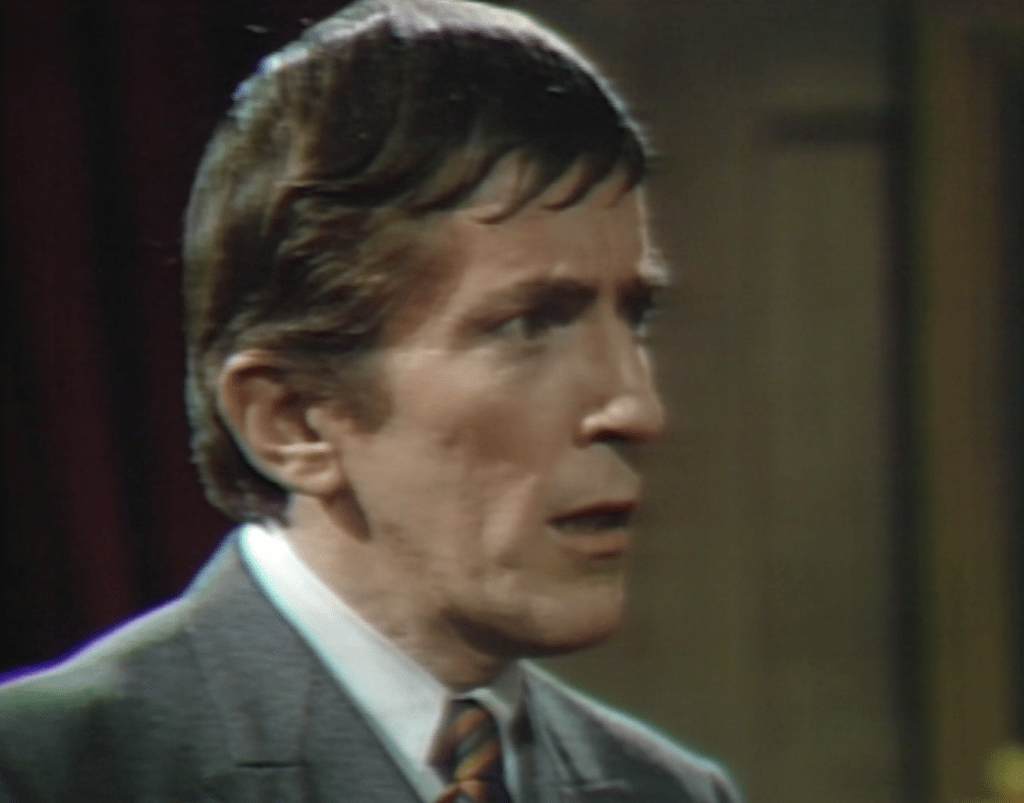
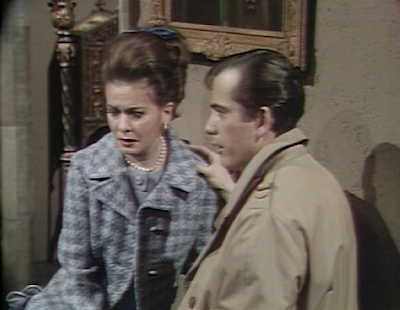
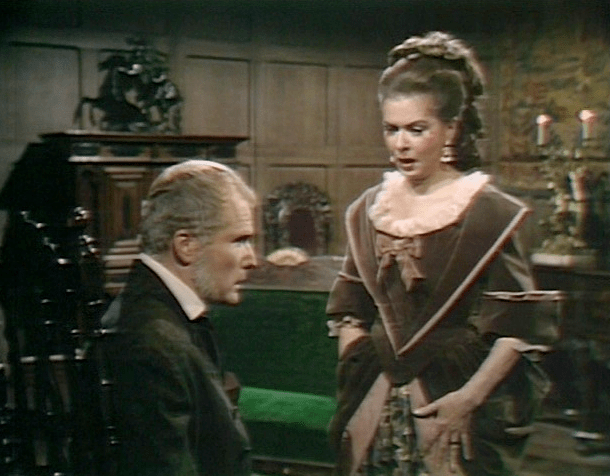
Episode 1095: Elizabeth Collins Stoddard

I first started watching Dark Shadows in the 1990s, when what was then The Sci Fi Channel was showing it Monday through Friday at 10:00 and 10:30 AM. I got into the habit of daily viewing when they were showing episodes from the summer of 1967, when the ghost of nine year old Sarah Collins was occasionally dropping in on strange and troubled boy David Collins. Sarah’s brother, vampire Barnabas, was thinking he might want to kill David, and David’s aunt, matriarch Elizabeth Collins Stoddard, was a blocking figure who refused to engage with any evidence that anything unusual was going on.

In those days, it appeared that if Barnabas got his way the estate of Collinwood would be peopled only by the unquiet spirits of the dead. I imagined how that might have played out, if the show were not an open-ended serial but were allowed to come to an end. I pictured the great house in ruins. Well-meaning governess Victoria Winters and her boyfriend, hopeless schlub Burke Devlin, would venture into the wreckage. Vicki and Burke would dodge phantoms and demons and make their way into the drawing room. There, they would find Liz sitting serenely while leathery-winged fiends flutter about her head. Vicki would plead with Liz to escape with them. Liz would only smile at her and say that nothing is wrong, nothing at all. Seeing that Liz had taken her commitment to denial as a way of life to its ultimate extreme, Vicki and Burke would have no alternative but to leave without her.

The makers of the show have acknowledged that Barnabas’ plan would have left Collinwood entirely uninhabitable. They did that in the feature film House of Dark Shadows, which replays the story that led to the summer of 1967 and takes it to that conclusion. And they are doing it again now.

Vicki has long since left the show, replaced as the audience point of view character by mad scientist Julia Hoffman. Julia tried to cure Barnabas of his vampirism in 1967; in 1968, she completed a procedure devised by a fellow mad scientist that did put the symptoms of his curse into abeyance. Barnabas has since bungled his way into another vampire curse, but his connection to Julia still makes it possible for him to be a permanent part of the cast of characters and, on balance, a defender of the status quo, which in a genre where the most important thing is that there is still a story left to tell in the next episode is the closest thing there is to a hero. As such, he is the successor to Burke, who was supposed to be a dashing action hero when Dark Shadows started.

In July 1970, Barnabas and Julia came unstuck in time and found themselves in the far-off future year 1995. There, the great house of Collinwood was in ruins, its residents either dead, missing, or insane as the result of a mysterious disaster that took place before 1970 was out. The estate was dominated by malevolent ghosts, and the people of the village of Collinsport dared not even speak of the place, let alone visit it. Since Julia and Barnabas returned to 1970 in #1071, they have been trying to figure out what the disaster will be and to prevent it.

At first, Liz was somewhat sympathetic to Barnabas and Julia’s efforts, as befits the several times in 1969 and early 1970 we saw her admit that uncanny events were taking place around her. But her old commitment to denial came back to the surface when she forbade Julia and Barnabas to talk with David or teenage houseguest Hallie Stokes about what they had seen in 1995, even though Hallie and David are clearly central to the upcoming disaster. Because they cannot talk with the teens, Barnabas and Julia have not been able to do anything to prevent the ghosts from encroaching on them and taking an ever stronger position in the house.

In #1088, Liz finally realized what was going on and ran to find Julia, crying that they would have to get David and Hallie out of the house before the ghosts got hold of them. But it was too late. She found herself looking into the face of the haunting, an evil spirit known as Gerard. By the time Julia caught up to her in #1089, Liz was entirely under the power of Gerard, and placidly refused to accept that anything out of the ordinary was going on.

Hints have been mounting that the disaster will occur soon. Today, Julia and Barnabas tell Liz that it is urgent Hallie and David be taken from the house at once. Liz refuses, telling them that when the night ends with no further disturbances they will have to admit that all of their fears are simply a “ridiculous fantasy.”

For their part, David and Hallie have been spending a lot of time the last few weeks sitting around moaning about how helpless they are. That does not make for gripping television, even when they look at a dollhouse and say they think the ghosts have been playing with the dolls when they weren’t looking. David gets an idea. The dolls in the ghosts’ dollhouse have connections with particular people around the estate, so if he and Hallie make a doll of Barnabas, perhaps that will cause Barnabas to be aware of what the ghosts are doing.

Hallie asks David why he wants to alert Barnabas in particular. He says that if anyone can fight Gerard and the other ghosts, it will be Barnabas, because “He’s… different.” In the summer and fall of 1967, David was the one person at Collinwood who was on track to figure out Barnabas’ secret, leading the show into a blind alley from which it escaped by going back in time to the year 1795. When they returned from that first costume drama insert in March 1968, David was for some reason no longer a threat to Barnabas. But he was still conscious about his distant cousin in ways his Aunt Liz would never countenance. So in #660, David told his friend Amy Jennings that “Barnabas knows a lot of things that he doesn’t tell anybody.”

The doll is not particularly realistic; the spirit world doesn’t require very high production values, and Hallie and David are under severe time constraints. So their Barnabas doll is adorably crude. I’m thinking of making it my PFP, replacing the tailor’s dummy known as “Mr Juggins” that I’ve been using since David and Amy showed him to Liz in #681.
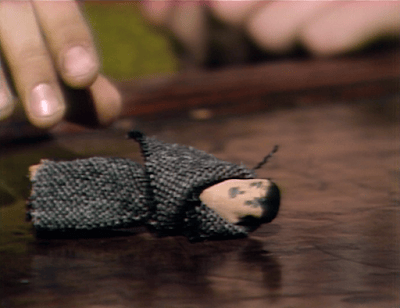
Looks more like Jonathan Frid than does the Barnabas from the Gold Key comics. Screenshot by Dark Shadows Before I Die.

Regular viewers know that David’s instincts are sound. Barnabas and Julia confronted Gerard in the room where the dollhouse is in #1070. Gerard was powerless against Barnabas. Something might have come of that, but Gerard then turned his attention to Julia, causing her to become very ill and forcing them to retreat. After they have put the doll in the dollhouse, David and Hallie leave the room for a little while. When they return, the Barnabas doll has been thrown from the dollhouse and destroyed, suggesting that Gerard did indeed see a danger in its presence.

Finally, Julia and Barnabas manage to corner Liz and force her to let them take Hallie and David away. After they leave her, Liz shuts herself up in the drawing room and apologizes to the unseen Gerard. She says she could not think of any way to resist them further.
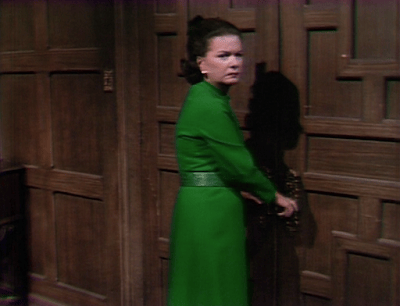
Liz, defeated. Screenshot by Dark Shadows Before I Die.

This admission of defeat is the next to last time we will see Liz. She will appear again in one scene twenty and a half weeks from now, in #1198, in which she will simply serve to confirm that things are back to normal. Moreover, that version of Liz appears in a Collinwood where none of the events we have seen over the last several months has taken place; we have no idea what her character development has been. This is the final appearance of the person we have been watching since episode #1.

When Dark Shadows began, Joan Bennett was its biggest ratings draw and Liz was the most powerful character. Her function as Keeper of the Secrets set her on the path that would lead her towards extreme denialism and away from any active role on the story, but along the way Bennett used her great talents to give the show’s foundations their basic outline. For example, in the relationship between Liz and her brother, high-born ne’er-do-well Roger Collins, Bennett and Louis Edmonds pioneered the dynamic of Bossy Big Sister and Bratty Little Brother, the same dynamic that makes Barnabas and Julia so much fun to watch and that turned Quentin Collins into a breakout hit in 1969 when we saw him with his Bossy Big Sister, Judith (also played by Joan Bennett.) In her other roles, Bennett will continue to be indispensable to the show, but those of us who started with #1 will never stop wishing the writers had found more to do with the character of Liz.
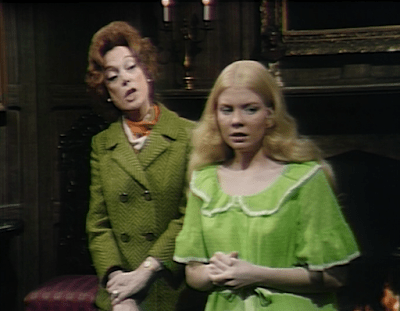
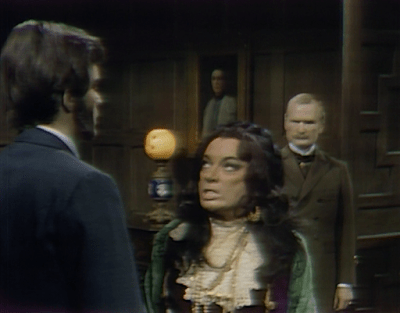
Episode 1071: The incredible part of our story

Quentin Collins comes to the drawing room of the great house of Collinwood to deliver some bad news to his distant cousin, Elizabeth Collins Stoddard. He was peering into the room in the east wing of the house through which an alternate universe is occasionally visible. He saw the room as it is in that other timeline, engulfed in smoke and occupied by a young woman calling the name “Barnabas.” Since Liz and Quentin’s distant cousin, Barnabas Collins, and Barnabas’ dear friend Julia Hoffman crossed over into the alternate universe some time ago and the aperture in the east wing is the only place where transits between the universes are known to be possible, Quentin proclaims to Liz that the “only conclusion” one can reach is that “we shall never see them again!” No sooner has he got those words out than the drawing room doors open to reveal Julia and Barnabas standing side by side, smiling happily, and saying “Elizabeth! Quentin! We’ve returned!”

One might think this would cure Quentin of the idea that he knows what the “only conclusion” is at which one might reasonably arrive, but no such luck. He tells Barnabas and Julia that today’s date is 3 August 1970. They say that was the date when they left the other universe, and that they then spent over a week in the year 1995, when they saw a bleak and horrifying future that resulted from a disaster that will occur later in 1970 unless they can somehow prevent it. Quentin says their experience in the future must have been an hallucination, because they can’t have come back to 3 August in one year from any date other than 3 August in another year. Julia and Barnabas share detailed recollections of their experience in the future, and have already met a living person in 1970 whom they saw for the first time as a ghost in 1995, but this argument shakes their confidence.

Quentin’s claim, nonsensical as it is to new viewers, actually does fit in with a notion the show has been developing since it first committed to being a supernatural thriller in late 1966 and early 1967. Since the laws of nature that science studies do not apply, they have to find other predictive models that will make it possible to build suspense. So they had well-meaning governess Victoria Winters figure out that women named Laura Murdoch incinerated their young sons named David at intervals of “exactly one hundred years!!!,” and therefore that Laura Murdoch Collins would soon present a mortal danger to her young son David Collins.

From that point on, the power of anniversaries has been a tremendously potent force in the metaphysics of Dark Shadows. Barnabas traveled back to the 1790s in #661 by going to a grave on the anniversary of its occupant’s death and shouting at the deceased for a while (shouting is also a potent metaphysical force.) Quentin himself first joined the cast of characters as the malevolent ghost of a man who died in 1897 and in 1968 and 1969 returned to haunt Collinwood, kill several people, and drive the survivors from the house. Barnabas traveled back to 1897 and bungled around until someone else changed history to prevent Quentin dying or even aging. On the anniversary of that change, the haunting broke, just in time to allow David to return from the dead. But when Quentin showed up as a living being late in 1969, everyone who had lived through the ten months of the haunting remembered it. So apparently the reality of Dark Shadows is a composite of all the various, mutually inconsistent timelines, and the consequences of the actions not taken are just as real as are those of the ones taken. The power of anniversaries is the thread that binds these unmatched events into a cosmic crazy quilt.

As the aperture between universes was a door to a room in the east wing, so the aperture from 1995 to 1970 was a door inside a room in the west wing. Barnabas and Julia were trapped in a mysterious playroom there when the ghost of a blonde teenager known to them as Carrie appeared, beckoned to them, and walked through the wall. A moment later, a door materialized in the spot through which Carrie had exited. Julia and Barnabas went through the door and found themselves on a staircase. They followed the staircase to another door. It was the door through which they had entered the playroom, but the corridor outside was in good repair, not in ruins as it was in 1995. They saw a girl there who appeared to be Carrie, though she was wearing different clothes, was alive, and demanded to know who they were.

Barnabas and Julia gave the girl their thanks for her help, and she repeated that she had no idea who they were or what they were talking about. She said that she was not named Carrie, but Hallie, Hallie Stokes, niece of Professor Timothy Eliot Stokes. She told them Liz was in the drawing room, Liz’ brother Roger was in Europe, and the year was 1970.

Later, Julia questions Hallie about some names and phrases she heard in 1995. Grayson Hall delivers all of these questions as if she were playing a Gestapo interrogator in a very bad World War Two movie. Even when Hallie says it is her bedtime, Hall enunciates the lines “All right, Hallie. Good night” while standing rigidly still and peering at the girl from under a single ruffled eyelid, as if the next words were going to be “Dream uff ze Fazzerlahnt, und uff ze famlee you shtill haff zere!”

Hallie is terrified of Julia, a perfectly natural reaction which Grayson Hall seems to think she needed to explain by turning into a villain from Hogan’s Heroes. Screenshot by Dark Shadows Before I Die.

The script calls for Hallie to hear something sinister in Julia’s voice, and Hall was an extraordinarily accomplished actress who should easily have been able to make us understand why a friendly series of questions might sound that way to a nervous person. This exaggerated performance cannot be explained as an ordinary failure. She also failed atypically last week when required to show that Julia was secretly under the control of the evil spirit. There was zero subtlety in her performance, leaving it inexplicable that Barnabas didn’t instantly catch on. Those episodes, like this one, were directed by Henry Kaplan, a hack. Kaplan’s idea of working with actors involved poking them with a stick and tying them up with gaffer tape. Hall’s misfires may not have been a protest against Kaplan’s brutishness and incompetence, but he certainly did not do anything to help her correct them.

When Julia and Barnabas left for the alternate universe, Quentin was still living somewhere in the village of Collinsport; it was implied Julia was paying his rent. At some point since, he has relocated to the great house. We see today that he has moved back into his old room. This is as hilarious for longtime viewers as was the instant refutation of Quentin’s claim that the only logical conclusion from the available facts is that they will never see Barnabas and Julia again. During the 1968-1969 “Haunting of Collinwood” segment, Quentin’s room served the same function the mysterious playroom served in the excursion to 1995 and in this incipient Re-Haunting of Collinwood. It was a place known at first only to the children, who visited it, fell under the power of the ghosts of its former occupants, and thereby became the instruments of general destruction. But he’s even brought his old stuff with him, including his haunted phonograph.

When we got to know Quentin as a living being during the eight months the show was set primarily in 1897, we saw that he had the same vices and the same appeal Roger had when he was introduced as a villain at the beginning of the series. Roger was eventually nerfed into a harmless snob who made sarcastic remarks and sipped brandy, and then reinvented again as an upright family man. Throughout those personality shifts, Roger continued to be one of the “Logical Explanation People.” No matter what he saw or experienced, he would reject any supernatural account and insist “There must be a logical explanation!” Quentin has followed Roger’s character progression to the point where he, a former student of black magic who conjured up demons from a fireplace, who turned into a zombie the first time he died and into a werewolf after he was resurrected, who died again and became a ghost, whose second death was then averted when he became half of a magical dyad including an enchanted oil painting, and who is now a hundred years old even though to all outward appearances he is about 30, is insisting that There Must Be a Logical Explanation.

As if that were not enough, when we see Quentin in his room he is wearing a dressing gown, an article of attire Roger favored in his first months on the show. Roger drifted to the margins of the action as he lost his capacity for villainy; he made his final appearance in #979. The show has had so much difficulty figuring out what to do with Quentin since it returned from 1897 that we may well fear he is headed for the same fate, and these resonances do nothing to assuage that fear.

Hallie comes in to see Quentin. She asks if Barnabas and Julia are good people. He hesitates to answer. He knows that Barnabas is a vampire and Julia is a mad scientist. Nonetheless, they are his friends, and he believes that they are motivated by a sincere desire to prevent the disasters they think they have foreseen. So he might answer truthfully by saying that they are locked in a three-way tie with him for the title of Most Dangerous Person You Have Ever Met, but that he likes them, and so long as Barnabas doesn’t start looking at her neck and Julia doesn’t try to strap her to a table and hook her up to an apparatus including Tesla coils she will probably survive her encounter with them. But he’s more interested in reassuring her than he is in adhering to strict literal accuracy, and so he says “Now look, now you listen to me. Barnabas and Julia are very fine people, and you don’t have to be afraid of them or of anything else. Now you believe that.” None of the other actors is having a good day at the office with this episode, but David Selby is on top form, and he delivers this little speech with a note of urgency that makes him sound like he is telling the truth, but with a panicked flicker in his eyes that makes it clear he is desperate for Hallie to accept a lie that might keep Julia and Barnabas from murdering her.

Hallie tells Quentin that she saw Barnabas and Julia emerge from a door in the west wing. He calls Barnabas to his room and tells him that since the aperture to the other universe is in the east wing, that causes Quentin to think there might be something to their story after all. Barnabas leads him to the door, and says that the playroom was behind it in 1995. Quentin says that there is no playroom there and never has been. Barnabas himself knew that full well when first he opened the door and saw the room in 1995, but for some reason is shocked today when sees that it is a linen closet. Quentin says that there cannot possibly ever be a playroom there, since the other wall is to the outside. Evidently it is perfectly in order for an entire alternate universe to intermittently fit into a room in the east wing, but the west wing doesn’t swing that way.

In his post about the episode on his great Dark Shadows Every Day, Danny Horn complains about Kathleen Cody’s performance as Hallie, claiming that she renders the next several weeks of the show unwatchable. I agree that in adopting a constant tone of freaked-out disbelief, Miss Cody made an acting choice that left her nowhere to go. If you’re already at the limit of the amount of bizarreness you can accept in your life, that’s it for you as a character on Dark Shadows.

I can see why Miss Cody thought that was the only way to go, though. This is her first substantive appearance on the show, and Quentin warns Barnabas not to tell anything disturbing to Hallie, because “She’s a very sensitive child… She frightens quite easily.” Everything else in the script reinforces the idea that Hallie is on the brink of a panic attack, so that’s how she plays it today. That’s the angle subsequent scripts are going to stick with, so I can see that Miss Cody felt she had no choice but to stay in the corner she had painted herself into.

When actors find themselves in a jam like that, a director might be expected to offer some kind of helpful guidance. That wasn’t going to happen with Henry Kaplan at the helm, and even principal director Lela Swift, an outstanding visual artist, was not an enthusiastic director of actors. John Karlen said that the only direction Lela Swift ever gave him was the single word “Go!” So once an actor took a wrong turn on Dark Shadows, they could find themselves trapped in a dead end. Many of the cast members who joined the show without much experience have spoken with gratitude about guidance they received from their veteran cast-mates; Karlen, Joan Bennett, Jonathan Frid, Clarice Blackburn, and Humbert Allen Astredo are most often mentioned as gifted teachers of acting. The only director any of the actors mentioned as a source of productive suggestions was John Sedwick, who left the show in June 1968. So unless Miss Cody could get some help from one of her cast-mates, it was very likely that her initial mistakes would doom her whole performance.

Episode 748: Here in the past

Madwoman Jenny Collins is hiding in the quarters of her formerly devoted servant, Beth. Beth enters with Jenny’s estranged husband, libertine Quentin. Jenny eavesdrops as Beth tearfully tells Quentin that she was once very close to Jenny, but that now she wishes her ill, because she is in love with him. Quentin and Beth embrace, and Jenny lunges at them with a kitchen knife.

Quentin disarms Jenny and strangles her. We were introduced to Quentin as a murderous ghost haunting the great house of Collinwood in 1969, and when we first came to the year 1897 to meet him as a living being it was a matter of minutes before he was squeezing his grandmother’s throat and threatening to kill her. Quentin has been going around the house announcing for days and days that he plans to kill Jenny, so it comes as no surprise to the audience that he puts his hands around her neck even though she has already been disarmed, fights off Beth’s attempts to stop him, and keeps choking Jenny until some time after she has stopped moving. We have been well-prepared for this unambiguous image of intentional homicide.

Once Quentin has finished his work, he runs out of the room. Beth goes to the foyer and, between sobs, tells Quentin’s stuffy brother Edward that Jenny is in her room, dead.

In Beth’s room, Edward feels Jenny’s wrist and says that she is indeed dead. Once Beth has given him a few of the salient details of the murder, he declares that he has heard enough. He orders Beth to take the knife back to the kitchen and put it where it belongs. They talk briefly about Jenny and Quentin’s children, whose existence has previously only been hinted to the audience and has been denied to other characters as recently as yesterday.

We cut to the foyer. Quentin comes creeping down the stairs, holding a bag and looking from side to side. When Quentin reaches the foot of the stairs, Edward seizes the bag and orders him to stay in the house. In the drawing room, Edward tells Quentin and Beth what story they will put about to cover up the murder and save the family name. Beth is to say that she found Jenny lying at the foot of the stairs, stunned. She helped Jenny to her room, then left her there for a moment while she went to look for help. Finding no one, she came back and saw Jenny lying on the bed. When she could not wake her, she realized she had died of the injuries she sustained in her fall.

Quentin says that the story will not work. He tells Edward that earlier in the evening, Jenny’s presence at Collinwood was revealed to three more people, distant cousin Barnabas Collins and ethnic stereotypes Magda and Sandor Rákóczi. Edward says that as a member of the family, Barnabas will not question the story, and that as “Gypsies,” Sandor and Magda will do anything in return for money. Quentin says that Magda and Sandor will not be so easy to deal with. When they learned that Jenny was in the house, Magda told Quentin something which he tells Edward and Beth “None of us ever knew,” that Jenny was her sister.

Edward is thunderstruck, and exclaims “You married a Gypsy!” Yesterday it seemed that Edward and Quentin’s sister Judith, the owner of the house, had known Jenny’s origin for some time, and that it was why she locked Jenny up in the house when she went insane rather than sending her to a mental institution where Sandor and Magda might be among her visitors. And as far back as #701, it seemed likely that Beth knew secrets relating to Jenny, to Magda, and to Romani heritage. In that episode, Quentin marveled that Beth was still around Collinwood when Jenny, who had brought her to the house as her servant, had left, and Magda taunted Beth by bringing up a bit of Romani folklore and laughing “But you wouldn’t know anything about that, would you?” So while Jenny’s background is news to Quentin and Edward, it may not be true that “None of us” knew.

Magda and Sandor come to the house. On their previous visits to the great house, they have acted like servants or like stage Gypsies come to tell fortunes and sing songs. But now that the word is out about Jenny’s true identity, they come in with their heads up and look Edward in the eye. They say that they have come to see Jenny. Edward turns away from them, and says that there has been an accident. Jenny is dead. Horrified, Magda asks where she is. Edward says that she is in Beth’s room, and offers to have Beth show them the way. Magda says that she knows where it is, and that she and Sandor want to go by themselves. Edward says “Of course,” very much in the tone a gentleman uses with his equals.

In the room, Magda notices that Jenny is holding a button in her hand. She concludes that she pulled it off the coat of a man with whom she was fighting for her life. Sandor notices heavy bruising around her neck.

Meanwhile, Edward is drilling Beth and Quentin in the stories they are to tell. Beth recites the whole thing, and he tells her to remember every word. Quentin is less cooperative, but still seems to have learned his part. He tells them not to speak until they are spoken to.

Sandor and Magda enter. She asks some questions; Edward answers, and shows offense when she tries to direct them to Beth. Before he can proceed to the next act of the little drama he has prepared, letting first Beth and then Quentin corroborate his account with the stories he has given them, Magda looks at Quentin’s coat. She can see that a button is missing and that the ones that remain match the one she found in Jenny’s hand. She calls him a murderer, and says that the police will hear of it.

Edward says that Quentin might have lost the button anywhere at any time. He asks her what the authorities in the village of Collinsport would do if asked to choose between a Romani person’s word and that of a Collins. Magda drops the idea of going to the police, and tells Quentin that she will place a curse on him that will make him suffer as Jenny suffered, but that his suffering will not be subject to the release that death has brought Jenny. Quentin is terrified, Edward dismissive.

Magda tells Quentin she will curse him. Screenshot by Dark Shadows Before I Die.

From the very beginning, one of the main themes of Dark Shadows has been denial, the psychological defense mechanism. In this one, we see that denial is, among other things, the wish that time would stop moving forward. Quentin says that he is not going to go to jail for something he did not mean to do. He obviously did mean to kill Jenny, but he does not want to accept any of the consequences that follow from that act. He wants to be frozen in his comfortable, carefree life, without punishment from the law or vengeance from Magda. Edward wants the family name to be frozen in the lofty regard in which it was held before Quentin murdered Jenny.

For her part, when Magda tells Quentin it will not be possible for him to die, she is promising to give him and Edward what they want, but not in the way they want it. A curse is a way of freezing time. The suffering it brings persists, unchanged, from year to year. It cannot be explained, it cannot be escaped, it falls on one person after another whatever their deserts. Its only logic is to renew itself endlessly.

Episode 747: Triumphant life behind a locked door

Madwoman Jenny, estranged wife of libertine Quentin Collins, is on the loose again, and she is the object of a madcap search by Quentin’s sister, spinster Judith, his girlfriend, maidservant Beth, and his distant cousin, secret vampire Barnabas. Quentin makes two contributions to the process. The less important is to serve as the bait in a cockamamie trap Barnabas and Judith lay for Jenny. The more important is to keep up a running commentary mocking the other characters for the silliness of their activities.

The trap itself involves a moment of intentional humor. Barnabas has returned to the year 1897 to prevent Quentin becoming a ghost who will ruin things for everyone on the great estate of Collinwood in 1969. One of the things Quentin did in that year that terrified the characters and tried the patience of the audience was to cause the strains of a sickly little waltz continually to resound from the walls of the great house. When the show became a costume drama and we got to know the living Quentin, we found that he too played a gramophone record of that same tune incessantly, annoying all and sundry. The trap requires Quentin to play the recording over and again until Jenny hears it and comes. After it has been going for half an hour, Barnabas tells Quentin that the plan didn’t work and they should stop playing the waltz. Quentin asks “Are you tired of hearing this music?” Barnabas speaks for all of us when he replies “Frankly, yes.”

Not only is this a successful comedy, it also gives the cast an opportunity for some of their best dramatic acting. As Judith, Joan Bennett at one point stops, looks at Barnabas, and asks “Can we trust you? Really trust you?” She apologizes for the bluntness of that question, then admits that she has long been busy putting a prettier face on the Collins family than the dark secrets Barnabas has discovered make plausible. “I’m not really very trusting. I try to pretend we’re nicer than we really are.” In the parts of Dark Shadows set in the 1960s, Bennett plays matriarch Liz, whose whole personality is about denial and the pretense that the Collinses are nicer than they really are. Liz latched onto Barnabas as soon as she saw him, and refuses to see any evidence that he is not quite normal. Nor does she ever really face her own habits of concealment and their implications. In this little exchange, we see Bennett playing a character whose superficial similarities to Liz point up her profound differences from her.

“Can we trust you? Really trust you?”

Joan Bennett had one of the most distinguished careers of any American actress of the twentieth century. Terrayne Crawford stands at something of the opposite pole, and her performance as Beth leads most fans to declare that she is the weakest of all the members of the cast of the portion of Dark Shadows set in the year 1897. I don’t really disagree with that, but she is fine today. Miss Crawford’s great limitation was that she could play only one emotion at a time, and she was on the show in a period when the scripts gave every character complex motivations in almost every scene. But today, all Beth has to play is Anguish, and Miss Crawford does a fine job.

Beth took care of Jenny during the year Quentin was away from Collinwood, and became very close to her. In the nine and a half weeks since Quentin’s return, she has fallen in love with him. In a scene at the close of today’s episode, Beth tearfully admits to Quentin that she wishes something would happen to Jenny so that he would no longer have a wife. Beth collapses into Quentin’s arms. Jenny has been hiding in a corner, eavesdropping; she comes out, holding a knife. There have been occasions when we might have rooted for Jenny to succeed in killing Beth, just to spare us the embarrassment of Miss Crawford’s flat, tedious performances. But this time, we want to see more of her, and the prospect that Beth might die makes for an effective cliffhanger.

Episode 694: Enough tragedy in this house

For months, the evil ghost of Quentin Collins has been gaining strength, secretly manipulating children Amy Jennings and David Collins as he prepares to drive everyone from the great house of Collinwood so that he can have the place to himself. Now he has cast aside all secrecy and he openly menaces the adult residents of the house. Today, they give up and leave. Once they are all gone, Quentin stands on the walkway at the top of the staircase in the foyer and laughs heartily.

Collinwood belongs to matriarch Elizabeth Collins Stoddard. Liz’ brother Roger, David’s father, lives there as her guest. Up to this point, Liz and Roger have served primarily as blocking figures. Each is devoted to denial as a way of life. Occasionally a fact bursts upon them that is so enormous that one or the other of them has no choice but to face it for a little while. Usually they snap back into their characteristic mode of willful ignorance the moment the crisis is past, and even while it is going on the other responds by digging even deeper into the insistence that nothing is happening. When I first watched Dark Shadows, I could imagine the characters fleeing Collinwood one by one, then venturing back to get Liz and Roger, only to find them sitting serenely in the drawing room, assuring their would-be rescuers that everything was all right while leather-winged demons fluttered about their heads.

On Monday, Liz saw enough of Quentin’s power that she gave up her attitude of denial, apparently forever. Today, Roger does what we have been led to expect, and loudly declares that the whole issue is imaginary and that the other adults should be ashamed of themselves for encouraging the children to be afraid of ghosts. When the whole house starts to resound with the crepuscular tones of an old-timey waltz Quentin plays when he is exercising power, Roger declares that it is a trick the children are playing on them. The others go to pack their things while Roger stays in the drawing room.

Alone there, Roger sees Quentin materialize before him. On their way out, Liz and occult expert Timothy Eliot Stokes check the drawing room one last time, and find Roger sitting motionless in a chair. For a moment we wonder if he will fall over dead. He starts speaking, though, and admits that he was wrong. As they leave, Roger looks back into the house and shouts a defiant pledge to return. Apparently the makers of Dark Shadows have decided they no longer need two major characters whose primary function is to put the brakes on the action.

Roger reacts to the sight of Quentin. Screenshot by Dark Shadows Before I Die.

After everyone has gone, the camera pans across sets representing several rooms in the great house. This must have taken some doing. The foyer and drawing room were the only standing sets; the others were built as needed. The show was done live to tape, so these sets must all have been standing simultaneously. The studio was not very big at all. I wonder if they crammed some of these into space that was not generally used for action.

The walkway at the top of the foyer stairs is a commanding position, and the show has been sparing in its use of it. Quentin’s triumphant laugh is the first time we see a villain stand there and exult in his new position as Master of Collinwood. In the early days of the show, the dashing and enigmatic Burke Devlin threatened to take control of the house. He never came very close to doing that, but it could have been interesting to see him stand on the walkway, survey the foyer, and think about the day when the house would be his. For a long period in 1967, seagoing con man Jason McGuire was bossing Liz around; there were several days when he might have stood on the walkway, looked around with smug satisfaction, and chuckled.

Yesterday’s episode ended with the drapes in a bedroom in flames. That was a real fire, not a special effect, and you could see it spreading rapidly and putting out a lot of smoke. Having failed in that attempt to murder everyone in the building, the technical staff in today’s reprise of the sequence settles for lighting some gas burners behind a window dressing.

Episode 686: Curious so many hearts should stop in this house

When Dark Shadows began in June 1966, we were introduced to Roger Collins as a high-born ne’er-do-well with no sense of responsibility to anyone or anything. Roger had squandered his entire inheritance; his sister, reclusive matriarch Elizabeth Collins Stoddard, nearly bankrupted herself trying to buy up his half of the family business to keep it from falling into outside hands. Roger and his son, strange and troubled boy David, lived in Liz’ house as her guests. Roger drew a salary from the business, but barely pretended to do any work for it. He made absolutely no pretense of concern for David; on the contrary, he expressed his hatred for his son openly, tried to persuade Liz to send him to a boarding school or an institution or any other place that was far away, and speculated out loud that David might be the natural son of his sworn enemy, dashing action hero Burke Devlin.

David’s mother, Roger’s estranged wife Laura Murdoch Collins, was on the show from December 1966 to March 1967. Roger schemed to get her to leave and take David with her. When he discovered that Laura was an undead fire witch whose plan was to burn David alive in order to secure her own peculiar immortality, he was shocked into a display of fatherly tenderness. He’s never been quite himself since.

By April 1968, the show had long since erased all signs of the financial crisis Roger’s crapulent youth had brought upon the family. Further, Roger had by that time shown so many signs of mature responsibility in his attitudes both towards his son and towards his work that we might have wondered if they were going to retcon away all of his vices. It was a genuine surprise when, in #474, Liz told Roger’s new wife Cassandra that Roger lived in her house as her guest, worked in her business as her employee, and owned nothing himself. Roger’s spendthrift past seemed to have no place in the story by that point.

Today, Roger is at his most conventionally respectable. He comes home from a long business trip, indicating his sober devotion to the work of Collins Enterprises. He finds David in his room, struggling with distant cousin Barnabas Collins and permanent houseguest Julia Hoffman. After a commercial break, Roger says that he has heard about the many complicated events that took place while he was away. Barnabas explains that David had told him that silversmith Ezra Braithwaite came to the house to see him, bearing a ledger with information he wanted. David found Mr Braithwaite in the drawing room, dead of a heart attack. The ledger was nowhere to be found. Barnabas and Julia have come to David to ask if he can shed any light on what may have happened to the ledger, and the boy became violently upset. Roger insists Julia and Barnabas leave the room. He talks soothingly to David and tells him he does not believe any accusations against him.

Later, Roger confronts Barnabas and Julia in the drawing room. He finds the ledger on the desk where Mr Braithwaite was sitting when he died; he does not accept Julia and Barnabas’ assurance that it was not there earlier. He dismissively asks if they are suggesting that “a ghost” put it there. He demands they apologize to David, making it a condition for their continued presence in the house that they do so.

Barnabas is shocked when Roger threatens to revoke his great house privileges. Screenshot by Dark Shadows Before I Die.

As it happens, Barnabas and Julia strongly suspect that a ghost did put the ledger back on the desk, and the audience knows they are right. Roger has seen quite a bit of evidence of supernatural forces at work in and around Collinwood, as has Liz. But both of them consistently refuse to acknowledge this evidence. Each of them has had moments when the wall of denial started to crumble; notably in #88, Roger said to Liz, “I’ve seen and felt things, things I couldn’t actually explain. You can’t tell me it hasn’t happened to you, because I know better.” But they always snap back to form sooner or later, no matter how obvious the truth is, and there would obviously be no point in laying the facts before Roger when he is in this mood.

Julia and Barnabas have asked Liz to show them the old family archives. It is the middle of the night, everyone is very tired as the result of the fuss and bother that occurs when a corpse has to be removed from the house by lawful means, they will not tell her what topic they are researching, and they insist on starting work immediately. She asks if they expect her to go along with them on this basis, prompting Barnabas to smile as genially as he can and say “Of course!” You can’t expect to persuade crazy people to behave reasonably, so she gives in.

The archives are a dusty room somewhere in the great house that Julia somehow failed to enter during the months when she was staying at the house under the pretense of being an historian looking into the early years of the Collins family. The first book Julia picks up is an old photo album, and one of the first pages she turns to is a photograph of a woman whose ghost she and Barnabas saw the other night. The photo is dated 1897. The woman looks just as she did in her ghostly form, suggesting that she died not much later than that. There is some business with doors slamming shut and windows blowing open to fill the last thirty seconds of the episode, and the closing credits roll.

My wife, Mrs Acilius, pointed out that Roger’s defensiveness concerning David serves the same purpose in the plot as does Barnabas and Julia’s ludicrously cack-handed approach to questioning him. The evil ghost is still quite weak, the ghost of the woman opposes him, and David and his friend Amy Jennings are desperate to escape from his influence. If any of the adults caught on to what was happening at this point, they could cut the Haunting of Collinwood story short. But it is just getting interesting, and there is only one other plot ongoing now. So we don’t want that. Roger and Liz have to be in full denial mode, Julia and Barnabas have to be terrible at talking with kids, and governess Maggie Evans has to be a squish who doesn’t know the first thing about discipline for the plot to work.

Fortunately, we have ample foundation for each of these character developments. Roger’s origin as a shockingly indifferent father makes it understandable that he would swing to the opposite extreme and treat David with excessive indulgence. As a former vampire and a mad scientist, Barnabas and Julia are metaphors for extreme selfishness, and when they were called upon to act as parents to Frankenstein’s monster Adam in April 1968 they did the worst possible job. Maggie is brand new to governessing; she has been on the show since #1, so we know that she was good at running the coffee shop in the Collinsport Inn, at containing the damage her father did by his alcoholism, at escaping from vampires and mad scientists, and at miscellaneous other tasks involving other adults. But she has never been responsible for children or trained as a teacher, and so it neither surprises us nor alienates us from her that she is bad at the job.

Episode 502: Some experience with the criminal mind

Yesterday, matriarch Elizabeth Collins Stoddard and her daughter Carolyn were in their drawing room quarreling about some family matters when a strange man stumbled into the house. The man was 6’6″ tall, his face was scarred, he trailed a length of chain from a shackle he wore on one ankle, and could speak only a few words. When Carolyn tuned the radio to an Easy Listening station, the man found that the listening was not at all easy for him. Saying “Not music!,” he smashed the radio. This prompted Liz to threaten him with a letter opener. Frightened, the man clutched at Carolyn. The situation escalated when Liz’ distant cousin Barnabas burst in and pointed a rifle at the man. Finally, the man ran out of the house, carrying Carolyn with him.

Today, Liz is moping in the foyer. Local man Tony Peterson, who had gone on a few dates with Carolyn some months ago, comes to the door. He and Liz discuss the situation. Liz laments the harsh tone she took with Carolyn during their argument. She tells Tony that she supposes there is a generational difference between them. He and Carolyn hide their feelings, while Liz expresses hers. This is an exceedingly strange thing for Liz to say- the whole foundation of her character is denial. In the first months of Dark Shadows, Liz was a central character, and the show was largely a study of that psychological defense mechanism and its consequences. She has moved to the margins of the action since then, but hasn’t changed her personality. Indeed, Liz’ conversation with Carolyn took a harsh turn precisely because she refused to face the unpleasant facts Carolyn was reporting to her.

Tony comforts Liz. Screenshot by Dark Shadows Before I Die.

Liz and Tony go to the Old House on the grounds of Liz’ estate, home to Barnabas. They find Barnabas’ servant Willie on the ground by the front door of that house; the door is open, and Willie is nursing a recent head wound. He confirms that the man had been there and that he was carrying Carolyn in his arms. He says that Carolyn appeared to be unconscious. Tony announces that he will go after them, and Willie tells him he will need a gun. “He’s strong, that Adam,” says Willie.

Liz demands to know why Willie called the man “Adam.” Willie denies that he did. That only irritates Liz, who insists that Willie tell her what he knows about the man. Willie repeats his denial, and says that he is worried about a nightmare. He keeps going on about this topic, to which Liz angrily responds “I don’t want to hear any more about your dream!”

Liz confronts Willie. Screenshot by Dark Shadows Before I Die.

Adam has taken Carolyn to an abandoned root cellar somewhere in the woods. This is a new set. Regular viewers, knowing what a rarity new sets are on a show with this one’s budget, will expect something important to happen there. What happens there today is that Adam and Carolyn struggle to communicate with each other. She asks him what he wants; he manages to say “Kill Barnabas!,” a goal which people who have been watching for the last several weeks will agree he has excellent reasons to pursue. He holds a burning pine cone and is surprised to find that it hurts when the fire reaches his hand; she is startled to find that he didn’t know that, and says that he is like a baby. She tries to leave the root cellar, but he won’t let her get to the door.

Liz spoke for the audience when she said she didn’t want to hear any more about Willie’s dream, but it is dramatized for us anyway. It ends with the image that frightens Willie the most, a wolf’s head. Longtime viewers can well understand why this might be a terrifying symbol to Willie. When Willie first worked for Barnabas, Barnabas habitually beat him with his heavy wooden cane topped with a metal handle in the shape of a wolf’s head. In those days, Barnabas was a vampire, and when he felt bloodlust dogs would howl. As Barnabas’ blood thrall, that sound would therefore tell Willie that either he himself would soon be drained of more blood, or that he would be forced to help Barnabas prey on someone else. So it makes sense that for Willie, terror has a canine face.

Episode 501: You’ve lied your way out of worse situations

Virtually every episode of Dark Shadows begins with one of a handful of still images of the exterior of a mansion in Newport, Rhode Island, known in those days as Seaview Terrace.* Before the series went into production, Dan Curtis took the cast up to Newport and shot some video of them on the grounds of the mansion. In 1966 and the first half of 1967, bits of that footage were occasionally inserted to give the show a more spacious and less static feeling. When they started shooting episodes in color at the end of July 1967, they could no longer use those inserts, and they had neither the time nor the budget to go back to make more.

Now, Dark Shadows uses green screen effects to create the illusion of exterior shots. Twice today, they show us actors in front of the still of Seaview Terrace that most frequently appears at the opening, with foliage hanging next to them to give an illusion of depth. The result isn’t as satisfactory as the location inserts were, but it’s nice to know the makers of the show are trying to broaden their canvas.**

Frankenstein’s monster Adam has escaped from the Old House at Collinwood and finds his way to the principal mansion on the same great estate. There, he stands outside the windows and listens to a conversation in the drawing room between matriarch Liz and her daughter Carolyn. Carolyn tells her mother that she saw Cassandra, Liz’ brother Roger’s new wife, having a romantic moment with local man Tony. Liz’ keynote has always been denial, and true to form she refuses to believe Carolyn. They go on with this until Adam stumbles through the front door and terrifies them.

Adam can only speak a few words. He smiles when he says one of his favorites, “music.” Carolyn turns on a radio we have never seen before and we hear Francois Lai’s theme to the movie “A Man and a Woman,” an instrumental hit of the 1960s which played on the jukebox at the Blue Whale tavern in #307. Adam scowls, declares it “not music,” and smashes the radio. I’ve always had a fondness for the tune, but listening to this arrangement I have to admit he has a point.

Liz reacts to Adam’s violent act by grabbing a letter opener and threatening him. Panicked, he grabs Carolyn. Two more residents of the estate burst in. They are old world gentleman Barnabas Collins, master of the Old House, and Julia Hoffman, permanent houseguest in the great house. Barnabas has a rifle and threatens to shoot Adam if he doesn’t put Carolyn down immediately. Adam flees into the woods, still carrying Carolyn.

Julia stays in the drawing room with Liz. It dawns on Liz that Barnabas must have been hunting Adam. Julia denies this, and Liz asks why Barnabas had a gun. In response, Julia talks very fast and says very little. That gives us a wonderful little scene. It’s always exciting when a brick falls out of the wall Liz built between herself and reality, and Julia is one of the most accomplished liars in drama.

Liz realizes that Barnabas and Julia know more about Adam than they are letting on. Screenshot by Dark Shadows Before I Die.

*A family named Carey bought the place in 1974, so these days it is usually referred to as the Carey mansion.

**The screenshots are from John and Christine Scoleri’s post on their blog Dark Shadows Before I Die.

Episode 452: What can I say to stop this?

Joshua Collins comes back home to the great house of Collinwood. His wife Naomi asks what he was doing the night before, when she found him at the Old House on the estate. He tells her that he had summoned a woman named Bathia Mapes who tried to exorcise the curse that is upon the family. It’s news to Naomi that Joshua believes in curses, and he explains that so much has happened lately that he feels he has no choice but to believe in such things.

Naomi says that when she found Joshua in the Old House she heard the voice of their son Barnabas in the front parlor. Joshua reminds her that she saw Barnabas’ body after he died. He says that he has come to agree with her that Victoria Winters, the family’s former governess who is currently in the Collinsport Gaol awaiting execution on charges of witchcraft, is innocent. He now believes that Barnabas’ sometime wife, Angelique, was the real witch, and that he will do whatever he can to free Victoria. Naomi insists that Joshua isn’t telling her the whole story. He doesn’t contradict her. He keeps saying that he has told her everything she needs to know, and pleads with her to accept that for her sake as well as his own.

Joshua realizing he has to admit to Naomi that he has been wrong. Screenshot by Dark Shadows Before I Die.

Returning viewers know that Joshua is withholding a great deal of information from Naomi. Barnabas did die, but Joshua has learned that at night he rises as a vampire. Bathia Mapes came to lift the curse from Barnabas. When Naomi interrupted the proceedings, Bathia lost her mojo and Angelique struck her dead. Joshua is desperate to protect Naomi from the horrible truth about their son, and he certainly doesn’t want her to know that her action led to Bathia’s death. More than once he stumbles over his words, often seeming to catch himself just in time to keep from telling her everything. In his reticence, we see that he really does love Naomi, but he is so firmly entrenched in his habits of concealment and denial and so attached to the control those habits give him over other people that he cannot stop measuring out the truths he will tell.

Joshua goes to the gaol, where Victoria is with her lawyer/ boyfriend/ etc, an unpleasant young man named Peter. Joshua tells Victoria that he wants to apologize to her for having helped convict her. Peter keeps interrupting with his nasty little shouts, and Joshua keeps looking away from him. Victoria accepts Joshua’s apology, and he vows to do whatever he can to prevent her execution.

Joshua talks with the judge who presided over Victoria’s trial. With difficulty, he brings himself to say that his sister Abigail, who was one of the driving forces behind the prosecution of Victoria, was not a reliable witness because of her preoccupation with the Devil. Regular viewers will understand his difficulty. After Abigail died, we saw Joshua, in #434, utterly despondent, freshly broken in ways we had not expected to see. He had already lost his brother, both of his children, and several other people he cared about, so it was no wonder the death of his beloved sister brought him to such a low state. In #446, he learned that Barnabas was responsible for Abigail’s death. When he has to say things about her to which she would object, all of that anguish comes flooding back. The judge asks Joshua if Abigail was insane; evidently that would make a difference. But he reflexively says “Of course not!”

The judge tells Joshua that nothing he has said justifies a new trial or even a postponement of Victoria’s execution. He asks if Joshua knows of a witness who could give unequivocal testimony that Angelique was the witch. As he had when Naomi alluded to the idea of such a witness earlier, Joshua falls silent for a moment. When they talk about this hypothetical witness, the judge and Naomi are both describing Barnabas. But Joshua, sincerely though he wants to spare Victoria, cannot reveal the truth about his son.

Joshua and Peter return to the cell and tell Victoria that nothing has changed. Joshua bids her farewell, looking more deeply defeated than we have seen him before.

A while later, Peter leaves the cell. Desperate, he steals the gaoler’s gun and forces him to unlock the cell. Victoria objects when she first sees what Peter is doing, but holds the gun for him while he tries to bind the gaoler. The gun goes off in the course of the struggle, injuring Victoria’s arm. Peter beats the gaoler unconscious and leads Victoria out of the cell. They hear the voices of a crowd outside and wander from room to room inside the gaol.

This ain’t the story of Bonnie and Clyde. Screenshot by Dark Shadows Before I Die.

Howard Honig plays the gaoler, his first screen appearance. Honig would have a long and distinguished career in television and features from the 1970s to the 1990s. I remember him from the movie Airplane!, where he played a passenger named Jack. In the terminal, a friend greets him with “Hi, Jack!” bringing a bunch of very aggressive security guards. I first saw that movie when I was about 12, and that scene fascinated me so much that for a couple of years my father was reluctant to take me on an airplane, fearing I would try to recreate it.

Episode 451: The pit of my soul

Haughty overlord Joshua Collins and good witch Bathia Mapes decide to take Joshua’s son Barnabas to the deserted Old House on the estate of Collinwood. Bathia has agreed to do battle with the ghost of wicked witch Angelique in hopes of lifting the curse whereby Angelique turned Barnabas into a vampire. Bathia warns Joshua that if she is interrupted, Angelique will defeat her. In that case, Barnabas will remain as he is, and Bathia will die. Joshua assures her that no one will come to the Old House.

Bathia, Joshua, and Barnabas before they go to the Old House. Screenshot by Dark Shadows Before I Die.

In the great house on the estate, Barnabas’ mother Naomi talks with fluttery heiress Millicent Collins and Millicent’s new husband, naval officer/ sleazy operator Nathan Forbes. Millicent’s mental health has always been fragile, and Nathan has been making a concerted effort to shatter it altogether so that he can get his hands on her share of the Collins fortune. Making matters worse, Barnabas bit Milllicent the other day. She has a beautiful mad scene today, one of several that Nancy Barrett knocks out of the park during this storyline. She insists on telling Naomi that she has seen Barnabas. This distresses Naomi, who knows that Barnabas is dead but does not know about the vampire curse.

Millicent gives Naomi enough details to stir her curiosity about what is going on at the Old House. She goes there, interrupting Bathia’s efforts. Joshua manages to hustle Naomi out of the house, but the damage is done. Bathia bursts into flames and dies. In keeping with his habit of covering up compromising information, Joshua has kept everything from Naomi. Once more, we see the cost of this habit. Had he leveled with her about Barnabas’ condition, Barnabas might have been freed.

There is a detailed comparison of the script for this episode with the finished product on a tumblelog called sights9. It is in five parts, the first of them here.

A very famous blooper occurs before Joshua and Bathia take Barnabas from the great house to the Old House. Bathia is supposed to be giving instructions, but falls silent, stares at the teleprompter, and squints helplessly for a long moment. Then we hear the line producer, Bob Costello, prompt her with “Then go to the house” and she picks back up.