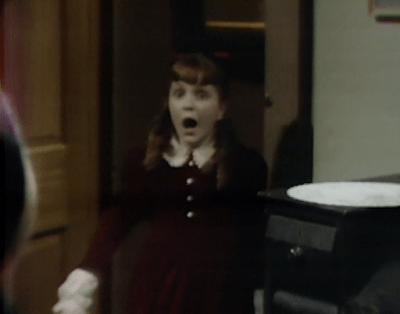
Episode 1046: Such a fearful unreality

Writer Gordon Russell takes bits of old episodes and mixes them as if he were rotating a kaleidoscope. There is a plot involved also, but the screen iconography is the main thing.

The show has been operating on the principle of the kaleidoscope for some time. They’ve traveled back in time repeatedly. Now they have traveled sideways in time and taken us to an alternate universe, which they insist on calling “Parallel Time.” Each of these segments represents a turn of the kaleidoscope, rearranging the actors, sets, musical cues, curse stories, imaginary geography of the estate of Collinwood and village of Collinsport, and other elements to create new patterns that shed unexpected light on familiar material.

Evil wizard Tim Stokes has used a combination of black magic and medical science to establish a remote connection between a woman named Roxanne and his late daughter, Angelique Stokes Collins. This connection drains the “life force” from Roxanne into Angelique, reanimating her and leaving Roxanne comatose. To sustain this circumstance, Roxanne must remain in precisely her current condition. If she dies, all of her “life force” will vanish, returning Angelique to the tomb. Whenever she recovers even a tiny bit of her lost strength, Angelique collapses, possibly to die.

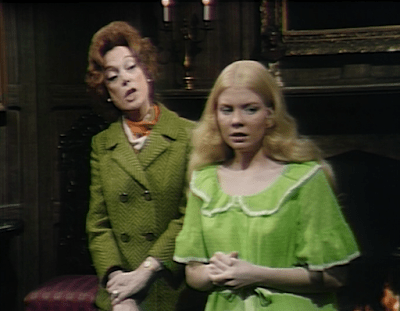
Vampire Barnabas Collins and mad scientist Julia Hoffman are visiting from the main continuity, and they are determined to stop Angelique’s evil plans. They have learned what Stokes has done, and have taken Roxanne into their own custody. As we open, Julia has just given up on an attempt to revive Roxanne and gone back to the great house at Collinwood, where she is impersonating her own Doppelgänger, the housekeeper. This woman, also named Julia Hoffman, was Angelique’s most fanatical devotee until Julia killed her, stole her French maid outfit, and assumed her identity.

Alone with Roxanne in the secret room behind the bookcase in the front parlor of the Old House on the grounds of the estate, Barnabas gives a soliloquy about his feelings for her. She opens her eyes and sits up.

In the spring of 1968, Julia took charge of an experimental procedure another mad scientist had devised to free Barnabas of his vampirism. The core of this procedure was the creation of a Frankenstein’s monster named Adam. In #490, Julia ran the apparatus and was disappointed when Adam seemed still to be inanimate. She and Barnabas left the lab, and Adam came to life. Her disappointment and departure are repeated in this scene, though Barnabas is there to see Roxanne open her eyes.

When Roxanne comes to, we cut to the great house and see Angelique collapse. She crawls around on the floor, trying to make her way to a telephone. This action is shown in quick cuts, but not quite quick enough. It is so much the sort of melodramatic business that was overdone in movies in the 1940s and 1950s and parodied in sketches on The Carol Burnett Show in the 1960s and 1970s that it raises a bad laugh.

Barnabas takes Roxanne out of the secret room, to the parlor. He finds that she cannot speak. He shows her a drawing of her that he found in another secret room, the chamber in the back of the Collins family mausoleum in the old cemetery north of town. It is signed “Claude North.” Roxanne reacts to the drawing with delight and to the name “Claude North” with dismay.

In the summer of 1969, the show was set in the year 1897. One of the characters we got to know in that year was the mysterious Amanda Harris. It turned out that Amanda had popped into existence when an artist thought her up and made a sketch of her. This artist, a repellent little man named Charles Delaware Tate, had no idea he was endowed with the power to bring his fancies to life by drawing them until he met Amanda, at which point he developed an exceedingly unpleasant obsession with her.

Roxanne’s origins are at this point as unknown to us as Amanda’s were when we first got to know her. So the drawing will suggest to longtime viewers that “Claude North” will turn out to be this universe’s version of Tate. When Stokes tells Angelique that he might be able to bring Roxanne back by contacting North, the thought of having further dealings with the man is abhorrent to him. Like Roxanne’s own display of distaste at North’s name, that fits with the idea that he might be a version of the loathsome Tate.

In the great house, Maggie Collins, current wife of Angelique’s widower Quentin, finds Angelique crawling on the floor and picks up the telephone to call the doctor. Angelique says that she needs her father, not the doctor, puzzling Maggie. While they contact Stokes, Barnabas takes Roxanne to the mausoleum and shows her the secret room in an attempt to restore her memory and her power of speech.

In #283, the original continuity’s version of Maggie was a mental patient at Windcliff, a private hospital Julia controls. She had succumbed to amnesia, reverted to early childhood, and become largely nonverbal after an ordeal as Barnabas’ victim. In that episode, Julia took Maggie on a trip to the mausoleum, where Barnabas had tortured her, in an attempt to restore her memory and power of speech. Now, the relatively benevolent Barnabas is taking Roxanne to this universe’s version of the same location in the same hope.

Stokes attends to Angelique in her room. He gives her some medicine to keep her alive until they can find Roxanne. He warns her that if Roxanne manages to speak, her first word will send Angelique back to the grave. He performs an incantation to summon the spiritual forces of darkness to come to their aid. When Mrs Acilius and I were watching this on Amazon Prime, Stokes’ incantation was interrupted by an ad for Chipotle. I’d always thought calling on the Devil and his minions was likelier to bring Taco Bell upon you, but I don’t suppose Chipotle is all that different.

Stokes DoorDashes Chipotle. Screenshot by Dark Shadows Before I Die.

During the 1897 segment, we saw a new version of a character from an earlier phase of the show, undead blonde fire witch Laura Murdoch Collins. That iteration of Laura was a heat vampire who drained the warmth from the living to remain animated. They’ve given the current version of Angelique the same condition, though we haven’t seen it lately. In #737, Laura was in a bad way. She lay in bed and her thrall Dirk Wilkins cozied up to her in the most sex-like interaction we had seen on the show up to that point (or up to this point, come to that.) Angelique’s bedroom is laid out the same way today as Laura’s was then, and as Dirk was on Laura’s right, Stokes is on her right. Earlier episodes made it clear that there was something deeply weird about the relationship between Stokes and Angelique. In the contrast between this scene and the one between Laura and Dirk, longtime viewers can see that Angelique and Stokes’ particular weirdness does not involve incest per se. Rather, it is their shared dedication to evil for its own sake that warps everything between them.

Back in the Old House, Barnabas puts Roxanne to bed on her table in the secret room. He goes into the parlor. A car pulls up. It is Carolyn Loomis, wife of his late blood thrall Will Loomis. Carolyn chatters happily about some shopping she did and asks for Will. Barnabas realizes she does not know that Will has died. He breaks the news to her. He says that Angelique killed him, which is part of the truth. Carolyn says it is because of Barnabas that Will was killed, which is the other part of the truth. Barnabas seems to have a whole speech prepared about how he will avenge Will’s death by defeating Angelique, but Carolyn keeps interrupting to ask who will avenge it by defeating him

Elsewhere in the 1897 segment, Barnabas’ enemies had killed his blood thrall Sandor Rákóczi. In #798, Sandor’s wife Magda blamed Barnabas for her husband’s death. She told him she would avenge Sandor by killing him. She then despaired of that and offered herself to him as his next victim. Barnabas grandly replied, “No, Magda, you will not kill me, and I will not harm you. We will grieve together.” Carolyn does not allow Barnabas to speak so loftily.

Carolyn goes to the great house. She is just about to reveal Barnabas’ secret to Maggie when Barnabas himself shows up. While he defuses the situation, Stokes realizes that the Old House is vacant. He slips out to search for Roxanne there. When Barnabas returns, Roxanne is nowhere to be found.

It may seem unlikely that the show will resolve this cliffhanger in the obvious way, by showing us that Stokes took Roxanne from the secret room. They usually go for surprise. Nonetheless, longtime viewers will be inclined to expect this to happen, even though it is so on-the-nose. This room was first seen in #113, when crazed handyman Matthew Morgan opened it as a dungeon for well-meaning governess Victoria Winters. Not even Vicki’s charge, strange and troubled boy David Collins, knew of the room’s existence, and David knew the Old House better than any other character on the show at that point. The room is therefore uniquely Matthew’s territory.

Like Matthew, Stokes is played by Thayer David. Stokes’s ancestor was eighteenth century indentured servant Ben Stokes, whose counterpart we saw in the 1790s segment as a commentary on Matthew, an example of the good and sane man Matthew might have been had he not grown up in the shadow of the ancient curses of Collinwood. Once those curses had been in operation for a little while, Ben started turning into Matthew. As Matthew inadvertently killed a man because of his unbounded devotion to matriarch Elizabeth Collins Stoddard, Ben inadvertently killed a man because of his unbounded devotion to Barnabas. As Matthew set out to cover up his accidental homicide by killing Vicki, who was played by an actress whose father was a Danish count, so Ben deliberately committed a murder to cover up his own accidental killing, and his victim was a lady with the title “Countess.” As a descendant of Ben and therefore a reflection of Matthew, it is a matter of course that Stokes knows about the room. Barnabas’ decision to hide Roxanne in the room is just one more case of a severe misreading of Dark Shadows by someone who didn’t watch the 1966 episodes.

Episode 952: Every inhuman creature has one vulnerability

We are in the fourteenth week of a story about the Leviathan People, a race of Elder Gods who are planning to retake the Earth from humankind. At first, old world gentleman Barnabas Collins was a zealous acolyte of the Leviathans and the faithful leader of a cult devoted to their service. The first chapter of the story came to an end when a shape-shifting monster from beyond space and time, the harbinger of the Leviathans’ return, ordered Barnabas to kill his best friend, mad scientist Julia Hoffman. Barnabas refused that order and became disaffected from the cult, held in line only by the Leviathans’ threats.

The shape-shifting monster has grown, and now spends most of his time as a young man whom everyone calls Jeb, despite his initial request to be called Jabe. Barnabas learned the other day that some of the threats the Leviathans had been making were empty, and so tried to smash a small wooden box that is important to them. Jabe stopped him, and punished the attempt by turning Barnabas back into what he was from the 1790s until 1968, a vampire.

Jabe’s home is a room above an antique shop owned by cultists Megan and Philip Todd. There is a lot of talk about this room as the only place where Jabe can change form. This is confusing to regular viewers. We saw him change from boy to girl while visiting the great house of Collinwood in #909, and in #946 and #947 he changed from his true, non-human, form into Jabe while at a house on an island many miles from the village of Collinsport. Today, Barnabas burns the antique shop down in order to destroy the room; Jabe says that he left the room through the window when the fire started, and changed from his true form into his human shape while outside. I keep trying to give them the benefit of the doubt about this, but at this point the whole theme of the “Chosen Room” falls apart completely.

Nonetheless, the antique shop sets and the troubled relationship between Philip and Megan have been signatures of the Leviathan story so far. Now the shop is gone, and Megan is gleeful that Philip is in jail, having confessed to three murders Jabe committed and unlikely ever to live with her again. So we can say that chapter two of the Leviathan story is over.

Barnabas’ re-vamping marks a transition in more than this storyline. He is the central character of the show and its main attraction; whether or not he is a vampire determines a great deal about what kind of show it is. You could periodize the show into segments depending on whether he is a vampire or not. I’ll risk a spoiler and tell you we have now begun a long segment of Barnabas-as-vampire.

Barnabas goes to the jail and has a conference with Philip. Jabe overtaxed Philip’s allegiance to the Leviathans, as he overtaxed Barnabas’. Philip has confessed to Jabe’s murders only because he loves Megan, believes she still loves him, and fears that if he does not do what Jabe commands he will kill Megan. Barnabas tells him that in fact Megan no longer cares about him at all, but is entirely devoted to Jabe.

In the real world, the state of Maine did away with capital punishment in 1887, a fact which applied to the universe of Dark Shadows in 1966. In #101, high-born ne’er-do-well Roger Collins disappointed his son, strange and troubled boy David, by mentioning it. But the prospect of a gallows is more melodramatic than is that of any prison sentence, however long, and so Philip announces that he is going to be hanged for Jabe’s murders.

Matriarch Elizabeth Collins Stoddard, owner of the great estate of Collinwood and of the businesses that employ most of the people in and around the village of Collinsport, is a devoted member of the Leviathan cult. Liz gives Jabe the carriage house on the estate to live in, telling him its back room will be suited to take the place of the now-destroyed Chosen Room. He tells her that Barnabas has betrayed the cult, but that she need not act against him yet. The carriage house was mentioned a few times in 1969, when Dark Shadows was a costume drama set in 1897 and the Collinses were still traveling by carriage. I believe this is our first confirmation that the carriage house still exists in the twentieth century.

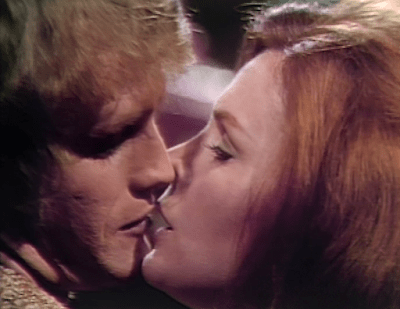
Megan comes to visit Jabe at the carriage house. She is exultant that Philip is in jail. Jabe tells her he has no intention of resuming his true form; she is appalled. The plan has been that he will take Liz’ daughter Carolyn as his bride, and that she will then turn into the same kind of being he is. If he is going to be humanoid all the time, then he will just be taking Carolyn out on dates. Megan says that this was not the point. Jabe dismisses her objections, and tells her that their own relationship is different now than it was when he was first taking shape and she and Philip were his foster parents. He pulls her close to him and gives her a passionate kiss.

Oedipal kiss. Screenshot by Dark Shadows Before I Die.

Jabe spent several weeks in the form of a succession of children. The children showed violent hostility towards Philip and remarkably little sense of boundaries in their relationship with Megan; the reference to the Freudian Oedipus complex was not subtle then, and the kiss he gives to Megan while he is setting Philip up for a judicial murder makes the connection explicit.

Episode 939: You find me repulsive

Heiress Carolyn Collins Stoddard is mourning her father, who was recently murdered. She tells Maggie Evans, governess to the children in the great house of Collinwood, that she will not rest until she finds the killer. Maggie urges her to leave that up to the Maine State Police. Returning viewers know that the culprit is a monster from beyond space and time. We also know that the monster takes the form of a very tall young man who, when he first materialized, asked people to “Call me Jabe.” They called him “Jeb” instead.

Jabe has no impulse control, no awareness of other people’s feelings, and no long-range plans. He wants to marry Carolyn tomorrow, which, considering that a disagreeable encounter yesterday was the first time he met her while in his current form, she would be unlikely to agree to do even if her father had not just been killed.

Carolyn is taking the night air on Collinwood’s terrace when she hears some strange noises. Most of them are being produced by the late Sheriff Davenport, whom Jabe recently murdered then raised from the dead to serve him as a zombie. He’s hanging around in the bushes, idly watching.

Jabe shows up and says he’s sorry if he startled Carolyn. He tells her that they will be married tomorrow, exasperating her beyond endurance. She gives him a piece of her mind. She uses the word “crazy” to describe his behavior, prompting him to get very stiff and snarl “Don’t ever call me that!” She turns to go, and he grabs her arm. She tells him to let go. He refuses, and she threatens to scream. He still does not let go, but she breaks away and goes back inside.

Maggie sees a flustered Carolyn come rushing into the house. She asks her what’s wrong. Carolyn won’t answer. She hurries upstairs to her bedroom.

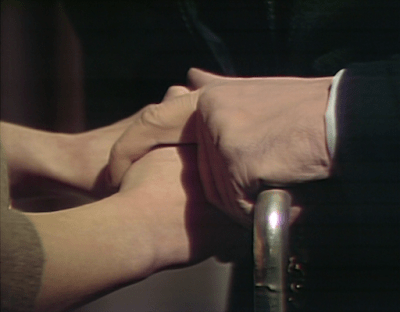
Carolyn’s distant cousin, old world gentleman Barnabas Collins, comes in. He and Maggie talk about Carolyn. Maggie says that she is deeply impressed by Barnabas’ concern for Carolyn. She takes his hand. They put their heads together and talk quietly about how important their friendship is to each of them while the camera zooms in on their hands. Barnabas used to be a vampire, and spent the spring and summer of 1967 torturing Maggie so viciously she suffered a complete mental collapse. Her psychiatrist, Julia Hoffman, saw in Barnabas her chance to pursue her dream career as a mad scientist, and so she sold Maggie out. She used her magical powers of hypnosis to rewrite Maggie’s memories so that she forgot all about what Barnabas had done to her. Her feelings of terror were replaced by warm friendliness towards him. Still, longtime viewers will find it a bit jolting to linger over this handclasp, with its suggestion that romance may be about to bloom between Maggie and Barnabas.

Maggie and Barnabas holding hands. Screenshot by Dark Shadows Before I Die.

The next day, Carolyn finds a note of apology and some red roses in the drawing room. They are from Jabe. She is putting them in a vase when Barnabas turns up. He is concerned when she tells him the flowers are from Jabe. She says she is not sure what to make of Jabe.

We hear Barnabas thinking that if Carolyn starts seeing Jabe, there will be no hope for her. He’s thinking of Jabe’s monstrous nature and his association with the Elder Gods who are on their way to destroy the human race, but even first-time viewers who know nothing of those things have seen enough of Jabe to agree with him. Regular viewers know that, while there is, in an ontological sense, more to Jabe than Carolyn has seen, she has already taken the complete measure of his personality and temperament. If she winds up deciding he is an acceptable partner, it can only be because the writing staff has decided to sacrifice her character once and for all to the business of moving the plot forward.

Longtime viewers will find this prospect especially disturbing. The terrace was the scene of many grisly encounters between Maggie’s predecessor, well-meaning governess Vicki Winters, and Vicki’s boyfriend, a repellent little man named Peter who preferred to be called Jeff. Peter/ Jeff was not a monster from beyond space and time, he was something much worse- a character played by Roger Davis. At least when Jabe grabs Carolyn’s arm, it is only the characters who are in an abusive situation. When Peter/ Jeff clutched at Vicki, Mr Davis squeezed Alexandra Moltke Isles out of shape and blocked the camera’s view of her. Vicki, Dark Shadows‘ original protagonist, had been pushed to the margins of the story for a number of reasons, but it was her inexplicable insistence on sticking with the loathsome Peter/ Jeff that finally made it impossible for her to continue on the show.

For some unaccountable reason, the producers and directors seem to have liked Mr Davis. They kept him on the show for a couple of years, in a variety of roles, and allowed him to assault his scene partners with abandon. The writers seem to have caught on that he was not so good; his most recent character, Harrison Monroe, was a robot who just kept yelling at everyone until his head fell off. But the directors were still fans; when Christopher Pennock joined the cast as Jabe last week, they told him to imitate Roger Davis. To his credit, he instead conducted himself in a professional manner. However much of a dead-end Jabe is, you will never see Pennock hurting another member of the cast or obstructing her performance.

Episode 937: The list of the expendables

A monster from beyond space and time has taken the form of a vicious man-child and asked people to call it “Jabe.” A cult devoted to the Leviathan People, mysterious Elder Gods who brought the monster to Earth, have decided to put up with its murders and depredations, but even they draw the line at calling the monster “Jabe.” It answers to “Jeb” instead.

Jabe’s latest pointless act of cruelty was to break the leg of one of his faithful servants, thirteen year old David Collins. A couple of times today, Jabe is about to explain why he broke David’s leg, and each time they cut away to some other scene. At one point we cut back to Jabe telling David that “Now you know why I had to do that, don’t you?,” to which David agrees that he does. That just lampshades the fact that the writers couldn’t come up with a reason.

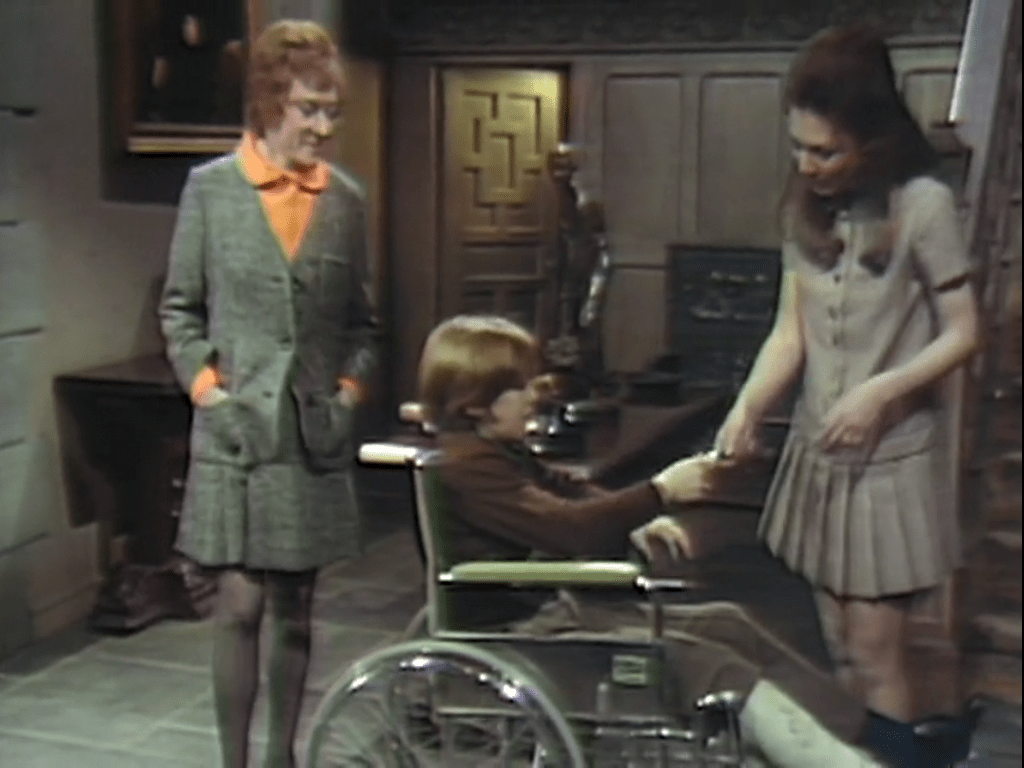
David wants Maggie to be the first to sign his cast.

The actual reason David Collins is wearing a cast and using a wheelchair is that actor David Henesy took a nasty spill on the ice. And since Jabe’s untrammeled violence is the big menace on the show right now, it makes sense that they would have him be at fault. It certainly makes more sense than does the fact that the family insists on David climbing the stairs to his bedroom with crutches, when they have a whole disused wing of servants’ bedrooms on the first floor in any one of which he could stay while he recuperates. On the other hand, that insistence does produce a moment of real hilarity. The instant David begins his ascent, governess Maggie Evans (Kathryn Leigh Scott) and permanent houseguest Julia Hoffman start talking as if he weren’t there. He must be lumbering up the stairs a couple of feet from them the whole time they are carrying on this conversation.

For his part, Jabe doesn’t generate any laughs. Nor is he pursuing any goals that lead us to wonder what he will do next. We just know that if he has a chance to do something nasty, he’ll probably take it.

If they want Jabe to be a character in whom we take an interest, they ought to give him some kind of cockamamie motivation that is intelligible only to him. That’s what they did in 1967, when vampire Barnabas Collins held Maggie prisoner and tortured her. They showed us that Barnabas thought he was going to turn Maggie into his lost love Josette. That idea, borrowed from the 1932 film The Mummy, was so utterly bonkers the show eventually decided to run with it, casting Miss Scott as Josette when they went back in time to explain how Barnabas became a vampire. Meanwhile, the ever-mounting zaniness kept viewers tuning in, wondering if they would ever expose a layer of Barnabas’ psychology that was composed of something other than nonsense.

The opening voiceover today labels Jabe “evil”; that’s no problem, all the most popular characters, including David, started off as appallingly evil, and they have retained their popularity to the extent that they stayed in touch with their roots. But Jabe is not only evil, he is monotonous, and that makes him a deadly threat to the show’s entertainment value.

Barnabas is not currently subject to the effects of the vampire curse, and Julia long ago used her powers as a mad scientist to erase Maggie’s memory of his crimes against her. Barnabas was the original leader of the Leviathan cult, but has become disaffected. Jabe tells Barnabas today that he wants to kill just about everyone at Collinwood, including ten year old Amy Jennings, who is a faithful member of the cult. He also wants to marry heiress Carolyn Collins Stoddard. Barnabas goes to Collinwood and warns Maggie that Carolyn is in danger. He asks her to keep an eye on Carolyn and to urge her to go away. He does not mention Amy. At least Amy’s name comes up in this episode- when she is on camera she is often the best thing in the show, but throughout her long absences she usually goes unmentioned.

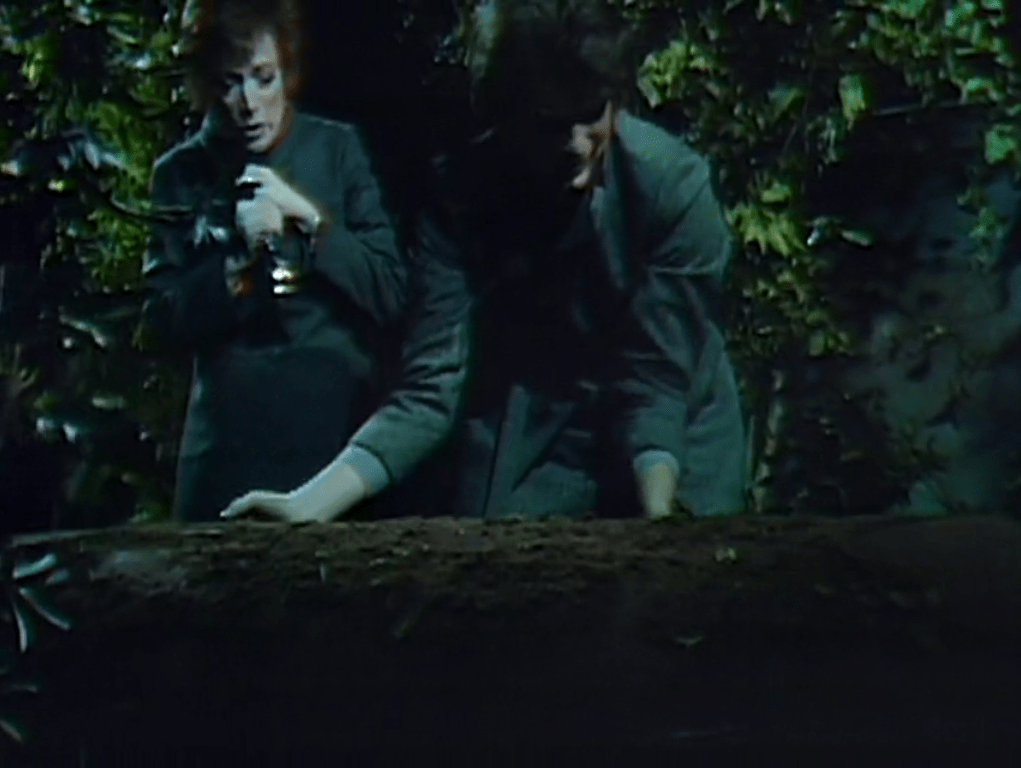
Julia goes to Amy’s great-grandfather, centenarian Quentin Collins, who has recently returned to Collinsport after an absence of many decades and who, because of a series of spells that were cast on him, looks like he is not quite 29 years old. Julia recruits Quentin to dig up the grave of Michael Hackett, Jabe’s previous incarnation. This gives us the first exhumation scene on Dark Shadows since, if I recall correctly, #820. It’s the longest the show has gone without digging up a coffin since the first exhumation scene, in #179. It feels like a homecoming when Quentin sticks his shovel in the plot. Of course they find an empty coffin.

As is usual when digging up a coffin, Quentin wears a three-piece suit with dress shoes, none of which is smudged in the process. Less typically, his coat appears to be somewhat wrinkled.

Afterward, Julia confronts Barnabas. When she tells him how much she already knows, he gives in and says he will tell her everything. With that, we have the promise that Barnabas and Julia will resume the partnership that has been the single most dynamic narrative element on Dark Shadows.

Episode 927: Reasons don’t matter

Permanent houseguest Julia Hoffman, MD, is in the drawing room of the great house of Collinwood when a secret panel opens and a boy known as Michael comes strolling out. She asks him how he knew about the panel and the passages behind it; he says that thirteen year old David Collins told him. Julia asks if Michael knows what has become of David’s governess, the missing Maggie Evans. Michael tries to dodge her questions. When Maggie comes running into the room, screaming that she has been living a nightmare, Michael takes the opportunity to flee.

Michael emerges from the secret passage.

Returning viewers know that Michael is not really human, but is the latest in a series of manifestations of a monstrous force that has enlisted the support of several characters for its plan to supplant the human race. We also know that Michael trapped Maggie in the long-disused west wing of the house and tormented her there. She had been sure that Michael was her tormentor, but when Michael’s foster father, antique dealer Philip Todd, came to her rescue, Maggie beaned him with a small candlestick and jumped to the conclusion that he was to blame. She tells Julia that Michael is innocent and Philip is dead.

Maggie’s captivity is a remake of a story that ran from #84 to #87. In those days, the show’s liveliest villains were David and his father, high-born ne’er-do-well Roger. David locked Maggie’s predecessor Victoria Winters up in a room in the west wing, where he hoped she would die. Eventually Roger used the secret panel from which Michael emerges today to go to the west wing and investigate. He went straight to the room where Vicki was trapped. Roger shared David’s ill-will towards Vicki, and had in #68 encouraged him to harm her. In the corridor outside her prison, he took advantage of the situation to terrorize her further, disguising his voice and pretending to be a ghost taunting her with her doom. When he finally opened the door, she flung herself into his arms and declared that he was right and David really was a monster.

That story dragged out for so long that we couldn’t help noticing several steps Vicki might have taken to get herself free. Her failure to try any of them was a major step towards the creation of the “Dumb Vicki” image that would in time destroy the character completely. Maggie doesn’t outdo Vicki in engineering ability, but at least part of her helplessness can be explained by a taunting voice that she hears, on and off, from the beginning of her captivity. This one really is supernatural in its origin, projected by Michael. Her misunderstanding of Philip’s motives and condition is as total as was Vicki’s of Roger’s, but she corrects it by the end of the episode, when she realizes that Philip was coming to rescue her from Michael, and that he is fine now. She goes to his shop to apologize for accusing him.

The contrast between the two stories sheds light on the strengths and weaknesses of the show in the days when they were made. In the first months, individual episodes might have so little action that there was nowhere to hide a logical problem like Vicki’s immediate resignation when she realized that the window in the room was slightly out of her reach, even though the room was full of materials she could stack up and stand on. Still, Vicki’s reaction when Roger enters was electrifying, one of the best moments of acting in the entire series, and the change in her relationship with David in the weeks after her release is pivotal to everything that happens from that point on.

The relative busyness of the stories now allow us to overlook Maggie’s absurd helplessness while she is in the room, and her quick reconciliation with Philip papers over her inexplicable failure to remember that she heard Michael’s voice taunting her. But as Philip points out, Maggie doesn’t really know him. Nor will her experience shape her future attitude to Michael in any interesting way- as a creature who rapidly changes his form, he comes with a built-in expiration date. The whole story vanishes without a trace once Maggie leaves the antique shop. The individual episodes may not seem as slow now as they did at first, but when we find ourselves weeks or months into a storyline and find that very little has happened that we have any need to remember, we are left with a sense of motionlessness.

Roger’s use of the secret panel in #87 was the first time we learned it existed, and we didn’t see or hear of it again for two years, when both David and the ghost of Quentin Collins used it during the “Haunting of Collinwood” segment. David ushered visiting psychic Madame Janet Findley through the panel, directly to her death; Quentin came out of it and killed elderly silversmith Ezra Braithwaite. So to longtime viewers, the panel represents both murderous intentions and an intimate knowledge of the layout of the house. When Michael comes sashaying out of it today, we are meant to be a deeply unsettled.

Philip is disaffected from the project Michael represents; his wife Megan is still all in, and she combines her fanaticism with a desperate love for Michael. She talks with Michael privately, and tells him that he has been making himself so conspicuous that he has raised suspicions in the minds of many people. They will have to take steps to quell these suspicions, steps which neither she nor Michael will like at all.

Michael becomes very ill, and Megan calls Julia to come to the shop to treat him. She finds that his heartbeat is irregular and his vital signs are fading. She is calling the hospital when he goes into some kind of crisis; she leaves the telephone and injects him with a stimulant to jolt him back into stability.

Recently, we have heard several references to “Dr Reeves,” a character who was on the show a couple of times in 1966. Dr Reeves did not appear on screen, much to the relief of longtime viewers who remember how annoying he was, but the sheer fact that his name came up sufficed to assure us that Julia is not the only doctor in Collinsport. Since the group around Michael has been unable to absorb Julia and sees her as a potential enemy, Megan must have chosen her for some reason to do with the plan she was telling Michael about.

Episode 909: Beyond what I saw before

Paul Stoddard (Dennis Patrick) has been staying in his ex-wife’s home, the great house on the estate of Collinwood. At the end of yesterday’s episode, he found a boy known as Alexander hiding in his room. He chased Alexander out of the room. We saw Alexander go behind some curtains. In today’s opening reprise of that scene, Paul looks behind the curtain and sees, not Alexander, but a girl. The girl calls him “Daddy” and runs off. He looks at a photo album and recognizes her as his daughter Carolyn as she was at the age of eight. Since Carolyn is alive and well, the girl cannot be her ghost. He concludes that she must be something that the mysterious enemies whom he knows to be persecuting him have conjured her up.

Paul sees this pseudo-Carolyn a few more times, but no one else does. The last time he sees her, he chases her into a closed room.

Paul chases the pseudo-Carolyn into a closed room.

When Paul opens the door to the room and invites permanent houseguest Julia Hoffman to look inside, no one who could be mistaken for Carolyn is there. Alexander is, and he has the same book with him that the pseudo-Carolyn took into the room with her.

The foyer from a new angle.

Alexander is not the eight year old boy he appears to be. He is both a borrowing from H. P. Lovecraft’s The Dunwich Horror and a meta-fictional comment on Soap Opera Rapid Aging Syndrome. He began life a couple of weeks ago as a whistling sound coming out of a wooden box, spent a week as a newborn baby, then emerged in his current form. When he masquerades as the very young Carolyn, he doesn’t get any bigger or smaller, but he does shift his shape between male and female. Which, good for him (them?,) I suppose.

Many longtime viewers will be even more intrigued by another metamorphosis that we see today. The foyer set has always stopped a little bit downstage from the front door. The room into which Paul chases Carolyn/ Alexander lies beyond this line. Previously, when characters had entered that space they simply exited and were picked up elsewhere later. The only time the camera followed actors beyond the line was in #664, when time-traveling vampire Barnabas Collins and indentured servant Ben Stokes walked from the foyer to the study by way of an undecorated area of the studio. That area is decorated now.

New set.

In the picture of Julia, Paul, and Alexander above, we see a portrait in the foyer behind Paul’s left shoulder. That depicts Barnabas as he was in the 1790s, before he became a vampire. It first appeared in #204, when Dennis Patrick was on the show as Paul’s sometime friend, seagoing con man Jason McGuire. It was still being painted when Patrick joined the cast a few weeks before. When he first entered the great house in #195, there was a mirror on that spot. The mirror had been trading places with a metal doodad that was shaped like a coat of arms. At the moment Jason entered, the mirror caught a portrait on the opposite wall, making it look like there was a portrait there. On repeat viewings, that effect makes it clear that Jason’s purpose is to clear the decks of leftover story elements that will not be needed in the show’s future as a supernatural thriller.

When Jason first came to the house and insisted on staying, he and Liz stood in the foyer. She looked into a space beyond the camera, to the viewer’s left (=stage right,) and said that she supposed she could find a room for him there. Jason identified the imaginary part of the house Liz was facing as the servants’ quarters, and when in later episodes we saw servants going to their rooms that was indeed the direction they exited. So when they have Patrick on screen when they enlarge the performing space available in the foyer to include an area to the viewer’s right (=stage left,) they are picking up on that aspect of his iconography.

The Carolyn side of Carolyn/ Alexander is played by Lisa Ross, whose given name was Alyssa Mary Ross. In later years, she took her husband’s name and was known as Mrs Eppich. She was born in 1959 and died in 2020; her family put a very nice tribute page to her online, you should look at it.

Lisa Ross had brown eyes; Nancy Barrett, who plays the adult Carolyn, has brilliantly blue eyes. Since half the episodes of Dark Shadows in this period were directed by Henry Kaplan, a specialist in extreme closeup shots, no regular viewers can be unaware of this. For a single episode, #578, Miss Barrett was replaced as Carolyn by Diana Walker. That one was directed by Sean Dhu Sullivan, who was adept at a wider variety of setups than Kaplan and therefore did not shove the camera into the actors’ faces over and over. Miss Walker’s eyes might be brown, I can’t tell. If so, maybe it was her Carolyn whose juvenile form Alexander assumed.

Episode 896: Those who have been hidden shall show themselves

David and the Book

Strange and troubled boy David Collins has stolen an old book from an antique shop. He didn’t want the book, but had damaged it slightly and was terrified that he would be punished if this was discovered and his father had to pay for the rare volume.

David’s friend and fellow resident of the great house of Collinwood, Amy Jennings, catches him with the book in the drawing room. He tells her he is going to burn it in order to conceal his crime. She points out that this will make a bad situation much worse. As a creature of Soap Opera Land, David can have no higher calling than to make bad situations worse, so this does not deter him.

While Amy offers to take the book to the nearest grownup and to claim that she was the one who stole it, David opens it to a page depicting a group of intertwined snakes, a symbol the show refers to simply as “the Naga.” He is transfixed by the symbol. His whole manner changes. His posture becomes more rigid, his voice grave and authoritative. He tells Amy he no longer wants to burn the book. Instead, he will read it. Since the book is written in a script neither of them has seen before, Amy tells David he cannot read it, but he assures her he can. She asks him to read it to her, and he says that it is forbidden for her to hear any of it. She says that she doesn’t like the game David is playing and would rather turn to another; he says it is no game. She leaves him alone with the book.

The book was not in fact part of the antique shop’s merchandise, though it was on a display table there. The owners of the shop, Megan and Philip Todd, have been inducted into a mysterious cult led by David’s distant cousin, old world gentleman Barnabas Collins, and the book is one of that cult’s most sacred objects. The Todds flew into a panic when they realized the book was missing, and Barnabas told Philip that he faced a severe penalty for losing it. Those reactions make it hard to understand why Philip and Megan left the book on the table in the first place.

Longtime viewers know that many of the major plot-lines on Dark Shadows start with David. So we may suspect that the supernatural forces behind the cult, unknown to Barnabas or the Todds, caused the book to be left on the table and led David to take it so that he could become part of the story. Indeed, once he is alone with the book David intones a statement from it: “And then those who have been hidden so long shall rise and show themselves, and the others will know their time is ended and the time of the people of the Leviathan will begin.” Later, he goes to the mysterious cairn in the woods that is the center of the Leviathan cult’s ceremonial activity, and announces that he is one of them now. The stones at the bottom of the cairn part, revealing a small opening. David crawls into it. The words are solemn, the music melodramatic, the action of the boy stuffing himself into the little hole preposterous. It is the perfect Dark Shadows sequence.

David Henesy was nine years old when the show started, and was thirteen by this time. It would seem no one told the carpenters he had grown in the interval. That gap is such a tight fit for him that he has to wiggle his rear end at the camera for quite a while as he tries to wedge himself into it. Screenshot by Dark Shadows Before I Die.

We Actresses are Vain

As David is leaving to go to the cairn, he has to refuse a request from permanent houseguest Julia Hoffman. Julia wants him to go to the Old House on the estate and give a note to Barnabas. She keeps telling him that it is urgent, but he tells her he is already on his way to do something urgent.

Julia does not know about the Leviathan cult, much less about Barnabas’ connection with it. All she knows is that Barnabas has been her best friend for a year and a half, and when last they had a chance to spend time together they were concerned with the rakish Quentin Collins, whose whereabouts they do not know. Now it is 4:45 PM, and Julia is expecting a Mr Corey to come to the house at 5:00 and look at a painting she bought from the Todds a little while ago. She thinks this Mr Corey might be Quentin, and is keen for Barnabas to meet him.

When David cannot help her, Julia decides to take the note to the Old House herself. The show is usually fairly vague and inconsistent about the geography of Collinwood, but several times they have said that it takes about fifteen minutes to walk between the great house and the Old House. They stick with this today. Julia leaves at 4:45, and returns as the clock is striking 5:15. Barnabas was not at home, so she just turned right around.

Julia hears voices in the drawing room. They are heiress Carolyn Collins Stoddard and another woman. Julia gathers that Mr Corey is actually Ms Olivia Corey. When she enters the room, she sees that Olivia is a dead ringer for Amanda Harris, a woman who lived in 1897. Julia became aware of Amanda in September, when she and Barnabas were traveling in time and met each other in that year. Julia did not meet Amanda, but evidently must have seen at least one of the many portraits of her that magical artist/ dreary goon Charles Delaware Tate painted. She mentions these portraits to Olivia, who claims that Amanda was her grandmother. Amanda was in love with Quentin, and Julia takes an excited breath when she asks Olivia who her grandfather was. Olivia gives his name as Langley. Quentin may well have used an alias, so that doesn’t rule out the possibility that Olivia may be his granddaughter, though Dark Shadows fans looking back in these later days will think of another member of the Collins family when they hear that name.

Olivia is a famous New York actress. Julia tells her that she has seen her on stage and has seen her photograph in the newspapers, but that she never noticed her resemblance to Amanda. Olivia asks where Julia heard about Amanda; she says that she must have read about her somewhere in connection with one of the portraits. She also tells Olivia that she isn’t likely to want the painting, since it is not a portrait. Olivia says that she wants any painting of Tate’s she can get. Julia tells her there is no portrait of Quentin Collins in the house; Olivia pauses for a fraction of a second, then blandly asks if she is supposed to know who that is.

Some of Tate’s paintings had supernatural effects. When Tate painted pictures of his ideal woman, Amanda came into being as their embodiment, like Galatea emerging from Pygmalion’s statue. And when he painted Quentin’s portrait, Quentin was freed of the effects of the werewolf curse. Like a Halloween version of The Picture of Dorian Gray, the portrait turned into a wolf on the nights of the full moon, while Quentin remained human.

As long as the portraits of Amanda and Quentin are intact, they themselves will remain alive and well and youthful. So Julia’s hope that Quentin might still be traveling the world and using false names 72 years after the period when she and Barnabas knew him is not ill-founded, and her surmise that Olivia might be, not Amanda’s granddaughter, but Amanda herself, is also plausible.

Episode 827: Magnificent, ain’t I?

Rroma chieftain/ New England crime boss King Johnny Romana and his Afro-Romani henchman Istvan have cornered broad ethnic stereotype Magda Rákóczi on top of the cliff at Widows’ Hill. King Johnny declares that he will now kill Magda. She is a major character, it’s a Tuesday, and this is the resolution of yesterday’s cliffhanger, so we have three reasons for expecting her to survive.

However, none of the three reasons is as strong as it might at first appear. First, while Magda precipitated every major storyline in the segment of Dark Shadows set in the year 1897, none of those stories needs any further action from her to continue right now. We’ve also had an indication that Grayson Hall’s original character, Julia Hoffman, will soon be returning to the cast. Second, Dark Shadows never followed the traditional soap opera format in which important developments were reserved for week-ending finales. Third, while the great majority of episode-ending cliffhangers fizzled out in the opening seconds of the next installment, occasionally they did go ahead and resolve one with a death. Besides, as my wife Mrs Acilius points out, Magda laid her husband Sandor’s ghost to rest at the top of the episode, and it is called Widows’ Hill because widows go there to die. So there actually is some suspense as to whether King Johnny will make good on his threat.

Time-traveling vampire Barnabas Collins shows up at the last moment and orders King Johnny to release Magda. King Johnny refuses and orders Istvan to throw Barnabas off the cliff. Barnabas looks into Istvan’s eyes, using his power of hypnosis. Once Istvan is under his control, Barnabas compels him to walk off the cliff. King Johnny then realizes who Barnabas is. He holds Barnabas at bay with a cross. Barnabas tells him that he can reclaim what Magda stole from him, but only if he lets her go. At that, King Johnny becomes cooperative. Too bad Barnabas didn’t open with that- Istvan could have lived. Fortunately for Barnabas and Magda, King Johnny forgets about Istvan instantly.

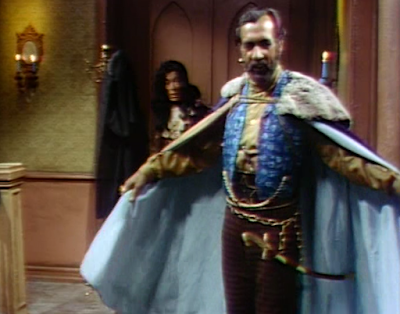
King Johnny shows off his hand-chopping clothes. Screenshot by Dark Shadows Before I Die.

For a hundred years, King Johnny’s tribe kept as its most prized possession The Hand of Count Petofi. This was literally a severed hand, cut from a Hungarian nobleman. Count Petofi was a sorcerer, and when nine Rroma men severed his right hand in a forest one night in 1797, most of his power went with it. Magda stole the Hand in hopes that she could use that power to undo a spell she herself had cast, but found that the Hand would not obey her. Now Count Petofi himself, 150 years of age, has reclaimed the Hand, and it is once more attached to his wrist. He is hugely powerful and a great problem for Barnabas.

Barnabas tells King Johnny what has happened. King Johnny turns out to be the one person in the world over whom Petofi has no power. In return for Petofi’s location, King Johnny agrees to return with the Hand and lift the curse Magda regrets. In his purple robe, King Johnny goes to Petofi’s hiding place. He and Petofi have a long and rather pointless conversation. Finally, Petofi is strapped to his chair and King Johnny raises his sacred scimitar, ready to re-sever the Hand.

This is a less suspenseful cliffhanger than yesterday’s. Petofi is still generating story; in fact, he is the only character who is. The hideout is Petofi’s territory; we have seen him thwarted there, but the defeats he suffered only confirmed that it is not a place where major changes take place in the direction of the narrative. And the meandering dialogue between Petofi and King Johnny deflates all the dramatic tension. Returning viewers have plenty of time to remember that, while Petofi’s magic may be useless against King Johnny, Petofi’s henchman Aristide is somewhere around, and he is quick with a knife. Without Istvan to run interference for him, King Johnny will be vulnerable to Aristide the whole time he’s dawdling around.

As King Johnny, Paul Michael has a very hard job. Not only is the character an egregious stereotype, but he really is scandalously ill-written. Violet Welles was far and away the best writer of dialogue on the show, and she manages to give a few glittering lines even to King Johnny. Still, he is ridiculous from beginning to end, a lot of menacing poses held together with a sinister laugh. That he is watchable at all is a tribute to Michael’s mastery of his craft. In his facial expressions and body language, we can see evidence of thought that is entirely absent from his words.

Episode 782: Satan on the run

Vampire Barnabas Collins has been exposed and is in hiding. Most of those who would destroy him are as evil as he is, and none is as much fun to watch, so we’re on his side.

Stuffy Edward Collins catches Barnabas’ blood thrall Charity Trask in the basement of the Old House on the estate of Collinwood. Barnabas sent her there to fetch some soil from his original grave which he will use to make a new coffin habitable. Edward asks Charity what she is doing in the basement; she lies and claims that she can’t remember. This is an interesting moment for fans of Dark Shadows. Nancy Barrett’s acting style is uninhibited and often larger-than-life; one suspects that she was often accused of overacting. But Charity really does overact. In the contrast between her one-dimensional, exaggerated manner when she feigns amnesia and Miss Barrett’s own very noisy but highly textured performances, we see the definitive refutation of any such charge.

Charity got into the basement through a tunnel that connects the beach below Widows’ Hill to a prison cell in the basement of the Old House. In #260, set in 1967, we saw that the tunnel was in place when Barnabas and his little sister Sarah were living beings in the eighteenth century, that Sarah was aware of the tunnel, and that their father Joshua forbade her to tell Barnabas about it. Sarah’s ghost told Barnabas’ victim Maggie Evans how to escape through the tunnel. When Barnabas pursued her through it, we could see from his reaction that he was seeing the tunnel for the first time. The other Collinses of the 1960s were unaware of the existence even of the cell, let alone of the tunnel.

Now it is 1897, and when Charity mentions the tunnel to Edward he impatiently responds that he knows all about the tunnel. His tone suggests that he would expect Charity to know that he knows about it; evidently it is no secret among the residents of Collinwood. Since Edward’s twelve year old son Jamison is one of those residents, and Jamison’s daughter Liz and son Roger will be the adults at Collinwood in the 1960s, one wonders how that knowledge was lost in the seventy years separating this time-travel story from the principal time frame.

In the last scene, Barnabas is in Charity’s bedroom, about to chow down on her bloodstream. We pan from a two-shot to a closeup of Charity. She gives a thirty five second speech about how it isn’t safe for him to stay long, since her father knows that she is under Barnabas’ power and is lying in wait for him. Thirty five seconds is evidently how long it took for Jonathan Frid to put in Barnabas’ fangs, because when we pan back to him they are showing and he is ready to bite. At that moment, Jamison’s nine year old sister Nora walks in and reacts with horror to the sight of Barnabas with his mouth on Charity’s neck.

Nora, shocked. Screenshot by Dark Shadows Before I Die.

Episode 720: The big, bad wolf

From #701, the episode in which Dark Shadows first became a costume drama set in the year 1897, they have been strongly hinting that Jenny Collins, the madwoman locked in the room on top of the tower in the great house of Collinwood, is the estranged wife of stuffy Edward Collins. Today, Jenny gets loose, and confronts Edward’s brother, rakish Quentin. It is only then that we learn that she is in fact Quentin’s wife. All of the clues that had led us to the other conclusion take on new meanings in that moment, making it one of the most effective twists on the show.

Man and wife, reunited, til death do them part. Screenshot by Dark Shadows Before I Die.

Edward is the father of two children whom we have seen, twelve year old Jamison and nine year old Nora. Jenny has been preoccupied with some dolls she has with her in her prisons, which she calls “my babies.” She is afraid someone will take her “babies” from her.

We came to 1897 along with well-meaning adventurer/ bloodsucking ghoul Barnabas Collins, who in 1969 encountered the ghosts of Quentin and of maidservant Beth. Quentin’s ghost had made the great house uninhabitable and was in the process of killing strange and troubled boy David when Barnabas decided to resort to the mumbo-jumbo that has brought him back to this period. In 1969, Barnabas was not only trying to contain the damage Quentin’s ghost was doing; he was also trying to help drifter Chris Jennings, who was a werewolf. Beth’s ghost appeared to Chris and led him to an unmarked grave containing the remains of an infant wearing an amulet meant to ward off werewolves. This proved that there was a werewolf at Collinwood when Beth and Quentin were alive, and suggested that Chris’ curse was inherited from that person.

When Barnabas first met the living Beth in # 703, he asked if there were any children in the house other than Jamison and Nora. She said that there were not. He wondered if the newborn to whose grave Beth’s ghost led Chris had already died and been buried. But now that we know that Jenny is Quentin’s wife, we remember that in that same episode Quentin caught Beth with $300 and that in #707 we heard that she had taken the money to a “Mrs Fillmore” in town. Perhaps Jenny really did have babies who were taken from her, and perhaps Mrs Fillmore is taking care of them. Perhaps, too, the “Jennings” in Chris’ name indicates that he is a descendant of Jenny, and therefore of Quentin. We have already seen Quentin dabbling in black magic- perhaps he brings the curse of the werewolf on his descendants by means of it.

Jenny’s meeting with Quentin today does not come to a happy ending as far as he is concerned. She leaves him on the floor, with a dagger stuck in his chest.

While the search is on for Jenny, Beth tells another servant that Edward and Quentin’s sister Judith has searched the west wing and is now searching the east wing. This is only the second time the dialogue has made it unequivocally clear that there are two wings extending from the main house, and the first time it is established that the east wing exists prior to the twentieth century. There was a time when the writers had not settled on which side of the house the long-deserted wing lay; the first couple of appearances of the phrase “east wing” dated from then. Subsequently, there were slips of the tongue by actors who were supposed to say “west wing.” We may wonder when, if ever, the writers will find a use for this other part of the house.