Ben Stokes
From November 1967 to March 1968, Dark Shadows was a costume drama set in the 1790s. In that period, we learned how scion Barnabas Collins first became the vampire we had met in April 1967, and more importantly learned that he could be interesting even if he were not a vampire.
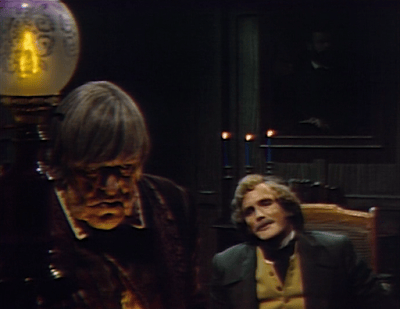
We also met much-put-upon indentured servant Ben Stokes. Ben was played by Thayer David, who first joined the cast of Dark Shadows in 1966 as crazed handyman Matthew Morgan. Matthew was so maniacally devoted to matriarch Elizabeth Collins Stoddard that he inadvertently killed a friend of hers whom he imagined to be her enemy and was about to deliberately murder another of her favorite people, well-meaning governess Victoria Winters, when the ghosts who haunt the estate of Collinwood emerged from the background and did him in. When we met Ben, he was as open-hearted and kindly as Matthew was dark and twisted.
Barnabas was the one member of the Collins family who took a liking to Ben. He taught Ben to read. Later, Barnabas would press his father, haughty overlord Joshua Collins, to free Ben from his indenture. When Barnabas became a vampire, Ben repaid his kindness by protecting him and abetting his crimes. Eventually, Ben’s devotion to “Mistah Bah-nah-bahs” led him to recreate the very crimes that triggered Matthew’s destruction, killing a man in the course of a struggle and murdering a woman in cold blood. We saw that he and Matthew were two versions of the same character. Ben became what Matthew was after a few months in the shadow of the Collins family curse. Matthew had spent his entire life in the shadow of that curse, and so he was doomed from the beginning.
Barnabas brought the vampire curse on himself when he met the gracious Josette, jumped to the conclusion that she could never love him, and consoled himself in a brief affair with her aunt’s maid Angelique. Unknown to Barnabas, Angelique had a talent for witchcraft. When it turned out that Josette did love Barnabas and agreed to marry him, Barnabas cast Angelique aside. Humiliated and enraged, Angelique used her powers of witchcraft to make him into a ghoul and sentence him to exist forever without love. The vampire curse was dramatically satisfying, because Barnabas had been so selfish that it was fitting he should be reduced to a metaphor for extreme selfishness. And Angelique’s declaration that anyone who loved him would die gave an extra pathos to his underestimate of his own lovableness.
As his involvement with Angelique led to Barnabas’ destruction, so Ben’s involvement with her blighted his life. He met Angelique in #372, and thought she was making a sexual overture to him. Without further ado, he walked up to her and took her in his arms. She gave him something to drink first, which made him the victim of a spell that subjected him to her will. As Angelique’s slave, he did harm to Barnabas and others whom he loved, filling him with anguish and self-loathing. Ben did not share Barnabas’ selfishness, so there would have been little point in making him a vampire. But his desperate response to Barnabas’ kindnesses suggests that he, too, believes himself to be unlovable.
Now, the show has traveled back in time again. Mad scientist Julia Hoffman, Barnabas’ devoted friend in 1970, escaped a disaster in that year by passing through a time warp that took her to 1840, when the seeds of the disaster were planted. Barnabas used some mumbo-jumbo to project his 1970 personality into his body as it was in 1840 and joined her there. The two of them needed help establishing themselves in the Collinwood of that period. They found that Ben was living there and that he was still devoted to Barnabas. Ben was very old, but also amazingly resourceful. He was able to provide Julia with contemporary clothing and a set of luggage that she seemed to have left at the Collinsport Inn, and to substantiate the story that Barnabas and Julia were the son and daughter of the original Barnabas Collins. Now they are securely ensconced in the bosom of the Collins family. At the rate Ben has enabled them to go, Julia and Barnabas should be able to solve all the problems they face in another week or two.
Of course, it cannot be so. Ben sees that Desmond Collins, a cousin of the Collinses who live in the great house, has brought a severed head back from a trip to the southeastern coast of China. Ben recognizes this loathsome thing as an object that was mentioned in connection with a series of murders many years before. He has gone to Desmond’s home, a mansion known as Rose Cottage, and left a book with a chapter about the murders and a note urging him to destroy the head. He also spent some time looking at the head and telling it he was going to see to it that it was destroyed. That turns out to have been unwise; when Ben is walking home through the woods, the head appears to him and he cries out in distress. The next morning, Ben’s corpse is found. It looks as if he tried to cut his own head off.
The Happy Couple
In March 1969, Barnabas began the longest of all Dark Shadows’ excursions backward in time when he went to the year 1897. When he arrived at Collinwood, the matriarch of the house was dying. She was Edith Collins, nonagenarian widow of Gabriel Collins. On her deathbed, Edith reminisced about the difficult relationship she and her darling Gabriel had with Gabriel’s father, Daniel Collins, master of Collinwood. At the time, that startled longtime viewers. We had seen Daniel as a twelve year old boy in the 1790s segment, and he seemed pleasant enough. But if we were to believe that he was the man his daughter-in-law remembered decades after his death, he grew up to be bitter and estranged from his own nearest kin.
We have met the adult Daniel, and he is indeed a difficult sort. He is confined to the tower room in the great house because of his unfortunate tendency to mistake women for his late wife and to try to kill them as he killed her. He also has dementia, so that people have to keep telling him which members of the family are dead and what year it is. In fairness to Daniel, these points are extremely difficult for anyone to keep track of on Dark Shadows. We’ve also heard that Daniel has a heart condition that medical science as of 1840 is powerless to do anything about.
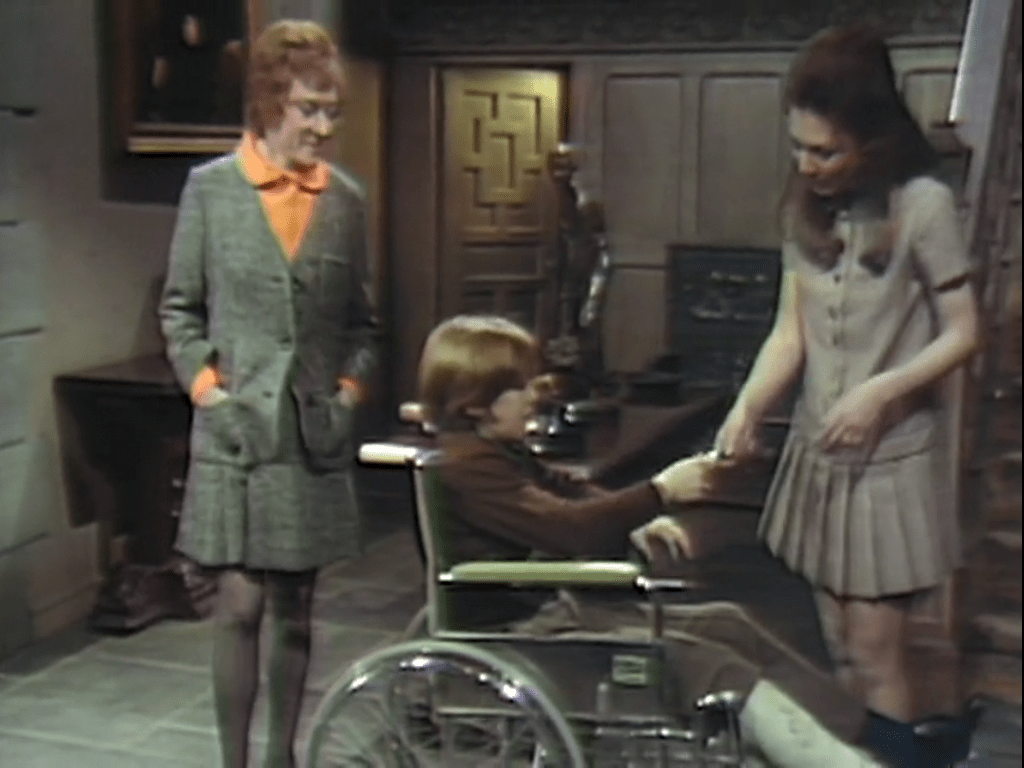
We have met Gabriel, too. He uses a manual wheelchair to get around; apparently he is quite skilled with it, since he keeps appearing in rooms on every floor of the house without any apparent assistance getting up and down stairs. He is a vicious bully, a characteristic Edith did not bring up in her deathbed reminiscences.
Today, we meet the young Edith. She is played by Terrayne Crawford, who in the 1897 segment played lady’s maid Beth Chavez. We haven’t seen her on the show since Beth’s final appearance in #880, though she did have a small part in the feature film House of Dark Shadows which was in theaters at this time.
Unlike the dying Edith of 1897, this version of the character despises Gabriel. There is an amusing idea in there. Perhaps in the 57 years between what we see today and what we saw then, Edith talked herself into believing that she and Gabriel had a lovely marriage and that only Daniel’s hostility gave them trouble.
If that was an idea they were planning to develop, they probably should not have given the part of Edith to Miss Crawford. She seems to be a very nice person, but she had severe limitations as an actress. All of the roles in the 1897 segment included dialogue which called for the depiction of multiple layers of feeling at once, and Miss Crawford was alone among the cast in failing to meet this challenge even a single time. So when Beth tells a devastatingly handsome married man that she doesn’t want him to make passes at her, that’s all there is to it- she simply does not want that, and he simply is a jerk for continuing to do it. We can see no conflict within her to set up a story in the course of which she will stop resisting his charms and begin an affair with him.
Eventually they started writing Beth as a one-dimensional character. That allowed Beth to be part of the story, but they did have to sacrifice some themes they had apparently meant to develop. So in her first appearance, Beth reacted with alarm when a Romani character dropped a hint that she was going to reveal to the Collinses that Beth was Romani, too. That fit with Beth’s origin as a servant who had come to Collinwood in the train of Jenny Collins, who was herself secretly Romani. But delivering on it would have required Beth to have more complicated feelings than Miss Crawford could be relied on to portray, so that was laid quietly to one side.
Showing the audience that Edith is the sort of person who will, in her own mind, eventually retcon her crappy marriage into a great but haunted romance would place even greater demands on a performer than would showing that Beth is hiding the facts about her ethnic background. But as we see her today, Miss Crawford seems to have become an even worse actress than she was playing Beth a year ago. She keeps changing her tone of voice in the middle of her lines for no apparent reason, making us wonder if she is trying to suppress the hiccups. That isn’t because she is tense- on the contrary, she is relaxed and comfortable, with a big grin on her face, an inexplicable affect when every conversation Edith has consists of everyone reviling and threatening everyone else.
Gabriel is in a good mood despite Edith’s loathing for him. He is blackmailing the evil Gerard Stiles into murdering Samantha Drew Collins, widow of his brother Quentin Collins. This will leave Daniel with no choice but to leave the Collins fortune to Gabriel. Samantha has no suspicion that anything like this is going on, but she does know that Gabriel hates her and cordially returns his hatred.
Gerard has told Gabriel that he will give Samantha a poison that will cause her to have a fatal stroke while he and she are in the village and Gabriel is at home, so that she will die in front of witnesses and no one will suspect him even if it is discovered that the stroke was artificially induced.
Gerard comes back to Collinwood. Gabriel menacingly says that “If you tell me anything went wrong…” Gerard replies that nothing went wrong. It is done. Delighted, Gabriel asks for all the details. Gerard says that he and Samantha made a stop at the police station to arrange for Ben’s body to be released for burial. Gabriel asks if it happened at the police station. Gerard says no, then goes on to say that they went from there to the bank. Gabriel asks if it happened at the bank. Gerard says no. He then says that they went to the courthouse. Gabriel is thrilled at the idea that it happened at the courthouse, and Gerard confirms that it did happen at the courthouse.
Gabriel asks where the body is now. Before Gerard can answer, the front door opens and the body comes walking in. What happened at the courthouse was not Samantha’s death. It was Gerard and Samantha’s wedding. Gabriel is dumbfounded.
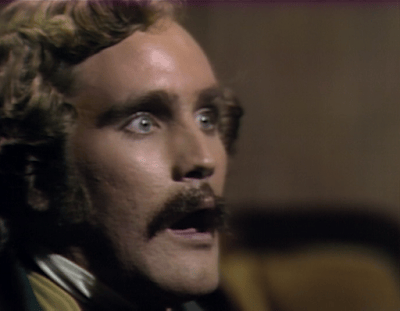
When he first joined the show in January 1970, Christopher Pennock had some troubles with line delivery that limited him almost as badly as Miss Crawford’s weaknesses limited her. But he has grown by leaps and bounds over the last ten months, and he really breaks through as Gabriel. The three “It happened in the–” questions and his responses to the answers they elicit are pattern from a bit that was old when Gallagher and Shean did it in vaudeville in 1910, but he and James Storm execute it so well that it feels fresh today. The expression on his face when he learns that Samantha has married Gerard is just exquisite.
The measure of Pennock’s success came earlier in the episode, when Samantha slapped Gabriel in the face. Virginia Vestoff is likable enough that her characters can get away with almost anything, but not even she could sell an audience on an able-bodied person who physically assaults a wheelchair user. But Pennock has established Gabriel as such an utter louse that we can see Samantha’s point.
Also in this episode, Samantha clears the toys out of a space known as “The Playroom.” It is explicitly acknowledged that her son Tad had outgrown the toys in it long before, a point the fans like to make whenever The Playroom is mentioned. Samantha has set aside her earlier resolution to leave the room unchanged to honor Tad, who was washed away in a storm at sea and is presumed dead, along with his father Quentin. She has decided the time has come to move on from the past.
The time warp that brought Julia to 1840 was localized in The Playroom, so we wonder what clearing it out will do to the prospects for a return trip. Also, The Playroom occasionally popped into being, complete with Tad’s old toys, in 1970 and in 1995, due to the influence of a bunch of ghosts of people from this period. So while first-time viewers will not likely find any significance in Samantha’s redecoration project, returning viewers may have many questions about it.