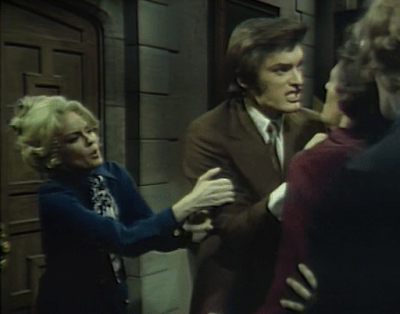
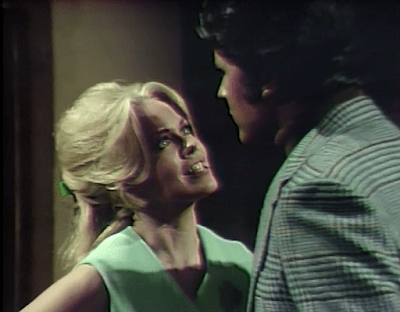
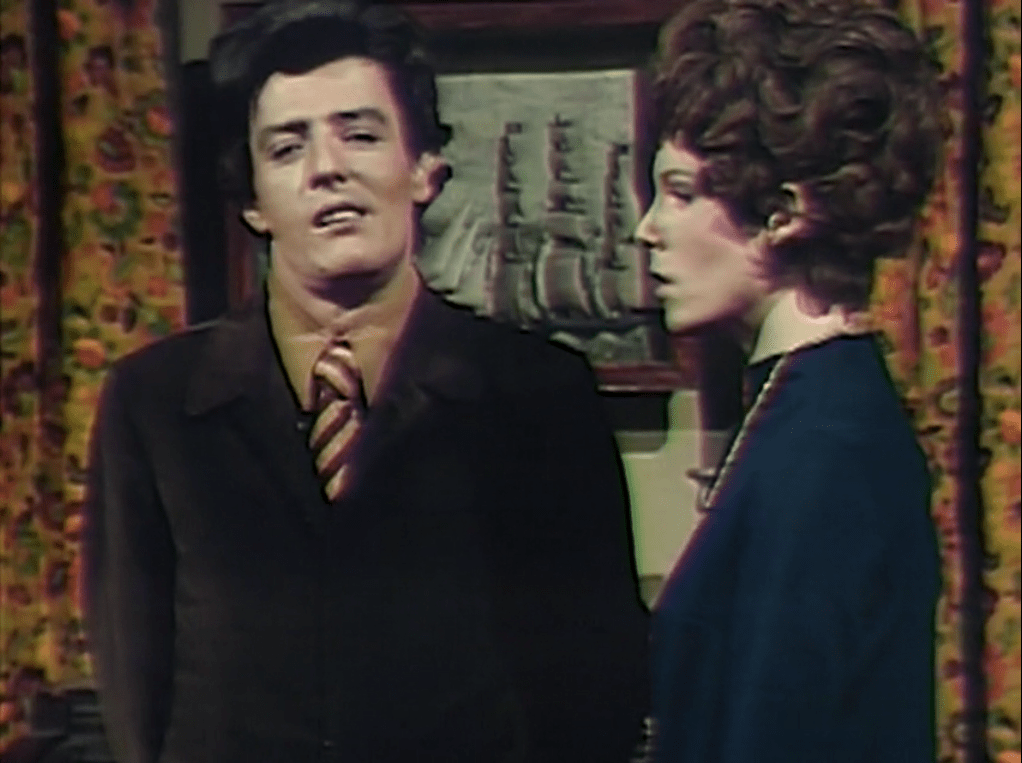
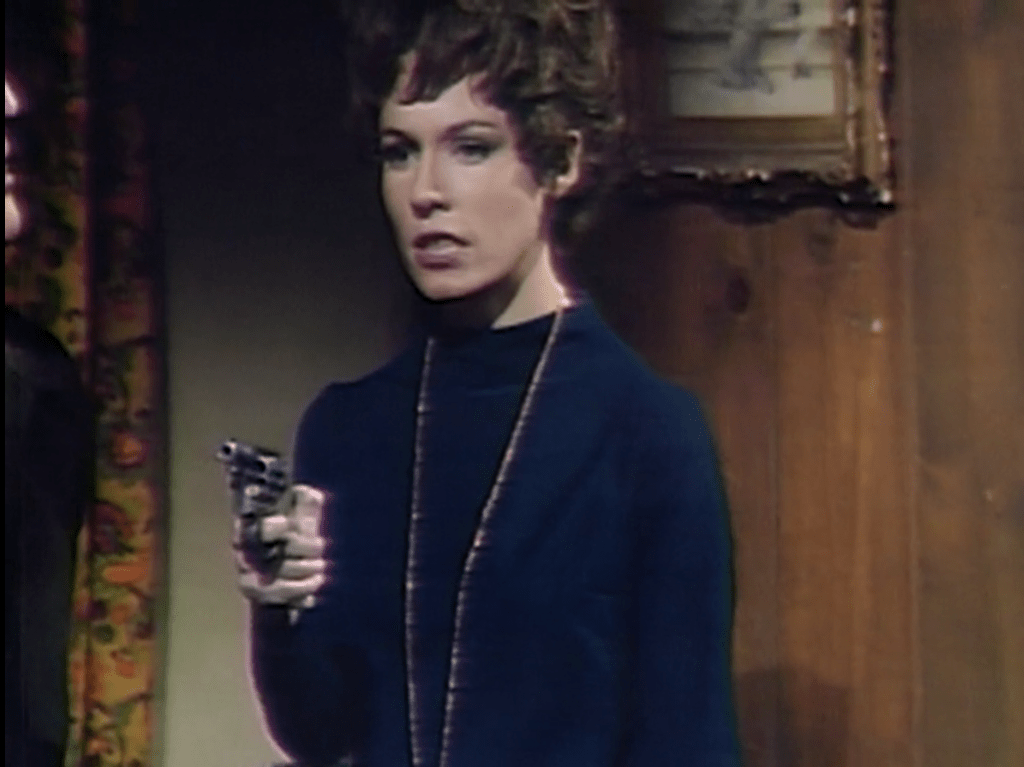
Episode 1114: I am the stranger

In June, Dark Shadows was set in an alternate universe to which vampire Barnabas Collins and mad scientist Julia Hoffman had traveled. Julia and Barnabas found a comatose woman. Barnabas took one look at her, saw how silent and immobile she was, and fell in love. He’s dead half the time, so we can’t judge him for that reaction.

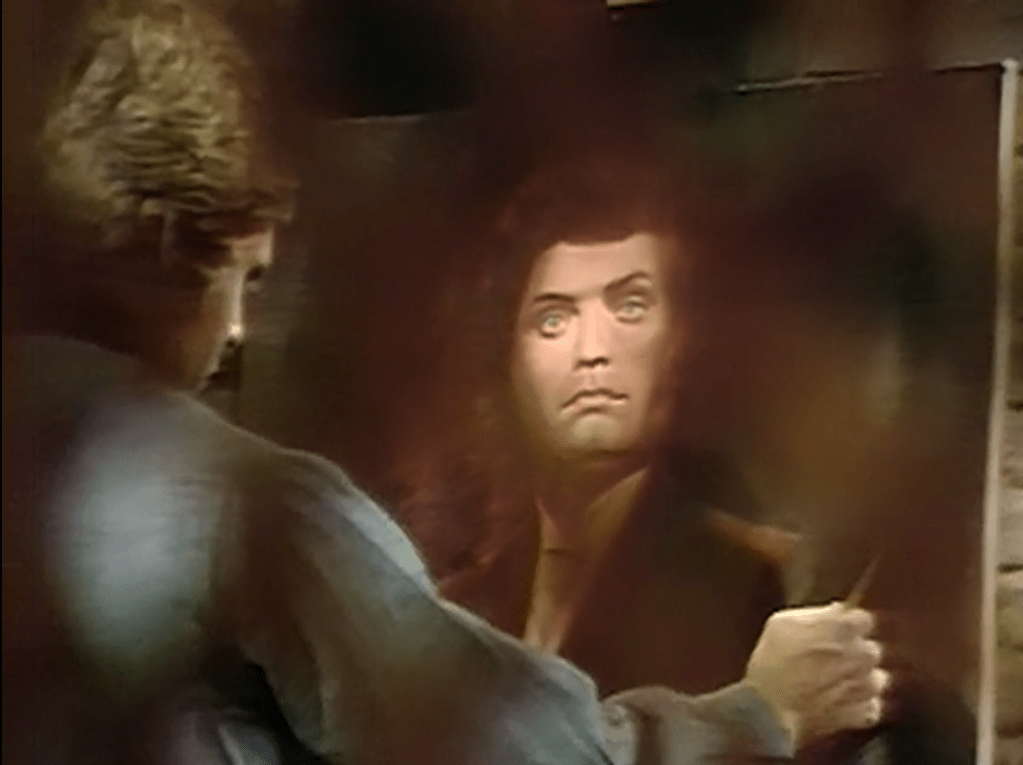
The woman’s name was Roxanne Drew, and Barnabas’ love for her survived even after she regained the ability to walk and talk. Roxanne didn’t make it to the original continuity when Barnabas and Julia returned there in July. Barnabas’ sorrow for her was lightened in #1081, when he met Roxanne’s counterpart in his native universe. Their relationship took a turn for the worse in #1106, when he discovered that she, too, was a vampire. In #1107, he found out that Roxanne was alive in 1840, and that she underwent a mysterious and terrible change in that year.

Now, Barnabas is keeping Roxanne chained in her coffin in the secret room behind his bookcase. Julia has traveled back in time to 1840 and hopes to prevent a disaster that has destroyed the great house of Collinwood and its residents. Trying some mumbo-jumbo that he hopes will lead him to join Julia in the past, Barnabas has a vision of a tombstone saying that she died on 6 October 1840. He and his friend Timothy Eliot Stokes go to the graveyard and see such a tombstone there. Barnabas says that 6 October is three days away; the episode was originally broadcast on 1 October 1970, which is more than three days from 6 October. But there is a weekend in between, and days when the show isn’t on don’t count.
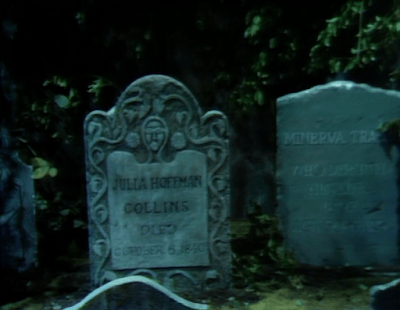
The stones. Screenshot by Dark Shadows Before I Die.

Barnabas says that he must find a way to travel back in time before 6 October. Stokes asks why, and Barnabas says he himself doesn’t understand how it works. But regular viewers know that anniversaries have a power in the cosmos of Dark Shadows that physical laws have in our world. If an event took place exactly 130 years ago, or any other number of years ago, it is possible for people in the present to interact with that event in ways they cannot on other days of the year. That has been the case ever since undead blonde fire witch Laura Murdoch Collins was on the show, before Barnabas made his first appearance.

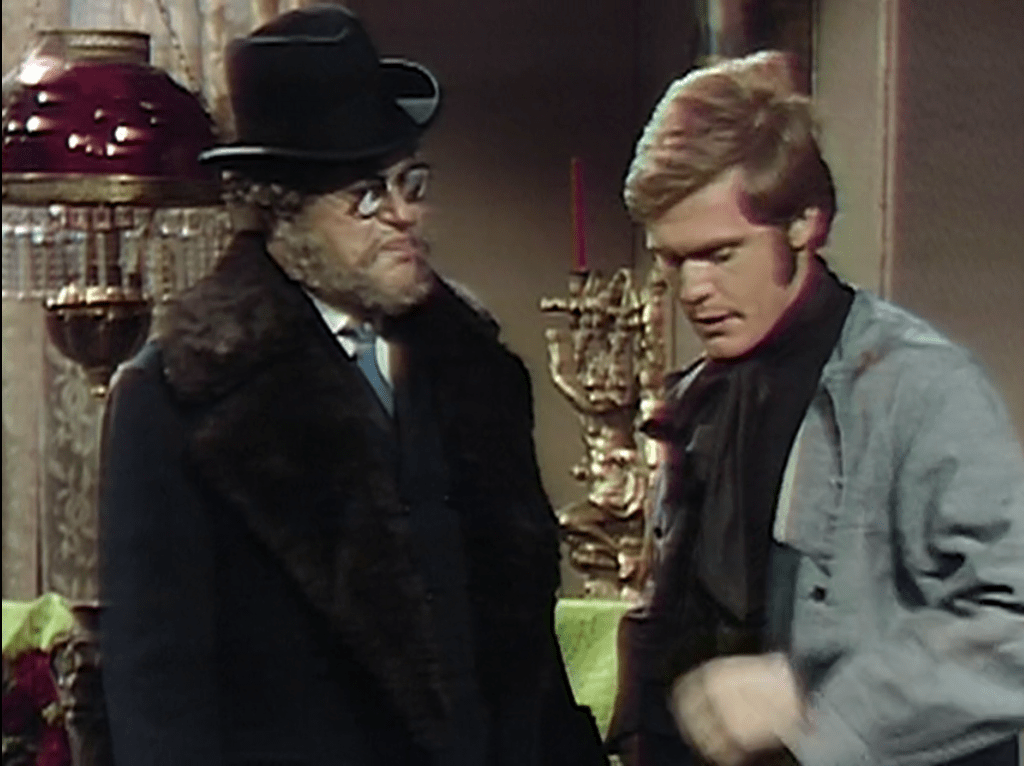
Julia’s grave is next to one commemorating Minerva Trask, a hateful biddy who was one of the most effective villains during the period in 1969 when the show was set in 1897. That turns out to be foreshadowing. The scenes with Barnabas and Stokes in a contemporary setting are a prologue to an episode set mostly in 1840. Julia meets the living Roxanne, who is accompanied by Lamar Trask, a kinsman of Minerva’s loathsome husband Gregory.

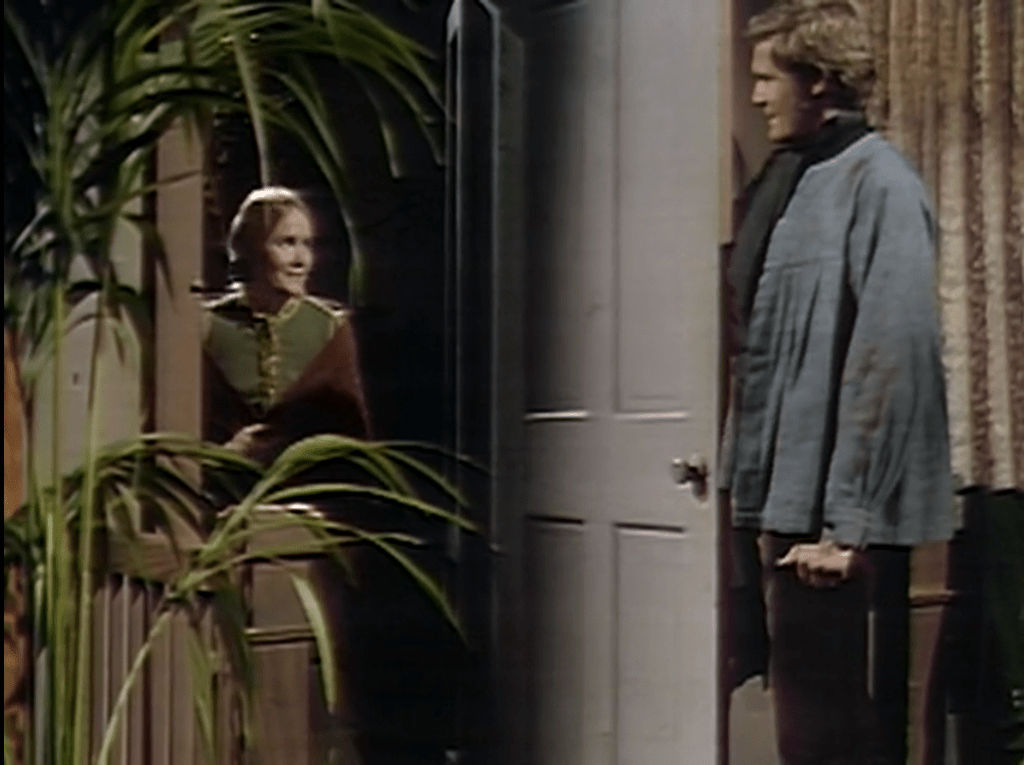
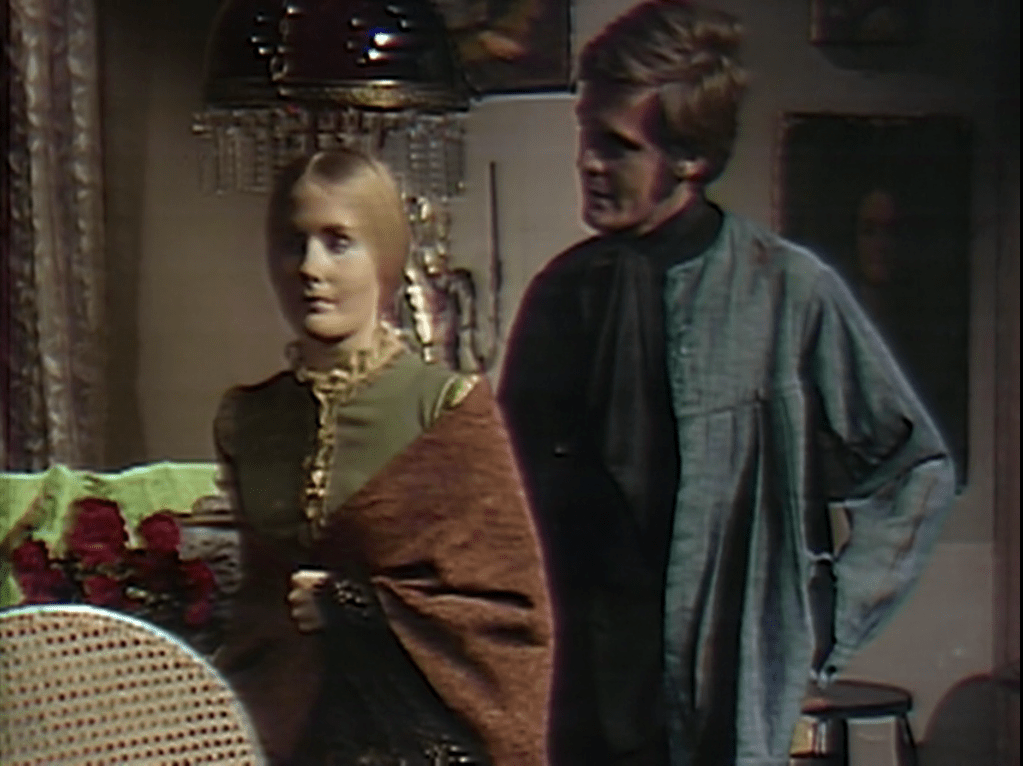
Julia is a guest at Collinwood, impersonating Barnabas’ imaginary daughter and telling the family to await the arrival of her brother, Barnabas Junior, who looks remarkably like their late father. Julia is in the drawing room, talking to herself about how much she misses Barnabas, when Roxanne enters. Roxanne makes a little joke about talking to inanimate objects, and introduces herself as the sister of Samantha Drew Collins, wife of the missing Quentin Collins and lady of the house.

Trask enters. Julia is startled to see him. Roxanne asks Julia to guess what business Trask is in. She says she could not possibly, and Trask protests that guessing games are silly. That’s a shame. Julia must have seen What’s My Line?; we can imagine her asking “Is there a product connected with what you do? Is the product bigger than a bread box? Is the product alive? Are your services equally available to men and women?” etc.

Roxanne says that Lamar is an undertaker. She spits the word out, and asks him sarcastically if he prefers to be called a mortician. She reviles his profession in quite vigorous language. The dramatic date may be 1840, but at this moment we are very clearly in the aftermath of Jessica Mitford’s 1963 book The American Way of Death, an extremely influential polemic against the mortuary industry.

Lamar insists that Roxanne go out on the terrace to talk with him privately. When they are gone, Julia wonders to herself what will happen later this year to turn Roxanne into a vampire. She really ought to know. She released Barnabas from his chained coffin the other day, hoping that he would already be her friend returned from the future. But instead he was the same monster sealed up there in the 1790s, who had no idea who she was. Had his old friend Ben Stokes not shown up in the nick of time, Barnabas would have killed Julia then and there. He has gone on to take other victims, killing some of them, and remains at large. So it seems quite likely that Barnabas will bite Roxanne to death, causing her to rise as a vampire. When that happens, Julia will be to blame.

This is a temporal paradox. Julia hadn’t traveled back to 1840 when she first met the vampiric Roxanne, and Barnabas hadn’t been out of his coffin between the 1790s and 1897 at that point. Roxanne’s vampirism was involved in the circumstances that led to Julia’s trip to 1840. So the vampirism caused the trip that caused the vampirism. And Roxanne the vampire had clearly never seen Barnabas before when she met him in 1970. Of course it doesn’t make logical sense, but so much of the story is made up of the consequences of Julia and Barnabas’ bungling that it would be wrong if it were any other way.

On the terrace, Lamar asks Roxanne to marry him. She refuses, angrily. My wife, Mrs Acilius, said that it was odd Lamar wanted to marry Roxanne, since she obviously hates him. I pointed out that he seems to hate her as well. Many married couples come to hate each other over the years, so I suppose it is a time-saver of a kind if two people get married who already hate each other.

Lamar keeps telling Roxanne that he made a deal with her father to marry her, and she keeps telling him that she doesn’t care. She wants to marry a mysterious stranger who will sweep her off her feet and show her a new life. Barnabas is eavesdropping from behind the wrought iron fence. He has not met Roxanne before, and cannot see her well, but he can well imagine himself being a mysterious stranger who will change everything in a woman’s life. Moreover, Barnabas hears her raging at Trask, whose late father was an enemy whom Barnabas killed with an even higher degree of sadism than is usual for him. Since Trask Junior looks and sounds just like Trask Senior, Roxanne’s hostility to him is enough to make Barnabas feel a special closeness to her.

Barnabas approaches Roxanne after Lamar has left. He persuades her to invite him to her home. When Barnabas was first on the show in April and May of 1967, they made good use of the trope that vampires can enter only where they are invited, but they soon became very inconsistent about that. It places a restriction on Barnabas’ movements that can be story-productive though, so I’m always happy when it seems they will be bringing it back.

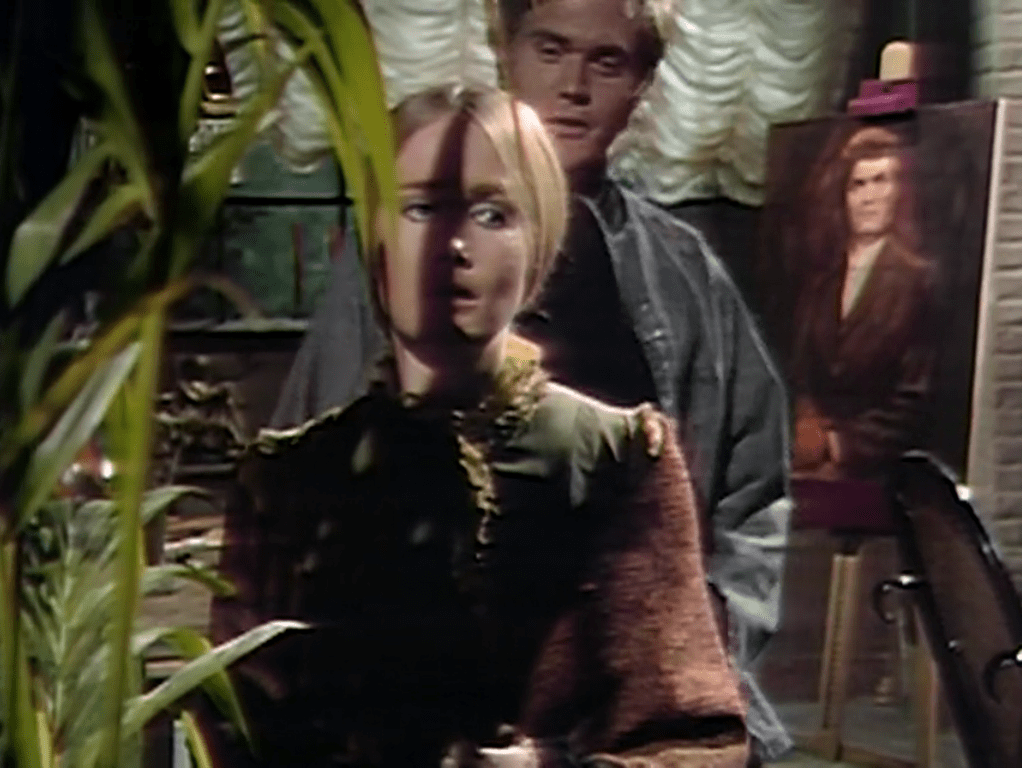
In her room, Roxanne is disappointed Barnabas did not call. He materializes inside her window. She can’t very well be happy about that, but he talks her out of screaming. She looks into his eyes and falls into a trance. He bares his fangs, and she tilts her head to offer him her neck. Her fate would appear to be sealed.

This is the first episode credited to Lela Swift as line producer. Swift has been with the show as its principal director from the beginning. Even though Henry Kaplan is listed as director today, it has the crisp look and inventive compositions that characterize Swift’s style, not the muddy images and extreme closeups with which Kaplan was content to fill the time. We can hope that, with Swift in the driver’s seat, the show will consistently meet her high standards of visual strategy.
Episode 1110: A room filled with toys

Mad scientist Julia Hoffman has escaped from a band of zombies who were wrecking the great house of Collinwood. From her perspective, it is a few moments after she saw her friend, vampire Barnabas Collins, wrestling with the zombies and urging her to save herself by walking down a mysterious staircase. But she soon discovers that she has left the year 1970 and made her way to 1840, when both the zombies and the ghosts who have triggered their destructive actions were living human beings.

Julia enters the staircase from a playroom that is only intermittently present in 1970 and walks down its two flights. She exits into the same playroom, which is a normal presence in 1840. We saw this same distortion of space in #1070 and #1071, when Julia and Barnabas used the staircase to escape from the far-off future year of 1995 and return to 1970. It was an effective way of expressing the magical nature of the staircase and the playroom then, and is still effective the second time.

When they opened the playroom door on their return to 1970, Barnabas and Julia saw a girl in the corridor. That girl appeared to be a ghost named Carrie whom they had met in 1995, but turned out to be a living girl named Hallie Stokes who had moved into Collinwood while they were away on their bizarre cosmic journey. Now, Julia opens the door and sees the living Carrie in the same corridor.

Hallie was the niece of occult expert Timothy Eliot Stokes and therefore a descendant of much-put-upon indentured servant Ben Stokes, whom we got to know from November 1967 to March 1968, when the show was set in the 1790s. We learn today that Carrie is Ben’s granddaughter, and that he and she are staying in the great house as the guests of Daniel Collins.

We saw Daniel in the 1790s segment. He was played then by David Henesy, who was eleven years old at the time. Mr Henesy looked a lot older in September 1970 than he had three years before, and he was an accomplished young actor. But it would likely have been beyond even his abilities to play a character well into middle age, so when we see Daniel from the knees down later in the episode we can be fairly sure he will turn out to be someone else.

Julia sees a confrontation between Carrie and a tall young man in a wheelchair. The man turns out to be Daniel’s son Gabriel. He insists Carrie open the door to her grandfather’s bedroom and push him in. Carrie objects, and Gabriel sneers that she is not to tell a Collins what to do at Collinwood. He berates her, saying that while others may indulge her because they are impressed by her good looks he sees only her impudence. She capitulates to his demands.

In the room, Gabriel turns his abusiveness against Ben. He orders Ben to break some bad news to Daniel. Word has come that Daniel’s son Quentin and Quentin’s son Tad have been lost at sea. Ben protests that Daniel is in no condition to receive such news. Gabriel digresses and says that he cannot make his own living; Ben tells him that many men in worse condition than he is have done, which only makes him angrier than he was to start with. Gabriel regrets his inability to stand up and strangle Ben. We can see that he’s a true Collins; they are a strangley bunch. He then says that he is now likely to become Daniel’s heir, and threatens to evict Ben and Carrie from Collinwood when he does. He menaces Ben with the prospect that he will use his position to make Carrie’s life difficult if he does not obey him now. Ben gives in.

Gabriel bullies Ben. Screenshot by Dark Shadows Before I Die.

When Ben returns to his room he finds Quentin’s wife, Samantha Drew Collins, waiting for him there. He tells her that the news did not prompt Daniel to change his will. She is still in line to inherit the estate when Daniel dies.

Samantha goes to the drawing room, where she finds Gabriel playing a one-handed game of chess. She is smugly pleased with his dismayed reaction to the news that Daniel has not changed his will. She exits and later returns with word that Daniel has escaped from the tower room. The Collinses have always made a practice of keeping mentally ill family members in that room, and Samantha and Gabriel are so frightened by his escape that we can assume Daniel’s illness disposes him to violence.

Julia emerges from the shadows in Ben’s room. Ben is alarmed to see her, and horrified when she identifies herself a friend of Barnabas’. She claims that she is not a monster, which is a defensible claim, given a very narrow definition of “monster.” When she tells him about traveling back in time from a future period when Barnabas is free to prey upon the living and she is his best friend, he says that she is mad. She denies being mad, which is what a person would do when they are as far from sanity as she is. Ben is leery, but agrees to help her. He escorts her back to the playroom and tells her to stay there until morning. Of course she leaves the room very shortly thereafter, and as soon as she enters the corridor Daniel grabs her by the throat.

The drawing room is downstairs; Ben’s room and the playroom are upstairs. No one seems to be helping Gabriel get from one floor to another, and there is no sign of any ramp or other contrivance that would make it possible for wheelchair users to get themselves from one floor of the house to another without help. Odd as this is, it is not a first on Dark Shadows. In January and February 1970, strange and troubled boy David Collins used a wheelchair in a few episodes because David Henesy had actually suffered a leg injury. David kept going up and down stairs by himself, without explanation of how such a thing was possible. I suppose they got few enough letters complaining about the illogic of that movement that they decide they could get away with it again.

Carrie has three scenes. In addition to her encounter with Gabriel, she talks with Samantha in the playroom and with her grandfather in his room. As Hallie, Kathleen Cody was in a state of maximum nervous tension from the start, so that she had nowhere to go in response to anything that might happen. As Carrie’s ghost, she often swung to the opposite extreme, being so blandly cheerful that she made no impression at all. She did put in a few good performances in the 1970 segment, however, and she is quite good as Carrie today.

Samantha is played by Virginia Vestoff, making her Dark Shadows debut. Vestoff was a distinguished performer who is now remembered chiefly for her role as Abigail Adams in the original Broadway cast of 1776 and of the 1972 film based on that musical. The Broadway cast also included several other Dark Shadows alums- David Ford (Sam Evans #2, Andre DuPres) as John Hancock, Emory Bass (Mr Best) as James Wilson, Daniel F. Keyes (The Cemetery Caretaker) as Josiah Bartlett, and Peter Lombard (Oberon) as a stage manager and understudy for the roles of Stephen Hopkins and Thomas Jefferson. All of those, aside from Lombard, also appeared in the film. Vestoff died of cancer in 1983, aged 42, a major loss to the world of the theater.

A great deal of emphasis is placed today on Samantha’s maiden name, Drew. We have in the last few months met two characters named Roxanne Drew; we can take it that Samantha will turn out to be related to one of those in some way.

Longtime viewers, learning that Daniel and Ben are in the 1840 story, will readjust their expectations. Most of what we saw in the ten weeks leading up to this uncertain and frightening journey into the past was recycled from a story that ran from December 1968 to March 1969 and culminated in a trip to the year 1897. So we may have come in thinking there would be a retelling of 1897. But seeing Ben and Daniel, we have the prospect of a sequel to the 1790s segment. That does sound like a fresher idea.

The episode is certainly structured very differently than were the first episodes of either the 1790s segment or the 1897 segment. Those featured a relatively wide variety of brightly lit sets full of busy people, getting us off to a fast start in a new world. Today most of the action takes place in the playroom, Ben’s room, and the corridor between them, with a couple of brief glimpses of the drawing room. We keep cutting to Julia standing very still behind one partition or another as she eavesdrops on the dialogue. We are operating within a very small space, but hearing about people who are far outside that space and whom we are confident we will meet soon. So rather than leading with the equivalent of a panorama of our new surroundings, they are opening the space up for us a little bit at a time. That makes it easier to keep the action moving rapidly and clearly, and also leaves us wanting more.

Episode 1075: A siege of unrelieved tranquility

We come to the end of the first week of The Re-Haunting of Collinwood, a rehash of a story that they got all the good out of when they did it the first time in December 1968 to March 1969.

The story isn’t going anywhere we haven’t been before, but there is some good stuff in this one. Kathleen Cody does an excellent job of acting as teen Hallie Stokes, brooding and subtle as she protests to her friend David Collins about the strangeness of their situation. Miss Cody had a very bad day at the office yesterday, and it is good to see what she can do.

As David, David Henesy commits one of the more memorable bloopers when he is supposed to tell Hallie that “We need a lot more clues” to figure out what is going on, but actually says “We need a lot more cues.”

Director Lela Swift, a gifted visual artist, outdoes herself at several points. I would particularly mention exceptionally fluid shot when Barnabas Collins and Julia Hoffman are in the foreground, in the doorway of the drawing room, and Quentin Collins approaches the through the foyer. Quentin’s loose-limbed, swinging motion combines with Barnabas and Julia’s intensely static pose to create a sense of rapid movement within strict boundaries.

There is some new stock footage of the Moon illustrating a solar eclipse; even though the final shot shows the Moon sprouting a corona at totality, it is so refreshing to see color pictures in this context that we can write that off.

The eclipse itself fulfills one of the cryptic clues a future version of Barnabas’ distant cousin Carolyn gave him, that something important would happen on “The night of the Sun and the Moon.” A lunar eclipse is a night of the Sun and the Moon, all right, but it is not at all all clear that anything that happens today would have struck Carolyn as especially noteworthy, even if she were in today’s episode.

While he is watching the eclipse, Quentin says that he is sad about his great-grandson and great-grand-daughter, Chris and Amy Jennings, and Chris’ fiancée Sabrina Stuart. Chris inherited an old curse of Quentin’s and was a werewolf. Quentin has managed to escape the effects of that curse, and also of aging, but no one could find a way to help Chris. Some time ago, when the show was set in an alternate universe where Barnabas and Julia were staying, Chris, Amy, and Sabrina left. All Quentin says is that he was sorry to see them go “that way.” We never hear a reference to any of them again.

Chris’ storyline ran out of road several months ago, and he was Sabrina’s only connection. So it would be no surprise that they are gone, even if actor Don Briscoe’s health problems had not overwhelmed him. We’re free to believe that Sabrina took Chris to a big farm in the country where he could play with the other werewolves. Amy was so central to the original Haunting of Collinwood segment in 1968 and 1969 that it would be impossible to pretend there was anything new about the Re-Haunting if she were around, so her departure was also inevitable.

Episode 990: Nothing ever goes well in this house

Most of this one is taken up watching people argue with each other about whether they should hold a séance. This puts longtime viewers on familiar ground. We’ve seen fourteen séances on Dark Shadows over the years, and have heard about others. Many of those we’ve seen have been preceded by the sort of wrangling we see today. The most spectacular case was #365. That installment was structured just like this one, one quarrel after another about the idea of the séance, then in the final scene the séance is held and comes to a shock ending.

Episode 365 came at the end of a period when the show was as slow-paced as it ever would be, and when such story elements as they had were all coming to an end. The episode was surprisingly fast-moving and exciting, mostly due to the visual artistry of director Lela Swift. Not only did Swift use a visual strategy that told more of a story than you might have thought was available had you read the script, but her skillful blocking and fluid use of the camera allowed the actors to project a great deal of energy. The shock ending, which the ABC network had spoiled with a series of promos but which I don’t think anyone could have seen coming otherwise, was the show’s first trip back in time. At the climax of the séance, well-meaning governess Vicki came unstuck in time and found herself transported to the year 1795.

Now, Vicki is long gone and mostly forgotten. The show has traveled in time again, not backward but sideways. We are in an alternate universe, which the show insists on calling “Parallel Time.” In this continuity, counterparts of familiar characters have different personalities and are arranged in different relationships than are the people we know.

The episode is much less effective than was #365, not so much from the absence of Vicki or the presence of any of the new characters, but because the director’s chair is occupied by the hapless Henry Kaplan. Kaplan stood at the opposite extreme from Swift. His idea of a well-composed sequence of images was one closeup after another, punctuated by extreme closeups showing us what an actor’s ear looked like when she was speaking a crucial line of dialogue. He takes the trouble to set up some two-shots and even three-shots today, but they put the actors in such cramped little frames that they don’t dare move without a furtive glance at the camera.

The master of the great house of Collinwood is drunken sourpuss Quentin Collins. His penniless siblings and permanent houseguests Elizabeth Collins Stoddard and Roger Collins have just come home from a trip out of town to find family friend Sabrina Stuart in the drawing room, demanding that they hold the séance that Quentin’s wife Angelique ordained for this night. They are shocked, because the night on which Angelique said there would be a séance fell six months before. Sabrina is having some kind of fit that causes her to be unalterably certain that this night is that one.

Angelique died of a stroke at that séance, and Liz and Roger are horrified at the idea of reenacting it. Sabrina’s fiancé, mad scientist Cyrus Longworth, says that she went through a traumatic experience the night before, when a strange man forced his way into her room and terrorized her. He then reports a conversation with a psychiatrist who suggests humoring Sabrina and holding another séance. Cyrus brings Bruno Hess, musician, lover of Angelique, and all-around sleaze to join in the reenactment.

While Roger and Liz were away, Angelique’s identical twin sister, Alexis Stokes, came to stay at Collinwood. Quentin neglected to inform even the people who were in the house at the time that this had happened, setting Alexis up for one terribly awkward encounter after another with people who thought she was her sister returned from the grave. Quentin and Alexis also got alarmingly cozy with each other, prompting his new wife, the former Maggie Evans, to walk out on him after barely a week in residence at Collinwood. So it is no surprise that he didn’t bother to telephone Liz and Roger and let them know they would see Angelique’s identical twin sister when they came home.

Roger is standing in Angelique’s old bedroom, holding a one-sided conversation with her portrait. We know that he is in the habit of doing this; it was what he was doing when first we saw him in #975. Quentin probably knows about it too, since several other people in the house have the same habit and even those who don’t spend a surprisingly large amount of time going in and out of Angelique’s room. Roger turns around and sees Alexis. Believing her to be Angelique redivivus, he nearly faints. She gives him her hand to assure him she is not a ghost, and he will later introduce her to Liz as Angelique’s sister.

Roger’s counterpart in the main continuity was Dark Shadows‘ first Big Bad, a charming, dissolute, narcissistic, cowardly, lecherous wastrel. That Roger Collins was supposed to be killed off when Vicki exposed his crimes, but Louis Edmonds made him such a joy to watch that this was out of the question. Dark Shadows had not yet figured out that a villain could be a permanent part of the cast, so when they decided to keep Roger around they nerfed him into a basically harmless supporting character. He developed gradually from the functional sociopath who in #68 coldly manipulated his own nine year old son David into a murder attempt on Vicki to the stoutly virtuous family man who made his final exit in #979 with a fatherly hand on David’s shoulder.

The Quentin of the main continuity made his debut in #646 as a ghost bent on annihilating all of his surviving relatives. From #701 to #884, Dark Shadows was a costume drama set in 1897, when we met Quentin as a living being. In those days, he was very much what Roger had been in 1966, only younger, sexier, and on a show that isn’t afraid to keep villains around indefinitely. He became a huge breakout hit, and a magic spell was cast that kept him from dying or aging. So when the show returned to contemporary dress at the end of 1969, Quentin was there, alive and intact.

Upon his arrival in 1969, Quentin found himself in the same position Roger had occupied two and a half years before. Everyone wanted him to be a big part of the show, but there was nothing for him to do. Unlike Roger, he was free to be evil, but also unlike him he had no connections to anyone who had anything he wanted to take. In some ways, Quentin is in an even worse position than Roger was. Even in his lovable gay uncle phase, Roger could admit to his sister Liz in #273 that he would have blackmailed her if he had had the chance, an admission that Quentin merrily echoed in #702 when he laughed at his sister Judith’s attempt to buy him off with $1500, boasting that he could blow through that much in a single night, even in a sleepy little place like Collinsport, and that he would shamelessly come back for more. He has no one to do anything like that with now.

Quentin can charm his way to an easy living. In December 1969, mad scientist Julia Hoffman and Broadway star Olivia Corey fought over which of them would get to pay Quentin’s hotel bill, a conflict that was motivated by some story points but that is the sort of thing that might happen to a man who looks like a young David Selby. On a fast-paced supernatural thriller, you have to be something a lot juicier than a mercenary Kept Man to count for much as a villain. No one in the Nixon era owes Quentin anything, so he can’t exploit anyone the way he did Judith and the rest of his immediate family. He has fallen into service as henchman to Julia and her best friend, his distant cousin vampire Barnabas Collins, but something big is going to have to change to find him another place at the center of the action.

Since that is the same problem that cost them Roger, it makes since that in this mirror universe Quentin’s counterpart and Roger’s are revisiting some stages of the development of the Roger from the main continuity. When Parallel Roger first appeared in #975 and #976, he seemed to be, if not the utterly depraved villain of the early days, at least the spineless, snobby, but amusingly sarcastic figure he was through most of 1967. Today he seems to be closer to the responsible family man he dead-ended into being.

This Roger is the first to articulate the reasons why it is inadvisable to reenact a ceremony that cost a life the last time it was attempted. Roger’s position recalls his role in #170, when he was the principal opponent of the first séance shown on Dark Shadows. In that, he was the unwitting stooge of his estranged wife, undead fire witch Laura Murdoch Collins, but the objections he came up with were all about the importance of social respectability and of refraining from doing the thing which is not done, fitting into the image of him as a shallow and unimaginative person. The fact of Angelique’s death gives his objections today a firmer footing and presents him as a representative of sober good sense, but does not make him seem any more dynamic than his counterpart in the main continuity did in #170.

Quentin learns of the proposed séance when Cyrus and Bruno enter the house. He is angry at the sight of Bruno, and reminds him he is not welcome there. Cyrus explains that Bruno is needed for the séance. This increases Quentin’s anger, and he tells Cyrus and Bruno to “go to another house and work your black magic, boys.” They insist on staying, and suggest that Alexis sit in Angelique’s place. After all, Bruno says, why shouldn’t she see exactly how her sister died, from her sister’s point of view. At this Quentin’s anger turns to total rage, and he has to be restrained from attacking Bruno physically. Alexis wants to hold the séance, though, and Quentin gives in. He refuses to participate, but allows the others to gather in the drawing room.

Alexis stops Quentin from attacking Bruno. Screenshot by Dark Shadows Before I Die.

Roger was never given to violence that required his direct personal involvement. Quentin’s reaction to Cyrus and Bruno’s awful idea suggests that the writers are trying to find a way forward for his character. The well-justified repugnance he feels for Bruno, the grotesquely morbid nature of the proposed reenactment, and the breathtakingly irresponsible suggestion that Alexis do the very thing it killed her sister to do, all call for a forceful response. His lunge at Bruno is manful in the best sense, and leads us to wonder if they might try to develop Quentin’s vices into the basis of some kind of heroic action.

When he scornfully tells Bruno and Cyrus to go somewhere else with their “black magic, boys,” it is clear that the writers are thinking in terms of what is possible for Quentin. In 1897, the original Quentin and his fellow Satanist Evan Hanley would hang out in the cottage on the estate corresponding to the one where Bruno lives in this timeline and do all sorts of ill-intended mumbo-jumbo. They could easily have been called “The Black Magic Boys.” That Quentin stood at the opposite pole from this one. Perhaps as the story progresses, we will see these contraries fuse into something more sustainable.

Although we are in “Parallel Time,” a development like that might have good effects on the Quentin of the main continuity as well. Roger’s character changed massively after the flashbacks to 1795 and 1897, merging with the deeply flawed, yet sturdily upright family men whom Edmonds played in those periods. So if they can build a version of Quentin in this universe who is still narcissistic but also capable of saving the day, that might point the way to transforming the Quentin in the established “time-band” into a character who can carry the show as he did for so many months in 1969.

The séance goes forward. Cyrus conducts, and Sabrina goes into the trance. She shouts the word “murder” over and again, and breaks the circle of fingers to point at Alexis. Alexis passes out. That’s the closing cliffhanger. We can be sure Alexis is not dead- it wouldn’t leave the story anywhere to go. Besides, they commissioned a gorgeous full-sized portrait of Lara Parker as Angelique for this storyline. That thing must have cost at least $5000, maybe twice that, and they will never be able to use it again after they go back to the main continuity. There’s no way they are going to blow that much money on a set decoration unless they are planning to feature it in another couple of months of episodes.

Episode 974: The has-beens

Dark Shadows spent a few months trying to put a story together from some themes drawn from the works of H. P. Lovecraft. A race of Elder Gods known as the Leviathan People wanted to escape from their long captivity in the underworld, retake the Earth, and destroy humankind. To that end, they controlled the minds of several people in and around the village of Collinsport, formed them into a cult, and entrusted them with the care of a fast-growing, shape-shifting monster. When the monster was able to assume the form of a grown man, he was supposed to be joined to heiress Carolyn Collins Stoddard in an unholy ceremony that would transform Carolyn into the same sort of being he was, and mark the beginning of the Time of the Leviathan People.

In #965, the unholy ceremony was underway. But the monster, who when he first appeared as an adult invited people to “Call me Jabe,” had decided he would rather become a human than turn Carolyn into a Leviathan. So he called to Carolyn’s distant cousin, old world gentleman Barnabas Collins, to whisk her away from the scene while he used the Leviathan sceptre to smash the Leviathan box, causing the Leviathan altar to explode and the Leviathan high priest to declare that the time of the Leviathans was over. He told Jabe that he had not only ruined the Leviathans’ grand design, but had doomed himself. His squamous, rugose, and paleogean form was his only true form; the tall young man is just a projection that cannot survive on its own.

Evidently, the original plan was that Jabe’s rebellion would begin a second half of the Leviathan arc. In that half, the chief villain would be a Leviathan who had been roaming the Earth for centuries and who wielded powers as great as Jabe’s even though he could not fulfill Jabe’s intended role as harbinger of Leviathan world dominion. The battle that Barnabas, Jabe, and their allies waged against that villain would involve a trip back in time to the 1790s, during a brief visit to which period Barnabas had first encountered the Leviathans. That return to the 1790s would tie the Leviathans into the tales that have become basic to the show’s backstory, including the stories of the gracious Josette, well-meaning governess Vicki, and Barnabas’ first vampire curse.

They abandoned that plan in some haste. The Leviathan arc never came together as a coherent story, and it was a flop in the ratings. So they never introduced the second Leviathan villain. In his place, they brought back suave warlock Nicholas Blair, who had been one of the villains in 1968, and made him the high priest of the cult and Jabe’s supervisor. When we hear about past deeds that Nicholas could not have done, they nonsensically attribute them either to Mr Strak, a character whose whole point was that he was only on the show once and could never be seen or heard of again, or to Jabe himself, who is four months old. The ghost who was supposed to usher in the return to the eighteenth century turns up in two episodes, does some shouting, then meets wicked witch Angelique, who tells him that he is irrelevant to the story and causes him to disappear forever.

Now, the show is gearing up to tell a story about a parallel universe that Barnabas has found in the east wing of the great house of Collinwood. But all the actors we need to kick that story off are in the cast of the film House of Dark Shadows, which had started principal photography by the time this episode was taped. So we have to find a way to take the characters left over from the Leviathan arc and make a story out of whatever it is they are doing.

Even though Nicholas has said in so many words that the Leviathan segment is over, he and his henchman Bruno are still hanging around Collinsport. They are joined by a third stooge, Angelique’s estranged husband Sky Rumson. Sky had been a fabulously successful publisher because of the deal he made when he met Nicholas and sold his soul to him, but now that the Leviathans have been defeated his enterprises are going under. Sky has apparently been crashing at Bruno’s place.

Bruno and Sky are holding a young woman named Sabrina Stuart prisoner. Sabrina had shown up and offered Bruno a packet of cash to leave Collinsport and forget about her fiancé, Chris Jennings, whom he knows to be a werewolf. Bruno refused to leave, saying that he hopes to exploit Chris’ curse for his own evil purposes. Sabrina then drew a gun on him. Before she could shoot, Sky bumbled in and distracted her. Bruno ordered Sky to guard Sabrina while he contacted Nicholas. Sky resented Bruno’s commands, but obeyed them anyway.

When Sky gets Sabrina into Bruno’s back room, she asks him what they are going to do to Chris. Sky lampshades the fact that there is no reason for him to be on the show when he says that he has never heard of Chris and has no idea what is going on. After Bruno and Nicholas have conferred, Sabrina tells Sky that they seem to have forgotten about him. Sky protests that this is impossible, since Nicholas had promised to talk with him about his future. He goes out to the front room, and sees that Sabrina was right. Bruno and Nicholas have in fact left without him.

Sky finds Angelique sitting in the corner, waiting for him. She left him when she learned that he was a pawn of the Leviathans and he tried to set fire to her. She taunts him for his reduced circumstances:

ANGELIQUE: From tycoon to lackey. My, how the mighty are fallen.

SKY: Angelique, what are you doing here?

ANGELIQUE: Oh, I came to see you, Sky.

SKY: How did you know where to find me?

ANGELIQUE: Oh, I’ve been keeping a very close watch on your activities. Tell me-how does it feel to be a has-been?

SKY: What are you talking about?

ANGELIQUE: That’s what you are, you know.

SKY: I said, what are you talking about?

ANGELIQUE: Every one of your business ventures is a disaster. There’s nothing you can do about it, because all you are now is Nicholas Blair’s slave.

SKY: That’s not true! I’m very important to him!

ANGELIQUE: Oh, don’t be absurd. Consider right now, what you’re doing- what he has you doing. Keeping guard over a helpless young girl. You’re not important to Nicholas. He doesn’t care anything about you.

SKY: That’s not true.

ANGELIQUE: What does Nicholas plan to do with that girl anyway? Or hasn’t he consulted you?

SKY: Angelique, shut up!

ANGELIQUE: What’s the matter, Sky? Am I making you unhappy?

SKY: Get off my back!

ANGELIQUE: [Chuckling] Oh, you’ve grown quite thin-skinned in your declining days, haven’t you?

Shall I tell you how it’s all going to end? Nicholas is going to find some ingenious way of doing himself in, he always does. And then you’re going to be alone. All alone. With no one to turn to. And then… Someone’s going to put you out of your misery. Who knows? It may even be me. Well, I better not keep you any longer. I know you have an important job to do in the next room.

Angelique tells Sky off. Screenshot by Dark Shadows Before I Die.

Angelique’s sarcastic characterization of guarding Sabrina as “an important job” not only reflects the lowly status of the work compared to the executive responsibilities Sky recently had as the head of a big business. The story has passed Sabrina and Chris by as completely as it has passed by Sky, Nicholas, and Bruno. Chris knows that on nights of the full moon, he will become an animal who, if not restrained, will kill at least one random person. Both magical and scientific means to relieve him of his curse have failed, but he has friends who will keep him cooped up on those nights so that he doesn’t hurt anyone. Yet he persistently refuses to let them do so. He is deliberately choosing to be a serial murderer. Not only is there no moral ambiguity about him, he has no plans or goals to draw our curiosity and win our sympathies in spite of ourselves. He is a simply and tediously bad person, and to the extent that livelier characters go along with him we like them less. Since Sabrina has no interest in anything other than her relationship with Chris, the two of them are both useless.

Nicholas is puzzled that Jabe continues to exist. He thinks that Jabe’s love for Carolyn, whom he has married, is giving him such a strong will to live that he has managed to hold onto his humanoid form for so long. As Angelique indicated when she told Sky that “Nicholas is going to find some ingenious way of doing himself in, he always does,” Nicholas’ run on the show in 1968 ended with the total failure of all his efforts and his abrupt recall to Hell. But he hopes that he can turn things around for himself. He was only seconded to the Leviathans by his real boss, Satan. He thinks he might be able to get his career back on track in Satan’s organization if he can be the one to destroy Jabe. To that end, he wants to use the werewolf to kill Carolyn, thereby depriving Jabe of his zest for life and making him fade away.

Siccing the werewolf on Carolyn is a typical Nicholas scheme. Even in his monstrous form, Jabe was defenseless against werewolves. So all Nicholas has to do is set the werewolf on him. Bringing Carolyn into it only increases the chances of failure. Moreover, Jabe is likely to be killed off soon, so we might have been willing to believe Nicholas would be the one to do it. But Carolyn has been a core member of the cast since the first week, so once Nicholas promulgates a scheme that involves her death, regular viewers know nothing will come of it.

Moreover, Nicholas has only a short time to make good his designs on Jabe. Angelique blames Jabe for Sky’s involvement with the Leviathans, and has taken a page from George MacDonald’s 1858 novel Phantastes by plaguing him with an autonomous shadow that occasionally appears to him. The shadow that attached itself to Anodos, MacDonald’s protagonist, was an allegory for anxiety as a consequence of unredeemed sin, but the shadow Angelique imposes on Jabe is a direct threat to his physical survival. It grows in size and intensity at each appearance, and when it engulfs Jabe entirely it will kill him.

In the drawing room of the great house of Collinwood, Jabe calls on Angelique to relieve him of the shadow. Nicholas comes instead. Jabe asks him for help against the shadow. He refuses. He does say that he very much hopes that he, not Angelique, is the one who finishes Jabe off, but he will not try to remove the shadow even to improve his own odds of success. Again, we are left wondering why the camera keeps settling on Nicholas if he won’t take action to change the direction of the plot.

Angelique appears to Jabe after Nicholas has gone. Jabe pleads with her to lift the shadow, and she says no. He tells her he had nothing to do with Sky’s recruitment to the Leviathan cult, and that he barely knows Sky. Angelique knows these things to be true, so she pauses before she answers him. She tells him he was the center of the Leviathan conspiracy, so she blames him for everything done in the course of it.

We end up at Bruno’s place. Sky has told Chris that Sabrina is being held prisoner there, and has given him the key. Chris lets himself in and opens a closet. He finds Sky in it, strung up by his wrists and bleeding. Sky begs for help, and Bruno appears. He holds a gun on Chris and greets him with “Good evening, Mr Jennings! Sabrina and I have been waiting for you.”

Writer Gordon Russell deserves a lot of credit for taking this unpromising material and coming up with a well-constructed script with a fast pace and intelligent dialogue. The actors also do a good job, all of them except the woefully inept Geoffrey Scott as Sky.

But director Henry Kaplan really does let everyone down. The episode starts with a fantastically bad job of blocking. Bruno and Sabrina are standing at right angles to each other, enabling us to see both of their faces.

Right angle pose.

Unfortunately, this pose means that when Sabrina draws her gun, she is not pointing it at Bruno, but holding it in front of him and threatening to fire it into the wall. Kaplan’s habit of relying heavily on closeups in lieu of a visual strategy does nothing to obscure this, and viewers who missed yesterday may be genuinely puzzled as to who or what Bruno is afraid Sabrina will shoot.

Is someone over there?

Episode 951: Do something with the body

Old world gentleman Barnabas Collins has fallen afoul of a shape-shifting monster from beyond time and space who once hoped people would call him “Jabe.” The monster, who has settled for the name “Jeb,” turns Barnabas back into what he was from the 1790s until 1968, a vampire.

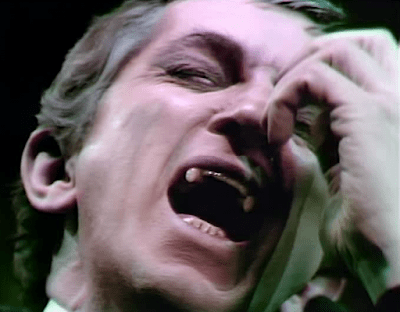
Re-vamped, Barnabas suddenly gets a lot of gray in his hair and a much darker complexion. Makeup artist Vince Loscalzo deserves a lot of credit for these bits of color, they are placed perfectly to emphasize the look of anguish as Barnabas realizes what has happened to him and struggles to resist his urges. The actors’ faces were the medium of Loscalzo’s art, and he outdid himself with these complements to Jonathan Frid’s face.

People talk endlessly about the heroic makeup work Dick Smith did with Jonathan Frid one week in October 1967 and again on a feature film, but Vince Loscalzo did great stuff like this day in and day out for years. Screenshot by Dark Shadows Before I Die.

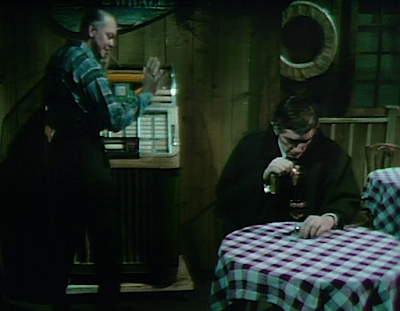
We see Barnabas sitting at a table in The Blue Whale, the tavern in the village of Collinsport. He is the only patron in the room. He has a glass of reddish liquid in front of him, and the bartender is moving around the room. The bartender looks at Barnabas, as if to ask, “How do you like your glass of AB negative, Mr Collins?” But he turns away and moves on.

A young woman enters. Barnabas invites her to join him at his table. He sees that she is wearing a pendant that identifies her as a member of the secret cult that serves Jabe and other creatures who intend to seize control of the Earth, supplanting humankind. Barnabas introduces himself, and says that he was the one who made it possible for Jabe to come to life. This is true, but it is also true that he has become disaffected from the cult. Even after Jabe turned him back into a vampire, Barnabas is still determined to thwart it.

The young woman introduces herself as Nelle Gunston, who was recruited into the cult while living a dreary life with her parents in Virginia. Nelle tells Barnabas that everything has changed for her since she joined the cult. She says that she will gladly do anything she can to advance its objectives, including murder. They have this conversation in nice loud voices while the bartender is nearby.

Barnabas’ friends, mad scientist Julia Hoffman and recovering werewolf Quentin Collins, enter. He introduces them to Nelle, then explains to them that he and Nelle have a private matter to discuss. Quentin and Julia go to the bar, where Quentin orders brandies. They talk about Nelle’s pendant and their fear that Barnabas is falling back under the power of the cult while the bartender is in their space serving them drinks. Evidently they’ve learned to rely on his discretion. They are still deep in conversation when Barnabas leaves with Nelle.

Barnabas takes Nelle back to his place on the pretext that Jabe will meet them there. She asks him why it is so dark in there; he asks her how she got into the cult. She catches on that Jabe is not coming and that Barnabas is not loyal to him. She draws a knife and is about to stab Barnabas when he bares his fangs to her.

Quentin and Julia let themselves into Barnabas’ house. They find Nelle dead on the floor and Barnabas wallowing in self-pity next to her. Julia takes a second look at Nelle and sees the puncture wounds on her neck. She tells Barnabas she will renew the treatments that first put his vampirism into remission two years before; he says there is something else he has to do first. After he rushes out, Quentin and Julia talk about how they will hide Nelle’s body.

Nelle was the perfect victim for Barnabas- no one in town knew her, no one expected her to come, no one will notice she is missing. And he is determined to weaken the cult, so reducing its numbers by one fits his goals.

Barnabas goes to the antique shop in the village. Jabe is in an upstairs room; Barnabas is convinced that Jabe can assume his true form and lay it down only in that room. We saw him do that in a house on an island many miles away in #946, and he told Barnabas that he had done so in #947, but apparently that doesn’t count, somehow. Jabe is far more powerful in his true form than he is when he is man-shaped, but he cannot mingle with humans in that form. So Barnabas believes that he will limit Jabe’s options if he destroys the room. He pours gasoline all around the first floor of the shop and sets a match to it.

Nelle is played by Elizabeth Eis, in her first appearance on Dark Shadows. They say that the first thing actors have to do to work effectively is to pay attention to each other. Eis shows how far this can take you. She listens ravenously to everything Frid says and never takes her eyes off him. The script doesn’t give her a huge amount to work with, but simply by giving her scene partner her total attention she creates a sensational performance. The producers noticed; she will be back later this year in two quite different roles.

This episode is the last time we see either the Blue Whale or Bob O’Connell as the Bartender. The Blue Whale was an important part of the show from its debut in June 1966 until the first costume drama insert began in November 1967. O’Connell appeared as the Bartender in 60 episodes (three of them as other bartenders in other periods of history) and had speaking parts in 6. It’s too bad he doesn’t get to say anything today, but at least he is in the closing credits.

Hail and farewell to Bob the Bartender, the jukebox, and the tavern. Screenshot by Dark Shadows Before I Die.

Episode 890: They will be strangers, but you will know them

Like many episodes of Dark Shadows, this one ran long and ended with credits only for the cast and for Dan Curtis Productions. The entry on the Dark Shadows wiki says that the director was Lela Swift. I am sure that it was in fact directed by Henry Kaplan. This shot of Nancy Barrett as heiress Carolyn Collins Stoddard is proof positive:

There is another flagrant Kaplanism in today’s first scene between antique shop owners Philip and Megan Todd (Christopher Bernau and Marie Wallace.) Philip enters from upstairs. He stops with his waist at the top of the frame. That’s where he stays for the first part of the scene, ending with Megan raising a paper that covers part of her face. Evidently what’s happening between the characters is none of the audience’s business.

Swift was a talented and ambitious visual artist, Kaplan a sloppy and unimaginative one. He relied heavily on closeups. When it dawned on him that it was dull to hold the frame just beyond the edges of an actor’s face, his response was to zoom in and give us an extreme closeup of some part of the actor’s face. It’s above average for him that the first shot above includes Miss Barrett’s eyes- he specialized in shots displaying the face from the nostrils down, and often held them even after the actors had to move, leaving us with the sight of an ear drifting out of our view.

Even when Kaplan’s tight little frames do not keep us from figuring out what is happening in a scene, they deprive us of the energy that comes from seeing the players interact with each other. We don’t get statements and reactions simultaneously, and we don’t see the actors using the space between them to tell us how the characters feel about each other. Kaplan was also a pretty bad director of actors, regularly poking them with a stick as his way of telling them he wanted them to play a scene differently and on one occasion fastening a handle to a child actor so that he could physically place him on his mark during rehearsal. So perhaps his mania for closeups reflected a lack of awareness of what actors do and how the choices they make contribute to the audience’s experience. As a result of his insensitivity to these and other visual aspects of the medium, Kaplan’s episodes would often be better suited to radio than to television.

Fortunately, the dialogue today is peppered with snappy lines. So Danny Horn devotes his post about the episode on his great Dark Shadows Every Day to a selection of memorable pieces of dialogue. That also makes me suspect the wiki is not entirely correct. It attributes the script to Gordon Russell, an able writer overall but one who is not at all given to bons mots. I use bits of dialogue whenever possible as the titles of these posts, and I often have to search very hard through Russell’s to find suitable ones. It was Violet Welles who excelled at producing those. Russell and Welles often collaborated, so it could be that he wrote a draft to which she added the quotable quotes.

The current story centers on a mysterious cult that has sent time traveler Barnabas Collins back to 1969 from a long sojourn in 1897, by way of a couple of days in 1796. Under the influence of the cult, Barnabas is being a real jerk to his friend, mad scientist Julia Hoffman. Barnabas was a vampire for a long time, and even when he is free of the effects of that curse he habitually resorts to murder to solve his problems. But the victims of those murders are imaginary, played by actors who will go on to find other work, so we don’t usually stay mad at him for any length of time when he commits them. His friendship with Julia, on the other hand, is the emotional core of the show. Barnabas’ coldness to her in yesterday’s episode and today’s leads us to see what the cult is doing to him as the greatest crime anyone has ever committed on Dark Shadows.

Barnabas was a pop culture phenomenon familiar to many millions of people who never saw a single minute of Dark Shadows. The show’s fanbase largely consisted of his devoted followers. So a story about a cult which co-opts him as its leader and changes his personality so that he is impossible to get along with directly addresses a fear that must have blacked out the mind of Dan Curtis every time the postal service truck loaded with Jonathan Frid’s fan mail backed up at ABC Studio 16.

Barnabas brought a box with him from his visit to the eighteenth century, and it is of the utmost importance to the vast eternal plan the cult is working on that the box not be opened until the right time. So Barnabas put it on the mantel in his living room, and when Julia was standing a few inches from him he lifted it from the mantel and placed it on a table in the middle of the room. When she asked what it was, he became flustered and refused to answer any questions about it.

When Julia left the house, Barnabas left the room, with the front door unlocked and the box still on the table. Today, we open with Julia coming back in, hearing the sound of breathing coming from the box, finding its key on the table next to it, and placing the key in its lock. Barnabas comes in just in time to stop her opening it, but we can see that the cult probably could have chosen an agent with a better sense of operational security. Barnabas’ function in the story is to make messes that other people will have to clean up, so as soon as we heard that the box must not under any circumstances be opened we expected him to leave it where it would inevitably fall into the hands of someone bent on opening it, though it is a bit disappointing he has done so this quickly.

After he has taken the box from her, Barnabas berates Julia, orders her from his house, and tells her he owes her nothing. He abruptly sweetens up and tells her that he is only carrying on that way because of some kind of temporal jet lag. He reminds her that when she traveled back in time in September, she was very ill for a while; he suggests that his surly mood might be the result of the same shock that caused that reaction. About a minute after he starts on this new tack, just as Julia has started smiling again, a knock comes at the door. It is Carolyn.

We don’t know what effect the cult’s co-optation of him has had on Barnabas, but regular viewers know that characters on Dark Shadows are always acquiring one magical power and losing another. For the last few months of the 1897 segment, the show’s main villain was sorcerer Count Petofi. One of Petofi’s signature moves was to become aware of visitors shortly before they arrived. It could be that the writers have decided to give the cultified Barnabas that power, and that it was because Carolyn was on her way that he wanted to put Julia in a good mood.

That interpretation is supported by what follows. Carolyn is delighted to see Barnabas; she hadn’t known he was back from his trip to 1897. She hugs him and he smiles, a stark contrast to his icy reaction when Julia hugged him yesterday. She wants to talk about Chris Jennings, a young man she dated a few times and whom she has been told is dangerous. Julia and Barnabas have befriended Chris and know that he is a werewolf. Julia thinks she can somehow control Chris’ transformations, and she urges Carolyn to think well of him. Barnabas tells her to trust her instincts and to avoid Chris. He keeps telling her that she is too important to be allowed to come to harm. Later, he visits Carolyn in her home, the great house on the estate of Collinwood, and he keeps going on and on about how important she is and how confident he is about her future. He also gives her a silver pentagram, an amulet to ward off werewolves, and urges her to wear it at all times. He subsequently has another scene with Julia in his own house, and he is just as cold and dismissive as he was in the first scene, exploding at her for being “irrational.” Evidently the cult has plans for Carolyn, but not for Julia.

Julia bought a painting from the Todds the other day, and now they have received a telegram offering to buy it regardless of price. Julia goes to their shop and discusses the telegram with them. She believes that the telegram, which is signed “Corey,” may actually be from Quentin Collins, a distant cousin of Barnabas’ whom he befriended during his time in 1897 and who may have been immortalized by a magical portrait painted by the same artist responsible for the picture Julia bought. She tells the Todds that she is not certain she wants to part with the painting, but that she would very much like to meet “Mr Corey,” and that she believes others in town would also like to do so. She urges them to reply to the telegram with an invitation.

Barnabas stands over the box. We hear his thoughts as he mulls over his questions about it. He suddenly declares “It is time!” Then he goes to his chair and sits down. Evidently, it is time to take a load off.

Barnabas has a vision of one of the hooded figures who inducted him into the cult. The figure, a man named Oberon, addresses him as “Master” and tells him that he is to give the box to people who wake him by knocking at his door. There is a knocking, he does awaken, and he goes to the door.

Episode 882: The show must go on. That’s the one and only rule there is.

Many fantastic tales dwell on a sense that dreams have a great power in the world, and so their characters are often afraid of falling asleep. Dark Shadows has several times referenced Edgar Allan Poe, who explored that fear in stories like “The Premature Burial,” “The Tell-Tale Heart,” and “The Man of the Crowd.” The show brought up another writer of fantastic tales preoccupied with the fear of sleep in #808. Aristide, henchman of sorcerer Count Petofi, threatened an enemy of Petofi’s with “the mysterious shadow he can cast, the shadow that isn’t your own that follows you.” That was a reference to George MacDonald’s 1858 novel Phantastes, in which a man named Anodos is plagued by a shadow that moves about on its own, following him and blighting his existence. Not only does Anodos fear sleep from time to time in Phantastes, but the main theme of MacDonald’s other very popular novel, 1895’s Lilith, is Mr Vane’s long refusal to sleep and the great battle he must wage in the dream-world when he finally does allow himself to nod off.

Aristide’s threat suggested that the show was about to give us a story based on Anodos and the autonomous shadow. Aristide is dead now, and Petofi is running out of story, so that isn’t going to happen, at least not in the segment of Dark Shadows set in the year 1897. But today we do get a little bit of George MacDonald in the form of a battle against sleep. Petofi is casting a spell over himself and handsome young rake Quentin Collins. If Quentin loses conscious control of his mind for even a moment, he and Petofi will evacuate their respective bodies and be re-embodied as each other. Petofi will then transport himself, in Quentin’s body, to the year 1969. Quentin will be left behind in 1897, occupying Petofi’s aging form and waiting helplessly for Petofi’s mortal enemies to come and kill him, thinking they are taking their long-delayed revenge.

By the time Quentin finds out what’s going on, it is the wee hours of the morning, after he hasn’t slept for a couple of nights. His friends, Cockney showgirl/ mentalist Pansy Faye and time-traveler/ recovering vampire Barnabas Collins, keep marching him around the drawing room of the great house of Collinwood in an effort to keep him awake. They don’t brew up any coffee, strangely enough. But Barnabas does call on wicked witch Angelique and appeals to her to use her powers to put some kind of barrier between Quentin and Petofi.

Angelique tells Barnabas that she is reluctant to help Quentin because she is upset that he wants to go to New York and look for a woman named Amanda Harris. She had wanted Quentin to fall in love with her, and is jealous that he chose Amanda instead. Barnabas points out that if she doesn’t help Quentin, he won’t exist in the form that either she or Amanda knew. Angelique explains that she has a reason for her attitude:

Before I came here this time, I was in the everlasting pits of Hell, where other creatures of my kind live. Only, my stay here on Earth made me dissatisfied with my life there. I longed to come back here… To Earth, to become a human being. I begged my master for the chance.

Finally, he gave it to me on one condition and one condition only… That I make one man fall in love with me, without any use of supernatural spells or powers. One man, one chance. That’s what I was granted.

Since Quentin is the one man who represented Angelique’s one chance, letting him go to Amanda might mean that Angelique has to go back down. My favorite part of her speech is “Only, my stay here on Earth made me dissatisfied with my life there.” Sure, she could have been happy in the everlasting pits of Hell, as one is, but how ya gonna keep ’em down on the farm after they’ve seen Pa-ree. Or, since Angelique’s sojourns in the upper world have all brought her to Collinsport, after they’ve had the lobster roll at the Blue Whale.

While Barnabas is talking with Angelique, Pansy is on Quentin duty. She decides to keep him awake by compelling him to join in a performance of her song. A record of this song, performed by Nancy Barrett and David Selby, hit the stores the very day this episode was first broadcast, so this is product placement. But Pansy is doing exactly what she would do in this situation, Quentin is reacting just as he would react, and it is a charming moment.

The musical number is preceded by Pansy making what literary critics call a programmatic statement. “Feel like it or not, you gotta do it, the show must go on. That’s the one and only rule there is, love. So let’s have a bright chorus from that new team, Pansy Faye and Quentin Collins.” Pansy is not only a good pal and a gifted psychic, she is an accomplished scientist. She has indeed stated the complete physics, metaphysics, and every other operating principle of the universe of Dark Shadows when she says that “The show must go on.”

Angelique and Barnabas enter. Angelique insists on some time alone with Quentin. He says that once he gets to New York he most definitely will be looking for Amanda and that he has no interest in a relationship with Angelique. She looks away from him and talks herself into believing it will be OK if he falls in love with her after Amanda “has ceased to exist.” Longtime viewers can be fairly sure this means that Angelique is planning to murder Amanda, but at the moment the important thing is to get Angelique involved in helping Quentin against Petofi.

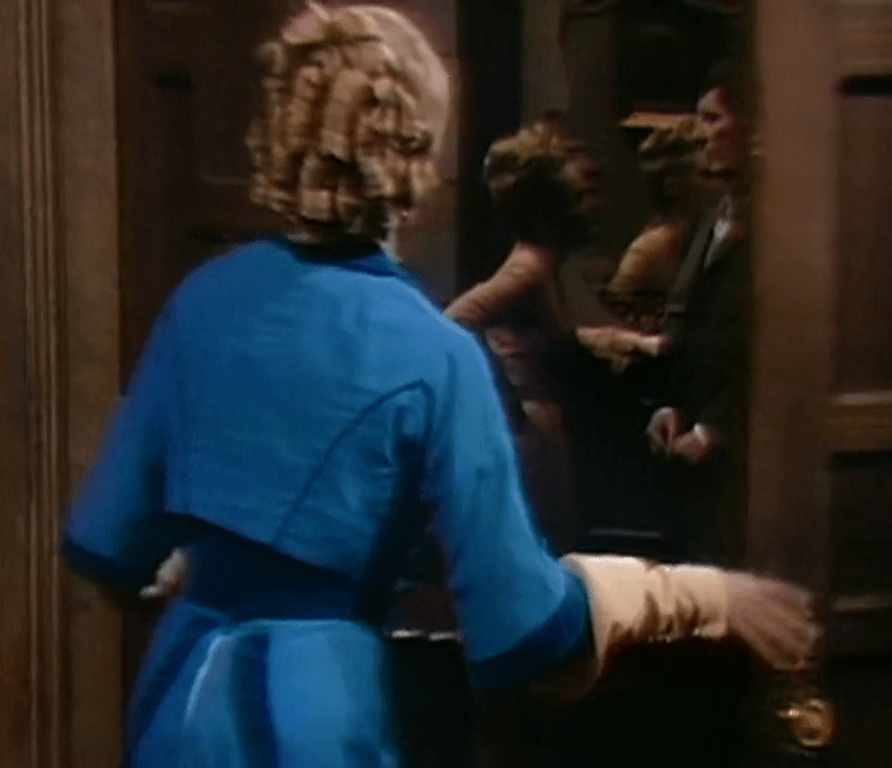
Angelique opens the door to the foyer, where we catch a glimpse of Nancy Barrett and Jonathan Frid doing a really marvelous mime depicting “intense conversation.” It’s one of those deliberately stagey bits of business that these twentieth century New York actors do so well.

Angelique opens the door on a silent “conversation.”

Angelique stares into the fire and tries to project psychic power Petofi-ward. We get a process shot simultaneously depicting Angelique in the drawing room and Petofi in his lair. The shot is not very successful, and Angelique explains that her efforts aren’t working either. She says that Petofi is in so deep a trance that she cannot reach him as she has done before.

Petofi’s surroundings are so heavily decorated that this shot just looks cluttered to me. I suppose having Petofi low in the shot and behind the flames is meant to remind us of Angelique’s old neighborhood, but the visual metaphor is spoiled by the cruddy 1960s TV color palette.
In black and white, as most viewers would have seen it in 1969, the shot has different problems- while the more abstract visual style does make the Petofi-as-Satan metaphor legible, it is less clear which shapes are in Angelique’s space and which are in Petofi’s.

Pansy, eavesdropping from the foyer, hears Angelique say that she will need to have something Petofi is wearing right now, something still warm from contact with him, in order to reach him with her powers. Pansy resolves to provide this, and she sneaks out. She makes her way to his lair, and is about to undo Petofi’s necktie when he comes out of his trance and tells Pansy she has interfered with his plans once too often. We have flashed to the motionless Petofi several times today, leading us to think that Thayer David was going to collect his fee without having to deliver a line. So it is quite effective when he springs into action.

Episode 859: Not this grownup

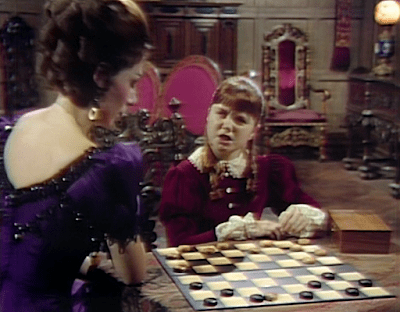
Nine year old Nora Collins enters the drawing room of the great house of Collinwood. She walks in on her father, the stuffy but lovable Edward, embracing Kitty Soames, the dowager countess of Hampshire. She gives them a dirty look and says she supposes Edward is too busy to join her in a game of checkers. He says he does have to run an errand, but suggests that Nora play with Kitty.

Kitty is eager to ingratiate herself with Nora, who clearly wants nothing to do with her. Nora asks, in an icy voice, if the reason Kitty wants to be her friend is that she is planning to marry her father. Returning viewers suspect she is right. Kitty and Edward have more in common than they know. Both are penniless, each is sure the other is very rich, and each imagines marriage to the other will solve all their problems. Kitty can’t very well level with Nora about this, so she claims that the women in the Collins family, being outnumbered by the men, have to stick together. Nora does not hide her distaste at Kitty’s inclusion of herself among the women of the family. Kitty asks Nora if she wants her father to be happy. Nora drills her eyes into Kitty’s face and says in a firm, flat voice “I want that.”

Nora asks Kitty if she is just letting her win at checkers. While she is asking this, Nora moves twice in one turn and takes three of Kitty’s pieces. Kitty watches this without protest and denies that she is letting her win. She then says she wants to concede the game and listen to whatever information Nora is willing to share about the family.

Nora is not impressed with Her Ladyship. Screenshot by Dark Shadows Before I Die.

Edward comes back from his errand to find Nora packing up the checkers and the board. He asks if she enjoyed her game with Kitty. Not looking up, Nora says they never finished it. Kitty hastens back in and asks if she wants to finish it now. Edward points out that it is getting close to Nora’s bedtime. He kisses her, and bids her say goodnight to Lady Hampshire. Kitty asks Nora to call her by her first name. Nora pointedly says “Good night, Lady Hampshire.”

It doesn’t show in her scenes with Nora, but Kitty seems to be suffering from a severe mental health crisis. Returning viewers know that the ghost of Josette Collins is taking possession of her, and suspect that she will turn out to be a reincarnation of Josette. Edward knows enough about the supernatural doings on the estate of Collinwood that he might give Kitty the benefit of the doubt when, for example, she comes running in today and is shrieking about a haunted house, a vanishing woman, and a curse that follows her everywhere. But she is so often so highly distraught that Nora must have noticed that she is not right in the head, and she can hardly look forward to having such a person as a stepmother.

Shortly before Nora enters, Edward calls Kitty “Katie.” This is a small enough slip of the tongue, but Kathryn Leigh Scott’s friends call her Katie, so it is a case of an actor’s name in place of the character’s. I think I can see Louis Edmonds blush a little when he realizes what he has done.

This episode marks the final appearance of Nora, and very nearly the last time we will hear Nora’s name. I think she was badly underused, disappointingly so after the outstanding work Denise Nickerson did as Amy Jennings in the months leading up to the segment set in 1897. She will be back later, in other parts.

Director Henry Kaplan was not much of a visual artist, and his deficiencies are particularly glaring today. Especially during Kitty and Nora’s first scene, the camera keeps drifting up to the actors until we see a randomly selected two-thirds of their faces in extreme closeup. Once the shot excludes the eyes or the mouth, it abruptly pulls back. Even the successfully framed closeups are rarely in focus, and you can forget about finding coherent visual storytelling in any kind of shot other than a closeup. The actors themselves do a good job, in spite of Kaplan’s notoriously unpleasant behavior towards them, but aside from a few evocative facial expressions, most of them by Nickerson, it may as well have been a radio play.

Episode 818: I have but one, and his name is Petofi

The disastrously repressed Charity Trask knows that rakish libertine Quentin Collins is a werewolf, and she wants to warn everyone about him without actually saying the facts out loud. She corners maidservant Beth Chavez in the drawing room of the great house at Collinwood and urges Beth to end her romance with Quentin.

Charity keeps saying that there is something about Quentin that Beth does not know. In fact, Beth not only knows everything Charity does about Quentin’s curse, but a great deal more. She was the very first person to know that Quentin was a werewolf, before Quentin himself knew. She was with him the first time he transformed, and when he became human again in the morning she refused to tell him what she had seen. She had previously seen Quentin murder his wife Jenny, she knows that Jenny’s sister Magda placed the curse as vengeance for that murder, and she was the one who told Magda that Jenny had borne children to Quentin who would inherit their father’s curse. Beth is the foremost authority on Quentin’s condition. But she is protecting him anyway.

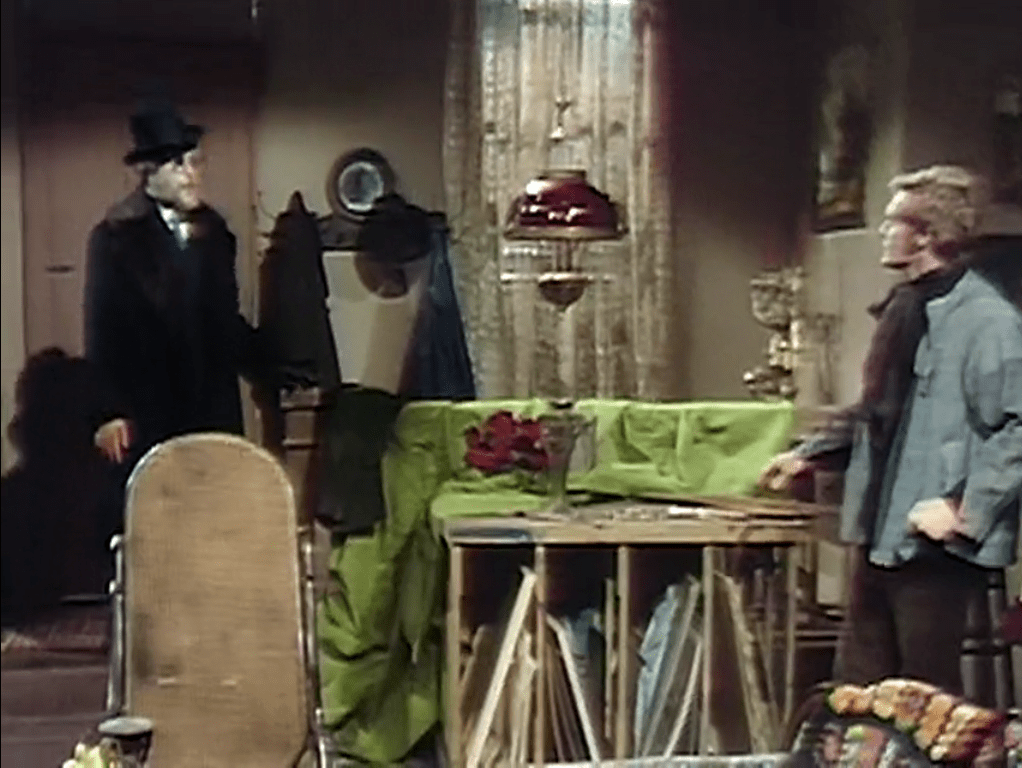
Charity then goes to a set known to longtime viewers as the Evans cottage. In the parts of Dark Shadows set between 1966 and 1968, this set is home to artist Sam Evans and his daughter Maggie, The Nicest Girl in Town. Today the dramatic date is 1897, but the cottage is already an artist’s studio. It is occupied by Charles Delaware Tate, a nationally renowned painter who was commanded by the evil sorcerer Count Petofi to execute Quentin’s portrait. When we first saw Tate in the cottage, he said that he rented it because he’d heard about it from a friend who had stayed there some time before.

The cottage is full of paintings and sculptures. This is odd for a rental. Several possible explanations come to mind. Did Tate bring a dozen or more of his own works to keep him company? Did his friend or other artists who had rented it leave their completed pieces behind? Did the landlords display their own collection there for the edification of their tenants? Easy as these explanations are to think of, none of them seems very likely, and the question is never addressed in the show. The out-of-universe explanation is of course that when the audience looks at an artist’s studio, it expects to see a lot of artwork, and the artwork here gives director Lela Swift a chance to make good use of color.

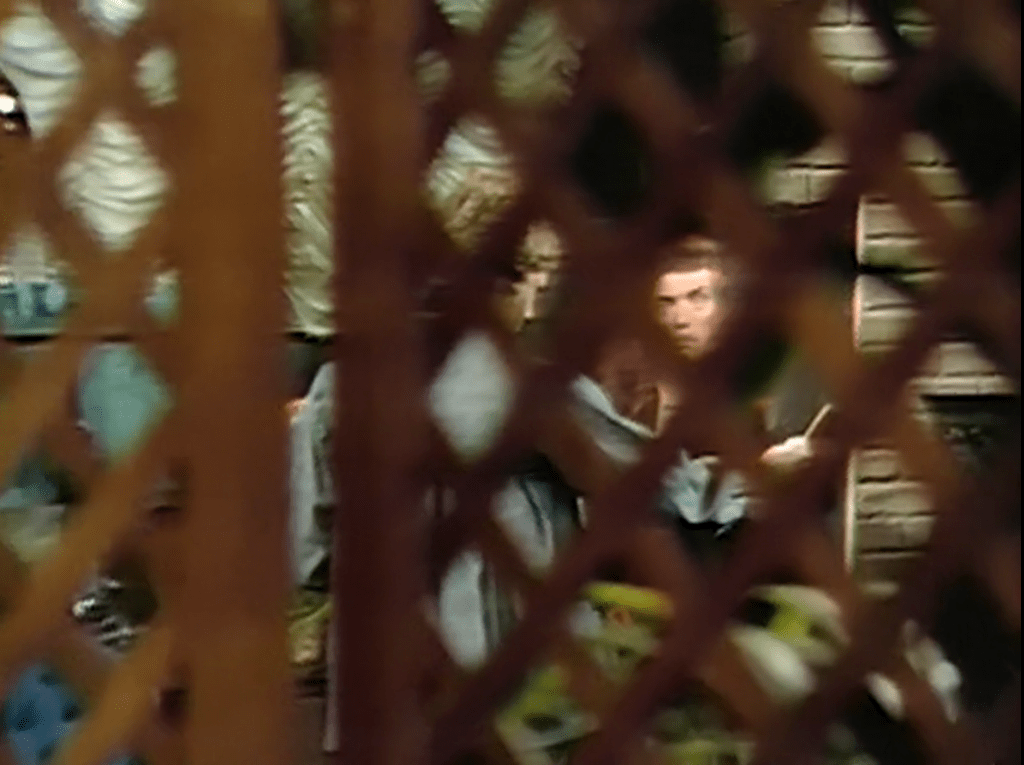
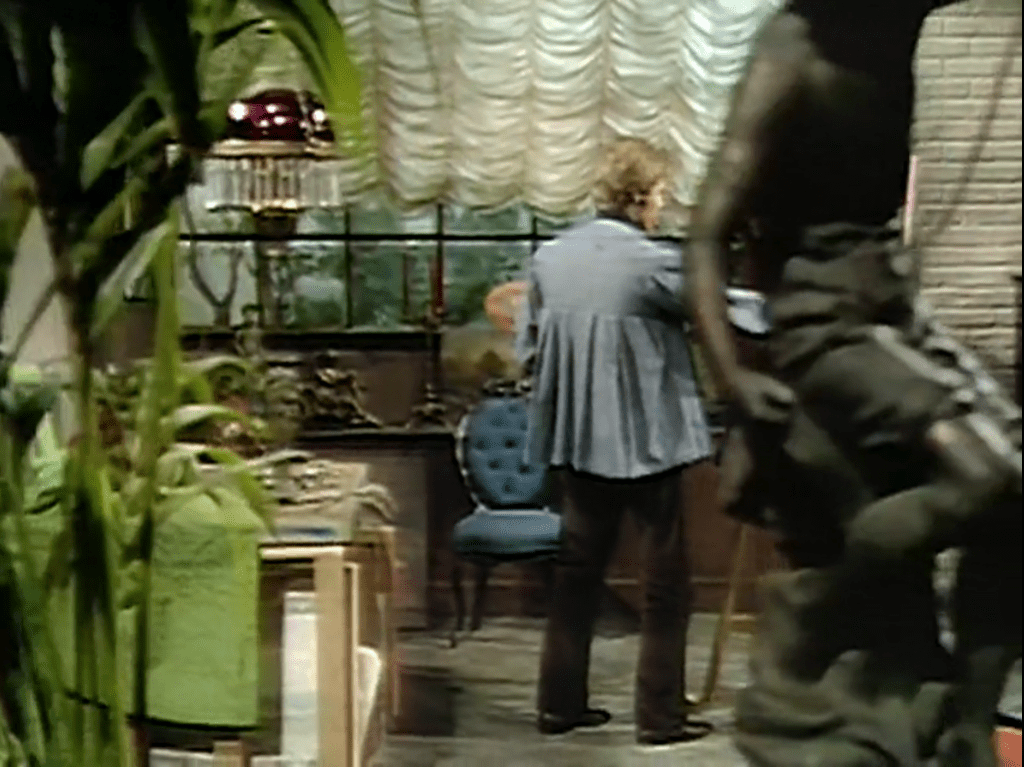
At any rate, the set is gorgeous today, full of bright greens and mixed reds. Swift was a highly ambitious visual artist, and she outdoes herself here. The first shot in the cottage begins with a closeup of the portrait of Quentin. It then pulls back further than any previous shot of this very familiar set, showing us a lattice that used to be part of the set representing the kitchen/ breakfast nook area at Collinwood. Behind it is a plant with some large, intensely green foliage. We then track around the set to see several sculpted pieces in black, paintings in a variety of tones, and a whole array of vivid colors in the furniture and other decorations. Dark Shadows has come a long way from the clumsiness that marked its use of color when it first switched from black and white in #295.

Charity is unaware that she and Tate are not alone. Tate’s master, Petofi, is in the next room eavesdropping. Charity is horrified to see the portrait of Quentin, and reminds Tate that she saw Quentin’s features in the portrait change into those of a wolf when she visited the cottage on the night of a full Moon. Tate tries to convince her she did not really see such a thing, but she will not have it. Charity gives Tate a warning somewhat less incoherent than the one she had given Beth. After she exits, Petofi and Tate talk. Tate had suspected Quentin was a werewolf, and now is sure. Petofi says that his plans for Quentin are none of Tate’s concern.

Petofi goes to the great house. Quentin confronts him there, demanding to know by what gods he swears. He replies “I have but one, and his name is Petofi!” Charity sees Petofi and vehemently demands he leave. I don’t know why she does this. As far as I can recall, Charity knows Petofi only as Victor Fenn-Gibbon, an honored guest of the Collins family. He did cast rather a nasty spell on her when he was using that alias, but I don’t see why she would realize that he was to blame for it, or for any of his other misdeeds.

Whatever the motive for Charity’s angry reaction to him, Petofi responds by magically robbing her of the power of speech. When he tells her that he has a healing touch, his manner and the background music indicate that after he touches her, what Charity will say will never again be up to her.