
In June, Dark Shadows was set in an alternate universe to which vampire Barnabas Collins and mad scientist Julia Hoffman had traveled. Julia and Barnabas found a comatose woman. Barnabas took one look at her, saw how silent and immobile she was, and fell in love. He’s dead half the time, so we can’t judge him for that reaction.
The woman’s name was Roxanne Drew, and Barnabas’ love for her survived even after she regained the ability to walk and talk. Roxanne didn’t make it to the original continuity when Barnabas and Julia returned there in July. Barnabas’ sorrow for her was lightened in #1081, when he met Roxanne’s counterpart in his native universe. Their relationship took a turn for the worse in #1106, when he discovered that she, too, was a vampire. In #1107, he found out that Roxanne was alive in 1840, and that she underwent a mysterious and terrible change in that year.
Now, Barnabas is keeping Roxanne chained in her coffin in the secret room behind his bookcase. Julia has traveled back in time to 1840 and hopes to prevent a disaster that has destroyed the great house of Collinwood and its residents. Trying some mumbo-jumbo that he hopes will lead him to join Julia in the past, Barnabas has a vision of a tombstone saying that she died on 6 October 1840. He and his friend Timothy Eliot Stokes go to the graveyard and see such a tombstone there. Barnabas says that 6 October is three days away; the episode was originally broadcast on 1 October 1970, which is more than three days from 6 October. But there is a weekend in between, and days when the show isn’t on don’t count.
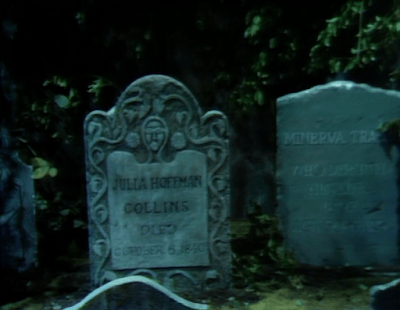
Barnabas says that he must find a way to travel back in time before 6 October. Stokes asks why, and Barnabas says he himself doesn’t understand how it works. But regular viewers know that anniversaries have a power in the cosmos of Dark Shadows that physical laws have in our world. If an event took place exactly 130 years ago, or any other number of years ago, it is possible for people in the present to interact with that event in ways they cannot on other days of the year. That has been the case ever since undead blonde fire witch Laura Murdoch Collins was on the show, before Barnabas made his first appearance.
Julia’s grave is next to one commemorating Minerva Trask, a hateful biddy who was one of the most effective villains during the period in 1969 when the show was set in 1897. That turns out to be foreshadowing. The scenes with Barnabas and Stokes in a contemporary setting are a prologue to an episode set mostly in 1840. Julia meets the living Roxanne, who is accompanied by Lamar Trask, a kinsman of Minerva’s loathsome husband Gregory.
Julia is a guest at Collinwood, impersonating Barnabas’ imaginary daughter and telling the family to await the arrival of her brother, Barnabas Junior, who looks remarkably like their late father. Julia is in the drawing room, talking to herself about how much she misses Barnabas, when Roxanne enters. Roxanne makes a little joke about talking to inanimate objects, and introduces herself as the sister of Samantha Drew Collins, wife of the missing Quentin Collins and lady of the house.
Trask enters. Julia is startled to see him. Roxanne asks Julia to guess what business Trask is in. She says she could not possibly, and Trask protests that guessing games are silly. That’s a shame. Julia must have seen What’s My Line?; we can imagine her asking “Is there a product connected with what you do? Is the product bigger than a bread box? Is the product alive? Are your services equally available to men and women?” etc.
Roxanne says that Lamar is an undertaker. She spits the word out, and asks him sarcastically if he prefers to be called a mortician. She reviles his profession in quite vigorous language. The dramatic date may be 1840, but at this moment we are very clearly in the aftermath of Jessica Mitford’s 1963 book The American Way of Death, an extremely influential polemic against the mortuary industry.
Lamar insists that Roxanne go out on the terrace to talk with him privately. When they are gone, Julia wonders to herself what will happen later this year to turn Roxanne into a vampire. She really ought to know. She released Barnabas from his chained coffin the other day, hoping that he would already be her friend returned from the future. But instead he was the same monster sealed up there in the 1790s, who had no idea who she was. Had his old friend Ben Stokes not shown up in the nick of time, Barnabas would have killed Julia then and there. He has gone on to take other victims, killing some of them, and remains at large. So it seems quite likely that Barnabas will bite Roxanne to death, causing her to rise as a vampire. When that happens, Julia will be to blame.
This is a temporal paradox. Julia hadn’t traveled back to 1840 when she first met the vampiric Roxanne, and Barnabas hadn’t been out of his coffin between the 1790s and 1897 at that point. Roxanne’s vampirism was involved in the circumstances that led to Julia’s trip to 1840. So the vampirism caused the trip that caused the vampirism. And Roxanne the vampire had clearly never seen Barnabas before when she met him in 1970. Of course it doesn’t make logical sense, but so much of the story is made up of the consequences of Julia and Barnabas’ bungling that it would be wrong if it were any other way.
On the terrace, Lamar asks Roxanne to marry him. She refuses, angrily. My wife, Mrs Acilius, said that it was odd Lamar wanted to marry Roxanne, since she obviously hates him. I pointed out that he seems to hate her as well. Many married couples come to hate each other over the years, so I suppose it is a time-saver of a kind if two people get married who already hate each other.
Lamar keeps telling Roxanne that he made a deal with her father to marry her, and she keeps telling him that she doesn’t care. She wants to marry a mysterious stranger who will sweep her off her feet and show her a new life. Barnabas is eavesdropping from behind the wrought iron fence. He has not met Roxanne before, and cannot see her well, but he can well imagine himself being a mysterious stranger who will change everything in a woman’s life. Moreover, Barnabas hears her raging at Trask, whose late father was an enemy whom Barnabas killed with an even higher degree of sadism than is usual for him. Since Trask Junior looks and sounds just like Trask Senior, Roxanne’s hostility to him is enough to make Barnabas feel a special closeness to her.
Barnabas approaches Roxanne after Lamar has left. He persuades her to invite him to her home. When Barnabas was first on the show in April and May of 1967, they made good use of the trope that vampires can enter only where they are invited, but they soon became very inconsistent about that. It places a restriction on Barnabas’ movements that can be story-productive though, so I’m always happy when it seems they will be bringing it back.
In her room, Roxanne is disappointed Barnabas did not call. He materializes inside her window. She can’t very well be happy about that, but he talks her out of screaming. She looks into his eyes and falls into a trance. He bares his fangs, and she tilts her head to offer him her neck. Her fate would appear to be sealed.
This is the first episode credited to Lela Swift as line producer. Swift has been with the show as its principal director from the beginning. Even though Henry Kaplan is listed as director today, it has the crisp look and inventive compositions that characterize Swift’s style, not the muddy images and extreme closeups with which Kaplan was content to fill the time. We can hope that, with Swift in the driver’s seat, the show will consistently meet her high standards of visual strategy.

