
Episode 1114: I am the stranger

In June, Dark Shadows was set in an alternate universe to which vampire Barnabas Collins and mad scientist Julia Hoffman had traveled. Julia and Barnabas found a comatose woman. Barnabas took one look at her, saw how silent and immobile she was, and fell in love. He’s dead half the time, so we can’t judge him for that reaction.

The woman’s name was Roxanne Drew, and Barnabas’ love for her survived even after she regained the ability to walk and talk. Roxanne didn’t make it to the original continuity when Barnabas and Julia returned there in July. Barnabas’ sorrow for her was lightened in #1081, when he met Roxanne’s counterpart in his native universe. Their relationship took a turn for the worse in #1106, when he discovered that she, too, was a vampire. In #1107, he found out that Roxanne was alive in 1840, and that she underwent a mysterious and terrible change in that year.

Now, Barnabas is keeping Roxanne chained in her coffin in the secret room behind his bookcase. Julia has traveled back in time to 1840 and hopes to prevent a disaster that has destroyed the great house of Collinwood and its residents. Trying some mumbo-jumbo that he hopes will lead him to join Julia in the past, Barnabas has a vision of a tombstone saying that she died on 6 October 1840. He and his friend Timothy Eliot Stokes go to the graveyard and see such a tombstone there. Barnabas says that 6 October is three days away; the episode was originally broadcast on 1 October 1970, which is more than three days from 6 October. But there is a weekend in between, and days when the show isn’t on don’t count.
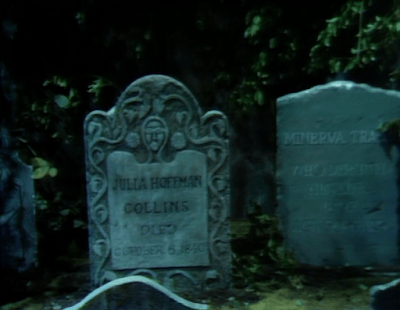
The stones. Screenshot by Dark Shadows Before I Die.

Barnabas says that he must find a way to travel back in time before 6 October. Stokes asks why, and Barnabas says he himself doesn’t understand how it works. But regular viewers know that anniversaries have a power in the cosmos of Dark Shadows that physical laws have in our world. If an event took place exactly 130 years ago, or any other number of years ago, it is possible for people in the present to interact with that event in ways they cannot on other days of the year. That has been the case ever since undead blonde fire witch Laura Murdoch Collins was on the show, before Barnabas made his first appearance.

Julia’s grave is next to one commemorating Minerva Trask, a hateful biddy who was one of the most effective villains during the period in 1969 when the show was set in 1897. That turns out to be foreshadowing. The scenes with Barnabas and Stokes in a contemporary setting are a prologue to an episode set mostly in 1840. Julia meets the living Roxanne, who is accompanied by Lamar Trask, a kinsman of Minerva’s loathsome husband Gregory.

Julia is a guest at Collinwood, impersonating Barnabas’ imaginary daughter and telling the family to await the arrival of her brother, Barnabas Junior, who looks remarkably like their late father. Julia is in the drawing room, talking to herself about how much she misses Barnabas, when Roxanne enters. Roxanne makes a little joke about talking to inanimate objects, and introduces herself as the sister of Samantha Drew Collins, wife of the missing Quentin Collins and lady of the house.

Trask enters. Julia is startled to see him. Roxanne asks Julia to guess what business Trask is in. She says she could not possibly, and Trask protests that guessing games are silly. That’s a shame. Julia must have seen What’s My Line?; we can imagine her asking “Is there a product connected with what you do? Is the product bigger than a bread box? Is the product alive? Are your services equally available to men and women?” etc.

Roxanne says that Lamar is an undertaker. She spits the word out, and asks him sarcastically if he prefers to be called a mortician. She reviles his profession in quite vigorous language. The dramatic date may be 1840, but at this moment we are very clearly in the aftermath of Jessica Mitford’s 1963 book The American Way of Death, an extremely influential polemic against the mortuary industry.

Lamar insists that Roxanne go out on the terrace to talk with him privately. When they are gone, Julia wonders to herself what will happen later this year to turn Roxanne into a vampire. She really ought to know. She released Barnabas from his chained coffin the other day, hoping that he would already be her friend returned from the future. But instead he was the same monster sealed up there in the 1790s, who had no idea who she was. Had his old friend Ben Stokes not shown up in the nick of time, Barnabas would have killed Julia then and there. He has gone on to take other victims, killing some of them, and remains at large. So it seems quite likely that Barnabas will bite Roxanne to death, causing her to rise as a vampire. When that happens, Julia will be to blame.

This is a temporal paradox. Julia hadn’t traveled back to 1840 when she first met the vampiric Roxanne, and Barnabas hadn’t been out of his coffin between the 1790s and 1897 at that point. Roxanne’s vampirism was involved in the circumstances that led to Julia’s trip to 1840. So the vampirism caused the trip that caused the vampirism. And Roxanne the vampire had clearly never seen Barnabas before when she met him in 1970. Of course it doesn’t make logical sense, but so much of the story is made up of the consequences of Julia and Barnabas’ bungling that it would be wrong if it were any other way.

On the terrace, Lamar asks Roxanne to marry him. She refuses, angrily. My wife, Mrs Acilius, said that it was odd Lamar wanted to marry Roxanne, since she obviously hates him. I pointed out that he seems to hate her as well. Many married couples come to hate each other over the years, so I suppose it is a time-saver of a kind if two people get married who already hate each other.

Lamar keeps telling Roxanne that he made a deal with her father to marry her, and she keeps telling him that she doesn’t care. She wants to marry a mysterious stranger who will sweep her off her feet and show her a new life. Barnabas is eavesdropping from behind the wrought iron fence. He has not met Roxanne before, and cannot see her well, but he can well imagine himself being a mysterious stranger who will change everything in a woman’s life. Moreover, Barnabas hears her raging at Trask, whose late father was an enemy whom Barnabas killed with an even higher degree of sadism than is usual for him. Since Trask Junior looks and sounds just like Trask Senior, Roxanne’s hostility to him is enough to make Barnabas feel a special closeness to her.

Barnabas approaches Roxanne after Lamar has left. He persuades her to invite him to her home. When Barnabas was first on the show in April and May of 1967, they made good use of the trope that vampires can enter only where they are invited, but they soon became very inconsistent about that. It places a restriction on Barnabas’ movements that can be story-productive though, so I’m always happy when it seems they will be bringing it back.

In her room, Roxanne is disappointed Barnabas did not call. He materializes inside her window. She can’t very well be happy about that, but he talks her out of screaming. She looks into his eyes and falls into a trance. He bares his fangs, and she tilts her head to offer him her neck. Her fate would appear to be sealed.

This is the first episode credited to Lela Swift as line producer. Swift has been with the show as its principal director from the beginning. Even though Henry Kaplan is listed as director today, it has the crisp look and inventive compositions that characterize Swift’s style, not the muddy images and extreme closeups with which Kaplan was content to fill the time. We can hope that, with Swift in the driver’s seat, the show will consistently meet her high standards of visual strategy.
Episode 1113: Do you smell the smoke?

From March to November 1969, Dark Shadows was mostly set in the year 1897, to which time-traveling vampire Barnabas Collins had made his way. Barnabas’ friend, mad scientist Julia Hoffman, would join him for several weeks towards the end of the 1897 segment.

While Barnabas and Julia were busy in the past, the show cut to a contemporary setting a few times to show us that time was passing there and that the actions taking place in 1897 were changing the circumstances at the great house of Collinwood in the twentieth century. When Barnabas returned to the contemporary setting, the other characters knew where he had been and remembered both the events he went back in time hoping to prevent and those that had replaced them.

The 1897 segment was so good I wished it had gone on longer. One way I imagined they might have been able to stretch it out would have been to do more with the intercutting timelines. So perhaps spend a week in 1897, then a week in 1969. Obviously that would have required a lot more advance planning than they ever managed to do, since they would have had to keep redressing the sets to represent the different periods, but I thought it might have been worthwhile.

Today, we have evidence that some idea like this also occurred to the makers of the show. Julia has gone back in time to 1840 to keep a series of events from starting that will lead to the ruination of Collinwood and its inhabitants in 1970. Barnabas was unable to join her. We spend time today with Julia in 1840, and then with Barnabas in 1970.

Arriving in 1840, Julia’s first act was to make contact with Barnabas’ old friend Ben Stokes. Ben believed her story and made himself incredibly helpful to her effort to establish herself at Collinwood. But she convinced herself that Barnabas had magically projected himself from 1970 into his body as it is in 1840. So she went to the secret room of the old Collins family mausoleum, unchained his coffin, and released him. He was about to kill her when Ben showed up and stopped him. Ben persuaded Barnabas to let Julia leave the room alive, and repeated her story to him. Barnabas reacted with incredulity, telling Ben that he had gone mad to accept such a tale, but Ben insisted Julia was their friend. Now Barnabas has resumed killing people, and Julia is terribly afraid that unless he stops he might be caught.

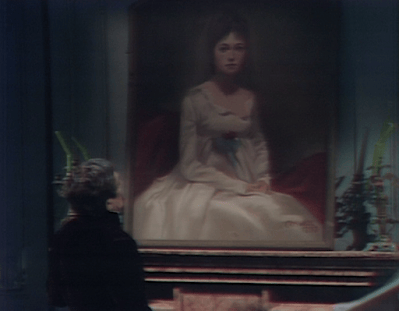
Barnabas is in the bedroom at the Old House at Collinwood once meant for Josette DuPrés to call her own after she married him. He takes Josette’s portrait off the wall and tells her that he must go on without her. We’ve heard that before. In #281, he stood in the same room and spoke to the same portrait, telling Josette that her ghost must go away and never come back so that he could face the world with someone else. We soon found that his plan was to turn that someone else into a simulacrum of Josette, and later he kept deciding that other women were reincarnations of Josette, so that speech did not represent the emotional growth we might have hoped to see. Finally, Josette’s ghost appeared to Barnabas in #948 and told him to lose her number, and his next love interest was a woman who did not remind him of her. That new woman was comatose, and Barnabas rhapsodized about how much beauty he found in her silence and immobility. Also, there was a bit of a problematic age gap, since she was 22 and he was well over 200. Baby steps, baby steps.

Barnabas has a heart to heart with Josette’s portrait. Screenshot by Dark Shadows Before I Die.

Ben enters and tries to talk Barnabas into returning to his coffin and allowing himself to be chained back in. As my wife, Mrs Acilius, points out, he doesn’t even mention that murder is bad. He knows Barnabas well enough to know he’d roll his eyes at that kind of talk. He just focuses on the danger Barnabas is putting himself in. Barnabas says that Ben does not know how horrible it is to spend years trapped in the darkness. Returning viewers may smile at this, since Barnabas doesn’t know that either. When Julia opened his coffin, he had no idea more than a single day had passed since he was chained there in the 1790s. He flounces off to take more victims.

In the drawing room of the great house, Julia meets Cockney psychic Leticia Faye. She asks Leticia if she can tell what will happen in that room in 1970. Leticia laughs and says her visions don’t extend that far. She adds that there wouldn’t be much point in them if they did, since no one alive today will be around to see if they came true. Julia claims to have had a dream about 1970, and Leticia humors her. She goes into a trance, and smells smoke. That’s about it, and when Leticia comes out of it she is still laughing, perhaps thinking that it didn’t amount to much. But it reminds Julia of the disaster she escaped, and leaves her wondering what Barnabas is doing in 1970.

We cut to Barnabas’ house in that year. He is doing what he does best, sitting around feeling sorry for himself. Ben’s descendant, occult expert Timothy Eliot Stokes, is there. They are talking about the funeral held that afternoon for the residents of the great house killed in the disaster. Stokes does not know that Barnabas is a vampire, and so Barnabas has to make an excuse for his absence from this daytime event. He simply says he was too upset to attend.

Heiress Carolyn Stoddard Hawkes and charming rogue Quentin Collins survived the disaster and are in the Old House, both quite insane. Barnabas and Stokes cart them off to a psychiatric facility. This is the final appearance on Dark Shadows of either of these characters, each of whom has been enormously important to the show.

Carolyn is played by Nancy Barrett, who also plays Leticia. Quentin is played by David Selby. We had expected to see Mr Selby in 1840 as another character named Quentin Collins, but when Julia arrived she learned that Quentin was missing and presumed dead after a nautical mishap. This glimpse of Quentin doesn’t add much to the story, but it does serve to reassure us that Mr Selby has not left the cast and that we will be seeing the 1840 version of Quentin sooner or later.

Barnabas decides to cast some I Ching wands. That’s what got him back to 1897, and the wands fall in the same pattern this time as they did then. He meditates on them. He sees a door, and seems to pass through it. On the other side, he sees a tombstone engraved “Julia Hoffman Collins 6 October 1840.”

Julia is masquerading as the daughter Barnabas had after he left for England in the 1790s, and has been telling the Collinses to expect her brother, Barnabas Junior. We haven’t heard her give “Hoffman” as a middle name. Of course it had to be there for Barnabas to be shocked by the stone. Otherwise, he would just have wondered who “Julia Collins” was.

It strikes me that they missed an opportunity. Julia has said that she moved from England to Philadelphia. Even though she lived there for so many years that she picked up an eastern Pennsylvania accent, she did not contact the family at Collinwood. Eventually they are likely to find out that she has a great deal of medical expertise, most unusual for a lady in 1840. Had she introduced herself as Julia Collins Hoffman, she might have explained that she met her late husband Dr Samuel Hoffman while he was studying in London, married him there, and lived with him in his hometown, Philadelphia. At the name “Dr Samuel Hoffman,” a theremin might have played on the soundtrack. Electronic music enthusiasts would laugh at the nod to the real Dr Samuel J. Hoffman (1903-1967,) the great player of and composer for the theremin. And fans of Dark Shadows would be happy that Julia’s imaginary husband has the same first name as Grayson Hall’s real husband, series writer Sam Hall.

This episode marks not only the final appearances of Carolyn and the original Quentin, but also the last time Peter Miner’s name will appear in the credits as line producer. Starting tomorrow, Lela Swift will be in command at 433 West 53rd Street. Swift was the principal director since the beginning of the show, chiefly responsible for the show’s often striking visual composition. It will be exciting to see what she can do now that she has a wider scope of action.

Episode 875: Barnabas, Quentin, and the difficulty of being oneself

This is the first episode credited to Peter Miner as line producer. Dark Shadows was being taped way out of sequence at this period, so Robert Costello’s name will appear in the credits several more times in the next few weeks. The role of the line producers is one of the most under-discussed aspects of the show’s history; writer Ron Sproat, for example, was in a 1985 festival appearance unable to remember ever receiving any input from Costello. So far as he could recall, the writers interacted exclusively with executive producer Dan Curtis.

Even if Sproat’s memory were accurate, I suspect that much of Curtis’ own time working on the show was spent in meetings with Costello. He was there from the beginning, and was around throughout the long periods when Curtis was away in London and other places working on other projects. When the show makes deep cuts into its early stages of development, referring to story points that played out long before any of the current staff of writers came aboard, I always suspect it was Costello who suggested the idea. Now that he is leaving, we will see if those references become rarer. If they don’t, maybe it is Curtis’ own memory that has been at work. On the other hand, even if they do dry up it may just be that they had run out of things to say about those old themes. Whatever happens, Costello had a hard job and clearly did it better than almost anyone else could have, it’s sad to see him go.

Today’s story is about the results of a spell that 150 year old sorcerer Count Petofi cast a few weeks ago. Petofi forcibly swapped bodies with handsome young Quentin Collins. I refer to the villainous Petofi who looks like Quentin as Q-Petofi, and to the forlorn Quentin who looks like Petofi as P-Quentin.

Yesterday, maidservant Beth Chavez found out about the body swap. In love with Quentin and terrified of Petofi, she was horrified by it. Today, she searches desperately for someone she can trust, and makes the singularly unfortunate choice of weak-willed schoolteacher turned unscrupulous adventurer Tim Shaw. She goes to Tim’s hotel room, tells him the story, and asks for help. Uncharacteristically, he does not look for a way to sell the information Beth gives him. He simply goes to Q-Petofi, whom he believes to be Quentin, in what can only be a sincere effort to do the right thing. He brings Q-Petofi back to his room, where Beth is waiting. She soon manages to escape, and Q-Petofi chases her.

For his part, P-Quentin made a happy discovery yesterday and the day before. When Petofi executed the body swap, he took his powers with him into Quentin’s form. But now P-Quentin finds that the powers have returned to Petofi’s own rightful body, which is to say to him. After consulting with his friend and distant cousin, recovering vampire Barnabas Collins, P-Quentin decides to will himself back into his own body.

This works. Quentin awakes as himself, in the woods on Widows’ Hill. He finds Beth at the summit of the hill, near the cliff from which so many people have leapt or fallen to their deaths. She thinks he is Petofi, and flees to the edge while he tries to reassure her of his true identity. The closing cliffhanger leaves her inches from death.

A few years ago, I posted a fanfic idea in the comments on Danny Horn’s post about this episode at his great Dark Shadows Every Day. I still like it:

This is one of the episodes that could have been novelized by “Marilyn” Ross under the title “Barnabas, Quentin, and the Dumbest Possible Plan.” Rather than will himself into his own body right away, thus returning Petofi to his body and for all they know to his full powers, a character with brains might have tried swapping places with someone relatively harmless. Beth would seem to be the obvious person. If she comes to in Petofi’s body, Beth would seem to be the person most likely to accept the situation and least likely to use the powers of Petofi to destroy Our Heroes. Playing Quentin may have been just the challenge Terry Crawford really needed to show off her acting talents, and I’m sure Thayer David would have done wonders as Beth.

Quentin/ Beth/ Petofi could have been the first in a whole series of body swaps. Some of those swaps could have led to villains getting their comeuppance, helping to clear the decks for the end of the 1897 segment. So, while inhabiting the body of a villain, Quentin tries to do something heroic, winds up in mortal peril, and at the last second snaps back to his previous host, just in time for the villain to be the one who dies.

Comment posted 6 December 2020 on Danny Horn, “Episode 875: Switchback,” Dark Shadows Every Day, 8 June 2016.

Fans if the original Star Trek will recognize the source of my inspiration. The episode titled “Return to Tomorrow” features a malevolent alien squatting in Mr Spock’s body. Spock hides his consciousness in the brain of Nurse Christine Chapel, whom the alien once controlled, as Petofi once controlled Beth, and who has a crush on Spock as Beth does on Quentin. And Spock and Nurse Chapel, as a composite being, deliver the fatal blow that kills the alien.