From March to June 1969, during a segment of Dark Shadows set in the year 1897, John Karlen played inveterate prankster Carl Collins. Carl could barely contain the manic glee his own practical jokes inspired in him, even though they rarely moved anyone else to more than irritation. A childlike man, Carl quickly dissolved into helplessness before even the slightest challenge.
Now, the dramatic date is 1840. Karlen is Desmond Collins. We met Desmond yesterday, and he seemed to be cut from the same cloth as Carl. He has returned from a trip to East Asia, and has brought a severed human head in a glass display case. His mother Flora reacted to this object with horror, as one would expect. In response, Desmond kept insisting that there was nothing frightening about the head and averring that he could not understand Flora’s reaction. His demeanor is calm and mature, setting him apart from Carl. But as regards the head, his judgment seems to be just as ludicrously poor.
Desmond does show good sense in one matter. Yesterday, Desmond expressed distrust of two people who have recently presented themselves at the great house of Collinwood under the names Barnabas and Julia Collins. Julia and Barnabas have identified themselves as brother and sister, and have said that their father was the Barnabas Collins who lived on the estate in the late eighteenth century and left for England in the 1790s. Desmond talks with Barnabas in the drawing room of the great house today, and is still openly suspicious.
The two people at Collinwood now who were there in the 1790s are Ben Stokes, an old man who was an indentured servant at Collinwood back then, and Daniel Collins, who was a child then and is now the master of the house. Daniel reacts with amazement to the sight of Barnabas. He is convinced he is the same man, unchanged after four and a half decades. Barnabas tells him he is the son of that Barnabas. There is still a note of suspicion in Desmond’s voice when he remarks that it is Barnabas’ night for being mistaken for his father, but he can hardly keep doubting that he is a member of the family.
As it happens, Daniel’s first impression was right. Barnabas is the person he knew long ago. Julia is not related to the Collinses at all. Barnabas has not aged, because he was turned into a vampire in the 1790s and was sealed in a coffin from that time until Julia released him a few nights ago. She is a time traveler from the year 1970, where she and Barnabas are friends. Barnabas is also a time traveler of a sort; he used some mumbo-jumbo to project his 1970 personality into his 1840 body, so that he and Julia are on the same page now. They have traveled into the past in hopes of preventing a disaster that will befall the Collins family in 1970, so their motives are good. But after all, one of them is a vampire and the other is a mad scientist. They are not likely to be an unmixed blessing to any house they enter.
Ben is visiting Flora at the house she and Desmond share, a mansion near Collinwood known as Rose Cottage. He sees the head, and recognizes it as something that figured in a series of murders many years before. Those murders took place in and around a town called Bedford, and are therefore known as The Bedford Atrocity. Ben asks Daniel if he remembers the matter. He certainly does, and mentions that his late sister Millicent had a book that included a chapter about it. He suggests Ben look for the book in the attic.
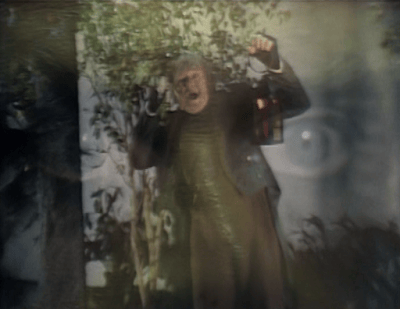
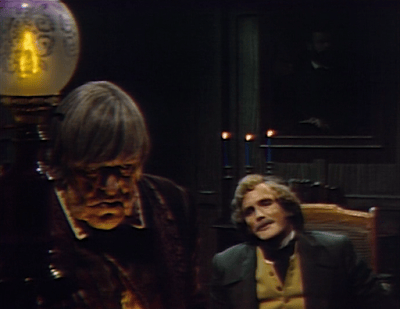
Ben finds the book there, and he is sure that if he shows it to Desmond he will convince Desmond to destroy the head. He takes the book to Rose Cottage. No one is home. He leaves the book in the room where the head is kept and writes a note for Desmond. He explains to the head that he is going to destroy it. This turns out to have been an unwise move. When Ben is walking home through the woods, an image of the head is superimposed over him and he reacts with distress.
In a day concerned with nautical mishaps, it is somehow fitting that Ben gets stuck in the head. Screenshot by Dark Shadows Before I Die.
There are a couple of other points worthy of mention. Daniel is conscious of his position as master of Collinwood, but he is not the haughty overlord Louis Edmonds played when he was Joshua Collins in the part of the show set in the 1790s or the stuffy but lovable figure he created as Edward Collins in the 1897 segment. He is dignified, courteous, and kindly. But he is also gravely mentally ill. When first we saw him, he tried to kill Julia, not for any of the good reasons anyone might have to do such a thing, but because he thought she was his late wife, whom he killed years ago and keeps trying to kill again every time she shows up disguised as someone else. He cannot remember who is alive and who is dead, or what year it is. (In fairness, these are very difficult things to keep track of on Dark Shadows.) It’s a cliche that Jonathan Frid played Barnabas “as if he were playing King Lear.” In his scenes today, Edmonds quite literally is playing King Lear. Mrs Acilius and I marveled at the depth and complexity of the characterization.
Barnabas meets the evil Gerard Stiles. Barnabas knows that Gerard’s ghost will cause the destruction of the great house and its residents in 1970 and that he will still preside over its ruins in 1995. Gerard tells Daniel a story about the deaths of his son and grandson, Quentin and Tad Collins. Barnabas is in the room when Gerard tells this story, and has reason to disbelieve it. Later, he is alone with Gerard and challenges his story. Barnabas learns nothing from this encounter, but Gerard learns that Barnabas is his enemy. Barnabas very often introduces himself to his foes by showing his cards in this way. That habit does keep the plot moving, but it is frustrating that the protagonist does not even try to ingratiate himself to his adversaries and get information from them he can use to advance his goals.
Friday’s episode ended with one of the most effective scenes in all of Dark Shadows. Vampire Barnabas Collins summoned his latest victim, Roxanne Drew, to the gazebo on the grounds of the estate of Collinwood. Roxanne looked at Barnabas adoringly and told him she was willing to die for him. He took her up on this. He bit her, draining her body of blood and letting it fall to the floor of the gazebo. He told her that her corpse would be found in the morning and that her family would grieve for her during the day. At dusk, she would rise as a vampire and would belong to him forever. He walked away from the gazebo, leaving her body lying there. Jonathan Frid and Donna Wandrey showed the full terror of this unimaginably cruel scene. The result chills the audience as deeply as anything they have shown us.
Today, it turns out Roxanne isn’t dead after all. That gives Roxanne’s sister Samantha a chance to find her, and Barnabas’ friends Julia Hoffman and Ben Stokes a chance to hide Roxanne from Samantha and to keep her from dying. When Barnabas finds out what Julia is doing, he moves to attack her, but collapses in the nick of time.
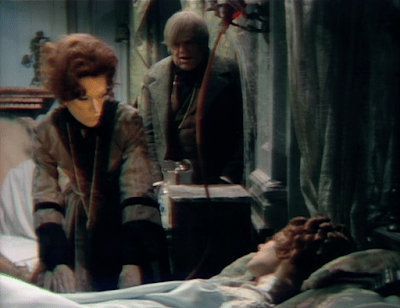
Julia uses some medical equipment she has improvised to give Roxanne a blood transfusion. Screenshot by Dark Shadows Before I Die.
There is also some activity involving Samantha and the evil Gerard Stiles, but that’s basically it. They can’t all be gems of course, but last week was a such bright spot that these twenty two minutes of busywork come as a big disappointment. We can only hope the show gets back up to speed soon!
From March to November 1969, Dark Shadows was mostly set in the year 1897, to which time-traveling vampire Barnabas Collins had made his way. Barnabas’ friend, mad scientist Julia Hoffman, would join him for several weeks towards the end of the 1897 segment.
While Barnabas and Julia were busy in the past, the show cut to a contemporary setting a few times to show us that time was passing there and that the actions taking place in 1897 were changing the circumstances at the great house of Collinwood in the twentieth century. When Barnabas returned to the contemporary setting, the other characters knew where he had been and remembered both the events he went back in time hoping to prevent and those that had replaced them.
The 1897 segment was so good I wished it had gone on longer. One way I imagined they might have been able to stretch it out would have been to do more with the intercutting timelines. So perhaps spend a week in 1897, then a week in 1969. Obviously that would have required a lot more advance planning than they ever managed to do, since they would have had to keep redressing the sets to represent the different periods, but I thought it might have been worthwhile.
Today, we have evidence that some idea like this also occurred to the makers of the show. Julia has gone back in time to 1840 to keep a series of events from starting that will lead to the ruination of Collinwood and its inhabitants in 1970. Barnabas was unable to join her. We spend time today with Julia in 1840, and then with Barnabas in 1970.
Arriving in 1840, Julia’s first act was to make contact with Barnabas’ old friend Ben Stokes. Ben believed her story and made himself incredibly helpful to her effort to establish herself at Collinwood. But she convinced herself that Barnabas had magically projected himself from 1970 into his body as it is in 1840. So she went to the secret room of the old Collins family mausoleum, unchained his coffin, and released him. He was about to kill her when Ben showed up and stopped him. Ben persuaded Barnabas to let Julia leave the room alive, and repeated her story to him. Barnabas reacted with incredulity, telling Ben that he had gone mad to accept such a tale, but Ben insisted Julia was their friend. Now Barnabas has resumed killing people, and Julia is terribly afraid that unless he stops he might be caught.
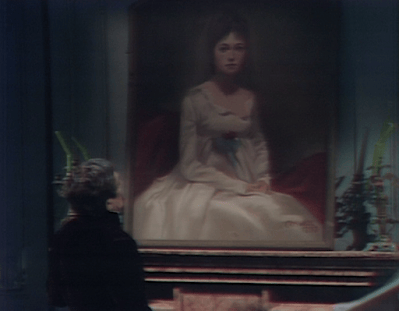
Barnabas is in the bedroom at the Old House at Collinwood once meant for Josette DuPrés to call her own after she married him. He takes Josette’s portrait off the wall and tells her that he must go on without her. We’ve heard that before. In #281, he stood in the same room and spoke to the same portrait, telling Josette that her ghost must go away and never come back so that he could face the world with someone else. We soon found that his plan was to turn that someone else into a simulacrum of Josette, and later he kept deciding that other women were reincarnations of Josette, so that speech did not represent the emotional growth we might have hoped to see. Finally, Josette’s ghost appeared to Barnabas in #948 and told him to lose her number, and his next love interest was a woman who did not remind him of her. That new woman was comatose, and Barnabas rhapsodized about how much beauty he found in her silence and immobility. Also, there was a bit of a problematic age gap, since she was 22 and he was well over 200. Baby steps, baby steps.
Ben enters and tries to talk Barnabas into returning to his coffin and allowing himself to be chained back in. As my wife, Mrs Acilius, points out, he doesn’t even mention that murder is bad. He knows Barnabas well enough to know he’d roll his eyes at that kind of talk. He just focuses on the danger Barnabas is putting himself in. Barnabas says that Ben does not know how horrible it is to spend years trapped in the darkness. Returning viewers may smile at this, since Barnabas doesn’t know that either. When Julia opened his coffin, he had no idea more than a single day had passed since he was chained there in the 1790s. He flounces off to take more victims.
In the drawing room of the great house, Julia meets Cockney psychic Leticia Faye. She asks Leticia if she can tell what will happen in that room in 1970. Leticia laughs and says her visions don’t extend that far. She adds that there wouldn’t be much point in them if they did, since no one alive today will be around to see if they came true. Julia claims to have had a dream about 1970, and Leticia humors her. She goes into a trance, and smells smoke. That’s about it, and when Leticia comes out of it she is still laughing, perhaps thinking that it didn’t amount to much. But it reminds Julia of the disaster she escaped, and leaves her wondering what Barnabas is doing in 1970.
We cut to Barnabas’ house in that year. He is doing what he does best, sitting around feeling sorry for himself. Ben’s descendant, occult expert Timothy Eliot Stokes, is there. They are talking about the funeral held that afternoon for the residents of the great house killed in the disaster. Stokes does not know that Barnabas is a vampire, and so Barnabas has to make an excuse for his absence from this daytime event. He simply says he was too upset to attend.
Heiress Carolyn Stoddard Hawkes and charming rogue Quentin Collins survived the disaster and are in the Old House, both quite insane. Barnabas and Stokes cart them off to a psychiatric facility. This is the final appearance on Dark Shadows of either of these characters, each of whom has been enormously important to the show.
Carolyn is played by Nancy Barrett, who also plays Leticia. Quentin is played by David Selby. We had expected to see Mr Selby in 1840 as another character named Quentin Collins, but when Julia arrived she learned that Quentin was missing and presumed dead after a nautical mishap. This glimpse of Quentin doesn’t add much to the story, but it does serve to reassure us that Mr Selby has not left the cast and that we will be seeing the 1840 version of Quentin sooner or later.
Barnabas decides to cast some I Ching wands. That’s what got him back to 1897, and the wands fall in the same pattern this time as they did then. He meditates on them. He sees a door, and seems to pass through it. On the other side, he sees a tombstone engraved “Julia Hoffman Collins 6 October 1840.”
Julia is masquerading as the daughter Barnabas had after he left for England in the 1790s, and has been telling the Collinses to expect her brother, Barnabas Junior. We haven’t heard her give “Hoffman” as a middle name. Of course it had to be there for Barnabas to be shocked by the stone. Otherwise, he would just have wondered who “Julia Collins” was.
It strikes me that they missed an opportunity. Julia has said that she moved from England to Philadelphia. Even though she lived there for so many years that she picked up an eastern Pennsylvania accent, she did not contact the family at Collinwood. Eventually they are likely to find out that she has a great deal of medical expertise, most unusual for a lady in 1840. Had she introduced herself as Julia Collins Hoffman, she might have explained that she met her late husband Dr Samuel Hoffman while he was studying in London, married him there, and lived with him in his hometown, Philadelphia. At the name “Dr Samuel Hoffman,” a theremin might have played on the soundtrack. Electronic music enthusiasts would laugh at the nod to the real Dr Samuel J. Hoffman (1903-1967,) the great player of and composer for the theremin. And fans of Dark Shadows would be happy that Julia’s imaginary husband has the same first name as Grayson Hall’s real husband, series writer Sam Hall.
This episode marks not only the final appearances of Carolyn and the original Quentin, but also the last time Peter Miner’s name will appear in the credits as line producer. Starting tomorrow, Lela Swift will be in command at 433 West 53rd Street. Swift was the principal director since the beginning of the show, chiefly responsible for the show’s often striking visual composition. It will be exciting to see what she can do now that she has a wider scope of action.
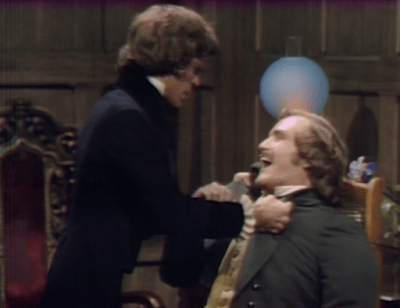
Mad scientist Julia Hoffman has traveled back in time from 1970 to 1840. Julia’s best friend, vampire Barnabas Collins, was unable to follow her into the past. Julia and Barnabas met in 1967 and became friends in 1968. In this period, Barnabas has been trapped in a chained coffin in the secret room of the old Collins family mausoleum for decades. She misses him so deeply that she convinces herself he must have used some mumbo-jumbo to project himself from 1970 into his body as it is in this time. She unchains the coffin and lets him out. He does not recognize her, and within seconds has his hands on her throat.
In the nick of time, Barnabas’ old retainer Ben Stokes shows up and tells him to let Julia go. Barnabas is shocked to see that Ben is far older than he was when last he saw him. Ben explains that 45 years have passed since he chained the coffin. Barnabas’ reaction settles a question that the vampire lore we have so far seen on Dark Shadows had left open. We have not known whether Barnabas experiences the passage of time while he is sealed in his coffin. Now, we see that he does not. That doesn’t stop him from throwing a big fit when Ben tells him that for the sake of all that is holy he must let himself be sealed back in; he pouts that he has already spent 45 years there, as if he had suffered consciously through all of them. That point will be exploited to broadly comic effect in Tim Burton’s 2012 feature film titled Dark Shadows, in which Johnny Depp’s version of Barnabas is closed in his coffin for a minute and a half and when the lid is reopened wails “How many centuries!?” This scene is played more subtly, but regular viewers will be just as inclined to laugh at Barnabas’ extravagant self-pity.
Ben tells Barnabas Julia’s preposterous story of a journey back in time from a future in which she is his fast friend. Barnabas tells Ben that he has gone mad, but Ben insists that he believes the story, bizarre as it is. Indeed, as a vampire Barnabas is hardly in a position to dismiss tales of the supernatural.
We got to know Ben from November 1967 to March 1968, when Dark Shadows was set in the 1790s. Young Daniel Collins was also a character on the show then. Daniel is in the cast of characters again now. He is the master of the great house of Collinwood, but is a man old before his time because of a severe mental illness and a heart condition that nineteenth century medicine is powerless to treat. When we saw that Ben and Daniel were in the story, longtime viewers realized that the 1840 segment would be a sequel to the 1790s segment. And indeed, Barnabas’ manner and tone of voice when he rises from his coffin are an exact match for what they were at the end of that part of the show. Jonathan Frid picks up right where he left off in #460. I know classically trained actors are taught to do things like that, but he pulls it off so brilliantly that I can’t help but wonder just how it was done.
Ben had laid out a plan for Julia in yesterday’s episode. He told her to present herself at the great house of Collinwood as Julia Collins. She was to tell the Collinses that she was the daughter of the Barnabas Collins who left for England in the 1790s, that she has been living in America, near Philadelphia, for many years, while her brother, Barnabas Junior, had stayed in England. She was to say that Barnabas Junior has written to her saying that he wanted to meet her at Collinwood and to feign surprise that her brother is not already there. She would say that her bags were at the Collinsport Inn. They might then invite her to stay at Collinwood.
Julia leaves the mausoleum. When Barnabas rushes out to claim more victims, she peeks out from behind a tree and watches him go. She now has nowhere to turn but Collinwood and no plan to follow but Ben’s.
Samantha Collins, daughter-in-law of Daniel and the lady of the house at Collinwood, is in the woods when she senses a malign presence. She starts running, and we see Barnabas. By the time Samantha bursts into the front door of the great house, she is on the point of tears. She tells her brother-in-law Gabriel Collins and houseguest Gerard Stiles that she felt that something evil was in the woods. She didn’t see whatever it was, but has somehow come to the conclusion that it was “tall.” Yesterday Gerard, who is a clairvoyant, had a vision of Julia; he described her as tall. Neither Jonathan Frid nor Grayson Hall was much above average height, while the cast included several actors who were. For example, Christopher Pennock, who plays Gabriel, was well over six feet. Gabriel uses a wheelchair, so this role does not emphasize his tallness, but we can’t help noticing it when they keep banging on about the great height of two medium-sized people.
Gerard says that he will go into the woods to investigate. Samantha tells him not to, that she wants him to stay with her and make her feel safe. She tilts her head towards his chest. Samantha’s husband, whose name is Quentin Collins, is missing at sea and presumed dead. In this moment, we see that she is considering Gerard as Quentin’s successor.
Gabriel speaks up. He tells Samantha and Gerard that there is no reason to investigate, since the police are all over the grounds. A woman was found dead earlier in the evening, her corpse drained of all blood. The presence Samantha sensed must have been, not a man, but the animal that killed that woman.
By opening the coffin, not only did Julia needlessly expose herself to the gravest possible danger and release a monster who has already taken one human life and will doubtless take more. She also put an additional obstacle in the way of her own effort to establish herself at Collinwood. That she will present herself and announce Barnabas to the Collinses on the very night the vampire attacks start makes it all but impossible for them not to connect the two of them with those attacks.
Samantha answers a knock at the front door and finds Julia. Julia feigns surprise that Samantha does not recognize her name. She is startled to see Gerard, whose ghost she met in terrible moments in the years 1970 and 1995, but composes herself quickly. Samantha invites Julia in. She tells the story Ben had crafted for her and expresses surprise the Collinses had not received the letters she sent.
Ben shows up and Julia makes a show of recognizing his name. She says that her late father often spoke warmly of him, and that he will be impressed by how much Barnabas Junior looks like his old man. They embrace. By that point, Samantha and Gabriel are sold. Samantha insists Julia stay at Collinwood, and sends Gerard to the inn to fetch her bags. Gerard pounces when Julia says Barnabas Junior will be glad to see Collinwood “again”; she explains that their father told them so much about the place that it feels like they’ve been there before.
Gerard does fetch a set of bags from the inn. Apparently Ben had supplied those, as he had earlier supplied the period-appropriate clothing Julia is wearing. He’s a very handy fellow to have on your side, that Ben.
In the morning, Ben joins Julia as she is returning to the mausoleum. He tells her sternly that they must chain the coffin back up and that she must never return to the secret room, no matter how sure she is that her version of Barnabas is summoning her.
They find they are too late. The coffin is gone. Both Julia and Ben know that Barnabas has a compulsion to stash his coffin at the foot of the cellar stairs in the Old House at Collinwood, and Julia also knows that Barnabas’ second choice for a hiding place is behind the bookcase in the parlor of that same house. Julia also knows of a cave near the beach where Barnabas has hidden his coffin a couple of times. So it would seem that they should be able to take the chains with them to those places, find the coffin, and take care of the matter before lunch. But for some reason they just give up.
Back in the great house, Gerard confronts Julia with an earring he found on the dresser in her room when he was putting her bags away. He tells her its mate was found in the long-disused playroom upstairs two nights ago, and asks her how long she has been lurking around. She denies everything, failing to quell his suspicions. Freeing Barnabas to prey upon the living may have been the most foolish thing Julia could possibly have done, but it was not much wiser of her to leave one extremely distinctive earring in such a conspicuous place when she has lost its mate she knows not where.
It was Gabriel who found the earring. He showed it to Gerard shortly after, prompting Gerard to have his vision of the “tall” Julia. Gerard and Gabriel have a scene early in today’s episode, before they meet Julia, in which they go back over the matter of the earring. We can see not only that Gerard is onto Julia, but also that Gabriel has a plan of some kind in which he is planning to involve Gerard. Combined with Samantha’s obvious interest in Gerard, that in turn suggests that we will see how multiple members of the household entangle themselves with him and put him in a position from which he can become a threat to the future of Collinwood.
In the closing credits, Grayson Hall is billed as “Julia Collins.” It has been their custom to list characters by the names they use, even when the audience knows those names to be false. So after Angelique Collins rose from the dead, killed her sister Alexis Stokes, and assumed Alexis’ identity in #1000, when the show was set in an alternate universe, Lara Parker kept being billed as Alexis until all the characters who were fooled by her imposture were off the show. Actors sometimes wander onto the set during the closing credits. My wife, Mrs Acilius, imagines someone doing so while still in character, looking at a credit that gives away someone’s true identity, and pointing at it with wide eyes and an “Aha!” Maybe they were trying to protect Julia from that.
Dark Shadows has been drifting downward in the ratings and the writing staff has been repeating material. If it is to survive, the show needs a new villain who will generate fresh story points and another breakout star to grab the attention of the public as Jonathan Frid did when he joined the cast as vampire Barnabas Collins in 1967 and as David Selby did when he came along as the dangerous Quentin Collins late in 1968 and early in 1969. They are gambling that they will be able to fulfill both of these requirements with James Storm as the evil Gerard Stiles.
Gerard has been on the show as an unspeaking ghost for twelve weeks. He makes his first appearance as a living being today, and delivers his first lines. He makes less of an impression than does any other member of the cast, which I believe is intentional.
Yesterday, mad scientist Julia Hoffman traveled back in time to 1840. Previous time-travel segments have begun with episodes mounted on the biggest scale of production the show could manage, but yesterday they tried a new approach. Most of the episode took place in one little section of the great house of Collinwood, with Julia hiding behind partitions in darkened rooms while she eavesdropped on random conversations. That structure suggested that 1840 is going to open out gradually, introducing new characters and situations a little bit at a time. So far from whisking us into the new world with a torrent of additional information, they subtracted from what we came in thinking we knew. When they revealed that governess Daphne Harridge is unknown in the great house, and Quentin Collins* and his son Tad are missing at sea and presumed dead, we found that this is a very different place from what we were led to expect. That was as good a way as any of ensuring we would come back on Monday.
Gerard makes his entrance in the middle of a scene between fluttery novelist Flora Collins and evil-tempered bully Gabriel Collins. Gabriel is not as cruel to Flora as we have seen him be with others, and he even pretends to take her latest novel seriously. But when she describes Gerard as “The Healer” and claims that he has supernatural powers, Gabriel has had enough. He insists that Flora ought not to waste her time with a man who, if he were not a transparent fraud, could only be a practitioner of the black arts. Flora is appalled by Gabriel’s description of Gerard as a possible Satanist.
Gerard enters and Flora tells him she is coming down with a migraine. She coquettishly asks him to do his thing for her. He rubs her forehead for a bit, and she proclaims that she is cured. After she exits, wheelchair user Gabriel tells Gerard that if he really has a miraculous gift of healing he would welcome him using it to restore his own ability to walk. Gerard angrily refuses.
Gabriel then tells Gerard that Flora claims more for him even than a gift for healing. She says that he is clairvoyant. Gerard says that he does have such a gift. Gabriel shows him an earring he found in the upstairs playroom and asks if he can identify it. Gerard goes into a trance and says that he sees “a tall woman… not dressed as a woman should be.” The earring belongs to Julia, whom we heard a clairvoyant describe as “a tall woman” in #1059, and she is indeed wearing the clothes she had on when she came from 1970. So we know that Gerard is a real clairvoyant, and expect that he will recognize Julia when he meets her. But Gabriel hasn’t been watching the show, so he laughs out loud and tells Gerard that he is indeed a fraud.
Gerard gets even angrier than he was a moment before, and tells Gabriel that he will not abide being laughed at. That suggests a complicated existence for a character on Dark Shadows, a show that has a lot of great stuff in it but that rarely goes more than ten minutes at a time without making at least one member of the cast look ridiculous.
Of course, no one is easier to laugh at than people who take themselves absolutely seriously, which is one of the reasons Barnabas and Julia were such big hits. But most of the characters who demand to be regarded with solemnity have had an expiration date, no matter how much value they added while they were on the show. So the fanatical witchfinder the Rev’d Mr Trask was one of the highlights of the show when it was set in the 1790s from November 1967 to March 1968, but no one could have expected Trask to stay in the cast when it returned to contemporary dress. Those who have lasted and have helped to grow the audience have had a sense of humor about themselves. By the middle of 1968, even wicked witch Angelique could crack the occasional joke at her own expense. Unless Gerard gains the same ability, he would seem unlikely to rise above Trask’s level in the hierarchy of characters.
Meanwhile, the aged Ben Stokes has befriended Julia. In the 1790s segment, Ben was a much-put-upon indentured servant whose extreme regard for Barnabas led him to become complicit in Barnabas’ crimes in his first nights as a vampire. When we revisited the 1790s in January 1969, Ben followed the footsteps of the first character Thayer David played on the show, crazed handyman Matthew Morgan. Matthew’s fanatical devotion to matriarch Elizabeth Collins Stoddard led him to inadvertently kill a man who was the head of the Collins fishing fleet and to attempt the deliberate murder of a woman who was played by the daughter of a countess. In #666, Ben inadvertently killed roguish naval officer Nathan Forbes, who was in Collinsport to do some executive work associated with the Collins family’s ships, and then deliberately murdered Natalie DuPrés, a character who bore the title countess. We saw that the kindly, sensible, open-hearted Ben whom we met before the great curse was placed on the Collins family had been deformed into the same shape that a century and a half in the shadow of that curse had inflicted on Collinsport dweller Matthew. Now, we see that Ben has lived on into his eighties and has recovered much of the goodness that was his hallmark when first we met him.
Julia tells Ben the insane story of her travels through time and her friendship with Barnabas, and he decides to help her find a place in 1840. He digs up a period-appropriate gown for her. It’s too big for his granddaughter Carrie and too small for him, so it does not seem likely to have been in his possession. He doesn’t have time to make a gown. He doesn’t leave the house, so even if there had been shops in central Maine in 1840 that sold ladies’ formal wear off the rack, he wouldn’t have been able to buy it at one of those. And any of the ladies in the house would surely notice if one of their dresses went missing and a stranger showed up wearing one exactly like it. So I suppose it must have belonged to a lady no longer resident in the house who left it behind in a disused room.
Ben drills Julia in a plan he has devised. She is to present herself at the front door of the great house of Collinwood at 8:30 PM, wearing the gown he has provided. She is to say that her name is Julia Collins, daughter of Barnabas, and that she has been living in America for ten years. Her brother, Barnabas Junior, is still based in England, where their father died some time ago. He wrote her a letter saying he was coming to the States and she was to meet him at Collinwood. Her bags are at the Collinsport Inn, where she is staying.
Julia is reluctant to follow Ben’s plan. She is preoccupied with Barnabas. She expects him to use some mumbo-jumbo to project himself from 1970 into his body as it is in 1840. Since that body is in a chained coffin in the secret room of the old Collins family mausoleum, she wants to go there and release him.
Ben points out that Julia’s desire is preposterous. Barnabas won’t meet Julia for another 127 years. The vampire in that coffin has no idea who she is, and if she lets him out she will be only the first of many victims in a renewed rampage of murder and enslavement.
Of course Julia goes to the mausoleum; of course she opens the panel to the secret room. If she were capable of taking good advice when it was offered, there wouldn’t be a show. We end with Julia trying to communicate with Barnabas through the coffin. She has already said that she has a sense that he might be calling her, a sense that she admits might be her imagination. So we know that it is unlikely that she will fail to discern the summons she so desperately wants to hear.
*Not the one we eat in 1968 and 1969, though apparently he is also David Selby.
Mad scientist Julia Hoffman has escaped from a band of zombies who were wrecking the great house of Collinwood. From her perspective, it is a few moments after she saw her friend, vampire Barnabas Collins, wrestling with the zombies and urging her to save herself by walking down a mysterious staircase. But she soon discovers that she has left the year 1970 and made her way to 1840, when both the zombies and the ghosts who have triggered their destructive actions were living human beings.
Julia enters the staircase from a playroom that is only intermittently present in 1970 and walks down its two flights. She exits into the same playroom, which is a normal presence in 1840. We saw this same distortion of space in #1070 and #1071, when Julia and Barnabas used the staircase to escape from the far-off future year of 1995 and return to 1970. It was an effective way of expressing the magical nature of the staircase and the playroom then, and is still effective the second time.
When they opened the playroom door on their return to 1970, Barnabas and Julia saw a girl in the corridor. That girl appeared to be a ghost named Carrie whom they had met in 1995, but turned out to be a living girl named Hallie Stokes who had moved into Collinwood while they were away on their bizarre cosmic journey. Now, Julia opens the door and sees the living Carrie in the same corridor.
Hallie was the niece of occult expert Timothy Eliot Stokes and therefore a descendant of much-put-upon indentured servant Ben Stokes, whom we got to know from November 1967 to March 1968, when the show was set in the 1790s. We learn today that Carrie is Ben’s granddaughter, and that he and she are staying in the great house as the guests of Daniel Collins.
We saw Daniel in the 1790s segment. He was played then by David Henesy, who was eleven years old at the time. Mr Henesy looked a lot older in September 1970 than he had three years before, and he was an accomplished young actor. But it would likely have been beyond even his abilities to play a character well into middle age, so when we see Daniel from the knees down later in the episode we can be fairly sure he will turn out to be someone else.
Julia sees a confrontation between Carrie and a tall young man in a wheelchair. The man turns out to be Daniel’s son Gabriel. He insists Carrie open the door to her grandfather’s bedroom and push him in. Carrie objects, and Gabriel sneers that she is not to tell a Collins what to do at Collinwood. He berates her, saying that while others may indulge her because they are impressed by her good looks he sees only her impudence. She capitulates to his demands.
In the room, Gabriel turns his abusiveness against Ben. He orders Ben to break some bad news to Daniel. Word has come that Daniel’s son Quentin and Quentin’s son Tad have been lost at sea. Ben protests that Daniel is in no condition to receive such news. Gabriel digresses and says that he cannot make his own living; Ben tells him that many men in worse condition than he is have done, which only makes him angrier than he was to start with. Gabriel regrets his inability to stand up and strangle Ben. We can see that he’s a true Collins; they are a strangley bunch. He then says that he is now likely to become Daniel’s heir, and threatens to evict Ben and Carrie from Collinwood when he does. He menaces Ben with the prospect that he will use his position to make Carrie’s life difficult if he does not obey him now. Ben gives in.
When Ben returns to his room he finds Quentin’s wife, Samantha Drew Collins, waiting for him there. He tells her that the news did not prompt Daniel to change his will. She is still in line to inherit the estate when Daniel dies.
Samantha goes to the drawing room, where she finds Gabriel playing a one-handed game of chess. She is smugly pleased with his dismayed reaction to the news that Daniel has not changed his will. She exits and later returns with word that Daniel has escaped from the tower room. The Collinses have always made a practice of keeping mentally ill family members in that room, and Samantha and Gabriel are so frightened by his escape that we can assume Daniel’s illness disposes him to violence.
Julia emerges from the shadows in Ben’s room. Ben is alarmed to see her, and horrified when she identifies herself a friend of Barnabas’. She claims that she is not a monster, which is a defensible claim, given a very narrow definition of “monster.” When she tells him about traveling back in time from a future period when Barnabas is free to prey upon the living and she is his best friend, he says that she is mad. She denies being mad, which is what a person would do when they are as far from sanity as she is. Ben is leery, but agrees to help her. He escorts her back to the playroom and tells her to stay there until morning. Of course she leaves the room very shortly thereafter, and as soon as she enters the corridor Daniel grabs her by the throat.
The drawing room is downstairs; Ben’s room and the playroom are upstairs. No one seems to be helping Gabriel get from one floor to another, and there is no sign of any ramp or other contrivance that would make it possible for wheelchair users to get themselves from one floor of the house to another without help. Odd as this is, it is not a first on Dark Shadows. In January and February 1970, strange and troubled boy David Collins used a wheelchair in a few episodes because David Henesy had actually suffered a leg injury. David kept going up and down stairs by himself, without explanation of how such a thing was possible. I suppose they got few enough letters complaining about the illogic of that movement that they decide they could get away with it again.
Carrie has three scenes. In addition to her encounter with Gabriel, she talks with Samantha in the playroom and with her grandfather in his room. As Hallie, Kathleen Cody was in a state of maximum nervous tension from the start, so that she had nowhere to go in response to anything that might happen. As Carrie’s ghost, she often swung to the opposite extreme, being so blandly cheerful that she made no impression at all. She did put in a few good performances in the 1970 segment, however, and she is quite good as Carrie today.
Samantha is played by Virginia Vestoff, making her Dark Shadows debut. Vestoff was a distinguished performer who is now remembered chiefly for her role as Abigail Adams in the original Broadway cast of 1776 and of the 1972 film based on that musical. The Broadway cast also included several other Dark Shadows alums- David Ford (Sam Evans #2, Andre DuPres) as John Hancock, Emory Bass (Mr Best) as James Wilson, Daniel F. Keyes (The Cemetery Caretaker) as Josiah Bartlett, and Peter Lombard (Oberon) as a stage manager and understudy for the roles of Stephen Hopkins and Thomas Jefferson. All of those, aside from Lombard, also appeared in the film. Vestoff died of cancer in 1983, aged 42, a major loss to the world of the theater.
A great deal of emphasis is placed today on Samantha’s maiden name, Drew. We have in the last few months met two characters named Roxanne Drew; we can take it that Samantha will turn out to be related to one of those in some way.
Longtime viewers, learning that Daniel and Ben are in the 1840 story, will readjust their expectations. Most of what we saw in the ten weeks leading up to this uncertain and frightening journey into the past was recycled from a story that ran from December 1968 to March 1969 and culminated in a trip to the year 1897. So we may have come in thinking there would be a retelling of 1897. But seeing Ben and Daniel, we have the prospect of a sequel to the 1790s segment. That does sound like a fresher idea.
The episode is certainly structured very differently than were the first episodes of either the 1790s segment or the 1897 segment. Those featured a relatively wide variety of brightly lit sets full of busy people, getting us off to a fast start in a new world. Today most of the action takes place in the playroom, Ben’s room, and the corridor between them, with a couple of brief glimpses of the drawing room. We keep cutting to Julia standing very still behind one partition or another as she eavesdrops on the dialogue. We are operating within a very small space, but hearing about people who are far outside that space and whom we are confident we will meet soon. So rather than leading with the equivalent of a panorama of our new surroundings, they are opening the space up for us a little bit at a time. That makes it easier to keep the action moving rapidly and clearly, and also leaves us wanting more.
Vampire Barnabas Collins has left the universe where the first 196 weeks of Dark Shadows took place and found himself in a universe chiefly populated by counterparts of people he knows. His own counterpart lived a quiet life and died in 1830, so he won’t be running into him.
In his own universe, Barnabas had an affair with wicked witch Angelique Bouchard in the 1790s, dooming his chance to find happiness with his true love, the gracious Josette. We saw the events associated with this disaster from November 1967 to March 1968, when Dark Shadows was a costume drama set in those days.
That Angelique came to the estate of Collinwood as a lady’s maid. In #372, she met much-put-upon indentured servant Ben Stokes. Ben thought Angelique had a romantic interest in him, only to find that she had cast a spell to turn him into her slave in furtherance of her scheme to take Barnabas away from Josette.
In the current universe, it is 1970. Angelique’s counterpart was born in the village of Collinsport in 1939 and died at Collinwood in 1969. Three weeks ago, she came back to life, murdered her identical twin sister Alexis, and took her place as a houseguest at Collinwood. Angelique and Alexis’ maiden name was Stokes; their father is Tim Stokes, counterpart of Professor Timothy Eliot Stokes, who is Ben’s descendant. Today, Barnabas talks with Angelique, who tells him that a Ben Stokes who was an indentured servant at Collinwood and an Angelique who came to the house as a lady’s maid in the 1790s are her ancestors. She also says that the Angelique of the 1790s is buried among the Stokes family. So we learn that we are in a “time-band” where Barnabas left Angelique alone and Ben wound up married to her.
The main event today is that Angelique reveals her true identity to Miss Julia Hoffman, housekeeper at Collinwood and most fanatical member of the cult Angelique built around herself in her lifetime. When Angelique admits she is not Alexis, she addresses Hoffman as “Julia,” the first time anyone has called her this. Julia admits that she is afraid of Angelique, since she is dead. Angelique orders Julia to hold her hand and feel her warmth. When she does, Julia asks how she managed to defeat death. Angelique resists telling her, but Julia insists. She dwells on the lack of sensation during the period when she was physically dead. In response to Julia’s continued prodding, Angelique says that her tomb was opened by her widower, drunken sourpuss Quentin Collins, with assistance from his friend, mad scientist Cyrus Longworth. Finally Julia can’t conceal her jubilation at the resurrection, and they cackle gleefully as they start discussing their plans to reestablish Angelique as Quentin’s wife and therefore as mistress of Collinwood. Angelique manages not to tell Julia that she murdered her sister.
The episode number “1015” signifies that this was the last episode of the 203rd week of Dark Shadows. There were some days in 1966-1971 when no episode of the show premiered on the ABC network. They skipped episode numbers on those days to keep the Friday episodes divisible by five. So far, there have been fifteen of these preemption days. That makes this the one thousandth episode aired. And therefore the one thousandth I have reviewed. A bit of a personal milestone, that.
There are a number of buildings on the estate of Collinwood. There is the Old House, a big mansion where the Collinses lived until the 1790s, and the great house, an even bigger mansion where they have lived since. These days, the Old House is home to hard-drinking writer William H. Loomis and his wife, the former Carolyn Collins Stoddard. Sometimes the place is called “Loomis House” in recognition of its inhabitants. We learn today that the Loomises have a servant. His name is Wilfred Block, but everyone knows him as Fred.
Fred hears some noise coming from the attic. He goes up there and finds two kids who belong at the great house. They are Amy Collins and her cousin, Daniel Collins. Amy is out cold, and Fred asks Daniel what he did to her. Daniel claims to be innocent. He says that Amy just looked at a portrait and fainted. That’s the sort of thing the Collinses do all the time, so Fred accepts it. He carries Amy back to the great house. Daniel follows.
There, Daniel tells his father, Quentin Collins, the same story he told Fred. Fred tells Quentin that he couldn’t get any answers out of Amy. She just kept repeating the words “chained” and “trapped.” Quentin thanks Fred.
On his way out, Fred sees a woman whom he greets as “Miss Alexis.” He tells Alexis that he misses her visits to the Loomis House. She walks up very close to him and says she is feeling cold. He says he knows what to do about that, and hugs her. She holds the embrace for quite a while. He says he’s wanted to do that ever since he first saw her. She tells him to kiss her. Before he can comply, they hear Quentin coming. They separate and look nonchalant. Quentin is surprised Fred is still there. Fred hastens out.
Later, Alexis’ aunt, Hannah Stokes, would go to Fred at the Loomis House and ask him to come to her place, telling him Alexis wanted to see him there. That scene took place out of our view. The next time we do see Fred, Hannah is leading him into her parlor. Fred tells Alexis that he’d been planning to see her at Collinwood, but she says it is better at Hannah’s. Hannah leaves them alone together. They embrace, and Fred kisses Alexis. He feels cold. She tells him he will go on feeling cold, but bids him embrace her again. He does. He collapses.
Hannah was close to one of her nieces, Quentin’s late wife Angelique Stokes Collins. But she never got along with Angelique’s identical twin sister Alexis. Angelique had shared Hannah’s interest in the occult, and had been her pupil in that area, while Alexis scorned such matters. Alexis came to stay at Collinwood four and a half weeks ago, and spoke to Hannah only once during that time, when Hannah invited herself to the great house. That was a tense meeting which ended with Alexis all but ordering Hannah to go.
Hannah is taken aback today when she answers her door. She sees Alexis. She makes sarcastic remarks about Alexis, which do not deter her visitor from entering. The visitor asks Hannah to tell her fortune. Hannah resists, but the visitor keeps telling her it is something she wants very much. Hannah starts laying out the Tarot, but the first two cards disturb her so deeply she stops and cannot be persuaded to resume. She tells her visitor that they mean that she has no future. The visitor responds with a placid look and an insistence that Hannah read her palm. Hannah does not want to see the same message there, but the visitor will not be denied. When she looks at her palm, Hannah has a realization. “You are not Alexis! You are Angelique!”
Hannah is horrified that Angelique has returned from the dead. She does not want to know how it was done. Angelique seems eager to tell her everything; if Hannah were willing to listen, she might even volunteer that she murdered Alexis by draining the warmth from her body to heat her own undead frame. Angelique asks Hannah to bring her up to date on some things that happened while Alexis was at Collinwood and she was in the tomb. She then explains that her own death was also a murder, and that she wants to avenge it, though she does not yet know who the murderer was. She also has plans for Quentin, though she does not make it clear at this time what those are. She tells Hannah to bring Fred to her so that she can drain the warmth from him. Hannah protests, but Angelique tells her she has no choice. If she does not deliver Fred to her, she will haunt Hannah as long as Hannah lives.
After Fred collapses, Angelique calls her aunt back to the parlor. She tells her that she is all right now. Hannah finds that Fred is dead. Angelique agrees that he is, and repeats that she is warm again. She goes on: “That’s the way it must be now. This is the way I will live now. And when Quentin comes to join me, he will live this way, too. For eternity.” Evidently she is now a vampire, only instead of blood she drains heat from her victims. Also, she will be killing someone every 24 hours. Collinsport has been established as a very small town, so if she and Quentin are both going to be keeping up that pace it’s hard to see how it can last even for a year, let alone for eternity.
Quentin Collins
Quentin does not suspect that Angelique has risen from the dead, killed her sister, and taken her place. He has problems of his own. At the beginning of today’s episode, he is standing at the door to Angelique’s old bedroom in the east wing of Collinwood, where Alexis stayed during her visit and which Angelique now occupies again under Alexis’ name. He is looking into the room, but does not see it. Instead, he sees an entirely different space. Unlike Angelique’s richly decorated room, it is bare and dark.
Quentin sees two children in the room. They look and sound exactly like Daniel and Amy, though they are wearing clothing he does not recognize. He calls the names Daniel and Amy, but even though they are just a few feet away from him they do not seem to hear him or to be aware of his presence. An invisible barrier of some kind keeps him from entering the room.
Though the children cannot hear Quentin, he can hear what they are saying. The boy says that according to his father, “Dr Hoffman” said that “Barnabas got caught” in the room. The girl is alarmed and says that she does not want to get caught. She does not want to be in the room at all, but would rather be asleep in bed.
Quentin keeps calling the names Daniel and Amy. After a moment, he hears Daniel’s voice coming from somewhere other than the room. He turns, and sees Daniel and Amy standing behind him in the hallway. They don’t know what he is talking about when he asks them if they have been in the room, and he doesn’t know how to explain what he saw.
The Hoffman likeliest to come to Quentin’s mind is Julia Hoffman, Angelique’s fanatically devoted servant, who is the housekeeper at the great house of Collinwood and is certainly not a doctor. The only Barnabas he can think of is Barnabas Collins, an ancestor who died in 1830 and who was the subject of a biography Will Loomis wrote five years ago. Amy has told him that Will has started another book about that Barnabas. Quentin read Will’s original book, and was puzzled as to what could possibly be left to be said about its subject. So the conversation he has overheard makes no more sense to him than does the setting in which it took place.
Quentin shoos the children away and goes into the room. It is furnished as it always is. Angelique, whom he believes to be Alexis, is lounging in the middle of it. He tries to explain the phenomenon to her, and she does not take him at all seriously. He tells her enough that she should know that if it was an hallucination, it was a remarkably involved one, the sort that occurs only to people with grave mental illnesses. Even so, she could not be less interested in it. She wants to know what Quentin is doing to investigate her murder. He says that he doesn’t believe Angelique was murdered, to which she replies that he is a fool. This conversation does not have an obvious track forward, and Quentin quickly excuses himself.
Barnabas Collins
Barnabas Collins went to the island of Martinique in the 1790s on a business trip for his father’s shipping concern. While there, he met two lovely young women. One was Josette DuPrés, daughter of the richest sugar planter on the island. He was captivated by Josette, but did not believe she could love him. Josette’s aunt, the exiled Countess DuPrés, had brought a lady’s maid with her when she escaped from the French Revolution. This maid, named Angelique, was quite as beautiful as Josette, and made it clear that she was available to Barnabas. He consoled the sadness that he felt when he supposed Josette to be unreachable in a light-hearted love affair with Angelique. When it turned out that Josette was not unreachable at all, he forgot about Angelique and turned to her. Soon, he and Josette were engaged to be married.
When Josette and her father came to Collinwood for the wedding in 1795, the countess and Angelique came along. Angelique was sure that Barnabas was marrying Josette only to conceal his true intention, which was to keep her as his real partner. When she discovered that this was not the case, Angelique vowed to do something about it. She had learned black magic, and was ready to wreak a terrible vengeance.
Angelique managed to end Barnabas’ engagement to Josette, and had caused many disasters by the time Barnabas agreed to marry her. Before long, he discovered that she was a witch. He made several farcically inept attempts to kill her. When he shot her with a gun, she thought he had succeeded. As she lay bleeding, Angelique cursed Barnabas to become a vampire. It turned out her wounds were only superficial, but the curse was not. Barnabas was eventually trapped and chained in his coffin until 1967, when he was accidentally freed once more to prey upon the living.
That Barnabas Collins was not the one Will wrote his 1965 book about, and that Angelique is not the one who has returned from her coffin to stay in Quentin’s house. They were residents of a parallel universe. It was in their universe that the first 196 weeks of Dark Shadows took place. There, the east wing of Collinwood has long been vacant and disused. Barnabas happened to be there when the bare dark room Quentin sees today was replaced by Angelique’s room from this universe. He and several other residents of the original continuity saw the phenomenon a number of times over the next few days.
Barnabas became preoccupied with the forlorn hope that if he could enter the other “time-band,” he might be freed of the vampire curse and become human again. His closest friend, mad scientist Julia Hoffman, MD, tried to dissuade him from this plan, but he was nothing daunted. Barnabas finally did manage to find a way through the barrier.
Once in “Parallel Time,” Barnabas’ hopes were instantly disappointed. He was still a vampire. The first person he met was Carolyn Stoddard Loomis. He bit her and made her his thrall. Will found out about this very shortly after, and trapped Barnabas in a chained coffin. He is using him as a source of material for a new book.
The children Quentin saw talking about Barnabas were not Daniel and Amy Collins, but David Collins and Amy Jennings from the main continuity. They don’t know that Barnabas is a vampire; so far as they are concerned, he is their kindly cousin from England, an old world gentleman with some eccentric habits.
Amy Collins
Amy had stayed with the Loomises for a few days recently when there was some trouble in the great house. She took Daniel to their attic because she wanted him to join her in her favorite pastime while she was there, going through the trunks. Daniel declares that only girls would be interested in an activity like that. Amy doesn’t refute his claim when she says that the trunks have all sorts of interesting old stuff in them, such as dolls.
Daniel asks Amy about the basement of the Loomis House. She tells him that Will has the only key, and that he refuses to let even Carolyn go down there. We know that the basement is where Will keeps Barnabas’ coffin. Daniel says that there is a tunnel that leads from the beach right into the basement, and that he likes to play there. He says that it has been sealed up lately, but suggests Amy come with him to unseal it and explore. She says “Not at night,” and turns away. He calls her a scared-y-cat. Longtime viewers know that the same tunnel exists in the main continuity and that it has been a hugely important part of the story more than once, and will wonder if they can again match the excitement associated with it in those past episodes.
Amy tells Daniel that there is a sword somewhere in the attic, a real one. This does not exactly thrill Daniel, but at least he asks if it is a saber or a fencing foil, which is more than he had to offer in response to the prospect of digging up some antique dolls. He goes to look for the sword behind some paintings. When he turns up the portrait of Barnabas Collins, he hears a heartbeat. Longtime viewers will remember that characters have several times heard a heartbeat when looking at the portrait of Barnabas in the main continuity, and that this means that Barnabas is going to be on the show before much longer. Amy can’t hear the heartbeat, but she does have a strong reaction. It is at this point that she faints and the ill-fated Fred enters.
Regular viewers know that Amy’s muttering of the words “chained” and “trapped” mean that she has a mystical perception of Barnabas’ situation. But Quentin doesn’t have the slightest idea what to make of it. Amy comes to in the drawing room and tells Quentin that when she saw the eyes in the portrait of Barnabas, she realized he needed help. Quentin says that Barnabas has been dead for a very long time.* Amy says she knows, and leaves it at that.
Ben Stokes
In the 1790s, the Barnabas of the main continuity befriended much-put-upon indentured servant Ben Stokes. Barnabas’ father, haughty overlord Joshua Collins, made Ben’s life miserable. Barnabas took pity on Ben, teaching him to read and write and standing up for him when he was wrongly accused of misconduct. In return, Ben gave Barnabas his absolute loyalty.
When Angelique came to Collinwood in 1795 and hatched her evil schemes, she decided she needed a henchman. She chose Ben. She pretended to find Ben attractive. He matter-of-factly walked up to her and took hold of her, as if women who look like movie stars come on to indentured servants every day. She soon used his excitement to cast her spell on him. He found himself helping Angelique to do great harm to Barnabas and everyone he cared about, grieving him very deeply.
Eventually, Ben broke free of Angelique. He went on to be freed from his indenture and to have children. One of his descendants is Professor Timothy Eliot Stokes, an expert on the occult and a frequent ally of Barnabas and Dr Hoffman.
Fred’s response to Angelique today reminds us of Ben so long ago. Once Ben gathered that Angelique was propositioning him, he didn’t see any need to talk at all. They both had work to get back to, so he was ready to get down to business straightaway. But Fred keeps telling Angelique how beautiful she is and how he always hoped something would develop between them. His dialogue and Edmund Hashim’s delivery of it are as realistic and unadorned as Angelique’s lines and Lara Parker’s style are florid and over the top. The contrast is deliberate, as the contrast between the monosyllabic working-class “Fred” and the ornate and ethereal “Angelique” is deliberate. Just as Ben did not know what kind of world he had stumbled into when he reached for the original Angelique, Fred has no idea that he lives in a place where beings such as this Angelique can exist.
When Barnabas first came to this universe, Carolyn Loomis told him that Angelique and Alexis were the daughters of “Tim Stokes,” the counterpart of his old acquaintance Timothy Eliot Stokes. We have yet to see Tim Stokes, but we can be sure he will played by Thayer David. We know what Thayer David looks like. Alexandra Moltke Isles, who was in 333 episodes as well-meaning governess Victoria Winters, dated critic John Simon in the 1970s. Simon was a college classmate of Thayer David, and told her that in their day David was “the handsomest man at Harvard.” When I mention that to my wife, Mrs Acilius, she says that those must have been rough days for Harvard. David may have been better looking before he put on weight, but he never bore anything that could be mistaken for a family resemblance to the dazzling Lara Parker.
Longtime viewers, thinking back to what we saw when the show was set in 1795, might have an idea. Will’s book proves that the timelines diverged in the 1790s, when the Barnabas of the current timeline left Angelique alone and had a happy marriage with Josette. Perhaps in that continuity Ben really did pair off with Angelique. If so, Angelique and Alexis might be their descendants. They were lucky to inherit all of the genes governing their appearance from her.
The thought of the counterparts of Ben and Angelique as the forebears of the Stokes family in the current continuity might shed some light on its members. We’ve heard not only that Hannah and Alexis had no use for each other, but that Alexis and her father have not spoken for a long time. Like Hannah, Tim shared Angelique’s interest in the occult and doted on Angelique, while scorning Alexis. The new Angelique certainly qualifies as the Evil Twin, and is very much a continuation of the Angelique we already know from the main continuity. From what we know about them, Hannah and Tim seem to be the sort of people Angelique would naturally turn to for help in her deadly doings.
As for Alexis, she seems to have set her cap for Quentin, and succeeded in driving Quentin’s current wife Maggie out of Collinwood when she caught Alexis and Quentin in rather a compromising position. Alexis kept saying it would be easier for the new Mrs Collins to come home if she were to leave, but she never did leave. On a conventional soap, Alexis would have the makings of a Vixen, but it takes more than husband-stealing to join the ranks of the villains on Dark Shadows. Alexis would seem to take more after Ben, who had been indentured because he was a thief and was bewitched by Angelique because he disregarded sexual morality. She may have those sorts of flaws, but compared to the evils around her they seem like minor foibles indeed.
Edmund Hashim
Fred is played by character actor Edmund Hashim, making his only appearance on Dark Shadows. Hashim does a fine job. Fred had to be played with strict naturalism, so that the only resource Hashim could draw on to hold anyone’s attention against the flamboyant Parker was skilled and truthful acting. He pulls it off. It’s a shame we won’t see him again. He died in 1974 at the age of 41, one of the first cast members to pass away. The only ones who predeceased him were Fred Stewart (1970, aged 64,) House Jameson (1971, aged 68) George Mitchell (1972, aged 66) and Patrick McVey (1973, aged 63.)
*In fact, he says that Barnabas has been dead for “over 200 years.” It’s 1970, as the wardrobe makes unmistakably clear, and they have explicitly said that the Barnabas Quentin has heard of died in 1830. So he’s bad at math.
We open with a reprise of yesterday’s closing scene. It is November 1897, and time traveler/ recovering vampire Barnabas Collins is about to be reunited with his lost love, Josette DuPrés, who threw herself to her death from the cliff on Widows’ Hill in February 1796. Josette is now reincarnated in the person of Kitty Soames, the dowager countess of Hampshire. Josette’s personality has been emerging from the substrata of Kitty’s unconscious mind in the eight weeks she has been staying at the great estate of Collinwood. Now Kitty and Josette are merging into a symbiont, and that combined being has agreed to marry Barnabas tonight. Kitty/ Josette is in the Old House on the estate, in the bedroom once meant for Josette, waiting for Barnabas to return from the great house where he has told his distant cousin Judith of their wedding plans.
Barnabas enters the bedroom just in time to see Kitty/ Josette assumed bodily into the portrait of Josette that hangs over the mantel. He reaches up to touch Kitty/ Josette, and the two of them both vanish.
Barnabas finds lying himself on the ground, wearing clothes he last put on in the 1790s. He stands up and calls out for Kitty. “Kitty! Kitty! Where are you, Kitty?” He calls her name several more times. Oddly, he stops short of calling out “Here, Kitty, Kitty, Kitty!” In a comment on Danny Horn’s post about the episode at his great Dark Shadows Every Day, user “kosmo13” wrote “It would’ve been cool if they’d had a cat wander into the scene at that moment and had Barnabas say ‘No. Not you!'”*
Barnabas comes face to face with Ben Stokes, who was his indentured servant and fanatically devoted friend in the 1790s. Ben has no idea why Barnabas is talking as if they haven’t seen each other for a long time- they saw each other last night, as far as he is concerned. Barnabas realizes that he has traveled back in time again. He was in 1897 after being dislocated from the 1960s. Now he has returned to February 1796, to the very night Josette killed herself.
Barnabas tries frantically to keep Josette from repeating her suicide. He sends Ben to the great house of Collinwood to see if Josette is in her room there, as she is supposed to be. He is concerned that, since the trip through the portrait left him on the ground near the woods, there is no telling where it may have dropped Kitty/ Josette.
He needn’t have worried about that. We see Josette in bed, as she was in #425, the first time the show took us through this night. Her aunt Natalie, the Countess DuPrés, is with her, and is intensely afraid of a prophecy foretelling Josette’s death this night. That much is identical to what we saw in the previous timeline, when the show was set in the 1790s in February 1968. Josette does tell the countess that she had an odd dream in which she was wearing an unfamiliar dress and having a conversation with a portrait; that dream, which Josette herself dismisses as not at all important, is evidently the only trace of Kitty left in Josette’s conscious mind.
This scene plays on the iconography of these two actresses. From the moment Kathryn Leigh Scott showed up as Kitty in #844, her title has reminded us of Josette’s aunt. So it is with a nice sense of inevitability that we see the show’s first countess again. Moreover, Miss Scott first joined the cast as Maggie Evans, The Nicest Girl in Town; Grayson Hall as Maggie’s psychiatrist, Julia Hoffman, MD. So it seems right to us when the countess becomes a therapist and listens intently to Josette’s account of her dream, growing only more interested as Josette insists that the dream was unimportant.
The first time through, Barnabas was trying to kill Josette and turn her into his vampire bride. Wicked witch Angelique, who had made Barnabas a vampire in the first place, lured Josette to the top of Widows’ Hill and showed her a vision of herself as a vampire. When Barnabas showed up, Josette ran from him and jumped off the cliff, flinging herself to a death on the rocks below rather than let him make her what he was.
This time, Barnabas wants Josette to live. He knows what Angelique is planning. During his eight months in 1897, he and Angelique became allies, almost friends. So it is logical that he meets with her and asks her to leave Josette alone. But this is Angelique as she was in #425. She is enraged with Barnabas, and full of hate for Josette. She does listen to him, and for a moment she seems to be considering his request that she stay with him through the night. One wonders how she would have reacted had Barnabas leveled with her about what happened in 1897, explaining why he thinks they can be something other than enemies. But he holds back, telling her nothing. She makes a hostile remark, and vanishes.
Angelique does just what she did the first time- she tricks the countess into leaving Josette’s room, projects a voice that Josette mistakes for Barnabas’ voice calling her to go to Widow’s Hill, and causes Josette to see a vision of herself as a vampire once she is on top of the hill. At the end, we hear footsteps approaching. The last we saw Barnabas, he announced he was hastening to Widows’ Hill to keep Josette from jumping; if he arrives now, that is exactly what he will prompt her to do.
In the 1897 segment, Grayson Hall played broad ethnic stereotype Magda Rákóczi and also had a few weeks as Julia. Today she returns to the cast after an absence of more than five weeks. She spent that time in Excelsior Springs, Missouri, where she had a part in a movie called Adam at 6 AM. The cast included Michael Douglas, Joe Don Baker, Dana Elcar, Louise Latham, and Meg Foster. Actor Steve McQueen was one of the producers. Hall and Elcar were the only Dark Shadows alums in the company, though Foster later played an ultra-soapy story opposite David Selby in a miniseries called Washington: Behind Closed Doors.
We haven’t seen the countess since #666. In that one, Barnabas had traveled back to a night a few weeks after the one he arrives in today. He made a terrible mess of things, which is his function on the show, and Ben wound up inadvertently killing the countess. Seeing her today, regular viewers can hope that, whatever misfortunes Barnabas brings with him this time, at least that won’t happen. The countess is a likable character, and while there was a point to showing Ben becoming a murderer it is a point they have already made. They won’t lose anything if they imply that the events we are about to see prevent it from happening.
*Posted 25 December 2024 on Danny Horn, “Not in Canvas Anymore,” Dark Shadows Every Day, 21 June 2016.
One of the first “Big Bads” on Dark Shadows was crazed handyman Matthew Morgan, played by Thayer David. Matthew was the most devoted employee of reclusive matriarch Elizabeth Collins Stoddard (Joan Bennett.) Matthew took his devotion to Liz to such an extreme that he was a menace to everyone else. In November and December of 1966, we learned that Matthew had decided that Liz’ second most dedicated employee, plant manager Bill Malloy, was a threat to her. Matthew had tried to put a stop to Bill’s doings. Not knowing his own strength, Matthew accidentally killed Bill. When well-meaning governess Victoria Winters discovered what had happened, Matthew abducted Victoria, held her prisoner in the long-deserted Old House on the grounds of the estate of Collinwood, and was about to murder her when a bunch of ghosts emanated from the show’s supernatural back-world and scared him to death.
In those days, Dark Shadows was a slow-paced “Gothic” drama set in contemporary times. From November 1967 to March 1968, it was a costume drama set in the 1790s, and its plot often moved at a breakneck speed. Among the characters then was much-put-upon indentured servant Ben Stokes, who like Matthew was played by Thayer David. At first Ben made a stark contrast with Matthew. He was as relaxed, friendly, and reasonable as Matthew was tense, forbidding, and paranoid. But when his one ally among the Collins family, scion Barnabas, was cursed to become a vampire, Ben’s devotion made him resemble Matthew ever more closely. In his development, we saw a retrospective reimagining of Matthew. The curses that were placed on Barnabas and the rest of the Collinses from the 1790s on had burdened the village of Collinsport, and people who grew up there labored under the consequences of those curses and of the Collinses’ attempts to conceal them. Ben was what Matthew might have been had he not been warped by the evil that began when black magic was first practiced in the area so many generations before.
In January 1969, the show briefly returned to 1796, to a time coinciding with the last days of the earlier flashback. We saw that by that point, the curses had already transformed life on and around the great estate. In that period, Ben’s efforts to protect Barnabas led him inadvertently to kill a man, not knowing his own strength, and then to cover that crime up by killing a woman, not at all inadvertently. He had become Matthew. The curse placed on Barnabas had become the curse of all those who work for the Collinses and all of those who live in the shadow of their wealth and power.
Before Matthew, Dark Shadows‘ chief villain was high-born ne’er-do-well Roger Collins (Louis Edmonds); after, it was Roger’s estranged wife, undead blonde fire witch Laura Murdoch Collins (Diana Millay.) In this episode, the makers of the show take a page from its 1790s flashbacks. They have Edmonds and Millay reconceive the Roger and Laura of that atmospheric, sometimes almost action-free soap as characters appropriate to the fast-paced supernatural thriller it now is.
Since #701, Dark Shadows has been set in the year 1897. Louis Edmonds plays Roger’s grandfather Edward; Diana Millay plays Edward’s estranged wife, undead blonde fire witch Laura Murdoch Collins. In his days as a villain, Roger’s defining characteristic was his unnatural lack of family feeling. He had squandered his entire inheritance, a fact which did not bother him in the least. When his sister Liz confronted him in #41 about the difficulties he had created by putting his half of the family business up for sale, he airily replied that he had enjoyed his inheritance. When in #273 Liz and Roger discussed a blackmail plot of which she had been the victim, Roger admitted that had he known her terrible secret, he probably would have used it to force her to give him her half of the estate so that he could squander that, as well.
It wasn’t only the family’s material possessions and Liz’ right to them to which Roger was indifferent. He openly hated his son, strange and troubled boy David Collins (David Henesy.) He continually insulted David, badgered Liz to send David away, and in #83 coldly manipulated David’s fears to lead him to try to murder Victoria.
In the 1897 segment, Edward is as stuffily serious about the family business as Roger was in 1966 nihilistically apathetic about it. Edward loves his children, twelve year old Jamison (David Henesy) and nine year old Nora, but his rage at Laura has come between himself and them. Laura left Edward the year before to run after Edward’s brother, breezy libertine Quentin (David Selby.) Edward tried to conceal the fact that his brother cuckolded him. He has repeatedly declared that Laura “No longer exists!” and has forbidden her name to be mentioned in the house.
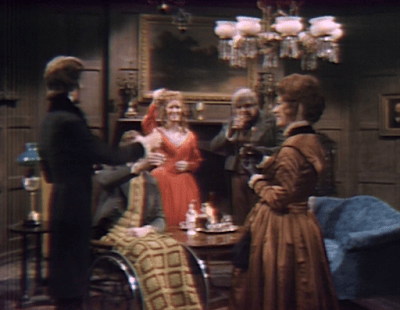
Edward trapped between the enigmatic Laura and the exuberant Quentin. Screenshot by Dark Shadows Before I Die.
For his part, Quentin bears a striking similarity to the early, wicked Roger. He wants money only to spend it, a fact which he cheerfully admits. He tried to forge a will in his grandmother Edith’s name to cheat his sister Judith (Joan Bennett) out of her inheritance, having previously threatened to kill Edith. He does have great affection for Jamison, but since he often uses the boy as a pawn in Satanic ceremonies, his fondness for his nephew is not much of an improvement over Roger’s hatred for his son. Indeed, Quentin’s resemblance to Roger connects the 1897 segment not only to the early months of the show, but also to the weeks immediately preceding it. Early in 1969, Quentin’s ghost had taken possession of David Collins and was causing him to die. When we see that Quentin is now what Roger was originally, David’s ordeal takes on a new dimension. He is dying for the sins of his father.
In this episode, Laura has returned. Edward has offered her a great deal of money to go away and never come back; she refuses. She threatens to tell the world about her relationship with Quentin if Edward does not let her stay at Collinwood. Edward buckles to this blackmail. Laura tells him that “Family pride is your greatest weakness,” making him Roger’s exact opposite.
When Laura was at Collinwood from December 1966 to March 1967, her old boyfriend Burke Devlin kept pestering her with his suspicion that he, not Roger, was David Collins’ father. Burke was not the first character to bring this idea up. Roger had mentioned it to Liz in #32, when they were talking about an attempt David had made to kill Roger. At that time, Liz was horrified that Roger seemed to want to believe that David was Burke’s natural son.
It seems unlikely that Quentin is Jamison’s father. They have been firm about 1870 as Quentin’s date of birth, and in 1897 Jamison is quite plainly twelve. Laura may have gone on to marry her own grandson, but it would be a bit of a stretch for her to have started sleeping with her brother-in-law when he was fifteen, even if he did look like David Selby.
But Roger’s anger and jealousy about Burke and Laura do mirror Edward’s about Quentin and Laura. It was abundantly clear that Roger and Burke’s deepest pain regarding Laura was that their intense attachment to each other was disrupted when she left Burke for Roger; Diana Millay used her gift for dry comedy to make this explicit in a scene the three of them played in the groundskeeper’s cottage in #139. Likewise, Edward’s frustration with and disappointment in his brother is at least as deep a source of anguish to him as is his loss of Laura’s love.
Laura, too, is quite different this time around. The first Laura story took shape gradually over a period of weeks, as Laura herself emerged from the mist. Now Laura is a forceful presence from her first appearance. Originally we heard that Laura had married into several of the leading families of the Collinsport region; now they have given up on the idea of developing other leading families, and Laura just keeps coming back to the Collinses. In the first story, they laid great emphasis on the interval of precisely one hundred years between her appearances; now, the number of years doesn’t seem to have any particular significance. As we go, we will see an even more important difference. When we first met Laura, she was utterly determined to make her way into a pyre so that she could rise as a humanoid Phoenix; now she is unhappy about the whole thing, and angry with people who have helped her on her fiery way.
Edward lets Laura live in the cottage where Roger and Liz would put her in 1966. In the final scene, she goes there and finds Quentin, drunk and trying to conjure up an evil spirit. Quentin keeps telling Laura that she is dead. Frustrated with her persistent refusal to concur with this statement, Quentin puts his hands around her neck and announces that whether or not she is dead now, she will be by the time he gets through with her.
Roger was uncharacteristically sober at the beginning of his three-scene in the cottage with Burke and Laura in #139, but he did enter brandishing a fire-arm. So Quentin’s homicidal intentions on this set further cement his affiliation with his great-nephew in the eyes of longtime viewers.
Millay and Edmonds are not the only actors whose screen iconography the show turns to advantage today. We first saw Kathryn Leigh Scott and Don Briscoe together in #638, when she was playing ex-waitress Maggie Evans and he was playing mysterious drifter Chris Jennings. They met in the foyer at Collinwood. Maggie was angry with Chris, and Chris was guilt-ridden. Today, Miss Scott plays governess Rachel Drummond and Briscoe plays teacher Tim Shaw. They meet in the foyer at Collinwood. Rachel is angry with Tim, and Tim is guilt-ridden.
Though the same actors are playing the same basic emotions on the same set, the situations are different, and the characters are very different. Maggie is Dark Shadows‘ principal representative of the working class of the village of Collinsport. She speaks directly and bluntly, using the plainest language she can to dare Chris to try to excuse his inexcusable behavior. Chris occupies a lowly and unsettled place in the world, and he dodges her gaze and evades her questions, saying as little as he can, almost mumbling.
But Rachel is a neurotic intellectual, and she expresses her anger in complex sentences featuring vocabulary that only a very well-read person would have used in 1897 (for example, the word “sadist.”) Tim retreats from her anger into a defense of his job that quickly devolves into the tiredest platitudes imaginable. At one point he actually intones “It is better to light one candle than to curse the darkness.” Miss Scott makes Rachel’s highly literate onslaught on Tim as forceful as was Maggie’s unvarnished challenge to Chris, and Briscoe makes Tim’s pompous posturing as pitiable as was Chris’ broken burbling. Writer Gordon Russell must have been delighted that the actors did such good work with his ambitious pages.