Indentured servant Ben was unhappy enough when he was under the rule of haughty overlord Joshua Collins. He has now found himself doubly enslaved, still subject to the Collinses, but also under a spell cast by lady’s maid/ wicked witch Angelique that compels him to do her bidding. At least Joshua isn’t bothering him these days- Angelique has, for reasons of her own, turned him into a cat. In Angelique’s room, Ben wields a hatchet, gleefully preparing to decapitate the cat formerly known as Joshua.
Angelique interrupts Ben’s evil plan.
Angelique enters and forbids Ben from committing this act of felicide. Ben is disappointed. When his arguments make no impression on her, he whines “Ple-e-e-ase!” Thayer David gets the full comic value out of that, Mrs Acilius and I laughed out loud.
Angelique’s main business is preventing Joshua’s son Barnabas from marrying the gracious Josette. To that end, she orders Ben to steal some things. When he protests that it will be the end of him if he is caught, she tells him to see to it that he isn’t caught.
In the parts of the show set in 1967, Barnabas is a vampire. We have heard him use the very words Angelique uses here when telling people who were under his power not to be caught, most recently with his distant cousin/ blood thrall Carolyn in #362. The echo is so specific and of so recent an episode that we can’t help but wonder if Angelique’s witchcraft will not only turn Barnabas into a vampire, but will deposit her personality in his body.
Barnabas and Josette’s wedding is supposed to be held in the front parlor of the manor house. When the bride doesn’t come downstairs, her father, André DuPrés, asks his sister, the Countess DuPrés, if he should look for her. She agrees that he should. This is an odd little moment, suggesting that the Bossy Big Sister/ Bratty Little Brother dynamic we have seen among the Collinses of the 1960s may have been familiar in the House of DuPrés in 1795.
André goes up to Josette’s room. He shouts her name, looks for her in the linen chest at the foot of her bed, and shouts for her some more. He reports her absence to the party downstairs. Angelique lifts a flute of champagne, silently toasting her triumph.
Wicked witch Angelique is trying to prevent young gentleman Barnabas Collins from marrying his fiancée Josette. To that end, she has cast a spell on Josette and on Barnabas’ uncle Jeremiah, causing them to conceive a mad passion for each other. Jeremiah resists the feeling, and is resolved to leave town until Barnabas and Josette are safely wed.
Angelique decides that she will keep Jeremiah around by causing his brother, haughty overlord Joshua, to disappear. When she makes this decision, she is with Ben, an indentured servant of Joshua and bewitched thrall to Angelique. Ben is miserable when Angelique compels him to act against Barnabas, since Barnabas has always been most kind to him. However, Joshua treats Ben with relentless cruelty, and when Angelique announces that she will transform him into an animal, Ben is gleeful at the idea of the tyrant getting his comeuppance. Ben pleads with Angelique to make Joshua into a jackass, so that he can whip him while they plow the fields.
Angelique ignores Ben’s idea, and makes Joshua into a small cat instead. This transformation takes place while Joshua and Jeremiah are in the front parlor, arguing about Jeremiah’s plan to go away. Jeremiah turns to look out the window for a second, and when he turns back Joshua is gone and the cat is in his place.
When I was a graduate student in Classics lo those many years ago, I made a study of Apuleius’ Metamorphoses, more commonly known as The Golden Ass, an ancient novel about a man who trifles with a witch and is transformed into a jackass in consequence. So I was more interested than most would likely have been by Ben’s suggestion.
We can see why it had to be a cat rather than a jackass. For one thing, they didn’t have the budget to get a jackass into the studio at 433 West 53rd Street in Manhattan. But there are other reasons. A jackass is a large animal, not graced with the gift of stealth, and if one had materialized out of thin air in the front room it would have been obvious that magic was at work. That would have been bad for the plot, because the characters would have had no choice but to admit that witchcraft was a likely explanation. Even Jeremiah and Josette might well have realized that their sudden attraction was the result of a spell, and have set about fighting it directly. By contrast, a cat is a small creature, known for silence, and on a rolling estate bordering on the wilderness any number of them would be likely to slip into the manor house on a cold night. Its presence would attract little notice from anyone not already convinced witchcraft was in progress.
In addition to the plot trouble that would have resulted had Angelique turned Joshua into a jackass rather than a cat, there would also have been a tonal misstep. At this point they are still developing stories that show us what life was like around the Collins estate before Angelique came. Those are comedies of manners, tales of romance, melodramas about family tensions, and other genres that generate light amusement. That light amusement can keep going if the uncanny phenomena people see are little oddities that elicit impatient demands for a Logical Explanation, but if Angelique conjures up something as big and distinctive as a jackass the natural reaction would be terror, a strong enough feeling that everything else would feel irrelevant until it was resolved.
Also, jackasses have large, expressive eyes. It is difficult to look at the face of one and not to think you know how it is feeling. Joshua is enough of a villain that we simply laugh at the idea of him being put out of the way in this bizarre fashion, and the enigmatic face of a cat does not undercut this laughter. But if we look in the animal’s eyes and see longing and sorrow, which are always easy to find in the eyes of a jackass, we would feel pity for him. That pity would sound a discordant note at this point in the story, distracting us from the suspense about how Angelique’s evil plans will work and our interest in the other story elements we will be seeing.
It is true that there is nothing very catlike about Joshua. For Danny Horn, that is a flaw, one so severe that the whole story of Joshua’s catification “doesn’t work.” He writes:
The cat thing just doesn’t work. But it doesn’t work for interesting reasons, so let’s break it down a little…
A truly satisfying witch-vixen scheme needs to get two things right — it needs to make sense tactically, and it needs to be metaphorically coherent.
For example, spiking Josette’s rose water perfume with love potion totally works, on a strategic level. Josette and Jeremiah find themselves drawn to each other, but they have no idea why. There’s no evidence that leads back to Angelique; everybody just thinks they’re unable to control their forbidden attraction to each other…
And then there’s the cat. Tactically, this is another clear mistake. Yes, Angelique’s goal was to keep Jeremiah from leaving town, and striking Joshua down is an effective way of doing that.
But the actual circumstances don’t allow for any kind of cover story — Joshua apparently disappeared in the middle of a conversation in the drawing room. He wasn’t even walking in the woods, or alone in the basement. Jeremiah knows exactly where Joshua was at that moment, and there’s no way that he could have silently left the house, even if he had a reason to, which he didn’t. Again, this just puts everybody on guard, and hunting around for a malign influence.
And as a metaphor, it’s even worse… What does “cat” mean, in this context?
There’s no sense in which Joshua was a “cat”; the concept doesn’t connect to anything. There’s no symbolic resonance that would make it narratively satisfying, and so it just feels random and silly.
Danny Horn, “Episode 379: Nine Lives to Live,” Dark Shadows Every Day, 24 April 2014
I disagree. Jeremiah is the only person who knows that there is no possible way Joshua could have left, and Angelique’s plan is that he himself will soon run away with Josette, a circumstance which will render his testimony about anything suspect. Further, Joshua and Jeremiah’s sister Abigail and Josette’s aunt the Countess DuPrés are already “hunting around for a malign influence,” prompting everyone else to think they are being ridiculous. If those two seize on Jeremiah’s account of Joshua vanishing and being replaced by a cat, that division within the household will only deepen, bringing greater confusion and setting Angelique’s victims against each other.
The characters look at Joshua and see a tyrant who dominates their lives. We know enough about the major events upcoming to know that he will be utterly powerless to influence them in any way. So when we see his attempt to impose his will on his brother come to an abrupt end when he is reduced to the form of a furry little animal, we see the whole logic of the story in a nutshell.
Moreover, Joshua is played by Louis Edmonds, who in the parts of Dark Shadows set in the 1960s plays high-born ne’er-do-well Roger Collins. The contrast between Roger and Joshua marks the decline of the Collinses from the zenith of their power in the eighteenth century to its nadir in the twentieth. Roger has many of Joshua’s mannerisms, most of his sense of superiority, and all of his taste for expensive things and grand surroundings. But where Joshua is a dynamic businessman, a dominating patriarch, and a self-righteous advocate of Jeffersonian republicanism, Roger has squandered his entire inheritance, lives as a parasite upon his sister, and is frankly and shamelessly nihilistic. Joshua would be shocked if he were told that his commanding self-assurance was an outgrowth of narcissism; Roger cheerfully admits that he is utterly selfish. Joshua may see himself as the lion of upper New England; Roger endears himself to us with a talent for sarcastic remarks that might well be called catty. So when Angelique turns Joshua into a house cat, she is doing what we already know history will do to his descendants.
No two performers did more to pioneer what would become the Dark Shadows house style of acting than Thayer David and Lara Parker. When David first appeared as gruff groundskeeper Matthew Morgan in #38, he stood out in a cast of theater actors who tended to play their parts somewhat larger than life by his exceptional intensity. In the 1795 period piece, he brings the same quality to his portrayal of kindly indentured servant Ben Stokes. As wicked witch Angelique, Parker is the first member of the cast to find a kind of ferocity that outdoes even David. Today, the two of them are the main characters in the episode, yet each shows great restraint and understatement. Their performances are admirably precise.
Angelique is maidservant to Countess Natalie DuPrés, a French lady who took her to the island of Martinique when she fled the Revolution. The countess hasn’t been much in evidence, so that Angelique spends most of her time working for her niece Josette, fiancée of young gentleman Barnabas Collins. Before Barnabas and Josette became a couple, he had a brief affair with Angelique, to which Angelique attached great importance. When she finds that Barnabas does not love her and cares only for Josette, she sets about casting spells to ruin their happiness.
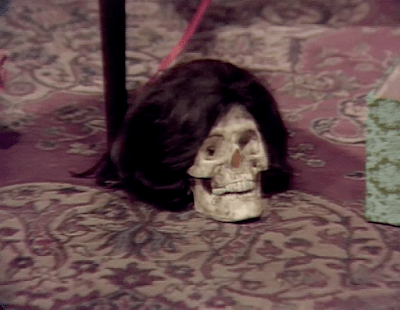
Today, Josette opens a gift box to find a skull wearing a wig. She is altogether undone by this. Barnabas confronts Angelique about it. While he does not seem to have any idea that Angelique is a witch, he is sure she is responsible for the nasty surprise. She denies everything, and he has no evidence against her.
Ben had tried to tell Barnabas and Josette about Angelique, but being under her power, he cannot. But Barnabas could tell Josette the truth about his past with Angelique. Because he does not, she goes on trusting Angelique, giving her full access to her things and to her person, enabling her to cast whatever spell she wishes. Had Barnabas trusted Josette with the truth, they might have been able to fight Angelique. Because he insists on hiding it from her, they are utterly helpless and will lose absolutely everything.
When Dark Shadows started, the 1960s version of the Collins family was isolated from the community, unable to make anything happen, and vulnerable to a wide variety of enemies, all because matriarch Liz and her brother Roger clung desperately to shameful secrets. When those secrets came to light, they lost nothing and found themselves with a new freedom. Now, in 1795, the Collinses are the lords of the town, running a dynamic business, and apparently unassailable in their wealth and prestige. But in Barnabas’ failure to come clean with Josette, we see the beginning of the process that will lead them to the precarious state in which they are trapped in 1966.
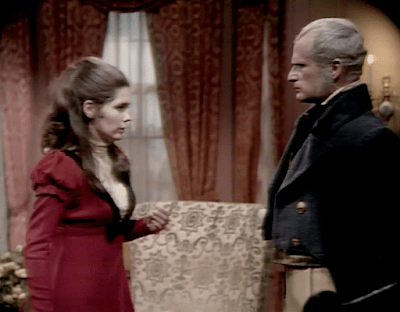
Today, Angelique completes a spell that causes Josette to conceive a mad passion for Barnabas’ uncle and best friend Jeremiah. After Josette sneaks into Jeremiah’s room and makes a fool of herself by propositioning him, she runs back to her own room and sobs on the bed. Angelique is there, feigning puzzlement and sympathy, quietly accepting the young mistress’ refusal to tell her what is wrong.
This is the first episode of the 1795 segment not to include time-traveling governess Vicki. While actors Kathryn Leigh Scott, Thayer David, and Anthony George all appeared in the main time frame (debuting in episodes #1, #38, and #262, respectively,) only Jonathan Frid, as Barnabas, is playing a character we had met there. There’s a heavy-handed moment of self-reference today when Josette tells Barnabas that sometimes he is “too modern,” and he thinks about it during a close-up. That close-up goes on so very long that there is no doubt they are giving us reading instructions, telling us that Barnabas, rather than Vicki, is now our point of view character.
Angelique, lady’s maid/ wicked witch, has cast a spell over kindly indentured servant Ben Stokes, making him her slave in an even deeper sense than he was already Joshua Collins’ slave. She gives Ben various tasks in support of her current project, black magic that will make the lovely Josette forget her fiancé Barnabas and conceive a mad passion for Barnabas’ uncle and dear friend Jeremiah. Most notably, she needs an unbroken spider web from an oak tree, and Ben brings her one.
Meanwhile, cousin Millicent Collins has come to the estate of Collinwood. Millicent is giggly, afraid of germs, and very, very rich. Joshua means for his bachelor brother Jeremiah to marry Millicent, a prospect that repels Jeremiah.
Time-traveling governess Vicki enters. When she sees Millicent, Vicki calls her “Carolyn,” because she is played by Nancy Barrett, who plays a character named Carolyn in the parts of Dark Shadows set in the twentieth century. The makers of the show wanted Vicki to keep the audience up to date on the cast members’ resumés, even though it makes all the other characters think she is a lunatic.
Alone with Vicki, Jeremiah confides that he does not want to marry Millicent. Vicki had studied Collins family history when she was living in the 1960s and has an idiotic compulsion to verbalize her every thought, so she declares that Millicent will never marry. Jeremiah remarks that she says the strangest things.
This scene is more tolerable than the others in which Vicki blurts out information she wouldn’t know if she belonged in 1795 because of the casting of Anthony George as Jeremiah. George was a cold actor who kept the audience guessing what was going on inside his characters’ heads. That made him a disaster as the second to play the hot-blooded Burke Devlin, but when we see him as Jeremiah we take his ready acceptance of Vicki’s bizarre behavior as a sign that he has something up his sleeve. If they can stop giving Vicki such tiresome lines, Jeremiah might be a promising love interest for her.
Time-traveling governess Victoria Winters sees a man fueling the fireplace in the front parlor of the manor house on the estate of Collinwood. As she has done several times since arriving in the year 1795, she jumps to the conclusion that he is the character the same actor played in the 1960s. In fairness to Vicki, a couple of the people are the same- young gentleman Barnabas Collins will become a vampire and meet her in her own time, and Barnabas’ ten year old sister Sarah will die soon and her ghost will haunt Collinwood and its environs in 1967. So it’s tricky to handle the repertory theater aspect of the rest of the cast, and, by having Vicki freak out and shout about the main time period every time she meets someone, the show has chosen the most irritating possible way of addressing this problem.
The man Vicki meets today is indentured servant Ben Stokes, and the man she mistakes him for is gruff groundskeeper Matthew Morgan. Since Matthew held her prisoner in this very house and tried to decapitate her here in 1966, her misidentification of Ben leads Vicki to scream and holler and bring the master of the house to ask what is going on. Ben responds that he did nothing at all, Vicki volunteers that it was all her fault and tries to explain.
The master, haughty overlord Joshua Collins, is ever mindful of Ben’s status as a felon entrusted by the state to his custody, and declares that Ben is forbidden to speak to any woman for any reason. Vicki is appalled by this, but as governess she is a servant herself, so Joshua orders her to be silent. Besides, her protestations don’t make any sense to anyone who didn’t see episodes #108-#126 of Dark Shadows. Since it is 1795, Joshua doesn’t have access to the show on streaming or even on cable. He tells Matthew he won’t get the day off he’d asked for tomorrow.
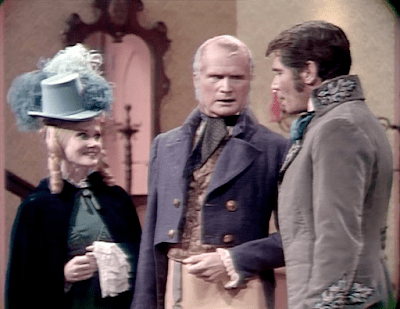
Before Joshua dismisses Vicki to return to her duties, he mentions that his second cousins Millicent and Daniel Collins will be arriving soon and staying for the month leading up to the wedding of Joshua’s son Barnabas to Josette duPrés. Daniel is a child the age of Joshua’s daughter Sarah, and will be joining Sarah as Vicki’s charge during his stay at Collinwood. Joshua mentions that Millicent is a lovely young woman, and that from her early childhood it had been understood that she would marry Joshua’s younger brother Jeremiah. Joshua is quite pleased with this prospect, not least because Millicent has inherited a considerable fortune.
Vicki’s compulsion to keep the audience up to date on the resumés of the actors is mirrored by a compulsion to blurt out information she knows only because she comes from 1967. She had studied the Collins family history, so when Joshua talks of Millicent’s prospective marriage to Jeremiah she shouts “Millicent never married!” Joshua is puzzled by this idiotic remark, but quick to accept Vicki’s explanation that she had read a novel about a spinster named Millicent and couldn’t help but yell about it.
During the first year of Dark Shadows, Vicki was, on balance, one of the smartest characters and was the one who made the most important things happen. So it is distressing to see her verbalizing her every thought, including irrelevancies about the actors’ other roles and information that would tend to expose her secret. If she is going to survive in this past world, she’s going to have to regain enough brain power to keep her mouth shut. Moreover, even when she was at her smartest Vicki was always a conspicuously inept liar. Joshua is fundamentally uninterested in a person of her apparently low social status, and so he accepted the story she made up to cover herself this time. But someone more willing to pay attention to her might very quickly conclude that Vicki is a strange and dangerous person.
Meanwhile, lady’s maid/ wicked witch Angelique is in the woods gathering noxious weeds to use in an evil potion. Ben catches her there, and warns her that the plants she has in her basket are poisonous. She drops them, thanks him, and strikes up a conversation. He tells her Joshua has forbidden him to talk to women. She says this is horribly cruel, and Ben agrees. He goes, and she picks the deadly leaves back up.
In the servants’ quarters, Vicki enters Angelique’s room. She sees some things of Barnabas’ that Angelique had used to cast a spell on him the other day. When Angelique comes in, Vicki tells her that Josette was asking for her. Vicki then asks how Barnabas’ things got to be in Angelique’s room. She says she doesn’t know, then puts the blame on Sarah. Vicki says she will scold Sarah for carrying Barnabas’ things around the house, and Angelique begs her not to. She says she is afraid that if she does, Sarah won’t visit her anymore.
Angelique has no way of knowing it, but this is the perfect lie to tell Vicki. For months before she left 1967, everyone was eager for Sarah’s ghost to come and visit them. Indeed, Vicki was at a séance called to contact Sarah when Sarah took possession of her, said through her that she would tell the “story from the beginning,” and yanked her back to this time. So, when Angelique presents herself as afraid that Sarah will stop visiting her, Vicki cannot refuse her request.
Angelique decides she needs a helper to keep herself from being suspected. We cut between the outdoors, where we see Ben chopping wood, and the servant’s quarters, where Angelique is mixing up a potion. Vicki comes to Ben, and we wonder which of them will be Angelique’s target.
Vicki apologizes to Ben. He just wants her to go away- he’s got into enough trouble for talking to her once, the last thing he wants is to be caught repeating the offense. She says that she knows that Joshua “can seem stern,” to which Ben reacts with disbelief. He says that Joshua is far worse than stern.
Again, this is Vicki failing to distinguish characters from the actors who play them. Louis Edmonds plays Joshua in 1795, and high-born ne’er-do-well Roger Collins in the parts of Dark Shadows set in the twentieth century. For the first 25 weeks of the show, Roger was the villain, and he tried to kill Vicki once or twice. By the time his ex-wife Laura went up in smoke in #191, Roger was no threat to anyone. When Sarah brought Vicki back here, Roger had long since been reduced to occasional comic relief.
Joshua is as selfish and cold as Roger at his worst, but where Roger is cowardly, weak, and shameless, Joshua is bold, imperious, and utterly convinced that he is right. Roger is what Joshua might become after a long period of continual degeneration and degradation, a grotesque parody of his ancestor. He has Joshua’s style, but none of his strength. He is reminiscent of the “Last Men” in Nietzsche’s Also Sprach Zarathustra, who were strangers to every consideration but their own immediate comfort. Even so, enough of Louis Edmonds’ wit and personality come through that we always enjoy seeing Roger, and we can understand why Vicki likes him. Edmonds is so good that we are sure we will enjoy watching Joshua as well, but he is clearly never going to become a lovable squish.
Ben is trying to orient Vicki to the current phase of the show when we cut to Angelique in her room. She calls Ben’s name. Suddenly Ben seems to have taken ill. He finally persuades Vicki to leave him alone before he gets caught talking to her again. Once Vicki is gone, he sees a vision of Angelique calling to him and sets off.
When Ben gets to Angelique’s room, he tells her he has no idea what he is doing there. She tells him he is there because she wanted him. This means only one thing to him, so he lifts his arms and steps forward, obviously intending to brighten the day with some rapid love-making. She pulls back and tells him to take a drink first. The beverage she offers him is readily identifiable to a modern audience as Coca-Cola.
In the 1960s, Coca-Cola may have been the pause that refreshes, but in 1795 it had more drastic effects. After Ben drinks it, he staggers back and Angelique tells him that he no longer has a will of his own and will be her slave forevermore. He doesn’t make love to her, either, so no matter how tasty the Coke was the visit would have to be reckoned a loss from Ben’s point of view.