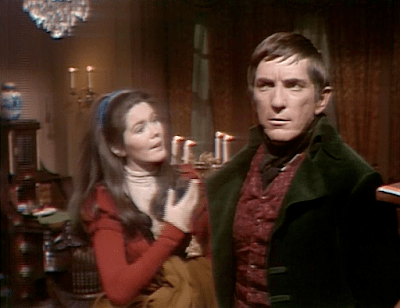
In #70, the deserted Old House on the great estate of Collinwood was introduced as the favorite hangout of strange and troubled boy David Collins (David Henesy.) Several adult characters tried to keep him away from the house, notably crazed handyman Matthew Morgan (Thayer David,) and Willie Loomis, servant to David’s distant cousin, vampire Barnabas Collins. David’s visits to the house precipitated a number of crises, including one that began when he found that Barnabas and Willie kept the cellar door locked and became intensely curious as to why. We knew that they did this to conceal Barnabas’ coffin at the foot of the stairs. That was when the show was set in 1967.
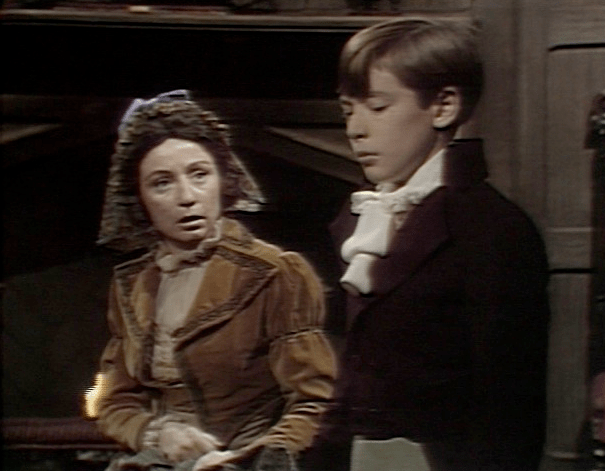
Today, young Daniel Collins (David Henesy) is introduced as a boy whose favorite hangout is the deserted Old House on the great estate of Collinwood. He finds much put-upon servant Ben Stokes locking the cellar door. Ben is the friend and accomplice of Daniel’s second cousin, vampire Barnabas Collins. Daniel is intensely curious as to why Ben is locking the door. We know that it is to conceal Barnabas’ coffin at the foot of the stairs. Now the show is set in 1796.
Ben initially responds to Daniel’s curiosity with the same angry bluster Willie had used in his efforts to keep David away from the house. By the end of their scene together, he has engaged Daniel in conversation, as Matthew often did with David. Daniel confides in Ben that he is planning to run away. Ben points out that Daniel is in no way prepared to strike out on his own, and persuades him to go back to the great house and to make a list of the things he will need. Combining Willie’s responsibility for protecting Barnabas with Matthew’s ability to persuade a boy that he is his friend, Ben seems well-positioned to keep Daniel from coming into conflict with the vampire in the family.
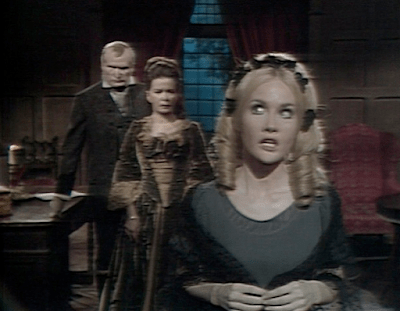
Back in the great house, repressed spinster Abigail Collins, Barnabas’ aunt, finds Daniel’s list and asks him what it is. He evades that question. As it happens, it is not the one she most urgently wants answered. She sits him down in the drawing room and asks him about a charm bracelet she had found somewhere around the house.
Daniel confirms that the bracelet belonged to Victoria Winters, the governess who used to teach him and Barnabas’ little sister Sarah. Vicki is now standing trial on charges of witchcraft. Sarah is dead, and Abigail is convinced that Vicki’s evil spells caused her death, among many other recent tragedies. The bracelet seems to Abigail to be evidence against Vicki. Abigail points to a charm in the shape of a devil and asks Daniel what Vicki told him about it. He says blandly that Vicki told him and Sarah that it was a devil. She asks him if Vicki instructed him and Sarah to fall to their knees and worship the Devil, and he reacts scornfully, asking who ever heard of worshiping a devil.
Abigail presses Daniel for more information about Vicki. He keeps talking about how much he and Sarah liked her, and tries to paint her in a favorable light. He tells Abigail that Vicki used to say that the day would come when people could fly through the air, covering hundreds of miles in a single hour, that there would be machines that would pick up voices traveling through the air and make them audible with the turn of a dial, and that other machines would be able to solve arithmetic problems. We know that Vicki is a time-traveler displaced from the 1960s and that she is describing airplanes, radio, and electronic calculators, and we further know that her time-travel was not the result of a spell she cast, but that Sarah’s ghost yanked her back in time. But Abigail interprets her stories as promises of rewards from the Devil, and most of those whom Vicki has told of her chronological dislocation have taken it to be a confession that she is a witch.
It dawns on Daniel that everything he is saying in his attempt to defend Vicki is making matters worse for her. David Henesy does a marvelous job showing us how miserable this makes Daniel. Abigail tells him he must go with her to Vicki’s trial tomorrow and repeat to the judges what he has told her. He resists the idea. She breaks off their conversation to announce she will go to the Old House. Daniel has told her that he saw Ben locking the cellar door, and she has jumped to the conclusion that he was hiding evidence against Vicki behind it. Daniel pleads with her not to go, but she insists.
We cut to the front door of the Old House, where Abigail encounters Ben. He begs her not to go in. She accuses him of being in league with Vicki and declares that his own trial will begin before long. Ben may have been able to soft-soap Daniel, but Abigail responds with hostility no matter what he says. Finally, he watches her go in. She has said that whatever happens to her inside will be her own responsibility; after she is gone, Ben echoes this statement, a savage note of satisfaction in his voice.
Abigail unlocks the cellar door, goes down the stairs, and sees the coffin. Of course, it is sunset; of course, she is just in time to see the coffin open and Barnabas rise. She watches in terror. Clarice Blackburn does an extraordinary job of acting in the closeup of Abigail’s reaction; she gives the purest possible look of fear, and her scream is perfectly open and smooth.
Barnabas looks at her and asks “Abigail, what are you doing here?” The audience can’t be in much doubt how their reunion will end, though we will have to wait until tomorrow to see just what happens between them.
Dark Shadows was made with very little advance planning, though we do know that they had settled on the name “Daniel Collins” for David Henesy’s character well before the 1795 segment began. In #350, three full weeks before Vicki starts her uncertain and frightening journey to the past, heiress Carolyn slips and calls David “Daniel.” So it is inexplicable that they’ve waited until the segment has been going for more than thirteen weeks before bringing Daniel in. Vicki and David’s relationship was the only thing on the show that consistently worked in 1966, and David’s scenes with Sarah were among the highlights of 1967. So when in #372 haughty overlord Joshua tells Vicki that she will be tutoring both his daughter Sarah and his young cousin Daniel, the audience would have been excited to see the three of them together.
Presumably the makers of the show were unsure how long they would be able to stay in the eighteenth century before the ratings started to suffer and they came under pressure to get back to a contemporary setting. That might explain why they wanted to keep the number of characters to a minimum, so that they would be able to show the four necessary events- Sarah’s death, Barnabas’ transformation into a vampire, Josette’s leap from Widows’ Hill, and the chaining of Barnabas in his coffin- without starting a lot of threads they would have to hasten away and leave dangling. Even so, there were plenty of longueurs in the first weeks when they could have fitted in a few scenes of Daniel and Sarah together, if they had had the time to plan them.
As it happened, the ratings were great for the eighteenth century segment, so they were under no pressure at all to go back to the 1960s. But the breakneck pace of the early weeks and the lack of detailed planning has come back to haunt them. Three of the four big points have all been covered. All that is left is to chain Barnabas in his coffin and to send Vicki home, and they can do both of those things in any one episode. They are going to have their work cut out for them to fill the remaining time with stories that are anything like as interesting as some of those they passed up because they didn’t realize they would have time to tell them. The result will be that, while the last few weeks of the eighteenth century segment feature some great moments and several Genuinely Good Episodes, they also involve a lot of disappointment for the audience.
Fluttery heiress Millicent Collins thought that she had a bright future to look forward to when she became engaged to young naval officer Nathan Forbes. That prospect shattered when she discovered that Nathan was already married. Making matters worse, Nathan’s wife, Suki, had presented herself to the Collinses as his sister, and he had gone along with this imposture. Suki is now dead, strangled in an apparently empty house, her body discovered by Nathan when no one else was anywhere near and he had a great deal to gain by her death. For some reason, no one seriously suspects Nathan of the murder, but the whole thing rather tends to cast him in a poor light.
Millicent has recently seen her second cousin, Barnabas Collins. Barnabas’ father, haughty tyrant Joshua, has put the word about that Barnabas has gone to England. Like most people in and around the village of Collinsport, Millicent had believed this story. But the other night she spotted Barnabas in the cemetery. Now she is determined to find Barnabas and recruit him to avenge her honor by fighting a duel with Nathan. She is indignant that Joshua and his wife Naomi keep insisting that she did not really see Barnabas, and that he is not available to fight Nathan.
As it happens, Barnabas did not go to England. Joshua invented that story to cover up the fact that Barnabas had died. Joshua believed that Barnabas died of the plague, and that if that became known the men would not show up to work at the family’s shipyard.
Today, Millicent hears for the first time that Barnabas has died. The news comes from an unpleasant young man named Peter, who is acting as attorney for accused witch Victoria Winters. Peter comes to the great house of Collinwood looking for much put-upon servant Ben Stokes, hoping that Ben will testify for Vicki. Millicent is uninterested in Peter’s mission, but asks him to look for Barnabas. Peter has heard that Barnabas is dead, and passes that information along to Millicent. Since she has seen Barnabas with her own eyes, she simply laughs at this.
As it happens, Peter and Millicent are both right. Barnabas is dead, most of the time. At night he rises as a vampire and preys upon the living. No one but his friend Ben knows this.
In her scene with Peter, Nancy Barrett’s Millicent is slightly, cheerfully crazy. She doesn’t get much support from Roger Davis as Peter, and winds up playing the part a little bit bigger than she might have wished. In her next scene, she has a partner who helps her stay on firm ground.
Millicent answers the front door, as she had done when Peter knocked. This time she is appalled to find that it is Nathan. He puts his foot in the door and refuses to leave until she has heard him out.
Nathan spins a tale to Millicent that he and Suki were in the process of divorcing. We know this is false, and Millicent should as well. When they became engaged, Nathan insisted on the earliest possible wedding date. Since Suki did not show up with a final decree, Nathan could not have been sure that the divorce would be official by that date. Of course, we also know that there was no divorce in the offing; Nathan had abandoned Suki, she had tracked him down, and when she found out about Millicent, she planned to force Nathan to send as much of Millicent’s vast inheritance her way as possible.
Millicent doesn’t know about those details, but she is quite sure Nathan is lying. When he tries to embrace her, she takes a letter opener and tries to stab him.
Millicent is not supposed to be particularly brainy, but she is a smart character in every sense that matters. She absorbs the facts presented to her, interprets them reasonably, forms plans, and pursues those plans by means which, if her interpretations are correct, might well succeed. She believes, correctly, that Nathan has mistreated her and made her look like a fool. She believes, as a young lady of the late 18th century well might, that matters can be set right only by Nathan’s violent death. Having seen Barnabas and knowing that he once fought a duel, she hoped that he would be her avenger. Since Barnabas is being kept from her for no reason she can fathom, she has decided to take matters into her own hands. Her actions may not be the optimal response to the situation, but we can follow her train of thought at each point and are in suspense as to what it will lead her to do next.
Joshua interrupts Millicent before she can accomplish her purpose. He sends her out of the room and confronts Nathan. He tells Nathan he will soon inform the Navy department of what he has done, and that he is sure they will share his eagerness to resolve the issue discreetly. Joshua’s horror of scandal, which we have seen many times, most spectacularly in his cover-up of Barnabas’ death, explains his willingness to believe that Nathan is innocent of Suki’s murder. There would be no way to settle that entirely out of the public eye.
Joel Crothers brought a great deal of wholesome charm to the role of the scoundrel Nathan. We are impressed when Millicent does not give him an inch, even though we can see that she is tempted to do so. We can understand why Joshua several times seems to have to remind himself that he disapproves of Nathan. When, as Joshua, he says he does not believe Nathan killed Suki, Louis Edmonds gives a little smile which flashes real affection for the man he is condemning. It is a testament to Crothers’ talent that his partners are able to achieve these subtle effects in the scenes they share with him in the drawing room.
We cut to the cemetery, where Ben is digging a grave in a heavy fog. Peter shows up to shout at him about testifying for Vicki. Thayer David answers him with an impressive simplicity. Roger Davis is as loud and monotonous as he usually is, but David’s Ben doesn’t waste the tiniest energy on any uncalled-for displays with his voice or face or gestures. It really is a master class in acting under difficult circumstances.
Joshua shows up and shoos Peter away. Joshua insists on going with Ben into the secret chamber where Barnabas’ coffin is hidden. The other night he went into the chamber alone, opened the coffin, and found it empty. Today he goes in with Ben and opens the coffin again. Unaware of the vampire curse, he is as shocked to find the body there as he had earlier been to find it missing.
For months now, fluttery heiress Millicent Collins has been staying at the great house of Collinwood as the guest of her cousin Joshua and Joshua’s wife Naomi. Tonight, she returns to the drawing room after a moonlight stroll and makes a series of statements that bewilder Joshua and Naomi.
Joshua and Naomi wonder what Millicent could possibly be talking about. Screenshot by Dark Shadows Before I Die.
Millicent tells her hosts that she has seen their son Barnabas. Joshua and Naomi are shocked to hear this, because they know that Barnabas has died. Believing that Barnabas died of the plague and that this news would scare the workers away from the family’s shipyard, Joshua put the word out that Barnabas went to England. Millicent saw Barnabas standing in the graveyard, near the secret chamber where his coffin is hidden. This further shocks Joshua and Naomi.
Millicent says that she needs Barnabas. He is the only member of the family who has fought a duel, and there is a family matter that can be settled only by dueling. Joshua and Naomi have no idea what she is talking about. She tells them she has learned that naval officer Nathan Forbes, to whom she recently became engaged, was already married. That hits them so hard they almost embrace her, something characters on this show do not do. They are supposed to be New Englanders, after all. She shies away from them.
What neither his parents nor Naomi know is that Barnabas rises from the dead by night and walks the earth as a vampire. The only living person privy to this secret is Barnabas’ friend, much put-upon servant Ben Stokes.
Ben saw Millicent at the graveyard, moments after Barnabas vanished into thin air. He tried desperately to convince her that she did not see Barnabas, repeating Joshua’s story that he has gone to England. He tried to bargain with her, promising to look for Barnabas and tell her if he finds him. His insistent denials that she saw what she knows she saw frustrated her. She told him that she wants to be buried in the mausoleum, and that she thinks of herself as already dead, dead as of today, no matter how long her body may survive. She told him her grave marker should reflect this date of death. He begged her to let him walk her back to Collinwood. Irritated with him, she allowed him only to follow her at a distance.
Millicent complains to Joshua and Naomi that Ben kept telling her that Barnabas had gone to England. She says that he must be punished. Joshua has been telling Millicent she is ill, and he wants Ben to stick to the official story. But he is such a tyrant that he cannot help but warm to the idea of punishing Ben. He ends the episode by expressing his vigorous agreement with Millicent.
Ben and Millicent are both wonderful today. Millicent has dozens of lines, all of them quotable, and most of them quoted in Danny Horn’s post about this episode. Nancy Barrett developed a deliberately stagy style for Millicent that always works, and today it reaches its summit.
As Ben, Thayer David has a subtler part to play, and he does it perfectly in this one. In an opening scene with Barnabas, he begins with a gruff expression of distaste for the horrible things Barnabas does, and before we know it is pleading with him not to allow himself to be destroyed. In a tiny bit of time, with only a few lines to speak and only a few opportunities to show his face, he takes us from loathing for the vampire to devotion to his friend, and at no point does the transition feel forced.
Naomi and Joshua have recently lost both of their children, among other loved ones, and there doesn’t seem to be any end to the death that surrounds them. Joan Bennett and Louis Edmonds fully connect us to their grief today. Dark Shadows too rarely gives these two extraordinary actors a chance to show what they can do, and both of them make great use of this opportunity.
Barnabas’ part is somewhat ridiculous. Today, he outdoes himself in narcissism, describing the death of his true love Josette solely as a thing that happened to him. But we know going in that that’s his deal- as a vampire, he is a metaphor for selfishness, and he was pretty self-centered even when he was alive. By this time, Jonathan Frid’s performance has made this preposterous creature into a major phenomenon of the era’s pop culture, and when he is this deep in his wheelhouse he does not disappoint. The result is a surprisingly strong entry in the series.
The terrace at the great house of Collinwood is a set where characters often behave as if things are possible that the audience knows won’t happen. Couples make dates we know they will never keep and talk about weddings we know one of them won’t live to see. Today, much put-upon servant Ben sees grand lady Josette there. He urges her to leave Collinwood, and she says she is planning to do so. Ben is overjoyed. He, and he alone, knows that Josette’s lost love Barnabas has become a vampire and is obsessed with her. When Josette talks about leaving, Ben hopes she will escape from the danger Barnabas represents.
The placement of this scene at the terrace is one of several pieces of evidence that Ben’s hopes will be dashed. We have known since #5 that Josette is fated to jump to her death from the precipice known as Widow’s Hill. We learned in #233 that she did this because she saw Barnabas up there and was horrified by what he had become. Josette’s death is such an important part of the show’s backstory that we are sure she will not escape her doom. Moreover, we have seen bewildered time-traveler Vicki try to persuade Josette to go away before it is too late. Everything Vicki has done since arriving in the year 1795 has backfired, so that is another sign that Josette will not leave.
Toward the end of the scene on the terrace, Josette asks Ben if he can hear a sound of distant laughter. He says that he didn’t hear it, and neither did she. He urges her to get some sleep, and they go their separate ways.
After sunrise, Ben goes to the secret chamber in the Collins family mausoleum where Barnabas’ coffin is hidden. Obeying Barnabas’ command, he has brought a stake made of holly wood and a mallet. When he was alive, Barnabas had been a friend and benefactor to Ben. Ben finds it difficult to stake him, but is just about to do so when a loud sound of laughter, punctuated by sharp intakes of breath, comes on the soundtrack. The head of wicked witch Angelique floats onto the screen. This visual effect had been a signature of undead fire witch Laura Murdoch Collins when she was on Dark Shadows late in 1966 and early in 1967; it is the first time we have seen it since Laura went up in smoke in #191.
It was Angelique who cursed Barnabas to become a vampire. As her head floats in front of Ben, we hear her recorded voice telling him her curse will be fulfilled. When Ben says she can’t stop him, she points out that the stake and mallet have vanished from his hands. She orders him to leave the chamber. He is to come back tonight and tell Barnabas that they will never escape her power.
In his post about this episode onDark Shadows Every Day, Danny Horn argues that since Barnabas just killed Angelique in #411, she hasn’t been gone long enough to make her return particularly effective. I agree. Even if the scene were well-conceived and well-executed in every other way, that alone would make it disappointing. But there are some other substantial problems. Angelique regretted the curse she put on Barnabas, and her last mortal act was to try to stake him to keep him from rising as a vampire. Nothing she says today explains the reversal of her attitude.
The repetition of the effect from the Laura story isn’t much of a problem, not only because it has been a long time since they’ve used it, but also because the show had such low ratings when Laura was on that most viewers watching now never saw it then. What is a problem is the execution of the effect. Angelique’s voice is a tinny recording that sounds very bad when she laughs, and they keep sliding the floating head around in the frame trying to square it with Ben’s line of sight. So far from terrifying us, the result simply irritates.
We open in the drawing room of the great house of Collinwood, where Naomi Collins (Joan Bennett) is drinking alone. Her husband Joshua (Louis Edmonds) enters, returning home after an absence of some days, and greets Naomi with a loud expression of scorn for her alcoholism. She looks up and recites these lines: “A little bird flew to the window. It hovered there for a moment, and then flew away. The first bird of the morning.” Many times, Joan Bennett found ways to show the viewers of Dark Shadows why she had been one of the biggest movie stars of her generation, but this is not one of those times. She delivers this little speech stiffly, as if embarrassed by it.
Joshua is about to leave the room when Naomi tells him that their daughter Sarah died the night before, on her eleventh birthday. He is thunderstruck and says that he cannot believe it. Naomi replies, “Yes, that is what we must do- not believe it!” With this line, Joan Bennett recovers her footing. As matriarch Elizabeth Collins Stoddard in the first 73 weeks of Dark Shadows, when the show was set in 1966 and 1967, Bennett created a character who had devoted her entire life to this motto. Now that the show is set in the late 18th century, we see that the Collinses had been living by it for hundreds of years. Once she starts playing a character who is wrestling with denial, Bennett is in familiar territory, and she is terrific to watch.
Joshua believes that the bewildered Victoria Winters (Alexandra Moltke Isles) is a witch, and that a spell she cast on Sarah caused her death. He goes to the gaol in the village of Collinsport where Vicki is being held, awaiting trial on witchcraft charges. We see her in her cell, the first time we have seen this set. Joshua confronts her there. She denies his accusation. She tells him she is a time-traveler displaced from 1967 and that she has been trying to use her knowledge of history to rescue people from the fates that she has read about. This is true, as it happens, but of course Joshua is not favorably impressed. He tells her to enjoy the few sunsets and sunrises that she will see between now and the day she is put to death.
A week before, Naomi and Joshua’s other child, their forty-ish son Barnabas (Jonathan Frid,) had died of a mysterious illness. Joshua decreed that no one must know that Barnabas had died. He had Barnabas’ body interred in a secret chamber hidden inside the Collins family mausoleum, and put out the word that Barnabas had gone to England.
Unknown to Joshua or Naomi, Barnabas has become a vampire. Joshua’s remark to Vicki about sunrises and sunsets thus carried an ironic charge for regular viewers. When Barnabas emerges from his coffin after this sunset, his friend, much put-upon servant Ben Stokes (Thayer David,) tells him Sarah has died. Barnabas blames himself for this. Sarah had seen him with blood on his face, and in her fear had run away. Alone in the night, she suffered from exposure. Barnabas tells Ben that he will go into the village of Collinsport, confess everything to the authorities, and let the sunlight destroy him. At least that will save Vicki. Ben pleads with him to find another way, but Barnabas insists.
Sarah’s remains have been deposited in a vault in the outer part of the mausoleum. Naomi comes in to look at the vault again; Joshua follows her. Naomi has many bitter words for Joshua; he is ready to lament the deaths of their children. Barnabas and Ben, hiding inside the secret chamber, listen to this painful conversation.
Joshua losing his grip on NaomiBarnabas and Ben eavesdrop.
For viewers who have been watching Dark Shadows from the beginning, the scene of Barnabas and Ben eavesdropping on Joshua and Naomi evokes two earlier scenes with particular force. In #318, Barnabas and his associate, mad scientist Julia Hoffman, stood on the same spots where Barnabas and Ben stand now, listening as two local men talking in the outer chamber revealed knowledge that might expose their many crimes. In #118, crazed groundskeeper Matthew Morgan, also played by Thayer David, held Vicki prisoner in a different secret chamber, and the two of them listened as another pair of local men searched for Vicki just outside. In those episodes, Frid and David played men who were bent on murder, but whom we knew to be unlikely to kill their intended targets. Today, they are playing characters who are both desperate to stop killing, but we know that they are doomed to take more lives.
After Naomi and Joshua leave, Barnabas tells Ben he cannot turn himself in. The family must not be disgraced. He tells Ben to come back in the morning with a stake made of holly and to drive it through his heart. He gives him this command in just the same words the witch Angelique had used in #410. Ben had not at that time known what had become of Barnabas, and had complied only because he was under Angelique’s power. He resists Barnabas’ command now, saying that he cannot destroy one who has been a true friend to him. Barnabas tells him he is already destroyed, and that staking him will be a mercy. Ben reluctantly agrees.
At the top of the episode, wicked witch Angelique is in the secret chamber hidden inside the Collins family mausoleum. She is standing before the open coffin of Barnabas Collins, a stake in one hand and a mallet in the other. The sun is setting; once it does, Barnabas will rise as a vampire. She would drive the stake through his heart to prevent this outcome, but she is moving in time with the background music, and it is too slow. Barnabas awakes, knocks the equipment from her hands, and grabs her throat.
In 1967, throat-grabbing was Barnabas’ reflex when someone opened his coffin at dusk. The character first appeared in #210 as a hand darting to the throat of would-be grave robber Willie Loomis; Barnabas would bite Willie and enslave him. In #275, seagoing con man Jason McGuire opened the coffin; again the hand darted to the throat, and in #276 we learned that Jason was dead. That was the first time in 1967 Barnabas killed someone.
Now it is 1795. When we return from the opening title sequence, Barnabas has let go of Angelique. He has questions, and she is trying to avoid answering them. He realizes that she is afraid of him. When he figures out that she has turned him into a monster, he strangles her. In 1967, thirteen weeks separated Willie’s freeing of Barnabas from the death of Jason; this time, Barnabas chokes the life out of Angelique only eight minutes after he first awakens as a vampire.
Barnabas opens the door to the outer part of the mausoleum. The mechanism that opens this door is hidden inside one of the stairs leading out, and the camera lingers on it long enough to show that Barnabas must already be very familiar with the room to have gone directly to it. Returning viewers will remember that Angelique seemed unable to find it yesterday, and committed fans will remember that strange and troubled boy David Collins spent a whole week trapped in the secret chamber in September 1967 because it was so well hidden. The ghost of Barnabas’ little sister Sarah had to manifest to David in #315 and show him the door opener before the plot could move forward.
In the outer part of the mausoleum, Barnabas finds much put-upon servant Ben. Ben had been Barnabas’ devoted friend, but Angelique cast a spell on him and forced him to do her evil bidding. He is glad to hear Angelique is dead, and pledges to help Barnabas. As a living man, Barnabas had always gone out of his way to reciprocate Ben’s friendship, but throughout their conversation in the mausoleum he keeps telling Ben about the reasons he has to kill him. Only when Ben points out that he will need someone to protect him during the day does Barnabas agree to let him live. This was the same appeal that mad scientist Julia Hoffman made to Barnabas in #351. Since Barnabas was busily preparing to kill Julia a few episodes after that, this echo does not inspire much hope for Ben’s future.
Barnabas and Ben are having a little talk about how to dispose of Angelique’s corpse when they hear someone approaching the mausoleum. Barnabas hustles back into the secret chamber. Ben turns to the entrance, an appropriately helpless expression on his face.
Ben faces the darkness, waiting for whatever fresh hell may be approaching.
Haughty overlord Joshua Collins enters. Joshua is Barnabas’ father and Ben’s legally recognized master. Joshua accuses Ben of coming to rob Barnabas’ grave. Ben denies it. Joshua demands to know who he was talking to a moment before. Ben says that he was praying and that the only way out of the chamber is the way Joshua came. Joshua says that it is not the only way- Ben’s confederate could have gone into the secret chamber. Joshua opens the secret chamber, looks inside, and sees only Barnabas’ coffin. He is about to close the panel again when a bat flies out and flusters him. After the bat is gone, he agrees to let Ben stay and say more prayers for Barnabas.
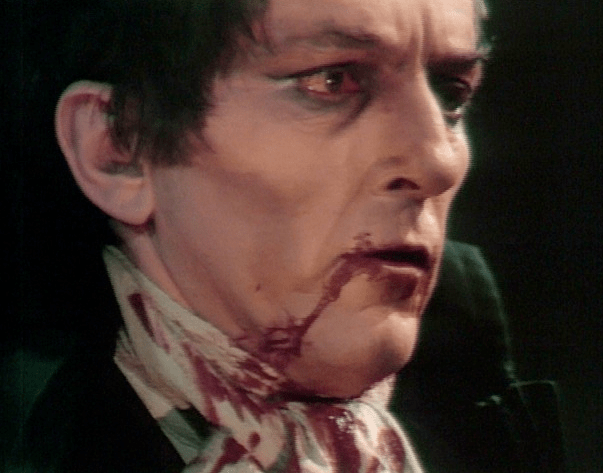
Ben is in the graveyard when Barnabas materializes in front of him. Barnabas tells Ben that his new existence has brought him new powers. When the two of them return to the mausoleum, Ben sees that Barnabas’ face is streaked with blood. Barnabas tells him that he has discovered that along with his new powers, he has a new need- he must drink other people’s blood in order to survive. Tomorrow, Ben will hear of an unfortunate woman in the village killed by a wild animal. Barnabas says that he should have let Angelique destroy him; Ben protests that he oughtn’t say things like that. Evidently Ben is going to stick with Barnabas no matter how gruesome his deeds become.
Through the first eight weeks of the part of Dark Shadows set in the year 1795, it seemed likely that wicked witch Angelique would not be on the show when it returned to the 1960s. Her narcissistic personality and consistent record of failure in her evil schemes overlapped so much with what we saw from vampire Barnabas Collins in 1967 that it would be hard to have them on the show at the same time, while her hyper-intense personality and the fast pace of the action she has generated would seem to be signs that she is not meant to stay on a daytime serial for the duration.
That starts to change today. Barnabas is not yet a vampire, but a living being and a gallant gentleman, albeit a deeply selfish and alarmingly violent one. He married Angelique, not knowing that she was a witch until too late. He has tried to kill her three times in the last few days. That was one attempt too many for Angelique, who in her irritation put a curse on him. A bat bit his throat, leaving him with heavy blood loss and a high fever. Today, Angelique tells escaped convict Ben Stokes, who is Barnabas’ loyal friend and her wretched thrall, that if Barnabas dies he will become “the living dead.”
When she is telling Ben what will happen if Barnabas dies, Angelique says that “I am responsible” for the situation. That is a phrase Barnabas never uttered in 1967. Angelique also tells Ben that she must keep Barnabas alive to prevent fulfillment of the curse, and that she will try to lift it altogether when she is stronger. That is another difference from vampire Barnabas- when one of his plans failed, he didn’t try to cure his victim. What failure with one person meant to him was that it was time to kill that one and start over with another. So we can see that the overlap between Angelique’s personality and the one Barnabas will have as a vampire is not total, and that it may be possible to construct plots involving both of them.
Wrongly suspected of witchcraft, bewildered time-traveler Vicki has found refuge in the home of young gentleman Barnabas Collins. Vicki doesn’t know it yet, but last night Barnabas married a woman named Angelique. Vicki knew Angelique when they were both working in the home of Barnabas’ family, Vicki as a governess, Angelique as a lady’s maid. Unknown to almost anyone, Angelique is the real witch and is glad Vicki has fallen into taking the blame for her evil deeds.
Angelique herself is in the dark about Vicki’s presence in the house. She chances upon Vicki in the morning. Angelique is the only character in the segment of Dark Shadows set in the year 1795 to address her as “Vicki”; everyone else insists on calling her “Victoria” or “Miss Winters.” Since we have known Vicki since the first episode, and we know that her friends call her “Vicki,” hearing her use that form of the name tells us that Angelique has presented herself to Vicki as a friend.
Angelique tells Vicki that she and Barnabas are now married. If Vicki had learned anything from the long string of failures to adapt to the mores of 1795 that have brought her to her current state, she would respond to this by lowering her eyes, curtsying, and saying “Mrs. Collins.” But instead, she reacts with a blank stare. Angelique asks what if she is merely startled by the news, or is shocked. Vicki resumes babbling, still calling Angelique by her first name, still referring to Barnabas by his.
Not only is Vicki continuing to flout the modes of address conventional to the period in which she finds herself, she seems genuinely unaware that a newlywed might be disturbed to stumble upon an attractive young woman her husband is hiding in the house. After a minute or two, it occurs to her to ask Angelique if she wants her to stay. Angelique says that because Barnabas is the master of the house, it is not for her to object. Vicki responds by jumping into her face and exclaiming “But you’re the mistress!” Even after that, she keeps on with her first-naming of Barnabas and Angelique and shows absolutely no sign of awareness that Angelique might be concerned about the nature of Barnabas’ attachment to her.
“But you’re the mistress!”
Downstairs, Angelique asks Barnabas about Vicki. He asks incredulously if she is jealous. Barnabas didn’t visit Angelique in her bedroom on their wedding night and she knows that he tends to make free with servant girls, since that’s how they met. Even so, he can’t figure out why Angelique might be unhappy to find that he has Vicki stashed in the house. It really is a shame Barnabas and Vicki didn’t marry, just imagine what oblivious children they might have had. They might have been the progenitors of a whole line of Detective Frank Drebins.
Later, Angelique has a spell she wants to cast on Barnabas’ aunt, repressed spinster Abigail Collins. She summons indentured servant Ben, whom she has enslaved. She orders Ben to steal Abigail’s hair ribbon from her night-stand. Ben is horrified by the command. It would have been bad enough if he had been caught sneaking into one of the gentlemen’s bedrooms, but he might have been able to talk his way out of that. If he is found in a lady’s bedroom, he’ll be lucky if all that happens is that he’s sent back to prison for several years. Impatient, Angelique tells him not to get caught.
Abigail does catch Ben in her room with the hair ribbon in his hand. She was the first to suspect witchcraft at Collinwood, before there even was any. Ben begs her not to ask him any questions, but she isn’t having it. She presses him, and he says that the witch sent him. She demands he say the witch’s name, wanting to hear him say “Victoria Winters.” He is about to say “Angelique” when we see her, in the Old House, cast the spell that causes him to choke. This scene takes about a minute to make all the points the story needs, but goes on for several times that long. That doesn’t hurt a thing- Clarice Blackburn and Thayer David were such a pair of pros that they could hold the audience’s attention for a good deal longer with a lot less to work with. It’s a fine ending.
Well-meaning governess Vicki is wrongly suspected of witchcraft and needs a place to hide. Young gentleman Barnabas takes her into his house. In her gratitude, Vicki tells Barnabas the truth about herself. She is a time-traveler, yanked back to this year 1795 from her native 1967 by forces she does not understand. Indentured servant Ben enters the room and Vicki leaves. Mystified by her story, Barnabas asks Ben if he thinks Vicki might be a witch after all.
It is exciting when Vicki starts confiding in Barnabas. She has utterly failed to adapt to her new environment, and has none of the abilities she would need to scam her way into a secure place there. She has ended up as an obstacle to story development and an irritating screen presence. If Vicki isn’t going to lie competently, she may as well tell the truth. But that turns out to be a dead end as well- there is no use for Barnabas to make of the information she has given him.
Barnabas doesn’t repeat Vicki’s story to Ben- he just reports that she said something utterly bizarre. What Barnabas does not know, but Ben does, is that there really is a witch in the house- it is Barnabas’ bride-to-be Angelique. Angelique has enslaved Ben, so if he found out Vicki’s secret she would as well, and would be able to use it against her as she frames Vicki for all of her own crimes. Ben proclaims to Barnabas his absolute certainty that Vicki is not a witch, but since he can’t tell anyone about Angelique, this only puzzles Barnabas. Barnabas is further baffled when Ben says he hopes that Barnabas’ marriage to Angelique brings an end to his troubles.
The other day, Angelique tried to solve a problem of her own by raising a corpse from its grave. This was the late Jeremiah Collins, uncle of Barnabas and his best friend until, under the influence of Angelique’s spell, he and Barnabas’ fiancée Josette eloped together. Barnabas responded to that by challenging Jeremiah to a duel. Conscience-stricken, Jeremiah decided to let Barnabas kill him and told Josette that she would be free to marry Barnabas once he was dead.
Angelique had ordered Jeremiah to plague Josette and Barnabas with angry demands that they stay apart. We could interpret that simply as puppetry on Angelique’s part. But today, Jeremiah is harassing Angelique and refusing her repeated commands to go back to his grave. He says he was at peace in the earth until Angelique disturbed him. He was content with his decision to forfeit his life, but now he has become something he didn’t bargain for. Maybe it’s the indignity of that change that accounts for his change of personality, or maybe he’s just cranky because he can’t get back to sleep.
Regular viewers will think of a third possibility. In the segments of Dark Shadows set in 1966 and 1967, we saw other supernatural beings, such as undead fire witch Laura Murdoch Collins and the ghosts of Josette and of Barnabas’ little sister Sarah. These beings looked at first glance like humans, but the more we learned about them the clearer it became that each was in fact a complex of multiple entities, some of which operated independently of and occasionally at cross-purposes with others. As a witch, Angelique might also be a composite being. Perhaps each time she casts a spell, she breaks off a little piece of herself and deposits it within the person she is trying to control. If so, the creature she is trying to send away is not simply Jeremiah, but the body of Jeremiah animated by a chunk of the spirit of Angelique. That would explain why the actions of the risen Jeremiah are characterized by three traits that were alien to the living man, but that Angelique has in abundance- single-mindedness, vengefulness, and ineffectiveness.
Barnabas, Ben, and a clergyman are in the front parlor, ready for the wedding. Angelique takes a long time to come downstairs. Barnabas goes up to her room to see what is keeping her. He finds her terribly upset, insisting that they have the ceremony somewhere else. Barnabas looks in her suitcase, which had a moment before held the clothes she removed to put on her bridal gown. Those clothes have vanished, and in their place Barnabas finds a doll belonging to his little sister Sarah and some pins. Had Barnabas ever seen a horror movie, he would know to interpret this as a clue from Jeremiah that Angelique had caused a recent illness of Sarah’s by sticking pins in her doll, but people didn’t get to the cinema in 1795, so it’s another dead end.
Angelique composes herself and says she will be right down for the wedding. Barnabas leaves the room. The door closes itself, and Angelique cannot open it. Jeremiah enters and tells Angelique she must be punished for disturbing the dead. He takes her to his grave, which is open. Angelique raised Jeremiah some days ago- if the grave has been open this whole time, you’d think someone would have noticed and people would be talking about it. Anyway, he puts her in the grave, and from her point of view we see him throwing dirt into it.
Jeremiah dropping dirt onto Angelique, from her point of view. Screenshot by
This is the first live burial we’ve seen on Dark Shadows. It’s true that the POV shot from inside the grave echoes a moment in #248 when Barnabas, who is in 1967 a vampire, shuts his prisoner Maggie Evans in a coffin and we see him through her eyes, but that coffin wasn’t in the ground.
Harking back as it does to that shocking moment from Barnabas’ early days on the show, the image of the reanimated Jeremiah dropping dirt in the grave invites us to make a comparison between Jeremiah and Barnabas. In life Jeremiah was a mild-mannered, good-hearted fellow, as is the living Barnabas. The destructive behavior he has exhibited since Angelique raised him from the dead is not only typical of her, but also of what we saw from the vampire Barnabas in 1967. Again, we wonder if the fate that awaits Barnabas is not only something Angelique will do to him, but if everything we saw of him in the months between April and November was what Angelique was doing disguised as him.
Closing Miscellany
Angelique’s repeated commands to Jeremiah today to “Go back to your grave!” find an echo in one of the great moments in the history of Dark Shadows conventions, when Lara Parker used that line to explain the Dark Shadows house style of acting:
“Go back to your grave!!!!!”
When Vicki tells Barnabas the truth about herself, the camerawork makes Alexandra Moltke Isles’ strabismus impossible to miss. Previously they had taken great care to photograph her from angles that would obscure this condition, but we’re going to get another clear look at it on Thursday. Combined with the lousy lines the scripts have given Vicki since the beginning of the 1795 segment, it is hard not to suspect that there was some kind of deliberate effort behind the scenes to push Mrs Isles aside.
This was the first episode of Dark Shadows broadcast in 1968. The copyright date printed on the screen at the end still says 1967. They were several months late before they stopped putting “1966” there, so I guess we shouldn’t be surprised they didn’t update it for an episode shown on New Year’s Day.
Like every other episode of Dark Shadows, this one opens with a voiceover delivered by a member of the cast. The voiceovers in the segment of the series set in the year 1795 usually begin thus:
A séance has been held in the great house of Collinwood, a séance which has suspended time and space and sent one girl on an uncertain and frightening journey into the past, back to the year 1795. There, each of the Collins ancestors resembles a present-day member of the Collins family. But the names and relationships have changed, and Victoria Winters finds herself a stranger in a sea of familiar faces.
The “sea of familiar faces” results from the same actors appearing in the parts of the show set in different periods. The emphasis the show places on this, both by the repeated use of “sea of familiar faces” in one opening voiceover after another and by the hapless Vicki’s (Alexandra Moltke Isles) exasperating habit of telling the characters that they are being played by actors who previously took other parts, gives the audience a reading instruction. Evidently we are meant to compare and contrast each actor’s twentieth century and eighteenth century roles.
The first face we see today is the only unfamiliar one that has bobbed to the surface of the 1795 sea. It belongs to wicked witch/ lady’s maid Angelique, played by Lara Parker. Angelique had a brief fling with young gentleman Barnabas Collins (Jonathan Frid) some time ago. They met when he first went to the island of Martinique and met her employers, the wealthy DuPrés family.
Barnabas had fallen in love with the gracious young Josette DuPrés (Kathryn Leigh Scott,) but was convinced Josette could never love him. Barnabas consoled himself in Angelique’s arms until he realized Josette did love him. Barnabas and Josette agreed to marry. Josette came to Collinwood for the wedding, accompanied by her father André (David Ford) and her aunt, the Countess DuPrés (Grayson Hall.) Angelique is the countess’ maid, but also attends Josette.
Angelique used her powers of black magic to make Josette and Jeremiah Collins (Anthony George,) Barnabas’ uncle, conceive a mad passion for each other. Josette and Jeremiah eloped, breaking Barnabas’ heart. Barnabas and Jeremiah fought a duel; consumed with remorse, Jeremiah let his nephew kill him. Even after all that, Barnabas realized he would always love Josette, a fact of which he apprised Angelique. Frustrated to find that she could never have Barnabas, Angelique yesterday announced in a soliloquy that she would punish him by forcing him to watch his beloved little sister Sarah (Sharon Smyth) suffer. At the top of the episode, Angelique is in her room in the servants’ quarters of Collinwood’s manor house with Sarah’s doll and some pins.
We cut to the front parlor, where Sarah is looking up adoringly at her mother Naomi Collins (Joan Bennett,) who is reciting a story. We cut back to Angelique, who drives a pin into Sarah’s doll. In the front parlor, Sarah clutches her chest and cries out in pain. Angelique sticks more pins into the doll, and Sarah cries out again.
In the parts of Dark Shadows set in the 1960s, Joan Bennett plays matriarch Elizabeth Collins Stoddard, owner of the great estate of Collinwood, of the Collins family enterprises, and of any other piece of property that they decide to tell a story about. In Liz’ time, the Collins family is much decayed from its eminence in 1795, but she is still the foremost figure in the town of Collinsport, and would have the authority to make just about anything happen. In fact, Liz can rarely bring herself to do very much that pertains to the plot, but when she does speak up we can see that she has great depths.
Naomi, by contrast, is utterly powerless, shut out by her husband, haughty overlord Joshua (Louis Edmonds) even from the management of the house. In today’s pre-title teaser, we see Sarah sitting on the floor of the front parlor, looking up adoringly while Naomi recites a story to her. That Naomi is reciting to Sarah rather than reading to her reminds us of what we learned when first we saw her in #366, that unlike most women in eighteenth century New England Naomi is altogether illiterate. Naomi occasionally bewails her inability to spend her time productively, and often drinks.
Sharon Smyth plays Sarah in 1795. In 1967, she was Sarah’s ghost, a frequent visitor to Collinwood and its environs. Sarah’s ghost was quite a different character than is the living Sarah. The little girl in the white bonnet who showed up in the oddest places and made the oddest remarks was only one aspect of a vast and mighty dislocation in time and space. It was Sarah’s ghost that started Vicki’s “uncertain and frightening journey into the past.”
Miss Smyth* nowadays describes her acting style when she was nine and ten saying “the first word that comes to mind is ‘clueless,'” but that works out surprisingly well for a ghost. It isn’t clear to us how the visible part of the Sarah phenomenon relates to the rest, much less how the whole thing works, and it can’t be clear- if a phenomenon stops being mysterious, it isn’t supernatural anymore. So it is gripping to see that the visible Sarah is herself in the dark about what she represents. That doesn’t work so well for living characters. When Miss Smyth can’t take her eyes off the teleprompter while delivering lines like “Help me, mother! It hurts!,” we can perhaps see one reason why the unfathomably mighty Sarah of 1967 was reduced to such a subordinate role in 1795.
But Miss Smyth’s limitations as a performer were not the only reason this development was inevitable. The whole idea of the supernatural is that something which appears to be very weak is in fact very strong. So children usually have fewer resources at their disposal than do adults, females are less likely to be found in positions of authority than are males, and the dead cannot rival the dynamism of the living. So the ghost of a little girl will of course be an immense force. The Sarah we see in 1795 is not yet a supernatural being, and so it would ruin the irony if even before her death she were already great and powerful.
In the part of the show set in 1967, Liz was one of the few major characters who never saw the ghost of Sarah. Liz was pretty firmly in denial about all reports of paranormal phenomena, and in #348 Sarah would declare that she could appear only to people who were prepared to believe in ghosts. So it is a bit startling for regular viewers to see these two actors together for the first time. Naomi is the same calm, indulgent presence to Sarah that Liz is to the children in her life, suggesting that though “the names and relationships have changed,” Liz and Naomi are two versions of the same person.
If the viewer’s main activity in watching the 1795 segment is contrasting the characters with those played by the same actors in the first 73 weeks, Angelique’s prominence is a puzzle. She is the only one who doesn’t fit into that scheme, yet she has driven all of the action so far. By the end of today’s episode, I think we can see a 1967 character with whom Angelique stands in juxtaposition. That character is Barnabas.
From April to November of 1967, Dark Shadows was largely the story of vampire Barnabas Collins (Jonathan Frid) and his attempt to impersonate a living man native to the twentieth century. It was so much fun to watch Barnabas scramble to keep this game going that the audience found it easy to put to one side the horrible evil he did and to look for reasons to think of him as good. But if we ever succeeded in doing that, Dark Shadows would be ruined. A deep-dyed villain allows a drama to be less serious overall than it might otherwise be, so that a thoroughly bad Barnabas lightens the tone. Make him relatable, or even forgivable, and everything gets terribly serious again. Yet a nonthreatening vampire is a purely comic character, like Count von Count on Sesame Street. So until they can establish another Big Bad, Barnabas has to be beyond redemption. If he is a lovable guy who just needs help dealing with his neck-biting problem, he has no place on the show, and it has no story left to tell. So they spent the fall systematically kicking away every possible mitigating factor and forcing us to behold Barnabas’ unrelieved evil.
The last hope of redemption for Barnabas in 1967 was his attachment to the late Sarah. Sarah had died when she was about ten, and her ghost started haunting the estate of Collinwood back in June, when Barnabas was holding Maggie Evans, The Nicest Girl in Town (Kathryn Leigh Scott,) prisoner in his basement. By November, many people had seen and talked with Sarah, but she had shunned Barnabas, even though he was desperately eager to reconnect with his baby sister. In his speeches about his longing for Sarah and in two moments when a suggestion he might see Sarah distracted him from a murder he was in the middle of committing, we saw the possibility that when Barnabas was finally reunited with her, he would change his ways.
That reunion finally took place in #364. Sarah walks in as Barnabas is strangling his only friend and sometime co-conspirator, mad scientist Julia Hoffman (Grayson Hall.) Barnabas does let Julia go, and has a heartfelt conversation with Sarah. Sarah says that she will not come back until Barnabas learns to be good. We can see just how long that is likely to be when, less than two minutes after Sarah has vanished, Barnabas tells Julia that, while he may not kill her tonight, her existence means no more to him than does that of a moth.
When even a direct encounter with Sarah cannot move Barnabas to find value in human life, we see that what Barnabas wanted when he was yearning for her to come near him was not to renew a relationship in which anything would be expected of him, but was something more like nostalgia. He has moved into the house where he spent his time when he was alive, and has restored it to its appearance in those days. He once persuaded his distant relatives, Liz and the other living members of the Collins family, to attend a party in that house dressed in clothing that belonged to their ancestors of his period and answering to their names. And he cherishes a fantasy that a young woman will discard her personality and replace it with that of Josette, then come to him and live out the life he had once believed he would have, long ago. His wishes for Sarah are of a piece with these attempts to recreate a past world. He wants to reenact the time he had with her, not to face the present alongside her. Barnabas is a damned soul, unable to love, unable to grow, unable to do anything for the first time.
Today, the show pushes Angelique into the same “Irredeemable” category where his reaction to Sarah’s visit had landed Barnabas. Again, it is an interaction with Sarah that represents the last straw. Josette and Barnabas made a sweet couple, but we knew before we ever saw them together that they were not fated to end up together. Jeremiah was likable enough, but we knew that he, too, had a sharply limited future. But Sarah is a child, a particularly adorable one, and is someone we have come to feel we know through her months as a ghost. When Angelique treats her so cruelly, we cannot imagine ever forgiving her.
And yet, there were times we felt that way about Barnabas, too. Angelique’s insane fixations are remarkably close to those vampire Barnabas exhibited in 1967, so much so that we keep wondering if whatever she does that turns Barnabas into a vampire will also put her personality into his body. We have come to be attached to the vampire; perhaps we will eventually discover it is Angelique we were watching until Vicki came to the past.
That isn’t to deny that the human Barnabas we have seen so far has points of contact with the ghoul from 1967. He was selfish enough to take advantage of a servant girl in Martinique when he didn’t think he could win the love of the grand lady he wanted and to discard her when he learned he could. He is cowardly enough that it never occurred to him to tell Josette that he had a past with Angelique at a time when doing so could have prevented Angelique casting the fatal spells on her and Jeremiah.
Real as these vices are, they are endemic to soap opera characters. Few daytime serials would have any stories to tell if they were about people who had a gift for monogamy, and we are supposed to find ourselves yelling at the screen “Just tell her!” and “Just tell him!” at regular intervals. Even the power differential between Barnabas the scion of the wealthy Collins family and Angelique the servant girl, problematic** as it would be in real life, is less troubling in the soaps, which take place in worlds where heirs and heiresses marry servants and their relatives all the time. Of course, most viewers know that Barnabas is destined to become a vampire, a metaphor for selfishness, and will be inclined to see in his use of Angelique the seeds of his subsequent damnation. And Angelique has enough lines about Barnabas’ selfishness that even viewers who joined the show during the 1795 segment can’t let him off the hook altogether.
Still, there is a great deal of good in the living Barnabas. We see him at Sarah’s bedside, consumed with worry for his beloved little sister. The doctor has been to see Sarah, and he has nothing to offer. Sarah asks to see her governess Vicki, who is in hiding because a visiting witch-hunter named Trask has blamed her for a series of inexplicable misfortunes that have befallen the house since she showed up in #366. It was Vicki’s own odd behavior that first made her a suspect, and Angelique has taken advantage of Trask’s foolishness to fabricate evidence against Vicki. She has gone into hiding, and Barnabas is helping her.
When Sarah keeps asking to see Vicki, Barnabas promises to bring her. Naomi is surprised to learn that Barnabas knows where Vicki is, and is not at all sure Trask isn’t right about her. But when she sees her daughter with Vicki, she is sure that she is innocent.
Vicki was the audience’s main point-of-view character throughout 1966 and well into 1967. Major story developments took place after Vicki found out what was going on. Vicki was the chief protagonist in the most important story of that period, the crisis represented by undead fire witch Laura Murdoch Collins. Vicki took charge of the household, organized a group to fight Laura, and rescued strange and troubled boy David from the flames when Laura tried to burn him alive. That intelligent, forceful character has been fading ever further into memory in recent months, and we haven’t seen a trace of her in the 1795 storyline. Sarah is happy to see Vicki and says she likes the stories she tells, but she is a passive witness to today’s events. She serves chiefly as a prop, used to demonstrate that the human Barnabas, whatever his faults, is capable of heroic action.
Barnabas’ compassion for Sarah and his valiant defense of Vicki do not negate his vices. As the heir to Collinwood, Barnabas can express his self-regard both by gratifying his urge to treat some women badly and by earning admiration for treating other women well. In her low station, the same trait leads Angelique directly to the “Dark Triad” of Narcissism, Manipulativeness, and Psychopathy. As a vampire, Barnabas will exhibit the same three qualities in abundance, but for now, we still have license to hope for better from him.
As it was so much fun to watch Barnabas trying to pass as a modern man that we wanted to like him even after he had been terribly cruel to Maggie, a character we like very much, it was so much fun to watch Angelique twist Trask around her finger that we wanted to like her. Besides, her desire to remake Barnabas as her lover is understandable for those who have been watching the show and wanting him to be something other than a heartless murder machine. So, perhaps we will wind up liking Angelique after all.
Angelique has bewitched indentured servant Ben Stokes (Thayer David) and forced him to act as her assistant. Ben is devoted to Barnabas and miserable that he has been the instrument of so much evil done to him, but has been powerless to resist Angelique’s commands. When he realizes that Angelique is causing Sarah to sicken and perhaps die, he goes to her room and demands that she stop. He threatens to kill her if she does not relent. In response, Angelique causes him to have a heart attack. She lets his heart start pumping again when he promises to be quiet.
This is the second heart attack a character of David’s has had on screen. The first also prevented a servant in this same house from killing a young woman. That came in #126, when crazed handyman Matthew Morgan had been holding Vicki prisoner here and was about to decapitate her. The ghost of Josette led several other supernatural presences who scared Matthew to death before he could complete his fell purpose. Matthew and Ben are both devoted to the Collinses, and both are led astray so that they become parties to terrible crimes. As the benevolent spirit of Josette put a stop to Matthew’s crimes, so the malign Angelique prevents Ben from putting a stop to her own.
Barnabas drops by Angelique’s room to ask if she has seen Sarah’s doll, which she calls Samantha. He tells her that Sarah is very ill and has asked for the doll. It occurs to Angelique that she has some leverage over Barnabas. She says that she can brew a special kind of tea that might cure Sarah’s symptoms. He asks her to do so. She makes him promise to marry her if she does.
Several times, we have seen that Angelique is flying by the seat of her pants. She had no idea of using Sarah’s illness to gain a hold over Barnabas until he chanced to come into her room. Nor is she thinking ahead- as it stands, the witch-hunters have fastened on Vicki as their suspect, and are not thinking of her. If word gets out that she had the power to cure Sarah’s mysterious ailment and exercised it only after extorting Barnabas’ promise of marriage, that would seem to be proof positive that she is a witch.
In her own bedroom, Sarah sips the tea. At the same moment, Angelique, in the servants’ quarters, pulls the pins from the doll. How exactly Angelique got the timing just right isn’t exactly clear, but she must have had a way- she is perfectly confident when she tells the doll that it has served her well.
*Mrs Lentz now, but it’s strange to say “Mrs” when you’re talking about a ten year old.
**I know people don’t really say “problematic” anymore, but it seems to be the right word here.