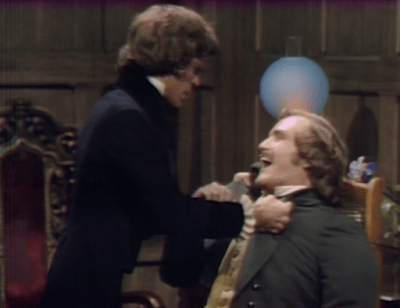
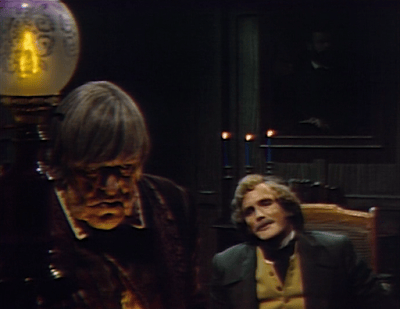
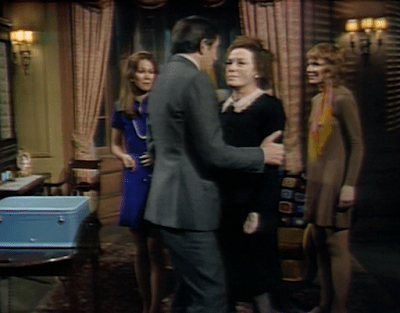
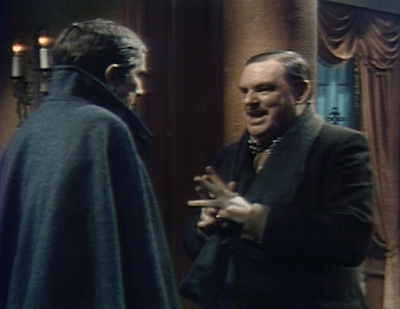
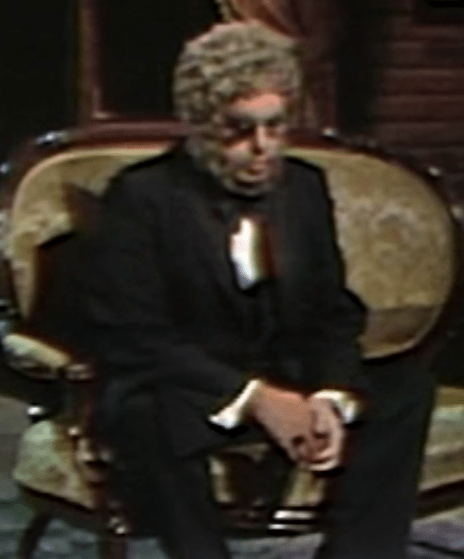
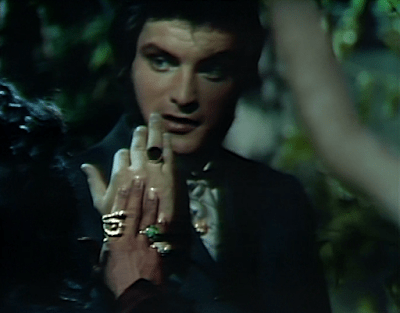
Dark Shadows has been drifting downward in the ratings and the writing staff has been repeating material. If it is to survive, the show needs a new villain who will generate fresh story points and another breakout star to grab the attention of the public as Jonathan Frid did when he joined the cast as vampire Barnabas Collins in 1967 and as David Selby did when he came along as the dangerous Quentin Collins late in 1968 and early in 1969. They are gambling that they will be able to fulfill both of these requirements with James Storm as the evil Gerard Stiles.
Gerard has been on the show as an unspeaking ghost for twelve weeks. He makes his first appearance as a living being today, and delivers his first lines. He makes less of an impression than does any other member of the cast, which I believe is intentional.
Yesterday, mad scientist Julia Hoffman traveled back in time to 1840. Previous time-travel segments have begun with episodes mounted on the biggest scale of production the show could manage, but yesterday they tried a new approach. Most of the episode took place in one little section of the great house of Collinwood, with Julia hiding behind partitions in darkened rooms while she eavesdropped on random conversations. That structure suggested that 1840 is going to open out gradually, introducing new characters and situations a little bit at a time. So far from whisking us into the new world with a torrent of additional information, they subtracted from what we came in thinking we knew. When they revealed that governess Daphne Harridge is unknown in the great house, and Quentin Collins* and his son Tad are missing at sea and presumed dead, we found that this is a very different place from what we were led to expect. That was as good a way as any of ensuring we would come back on Monday.
Gerard makes his entrance in the middle of a scene between fluttery novelist Flora Collins and evil-tempered bully Gabriel Collins. Gabriel is not as cruel to Flora as we have seen him be with others, and he even pretends to take her latest novel seriously. But when she describes Gerard as “The Healer” and claims that he has supernatural powers, Gabriel has had enough. He insists that Flora ought not to waste her time with a man who, if he were not a transparent fraud, could only be a practitioner of the black arts. Flora is appalled by Gabriel’s description of Gerard as a possible Satanist.
Gerard enters and Flora tells him she is coming down with a migraine. She coquettishly asks him to do his thing for her. He rubs her forehead for a bit, and she proclaims that she is cured. After she exits, wheelchair user Gabriel tells Gerard that if he really has a miraculous gift of healing he would welcome him using it to restore his own ability to walk. Gerard angrily refuses.
Gabriel then tells Gerard that Flora claims more for him even than a gift for healing. She says that he is clairvoyant. Gerard says that he does have such a gift. Gabriel shows him an earring he found in the upstairs playroom and asks if he can identify it. Gerard goes into a trance and says that he sees “a tall woman… not dressed as a woman should be.” The earring belongs to Julia, whom we heard a clairvoyant describe as “a tall woman” in #1059, and she is indeed wearing the clothes she had on when she came from 1970. So we know that Gerard is a real clairvoyant, and expect that he will recognize Julia when he meets her. But Gabriel hasn’t been watching the show, so he laughs out loud and tells Gerard that he is indeed a fraud.
Gerard gets even angrier than he was a moment before, and tells Gabriel that he will not abide being laughed at. That suggests a complicated existence for a character on Dark Shadows, a show that has a lot of great stuff in it but that rarely goes more than ten minutes at a time without making at least one member of the cast look ridiculous.
Of course, no one is easier to laugh at than people who take themselves absolutely seriously, which is one of the reasons Barnabas and Julia were such big hits. But most of the characters who demand to be regarded with solemnity have had an expiration date, no matter how much value they added while they were on the show. So the fanatical witchfinder the Rev’d Mr Trask was one of the highlights of the show when it was set in the 1790s from November 1967 to March 1968, but no one could have expected Trask to stay in the cast when it returned to contemporary dress. Those who have lasted and have helped to grow the audience have had a sense of humor about themselves. By the middle of 1968, even wicked witch Angelique could crack the occasional joke at her own expense. Unless Gerard gains the same ability, he would seem unlikely to rise above Trask’s level in the hierarchy of characters.
Meanwhile, the aged Ben Stokes has befriended Julia. In the 1790s segment, Ben was a much-put-upon indentured servant whose extreme regard for Barnabas led him to become complicit in Barnabas’ crimes in his first nights as a vampire. When we revisited the 1790s in January 1969, Ben followed the footsteps of the first character Thayer David played on the show, crazed handyman Matthew Morgan. Matthew’s fanatical devotion to matriarch Elizabeth Collins Stoddard led him to inadvertently kill a man who was the head of the Collins fishing fleet and to attempt the deliberate murder of a woman who was played by the daughter of a countess. In #666, Ben inadvertently killed roguish naval officer Nathan Forbes, who was in Collinsport to do some executive work associated with the Collins family’s ships, and then deliberately murdered Natalie DuPrés, a character who bore the title countess. We saw that the kindly, sensible, open-hearted Ben whom we met before the great curse was placed on the Collins family had been deformed into the same shape that a century and a half in the shadow of that curse had inflicted on Collinsport dweller Matthew. Now, we see that Ben has lived on into his eighties and has recovered much of the goodness that was his hallmark when first we met him.
Julia tells Ben the insane story of her travels through time and her friendship with Barnabas, and he decides to help her find a place in 1840. He digs up a period-appropriate gown for her. It’s too big for his granddaughter Carrie and too small for him, so it does not seem likely to have been in his possession. He doesn’t have time to make a gown. He doesn’t leave the house, so even if there had been shops in central Maine in 1840 that sold ladies’ formal wear off the rack, he wouldn’t have been able to buy it at one of those. And any of the ladies in the house would surely notice if one of their dresses went missing and a stranger showed up wearing one exactly like it. So I suppose it must have belonged to a lady no longer resident in the house who left it behind in a disused room.
Ben drills Julia in a plan he has devised. She is to present herself at the front door of the great house of Collinwood at 8:30 PM, wearing the gown he has provided. She is to say that her name is Julia Collins, daughter of Barnabas, and that she has been living in America for ten years. Her brother, Barnabas Junior, is still based in England, where their father died some time ago. He wrote her a letter saying he was coming to the States and she was to meet him at Collinwood. Her bags are at the Collinsport Inn, where she is staying.
Julia is reluctant to follow Ben’s plan. She is preoccupied with Barnabas. She expects him to use some mumbo-jumbo to project himself from 1970 into his body as it is in 1840. Since that body is in a chained coffin in the secret room of the old Collins family mausoleum, she wants to go there and release him.
Ben points out that Julia’s desire is preposterous. Barnabas won’t meet Julia for another 127 years. The vampire in that coffin has no idea who she is, and if she lets him out she will be only the first of many victims in a renewed rampage of murder and enslavement.
Of course Julia goes to the mausoleum; of course she opens the panel to the secret room. If she were capable of taking good advice when it was offered, there wouldn’t be a show. We end with Julia trying to communicate with Barnabas through the coffin. She has already said that she has a sense that he might be calling her, a sense that she admits might be her imagination. So we know that it is unlikely that she will fail to discern the summons she so desperately wants to hear.
*Not the one we eat in 1968 and 1969, though apparently he is also David Selby.
Mad scientist Julia Hoffman has escaped from a band of zombies who were wrecking the great house of Collinwood. From her perspective, it is a few moments after she saw her friend, vampire Barnabas Collins, wrestling with the zombies and urging her to save herself by walking down a mysterious staircase. But she soon discovers that she has left the year 1970 and made her way to 1840, when both the zombies and the ghosts who have triggered their destructive actions were living human beings.
Julia enters the staircase from a playroom that is only intermittently present in 1970 and walks down its two flights. She exits into the same playroom, which is a normal presence in 1840. We saw this same distortion of space in #1070 and #1071, when Julia and Barnabas used the staircase to escape from the far-off future year of 1995 and return to 1970. It was an effective way of expressing the magical nature of the staircase and the playroom then, and is still effective the second time.
When they opened the playroom door on their return to 1970, Barnabas and Julia saw a girl in the corridor. That girl appeared to be a ghost named Carrie whom they had met in 1995, but turned out to be a living girl named Hallie Stokes who had moved into Collinwood while they were away on their bizarre cosmic journey. Now, Julia opens the door and sees the living Carrie in the same corridor.
Hallie was the niece of occult expert Timothy Eliot Stokes and therefore a descendant of much-put-upon indentured servant Ben Stokes, whom we got to know from November 1967 to March 1968, when the show was set in the 1790s. We learn today that Carrie is Ben’s granddaughter, and that he and she are staying in the great house as the guests of Daniel Collins.
We saw Daniel in the 1790s segment. He was played then by David Henesy, who was eleven years old at the time. Mr Henesy looked a lot older in September 1970 than he had three years before, and he was an accomplished young actor. But it would likely have been beyond even his abilities to play a character well into middle age, so when we see Daniel from the knees down later in the episode we can be fairly sure he will turn out to be someone else.
Julia sees a confrontation between Carrie and a tall young man in a wheelchair. The man turns out to be Daniel’s son Gabriel. He insists Carrie open the door to her grandfather’s bedroom and push him in. Carrie objects, and Gabriel sneers that she is not to tell a Collins what to do at Collinwood. He berates her, saying that while others may indulge her because they are impressed by her good looks he sees only her impudence. She capitulates to his demands.
In the room, Gabriel turns his abusiveness against Ben. He orders Ben to break some bad news to Daniel. Word has come that Daniel’s son Quentin and Quentin’s son Tad have been lost at sea. Ben protests that Daniel is in no condition to receive such news. Gabriel digresses and says that he cannot make his own living; Ben tells him that many men in worse condition than he is have done, which only makes him angrier than he was to start with. Gabriel regrets his inability to stand up and strangle Ben. We can see that he’s a true Collins; they are a strangley bunch. He then says that he is now likely to become Daniel’s heir, and threatens to evict Ben and Carrie from Collinwood when he does. He menaces Ben with the prospect that he will use his position to make Carrie’s life difficult if he does not obey him now. Ben gives in.
When Ben returns to his room he finds Quentin’s wife, Samantha Drew Collins, waiting for him there. He tells her that the news did not prompt Daniel to change his will. She is still in line to inherit the estate when Daniel dies.
Samantha goes to the drawing room, where she finds Gabriel playing a one-handed game of chess. She is smugly pleased with his dismayed reaction to the news that Daniel has not changed his will. She exits and later returns with word that Daniel has escaped from the tower room. The Collinses have always made a practice of keeping mentally ill family members in that room, and Samantha and Gabriel are so frightened by his escape that we can assume Daniel’s illness disposes him to violence.
Julia emerges from the shadows in Ben’s room. Ben is alarmed to see her, and horrified when she identifies herself a friend of Barnabas’. She claims that she is not a monster, which is a defensible claim, given a very narrow definition of “monster.” When she tells him about traveling back in time from a future period when Barnabas is free to prey upon the living and she is his best friend, he says that she is mad. She denies being mad, which is what a person would do when they are as far from sanity as she is. Ben is leery, but agrees to help her. He escorts her back to the playroom and tells her to stay there until morning. Of course she leaves the room very shortly thereafter, and as soon as she enters the corridor Daniel grabs her by the throat.
The drawing room is downstairs; Ben’s room and the playroom are upstairs. No one seems to be helping Gabriel get from one floor to another, and there is no sign of any ramp or other contrivance that would make it possible for wheelchair users to get themselves from one floor of the house to another without help. Odd as this is, it is not a first on Dark Shadows. In January and February 1970, strange and troubled boy David Collins used a wheelchair in a few episodes because David Henesy had actually suffered a leg injury. David kept going up and down stairs by himself, without explanation of how such a thing was possible. I suppose they got few enough letters complaining about the illogic of that movement that they decide they could get away with it again.
Carrie has three scenes. In addition to her encounter with Gabriel, she talks with Samantha in the playroom and with her grandfather in his room. As Hallie, Kathleen Cody was in a state of maximum nervous tension from the start, so that she had nowhere to go in response to anything that might happen. As Carrie’s ghost, she often swung to the opposite extreme, being so blandly cheerful that she made no impression at all. She did put in a few good performances in the 1970 segment, however, and she is quite good as Carrie today.
Samantha is played by Virginia Vestoff, making her Dark Shadows debut. Vestoff was a distinguished performer who is now remembered chiefly for her role as Abigail Adams in the original Broadway cast of 1776 and of the 1972 film based on that musical. The Broadway cast also included several other Dark Shadows alums- David Ford (Sam Evans #2, Andre DuPres) as John Hancock, Emory Bass (Mr Best) as James Wilson, Daniel F. Keyes (The Cemetery Caretaker) as Josiah Bartlett, and Peter Lombard (Oberon) as a stage manager and understudy for the roles of Stephen Hopkins and Thomas Jefferson. All of those, aside from Lombard, also appeared in the film. Vestoff died of cancer in 1983, aged 42, a major loss to the world of the theater.
A great deal of emphasis is placed today on Samantha’s maiden name, Drew. We have in the last few months met two characters named Roxanne Drew; we can take it that Samantha will turn out to be related to one of those in some way.
Longtime viewers, learning that Daniel and Ben are in the 1840 story, will readjust their expectations. Most of what we saw in the ten weeks leading up to this uncertain and frightening journey into the past was recycled from a story that ran from December 1968 to March 1969 and culminated in a trip to the year 1897. So we may have come in thinking there would be a retelling of 1897. But seeing Ben and Daniel, we have the prospect of a sequel to the 1790s segment. That does sound like a fresher idea.
The episode is certainly structured very differently than were the first episodes of either the 1790s segment or the 1897 segment. Those featured a relatively wide variety of brightly lit sets full of busy people, getting us off to a fast start in a new world. Today most of the action takes place in the playroom, Ben’s room, and the corridor between them, with a couple of brief glimpses of the drawing room. We keep cutting to Julia standing very still behind one partition or another as she eavesdrops on the dialogue. We are operating within a very small space, but hearing about people who are far outside that space and whom we are confident we will meet soon. So rather than leading with the equivalent of a panorama of our new surroundings, they are opening the space up for us a little bit at a time. That makes it easier to keep the action moving rapidly and clearly, and also leaves us wanting more.
Sixteen weeks ago Dark Shadows crossed over to a different universe than the one where the first 196 weeks of the action took place. The show insists on calling this segment “Parallel Time.”
The only villain left standing in this next-to-last installment of “Parallel Time” is the evil Tim Stokes, whom we did not see and barely heard of until the tenth week of the segment, and who did not start acting on his own initiative until the last few days. Thayer David does a great job playing Stokes, and the character evokes his earlier parts in interesting ways. But he is obviously a last-minute addition meant to keep the story going while they take care of some loose ends they were in too much of a hurry to tie up in a natural way.
Desperate to get vampire Barnabas Collins and mad scientist Julia Hoffman out of Parallel Time, writer Gordon Russell resorts to what Roger Ebert used to call an “Idiot Plot,” a series of events that can take place if and only if every character is dumber than any member of the audience.
Barnabas has fallen in love with and bitten a non-character named Roxanne, who, in lieu of a personality, has psychic powers. Yesterday Barnabas gave Roxanne a scarf that belonged to Julia’s counterpart in this universe, and Roxanne told him its owner was dead. Only today, when Maggie speaks the name of that other Julia Hoffman with revulsion, does Barnabas remember that there are two of them, and that the scarf belonged to the one whom he already knew to be dead.
Barnabas and Roxanne know that Stokes is on the loose and that he has vowed to take revenge on everyone. So she walks home alone, and finds Stokes waiting for her there. He finds Barnabas’ bite marks on her neck, and realizes that he is a vampire. Stokes decides he must lock Roxanne up. A man of his evil ways must know of any number of places where he could lock Roxanne up, many of which would take Barnabas a long time to find, but he choose to stick her in her closet. Minutes after his departure, Barnabas comes to the house and lets her out.
Barnabas takes Roxanne back to the Old House on the estate of Collinwood, where Maggie has the suitcase Julia brought with her when she came to this universe five weeks ago. Roxanne takes a piece of costume jewelry and confirms that its owner is alive. She leads them to the basement of the great house on the estate. They hear Julia weeping in the dungeon behind a bookcase where Angelique trapped her a few days before her own destruction. This weeping sound will bring back memories for longtime viewers. In the first months of the show, several characters heard the sound of a woman weeping behind a wall in the basement of the great house, a sound strongly implied to be of ghostly origin. They eventually gave that sound an explanation that was neither supernatural nor consistent with what we had seen up to that point, and then never mentioned it again. But it’s good to be reminded of it regardless.
Barnabas, Roxanne, and Maggie eventually find Julia and take her back to the Old House, where they give her a large brandy. Barnabas, Maggie, and Julia then go to the police station, leaving Roxanne alone in the house so that Stokes can get at her. She threatens him with a dagger, and he withdraws. Maggie then goes from the police station to the great house by herself so that Stokes can grab her.
Evil wizard Tim Stokes combined medicine with black magic to connect his late daughter Angelique with a woman named Roxanne. The connection drains most of the “life force” from Roxanne into Angelique. This rendered Roxanne comatose and allowed Angelique to move among the living so long as Roxanne neither dies nor gets even a tiny bit better.
Vampire Barnabas Collins and mad scientist Julia Hoffman are interlopers from another dimension. They know what Stokes has done and want to defeat Angelique. They made off with Roxanne and were keeping her in the Old House on the grounds of the estate of Collinwood, planning to use some mad science equipment to revive her. Roxanne did perk up after the first treatment, and Barnabas took her on a date to his favorite place, the old cemetery north of town, where she showed some signs of recognizing her surroundings.
Yesterday, Stokes went to the Old House to search for Roxanne while Barnabas was out. When Barnabas got home, Roxanne was nowhere to be found. We learn today that Stokes does not have her. He turns to a man named Claude North for help in finding her. Yesterday he told Angelique that he was most reluctant to contact North; only after an incantation calling upon all the spiritual forces of darkness fails to solve their problem does he consider turning to him. He told Angelique that North was no ordinary man, and he is evidently more unpleasant to deal with than are Satan and his minions. But he answers when Stokes picks up the telephone and calls him.
Barnabas is also familiar with “Claude North” as the name of someone linked to Roxanne. He found a drawing of her signed by North in the secret chamber in the back room of the mausoleum in the cemetery. He goes back to the cemetery twice tonight. The first time, he goes into the secret chamber and finds evidence that a man with the initials “CN” has been staying there. He takes this as confirmation that it is Claude North’s roost. It does not seem likely that it is North’s only residence, since there is no sign of a telephone there. Stokes is spying on Barnabas while he does this. He is disturbed that Barnabas knows about the secret chamber, and wonders if he has been keeping Roxanne there.
Barnabas goes back to the Old House and finds Stokes talking with the lady of the house, Carolyn Loomis. Angelique killed Carolyn’s husband Will the other day because he would not reveal Barnabas’ secret, and Carolyn has been drinking steadily ever since. Barnabas tells Stokes that since he has extended his condolences to Carolyn, he can leave now. Stokes takes his time about going. He says that Will thought that Barnabas might have a girl someplace. “Is he right, Mr Collins? Do you have a girl someplace?” Thayer David delivers this line with an urgency that elevates it from mildly clever to almost brilliant. Jonathan Frid responds with a slow burn that brings the exchange to perfection. Barnabas knows that Stokes neither has Roxanne nor knows that he does not have her, but he also knows that Stokes, as a native of this universe, is likelier to find her than he is.
“Do you have a girl someplace?” Screenshot by Dark Shadows Before I Die.
Barnabas goes back to the cemetery and finds Roxanne there. She is kneeling at a gravestone. It marks the grave of Claude North, who lived from 1814 to 1866.
In his own world, Barnabas was trapped in the counterpart of the secret chamber in the mausoleum for 171 years. So regular viewers think of that chamber as a place for vampires. North’s tombstone suggests that he might be such a creature.
Moreover, the drawing of Roxanne evokes Charles Delaware Tate, an artist who was a character on the show in 1969. Tate had the magical power to bring people to life by drawing them. He became obsessed with a woman he created in that way. As my wife, Mrs Acilius, points out, Tate’s erotic preoccupation with a product of his own imagination is as much a metaphor for extreme selfishness as is the vampire. So if the answer to the question of Roxanne’s origin is that she sprang into being as the result of North’s drawing of her, it would only be appropriate if North were also a vampire.
There is a scene in the room on top of the tower at the great house of Collinwood. Carolyn goes there and looks at the window from which Will fell to his death. To her surprise, sourpuss Quentin Collins enters the room. Quentin is a fugitive from justice, having assaulted a policeman and fled from jail because he was under arrest for murder. He makes menacing remarks demanding her silence; she’s so drunk that it doesn’t seem likely she will remember he was there. In the other continuity, the Collinses had a habit of using the tower room, which is entirely enclosed in windows that can be seen from every part of the estate, as a hiding place; we can see that their counterparts here maintain the same self-defeating tradition.
Writer Gordon Russell takes bits of old episodes and mixes them as if he were rotating a kaleidoscope. There is a plot involved also, but the screen iconography is the main thing.
The show has been operating on the principle of the kaleidoscope for some time. They’ve traveled back in time repeatedly. Now they have traveled sideways in time and taken us to an alternate universe, which they insist on calling “Parallel Time.” Each of these segments represents a turn of the kaleidoscope, rearranging the actors, sets, musical cues, curse stories, imaginary geography of the estate of Collinwood and village of Collinsport, and other elements to create new patterns that shed unexpected light on familiar material.
Evil wizard Tim Stokes has used a combination of black magic and medical science to establish a remote connection between a woman named Roxanne and his late daughter, Angelique Stokes Collins. This connection drains the “life force” from Roxanne into Angelique, reanimating her and leaving Roxanne comatose. To sustain this circumstance, Roxanne must remain in precisely her current condition. If she dies, all of her “life force” will vanish, returning Angelique to the tomb. Whenever she recovers even a tiny bit of her lost strength, Angelique collapses, possibly to die.
Vampire Barnabas Collins and mad scientist Julia Hoffman are visiting from the main continuity, and they are determined to stop Angelique’s evil plans. They have learned what Stokes has done, and have taken Roxanne into their own custody. As we open, Julia has just given up on an attempt to revive Roxanne and gone back to the great house at Collinwood, where she is impersonating her own Doppelgänger, the housekeeper. This woman, also named Julia Hoffman, was Angelique’s most fanatical devotee until Julia killed her, stole her French maid outfit, and assumed her identity.
Alone with Roxanne in the secret room behind the bookcase in the front parlor of the Old House on the grounds of the estate, Barnabas gives a soliloquy about his feelings for her. She opens her eyes and sits up.
In the spring of 1968, Julia took charge of an experimental procedure another mad scientist had devised to free Barnabas of his vampirism. The core of this procedure was the creation of a Frankenstein’s monster named Adam. In #490, Julia ran the apparatus and was disappointed when Adam seemed still to be inanimate. She and Barnabas left the lab, and Adam came to life. Her disappointment and departure are repeated in this scene, though Barnabas is there to see Roxanne open her eyes.
When Roxanne comes to, we cut to the great house and see Angelique collapse. She crawls around on the floor, trying to make her way to a telephone. This action is shown in quick cuts, but not quite quick enough. It is so much the sort of melodramatic business that was overdone in movies in the 1940s and 1950s and parodied in sketches on The Carol Burnett Show in the 1960s and 1970s that it raises a bad laugh.
Barnabas takes Roxanne out of the secret room, to the parlor. He finds that she cannot speak. He shows her a drawing of her that he found in another secret room, the chamber in the back of the Collins family mausoleum in the old cemetery north of town. It is signed “Claude North.” Roxanne reacts to the drawing with delight and to the name “Claude North” with dismay.
In the summer of 1969, the show was set in the year 1897. One of the characters we got to know in that year was the mysterious Amanda Harris. It turned out that Amanda had popped into existence when an artist thought her up and made a sketch of her. This artist, a repellent little man named Charles Delaware Tate, had no idea he was endowed with the power to bring his fancies to life by drawing them until he met Amanda, at which point he developed an exceedingly unpleasant obsession with her.
Roxanne’s origins are at this point as unknown to us as Amanda’s were when we first got to know her. So the drawing will suggest to longtime viewers that “Claude North” will turn out to be this universe’s version of Tate. When Stokes tells Angelique that he might be able to bring Roxanne back by contacting North, the thought of having further dealings with the man is abhorrent to him. Like Roxanne’s own display of distaste at North’s name, that fits with the idea that he might be a version of the loathsome Tate.
In the great house, Maggie Collins, current wife of Angelique’s widower Quentin, finds Angelique crawling on the floor and picks up the telephone to call the doctor. Angelique says that she needs her father, not the doctor, puzzling Maggie. While they contact Stokes, Barnabas takes Roxanne to the mausoleum and shows her the secret room in an attempt to restore her memory and her power of speech.
In #283, the original continuity’s version of Maggie was a mental patient at Windcliff, a private hospital Julia controls. She had succumbed to amnesia, reverted to early childhood, and become largely nonverbal after an ordeal as Barnabas’ victim. In that episode, Julia took Maggie on a trip to the mausoleum, where Barnabas had tortured her, in an attempt to restore her memory and power of speech. Now, the relatively benevolent Barnabas is taking Roxanne to this universe’s version of the same location in the same hope.
Stokes attends to Angelique in her room. He gives her some medicine to keep her alive until they can find Roxanne. He warns her that if Roxanne manages to speak, her first word will send Angelique back to the grave. He performs an incantation to summon the spiritual forces of darkness to come to their aid. When Mrs Acilius and I were watching this on Amazon Prime, Stokes’ incantation was interrupted by an ad for Chipotle. I’d always thought calling on the Devil and his minions was likelier to bring Taco Bell upon you, but I don’t suppose Chipotle is all that different.
During the 1897 segment, we saw a new version of a character from an earlier phase of the show, undead blonde fire witch Laura Murdoch Collins. That iteration of Laura was a heat vampire who drained the warmth from the living to remain animated. They’ve given the current version of Angelique the same condition, though we haven’t seen it lately. In #737, Laura was in a bad way. She lay in bed and her thrall Dirk Wilkins cozied up to her in the most sex-like interaction we had seen on the show up to that point (or up to this point, come to that.) Angelique’s bedroom is laid out the same way today as Laura’s was then, and as Dirk was on Laura’s right, Stokes is on her right. Earlier episodes made it clear that there was something deeply weird about the relationship between Stokes and Angelique. In the contrast between this scene and the one between Laura and Dirk, longtime viewers can see that Angelique and Stokes’ particular weirdness does not involve incest per se. Rather, it is their shared dedication to evil for its own sake that warps everything between them.
Back in the Old House, Barnabas puts Roxanne to bed on her table in the secret room. He goes into the parlor. A car pulls up. It is Carolyn Loomis, wife of his late blood thrall Will Loomis. Carolyn chatters happily about some shopping she did and asks for Will. Barnabas realizes she does not know that Will has died. He breaks the news to her. He says that Angelique killed him, which is part of the truth. Carolyn says it is because of Barnabas that Will was killed, which is the other part of the truth. Barnabas seems to have a whole speech prepared about how he will avenge Will’s death by defeating Angelique, but Carolyn keeps interrupting to ask who will avenge it by defeating him
Elsewhere in the 1897 segment, Barnabas’ enemies had killed his blood thrall Sandor Rákóczi. In #798, Sandor’s wife Magda blamed Barnabas for her husband’s death. She told him she would avenge Sandor by killing him. She then despaired of that and offered herself to him as his next victim. Barnabas grandly replied, “No, Magda, you will not kill me, and I will not harm you. We will grieve together.” Carolyn does not allow Barnabas to speak so loftily.
Carolyn goes to the great house. She is just about to reveal Barnabas’ secret to Maggie when Barnabas himself shows up. While he defuses the situation, Stokes realizes that the Old House is vacant. He slips out to search for Roxanne there. When Barnabas returns, Roxanne is nowhere to be found.
It may seem unlikely that the show will resolve this cliffhanger in the obvious way, by showing us that Stokes took Roxanne from the secret room. They usually go for surprise. Nonetheless, longtime viewers will be inclined to expect this to happen, even though it is so on-the-nose. This room was first seen in #113, when crazed handyman Matthew Morgan opened it as a dungeon for well-meaning governess Victoria Winters. Not even Vicki’s charge, strange and troubled boy David Collins, knew of the room’s existence, and David knew the Old House better than any other character on the show at that point. The room is therefore uniquely Matthew’s territory.
Like Matthew, Stokes is played by Thayer David. Stokes’s ancestor was eighteenth century indentured servant Ben Stokes, whose counterpart we saw in the 1790s segment as a commentary on Matthew, an example of the good and sane man Matthew might have been had he not grown up in the shadow of the ancient curses of Collinwood. Once those curses had been in operation for a little while, Ben started turning into Matthew. As Matthew inadvertently killed a man because of his unbounded devotion to matriarch Elizabeth Collins Stoddard, Ben inadvertently killed a man because of his unbounded devotion to Barnabas. As Matthew set out to cover up his accidental homicide by killing Vicki, who was played by an actress whose father was a Danish count, so Ben deliberately committed a murder to cover up his own accidental killing, and his victim was a lady with the title “Countess.” As a descendant of Ben and therefore a reflection of Matthew, it is a matter of course that Stokes knows about the room. Barnabas’ decision to hide Roxanne in the room is just one more case of a severe misreading of Dark Shadows by someone who didn’t watch the 1966 episodes.
Vampire Barnabas Collins discovers that the woman introduced to him as Alexis Stokes, identical twin sister of the late Angelique Stokes Collins, is in fact Angelique herself risen from the grave. He confronts Angelique, and the two find themselves at a stalemate. Angelique calls her stepfather, Tim Stokes, tells him who she really is, and enlists his help against Barnabas. Angelique’s widower, drunken sourpuss Quentin Collins, comes home to the great house on the estate of Collinwood and refuses to have an adult conversation with his current wife, the former Maggie Evans, about his temper tantrums and other bad habits that are ruining their marriage.
Meanwhile, mad scientist Cyrus Longworth, who has been conducting a Jekyll and Hyde experiment on himself, transforms into his Hyde form in front of his fiancée Sabrina Stuart. She tries to reason with him, and he responds with a lot of sneering and threats. Cyrus sneaks into the great house and lets himself into the master bedroom while Maggie is asleep there. He tricked Maggie into meeting him on the waterfront last week, and tried to rape her there. Apparently he has decided to make another attempt.
Writer Joe Caldwell takes a surprising approach to tying this big bundle of disparate content together. In each encounter, he has the characters talk about the way they are looking at each other. This sounds extremely unpromising, like a recipe for the dullest possible essay about literary theory, but when they put the script on its legs it works well enough.
Barnabas learns Angelique’s secret by going to her old bedroom in the east wing of the great house and staring really hard at the eyes in the portrait of Angelique that hangs there. “Alexis” comes running in, wailing that he is staring into her eyes and it burns. Barnabas goggles at her and she admits to being Angelique come back to life. He refuses to explain his powers of remote viewing.
Angelique telephones Stokes, who was named in #981 as her father but whom we see for the first time today. He thinks she is Alexis. He wearily tells her there is no point in the two of them having a conversation. She tells him she has something to tell him about Angelique, and he comes right over.
In her room, Angelique identifies herself to Stokes. He is overjoyed that the twin he liked is alive. She tells him that when she rose from the grave, she drained the warmth from Alexis’ body, killing her. Stokes frowns and says he didn’t want Alexis to die. He seems genuinely sad for a period. I timed this period; it lasts precisely four seconds. That season of mourning complete, Stokes and Angelique are again beaming and laughing and moving about in a circular pattern that looks very much like a dance around the May pole.
This scene includes some deeply puzzling information. Stokes says that he was stepfather to Alexis and Angelique. The other day, Angelique told Barnabas that her family’s burial grounds is the final resting place of her namesake, a woman named Angelique who came to Collinwood in the late eighteenth century as a domestic, and that another servant at Collinwood in those days, Ben Stokes, was her several times great-grandfather in the male line. Perhaps Angelique’s remarks about Ben and her namesake are being retconned away, but there doesn’t seem to be any point in doing so.
For its first 196 weeks, Dark Shadows was set in an alternate universe. The show insists on calling the current continuity “Parallel Time.” Stokes’ counterpart in the other universe, Professor Timothy Eliot Stokes, is a descendant of his version of Ben, though that Ben never married his coeval Angelique. Professor Stokes is an expert on the occult and a good guy, and it was he who first explained the theory of “Parallel Time” when characters started catching glimpses of it through a warp in Angelique’s bedroom here. Now the same warp is making the original continuity visible to the current characters, and it falls to Tim Stokes to explain the same theory to his (step)daughter. The Parallel Time phenomenon, like Barnabas’ remote viewing of Angelique through her portrait, is a case of one-way visibility. When the warp occurs, people can see into the other universe, but the people they are watching are not aware of them.
Shortly before dawn, Stokes lets himself into the Old House on the estate, where Barnabas is staying. Barnabas sees Stokes in the parlor. Barnabas asks Stokes who he is and what he is doing alone in someone else’s house at such an unusual hour. Stokes responds to these questions as he sees fit, then asks if he and Barnabas have met before. He characterizes Barnabas’ look upon seeing him as one of recognition. Barnabas replies that on the contrary, it was the shock of non-recognition. One does not expect to see a stranger in such circumstances. This little conversation about the act of seeing turns out to be the main part of the scene.
Quentin shows up in the master bedroom and stares at Maggie while she sleeps. She wakes up and is relieved to see that he is back. Then they have their frustrating little conversation. Maggie may as well have kept sleeping; at least Quentin wasn’t making things between them worse when she didn’t know he was there.
After he attacked Maggie on the docks, Cyrus threw away the potion that turns him into his Mr Hyde form, which he calls “John Yaeger.” He does not have the means to make more of it, since he murdered the chemist who alone was able to supply one of the key ingredients. He uses the same potion to re-Jekyllize himself, and since he had already transformed spontaneously once before it seems pretty reckless to throw it out. Sabrina is with Cyrus in his laboratory when the transformation happens again. She is horrified to discover that Yaeger, whom she has met and has reason to hate, is in fact Cyrus in disguise.
In the other universe, Sabrina’s counterpart was engaged to another murderous shape-shifter, a werewolf named Chris Jennings. When the other Sabrina saw Chris change into his lupine form, her hair turned white and she lost the power of speech for several years. This Sabrina is more resilient, and she tries to reason with Cyrus. He keeps telling her how dumb she is, then leaves. At the end, we see him standing where Quentin had stood earlier, at the foot of Maggie’s bed, watching while she sleeps. We hear his internal monologue as he tells himself “Now, John Yaeger, now!”
This episode was made not long after the feature film House of Dark Shadows finished principal photography. The very large number of story points crammed into its 22 minutes may show the influence of that production. It wouldn’t be unusual to see this much action in two reels of a theatrical release, but it is far more than we are accustomed to seeing at 4 PM on weekdays.
There are a number of buildings on the estate of Collinwood. There is the Old House, a big mansion where the Collinses lived until the 1790s, and the great house, an even bigger mansion where they have lived since. These days, the Old House is home to hard-drinking writer William H. Loomis and his wife, the former Carolyn Collins Stoddard. Sometimes the place is called “Loomis House” in recognition of its inhabitants. We learn today that the Loomises have a servant. His name is Wilfred Block, but everyone knows him as Fred.
Fred hears some noise coming from the attic. He goes up there and finds two kids who belong at the great house. They are Amy Collins and her cousin, Daniel Collins. Amy is out cold, and Fred asks Daniel what he did to her. Daniel claims to be innocent. He says that Amy just looked at a portrait and fainted. That’s the sort of thing the Collinses do all the time, so Fred accepts it. He carries Amy back to the great house. Daniel follows.
There, Daniel tells his father, Quentin Collins, the same story he told Fred. Fred tells Quentin that he couldn’t get any answers out of Amy. She just kept repeating the words “chained” and “trapped.” Quentin thanks Fred.
On his way out, Fred sees a woman whom he greets as “Miss Alexis.” He tells Alexis that he misses her visits to the Loomis House. She walks up very close to him and says she is feeling cold. He says he knows what to do about that, and hugs her. She holds the embrace for quite a while. He says he’s wanted to do that ever since he first saw her. She tells him to kiss her. Before he can comply, they hear Quentin coming. They separate and look nonchalant. Quentin is surprised Fred is still there. Fred hastens out.
Later, Alexis’ aunt, Hannah Stokes, would go to Fred at the Loomis House and ask him to come to her place, telling him Alexis wanted to see him there. That scene took place out of our view. The next time we do see Fred, Hannah is leading him into her parlor. Fred tells Alexis that he’d been planning to see her at Collinwood, but she says it is better at Hannah’s. Hannah leaves them alone together. They embrace, and Fred kisses Alexis. He feels cold. She tells him he will go on feeling cold, but bids him embrace her again. He does. He collapses.
Hannah was close to one of her nieces, Quentin’s late wife Angelique Stokes Collins. But she never got along with Angelique’s identical twin sister Alexis. Angelique had shared Hannah’s interest in the occult, and had been her pupil in that area, while Alexis scorned such matters. Alexis came to stay at Collinwood four and a half weeks ago, and spoke to Hannah only once during that time, when Hannah invited herself to the great house. That was a tense meeting which ended with Alexis all but ordering Hannah to go.
Hannah is taken aback today when she answers her door. She sees Alexis. She makes sarcastic remarks about Alexis, which do not deter her visitor from entering. The visitor asks Hannah to tell her fortune. Hannah resists, but the visitor keeps telling her it is something she wants very much. Hannah starts laying out the Tarot, but the first two cards disturb her so deeply she stops and cannot be persuaded to resume. She tells her visitor that they mean that she has no future. The visitor responds with a placid look and an insistence that Hannah read her palm. Hannah does not want to see the same message there, but the visitor will not be denied. When she looks at her palm, Hannah has a realization. “You are not Alexis! You are Angelique!”
Hannah is horrified that Angelique has returned from the dead. She does not want to know how it was done. Angelique seems eager to tell her everything; if Hannah were willing to listen, she might even volunteer that she murdered Alexis by draining the warmth from her body to heat her own undead frame. Angelique asks Hannah to bring her up to date on some things that happened while Alexis was at Collinwood and she was in the tomb. She then explains that her own death was also a murder, and that she wants to avenge it, though she does not yet know who the murderer was. She also has plans for Quentin, though she does not make it clear at this time what those are. She tells Hannah to bring Fred to her so that she can drain the warmth from him. Hannah protests, but Angelique tells her she has no choice. If she does not deliver Fred to her, she will haunt Hannah as long as Hannah lives.
After Fred collapses, Angelique calls her aunt back to the parlor. She tells her that she is all right now. Hannah finds that Fred is dead. Angelique agrees that he is, and repeats that she is warm again. She goes on: “That’s the way it must be now. This is the way I will live now. And when Quentin comes to join me, he will live this way, too. For eternity.” Evidently she is now a vampire, only instead of blood she drains heat from her victims. Also, she will be killing someone every 24 hours. Collinsport has been established as a very small town, so if she and Quentin are both going to be keeping up that pace it’s hard to see how it can last even for a year, let alone for eternity.
Quentin Collins
Quentin does not suspect that Angelique has risen from the dead, killed her sister, and taken her place. He has problems of his own. At the beginning of today’s episode, he is standing at the door to Angelique’s old bedroom in the east wing of Collinwood, where Alexis stayed during her visit and which Angelique now occupies again under Alexis’ name. He is looking into the room, but does not see it. Instead, he sees an entirely different space. Unlike Angelique’s richly decorated room, it is bare and dark.
Quentin sees two children in the room. They look and sound exactly like Daniel and Amy, though they are wearing clothing he does not recognize. He calls the names Daniel and Amy, but even though they are just a few feet away from him they do not seem to hear him or to be aware of his presence. An invisible barrier of some kind keeps him from entering the room.
Though the children cannot hear Quentin, he can hear what they are saying. The boy says that according to his father, “Dr Hoffman” said that “Barnabas got caught” in the room. The girl is alarmed and says that she does not want to get caught. She does not want to be in the room at all, but would rather be asleep in bed.
Quentin keeps calling the names Daniel and Amy. After a moment, he hears Daniel’s voice coming from somewhere other than the room. He turns, and sees Daniel and Amy standing behind him in the hallway. They don’t know what he is talking about when he asks them if they have been in the room, and he doesn’t know how to explain what he saw.
The Hoffman likeliest to come to Quentin’s mind is Julia Hoffman, Angelique’s fanatically devoted servant, who is the housekeeper at the great house of Collinwood and is certainly not a doctor. The only Barnabas he can think of is Barnabas Collins, an ancestor who died in 1830 and who was the subject of a biography Will Loomis wrote five years ago. Amy has told him that Will has started another book about that Barnabas. Quentin read Will’s original book, and was puzzled as to what could possibly be left to be said about its subject. So the conversation he has overheard makes no more sense to him than does the setting in which it took place.
Quentin shoos the children away and goes into the room. It is furnished as it always is. Angelique, whom he believes to be Alexis, is lounging in the middle of it. He tries to explain the phenomenon to her, and she does not take him at all seriously. He tells her enough that she should know that if it was an hallucination, it was a remarkably involved one, the sort that occurs only to people with grave mental illnesses. Even so, she could not be less interested in it. She wants to know what Quentin is doing to investigate her murder. He says that he doesn’t believe Angelique was murdered, to which she replies that he is a fool. This conversation does not have an obvious track forward, and Quentin quickly excuses himself.
Barnabas Collins
Barnabas Collins went to the island of Martinique in the 1790s on a business trip for his father’s shipping concern. While there, he met two lovely young women. One was Josette DuPrés, daughter of the richest sugar planter on the island. He was captivated by Josette, but did not believe she could love him. Josette’s aunt, the exiled Countess DuPrés, had brought a lady’s maid with her when she escaped from the French Revolution. This maid, named Angelique, was quite as beautiful as Josette, and made it clear that she was available to Barnabas. He consoled the sadness that he felt when he supposed Josette to be unreachable in a light-hearted love affair with Angelique. When it turned out that Josette was not unreachable at all, he forgot about Angelique and turned to her. Soon, he and Josette were engaged to be married.
When Josette and her father came to Collinwood for the wedding in 1795, the countess and Angelique came along. Angelique was sure that Barnabas was marrying Josette only to conceal his true intention, which was to keep her as his real partner. When she discovered that this was not the case, Angelique vowed to do something about it. She had learned black magic, and was ready to wreak a terrible vengeance.
Angelique managed to end Barnabas’ engagement to Josette, and had caused many disasters by the time Barnabas agreed to marry her. Before long, he discovered that she was a witch. He made several farcically inept attempts to kill her. When he shot her with a gun, she thought he had succeeded. As she lay bleeding, Angelique cursed Barnabas to become a vampire. It turned out her wounds were only superficial, but the curse was not. Barnabas was eventually trapped and chained in his coffin until 1967, when he was accidentally freed once more to prey upon the living.
That Barnabas Collins was not the one Will wrote his 1965 book about, and that Angelique is not the one who has returned from her coffin to stay in Quentin’s house. They were residents of a parallel universe. It was in their universe that the first 196 weeks of Dark Shadows took place. There, the east wing of Collinwood has long been vacant and disused. Barnabas happened to be there when the bare dark room Quentin sees today was replaced by Angelique’s room from this universe. He and several other residents of the original continuity saw the phenomenon a number of times over the next few days.
Barnabas became preoccupied with the forlorn hope that if he could enter the other “time-band,” he might be freed of the vampire curse and become human again. His closest friend, mad scientist Julia Hoffman, MD, tried to dissuade him from this plan, but he was nothing daunted. Barnabas finally did manage to find a way through the barrier.
Once in “Parallel Time,” Barnabas’ hopes were instantly disappointed. He was still a vampire. The first person he met was Carolyn Stoddard Loomis. He bit her and made her his thrall. Will found out about this very shortly after, and trapped Barnabas in a chained coffin. He is using him as a source of material for a new book.
The children Quentin saw talking about Barnabas were not Daniel and Amy Collins, but David Collins and Amy Jennings from the main continuity. They don’t know that Barnabas is a vampire; so far as they are concerned, he is their kindly cousin from England, an old world gentleman with some eccentric habits.
Amy Collins
Amy had stayed with the Loomises for a few days recently when there was some trouble in the great house. She took Daniel to their attic because she wanted him to join her in her favorite pastime while she was there, going through the trunks. Daniel declares that only girls would be interested in an activity like that. Amy doesn’t refute his claim when she says that the trunks have all sorts of interesting old stuff in them, such as dolls.
Daniel asks Amy about the basement of the Loomis House. She tells him that Will has the only key, and that he refuses to let even Carolyn go down there. We know that the basement is where Will keeps Barnabas’ coffin. Daniel says that there is a tunnel that leads from the beach right into the basement, and that he likes to play there. He says that it has been sealed up lately, but suggests Amy come with him to unseal it and explore. She says “Not at night,” and turns away. He calls her a scared-y-cat. Longtime viewers know that the same tunnel exists in the main continuity and that it has been a hugely important part of the story more than once, and will wonder if they can again match the excitement associated with it in those past episodes.
Amy tells Daniel that there is a sword somewhere in the attic, a real one. This does not exactly thrill Daniel, but at least he asks if it is a saber or a fencing foil, which is more than he had to offer in response to the prospect of digging up some antique dolls. He goes to look for the sword behind some paintings. When he turns up the portrait of Barnabas Collins, he hears a heartbeat. Longtime viewers will remember that characters have several times heard a heartbeat when looking at the portrait of Barnabas in the main continuity, and that this means that Barnabas is going to be on the show before much longer. Amy can’t hear the heartbeat, but she does have a strong reaction. It is at this point that she faints and the ill-fated Fred enters.
Regular viewers know that Amy’s muttering of the words “chained” and “trapped” mean that she has a mystical perception of Barnabas’ situation. But Quentin doesn’t have the slightest idea what to make of it. Amy comes to in the drawing room and tells Quentin that when she saw the eyes in the portrait of Barnabas, she realized he needed help. Quentin says that Barnabas has been dead for a very long time.* Amy says she knows, and leaves it at that.
Ben Stokes
In the 1790s, the Barnabas of the main continuity befriended much-put-upon indentured servant Ben Stokes. Barnabas’ father, haughty overlord Joshua Collins, made Ben’s life miserable. Barnabas took pity on Ben, teaching him to read and write and standing up for him when he was wrongly accused of misconduct. In return, Ben gave Barnabas his absolute loyalty.
When Angelique came to Collinwood in 1795 and hatched her evil schemes, she decided she needed a henchman. She chose Ben. She pretended to find Ben attractive. He matter-of-factly walked up to her and took hold of her, as if women who look like movie stars come on to indentured servants every day. She soon used his excitement to cast her spell on him. He found himself helping Angelique to do great harm to Barnabas and everyone he cared about, grieving him very deeply.
Eventually, Ben broke free of Angelique. He went on to be freed from his indenture and to have children. One of his descendants is Professor Timothy Eliot Stokes, an expert on the occult and a frequent ally of Barnabas and Dr Hoffman.
Fred’s response to Angelique today reminds us of Ben so long ago. Once Ben gathered that Angelique was propositioning him, he didn’t see any need to talk at all. They both had work to get back to, so he was ready to get down to business straightaway. But Fred keeps telling Angelique how beautiful she is and how he always hoped something would develop between them. His dialogue and Edmund Hashim’s delivery of it are as realistic and unadorned as Angelique’s lines and Lara Parker’s style are florid and over the top. The contrast is deliberate, as the contrast between the monosyllabic working-class “Fred” and the ornate and ethereal “Angelique” is deliberate. Just as Ben did not know what kind of world he had stumbled into when he reached for the original Angelique, Fred has no idea that he lives in a place where beings such as this Angelique can exist.
When Barnabas first came to this universe, Carolyn Loomis told him that Angelique and Alexis were the daughters of “Tim Stokes,” the counterpart of his old acquaintance Timothy Eliot Stokes. We have yet to see Tim Stokes, but we can be sure he will played by Thayer David. We know what Thayer David looks like. Alexandra Moltke Isles, who was in 333 episodes as well-meaning governess Victoria Winters, dated critic John Simon in the 1970s. Simon was a college classmate of Thayer David, and told her that in their day David was “the handsomest man at Harvard.” When I mention that to my wife, Mrs Acilius, she says that those must have been rough days for Harvard. David may have been better looking before he put on weight, but he never bore anything that could be mistaken for a family resemblance to the dazzling Lara Parker.
Longtime viewers, thinking back to what we saw when the show was set in 1795, might have an idea. Will’s book proves that the timelines diverged in the 1790s, when the Barnabas of the current timeline left Angelique alone and had a happy marriage with Josette. Perhaps in that continuity Ben really did pair off with Angelique. If so, Angelique and Alexis might be their descendants. They were lucky to inherit all of the genes governing their appearance from her.
The thought of the counterparts of Ben and Angelique as the forebears of the Stokes family in the current continuity might shed some light on its members. We’ve heard not only that Hannah and Alexis had no use for each other, but that Alexis and her father have not spoken for a long time. Like Hannah, Tim shared Angelique’s interest in the occult and doted on Angelique, while scorning Alexis. The new Angelique certainly qualifies as the Evil Twin, and is very much a continuation of the Angelique we already know from the main continuity. From what we know about them, Hannah and Tim seem to be the sort of people Angelique would naturally turn to for help in her deadly doings.
As for Alexis, she seems to have set her cap for Quentin, and succeeded in driving Quentin’s current wife Maggie out of Collinwood when she caught Alexis and Quentin in rather a compromising position. Alexis kept saying it would be easier for the new Mrs Collins to come home if she were to leave, but she never did leave. On a conventional soap, Alexis would have the makings of a Vixen, but it takes more than husband-stealing to join the ranks of the villains on Dark Shadows. Alexis would seem to take more after Ben, who had been indentured because he was a thief and was bewitched by Angelique because he disregarded sexual morality. She may have those sorts of flaws, but compared to the evils around her they seem like minor foibles indeed.
Edmund Hashim
Fred is played by character actor Edmund Hashim, making his only appearance on Dark Shadows. Hashim does a fine job. Fred had to be played with strict naturalism, so that the only resource Hashim could draw on to hold anyone’s attention against the flamboyant Parker was skilled and truthful acting. He pulls it off. It’s a shame we won’t see him again. He died in 1974 at the age of 41, one of the first cast members to pass away. The only ones who predeceased him were Fred Stewart (1970, aged 64,) House Jameson (1971, aged 68) George Mitchell (1972, aged 66) and Patrick McVey (1973, aged 63.)
*In fact, he says that Barnabas has been dead for “over 200 years.” It’s 1970, as the wardrobe makes unmistakably clear, and they have explicitly said that the Barnabas Quentin has heard of died in 1830. So he’s bad at math.
In episodes #853-#856, Sorcerer Count Petofi (Thayer David) used his powers to force the devastatingly handsome Quentin Collins (David Selby) to trade bodies with him. Ever since, Quentin (Thayer David) has been trying to persuade someone to believe his story about Petofi (David Selby.) For the duration of the switch, I shall refer to Thayer David’s version of Quentin as P-Quentin, and David Selby’s version of Petofi as Q-Petofi.
P-QuentinQ-Petofi
Yesterday, P-Quentin persuaded his old friend and fellow Satanist, Evan Hanley, of what had happened. Evan agreed to conduct a ceremony to call upon their dark lord and ask for the transfer to be broken. They trick Q-Petofi into coming to Evan’s house and knock him out with chloroform. Then Evan begins an odd incantation:
Oh, Lucifer…
Great God of man and beast, look upon us with favor. Help us correct this evil which has been done in defiance of you.
Renew our bondage as your servants. Grant us the power we need this night, and we will be yours for eternity.
For Baal, who guides your mind.
For Beelzebub, who rules your spirit.
The robber of a soul must not be spared. The robbed must be avenged.
I exorcise thee.
Oh, impure spirit, who is the mind of the enemy, by the holy rite of Hecate, I conjure thee that thou do immediately hear and obey my command. Leave this man’s body, that he may return… Oh, yes, spirits of invisibility, I conjure and constrain thee herewith to consecrate this ceremony. So that surely and without trickery, thou may return each, to the body of [its] origin.
So be it.
Oh, Lucifer, so be it.
So be it…
I charge thee. I conjure thee. I command thee. Answer my demand.
Depart from these alien bodies and return to those from whence you came.
Depart.
So be it.
So be it.
So be it.
Oh, Lucifer, we give thee thanks.
Evan and P-Quentin seem to have the wrong guy. Whatever Satan’s powers may be, undoing evil, restoring property to its rightful owners, and enforcing justice are not exactly among the old fellow’s core competencies. Of course the ceremony fails. Q-Petofi wakes up from the chloroform, tells Evan he has made the greatest and last mistake of his life, and puts the zap on his brain. The next we see him, Evan is digging a grave, refusing P-Quentin’s offer to help him, and listening to Q-Petofi announce that he is about to be buried alive.
Q-Petofi’s announcement is the closing cliffhanger, suggesting that Evan has a somewhat longer life expectancy than we might have imagined when the ceremony fell apart. But once in a while cliffhangers really are resolved with the death of the character who is in peril, and that would seem to be a possibility in this case. Yesterday was Evan’s first appearance after an absence of more than eleven weeks, and he is not associated with any major loose ends in the plot. His alliance with the odious Gregory Trask, husband of Judith Collins Trask, may have given him a foothold now that Judith is back from her own long absence and is looking on Trask with suspicion, but yesterday he seemed to back off from siding with Trask in whatever fight might be coming up. So if the makers of the show are thinking it’s time for Q-Petofi to confirm his credentials as a major villain by killing a familiar character, Evan would be the obvious choice.
Judith confronts Trask today. He lies to her to cover up his misdeeds during the more than thirteen weeks she was confined to a mental hospital. She does not contradict all of his lies, and invites him to embrace her. He seems to think he has regained his control over her, but she tells him two things that make him uncomfortable. First, she says that she has persuaded his daughter to leave her apartment in the village and move back into the great house of Collinwood. When he protests that “She is not my daughter!,” Judith calmly replies that she is, closing the subject and leaving him looking like a petulant child. She also says that she hopes he has not bought or sold any stocks in her name lately, since she has revoked his power of attorney over her holdings. Again, he can say nothing in response.
Judith’s brother, the stuffy but lovable Edward, does not hear the details of this conversation. After Judith leaves the drawing room, Edward enters and tells Trask that he has won again. Trask perks up at this, and becomes his usual overbearing self. But he is just as quickly deflated when Edward tells him that he is looking into what he has been doing for the last thirteen weeks, and that when he finds out he will make a full report to Judith.
When Dark Shadows first became a costume drama set in 1897, Edward assumed he was to inherit the estate of Collinwood and all the family’s businesses. He was haughty and commanding, and Judith was a fragile spinster. But then their grandmother died, and the will left everything to Judith. She fell victim to Trask’s machinations and married him; he gaslighted her into the madhouse. Now that she has come home, Judith has found a new strength, sufficient to hold her own in the household if not to uphold justice and right on the scale which her position in the community would seem to demand. Edward’s dependent financial position, coupled with the many supernatural horrors he has witnessed, have gradually reduced him to a childlike state. In their scenes today, we see that the two of them have come to embody that signature dynamic of Dark Shadows, the relationship between Bossy Big Sister and Bratty Little Brother.
Sorcerer Count Petofi is wearing the body of rakish libertine Quentin Collins as a disguise, while Quentin is trapped in Petofi’s own aging and pudgy form. I will call the villainous Petofi played by David Selby Q-Petofi, and the forlorn Quentin as played by Thayer David P-Quentin.
Q-PetofiP-Quentin
We open with Q-Petofi at the front door of the great house of Collinwood. Yesterday we saw P-Quentin on the same spot, and heard David Selby’s voice articulating the miserable thoughts that showed on Thayer David’s face. Today the roles are reversed, and we see Mr Selby looking exultant while the voice of Thayer David talks about the glories of his situation.
We see that Q-Petofi is accompanied by his henchman, Aristide. He dismisses Aristide’s fear that he will somehow reveal his true identity to the occupants of the great house. He twits Aristide for a little while, pretending that he will use him as a guinea pig in a dangerous experiment he has planned for later in the evening, then sends him off to find someone else to serve that purpose.
Q-Petofi walks in on an argument in the drawing room between stuffy Edward Collins and the overbearing Gregory Trask. Trask is in charge of the house while his wife, Edward’s sister Judith, is in a mental hospital. Trask is going over the household accounts and complaining that Edward is spending too much on his houseguest, Kitty Soames, the dowager countess of Hampshire. Edward asks Q-Petofi to explain Collinwood’s tradition of hospitality to Trask, setting Trask off with a rant about Quentin’s relationship with Trask’s own former houseguest, the lovely and mysterious Amanda Harris. Q-Petofi’s indifference to the whole discussion strikes both Trask and Edward as odd, but it really is quite typical of the old Quentin.
After Trask exits, Edward tells Q-Petofi that he thinks he can subdue Trask by marrying Kitty. He says that it takes money to run Collinwood, and the late Earl’s estate gives Kitty ownership of half the county of Hampshire. Returning viewers know that the Earl died bankrupt, and so far from owning great swathes of southern England Kitty doesn’t even have train fare to get from Collinwood in central Maine to her mother’s house in Pennsylvania. So we have confirmation that Kitty has been less than fully honest with Edward. On the other hand, Kitty is under the impression that Edward is rich, while in fact their grandmother left every penny to Judith. So neither is leveling with the other about their financial status. Q-Petofi knows all of this, but it has nothing to do with his plans, and so he struggles to feign interest.
For his part, P-Quentin is sitting in the caretaker’s cottage on the estate. It seems right to longtime viewers that a character played by Thayer David should seek refuge here. When we first saw the cottage, it belonged to handyman Matthew Morgan, who was at that time played by George Mitchell. In #38, Mitchell was replaced in the part of Matthew by Thayer David, in the first of the many roles he would play on Dark Shadows. When Matthew had to leave the cottage for the last time in #112, his whole world fell apart. So when Aristide comes in and brutally evicts him, we can feel the full weight of the disaster that has befallen P-Quentin.
With nowhere else to go, P-Quentin returns to the great house. Once again it is Thayer David’s turn to look soulfully at the camera while David Selby’s voice speaks desperate words in voiceover. He tells himself that his brother Edward will have to believe him when he tells him the truth.
As it happens, Edward likes Petofi and is glad when he believes he is receiving a visit from him. Based on Edward’s earlier remarks about Collinwood’s tradition of hospitality, we could be quite sure that if P-Quentin presented himself as Petofi, Edward would be glad to offer him a place to stay. But P-Quentin plunges right in and tries to tell Edward the whole story. Of course Edward is not convinced. He treats it as a joke in questionable taste, and offers P-Quentin a brandy. When P-Quentin tells him to forget the brandy, he says that if he really were Quentin, he would never forget the brandy.
P-Quentin insists on going ahead with the lunatic tale, and keeps clutching at Edward’s arm. Edward finds the whole experience revolting, and firmly escorts him to the door. If it has occurred to P-Quentin to tell Edward any of the little stories of childhood that only he and Edward would know, it is too late now to do so. Edward orders P-Quentin to stop talking and go home. Little does he know that P-Quentin has no home to go to.
At the waterfront, the fog machine is working overtime, and so is one of the locals. In a comment on Danny Horn’s post about the episode at his great Dark Shadows Every Day, user “Goddess of Transitory” remarks:
I was remarking to my husband about the really remarkable size and relative wealth of the hooker population of Collinsport. They may hang at the docks (makes sense in a port town–you troll for lonely sailors) but they all have really nice clothes and jewelry and no matter how many of them Barnabas et al. tear through, there’s always more.
Makes you wonder what modern day Collinsport’s main economic generator really is…
Comment by “Goddess of Transitory,” left 7 April 2021 on Danny Horn, “Episode 857: All of Him,” 5 May 2016, Dark Shadows Every Day.
We find today’s well-bathed, well-coiffed, well-made-up young woman of professionally agreeable disposition drinking from a flask. Aristide emerges from the fog and takes the flask from her. When she protests, he says that if she follows him, she will be drinking champagne, and her protests subside. Her name is Wanda Paisley.
Aristide takes Wanda to the cottage, where Q-Petofi is waiting. Wanda is quite pleased at the prospect of sharing her favors with two handsome young men at once, but less pleased when Q-Petofi says that before the festivities get underway she will have to throw some I Ching wands and meditate on them. He assures her that she will be well paid for whatever services she may render, and asks her to agree that this is what really matters. Wanda’s agreement is not forthcoming. When Q-Petofi keeps yammering on about the wands and the hexagrams and the trance and the doors, it dawns on Wanda that this evening is not going to be what she signed up for, and she gets up to leave. Aristide grabs her, and Q-Petofi uses his magical powers to coerce her into cooperating.
Wanda casts the wands and meditates on them. She has a vision of a skeleton with big plastic eyeballs reaching its arm bones out to her. She screams. Where she had been sitting is another skeleton with big plastic eyeballs, this one also wearing a dress and a wig. Q-Petofi tells Aristide that “beyond the door anything is possible.”
Her turn as Wanda today marks Karen Lynn’s only appearance on Dark Shadows. She’s very good, it’s a shame they couldn’t find more for her. Her only other screen credit is a 1963 feature called The Orgy at Lil’s, which an IMDb reviewer says made history as “the first roughie.” I don’t know what a “roughie” is, and based on the description of The Orgy at Lil’s I rather doubt that my education in cinematic history would be significantly deepened by finding out. At any rate, it sounds like Miss Lynn was well-prepared to portray Wanda’s enthusiastic response when Q-Petofi first joined her and Aristide.
I made a contribution of my own to the comment thread on Danny’s post:
This has to be the archetypal Dark Shadows episode. It has Jerry Lacy modeling the style of acting he and Lara Parker invented for the show, Louis Edmonds being sarcastic, a squabble about control of Collinwood, people drinking brandy, a prostitute picked up on the docks while the [fog] machine runs, several kinds of supernatural mumbo-jumbo presented as if we will of course understand them, a dream sequence, and a skeleton in a wig. The next episode opens with a grave-digging scene, which is pretty nearly the only thing missing from this one.
Comment left by “Acilius,” 3 December 2020, on Danny Horn, “Episode 857: All of Him,” 5 May 2016, Dark Shadows Every Day.
It’s true no actors blow their lines, none of the boom mic shadows obstruct our view of anything crucial, and there is only one audible cough from a crew member, so it is an unusual episode in some ways. But I could have mentioned another very typical thing- a practical effect they try for the first time. I believe the split screen shot of Q-Petofi in the drawing room and P-Quentin at the cottage is the first time the show has used this device. It doesn’t work very well, but they were always pushing to do something new:
Evil sorcerer Count Petofi has cast a spell causing his mind to take over the body of rakish Quentin Collins, while Quentin is confined to Petofi’s own body. So David Selby begins playing a youthful and handsome Petofi, while Thayer David plays an aging and pudgy Quentin.
In their post about the episode on Dark Shadows Before I Die, John and Christine Scoleri use a wide variety of expressions to refer to the characters Thayer David and David Selby play today. I will just call Thayer David’s character P-Quentin and David Selby’s Q-Petofi.
P-QuentinQ-Petofi
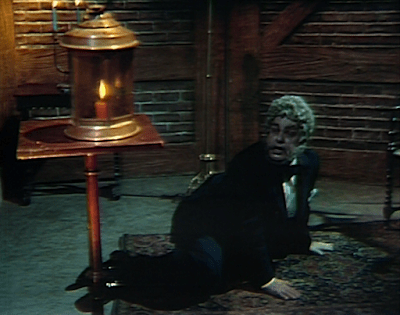
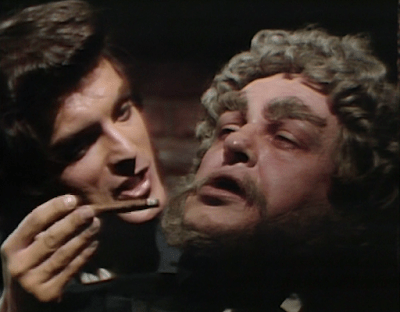
Both of those actors give superb performances today; David Selby makes Q-Petofi’s preening arrogance suitably repellent, while the 42 year old Thayer David shows us P-Quentin reduced to the total helplessness of a despised man in extreme old age. There is a scene that Mrs Acilius and I found particularly hard to watch when Q-Petofi’s henchman Aristide takes the thick glasses without which P-Quentin is effectively blind and holds them away from him.
Q-Petofi and Aristide’s gleeful cruelty to P-Quentin make us wonder how the count and his henchman feel about the body they are looking at. The show’s earlier body swap story, in which vampire Barnabas Collins had hoped to die and come back to life in the form of Frankenstein’s monster Adam, led Adam to ask Barnabas in #587 “How could you hate yourself so much that you wanted to change your body?” We hadn’t known that that the count hated himself at all until we saw this scene, but he must have done to take such delight in tormenting P-Quentin, and Aristide’s revelry shows that he, too, harbors more hostility to his master than he ever dared expose.
P-Quentin staggers away from the lair of Q-Petofi and Aristide and meets broad ethnic stereotype Magda Rákóczi in the woods. He tries to explain his true identity to Magda, who has experience with magic and has for some time now been his ally. But Magda’s fear of the count keeps her from listening to the far-fetched tale, and she rushes off.
P-Quentin makes his way to the door of his home, the great house of Collinwood. He stands there, and we hear his thoughts, in David Selby’s voice. He tells himself he cannot go in, because no one there would believe him if he told them who he was. He slinks off to the caretaker’s cottage, where he meets maidservant Beth, who is his sometime fiancée. He tries to tell her the story, but she too is terrified of the count. When Q-Petofi shows up, she leaves with him.
Magda is a wonderful character, and what we have seen has given us every reason to hope she will be a substantial part of the show for a while yet. Unfortunately, this is her final on-screen appearance. We will hear her voice once more, six weeks from now. The show has always been visually ambitious, and lately they’ve managed to pull some neat tricks with videotape that led me to hope we would see at least one scene in which Grayson Hall appears opposite herself as both Magda and time-traveling physician Julia Hoffman. When Hall appeared in the 1970 film End of the Road, she said that it was a relief from playing Julia, to whom she apparently referred as “that tight-ass doctor.” Magda is earthy enough that it would have been fun to see how Hall would have used her to demonstrate the same attitude towards Julia, even if she had to stick to words approved by the ABC network’s Standards and Practices office, and Julia’s reaction to Magda would doubtless have been just as much fun.