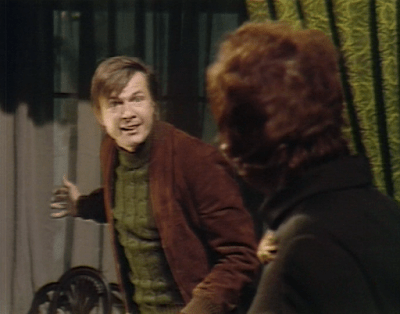
Dark Shadows showed its first exorcism in #400. At that point the show was a costume drama set in the 1790s. The fanatical Rev’d Mr Trask was convinced that time-traveling governess Victoria Winters was a witch and that she was hiding in the Old House on the estate of Collinwood. He stood outside that house with a forked stick. He set the points of the stick on fire and shouted commands for the forces of darkness to come out.
Vicki was indeed hiding in the house, but she was not alone there. The actual witch, the wicked Angelique, set a fire of her own. She built a house of cards and burned it to cast a spell that caused Vicki to see flames in her room and respond by running out into Trask’s clutches. What surrounded Vicki were special effects superimposed on the screen, but what was in Angelique’s room was real fire, and it flared alarmingly close to actress Lara Parker’s lovely face. You’d think they’d have learned from #191, when an on-camera fire went out of control and nearly killed the entire cast, or perhaps from #290, when an off-camera electrical mishap led to fire extinguisher noise almost drowning out some dialogue. But apparently the prevailing philosophy was no injuries, no problem, so they went right on playing with fire.
Today we have another unsuccessful exorcism, and its failure leads them to make another attempt to burn down the set. Occult expert Timothy Eliot Stokes is informed that the evil spirit of the late Quentin Collins is haunting the great house of Collinwood and taking possession of strange and troubled boy David Collins. Stokes follows Trask’s rubric of standing outside the house, pointing a forked stick at it, and shouting inhospitable remarks at the spirits, but he doesn’t set fire to the points of the stick as Trask had done. There is a lot of excitement while he is performing the ritual, and once he finishes all of it dies down. Unsure of the outcome, he arranges to stay the night; while he is getting ready for bed, the curtains in his room catch fire. These are not special effects images; the curtains are really on fire, they are burning rapidly, and they are putting out a lot of smoke. The little building at 442 West 54th Street where Dark Shadows was made was packed with sets made of plywood and crammed with props, many of them highly flammable. Several sets were draped with huge fake cobwebs; I’m not sure what those were made of, but I doubt it was anything that would make a fire marshal very happy. It’s just amazing anyone who worked on the show lived to see 1971.
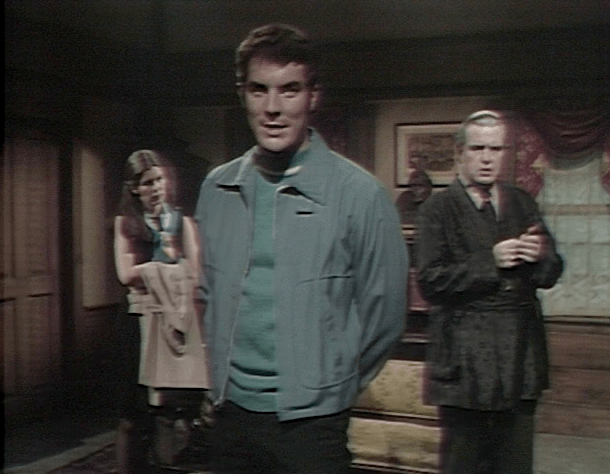
There is a lot of very good stuff in this one. All of the acting is top-notch. David Henesy and Thayer David had scenes together as several characters, first as David Collins and crazed handyman Matthew Morgan in 1966, then as young Daniel Collins and much put upon indentured servant Ben Stokes when the show was a costume drama set in the 1790s, and now in 1969 as Ben’s descendant Professor Stokes and David. Those scenes all crackled, and today when Stokes catches David hiding behind the secret panel in the drawing room, demands he tells him the truth about what is happening to him, tricks him into admitting that he is afraid of Quentin, and warns him of the dangers ahead, the two make the exchange work magnificently.
There is also a scene in the drawing room between David Collins, his cousin Carolyn Collins Stoddard, and permanent houseguest Julia Hoffman while Stokes is performing the exorcism. He has to shout and writhe around a lot during this scene, very difficult things for child actors to do convincingly. But Mr Henesy had been acting professionally for four years before he joined the cast of the show in 1966, at the age of nine, and had studied acting under several distinguished teachers, among them Uta Hagen.
That background pays off; violent as the symptoms of the incipient possession are, Mr Henesy does not overplay them. It helps that he has support from Grayson Hall and Nancy Barrett; Hall plays Julia as firmly in control of herself, but obviously uneasy with the situation, while Miss Barrett shows Carolyn’s anxieties mounting until she shouts that David might be in real trouble. Since he is in convulsions and the crepuscular sound of the creaky old waltz that plays when Quentin is exercising power is emanating from the walls of the house, it would seem obvious that David is in real trouble. The line shows that Carolyn is starting to panic. When we see that neither the determinedly calm Julia nor the increasingly anxious Carolyn is having any particular influence on David’s emotions, we know that they are coming from someplace far removed from his visible surroundings.
Thayer David joined the cast of Dark Shadows in August 1966, taking over the role of moody handyman Matthew Morgan from George Mitchell starting with #38. In that first episode, Matthew brawled in a barroom and left dashing action hero Burke Devlin gasping. The main storyline of the next few months was the investigation into the death of beloved local man Bill Malloy; it turned out Matthew had unintentionally killed Bill when they got into a fight and Matthew didn’t know his own strength.
Those two events explain the recast. George Mitchell was a slender little man whose white hair and craggy face made him look older than his 61 years. He was a fine actor, but no one would have believed that he could win a fight with Burke or that he was so strong that he would accidentally kill Bill. David was Mitchell’s equal in acting ability, but more importantly was a burly fellow in his late 30s.
Today, we hark back to David’s original function on the show. The setting is the year 1796; vampire Barnabas Collins has traveled back from the 1960s to rescue his fellow time traveler, well-meaning governess Victoria Winters, from death by hanging. David plays another servant. As Matthew was fanatically loyal to matriarch Elizabeth Collins Stoddard, so Ben Stokes is utterly devoted to Barnabas. Ben finds roguish naval officer Nathan Forbes and visiting Countess Natalie DuPrés about to drive a stake through Barnabas’ heart. Ben demands they stop; Nathan aims his pistol in Ben’s direction and squeezes the trigger. The gun misfires. Ben reflexively clutches at his chest, but finding he is not hurt he advances on Nathan. They fight. As Matthew was so strong he could not fight Bill without accidentally killing him, so Ben accidentally kills Nathan. Ben then tells the countess he doesn’t want to hurt her and that she will be all right if she stays put until he can figure out what to do; she is unable to assure him she will do so, and in his attempt to restrain her he inadvertently kills her, too.
Barnabas had originally lived in the eighteenth century. He passed from that time into the 1960s because he was chained in his coffin in 1796 and discovered in 1967 by would-be grave-robber Willie Loomis. Now, he has rescued Victoria, and he is eager to go back to 1969, when he is free of the effects of the vampire curse. He traveled back by standing in an old graveyard and calling to the spirit of Vicki’s boyfriend, an unpleasant man known variously as Peter and Jeff, to pull him into the past. He went to the same graveyard yesterday and tried the same trick in reverse. Peter/ Jeff isn’t in 1969, so he calls instead to his friend, mad scientist Julia Hoffman. That didn’t work, so he decided to have Ben chain him in the coffin and take the long way back.
Barnabas is unhappy to wake up this evening. He leaves his crypt to find Ben using a shovel to pat down some earth nearby. He asks why Ben did not chain the coffin as he was instructed. Ben tells him about Nathan and the countess; evidently he is only now finishing their shallow graves. Ben has never murdered anyone before, so he asks Barnabas’ expert opinion about the next steps. Barnabas tells him to get rid of the countess’ things and to tell whoever asks that she left for Paris.
The reference to Paris is a bit unexpected to longtime viewers. When the countess first appeared in #368/369, she said that she chose to live on the island of Martinique because metropolitan France had become a republic. She and her servant Angelique came to Collinwood along with the countess’ brother André DuPrés and André’s daughter Josette, who was at that time engaged to marry the still-human Barnabas. André is identified as the owner of a sugar plantation on Martinique.
In 1796, France was of course still a republic. But the Terror had ended shortly after the execution of Robespierre in the summer of 1794. Among the beneficiaries were the real-world counterparts of the DuPrés family, the vaguely aristocratic owners of a sugar plantation on Martinique. Their name was Tascher; the daughter of the family was named, not Josette, but Josephine, the widow of the Vicomte de Beauharnais. Josephine was imprisoned in Paris during the Terror, but she was freed, reunited with her son, and restored to her property by June 1795. In May of 1796, Josephine would marry an up-and-coming artillery officer named Napoleon Bonaparte. It would indeed be plausible that the countess would want to go back to Paris and take the opportunity to reestablish a life there.
After the story of Matthew Morgan and the consequences of the death of Bill Malloy ended in December 1966, Dark Shadows was for 13 weeks dominated by the battle between undead fire witch Laura Murdoch Collins and the forces of good, led by Victoria with assistance from the ghost of Josette. Laura was the show’s first supernatural menace.
The ghost of Josette had been introduced in #70 as the tutelary spirit of the long-deserted Old House on the estate of Collinwood. Matthew held Victoria prisoner in the Old House late in 1966, and in #126 he decided to kill her. Josette led the other ghosts out of the supernatural back-world that exists somewhere behind the action to save Victoria by scaring Matthew to death. During the Laura story, Josette’s ghost was deeply involved in the action, literally painting a picture to explain to the characters what was going on.
Prompted by Josette’s ghost, Victoria figured out that Laura was going to burn her son, strange and troubled boy David Collins, to death on the anniversary of similar immolations. This would turn out to be a key turn in Dark Shadows’ world-building. When you are telling stories about supernatural beings, you can’t rely on the laws of nature or logic to shape the audience’s expectations. You need to give them some other mechanism of cause and effect if you are going to create suspense. So from that point on, the show would use anniversaries as causal forces. “It happened exactly one hundred years ago tomorrow night!” means it will happen again then.
That was the basis of Barnabas’ trip to 1796 and of his hope to return by standing on the same spot. Tombstones indicating that Victoria and Peter/ Jeff had been hanged materialized at times related to the anniversaries of those events, and Barnabas must leave 1969 at a certain point to arrive at a certain point in 1796. Eight o’clock on a given night in 1796 corresponds to eight o’clock on a given night in 1969, and those are the times when Barnabas and Julia go to the graveyard from which he vanished and call out to each other.
Even though the conjoined eight o’clocks don’t facilitate Barnabas’ return trip, the structure of today’s episode plays on the same idea of intercutting timelines. We alternate between scenes of Barnabas and Ben in 1796, and of Julia and Willie in 1969. Barnabas bit Willie and enslaved him when he opened his coffin; by the time Barnabas was cured of the effects of the vampire curse, Willie had let go of any hard feelings about that. Barnabas has made the Old House his home, and Willie voluntarily lives there as his servant. Julia has been a permanent guest in the great house on the estate since 1967, but now is apparently staying at Barnabas’.
Julia is determined that Barnabas will return by rematerializing on the spot from which he vanished, and she keeps going back there. Willie doesn’t believe this will happen, but in a long interior monologue comes up with the idea that he might reappear in his old coffin. In her turn, Julia dismisses that idea. They quarrel about these competing absurdities, and Willie decides to put his hypothesis to the test. He goes to the old mausoleum to check on the coffin, and finds it empty. He returns to the house to report this to Julia.
Julia decides it’s time to sleep, so she goes upstairs- apparently to her own bedroom. Seconds later, a ghost appears to Willie. He recognizes it as Josette. She vanishes, and he calls Julia. When Julia comes he tells her that Josette had never appeared to either of them unless Barnabas was in danger. As far as I can recall the audience has never known Josette to appear to Willie or Julia at all, and Barnabas is always in danger, so that remark is a bit of a mystery to longtime viewers.
In the days leading up to Willie’s discovery of Barnabas in April 1967, he, and he alone, heard a heartbeat coming from the eighteenth century portrait of Barnabas that hangs in the foyer of the great house. While he is talking with Julia, Willie turns to the portrait of Barnabas that artist Sam Evans painted in May 1967 and hears the heartbeat again. Julia cannot hear the heartbeat. Willie combines the sound of the heartbeat with the sight of Josette and concludes that Barnabas has returned and the old coffin is no longer empty. We cut to the hidden room in the mausoleum. Chains materialize around the coffin, and we see Barnabas inside it, struggling to escape.
We may wonder if Barnabas has been struggling that way every night since he was chained there in his attempt to return to the 1960s. That would be 173 years, added to the 171 years the first time. It would seem that 344 years confined to a box would make Barnabas even screwier than he is. In a much later episode, we will see Barnabas released after a long entombment and he will be surprised that more than one day has passed. The 2012 film adaptation of Dark Shadows includes a humorous scene based on the idea that time does not pass for Barnabas while he is chained in his coffin. But when he was first released in April 1967, there were indications that he had undergone a nightly torment through the centuries, and the closing image of Barnabas in the box today echoes those indications.
Nathan’s death marks the final appearance of actor Joel Crothers, who has been one of Dark Shadows’ most valuable cast members since his debut in #3, when he played hardworking young fisherman Joe Haskell. We said goodbye to Joe last week; it was nice to have another glimpse of Crothers in his villainous role before he left for the last time.
Occult expert Timothy Eliot Stokes is searching the room in the long-deserted west wing of the great house of Collinwood where heiress Carolyn has been hiding Frankenstein’s monster Adam since #539 in July. Strange and troubled boy David Collins saunters into the room and greets him with a casual “Hello, professor.” When a flustered Stokes makes up a story about Carolyn sending him to the room to look for some old books, David calmly replies, “Oh, I thought you might be looking for Adam.”
We haven’t seen David since #541. The only time we saw him interact with Adam was when they crossed paths in the woods in #495, and in none of the countless scenes featuring Adam cooped up in this dusty little room has David been mentioned. Yet today he tells Stokes that he visited Adam there many times, and that the two of them became great friends. I take that to mean that Ron Sproat, writer of today’s script, wanted to show us a lot of conversations between David and Adam and was overruled by the producers. It’s a major disappointment Sproat didn’t get his way. David Henesy and Robert Rodan would have been a wonderful pairing. David Collins tells Stokes that Adam told him last night that he would be leaving Collinwood before morning, and that he would never return.
Carolyn enters the room and tells David to go. He eavesdrops on her conversation with Stokes. He hears Stokes acknowledge that he is in the room without her permission, confirming that he was lying when he claimed Carolyn sent him there. He stays long enough to hear that Stokes is anxious to find Adam because he is afraid he is in danger. He goes off to look for the big guy.
During Carolyn’s conversation with Stokes, it becomes clear that she does not remember the events of the previous night. Since that night stretched over 13 episodes, that is quite a gap. During it, a mate was created for Adam; Carolyn participated in the first attempt at that procedure as the donor of the “life force.” She did that under the influence of suave warlock Nicholas Blair; Nicholas later enlisted her in another task, after which he erased her memory. Perhaps she forgot everything she did while his spell was upon her. That would explain why she doesn’t remember anything about Adam’s mate or about his passionate goodbye kiss. The show was so much more interesting during the little interval when Carolyn knew what was going on that it is almost as big a disappointment to learn of this mind-wipe as it is to hear that we were denied a chance to see a friendship develop between David and Adam.
David goes to Eagle Hill cemetery to look for Adam. He sees Willie Loomis, bedraggled servant of David’s distant cousin Barnabas Collins, emerge from the old Collins family mausoleum. David hides behind a tombstone until Willie is gone.
David wonders what Willie was doing in the mausoleum. He goes inside, and decides to open the panel to the hidden chamber. There, he finds Maggie Evans, The Nicest Girl in Town, bound and gagged. He calls her by name, and we cut to commercial.
This situation will be familiar to longtime viewers. In #124, David found his governess, the well-meaning Vicki Winters, bound and gagged in a secret room in the Old House on the estate. That time, he panicked and left Vicki still restrained.
After the commercial break, we spend some time with Willie and Stokes in the Old House, where Barnabas now lives. Thayer David plays Stokes. In #124, he played Matthew Morgan, the crazed handyman who was holding Vicki prisoner. Seeing him in this house with Willie at this point in the episode ensures that those of us who saw it will remember #124 and wonder how David’s response to the situation with Maggie will compare to his failure to help Vicki.
Willie then goes back to the mausoleum and finds David sitting on one of the coffins in the publicly known part. He asks David what he is doing there. David answers in a roundabout way. We start to wonder if he may have reverted to his old form and left Maggie where she was. But he eventually gets around to describing how Maggie behaved when he was untying her. Willie is terribly upset to find that Maggie is gone.
Willie abducted Maggie and locked her up in the mausoleum because Barnabas and mad scientist Julia Hoffman were planning to impose the role of “life force” donor on her. While there, she remembered that in May and June of 1967 Barnabas was a vampire who fed on her, imprisoned her, tried to replace her personality with that of his lost love Josette, and tortured her when she resisted. Willie doesn’t see any way to let her out when she has information like that. In the middle of today’s episode, Kathryn Leigh Scott and John Karlen have a big scene in the mausoleum as Maggie defies Willie and he begs her to be nice to him. They do an excellent job, but it is quite a relief to be out of that dungeon.
Act One consists of recovering vampire Barnabas and mad scientist Julia standing around Barnabas’ front parlor recapping various ongoing storylines.
Danny Horn devotes his post about this episode to a detailed analysis of this scene. He shows that Jonathan Frid’s performance and Grayson Hall’s are open to many objections. They fall short in such technical categories as “knowing their lines” and “standing on their marks” and “having the slightest idea what is going on.” But they are fascinating to watch nonetheless. Danny declares that “[t]he point of these scenes is to see how long two adults can stand around in a room saying preposterous things to each other.” Frid and Hall operate at such a high level of tension that the prospect of either of them breaking character generates enough suspense to keep us on the edge of our seats.
Patrick McCray wrote two separate posts about this episode. In the one that went live 13 September 2017, he too focuses on the performances in Act One. He writes:
Poor Jonathan Frid. He must have had a rough night. I am usually oblivious to his infamous (and completely understandable) line trouble, but in this one, it is so palpable that I totally understand why he retired from TV after DARK SHADOWS left the air. In his early dialogue with Grayson Hall, you can see sheer terror in the eyes of both performers as Barnabas haltingly recalls a trip to the hospital. This is followed by the “Frid Surge,” where Barnabas becomes far more committed and energetic when he turns to face the teleprompter. Of course, this gives him that great sense of vulnerability that was the secret to Barnabas’ success.
This is the only post on the Collinsport Historical Society tagged “Frid Surge”; that’s too bad, I’d like to see that phenomenon tracked throughout the series. I should also mention that Patrick goes on in this post to express his “confidence that Frid could have acted the doors off the collected ensemble had the poor guy just been given another frickin day to study his sides.”
Barnabas and Julia’s recap scene ends when an unexpected visitor barges in. He is an unpleasant man named Peter, who prefers to be called Jeff. Peter/ Jeff is fiancé to well-meaning governess Vicki, whom Barnabas and Julia know to have been abducted by Frankenstein’s monster Adam. Adam came to Barnabas’ house yesterday and threatened to kill Vicki unless Barnabas and Julia created a mate for him.
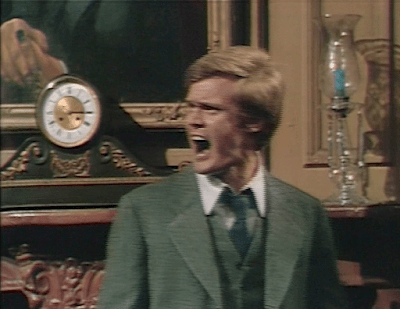
Peter/ Jeff was assistant to Eric Lang, the mad scientist who created Adam, and he knows that Barnabas and Julia were connected to the experiment. He does not know for sure that Adam is Lang’s creation, that Barnabas and Julia brought Adam to life after Lang’s death, or that Adam has abducted Vicki. He does, however, have grounds to suspect that each of these things might be true. In this scene, he announces his suspicions to Barnabas and Julia. They huddle in one corner of the room while he shouts his lines in his singularly irritating voice. They deny all three of his points. One of the commenters on Danny’s post, “Straker,” summed up their reaction admirably:
Frid and Hall were too professional to show it but I sensed they were both annoyed when Roger Davis marched in and started yelling. It’s kind of like how you feel when you’re at a party and the host’s five year old son throws a tantrum. Sort of an embarrassed tolerance.
Comment left by “Straker” at 6:21 am Pacific time 31 July 2020 on “Episode 557: A Race of Monsters,” by Danny Horn, Dark Shadows Every Day, 1 January 2015
Roger Davis as Peter/ Jeff, in one of the most subtle moments of his performance. Screenshot by Dark Shadows Before I Die.
After Peter/ Jeff’s scene, it is Barnabas’ turn to be an unwelcome guest. He calls on occult expert Timothy Eliot Stokes. Barnabas and Julia suspect that Stokes may be the evil mastermind who has turned the previously gentle Adam toward evil plans. When Stokes hears Barnabas knocking on his door, he looks up and rasps to himself “Go away… No one is home…” This is one of my favorite lines in the whole series. Stokes was quite cheerful when he first involved himself in the strange goings-on, but as he has found himself drawn deeper and deeper into the unholy world of Collinsport he has come to regret his decisions.
Stokes is quite impatient with Barnabas’ demands that he tell him what he knows and his refusal to reciprocate with information about himself. It is only because Vicki is in danger that Stokes tells Barnabas anything at all.
Stokes already knows how Adam came into being, and Barnabas tells him about Adam’s conversation with him. This brings up a question about the scene with Peter/ Jeff. Why couldn’t Barnabas and Julia have trusted Peter/ Jeff with as much information as Barnabas here gives Stokes? Peter/ Jeff can no more go to the police than Stokes can, he will not tell Vicki anything about Lang’s experiment, and Barnabas and Julia have no reason to suspect him of being behind Adam’s turn to evil. These questions don’t come to mind during the scene with Peter/ Jeff, partly because he is so disagreeable a presence that we want him off screen as soon as possible, and partly because it has long been Barnabas’ habit to tell his enemies everything he knows while he zealously guards his secrets from potential helpers.
Patrick McCray’s second post about this episode, published 30 July 2018, includes an analysis of Thayer David’s portrayal of Stokes:
Professor Eliot Stokes gains fascinating dimension in 557. Normally, jovial and helpful, we see his protectiveness of Adam reveal an irascible and sternly just man within. Anton LaVey extolled “responsibility to the responsible,” and there are few other places where Barnabas gets both barrels of that. Stokes is perhaps the most inherently good man in Collinsport since his fellow freemason, Bill Malloy, took his last diving lesson. (Ironically, at the hands of Thayer David’s first character.) Stokes’ prime reason for siding with Adam and not Barnabas? The former vampire and Julia have withheld vital information for months. Yes, they have necessary trust issues, but this is Stokes we’re talking about. Adam may be a wildly unpredictable man-beast, capable of leveling Collinsport to sand before breakfast, but he’s also (until later in the episode) a prime graduate of Rousseau’s Finishing School for Noble Savages. He’s nursed greedily on the milk of morality that spurts abundantly from the ripe and straining teat of of Eliot Stokes’ moral tutelage. It takes a Nicholas Blair — so often Stokes’ foil — to teach him the less savory lessons in humanity. Stokes knows that there’s only so much danger in which Adam can find himself… Victoria Winters is another matter.
Barnabas passes the baton to Stokes, who becomes the third character in the episode to pay an unwelcome visit. He goes to Adam. He asks the big guy who has taught him to be cruel and amoral, and gets nothing but lies in return. He tries to persuade him that he must not hurt an innocent person, and Adam angrily declares that it is “fair” for him to make Barnabas watch him kill Vicki if Barnabas will not make a mate for him.
In Patrick McCray’s 2017 post, he praises Robert Rodan’s performance as Adam:
Robert Rodan issues a highly cerebral, emotionally packed performance. Rodan never receives the credit he deserves. Much of Adam’s stint on the show finds him equipped with an eloquent, even sesquipedalian command of the language. His inner conflict is as existential as it gets… Where do you turn? Rodan balances this absurd chimera of conflicts with effortless aplomb that makes Cirque du Soleil look as clumsy as a Matt Helm fight scene.
Robert Rodan is an unsung hero of an actor, delivering his existential angst with passion and truth. It’s a shame that his identification with an eventually unpopular character was probably a factor in Rodan not being recycled by Dan Curtis, despite being the dark-haired, blue-eyed “type” that typified the ruggedly handsome, DS norm (such as Selby, Lacy, Crothers, George, Ryan, Prentice, Storm, Bain, etc.)
While I always found the sight of Conrad Bain a guarantee of a fine performance, I can’t say it ever occurred to me to class him as “ruggedly handsome” in the way that one might class the other men Patrick lists. There’s no accounting for taste, I suppose.
Mad scientist Julia Hoffman and suave warlock Nicholas Blair each want to find Frankenstein’s monster Adam before the other does. Julia is sure that occult expert Timothy Eliot Stokes knows where Adam is; while he sits at a chessboard and plays both sides of a game, she asks Stokes to tell her. He says he wants answers to some questions of his own, but the audience knows that the information he wants is just what Julia will never tell him.
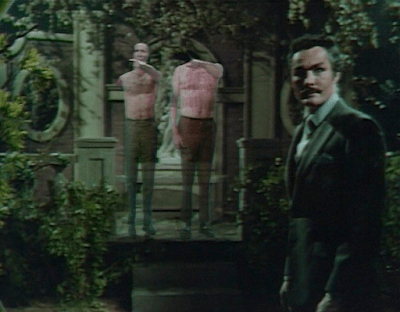
Nicholas takes a less conventional approach. He raises the ghosts of a couple of the dead men whose corpses supplied the raw materials from which Adam’s body was constructed. One lacks a right arm, the other a head. He asks them where Adam is, and they turn in unison to point with their left arms at the great house of Collinwood. It’s such a smoothly coordinated move that it looks like they must be spending their time in the afterlife starting a boy band.
The Boneyard Boys showing off their signature move, the Postmortem Point. Screenshot by Dark Shadows Before I Die.
The arm donor is played by David Groh, who less than a decade later would become a star as Joe on the sitcom Rhoda. Groh was such a charismatic performer that it’s hard not to think of speaking parts on Dark Shadows that other actors played badly and wonder what would have happened had he played them instead. I went on about that in a comment I left on Danny Horn’s Dark Shadows Every Day in 2020; here, I will just mention that if Groh, instead of the lamentably unaccomplished Craig Slocum, had played ex-convict Harry Johnson, we would probably have seen a red-hot love triangle in which Harry vied with Adam for the affections of heiress Carolyn Collins Stoddard.
Earlier in the episode, Adam had asked Stokes why it was not allowed for him to kiss Carolyn. Thayer David makes the most of this scene. Stokes freezes and looks up when Adam starts posing his questions, then seems genuinely shaken when he says that he is inadequate to the task of answering them, since he himself has never raised children. We can see that, in that moment, Stokes feels as incomplete as Adam. It’s touching to see Stokes’ usually supreme self-assurance give way to shamefaced uncertainty. When Stokes tells Adam to put away his budding sexual desires and to concentrate on his books, we catch a glimpse of the tragic side of Stokes’ own celibate, scholarly life.
But not even a father of twenty would be prepared for this situation. In the ten weeks he has been alive, Adam has become fluent in English and able to read with facility; he has the body of a grown man and moves with agility and force. Yet he knows absolutely nothing of human relationships beyond a basic understanding of the words “Friend” and “Kill!” It is hard to imagine that anyone has ever lived who needed the instruction Adam needs now.
It’s the wee hours of the morning, and hardworking young fisherman Joe comes to his fiancée Maggie’s house. Maggie had telephoned Joe and asked him to come right over. Joe can’t imagine what Maggie wants. In the chaste world of Dark Shadows, there is no word for “late night booty call.”
Joe finds Maggie and her friend Vicki waiting for him in their nightgowns. Maggie tells him that she had heard a noise in the bedroom where Vicki is staying, that she went in to investigate, and that she saw a ghost whispering into Vicki’s ear. Vicki tells him that she is staying at Maggie’s house to escape the power of a witch who is trying to make her have a nightmare that Maggie and others have already had, and that if she does have the nightmare it will spell doom for Barnabas Collins, who hasn’t been on the show for a week and a half. Joe gets more and more befuddled as the women go on about these matters. When they mention occult expert Professor Timothy Eliot Stokes, Joe perks up. Stokes is a topic on which he has a definite opinion. He thinks Stokes broke into Maggie’s house while she was away mourning for her father Sam, that he is harboring a fugitive named Adam who was involved in Sam’s death, and that he is in general a slippery sort. When Vicki says she is planning to call on Stokes the following day, Joe insists on accompanying her.
Stokes is slow to answer the door when Joe and Vicki knock. Vicki tells Stokes about her experience the night before, and Stokes replies that he can do nothing for her unless she leaves the town of Collinsport.
Joe finds some beginning reader’s flashcards and asks Stokes what he is doing with them. Stokes claims to be tutoring a three year old nephew in reading. Joe hears footsteps in the back bedroom. He wants to go to investigate, as Maggie had investigated sounds in her back bedroom, but Stokes denies him permission, claiming that there are cleaning people working in there. Joe seems to suspect what the audience already knows, that neither the nephew nor the cleaning people exist and Adam is in the bedroom.
Thus compromised, Stokes is off his guard when Joe reaches into his pocket and takes out a stickpin bearing the monogram “S.” Stokes confirms that it is his, and Joe says it was found in Maggie’s living room. Stokes suggests he dropped it there when he visited Sam. Joe argues this could not have been so, and Stokes is compelled to accept his reasons. He claims to have let himself into Maggie’s house through the unlocked door hoping to find her and offer his condolences, and that when he found no one home he left right away.
Later, Joe lets himself into Maggie’s house and grabs a rifle. Maggie asks him what he is doing. He refuses to explain himself and insists on going away with the weapon. She objects quite forcefully, as one would expect, but cannot stop him. Throughout the first 106 weeks of the show, Joe has been an unfailingly kindly and conscientious fellow; longtime viewers will therefore be as shocked as Maggie is to see Joe behaving in this way.
Joe returns to Stokes’ place. Stokes is unsettled to see him with a gun. Joe declares that he has come to conduct a thorough search for Adam. Stokes orders him out of the house. Joe refuses to go, and Stokes threatens to call the police. Joe encourages him to call them. The two start to scuffle, and Adam bursts in from the bedroom. Joe points the gun at Adam, and Stokes urges him to put it down. Joe and Adam both run out the door. Stokes is looking on and urging Joe not to fire when we hear a shot.
Professor Timothy Eliot Stokes (Thayer David) comes home and greets his house-guest Adam (Robert Rodan.) He says that he envies Adam his freedom from the responsibility of attending lectures delivered by people who are “inferior” to him. However snobby Stokes’ attitude towards his faculty colleagues may be, we immediately see that it does not extend to people who lack educational credentials. He takes out a deck of flashcards with words as short as “car” and as long as “dictionary” and is delighted with Adam’s ability to read them aloud.
The Professor takes pleasure in his pupil’s progress.
From November 1967 to March 1968, Dark Shadows was a costume drama set in the 1790s and Thayer David played Stokes’ ancestor Ben, a servant indentured to the mighty Collins family. We saw kindly scion Barnabas Collins (Jonathan Frid) teach Ben to read. Barnabas became a vampire in those days; his vampirism went into remission only a few months ago, when he went through an experimental treatment that involved Adam’s creation as a Frankenstein’s monster. To the extent that Adam is Barnabas’ responsibility, Stokes is repaying his ancestor’s debt to him in kind.
Barnabas and his friend Dr Julia Hoffman (Grayson Hall) knock on Stokes’ door. Stokes does not know that Barnabas used to be a vampire or what he and Julia had to do with Adam’s creation, but he knows enough to distrust them deeply. He insists Adam hide in the back bedroom before he will let Barnabas and Julia in.
Barnabas and Julia tell Stokes that they telephoned him earlier. He explains that he was out, and they say that someone answered the phone and breathed audibly into the receiver, but did not speak. Before he can suggest they misdialled, they notice that his receiver is still off the hook. He speculates that his cleaning lady, who obviously does not exist, must have done it. He furrows his brow and sounds quite stern when he expresses his disapproval of this imaginary person’s behavior. Barnabas and Julia can’t do anything with that, so they change the subject to the matters they originally wanted to discuss.
Those amount to a recap of the storyline concerning wicked witch Cassandra Blair Collins, who in the 1790s was known as Angelique Bouchard Collins. As Angelique, she was the one who made Barnabas a vampire. She returned to the world of the living in the spring of 1968 in a bid to reactivate that curse. Now she has gone missing, and Barnabas and Julia are hoping she is gone forever. While Stokes is in the dark about Barnabas’ past and his true nature, he knows plenty about Angelique/ Cassandra. He tells Barnabas and Julia that to test their hypothesis, they must find the portrait of Angelique that turned up shortly before Angelique/ Cassandra herself returned.
Barnabas and Julia search for the portrait in the great house of Collinwood, where Angelique/ Cassandra has been living as the wife of Roger Collins (Louis Edmonds.) Julia keeps Roger busy downstairs while Barnabas roots around in Roger and Angelique/ Cassandra’s bedroom. The soundtrack plays a recording of Barnabas’ thoughts about his search while we see him staring at the room. When these interior monologues were new to the show, they tended to be very informative. Lately they’ve had less substance, and this one is totally unnecessary.
It turns out that the search itself was equally unnecessary. As soon as Barnabas makes his way back to the drawing room, Roger pulls out the portrait and shows it to him and Julia. Roger found it in the back of a dark closet, but is badly faded, as if it had been left in direct sunlight for a great many days. Barnabas and Julia know that the portrait has some mysterious connection with Angelique’ Cassandra’s physical being, so this is grounds for hope that she is on the way out.
That hope is dashed within seconds. Barnabas answers the front door, and finds a stranger. The man tells Barnabas he should have recognized him at once- “Cassandra’s husband!” Barnabas was briefly Angelique’s husband, 172 years before, but does not bring that up. Instead, he directs the man’s attention to Roger. The man is unfazed when Roger announces that he, not Barnabas, is married to Cassandra. The man then introduces himself as “Cassandra’s brother!” Barnabas and Julia react with shock.
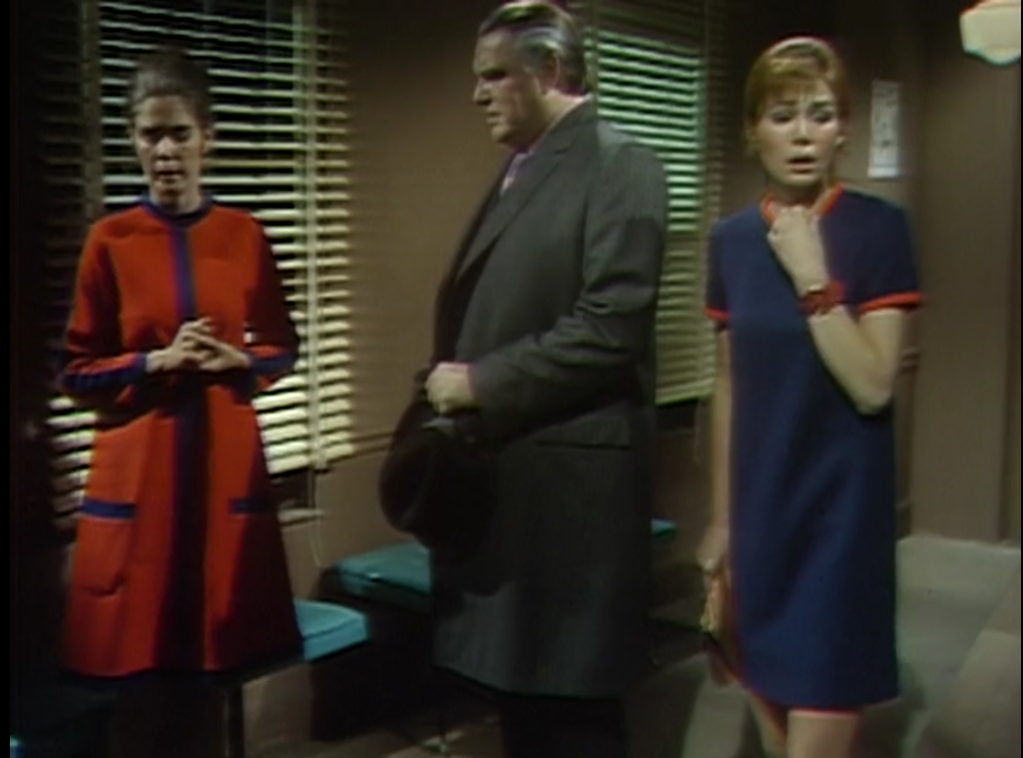
We open in a hospital room where Sam Evans is in bed, wearing dark glasses. This would tell a first time viewer that Sam is blind, and also that he’s reckless about his glasses.
Sam is begging his daughter Maggie to bring her friend Vicki around so he can tell her about a dream he just had. Vicki shows up and invites Sam to tell her the dream. This leads to a dramatic musical sting and a cut to the opening title. The first time viewer, still worried that Sam might nod off and break his glasses, will be unlikely to see why Vicki’s willingness to listen to Sam’s dream should be a concerning development.
Sam starts to describe his dream. A knock on the door interrupts him. It is Timothy Eliot Stokes. Stokes orders Vicki out of the room. Stokes is wearing a suit, not a white coat, and is addressed as “Professor.” So it should be clear to the first-time viewer that he is not a medical doctor, has no authority in the hospital, and is not particularly close to Vicki, Maggie, or Sam. The women resist his commands, but when it becomes clear he won’t back down they humor him.
In the corridor outside Sam’s room, Vicki tells Stokes “I hope you have some explanation.” He replies “The situation required drastic action.” “Is that all you have to say?” “No, I might add you should be grateful to me.” Thus the first-time viewer learns that Stokes does not feel obligated to be polite to young, pretty women.
Stokes tells Vicki that “Your recent experience in the past has taught you some rather frightening things about witchcraft.” Vicki agrees with this statement. Maggie turns away and looks out into space, wondering what the heck these lunatics are talking about. At last the first-time viewer has an on-screen representative.
Stokes describes a “Dream Curse,” in which a series of people all have the same nightmare. Each dreamer is compelled to tell the nightmare to a particular person who appeared in it. That person then has the nightmare, featuring a third person, and awakens with the same compulsion to tell the nightmare to that person, keeping the cycle going. Vicki declares that she doesn’t know what Stokes is talking about, but Maggie seems to. Vicki grudgingly agrees not to go into Sam’s room, but refuses to leave the corridor.
Maggie reacts to Stokes’ explanation.
Returning viewers know that Maggie was the first to have the nightmare. It will also stretch their credulity that Vicki hasn’t heard about it. Maggie is one of Vicki’s dearest friends, and the nightmare was a terrifying experience that weighed on her for quite some time. The person Maggie passed the nightmare to was Vicki’s boyfriend Peter, who prefers to be called Jeff. Not only has neither Maggie nor Peter/ Jeff told Vicki about the nightmare, neither has any of the three people who have already had the nightmare and who live with her in the great house of Collinwood. These are heiress Carolyn, whom Vicki has addressed as “my best friend”; strange and troubled boy David, who is Vicki’s charge in her job as governess and who feels very close to her; and housekeeper Mrs Johnson, who habitually tells everyone everything she knows.
It will also be strange to those who have been watching the show that Stokes does not tell Vicki the key thing about the Dream Curse, that it is aimed at old world gentleman Barnabas Collins. Vicki is extremely fond of Barnabas; Stokes knows this, because in #509, he told her that he was doing battle with a witch whose goal was to kill Barnabas, and she was most eager to help him. If he told her that by listening to Sam’s account of the dream she would be bringing Barnabas one step closer to death, surely he would have persuaded her to go home. But, as my wife Mrs Acilius pointed out while we were watching the episode, that would let Vicki back into the story. Stokes, like Barnabas and several other major characters, is working to keep Vicki from becoming relevant to any ongoing plot.
Stokes has to leave the hospital to attend to another matter. While Maggie was leading the way out of the hospital room, he looked out the window and saw a man looking in. The man is Adam, a very tall, phenomenally strong, peculiarly inarticulate fellow whom Stokes met at Sam and Maggie’s cottage a few days ago. Stokes is eager to get to know Adam. He lets himself into the cottage and waits there until Adam comes by. Adam is confused to find him there, but Stokes quickly persuades him to come home with him. Stokes promises to give him food and become his friend. The two of them are quite cheerful as they walk out the front door.
The camera repeatedly focuses on a stickpin Stokes dropped on the rug, suggesting that he will get in trouble for having let himself into the cottage without Maggie’s permission. That suggestion is clearer to the first-time viewer than to those who know what’s been happening. Stokes had been in the cottage with Sam not long before, and could easily claim to have dropped the stickpin on that occasion.
Back in the hospital corridor, Vicki hears Sam crying out in agony. She goes to his room. Maggie joins her there, and Sam starts describing the nightmare. Maggie recognizes it as the one that caused her such distress when she had it, and her eyes dart to Vicki. She tells Vicki she doesn’t have to stay. Vicki insists, and a look of panic starts to form on Maggie’s face. Sam doesn’t get far into the nightmare before he dies.
Returning viewers will remember that the luckless Willie Loomis was interrupted in his attempt to tell Carolyn the nightmare in #506, and that when she next went to sleep she could have only the part of the nightmare he had described. So we wonder if Vicki will have the same problem.
We may wonder about something else. Stokes, as an expert on witchcraft, has several times said that a Dream Curse is designed to “end with a death.” We may wonder if Sam’s death will end it before it gets to Barnabas.
That would represent a stinging defeat for the witch. Sam was once a fairly important character, but long ago receded to the margins of the show. He made his debut in #5, and has been played by David Ford since #35. Originally he was a tormented alcoholic, driven to drink by his part in the injustice done long ago to dashing action hero Burke Devlin. Burke’s storyline fizzled out completely in #201, and since then Sam has made only intermittent appearances, mostly as support for Maggie, who is herself usually a secondary character. To launch an attack on the show’s breakout star and hit a tertiary player would be quite embarrassing to any villain. Maybe the witch’s next plan will wind up falling on Bob the Bartender, and the one after that will hit one of the sheriff’s feeble-minded deputies.
Kathryn Leigh Scott tells some stories about Sam’s death scene that do not fit with what is on the tape. In her 1986 book My Scrapbook Memories of Dark Shadows, she writes about the teleprompter falling over and making a loud noise and Ford shouting “Where is it!?” In appearances at Dark Shadows conventions, she has said that the lines Ford improvised to replace the ones he couldn’t read ran over time, and that in her desperation to get to the next break she pushed a pillow on his face and nearly smothered him while saying “Don’t die, Pop!” In his post on Dark Shadows Every Day, Danny Horn says that Miss Scott’s “anecdote was entirely made up. None of that happened.”
I reserve judgment. Maybe the episode we have is a second take. It runs unusually smoothly up to Sam’s death scene, as if the cast had had more practice with its parts than usual. We know that, in spite of all the spectacular bloopers and other production errors they left in, they did sometimes start over, and the incidents Miss Scott described might well have been enough to warrant that.
In the first months of Dark Shadows, the audience’s point of view was represented by well-meaning governess Vicki, who needed to have explained to her everything we might want to know and who reacted to all the strange goings-on with the mixture of disquiet and curiosity that the makers of the show hope we will feel.
Vicki has long since been replaced as our representative by mad scientist Julia. We no longer want characters to tell us what has been going on, nor are we making up our minds about our moral evaluation of the events in the stories. We find ourselves in the middle of a whole clutch of fast-moving plots, trying to keep up with them all and hoping that nothing will stop the thrills. Julia’s loyalty to her best friend, sometime vampire Barnabas, and her supremely well-developed capacity for lying put her in the same position, and her vestigial conscience is no obstacle to any juicy storyline.
When Vicki was our on-screen counterpart, her charge, strange and troubled boy David, was the show’s most powerful chaos agent. David precipitated a series of crises that seemed likely to expose the secrets of the ancient and esteemed Collins family, to kill one or more of the major characters, or both. In #70, David led Vicki to his favorite playground, the long-vacant Old House on the estate of Collinwood. David would keep sneaking into the Old House even after Barnabas took up residence there in #218.
Today, David again lets himself into the Old House. He is caught there by Julia and a man he has not seen before. Julia is stern with him for entering the house without Barnabas’ permission; he defends his presence there, reminding Julia that she promised him he could play with the tape recorder on Barnabas’ desk. He asks who the man is.
The man introduces himself to David as “Timothy Eliot Stokes.” This is the first time time we have heard his middle name. Soon, the show will phase “Timothy” out, and his friends will address Stokes as “Eliot.” I suppose that’s because he’s a professor, and “Eliot” suggests Harvard.
Stokes introduces himself to David.
In 1966, Thayer David played crazed groundskeeper Matthew. Suspected of murder, Matthew hid out in the Old House and kept Vicki prisoner there until some ghosts scared him to death in #126. David didn’t believe Matthew was a killer and didn’t know he was holding Vicki, so when he stumbled upon him in the Old House he brought him food and cigarettes. Even after he found Vicki bound and gagged behind a hidden panel, he kept Matthew’s secret. When David meets another character played by the same actor on the same set, longtime viewers can see that Stokes is as genteel and urbane as Matthew was rough-hewn and paranoid. For her part, Julia recalls Vicki when she scolds David for sneaking into the Old House, but where Vicki was doing her job as David’s governess and trying to enforce the rules of the household as a governess might, Julia is scrambling to keep David from finding out about her own secret activities.
Julia tells David to take the tape recorder and go home to the great house on the estate. As he makes his way to the front door, Stokes takes Julia aside and tells her that it will not be well if it is known in the great house that David has seen him. Julia hurries to David and tells him to keep quiet about the fact that he has seen Stokes. She says that she hates to ask him to lie; at this, I mimicked Julia and said “I know you share my devotion to the truth,” prompting Mrs Acilius to laugh out loud. Later, Julia will go to the great house, where she lives as a permanent guest, and David will cheerfully assure her that he kept her secret. The two of them seem quite relaxed together, leading us to believe that he will continue to do so.
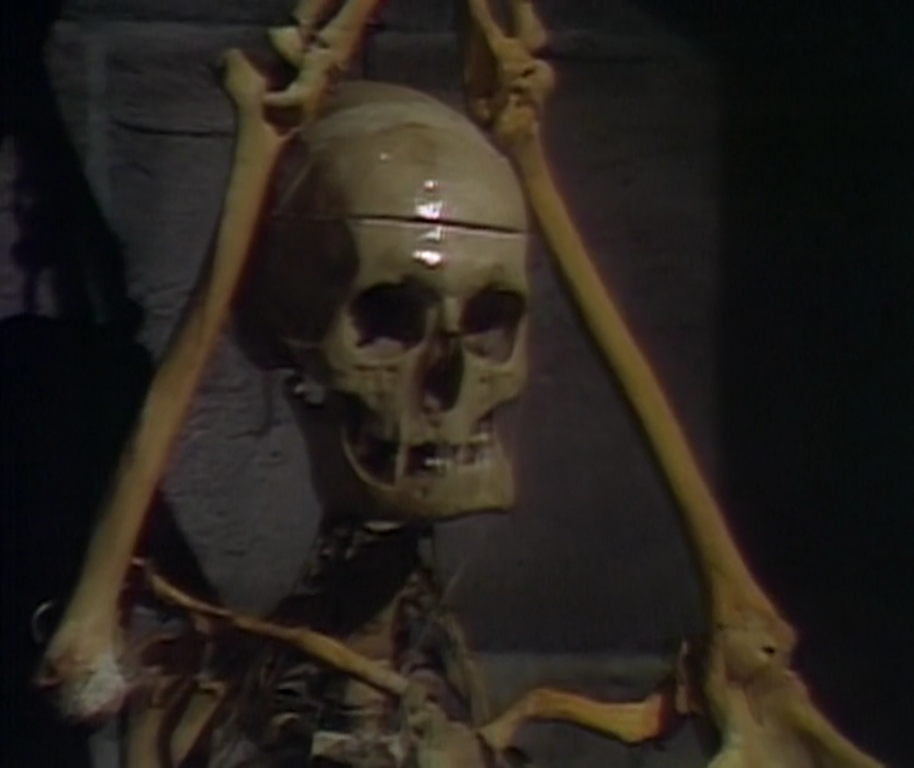
There is a bit of irony in Julia’s harshness with David for entering Barnabas’ house without his permission. She and Stokes didn’t have Barnabas’ permission to be there, either. Indeed, if he had known what they were up to he would likely have objected most strenuously. Along with a man named Tony, they held a séance in the part of the basement where Barnabas kept his coffin when he was under the full effect of the vampire curse. They were trying to contact the Rev’d Mr Trask, a Puritan divine whom Barnabas bricked up to die in the eighteenth century. The séance was so successful that the bricks crumbled, exposing Trask’s bones, still held together somehow in the shape of a skeleton hanging from the ceiling. At the end of the episode, Trask has resumed his corporeal form and set about taking revenge on Barnabas by walling him up in the same spot.
Odd that Trask’s skeleton holds together after all the ligaments and tendons have rotted away, odder that there is a straight cleavage separating the top of the skull from the rest, oddest of all that the section is attached to the rest of the skull by a piece of Scotch tape.
Yesterday, wiggéd witch Angelique/ Cassandra sent her cat’s paw Tony to kill sage Timothy Eliot Stokes. Stokes pulled “the old switcheroo” on him, and Tony drank from the glass into which he had put Angelique/ Cassandra’s poison. Today, we learn that Stokes gave Tony an emetic to save his life. Stokes calls mad scientist Julia Hoffman, MD to examine Tony and assist with the next stage of the battle against Angelique/ Cassandra.
Recovered, Tony has no idea why he obeyed Angelique/ Cassandra’s command to kill Stokes, and is ready to surrender to the police. Stokes tells him he is under the power of a witch, and enlists him in the battle against her.
Stokes takes out the memoirs of his ancestor Ben, who was Angelique’s cat’s paw in the eighteenth century. He does some automatic writing in Ben’s hand and finds that they must contact the spirit of the Rev’d Mr Trask, a witchfinder who inadvertently helped Angelique in those days. Fortunately, Trask, like Tony, was played by Jerry Lacy, so it shouldn’t be too hard to get hold of him. Stokes also finds that Trask was walled up in “the coffin room,” which Julia tells him is for some mysterious reason a nickname given to the space at the foot of the stairs in the basement of the Old House on the estate of Collinwood. Stokes decrees that he, Julia, and Tony must go to this room and hold a séance there.
On his way to the Old House, Tony follows Stokes’ instructions and stops at the main house on the estate and tells Angelique/ Cassandra that Stokes is dead. This follows a scene between Angelique/ Cassandra and her husband, sarcastic dandy Roger, in which Roger complains about her lack of interest in him. Her mind isn’t on the game of chess they are playing, she hasn’t been attentive to him for several nights, and she refuses to go on a honeymoon. Angelique/ Cassandra ensorcelled Roger into marrying her so that she could have a perch at Collinwood, and he seems to be slipping out of the spell’s power.
Stokes, Julia, and Tony gather in the coffin room. They begin the séance. This is the fifth séance we have seen on Dark Shadows, but the first that does not include well-meaning governess Vicki. In four of the previous five, it had been Vicki who went into the trance. On the other occasion, it was strange and troubled boy David who became the vessel through which the dead spoke to the living. The first three times Vicki served as the medium, she channeled the gracious Josette Collins, and when David filled that role he gave voice to David Radcliffe. In those days, Vicki was closely connected to Josette, perhaps a reincarnation of her, as David was another version of the cursed boy David Radcliffe. The final time Vicki spoke for the dead, she spoke for nine year old Sarah Collins, with whom she was no more closely connected than were any of a number of other characters. Sarah has no present-day counterpart, so her appearance at a séance suggested that Dark Shadows was moving away from its use of necromancy as a way of connecting characters from different time periods.
This time, Tony goes into the trance. In #481, Angelique/ Cassandra told Tony that she chose him as her cat’s paw because he resembled Trask, so when he is the medium through whom Trask speaks we are returning to Dark Shadows‘ original conception of how séances work. Trask mistakes Stokes for Ben, as Angelique did in a dream visitation last week. The brick wall behind which Trask’s remains are hidden bulges and is about to crumble when we fade to the credits.
True fans of Dark Shadows know that the episode’s real climax comes during those credits. Thayer David strolls onto the set under Louis Edmonds’ credit for Roger. He even looks into the camera when he realizes what he has done.