For several months starting in late 1968, the great house of Collinwood was haunted by the unspeaking ghost of Quentin Collins. The Haunting of Collinwood posed a grave danger to children David Collins and Amy Jennings. At the end of March 1969, old world gentleman Barnabas Collins tried to communicate with Quentin’s ghost in hopes of saving David’s life. Barnabas came unstuck in time and found himself in 1897, where he met Quentin as a living being. For the next eight months Dark Shadows was a costume drama set in that year. David Selby’s charm made Quentin a breakout hit. In the course of Barnabas’ bungling, history was changed so that Quentin did not die. Instead, he was immunized against aging, so that when the show returned to contemporary dress he showed up alive, well, and apparently a bit under 30.
Now, this storyline is being recycled. In the Re-Haunting of Collinwood, the unspeaking ghost of Gerard Stiles takes the place of the unspeaking ghost of Quentin. Hallie Stokes takes the place of Amy. David is reenacting his original part.
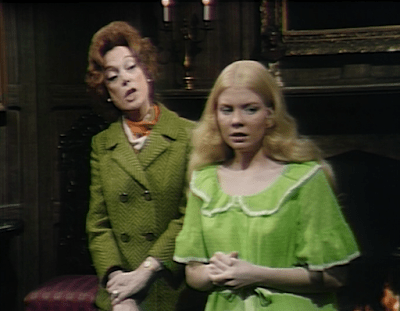
David Henesy does a good job today playing David’s frustration at finding himself in the same situation over and over. He is in his bedroom when Gerard stands in front of him menacingly. He screams. Permanent houseguest Julia Hoffman lets herself into the room. Julia knows about Gerard, and tells David she can feel that “he” has been in the room. David feigns ignorance. Julia has withheld her knowledge of the ghosts from David, so she cannot give him an answer when he asks who she is talking about. She stays on the offensive, asking him to tell her. He won’t, so she asks him why he was screaming. He tells her he had a nightmare. She demands he stop lying and claims that she has always told him the truth. In fact, she has never told him the truth, and her failure to let him in on what she knows about Gerard and the other ghosts is a case of dishonesty that has kept the show on a treadmill for three and a half weeks now, so this is just a bizarre claim.
David becomes angry with Julia. When she tells him that it is important he report anything unusual to her, he explodes:
“No, you calm down!”
DAVID: What’s so unusual about a dream? Nothing. Or a kid having one? I can’t do anything around here without one of you jumping on my back, asking me about unusual things. Well, the unusual things around here are you, and Barnabas, and Quentin.
JULIA David, just be calm.
DAVID: No, you calm down! Pretty soon somebody’s going to come in here and say, ‘David, why aren’t you asleep yet?’ How could I go to sleep in a house like this, with all of you people crawling all over the halls?
David is right when he says that he is questioned in just about every episode in which he appears, and right that there have been countless scenes in which someone comes into his bedroom and asks him why he is still up. He’s also right that people at Collinwood keep odd hours. Most episodes are set at night, and involve people running into each other at four in the morning and exchanging stories about how they are out running errands and have to rush off to keep an appointment. And he is certainly right about Julia, Barnabas, and Quentin being unusual. Julia is a mad scientist, Barnabas is a vampire, and Quentin is an ex-ghost, ex-zombie, and ex-werewolf. All three of them have made weird journeys through time and into the world of the dead, and each is guilty of several murders.
Later, David opens the door to his bedroom and finds Julia examining his belongings. He’s had as much of that kind of thing as he plans to take:
David stands up for his rights.
DAVID (sharply): What are you doing here?
JULIA (oblivious to David’s irritation): Oh, David, David, this flag, it was never here before.
DAVID (angrier): Well, I don’t think that’s any of your business.
JULIA (still oblivious): I was just curious.
DAVID (making an effort to control his anger): Well, you have no right to be here.
JULIA (finally aware that David is upset): David!
DAVID (really blowing his stack): I’ve got a right to some privacy, don’t I? Do I have to put signs up?
JULIA (sincerely puzzled at his reaction): David, there’s no reason for you to be this angry.
DAVID (firm): Well, you can just get out of here. You don’t have to come back until you’re invited, and I can guarantee you won’t be, because I’m tired of all of your questions and snooping. Tired!
JULIA (seeming to realize she is in the wrong): I’m sorry.
Later, David goes to the drawing room and apologizes to Julia for his harshness. She says that he was right to object to her letting herself into his room when he wasn’t there. She assures him it won’t happen again. David says that he is glad she isn’t angry, because he can’t stand to be on bad terms with anyone. What if something happens and they never have a chance to make up? Julia shows signs of concern when he first says this, but then smiles and says she is sure that she and David will have many opportunities to fight and make up. As in all scenes where Julia talks to a child character in a happy and relaxed tone, we can see that Grayson Hall must have been great with kids. Julia offers David a hug at the end, but he is too deep in his thoughts to embrace her. They exit together.
Looking forward to future fights and makings-up.
The episode ends with Gerard in corporeal form, standing behind Quentin and preparing to strangle him with a cord. Gerard is played by James Storm, who like David Selby is a darkly handsome man. Mr Storm is much shorter than Mr Selby. This has some practical advantages. Mr Selby is well over six feet tall, so that it was often beyond the abilities of the makers of the show to keep the studio lights out of frame when they were shooting him from the perspective of a scene partner. But when we see the two of them together, I can think of Gerard only as mini-Quentin. It rather undercuts the effectiveness of the closing cliffhanger.
Teenagers David Collins and Hallie Stokes are intermittently subject to possession by the ghosts of Tad Collins and Carrie Stokes. They fear that the ghosts will soon take them over permanently, erasing their own personalities once and for all. We have seen the future, and know that unless something changes not only will the bodies of Hallie and David become vessels for Carrie and Tad, but those bodies will die and the ghosts will haunt the uninhabitable ruins of the great house of Collinwood for years to come.
Previously, Tad and Carrie had been unaware of David and Hallie. When one of them was possessed, the ghost would not know whom the other meant when addressing them by the name of the living person. But yesterday Carrie and Tad simultaneously took possession of Hallie and David, and they talked to each other about how much they liked them and how puzzled they were that they were afraid of them. They went to the ghost of their governess, Daphne Harridge, and asked her if she knew why David and Hallie were afraid of them. For a moment we might have hoped that communication would take place and the story of the haunting would finally pick up steam, but that hope was dashed when Daphne responded to Tad and Carrie with silence. Daphne had been silent in her interactions with the living characters until Hallie and David heard her laugh in a dream they both had in #1082. It’s depressing that she can’t talk even to her fellow ghosts.
Any hopes we may have had for Hallie or Carrie also suffered yesterday from Kathleen Cody’s poor performance. Miss Cody gets a lot of hate from fandom, much of it unfair. She is good sometimes. But called upon to draw a bright line between the frightened Hallie and the cheerful Carrie, she went way overboard in both parts. The excessively ebullient Carrie is easy to ignore, while the heavily distraught Hallie is tiresome in the extreme. Even the usually reliable David Henesy occasionally got caught up in Miss Cody’s hamminess and overplayed David Collins. He pulled himself back each time, but it is hard to look forward to heaven knows how much more of this story when that keeps happening.
Today we get another David and Hallie/ Tad and Carrie episode, and it is little better than yesterday’s. Miss Cody is even more monotonous than she was yesterday. Mr Henesy does keep from following her into the dead end where she is stuck, and he manages to introduce a touch of comedy. The ghosts lock David in his room with Hallie, and his response is go directly to the window, open it, and climb out. His room appears to be on the third floor of the house and to overlook a cliff, but if that’s the only alternative to spending an hour locked up with Hallie I don’t think anyone can blame him.
David climbs out the window to get the hell away from Hallie. Screenshot by Dark Shadows Before I Die.
The highlight comes when David sees his distant cousin, Quentin Collins, standing by the brandy decanter. David has overheard Quentin muttering about a mysterious stranger and has questions:
David: Who are you talking to?
Quentin (drunk): The dregs, David…the dregs of this glass. That’s where all the answers are.
David: I thought you said something about a stranger.
Quentin: Oh, well, I’m in immediate danger of becoming a stranger to my glass, but that can be easily remedied. Yes, it can be. [Pours drink.] Ah ha ha…friends again.
Quentin was a malevolent ghost when we first got to know him, late in 1968. We then traveled back in time to 1897, where we met him as a living being. He was an utterly irresponsible rascal, selfish, cruel, cowardly, and shameless, and everyone who saw him fell in love with him at once. His death was prevented, he was immunized against aging, and when the show returned to contemporary dress there he was, none the worse for his 100 years. But they couldn’t find much of a place for him in the story. He may not be making many things happen these days, but in this exchange we find that he is still an alcoholic. As long as he has that going for him, he will always be the Quentin we can’t get enough of.
Quentin Collins comes to the drawing room of the great house of Collinwood to deliver some bad news to his distant cousin, Elizabeth Collins Stoddard. He was peering into the room in the east wing of the house through which an alternate universe is occasionally visible. He saw the room as it is in that other timeline, engulfed in smoke and occupied by a young woman calling the name “Barnabas.” Since Liz and Quentin’s distant cousin, Barnabas Collins, and Barnabas’ dear friend Julia Hoffman crossed over into the alternate universe some time ago and the aperture in the east wing is the only place where transits between the universes are known to be possible, Quentin proclaims to Liz that the “only conclusion” one can reach is that “we shall never see them again!” No sooner has he got those words out than the drawing room doors open to reveal Julia and Barnabas standing side by side, smiling happily, and saying “Elizabeth! Quentin! We’ve returned!”
One might think this would cure Quentin of the idea that he knows what the “only conclusion” is at which one might reasonably arrive, but no such luck. He tells Barnabas and Julia that today’s date is 3 August 1970. They say that was the date when they left the other universe, and that they then spent over a week in the year 1995, when they saw a bleak and horrifying future that resulted from a disaster that will occur later in 1970 unless they can somehow prevent it. Quentin says their experience in the future must have been an hallucination, because they can’t have come back to 3 August in one year from any date other than 3 August in another year. Julia and Barnabas share detailed recollections of their experience in the future, and have already met a living person in 1970 whom they saw for the first time as a ghost in 1995, but this argument shakes their confidence.
Quentin’s claim, nonsensical as it is to new viewers, actually does fit in with a notion the show has been developing since it first committed to being a supernatural thriller in late 1966 and early 1967. Since the laws of nature that science studies do not apply, they have to find other predictive models that will make it possible to build suspense. So they had well-meaning governess Victoria Winters figure out that women named Laura Murdoch incinerated their young sons named David at intervals of “exactly one hundred years!!!,” and therefore that Laura Murdoch Collins would soon present a mortal danger to her young son David Collins.
From that point on, the power of anniversaries has been a tremendously potent force in the metaphysics of Dark Shadows. Barnabas traveled back to the 1790s in #661 by going to a grave on the anniversary of its occupant’s death and shouting at the deceased for a while (shouting is also a potent metaphysical force.) Quentin himself first joined the cast of characters as the malevolent ghost of a man who died in 1897 and in 1968 and 1969 returned to haunt Collinwood, kill several people, and drive the survivors from the house. Barnabas traveled back to 1897 and bungled around until someone else changed history to prevent Quentin dying or even aging. On the anniversary of that change, the haunting broke, just in time to allow David to return from the dead. But when Quentin showed up as a living being late in 1969, everyone who had lived through the ten months of the haunting remembered it. So apparently the reality of Dark Shadows is a composite of all the various, mutually inconsistent timelines, and the consequences of the actions not taken are just as real as are those of the ones taken. The power of anniversaries is the thread that binds these unmatched events into a cosmic crazy quilt.
As the aperture between universes was a door to a room in the east wing, so the aperture from 1995 to 1970 was a door inside a room in the west wing. Barnabas and Julia were trapped in a mysterious playroom there when the ghost of a blonde teenager known to them as Carrie appeared, beckoned to them, and walked through the wall. A moment later, a door materialized in the spot through which Carrie had exited. Julia and Barnabas went through the door and found themselves on a staircase. They followed the staircase to another door. It was the door through which they had entered the playroom, but the corridor outside was in good repair, not in ruins as it was in 1995. They saw a girl there who appeared to be Carrie, though she was wearing different clothes, was alive, and demanded to know who they were.
Barnabas and Julia gave the girl their thanks for her help, and she repeated that she had no idea who they were or what they were talking about. She said that she was not named Carrie, but Hallie, Hallie Stokes, niece of Professor Timothy Eliot Stokes. She told them Liz was in the drawing room, Liz’ brother Roger was in Europe, and the year was 1970.
Later, Julia questions Hallie about some names and phrases she heard in 1995. Grayson Hall delivers all of these questions as if she were playing a Gestapo interrogator in a very bad World War Two movie. Even when Hallie says it is her bedtime, Hall enunciates the lines “All right, Hallie. Good night” while standing rigidly still and peering at the girl from under a single ruffled eyelid, as if the next words were going to be “Dream uff ze Fazzerlahnt, und uff ze famlee you shtill haff zere!”
Hallie is terrified of Julia, a perfectly natural reaction which Grayson Hall seems to think she needed to explain by turning into a villain from Hogan’s Heroes. Screenshot by Dark Shadows Before I Die.
The script calls for Hallie to hear something sinister in Julia’s voice, and Hall was an extraordinarily accomplished actress who should easily have been able to make us understand why a friendly series of questions might sound that way to a nervous person. This exaggerated performance cannot be explained as an ordinary failure. She also failed atypically last week when required to show that Julia was secretly under the control of the evil spirit. There was zero subtlety in her performance, leaving it inexplicable that Barnabas didn’t instantly catch on. Those episodes, like this one, were directed by Henry Kaplan, a hack. Kaplan’s idea of working with actors involved poking them with a stick and tying them up with gaffer tape. Hall’s misfires may not have been a protest against Kaplan’s brutishness and incompetence, but he certainly did not do anything to help her correct them.
When Julia and Barnabas left for the alternate universe, Quentin was still living somewhere in the village of Collinsport; it was implied Julia was paying his rent. At some point since, he has relocated to the great house. We see today that he has moved back into his old room. This is as hilarious for longtime viewers as was the instant refutation of Quentin’s claim that the only logical conclusion from the available facts is that they will never see Barnabas and Julia again. During the 1968-1969 “Haunting of Collinwood” segment, Quentin’s room served the same function the mysterious playroom served in the excursion to 1995 and in this incipient Re-Haunting of Collinwood. It was a place known at first only to the children, who visited it, fell under the power of the ghosts of its former occupants, and thereby became the instruments of general destruction. But he’s even brought his old stuff with him, including his haunted phonograph.
When we got to know Quentin as a living being during the eight months the show was set primarily in 1897, we saw that he had the same vices and the same appeal Roger had when he was introduced as a villain at the beginning of the series. Roger was eventually nerfed into a harmless snob who made sarcastic remarks and sipped brandy, and then reinvented again as an upright family man. Throughout those personality shifts, Roger continued to be one of the “Logical Explanation People.” No matter what he saw or experienced, he would reject any supernatural account and insist “There must be a logical explanation!” Quentin has followed Roger’s character progression to the point where he, a former student of black magic who conjured up demons from a fireplace, who turned into a zombie the first time he died and into a werewolf after he was resurrected, who died again and became a ghost, whose second death was then averted when he became half of a magical dyad including an enchanted oil painting, and who is now a hundred years old even though to all outward appearances he is about 30, is insisting that There Must Be a Logical Explanation.
As if that were not enough, when we see Quentin in his room he is wearing a dressing gown, an article of attire Roger favored in his first months on the show. Roger drifted to the margins of the action as he lost his capacity for villainy; he made his final appearance in #979. The show has had so much difficulty figuring out what to do with Quentin since it returned from 1897 that we may well fear he is headed for the same fate, and these resonances do nothing to assuage that fear.
Hallie comes in to see Quentin. She asks if Barnabas and Julia are good people. He hesitates to answer. He knows that Barnabas is a vampire and Julia is a mad scientist. Nonetheless, they are his friends, and he believes that they are motivated by a sincere desire to prevent the disasters they think they have foreseen. So he might answer truthfully by saying that they are locked in a three-way tie with him for the title of Most Dangerous Person You Have Ever Met, but that he likes them, and so long as Barnabas doesn’t start looking at her neck and Julia doesn’t try to strap her to a table and hook her up to an apparatus including Tesla coils she will probably survive her encounter with them. But he’s more interested in reassuring her than he is in adhering to strict literal accuracy, and so he says “Now look, now you listen to me. Barnabas and Julia are very fine people, and you don’t have to be afraid of them or of anything else. Now you believe that.” None of the other actors is having a good day at the office with this episode, but David Selby is on top form, and he delivers this little speech with a note of urgency that makes him sound like he is telling the truth, but with a panicked flicker in his eyes that makes it clear he is desperate for Hallie to accept a lie that might keep Julia and Barnabas from murdering her.
Hallie tells Quentin that she saw Barnabas and Julia emerge from a door in the west wing. He calls Barnabas to his room and tells him that since the aperture to the other universe is in the east wing, that causes Quentin to think there might be something to their story after all. Barnabas leads him to the door, and says that the playroom was behind it in 1995. Quentin says that there is no playroom there and never has been. Barnabas himself knew that full well when first he opened the door and saw the room in 1995, but for some reason is shocked today when sees that it is a linen closet. Quentin says that there cannot possibly ever be a playroom there, since the other wall is to the outside. Evidently it is perfectly in order for an entire alternate universe to intermittently fit into a room in the east wing, but the west wing doesn’t swing that way.
In his post about the episode on his great Dark Shadows Every Day, Danny Horn complains about Kathleen Cody’s performance as Hallie, claiming that she renders the next several weeks of the show unwatchable. I agree that in adopting a constant tone of freaked-out disbelief, Miss Cody made an acting choice that left her nowhere to go. If you’re already at the limit of the amount of bizarreness you can accept in your life, that’s it for you as a character on Dark Shadows.
I can see why Miss Cody thought that was the only way to go, though. This is her first substantive appearance on the show, and Quentin warns Barnabas not to tell anything disturbing to Hallie, because “She’s a very sensitive child… She frightens quite easily.” Everything else in the script reinforces the idea that Hallie is on the brink of a panic attack, so that’s how she plays it today. That’s the angle subsequent scripts are going to stick with, so I can see that Miss Cody felt she had no choice but to stay in the corner she had painted herself into.
When actors find themselves in a jam like that, a director might be expected to offer some kind of helpful guidance. That wasn’t going to happen with Henry Kaplan at the helm, and even principal director Lela Swift, an outstanding visual artist, was not an enthusiastic director of actors. John Karlen said that the only direction Lela Swift ever gave him was the single word “Go!” So once an actor took a wrong turn on Dark Shadows, they could find themselves trapped in a dead end. Many of the cast members who joined the show without much experience have spoken with gratitude about guidance they received from their veteran cast-mates; Karlen, Joan Bennett, Jonathan Frid, Clarice Blackburn, and Humbert Allen Astredo are most often mentioned as gifted teachers of acting. The only director any of the actors mentioned as a source of productive suggestions was John Sedwick, who left the show in June 1968. So unless Miss Cody could get some help from one of her cast-mates, it was very likely that her initial mistakes would doom her whole performance.
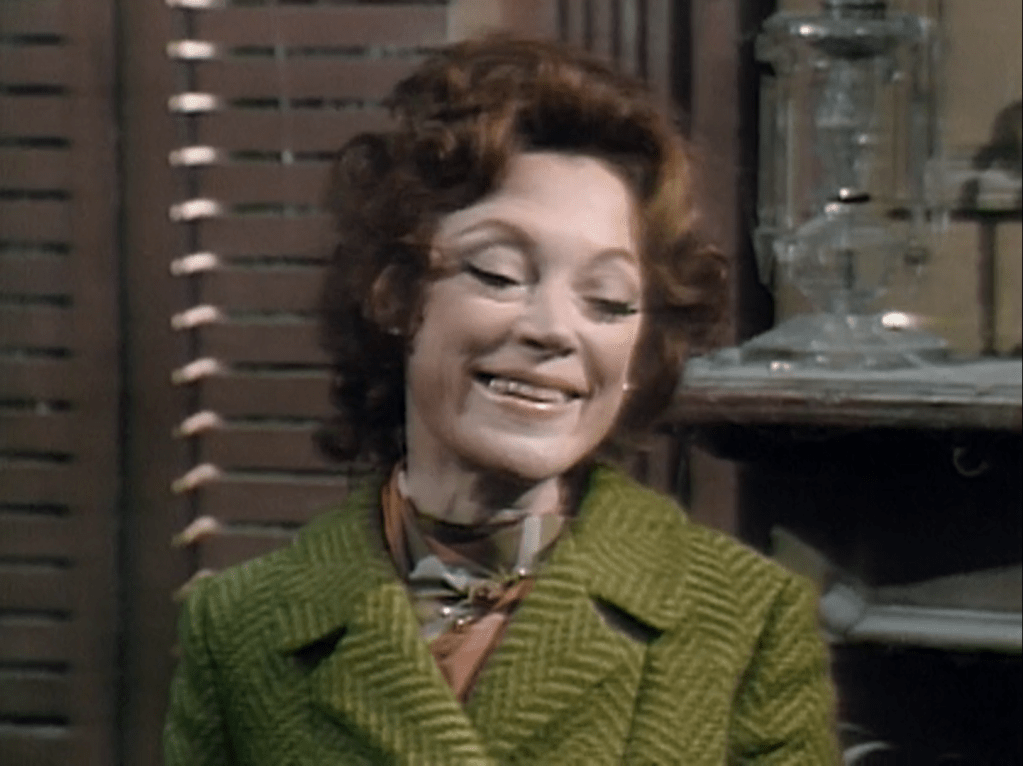
I wonder how long the actors had the script before they started taping this one. As unspeaking, barely mobile ghosts Gerard and Daphne, James Storm and Kate Jackson didn’t need much prep time; as lunatics Carolyn Fredericks (neé Stoddard) and Quentin Collins, Nancy Barrett and David Selby probably didn’t need much more. But vampire Barnabas Collins has a lot of dialogue today, and Jonathan Frid rarely seems to be within a country mile of his scripted lines. That isn’t so unusual, but Grayson Hall’s trouble really stands out. Barnabas’ friend, Julia Hoffman, MD, is possessed by Gerard and is pleased that Barnabas keeps meeting with one failure after another. We are supposed to know this, Barnabas isn’t. But she has a huge grin on her face each time she gloats to Barnabas about one of his setbacks. The one time Frid is clearly delivering a line that was written for him, Barnabas tells a conspicuously blissed-out Julia that she seems “almost pleased.” Hall was a highly accomplished actress, and we would expect her to be able to do “secretly pleased” in her sleep. But when this line comes up, she gets a bad laugh.
Far and away the happiest we have ever seen Julia, this strikes Barnabas as “almost pleased.”
The episode ends with Barnabas going to the drawing room of the great house of Collinwood in response to a note from Carolyn. He finds her sitting at the desk there. He talks to her for a moment, then notices that she is not moving. He touches her, and she falls over dead. The episode has its problems, but that is an extremely effective closing curtain.
For many months starting in late 1968, the estate of Collinwood was haunted by the ghost of Quentin Collins. Quentin’s presence became steadily more intolerable until the living members of the Collins family had to abandon the great house in #694. At the end of that episode, we saw Quentin standing on the walkway at the top of the foyer stairs, laughing in triumph.
Vampire Barnabas Collins traveled back in time in #701 and blundered around until history was changed. In #838, set in September 1897, Quentin’s death was prevented. On the anniversary of that event in September 1969, the haunting broke, though the people who lived through it remembered Quentin’s ghost and the events of the haunting. A magic spell was cast on Quentin keeping him forever young, and late in 1969 he took his place among the Collinses whom he had once driven from the family home.
Now, Barnabas and his friend, mad scientist Julia Hoffman, have come unstuck in time again. They find themselves in Collinwood in the year 1995. The house is in ruins, the members of the family either dead, missing, or insane, and the village of Collinsport full of people who won’t answer any of their questions. Quentin is around, having escaped from a psychiatric facility and come back to the estate. Today, Barnabas and Julia have taken him to the great house to try to get him to tell them something useful.
Julia and Barnabas want Quentin to see an upstairs room that is in much better shape than the rest of the house. They open the door, and see a ghost which appears to be strange and troubled teen David Collins. Quentin flees in terror and makes his way to the foyer while Barnabas and Julia watch the ghost vanish.
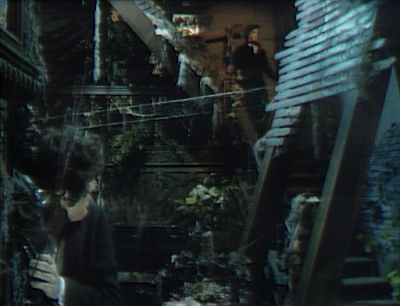
Quentin finds that he cannot open the front doors. He sees the ghost of a young man staring at him from the walkway at the top of the stairs. Like Quentin during “The Haunting of Collinwood,” this ghost has lots of curly black hair, does not speak, and wears a dark suit from the nineteenth century. Since David Selby is very tall and James Storm is rather the other thing, I can’t help but think of him as Mini-Quentin. The credits tell us that his name is Gerard.
Quentin rolls around on the floor, terrified of Gerard. Barnabas and Julia come and try to calm him down. Quentin says the doors won’t open; Barnabas opens them. Quentin runs out. Julia says she senses an evil presence, which, considering that every character we’ve seen so far is a murderer, is not too surprising. She and Barnabas leave.
Two ghosts dance a minuet by the gazebo. Julia and Barnabas think that one of the ghosts is David; the other is a blonde girl whom they do not recognize. The ghosts kiss each other. They walk towards the woods and vanish.
Barnabas and Julia go to the Old House on the estate. They find Quentin, and overhear him talking in an anguished voice to someone named “Daphne.” He tells them that the ghost they saw was not David Collins, but was named Tad. Julia remembers that they found a birthday card addressed to “Tad” and signed “Carrie.” If the ghost who looks like David is actually Tad, one might assume that the blonde girl is Carrie, though she could be Daphne or some other personage.
The next afternoon, Quentin finds Julia sleeping in an armchair in the parlor of the Old House. He asks to see Barnabas. Julia reacts with puzzlement. She says Quentin knows perfectly well that Barnabas cannot rise until the sun sets. He says he doesn’t know what she’s talking about. Julia is shocked. Once you’ve learned that a fellow is a vampire, that information doesn’t usually slip your mind. But he seems quite sincere. He wanders off.
The blonde girl appears at the window and beckons to Julia. Julia follows her, silently. It seems at first that Julia is in a trance, since she does not call to the girl by the names “Carrie” or “Daphne.” But when the girl leads her into the great house, Julia keeps moving her head around as she watches her step, making it clear she is wide awake. The girl leads her into the strangely intact room, where Gerard is waiting for her.
Danny Horn’s post about the episode on his great Dark Shadows Every Day is full of remarks about how cleverly they blur the line between soundtrack music that the characters can’t hear and atmospheric sounds that they can, disorienting us in a way that adds greatly to the effect of the scares and confusion. It is indeed powerful, and there is a lot of other good stuff in this one.
But this is the first episode of the 1995 segment I wouldn’t show to someone new to Dark Shadows to entice them into watching the show. The pacing is just too slow for the material. We have time to start asking questions that take us out of the story. For example, Julia and Barnabas lament that they have no idea what is going on and are desperate for Quentin to tell them what he knows. But as soon as he volunteers a piece of information, telling him that they saw Tad’s ghost rather than David’s they flatly contradict him. Also, Julia gives Quentin a sedative. We wonder where she got it, since her prescription pad is 25 years out of date and any samples she had in her bag have been sitting out, unrefrigerated and exposed to dry rot, for that same period. Those and other incongruities are the sorts of things we could easily overlook if we were moving as fast as we moved in all five episodes last week, but when events move as leisurely as they do today they mean trouble.
Evil wizard Tim Stokes combined medicine with black magic to connect his late daughter Angelique with a woman named Roxanne. The connection drains most of the “life force” from Roxanne into Angelique. This rendered Roxanne comatose and allowed Angelique to move among the living so long as Roxanne neither dies nor gets even a tiny bit better.
Vampire Barnabas Collins and mad scientist Julia Hoffman are interlopers from another dimension. They know what Stokes has done and want to defeat Angelique. They made off with Roxanne and were keeping her in the Old House on the grounds of the estate of Collinwood, planning to use some mad science equipment to revive her. Roxanne did perk up after the first treatment, and Barnabas took her on a date to his favorite place, the old cemetery north of town, where she showed some signs of recognizing her surroundings.
Yesterday, Stokes went to the Old House to search for Roxanne while Barnabas was out. When Barnabas got home, Roxanne was nowhere to be found. We learn today that Stokes does not have her. He turns to a man named Claude North for help in finding her. Yesterday he told Angelique that he was most reluctant to contact North; only after an incantation calling upon all the spiritual forces of darkness fails to solve their problem does he consider turning to him. He told Angelique that North was no ordinary man, and he is evidently more unpleasant to deal with than are Satan and his minions. But he answers when Stokes picks up the telephone and calls him.
Barnabas is also familiar with “Claude North” as the name of someone linked to Roxanne. He found a drawing of her signed by North in the secret chamber in the back room of the mausoleum in the cemetery. He goes back to the cemetery twice tonight. The first time, he goes into the secret chamber and finds evidence that a man with the initials “CN” has been staying there. He takes this as confirmation that it is Claude North’s roost. It does not seem likely that it is North’s only residence, since there is no sign of a telephone there. Stokes is spying on Barnabas while he does this. He is disturbed that Barnabas knows about the secret chamber, and wonders if he has been keeping Roxanne there.
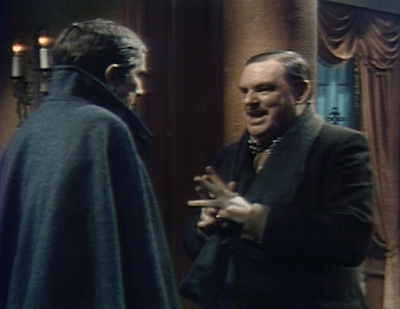
Barnabas goes back to the Old House and finds Stokes talking with the lady of the house, Carolyn Loomis. Angelique killed Carolyn’s husband Will the other day because he would not reveal Barnabas’ secret, and Carolyn has been drinking steadily ever since. Barnabas tells Stokes that since he has extended his condolences to Carolyn, he can leave now. Stokes takes his time about going. He says that Will thought that Barnabas might have a girl someplace. “Is he right, Mr Collins? Do you have a girl someplace?” Thayer David delivers this line with an urgency that elevates it from mildly clever to almost brilliant. Jonathan Frid responds with a slow burn that brings the exchange to perfection. Barnabas knows that Stokes neither has Roxanne nor knows that he does not have her, but he also knows that Stokes, as a native of this universe, is likelier to find her than he is.
“Do you have a girl someplace?” Screenshot by Dark Shadows Before I Die.
Barnabas goes back to the cemetery and finds Roxanne there. She is kneeling at a gravestone. It marks the grave of Claude North, who lived from 1814 to 1866.
In his own world, Barnabas was trapped in the counterpart of the secret chamber in the mausoleum for 171 years. So regular viewers think of that chamber as a place for vampires. North’s tombstone suggests that he might be such a creature.
Moreover, the drawing of Roxanne evokes Charles Delaware Tate, an artist who was a character on the show in 1969. Tate had the magical power to bring people to life by drawing them. He became obsessed with a woman he created in that way. As my wife, Mrs Acilius, points out, Tate’s erotic preoccupation with a product of his own imagination is as much a metaphor for extreme selfishness as is the vampire. So if the answer to the question of Roxanne’s origin is that she sprang into being as the result of North’s drawing of her, it would only be appropriate if North were also a vampire.
There is a scene in the room on top of the tower at the great house of Collinwood. Carolyn goes there and looks at the window from which Will fell to his death. To her surprise, sourpuss Quentin Collins enters the room. Quentin is a fugitive from justice, having assaulted a policeman and fled from jail because he was under arrest for murder. He makes menacing remarks demanding her silence; she’s so drunk that it doesn’t seem likely she will remember he was there. In the other continuity, the Collinses had a habit of using the tower room, which is entirely enclosed in windows that can be seen from every part of the estate, as a hiding place; we can see that their counterparts here maintain the same self-defeating tradition.
When Dark Shadows began in June 1966, its biggest draw was movie star Joan Bennett as reclusive matriarch Elizabeth Collins Stoddard. Liz was highly capable, and Bennett made her compelling to watch. When in #25 Liz’ brother, high-born ne’er-do-well Roger Collins, grudgingly complimented her on her “neat way of managing people,” we could see that he was putting it mildly. But the show didn’t handle Liz’ storyline very well, and she soon became a blocking figure. As the owner of the estate of Collinwood and of the Collins family businesses, as a central player in all the stories they had started with, and as the powerful personality Bennett had created, Liz was such an important part of the show that when she became a brake on the action, there was a constant danger that it would be impossible for anything to happen ever again.
The arrival of Roger’s estranged wife Laura Murdoch Collins in #123 marked Dark Shadows’ transformation into a supernatural thriller. By the time Laura went up in smoke in #191, her story had absorbed two of the four original narrative themes, “The Revenge of Burke Devlin” and well-meaning governess Vicki’s growing friendship with strange and troubled boy David, and had undercut whatever interest we might still have had in the other two, the mystery of Liz’ decision to become a recluse and Vicki’s quest to learn her true identity. The emerging Dark Shadows 2.0 had little room for Liz, and she subsided to the margins. When the show traveled back in time and became a costume drama from November 1967 to March 1968 and again from March to November 1969, Bennett played other characters and was able to make a substantial contribution, but Liz would never again be a suitable vessel for her great talents.
For the last eight weeks, the show has been in another time travel segment. Now it has traveled, not back in time, but sideways. They are in an alternate universe. The show insists on calling this universe “Parallel Time.” It is 1970 here, as it is in the original continuity, but a different 1970 where people with the names and faces we already know are living very different lives.
The Elizabeth Collins Stoddard of Parallel Time is not the mistress of Collinwood or an effective businesswoman. This Liz entrusted her inheritance to her brother Roger, who turned out to be just as feckless as his counterpart in the original continuity. As the penniless Roger we met in 1966 lives in Liz’ house as her guest and works in Liz’ business as her employee, so this Liz and Roger both live at Collinwood as the dependents of their brother, drunken sourpuss Quentin Collins.
In the original continuity, Quentin was not Liz and Roger’s brother, nor did he own anything. We got to know him when Dark Shadows was set in 1897, and he was a charming rogue, the younger brother of Judith and Edward Collins, who like Liz and Roger were played by Joan Bennett and Louis Edmonds. So the parallel lines representing the two versions of 1970 take a bit of a swerve into that other epoch.
Today, Liz is busy organizing a costume ball to be held in the great house of Collinwood. They had such a ball every year at this time when Quentin was married to his first wife, the late Angelique Stokes Collins, and Liz thinks that having another one would be the perfect occasion for Quentin to introduce all of his friends to his new wife, the former Maggie Evans. Liz needs help getting this party going. She comes bustling into the drawing room today and addresses herself to Angelique’s identical twin sister, Alexis Stokes, announcing that the party is tonight and 14 of the guests have failed to RSVP. She bemoans her inability to get anything organized and pleads with Alexis to help her. Alexis agrees to do so and excuses herself from a chess game she had been playing with Barnabas Collins, a man who recently showed up and introduced himself as a distant cousin of the Collinses of Collinwood.
Quentin enters the drawing room and orders Liz to cancel the ball. She says that it is too late to do that. Quentin stalks off and goes outside. Liz turns to Barnabas and asks him to reason with Quentin. Barnabas is unsure that he is the right person, but he goes to the door anyway. He opens it just in time to hear Quentin peeling away in his car. Maggie appears at the head of the stairs and asks if Quentin has gone. Barnabas has to say that he has, and Maggie looks crushed. Liz is unable to help in any way.
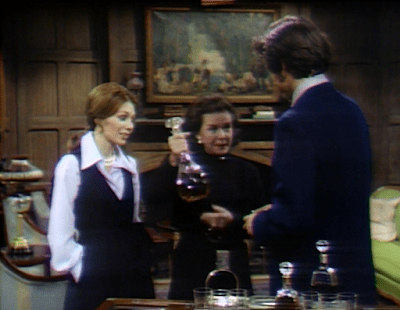
Later, Liz returns to the drawing room in the middle of a conversation between Quentin and Maggie. She is carrying an enormous decanter containing some sherry and congratulating herself on calming the cook’s nerves by her bartending. Quentin excuses himself to go get into his costume.
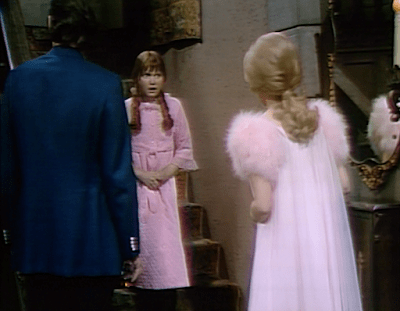
Liz finds that Maggie has not yet chosen a costume. She urges her to do so at once. Maggie says she supposed that Angelique always picked out her costume weeks in advance. Liz knows that Maggie is intimidated living in Angelique’s shadow, and does not know what to say in response to that remark. She quickly changes the subject. She brightens, and says that Alexis has brought many lovely dresses down from the attic. She urges Maggie to go to Alexis’ room and choose one of them.
As the time for the guests to arrive comes near, Liz and Barnabas meet in the foyer. A portrait of the Barnabas Collins who died in 1830 hangs on the spot on the wall next to the front door where earlier this week we had seen a metal doodad that looks like a coat of arms. Barnabas is wearing the same outfit, and looks just like the man in the portrait. Liz is wearing a dress of the same vintage. She is overjoyed, and tells Barnabas that the period suits him. He thanks her, and returns the compliment. Quentin is wearing a blue federal coat; Liz and Barnabas tell him that he, too, is suited to the early 1800s. Alexis comes downstairs in a blue dress, and she receives the same commendation. Lastly Maggie makes her appearance. When Quentin sees her dress, he becomes very tense. He tells her to take it off, orders her never to wear it again, and smashes his glass on the floor. The camera pans from Barnabas’shocked expression to a flickering look of pleasure on Alexis’ face; Liz stands between them, and unfortunately we only see the top of her head.
What Liz does not know is that the person she thinks is Alexis is in fact Angelique risen from the grave. Angelique murdered Alexis, took her place, and is conspiring with housekeeper Julia Hoffman to drive Maggie and Quentin apart. The story is a souped-up version of Daphne Du Maurier’s Rebecca, in which the dead first wife is not only a memory that triggers anxiety in her successor but a supernatural being who rises from the dead to torment her directly. There is a scene with Maggie looking out the window of the drawing room that is an exact recreation of a shot in Alfred Hitchcock’s 1940 film of Rebecca, and when Angelique and Hoffman trick Maggie into wearing the same dress Angelique wore to last year’s ball, prompting Quentin’s outburst, most grownups in the original audience would remember the same thing happening to the second Mrs de Winter in that film.
Angelique is the villain, and Maggie is the heroine. Still, we rather like Angelique. The sister-murdering is bad, of course, but Quentin is such a lousy husband that she is doing Maggie a big favor by trying to bring their intolerable marriage to its end as soon as possible. For example, today Quentin finds Maggie reading his old love letters to Angelique. He might justifiably have objected that those are private and say he wished she’d asked before reading them, but he doesn’t do that or anything else one adult would do when disappointed in another. Instead, he flies into a rage, accuses her of a variety of things she hasn’t done, and orders her to, and I quote, “Go to your room!”
Later, in the room they share, Quentin is still scolding Maggie for failing to admit that she was lying about how she found the letters. We know she had in fact told the truth. When she tells him so, he dismisses her with a shake of the head. When she brings up the fact that it is the anniversary of his wedding to Angelique, he shouts that she is forbidden to discuss the subject, then storms out and slams the door. This is when he goes downstairs, tells Liz to cancel the party, and drives away. We have never seen Maggie have a happy day with Quentin. He sometimes manages to be pleasant in the intervals between his tantrums, but even then he can’t let go of his habit of talking to Maggie as if she were a child and he were her somewhat weary guardian. If Angelique can hasten their final split, Maggie will owe her an enormous debt of gratitude.
Barnabas is not in fact a descendant of the man whose portrait now hangs in the foyer. He is a visitor from the main continuity. Angelique’s counterpart there is his great enemy, so it is fun to see him talking with this Angelique and playing chess with her.
David Selby has a problem with one of his lines, when Quentin winds up saying “I wonder where I got the illusion that an hour or two alone would settle one’s all of problems.” This is a fairly minor stumble by Dark Shadows standards, but it comes when Angelique is in closeup and Lara Parker’s left eyelid twitches when she hears “one’s all of problems.” That reaction is worth a laugh.
We are in the fifth week of a segment set in a different universe than the one where Dark Shadows spent its first 196 weeks. There are enough stories to keep everyone busy all day every day, and almost all of those stories are working quite well right now.
The only exception is the one that dominates the action today. In #994, we learned that a man named Dameon Edwards used to be a frequent visitor to the great estate of Collinwood. Dameon hasn’t been seen or heard from in about a year. He’s dead, as it happens, and his ghost has been popping up and making various people uncomfortable.
Since the first thing we had ever heard about Dameon was that he was dead, we were off to a rocky start with him. The main continuity had a great success with Quentin Collins, who was introduced the same way. But Quentin was not only a member of the Collins family that is central to the show, he figured first as a series of weird and frightening events in the lives of children David Collins and Amy Jennings, characters we know and care about. Dameon’s only background is that he was one of many ex-boyfriends of Angelique Collins, the late and recently reanimated wife of Quentin’s counterpart. His actions are just a bunch of not-particularly scary special effects that are witnessed by people who have either been brought on so that they can worry about them, such as sleazy musician Bruno Hess and uptight butler Mr Trask, or who have bigger problems, such as Quentin and Angelique.
I’ve speculated in previous posts that this was not the original plan for Dameon. Maybe they planned to develop more of a connection between him and the action, and just couldn’t fit the necessary material into the first 13 scripts of the “Parallel Time” segment. Or maybe they did not intend to introduce a new character, but the counterpart of someone we know from the other continuity. Whatever they may have hoped to do, what they actually did falls absolutely flat.
To the extent that Dameon is the counterpart to anyone in the other continuity, it would be Quentin’s ghost. Indeed, today he leads Parallel Quentin to a room that reminds us of the one from which Quentin’s ghost began his reign of terror in late 1968 and early 1969. As 1969 went on, the living Quentin became an important character. Due to a trip back in time and some magic, he was prevented from dying and immunized against aging. The people he had haunted remembered the ghost, but the living Quentin was also around. Eventually they started to treat the ghost as a separate being from the Quentin who was a regular fixture of the cast of characters. So I suppose they might have intended to have Quentin’s ghost cross over into the current continuity, confusing David Selby when he saw himself wearing mutton chop sideburns, a Victorian-era suit, and a sardonic grin while he refused to speak. But that kind of thing was still a stretch for viewers when they did it on Twin Peaks twenty years later, and would have been a big ask for a daytime audience to follow in 1970.
Most of this one is taken up watching people argue with each other about whether they should hold a séance. This puts longtime viewers on familiar ground. We’ve seen fourteen séances on Dark Shadows over the years, and have heard about others. Many of those we’ve seen have been preceded by the sort of wrangling we see today. The most spectacular case was #365. That installment was structured just like this one, one quarrel after another about the idea of the séance, then in the final scene the séance is held and comes to a shock ending.
Episode 365 came at the end of a period when the show was as slow-paced as it ever would be, and when such story elements as they had were all coming to an end. The episode was surprisingly fast-moving and exciting, mostly due to the visual artistry of director Lela Swift. Not only did Swift use a visual strategy that told more of a story than you might have thought was available had you read the script, but her skillful blocking and fluid use of the camera allowed the actors to project a great deal of energy. The shock ending, which the ABC network had spoiled with a series of promos but which I don’t think anyone could have seen coming otherwise, was the show’s first trip back in time. At the climax of the séance, well-meaning governess Vicki came unstuck in time and found herself transported to the year 1795.
Now, Vicki is long gone and mostly forgotten. The show has traveled in time again, not backward but sideways. We are in an alternate universe, which the show insists on calling “Parallel Time.” In this continuity, counterparts of familiar characters have different personalities and are arranged in different relationships than are the people we know.
The episode is much less effective than was #365, not so much from the absence of Vicki or the presence of any of the new characters, but because the director’s chair is occupied by the hapless Henry Kaplan. Kaplan stood at the opposite extreme from Swift. His idea of a well-composed sequence of images was one closeup after another, punctuated by extreme closeups showing us what an actor’s ear looked like when she was speaking a crucial line of dialogue. He takes the trouble to set up some two-shots and even three-shots today, but they put the actors in such cramped little frames that they don’t dare move without a furtive glance at the camera.
The master of the great house of Collinwood is drunken sourpuss Quentin Collins. His penniless siblings and permanent houseguests Elizabeth Collins Stoddard and Roger Collins have just come home from a trip out of town to find family friend Sabrina Stuart in the drawing room, demanding that they hold the séance that Quentin’s wife Angelique ordained for this night. They are shocked, because the night on which Angelique said there would be a séance fell six months before. Sabrina is having some kind of fit that causes her to be unalterably certain that this night is that one.
Angelique died of a stroke at that séance, and Liz and Roger are horrified at the idea of reenacting it. Sabrina’s fiancé, mad scientist Cyrus Longworth, says that she went through a traumatic experience the night before, when a strange man forced his way into her room and terrorized her. He then reports a conversation with a psychiatrist who suggests humoring Sabrina and holding another séance. Cyrus brings Bruno Hess, musician, lover of Angelique, and all-around sleaze to join in the reenactment.
While Roger and Liz were away, Angelique’s identical twin sister, Alexis Stokes, came to stay at Collinwood. Quentin neglected to inform even the people who were in the house at the time that this had happened, setting Alexis up for one terribly awkward encounter after another with people who thought she was her sister returned from the grave. Quentin and Alexis also got alarmingly cozy with each other, prompting his new wife, the former Maggie Evans, to walk out on him after barely a week in residence at Collinwood. So it is no surprise that he didn’t bother to telephone Liz and Roger and let them know they would see Angelique’s identical twin sister when they came home.
Roger is standing in Angelique’s old bedroom, holding a one-sided conversation with her portrait. We know that he is in the habit of doing this; it was what he was doing when first we saw him in #975. Quentin probably knows about it too, since several other people in the house have the same habit and even those who don’t spend a surprisingly large amount of time going in and out of Angelique’s room. Roger turns around and sees Alexis. Believing her to be Angelique redivivus, he nearly faints. She gives him her hand to assure him she is not a ghost, and he will later introduce her to Liz as Angelique’s sister.
Roger’s counterpart in the main continuity was Dark Shadows‘ first Big Bad, a charming, dissolute, narcissistic, cowardly, lecherous wastrel. That Roger Collins was supposed to be killed off when Vicki exposed his crimes, but Louis Edmonds made him such a joy to watch that this was out of the question. Dark Shadows had not yet figured out that a villain could be a permanent part of the cast, so when they decided to keep Roger around they nerfed him into a basically harmless supporting character. He developed gradually from the functional sociopath who in #68 coldly manipulated his own nine year old son David into a murder attempt on Vicki to the stoutly virtuous family man who made his final exit in #979 with a fatherly hand on David’s shoulder.
The Quentin of the main continuity made his debut in #646 as a ghost bent on annihilating all of his surviving relatives. From #701 to #884, Dark Shadows was a costume drama set in 1897, when we met Quentin as a living being. In those days, he was very much what Roger had been in 1966, only younger, sexier, and on a show that isn’t afraid to keep villains around indefinitely. He became a huge breakout hit, and a magic spell was cast that kept him from dying or aging. So when the show returned to contemporary dress at the end of 1969, Quentin was there, alive and intact.
Upon his arrival in 1969, Quentin found himself in the same position Roger had occupied two and a half years before. Everyone wanted him to be a big part of the show, but there was nothing for him to do. Unlike Roger, he was free to be evil, but also unlike him he had no connections to anyone who had anything he wanted to take. In some ways, Quentin is in an even worse position than Roger was. Even in his lovable gay uncle phase, Roger could admit to his sister Liz in #273 that he would have blackmailed her if he had had the chance, an admission that Quentin merrily echoed in #702 when he laughed at his sister Judith’s attempt to buy him off with $1500, boasting that he could blow through that much in a single night, even in a sleepy little place like Collinsport, and that he would shamelessly come back for more. He has no one to do anything like that with now.
Quentin can charm his way to an easy living. In December 1969, mad scientist Julia Hoffman and Broadway star Olivia Corey fought over which of them would get to pay Quentin’s hotel bill, a conflict that was motivated by some story points but that is the sort of thing that might happen to a man who looks like a young David Selby. On a fast-paced supernatural thriller, you have to be something a lot juicier than a mercenary Kept Man to count for much as a villain. No one in the Nixon era owes Quentin anything, so he can’t exploit anyone the way he did Judith and the rest of his immediate family. He has fallen into service as henchman to Julia and her best friend, his distant cousin vampire Barnabas Collins, but something big is going to have to change to find him another place at the center of the action.
Since that is the same problem that cost them Roger, it makes since that in this mirror universe Quentin’s counterpart and Roger’s are revisiting some stages of the development of the Roger from the main continuity. When Parallel Roger first appeared in #975 and #976, he seemed to be, if not the utterly depraved villain of the early days, at least the spineless, snobby, but amusingly sarcastic figure he was through most of 1967. Today he seems to be closer to the responsible family man he dead-ended into being.
This Roger is the first to articulate the reasons why it is inadvisable to reenact a ceremony that cost a life the last time it was attempted. Roger’s position recalls his role in #170, when he was the principal opponent of the first séance shown on Dark Shadows. In that, he was the unwitting stooge of his estranged wife, undead fire witch Laura Murdoch Collins, but the objections he came up with were all about the importance of social respectability and of refraining from doing the thing which is not done, fitting into the image of him as a shallow and unimaginative person. The fact of Angelique’s death gives his objections today a firmer footing and presents him as a representative of sober good sense, but does not make him seem any more dynamic than his counterpart in the main continuity did in #170.
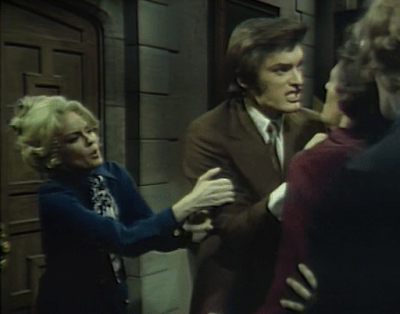
Quentin learns of the proposed séance when Cyrus and Bruno enter the house. He is angry at the sight of Bruno, and reminds him he is not welcome there. Cyrus explains that Bruno is needed for the séance. This increases Quentin’s anger, and he tells Cyrus and Bruno to “go to another house and work your black magic, boys.” They insist on staying, and suggest that Alexis sit in Angelique’s place. After all, Bruno says, why shouldn’t she see exactly how her sister died, from her sister’s point of view. At this Quentin’s anger turns to total rage, and he has to be restrained from attacking Bruno physically. Alexis wants to hold the séance, though, and Quentin gives in. He refuses to participate, but allows the others to gather in the drawing room.
Roger was never given to violence that required his direct personal involvement. Quentin’s reaction to Cyrus and Bruno’s awful idea suggests that the writers are trying to find a way forward for his character. The well-justified repugnance he feels for Bruno, the grotesquely morbid nature of the proposed reenactment, and the breathtakingly irresponsible suggestion that Alexis do the very thing it killed her sister to do, all call for a forceful response. His lunge at Bruno is manful in the best sense, and leads us to wonder if they might try to develop Quentin’s vices into the basis of some kind of heroic action.
When he scornfully tells Bruno and Cyrus to go somewhere else with their “black magic, boys,” it is clear that the writers are thinking in terms of what is possible for Quentin. In 1897, the original Quentin and his fellow Satanist Evan Hanley would hang out in the cottage on the estate corresponding to the one where Bruno lives in this timeline and do all sorts of ill-intended mumbo-jumbo. They could easily have been called “The Black Magic Boys.” That Quentin stood at the opposite pole from this one. Perhaps as the story progresses, we will see these contraries fuse into something more sustainable.
Although we are in “Parallel Time,” a development like that might have good effects on the Quentin of the main continuity as well. Roger’s character changed massively after the flashbacks to 1795 and 1897, merging with the deeply flawed, yet sturdily upright family men whom Edmonds played in those periods. So if they can build a version of Quentin in this universe who is still narcissistic but also capable of saving the day, that might point the way to transforming the Quentin in the established “time-band” into a character who can carry the show as he did for so many months in 1969.
The séance goes forward. Cyrus conducts, and Sabrina goes into the trance. She shouts the word “murder” over and again, and breaks the circle of fingers to point at Alexis. Alexis passes out. That’s the closing cliffhanger. We can be sure Alexis is not dead- it wouldn’t leave the story anywhere to go. Besides, they commissioned a gorgeous full-sized portrait of Lara Parker as Angelique for this storyline. That thing must have cost at least $5000, maybe twice that, and they will never be able to use it again after they go back to the main continuity. There’s no way they are going to blow that much money on a set decoration unless they are planning to feature it in another couple of months of episodes.
In #949, eleven year old Amy Jennings saw twenty-nine year old Quentin Collins. She reacted with terror, certain that he was the ghost of her great grandfather, the ghost who had persecuted her and everyone else at the great house of Collinwood from December 1968 to September 1969. Heiress Carolyn Collins laughed at Amy and told her that he was not a ghost, but was a cousin of theirs, another descendant of Quentin’s. In fact, Quentin was Amy’s great-grandfather and Carolyn’s great-great-uncle, but he wasn’t a ghost, and he meant no harm to Amy.
Amy refused to accept Carolyn and Quentin’s assurances that he was “not that Quentin Collins.” That refusal highlighted Quentin’s convoluted backstory. The show went back in time in March 1969 to the year 1897, and during an eight-month costume drama segment it introduced us to Quentin as he was before he died. He was a charming rascal who immediately became a huge breakout star. During the 1897 segment, they showed history being changed so that Quentin never died and was the beneficiary of a magic spell that immunized him against aging. Ever since early 1967, Dark Shadows has been operating on a model of the cosmos in which the usual laws of cause and effect are replaced with anniversaries. So in #839, we saw that Quentin’s haunting of Collinwood had gone on for ten months and had finally resulted in the death of strange and troubled boy David Collins. But that day was also the 72nd anniversary of the change in history which prevented Quentin’s death, so the haunting broke and David came back to life. When Quentin showed up in 1969 as a living being, everyone remembered the haunting. Most characters accepted Quentin’s claim to be his own great-grandson, but Amy saw the truth, that he and the ghost were two continuations of one man.
The show’s metaphysics probably didn’t bother anyone who watched it the first time it was broadcast. The characters just take them for granted, as in our world we take hard-to-explain phenomena like gravity and magnetism for granted, and the story keeps on going as if they somehow made sense. What the writers were worried about when Amy saw the living Quentin was not that their model of the universe lacked plausibility, but that they hadn’t found a way to keep Quentin at the center of the story. He’d made a hit in the 1897 segment because he was connected to everyone and was naturally involved in everything that was happening, but in 1969 and 1970 he is a visitor, a distant relative who has come wandering in from who knows where. When Amy tries to figure out in what sense he is “that Quentin Collins,” she is trying to solve a puzzle that the show has to solve to keep him generating heat in the ratings.
Now, Dark Shadows has crossed over to an alternate universe. Here, we have met yet another iteration of Quentin. This Quentin Collins is the Master of Collinwood. Amy lives in the house in this continuity as well, but she really is Quentin’s cousin, and her last name is Collins.
Parallel Quentin hasn’t thought to tell Amy that there is a houseguest staying at Collinwood. She is Alexis Stokes, identical twin sister of his late wife Angelique. Since there are a lot of people around the estate who keep saying that Angelique is going to come back to life, the sight of Alexis comes as quite a shock to everyone. Amy sees Alexis today, and reacts with terror, certain that she is the ghost of Angelique. She does not accept Quentin’s belated explanations, anymore than her counterpart accepted Carolyn’s. Amy Jennings had specialized in looking directly into the camera; as Amy Collins, Denise Nickerson has a moment after Quentin and Alexis have explained the situation to her when it looks like she is about to make this move, but she does not.
Amy has two more scenes today. She opens the front door and lets Angelique’s associate, sleazy musician Bruno Hess, into the house. Amy greets Bruno with “She’s upstairs.” He asks how she knows who he came to see, and she tells him he always came to see “her” before. She wonders if “they” will make Bruno call the woman “Alexis.” Perhaps she thinks all adults are in on this scam, pretending that the dead can be counted on to leave the living alone. Later, she gives Quentin a telegram. When he scolds her for having opened it, she is at once sincerely remorseful about what she has done and indignant about what is going on upstairs. She says that while opening other people’s mail is indeed bad, what “she” has done is even worse.
On Friday, the show hinted that Alexis might be Angelique. Today, Bruno starts an investigation to check up on Alexis’ report that she arrived in New York from Genoa a couple of days before. They spend enough time on Bruno’s activities that it would be surprising if her story simply held up, so that keeps the question alive.
Quentin’s new wife, the former Maggie Evans, left him and went to her sister Jennifer’s place in New York on Friday. She was fed up with Quentin’s high-handed attitude, with everyone’s preoccupation with Angelique, and with Alexis’ presence in the house. Quentin picks up a telephone today, says “Operator, this is a person to person call. Mrs Collins!” And they connect him to Jennifer’s place! In spite of this magical power, he still can’t persuade Maggie to come to the phone. By the end of the call, he and Jennifer are mad at each other, too.
When this episode was taped, principal photography was underway for the feature film House of Dark Shadows. Many of the best-known members of the cast are going to be in Tarrytown, New York for the next six weeks. When Quentin talks to Jennifer Evans, he offers to go to Maggie in New York- we might assume he means NYC, but I suppose Jennifer might live in Tarrytown, and Maggie’s real reason for staying with her is that she doesn’t want to be separated from Kathryn Leigh Scott.
As Quentin and Alexis, David Selby and Lara Parker are the biggest names currently on Dark Shadows, and they are playing characters quite different from those that made them famous. This Quentin intermittently displays the charm which the one from the main continuity exudes so effortlessly, but he is a downer at least half the time, and his position as Master of Collinwood keeps him from being the lovable rascal who has been a fixture on the cover of the fan magazines for a year now. And even if Alexis is Angelique, she is an Angelique who has not gone through any of the development that has held the fans’ attention for over two years. Angelique was a story dynamo from her introduction at the end of 1967, but what has made her indispensable in arc after arc is that she usually knows everything the audience knows about what is happening and has some crazy scheme that no one else would have thought of as to how she can make it all much worse. And over the last year, she has shown an ability to learn and grow that has made her a much more interesting character. A new Angelique, starting from scratch, won’t match the audience’s understanding of the situation, and won’t remember anything that gave her new depth in 1969 and early 1970.
You may wonder if these two can carry the show for a month and a half. The writers certainly did, as witness a conversation between Alexis and Quentin today. She goes on at length about how difficult it was to grow up in her sister’s shadow, saying that she tried to imitate Angelique but could never make it. The harder she tried to copy the habits that attracted everyone to Angelique, the more embarrassed their reactions were.
Not only does Alexis tell us explicitly that she isn’t as appealing as Angelique, Quentin couldn’t be less interested what she is saying. He is preoccupied with a dispute he is having with Bruno. That dispute, were Alexis aware of it, would probably interest her as little as what she is saying interests Quentin. In their scene together, Alexis does not give any sign that she recognizes Bruno. After he leaves, she looks at a picture of him on some sheet music he composed, as she would do if she never had seen him before. So, if she is Angelique returned from the grave, she would appear to have lost her memory of Bruno along the way. And whoever she is, her attitude towards him throughout is one of amused tolerance. We can’t imagine her being particularly invested in a conflict about whether Bruno has a right to live in the caretaker’s cottage on the grounds of Collinwood. So the scene between Angelique and Quentin, in which neither has anything to say that is of concern to the other, seems to be something like the opposite of a programmatic statement. Rather than telling us what they plan to do, the writers are telling us what they are afraid we will think they have done.
Not that they have despaired of making it work. By the end, Quentin and Alexis have drawn each other’s attention sufficiently to do some pretty firm smooching. Maggie has been a fan favorite from episode #1, and many of the nine year old girls in the audience probably identify with her and are excited about the idea of her being married to Quentin. The image of him cheating on Maggie with the wicked witch will outrage them enough to keep them tuning in.
The prospect of an affair between Quentin and Alexis presents something of a puzzle in logic. If she really is who she says she is, he is cheating on Maggie with her. But if she is Angelique, he has been cheating on her with Maggie, albeit unknowingly. One way or another, it is far from gentlemanly behavior on his part. As for Alexis, what we know so far would tend to confirm our initial assumption that Angelique is an Evil Twin, but seeing her go after Maggie’s husband will keep regular viewers from labeling her the Good Twin.