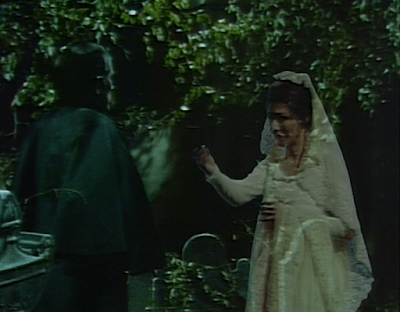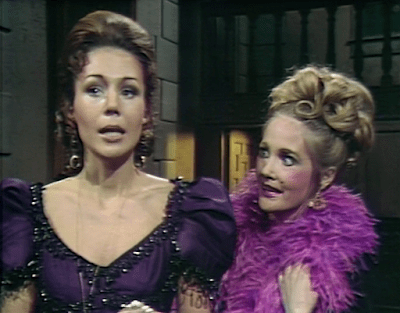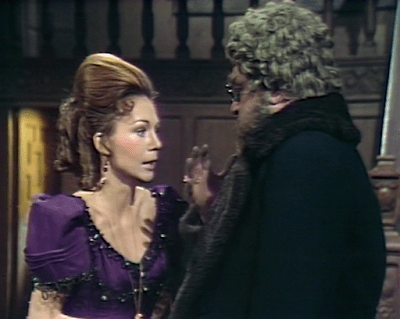
Episode 1126: Evil is joining evil

Overbearing undertaker Lamar Trask is on a mission to find out what happened to his late father, fanatical witchfinder the Rev’d Mr Trask. Trask was last seen entering the gates of the estate of Collinwood in the 1790s. Lamar is pretty sure that he was murdered by Barnabas Collins and that his remains are in the Old House on the grounds of Collinwood.

Lamar is correct on these points. There is a Barnabas Collins staying at the Old House now; he has identified himself as the son of the Barnabas who was there in the late eighteenth century and who left for England. Unknown to Lamar or the others who live on and around Collinwood in 1840, he is in fact the same person, and never went to England. A witch turned him into a vampire in 1796, and he was sealed in a coffin in the old cemetery north of town after he had taken many victims. He was released to prey upon the living in 1967. Now, Barnabas and his friend Julia Hoffman have traveled back in time from 1970 in hopes of preventing a disaster that will befall Collinwood in that year as the result of events in the current year, 1840.

Lamar is in a mansion near Collinwood known as Rose Cottage. He is visiting Gerard Stiles, a guest of Flora Collins, the lady of the house. Lamar tells Gerard and Flora that he is searching for his father’s remains and that he hopes to take revenge on his killer. When he says that he believes Barnabas has something to hide, he piques Gerard’s interest. Barnabas saw Gerard’s ghost as the face of the disaster in 1970, and when he encounters a potential adversary Barnabas is incapable of concealing his hostility for one second. So when he met Gerard as a living being, Barnabas all but announced himself as his sworn enemy. Gerard wants to know who this new foe is and what he wants, so he suggests holding a séance to contact the late Mr Trask. Flora avidly agrees, and Lamar goes along.

The séance is barely underway when the disembodied voice of Trask rings out. It speaks of evil in the room and evil all around them. It says that soon the evil will walk again. Since Barnabas is not in the room and can already walk, it does not seem to be a reference to him. We cut to an alcove in the room shaded by a curtain; in it there is a glass case holding a severed head. Flora’s adult son Desmond brought it home with him from a trip to Macau, and it has already taken possession of him and killed two men. Returning viewers know that the evil Trask is speaking of is that which emanates from the head. Since Barnabas murdered Trask, and did so most cruelly, it really is quite decent of him to forgo an opportunity to ask that Barnabas be punished and to focus on this immediate problem.

Trask was a villain in life, whose fanatical sincerity not only led him to commit grave injustices but also turned itself into hypocrisy when he saw that only crime could prevent an embarrassment that would interfere with his mission. But he has been somewhat redeemed in death. In #523, made and set in 1968, a warlock raised Trask’s ghost and tried to manipulate his hostility to Barnabas for evil purposes, but he would not be used. He was about to warn well-meaning governess Vicki of the danger the warlock posed to her when he met a character played by Roger Davis. At the sight of him, Trask instantly returned to whence he came. Say what you will about Hell, at least you don’t have to put up with Roger Davis while you’re there.

None of Trask’s ominous utterances is very definite, but one would have puzzled the assembled spiritualists more than the rest. He warns them to “Beware the cross!” Trask wasn’t consistently orthodox in his approach to Christianity, but he was all for the cross. What we can see that Lamar, Gerard, and Flora cannot are cross-cuts to a secret underground chamber in an old cemetery. Desmond, in search of the body that used to go along with the head, uncovered the chamber and found a coffin in it. A large cross is wedged between the ceiling of the chamber and the lid of the coffin, holding the main part of it shut. There is a Dutch door cut into one end of the lid. Desmond opened it, and found a golden mask with many precious jewels embedded in it. The opening looked big enough to pull the body through, but Desmond decided to put the mask back and get help moving the cross.

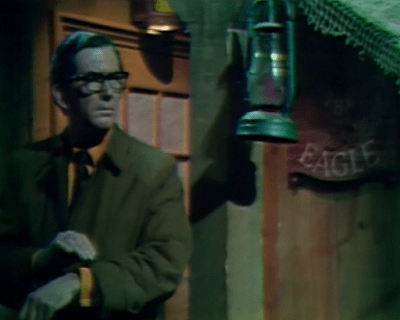
Desmond went to the Eagle tavern. There, he found a drunken sailor named Tim Braithwaite. He offered Braithwaite a $20 gold piece if he would do a job for him, no questions asked. Tim starts asking questions. The first is whether Desmond wants him to beat someone up. His tone and manner suggest that Desmond has hired him to do that before. This reminds us that they’ve never got round to telling us much about Desmond. All we know is that he is the sort of person who goes to Macau and buys severed heads, which come to think of it is also the sort of person who hires guys to beat people up.
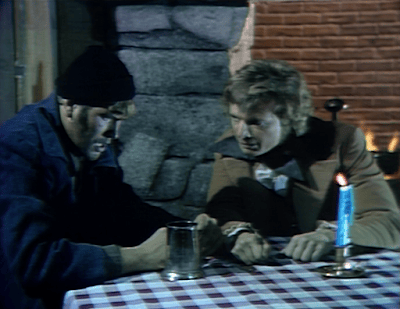
Desmond has a job for Tim. Screenshot by Dark Shadows Before I Die.

Tim is now in the chamber working the cross loose while Desmond is at the livery stable getting a cart in which to carry the coffin back to Rose Cottage. That’s the cross of which Trask wants Lamar, Flora, and Gerard to beware.

Tim finds the jewel-encrusted mask and decides to make off with it. The body comes to life, leaves the coffin, kills Tim, and escapes from the chamber.

Tim’s name recalls two other characters. At first glance I mistook actor Dick Sabol for Don Briscoe, and the resemblance between them is strong enough that every time Desmond calls him “Tim” I thought of Briscoe’s character Tim Shaw, who figured in the story when it was set in the year 1897. Tim inadvertently helped to reunite evil sorcerer Count Petofi with his severed and equally evil hand, so the resonance with that Tim is a clue to longtime viewers that this one will also thwart his own plans in the course of reconnecting the evil head with its missing body.

We’ve heard the name “Braithwaite” before as well. Abe Vigoda appeared in #684 and #685 as aged silversmith Ezra Braithwaite, and Edward Marshall played a much younger version of the same character in #764. We learned in those episodes that Braithwaite’s silver shop had been in operation in Collinsport continuously from 1781 to 1968. Vigoda returned to the show just last week, playing the head’s victim Otis Greene in # 1124. Nothing is said of any connection between Tim and the owners of the silver shop, though “Braithwaite” isn’t so common a name that we can assume he is not related to them. All we can be sure of is that the writers and producers had Abe Vigoda on their minds at this time.

A woman named Christine Domaniecki is seen gulping a drink at the Eagle. She is credited as “Christine Domaneck,” in the role of “Barmaid.” Whether “Domaneck” was a stage name or a typo, who can say. Ms Domaniecki has the role because she was the runner-up in the Miss American Vampire Contest, a promotion for the feature film House of Dark Shadows. She went on to become a highly accomplished makeup artist in Hollywood, working on dozens of well-known television and big screen productions. She was nominated for a primetime Emmy in 2016 for her work on a production of The Wiz. This episode is the first of six screen acting credits listed on her IMDb page. All of the others went direct to video, were produced in the 2000s, and involved her then-husband, Michael R. Thomas. Four of the five appear to be soft-core porn flicks.

The winner of the Miss American Vampire contest was Sacheen Littlefeather. Littlefeather made an appearance on a 1970 episode of To Tell the Truth in her capacity as Miss American Vampire, but was not able to be in New York to tape this episode. She became even more famous in 1973, when her friend Marlon Brando dispatched her to Hollywood to convey his refusal to accept the Academy Award for his work in The Godfather. As luck would have it, Abe Vigoda also had a part in The Godfather, playing doomed capo Sal Tessio.

Also, Brando’s performance in The Godfather always reminds me of David Henesy as strange and troubled boy David Collins in #667. I wonder if Brando insisted on holding a cat during the opening scene of the film because he didn’t want people catching on that he was copying Mr Henesy.
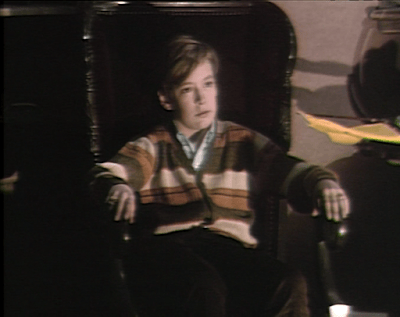
You come to my house on the day of my daughter’s wedding and you ask me to play dress-up? Screenshot by Dark Shadows Before I Die.

This one also includes a notable blooper. Jerry Lacy’s Lamar is telling Flora about his suspicions of Barnabas:

LAMAR: Ms. Faye corroborated my opinion. When I asked her to locate my father’s last remains, she had a vision of the Old House.

FLORA: But that is when the original Barnabas lived there, wasn’t it? Before the main house was built?

LAMAR: Yes, that’s true, but I don’t think… I do think he had something to do with it.

FLORA: You don’t think he had anything to do with it!?

LAMAR: What I think is my business.

It’s clear enough that Mr Lacy was supposed to stop with “Yes, that’s true…” and that he encroached upon Flora’s dialogue with “but I don’t think,” leaving him in a trap from which he could escape only by adding “I do think he had something to do with it.” Joan Bennett goes ahead with her scripted line, sounding exactly as you suppose she would if she had received the correct cue, and he responds with “What I think is my business.” Though the blooper makes this final line nonsensical, Mr Lacy delivers it with the full weight of Trask’s immense pomposity, and the effect is hilarious.
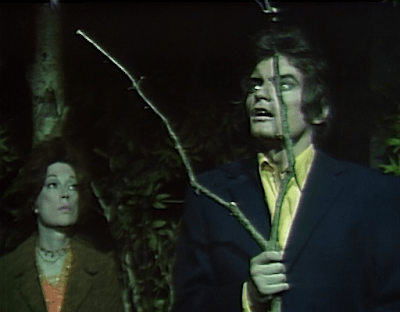
Episode 1079: Just join hands with us and you’ll know everything

The ghost of Daphne Harridge wants to kill Quentin Collins, for no reason the show divulges to us; then she doesn’t, again for no reason we can see. Daphne insists teenager David Collins and Hallie Stokes not look at her, then insists they do look at her. David refuses to join hands with Hallie and Daphne to gain mystical knowledge, then demands Hallie join hands with him in a séance. Quentin is under Daphne’s power and unable to assist Julia Hoffman in her quest to free the great house of Collinwood from the hauntings; then he orders Julia to attend him while he performs an exorcism of the house.

Quentin the exorcist. Screenshot by Dark Shadows Before I Die.

In his post about the episode on his great Dark Shadows Every Day, Danny Horn said everything I wanted to say about how unsatisfying all of this is. The show has had its ups and downs. I call this segment The Re-Haunting of Colllinwood, because the A story from December 1968 to March 1969 is often called The Haunting of Collinwood and this is a recycling of that. The original Haunting of Collinwood was itself pretty slow-paced and frequently got bogged down with ominous games of dress-up. This time around the pace is again slow and the rounds of dress-up are even more tedious.

It is somewhat interesting to listen to Quentin reciting traditional Christian formulas as he conducts the exorcism. When we first got to know him, Quentin was a devout and enthusiastic Satanist. I suppose all religions lose adherents from time to time.

Episode 1070: Never without you

The sun has set, and vampire Barnabas Collins is opening the lid of his coffin in the basement of the Old House on the estate of Collinwood. Suddenly a cross is thrust in his face. He recoils from it, crying in pain and becoming immobile. The cross is wielded by the sheriff of Collinsport, who announces “I know all about you, Barnabas Collins!”

Before the sheriff can take matters any further, a teenage girl appears nearby. Shocked to see her, he reels away from the coffin. He jabbers at her, saying that he recognizes her and pleading with her not to come closer. Barnabas grabs him from behind and strangles him to death.

Barnabas didn’t have anything against the sheriff, but can’t deny that it feels good to use the old strangling muscles again. Screenshot by Dark Shadows Before I Die.

Barnabas goes upstairs and finds his best friend, mad scientist Julia Hoffman. He tells Julia that the sheriff’s gun was loaded with silver bullets, and that only the manifestation of the ghost of Carrie prevented his destruction. The police know about him, and more officers will be coming any time. Julia admits that she told the sheriff about Barnabas. Shocked, he says “You betrayed me?” He has said these words many times, always as a prelude to extreme violence. Julia braces herself, expecting the same. But to her amazement, Barnabas is gentle and understanding. He realizes she is under the sway of an evil ghost named Gerard. She says that she will betray Barnabas again and again, and urges him to leave without her. He says he will never do that. She embraces him, weeping, and he comforts her. For most people, a day that begins with the murder of a policeman is a day when nothing goes well, but Barnabas is not like most people. This is far and away the most mature behavior we have ever seen on his part.

The year is 1995; Barnabas and Julia have come unstuck in time and found themselves at Collinwood 25 years after a mysterious disaster wrecked the great house on the estate, ruined its inhabitants, and left Gerard in charge. They believe they can travel back to 1970 and prevent the disaster from ever occurring, if only they can find out what it was. Barnabas’ distant cousin Carolyn left him a note yesterday consisting of six cryptic phrases which he took to be clues, but Gerard killed Carolyn before Barnabas could ask her to explain them.

Barnabas has brought occult expert Timothy Eliot Stokes to the Old House. We find Stokes exclaiming to Barnabas “You killed the sheriff?” Barnabas confirms, “Yes, I killed him.” Stokes replies, “Everyone’s going mad. It’s the effect of this place. I’m not surprised at your terrible story. Horrified, not surprised.” One wonders what the story was that Julia and Barnabas told. Stokes’ role in the parts of the show set in contemporary times was always limited, because he is too decent and law-abiding to be a party to the continued existence of a vampire. He could never be allowed to learn the truth about Barnabas. He stays in the room, chatting amiably with Barnabas and Julia, so clearly they haven’t told him now, either. Perhaps they just told him that the sheriff was going to shoot Barnabas, and let him assume that the reason was that Gerard was making him do it.

Be that as it may, Stokes is still aware of the situation. “Do you realize that I will be implicated in all this if the police come here?” he asks. They say that they do, but that they desperately need him to make a third for a séance. He dismisses as hopelessly naive the idea that Gerard would allow a séance to succeed, but Barnabas says that Gerard may not have the power to prevent Carolyn’s spirit coming through and telling them what her note meant. The idea of one spirit trying to block another from emerging out of the supernatural back-world and speaking at a séance harks back to the very first séance on Dark Shadows, in #170 and #171, when undead fire witch Laura Murdoch Collins used her powers to impede the spirit of the gracious Josette from warning the company about her. Stokes gives in and agrees to participate; Julia, self-conscious because of her compromised position, is reluctant, but Barnabas proclaims that if Carolyn is to speak it will be through her.*

The séance begins. Julia goes into the trance, and starts speaking in what appears to be Carolyn’s voice. If this is Grayson Hall’s Nancy Barrett imitation, it is terrible. Mrs Acilius and I laughed out loud at it. But the voice does not give any useful information, and Julia is under Gerard’s power, so it is also possible she is faking the trance to throw Barnabas off. In that case, it is Julia’s Carolyn imitation, and it reminds us of the ups and downs in the relationship between those two characters.

When the séance is over, Stokes says he feels a presence. He rises from the table, drifts towards the window, and sees Gerard watching him from outside. Gerard touches the pane. Stokes staggers back, descends into a chair, and becomes still. Barnabas finds that he is dead. He looks up and realizes that Julia has fled the house.

Julia has gone to the great house. She is in a mysterious playroom with Gerard. Gerard gives her a dagger. She asks if she “must.” She is reluctant, but finally works herself up to joy as she says that she always knew it would come to this, that now she will be with Gerard as he wants her. She lifts the dagger to stab herself in the heart.

Barnabas enters. He confronts Gerard. As the two beings from beyond the grave stare each other down, Julia drops the dagger. Barnabas tells Gerard he cannot stop them leaving. Gerard looks offended at this. He touches Julia, who collapses. She is not dead, but she and Barnabas fear she is dying. Gerard leaves the room and takes his time locking the door from the outside.

Carrie’s ghost materializes to Julia and Barnabas. She beckons to them, then walks out through the wall. They stare at the wall, and a door appears. They pass through the door, and find themselves on a staircase. They follow the staircase, and come to another door. They exit in the same corridor outside the playroom; they have gone in a circle. In space, anyway- the time appears to be different. The corridor is in severe decay in 1995, but is in good repair now. And they see a girl who looks exactly like Carrie, but is alive. She asks them who they are.

This is the final episode set in 1995. It is also the last we will see of Don Crabtree. Previous sheriffs of Collinsport have been ridiculously ineffective. Crabtree’s sheriff doesn’t chalk up many successes either, but no one else meets with anything but failure in these two weeks. Every death and defeat we see reinforces the sense that the evil which Gerard represents is overwhelming. As the penultimate victim of the 1995 curse, the sheriff is second only to Stokes as someone who would have been able to make a positive difference, if anyone could have, and Crabtree makes us believe that he belongs in that position.

*In the main continuity of Dark Shadows, spirits at séances always speak through a medium of the same sex as themselves. In the séance in #990, when the show was set in a mirror universe, the spirit chose a medium of the opposite sex.

Episode 1009: Remember the dead

The Graves of All Those Who Once Lived Here

The name “Barnabas Collins” has been coming up in the oddest circumstances around the estate of Collinwood. The only person of that name known to drunken sourpuss Quentin Collins, the master of the great house, was an ancestor of his who lived a long dull life and died a natural death in 1830. Quentin has decided that it is time to ask Barnabas’ spirit what’s going on. He wants housekeeper Julia Hoffman to join him and his late wife Angelique’s identical twin sister, Alexis Stokes, in a séance.

Hoffman is reluctant to participate, and when the invocation prompts theremin music to start playing in the background she breaks the circle of fingers and runs out of the drawing room. But Hoffman is not the most problematic participant. Alexis is not in fact present. Angelique returned from the dead, murdered her, and took her place. Unknown to Hoffman or to Quentin, it is the undead Angelique who is at the table with them.

“Alexis” tells Quentin that she felt a presence before Hoffman broke the circle, but that it is gone now. Suddenly a figure appears in the corner of the room. He identifies himself as the ghost of Joshua Collins, father of Barnabas. Joshua addresses his remarks to Quentin, ignoring “Alexis.” He says that Quentin knows all he needs to know about his son Barnabas, but that there is another entity at Collinwood, an evil that is at once living and dead. “Alexis” looks shocked and says “Living and dead? How can that be possible?” I suppose we should praise Lara Parker for resisting the temptation to pad her part by visibly squirming and playing up the fact that this describes her character precisely. She is giving the audience credit for the brains needed to make that connection. But if I wanted a show that gave me credit for brains, I wouldn’t watch Dark Shadows every evening, so I’m disappointed. I wish she were tugging on her collar and fidgeting like a Hank Azaria character on The Simpsons.

Joshua can’t be any more specific. This might have been OK had he just flickered into view for a few seconds, uttered his vague warning, and flickered out. We would then be left thinking of the awe-inspiring improbability of even the most fleeting communication between the living and the dead. But as Joshua, Louis Edmonds stands there for several minutes, in the same light as the other actors. They’ve had trouble with one of the microphones lately, occasionally making one actor sound like they are far away from the person standing next to them, but that microphone isn’t used in this scene. Both the audio and the video make it clear Joshua is occupying the same space as Quentin and “Alexis.” The result is an embarrassment for which writer Gordon Russell and director Henry Kaplan must share the blame.

This embarrassment is particularly disappointing under the circumstances. The scene is Edmonds’ first appearance since going off to play his part in the feature House of Dark Shadows after #990, and the first appearance of this Joshua Collins. Edmonds played another version of Joshua from November 1967 to March 1968, when Dark Shadows was set in a different universe. That Joshua figured in a costume drama segment set in the 1790s. He emerged as the central figure in a tragedy in the course of which his son Barnabas became a vampire and he had to decide what to do about him.

This Joshua never dealt with such a curse. The audience knows, if only because the opening voiceover told us, that the vampire Barnabas has crossed over into this universe, into this year 1970, and that he is at present trapped in a chained coffin in the basement of the home where the Joshua we meet today raised that other, luckier Barnabas. We last saw the other Joshua in #623, and longtime viewers will be excited at the idea of seeing Edmonds reprise the character who was perhaps his greatest triumph. To see him in such a debacle lets us down hard.

After Joshua leaves, Quentin and “Alexis” talk for a moment. Then Quentin’s brother Roger enters. Roger is also played by Louis Edmonds, but neither Quentin nor “Alexis” notices that he looks like Joshua. This works well enough, since Edmonds takes a very different posture and tone as Roger than he had as Joshua. Joshua was erect and stentorian, Roger curls to his left as he sits on the couch and purrs about how tedious it is to read about the life of the late Barnabas.

Quentin exits, and Roger talks with “Alexis.” He says that despite her resemblance to her sister, he never for a moment thought she was Angelique. In fact, when he first met the real Alexis he was utterly shocked, certain she was Angelique, and she had to work hard to bring him around. But Angelique doesn’t know about that, and Roger doesn’t want to remember it, so she just looks at him placidly while he goes on and on about how unlike anyone else Angelique was and how he knew her more intimately than anyone else could, even though she was married to Quentin.

I suppose Russell may have been trying to make a point by juxtaposing Joshua’s long pointless speech in which he keeps referring to Quentin’s responsibilities as the master of Collinwood with Roger’s long pointless speech in which he keeps referring to his mystical connection with his brother’s late wife. We saw in the 1790s segment that the Joshua of the other continuity was the victim of his own virtues. A forceful, dynamic man devoted to his family and its honor, he became a tyrant in pursuit of his worthy goals, and saw everyone he loved destroyed in part because of his haughtiness. As generation followed generation, Joshua’s misguided strength and brittle courage would yield to ever weaker, ever-softer descendants. Perhaps in the contrast between this Joshua’s attempt to help his successor use the authority he once held when he cannot impart any useful information and Roger’s fatuous pretense to have known Angelique uniquely well when he cannot recognize that he is talking to her we can see the same decline in this iteration of the Collins family.

The Legal Eagle

Meanwhile, mad scientist Cyrus Longworth has a problem of his own. Cyrus has developed a potion which, when he drinks it, transforms his appearance so drastically that even those closest to him cannot recognize him. When thus disguised, he calls himself “John Yaeger,” spends a lot of money, and beats people up. This makes him very happy, but now chemist Horace Gladstone, his connection for one of the potion’s vital ingredients, has learned his secret. Gladstone will not supply him with more of the ingredient or keep his mouth shut about Cyrus’ crimes unless he gets $10,000 in cash.

Cyrus’ lawyer, Larry Chase, comes to his laboratory. On Cyrus’ instructions, Larry has drawn up a will naming “Yaeger” as the sole beneficiary of Cyrus’ estate. Larry has met “Yaeger” and been appalled by him. He urges Cyrus to reconsider. Cyrus signs the papers and invites Larry to a late supper. Larry declines, saying that Horace Gladstone called him earlier and wants to meet him outside the Eagle tavern at 10 PM.

Larry was in the drawing room at Collinwood going over some papers with Quentin when he got Gladstone’s call. Cyrus’ newly drafted will fell out of Larry’s briefcase, and Quentin read through it while Larry was looking for another document. Quentin asked some questions about the will. Larry responded to the first by saying that he couldn’t talk about it, but thereafter blabbed away, revealing everything Quentin could want to know. With that level of regard for a client’s confidential communications, we aren’t surprised when Larry tells Cyrus who he is going to meet at what time in what place.

After Larry goes, Cyrus takes the potion, that is, puts on his disguise. He goes to the alley next to the Eagle, in which the sign for the Greenfield Inn hangs. He corners Gladstone there. He beats Gladstone to the pavement with his heavy cane. Gladstone begs for mercy, and Cyrus sneers at him. He releases the bayonet from inside the cane, stabbing Gladstone with it. The first time Cyrus took the potion, he had amnesia after he resumed his normal appearance, and we could believe that he was less than fully responsible for what he did while under its influence. But he has had his full memories on each subsequent occasion, and has shown pleasure when told of the harm “Yaeger” has done and the fear he inspires. By this point, we can classify Cyrus’ killing of Gladstone as nothing other than premeditated murder.

Cyrus doesn’t really surprise us by this act. It is Larry who does something we would not have expected. While Gladstone is in the alley, Larry is already in front of the tavern. We see enough of the set that we cannot believe he is more than 30 or 40 feet away from Gladstone, just around the corner. Gladstone cries out when “Yaeger” attacks him. We cut to Larry, and see him react to that cry and start towards the alley. “Yaeger” stands over Gladstone and pontificates for a minute or two before stabbing him. Even after that, “Yaeger” still has time to get most of the way out of the alley before Larry finally arrives. It took Joshua Collins less time to get from the abode of the dead to the drawing room at Collinwood than it takes Larry to walk the few steps from the sidewalk to the alley. Maybe he had to stop somewhere along the way to make some more announcements about a client’s business.

Larry hears a cry for help. Screenshot by Dark Shadows Before I Die.

Episode 1008: One obvious person

From the time he joined the cast of characters in April 1967, vampire Barnabas Collins has been the most famous thing about Dark Shadows. We haven’t seen him in over a month. He passed through a cosmic rift in #980, leaving his native universe behind and arriving in another “time-band” populated largely by counterparts of people he knew. In the original continuity, Barnabas was freed from his coffin when dangerously unstable ruffian Willie Loomis unchained it, believing he would extract from it a treasure in jewels that would make him rich. Here, Barnabas is trapped in his coffin when Willie’s counterpart, author William H. Loomis, chains it, believing he will extract a story from Barnabas that will make him rich.

We haven’t seen any of Will Loomis’ oral history sessions with Barnabas, since John Karlen and Jonathan Frid have both been in Tarrytown, New York. Along with many other key members of the cast, they have been filming their parts in the feature House of Dark Shadows. That production is nearing a wrap, and several other cast members have already come back. Today’s story is all about Barnabas’ impending return.

When Barnabas found himself in “Parallel Time,” the first person he met was Will’s wife, the counterpart of Barnabas’ distant cousin Carolyn Collins Stoddard. He told Carolyn that he was a descendant of the eighteenth century Barnabas Collins, of whom a portrait hangs in the foyer of the great house of Collinwood. In his own universe, that portrait does hang there, and it has been Barnabas’ letter of introduction to the Collinses more than once. But Carolyn told him there was no such portrait there or, so far as she knows, anywhere else. So he bit her and made her his blood thrall.

Indeed, the other day we saw the spot on the wall where Barnabas’ portrait hangs in the main continuity, and it was not there. Instead, there was a metallic decoration reminiscent of a coat of arms. That decoration hung there before Barnabas’ portrait first appeared in #204. So few of the people watching at this point in 1970 had been in the audience in early 1967, and so few of those would have made note of what was hanging on the walls, that I can’t imagine one viewer in ten thousand would have caught the reference during the first broadcast. None of the writers currently with the show was on staff then, nor was line producer Peter Miner. It’s one of those moments when I suspect director Lela Swift and art director Sy Tomashoff were decorating the set for their own amusement.

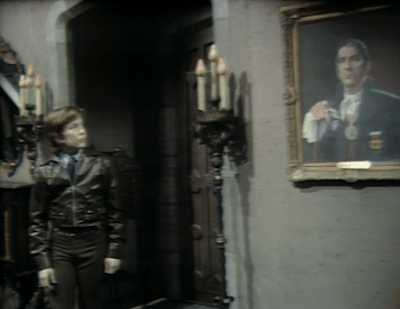
Today, a portrait of Barnabas has taken the place of the coat of arms. Children Daniel and Amy Collins found it in the attic of Will and Carolyn’s house, and for some reason housekeeper Julia Hoffman and butler Mr Trask decided to hang it up by the front door. It is a copy of the one we have seen over the last three years. It depicts Barnabas’ counterpart in this universe, a man who lived a quiet life and died a natural death in 1830.

Daniel and the portrait of Barnabas Collins (d. 1830.) Screenshot by Dark Shadows Before I Die.

The master of Collinwood, drunken sourpuss Quentin Collins, is shocked to see the portrait, and orders it to be removed immediately. Daniel’s counterpart, strange and troubled boy David Collins, had been the first to speak Barnabas’ name when he called Willie’s attention to the portrait in #205. Shortly after, Willie heard a heartbeat coming from the portrait, which led him to make his fateful trip to open the coffin. In this continuity, it is Daniel who hears the heartbeat, and he will today try to find and open the coffin.

Quentin has caught two glimpses of the other universe in the room in the east wing that was his late wife Angelique’s bedroom. Unknown to Quentin, Angelique has returned from the dead and murdered her identical twin sister Alexis. Quentin thinks that it is Alexis who is his guest in the great house, staying in her sister’s old room. When he tells her today what he saw, “Alexis” thinks he is losing his mind. But she then sees the phenomenon herself. She sees Hoffman’s counterpart calling for Barnabas, as Quentin had seen her talking about Barnabas’ “terrible curse.” “Alexis” and Quentin decide that they and Hoffman should have a séance to contact the spirit of the Barnabas Collins who died in their universe in 1830, the only Barnabas Collins they know of.

In the main continuity, séances are a frequent occurrence; we have seen fourteen of them there, and heard a detailed account of a fifteenth. In the early days, there was always one participant who tried to break the circle, only to be sternly reproved by the leader. The characters stopped doing that as they got to be familiar with the procedure, but séances are rarer in this universe. As things start to get interesting, Hoffman can’t take it anymore. She breaks the circle and runs out. “Alexis” says that the presence she felt is gone. But then a ghost materializes in the corner of the room.

Episode 990: Nothing ever goes well in this house

Most of this one is taken up watching people argue with each other about whether they should hold a séance. This puts longtime viewers on familiar ground. We’ve seen fourteen séances on Dark Shadows over the years, and have heard about others. Many of those we’ve seen have been preceded by the sort of wrangling we see today. The most spectacular case was #365. That installment was structured just like this one, one quarrel after another about the idea of the séance, then in the final scene the séance is held and comes to a shock ending.

Episode 365 came at the end of a period when the show was as slow-paced as it ever would be, and when such story elements as they had were all coming to an end. The episode was surprisingly fast-moving and exciting, mostly due to the visual artistry of director Lela Swift. Not only did Swift use a visual strategy that told more of a story than you might have thought was available had you read the script, but her skillful blocking and fluid use of the camera allowed the actors to project a great deal of energy. The shock ending, which the ABC network had spoiled with a series of promos but which I don’t think anyone could have seen coming otherwise, was the show’s first trip back in time. At the climax of the séance, well-meaning governess Vicki came unstuck in time and found herself transported to the year 1795.

Now, Vicki is long gone and mostly forgotten. The show has traveled in time again, not backward but sideways. We are in an alternate universe, which the show insists on calling “Parallel Time.” In this continuity, counterparts of familiar characters have different personalities and are arranged in different relationships than are the people we know.

The episode is much less effective than was #365, not so much from the absence of Vicki or the presence of any of the new characters, but because the director’s chair is occupied by the hapless Henry Kaplan. Kaplan stood at the opposite extreme from Swift. His idea of a well-composed sequence of images was one closeup after another, punctuated by extreme closeups showing us what an actor’s ear looked like when she was speaking a crucial line of dialogue. He takes the trouble to set up some two-shots and even three-shots today, but they put the actors in such cramped little frames that they don’t dare move without a furtive glance at the camera.

The master of the great house of Collinwood is drunken sourpuss Quentin Collins. His penniless siblings and permanent houseguests Elizabeth Collins Stoddard and Roger Collins have just come home from a trip out of town to find family friend Sabrina Stuart in the drawing room, demanding that they hold the séance that Quentin’s wife Angelique ordained for this night. They are shocked, because the night on which Angelique said there would be a séance fell six months before. Sabrina is having some kind of fit that causes her to be unalterably certain that this night is that one.

Angelique died of a stroke at that séance, and Liz and Roger are horrified at the idea of reenacting it. Sabrina’s fiancé, mad scientist Cyrus Longworth, says that she went through a traumatic experience the night before, when a strange man forced his way into her room and terrorized her. He then reports a conversation with a psychiatrist who suggests humoring Sabrina and holding another séance. Cyrus brings Bruno Hess, musician, lover of Angelique, and all-around sleaze to join in the reenactment.

While Roger and Liz were away, Angelique’s identical twin sister, Alexis Stokes, came to stay at Collinwood. Quentin neglected to inform even the people who were in the house at the time that this had happened, setting Alexis up for one terribly awkward encounter after another with people who thought she was her sister returned from the grave. Quentin and Alexis also got alarmingly cozy with each other, prompting his new wife, the former Maggie Evans, to walk out on him after barely a week in residence at Collinwood. So it is no surprise that he didn’t bother to telephone Liz and Roger and let them know they would see Angelique’s identical twin sister when they came home.

Roger is standing in Angelique’s old bedroom, holding a one-sided conversation with her portrait. We know that he is in the habit of doing this; it was what he was doing when first we saw him in #975. Quentin probably knows about it too, since several other people in the house have the same habit and even those who don’t spend a surprisingly large amount of time going in and out of Angelique’s room. Roger turns around and sees Alexis. Believing her to be Angelique redivivus, he nearly faints. She gives him her hand to assure him she is not a ghost, and he will later introduce her to Liz as Angelique’s sister.

Roger’s counterpart in the main continuity was Dark Shadows‘ first Big Bad, a charming, dissolute, narcissistic, cowardly, lecherous wastrel. That Roger Collins was supposed to be killed off when Vicki exposed his crimes, but Louis Edmonds made him such a joy to watch that this was out of the question. Dark Shadows had not yet figured out that a villain could be a permanent part of the cast, so when they decided to keep Roger around they nerfed him into a basically harmless supporting character. He developed gradually from the functional sociopath who in #68 coldly manipulated his own nine year old son David into a murder attempt on Vicki to the stoutly virtuous family man who made his final exit in #979 with a fatherly hand on David’s shoulder.

The Quentin of the main continuity made his debut in #646 as a ghost bent on annihilating all of his surviving relatives. From #701 to #884, Dark Shadows was a costume drama set in 1897, when we met Quentin as a living being. In those days, he was very much what Roger had been in 1966, only younger, sexier, and on a show that isn’t afraid to keep villains around indefinitely. He became a huge breakout hit, and a magic spell was cast that kept him from dying or aging. So when the show returned to contemporary dress at the end of 1969, Quentin was there, alive and intact.

Upon his arrival in 1969, Quentin found himself in the same position Roger had occupied two and a half years before. Everyone wanted him to be a big part of the show, but there was nothing for him to do. Unlike Roger, he was free to be evil, but also unlike him he had no connections to anyone who had anything he wanted to take. In some ways, Quentin is in an even worse position than Roger was. Even in his lovable gay uncle phase, Roger could admit to his sister Liz in #273 that he would have blackmailed her if he had had the chance, an admission that Quentin merrily echoed in #702 when he laughed at his sister Judith’s attempt to buy him off with $1500, boasting that he could blow through that much in a single night, even in a sleepy little place like Collinsport, and that he would shamelessly come back for more. He has no one to do anything like that with now.

Quentin can charm his way to an easy living. In December 1969, mad scientist Julia Hoffman and Broadway star Olivia Corey fought over which of them would get to pay Quentin’s hotel bill, a conflict that was motivated by some story points but that is the sort of thing that might happen to a man who looks like a young David Selby. On a fast-paced supernatural thriller, you have to be something a lot juicier than a mercenary Kept Man to count for much as a villain. No one in the Nixon era owes Quentin anything, so he can’t exploit anyone the way he did Judith and the rest of his immediate family. He has fallen into service as henchman to Julia and her best friend, his distant cousin vampire Barnabas Collins, but something big is going to have to change to find him another place at the center of the action.

Since that is the same problem that cost them Roger, it makes since that in this mirror universe Quentin’s counterpart and Roger’s are revisiting some stages of the development of the Roger from the main continuity. When Parallel Roger first appeared in #975 and #976, he seemed to be, if not the utterly depraved villain of the early days, at least the spineless, snobby, but amusingly sarcastic figure he was through most of 1967. Today he seems to be closer to the responsible family man he dead-ended into being.

This Roger is the first to articulate the reasons why it is inadvisable to reenact a ceremony that cost a life the last time it was attempted. Roger’s position recalls his role in #170, when he was the principal opponent of the first séance shown on Dark Shadows. In that, he was the unwitting stooge of his estranged wife, undead fire witch Laura Murdoch Collins, but the objections he came up with were all about the importance of social respectability and of refraining from doing the thing which is not done, fitting into the image of him as a shallow and unimaginative person. The fact of Angelique’s death gives his objections today a firmer footing and presents him as a representative of sober good sense, but does not make him seem any more dynamic than his counterpart in the main continuity did in #170.

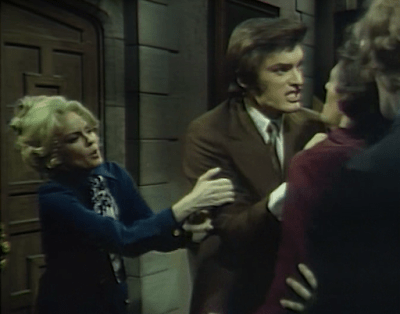
Quentin learns of the proposed séance when Cyrus and Bruno enter the house. He is angry at the sight of Bruno, and reminds him he is not welcome there. Cyrus explains that Bruno is needed for the séance. This increases Quentin’s anger, and he tells Cyrus and Bruno to “go to another house and work your black magic, boys.” They insist on staying, and suggest that Alexis sit in Angelique’s place. After all, Bruno says, why shouldn’t she see exactly how her sister died, from her sister’s point of view. At this Quentin’s anger turns to total rage, and he has to be restrained from attacking Bruno physically. Alexis wants to hold the séance, though, and Quentin gives in. He refuses to participate, but allows the others to gather in the drawing room.

Alexis stops Quentin from attacking Bruno. Screenshot by Dark Shadows Before I Die.

Roger was never given to violence that required his direct personal involvement. Quentin’s reaction to Cyrus and Bruno’s awful idea suggests that the writers are trying to find a way forward for his character. The well-justified repugnance he feels for Bruno, the grotesquely morbid nature of the proposed reenactment, and the breathtakingly irresponsible suggestion that Alexis do the very thing it killed her sister to do, all call for a forceful response. His lunge at Bruno is manful in the best sense, and leads us to wonder if they might try to develop Quentin’s vices into the basis of some kind of heroic action.

When he scornfully tells Bruno and Cyrus to go somewhere else with their “black magic, boys,” it is clear that the writers are thinking in terms of what is possible for Quentin. In 1897, the original Quentin and his fellow Satanist Evan Hanley would hang out in the cottage on the estate corresponding to the one where Bruno lives in this timeline and do all sorts of ill-intended mumbo-jumbo. They could easily have been called “The Black Magic Boys.” That Quentin stood at the opposite pole from this one. Perhaps as the story progresses, we will see these contraries fuse into something more sustainable.

Although we are in “Parallel Time,” a development like that might have good effects on the Quentin of the main continuity as well. Roger’s character changed massively after the flashbacks to 1795 and 1897, merging with the deeply flawed, yet sturdily upright family men whom Edmonds played in those periods. So if they can build a version of Quentin in this universe who is still narcissistic but also capable of saving the day, that might point the way to transforming the Quentin in the established “time-band” into a character who can carry the show as he did for so many months in 1969.

The séance goes forward. Cyrus conducts, and Sabrina goes into the trance. She shouts the word “murder” over and again, and breaks the circle of fingers to point at Alexis. Alexis passes out. That’s the closing cliffhanger. We can be sure Alexis is not dead- it wouldn’t leave the story anywhere to go. Besides, they commissioned a gorgeous full-sized portrait of Lara Parker as Angelique for this storyline. That thing must have cost at least $5000, maybe twice that, and they will never be able to use it again after they go back to the main continuity. There’s no way they are going to blow that much money on a set decoration unless they are planning to feature it in another couple of months of episodes.

Episode 988: Breaking in

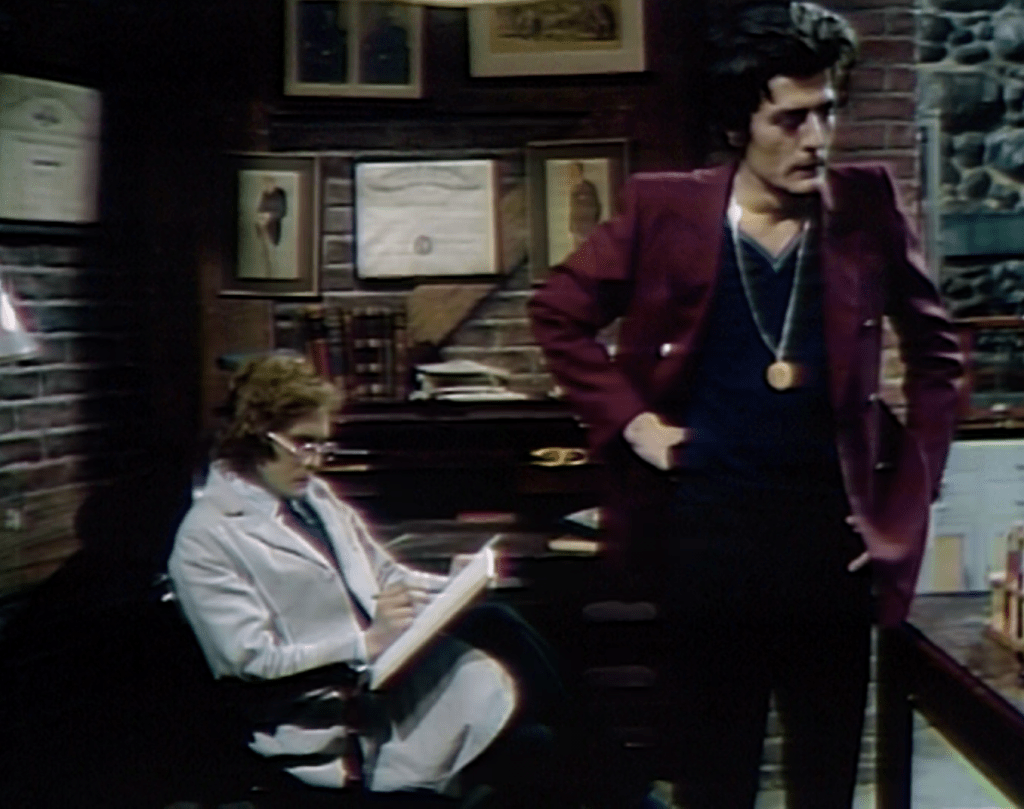
Drunken sourpuss Quentin Collins and wealthy socialite Alexis Stokes enter the mausoleum where Angelique, Quentin’s late wife and Angelique’s identical twin sister, is entombed. They find a fancifully dressed man named Bruno Hess driving a chisel into the wall beside Angelique’s nameplate. When they demand to know what Bruno is doing, he explains that he is going to open the vault, show that Angelique’s body is not there, and thereby prove that Alexis is in reality Angelique come back to life.

Quentin says he will call the police if Bruno does not desist from his efforts. Bruno says that he does not believe that Quentin wants to involve the police, since that might raise questions that he would rather leave unasked. In response to this, Quentin looks down, and Alexis asks what on earth he is talking about. Quentin says it is an empty threat. He offers Bruno $25,000 to go away, rather a large amount of money to offer someone who has just made an empty threat. Bruno says he will go away without payment if he is allowed to open the vault and it turns out Angelique’s remains are there. Alexis is horrified by this idea, and she and Quentin manage to run Bruno off.

Returning viewers know that these characters are part of a story mashing up Daphne Du Maurier’s 1938 novel Rebecca with Edgar Allan Poe’s 1838 story Ligeia. Maxim de Winter put up with the presence of Jack Favell, his late wife Rebecca’s lover, on his estate because Maxim knew that Favell was willing to spread the rumor that Maxim had murdered Rebecca, and he feared that Favell might be able to prove that the rumor was true. Bruno was Angelique’s lover, and is ensconced on the estate of Collinwood. Quentin’s look down when Bruno scoffs at the idea of him calling the police suggests that he has the same exposure in regard to Angelique’s death that Maxim had in regard to Rebecca’s.

This part of the show is set in a universe parallel to the one where it spent its first 196 weeks. Angelique’s counterpart in the main continuity is a wicked witch who has returned from the dead many times. Poe’s Ligeia, like Du Maurier’s Rebecca and like the Angelique of the current continuity, was a great beauty who fascinated those who knew her and remained an inescapable presence in her husband’s house after her death and his remarriage. Unlike Rebecca, but like the Angelique of the main continuity, Ligeia was a woman of vast knowledge who could transcend death. At the end of Poe’s story, the unnamed narrator finds that his second wife, who has died, has come back to life, and that both her physical appearance and her personality have been transformed into those of Ligeia. Bruno, like other devotees of Angelique, is unshakably convinced that Alexis is lying when she says that she is not the resurrected Angelique.

Bruno is a subject in an experiment being conducted by aspiring mad scientist Cyrus Longworth. Cyrus was himself an admirer of Angelique’s. When he first saw Alexis, he too believed that she was Angelique risen from the dead. But he has accepted that she is who she says she is, and has immersed himself in his work, an attempt to create a potion that will turn whoever drinks it into a Dr Jekyll and Mr Hyde-like duality. Last week, we learned that this somewhat questionable project was Angelique’s idea.

We see Bruno in Cyrus’ laboratory, telling him about his activities in the mausoleum. Cyrus is amused by the story, and tells Bruno he wishes he had his daring. He makes fun of Bruno for getting caught, and turns back to his notes. Frustrated that he cannot enlist Cyrus in his attempt to prove that Alexis is Angelique redivivus, Bruno exits.

Bruno’s a pretty weird guy, but you’d think even he would hesitate before getting into that outfit. Screenshot by Dark Shadows Before I Die.

Later, Bruno shows up in Angelique’s old bedroom at the great house of Collinwood, where Alexis is staying. She demands he leave, and he demands she admit to being Angelique. She says that if he refuses to go, she will resort to force. He invites her to do so.

The Angelique we know in the main continuity has vast magic powers, and would be hard put to keep herself from turning Bruno into a toadstool. We don’t know if the Angelique who once occupied this room is a match for her, but the widespread belief among people who knew her well that she will transcend death suggests that she does have some kind of extraordinary ability, and a moment yesterday when Bruno believed she had cast a spell to interfere with his breathing confirms that she shared at least some of our Angelique’s talents. Bruno believes he will expose her true identity by provoking her into using them. My wife, Mrs Acilius, says that she found herself torn at this point. Returning viewers have ample reasons to dislike Bruno, and his invasion of Alexis’ personal space reinforces all of them. At the same time, she is very much inclined to believe that Alexis is Angelique. So even while she roots against Bruno, she also hopes he will succeed in this attempt.

Alexis does not cast a spell. Instead, she goes to the drawing room and tells Quentin that Bruno has invaded her room. Our Angelique would probably find it galling to have to turn to some guy and report that a meanie was bothering her, so if Alexis is an impostor we can believe she is an exceptionally well-disciplined one.

Bruno follows her. He and Quentin confront each other. Bruno taunts Quentin, saying that he always knew Angelique better than he did. Quentin reminds Bruno that he is not allowed in the house and forbids him to pester Alexis. Bruno mentions that Angelique died during a séance; this piques Alexis’ interest, and after Bruno leaves she asks Quentin about it. He doesn’t want to answer, and she drops the subject.

Cyrus goes to his laboratory late at night and finds evidence of an intruder. He discovers that the man is still there. Cyrus tells him to come out of the shadows so he can see him face to face. It is Horace Gladstone, a chemist from Boston who formulated an extremely exotic compound Cyrus bought as an ingredient in his potion. Cyrus asks Gladstone if he satisfied his curiosity when he was reading through his notes. Gladstone said he didn’t, because Cyrus’ handwriting is so bad. Gladstone says that if Cyrus will tell him what he is working on, he can be of great assistance to him. Cyrus keeps refusing, and Gladstone warns him that he is about to take “a lonely and dangerous journey.”

When he is alone, Cyrus drinks the potion. He makes noises suggesting acute gastric distress and collapses.

Episode 948: A sign of your freedom, and of mine

The first ghost we saw on Dark Shadows was that of the gracious Josette Collins, who came down from her portrait and danced around the outside of the Old House on the grounds of the estate of Collinwood in #70. We had first heard of Josette in #5, when drunken sad sack Sam Evans told well-meaning governess Vicki Winters about her, and she had been mentioned many times in the first fourteen weeks. From #70 until #191, Josette’s ghost became a steadily bigger part of the story. She rallied the other ghosts of Collinwood to rescue Vicki from crazed handyman Matthew in #126, and from that point until #191 guided Vicki in her battle with undead blonde fire witch Laura Murdoch Collins. By the end of the Laura story, Josette was firmly established as the chief figure in the show’s supernatural back-world, a world which the action is continually tugging into view.

Vampire Barnabas Collins succeeded Laura as the show’s supernatural Big Bad. Josette was well-suited to do battle with the distant and indefinable Laura, but was too wispy to be very effective against the more dynamic Barnabas. In #212, Barnabas addressed Josette through her portrait in the Old House, which we had seen strange and troubled boy David Collins use to carry on conversations with her in #102 and #162. Barnabas spoke to Josette then as if she were his grandmother, who had sided with his father against him in a fateful conflict, and told her he was kicking her out of the house. Over the next few weeks, there were several episodes when David lamented Josette’s absence from the Old House, suggesting that Barnabas had succeeded in banishing her.

As it became clear Barnabas was a hit and would be kept on the show for a while, they decided to connect him to Josette. So they borrowed the story of the 1932 film The Mummy. As Boris Karloff’s undead Imhotep decided that Helen Grosvenor was the reincarnation of his lost love Princess Ankh-Esen-Amun, so Barnabas decided that Josette, retconned as his lost love, had been reincarnated as Maggie Evans (Kathryn Leigh Scott,) daughter of Sam. As Imhotep abducted Helen and tried to turn her into Ankh-Esen-Amun, so Barnabas abducted Maggie and tortured her in an attempt to erase her personality and upload Josette’s in its place.

In the movie, Helen and Ankh-Esen-Amun were both played by Zita Johann. The original viewers wouldn’t have known it, but Miss Scott, wearing a veil, played the ghost of Josette in #70 and voiced Josette’s lines to Vicki in #126. In the scenes during the Laura story when we caught glimpses of Josette’s face, the ghost was played by frequent stand-in Rosemary McNamara, who looked enough like Miss Scott that viewers may have wondered if she was playing the role. So the idea of a connection between Maggie and Josette had been rattling around the writers’ room for a while. In #240, David saw Maggie wandering around Barnabas’ house. She was wearing Josette’s dress but no veil, in a daze and answering to Josette’s name. Afterward, David said that he had seen Josette and that she looked exactly the same as she did when he had seen her as a ghost. That confirmed that Maggie was at least a Josette lookalike, if not her reincarnation.

Maggie eventually escaped from Barnabas. Her psychiatrist, Julia Hoffman, saw in Barnabas her chance to make a career as a mad scientist, and so she sold Maggie out, using her magical power of hypnosis to delete her memory of what Barnabas did to her and leave her with a feeling of goodwill towards Barnabas. By that time, Barnabas had turned his attentions to Vicki, toying with the idea of Josettifying her. Josette’s ghost made it clear to him that she would try to stop any such effort when she spoke through Vicki at a séance in #280 and 281; after that, Barnabas gave her portrait another talking-to, telling her that she was lost to him forever and must let him live in the present. It sounded like he was going to stop trying to turn girls into Josette, but he kept pushing Josette’s hypnotic music box on Vicki, so if that’s what he meant he didn’t stick with it.

In November 1967, Vicki went back in time to the days when Barnabas and Josette were living human beings. From then until March 1968, Dark Shadows was a costume drama set in the 1790s. Miss Scott was cast as the living Josette, completing the parallel with the flashbacks to ancient Egypt in The Mummy and suggesting that Barnabas, though he was appallingly cruel and thoroughly crazy, was onto something when he told Maggie she was Josette.

The whole idea of supernaturalism is that what appears to be powerless is in fact most powerful and vice versa, so having been powerful as a ghost, Josette has to be at least somewhat understated as a living being. Making matters worse for her, the 1790s segment moved at a breakneck speed, piling one bizarre disaster on top of another, so that there was no time to develop the kind of subtle strength a lady of her sort might be expected to have or to give us much of a look at Josette and Barnabas as a loving couple before everything went horribly wrong for them. She winds up as a pleasant but ineffectual person. The 1790s period was the show’s first great triumph, but it did knock Josette out of the spotlight permanently.

A couple of weeks after Dark Shadows returned to contemporary dress in March 1968, Barnabas’ vampirism went into remission and he tried to function as a good guy. His bumbling attempts at heroism generated as much trouble for everyone as had his villainy. Julia had made herself a permanent houseguest at Collinwood, and she was the one who was busiest with the work of containing his damage. Throughout the part of the show made and set in 1968, Josette was all but forgotten.

Early in 1969, Barnabas came unstuck in time and found himself in 1897, once more subject to the vampire curse. During his eight months in that period, he met two more characters played by Miss Scott. Each of them led him into a fresh bout of Josettery. He gave the music box to neurotic intellectual Rachel Drummond; after her death, he met Kitty Soames, dowager countess of Hampshire, who despite her title was a young woman from Pennsylvania. The music box showed up in Kitty’s room at a time when Barnabas could not possibly have been around, and it became clear that this time, it was Josette herself who was trying to take possession of Kitty.

In #884, airing in November 1969, Kitty was assumed bodily into Josette’s portrait. Barnabas saw this happen. He then returned to the 1790s, to the night when Josette originally flung herself to her death from the cliff at Widows’ Hill rather than let Barnabas turn her into a vampire. Josette had only the vaguest memory of 1897 or of Kitty; as far as she is concerned, she was living through this night for the first time, and was experiencing time in the usual linear fashion.

Barnabas tried to prevent Josette’s suicide, but succeeded only in changing the method she used to do herself in. By the time he returned to the twentieth century, he had fallen under the sway of the Leviathan People, a race of Elder Gods who are trying to retake the Earth from humankind. For a time he led a cult that served them in this goal, but eventually became disaffected. He hesitates to take any very definite action against the Leviathans, because they told him they were “holding Josette prisoner in the past” and that they would inflict on her a more horrible death than either of those she has already died if he defied them in any way.

Vicki was written out of the show in 1968, and Maggie succeeded her as governess to the children at Collinwood. The Leviathans have sent a shape-shifting monster from beyond space and time as the harbinger of their conquest. The monster usually takes the form of a young man who initially asked people to call him “Jabe,” but whom everyone instead calls “Jeb.” Jabe is always obnoxious and often homicidal, and has alienated many people from the Leviathans, including Barnabas. He abducted Maggie and thought he had brainwashed her into joining the cult; once he let her go, she made an alliance with Barnabas and Julia to fight the Leviathans.

Barnabas is convinced Jabe is about to do something especially horrible, and so he wants to open the battle. But his concern for Josette is still holding him back. He and Julia talk about this. It dawns on them that the Leviathans may have been lying, and that they may not have the power to make Josette re-die. The only way they can be sure is to ask Josette, so they decide to hold a séance. They enlist Maggie to be the third member of the circle.

The typical Dark Shadows séance involves three roles- the convener, who gives detailed instructions and barks about the importance of following them, even if everyone in the room has attended multiple séances already; the medium, who goes into the trance and channels the voice from the realm of the dead; and the objector, who tries to interrupt and is sternly hushed by the convener. Recent séances have omitted the objector; today, Julia keeps up a running commentary from the time Barnabas starts the incantations until Maggie goes into the trance, but she doesn’t object and Barnabas doesn’t hush her.

Through Maggie, Josette says she had a hard time getting to the séance, but that it had nothing to do with the Leviathans. She says she doesn’t even know the Leviathans. Barnabas doesn’t believe her, and she says that if he wants proof he should come to her grave.

He does. The tinkling tune of the music box plays on the soundtrack; Barnabas does not mention the original signature of Josette’s presence, the scent of jasmine. Her ghost manifests before him:

THE GHOST OF JOSETTE: It is I. And I will tell you what you must know, now and forever. You asked me if the Leviathans held me prisoner. They do not. But you hold me, just as I hold you with my love. But now the time has come for us both to go free.

BARNABAS: I cannot be free without you.

GHOST: But you must. For I belong to the past. For you there is a future with someone else.

BARNABAS: But I don’t want anyone else.

GHOST: Then you must be lonely, for you cannot have me. But you will find someone else. I know it. And when you do, give her this. The ring that you gave to me, give to her, whoever she may be. This ring is a sign of your freedom and of mine. (Returns her engagement ring to him and vanishes.)

Josette says goodbye. Screenshot by Dark Shadows Before I Die.

This is Josette’s final appearance on Dark Shadows, not counting a parallel universe version of Josette who will feature in the last weeks of the show, played by another actress. As for the “someone else,” it would be logical for Barnabas to get with Julia, since the two of them are so deeply complicit in each other’s crimes that neither of them will ever be able to make a life with anyone else. But there have been some hints lately that romance might be budding between Barnabas and Maggie, and if that’s going to happen they are going to have to keep us from thinking very clearly about Josette and Barnabas’ attempts to recreate her. We might suppose that her farewell is meant to clear the path for such a development.

There’s also some business about the Leviathan story. In the opening reprise, Jabe catches a bat, which he plans to use to turn Barnabas back into a vampire.

After Barnabas gets the green light from Josette, he meets with Philip Todd, another person whom Jabe has driven out of the Leviathan cult. Philip tells Barnabas how much he hates Jabe and agrees to steal the Leviathan box, an object which does not play music but which is a lot more effective at controlling the minds of people who open it than was that box of Josette’s. At the end of the episode, Jabe catches Philip with the box.

A commenter on Danny Horn’s great Dark Shadows Every Day who identifies herself as “Melissa”* wrote this lyric about Jabe in two comments about the post covering today’s episode:

Come and listen to my story ’bout s man named Jeb,
Poor Leviathan, barely kept his evil web.
Then, one day, he and Barney had a spat,
And out from the cage came a rubberized bat.
(Vampire bat, that is:
Nylon string,
Terror teeth.)

Next thing you know,ol’ Jeb has got a girl.
Cult folk said, “Jeb, come and rule the world!”
They said, “In the attic is the place you want to be,”
So they threw themselves a seance and they called on J.D.C.
(Josette Collins, that is.
Swimming fail.
Newly scarred.)

Comments left 31 October 2016 by “Melissa” on Danny Horn “Episode 948: War Games,” posted 30 October 2016 at Dark Shadows Every Day.

I’m singing that aloud right now. I realize you might be reading this years after I wrote it, but believe me, I’m singing it right now.

*Apparently also an FotB here.

Episode 898: The keeper of the book

A cult devoted to the service of supernatural beings known as “the Leviathan people” is secretly establishing itself in and around Collinsport, Maine. Antique shop owners Megan and Philip Todd are members of the cult. Its acting leader, old world gentleman Barnabas Collins, has entrusted them with several items sacred to the cult. The Todds are responsible for a scroll, a box, a book, and a baby. Now the book has gone missing, and the baby is sick. Yesterday, Barnabas responded to this situation by brainwashing Philip into killing Megan. Today, we open with Philip entering the antique shop and choking Megan.

Megan is Marie Wallace’s third character on Dark Shadows. Her first, fiancée of Frankenstein Eve, was strangled by her intended spouse Adam in #626. Her second, madwoman Jenny Collins, was strangled by her estranged husband Quentin in #748. The murder of Eve came at the end of the Monster Mash period of the show that stretched throughout most of 1968, while the murder of Jenny marked a turning point in the eight-month costume drama segment set in the year 1897. The Leviathan arc is just beginning, and Miss Wallace’s character is already being strangled by her husband. If we were hoping for fresh new story ideas, we couldn’t be more disappointed.

Until, that is, the strangulation is called off. Philip is holding Megan by the neck, reiterating that “There is no margin for error! Punishment is necessary!,” when strange and troubled boy David Collins appears on the staircase and announces “punishment is no longer necessary.” Philip releases Megan, and David informs them that he is now “the keeper of the book, and the protector of the baby.” He gives Megan and Philip medicine that will cure the baby of his illness. He tells them that if they need him, he will know and will appear.

Barnabas was a vampire when he joined the cast of characters in April 1967. As a villain he was unrivaled at giving everyone else things to do, whether as his victims, his accomplices, or his would-be destroyers. In March 1968, his curse was put into abeyance and he became human. He set out to be the good guy, but still had the personality of a metaphor for extreme selfishness. As a result, Barnabas the would-be hero created at least as many disasters as Barnabas the monster ever did. He thus remained the driving force of the show, as well as its star attraction.

While Barnabas can keep things going from day to day, Philip’s attack on Megan suggests that he cannot take the story in new directions. From episode #1, that has been David’s forte. The series began when well-meaning governess Vicki was called to Collinwood to take charge of David’s education, took its first turn towards grisly tales when David tried to murder his father, became a supernatural thriller when David’s mother the undead blonde fire witch came back for him, began its first time travel story when Barnabas was planning to kill David in November 1967, and was launched into both the “Haunting of Collinwood” that dominated the show from December 1968 through February 1969 and the 1897 segment that followed it by David’s involvement with the ghost of Quentin Collins. David was not always a highly active participant in the stories that began with him; indeed, he sometimes disappeared altogether for months at a time. But even from the outside, he is the instrument by which the basic architecture of the show is reshaped. Now that he is, apparently, the leader of the Leviathans, we can renew our hopes that something we haven’t seen before is still in store for us.

David is still in the shop when a gray-haired man enters. David greets him as “Mr Prescott,” the name by which he heard his cousin Carolyn address the man when he met her in the shop the other day. David has a smug look on his face that suggests he knows this is an alias. Indeed, we already know that the man is connected with the Leviathan cult, so the leader of the cult may well recognize him as Paul Stoddard, Carolyn’s long-missing father.

Paul asks the Todds to give a note to Carolyn. David says that he will be going home to the great house of Collinwood in a few minutes, and volunteers to take the note to her there. Paul gladly hands it to him.

At Collinwood, permanent houseguest Julia Hoffman is conferring with mysterious drifter Chris Jennings. Yesterday, Jenny’s ghost appeared to Chris and told him that Quentin could help him with his big problem, which is that he is a werewolf. Jenny did not identify herself, and Chris had no clue who she was.

Julia shows him a Collins family photo album. She shows him a picture of maidservant Beth Chavez and asks if that is who he saw. He says it wasn’t, and they keep turning pages. It is interesting for regular viewers that they take a moment to put Beth’s picture on the screen and to make some remarks about her. Beth appeared several times during the “Haunting of Collinwood” segment, and was a major character during the 1897 flashback. The sight of her picture is the first reason we have had to suspect that either she or actress Terrayne Crawford will be back.

Chris and Julia look through a Collins family photo album. Screenshot by Dark Shadows Before I Die.

When Chris recognizes Jenny’s picture, Julia breaks the news to him that Jenny and Quentin were his great-grandparents, and that Quentin was the first to be afflicted with the werewolf curse. We know that Quentin and Jenny’s daughter was named Lenore, and that she was raised by a Mrs Fillmore. Chris confirms that his grandmother’s maiden name was Lenore Fillmore. Wondering how Quentin could help Chris, Julia decides they will hold a séance and contact Quentin’s spirit.

David enters, looking for Carolyn. Julia asks him to participate in the séance. He agrees, with the blandness appropriate in a house where séances have become almost routine. When Julia tells him that the spirit they are trying to reach is that of Quentin Collins, David becomes alarmed. As well he might- we left 1969 at the beginning of March, but in #839, broadcast and set in September, we saw that the haunting continued in the absence of the audience, and that Quentin’s ghost had killed David. That episode took place on the anniversary of an event in 1897 that was changed by time travelers from the 1960s, and so David came back to life and the haunting ended. But everyone at Collinwood still remembers the ten months that Quentin exercised his reign of terror, and David does not want to return to it.

Julia assures David he has nothing to be afraid of. She says that the past was changed as of September 1897/ September 1969, and that Quentin’s ghost was laid to rest forever. This doesn’t fit very well with her plan to disturb that rest, but David is still ready to go along with the plan.

When they have the séance, David goes into the trance. He speaks, not with Quentin’s voice, but with that of Jamison Collins, his own grandfather and Quentin’s favorite nephew. Jamison says that Quentin’s spirit is no longer available for personal appearances. He doesn’t know more than that, and excuses himself. When David comes to and asks what happened, Julia says she will tell him later and sends him to bed. Once he is gone, she tells Chris that she thinks Quentin may still be alive.

Quentin was a big hit when he was on the show as an unspeaking ghost during the “Haunting of Collinwood,” and became a breakout star to rival Barnabas when he was a living being during the 1897 segment. So the audience is not at all surprised that he will be coming back. But David’s behavior before, during, and after the séance is quite intriguing. He is not simply possessed by some spirit that is part of whatever it is the Leviathan cult serves. He is still David, is still afraid of Quentin’s ghost, and is still fascinated by séances. During the 1897 segment, Jamison was a living being; like David Collins, he was played by David Henesy. That Jamison can speak through his grandson and not express discomfort at the unfamiliarity of the atmosphere suggests that there are sizable expanses inside David which are still recognizably him.

There is a similar moment between Philip and Megan. She smiles at him and in a relaxed voice says she understands why he had to do what he did. Philip has no idea what she is talking about. She reminds him that he tried to strangle her earlier in the evening, and he suddenly becomes highly apologetic. She tells him he has nothing to apologize for, that it was his duty as a servant of their cause. He is still anguished about it. They share a tender embrace. Again, while the force that animates the Leviathan cult may have the final say over what Megan and Philip do, their personalities are still there, and the loving couple we met a not so long ago still exists. There is still something for us to care about concerning them.*

Paul also has a lot of activity today. He goes to the cairn in the woods that is the ceremonial center of the Leviathan cult and that only people associated with it can see. He wonders why he keeps being drawn to it. When he first returned to Collinwood in #887, he was watching when the cairn materialized in its place out of thin air. He didn’t react at all, but merely turned and continued on his stroll. That led us to believe he knew a great deal about the cult, enough that he not only expected to see this extraordinary sight, but knew he need take no action regarding it. But evidently his connection is more subtle, and he does not understand it himself.

In his hotel room, Paul goes into a trance and circles the date 4 December 1969 on his calendar. That was when the episode was first broadcast, so the original audience would have assumed he was merely circling the current date. But when it was taped, the makers of Dark Shadows had expected the episode to be shown on 3 December. In between, there had been a pre-emption when the ABC television network gave its news department the 4:00 PM timeslot to cover the end of the Apollo 12 lunar landing mission. So the intention had been that we would share Paul’s puzzlement as to what was so special about the next day.

Paul is already worked up because some unknown person left him a note at the antique shop reading “Payment Due, 4 December 1969.” By the end of the episode, he notices that a tattoo has appeared on his wrist. It is a symbol that the show refers to simply as “the Naga,” a group of intertwined snakes that represent the Leviathan cult. All of this combines to get him into quite a state.

* I should mention that Danny Horn made the same point in his post about the episode on his great Dark Shadows Every Day: “And then they kiss, and the creepy thing is that I think they’re actually in there… So far, I’ve been critical of Chris Bernau, but he’s the one who pulls this moment together. As far as he’s concerned, the unpleasant incident is entirely forgotten — but when Megan brings up the fact that he was seconds away from killing her, his apology is entirely sincere.” Danny Horn, “Episode 989: Executive Child,” on Dark Shadows Every Day, 12 July 2016.

Episode 861: Complete control of my faculties

Judith Collins Trask, owner of the estate of Collinwood and all the Collins family businesses, has returned home after more than thirteen weeks confined to a sanitarium. Her return is supposed to be a big shock, but they spoil it by having Joan Bennett do the opening voiceover. They really should have paid more attention to that sort of thing.

Judith’s husband, the odious Gregory Trask, gaslighted her into the sanitarium, and has been exercising control over the Collins family’s wealth ever since. Today, Judith tells her stuffy but lovable brother Edward that Trask never visited her during her time as a mental patient. Edward is surprised, telling her that Trask left the house for an overnight stay every week during that period, and presented these absences as visits to her. In fact, he is on such a trip now. She does not want to hear any more, and says she will give Gregory a chance to explain himself when he comes back to Collinwood.

Judith claims to be entirely herself. That puts her in the minority today. When she left Collinwood in July, Judith had a stepdaughter named Charity Trask. When she enters today, she sees someone who is to all appearances Charity leading Edward and a lady named Kitty Soames in a séance. The body is indeed Charity’s, but sorcerer Count Petofi erased Charity’s personality in #819 and replaced it with that of the late Pansy Faye, a Cockney showgirl and “mentalist” whom Judith met in #771, when Judith’s late brother Carl brought her to Collinwood as his fiancée. Pansy noticed Judith’s disapproval of her when she was alive, and is quite indignant about it now. That Judith keeps live-naming her, calling her “Charity,” doesn’t help.

Judith does manage to do something Edward failed to do a while ago, and talks Pansy into moving back into the great house of Collinwood. She agrees to give up the apartment she rented in the village of Collinsport after she took a job doing her old act at the local tavern, the Blue Whale. We saw her at the Blue Whale in Friday’s episode; it was shortly before nine PM, and she was the only person in the place. So perhaps her income as a cabaret performer is not particularly lavish, and the mansion is a more appealing place to live than the apartment that job would pay for.

For her part, Kitty is still, most of the time, the dowager countess of Hampshire. But the ghost of Josette Collins has been possessing her off and on ever since she arrived at Collinwood in #844, and the trend is definitely towards “on.” In Friday’s scene at the Blue Whale, Kathryn Leigh Scott played Kitty quietly and let Nancy Barrett’s Pansy provide the scene with all its Crazy Lady Energy; today, it is Miss Barrett’s turn to stand back and let Miss Scott show that Kitty is Pansy’s match in that department.

Crazy Lady Energy, also known as “CLE,” the main driving force of Soap Opera Land. Screenshot by Dark Shadows Before I Die.

Judith and Edward’s brother Quentin is in an even stranger predicament than are Pansy and what’s left of Kitty. Between #854 and #856, Petofi forced Quentin to swap bodies with him, so that David Selby now plays Petofi and Thayer David plays Quentin. I call Mr Selby’s portrayal of Petofi “Q-Petofi,” and Thayer David’s portrayal of Quentin “P-Quentin.”

Kitty with P-Quentin. Screenshot by Dark Shadows Before I Die.

The initial shock of finding himself estranged from his own body and trapped in Petofi’s left P-Quentin bewildered. All he could do was go to one person after another and tell the true story of what had happened, which produced only a widespread belief that Count Petofi had gone mad. Now he is starting to figure out how to use his resources.

P-Quentin’s first attempt to take advantage of the fact that everyone thinks he is Petofi was not successful. In #859, he exploited Kitty’s fear of Petofi and threatened to make her vanish if she did not bring him a portrait of Quentin later that night. Kitty tried to comply, but failed, and now it is long past the deadline. Soon she will realize that his threat was an empty one, and so far from being useful to him as a cat’s paw, she will be in a position to expose him as powerless.

Today, P-Quentin runs a smarter game. He introduces himself to Judith as Petofi, and claims to have psychic abilities. He pretends to read her palm, and tells her a story from their childhood that very few people could know. She is delighted, and decides that Count Petofi is someone she wants to see more of.

P-Quentin and Judith. Screenshot by Dark Shadows Before I Die.

In her bedroom upstairs at Collinwood, Kitty has another fit of Josettification. She opens the trunk at the foot of her bed and finds Josette’s wedding dress. She puts it on and wraps a red cloak around it. She goes to the top of Widow’s Hill, the cliff from which Josette jumped to her death in the 1790s. The ghost of Josette’s husband Jeremiah appears to her.

The show is set in 1897 now. It was set in the 1790s from November 1967 to March 1968. Miss Scott played Josette then, and for most of the segment Anthony George played Jeremiah. After Jeremiah’s death, Timothy Gordon played his ghost in a memorable part of the 1790s story. Gordon made two appearances as the ghost after the show returned to contemporary dress, playing him in #462 and #512. This is Jeremiah’s first appearance in 1897, and the second time, after #462, that Gordon’s name appeared in an on-screen credit on Dark Shadows.