Episode 1070: Never without you

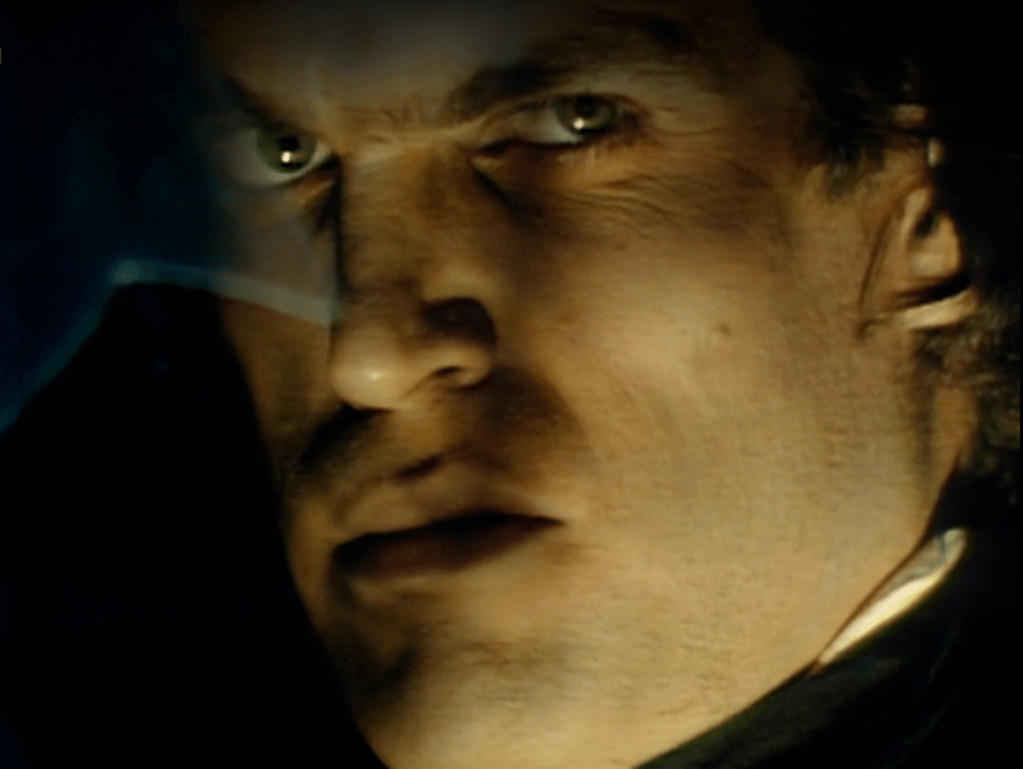
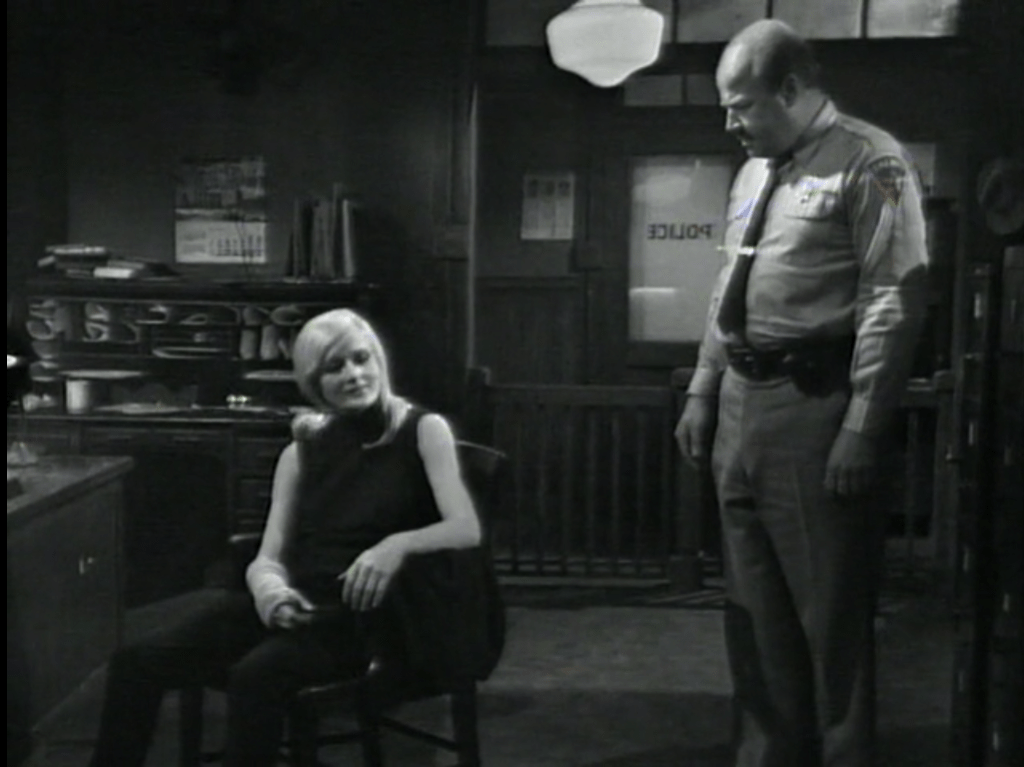
The sun has set, and vampire Barnabas Collins is opening the lid of his coffin in the basement of the Old House on the estate of Collinwood. Suddenly a cross is thrust in his face. He recoils from it, crying in pain and becoming immobile. The cross is wielded by the sheriff of Collinsport, who announces “I know all about you, Barnabas Collins!”

Before the sheriff can take matters any further, a teenage girl appears nearby. Shocked to see her, he reels away from the coffin. He jabbers at her, saying that he recognizes her and pleading with her not to come closer. Barnabas grabs him from behind and strangles him to death.

Barnabas didn’t have anything against the sheriff, but can’t deny that it feels good to use the old strangling muscles again. Screenshot by Dark Shadows Before I Die.

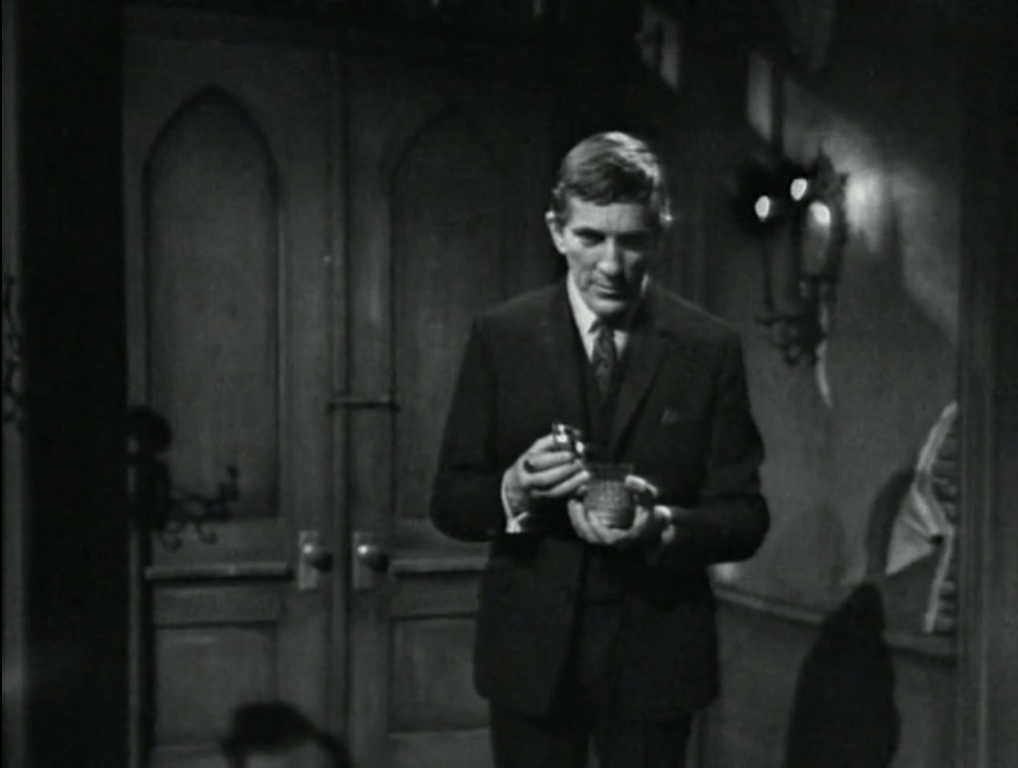
Barnabas goes upstairs and finds his best friend, mad scientist Julia Hoffman. He tells Julia that the sheriff’s gun was loaded with silver bullets, and that only the manifestation of the ghost of Carrie prevented his destruction. The police know about him, and more officers will be coming any time. Julia admits that she told the sheriff about Barnabas. Shocked, he says “You betrayed me?” He has said these words many times, always as a prelude to extreme violence. Julia braces herself, expecting the same. But to her amazement, Barnabas is gentle and understanding. He realizes she is under the sway of an evil ghost named Gerard. She says that she will betray Barnabas again and again, and urges him to leave without her. He says he will never do that. She embraces him, weeping, and he comforts her. For most people, a day that begins with the murder of a policeman is a day when nothing goes well, but Barnabas is not like most people. This is far and away the most mature behavior we have ever seen on his part.

The year is 1995; Barnabas and Julia have come unstuck in time and found themselves at Collinwood 25 years after a mysterious disaster wrecked the great house on the estate, ruined its inhabitants, and left Gerard in charge. They believe they can travel back to 1970 and prevent the disaster from ever occurring, if only they can find out what it was. Barnabas’ distant cousin Carolyn left him a note yesterday consisting of six cryptic phrases which he took to be clues, but Gerard killed Carolyn before Barnabas could ask her to explain them.

Barnabas has brought occult expert Timothy Eliot Stokes to the Old House. We find Stokes exclaiming to Barnabas “You killed the sheriff?” Barnabas confirms, “Yes, I killed him.” Stokes replies, “Everyone’s going mad. It’s the effect of this place. I’m not surprised at your terrible story. Horrified, not surprised.” One wonders what the story was that Julia and Barnabas told. Stokes’ role in the parts of the show set in contemporary times was always limited, because he is too decent and law-abiding to be a party to the continued existence of a vampire. He could never be allowed to learn the truth about Barnabas. He stays in the room, chatting amiably with Barnabas and Julia, so clearly they haven’t told him now, either. Perhaps they just told him that the sheriff was going to shoot Barnabas, and let him assume that the reason was that Gerard was making him do it.

Be that as it may, Stokes is still aware of the situation. “Do you realize that I will be implicated in all this if the police come here?” he asks. They say that they do, but that they desperately need him to make a third for a séance. He dismisses as hopelessly naive the idea that Gerard would allow a séance to succeed, but Barnabas says that Gerard may not have the power to prevent Carolyn’s spirit coming through and telling them what her note meant. The idea of one spirit trying to block another from emerging out of the supernatural back-world and speaking at a séance harks back to the very first séance on Dark Shadows, in #170 and #171, when undead fire witch Laura Murdoch Collins used her powers to impede the spirit of the gracious Josette from warning the company about her. Stokes gives in and agrees to participate; Julia, self-conscious because of her compromised position, is reluctant, but Barnabas proclaims that if Carolyn is to speak it will be through her.*

The séance begins. Julia goes into the trance, and starts speaking in what appears to be Carolyn’s voice. If this is Grayson Hall’s Nancy Barrett imitation, it is terrible. Mrs Acilius and I laughed out loud at it. But the voice does not give any useful information, and Julia is under Gerard’s power, so it is also possible she is faking the trance to throw Barnabas off. In that case, it is Julia’s Carolyn imitation, and it reminds us of the ups and downs in the relationship between those two characters.

When the séance is over, Stokes says he feels a presence. He rises from the table, drifts towards the window, and sees Gerard watching him from outside. Gerard touches the pane. Stokes staggers back, descends into a chair, and becomes still. Barnabas finds that he is dead. He looks up and realizes that Julia has fled the house.

Julia has gone to the great house. She is in a mysterious playroom with Gerard. Gerard gives her a dagger. She asks if she “must.” She is reluctant, but finally works herself up to joy as she says that she always knew it would come to this, that now she will be with Gerard as he wants her. She lifts the dagger to stab herself in the heart.

Barnabas enters. He confronts Gerard. As the two beings from beyond the grave stare each other down, Julia drops the dagger. Barnabas tells Gerard he cannot stop them leaving. Gerard looks offended at this. He touches Julia, who collapses. She is not dead, but she and Barnabas fear she is dying. Gerard leaves the room and takes his time locking the door from the outside.

Carrie’s ghost materializes to Julia and Barnabas. She beckons to them, then walks out through the wall. They stare at the wall, and a door appears. They pass through the door, and find themselves on a staircase. They follow the staircase, and come to another door. They exit in the same corridor outside the playroom; they have gone in a circle. In space, anyway- the time appears to be different. The corridor is in severe decay in 1995, but is in good repair now. And they see a girl who looks exactly like Carrie, but is alive. She asks them who they are.

This is the final episode set in 1995. It is also the last we will see of Don Crabtree. Previous sheriffs of Collinsport have been ridiculously ineffective. Crabtree’s sheriff doesn’t chalk up many successes either, but no one else meets with anything but failure in these two weeks. Every death and defeat we see reinforces the sense that the evil which Gerard represents is overwhelming. As the penultimate victim of the 1995 curse, the sheriff is second only to Stokes as someone who would have been able to make a positive difference, if anyone could have, and Crabtree makes us believe that he belongs in that position.

*In the main continuity of Dark Shadows, spirits at séances always speak through a medium of the same sex as themselves. In the séance in #990, when the show was set in a mirror universe, the spirit chose a medium of the opposite sex.
Episode 1069: The sheriff’s place

Vampire Barnabas Collins and mad scientist Julia Hoffman have come unstuck in time and found themselves in the year 1995. The estate of Collinwood is in ruins, dominated by an evil ghost named Gerard. Barnabas’ distant cousins Carolyn Fredericks (née Stoddard) and Quentin Collins are insane. Occult expert Timothy Eliot Stokes is sometimes openly hostile, sometimes apparently helpful, but never his usual trustworthy self. Everyone else they knew in 1970 has either gone missing or died. Julia has fallen under the possession of Gerard and turned against Barnabas. Most unaccountable of all, the sheriff of Collinsport is not completely useless at his job.

Barnabas has received a note from Carolyn asking him to meet her in what remains of the great house. He and Julia enter the house; she insists on waiting in the foyer. While he goes into the drawing room, she stares up at Gerard, standing in his usual perch on the walkway at the top of the stairs. Barnabas looked right at Gerard there yesterday and did not see him, so apparently he can be selective about making himself visible.

Barnabas finds Carolyn sitting at the desk in the drawing room. She falls over dead. He calls for Julia. Gerard shakes his head, and she does not respond. Barnabas goes to the foyer and brings her to the spot where Carolyn had lain a moment before; she has vanished. The note she was writing is still on the desk; it is made up of six cryptic phrases which Barnabas declares to be clues as to what happened in 1970. He reads them aloud- “The night of the sun and the moon,” “The night Rose Cottage was destroyed,” “The unfinished horoscope,” “The night I sang my song,” “The picnic,” “The murder.” Julia keeps interrupting him, declaring that the phrases are meaningless and Carolyn was mad. He keeps wondering why she has become so uncooperative.

Barnabas tells Julia to find a telephone and call the sheriff. Often on Dark Shadows, people dismiss the idea of calling the police when someone turns up dead, saying that it’s too late to do anything but bury them and move on. But after a lot of back and forth, Julia goes off and does place the call.

Barnabas goes to open the secret panel in the drawing room to see if Gerard stashed Carolyn’s remains there. Gerard himself appears to Barnabas. Barnabas yells at him for a while. Julia comes back, and Gerard disappears. Julia wonders why Gerard did not try to harm Barnabas; Barnabas says that he knows he cannot harm him. This seems to be news to Julia. In 1970, Quentin knew that Barnabas was a vampire. We learned the other day that his contact with Gerard erased this knowledge. We may wonder if this fact has also slipped Julia’s mind.

Barnabas goes upstairs, and asks Julia to bring the sheriff to him when he gets to the house. She agrees. Once he is out of earshot, she asks Gerard if he had to kill Carolyn. She seems sad about it.

Barnabas is at the door of the one room at Collinwood that is in good repair, a mysterious playroom on an upper floor. He can’t get the door open. Julia brings the sheriff, and Barnabas says that the door wasn’t locked when he was there earlier. The sheriff says he has some questions and Barnabas angrily responds “Not now!” Cops don’t love it when you answer them that way, in my experience, but the sheriff does seem to be a bit cowed by the surroundings and he lets it pass.

Barnabas asks the sheriff to try the door. He does, and the knob turns easily. He turns to Barnabas and asks sternly “How much of this is in your imagination, Mr Collins?”

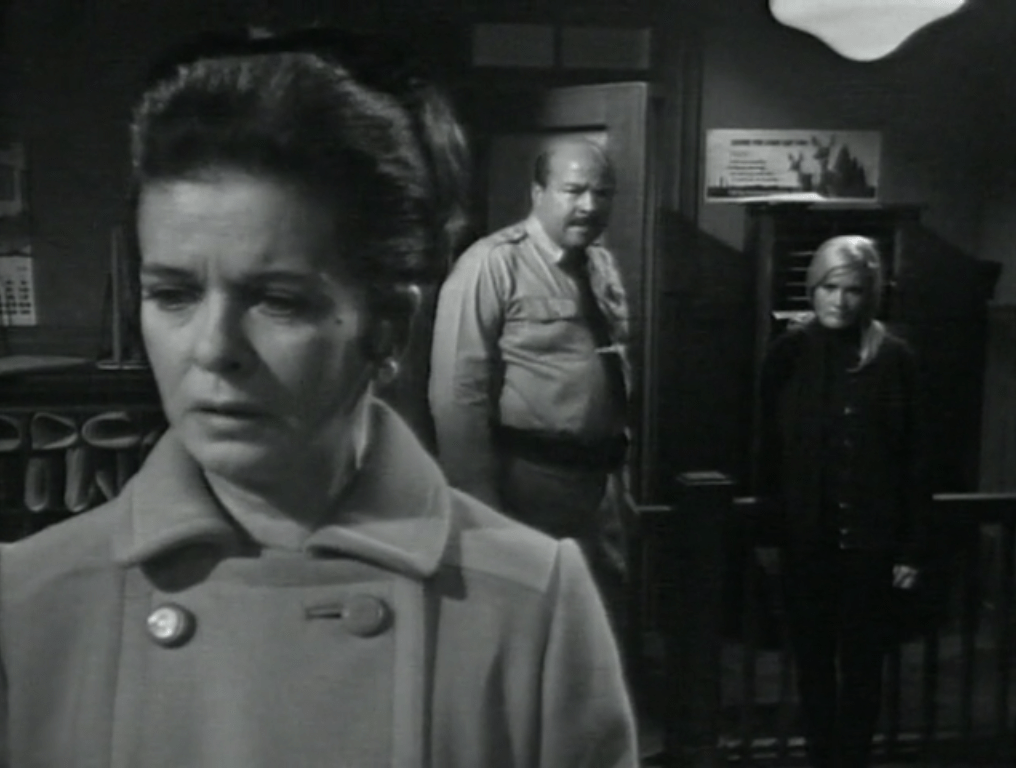
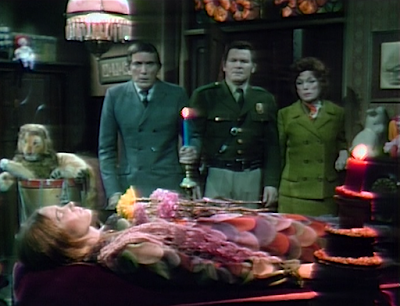
Barnabas’ embarrassment doesn’t last long. Carolyn is laid out on a table in the middle of the room, a spray of flowers on her chest. The sheriff remembers how lovely Carolyn was when she was young; Barnabas stalks around the room yelling at the invisible Gerard. When the sheriff says it is time to go, Julia insists on sitting with Carolyn for a while. The sheriff tells her she’s crazy to want to stay in the middle of the house. He’s not exactly sane himself, leaving her alone at what is after all a crime scene. Once the sheriff and Barnabas have gone, Julia receives further instructions from Gerard.

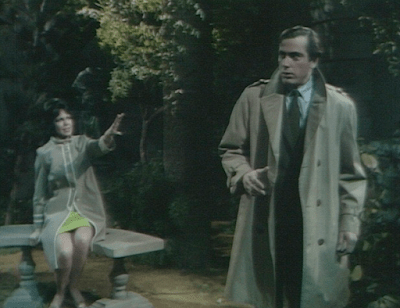
Barnabas, the sheriff, and Julia pay their respects to the late Ms Fredericks. Screenshot by Dark Shadows Before I Die.

The sheriff finds Quentin at the Old House on the estate. He questions him, and gets some very strange answers. Quentin has worked himself into a state when Julia comes back. She announces that she is a doctor and will now give Quentin a sedative. The sheriff takes her word for her professional credentials, and tries to wrestle Quentin into position for her to give him an injection. He can’t manage it, but Julia speaks to Quentin in a tone that is sufficiently authoritative it calms him down right away. Once he is sedated, Quentin asks the sheriff to take him back to the psychiatric facility from which he recently escaped. The sheriff agrees.

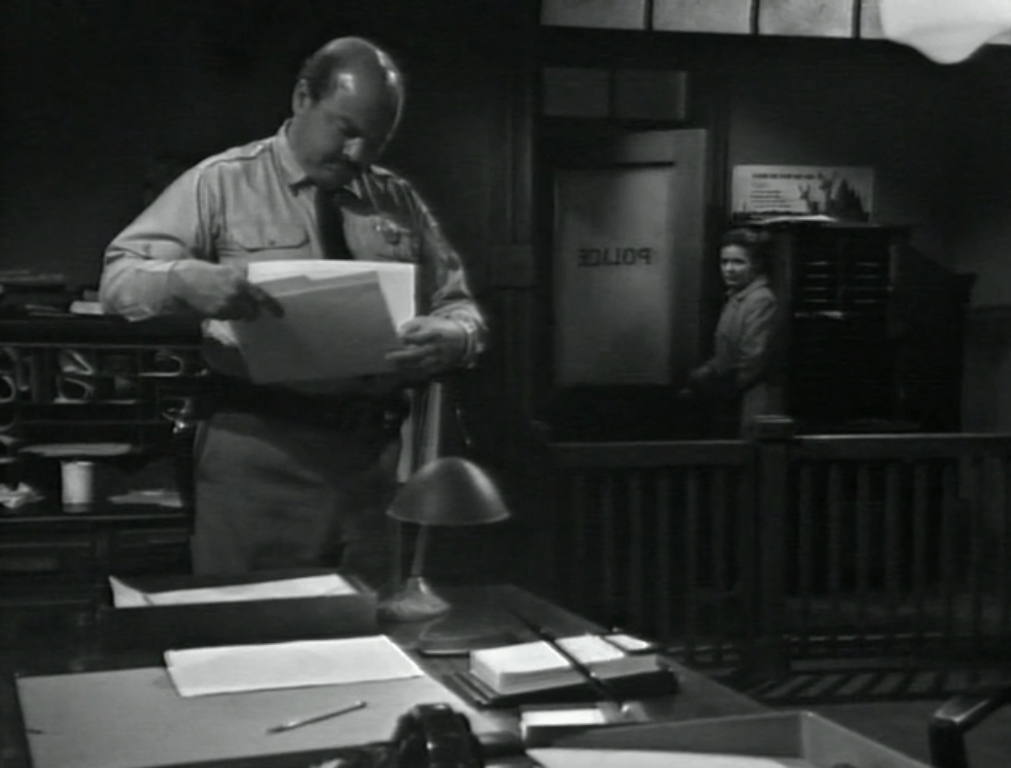
The sheriff turns to Julia and asks where Barnabas is. In lieu of an answer, she tells him to come back to the house immediately before sunset. We cut to Barnabas opening the lid of his coffin. The sheriff is there, sticking a cross in his face, and announcing “I know all about you, Barnabas Collins!” Odd as his behavior in the playroom may have been, this sheriff clearly has more on the ball than did any of his predecessors. It’s a good thing the others weren’t up to his standards. If Sheriff Patterson had been as quick to catch on to what was going on around him in April 1967, Barnabas would have been staked by the end of the month and Dark Shadows would never have become a hit.

Sheriff Patterson may be on the minds of longtime viewers. Sometimes fans wonder what Barnabas’ ultimate plan was when he returned to prey upon the living in 1967. Weren’t the Collinses going to catch on that there was something a bit odd about their “cousin from England” sooner or later, as girls kept disappearing or turning up drained of blood? I think the answer is what we see in these two weeks of episodes, and also in the feature film House of Dark Shadows. Had Barnabas gotten his own way, eventually all living people would have fled Collinwood and no one from the village would have dared approach the estate. He’d have ventured forth occasionally to take fresh victims, but otherwise Collinwood would have been entirely cut off from the outside world. The buildings would have decayed and the grounds been overgrown. It was only because Julia showed up and devised a way to limit his consumption of human blood and to give him hope his curse could be put into remission that he himself did not long ago reduce Collinwood to the condition to which Gerard has brought it.

Episode 1063: To see what you own

The sheriff of Collinsport arrests two trespassers at the long-deserted great house of Collinwood. They are Barnabas Collins and Dr Julia Hoffman, who inexplicably disappeared in 1970 and have even more inexplicably reappeared in 1995. The owner of Collinwood, Carolyn Fredericks (formerly Carolyn Stoddard Hawkes) has complained about them.

Barnabas pretends to be his own son, and claims that Carolyn’s mother, Elizabeth Collins Stoddard, put the Old House on the estate in his father’s name in the late 1960s. While we never saw this happen, from 1967 on Liz often did talk about the Old House as if it and its contents were Barnabas’ property. Furthermore, the sheriff’s office appears to be right across the hall from the registry of deeds, and the Sheriff himself appears to be far more competent than most Collinsport law enforcement personnel we have seen, so if Barnabas were lying he would probably catch on.

The sheriff says that Barnabas may have a right to go to the Old House, but that he found him and Julia at the great house. He asks a number of intelligent questions, none of which Julia or Barnabas can answer to his satisfaction. He threatens to hold them on a vagrancy charge. When Barnabas says that “I have a great deal of money… I own property here,” he backs off that threat, but he does tell them that he hopes their friends from Bangor come and take them away very soon.

Barnabas and Julia leave the sheriff’s office. Carolyn enters from the back room where she has been eavesdropping. She asks the sheriff to look at a picture in her photo album. It is a picture of Julia taken in 1970. The sheriff notices that she hasn’t changed a bit, not even the way she wears her hair. He asks Carolyn if she has any pictures of Barnabas, and she says that she does not. She says that the only picture of him she knows of is an oil painting done in the 1790s.

There was another oil painting of Barnabas done in 1967, and Carolyn’s late cousin David took a photograph of him in #659. The 1967 portrait hung in the Old House, which Carolyn may not have visited in the last twenty five years, and the photograph David took was an oddity that likely would not have been put into an album. So it isn’t really strange that she doesn’t think of them.

Carolyn does remember some other things about Barnabas, though. We open with Julia and Barnabas heading towards the Collins family mausoleum in the old cemetery north of town. They find that the door to the secret chamber is standing open, and are shocked that someone else knows about it. They find Carolyn there. They pretend not to have known about the chamber. They also pretend to be puzzled by the empty coffin in the chamber.

Carolyn says she knows why the coffin is there. She tells Barnabas it is waiting for him. Then she turns to Julia and says that it may also be waiting for her, whichever one dies first. They leave. Carolyn closes the panel and says with a gleam in her eye that it is waiting for him.

“It is waiting… for… him.”

Barnabas is a vampire, and the coffin is his resting place. In the fall of 1967, he bit Carolyn and took her as his victim. He was cured of vampirism in March of 1968. The bite marks disappeared from his victims’ necks at that point, and it seemed that their memory of what he was and what he had done to them faded as well.

But for months after, Nancy Barrett played Carolyn as if she remembered a good deal more than Barnabas knew she remembered. The scripts didn’t give her much support in that interpretation, but it was well over a year before she had to make it clear Carolyn no longer knew about Barnabas. Perhaps whatever happened while Barnabas and Julia were away jarred Carolyn’s memory loose. If Carolyn does remember that Barnabas is a vampire, she is being astonishingly reckless in her scene with him and Julia in the secret room. Barnabas takes a menacing tone when she says that she knows why the coffin is there, and the background music makes it clear that he is on the point of striking when she says it is waiting for him. She laughs after she says to herself that “It is for him”; perhaps the light in her eyes is nostalgia for those days in 1967 when she was his blood thrall.

There is also a scene in Julia’s old room at Collinwood where they find that the box containing the notes she took while trying to cure Barnabas of vampirism has been forced open. They wonder who may have seen those notes.

Julia and Barnabas go back to the great house. She points out that the sheriff will lock them up if he finds them there, a concern Barnabas dismisses. He mentions that they have to find another place for the coffin, and suggests the great house. It would be interesting if they were lugging a coffin around when the sheriff showed up, but Julia puts the kibosh on that. Barnabas then says maybe the Old House. They busy themselves running up and down the stairs in the foyer for no discernible reason. They hear some music coming from nowhere in particular. Barnabas declares that this cannot be a sign of danger, since “music is seldom used to frighten.” For months in early 1969, an evil spirit possessed Collinwood and drove the family out by the incessant playing of a sickly little waltz, but apparently that has slipped Barnabas’ memory.

Yesterday, a man called Victor Flagler told Barnabas and Julia that he and his wife Jeanne had gone into the great house on a dare. Something pushed a heavy object off the rail at the top of the stairs. It landed on Jeanne’s head, killing her, and Victor heard laughter in the house. Julia and Barnabas don’t notice that there is a weighty bust perched on that rail today that wasn’t there yesterday, and Julia stands on the floor beneath it. It falls, and she gets out of the way in the nick of time. They leave the house.

We see a blue dot pulsating inside the house. Barnabas and Julia don’t get a look at that, but when they are outside they do see a man in nineteenth century garb sneering at them through a window. He is the face of whatever is going on in the house. The credits give his name as Gerard.

Episode 935: Call me Jabe

Sheriff Davenport and his new sidekick, mad scientist Julia Hoffman, have come to the top of the stairs above Philip and Megan Todd’s antique shop in the village of Collinsport. The sheriff has a search warrant that specifies the room by the landing as a place of interest in connection with the violent death of one Paul Stoddard. Philip begs the sheriff not to enter the room, saying that a boy who lived there recently died and that any disturbance would “defile” it. He swears the room is entirely empty. The sheriff expresses his sympathy, but opens the door anyway.

Inside is a young man. Philip seems as surprised at the sight of him as are the sheriff and Julia. He gives his name as “Hawkes, Jeb Hawkes. Short for Jabez… Call me Jabe.” No one calls him Jabe, which seems a bit rude. Jabe claims that he came by earlier when Megan was in and Philip was out, and that she offered to let him live in the room.

The room does not contain any furniture, any luggage, or any other movable property whatsoever. Moreover, while it is possible Megan might have rented the room without mentioning it to Philip, it is difficult to see what Jabe has been doing up there since she left, and since Philip has been moving around the rest of the building it is even more difficult to suppose Jabe could have left his belongings elsewhere without attracting Philip’s notice. Jabe claims to be a photographer, but does not appear to have any camera equipment. Moreover, the sheriff will later tell Julia that he noticed a distinctive odor on Jabe that was prominent on Paul’s corpse, and that he found one of Paul’s cufflinks, damaged as by fire, on the floor of the antique shop. In the finest traditions of Collinsport law enforcement, the sheriff does not take Jabe or Philip into custody, question either of them more than cursorily, or close off the antique shop for a further search. He does come back later to tell Jabe that he should think about finding another apartment.

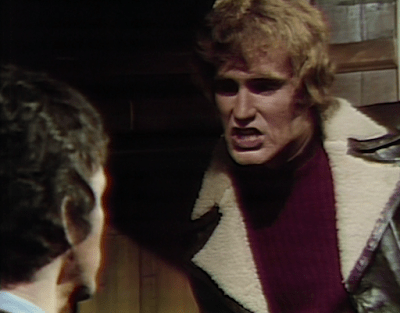
Jabe is the latest embodiment of a mysterious creature that has previously taken the form of a newborn boy, an eight year old boy, an eight year old girl, and a thirteen year old boy. The boys were vicious little tyrants who did not seem to think at all, only to follow impulses to dominate and humiliate whomever they met. The girl was a Doppelgänger of Paul’s daughter Carolyn as she was when she was eight, and she existed specifically to make Paul feel worthless because he was a deadbeat dad. None of these children engaged with another character in a way that meant there was anything at stake for them in any scene. They as much as tell us that the same will be true of Jabe. When Philip complains today that he has put him and Megan in a difficult position by failing to tell them of his plans, Jabe answers “Maybe I just didn’t want to let you know. Maybe I just wanted to see you sweat it out.”

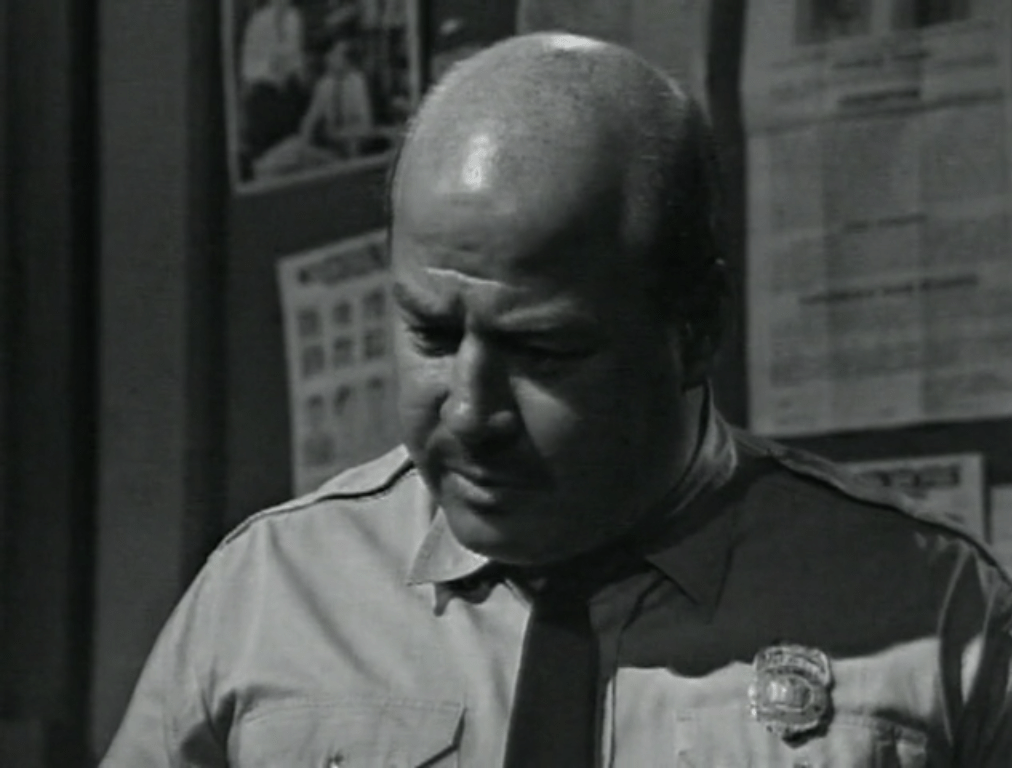
The only time one of the children did anything surprising in an effort to take on an adversary was when the eight year old boy shape-shifted and became the young Carolyn. Had the sheriff not shown the clownish ineptitude typical of his office, but instead done what a real cop would do and arrested Jabe and Philip, they might have created a situation in which Jabe would have to surprise us again. It might be interesting to see him turn into the grown-up Carolyn, for example. As it is, Jabe just insults Philip, goes to the police station, and murders the sheriff.

Jabe berates Philip. Screenshot by Dark Shadows Before I Die.

This puts a new spin on Roger Ebert’s category of “Idiot Plot.” Ebert said that a movie had an Idiot Plot when its story would end immediately if any of the characters had the brains of an average member of the audience. In this case, the story stays stuck in an angry and utterly predictable rut because of the sheriff’s inexplicable nonfeasance.

The first time Mrs Acilius and I watched Dark Shadows through, we hated Jabe and didn’t want to see Christopher Pennock again. Later, Pennock will return in several quite different roles, each of them more appealing than the one before. By the end of the series he had become one of our favorites, and it occurred to us that even as Jabe he managed to do a lot of things right. But there is only so much an actor can do to work around a script problem, and as written Jabe is barely a character at all. His actions cause problems for several other people, but nothing we see him do or hear him say makes us care about why he takes those actions as opposed to any others. It certainly doesn’t help that half of his episodes, including this one, are directed by Henry Kaplan, whose idea of visual composition was to shove a camera so close to an actor’s face that you can see about one half of one cheekbone.

It didn’t have to be that way. Not only was Pennock a fine actor when he had something to work with, but in this episode we have a scene between Julia and rakish libertine Quentin Collins that shows how a character with a bizarre backstory and a record of evil deeds can become an audience favorite. Quentin is down in the dumps because he just failed to rescue his one true love, Amanda Harris, from the realm of the dead. Julia urges him to reconnect with the Collinses of Collinwood. He asks how he can possibly explain that he is 72 years older than he looks and is now alive, even though his ghost carried out a protracted and deadly haunting of the estate. This dialogue shows that Quentin’s origins require us to believe any number of impossible things, and longtime viewers remember that he is a murderer who killed his wife in cold blood, among other unspeakable acts. But all we see in this scene are his charm and the affection that he and Julia have for each other, and we want to see more of that, as much as they can give us. With similar material, Pennock could have achieved similar results. But it is already clear that he won’t get it as Jabe.

Postscript

In his scene with Julia, Quentin says that no one at the hotel where he and Amanda have been staying remembers her, and that all traces of the alias she had been using seem to have disappeared. Julia speculates that when he lost her in the underworld, the last 72 years of Amanda’s life were negated, that the past was reset so that she did in fact die on a night in the 1890s when she might have died had one of the gods of the dead not intervened.

This raises two questions. First, Amanda has been keeping Quentin. If they are now in a timeline where she never came to town, who’s paying his hotel bill and buying his liquor? It’s a standard feature of soap operas that unless they are telling a story about conflicts over ownership of a business or a house or some other valuable property, everyone just has an inexhaustible supply of money, but they put enough time into Amanda and Julia’s squabble as to which one of them would be Quentin’s sugar mama that you might have expected a line or two about this question.

Second, if everyone else has forgotten Amanda, how does Julia remember her? Quentin journeyed through the infernal regions with her, and so I suppose it makes a kind of sense that from that supernatural location he would have a perspective that would transcend our perception of time and space. But Julia was in and around Collinsport the whole time Quentin and Amanda were harrowing the abode of the permanently unavailable. I suppose the real answer is that she is the audience’s point of view character, and as such knows everything we know. But it does leave us wondering if, in the course of her adventures, some kind of uncanny power may have rubbed off on her.

Episode 787: You said that, I said nothing

Dark Shadows fans like to make jokes about the inefficiency of law enforcement in the fictional town of Collinsport, but in this episode we see that the sheriff and his men really never had a chance. The ancient and esteemed Collins family controls everything in the area, and they will go to any lengths to keep the police from obtaining the information they need to do their job effectively.

Stuffy Edward Collins invokes the police when he demands that broad ethnic stereotype Magda Rákóczi vacate the Old House on the estate of Collinwood. Magda laughs and says that if the police show up, she will tell them that Edward’s distant cousin Barnabas is a vampire. Horrified at the damage it would do to the Collins family name were word of Barnabas’ condition to get out, Edward backs down. Barnabas is at large and has been responsible for at least six homicides since traveling through time to the year 1897, including the murder of Edward’s brother Carl in the drawing room of their home just the other day. But evidently that is a small matter to Edward compared to the danger that the sheriff might be indiscreet.

Barnabas materializes at the police station, where a werewolf is being held in custody. A deputy is startled to see Barnabas in front of him all of a sudden. For only the third time in the series, Barnabas says “Look into my eyes!” and induces an hypnotic trance in someone not his blood thrall. It is the first time he has exercised this power on someone other than Edward’s nine year old daughter Nora. Barnabas tells the deputy that once he has completed his task, he will remember nothing. So he is following the family policy with regard to keeping the police in total ignorance.

Edward shows up and sees Barnabas. Edward is wearing a cross and holding a revolver loaded with six silver bullets, which on Dark Shadows are as effective against vampires as they are against werewolves. Barnabas hides behind the deputy and tells Edward that he is acting in the interests of the future of the Collins family. Edward says that he belongs to the past, not the future. Barnabas doesn’t explain anything; he vanishes.

Not exactly an heroic look for ol’ Barney. Screenshot by Dark Shadows Before I Die.

Barnabas’ post-hypnotic suggestion has its effect, and the deputy is bewildered to find himself face to face with Edward. Edward tells him that they must watch the werewolf. The deputy starts to say something about the sheriff, and Edward replies “The sheriff doesn’t realize what this animal is!” Of course he doesn’t, no one will tell him anything about it.

Back in the Old House, Barnabas and Magda lament their failures. He could not take the werewolf from the cell in the police station to the cell in the basement of the house; she could not persuade lawyer/ Satanist Evan Hanley to return a severed hand he stole from them. They wanted to do these things because the werewolf is Edward’s brother Quentin, whom Magda is trying to free from his curse by means of the hand’s magical powers. Barnabas knows that if they do not succeed, terrible consequences will ensue in 1969.

Closing Miscellany

It is a serious mistake to show the werewolf when he is not in the act of committing a spectacular homicide. They didn’t have the budget to put him in full-body makeup, so he wears a tidy little suit, complete with a watch fob. He is so well put together that it is difficult to imagine him inspiring any fear other than the fear that one will not meet his apparently rather exacting standards of attire.

Whoooo’s a well-dressed doggie? You are! Screenshot by Dark Shadows Before I Die.

There is a noteworthy blooper in this one. Magda confronts Evan, declaring “The book, I know you took it from the Old House!” Usually actors roll with each other’s bobbled lines, but this is far enough out that Humbert Allen Astredo obviously has no idea where Grayson Hall is in the script. All he can do is ask “The book?” “The hand!” she corrects.

They also make a goof in the closing credits. This is one of three consecutive days when Louis Edmonds is billed not as Edward, but as Roger Collins, the role he plays in the parts of Dark Shadows set in the 1960s. He’s been identified correctly throughout the first seventeen weeks of the 1897 segment and everyone else is identified correctly in these episodes, so it is not clear what happened.

Danny Horn’s posts at Dark Shadows Every Day are often laugh-out-loud funny, and the one for this episode is especially so. His description of the scene between Magda and Evan has some big laughs, and when he imagines the sheriff’s deputies trying to catch the werewolf by “putting on their alluring lady-werewolf disguises a la the Warner Brothers cartoons,” well that’s just super how could anyone improve on it.

Episode 777: Two murderers at Collinwood

The opening voiceover, delivered by Kay Frye, tells us that a vampire named Dirk Wilkins has been destroyed. We hear that Dirk was the pawn of someone called Barnabas Collins, who hoped to use him to conceal a secret of his own. The narrator also says that “certain things cannot be forgotten, as Judith Collins will learn this day.” This implies that the day’s action will center on challenges in information management.

Returning viewers may not recognize Miss Frye’s voice. We have seen her as Pansy Faye, Cockney showgirl, improbable fiancée of prankster Carl Collins, and victim of Dirk’s first murder. As narrator, Miss Frye forgoes Pansy’s rather uncertain East London accent. She also takes a different approach to the role of narrator than she had to that of Pansy. When we first saw her, Pansy was putting on an act for Carl’s benefit, and Pansy is a terrible actress. When Carl left, Pansy dropped her act and we could see that Miss Frye is as capable a performer as the character is a poor one. Today’s voiceover gives Miss Frye a still better role. The crass and cynical Pansy did not call for much nuance. But as narrator, Miss Frye speaks with a quiet urgency and subtle modulation of the voice that leaves us wondering what might have been had she been cast in a bigger part.

We cut to what regular viewers recognize as the drawing room of the great house of Collinwood in the year 1897, where a man in a cassock is talking tenderly with a woman in a colorful dress. The man is very affectionate, even stroking the woman’s neck with two fingers.

Trask fingers Judith’s neck. Screenshot by Dark Shadows Before I Die.

The woman is the Judith Collins mentioned in the opening voiceover; the man is the Rev’d Gregory Trask. It is not mentioned in the episode, but Trask is the keeper of a boarding school called Worthington Hall. Also unmentioned is that Trask conspired with a Satanist named Evan Hanley to brainwash a young man named Tim Shaw, one of the teachers at Worthington Hall, and that once he was under their control they used Tim to murder Trask’s wife Minerva. Trask wanted Minerva out of the way, evidently because he plans to marry Judith and take control of her vast fortune.

Judith is disconsolate at the thought that she was under Dirk’s control. While Trask is talking sweetly to Judith, Tim enters. Trask pulls a gun on him and instructs Judith to call the police and report that Minerva’s murderer has been captured.

Tim, who has up to this point ranged from mousy to timid to utterly defeated, is suddenly assertive. He tells Judith that she won’t want to telephone the sheriff. He says that there are two murderers at Collinwood, and she is one of them.

Tim says that he came upon Judith in the act of shooting neurotic intellectual Rachel Drummond to death. Returning viewers know that this is true; Tim, Judith, and Rachel were all under Dirk’s power at the time, and for reasons that made sense only to the dim-witted Dirk he ordered Judith to kill Rachel. A vague memory comes back to Judith and prompts her to confess; when Trask realizes that Tim will not back down from his accusation and Judith will not participate in a cover-up, he tells Tim he will make a deal with him.

Trask calls the sheriff. He addresses himself to “Sheriff Furman,” a name we have not heard before. It quickly becomes clear that we are not likely to hear it again. He tells the sheriff that Tim was out of town the night Minerva was poisoned and that, in his grief, he had forgotten this fact. Returning viewers know that Evan has told the sheriff that he saw Tim with Minerva while she was dying. One might assume that Trask would at least have to call Evan first to ensure that he gave the sheriff a story to account for this discrepancy, but Trask doesn’t bother to contact Evan at all. Evidently the sheriff is such an abysmal moron that Trask can safely assume he won’t think of any questions.

Sheriff Furman’s manifest incompetence prompts one of Danny Horn’s funniest posts at Dark Shadows Every Day, in which he writes a series of hypothetical police reports about the killings we have seen so far in the 1897 segment. One of Danny’s recurring themes is that law enforcement characters on Dark Shadows serve only to delay the plot. There is so much story in 1897 that the producers saw no need to slow things down, so it shouldn’t be surprising that neither Sheriff Furman nor any of his deputies appear on-screen.

For my part, I wish they had stayed in 1897 considerably longer, so I would have liked to spend one day a week or so without much forward narrative movement. That might have included some episodes when the police show up and you do a lot of recapping, some built around character studies of the type Joe Caldwell wrote so well in 1967, some in which we reconnect with Collinwood as it is on the night in 1969 when Barnabas left for the past, and so on. Not only would that have extended the show’s strongest period and helped new viewers catch up to what is going on, it would also have enabled them to make more use of the many fine actors whom we go weeks on end without seeing. Even David Selby, whose handsome rake Quentin Collins is breaking out as a pop culture sensation at this point, hasn’t been on the show since #768. Other fan favorites are in the midst of even longer unexplained absences; for example, Lara Parker’s wicked witch Angelique has not been seen since #760.

Tim, who was out of the room while Trask was on the phone, returns. He “gladly!” agrees to leave Trask’s employ, and at first says that he will “gladly” leave the village of Collinsport. But then it dawns on him that he needs a job, and he blackmails Judith into assuring him that she will find a place for him in her business.

This will remind longtime viewers of the spring and early summer of 1967. At that time, Dark Shadows took place in a contemporary setting, and there were two major storylines. One was the introduction of the vampire Barnabas Collins. The other was the blackmail of matriarch Elizabeth Collins Stoddard by seagoing con man Jason McGuire. Like Judith, Liz owns all of the Collins family’s assets; also like her, she is played by Joan Bennett. Threatening to expose the terrible secret that she was a murderer, Jason forced Liz to take him into her home, pay his debts, give him a job, and agree to marry him. When she finally balked rather than go through with the marriage, it turned out Liz wasn’t a murderer after all, the whole thing was a scam Jason cooked up.

Jason was a short-term character brought on to tie up the last non-supernatural narrative loose ends and fill time while Barnabas found his footing, as witness the casting of Dennis Patrick, who refused to sign a contract for the role since he wanted to be free to move to Los Angeles without giving more than 24 hours notice. But in those days, before the internet or soap opera magazines, the audience had no way of knowing that. They may well have thought that Barnabas would be destroyed and Jason’s oppression of Liz would become the show’s backbone.

In yesterday’s episode, a vampire was in fact destroyed. In May and June 1967, Barnabas’ chief victim was Maggie Evans, who like Rachel was played by Kathryn Leigh Scott. It was possible then that he would kill Maggie and that she would rise as a vampire, as Lucy Westenra did in Bram Stoker’s Dracula, compelling the good guys to stake her. Rachel doesn’t become a vampire, but Trask does tell the sheriff that it was the men hunting Dirk who shot her, accidentally. So when the final appearances of Dirk and Rachel lead to Judith both submitting to blackmail because of her mistaken belief that she is a murderer and taking steps towards marrying an overwhelmingly evil man, longtime viewers will remember a resolution that seemed to be on the horizon back in 1967.

Carl enters. Judith has no patience for her childish brother, and dismisses his concerns about Pansy. She tells Carl to go with Tim to the Old House on the estate. Tim took Rachel to the Old House when she was dying. Barnabas, who has traveled back in time to 1897, is staying there, and he had befriended Rachel. Tim had hoped Barnabas would help them, but it was daylight and he was not available. Rachel died in the Old House, and Tim left her corpse there when he came to the great house.

When Carl and Tim leave, Trask warns Judith that she almost gave herself away. “You must be more cautious, Judith! Even Carl was suspicious.” Judith agrees, showing that Trask is luring her into his world of lies.

We see Tim and Carl at the Old House. Rachel’s body is no longer there. Who took it, and why didn’t Tim and Carl leave with them? We are not told. Carl goes on about how wonderful Pansy is, and says he is going to the police because he thinks someone at Collinwood has done her harm. Evidently Carl’s suspicions are more highly developed than Trask realizes. Trask underestimates Carl because he is focused exclusively on Rachel and Tim. He never met Pansy, and knows nothing about her.

Carl leaves the house, and Pansy’s ghost appears to Tim. Tim is bewildered, and asks Pansy if she is looking for Barnabas. That is a natural assumption- after all, it is Barnabas’ house and Tim has no idea who Pansy is. When she vanishes into thin air, he shouts for Carl. He finds Carl not far outside the door, and describes the woman he saw. Carl jumps to the conclusion that she is Pansy, and starts calling for her. He sends Tim along to the great house, and continues searching for Pansy.

Evidently Carl’s search did not take long, because we see him standing next to Tim in the drawing room at the great house in the next shot. It is Rachel’s funeral.

Trask delivers a eulogy in which he says of Rachel that “The littlest angels have a new teacher.” Even first-time viewers are likely to laugh out loud at this ridiculous turn of phrase, and those who have been with the show for a while will see more in it than that. From childhood on, Rachel was Trask’s prisoner, first as one of the pupils imprisoned in his horrible school, then when he extorted her into staying on as a teacher with threats that he would have her prosecuted on false charges of theft and murder if she tried to leave. He made flagrant sexual advances to her as well, all the more hideous because he has been responsible for her since she was a small girl. In Rachel and Tim’s helpless personalities, we saw what can happen when a criminal like Trask is given an opportunity to turn a person into filet of human being, and an ominous sign of what might lie in store for Judith’s nephew and niece Jamison and Nora, who are currently among the inmates at Worthington Hall.

Tim and Carl bury Rachel themselves. My wife, Mrs Acilius, asked “Isn’t this usually handled by professionals?” Presumably whoever took Rachel’s body from the Old House would have been a better choice for the work than are Tim and Carl, but that isn’t the Collins way.

Tim announces his intention to get drunk. Carl brings up other things they might do, and Tim says that those will have to wait until after he gets drunk. After Tim leaves to pursue his eminently sound plan, Carl hears Pansy singing. He wonders if she is dead. He realizes that her voice is coming from the mausoleum which we know to have been Barnabas’ longtime home. Carl is played by John Karlen, who in the parts of Dark Shadows set in the 1960s plays the luckless Willie Loomis. It was Willie who inadvertently released Barnabas from the mausoleum, so longtime viewers who see this actor on this set will expect something important to happen in the story.

Episode 654: After you see what happens, you will never be the same again

One of the duller storylines in the first several months of Dark Shadows was the relationship between hardworking young fisherman Joe Haskell and flighty heiress Carolyn Collins Stoddard. Carolyn and Joe were thoroughly bored with each other before we ever saw them, and we were treated to scene after scene of them having nothing to say while they were out on dates. They only kept going out to humor reclusive matriarch Liz, who was both Carolyn’s mother and Joe’s employer.

Eventually Joe and Carolyn went their separate ways, and Joe struck up a much happier romance with Maggie Evans, The Nicest Girl in Town. There were too few obstacles between Joe and Maggie to make for exciting drama. There were long stretches when the show had established that they wanted to get married and couldn’t give us a single reason why they didn’t. Occasionally one of them would be caught up in the strange goings-on, and then we would see the other being all anguished and determined to get to the bottom of all this. As Dark Shadows‘ principal representatives of the working class of the village of Collinsport, Maggie and Joe were appealing when they went into that mode, suggesting a whole community of people who struggle to make sense of the inexplicable disasters that continually emanate from the big house on the hill.

Joe is on his way out of the show now. Actor Joel Crothers has taken a part on another soap, and will be leaving any day. In recent months, supernatural beings have cast spells on Joe and Maggie that have caused each to think the other had fallen out of love. Yesterday they met at her house. He told her he would be leaving town soon, probably never to return. They agreed to part as friends.

This scene of parting was cut short when a telephone call came summoning Maggie to the great house of Collinwood. Joe drove her there, and was downstairs when Liz offered Maggie a job as governess to the two children living there, strange and troubled boy David Collins and Joe’s orphaned cousin Amy Jennings. Maggie accepted the job, which Liz stipulated would start immediately. Joe drove back to her house to get the things she would need to stay the night.

Joe had only been in the Evans cottage a moment when a window burst open and a werewolf entered in a shower of broken glass. We open today with Joe fighting the werewolf. He manages to stab the werewolf with a pair of scissors. The werewolf does not appear to be gravely wounded, but he does run away.

The werewolf drops in on Joe. Screenshot by Dark Shadows Before I Die.

Back at Collinwood, Maggie is worried that it is taking Joe so long to get her things. Old world gentleman Barnabas Collins suggests that Joe might be having trouble finding the items on the list she made; she rules that out, saying that it was a very short list. She calls home. Joe picks up the telephone and immediately passes out. This alarms Maggie. She stays at Collinwood while Barnabas goes to the cottage to investigate.

Barnabas finds an unconscious, bloodied Joe in the midst of the wreckage strewn throughout the Evans cottage. Joe comes to, and resists Barnabas’ offer to call a doctor.

Shortly after, Barnabas enters Collinwood, Joe leaning heavily on his shoulder. Barnabas went to the Evans cottage alone, and he cannot possibly have carried Joe all the way back. Later, it will come up that Joe’s car is still at the cottage. So Barnabas must have learned to drive and acquired a car at some point in the last several months.

In the drawing room, Joe receives medical attention from permanent houseguest Julia Hoffman, MD. When Julia asks if he is ready to talk to the police, she is surprised to find that he hasn’t called them, isn’t going to call them, and doesn’t want anyone else to call them. She and Barnabas try to reason with him. When Julia points out that the werewolf might attack someone else tonight, Joe asks if it did any good when Liz saw the werewolf and called the sheriff. Julia looks down and, sounding like a chastened child, says “No.” Regular viewers know that calling the sheriff’s office never does any good in Collinsport, and Julia’s reaction is so much that of a person who is aware of this fact that I suspect the humor is intentional.

Barnabas and Julia reluctantly agree not to call the sheriff. They leave Joe alone with Maggie, who says she feels guilty that this terrible thing happened to him while he was doing her a favor. He says he’s just glad it didn’t happen to her. She says “We keep on hurting each other, and it just isn’t right!,” apparently expecting to finish the parting-of-the-ways scene that was interrupted yesterday. He is not interested. She notices that he is clutching a strip of fabric, and asks him what it is. He says that it is “nothing at all.”

The next day, we see mysterious drifter Chris Jennings in his apartment. We hear his thoughts in voiceover as he worries that he may have killed his cousin Joe the night before, when he was the werewolf. This does not imply that Chris remembers what he did in his lupine form; he knew that a pentagram had been seen on Joe’s face, and that this marks the werewolf’s next victim.

Chris goes to Collinwood to see Julia. He had hoped she would give him a sedative powerful enough to make him sleep through his time as the werewolf. Had he told her his real problem, she would likely have been very helpful, since she specializes in treating patients who are based on monsters from Universal Studios movies of the 1930s, but all she knew when he came to her was that he was a hobo demanding narcotics. It’s against Julia’s nature to deny anyone sedatives, so she did give him a few pills, but they didn’t help.

Chris sees Maggie. She tells Chris that she just left his sister Amy playing at Barnabas’ house. She explains that she is the governess now, a fact in which Chris feigns interest for almost five seconds. “Oh, that’s… that’s really great, that’ll be great for her” he says. He then tells Maggie he has been looking for Joe. When she indicates that Joe was attacked the night before, he grabs her by the arms so hard he hurts her and shouts his questions in her face.

As it happens, Joe is also looking for Chris. At nightfall, Chris returns home to find Joe waiting for him. Joe had brought the strip of fabric that Maggie had seen him holding at Collinwood and matched it to a gap torn in Chris’ shirt. He confronts Chris, who tries desperately to get him to leave. When he realizes he cannot get rid of Joe, he tells Joe where he keeps his gun, and tells him to use it “when it happens.” Joe sees Chris turn into the werewolf and does empty the revolver into his chest, but it only slows him down. As the episode ends, the werewolf is closing in on Joe.

In his posts about this episode and the preceding one, Danny Horn remarks on Maggie and Joe’s inability to have an extended breakup scene as a sign that Dark Shadows is very different from other soap operas, and on Maggie’s inability to get anyone interested in her new job as a sign that Dark Shadows has changed- “This is not that kind of show anymore,” her writes. I would go further, and say that they amount to a programmatic statement. The first 38 weeks of the show were all about the well-meaning Victoria Winters’ attempt to find her place as a governess; Maggie can’t get us to pay attention to her thoughts about the position for 38 seconds. Carolyn and Joe’s months-long relationship amounted to about one-fifth of a breakup scene, the part where the former lovers realize they’ve said everything they had to say but neither wants to be the first to leave the room. But Joe and Maggie no sooner start talking about the end of their far more substantial relationship than it is time to rush off and do battle with a werewolf. That’s what Dark Shadows is about now, and they want us to know it.

Maggie’s brief remark to Chris that she left Amy playing at Barnabas’ house will also strike longtime viewers as a programmatic statement. That house, the Old House on the estate, was introduced in #70 as a haunted ruin. David’s habit of sneaking into it caused the adults no end of concern, especially after Barnabas moved into it in #220. Barnabas was a vampire then. That was a secret, but everyone could understand that he did not want to look up and find David in his house. In those days, the governess would never have dreamed of leaving her charge to play in Barnabas’ house.

That Maggie is now the governess adds an extra charge to this moment. In May and June of 1967, Maggie was Barnabas’ victim and he held her prisoner in the Old House. Julia used her preternatural powers of hypnosis to erase Maggie’s recollection of that ordeal, but several times since the show has teased the idea that her memory might come back. When Maggie so blithely mentions that she left Amy at Barnabas’ house, it is clear to use that Dark Shadows has no further plans for its previous storylines about the place.

I was puzzled as to why Joe suspected that the strip he tore from the werewolf’s shirt would match Chris’. There is nothing at all distinctive about Chris’ clothing even in the full light of day, and in a few moments of pitched battle in a dimly lit room there is no way anyone would have recognized the werewolf’s clothes as the ones Joe had seen Chris wearing earlier that evening. I think it would have been better if, when Joe saw Chris in his room in yesterday’s episode, Chris had spilled some brightly colored fluid or powder on his shirt. He could easily have done that, it is a small room and the two of them were both very upset. Joe could then have recognized the smudge during the fight, and that would have explained why he thought that it was his cousin under the fur.

Episode 481: Every time, it will be the same story

Dr Julia Hoffman is in the front parlor of the house of her fellow mad scientist, Eric Lang. She is on the telephone, asking the operator to connect her with the police. Even though she has lived in the Collinsport area for months now, she is still surprised that the sheriff’s office doesn’t have an emergency number.

Julia locked the door to the parlor; Lang is outside it with a gun, and recovering vampire Barnabas Collins is knocking and calling her name. They want to stop her reporting to the police that Lang is building a Frankenstein’s monster with body parts retrieved from the cemetery, and that he was planning to cut a living man’s head off to use as the last piece of the creature. Lang plans to bring the body to life by draining Barnabas’ “life-force” into it. Barnabas hopes this will free him of the vampire curse once and for all, and is desperate to complete the experiment.

Barnabas shouts that Julia should remember “someone.” When he can’t come up with the name, Lang prompts him with a yell of “Dave Woodard!” Barnabas and Julia killed local physician Dave Woodard in #341; Julia hangs up the phone, realizing that if the operator ever does manage to find a police officer any investigation of Lang would likely expose her as a murderer.

Barnabas has told Lang a great deal about himself. For example, in #467, Lang was the first person Barnabas told that his vampirism was the result of a curse placed on him by wicked witch Angelique. So returning viewers can believe that Barnabas might have confided in Lang about the murder of Dr Woodard. But it would be strange for him to have done so off-screen. And just Friday, Barnabas explained to Lang that the reason he thinks Julia can be trusted with the secret of the experiment is that she has a crush on him.* He hasn’t had much time to share more information with Lang since then, and if Lang had already known that Julia couldn’t call the cops without exposing herself to a murder charge Barnabas wouldn’t have needed to mention her crush on him. The likeliest explanation is that the loud and clear exclamation of “Dave Woodard!” is not Lang prompting Barnabas at all; rather, it was Addison Powell prompting Jonathan Frid. The result is a blooper that seriously confuses the relationships among Lang, Barnabas, and Julia. It’s early enough in the episode that it really is odd they didn’t stop tape and start over.

At any rate, they never mention Woodard again. He was introduced early in the vampire storyline. He was the counterpart to Dr John Seward, the physician in Dracula who realizes that all the patients who are suddenly showing up with puncture wounds on their necks and massive blood loss need care he is not trained to provide, and calls in his old med professor, Dr Van Helsing. Julia was the Van Helsing analogue, but she wound up siding with the vampire and killing her onetime friend. It is appropriate that the last reference to Woodard comes in this, the second episode of Dark Shadows with no cast members introduced before Barnabas. From now on, the daylight world Woodard represented and tried to restore is no longer present even as a memory.

Julia lets Barnabas and Lang into the parlor, and asks Lang to promise that he won’t kill anyone. He gives such a promise. She is unconvinced, but agrees not to call the police. She also tells Lang she will continue to oppose the experiment.

On the terrace of the great house of Collinwood, Barnabas and Julia talk about Lang’s experiment. Angelique, wearing a black wig and calling herself Cassandra, lives in the house as the wife of sarcastic dandy Roger, and the terrace is surrounded by trees, fences, and other prime screens for eavesdroppers. Barnabas and Julia know this well, as each of them has eavesdropped on important conversations here themselves.

Of course Angelique/ Cassandra comes by and hears everything. Barnabas does catch her, grab her, call her by her right name, and vow that she won’t stop him. After he lets her go, he moans to Julia that it was foolish of them to discuss their plans there. That underlines the foolishness of an idea key to the plan, that after Lang’s creature has been animated Angelique will never realize that Barnabas is dwelling within it and place a fresh curse on it. Barnabas assumes that Angelique, who has transcended time itself to pursue him, will just give up and go away once she sees that his original body is dead, and won’t have any questions about the new guy living at his doctor’s house.

Angelique summons her new cat’s paw, lawyer Tony Peterson. Jerry Lacy plays Tony. From #365 to #461, Dark Shadows was a costume drama set in the 1790s. In that phase of the show, Mr Lacy played the Rev’d Mr Trask, a fanatical witchfinder who inadvertently gave Angelique a great deal of assistance in her campaign to destroy the Collins family and those close to them. Most of the characters in the 1790s segment represent a commentary of some kind on the characters the same actors play in the parts of Dark Shadows set in the 1960s. Tony and Trask have seemed to be an exception. In 1967, Tony was introduced through his profession and served mainly as an instance of Mr Lacy’s famous Humphrey Bogart imitation. Trask did end up functioning as a lawyer in a witchcraft trial, and his lunatic shouting about “THE ALMIGHTY!!” and “THE DE-VILLLL!!!!” were occasionally suggestive of what Bogart might have ended up doing if Captain Queeg’s testimony before the court-martial in The Caine Mutiny had gone on for nineteen weeks. Otherwise, there didn’t seem to be any fruitful points of comparison between the two.

Angelique tells Tony that the reason she chose him as her servant was that he reminded her of Trask. She orders him to go to Lang’s and steal a talisman that can guard against witches. At that, Tony shouts “Against you!,” and he sounds very much like Trask. Perhaps we are to think that a secular education and a steady diet of Hollywood movies could have turned the farcically warped Trask into a basically reasonable fellow like Tony, but that there is no strength in those things to stand up to a force like Angelique.

Angelique zaps Tony. Screenshot by Dark Shadows Before I Die.

The talisman was a gift to Lang from Barnabas. Lang refuses to keep it on his person, even though it saved his life to clutch it when Angelique was making his heart beat so fast it was about to burst. Lang shows up at Barnabas’ house, under the false impression he received a telephone call from Barnabas. Barnabas, who has no telephone in his house, explains to Lang that Angelique has lured him away. When he learns that Lang has left the talisman in his desk drawer at home, he insists on accompanying him back there.

It is too late. Tony has already stolen the talisman and delivered it to Angelique. She looks at it and says that Lang will not be able to save either Barnabas or himself. Presumably, not even by reminding him of his lines.

*My wife, Mrs Acilius, pointed this out.

Episode 259: Mustache, must tell

Elizabeth Collins Stoddard, matriarch of the ancient and esteemed Collins family of Collinsport, Maine, receives a telephone call. Her daughter Carolyn is in jail. Driving drunk, Carolyn barely missed a pedestrian, smashing instead into a tree. The almost-victim rescued Carolyn from the car moments before the fuel tank exploded, and Carolyn rewarded her with some nasty remarks. Liz is upset that her brother Roger isn’t available to pick Carolyn up from the police station.

Well-meaning governess Vicki suggests that Liz go to the police station herself. Liz hasn’t left home under her own power for eighteen years, and so reacts to this idea with dread. Vicki talks her into it, giving Alexandra Moltke Isles a chance to show that there is some substance to her character. Looking in through the front door, we see Liz taking a series of halting, forced steps to Vicki’s car.*

Seen in isolation from the rest of the series, Liz’ march is a poignant evocation of agoraphobia. But the Liz-is-a-recluse story is a dead end. They never showed us anyplace Liz would want to go, and the reason for her staying in the house was exposed in #249 as nonsensical. Still, they’ve been presenting Liz as a recluse from the beginning, so sending her into town feels like a promise that something big will happen.

In the police station, we see that Sheriff Patterson has grown a mustache. He didn’t have one when last we saw him, in #248, and he won’t have one when next we see him, in #272. So this is our only chance to appreciate it.

Carolyn is doing a “teen rebel” bit. This would have been one thing earlier in the series, when she was supposed to be fresh out of high school and wildly capricious. But she took charge of the family business for a month early in the spring of 1967, and has been relatively level-headed since. When she makes sassy remarks to the sheriff, they are just throwing all that character development out the window.

Liz shows up, to the sheriff’s amazement and Carolyn’s. Carolyn recovers from the shock, and claims she is not impressed by Liz’ leaving the house. Liz supposedly stayed there for eighteen years waiting for Carolyn’s father, Paul Stoddard, to come back. Now she is divorcing Stoddard and marrying seagoing con man Jason McGuire. If Stoddard means nothing to Liz anymore, what’s the big deal about going into town? Carolyn then makes some superheated remarks about Liz’ disloyalty to Stoddard. Finally, she refuses to leave with Liz. She insists on spending the night in a cell.

In #244, Liz tried to tell Carolyn that her father was a terrible man who never loved anyone. Carolyn became upset and wouldn’t listen to her, then jumped to believe Jason’s stories that Stoddard was a fine fellow who doted on her. That was understandable as a first reaction to dismal news, but we’ve never seen any other indication that Carolyn is especially hung up on the father who disappeared from the house when she was an infant. All the shouting about “my father!” comes out of nowhere. The scene amounts to nothing.

Back in the drawing room, Liz has a conversation with Jason. She has agreed to marry him because he has threatened that if she does not he will reveal to the police that she killed Stoddard and he buried him in the basement. The blackmail plot has been dragging on for months, and we have yet to see anything happen between Liz and Jason that didn’t happen in the first five minutes they were on camera. At this point, scenes like this are just a test of the audience’s endurance.

Upstairs in Collinwood, Vicki hears sobbing in Liz’ bedroom. She calls to her, and lets herself in. She apologizes for urging her to see Carolyn. She suspects that Liz has something she wants to say, and gently presses her to say it. Liz finally confesses that she killed Stoddard. The whole scene is very effective, a strong conclusion to a weak outing.

*It became clear in #232 and #233 that Vicki has a car. How and when she came into possession of this vehicle has not been explained.

Episode 251: Madness preferable to sanity

We reprise the final scene of Friday’s episode, in which vampire Barnabas Collins catches his prisoner Maggie Evans trying to stab him. He flashes his fangs at her.

Doctor Teeth and the Electric Mayhem

The first time around, this had been the climax of a number of powerfully realized scenes, so it still carried a punch despite the silliness of the fangs. From a standing start, though, the result is a bad laugh.

In the 45 seconds following the first commercial, ABC staff announcer Bill Rice* summarizes the action of the previous week’s episodes.** This recap comes so close to exhausting every event we saw in those 110 minutes of scripted drama that regular viewers will have another unintended laugh.

The recap was inserted because many ABC stations preempted Dark Shadows to cover a United Nations debate about the Vietnam War. The show was about as resolutely disengaged from contemporary politics as it was possible to be, but conjoining US policy in Vietnam with a character like Barnabas, who combines a vast capacity for killing with a desperate need to be loved, does bring certain thoughts to mind.

Barnabas and Maggie have a conversation about his inclination to kill her. Barnabas’ sorely bedraggled blood-thrall Willie Loomis joins in, saying that Barnabas will have to kill him first. This would not seem to present Barnabas with any difficulty at all. Willie wouldn’t be missed- everyone else on the show remembers Willie from the days before he met Barnabas, when he was dangerously unstable ruffian Willie Loomis, and has been urging Barnabas to get rid of him. Nor would it be especially difficult for Barnabas to replace Willie- he just has to bite someone else, and that other person will become his new slave. But Barnabas stands around arguing with Willie and Maggie. When someone knocks on the front door, he scolds Willie for failing to keep it locked, such a humdrum complaint under the circumstances as to bring another bad laugh. Barnabas leaves Willie and Maggie in the basement while he answers the door. Before he goes, he sticks out his lower lip, a facial expression known as “pouting.”

Barnabas pouts

The visitor is well-meaning governess Vicki, who tells Barnabas that the sheriff has ordered that no woman go out alone at night. Some think it strange to send a woman out alone at night to carry this message to a man who is indoors, but considering what we’ve seen of the sheriff, doing the exact opposite of what he commands would seem always to be the wisest course.

Vicki notices an antique music box on a table in Barnabas’ front parlor. Vicki admires its tune and makes a few not-very-coherent remarks about “the past” while it is playing. Barnabas has been using this music box as a tool to hypnotize Maggie into believing that she is his long-lost love Josette. After Vicki leaves, he opens it again, then looks at the door through which she left. He turns his head and smiles, looking very much like someone who has just had an exciting new idea.

Lightbulb moment

Meanwhile, Maggie and Willie talk to each other in the basement. The two of them had one of the most electrifying scenes of the entire series down there Friday. The last traces of that energy have been piddled away by the time Barnabas comes back downstairs and resumes his conversation with them.

Willie urges Barnabas to look at Maggie and see how beautiful she is. Barnabas says “No” and looks away. Coming at a moment of high dramatic tension, this might have been powerful. When we sit down as an audience, we enter into a sort of agreement that if the show includes something worth seeing, we will look at it. So when we see a character refusing to look at a sight as well worth contemplating as was the young Kathryn Leigh Scott,*** we might be shocked. But there has been too much idle chatter, and the memory of Barnabas’ pout is so fresh, that all we can think of is a petulant child saying “I don’t wanna look at her!”

Barnabas announces that he will not kill Maggie right away. He tells her that he will make her suffer torments worse than anyone has ever known so that death will finally come as a blessed relief, then locks her up in the prison cell in the basement of the house. What, your house doesn’t have a prison cell in its basement? It’s a standard feature of homes in Collinsport, as we will come to see in future episodes.

Barnabas goes to the great house of Collinwood and talks to Vicki. He brings a handkerchief that, legend has it, was a gift from the queen of France to Josette. They babble about “the past” and Barnabas invites her to drop in at his house “some day.” He says “day,” even though he’s busy being dead every day until sunset. And doesn’t specify when- any old time, if she hears screams coming from the basement she’ll probably just ignore them.

Evidently Barnabas is thinking of Vicki as a backup Josette in case Maggie doesn’t come around. This marks a retreat from #240 and #241, when strange and troubled boy David Collins, who has seen Josette’s ghost many times, saw Maggie in the gown Barnabas gave her and said that she must have been Josette because she looked “exactly the same” as he had seen her before. That suggested, not only that Barnabas chose Maggie because of her looks, but also that he might be right in thinking that she is Josette’s reincarnation. This storyline is modeled on the 1932 Universal film The Mummy, in which Imhotep’s idea that Helen Grosvenor is the reincarnation of his lost love Princess Ankh-esen-amun is substantiated when Zita Johann plays both roles. If Vicki and Maggie are interchangeable, then all of that goes by the boards.

*Presumably no relation to the main character of Gene Roddenberry’s 1963-4 CBS TV series The Lieutenant, one episode of which was written by Art Wallace.

**As transcribed by the Dark Shadows wiki:

For those who have missed the last few episodes of Dark Shadows: Elizabeth Collins [Stoddard,] at Jason McGuire’s insistence, has taken Vicki, Carolyn, and Roger into the basement room and convinces them that it holds no mystery. They don’t realize that beneath the flagstones on the floor is concealed the room’s secret—the body of Elizabeth’s husband, Paul. Elizabeth, now realizing that the secret can never be told, announces to the family that she and Jason will be married. Maggie Evans escaped from Barnabas and attempted to get to her father, but was recaptured and told by Barnabas that unless she assumes the identity of Josette Collins, she will die. Realizing that she can never escape, Maggie attempts to destroy Barnabas.

The title card shown during the recap

***Or for that matter as is the not-so-young Miss Scott of today, she’s one of the best looking octogenarians around.