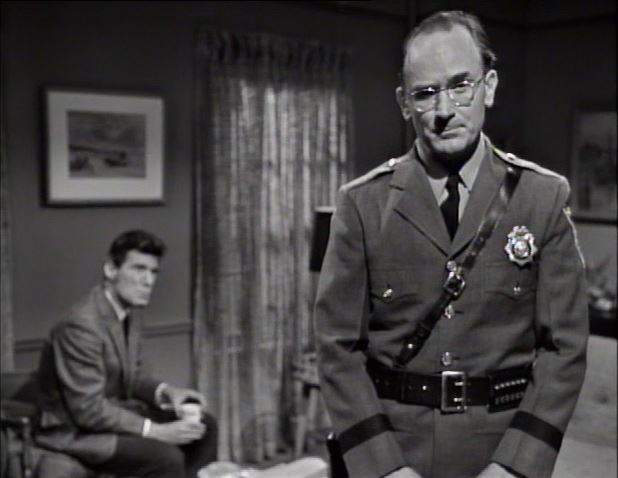
At the end of yesterday’s installment, artist Sam Evans looked out the window of his house and saw his daughter, missing local girl Maggie. Today, the sheriff shows up and reports that he and his men couldn’t find anything to substantiate Sam’s report. The sheriff then tries to convince Sam that he didn’t really see Maggie at all. When last we see Sam, he is telling himself that it was only his imagination.
Maggie had escaped from the custody of vampire Barnabas Collins and Barnabas’ sorely bedraggled blood thrall, Willie Loomis. Today, Barnabas meets Maggie in the graveyard, chokes her, and takes her into the tomb where he spent a century or two. He declares that he will punish her for trying to leave him.
As Barnabas talks, Maggie seems inclined to go along with his plan to annihilate her personality and replace it with that of his long-dead love, Josette. He wonders aloud if the punishment he was planning is necessary after all. But then she remembers that she is holding her father’s pipe, and she calls out “Pop!” Barnabas then takes her to the hidden room in the back of the tomb and shuts her up in his old coffin.
Director Lela Swift was uncharacteristically sloppy with the framing yesterday, but today she makes up for it with one of the most remembered shots of the entire series. When Barnabas shuts Maggie up in the coffin, we see him from her point of view. Claustrophobic viewers beware!
Barnabas closing the lid
The next morning, Willie releases Maggie from the coffin, takes her back to Barnabas’ house, and urges her to convince herself that she is Josette. For a while, she tries it. We start to wonder if Willie will have as much success with Maggie as the sheriff had with her father. But then she looks in the mirror and shouts “I’m Maggie Evans!”
That may not sound like much story for 22 minutes, but it never feels slow. Swift and the actors are all in fine form today.
On the other hand, there are a couple of script problems. The sheriff is written as such a fool that we can’t help but be distracted, and the scene between Maggie and Barnabas in the outer section of the tomb goes on too long. But even at its lowest points the actors just about save it. Dana Elcar always makes it seem that Sheriff Patterson knows more than he’s letting on, so it isn’t until he starts trying to talk Sam into believing he didn’t really see Maggie that we get the sinking feeling that he is absolutely useless. And Jonathan Frid and Kathryn Leigh Scott are electric as Barnabas and Maggie, so much so that we could forgive the scene between them even if it had been twice as repetitious as it fact is. With two consecutive episodes including as much good stuff as was in yesterday’s and today’s, it’s starting to seem like they are due to land one in the ranks of the Genuinely Good Episodes any day now.
Dark Shadows has been a supernatural thriller ever since the ghosts of Josette and the Widows scared Matthew Morgan to death in December 1966. But today’s episode is the first one that is structured like a horror movie.
Horror movies tend to focus on the visible damage done to the bodies of the female victims of the monster. The current victim is Maggie Evans, The Nicest Girl in Town, and the monster is vampire Barnabas Collins. We open with Maggie’s father, artist Sam Evans, looking helplessly around the house. Sam doesn’t know it, but Maggie was compelled to leave by the power that Barnabas has gained over her by drinking her blood.
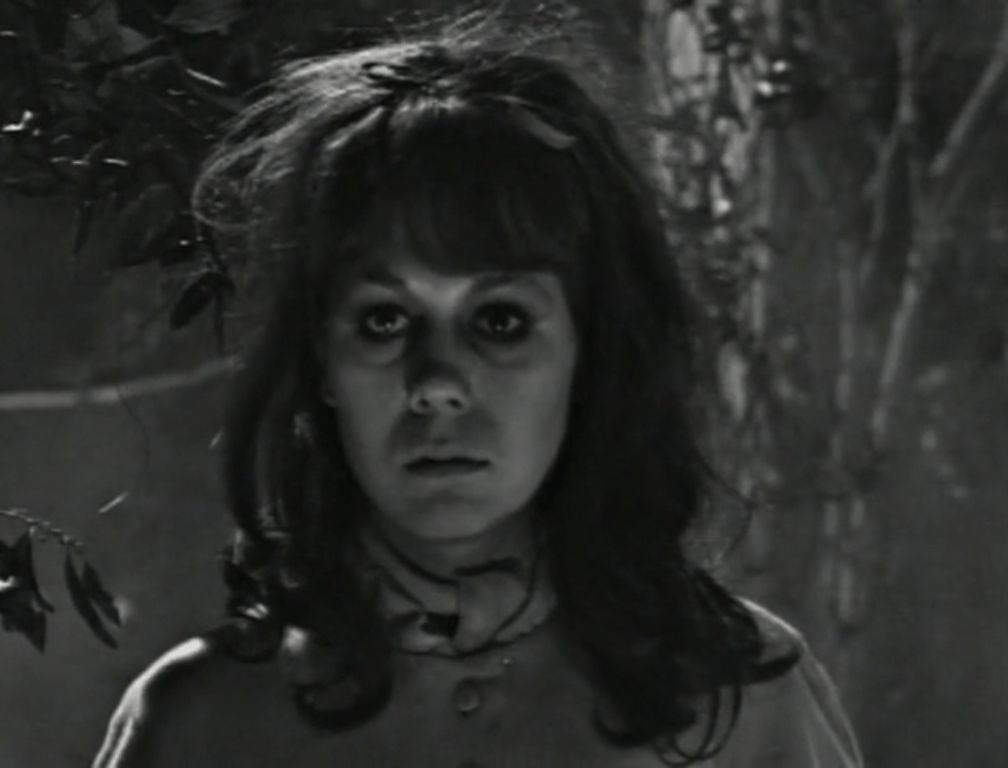
What Sam does know is that Maggie was in extremely poor health. He cannot understand how she could have gone anywhere under her own power. We then see Maggie looking awful and wandering around the graveyard. Later, a closeup of a professional headshot of actress Kathryn Leigh Scott will dissolve into an image of Maggie among the tombstones, contrasting her usual fresh-faced beauty with her present ghastly haggardness.
Maggie’s professional headshotThe dissolveBride of the monster
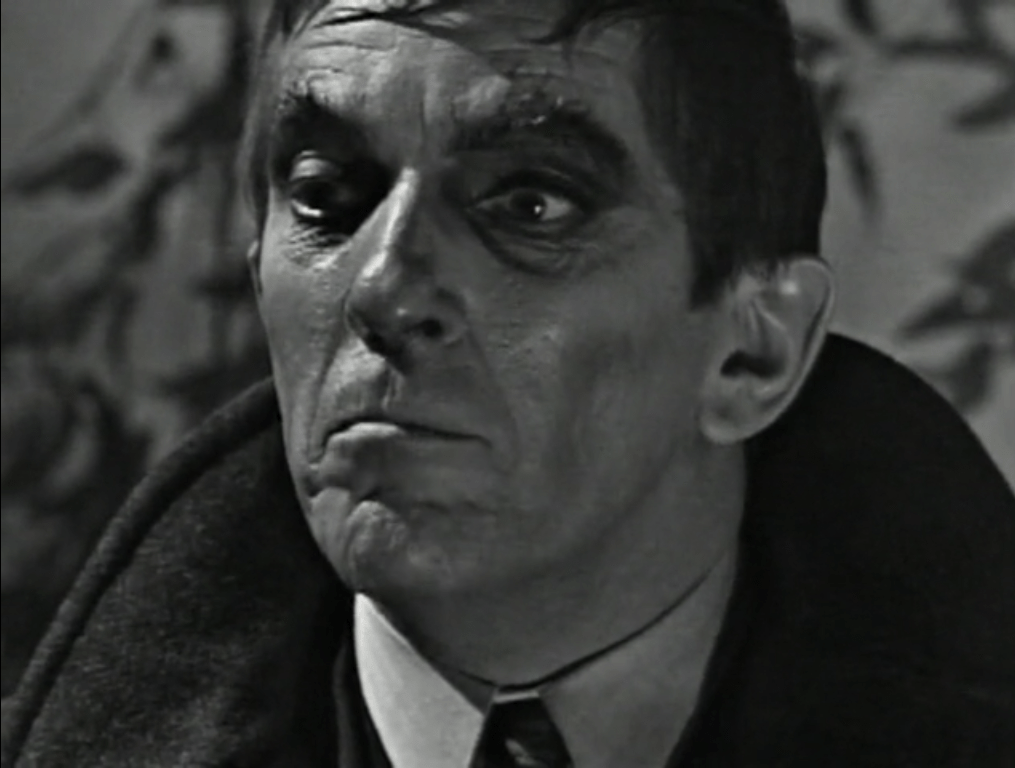
The monster who has reduced her to this sorry state, vampire Barnabas Collins, emerges from the fog. Barnabas has been on the show for four full weeks now, but this is the first time we see his face not in the pleasant disguise of a wealthy gentleman visiting from across the sea. He is wearing a more extreme version of the makeup Maggie has on, and his fangs feature prominently. This is the introduction of the monster, a key element on any horror film, and it suggests that Barnabas is now what Maggie will become.
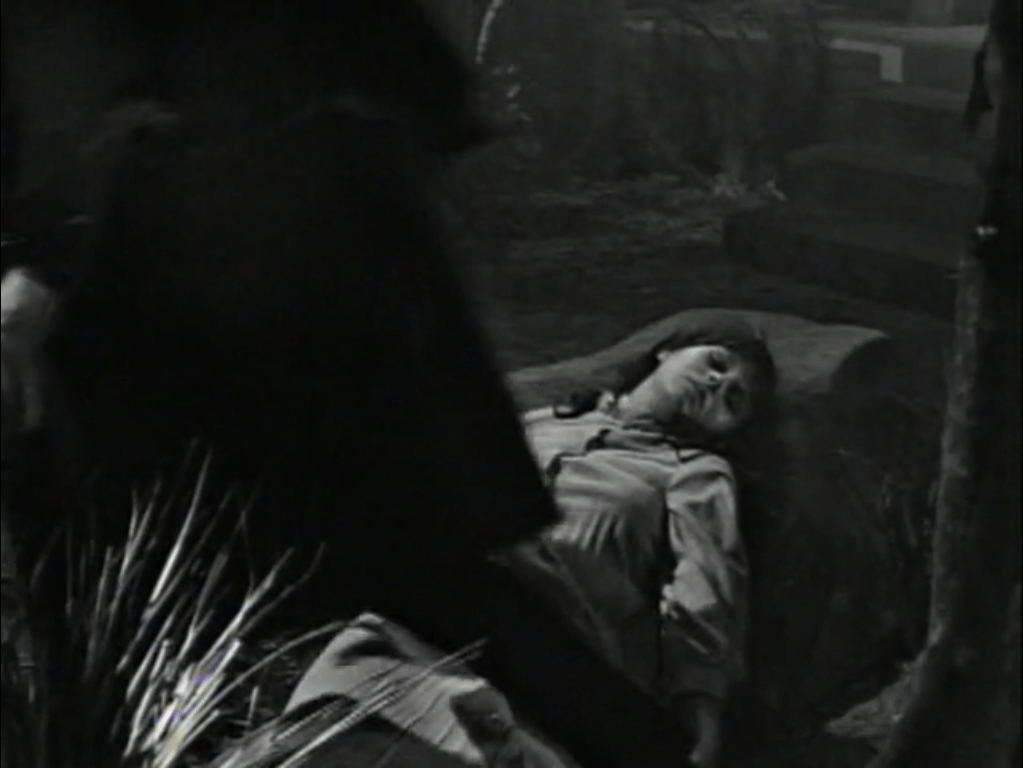
When Barnabas hears Maggie’s friends approaching before he can complete his evil plan, he drops her on the ground and steps over her, again treating her body as a thing.
Barnabas steps over Maggie
After she is carried home, Maggie moans about her pain but can say nothing about what has happened to her, who is responsible for it, or what she is thinking. Again, we can connect only with her physical being, not her social relations or her inner life or the events that have involved her. At the end, the handkerchief tied around her neck is removed without her permission or objection, as if she were inanimate. The camera zooms in on open wounds on her neck, isolating that area and leaving us with the image of the wounds as things available to us to examine apart from Maggie’s personality or the rest of her body.
The Source of the Evil
The episode is an adaptation of elements from Bram Stoker’s Dracula. Early in that novel, the vampire’s victim Lucy rose from her sickbed and wandered off to a graveyard. As Lucy is found by her friend Mina, so Maggie will be found by her friend, well-meaning governess Vicki. As Mina would spend the second half of the novel as the only female member of a group of stalwart and dynamic men doing battle with the evil Count, so Vicki is working with an otherwise all-male search party led by dashing action hero Burke Devlin. As Mina’s colleagues exclude her from their activities and thereby come close to total failure, so the men leave Vicki behind in the Evans cottage to wait by the phone, only to find that she is the one who will have the most to offer when she joins them in the field.
After Lucy dies and her undead form is destroyed, Mina becomes Dracula’s victim. Mina ends up as the precursor of the “Final Girl” in the mad slasher movie, playing a key part in Dracula’s final defeat, though unlike those movies Dracula ends with a successful team effort.
Since Vicki has been our point of view character from the beginning, was an effective protagonist in the “Phoenix” storyline, and is as relentlessly wholesome as the Final Girl typically is, we might expect that she will be Barnabas’ last victim. That expectation in turn suggests that Maggie, like Lucy, will die, rise as a vampire, and be destroyed by those who love her most. Maggie is one of every viewer’s favorite characters, so the prospect that she might turn into a monster and then leave the show altogether brings keen suspense.
Barnabas Beats His Willie
Vicki does have two important conversations with sorely bedraggled blood thrall Willie Loomis while she is in the Evans cottage. The first occurs when Willie comes to the door to bring a message that his master Barnabas will not be available at the usual time to sit for the portrait Maggie’s father is painting of him. Vicki tells Willie that Sam is out searching for Maggie, and Willie becomes very upset to learn that Maggie is missing.
The second conversation comes a few minutes later, when Willie, not disguising his voice in any way, telephones the Evans cottage and tells Vicki that Maggie is in the cemetery and that she is in extreme danger. Somehow Vicki doesn’t recognize his voice. I suppose there were lots of people it might have been- maybe it was Detective Mary Beth Lacey’s husband Harvey from Cagney and Lacey, or Stefan from Daughters of Darkness, or Jock Porter from Love is a Many Splendored Thing, or Geoffrey Fitton from the original Broadway cast of All in Good Time, or any of dozens of policemen and criminals who were in single episodes of cop shows in the 1970s and 1980s.
Willie’s call to Vicki made me wonder about the extent of Barnabas’ powers. When we first saw Barnabas with Willie, his power over him was so extreme that it cost Willie a great effort even to ask Barnabas an unwelcome question, and a look was enough to drive Willie to scurry off and perform the most hateful of tasks. An act of defiance like this was out of the question. Perhaps Barnabas can only keep one blood thrall under total control at a time, and by adding Maggie to his diet he has weakened his hold over Willie.
Willie intrudes on Barnabas’ encounter with Maggie in the cemetery to warn him that Maggie’s friends are on their way. Barnabas instantly suspects that Willie told them where to look for her. When Vicki’s party arrives in the cemetery, Barnabas and Willie run away and hide in the back room of the Collins family tomb where Barnabas was trapped for about 170 years until Willie accidentally released him. This is a departure from Dracula– the Count would have attacked whoever interrupted him, no matter how many of them there were, and fled only if they were armed with crucifixes or consecrated communion wafers or other objects he couldn’t tolerate. But, as my wife Mrs Acilius pointed out, Barnabas has gone a long time without using his vampire powers, so he’s probably rusty.
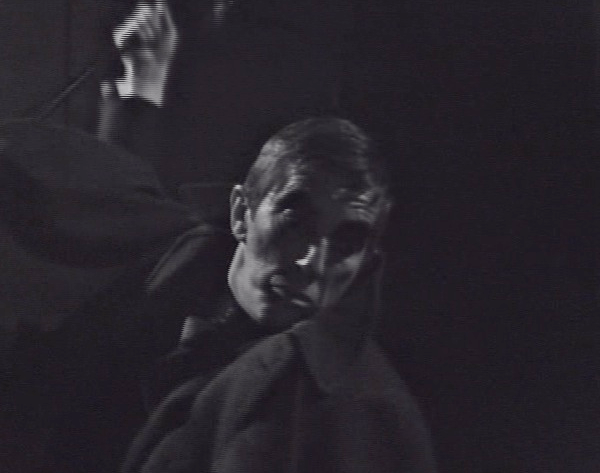
Barnabas and Willie listen as Burke looks around the outer room of the mausoleum. Once they are sure he is gone, Barnabas confronts Willie with his suspicions. Willie’s lies do not satisfy him, and he lifts his heavy cane and starts beating Willie with it. All we see of this beating is Jonathan Frid’s face and the cane in his hand, but those images, coupled with sound of John Karlen’s cries, imply a violence that shocks us.
Burke picks Maggie up off the ground, grunting audibly as he does so. He carries her into her house, again with a lot of grunting. If I had been Kathryn Leigh Scott’s agent, the production staff would have received a very hot letter about that grunting. The good-looking young women on a soap opera aren’t supposed to weigh anything at all, certainly not enough to cause a dashing action hero to grunt like that even if he carried her all the way from the cemetery.*
In his post about this episode, Danny Horn has some lines about the ineffectiveness of the Collinsport police that I can’t resist quoting:
Sam tells the Scooby gang that he’s alerted the police — the sheriff and his deputies are out looking for Maggie. But, as everyone knows, the police department in Collinsport is 100% useless, so by now the deputies have probably arrested each other, and the sheriff’s all tangled up in a clothesline somewhere…
Vicki tries to call the sheriff, but there’s no answer; apparently every single person associated with the police department is out searching for Maggie, or falling down wells, or buying magic beans, or whatever the hell it is that Collinsport police officers do in a crisis.
When I first read about “the sheriff all tangled up in a clothesline somewhere” a few years ago, I laughed for about five minutes and knew I would be reading Danny’s blog to the end. I’m glad I did, it’s so much fun it inspired me to start this one.
*Mrs Acilius and I remembered a story Miss Scott tells nowadays. Early in the production of the show, Joan Bennett saw her eating a cheese Danish and said “The figure you have now can be your career for the rest of your life.” She put the cheese Danish down immediately, and hasn’t eaten another since. Our response to the story has been to eat cheese Danish on Miss Scott’s behalf at regular intervals.
The entire episode is set in the Collinsport Inn- the lobby, the restaurant, and Burke’s room.
In episode 21, Vicki took Liz in hand as if she were Plato’s Socrates and Liz were some pompous Athenian aristocrat, leading her through a series of simple, seemingly innocent questions to a most uncomfortable conclusion. That took place in the drawing room at Collinwood, while Carolyn watched. In episode 24, Carolyn joins Burke and the sheriff in Burke’s room. It’s Burke’s turn to play Socrates, Carolyn’s to answer the questions, and the sheriff’s to be an audience. Burke’s questioning is not only effective at raising doubts in the sheriff’s mind, but also prompts regular viewers to bracket Vicki and Burke together and see them as a likely, indeed inevitable, romantic pair.
The scenes in Burke’s room also highlight Roger’s bizarre folly in telling Burke his evidence against him before going to the police. We saw Vicki try to talk Roger out of this in two episodes, and the sheriff commented on it later. Watching the well-prepared Burke cross-examine Carolyn as effectively as any defense attorney, it is all the clearer that Roger’s behavior was driven not by any rational calculation, but by some wild impulse he cannot entirely control.
The scenes in the lobby and the restaurant show us a quiet rewriting of some characterizations laid out in episode 1. In that episode, Burke stood in the lobby and refused to admit that he so much as knew the name of Mr Wells, the hotel clerk, simply because Wells was from the town from which he was sent to prison ten years before. Now he stands on the same set, warmly greets one of the policemen who made the case against him, and repeatedly tries to persuade him to join him for lunch. Also in episode 1, Maggie stood behind the counter of the restaurant and told Vicki that she considers her, as a member of the staff of Collinwood, to be a “jerk” practically as bad as the family that owns the house. In this one, Carolyn herself comes into the restaurant and she and Maggie have a warm, cozy chat, like old friends.
I suppose it was inevitable that they would retcon Burke into a hail-fellow-well-met and Maggie into a friend of at least some of the Collinses. After all, soap operas consist mostly of conversation, so characters who aren’t on speaking terms with each other are dead weight. Placing these scenes on the same sets used in episode 1 is an emphatic way to make it clear to viewers who remember that episode that the change is intentional and permanent.
The videography is also as ambitious as we ever see it in this show. The camera tracks fluidly through the lobby, showing us more of that set than we see in any other episode, ending in a low angle shot of the sheriff that makes him look ominous. Some of those tracking shots are too much for Michael Currie, the actor playing the sheriff- during his scene alone with Burke, he bumps into one camera, stumbles into a piece of furniture, and then the other camera hits him in the back of the head. After that, he stands with his back to Burke and his elbows bent in front of him, looking for all the world like he is urinating on the floor:
Currie is so physically awkward that when Burke asks the sheriff the rhetorical question “Have you ever sat on a wrench?,” it seems to be a pretty near certainty that the answer is yes.
Currie has a rough time in this episode with his lines as well as with his movement. Perhaps the single funniest blooper comes when he declares that a good memory “is what I’m paid for,” then forgets his next line. It’s also interesting when he calls Burke “Burt.” Bloopers are after all one of the things Dark Shadows is known for, so we can’t be too annoyed with him for those. Worse is what happens when he does remember his lines. He intones them all as if he were leading the Pledge of Allegiance.
In the months after Mark Allen left the show, the standard of acting on it was remarkably high. Every actor other than Currie consistently turns in performances so strong that watching an episode feels like a fine evening at the theater. And bad as he is, even Currie doesn’t keep his scene partners from delivering good performances. He just wasn’t ready for professional acting. So I don’t have the same need to complain about him as about Allen, but he does deliver the series’ first laugh-out-loud moments of incompetence, and it is a relief when he is replaced.
Roger has finally deigned to notify the police of his suspicion that Burke Devlin tampered with his brakes in an attempt to kill him. In story time, that was twelve hours ago. In the interim, both Roger and Bill Malloy have gone to Burke’s room and told him everything they know and think they know. Roger presented Burke with Vicki and her testimony. The newspaper has run a front-page story about it.
The sheriff is peeved that Roger is bringing him into it only now. Roger explains that his goal in giving Burke all the evidence in advance of any investigation was to persuade him to leave town, but that he never had the opportunity to present that idea to Burke.
Upstairs, Vicki is trying to teach David a lesson about the history of Maine. Considering that we learned in episode 13 that Vicki has never heard of Augusta, the capital of the state, it’s difficult to be optimistic about that instruction. But every scene between David and Vicki in his room is worth watching. No matter what lines they may be required to say, David Henesy and Alexandra Moltke Isles always use body language, facial expression, tone of voice, and spatial position to convey the emotions appropriate to their characters. As episode follows episode, those emotions shift from wild hostility on David’s part and patient solicitude on Vicki’s to genuine affection and trust. It’s the one story-line that really works in the first 42 weeks of the show.
David made some incriminating remarks to Vicki and his aunt the night of his father’s wreck; they both thought he was simply expressing his guilt over his hostility to his father. In this one, he asks Vicki if she ever tried to kill anyone. She tells a story of some fist-fighting she did at the Hammond Foundling Home, and says that’s as close as she got. She looks happy telling David that story, not because it’s a happy story, but because it’s a chance to make a connection.
She isn’t happy at the end of the episode- when David grabs at the bleeder valve and the other adults ignore his action, we see it dawn on her that he is the culprit.
I don’t agree that Constable Carter seems intelligent. He greets David by asking his name. If a cop has been on the job for over ten years in Collinsport, a town under the shadow of a big house called Collinwood, home of the the Collins Cannery and the Collins Fishing Fleet, and he still doesn’t know the four members of the Collins family, he’s an idiot.
Of course, he is sensible when he’s demanding to know why Roger waited twelve hours before coming to him and expressing incredulity at Roger’s visit to Devlin. Characters in soaps and suchlike productions are always declaring they have to do their own investigations before they can go to the police, and often this is treated in the story as if it were a reasonable thing to do. But every step of the way they’ve lampshaded the preposterousness of it. Vicki kept telling him it was a bad idea before he did it, last episode Sam reacted scornfully when he told him what he repeats to the constable here, that he wanted to give Devlin a chance to leave town and never come back. And the constable shows the same scorn for the idea today.
Those scenes make Vicki, Sam, and the constable look smarter than Roger, but we’ve seen enough of Roger to know that he isn’t a fool. Something is clouding his judgment, something more complicated and slipperier than the stories that have been suggested to us so far. Roger is hiding more than one thing, and he doesn’t trust himself with his own secrets.
David looks at the camera again today, when he’s eavesdropping on the conversation with the constable. An effective tactic- we the audience know what he knows, and he seems to be pleading with us to keep quiet.
Another meaningful look at the end of the episode. When the constable, who is an idiot, says cheerfully that now we’ll know how David’s fingerprints got on the wrench, Vicki gives David a grim little glance. Just for a second- but not only is it the last moment of the episode and therefore emphatic, it is also the second time we’ve seen her give David that look. The first time was in his room, when he was betraying himself with some remarks about how terrible it would be to go to prison. We can see a terrible idea starting to form in the back of Vicki’s mind.