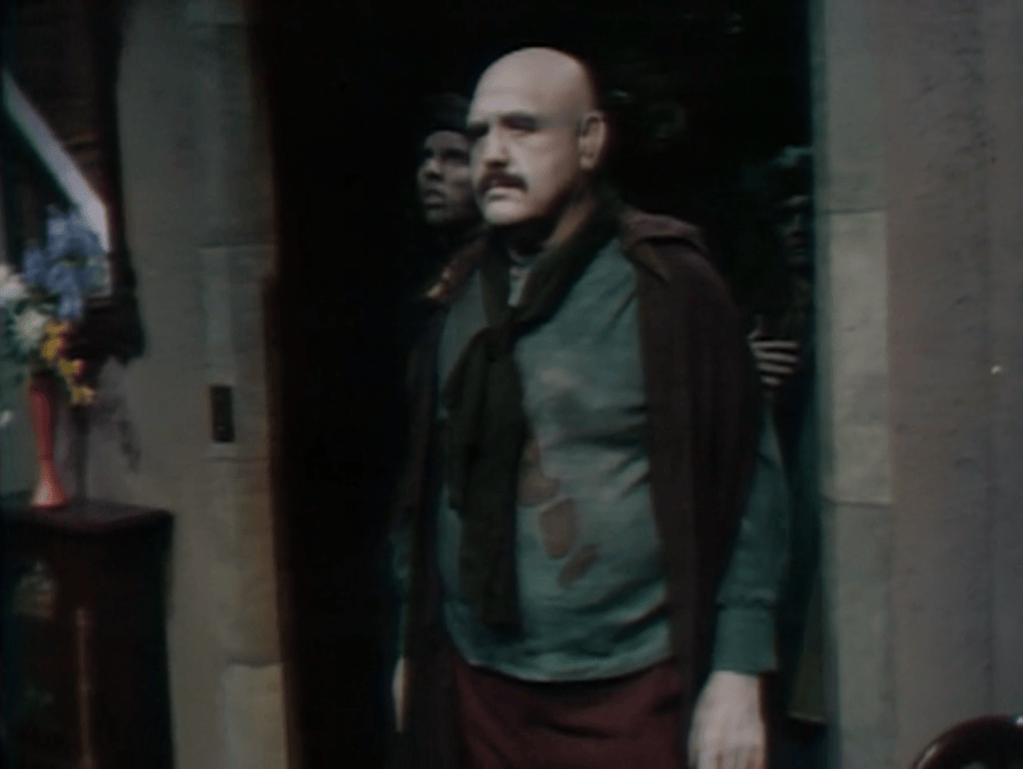
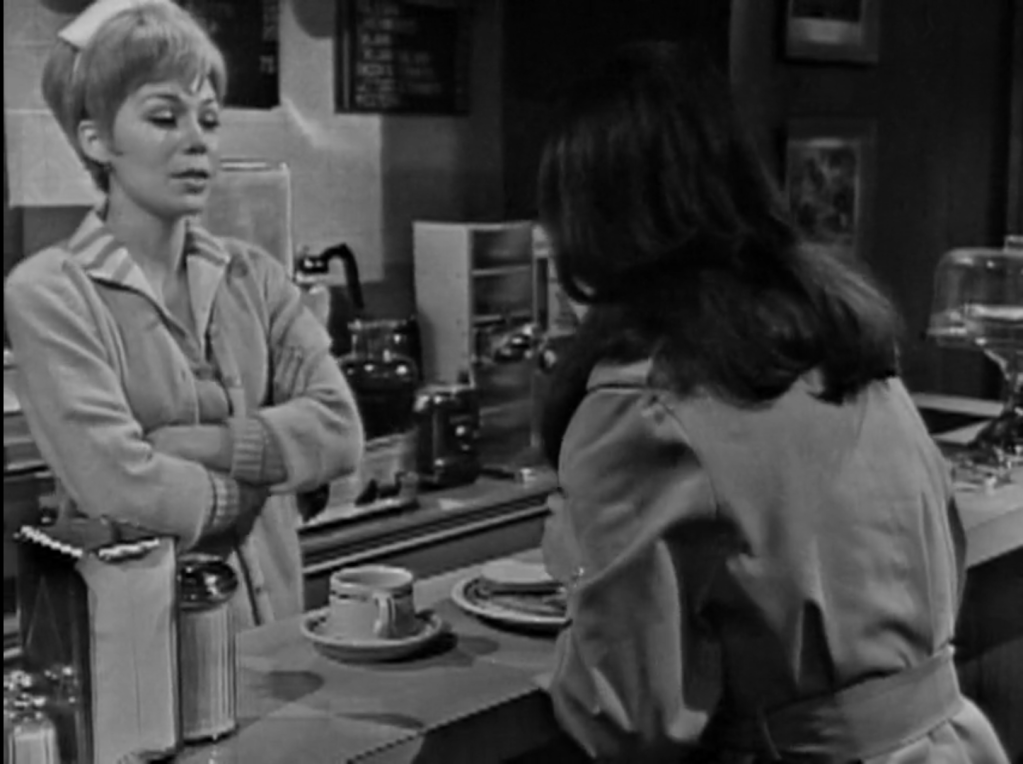
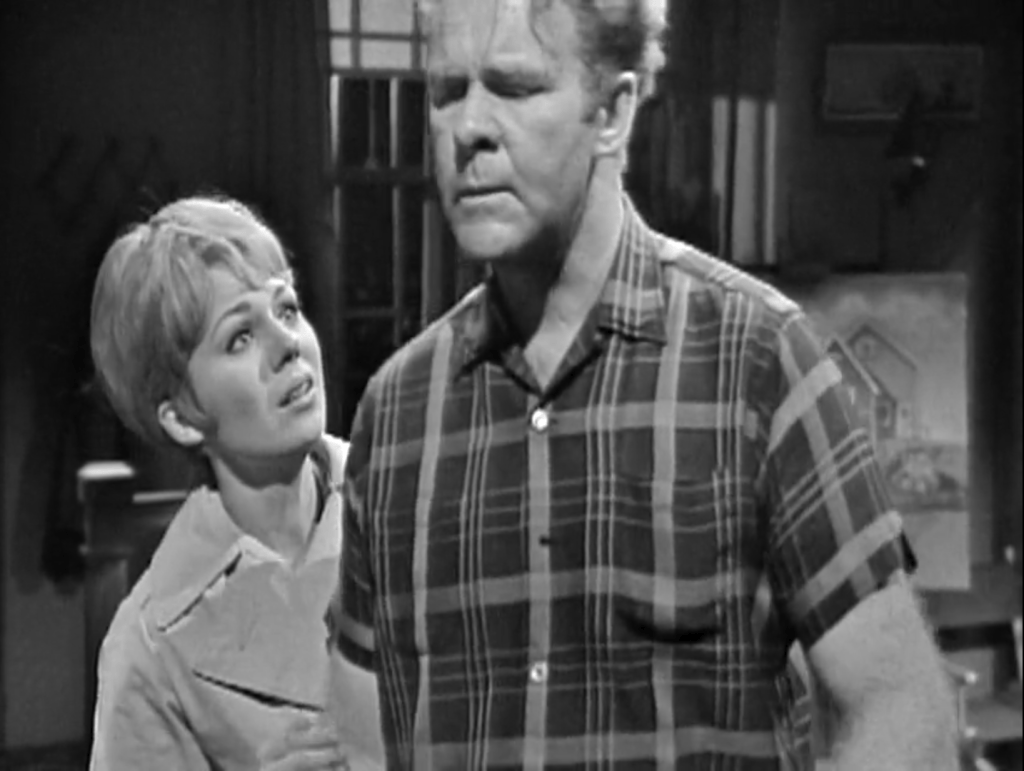
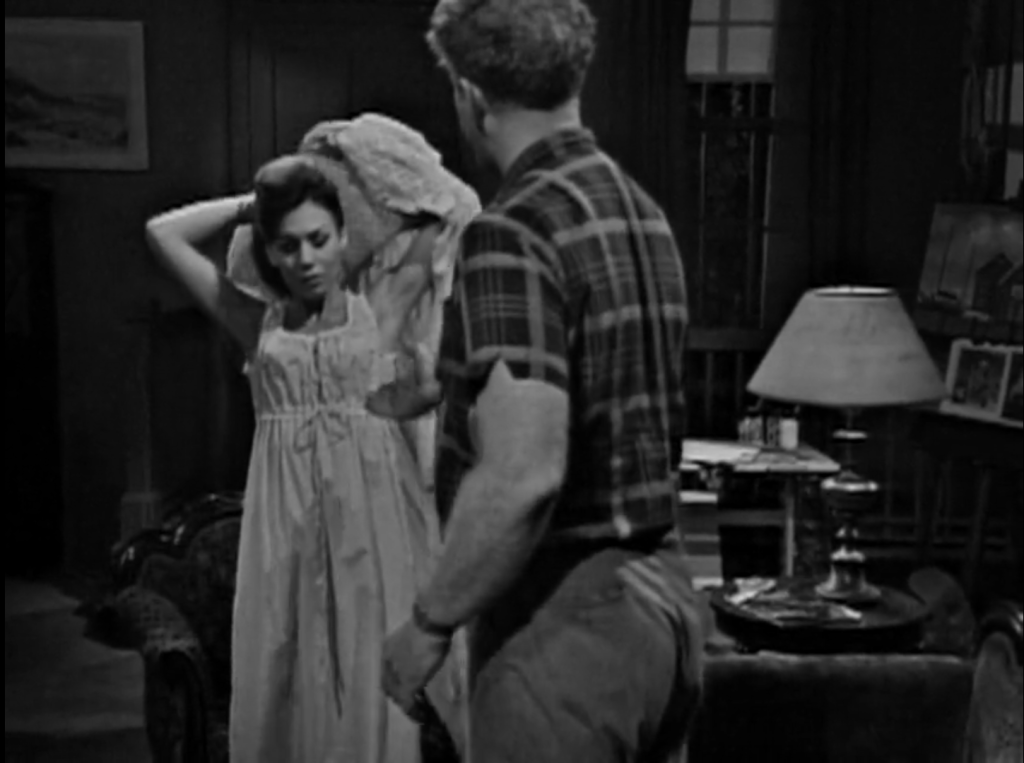
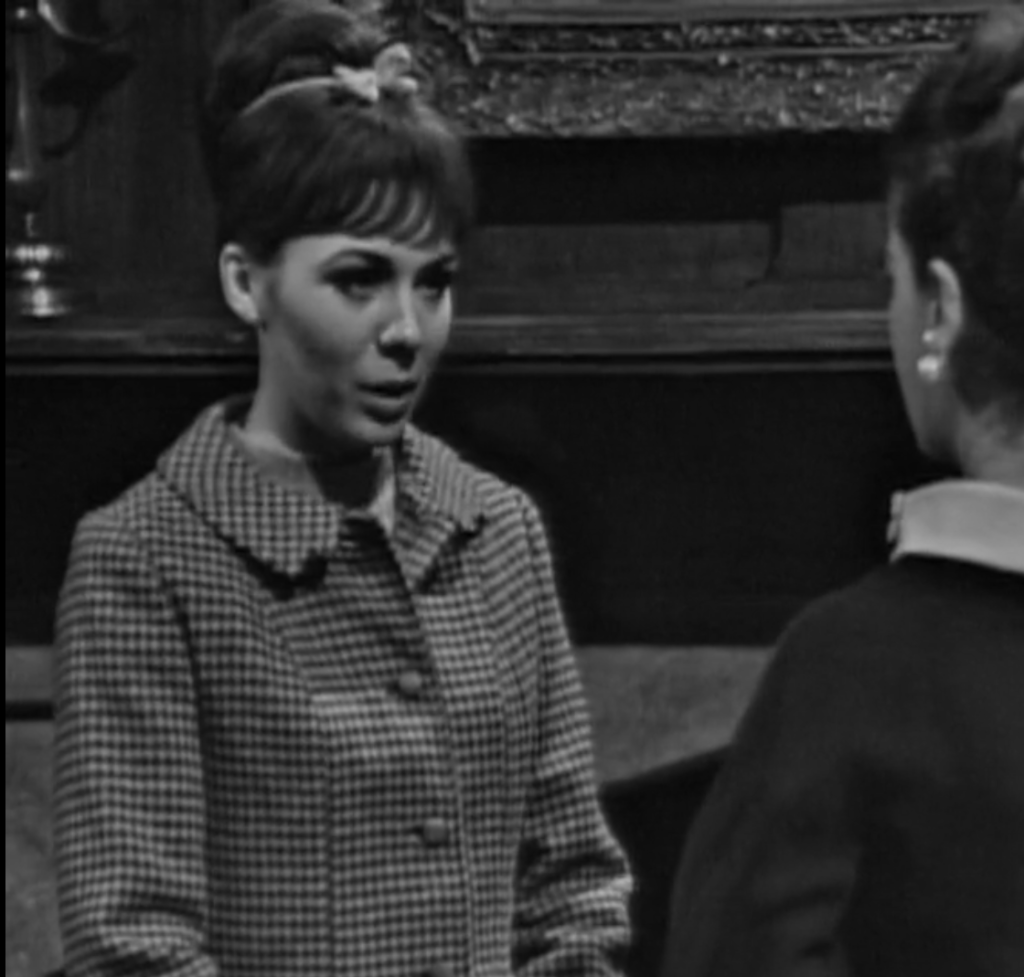
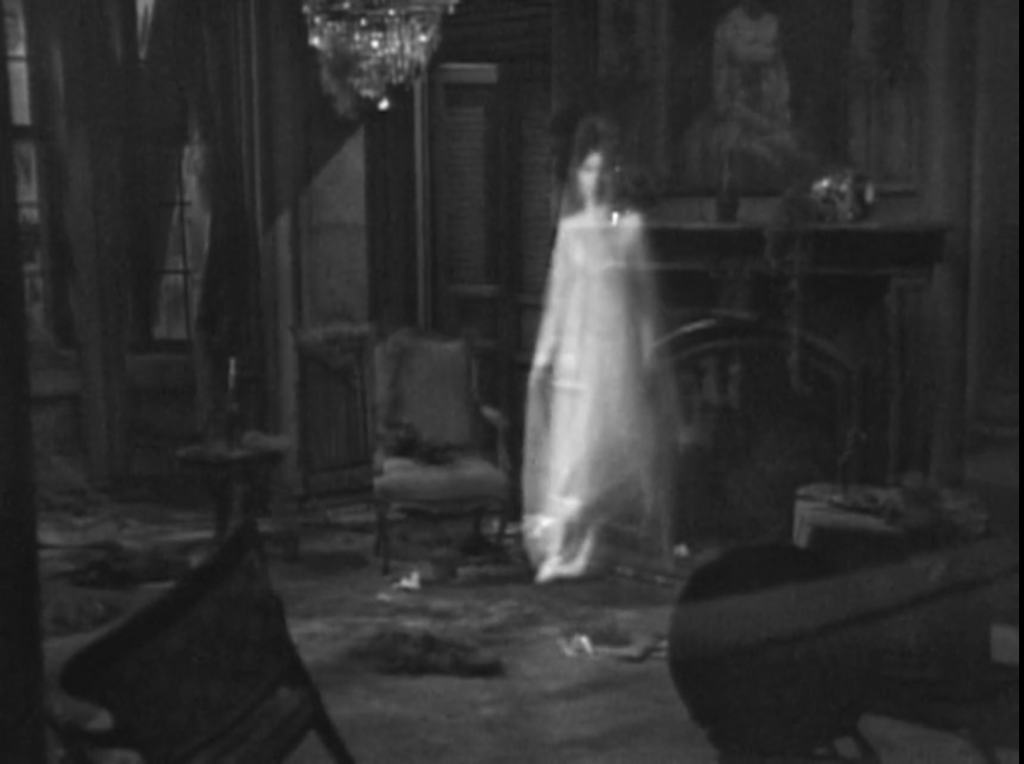
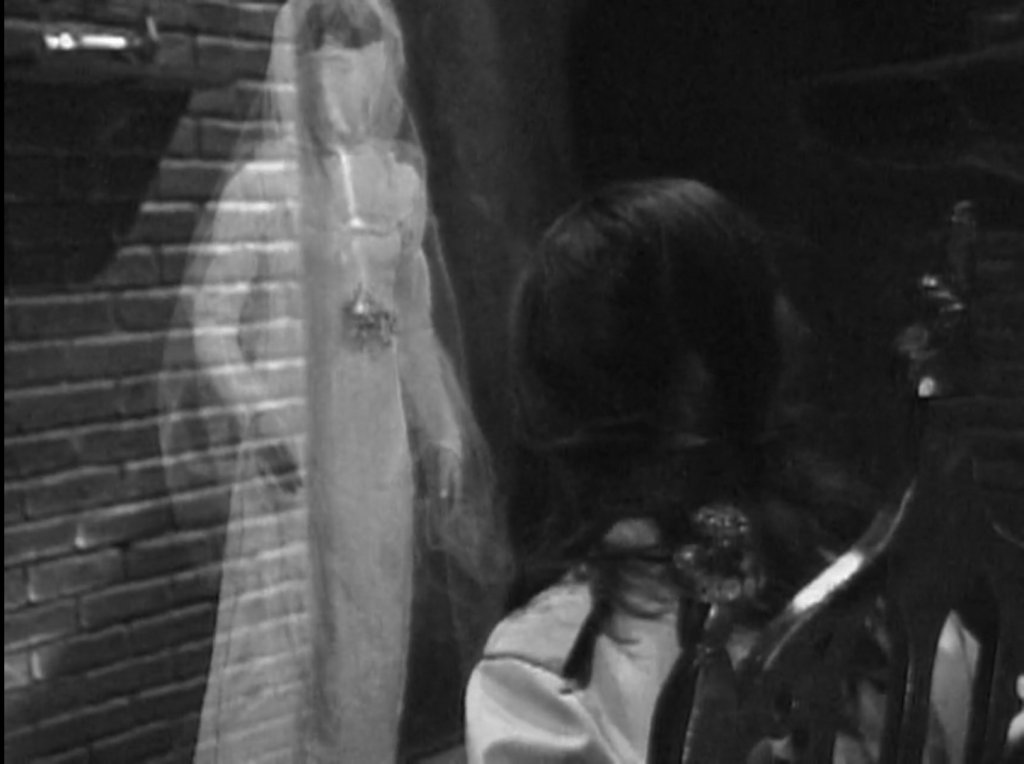
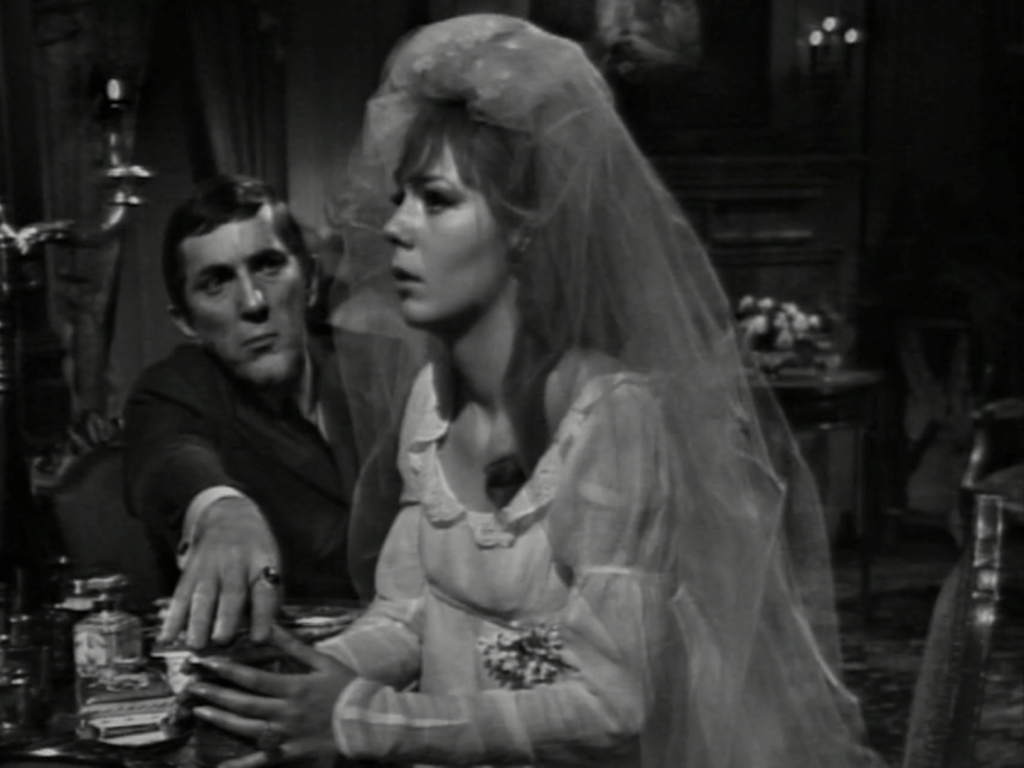
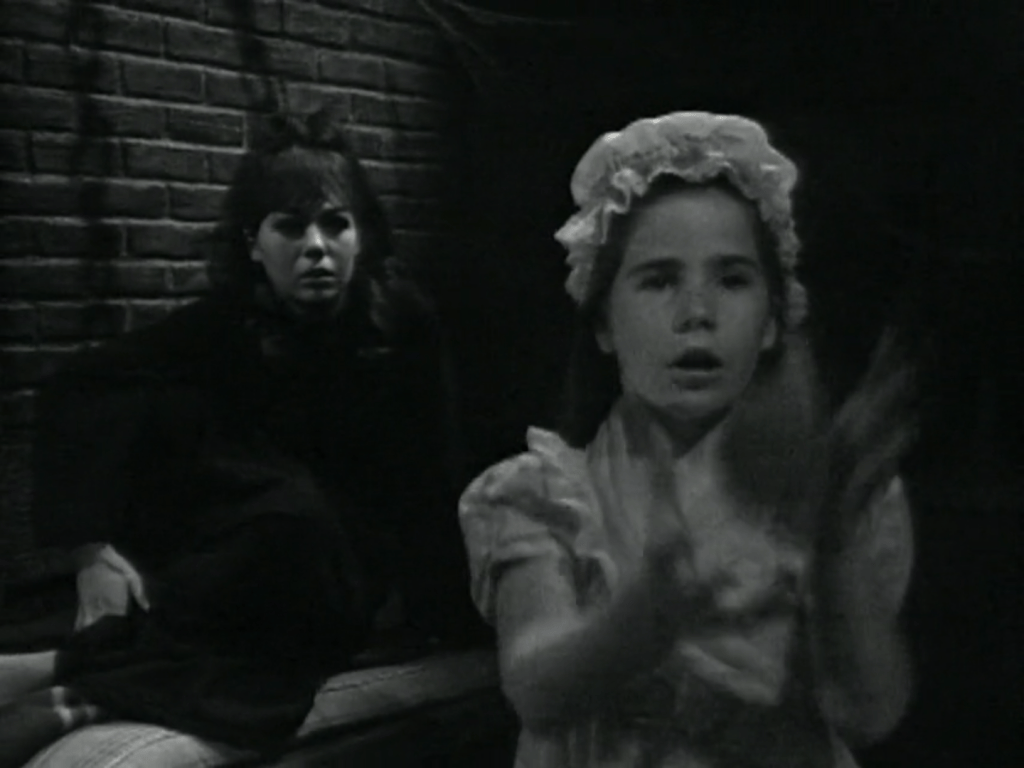
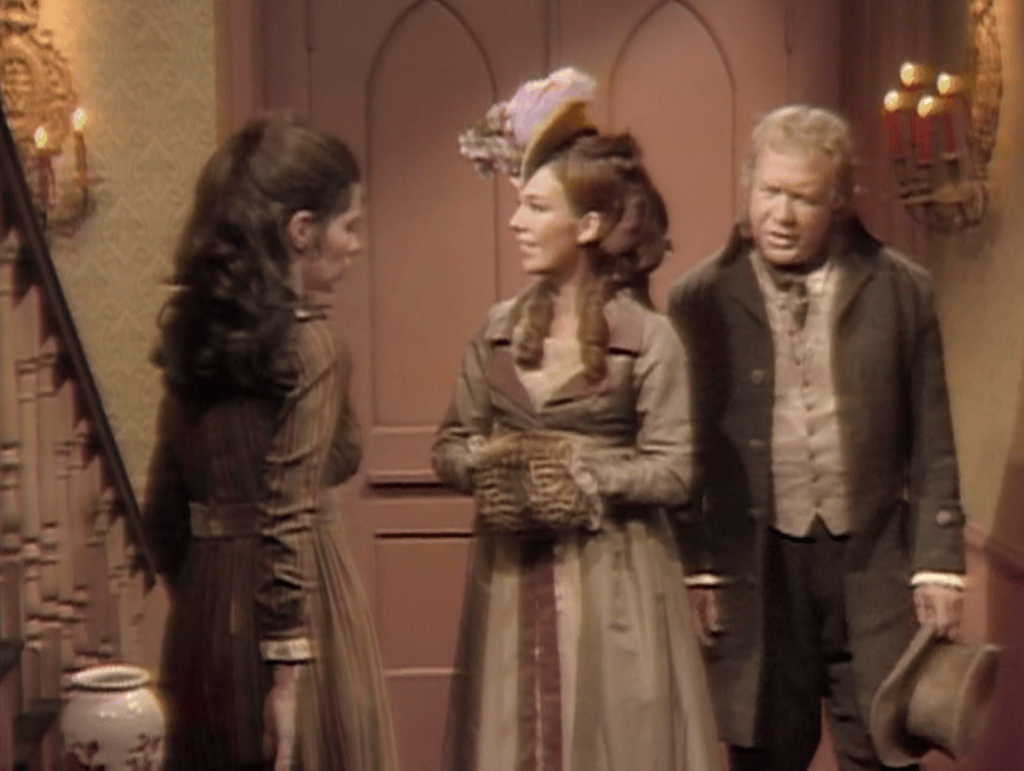
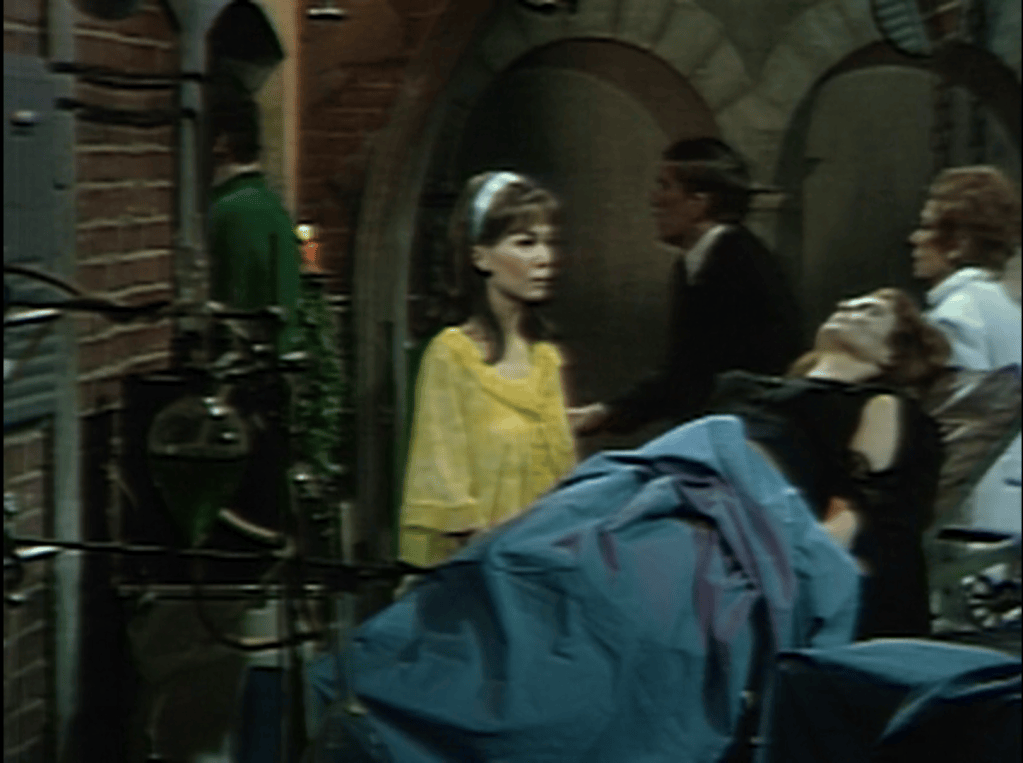
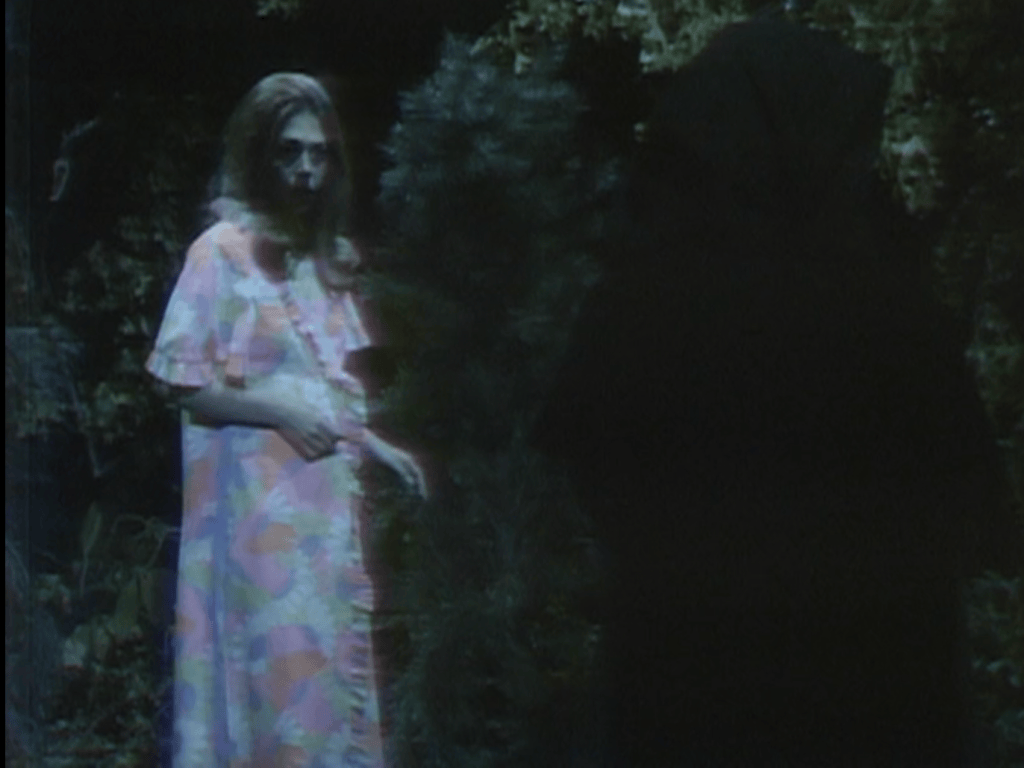
From March to November 1969, Dark Shadows was mostly set in the year 1897, to which time-traveling vampire Barnabas Collins had made his way. Barnabas’ friend, mad scientist Julia Hoffman, would join him for several weeks towards the end of the 1897 segment.
While Barnabas and Julia were busy in the past, the show cut to a contemporary setting a few times to show us that time was passing there and that the actions taking place in 1897 were changing the circumstances at the great house of Collinwood in the twentieth century. When Barnabas returned to the contemporary setting, the other characters knew where he had been and remembered both the events he went back in time hoping to prevent and those that had replaced them.
The 1897 segment was so good I wished it had gone on longer. One way I imagined they might have been able to stretch it out would have been to do more with the intercutting timelines. So perhaps spend a week in 1897, then a week in 1969. Obviously that would have required a lot more advance planning than they ever managed to do, since they would have had to keep redressing the sets to represent the different periods, but I thought it might have been worthwhile.
Today, we have evidence that some idea like this also occurred to the makers of the show. Julia has gone back in time to 1840 to keep a series of events from starting that will lead to the ruination of Collinwood and its inhabitants in 1970. Barnabas was unable to join her. We spend time today with Julia in 1840, and then with Barnabas in 1970.
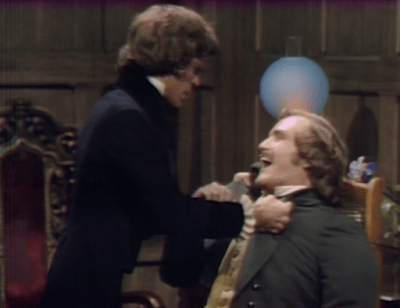
Arriving in 1840, Julia’s first act was to make contact with Barnabas’ old friend Ben Stokes. Ben believed her story and made himself incredibly helpful to her effort to establish herself at Collinwood. But she convinced herself that Barnabas had magically projected himself from 1970 into his body as it is in 1840. So she went to the secret room of the old Collins family mausoleum, unchained his coffin, and released him. He was about to kill her when Ben showed up and stopped him. Ben persuaded Barnabas to let Julia leave the room alive, and repeated her story to him. Barnabas reacted with incredulity, telling Ben that he had gone mad to accept such a tale, but Ben insisted Julia was their friend. Now Barnabas has resumed killing people, and Julia is terribly afraid that unless he stops he might be caught.
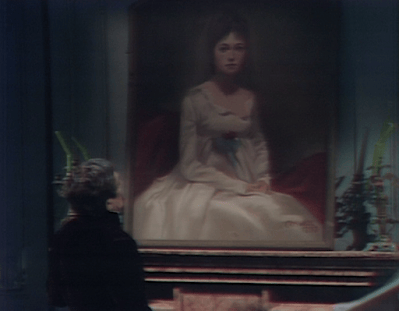
Barnabas is in the bedroom at the Old House at Collinwood once meant for Josette DuPrés to call her own after she married him. He takes Josette’s portrait off the wall and tells her that he must go on without her. We’ve heard that before. In #281, he stood in the same room and spoke to the same portrait, telling Josette that her ghost must go away and never come back so that he could face the world with someone else. We soon found that his plan was to turn that someone else into a simulacrum of Josette, and later he kept deciding that other women were reincarnations of Josette, so that speech did not represent the emotional growth we might have hoped to see. Finally, Josette’s ghost appeared to Barnabas in #948 and told him to lose her number, and his next love interest was a woman who did not remind him of her. That new woman was comatose, and Barnabas rhapsodized about how much beauty he found in her silence and immobility. Also, there was a bit of a problematic age gap, since she was 22 and he was well over 200. Baby steps, baby steps.
Ben enters and tries to talk Barnabas into returning to his coffin and allowing himself to be chained back in. As my wife, Mrs Acilius, points out, he doesn’t even mention that murder is bad. He knows Barnabas well enough to know he’d roll his eyes at that kind of talk. He just focuses on the danger Barnabas is putting himself in. Barnabas says that Ben does not know how horrible it is to spend years trapped in the darkness. Returning viewers may smile at this, since Barnabas doesn’t know that either. When Julia opened his coffin, he had no idea more than a single day had passed since he was chained there in the 1790s. He flounces off to take more victims.
In the drawing room of the great house, Julia meets Cockney psychic Leticia Faye. She asks Leticia if she can tell what will happen in that room in 1970. Leticia laughs and says her visions don’t extend that far. She adds that there wouldn’t be much point in them if they did, since no one alive today will be around to see if they came true. Julia claims to have had a dream about 1970, and Leticia humors her. She goes into a trance, and smells smoke. That’s about it, and when Leticia comes out of it she is still laughing, perhaps thinking that it didn’t amount to much. But it reminds Julia of the disaster she escaped, and leaves her wondering what Barnabas is doing in 1970.
We cut to Barnabas’ house in that year. He is doing what he does best, sitting around feeling sorry for himself. Ben’s descendant, occult expert Timothy Eliot Stokes, is there. They are talking about the funeral held that afternoon for the residents of the great house killed in the disaster. Stokes does not know that Barnabas is a vampire, and so Barnabas has to make an excuse for his absence from this daytime event. He simply says he was too upset to attend.
Heiress Carolyn Stoddard Hawkes and charming rogue Quentin Collins survived the disaster and are in the Old House, both quite insane. Barnabas and Stokes cart them off to a psychiatric facility. This is the final appearance on Dark Shadows of either of these characters, each of whom has been enormously important to the show.
Carolyn is played by Nancy Barrett, who also plays Leticia. Quentin is played by David Selby. We had expected to see Mr Selby in 1840 as another character named Quentin Collins, but when Julia arrived she learned that Quentin was missing and presumed dead after a nautical mishap. This glimpse of Quentin doesn’t add much to the story, but it does serve to reassure us that Mr Selby has not left the cast and that we will be seeing the 1840 version of Quentin sooner or later.
Barnabas decides to cast some I Ching wands. That’s what got him back to 1897, and the wands fall in the same pattern this time as they did then. He meditates on them. He sees a door, and seems to pass through it. On the other side, he sees a tombstone engraved “Julia Hoffman Collins 6 October 1840.”
Julia is masquerading as the daughter Barnabas had after he left for England in the 1790s, and has been telling the Collinses to expect her brother, Barnabas Junior. We haven’t heard her give “Hoffman” as a middle name. Of course it had to be there for Barnabas to be shocked by the stone. Otherwise, he would just have wondered who “Julia Collins” was.
It strikes me that they missed an opportunity. Julia has said that she moved from England to Philadelphia. Even though she lived there for so many years that she picked up an eastern Pennsylvania accent, she did not contact the family at Collinwood. Eventually they are likely to find out that she has a great deal of medical expertise, most unusual for a lady in 1840. Had she introduced herself as Julia Collins Hoffman, she might have explained that she met her late husband Dr Samuel Hoffman while he was studying in London, married him there, and lived with him in his hometown, Philadelphia. At the name “Dr Samuel Hoffman,” a theremin might have played on the soundtrack. Electronic music enthusiasts would laugh at the nod to the real Dr Samuel J. Hoffman (1903-1967,) the great player of and composer for the theremin. And fans of Dark Shadows would be happy that Julia’s imaginary husband has the same first name as Grayson Hall’s real husband, series writer Sam Hall.
This episode marks not only the final appearances of Carolyn and the original Quentin, but also the last time Peter Miner’s name will appear in the credits as line producer. Starting tomorrow, Lela Swift will be in command at 433 West 53rd Street. Swift was the principal director since the beginning of the show, chiefly responsible for the show’s often striking visual composition. It will be exciting to see what she can do now that she has a wider scope of action.
Mad scientist Julia Hoffman has traveled back in time from 1970 to 1840. Julia’s best friend, vampire Barnabas Collins, was unable to follow her into the past. Julia and Barnabas met in 1967 and became friends in 1968. In this period, Barnabas has been trapped in a chained coffin in the secret room of the old Collins family mausoleum for decades. She misses him so deeply that she convinces herself he must have used some mumbo-jumbo to project himself from 1970 into his body as it is in this time. She unchains the coffin and lets him out. He does not recognize her, and within seconds has his hands on her throat.
In the nick of time, Barnabas’ old retainer Ben Stokes shows up and tells him to let Julia go. Barnabas is shocked to see that Ben is far older than he was when last he saw him. Ben explains that 45 years have passed since he chained the coffin. Barnabas’ reaction settles a question that the vampire lore we have so far seen on Dark Shadows had left open. We have not known whether Barnabas experiences the passage of time while he is sealed in his coffin. Now, we see that he does not. That doesn’t stop him from throwing a big fit when Ben tells him that for the sake of all that is holy he must let himself be sealed back in; he pouts that he has already spent 45 years there, as if he had suffered consciously through all of them. That point will be exploited to broadly comic effect in Tim Burton’s 2012 feature film titled Dark Shadows, in which Johnny Depp’s version of Barnabas is closed in his coffin for a minute and a half and when the lid is reopened wails “How many centuries!?” This scene is played more subtly, but regular viewers will be just as inclined to laugh at Barnabas’ extravagant self-pity.
Ben tells Barnabas Julia’s preposterous story of a journey back in time from a future in which she is his fast friend. Barnabas tells Ben that he has gone mad, but Ben insists that he believes the story, bizarre as it is. Indeed, as a vampire Barnabas is hardly in a position to dismiss tales of the supernatural.
We got to know Ben from November 1967 to March 1968, when Dark Shadows was set in the 1790s. Young Daniel Collins was also a character on the show then. Daniel is in the cast of characters again now. He is the master of the great house of Collinwood, but is a man old before his time because of a severe mental illness and a heart condition that nineteenth century medicine is powerless to treat. When we saw that Ben and Daniel were in the story, longtime viewers realized that the 1840 segment would be a sequel to the 1790s segment. And indeed, Barnabas’ manner and tone of voice when he rises from his coffin are an exact match for what they were at the end of that part of the show. Jonathan Frid picks up right where he left off in #460. I know classically trained actors are taught to do things like that, but he pulls it off so brilliantly that I can’t help but wonder just how it was done.
Ben had laid out a plan for Julia in yesterday’s episode. He told her to present herself at the great house of Collinwood as Julia Collins. She was to tell the Collinses that she was the daughter of the Barnabas Collins who left for England in the 1790s, that she has been living in America, near Philadelphia, for many years, while her brother, Barnabas Junior, had stayed in England. She was to say that Barnabas Junior has written to her saying that he wanted to meet her at Collinwood and to feign surprise that her brother is not already there. She would say that her bags were at the Collinsport Inn. They might then invite her to stay at Collinwood.
Julia leaves the mausoleum. When Barnabas rushes out to claim more victims, she peeks out from behind a tree and watches him go. She now has nowhere to turn but Collinwood and no plan to follow but Ben’s.
Samantha Collins, daughter-in-law of Daniel and the lady of the house at Collinwood, is in the woods when she senses a malign presence. She starts running, and we see Barnabas. By the time Samantha bursts into the front door of the great house, she is on the point of tears. She tells her brother-in-law Gabriel Collins and houseguest Gerard Stiles that she felt that something evil was in the woods. She didn’t see whatever it was, but has somehow come to the conclusion that it was “tall.” Yesterday Gerard, who is a clairvoyant, had a vision of Julia; he described her as tall. Neither Jonathan Frid nor Grayson Hall was much above average height, while the cast included several actors who were. For example, Christopher Pennock, who plays Gabriel, was well over six feet. Gabriel uses a wheelchair, so this role does not emphasize his tallness, but we can’t help noticing it when they keep banging on about the great height of two medium-sized people.
Gerard says that he will go into the woods to investigate. Samantha tells him not to, that she wants him to stay with her and make her feel safe. She tilts her head towards his chest. Samantha’s husband, whose name is Quentin Collins, is missing at sea and presumed dead. In this moment, we see that she is considering Gerard as Quentin’s successor.
Gabriel speaks up. He tells Samantha and Gerard that there is no reason to investigate, since the police are all over the grounds. A woman was found dead earlier in the evening, her corpse drained of all blood. The presence Samantha sensed must have been, not a man, but the animal that killed that woman.
By opening the coffin, not only did Julia needlessly expose herself to the gravest possible danger and release a monster who has already taken one human life and will doubtless take more. She also put an additional obstacle in the way of her own effort to establish herself at Collinwood. That she will present herself and announce Barnabas to the Collinses on the very night the vampire attacks start makes it all but impossible for them not to connect the two of them with those attacks.
Samantha answers a knock at the front door and finds Julia. Julia feigns surprise that Samantha does not recognize her name. She is startled to see Gerard, whose ghost she met in terrible moments in the years 1970 and 1995, but composes herself quickly. Samantha invites Julia in. She tells the story Ben had crafted for her and expresses surprise the Collinses had not received the letters she sent.
Ben shows up and Julia makes a show of recognizing his name. She says that her late father often spoke warmly of him, and that he will be impressed by how much Barnabas Junior looks like his old man. They embrace. By that point, Samantha and Gabriel are sold. Samantha insists Julia stay at Collinwood, and sends Gerard to the inn to fetch her bags. Gerard pounces when Julia says Barnabas Junior will be glad to see Collinwood “again”; she explains that their father told them so much about the place that it feels like they’ve been there before.
Gerard does fetch a set of bags from the inn. Apparently Ben had supplied those, as he had earlier supplied the period-appropriate clothing Julia is wearing. He’s a very handy fellow to have on your side, that Ben.
In the morning, Ben joins Julia as she is returning to the mausoleum. He tells her sternly that they must chain the coffin back up and that she must never return to the secret room, no matter how sure she is that her version of Barnabas is summoning her.
They find they are too late. The coffin is gone. Both Julia and Ben know that Barnabas has a compulsion to stash his coffin at the foot of the cellar stairs in the Old House at Collinwood, and Julia also knows that Barnabas’ second choice for a hiding place is behind the bookcase in the parlor of that same house. Julia also knows of a cave near the beach where Barnabas has hidden his coffin a couple of times. So it would seem that they should be able to take the chains with them to those places, find the coffin, and take care of the matter before lunch. But for some reason they just give up.
Back in the great house, Gerard confronts Julia with an earring he found on the dresser in her room when he was putting her bags away. He tells her its mate was found in the long-disused playroom upstairs two nights ago, and asks her how long she has been lurking around. She denies everything, failing to quell his suspicions. Freeing Barnabas to prey upon the living may have been the most foolish thing Julia could possibly have done, but it was not much wiser of her to leave one extremely distinctive earring in such a conspicuous place when she has lost its mate she knows not where.
It was Gabriel who found the earring. He showed it to Gerard shortly after, prompting Gerard to have his vision of the “tall” Julia. Gerard and Gabriel have a scene early in today’s episode, before they meet Julia, in which they go back over the matter of the earring. We can see not only that Gerard is onto Julia, but also that Gabriel has a plan of some kind in which he is planning to involve Gerard. Combined with Samantha’s obvious interest in Gerard, that in turn suggests that we will see how multiple members of the household entangle themselves with him and put him in a position from which he can become a threat to the future of Collinwood.
In the closing credits, Grayson Hall is billed as “Julia Collins.” It has been their custom to list characters by the names they use, even when the audience knows those names to be false. So after Angelique Collins rose from the dead, killed her sister Alexis Stokes, and assumed Alexis’ identity in #1000, when the show was set in an alternate universe, Lara Parker kept being billed as Alexis until all the characters who were fooled by her imposture were off the show. Actors sometimes wander onto the set during the closing credits. My wife, Mrs Acilius, imagines someone doing so while still in character, looking at a credit that gives away someone’s true identity, and pointing at it with wide eyes and an “Aha!” Maybe they were trying to protect Julia from that.
Dark Shadows has been drifting downward in the ratings and the writing staff has been repeating material. If it is to survive, the show needs a new villain who will generate fresh story points and another breakout star to grab the attention of the public as Jonathan Frid did when he joined the cast as vampire Barnabas Collins in 1967 and as David Selby did when he came along as the dangerous Quentin Collins late in 1968 and early in 1969. They are gambling that they will be able to fulfill both of these requirements with James Storm as the evil Gerard Stiles.
Gerard has been on the show as an unspeaking ghost for twelve weeks. He makes his first appearance as a living being today, and delivers his first lines. He makes less of an impression than does any other member of the cast, which I believe is intentional.
Yesterday, mad scientist Julia Hoffman traveled back in time to 1840. Previous time-travel segments have begun with episodes mounted on the biggest scale of production the show could manage, but yesterday they tried a new approach. Most of the episode took place in one little section of the great house of Collinwood, with Julia hiding behind partitions in darkened rooms while she eavesdropped on random conversations. That structure suggested that 1840 is going to open out gradually, introducing new characters and situations a little bit at a time. So far from whisking us into the new world with a torrent of additional information, they subtracted from what we came in thinking we knew. When they revealed that governess Daphne Harridge is unknown in the great house, and Quentin Collins* and his son Tad are missing at sea and presumed dead, we found that this is a very different place from what we were led to expect. That was as good a way as any of ensuring we would come back on Monday.
Gerard makes his entrance in the middle of a scene between fluttery novelist Flora Collins and evil-tempered bully Gabriel Collins. Gabriel is not as cruel to Flora as we have seen him be with others, and he even pretends to take her latest novel seriously. But when she describes Gerard as “The Healer” and claims that he has supernatural powers, Gabriel has had enough. He insists that Flora ought not to waste her time with a man who, if he were not a transparent fraud, could only be a practitioner of the black arts. Flora is appalled by Gabriel’s description of Gerard as a possible Satanist.
Gerard enters and Flora tells him she is coming down with a migraine. She coquettishly asks him to do his thing for her. He rubs her forehead for a bit, and she proclaims that she is cured. After she exits, wheelchair user Gabriel tells Gerard that if he really has a miraculous gift of healing he would welcome him using it to restore his own ability to walk. Gerard angrily refuses.
Gabriel then tells Gerard that Flora claims more for him even than a gift for healing. She says that he is clairvoyant. Gerard says that he does have such a gift. Gabriel shows him an earring he found in the upstairs playroom and asks if he can identify it. Gerard goes into a trance and says that he sees “a tall woman… not dressed as a woman should be.” The earring belongs to Julia, whom we heard a clairvoyant describe as “a tall woman” in #1059, and she is indeed wearing the clothes she had on when she came from 1970. So we know that Gerard is a real clairvoyant, and expect that he will recognize Julia when he meets her. But Gabriel hasn’t been watching the show, so he laughs out loud and tells Gerard that he is indeed a fraud.
Gerard gets even angrier than he was a moment before, and tells Gabriel that he will not abide being laughed at. That suggests a complicated existence for a character on Dark Shadows, a show that has a lot of great stuff in it but that rarely goes more than ten minutes at a time without making at least one member of the cast look ridiculous.
Of course, no one is easier to laugh at than people who take themselves absolutely seriously, which is one of the reasons Barnabas and Julia were such big hits. But most of the characters who demand to be regarded with solemnity have had an expiration date, no matter how much value they added while they were on the show. So the fanatical witchfinder the Rev’d Mr Trask was one of the highlights of the show when it was set in the 1790s from November 1967 to March 1968, but no one could have expected Trask to stay in the cast when it returned to contemporary dress. Those who have lasted and have helped to grow the audience have had a sense of humor about themselves. By the middle of 1968, even wicked witch Angelique could crack the occasional joke at her own expense. Unless Gerard gains the same ability, he would seem unlikely to rise above Trask’s level in the hierarchy of characters.
Meanwhile, the aged Ben Stokes has befriended Julia. In the 1790s segment, Ben was a much-put-upon indentured servant whose extreme regard for Barnabas led him to become complicit in Barnabas’ crimes in his first nights as a vampire. When we revisited the 1790s in January 1969, Ben followed the footsteps of the first character Thayer David played on the show, crazed handyman Matthew Morgan. Matthew’s fanatical devotion to matriarch Elizabeth Collins Stoddard led him to inadvertently kill a man who was the head of the Collins fishing fleet and to attempt the deliberate murder of a woman who was played by the daughter of a countess. In #666, Ben inadvertently killed roguish naval officer Nathan Forbes, who was in Collinsport to do some executive work associated with the Collins family’s ships, and then deliberately murdered Natalie DuPrés, a character who bore the title countess. We saw that the kindly, sensible, open-hearted Ben whom we met before the great curse was placed on the Collins family had been deformed into the same shape that a century and a half in the shadow of that curse had inflicted on Collinsport dweller Matthew. Now, we see that Ben has lived on into his eighties and has recovered much of the goodness that was his hallmark when first we met him.
Julia tells Ben the insane story of her travels through time and her friendship with Barnabas, and he decides to help her find a place in 1840. He digs up a period-appropriate gown for her. It’s too big for his granddaughter Carrie and too small for him, so it does not seem likely to have been in his possession. He doesn’t have time to make a gown. He doesn’t leave the house, so even if there had been shops in central Maine in 1840 that sold ladies’ formal wear off the rack, he wouldn’t have been able to buy it at one of those. And any of the ladies in the house would surely notice if one of their dresses went missing and a stranger showed up wearing one exactly like it. So I suppose it must have belonged to a lady no longer resident in the house who left it behind in a disused room.
Ben drills Julia in a plan he has devised. She is to present herself at the front door of the great house of Collinwood at 8:30 PM, wearing the gown he has provided. She is to say that her name is Julia Collins, daughter of Barnabas, and that she has been living in America for ten years. Her brother, Barnabas Junior, is still based in England, where their father died some time ago. He wrote her a letter saying he was coming to the States and she was to meet him at Collinwood. Her bags are at the Collinsport Inn, where she is staying.
Julia is reluctant to follow Ben’s plan. She is preoccupied with Barnabas. She expects him to use some mumbo-jumbo to project himself from 1970 into his body as it is in 1840. Since that body is in a chained coffin in the secret room of the old Collins family mausoleum, she wants to go there and release him.
Ben points out that Julia’s desire is preposterous. Barnabas won’t meet Julia for another 127 years. The vampire in that coffin has no idea who she is, and if she lets him out she will be only the first of many victims in a renewed rampage of murder and enslavement.
Of course Julia goes to the mausoleum; of course she opens the panel to the secret room. If she were capable of taking good advice when it was offered, there wouldn’t be a show. We end with Julia trying to communicate with Barnabas through the coffin. She has already said that she has a sense that he might be calling her, a sense that she admits might be her imagination. So we know that it is unlikely that she will fail to discern the summons she so desperately wants to hear.
*Not the one we eat in 1968 and 1969, though apparently he is also David Selby.
Mad scientist Julia Hoffman has escaped from a band of zombies who were wrecking the great house of Collinwood. From her perspective, it is a few moments after she saw her friend, vampire Barnabas Collins, wrestling with the zombies and urging her to save herself by walking down a mysterious staircase. But she soon discovers that she has left the year 1970 and made her way to 1840, when both the zombies and the ghosts who have triggered their destructive actions were living human beings.
Julia enters the staircase from a playroom that is only intermittently present in 1970 and walks down its two flights. She exits into the same playroom, which is a normal presence in 1840. We saw this same distortion of space in #1070 and #1071, when Julia and Barnabas used the staircase to escape from the far-off future year of 1995 and return to 1970. It was an effective way of expressing the magical nature of the staircase and the playroom then, and is still effective the second time.
When they opened the playroom door on their return to 1970, Barnabas and Julia saw a girl in the corridor. That girl appeared to be a ghost named Carrie whom they had met in 1995, but turned out to be a living girl named Hallie Stokes who had moved into Collinwood while they were away on their bizarre cosmic journey. Now, Julia opens the door and sees the living Carrie in the same corridor.
Hallie was the niece of occult expert Timothy Eliot Stokes and therefore a descendant of much-put-upon indentured servant Ben Stokes, whom we got to know from November 1967 to March 1968, when the show was set in the 1790s. We learn today that Carrie is Ben’s granddaughter, and that he and she are staying in the great house as the guests of Daniel Collins.
We saw Daniel in the 1790s segment. He was played then by David Henesy, who was eleven years old at the time. Mr Henesy looked a lot older in September 1970 than he had three years before, and he was an accomplished young actor. But it would likely have been beyond even his abilities to play a character well into middle age, so when we see Daniel from the knees down later in the episode we can be fairly sure he will turn out to be someone else.
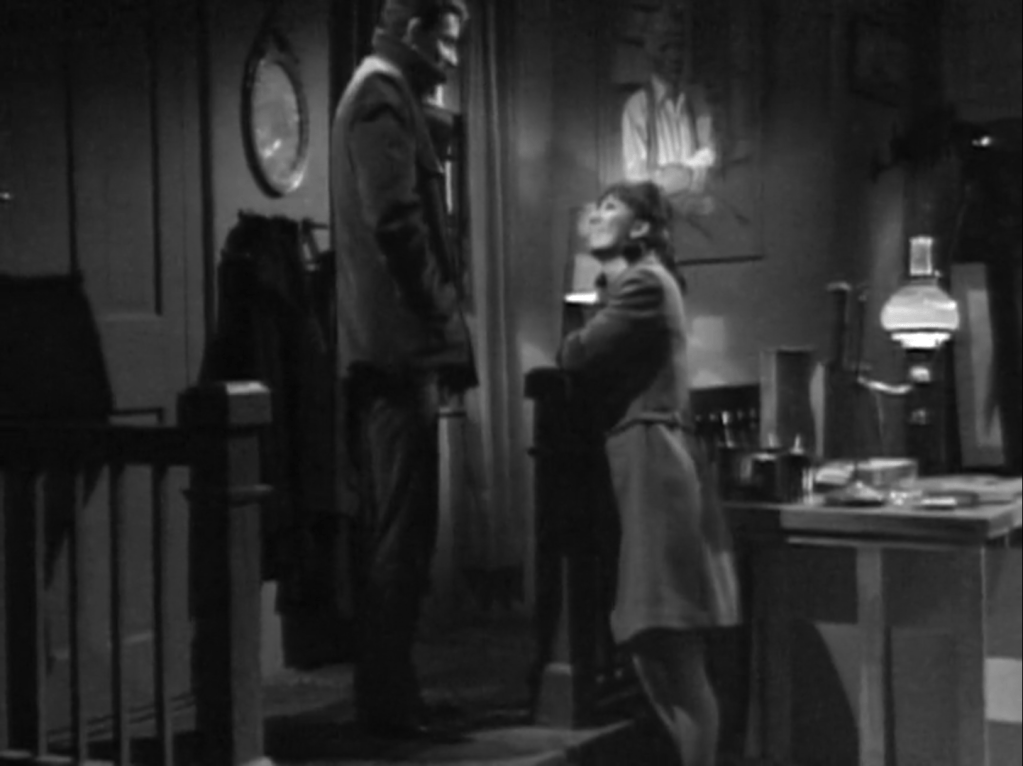
Julia sees a confrontation between Carrie and a tall young man in a wheelchair. The man turns out to be Daniel’s son Gabriel. He insists Carrie open the door to her grandfather’s bedroom and push him in. Carrie objects, and Gabriel sneers that she is not to tell a Collins what to do at Collinwood. He berates her, saying that while others may indulge her because they are impressed by her good looks he sees only her impudence. She capitulates to his demands.
In the room, Gabriel turns his abusiveness against Ben. He orders Ben to break some bad news to Daniel. Word has come that Daniel’s son Quentin and Quentin’s son Tad have been lost at sea. Ben protests that Daniel is in no condition to receive such news. Gabriel digresses and says that he cannot make his own living; Ben tells him that many men in worse condition than he is have done, which only makes him angrier than he was to start with. Gabriel regrets his inability to stand up and strangle Ben. We can see that he’s a true Collins; they are a strangley bunch. He then says that he is now likely to become Daniel’s heir, and threatens to evict Ben and Carrie from Collinwood when he does. He menaces Ben with the prospect that he will use his position to make Carrie’s life difficult if he does not obey him now. Ben gives in.
When Ben returns to his room he finds Quentin’s wife, Samantha Drew Collins, waiting for him there. He tells her that the news did not prompt Daniel to change his will. She is still in line to inherit the estate when Daniel dies.
Samantha goes to the drawing room, where she finds Gabriel playing a one-handed game of chess. She is smugly pleased with his dismayed reaction to the news that Daniel has not changed his will. She exits and later returns with word that Daniel has escaped from the tower room. The Collinses have always made a practice of keeping mentally ill family members in that room, and Samantha and Gabriel are so frightened by his escape that we can assume Daniel’s illness disposes him to violence.
Julia emerges from the shadows in Ben’s room. Ben is alarmed to see her, and horrified when she identifies herself a friend of Barnabas’. She claims that she is not a monster, which is a defensible claim, given a very narrow definition of “monster.” When she tells him about traveling back in time from a future period when Barnabas is free to prey upon the living and she is his best friend, he says that she is mad. She denies being mad, which is what a person would do when they are as far from sanity as she is. Ben is leery, but agrees to help her. He escorts her back to the playroom and tells her to stay there until morning. Of course she leaves the room very shortly thereafter, and as soon as she enters the corridor Daniel grabs her by the throat.
The drawing room is downstairs; Ben’s room and the playroom are upstairs. No one seems to be helping Gabriel get from one floor to another, and there is no sign of any ramp or other contrivance that would make it possible for wheelchair users to get themselves from one floor of the house to another without help. Odd as this is, it is not a first on Dark Shadows. In January and February 1970, strange and troubled boy David Collins used a wheelchair in a few episodes because David Henesy had actually suffered a leg injury. David kept going up and down stairs by himself, without explanation of how such a thing was possible. I suppose they got few enough letters complaining about the illogic of that movement that they decide they could get away with it again.
Carrie has three scenes. In addition to her encounter with Gabriel, she talks with Samantha in the playroom and with her grandfather in his room. As Hallie, Kathleen Cody was in a state of maximum nervous tension from the start, so that she had nowhere to go in response to anything that might happen. As Carrie’s ghost, she often swung to the opposite extreme, being so blandly cheerful that she made no impression at all. She did put in a few good performances in the 1970 segment, however, and she is quite good as Carrie today.
Samantha is played by Virginia Vestoff, making her Dark Shadows debut. Vestoff was a distinguished performer who is now remembered chiefly for her role as Abigail Adams in the original Broadway cast of 1776 and of the 1972 film based on that musical. The Broadway cast also included several other Dark Shadows alums- David Ford (Sam Evans #2, Andre DuPres) as John Hancock, Emory Bass (Mr Best) as James Wilson, Daniel F. Keyes (The Cemetery Caretaker) as Josiah Bartlett, and Peter Lombard (Oberon) as a stage manager and understudy for the roles of Stephen Hopkins and Thomas Jefferson. All of those, aside from Lombard, also appeared in the film. Vestoff died of cancer in 1983, aged 42, a major loss to the world of the theater.
A great deal of emphasis is placed today on Samantha’s maiden name, Drew. We have in the last few months met two characters named Roxanne Drew; we can take it that Samantha will turn out to be related to one of those in some way.
Longtime viewers, learning that Daniel and Ben are in the 1840 story, will readjust their expectations. Most of what we saw in the ten weeks leading up to this uncertain and frightening journey into the past was recycled from a story that ran from December 1968 to March 1969 and culminated in a trip to the year 1897. So we may have come in thinking there would be a retelling of 1897. But seeing Ben and Daniel, we have the prospect of a sequel to the 1790s segment. That does sound like a fresher idea.
The episode is certainly structured very differently than were the first episodes of either the 1790s segment or the 1897 segment. Those featured a relatively wide variety of brightly lit sets full of busy people, getting us off to a fast start in a new world. Today most of the action takes place in the playroom, Ben’s room, and the corridor between them, with a couple of brief glimpses of the drawing room. We keep cutting to Julia standing very still behind one partition or another as she eavesdrops on the dialogue. We are operating within a very small space, but hearing about people who are far outside that space and whom we are confident we will meet soon. So rather than leading with the equivalent of a panorama of our new surroundings, they are opening the space up for us a little bit at a time. That makes it easier to keep the action moving rapidly and clearly, and also leaves us wanting more.
The ghost of Gerard Stiles kills Daphne Harridge, Tad Collins, and Carrie Stokes. It was his idea to bring these three back to life in recent weeks after he murdered them the first time, in 1841. Daphne regained a body of her own, while Carrie and Tad took possession of the bodies of Hallie Stokes and David Collins. Now all of them are dead again, David and Hallie into the bargain. What the point was of any of that, none can say.
Gerard waves a green polyester flag from the window of the room on top of the tower at the great house of Collinwood, prompting zombies to rise from the dead and wreck the house. The shots of the earth heaving as the zombies rise from their graves were anticipated when David waved the flag in #1089, when a monster masquerading as a man named Jabez Hawkes raised some zombies in #963, and when wicked witch Angelique raised Jeremiah Collins from the dead as a zombie in #392/393. For that matter, the whole graveyard scene was anticipated in the 1959 feature film Plan 9 from Outer Space, and actor Chuck Morgan, who also played one of Jabe’s zombies, even looks like Tor Johnson.
Laugh if you must, but he’s leading a group of six who will demolish an incomprehensibly large haunted house in a single night. That’s more than you’ve done.
The Destruction of Collinwood will leave most of the Collins family dead, missing, or hopelessly insane. That was prophesied when vampire Barnabas Collins and mad scientist Julia Hoffman traveled to the far-off future year 1995 in #1061-1070. It also echoes a line with which heiress Carolyn Collins Stoddard greeted well-meaning governess Victoria Winters in #2, “Welcome to the House of Usher.”
Julia escapes from the zombies and finds herself in 1840. She has to leave Barnabas behind in 1970, where he is busy wrestling with some of the zombies. Each of Dark Shadows‘ major costume drama segments has begun with a character from the contemporary setting alone in an unfamiliar past. Victoria served this function in the first costume drama segment, when the show went to the 1790s from November 1967 to March 1968; Barnabas did it in March 1969, when the show started an eight months tour in the year 1897. Now it is Julia’s turn. She eventually joined Barnabas in 1897; we may wonder whether Barnabas, or perhaps someone else, will manage to find their way to her from 1970.
In episode #1 of Dark Shadows, first broadcast 27 June 1966, Victoria Winters came to the great house of Collinwood to serve as governess to strange and troubled boy David Collins. On her way, Vicki stopped at the Collinsport Inn and had a meal at the diner there. Her waitress was Maggie Evans, a young woman with short blonde hair whom the original story bible identified as “everybody’s pal and nobody’s friend.” Maggie opened their conversation by telling Vicki that she was a “jerk- J-E-R-K” for going to live at Collinwood. Maggie told Vicki that the great house would turn her long black hair gray in two months. When Vicki said she would go there anyway, Maggie offered her a “piece of apple pie on the house- and I won’t take no for an answer.”
Maggie lays it on the line for the new jerk.
Maggie was the chief representative of Collinsport’s working class in the show’s first months. The diner was a meeting place for a variety of characters, so we saw her wait on all sorts of people. She shared her home, “The Evans Cottage,” with her father, drunken sad-sack Sam Evans. Sam’s career as an artist was ruined when he took a bribe from high-born ne-er-do-well Roger Collins and allowed his one-time friend, Burke Devlin, to go to prison alone for a crime of which Roger was also guilty. Sam’s misery and Maggie’s Adult Child of an Alcoholic (ACoA, they call it) mannerisms, such as laughing awkwardly whenever she begins to speak, attest to the dire consequences for the whole town of what goes on in the big house on the hill. As Maggie and Sam’s territory, the cottage was a space where Burke, who left prison and came back to Collinsport as a corporate raider, could talk about his plans to wrench control of the cannery and fishing fleet from the feudal-minded Collinses and bring the area into the age of capitalism.
From #12, Maggie at home with Sam. At that point, Sam was played (very badly) by Mark Allen.
They eased up on the “everybody’s pal and nobody’s friend” business pretty quickly. Maggie’s short blonde hair was a wig seen for the last time in #12; from #20 on, she has Miss Scott’s long brown hair. When Miss Scott’s real hair came out, her real personality started to peek through as well. While Maggie could still make a caustic remark or a tactless one as occasion demanded, the signs were already there of her final form, The Nicest Girl in Town.
Our first look at Maggie as a brunette.
In #63, Maggie made her first visit to Collinwood. She had made a vow never to set foot in the great house, and was ill at ease when she broke it. With a great show of courage she stood up to matriarch Elizabeth Collins Stoddard. She told Liz that she believed that her family had information about what had gone wrong in her father’s life, and she wanted answers.
Maggie admits to Liz that she had to screw up her courage to come to Collinwood.
The supernatural was represented in the first months of Dark Shadows primarily by people using the word “ghost” as a metaphor when talking to Vicki, prompting her to reply “Surely you don’t believe in ghosts!?” They would then respond that they damn well did believe in them, and that if she went on living at Collinwood it wouldn’t be long before she believed in them, too. The first unequivocal sign the audience had of supernatural activity came in #70, when the ghost of the gracious Josette Collins emanated from her portrait above the mantel of the Old House at Collinwood, walked outside, and danced among the columns. The figure of Josette was none other than Kathryn Leigh Scott, who volunteered for the task when the original plan to achieve the effect without a performer fell apart.
EmergenceDance
Miss Scott reprised the role of Josette’s ghost in #126, wearing a heavy veil over her face. We hear her voice, with a French accent of sorts, telling Vicki not to be afraid even though a madman has tied her up and is on his way with an ax to cut her head off. Josette then leads the other ghosts of Collinwood in killing the madman before he can harm Vicki.
“I am Josette Collins.”
With that, Miss Scott became the first member of the cast to play multiple roles on Dark Shadows. For anyone who happened to recognize her voice in #126 and notice that she was in the credits, even though Maggie was not in the episode, the wised-up waitress and the ghost of Josette would have made an interesting pair. All we knew about Josette at that point was that her maiden name was LaFreniere, that she came to Collinwood in 1830 and married Jeremiah Collins, that she died by jumping off the cliff at Widows’ Hill, and that her ghost could be seen and heard around the estate. For all we knew, the LaFrenieres may have been a humble Franco-American family whom Jeremiah’s haughty relatives snubbed. She may have grown up in a house like The Evans Cottage, and her death might have been the outcome of a class conflict. Later, Josette’s family name would be retconned to DuPrés, her time of arrival to 1795, and she would be presented as a French aristocrat who was the daughter of one of the richest sugar planters on the island of Martinique, a description met in our universe by Joséphine de Beauharnais, wife and empress to Napoleon I.
In the first months of the show, Liz’ daughter Carolyn was dating hardworking young fisherman Joe Haskell. Carolyn and Joe were bored to tears with each other, and only kept going out because Liz thought they should. Joe and Carolyn finally broke up in #84, and he started dating Maggie by #129. Maggie and Joe were happy together, and soon planned to get married once Joe had saved up the money to go into business for himself with a boat and crew of his own. Their cheerful repartee was more agreeable to watch than were the many many scenes of Carolyn and Joe staring silently at each other, but it did not generate any story. It would be helpful that Joe and Maggie each had someone to talk to if they got involved in the plot in any way, but there were long stretches when we did not see either of them.
Maggie invites Joe to stay for a nightcap after a date in #129.
From December 1966 to March 1967, Dark Shadows was dominated by the story of undead blonde fire witch Laura Murdoch Collins. Maggie was very far from the center of the action during that period. Laura’s story gathered up the loose ends of all the ongoing stories, including “The Revenge of Burke Devlin” and the significance it gave to Sam’s alcoholism. That would clear the decks for the transformation of the show from a Gothic romance with occasional nods to the uncanny to a full-blown supernatural thriller.
After Laura went up in smoke in #192, Sam wrestled with the idea of admitting Burke that he had taken a bribe from Roger to stay silent in his case. Maggie had a tearful scene in #199 when Sam told her the truth. She urged him to make a clean breast of it. Even if he went to prison, he would be better off in prison than he has been these last ten years. In #200 and #201, Burke heard Sam’s confession and Roger’s, and decided to peace out. The Revenge of Burke Devlin never was a very exciting storyline, and it was apt that Burke himself eventually gave up on it.
In April 1967, Laura was succeeded as the show’s supernatural Big Bad by vampire Barnabas Collins. Barnabas met Maggie in #221, and shortly after added her blood to his diet. She went through a period bedridden in her room at The Evans Cottage, helplessly weak during the day and aggressively determined to deliver herself to Barnabas at night. Eventually he took her to his home, the Old House, where he set about erasing her personality and replacing it with that of Josette.
Barnabas with the partially Josettified Maggie in #241.
Despite Miss Scott’s appearances as the ghost of Josette in #70 and #126, the show had always associated Josette primarily with Vicki up to that point. At times it seemed Barnabas believed Maggie really was Josette come back to life; he certainly expressed himself with conviction in #260, when he sat with Maggie in the prison cell in his basement to which he had confined her after she started trying to resist him and said “But you are Josette!” And David, who had been very chummy with the ghost of Josette, saw Maggie in the dress in #240 and #241 and took her for Josette, remarking that her face looked exactly the same as it always had. In those moments, the show was nodding to the 1932 film The Mummy, in which Boris Karloff plays the undead Imhotep, who recognizes in Helen Grosvenor (Zita Johanns) the reincarnation of his lost love Ankh-Esen-Amun (also Zita Johanns.)
At other times, it seems that any pretty girl will do for arnabas’ fiendish plan. So in #274, after Maggie escaped and he decided to repeat the experiment with Vicki as the subject, Barnabas tells his sorely bedraggled blood thrall Willie Loomis that if you “Take the right individual, place her under the proper conditions and circumstances, apply the required pressure… a new personality is created.”
While Barnabas was holding Maggie in his basement cell, the ghost of his little sister Sarah showed up and befriended Maggie. It was she who helped Maggie escape. Sarah’s appearances turned out to be at least as big a turning point in Dark Shadows’ development as anything else that had happened up to that point, since it showed that the beings who lurked in the supernatural back-world behind the show’s action are starting to emerge into the foreground. Eventually, they will come on in force.
Sarah visits Maggie in her cell.
Maggie was sent off to a psychiatric facility called Windcliff after her ordeal as Barnabas’ prisoner. She had lost much of her memory and regressed to an almost nonverbal state. Her doctor, Julia Hoffman, probed into her mind, and soon learned the truth. Julia then went to Collinwood, where it turned out that her true loyalty was not to Maggie at all. She had been working on a cure for vampirism, and wanted to attach herself to Barnabas. When Sarah magically released Maggie from Windcliff and led her back to Collinsport, Julia betrayed her patient completely by using her powers of hypnosis to erase her memory and protect her abuser.
In November 1967, the supernatural back-world switched places with the naturalistic fore-world when Vicki traveled back in time to 1795. There, she met Josette, played by Miss Scott. That casting confirmed that Maggie really was the reincarnation of Josette, as Helen Grosvenor really was the reincarnation of Ankh-Esen-Amun. Those who remember how bleak the show was in May and June of 1967 when Maggie was in Barnabas’ basement can’t help but squirm at the thought that his attempt to torture her into expressing Josette’s personality was motivated by anything other than his utter loathsomeness, yet here the show is telling us that, however unsound his methods may have been, he had a point.
Josette’s first appearance as a living being, in #370.
When the show returned to contemporary dress in March 1968, it was a Monster Mash with a cast drawn from the whole back-catalogue of Universal Studios horror pictures from the 1930s. Wicked witch Angelique struck Sam blind; later, he befriended Frankenstein’s monster Adam. Not knowing his own strength, Adam would accidentally kill Sam. The story moved so fast in those days that Maggie didn’t have much time to mourn her father.
Angelique defied her master, suave warlock Nicholas Blair. To punish her, Nicholas turned Angelique into a vampire. Angelique took Joe as a victim, wrecking his relationship with Maggie. In #599, Maggie had recovered her memory of her own time as Barnabas’ victim, and she saw Angelique biting Joe. She pleaded with Joe to run away with her, urging upon him the hope that there was still time for them to escape. Then, Nicholas got hold of them. He erased Maggie’s memory again, leaving her cheerful and Joe beyond help.
Shortly thereafter, Nicholas and Maggie went on some dates. Nicholas had plans for Adam that required a woman to risk her life. In #633/634, Maggie accompanied Nicholas to the basement of the Old House, where he was forcing Julia and Barnabas to do his bidding. Maggie calmly and cheerfully volunteered to serve the function Nicholas had in mind for her. She looked around the basement and mentioned that she had spent a great deal of time there, indicating a knowledge of everything that had happened to her in that place before. When Nicholas threatens to kill both Adam and Barnabas if he does not get his way, Julia tells Maggie to stop him. Maggie blandly asks why she should. Her willingness to risk her life seems to be the measure, not of her resignation to her fate, but of an indifference to human life so total as to include her own life. Maggie was under a spell then, and when Nicholas’ plans failed she became her usual self again. But in that scene, we catch the only glimpse we will ever get of Evil Maggie. It is thrilling.
Maggie working with Nicholas in #633/634.
Not long after Nicholas’ defeat, Vicki disappeared. Maggie took her place as the new governess at Collinwood just in time for a story that calls for a new governess, an adaptation of Henry James’ The Turn of the Screw. Unlike the famously unreliable narrator of that novella, Maggie is not an overpowering presence who would obviously a danger to the children in her charge even if she were right about the ghosts. Instead, she is a squish, a completely ineffective teacher whom David and his live-in playmate Amy Jennings easily wrap around their fingers.
That’s a long way from the hard-boiled dame in the short blonde wig. Nor is it what we would have expected of the plucky heroine who fought her way back from dependence on the vampire’s bite to escape Barnabas in June 1968. It works in the story, though, and we’ve all known people who are tough and efficient in one situation but who go to pieces in a different kind of situation. And if we remember #63, we know that even when she was at her most hard-bitten Maggie couldn’t keep from trembling at the thought of Collinwood, so longtime viewers can believe that Maggie would be unable to bring herself to discipline David, who is after all one of Liz’ principal heirs.
The “Haunting of Collinwood” segment ended with another trip back in time, in this case to 1897. In that period, Miss Scott played Rachel Drummond, a neurotic intellectual hired to act as governess to children Jamison and Nora Collins. Rachel had spent the first twenty-odd years of her life under the thumbs of the horrendous Rev’d Mr Gregory Trask and his equally unspeakable family, wife Minerva and daughter Charity. The show gave Miss Scott enough to work with that we could see why Rachel kept going back to the Trasks and submitting to further abuse from them.
Miss Scott’s performance as Rachel was a finely observed and persuasively realized study of the psychology of dependence, which is probably why the fans all hate it so much. Dark Shadows was such a slam-bang adventure show at that point that Rachel seemed to have wandered in from the Strindberg play in the theater down the street. But so far as I’m concerned, she anchors the whole 1897 segment. Every story in it depends on our dread of the Trasks. They are the villains in the part that is concerned with the danger that they will take control of Collinwood. The Collinses are such a mess that the Trasks have to be something special to make us see them as a step down. The other parts of the segment require that we enjoy watching or even root for villains who are so wicked that we might be expected to want them to be stopped immediately. It is because they are a relief from the Trasks that we can find sympathy for werewolf Quentin Collins, can be amused by sorcerer Count Petofi, and can be glad that Angelique makes friends with Julia and Barnabas. Rachel’s torment shows us just how much is at stake in the battle against the Trasks and makes those reactions possible.
Rachel died halfway into 1897. After a bit, Miss Scott returned to the cast as Kitty Soames, a young American woman who is the dowager Countess of Hampshire. Kitty schemes to marry stuffy Edward Collins for his money, while he wants to marry her for her money. As it happens, they don’t have a cent between them. This farcical situation is executed with charm and wit, and as Kitty Miss Scott proved that she could play a character who is not The Nicest Girl in Town.
Kitty’s story came to a bizarre end. It turned out that she really was the reincarnation of Josette, that Josette’s personality was lurking in her subconscious, and that she wanted to trade places with her and live again. Barnabas was all for this, and he and Kitty vanished from 1897 into Josette’s portrait. They came out in 1796, where Kitty was indeed an inchoate memory somewhere in the depths of Josette’s mind. Barnabas tried to prevent Josette dying, but succeeded only in diverting her from her leap off the cliff to a fatal dose of poison. Poison was a suitable way to end that story, since it left a bitter taste in the audience’s mouths.
When the show was back in a contemporary setting in February 1970, Josette’s ghost appeared one last time. In #948, she told Barnabas that it was over between them, and that he should get a new girlfriend. In March, it looked like he and Maggie were becoming an item. She was certainly interested in him. In #973, she asks the newlywed Carolyn how married life is treating her, and mentions that she has a dinner date with Barnabas. When Carolyn responds that “Oh, maybe you and Barnabas…,” with the implied conclusion “will get married soon, Maggie doesn’t contradict her. It is unclear how Barnabas can take Maggie to dinner- she doesn’t know that he’s a vampire, and if she looks up from her salad to see him munching on one of the girls at the docks she will probably catch on. But for a couple of weeks they are getting remarkably cozy.
In #980, Barnabas traveled to an alternate universe, which the show insists on calling “Parallel Time.” In Parallel Time, Maggie’s counterpart is married to Quentin’s. Parallel Quentin is an abusive jerk, and he and Maggie Collins never have a single happy day together. This Maggie stands up for herself in #985. In one of the very best scenes Miss Scott ever played on Dark Shadows, she objects that Quentin insists on talking to her “like a child, and I am not a child, and I refuse to be treated like a child.” She walks out of the house and does not return until #1016.
Maggie Collins refuses to be treated like a child.
The six weeks of Maggie’s absence were the six weeks Miss Scott was in Tarrytown, New York for principal photography on the feature film House of Dark Shadows, in which she played the lead. When we see Maggie again, she is in her sister’s apartment in New York writing a letter to Quentin saying that it is time to formally end their marriage. She crumples that letter up before the phone rings and she learns that Quentin is gravely ill. Whether she would have written another draft making the same point, we never find out.
Maggie goes back to Collinwood, where Quentin dishes out more of the same stuff. This time she does allow herself to be treated like a child. It is a demoralizing thing to see. We don’t get enough of Maggie Collins’ backstory to give Miss Scott room to etch a portrait of the psychology of defeat like that which made Rachel such a triumph for her. Worst of all, Quentin is not in the position of the Trasks- we aren’t supposed to hate him. On the contrary, we can get invested in the story only to the extent that we like him. Seeing how he treats Maggie, that extent is zero.
In July 1970, Barnabas returned to the original continuity. After a few days we saw that Maggie was distraught that he wasn’t coming around anymore. Other characters tried to explain that he and Julia had learned of a terrible menace facing Collinwood and were busy trying to fight it, and they did eventually enlist Maggie in their efforts. But she is still disappointed that her romance with him has fizzled. Considering that Barnabas’ attempted Josettification of Maggie was the story that first made Dark Shadows a hit, and that it is retold in House of Dark Shadows, you don’t have to be a longtime fan for this attitude to make you queasy.
For the last couple of weeks, Maggie has been the victim of a vampire other than Barnabas. This turns out to be Roxanne Drew, counterpart of a woman Barnabas fell in love with in Parallel Time. Barnabas has taken male victims before, but this is the first time a female vampire has taken a female victim. They never showed Barnabas biting Willie or the luckless Dirk Wilkins, while they often lingered over him biting female victims and Angelique, in her vampire phase, biting male ones. The ABC network’s office of Standards and Practices was vigilantly on guard against any exploration of homoerotic imagery. We never see Roxanne bite Maggie, though the final image of #1104 does show Maggie with a startlingly raw look of longing as she approaches a veiled Roxanne.
She wants her disease.
We see Maggie for the last time today. She is in a car, being driven back to Windcliff by strangely dressed man Sebastian Shaw. Some speculate that this ending was a private joke on the part of executive producer Dan Curtis, who thought that Miss Scott was crazy to want to leave the show and move to Paris with her husband, photographer Ben Martin.
The last of Maggie.
Be that as it may, it is a nice touch that the final reference to Windcliff should be in connection with Maggie, for whom it was invented in the first place. Her stay there brought Julia onto the show, and Julia, for all her villainy, has for some time been the chief protagonist and audience identification character. Sending her there also leaves open the widest range of options for ways to bring her back. Maybe she will still be a patient there, as she was when she played a mad scene in #265 that was the single most frightening moment in all of Dark Shadows. Or maybe she will return to Collinwood, or maybe she will become a monster, or maybe something else will happen. Anything is possible.
Except that nothing is possible. The ratings are going down, Curtis and the writers are exhausted, and the public has moved on from the mood that made Dark Shadows one of the big fads of the late 1960s. The loss of Miss Scott, a performer who gave the show so much of its heart, is a nail in a coffin that was almost fully built already. House of Dark Shadows is in the theaters, and it is a big enough hit that MGM will greenlight another film in the franchise. But the series is on a one-way road to cancellation. In April 1971, Mrs Ben Martin will pick up an American paper from a newsstand in Paris and be astonished to read that Dark Shadows has broadcast its final episode.
In the years since, Miss Scott has been perhaps the most assiduous member of the original cast at keeping the fandom alive. No one has attended more of the conventions; she presided over the last two, held this year. Her publishing firm, Pomegranate Press, has put out many Dark Shadows-themed books, some of which she herself wrote. She, along with Jonathan Frid, David Selby, and Lara Parker, had a cameo in Tim Burton’s 2012 Dark Shadows film. She took roles in many of the audio drama continuations of the show produced by Big Finish, and she is the voice performer for the audiobooks of “Marilyn Ross'” Dark Shadows novels. If Dark Shadows was a projection of the personality of Dan Curtis while he was alive, in the last twenty years Kathryn Leigh Scott has been the first lady of the world of Dark Shadows, and has done more than anyone else to set the cheerful, welcoming tone of its fandom.
A lot happens in this one, and all the actors do a good job. Even so, it feels very slow. None of the incidents seems to connect with any of the others.
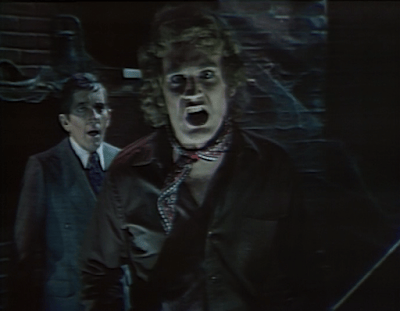
Ill-dressed man Sebastian Shaw lets himself into the secret room where vampire Barnabas Collins keeps a coffin. It is not the coffin where Barnabas spends his days, but is the resting place of another vampire. Its occupant is Roxanne Drew, whom Barnabas loves and Sebastian hates. Sebastian opens the coffin, pulls a pistol, and aims it at Roxanne. He is about to fire when another figure appears in the corner of the room. Regular viewers recognize this figure as the ghost of pirate Gerard Stiles. Sebastian does not know that Gerard is a ghost. He fires two shots at him, of course without effect.
Barnabas enters. He disarms Sebastian, who tells him he was going to destroy Roxanne but that a man stopped him. Barnabas recognizes his description of Gerard. Sebastian shows Barnabas the bite marks on his neck, and explains he was under Roxanne’s power until recently. She lost her control of him when she began feeding on governess Maggie Evans. Longtime viewers have often wondered why Barnabas didn’t build an army by biting everyone who got in his way and turning them into his blood slaves; this is the first explicit statement on the show that a vampire risks losing control over one victim by taking another. We’ve seen examples of Barnabas’ power weakening when he takes an additional victim, but this has been far from consistent.
Sebastian shouts so loudly the microphone distorts his voice in a way we’ve never heard before on the show. Screenshot by Dark Shadows Before I Die.
Barnabas asks if Roxanne ever mentioned the name Gerard Stiles. Sebastian says that he believes she did, but that he can’t remember in what connection it came up. We’ve had a few hints recently that Roxanne has some kind of association with Gerard and the other ghosts who are taking over the great house of Collinwood. This doesn’t give any substance to these hints, but it does confirm that the writers plan to keep dropping them.
Upstairs, Barnabas visits the other undead female he is keeping in his house, former ghost Daphne Harridge. He questions Daphne, who confirms that there was a girl named Roxanne Drew around Collinwood when she and Gerard were alive in 1840. She doesn’t remember much about Roxanne, but does recall that there was some drastic change in her that got people talking in that year. The show is obviously preparing for a trip back in time to 1840, so with this we learn that Roxanne will figure in that segment and that we will see how she became a vampire.
Another rehumanized ghost, Quentin Collins, enters. Barnabas orders Daphne to leave with Quentin, going far away from Collinwood before Gerard can get at her. Quentin tells Daphne to take Barnabas’ orders. When she protests, he says “Daphhh-neee” in a slow, condescending voice. David Selby started doing this in March to July 1970, when Dark Shadows was set in an alternate universe and he played a different Quentin Collins, one who was married to Maggie’s counterpart. That Quentin was an insufferable jerk who often scolded Maggie with a slow, condescending “Maaaa-ggie.” Hearing him say Daphne’s name in that tonal format this time, I finally realized what it reminded me of. Ted Knight, as pompous newsman Ted Baxter on the Mary Tyler Moore show, would often pronounce the two-syllable names of people he was addressing using the same intonation. All of a sudden I could hear Quentin telling “Murrr-ray!” he shouldn’t put such complicated words in the copy he writes, or “Georrr-gette” not to be so independent. When I mentioned the resonance to my wife, Mrs Acilius, she laughed and said she couldn’t believed she hadn’t noticed it herself.
Barnabas leaves Daphne alone with Quentin. They toast their future life. Daphne abruptly collapses, and Quentin clutches his stomach. Gerard appears, and Quentin asks him why he has poisoned them. Quentin is an expert on ghosts who poison the living. In #677, he was himself a ghost, and he put strychnine in a drink his great-grandson Chris Jennings took. Barnabas’ buddy, mad scientist Julia Hoffman, saved Chris then. Now, Julia is with Barnabas when he returns to the room. Daphne is on the floor, unconscious but still alive. Quentin is nowhere to be seen.
Barnabas goes to the great house, searching for Quentin. He finds heiress Carolyn Stoddard Hawkes, playing a mad scene. Nancy Barrett and Jonathan Frid make Carolyn and Barnabas sound like Ophelia and Claudius in Act 4, Scene 5 of Hamlet, for a little while anyway. When Barnabas tells Carolyn that they must stop what is happening, she replies “I cannot stop anything. Whatever gave you the impression that I could?” It really is lovely.
Barnabas goes back to his house. Julia has treated Daphne, who is resting comfortably, aside from glycerin tears streaking her face at several angles, none of them convincing. Carolyn enters and demands to be left alone with Daphne. Julia and Barnabas know that Carolyn is intermittently possessed by a ghost known as Leticia, who is somehow associated with Gerard and Daphne, and are therefore reluctant to comply with this demand. But they apparently don’t think they have much to lose, so they go along with it.
Carolyn/ Leticia gives Daphne a dress. It is the dress she wore when she was a ghost. Daphne cries out to Gerard, asking if the time has really come. She then goes and hides in the closet. There was a lot of dull business with clothes when Quentin was a ghost, late in 1968, and they recycled that early in the current haunting, five weeks ago. This moment is easier to take, both because it is mercifully brief and because the dress is clearly legible as a sign of imminent story progression in the form of Daphne’s next death.
Quentin and Gerard are in a graveyard. Quentin has recovered from the poisoning sufficiently to smile lovingly at Gerard and say that he can’t imagine why he ever thought he was his enemy. He examines the tombstones in the fenced-off part of the graveyard and reminisces about the men buried under them, men who were underlings of Gerard’s in 1840. Since Quentin is only 100 years old, he is puzzled that he has memories from 130 years ago, but when he takes another look at Gerard’s smiling face his anxiety dissipates. He looks at a blank tombstone and puzzles as to why it is blank. At Gerard’s bidding, he digs up the grave and opens the coffin. He is delighted to realize that it was meant for Quentin Collins, and that the time has come for him to get into it. He briefly resists the idea of burying himself alive, but then looks at Gerard, says “You are Death. Whatever made me think I could run away from you?,” and complies. We end with Gerard putting the dirt back on top of the grave, Quentin securely inhumed.
Longtime viewers know that Quentin is alive because of a magical portrait that immunized him against aging, lycanthropy, and injury. So we are left wondering whether he is also covered for asphyxiation. If he is, Gerard is going to be pretty embarrassed when Quentin makes his way out of the ground.
Julia Hoffman and Willie Loomis have gone to an old crypt and opened a coffin in which a vampire rests by day. They have come at the bidding of another vampire, Barnabas Collins, who wants them to destroy his colleague. Willie is ready with the stake and hammer, but Julia calls stop. She recognizes the ghoul in the box as Roxanne Drew, whom she identifies as “The girl Barnabas thinks he loves.”
Willie used to be Barnabas’ blood thrall; for some reason he now considers him a friend, and is voluntarily helping him and Julia in their efforts to combat the new vampire and a separate supernatural menace represented by a number of ghosts, some of whom have taken corporeal form. He hesitates to drive a stake through the heart of what appears to be a lovely young woman, but knows that doing so is the only way to save the life of Roxanne’s victim, governess Maggie Evans.
Julia has long since implicated herself so deeply in Barnabas’ many crimes that she has no hope of a future that does not center on him. She would like to carry on some kind of romance with him, a reasonable enough choice given that she cannot have one with anyone else, and has fallen in love with him after a fashion. Barnabas does not recognize the nature of their entanglement, and he refuses to reciprocate Julia’s desires in this matter. It must be galling to her that he has chosen Roxanne as his current infatuation, not least because she looks so much like her to be the daughter she never had. But her devotion to Barnabas is so extreme that Julia says that Willie and their friend, Quentin Collins, must carry the coffin to Barnabas’ house with Roxanne in it and allow Barnabas to decide what to do when he rises.
Julia goes to Barnabas’ house and finds Sebastian Shaw lurking in the parlor. She is startled to see him. He asks if he has committed a crime. Presumably he has, since he has no legal right to be there and no one is available who could have let him in, but Julia would rather ask him questions than scold him for trespass and unlawful entry. Sebastian is Roxanne’s closest known associate, and when they discovered that she was the vampire Julia and Willie were puzzled that he was not guarding her. For his part, Sebastian is interested in Maggie, and has come to Barnabas’ place to talk with Julia, who is Maggie’s doctor. He asks for permission to sit with Maggie, and Julia says that Maggie is too ill for visitors. Neither of them gets much satisfaction from the conversation.
Sebastian goes to the crypt and is surprised to find that the coffin is gone. He notices the hammer and stake on the floor, unused. Meanwhile, back at Barnabas’ house, Willie tells Julia that they left the hammer and stake in the crypt. Inexplicably, she orders him to go get them lest Sebastian find them. They aren’t monogrammed or anything- there’s nothing about them that could tell Sebastian who had been in the crypt. The most they can do is reveal to him that Roxanne has not been destroyed, but if he is under her power he knows that already. When Willie comes, of course Sebastian sees him and realizes that Roxanne must be in Barnabas’ house.
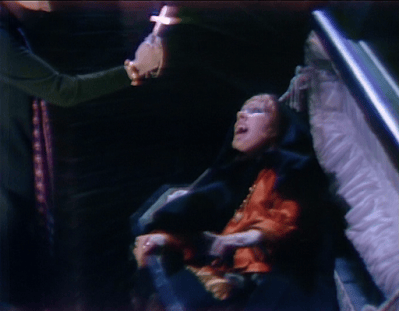
Barnabas rises. He is distraught to learn that Roxanne shares his affliction. At his command, Willie opens the coffin. Roxanne tries to bite everyone. Julia holds her back with a cross, and they re-close the coffin.
Willie and Julia leave. Roxanne is kept immobile by a cross on her chest. The coffin is hidden behind a bookcase in the parlor. Barnabas stands over the coffin and makes a speech, then leaves Roxanne alone in the house. The front door is, as always, unlocked.
Sebastian had let himself in after Julia and Willie left. He sees Barnabas come out of the chamber behind the bookcase, then lets himself into that chamber. He opens the coffin. Surprisingly, he does not let Roxanne go- he aims a pistol at her. Presumably it is loaded with silver bullets that will destroy her. It’s been clear all along that Sebastian hates Roxanne, but also clear that she controls him, so we have assumed he is her blood thrall and is powerless to act against her. Perhaps this is not so!
From March until July 1970, Dark Shadows was set in a universe other than the one where the action had taken place up to that point. In that universe, which the show insists on calling “Parallel Time,” the counterparts of heiress Carolyn Collins Stoddard and woebegone lowlife Willie Loomis were a married couple. That other Will Loomis was a bestselling but hard-drinking author who had squandered his earnings, and Carolyn Loomis was a poor relation of the master of the great house of Collinwood. They bickered incessantly, in an adaptation of Who’s Afraid of Virginia Woolf? that, in the hands of John Karlen and Nancy Barrett, sometimes seemed to rival Edward Albee’s original.
We’ve been back in the original continuity for five weeks now. The Carolyn we have known from the first week of the show is back, but she is half mad, intermittently possessed by a ghost known as Leticia Faye. Willie is helping time travelers Barnabas Collins and Julia Hoffman in their efforts to battle two distinct supernatural menaces, one consisting of a group of ghosts including Leticia, the other a vampire whose identity they have not discerned but whom they know to be feeding on governess Maggie Evans. Carolyn and Willie have their first scene together today since the return from Parallel Time. It is infused with the energy Karlen and Miss Barrett brought to their versions of Albee’s George and Martha. Karlen has some scenes alone where he wanders around and shouts in the general direction of a microphone; those don’t work at all. But when he has Miss Barrett to anchor him, he’s terrific and so is she. When she addresses him as “Willie Loomis!,” we are, for one lovely moment, right back in Loomis House.
Carolyn gives Willie a riddle and tells her that unless he’s too stupid to solve it, it will lead him to the missing governess: “Where the north woods path is narrow, you’ll be at sixes and sevens, but look for the H and follow the arrow, that points to Maggie Evans.” That riddle reminds longtime viewers how far the show has come in the last three years. The last time Maggie was the victim of a vampire, it was the summer of 1967 and the ghoul was Barnabas. The ghost of Barnabas’ little sister Sarah appeared to Maggie in the cell where he and his blood thrall Willie were keeping her and gave her a riddle which she solved, finding an escape route and avoiding the death Barnabas had planned for her. Now Maggie is helpless, and Willie and Barnabas are the good-ish guys. This riddle will enable Willie to come to her rescue.
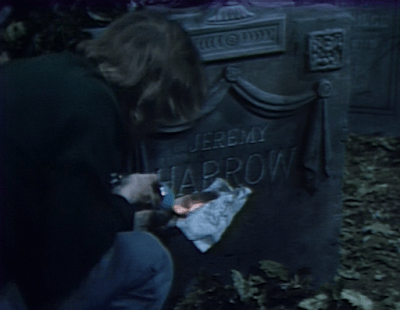
Willie goes to the narrow part of the path through the north woods. He shines a flashlight directly into the camera, a sure sign that we are watching Dark Shadows. Willie finds himself in a graveyard. He notices a tombstone inscribed with the name of Harrow. Subtracting the H, what’s left is “arrow.” He keeps moving his eyes rightward beyond the edge of the stone and sees the door of a mausoleum. He goes inside and finds Maggie on the floor, beside an empty coffin. He infers that the empty coffin must be where the vampire rests during the day.
Willie takes Maggie back to her room at Collinwood and confers with Julia and Barnabas. Barnabas decrees that Willie and Julia should go to the mausoleum during the day and stake the vampire. When they do, they are uneasy to find that no one is guarding the coffin. The episode ends with Julia’s expression of shock when she sees inside the coffin.
Time travelers Barnabas Collins and Julia Hoffman are doing battle with two distinct supernatural menaces. One of these is the ghost of Gerard Stiles, who, as they learned while visiting the far-off future year 1995, is destined to destroy the great house of Collinwood and the people who call it home before the end of the current year, 1970. The other is a vampire whom they have not identified, but who has been feeding on their friend and frequent victim, Maggie Evans.
In the drawing room, housekeeper Mrs Johnson sees Gerard. Gerard takes control of her, as he does when he meets people in that room. She goes upstairs, where Julia is keeping vigil over Maggie. Mrs Johnson says she woke up from a frightening nightmare in which Barnabas was suffering. She describes the setting of the nightmare. Julia recognizes it as Rose Cottage, the deserted mansion where Barnabas has gone to confront Gerard. Julia tells Mrs Johnson to take over for her in Maggie’s room, and rushes off to her friend’s side.
Julia bursts into the room where Barnabas is standing around, his confrontation with Gerard having come and gone without noticeable result. Barnabas is surprised to see her. As she explains what Mrs Johnson told her, the room bursts into flames. They try to escape, only to find that the door will not open. All seems lost, until the door opens from the other side. A woman named Roxanne Drew has come to their rescue.
Before their sojourn in 1995, Julia and Barnabas spent a while in an alternate universe which the show insists on calling “Parallel Time.” In Parallel Time, Barnabas met Roxanne’s counterpart while she was comatose. Charmed by her immobility and silence, he fell in love with her. Even after she came to and started moving around and speaking, Barnabas remained attached to that Roxanne. Barnabas and Julia escaped from Parallel Time through a room in a burning house; we learned in #1071 that Roxanne followed Barnabas and Julia into the burning room too late for them to rescue her. We can only assume she died in the fire. In the current universe, an inverted mirror image of that one, this other Roxanne is the one who rescues Julia and Barnabas from a burning room.
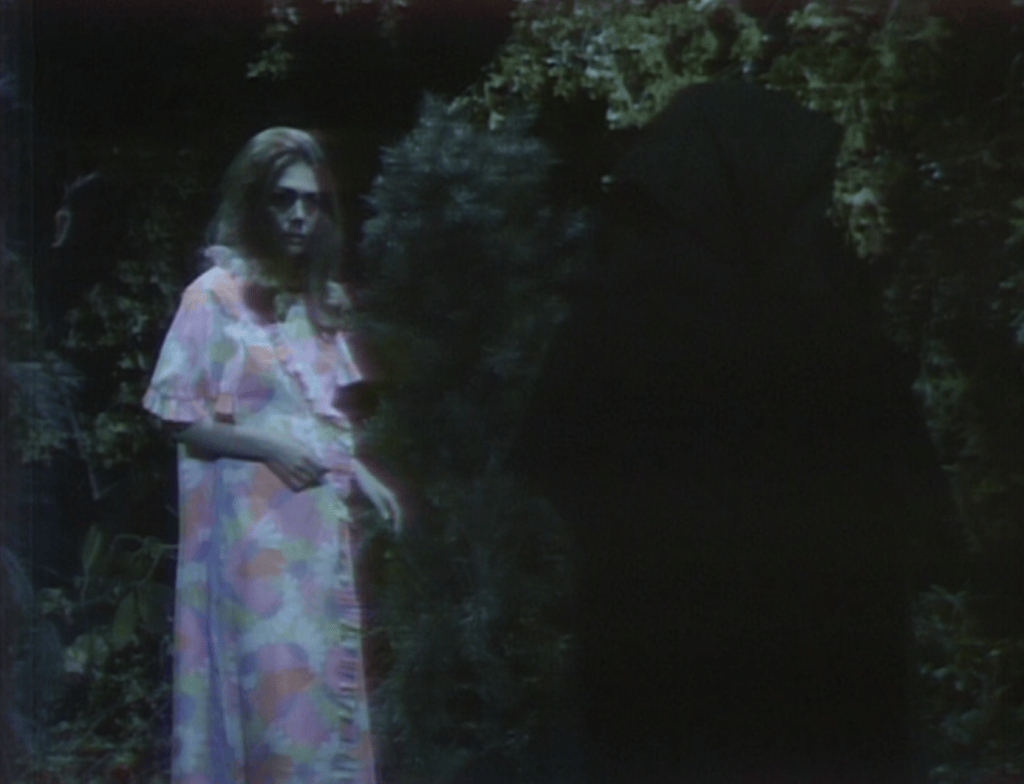
Roxanne separates from Barnabas and Julia in the woods, saying she has something else to do. They return to Collinwood. They find Mrs Johnson unconscious and Maggie missing. In the woods, Maggie approaches a shrouded figure, whom we assume to be the vampire and who appears to be Roxanne.
This episode marks the final appearance of the character Mrs Johnson and of the actress Clarice Blackburn. Blackburn had taken a writing job on another soap by this time and was not available for acting work on a regular basis. She was an outstanding performer; Nancy Barrett says that Blackburn was the single best actor in the entire cast of Dark Shadows. Since Miss Barrett herself is a serious contender for this title, that is not an opinion to be taken lightly.
In the 1995 segment, Mrs Johnson died in the episode broadcast on 23 July 1970. That would suggest a dramatic date of 23 July 1995, very close to Blackburn’s actual date of death, 5 August 1995. But it gets eerier than that. In #1071, when charming rogue Quentin Collins says that he looked into Parallel Time and saw Roxanne trapped in the burning room, he goes on to fix the date of Julia and Barnabas’ departure from Parallel Time as 3 August, two weeks after the broadcast date. That would be the date of their arrival in 1995, and would mean that the third night of their time in that year, the night when Mrs Johnson died, would have been 5 August 1995.