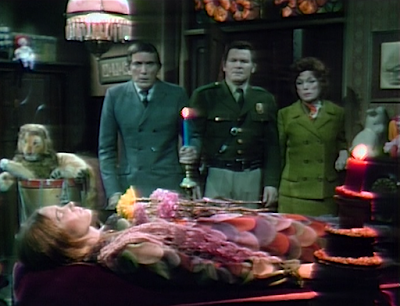
Episode 1050: How to bring you half alive

Late in 1968, the ghost of Quentin Collins began haunting the great house on the estate of Collinwood. The ghost gradually waxed more powerful and more malevolent, killing some people and tormenting others. By March of 1969, the great house had become altogether uninhabitable. Old world gentleman Barnabas Collins, trying to contact Quentin, traveled back in time to 1897, when Quentin was a living being. During the eight months the show was set in that year, we got to know a Quentin who was selfish, cowardly, untrustworthy, cruel, and supremely charming. Barnabas’ interventions changed history. In the revised timeline, Quentin did not become a malevolent ghost. He didn’t even die. A spell was cast on him that immunized him against aging, so that when the show returned to a contemporary setting in November 1969 he was alive, well, and to all appearances 28 years old.

In 1969 and 1970, Quentin still had all the lovableness that came from being played by David Selby. But the writers were stumped when it came time to give Quentin something to do. They kept him in a holding pattern for a month or so with a case of amnesia, and used him and one of his girlfriends to tell a version of the story of Orpheus and Eurydice. When Barnabas and his best friend, mad scientist Julia Hoffman, were doing battle with an unseen race of monsters from beyond space and time, they occasionally turned to Quentin for help. When Barnabas’ old nemesis, wicked witch Angelique, grew jealous of his interest in governess Maggie Evans, she cast a spell to cause Quentin and Maggie to conceive a wild passion for each other, something which came and went and which Barnabas never noticed. None of that activity made an impression on the audience or gave the character room to grow.

The evil but irresistible Quentin of 1897 had a great deal in common with high-born ne’er-do-well Roger Collins, who was in 1966 the show’s first true villain. As played by Louis Edmonds, Roger was so much fun to watch that it was soon out of the question to follow the original plan and kill him off when his crimes were exposed, so they nerfed him. Roger turned into a sarcastic but harmless snob. When in November 1967 the show went back in time to 1795, Edmonds played haughty overlord Joshua Collins, a man as strong as Roger was weak. In a tragic turn Aristotle would have admired, it was Joshua’s virtues that led to disaster for himself and everyone he loved. In the 1897 segment, Edmonds played the stuffy but lovable Edward Collins, who had many faults but was devoted to his family and committed to doing the honorable thing. Under the influence of these roles, Roger himself had by the time the show was done with him transformed into an upright family man.

The makers of the show have apparently decided that if traveling in time and casting Edmonds in other roles could change Roger so profoundly, finding a setting where they can present us with a different version of Quentin might be a path to reinvigorating that character. To that end, they have traveled, not backward in time, but sideways in time. We are now in a different universe than the one where the first 196 weeks of the show took place. The show insists on calling this universe “Parallel Time.”

Here, Quentin is the master of Collinwood and Maggie is his wife. This Quentin is something his counterpart never was, an authority figure. But authority does not come naturally to him, as it did to Joshua and Edward. He holds onto it in his relationship with Maggie by treating her as a child, with the result that their marriage is all but dead. He ignores his son Daniel, caves in to the servants when they stand their ground against him, and throws tantrums and runs away when he encounters serious opposition. In those moments he reminds us of the cowardice Quentin showed in 1897. On occasion, however, he has shown physical courage, as when he stood up to an evil man called John Yaeger. As Joshua suffered from the overgrowth of his virtues, so Quentin’s better deeds seem to be the accidental byproduct of his vices. What we have seen in Parallel Time makes it easy to imagine that when we get back to the main continuity, we will see Quentin as a sometime action hero who must at all costs be kept from taking charge of anything. Had the segment caught on as 1795 and 1897 did and been expanded beyond the bounds originally planned for it, who knows what other paths it might have opened for the character.

Angelique was Quentin’s first wife, who was murdered nine months ago but has risen from the dead, assumed the identity of her identical twin sister Alexis, and set about taking revenge on her killer. She doesn’t know who that was, though for now she is operating on the assumption it was Quentin.

Roger and the matronly Elizabeth Collins Stoddard are Quentin’s siblings. While in the main continuity Liz kept her share of the inheritance as Roger was squandering his, here she entrusted her money to Roger, so that they are both penniless dependents on Quentin.

Barnabas and Julia have crossed over from the main continuity. Barnabas is pretending to be a long-lost cousin of the Collinses, while Julia is impersonating her own counterpart. That other Julia Hoffman was the housekeeper at Collinwood and Angelique’s most fanatical devotee until Julia showed up, beat her to death, and stole her French maid outfit.

At this point, Quentin is on the run from the law, suspected of the murder of sleazy musician Bruno Hess. He was choking Bruno shortly before his death, but is in a sense innocent of the crime, since it was a spell Angelique cast that completed the fatal strangulation. Liz’ daughter Carolyn is in mourning for her husband Will, who found himself caught between Angelique’s magical powers and Barnabas’ and could do nothing but fling himself to his death from a high window. Yesterday Carolyn announced that she knew and could prove who had killed Angelique. She went to the room on top of the tower attached to the great house. A man entered. She greeted him. He drew a knife and she screamed.

Today, Roger tells Liz and Julia that he heard Carolyn’s scream, ran to the tower room, and found her stabbed to death. Presumably the same man killed her who killed Angelique. The three current suspects are Roger himself, Quentin, and butler Mr Trask.

Yesterday’s episode hinted heavily that Trask was the culprit, and Liz says that he has been missing since Carolyn was killed. We had not seen or heard of Trask in more than eight weeks, and in none of the handful of episodes in which he appeared before that hiatus was it suggested he might have killed Angelique. If it does turn out that the butler did it, therefore, it would be obvious that the show had originally planned to pin the crime on a major character and chickened out at the last minute. We do see a man lurking about today who might be Trask and almost certainly is the mysterious and terrible “Claude North” whom we have heard about recently; if Trask and North are one and the same, that might lead somewhere, but it would hardly be a logical culmination of what we have seen so far.

The whole point of the “Parallel Time” segment is to reconceive Quentin. Making him the killer of Angelique might fit with that. The Quentin of the main continuity murdered his wife Jenny in 1897,* and Angelique is much less sympathetic than Jenny was. Quentin does not have to be admirable, or even defensible. He just has to be attractive. If they can find a way to occasionally make his vices into motives for good deeds, all the better. But Carolyn’s counterpart in the main continuity has been a central figure on the show since the first week, and like all characters played by Nancy Barrett she is a fan favorite. If this Quentin deliberately kills Carolyn, especially by hacking her to bits with a kitchen knife, it is hard to see how the Quentin of the main continuity will benefit. It is true the present Quentin is such a gloomy sourpuss and such a miserable failure as a husband to Maggie that he has already alienated the audience, so they might have decided they had nothing to lose by turning him into Jack the Ripper.

That leaves Roger. He has been painted in the colors of his counterpart as he was in 1966, making him a possible murderer. Even at his coldest, the Roger of the main continuity was close to Carolyn, whom he called “Kitten.” But when we first saw the characters from the current universe in #975, they were hostile and impatient with each other, and Roger took a menacing tone with his niece. The only person for whom this iteration of Roger has any affection is Angelique, and all of that flows to a version of her that exists only in his imagination. Roger seems to be describing himself in both universes when he tells Liz that “The sum total of my life seems to be that I can never help anyone.” So we can certainly believe he killed both Angelique and Carolyn, and that he might kill again.

Liz and Roger’s counterparts have been on the fringes of the action in the main continuity for years, and today we see that this Liz and Roger are also excluded from much that is happening. They visit the Collins family mausoleum in the old cemetery north of town scouting out potential resting places for Carolyn. Unknown to them, there is a hidden chamber in the back of this mausoleum, and Claude North is lurking there, a dagger in his hand, while they chat in the publicly visible part. They then go to Carolyn’s home, the Old House on the grounds of Collinwood, to look for anything she might have written that would give a clue as to who killed her. Unknown to them, Julia is in the basement of the house, conducting a mad science procedure to weaken Angelique by reviving a woman named Roxanne on whose “life force” she is feeding. One wonders where else they will stop on their way home, and of what other uncanny doings they will be oblivious while there.

We hear Julia’s thoughts as she is preparing to revive Roxanne. She tells herself that this is the procedure that brought Adam and Eve to life. She is not thinking of some obscure midrash about the book of Genesis, but about two Frankenstein’s monsters she loosed upon the world in 1968.

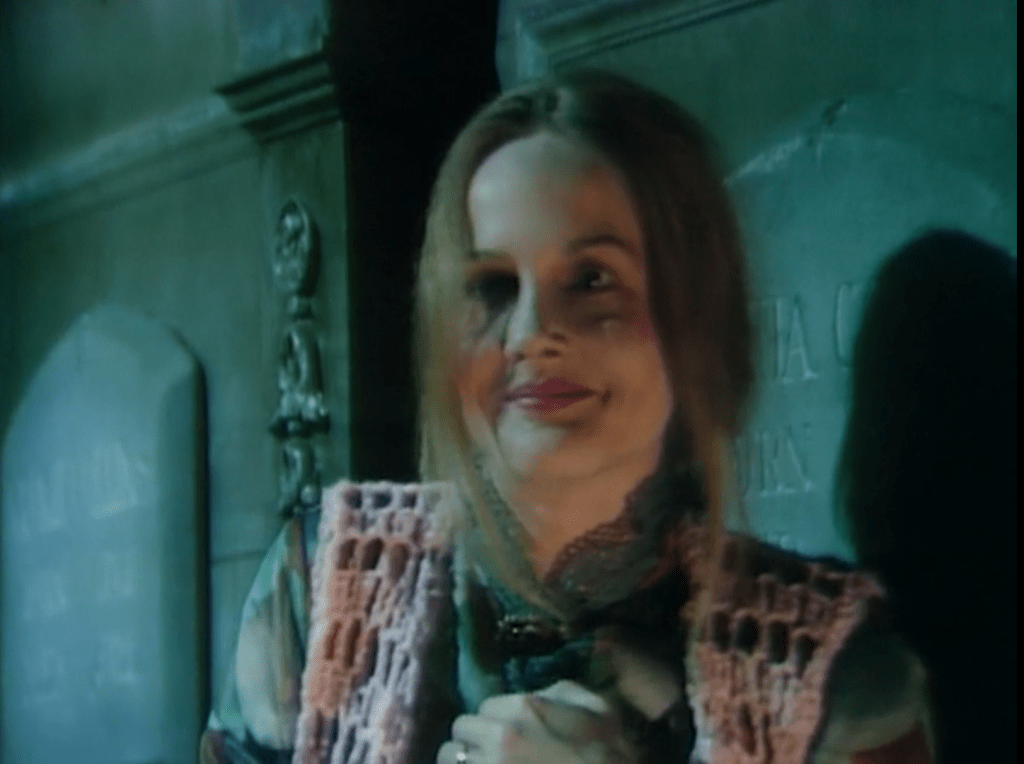
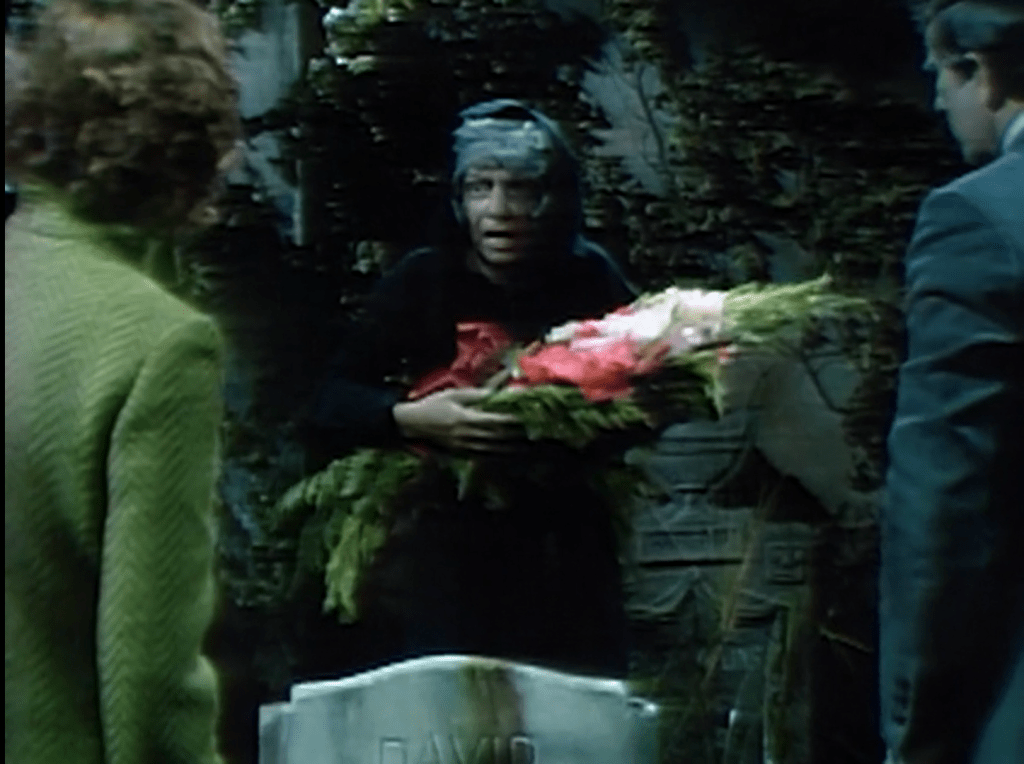
*Jenny must have been in someone’s mind when they were making this episode. We catch a glimpse of a gravestone in her name during a cemetery scene:

Poor Jenny, bright as a penny. Screenshot by Dark Shadows Every Day.

Episode 1049: Evening brings another secret

In the first months of Dark Shadows, characters several times shared meals in the kitchen in the great house on the estate of Collinwood. In that intimate setting, they would often exchange information that made it possible for them to advance the story. As time went on, the show developed more ways to get knowledge flowing, and the kitchen lost its importance. We haven’t seen it since #208.

Now, the show is set in an alternate universe, which it calls “Parallel Time.” We see the kitchen in this reality’s Collinwood today, the last glimpse we get of the room in any version of the place. Young Amy Collins visits butler Mr Trask there while he is sharpening a large knife. She tells him a man is living in the tower room. He leaves to investigate, leaving the knife on the countertop. The camera zooms in on the implement, lingering over it while an ominous cue plays on the soundtrack.

Later, Amy returns to the kitchen with the matronly Elizabeth Collins Stoddard. Liz is upset that dinner is not ready and Trask is nowhere to be found. Amy notices that the knife is not where Trask left it hours before. Liz is unimpressed with this fact, as anyone would be who had not seen the zoom shot and heard the melodramatic music. We cut to the tower room, where Liz’ daughter Carolyn Loomis greets someone we cannot see. We cut to a hand holding a knife very much like the one Trask had sharpened. The hand brings the knife down, and Carolyn screams.

It is Carolyn who is the main source of information for the other characters in today’s show. Carolyn’s husband was killed the other day in a conflict between two supernatural beings. The other characters in today’s episode have no idea that such beings dwell among them, and think that those two in particular are simply members of their extended family. Carolyn has had all she can take of this situation. She claims “to know all the secrets” of Collinwood, and is far too drunk to keep many of them to herself.

Trask learned several secrets from Carolyn in Act One, when he was leaning up against the door to the drawing room, his ear pressed hard to it, eavesdropping ferociously on her conversation with her uncle, Roger Collins. Carolyn taunts Roger with his failure to recognize someone he loves desperately. She declares that she can prove that the houseguest who has been staying in the great house lately is not Alexis Stokes, but Alexis’ identical twin sister, Angelique Stokes Collins.

Trask eavesdropping. Screenshot by Dark Shadows Before I Die.

Roger rejects this claim. Since Angelique died last year, one might expect Roger to be confident in his rejection, but he is high-strung and defensive about it. Carolyn does not deny that Angelique is dead. Indeed, she says that if anyone were to look at the base of “Alexis'” skull, they would find a scar where the killer drove in the hatpin that killed Angelique, proving that “Alexis” is Angelique’s reanimated corpse. This makes more sense to Roger than one might expect. When he first saw Alexis in #990 she had to give him her hand and talk soothingly to him for some time before he would accept that she was not Angelique risen from the grave.

As it happens, Carolyn is right. Two weeks after she met Roger, Alexis saw Angelique lying in the tomb. Alexis touched her sister to bid her a final farewell, only to find that all of the heat was draining from her body into Angelique’s. Moments later, Alexis was dead and Angelique was standing over her icy corpse. Angelique put on Alexis’ clothes, did her hair in the style Alexis wore, and met Trask, who accompanied her to the great house. Ever since, Angelique has been passing herself off as Alexis.

Amy interrupted Trask while he was eavesdropping. He ordered her to leave him alone, getting quite surly about it. If he can hear everything Carolyn and Roger are saying, we wonder why they can’t hear him being nasty to a member of the family. But apparently they can’t. She goes away, and he presses himself even closer to the door.

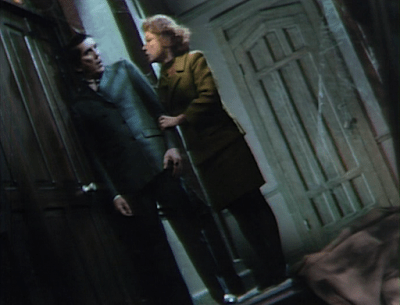
Carolyn is still talking to Roger and Trask is still eavesdropping when “Alexis” comes by. She reproves Trask, opens the doors to the drawing room, and exposes him to Roger and Carolyn. Roger is too shocked by the sight of “Alexis” and Carolyn is too amused by it all for either of them to do anything about Trask’s misconduct.

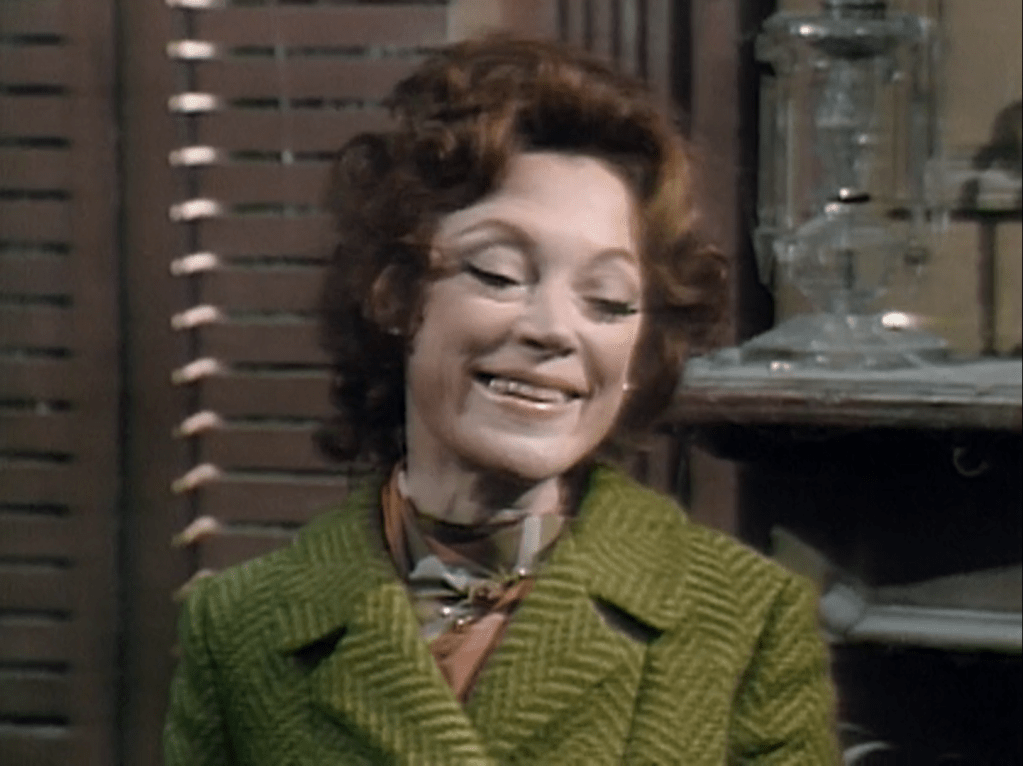
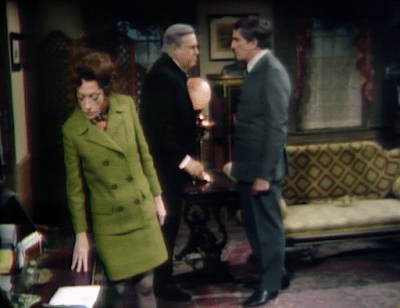
Later, Carolyn returns to the drawing room and finds her mother talking with “Alexis.” She leans down way into “Alexis'” personal space, making her hilariously uncomfortable.

Hello there. Screenshot by Dark Shadows Before I Die.

“Alexis” leaves them alone. Carolyn tells her mother that she knows who murdered Angelique. She says that she had suspected her, and is greatly relieved to know that she was wrong. Roger eavesdrops on this conversation, and turns around to see the shadow of yet another eavesdropper.

The Shadows’ knows. Screenshot by Dark Shadows Before I Die.

Carolyn tells Liz that she not only knows who the murderer is, she has talked to “him” recently. That doesn’t narrow it down. She has talked to all three current suspects, and all of them are men. Roger gets very agitated whenever the topic of Angelique’s murderer comes up; his reaction is one of many heavy-handed clues the show has been giving lately that he did it. They had not suggested Trask might be the culprit when he was last on the show, in #1004, but they couldn’t be more obvious about it today. The third suspect is Quentin Collins, brother to Roger and Liz, who is currently a fugitive from justice, having escaped from jail after he was charged with another murder. Quentin is the man living in the tower room; Carolyn saw him there the other day, and he took a threatening tone with her. So any of those three men might be the one wielding the knife in the final shot.

This is a day for final appearances. Not only do we bid the kitchen adieu, but also Carolyn Loomis, Mr Trask, and Amy Collins. Nancy Barrett and Jerry Lacy will be back as other characters, but Denise Nickerson is gone from the cast as of today. After a great run in her first couple of months on the show, she was criminally underused. Still, whenever they did put her on she was typically the highlight of the day, so it is sad to lose her.

Liz mentions someone named “Dr Blum” today. We never see Dr Blum. The only character in the whole series who seems to be Jewish is Dr Julia Hoffman, who like the unseen Dr Blum is a psychiatrist. It was less than a year after this episode aired, on 26 May 1971, that President Richard Nixon said in a conversation with his chief of staff H. R. Haldeman that the reason he was unpopular with Jewish voters was that “Most of them are psychiatrists.” Ever since the tape of that conversation was released in 2002, people have been trying to figure out what Nixon meant to say. Perhaps the White House taping system malfunctioned, and picked up some audio not from the Richard Nixon of our universe, but from one who lived in one of the universes where Dark Shadows took place. There, he might have been making a simple statement of fact.

Episode 1048: There are a lot of closets, baby!

The police are looking into the murder of Angelique Stokes Collins. Angelique has risen from the grave and is available to assist with the investigation, though Inspector Hamilton, like most of the other people in the village of Collinsport and on the estate of Collinwood, thinks she is her identical twin sister Alexis.

Hamilton is impatient with everyone, a bad quality in an investigator. So when he accuses “Alexis” of helping Angelique’s widower Quentin to burn Angelique’s body in order to cover up evidence that Quentin murdered her, she responds with a more or less true account of what happened, omitting only that it was Alexis’ body Quentin burned. Hamilton cuts her off in mid-sentence, proclaiming that he won’t listen to any more of it.

Hamilton was once a close friend of Julia Hoffman, the housekeeper at the great house on the estate and Angelique’s most fanatical devotee. What neither he nor Angelique knows is that Hoffman is dead. Her Doppelgänger has come from an alternate universe, killed her, and assumed her identity. This other Julia Hoffman is working in concert with another interloper from the same universe, vampire Barnabas Collins, to defeat Angelique and end her presence among the living.

Hamilton questions Julia about the night of Angelique’s death. That was many months ago and Hoffman was not present at the scene, so Julia is able to fake her way through the questioning without major slips. But when Hamilton starts talking about old times, Julia is at a total loss. Hamilton mentions to “Alexis” that she does not seem like the Julia Hoffman he knows. Since Angelique has begun to notice differences in Julia’s behavior from what she would expect of Hoffman, this indiscreet remark represents a considerable danger to her.

At the Old House on the estate, Hamilton questions Carolyn Loomis. Carolyn’s husband was caught between Angelique’s powers and Barnabas’ the other day, and all he could do to resolve the strain was to fling himself to his death from a high window. Carolyn is hugely drunk. She raves at Hamilton that “Collinwood is not exactly a picture book house by the sea. There’s a skeleton in every closet, and there are a lot of closets, baby! Let me put it this way, Inspector- Collinwood is a nice place to visit, but you would not want to live there.” He seems to regard this as the sort of unseemly thing it is best to pass over in silence.

Carolyn is not overawed by the dignity of Hamilton’s badge. Screenshot by Dark Shadows Before I Die.

There are several strong hints today, as there have been over the last couple of weeks, that Carolyn’s uncle Roger Collins murdered Angelique. They can drop as many hints to that effect as they like, and longtime viewers will still be surprised if it turns out to be true. For its first 196 weeks, Dark Shadows was set in the universe from which Julia and Barnabas came. Roger’s counterpart there was indeed a potentially deadly villain in the first months of the show, but he was eventually nerfed. By the time we decamped for this continuity, it had been more than three years since he was a menace to anyone. They’ve been painting this character in the colors of the 1966 Roger, and his languidly sarcastic manner combines with his relationship to the portrait of Angelique to remind us of Waldo Lydecker in the 1944 film Laura. But we saw so much of Roger the harmless gay uncle in 1967 and Roger the conscientious family man in 1968 and 1969 that it is still hard to imagine that he will turn out actually to be a killer.

The show was done live to tape for years, and even after post-production editing became an important part of it they were slow to credit the videotape editors. They’ve been making up for that lately, though. Today they credit their fourth pair of editors, Alex Moskovic and Rene Labat. Still other teams will be named in the weeks ahead, but Moskovic and Labat are the last ones I will mention here, unless there is something special about the cutting of a given episode.