Episode 1114: I am the stranger

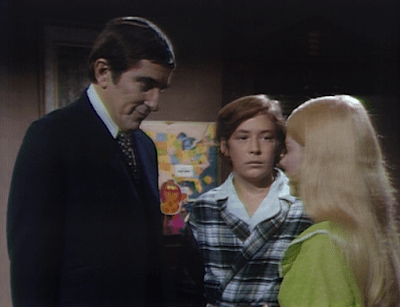
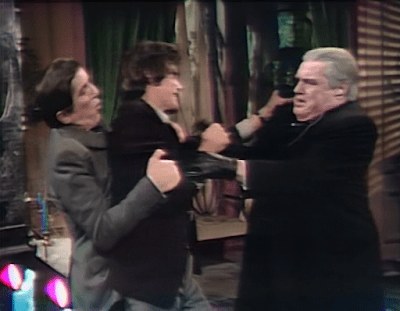
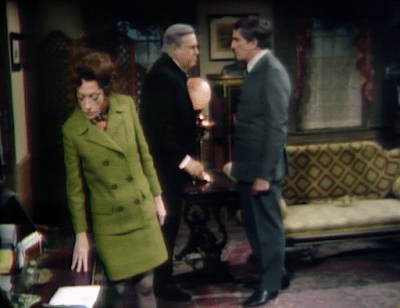
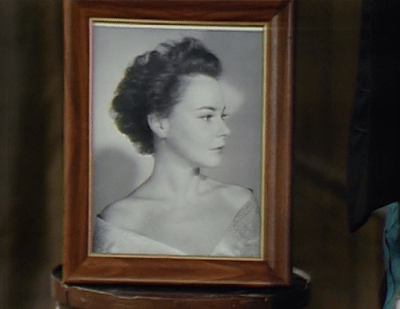
In June, Dark Shadows was set in an alternate universe to which vampire Barnabas Collins and mad scientist Julia Hoffman had traveled. Julia and Barnabas found a comatose woman. Barnabas took one look at her, saw how silent and immobile she was, and fell in love. He’s dead half the time, so we can’t judge him for that reaction.

The woman’s name was Roxanne Drew, and Barnabas’ love for her survived even after she regained the ability to walk and talk. Roxanne didn’t make it to the original continuity when Barnabas and Julia returned there in July. Barnabas’ sorrow for her was lightened in #1081, when he met Roxanne’s counterpart in his native universe. Their relationship took a turn for the worse in #1106, when he discovered that she, too, was a vampire. In #1107, he found out that Roxanne was alive in 1840, and that she underwent a mysterious and terrible change in that year.

Now, Barnabas is keeping Roxanne chained in her coffin in the secret room behind his bookcase. Julia has traveled back in time to 1840 and hopes to prevent a disaster that has destroyed the great house of Collinwood and its residents. Trying some mumbo-jumbo that he hopes will lead him to join Julia in the past, Barnabas has a vision of a tombstone saying that she died on 6 October 1840. He and his friend Timothy Eliot Stokes go to the graveyard and see such a tombstone there. Barnabas says that 6 October is three days away; the episode was originally broadcast on 1 October 1970, which is more than three days from 6 October. But there is a weekend in between, and days when the show isn’t on don’t count.
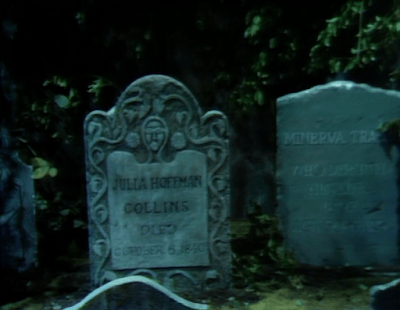
The stones. Screenshot by Dark Shadows Before I Die.

Barnabas says that he must find a way to travel back in time before 6 October. Stokes asks why, and Barnabas says he himself doesn’t understand how it works. But regular viewers know that anniversaries have a power in the cosmos of Dark Shadows that physical laws have in our world. If an event took place exactly 130 years ago, or any other number of years ago, it is possible for people in the present to interact with that event in ways they cannot on other days of the year. That has been the case ever since undead blonde fire witch Laura Murdoch Collins was on the show, before Barnabas made his first appearance.

Julia’s grave is next to one commemorating Minerva Trask, a hateful biddy who was one of the most effective villains during the period in 1969 when the show was set in 1897. That turns out to be foreshadowing. The scenes with Barnabas and Stokes in a contemporary setting are a prologue to an episode set mostly in 1840. Julia meets the living Roxanne, who is accompanied by Lamar Trask, a kinsman of Minerva’s loathsome husband Gregory.

Julia is a guest at Collinwood, impersonating Barnabas’ imaginary daughter and telling the family to await the arrival of her brother, Barnabas Junior, who looks remarkably like their late father. Julia is in the drawing room, talking to herself about how much she misses Barnabas, when Roxanne enters. Roxanne makes a little joke about talking to inanimate objects, and introduces herself as the sister of Samantha Drew Collins, wife of the missing Quentin Collins and lady of the house.

Trask enters. Julia is startled to see him. Roxanne asks Julia to guess what business Trask is in. She says she could not possibly, and Trask protests that guessing games are silly. That’s a shame. Julia must have seen What’s My Line?; we can imagine her asking “Is there a product connected with what you do? Is the product bigger than a bread box? Is the product alive? Are your services equally available to men and women?” etc.

Roxanne says that Lamar is an undertaker. She spits the word out, and asks him sarcastically if he prefers to be called a mortician. She reviles his profession in quite vigorous language. The dramatic date may be 1840, but at this moment we are very clearly in the aftermath of Jessica Mitford’s 1963 book The American Way of Death, an extremely influential polemic against the mortuary industry.

Lamar insists that Roxanne go out on the terrace to talk with him privately. When they are gone, Julia wonders to herself what will happen later this year to turn Roxanne into a vampire. She really ought to know. She released Barnabas from his chained coffin the other day, hoping that he would already be her friend returned from the future. But instead he was the same monster sealed up there in the 1790s, who had no idea who she was. Had his old friend Ben Stokes not shown up in the nick of time, Barnabas would have killed Julia then and there. He has gone on to take other victims, killing some of them, and remains at large. So it seems quite likely that Barnabas will bite Roxanne to death, causing her to rise as a vampire. When that happens, Julia will be to blame.

This is a temporal paradox. Julia hadn’t traveled back to 1840 when she first met the vampiric Roxanne, and Barnabas hadn’t been out of his coffin between the 1790s and 1897 at that point. Roxanne’s vampirism was involved in the circumstances that led to Julia’s trip to 1840. So the vampirism caused the trip that caused the vampirism. And Roxanne the vampire had clearly never seen Barnabas before when she met him in 1970. Of course it doesn’t make logical sense, but so much of the story is made up of the consequences of Julia and Barnabas’ bungling that it would be wrong if it were any other way.

On the terrace, Lamar asks Roxanne to marry him. She refuses, angrily. My wife, Mrs Acilius, said that it was odd Lamar wanted to marry Roxanne, since she obviously hates him. I pointed out that he seems to hate her as well. Many married couples come to hate each other over the years, so I suppose it is a time-saver of a kind if two people get married who already hate each other.

Lamar keeps telling Roxanne that he made a deal with her father to marry her, and she keeps telling him that she doesn’t care. She wants to marry a mysterious stranger who will sweep her off her feet and show her a new life. Barnabas is eavesdropping from behind the wrought iron fence. He has not met Roxanne before, and cannot see her well, but he can well imagine himself being a mysterious stranger who will change everything in a woman’s life. Moreover, Barnabas hears her raging at Trask, whose late father was an enemy whom Barnabas killed with an even higher degree of sadism than is usual for him. Since Trask Junior looks and sounds just like Trask Senior, Roxanne’s hostility to him is enough to make Barnabas feel a special closeness to her.

Barnabas approaches Roxanne after Lamar has left. He persuades her to invite him to her home. When Barnabas was first on the show in April and May of 1967, they made good use of the trope that vampires can enter only where they are invited, but they soon became very inconsistent about that. It places a restriction on Barnabas’ movements that can be story-productive though, so I’m always happy when it seems they will be bringing it back.

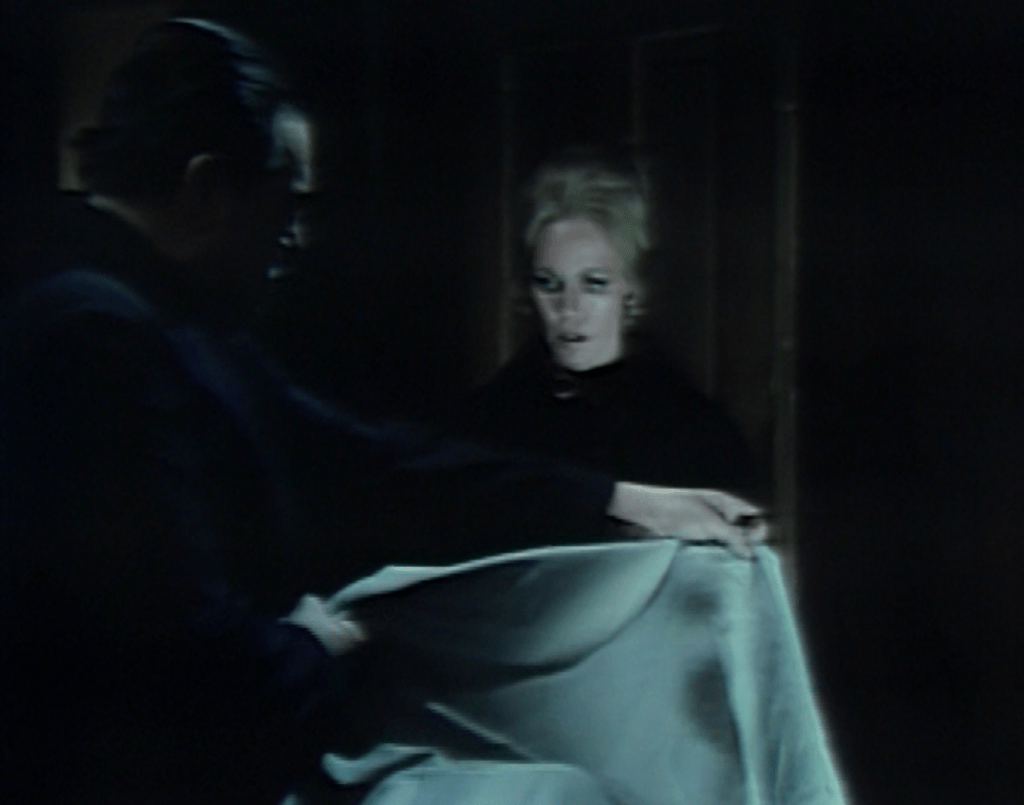
In her room, Roxanne is disappointed Barnabas did not call. He materializes inside her window. She can’t very well be happy about that, but he talks her out of screaming. She looks into his eyes and falls into a trance. He bares his fangs, and she tilts her head to offer him her neck. Her fate would appear to be sealed.

This is the first episode credited to Lela Swift as line producer. Swift has been with the show as its principal director from the beginning. Even though Henry Kaplan is listed as director today, it has the crisp look and inventive compositions that characterize Swift’s style, not the muddy images and extreme closeups with which Kaplan was content to fill the time. We can hope that, with Swift in the driver’s seat, the show will consistently meet her high standards of visual strategy.
Episode 1113: Do you smell the smoke?

From March to November 1969, Dark Shadows was mostly set in the year 1897, to which time-traveling vampire Barnabas Collins had made his way. Barnabas’ friend, mad scientist Julia Hoffman, would join him for several weeks towards the end of the 1897 segment.

While Barnabas and Julia were busy in the past, the show cut to a contemporary setting a few times to show us that time was passing there and that the actions taking place in 1897 were changing the circumstances at the great house of Collinwood in the twentieth century. When Barnabas returned to the contemporary setting, the other characters knew where he had been and remembered both the events he went back in time hoping to prevent and those that had replaced them.

The 1897 segment was so good I wished it had gone on longer. One way I imagined they might have been able to stretch it out would have been to do more with the intercutting timelines. So perhaps spend a week in 1897, then a week in 1969. Obviously that would have required a lot more advance planning than they ever managed to do, since they would have had to keep redressing the sets to represent the different periods, but I thought it might have been worthwhile.

Today, we have evidence that some idea like this also occurred to the makers of the show. Julia has gone back in time to 1840 to keep a series of events from starting that will lead to the ruination of Collinwood and its inhabitants in 1970. Barnabas was unable to join her. We spend time today with Julia in 1840, and then with Barnabas in 1970.

Arriving in 1840, Julia’s first act was to make contact with Barnabas’ old friend Ben Stokes. Ben believed her story and made himself incredibly helpful to her effort to establish herself at Collinwood. But she convinced herself that Barnabas had magically projected himself from 1970 into his body as it is in 1840. So she went to the secret room of the old Collins family mausoleum, unchained his coffin, and released him. He was about to kill her when Ben showed up and stopped him. Ben persuaded Barnabas to let Julia leave the room alive, and repeated her story to him. Barnabas reacted with incredulity, telling Ben that he had gone mad to accept such a tale, but Ben insisted Julia was their friend. Now Barnabas has resumed killing people, and Julia is terribly afraid that unless he stops he might be caught.

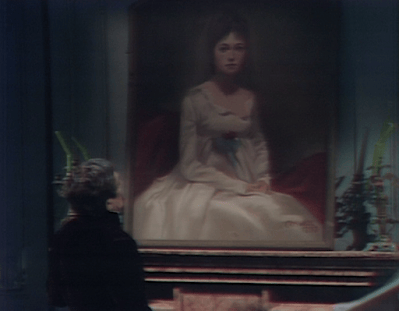
Barnabas is in the bedroom at the Old House at Collinwood once meant for Josette DuPrés to call her own after she married him. He takes Josette’s portrait off the wall and tells her that he must go on without her. We’ve heard that before. In #281, he stood in the same room and spoke to the same portrait, telling Josette that her ghost must go away and never come back so that he could face the world with someone else. We soon found that his plan was to turn that someone else into a simulacrum of Josette, and later he kept deciding that other women were reincarnations of Josette, so that speech did not represent the emotional growth we might have hoped to see. Finally, Josette’s ghost appeared to Barnabas in #948 and told him to lose her number, and his next love interest was a woman who did not remind him of her. That new woman was comatose, and Barnabas rhapsodized about how much beauty he found in her silence and immobility. Also, there was a bit of a problematic age gap, since she was 22 and he was well over 200. Baby steps, baby steps.

Barnabas has a heart to heart with Josette’s portrait. Screenshot by Dark Shadows Before I Die.

Ben enters and tries to talk Barnabas into returning to his coffin and allowing himself to be chained back in. As my wife, Mrs Acilius, points out, he doesn’t even mention that murder is bad. He knows Barnabas well enough to know he’d roll his eyes at that kind of talk. He just focuses on the danger Barnabas is putting himself in. Barnabas says that Ben does not know how horrible it is to spend years trapped in the darkness. Returning viewers may smile at this, since Barnabas doesn’t know that either. When Julia opened his coffin, he had no idea more than a single day had passed since he was chained there in the 1790s. He flounces off to take more victims.

In the drawing room of the great house, Julia meets Cockney psychic Leticia Faye. She asks Leticia if she can tell what will happen in that room in 1970. Leticia laughs and says her visions don’t extend that far. She adds that there wouldn’t be much point in them if they did, since no one alive today will be around to see if they came true. Julia claims to have had a dream about 1970, and Leticia humors her. She goes into a trance, and smells smoke. That’s about it, and when Leticia comes out of it she is still laughing, perhaps thinking that it didn’t amount to much. But it reminds Julia of the disaster she escaped, and leaves her wondering what Barnabas is doing in 1970.

We cut to Barnabas’ house in that year. He is doing what he does best, sitting around feeling sorry for himself. Ben’s descendant, occult expert Timothy Eliot Stokes, is there. They are talking about the funeral held that afternoon for the residents of the great house killed in the disaster. Stokes does not know that Barnabas is a vampire, and so Barnabas has to make an excuse for his absence from this daytime event. He simply says he was too upset to attend.

Heiress Carolyn Stoddard Hawkes and charming rogue Quentin Collins survived the disaster and are in the Old House, both quite insane. Barnabas and Stokes cart them off to a psychiatric facility. This is the final appearance on Dark Shadows of either of these characters, each of whom has been enormously important to the show.

Carolyn is played by Nancy Barrett, who also plays Leticia. Quentin is played by David Selby. We had expected to see Mr Selby in 1840 as another character named Quentin Collins, but when Julia arrived she learned that Quentin was missing and presumed dead after a nautical mishap. This glimpse of Quentin doesn’t add much to the story, but it does serve to reassure us that Mr Selby has not left the cast and that we will be seeing the 1840 version of Quentin sooner or later.

Barnabas decides to cast some I Ching wands. That’s what got him back to 1897, and the wands fall in the same pattern this time as they did then. He meditates on them. He sees a door, and seems to pass through it. On the other side, he sees a tombstone engraved “Julia Hoffman Collins 6 October 1840.”

Julia is masquerading as the daughter Barnabas had after he left for England in the 1790s, and has been telling the Collinses to expect her brother, Barnabas Junior. We haven’t heard her give “Hoffman” as a middle name. Of course it had to be there for Barnabas to be shocked by the stone. Otherwise, he would just have wondered who “Julia Collins” was.

It strikes me that they missed an opportunity. Julia has said that she moved from England to Philadelphia. Even though she lived there for so many years that she picked up an eastern Pennsylvania accent, she did not contact the family at Collinwood. Eventually they are likely to find out that she has a great deal of medical expertise, most unusual for a lady in 1840. Had she introduced herself as Julia Collins Hoffman, she might have explained that she met her late husband Dr Samuel Hoffman while he was studying in London, married him there, and lived with him in his hometown, Philadelphia. At the name “Dr Samuel Hoffman,” a theremin might have played on the soundtrack. Electronic music enthusiasts would laugh at the nod to the real Dr Samuel J. Hoffman (1903-1967,) the great player of and composer for the theremin. And fans of Dark Shadows would be happy that Julia’s imaginary husband has the same first name as Grayson Hall’s real husband, series writer Sam Hall.

This episode marks not only the final appearances of Carolyn and the original Quentin, but also the last time Peter Miner’s name will appear in the credits as line producer. Starting tomorrow, Lela Swift will be in command at 433 West 53rd Street. Swift was the principal director since the beginning of the show, chiefly responsible for the show’s often striking visual composition. It will be exciting to see what she can do now that she has a wider scope of action.

Episode 1084: A living man no bigger than a doll

Julia Hoffman and her friend Barnabas Collins recently returned to 1970 after a cosmic journey that ended with two weeks in 1995. In that far-off future year, they found the great house of Collinwood in ruins and everyone who had lived there either dead, missing, or hopelessly insane. This was the result of a mysterious disaster that occurred before 1970 was out. Since they returned, they have been trying to find out what this disaster will be and to prevent it.

Julia’s friend Timothy Eliot Stokes tells her she and Barnabas have accomplished nothing since they came back to 1970. He says that the time has come to enlist the aid of a strangely dressed man named Sebastian Shaw. Sebastian has psychic powers, and may be able to use them to figure out what’s going on.

Sebastian comes to the great house. Julia tells him of her experience in the future. He has a vision which he says he cannot interpret. It is presented to us in an unfocused shot, so that we can believe Sebastian does not know what he is seeing. But we recognize it. It is The Playroom, a room that intermittently exists behind a door in a little-used part of the great house. Most of the time that door opens on a linen closet, but teenagers Hallie Stokes and David Collins have found that occasionally the same door admits them to a much larger space stocked with antique toys and ruled by the ghosts of several people who died in 1841. Julia knows The Playroom well; she and Barnabas visited it several times in 1995, and met the same ghosts there who are now taking control of David and Hallie. Julia and Barnabas also went to The Playroom in 1995 with two living people, Carolyn Fredericks (née Carolyn Collins Stoddard) and the Sheriff of Collinsport. But in 1970, only the linen closet has so far been visible to anyone other than Hallie, David, or the ghosts.

After Sebastian has his vision, Stokes and Julia decide to bring David and Hallie to him. Stokes goes upstairs to fetch them, and Julia goes to get some tea. When she returns to the drawing room, Julia finds Sebastian at the piano. He is playing the melody that often sounds in The Playroom, and that Julia heard echoing through the house in 1995. She asks him where he heard it. When he says he was just making it up as he went along, she flatly declares that he is lying. He must have heard it in his vision, because it is the very tune that is associated with the phenomenon they are investigating. He will not admit to this, and she will not soften her tone. On the contrary, she says that she had suspected that he was a fraud, but that she now believes he is something far worse- a man with genuine psychic gifts who uses them dishonestly. We learned yesterday that this is precisely what Sebastian is, but Julia can hardly expect him to agree with her. He says that he is being insulted, and leaves the house before Hallie and David can get downstairs.

Julia has been given to counterproductively harsh behavior of this sort since returning to 1970. Perhaps this is the consequence of a trauma she suffered in 1995, when a blatantly evil ghost known as Gerard Stiles took possession of her. Or perhaps it is the influence of someone she encountered on the first leg of her journey, when she was in an alternate universe. There, she met her own Doppelgänger. She greeted this other Julia Hoffman by beating her to death, stealing her clothes, and assuming her identity. A deed like that might leave a mark on its doer. Besides, that other Hoffman was herself inclined to be tactless, so perhaps Julia picked that habit up in the course of her imposture.

Unknown to Julia and Stokes, David and Hallie are busy in The Playroom today. Yesterday they learned that the ghosts plan to reduce them to the status of the dolls that are in a dollhouse there. In particular, the ghost of a teenage boy named Tad wants to take possession of David, and that of a teenage girl named Carrie wants to take possession of Hallie. Tad and Carrie will then live their lives while David and Hallie are in storage as inanimate things in a miniature case. Hallie and David took the dolls to the fireplace in the drawing room and burned them there, hoping this would break the power of the ghosts. Once they had seen the flames consume the dolls, they returned to The Playroom, hoping to find that it had vanished and the linen closet had resumed its place. To their dismay, they found that The Playroom was still there and the dolls had reappeared in their places in the dollhouse.

While David and Hallie are processing this fact, they see lights come on inside the dollhouse. The dollhouse has no electricity, so this puzzles them. David looks inside the dollhouse and sees a man in it. He is the size of the dolls, but is moving around as if he is alive. By the time Hallie comes around to look, the tiny man has vanished. She believes that David saw him, though.

David then tells Hallie that they ought to write up everything that has happened to them since they first encountered The Playroom. When Hallie asks what good that would do, David says it is the only way people will know what happened to them after they are gone.

They go to David’s room and write the whole story in a notebook. When Stokes comes to get them, they hide the notebook. They return to the room after Sebastian’s abrupt departure, and find that the notebook is gone.

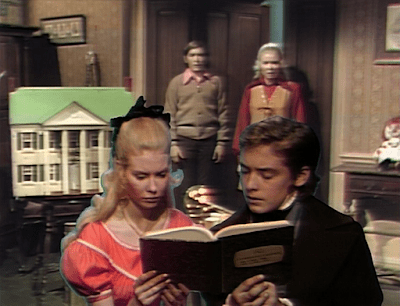
Hallie and David decide that one of the ghosts must have taken the notebook. They go to The Playroom to look for it. They open the door, and see Carrie and Tad reading the notebook.

David and Hallie see Carrie and Tad. Screenshot by Dark Shadows Before I Die.

David’s vision of a little man moving around inside the dollhouse now reminds me of the moment in part 6 of the 2017 revival of Twin Peaks when a tiny version of the supernatural figure known as “Mike” appears to the near-catatonic Special Agent Dale Cooper and urges him to “Wake up! Wake up! Don’t die! Don’t die!” “Mike” is a resident of The Red Room, a space that is as mysterious in its nature and as intermittent in its presence as is The Playroom. We can assume that the tiny man David sees is Gerard, whose plans for him are just the opposite of “Mike’s” wish that Cooper should regain his true identity and once more function as an action hero.

At the time, the idea of living figures small enough to make their homes in a dollhouse and of people from the outside world shrunken and enclosed with them might have reminded viewers of the 1963 Twilight Zone episode “Miniature,” featuring the young Robert Duvall as a lonely man who encounters such a situation. “Mike” himself is a reference to 1960s cult television; he is a mysterious one-armed man who sometimes goes by the name Philip Gerard, evoking the two antagonists Dr Richard Kimble faced on The Fugitive. So it is not unlikely that “Miniature” was a common source for that installment of Twin Peaks and this installment of Dark Shadows. It isn’t even impossible that David Lynch or Mark Frost saw this episode of Dark Shadows and were on some level influenced by it as they wrote the script for Twin Peaks, though of course that would be a far less probable source than The Twilight Zone, which has long been one of the most heavily rerun of all TV shows.

At any rate, I think the similarity is intriguing even beyond the question of influences and sources. A soundstage looks a lot like a dollhouse, and when a drama isn’t connecting with the audience the actors may as well be dolls the director is playing a private game with. So the premise of characters ending up in a dollhouse plays to a fear that must prey on the minds of the writers.

Moreover, all three of these shows share a theme of stunted sexual development. Robert Duvall’s character in “Miniature” is a solitary man who cannot achieve any form of intimacy with another person. The stupefied Agent Cooper lives with a woman who has mistaken him for her husband and enjoys sex with her, but that is strictly a matter of mechanics. He has no idea what is going on during their encounters.

For their part, David and Hallie seem to be developing on the usual timetable. Certainly the dialogue between them when they were first introduced acknowledged that they were old enough to be interested in each other sexually, though David made it very clear to Hallie that she was not the partner he would choose. But Tad and Carrie seem to be quite alarmingly immature. Tad first possessed David in #1081, on Monday. That day, Hallie found David in The Playroom. Speaking as Tad, David took her to be Carrie. Tad was shocked by Hallie’s 1970 clothing and advised her to take it off immediately. It doesn’t seem to occur to Tad that there is anything untoward about demanding Carrie disrobe in front of him. Tad also said that he would be sad when he was too old to play with the toys in The Playroom. But he is very obviously much too old to be enthusiastic about a rocking horse, a dollhouse, a miniature carousel, and a bunch of stuffed animals. So his and Carrie’s attachment to those things shows that even when they were alive they were relics of a dead past. They never grew up, and their ghosts are determined to freeze Hallie and David in place, immobilized and on display in a small, unchanging world.

Danny Horn’s post under the title Episode 1084 on his great Dark Shadows Every Day doesn’t have all that much to do with the episode, but it is a magnificent production in its own right. Its subtitle is “100 Things That I Would Like David and Hallie to See When They Open the Playroom Door, in No Particular Order.” The 100 things he lists range from chuckleworthy to hilarious. Best of all, it ends with a video the post inspired Cody Schell to put together with alternate endings for the episode.

Episode 1083: The grifters

Elizabeth Collins Stoddard called on astrologer Sebastian Shaw in #1073 and commissioned him to do her horoscope for the rest of the year. Contrary to the dire warnings Liz had received from her distant cousin Barnabas Collins and her permanent houseguest Julia Hoffman, Sebastian’s horoscope predicted that nothing of the slightest interest would happen at the great house of Collinwood for the rest of the year 1970. So far as Liz can tell, this has held true.

Longtime viewers know that denial, the psychological defense mechanism, is the keynote of Liz’ character. Evidently this information is also available to Sebastian and his associate Roxanne Drew. Liz’ friend Timothy Eliot Stokes visits Sebastian today, and Sebastian has a vision of the two teenagers who reside at Collinwood as they will be at some point in the near future. He tells Stokes that he sees the two of them are asleep. But after Stokes leaves, he tells Roxanne that in fact they were not asleep, but dead. He wants to go to Collinwood and tell Liz the truth, but Roxanne forbids him, saying that doing so will jeopardize their relationship with Liz, the richest sucker they’ve ever had on the line.

Roxanne makes it clear that neither Sebastian nor the story is going anywhere. Screenshot by Dark Shadows Before I Die.

In these scenes, we learn that Roxanne is evil and that she has control over Sebastian. We also get the idea that her plans are probably short-term. She must expect to have completed fleecing Liz and skipped town before the disaster occurs. Otherwise, even if Liz survives they’ll be losing her as a client when she discovers that Sebastian’s predictions were wrong.

Anyone could tell Liz what she wants to hear, but since Sebastian really can see into the future, using him as a lie-teller seems like a sheer failure of imagination on Roxanne’s part. That’s only one of several problems with the writing of these episodes. The show is heading for a trip back in time, which requires designing sets, making costumes, planning out new stories with new characters, casting parts, etc. As day follows day and we keep finding ourselves back where we started, it seems that they are just stalling while all that work is being done. I suppose if Sebastian were to make full use of his gifts, he might make the story move fast enough that they would run out of road before they are ready to move on.

If Sebastian were simply a fraud, he might be able to spin things out as the makers of the show need. But the only person we have seen who pretended to have supernatural gifts was Miss Pansy Faye in #771. For some time Pansy had been making a living by faking contact with the spirit world. But once she found herself in the ghost-packed environs of Collinwood, Pansy actually served as a medium for communication with that other world, much to her surprise. So a fraudulent Sebastian would just encourage longtime viewers to get their hopes up for a similarly clever resolution. By the time all the contracts were signed, sets prepared, and wardrobe fitted, we’d be the ones feeling cheated.

Episode 1072: Who do you think is watching you?

Teen orphan Hallie Stokes has gone to stay in the great house of Collinwood, a logical place for her since an ancestor of hers was an indentured servant there 174 years ago. I’m not sure where my ancestors were indentured servants 174 years ago, but now that I know the information comes with free room and board in mansions you can bet I’ll be looking into it.

Hallie was eavesdropping on a conversation among some adults in the drawing room. Old world gentleman Barnabas Collins recently returned from an inexplicable journey through time and space with warnings of an undefined disaster that will be happening later in this year, 1970. Hallie has gone to visit the other teenager in the house, grouchy New Englander David Collins. David greets her with a warning that if his governess catches them alone in his bedroom after dark, “I’m in for it.” David has been on the show from week one, and this indication that there are rules against him having sleepovers with girls is the first acknowledgment that he is not a small child.

Hallie reports on the conversation she heard, much to David’s irritation. She then says she can’t shake the feeling that someone is watching her. At that, Barnabas’ voice comes from the door asking who she thinks is watching her. She is afraid of Barnabas and wants to get back to her own room as quickly as possible. That’s a sign of healthy instincts, since Barnabas is a vampire, but he really did find evidence that a disaster is coming and he really is trying to save everyone by preventing it. He lets Hallie go, and bids a relaxed good night to David.

I wonder what could possibly be making Hallie nervous. Screenshot by Dark Shadows Before I Die.

When Barnabas and his friend, Dr Julia Hoffman, returned from the distant future year of 1995, the first people they met were matriarch Elizabeth Collins Stoddard and roguishly handsome anomaly Quentin Collins. They told Liz and Quentin everything they knew right away, and today Barnabas gives another complete debriefing to Hallie’s uncle, Professor Timothy Eliot Stokes. So we might think that the characters have finally learned that keeping secrets unnecessarily just prevents people working together to solve their problems and we are finally going to let the story flow. But no such luck. Liz’ daughter Carolyn was a pivotal figure in 1995, but for no reason they bother to specify Barnabas decides to withhold all information from her today.

They do give a reason for Barnabas’ failure to tell Hallie anything about what he saw in 1995. Quentin told Barnabas yesterday that Hallie is psychologically fragile and couldn’t take any disturbing news. But since she just winds up eavesdropping and getting some alarming facts with no context and no indication that there is anything she can do to help the situation, this backfires. What is more, it was predictable it would happen. David scolds Hallie for eavesdropping, prompting her to point out that he is an inveterate eavesdropper himself. Everyone in the house has known this about David for four years, so there is simply no excuse for expecting that the adolescents will stay in the dark about what is being discussed in the drawing room.

Perhaps the oddest moment of the episode comes when Barnabas is talking to Stokes. He tells him that he and Julia saw Hallie’s ghost in 1995, looking exactly as she does now, suggesting that her death is imminent if she remains at Collinwood. Stokes, who seems remarkably cheerful about the whole thing, says with a bright smile “Perhaps I should take her away!” Barnabas says that no, “I wouldn’t do that.” He explains that it might upset Liz if they did so. Since he just told Liz the whole horrible story yesterday, it seems a bit late to make shielding her from distressing news one’s top priority, but Stokes goes along with it.

David has a dream in which Hallie is wearing an old-fashioned long orange dress with puffy sleeves. He does not know it, but this was the dress Julia and Barnabas saw a girl wearing in 1995. This girl was a ghost who looked exactly like Hallie but was named Carrie, and who danced a minuet with a boy who looked exactly like David but was named Tad. Later, Hallie finds Carrie’s dress laid out on her bed.

In late 1968 and early 1969, Quentin was an evil ghost who took control of David and his friend Amy Jennings as the first step towards driving everyone out of the house. In the course of that, there was a lot of monkey business about moving clothes in and out of closets. The original “Haunting of Collinwood” segment had its strengths and led to the trip back in time to 1897 that turned out to be Dark Shadows‘ greatest triumph. But the time spent worrying about where various items of clothing were being kept and why did not make for gripping television, and longtime viewers will wince to see that the incipient Re-Haunting of Collinwood is going to recapitulate that element.

Episode 1070: Never without you

The sun has set, and vampire Barnabas Collins is opening the lid of his coffin in the basement of the Old House on the estate of Collinwood. Suddenly a cross is thrust in his face. He recoils from it, crying in pain and becoming immobile. The cross is wielded by the sheriff of Collinsport, who announces “I know all about you, Barnabas Collins!”

Before the sheriff can take matters any further, a teenage girl appears nearby. Shocked to see her, he reels away from the coffin. He jabbers at her, saying that he recognizes her and pleading with her not to come closer. Barnabas grabs him from behind and strangles him to death.

Barnabas didn’t have anything against the sheriff, but can’t deny that it feels good to use the old strangling muscles again. Screenshot by Dark Shadows Before I Die.

Barnabas goes upstairs and finds his best friend, mad scientist Julia Hoffman. He tells Julia that the sheriff’s gun was loaded with silver bullets, and that only the manifestation of the ghost of Carrie prevented his destruction. The police know about him, and more officers will be coming any time. Julia admits that she told the sheriff about Barnabas. Shocked, he says “You betrayed me?” He has said these words many times, always as a prelude to extreme violence. Julia braces herself, expecting the same. But to her amazement, Barnabas is gentle and understanding. He realizes she is under the sway of an evil ghost named Gerard. She says that she will betray Barnabas again and again, and urges him to leave without her. He says he will never do that. She embraces him, weeping, and he comforts her. For most people, a day that begins with the murder of a policeman is a day when nothing goes well, but Barnabas is not like most people. This is far and away the most mature behavior we have ever seen on his part.

The year is 1995; Barnabas and Julia have come unstuck in time and found themselves at Collinwood 25 years after a mysterious disaster wrecked the great house on the estate, ruined its inhabitants, and left Gerard in charge. They believe they can travel back to 1970 and prevent the disaster from ever occurring, if only they can find out what it was. Barnabas’ distant cousin Carolyn left him a note yesterday consisting of six cryptic phrases which he took to be clues, but Gerard killed Carolyn before Barnabas could ask her to explain them.

Barnabas has brought occult expert Timothy Eliot Stokes to the Old House. We find Stokes exclaiming to Barnabas “You killed the sheriff?” Barnabas confirms, “Yes, I killed him.” Stokes replies, “Everyone’s going mad. It’s the effect of this place. I’m not surprised at your terrible story. Horrified, not surprised.” One wonders what the story was that Julia and Barnabas told. Stokes’ role in the parts of the show set in contemporary times was always limited, because he is too decent and law-abiding to be a party to the continued existence of a vampire. He could never be allowed to learn the truth about Barnabas. He stays in the room, chatting amiably with Barnabas and Julia, so clearly they haven’t told him now, either. Perhaps they just told him that the sheriff was going to shoot Barnabas, and let him assume that the reason was that Gerard was making him do it.

Be that as it may, Stokes is still aware of the situation. “Do you realize that I will be implicated in all this if the police come here?” he asks. They say that they do, but that they desperately need him to make a third for a séance. He dismisses as hopelessly naive the idea that Gerard would allow a séance to succeed, but Barnabas says that Gerard may not have the power to prevent Carolyn’s spirit coming through and telling them what her note meant. The idea of one spirit trying to block another from emerging out of the supernatural back-world and speaking at a séance harks back to the very first séance on Dark Shadows, in #170 and #171, when undead fire witch Laura Murdoch Collins used her powers to impede the spirit of the gracious Josette from warning the company about her. Stokes gives in and agrees to participate; Julia, self-conscious because of her compromised position, is reluctant, but Barnabas proclaims that if Carolyn is to speak it will be through her.*

The séance begins. Julia goes into the trance, and starts speaking in what appears to be Carolyn’s voice. If this is Grayson Hall’s Nancy Barrett imitation, it is terrible. Mrs Acilius and I laughed out loud at it. But the voice does not give any useful information, and Julia is under Gerard’s power, so it is also possible she is faking the trance to throw Barnabas off. In that case, it is Julia’s Carolyn imitation, and it reminds us of the ups and downs in the relationship between those two characters.

When the séance is over, Stokes says he feels a presence. He rises from the table, drifts towards the window, and sees Gerard watching him from outside. Gerard touches the pane. Stokes staggers back, descends into a chair, and becomes still. Barnabas finds that he is dead. He looks up and realizes that Julia has fled the house.

Julia has gone to the great house. She is in a mysterious playroom with Gerard. Gerard gives her a dagger. She asks if she “must.” She is reluctant, but finally works herself up to joy as she says that she always knew it would come to this, that now she will be with Gerard as he wants her. She lifts the dagger to stab herself in the heart.

Barnabas enters. He confronts Gerard. As the two beings from beyond the grave stare each other down, Julia drops the dagger. Barnabas tells Gerard he cannot stop them leaving. Gerard looks offended at this. He touches Julia, who collapses. She is not dead, but she and Barnabas fear she is dying. Gerard leaves the room and takes his time locking the door from the outside.

Carrie’s ghost materializes to Julia and Barnabas. She beckons to them, then walks out through the wall. They stare at the wall, and a door appears. They pass through the door, and find themselves on a staircase. They follow the staircase, and come to another door. They exit in the same corridor outside the playroom; they have gone in a circle. In space, anyway- the time appears to be different. The corridor is in severe decay in 1995, but is in good repair now. And they see a girl who looks exactly like Carrie, but is alive. She asks them who they are.

This is the final episode set in 1995. It is also the last we will see of Don Crabtree. Previous sheriffs of Collinsport have been ridiculously ineffective. Crabtree’s sheriff doesn’t chalk up many successes either, but no one else meets with anything but failure in these two weeks. Every death and defeat we see reinforces the sense that the evil which Gerard represents is overwhelming. As the penultimate victim of the 1995 curse, the sheriff is second only to Stokes as someone who would have been able to make a positive difference, if anyone could have, and Crabtree makes us believe that he belongs in that position.

*In the main continuity of Dark Shadows, spirits at séances always speak through a medium of the same sex as themselves. In the séance in #990, when the show was set in a mirror universe, the spirit chose a medium of the opposite sex.

Episode 1067: Collinwood works on all our imaginations

Dark Shadows just spent sixteen weeks in an alternate universe where Quentin Collins was neither the family-annihilating ghost he was when first we saw him in December 1968 nor the charming rogue we got to know when the show went back in time in March 1969. Instead, he was a foul-tempered sourpuss who treated his wife like an irritating child and refused to learn anything from anyone. Like those previous iterations of the character, “Parallel Time” Quentin had a compulsion to choke people, but unlike them he was no fun to watch.

Now we have traveled forward in time to the year 1995. Here, Quentin is an escaped mental patient who is sometimes extremely docile and at other times just as extremely refractory. But one thing hasn’t changed, which is his zeal for strangling anyone who bothers him. He sees the elderly Timothy Eliot Stokes, expert in the supernatural, and at once grabs him by the throat. Quentin’s friend Barnabas Collins pulls him off of Stokes. Barnabas suggests that Dr Julia Hoffman should give Quentin a sedative. He responds “The only sedative I need is to get my hands around Stokes’s neck. I’ll be calm for the rest of my life!” That’s our Quentin.

Barnabas tries to keep Quentin from giving Stokes his signature Collinwood Handshake. Screenshot by Dark Shadows Before I Die.

Quentin blames Stokes for the fact that the estate of Collinwood has been a demon-ridden ruin for the last 25 years. Stokes has been telling Julia and Barnabas that it was that way when he got there. He returned from a trip to Europe in the autumn of 1970, a few months after Barnabas and Julia left on their journey into the alternate universe and out to this future year, and found the place in its current condition and everyone associated with it destroyed in one way or another. But Quentin says that the real disaster came only when Stokes tried to exorcize a ghost. That just made the ghost angry.

Once Quentin is out of the way, Barnabas tells Stokes he believes that Quentin’s madness is a symptom of the ghost’s continued hegemony over Collinwood. He is determined to try another exorcism. Stokes advises him against it, but says he will try to help him if he does go ahead.

Meanwhile, the ghost, who according to the credits is named Gerard, has taken possession of Julia. The ghost has ordered Julia to do something she does not want to do. She keeps this from Barnabas. She tells Barnabas they should give up and go away. He refuses, and she sadly says that whatever will happen will happen. From the look on her face, it seems that the ghost has ordered her to do away with Barnabas and she is resigned to the idea that she will eventually obey this command.

There are other ghosts in the area as well. Yesterday Julia and Barnabas saw the ghosts of two teenagers who were apparently named Tad and Carrie while they danced a minuet and exchanged a chaste kiss, and they heard Quentin talking earnestly to an invisible person he called Daphne. A woman with long black hair briefly comes into Barnabas’ view in his parlor today; the credits confirm that she is Daphne. Anyone who watched US television in the 1970s, 1980s, or 1990s will already know that she is Kate Jackson, and might be interested to know that she is making her first screen appearance.

When Daphne appears, the air smells of lilacs. That comes as something of a relief. The opening voiceover told us that Collinwood is ruled by “a ghost whose mere presence corrupts the surrounding air.” That would suggest rather a less pleasant odor than that of lilac perfume.

The ghost of the gracious Josette was the chief supernatural presence on the show for its first 42 weeks, and an occasional visitor for some time after. Her signature was the scent of jasmine, so longtime viewers are getting a hint that Daphne will turn out to be important.

Episode 1065: How long will it be before they all come back?

Vampire Barnabas Collins and mad scientist Julia Hoffman have come unstuck in time and found themselves in 1995, 25 years ahead of their proper period. The great house on the estate of Collinwood is in ruins. Some of the people they knew are missing, some are dead, and the rest are determined not to help them find out what happened when disaster struck in 1970.

In his post about the episode on his great blog Dark Shadows Every Day, Danny Horn writes that “if this is July 1995, then Barnabas and Julia are on completely the wrong track. They want to know where Elizabeth and Roger and Maggie are, and the answer is obvious — they’re watching the O.J. trial. Where else would they be?”

Barnabas’ distant cousin Carolyn owns Collinwood now, and she doesn’t have cable. So she is in the great house, a demon-haunted wreck which most people avoid. Julia and Barnabas have followed her there. They hear Carolyn talking and laughing inside an upstairs room that didn’t exist in 1970. They let themselves in. Unlike the rest of the great house and every other structure on the estate, the room is in perfect repair, well-lit and full of luxury items. Carolyn has repeatedly told Barnabas and Julia to stay off her property, even sending the sheriff to arrest them on one of their previous trespassing expeditions to the great house, and she is outraged at this latest intrusion. She demands how dare they follow her into the room, and they respond by praising themselves for their good intentions.

Julia and Barnabas finally leave the room, and Carolyn relaxes. She turns and starts talking to someone who, to her surprise, is not there. She is all the more furious that Barnabas and Julia have driven this person away.

Not content with one home invasion, Julia and Barnabas go to the apartment of their former friend Timothy Eliot Stokes. Before they pushed past him into his parlor, Stokes had been reading a letter from a psychiatric facility where Barnabas and Carolyn’s distant cousin Quentin is a patient. His interior monologue read the part to us about Quentin having taken a turn for the worse. While Barnabas hectors Stokes, Julia leans way down and reads the letter. It turns out Quentin has escaped from the facility. At length, Stokes tells them that he was out of town when the disaster occurred in 1970 and that he doesn’t know much about it. He agrees to help them.

Julia keeps it classy. Screenshot by Dark Shadows Before I Die.

Later in the episode, two scenes take place between Stokes and Carolyn. Carolyn enters Stokes’ apartment and reproves him for collaborating with the enemy. She laments that Julia and Barnabas ruined the birthday party, and that there won’t be another birthday party for a year. He has no idea what she is talking about and tries to reason with her. He finally takes her home. These, like every scene with Carolyn in the 1995 segment, are spectacularly good. Nancy Barrett is an excellent actress, Dark Shadows suited her strengths perfectly, and crazy lady Carolyn Fredericks was as good a part as any performer could wish for. Thayer David was terrific also, and the two of them are unforgettable together today.

Barnabas and Julia return to the playroom, since they haven’t been arrested yet tonight. They find a brand new birthday card addressed to “Tad” and signed “Carrie.” Barnabas has never heard those names in connection with Collinwood and wonder who they could be.

Barnabas says that he wants to question Quentin. Julia responds “Barnabas, If Quentin has been in a mental institution, he can’t help us.” It’s true that it takes special training and considerable experience to gain useful information by questioning severely disturbed people, but Julia has those qualifications. She is a psychiatrist who, when we first saw her in #265, was conducting an examination of a barely verbal patient. Over the last three years, everything that Julia had in those days has been stripped from her, a theme the show has been exploring heavily for the last six weeks. This line seems like a throwaway, but it underlines the transformation we have seen.

Quentin’s existence depends on a magical portrait painted in the year 1897. In an upstairs room at the Old House, Julia and Barnabas find this portrait intact. At that very moment, Quentin himself rushes in with a knife and tries to slash it. Barnabas thwarts him.

Quentin won’t believe that Barnabas and Julia are who they appear to be. He babbles as if he were still in the psychiatric facility. He claims never to have heard of the playroom, then insists the playroom was always there. They take him to the playroom, their third trip there today. Quentin looks in the room and flees in terror. Barnabas and Julia stay, and see the ghost of strange and troubled teen David Collins. The appearance of David’s ghost is one of the most forceful week-ending images in the series, up there with Barnabas’ hand darting out of its coffin in #210 or the Old House in sunlight in #365.

Episode 1062: You shouldn’t look the same

Vampire Barnabas Collins and mad scientist Julia Hoffman have come unstuck in time and found themselves 25 years in the future, in the year 1995. The great house of Collinwood is in ruins. They are trying to find someone who can tell them what happened after they left in 1970.

They meet Carolyn Collins Stoddard Hawkes, who has changed her name to Carolyn Fredericks. Carolyn now lives in an old shack on the beach. She is offended that Julia and Barnabas look the same as they did in 1970. She refuses to answer any of their questions and orders them to leave her house.

During the day, Barnabas takes shelter in his coffin in the secret chamber hidden in the old Collins family mausoleum. Julia leaves the mausoleum and finds Carolyn waiting outside. Carolyn warns her that she and Barnabas must leave the area. Julia goes on her way, and occult expert Timothy Eliot Stokes comes out of the shadows and talks with Carolyn. Carolyn had seemed to be drifting in and out of lucidity while talking to Julia, but she is crystal clear while she and Stokes discuss the need to get rid of the new arrivals.

Julia goes to the county building and tries to get the clerk to answer questions about what happened in 1970. He is frightened by the mention of the date and claims that there are no records of any kind from that year. She finds Stokes in the corridor outside the clerk’s office. She greets him joyously. He tells her to go away, lest he and others be “forced to act.”

After nightfall, Julia and Barnabas decide to visit a man named Victor Flagler, whose name the clerk had mentioned. As Barnabas and Julia leave the mausoleum, Stokes and the clerk watch them go and speculate as to their destination. Evidently the secret chamber is no longer secret at all.

Victor is in his 30s; he has a framed picture of his wife Jeanne that appears to have been taken during the Coolidge administration. Some fans complain that everyone in the 1995 segment dresses in clothes that might have been found at Ohrbach’s in 1970, but I don’t think that’s a problem. The Collinses of Collinwood had a stranglehold on the economy of the village of Collinsport in the 1960s, and if they were annihilated in 1970 and their assets left to rot it stands to reason people in the area would still be wearing the clothes they bought then. But the antique style of this photograph really does take me out of the show:

A photo taken no earlier than 1985. Screenshot by Dark Shadows Before I Die.

Victor initially resists having anything to do with Julia and Barnabas, but finally tells his story. He and Jeanne went into Collinwood on a dare, believing it to be just a big empty house. They felt an evil presence there, and something pushed a heavy object from the top of the foyer stairs onto Jeanne’s head, killing her. When Victor found that Jeanne was dead, he heard laughter resounding through the house.

Barnabas and Julia go back to the mausoleum, only to find that the door to the secret chamber is standing wide open. They wonder who knows about it.

The clerk’s name is Ed. He is played by Ronald Dawson, who also appeared in #910 as art restorer Henry Osmund. This is Ed’s only episode, and Dawson’s final appearance. It is also Victor’s only episode, and Cliff Cudney’s final appearance. Cudney played a zombie in #963, 964, and 965. Both Dawson and Cudney have much better chances today to show us what they could do than those earlier parts afforded them. Indeed, all the actors are on top form. All roles played by Nancy Barrett are serious contenders for the title Best Character Ever, and in her scene with Barnabas and Julia in the little house on the beach, we can see that Carolyn Fredericks will be no exception.

Episode 1031: Some way of getting there

In 1968, vampire Barnabas Collins fell into the hands of mad scientist Eric Lang. Like Julia Hoffman, the mad scientist into whose hands Barnabas had previously fallen, Lang wanted to cure Barnabas of vampirism. Unlike Julia, Lang had a plan that actually worked. First, he gave him a treatment that temporarily arrested the symptoms of the curse. Then he built a Frankenstein’s monster which he planned to bring to life with an infusion of Barnabas’ “life force.” Wicked witch Angelique killed Lang before he could complete this experiment. Julia took over, and succeeded. The monster, named Adam, drained Barnabas’ affliction from him permanently.

Julia and Barnabas turned out to be the worst parents imaginable, and Adam grew to hate them. The big guy found kindness in the form of Professor Timothy Eliot Stokes, an expert on the supernatural. Stokes taught Adam to speak and to read, and tried to introduce him to the social graces. In #636, Adam was in Stokes’ apartment when an enemy knocked on the door. Stokes told him to hide in the back room. He did, and was never seen and barely ever mentioned again. Only in #933, when another guest of Stokes’ had an unfortunate experience in that room, did we get confirmation that Adam wasn’t still waiting there.

Now, we are beginning the eleventh week of an arc set in a different universe than the one where the show spent its first 196 weeks. Barnabas, again a vampire because of a new curse, had discovered that a particular room in the long-disused east wing of the great house of Collinwood sometimes changes its appearance. Standing in the hall and looking through the door, he could see, not the bare dark walls that are there in his world, but a fully furnished, richly decorated, brightly lit room. People with the same appearances and voices as those he knew would come and go in that room, but they could not see or hear him, nor could he pass through the invisible barrier in the doorway to join them. Stokes explained the many-worlds hypothesis, which he calls “Parallel Time.” Hoping that he might be freed from his curse if he could enter the other universe, Barnabas stood in the room while it was in its normal state. It changed around him, and he found himself in that other continuity.

Barnabas was disappointed to find that he was still a vampire. He bit and enslaved the first person he met. Now he has come to know many people, among them counterparts of Angelique, Julia, and Stokes. Angelique is a wicked witch here as well. She has returned from the dead, murdered her identical twin sister Alexis, and taken Alexis’ place as a permanent houseguest at Collinwood. He knows who she really is and she knows that he knows, but neither is in a position to fight the other. He does not know that Angelique killed Alexis, nor does he know that she, like he, is a vampire. She does not steal blood from the living, but warmth. And her attacks, when they provide her with enough warmth to keep her going, are invariably fatal.

Julia is Angelique’s most fanatical devotee. She is reluctant to bring victims for her to quick-freeze, but is happy enough to serve her in every other way. The portal occasionally opens in the room on this side too, so that inhabitants of the current timeline can catch glimpses of the main continuity as those in the main continuity can catch glimpses of what is happening here. That’s given the show opportunities to contrast this Julia with the one we first met. They have made it very clear that this Julia has the same feelings for Angelique that the original Julia has for Barnabas. Since we know that the other Julia has been Barnabas’ constant helper through all his murders and other activities, we can assume that this Julia will be Angelique’s deadliest enforcer.

Stokes has played a parental role in Angelique’s life. Originally he was identified as Angelique and Alexis’ father, and that is how he is described today. In between there were a couple of days when he was their stepfather, but that didn’t fit with other information we had, and we can hope they will drop that point. At any rate, Stokes disliked Alexis and forgot all about her four seconds after Angelique told him she had killed her. He delights in Angelique. He is an evil mirror image of his virtuous opposite number in the other universe.

Yesterday, Stokes and Angelique were in his apartment, which is the same as the one his counterpart occupies. He told her that he used his unsurpassed mastery of the occult to make it possible for her to return from the dead. Angelique wanted him to cure her of the need to steal the warmth from the living, but he said neither he nor anyone else knows how to do that. When he told her that someone else was involved in the process, she brightened and asked to meet this other person. Stokes looked sad, even ashamed. He indicated that the person is in the back room of his apartment, and Angelique went to its door.

Today, Angelique enters the room. She finds a blanket covering a woman’s body. Stokes enters. Angelique asks if the woman is alive; Stokes says she is more alive than Angelique is. He took much of her “life force” to make it possible for Angelique to overcome death. She retains enough of this force to stay alive. If she dies, all of her “life force” will disappear, including the portion which animates Angelique. But as long as she lives, the woman will keep pulling that portion back to herself. At moments when the woman is drawing on it most effectively, Angelique is overwhelmed with the desperate need for warmth and can right herself only by consuming a victim.

Was this your card? Screenshot by Dark Shadows Before I Die.

This story is the reversed mirror image of Adam and Barnabas. As Adam cured Barnabas of vampirism by absorbing his “life force” and coming to life, so the unnamed woman causes Angelique’s heat vampirism by reclaiming her own “life force” and staying alive. Adam had a female companion, an intended Bride of Frankenstein named Eve. Eve was played by Marie Wallace. The original audience was in a position to know that whoever is under the blanket, she will not be played by Miss Wallace. Somerset had premiered opposite Dark Shadows on NBC at the end of March, and she was an original member of its cast.

Evidently, the show does not want us to miss the echo of Adam. Angelique goes back to the apartment later in the episode, and finds Stokes playing chess against himself. First-time viewers will recognize this as a symbol of Stokes’ attempt to manipulate those around him for the sake of an elaborate plan, but those who have been with the show for a long time will also remember Adam’s habit of passing the time with solitaire games of chess.

Meanwhile, in the original continuity, Julia is looking into the room where the portal between universes sometimes becomes visible. She sees her own counterpart talking with Angelique. She is horrified to hear them decide that they must destroy Barnabas, and despairs that she cannot pierce the invisible barrier that separates the two worlds.

Later, Barnabas is in the room. He finds Angelique’s diary and turns to her account of how “he” has a plan to defeat death. Barnabas wonders who “he” is, and decides to take the diary someplace where he can study it. He sets it down. When he looks up, the room is dark and bare. He is back in his own universe, without the diary. Julia enters and welcomes him home.

Without missing a beat, Barnabas exclaims that he must not stay. He has discovered that Maggie Evans Collins, counterpart of someone important to him in his own world, is in danger, and he has to go back to the other universe to rescue her. This is a typical moment. Julia has given up everything she has and any hope of a meaningful relationship with anyone else in her devotion to Barnabas, and in return he keeps throwing other women in her face. The story in “Parallel Time” is getting more complicated and the sufferings of the characters there are getting more urgent, so we can be sure Barnabas will find a way back. But longtime viewers will remember that when Barnabas traveled back in time to 1897, Julia eventually found a way to join him there. So when he travels sideways in time and returns to the other continuity, we can hope that Julia will somehow manage to take her place at his side.

The closing credits bill Grayson Hall twice, once as “Julia Hoffman” and once as “Dr Julia Hoffman.” Julia was in hundreds of episodes before the “Parallel Time” story began, and has appeared a couple of times in episodes where Miss Hoffman the housekeeper also figured. This is the first time her degree makes it on screen.