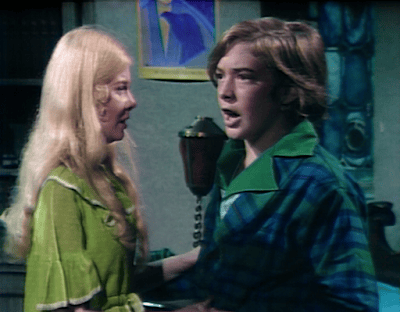
Barnabas Collins leaves people who appear to be his distant cousins Carolyn Stoddard Hawkes and David Collins, as well as Carolyn and David’s houseguest Hallie Stokes, in David’s bedroom. Barnabas is still within earshot when these three address each other as “Leticia,” “Tad,” and “Carrie.” He rushes back into the room, looks at those who might be taken for Hallie and David, and declares “You are both possessed!” He ignores the fact that the same evidence indicates that Carolyn is also possessed.
Initially, Tad and Carrie pretend they were only using those names as part of a game. Barnabas says that in that case, he will play, too. He asks Tad to name David’s mother. He cannot. He then asks who his previous governess was. He can’t answer that, either. He asks Carrie why Hallie lives in the great house of Collinwood. She says that it is because there was an accident. Barnabas confirms that is so, and that the accident involved her parents. He asks her what their names were. She cannot answer. He presses on when they object. Finally, Carrie calls out to Daphne, a ghost whom she and Tad had previously denied ever having heard of, to come and help them. Shocked, Tad looks at her and calls her Carrie. The cat is out of the bag.
Longtime viewers will be thrilled by Barnabas’ questions. Not only is it a refreshing change to see him demonstrating presence of mind and moving quickly to advance the story, but the references to David’s mother and to his previous governess bring up characters who used to be very important to the show and who have been absent from the story and unmentioned for a long time. Real heads know who those women were, Tad and Carrie are exposed as noobs.
Throughout this interrogation, Carolyn/ Leticia was standing still, watching placidly while Carrie and Tad got flustered and blew their cover. Barnabas asks what the ghosts of Daphne and of someone named Gerard want. At that, Carolyn/ Leticia breaks her silence. Smiling, she says that Tad and Carrie do not yet know the answer to that themselves. Neither does she, come to that. She wafts away, leaving everyone reeling.
Yesterday, Tad told Carrie that if they let on who they really were, they would be defeated at once. It was not at all clear then what anyone could do to bring that about. Tad tells Barnabas that he and Carrie are here to stay, and that there is nothing he can do to stop them. This seems to be true.
After Barnabas leaves Carrie and Tad alone in David’s room, they wonder what happened to Hallie and David. They say that they liked them, and that they hope nothing bad happened to them. Carrie asks Tad if he thinks David and Hallie are dead. He says he doesn’t think so, but he sounds very doubtful. Carrie asks where they are. He says they aren’t anyplace. While he and Carrie are using their bodies, Hallie and David “don’t exist.” It may seem obvious that ceasing to exist qualifies as something bad happening to a person, but ever since Epicurus in the fourth century BCE that has been an open question among philosophers. So maybe nothing bad did happen to David and Hallie. Certainly nothing at all will happen to them ever again.
Though Carrie and Tad have entirely erased Hallie and David, Carolyn persists. Leticia sets out to tell Quentin Collins something. By the time she gets to Quentin’s room, Carolyn has reemerged and is unsure what she is doing there. Quentin is drunk, which is not unusual. He is under Daphne’s power and has been unable to do anything to prevent Tad and Carrie from taking over David and Hallie’s bodies. Carolyn became clairvoyant when Leticia moved in with her, and can tell Quentin is feeling guilty about something. He denies everything.
There’s a lot of spellcasting today. Quentin tries to break free of Daphne by setting fire to her handkerchief. This fails immediately. Carrie and Tad try to raise one of the ghosts from the dead. They hope they will get Daphne, because they are afraid of Gerard, but they have no way of knowing which one it will be. The episode ends with a knock at the door. We will have to wait until tomorrow to find out whether that will be Daphne, Gerard, or the man from the gas company come to read the meter.
In July 1970, Barnabas Collins and Julia Hoffman came unstuck in time and spent two weeks in the far-off future year 1995. They found that the great house of Collinwood was in ruins, its residents either dead, missing, or insane as the result of a mysterious disaster that took place before 1970 was out. Since returning to their own period, they have been making fruitless efforts to learn what is happening and prevent the disaster.
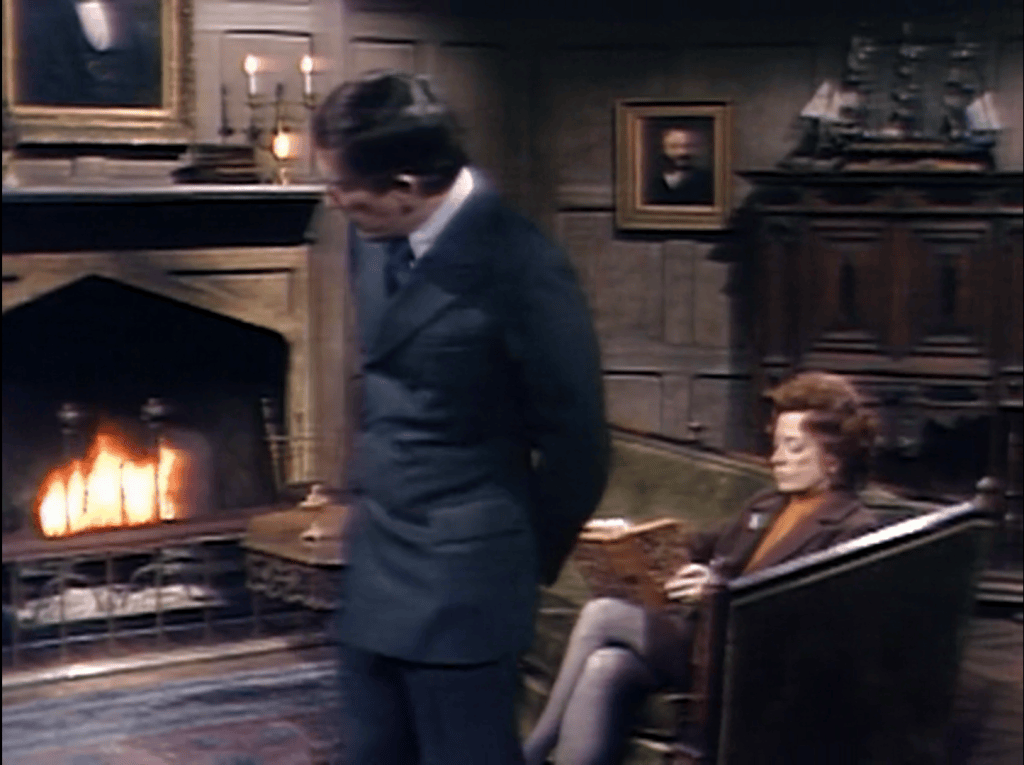
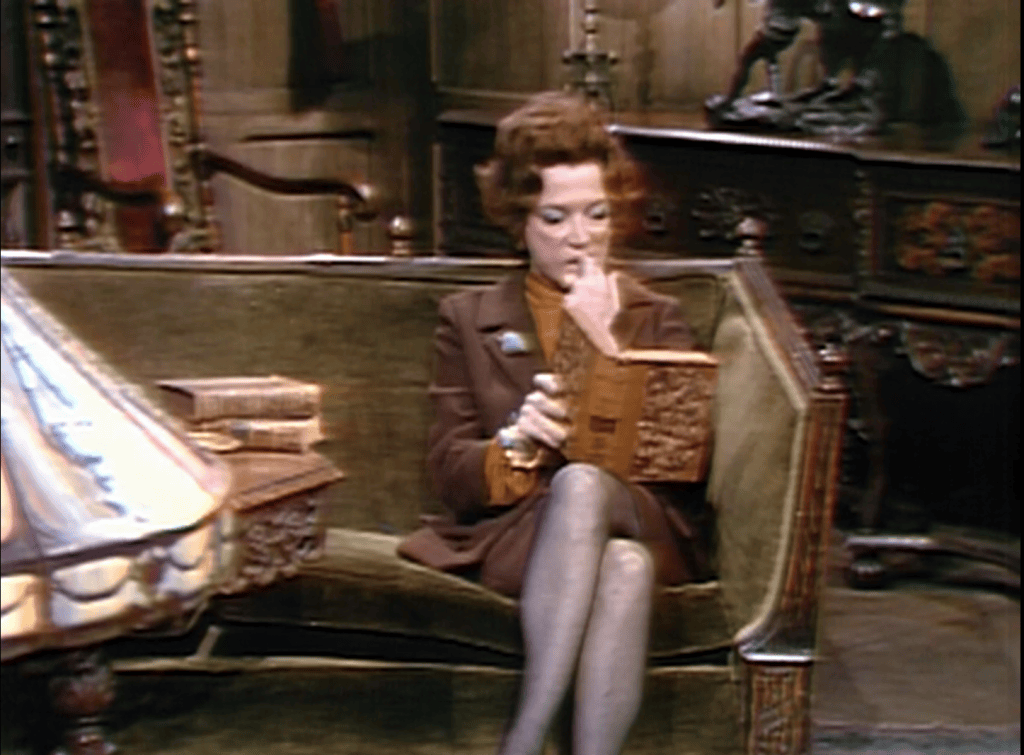
Today, we see Julia sitting on the couch in the drawing room, reading a book and picking her teeth. Barnabas is pacing nearby. I am not making this up, the ABC network actually broadcast this on national television.
This thrilling scene follows an exchange in which Barnabas and Julia talk about a place called Rose Cottage that they heard about in 1995 and have been trying to find for the last six weeks. Julia tells Barnabas that it has just occurred to her that the place may not be known as Rose Cottage now. Barnabas does not understand what she means. Julia tries to explain that it might be possible for people to use one name for a house at one time and a different name for the same house at a different time. Barnabas has difficulty with this concept. Grayson Hall and Jonathan Frid, highly trained and much-honored actors, play this exchange with great emotional tumult, focusing our attention on the precise level of cognitive ability it suggests the characters have.
Just as we are thinking that the show has finally come to a dead halt, Carolyn Stoddard Hawkes enters. Julia and Barnabas notice that Carolyn seems to be in a good mood, to which they make it their business to put an immediate stop. They say Carolyn must not have heard about the latest crisis concerning teenagers Hallie Stokes and David Collins:
JULIA: Carolyn, how are you feeling?
CAROLYN: Quite well, thank you. But both of you look so terribly distressed. Whatever’s the matter?
BARNABAS: Well, hasn’t anyone told you?
CAROLYN: Told me what?
BARNABAS: Well, the children are missing.
CAROLYN: Oh, that. Yes, I know.
JULIA: Well, aren’t you the least bit concerned about it?
CAROLYN: No.
JULIA: Why, Carolyn? Why aren’t you concerned? Carolyn, do you know something about David and Hallie you’re not telling us?
CAROLYN: Perhaps.
JULIA: Well, you must tell us. Do you know where they are?
CAROLYN: They’re gone. David and Hallie are gone.
BARNABAS: We told you that!
JULIA: Carolyn, we believe they’re in some terrible danger, the children.
CAROLYN: The children, in danger? No, no, that’s not true.
JULIA: How do you know it’s not true?
CAROLYN: Because I know the children are alive and well.
JULIA: If you know that much, then you must know where they are.
CAROLYN: No, that’s all I can tell you. They’re alive and well. Now, you must excuse me, I’m really very tired. (Exit)
BARNABAS (watching Carolyn go): Do you think she knows what she’s talking about?
JULIA (wonderingly): I have no idea.
They say that if a performer is really present in a scene, there is always a chance that when you throw the light on them something wonderful will happen. What Nancy Barrett does here is as pure an example of this I could hope to find. Carolyn’s blissed-out insouciance is so great to watch that it redeems everything that went before. I wonder if Frid and Hall’s ferocious overplaying was deliberate, meant to give the sharpest possible contrast to what they knew Miss Barrett was about to do.
Later, Barnabas encounters Carolyn in the little-used west wing of the great house:
BARNABAS: Carolyn, what are you doing up here?
CAROLYN: What, I just went to get something from my room.
BARNABAS: Your room?
CAROLYN: Yes, just down the hall.
BARNABAS: But your room isn’t up here in the west wing, it’s downstairs in the house proper.
CAROLYN (laughing): Don’t be absurd. You know perfectly well I’ve always lived in the west wing. I do think it the most enchanting part of the house.
BARNABAS: Carolyn?
CAROLYN: May I ask why you keep calling me that?
BARNABAS: Because it’s your name.
CAROLYN (laughing): You know very well my name is Leticia, and I live in that room just down the hall.
BARNABAS: Leticia?
CAROLYN: Of course.
BARNABAS: Well, Leticia, perhaps you can tell me where the children are. Can you do that?
CAROLYN: What an odd question.
BARNABAS: What’s odd about it?
CAROLYN: Do you realize how late it is? Where else would the children be but in bed? You are a strange one! (exits, laughing.)
In 1995, Barnabas and Julia found that Hallie and David had died in 1970, and that ghosts which looked like them were in fact the ghosts of teenagers named Carrie and Tad who died in 1841. So when they find that David and Hallie are not in the house, they fly into a panic. In that same year, they found that Carolyn was alive, and that she had gone insane in 1970. So far as they could tell, Carolyn believing herself to be someone named Leticia who lived in the west wing of Collinwood was no part of the disaster. So they stay focused on Hallie and David, and let Carolyn/ Leticia go her own way.
Barnabas takes “Leticia’s” suggestion and goes into David’s bedroom. There, he finds the young fellow asleep in bed. Later, Julia has gone to Hallie’s room and found her bed also occupied. Julia woke her and herded her into David’s room, where Barnabas confronts both teens. They claim that they ran away from home because all the talk about ghosts and whatnot had unsettled them, and that they came back because they realized they were being silly. Barnabas mentions the names of some of the ghosts; they claim never to have heard those names. Barnabas is startled by this denial. Returning viewers know that Julia has mentioned the names to David and Hallie, and it is likely she told Barnabas she had done so. They are trying to play dumb, but in fact reveal that something is very wrong.
Carolyn enters. Barnabas leaves her alone with the teenagers. He is still just outside the door when he hears the three of them bid each other goodnight. Carolyn calls them Carrie and Tad; they call her Leticia. Barnabas bursts back in and declares “You are both possessed!” All three of them are possessed, but what he saw in 1995 leads him to disregard Carolyn’s possession and to focus on David and Hallie’s.
Early in the episode, we saw what it means when Carolyn says “David and Hallie are gone.” They no longer exist. Their bodies are now the vessels through which Tad and Carrie have resumed living. Carrie and Tad talked about the importance of keeping up the appearance of being Hallie and David; Tad said that one slip would be enough to expose them, and then “the game will be over.” We might wonder how. What can the living characters do to defeat the ghosts, if they know what the ghosts are doing? Nothing we’ve seen in the last six weeks suggests an answer to that question. For all we can tell, Julia, Barnabas, and the rest of them are so completely helpless that the ghosts may as well throw all discretion aside and operate openly.
Grouchy New England teen David Collins and his live-in girlfriend Hallie Stokes go to a playroom for small children that intermittently manifests itself in a space otherwise occupied by a linen closet in the west wing of the great house of Collinwood. Hallie is possessed by the spirit of a girl named Carrie, who died in 1841. David hasn’t caught on that Hallie isn’t herself, and in his exasperation he asks her to “stop acting like the world’s number-one weirdo.” Carrie is puzzled by the word “weirdo.” She recognizes it as a derivative of “weird,” but claims that “the addition of the letter O makes it completely incomprehensible.” Evidently Carrie wasn’t all that quick on the uptake. If someone called me a “peculiar-Z,” I might not know why the letter Z was added, but it would be perfectly clear to me what they were saying. Historians of American English often say that the 1830s and 1840s were the single busiest period for the invention of new slang terms the USA has ever seen, so that if Carrie were as stumped by the “O” on “weirdo” as she claims to be, she would likely have been unable to conduct a conversation with many of her contemporaries.
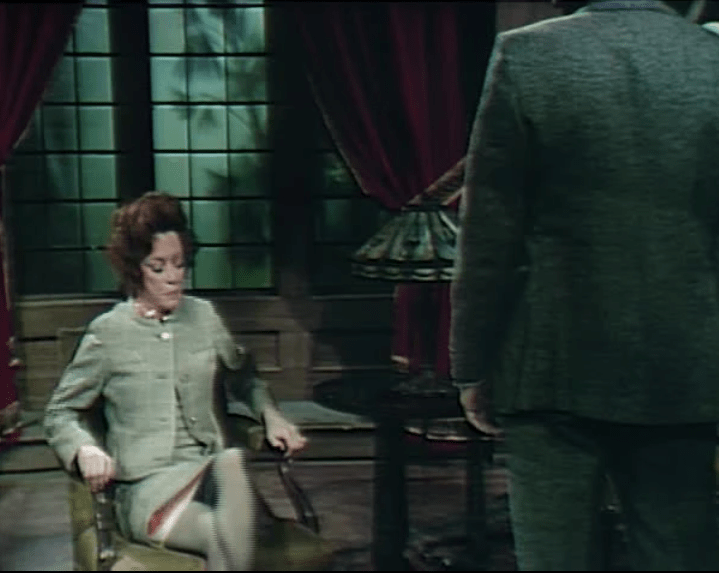
David’s realistic 1970 dialogue and Carrie’s antiquated verbiage bounce off each other to produce some intentional comedy; my wife, Mrs Acilius, thought the scene was really funny. It is certainly more appealing than the rest of the episode, which is yet another series of events that take place only because the characters cannot bring themselves to tell each other what’s going on. Because the ghosts won’t let them, yes yes yes, we’ve been through all that many times before. The fansites seem bored enough by the whole thing that one of biggest points of discussion is whether it is reasonable to say that, because a bit of Grayson Hall’s slip is visible under her skirt at one point, we can say that we see her “underwear.” I guess the slip is “underwear” in the sense that she is wearing it under something else, and it probably wasn’t supposed to be visible, but you’d have to be a very specific kind of person to get excited about it.
Feast your eyes, pervs.
Hall plays Julia Hoffman, MD. Julia is a psychiatrist, among other things. She tells Quentin Collins that the ghost of Daphne Harridge, a governess who like her charge Carrie died in 1841, fills the room with the scent of lilacs when she is near. Quentin is so obviously lying when he tells Julia that he has not smelled that scent that we are probably supposed to assume that Julia is onto him.
Dark Shadows just spent sixteen weeks in an alternate universe where Quentin Collins was neither the family-annihilating ghost he was when first we saw him in December 1968 nor the charming rogue we got to know when the show went back in time in March 1969. Instead, he was a foul-tempered sourpuss who treated his wife like an irritating child and refused to learn anything from anyone. Like those previous iterations of the character, “Parallel Time” Quentin had a compulsion to choke people, but unlike them he was no fun to watch.
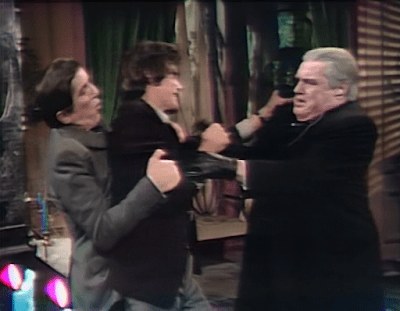
Now we have traveled forward in time to the year 1995. Here, Quentin is an escaped mental patient who is sometimes extremely docile and at other times just as extremely refractory. But one thing hasn’t changed, which is his zeal for strangling anyone who bothers him. He sees the elderly Timothy Eliot Stokes, expert in the supernatural, and at once grabs him by the throat. Quentin’s friend Barnabas Collins pulls him off of Stokes. Barnabas suggests that Dr Julia Hoffman should give Quentin a sedative. He responds “The only sedative I need is to get my hands around Stokes’s neck. I’ll be calm for the rest of my life!” That’s our Quentin.
Barnabas tries to keep Quentin from giving Stokes his signature Collinwood Handshake. Screenshot by Dark Shadows Before I Die.
Quentin blames Stokes for the fact that the estate of Collinwood has been a demon-ridden ruin for the last 25 years. Stokes has been telling Julia and Barnabas that it was that way when he got there. He returned from a trip to Europe in the autumn of 1970, a few months after Barnabas and Julia left on their journey into the alternate universe and out to this future year, and found the place in its current condition and everyone associated with it destroyed in one way or another. But Quentin says that the real disaster came only when Stokes tried to exorcize a ghost. That just made the ghost angry.
Once Quentin is out of the way, Barnabas tells Stokes he believes that Quentin’s madness is a symptom of the ghost’s continued hegemony over Collinwood. He is determined to try another exorcism. Stokes advises him against it, but says he will try to help him if he does go ahead.
Meanwhile, the ghost, who according to the credits is named Gerard, has taken possession of Julia. The ghost has ordered Julia to do something she does not want to do. She keeps this from Barnabas. She tells Barnabas they should give up and go away. He refuses, and she sadly says that whatever will happen will happen. From the look on her face, it seems that the ghost has ordered her to do away with Barnabas and she is resigned to the idea that she will eventually obey this command.
There are other ghosts in the area as well. Yesterday Julia and Barnabas saw the ghosts of two teenagers who were apparently named Tad and Carrie while they danced a minuet and exchanged a chaste kiss, and they heard Quentin talking earnestly to an invisible person he called Daphne. A woman with long black hair briefly comes into Barnabas’ view in his parlor today; the credits confirm that she is Daphne. Anyone who watched US television in the 1970s, 1980s, or 1990s will already know that she is Kate Jackson, and might be interested to know that she is making her first screen appearance.
When Daphne appears, the air smells of lilacs. That comes as something of a relief. The opening voiceover told us that Collinwood is ruled by “a ghost whose mere presence corrupts the surrounding air.” That would suggest rather a less pleasant odor than that of lilac perfume.
The ghost of the gracious Josette was the chief supernatural presence on the show for its first 42 weeks, and an occasional visitor for some time after. Her signature was the scent of jasmine, so longtime viewers are getting a hint that Daphne will turn out to be important.
In October 1897, sorcerer Count Petofi has used his magical powers to swap bodies with Quentin Collins. I refer to the villainous Petofi who looks like Quentin as Q-Petofi, and to the forlorn Quentin who looks like Petofi as P-Quentin.
Q-PetofiP-Quentin
We open with Q-Petofi meditating on a lineup of I Ching wands. He goes into a trance which unlocks a cosmic force that transports him to the great house of Collinwood in 1969. He wanders into the drawing room, finds a newspaper dated 28 October of that year, and starts exulting. Maggie Evans, governess in the great house in the late 60s, hears him and comes downstairs.
As the segment of Dark Shadows set in 1897 winds down, we’ve been thinking of ways they might have moved forward. Some of the possibilities involve splitting the week between episodes set in 1897 and others set in 1969. Maggie has been on the show from episode #1, and has been central to several of the storylines that take place in contemporary dress. The last of these stories before the move to 1897 centered on Quentin’s malevolent ghost haunting Collinwood and making it impossible for anyone to live there. In the course of that, he appeared to Maggie several times. In #682, Maggie had a dream in which Quentin’s ghost strangled her to death. Though the events we have seen in 1897 have changed the future, we saw in #839 that the 1960s characters remember Quentin’s haunting. So when Maggie is on her way to meet someone who is to all outward appearances Quentin, we have a hint that a story might be brewing in which Q-Petofi finds himself carrying the can for all of the horrors Quentin’s ghost wrought between December 1968 and September 1969.
Alas, it is not to be. By the time Maggie reaches the drawing room, Q-Petofi has vanished. A few moments after he left 1897, maidservant Beth scattered the wands and brought him back. He is furious when he comes to, and she explains that she had to do it. The magical portrait that keeps Quentin, and presumably also Q-Petofi, from becoming a werewolf is not in the suitcase Q-Petofi gave her earlier in the evening to bury. Q-Petofi has been in possession of Quentin’s body and of his portrait for weeks, and he has vast powers of sorcery, so you’d think he would have hidden the portrait long before. His magic powers would seem to give him the ability to do anything at all to hide it. My favorite idea is that he would impose onto Quentin’s portrait an exact copy of the portrait that hangs above the mantel in the drawing room of the great house and hang it in its place, so that it would be hidden in plain sight for years to come.
Besides, if Q-Petofi was going to bury the portrait surely he would at least have put it in something airtight and made of metal, not a wooden suitcase that doesn’t close all the way and that will likely rot to dust in a year or two. Apparently he isn’t as big on long-term plans as he led us to believe when he claimed he was working on a design to become the ruler of the cosmos.
Q-Petofi orders Beth to bring Pansy Faye, a deceased Cockney showgirl/ mentalist who has for some time been inhabiting the body once occupied by the stunningly dreary Charity Trask, to Quentin’s room at Collinwood. He demands information which she refuses to give. She storms out.
Pansy has a dream in which she and Quentin dance in the drawing room of Collinwood while a specially recorded version of her song, I Wanna Dance for You, featuring the voices of Nancy Barrett and David Selby, plays in the background. Colors flare on the screen while we hear them sing. Miss Barrett was an excellent singer, Mr Selby an adequate one. He does speak a few of his lines, which damages the rhythm of the song, and the flaring colors often obscure the actors completely. Mr Selby and Miss Barrett are so lovable that we very much want to overlook these flaws in the number’s conception.
The dream ends with Quentin turning into Petofi and laughing evilly at Pansy. She awakes in horror. She has known for some days that Q-Petofi isn’t Quentin, and she knows enough about Petofi that it is strange she hasn’t already figured out that he is the one hiding inside his body. But when she sits up with a gasp, we know that she has finally put it all together.
Time-traveler Barnabas Collins, a recovering vampire, meets Q-Petofi in the drawing room at Collinwood. Q-Petofi is convinced that Barnabas stole the portrait of Quentin, and is very aggressive about pressing his suspicions. Barnabas has been playing dumb ever since his vampirism went into remission, but after a couple of minutes of Q-Petofi’s hectoring he addresses him as “Count Petofi.” When Barnabas cannot tell him what he wants to hear, Q-Petofi declares that he will restore the vampire curse to its full potency. He touches Barnabas’ forehead with the right hand in which his powers are concentrated. Barnabas squeezes his eyes shut for a moment, then opens them with a look of triumph. He asks Q-Petofi what has become of his powers.
The rest of the episode revolves around yet another possessed person. Kitty Soames, a young American woman who is the dowager countess of Hampshire, is also Josette DuPrés, who plunged to her death from the cliff at Widow’s Hill 101 years before. Barnabas was supposed to marry Josette at one point, and he has been obsessed with recreating her ever since.
In May and June of 1967, when the show was set in the present, Barnabas abducted Maggie and tried to brainwash her into becoming Josette. In those days, the show was ambiguous about why Barnabas picked Maggie. Strange and troubled boy David Collins was an intimate friend of Josette’s ghost, and when he saw Maggie in Josette’s dress in #240 and #241, he thought she was Josette, looking just as she always did. Indeed, Miss Scott had played the ghost a few times, always behind a veil. When Barnabas was about to give up on Maggie in #260 he very earnestly told her “But you are Josette!” Yet after Maggie escaped, he picked another girl and planned to repeat the experiment with her, explaining to his sorely-bedraggled blood thrall Willie in #274 that all you have to do is “Take the right individual, place her under the proper conditions and circumstances, apply the required pressure, and a new personality is created.”
But when the show made its first trip back in time, visiting the 1790s from November 1967 to March 1968, Kathryn Leigh Scott played Josette. That was a bold move. Longtime viewers were left with the uncomfortable feeling that Barnabas may have had a point when he devised the horrifying program of torture that made the show so terribly bleak for several weeks. When we see Miss Scott playing Kitty, who really is Josette and really does have to accept that fact, longtime viewers can only squirm as they remember Barnabas shoving Maggie into his old coffin and later walking down the long gray corridors of his basement on his way to the prison cell where he was going to murder her. We’ve since come to know Barnabas as an endearingly ineffectual comic villain, but it is a stretch to remind us of him as he was in those grim days and ask us to concede that he was in any sense right.
Kitty confronts Barnabas at Collinwood and accuses him of orchestrating her Josettifying psychosis. He denies that he is responsible, and claims to know that Josette’s spirit lives in her and that she ought to yield to it. When she asks how he knows, he makes up a story about being a boy in England, falling in love with a portrait of Josette, and reading her diaries. She is unconvinced.
Later, Josette goes to P-Quentin in Petofi’s old squat, the abandoned mill on the North Road. She believes he is Petofi, and asks him to use his power to resolve her identity crisis. He tries to explain that he only looks like Petofi, and has none of his power, but she refuses to believe him. Having nothing to lose, he decides to play along. He tells the right hand to tell Kitty the truth about herself, and touches her forehead. She suddenly realizes that she is both Josette and Kitty. P-Quentin just as suddenly realizes that Petofi’s power has returned to the body in which he is now an unwilling tenant.
Kitty/ Josette keeps telling P-Quentin that she remembers what he was able to do with his right hand when he was staying with her and her late husband in England a few years before. This is a pretty bad continuity error. For eight weeks from #778, the most dynamic story on the show centered on the fact that Petofi’s hand was cut off in 1797 and kept in a box by a Romani tribe for the hundred years since, until broad ethnic stereotype Magda Rákóczi stole it in an attempt to lift the werewolf curse from Quentin. It was only in #815, in August, that Petofi reattached his hand and with it regained the bulk of his power. Granted, #815 is eleven and a half weeks ago, but the show now takes so little time to onboard new viewers by recapping that the writers are clearly counting on the audience to have a great deal of information about the story so far in their heads. As such, it is very surprising that they would break from established continuity on such a major point of the recent months.
Barnabas Collins went into a trance at the end of February 1969 and came to in March 1897, a time when he was a vampire. Barnabas took the audience with him, so that Dark Shadows has been a costume drama set in 1897 ever since. We’ve had a few glimpses of 1969- we can see that time is passing there, that twelve year old David Collins has been saved from death, that the ghosts of rakish libertine Quentin Collins and maidservant Beth Chavez have stopped haunting the great house of Collinwood, and that Barnabas’ physical body has vanished, leaving him no avenue of return to the 1960s. We’ve also had indications at several points that the show was about to put the 1897 segment into its climactic crisis, each of which was followed by a restart of that segment. Some of those false signs probably reflected long-range plans that were abandoned when they saw how popular 1897 was.
Now, they are in a position when they can go back to 1969 whenever they wish. There are only a few unresolved story points in 1897. Most of those can be wrapped up quickly, and the rest can be forgotten. If they wanted to, they could write a single slam-bang episode in which the evil Gregory Trask is forced to accept the annulment of his marriage to Judith Collins and to relinquish control of Collinwood, the family is persuaded that Barnabas never really was a vampire after all, and Kitty Soames, the dowager countess of Hampshire, turns into Barnabas’ lost love Josette and finds a way to leave him that will make him even more miserable than he already is. Sorcerer Count Petofi might be left watching helplessly as Barnabas, his friend Julia Hoffman, and the living Quentin all escape into the future. We could then assume that the rest of the characters just toddled off and led quiet lives.
They could equally well take another tack on their way back to contemporary dress. Barnabas and Julia came to 1897 separately; there is no reason why they, or any other characters, should have to go to 1969 together. Today, Petofi is performing some kind of mumbo-jumbo that is supposed to lead to a body swap that will cause him to trade forms with Quentin. After that, he is confident he will travel to 1969 and be safe from his foes, the Rroma people. He seems to be succeeding. So perhaps a Petofi who looks and sounds like Quentin will appear in 1969, in a Collinwood based on the events that have taken place so far in 1897.
In that pocket universe, Collinwood would be known as Traskwood. Its owner in 1969 would be Trask’s son by a subsequent marriage. Call him Gregory, Junior. It would be unclear at first what happened to Judith and to her presumptive heir, her twelve year old nephew Jamison. The revelation of their fates could set us up for some big twists and the introduction of new characters with familiar faces.
Since Gregory, Junior would be in his sixties, he could have a couple of adult children who would carry on some story points. Gregory III could be played by Jerry Lacy without old age makeup, and could be a morally ambiguous character who might emerge as a protagonist and would certainly become prominent in the pages of the fan magazines. None of the Trasks would have any legal obligation to let Quentin stay in any of their houses or to work for any of their businesses, nor would any surviving Collinses. Moreover, everyone in the area would know full well that there used to be a vampire on the estate named Barnabas Collins, and no one would ever have heard of Julia.
If the show goes that direction, we could spend half of each week with Petofi-as-Quentin while he makes a place for himself in that pocket universe version of 1969, while we would spend the other half with Barnabas and perhaps Julia back in 1897, where they are in an uneasy alliance with wicked witch Angelique as they try to set history right. Kitty’s Josettification would threaten to destroy this alliance, since Barnabas is obsessed with his love for Josette and Angelique is equally obsessed with her hatred for her.
The body-swap theme of today’s episode, along with the emphasis on the procedure Petofi is following, will remind longtime viewers of The Experiment, a theme that ran from April to May 1968. Barnabas and Julia built a Frankenstein’s monster with the intention of killing Barnabas and bringing him to life again in the new body. Some viewers may have wondered if Jonathan Frid was actually going to leave the show, and if the actor playing the monster was going to take over the role of Barnabas.
This time a larger fraction of the viewers are likely to think the transfer might work, since it would not require a popular star to leave the show. On the contrary, casting David Selby as Petofi in an altered twentieth century would give him the chance to wear up-to-date clothing, have magical powers, inflict cruel punishments on people who get in his way, run con games, hint at an ambiguous sexual orientation, and generally have a wonderful time. Since Mr Selby had by this point become the pin-up of a huge percentage of America’s teenaged and preteen girls, that sounds like a recipe for sky-high ratings. Meanwhile, casting Thayer David as a Quentin estranged from his body and his social environment would present an expert character actor with a challenge worthy of his skills.
It might sound like it would be too confusing to intercut between a parallel version of 1969 and a continuation of 1897, but the show will try almost exactly the same tactic a couple of years from now, as they set up for the storyline that carries the series through its final nine weeks. That closing bit is not widely regarded as one of the better phases of Dark Shadows, but the intercutting timelines that lead to it are an intriguing gambit. Maybe the idea for it came when they were trying to figure out how to get from 1897 back to 1969, in which case it is possible that the scenario I have outlined above may be very much like what the writers had in mind at some point in the development of the story.
Corridors of Trial and Error
We do get a few hints today about what we might see in the 1897 half of the show if it does split. Broad ethnic stereotype Magda Rákóczi shows up for the first time since #834, before Julia came to 1897. We had begun to fear we wouldn’t see her again. It’s good to have her back, but since Magda is also played by Grayson Hall, it raises the possibility that Julia might go away for a long time. Maybe the action will be split between 1897 and 1969 for some months, and during those months Julia will be in 1969, running her hospital, entirely unaware that there ever was a Barnabas Collins.
Beth is a servant of Petofi’s now, and she spends the episode bickering with her colleague Aristide. It turns out that she still has feelings for Quentin. At the end, she runs out of Petofi’s lair to try to help Quentin. This suggests that Beth’s conflicted loyalties will be a source of drama. Aristide shouts after her not to go, then says that “You’ll ruin everything.” He delivers this line in such a mild tone that the resulting laugh must have been intentional. This raises the possibility of Aristide emerging as a source of laughs. In the hands of actor Michael Stroka, that is a distinct possibility.
Quentin rambles into the Blue Whale, the tavern in the village of Collinsport. It’s after hours, and the only person in the barroom to tell him to stop knocking on the door is cabaret performer Pansy Faye, whose body Quentin first met when it was occupied by Trask’s daughter Charity. He still calls her Charity, which she overlooks because she has the hots for him. Pansy lets Quentin in, and invites him to her place.
Charity lived at Collinwood with her father, and after Pansy took over she stayed on there for some time. The other day she talked about wanting to leave Collinwood and go “home,” but it was not at all clear what that meant. Her invitation to Quentin is the first time she explicitly says that she has her own apartment now. Perhaps, if we stay in 1897, we will see that apartment. Maybe when Thayer David takes over the part of Quentin, Pansy’s psychic gifts will enable her to recognize who he really is, and she will take him in. In those days, of course, a man and a woman would have to get married to rent a lodging, so presumably that would have involved a wedding. Since Quentin would appear to be Petofi, Pansy would thereby become a countess, Kitty’s equal in rank. It already makes Kitty exceedingly uncomfortable to be around Pansy, so that would be an occasion for a great deal of comedy. Moreover, any viewer who saw that both women had the same title and both were involved in supernatural changes of personality would be convinced that the writers had planned that phase of their story all along.
Pansy goes into her act. She sings her song; Quentin is seized with a fit of brio. He gives a little speech addressed to the absent bartender, picks Pansy up, spins her around, kisses her passionately, then sits down at the piano and bangs out the tune of her song. She admires his piano playing and he says that he used to be able to play quite well, before “they” came. Then he suddenly sinks back into his previous depression. He denies that he ever played the piano in his life. We know that it was Petofi who had that moment of brightness, and that Petofi’s mood darkened when he remembered the Rroma who cut his hand off 100 years before. Quentin has no recollection of anything his body does or says when Petofi is using it.
A piano is prominently featured in the drawing room at Collinwood in the 1960s- perhaps there will also be one there when the estate is renamed Traskwood, and when Petofi, as played by David Selby, wangles an invitation to the great house, he will play it. That might set us up for a moment when Quentin returns to his proper body, tries to explain what has happened, and finds that his inability to play the piano marks him as an impostor. You could build a lot of story on that- you might make it look for a while like Quentin could find a home in the Traskwood universe, then show that no, the people back in 1897 have to reset the past before anything can work again.
For some time after the Rev’d Mr Gregory Trask first appeared in #725, he projected an intense evil that overshadowed everything around him. Trask’s daughter Charity debuted in #727. Charity was Trask’s enforcer, and was herself so intensely joyless that her mere presence could drain the life out of anyone she disapproved of. The Trasks are triumphs of acting by Jerry Lacy and Nancy Barrett, but they are so intense they threaten to overload the show. So even as devoted a fan as my wife, Mrs Acilius, chose to skip many of the Trask-driven episodes on this watch-through.
In #771, inveterate prankster Carl Collins brought Cockney showgirl Pansy Faye home to the estate of Collinwood. At that point, Dark Shadows was quite somber; when Pansy starts singing and dancing, she seems to have wandered in from another universe altogether. Pansy bills herself as a mentalist; when she tries to do her act at Collinwood, an actual message from the supernatural interrupts her, much to her astonishment.
Pansy was killed by a vampire named Dirk Wilkins the very night she arrived at Collinwood, leading us to assume that the note of brightness she represented was at an end. But strangely, she has now returned. Charity and Pansy never met; when Carl was looking for Pansy in #772, he asked Charity if she had seen her, and the sheer idea of the two of them sharing a scene was enough to raise a chuckle. But now they share more than that. Sorcerer Count Petofi has cast a spell causing Pansy’s spirit to take up residence in Charity’s body. Now, Charity’s personality seems to have faded away altogether, and all that’s left is Pansy.
Charity/ Pansy has a scene with Trask that blasts away the excessive tension he once introduced. He keeps demanding that she behave as he is used to seeing Charity behave, and she keeps singing, dancing, and making fun of him. Miss Barrett and Mr Lacy are both highly accomplished comic actors, and this scene is among their finest achievements in that field.
It also includes a serious moment that further confirms Charity really is channeling Pansy, not acting out some kind of delusion. At one point she becomes very still and prophesies the circumstances of Trask’s death. As she completes this pronouncement, she says that it is different now when she speaks of things unseen. It used to be a game, but now she hears another voice and reports what it tells her. This picks up on Pansy’s astonishment at her own success in #771, something Charity could not possibly have known about.
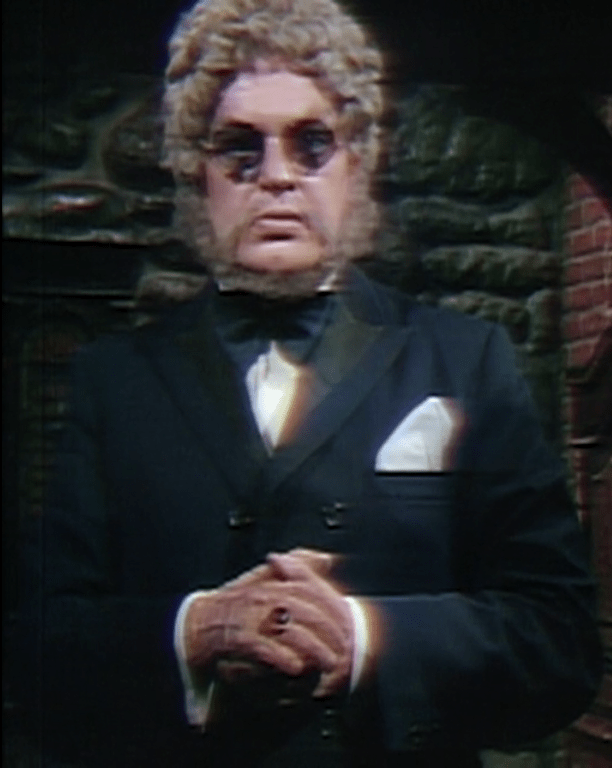
One night in 1797, nine Rroma men trapped the sorcerer Count Petofi in the forest of Ojden and cut off his right hand. With it, the count lost most of his magical powers. Sometime after, Petofi learned that he could live for exactly one hundred years without his hand. If he was reunited with it in that time, he would become immortal; if he was not, he would die.
Now, it is 1897, and the hundred years are almost up. Petofi has vacated his body and has for some weeks been operating in the person of twelve year old Jamison Collins. He has regained the hand, but as Petofi is dying, so is Jamison. Jamison/ Petofi collapses in the woods carrying the hand back to the place where his servant Aristide is waiting with Petofi’s own body. Jamison/ Petofi passes out shortly after Jamison’s uncle, the rakish Quentin Collins, catches up to him. Quentin carries Jamison/ Petofi and the hand to the caretaker’s cottage on the grounds of the estate of Collinwood, where he confers with his distant cousin, Barnabas Collins the vampire.
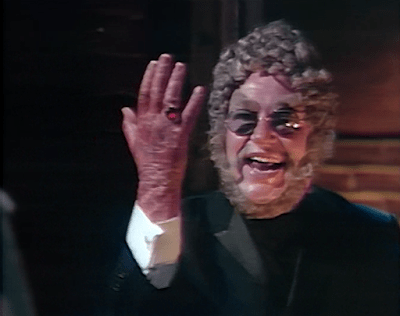
Quentin and Barnabas decide that if Petofi dies, Jamison will die as well. Therefore they have no choice but to take the hand to Aristide. Barnabas does get Aristide to promise that once Petofi has the hand, he will use his powers to cure Quentin’s werewolf curse, but no one seems to regard Aristide’s word as valuable. Barnabas makes a menacing move towards Aristide; Aristide wards him off with a cross. Aristide puts the hand on Petofi’s chest, says some magic words, and waits a little over an hour. During this time, he needles Barnabas by offering him tea, which he must know is not part of a vampire’s diet. Then Petofi comes out of his room, laughing his evil laugh and showing off his reattached hand.
“At last my arm is complete again!” Screenshot by Dark Shadows Before I Die. (Caption by Stephen Sondheim.)
In #767, Jamison had a dream in which Quentin told him that his doom was sealed when the one person he truly loved turned against him. It was already clear at that point that this person was Jamison, but today Quentin tells Jamison in so many words that he is the only person he ever really loved. So we can take this as an announcement that the climactic crisis of the part of Dark Shadows set in 1897 is approaching.
Charity Trask is in the drawing room of the great house on the estate of Collinwood trying to call the police when her abusive step-uncle, Quentin Collins, comes out of a secret panel and takes the telephone from her. He tells her that there is no longer any point in telling the police about Tessie, the injured woman upstairs. Tessie won’t be telling them anything. She has died. Apparently the sheriff of Collinsport is the same in 1897 as are his counterparts in other periods when Dark Shadows has been set- if you’re already dead, it’s too late for them to take an interest in you.
Charity says that Quentin killed Tessie. Charity knows that Quentin is a werewolf. He locks the door to the room and asks “Are you afraid to be locked in alone with a beast, a murderer, a creature of the supernatural?” This would seem to be rather an odd question, especially since he spent yesterday’s whole episode threatening to kill her.
Charity says that her father, Gregory Trask, will see to it that Quentin is brought to justice. Quentin takes a paper from his pocket and shows it to Charity. It is a confession to the murder of Charity’s mother, signed by her father. Charity claims that it was fabricated by Satan, which is what her father told her when she first saw it, and that Trask repeatedly tried to destroy it. This only convinces Quentin that the confession is true. He says that if either Charity or her father tells the police about him, he will hand over the paper. He adds “Now, Charity, I may hang for murder, but your father will be dancing at the end of a rope, too.”
Dark Shadows is set in the state of Maine, which in our universe abolished capital punishment in 1887. That used to be true in the show’s universe, as well. In #101, broadcast and set in November 1966, high-born ne’er-do-well Roger Collins told his son, strange and troubled boy David, that “They don’t hang people anymore. Not in this state, anyway.” But by the time the show left the 1960s for its first costume drama segment a year later, characters were already afraid of being sentenced to death. The morbid fascination of the gallows is so much of a piece with the show’s exaggerated melodrama that there must be a death penalty, no matter when or where the action is supposed to be taking place.
Quentin tells Charity that there is a chance- a small chance, he concedes- that he will be cured of lycanthropy before the next full Moon, so that she need not feel that she is an accessory to murder if she doesn’t turn him in right away. Miserable, frightened, and confused, she takes this seriously enough that she remains quiet at least through this episode.
We cut to a hiding place where a man known as Aristide is looking at himself in a mirror and primping his hair, moving his fingers through it with an exaggerated daintiness. We pan to broad ethnic stereotype Magda Rákóczi , who impatiently asks “Did you send for me so there would be two of us to admire you?” Aristide has some business to discuss relating to plot points not directly involved in this episode, and he and Magda trade menacing insinuations about the danger each faces from the various supernatural forces at work in the area. Magda says that what the ziganophobic Aristide calls her “Gypsy cunning” will protect her, and Aristide says that an amulet he wears around his neck will protect him.
Magda replies “All right, we’ve both got something to protect us. I go now,” and starts to leave. Aristide stops her, and says that she must recover the severed hand of Count Petofi. She says that a man named Tim Shaw stole the hand and ran off with it, and she has no way of knowing where Tim is. Aristide says she must find out and bring it soon, “before time runs out.” She asks “Before time runs out for who? You mean when Petofi comes back!” In fact, Aristide means more than that- his master, 150 year old sorcerer Count Petofi, will die in a matter of days unless he is reunited with the hand that was cut from his right arm a century before, in 1797. If he does recover the hand in time, he will become immortal. Magda fears Petofi and hates him, and would doubtless make any sacrifice to keep the hand away from him if she knew these were the stakes. So Aristide is mortified that he let slip the phrase “before time runs out,” and is anxious to avoid saying anything else.
Back at Collinwood, Quentin confers with a Mrs Fillmore. Mrs Fillmore has been looking after the twin children Quentin’s wife Jenny bore him after he left her and before he murdered her. This is the first time we have seen Mrs Fillmore. It is also the first confirmation we have had that Quentin has seen Mrs Fillmore. He didn’t know about the twins until #798, when the boy twin was already dead as the result of a curse that a woman named Julianka placed on Magda, who is Jenny’s sister. Now Mrs Fillmore tells Quentin that the girl is suffering the same symptoms the boy showed before he died, and that the doctor is at a loss what to do for her. Quentin says he will look for someone who might be able to help, and they both exit.
Charity is alone in the drawing room, making an earnest effort to get drunk. Magda enters and expresses surprise that the unbendingly prudish Charity has been drinking. Charity replies that she merely ate some chocolates that were filled with brandy. At the sight of an empty snifter, she says that after eating the chocolates she poured herself a small brandy. She then picks up and drinks another, regular-sized brandy. Charity starts talking about how terrible life at Collinwood is. Magda mentions Tim Shaw, who was once Charity’s fiancé and who was framed for her mother’s murder. Charity wonders if Magda can use the Tarot cards to find Tim and bring him back. She asks if Tim will have to tell the truth if he comes back, and Magda assures her that he will. Magda may assume that the truth Charity wants is about the end of her relationship with Tim; she does not know that Charity is desperate to revert to believing that Tim, not her father, murdered her mother.
Magda asks Charity to tell her as much as she can about Tim. Charity says that when Tim was a boy, his closest friend was named Stephen Simmons, and that “He and Stephen Simmons used to always say they would go to San Francisco when they grew up.” Magda asks where Stephen Simmons is now, and Charity says she thinks he lives in Worcester, Massachusetts. She goes to her bedroom to look for a Christmas card Stephen sent her last year, hoping it may have his current address.
Quentin returns and finds Magda. He asks Magda how she knew about his daughter. She asks what he means. When Quentin tells her that the girl is suffering the same symptoms that her brother showed immediately before his death, they rack their brains to come up with a potential defense against Julianka’s curse. Magda remembers Aristide’s amulet. It is capable of warding off vampires and witches- perhaps it will defend against Julianka as well. Magda tells Quentin where Aristide is hiding, and he decides to go to Aristide and rob him of the amulet.
Aristide is asleep when Quentin arrives. He awakens before Quentin can take the amulet, and declares “This pendant protects me from witches, warlocks, and unnatural spirits.” Quentin asks “How does it do against flesh and blood, Aristide?” Aristide draws a curvy piece of wood with no sharp edges and replies “For flesh and blood, I have The Dancing Lady.” The piece of wood is supposed to be a knife. When Aristide first displayed it in #792, he called it “The Dancing Girl.” Perhaps this is a case of Soap Opera Rapid Aging Syndrome, and in a couple of weeks it will be The Dancing Dowager, then The Dancing Crone. At any rate, Quentin replies “Then let her dance, Aristide, let her dance.” Quentin wins the subsequent fistfight. He knocks Aristide senseless, then takes the amulet from him.
Quentin and Magda go to Mrs Fillmore’s house, the first time we have seen this set. Appropriately for a member of the Collins family, the baby sleeps in a cradle shaped like a coffin.
Quentin talks with Mrs Fillmore about little “Lenore,” a name we have not heard before today. The only other girl of Lenore’s generation in the Collins family is the daughter of Quentin’s brother Edward, and she is named Nora. Since the name “Lenore” became popular outside Greece because speakers of English and French thought it was an alternative form of “Nora,” that would suggest rather a limited imagination regarding girl’s names on the part of whoever chose them.
But it is appropriate that Quentin and Edward have children with similar names. They are two variations on Dark Shadows’ first archvillain, Roger, whose evil largely expressed itself in his amazingly bad parenting of David. Edward’s attentive and caring interactions with Nora and her brother Jamison show that he is a less villainous Roger, while Quentin’s frequent assaults on his adult family members are among the evidence that he is an even worse version of the same character. Jamison is the only child we have seen Quentin interact with, and he is fond of him. But while we were still in the 1960s, Quentin’s ghost was possessing and killing the children at Collinwood, and in #710, only two weeks into the 1897 flashback, he and his fellow Satanist Evan Hanley used Jamison as a “sacrificial lamb” in a ritual meant to exploit his innocence for their own sinister purposes. Clearly, Quentin is no more to be trusted with the care of a child than was the early Roger.
Quentin asks Mrs Fillmore to leave him and Magda alone with Lenore. They apply the amulet, and it does not seem to work. Magda tries to raise the spirit of Julianka. After some pleadings and whatnot, there is thunder, wind, and other signs of ghostly presence. Magda cries out in hope that Julianka has come with pity. A figure materializes and says “Not with pity, Magda.” But the figure is not Julianka. It is Jenny.
In #804, we saw a photograph of Jenny in Quentin’s room. It was a full length picture in a period-appropriate costume, not just Marie Wallace’s professional headshot, raising a hope that we would see Miss Wallace again before too long. But after a week and a half, those hopes had begun to fade. Perhaps they took the picture months ago and never got around to using it when Jenny was on the show. If they had done that, they wouldn’t be above sticking in a scene of Quentin looking at the picture and discussing it with his distant cousin Barnabas the vampire so that they could get their money’s worth out of it. When Miss Wallace does in fact return, the show sends us out on a high note.
Charity Trask finds Quentin Collins unconscious and disheveled in the woods. She kneels beside him in a show of concern, then notices a woman on the ground near him. The woman’s face is covered with what on a black and white television look like slash marks and her clothing is badly torn. She regains consciousness just long enough to say Quentin’s name. Charity notices that Quentin is holding a scrap of cloth that matches the woman’s dress, and realizes that he is the werewolf who has been terrorizing the area.
Quentin comes to, and Charity tells him they must get help for the injured woman. Quentin’s response is to threaten to kill Charity if she says anything to anyone about what she has seen. He says that he will look after the woman, and repeats his death threats to Charity.
Charity goes home to the great house of Collinwood, where her father, the overbearingly evil Gregory Trask, orders her to marry Quentin by the end of the week. She is horrified and tells him she will not. She cannot explain why. Before Gregory can corner Charity and force her to give him information, twelve year old Jamison Collins enters. Jamison reports seeing the injured woman in the woods, and says that Gregory must go to her at once if she is to survive. Gregory dismisses this as a “tall tale” and says he will not be distracted from punishing Jamison for his long unexplained absence from the house. Charity, on the point of sobbing, urges Trask to take Jamison seriously, and he reluctantly goes to see if there really is a woman in the woods.
We know more than do Charity or Trask. We saw Jamison meet Quentin in the woods next to the woman’s body, and talk to him in an amiable and condescending tone about the possibility of turning this unfortunate incident to their mutual advantage. He also makes it clear that, despite his appearance, he is not simply Jamison. He is a sorcerer named Count Petofi, in possession of Jamison and acting through his body. When Charity asks Jamison/ Petofi if the woman was alone when he found her, he replies that of course she was. Smiling, he asks who she thought he might have seen. Terribly agitated, she soon excuses herself and goes into the foyer. Jamison/ Petofi looks directly into the camera and smiles. David Henesy was the first actor on Dark Shadows to use this technique, back in 1966 when he was playing strange and troubled boy David Collins. He’s been doing it a lot lately, and is still very good at using it to unsettle the audience.
He looks young for 150, but he’s grown quite a bit since 1966. Screenshot by Dark Shadows Before I Die.
Quentin comes down the staircase, wearing a tidy new suit. Charity is shocked that he did nothing to help the injured woman; he resumes his menacing tone and demands to know whether she kept her side of the bargain. He eventually deduces that she did not tell what she saw, and allows her to go upstairs to her bedroom. Quentin is usually charming, often funny, and occasionally aligned with good against evil, but even before he became a monster he was established as a homicidal maniac. When we first met Quentin, he was a ghost haunting Collinwood in the late 1960s and he kept killing people there. The first week of our trip back in time to 1897, we saw him trying to strangle his grandmother in her bed. And his sister-in-law turned him into a werewolf as revenge after he murdered his wife Jenny. Since we are focused on the horror of Charity’s situation as her father is pressuring her to marry Quentin, of course his bloodthirstiness is the aspect of his personality we see most clearly today.
Trask returns, carrying the injured woman. Quentin asks if she was conscious. Trask says she is not conscious. Quentin specifies that he wants to know if she has been conscious at any point while with Trask. This arouses Trask’s suspicions; Quentin protests that it is information he will need when he telephones the doctor. Trask says that she was not, and carries her upstairs.
Quentin goes to the drawing room. Jamison/ Petofi is there, and has some business to discuss. Quentin is too unsettled by the fact of the possession to talk candidly. Jamison/ Petofi decides to humor him. “I’ll become that beautiful child you so want to see… Can we play a game, Uncle Quentin?” Quentin is stunned by Jamison/ Petofi’s sudden change of tone and bearing. It is indeed impressive to see David Henesy drop his mimicry of Thayer David as Petofi and resume his usual approach to the role of Jamison. We’d forgotten just how deeply he had come to inhabit that imitation.
Jamison/ Petofi declares that they will have a treasure hunt. He gives Quentin a series of clues in the form of cryptic rhymes. Quentin is completely stumped by all of them. Finally Jamison/ Petofi just points at the desk drawer he wants Quentin to open and tells him there is a document in it that he can use against Trask. Quentin opens the drawer and pulls out heap after heap of paper, then declares “There’s no paper here!”
Quentin is not especially brainy; much of his appeal comes from the joy David Selby, Ph.D., took in playing a character who at no point says or does anything to demonstrate intellectual prowess. But we are not supposed to believe that he is stupid, at least not so stupid that it is plausible that “There’s no paper here!” was the scripted line. Maybe it was a blooper for “There’s no paper like that here!” or “There’s no paper here I haven’t seen before!” or something like that.
A document bearing a wax seal and a couple of signatures materializes on top of the papers Quentin has pulled out of the desk. He reads it, and sees that it is a full confession to the murder of Trask’s first wife, signed by Trask and lawyer Evan Hanley. All Jamison/ Petofi has to say is “It can be very useful, can’t it? Especially since it’s true… Aren’t games fun, Uncle Quentin?” and Quentin catches on that the document gives him power he can use against Trask.
Meanwhile, the injured woman has briefly regained consciousness in the upstairs bedroom where Trask and Charity are attending her. She spoke Quentin’s name, and Trask sent Charity to fetch him. Trask confronts Quentin about this. Quentin says that the woman’s name is Tessie, that he talked to her a couple of times when they ran into each other at the Blue Whale tavern, and that he knows nothing more about her. He admits he didn’t call the police after he called the doctor; he claims he simply forgot, in the confusion of the moment. Trask says that he will go and make the call. In an accusing tone, he asks “Most unfortunate, isn’t it, that you were the one who forgot?” He leaves Quentin alone with Tessie.
Tessie regains consciousness, looks at Quentin, and reacts with dismay. He tells her he didn’t mean to do it. She moans and dies. As she flops over, her right breast comes perilously close to springing out of her décolletage. When he realizes she has died, Quentin says “Tessie!” with a note of exasperation, as if she’s always doing inconvenient things like that. Mrs Acilius and I laughed out loud.
Downstairs, we see that Trask did not call the police after all. Charity is doing it from the telephone in the drawing room. Quentin enters through the secret panel behind her. We first saw him use this panel in #685, when it was 1969 and he was a silent but peculiarly corporeal ghost. He let himself into the drawing room and strangled silversmith Ezra Braithwaite, played by Abe Vigoda. A bit of an eldritch moment that the killer of Tessie is also the killer of a character played by the actor who would go on to play Tessio in the 1972 film The Godfather.
In Vigoda’s last scene in that movie, Tessio and Corleone Family consigliere Tom Hagen are at pains to assure each other that Tessio’s impending murder and the events that led up to it were strictly business, and that Tessio and his murderers still have the warmest regards for each other. Quentin’s attempt to deny his guilt to Tessie is of that same sort- he didn’t have any hostility towards her, his nature as a werewolf simply required that he kill the nearest person.
By contrast, Quentin’s interaction with Charity is intensely personal and intensely unpleasant. He takes the telephone out of her hand, something that men often do to women on Dark Shadows when they are trapping them, and moves deep into her personal space as he demands to know why she would want to call the police. She tells him her father ordered her to make the call; he says that Tessie will tell the police nothing now, because she is dead. Charity shouts that he killed Tessie, and that she will tell everything.
Danny Horn devotes much of his post about the episode at his great blog Dark Shadows Every Day to the absurdity of Quentin making a date with Tessie on a night when the Moon was full. In a comment, I pointed out that we have no reason to think he did make a date with her:
I don’t think it’s so hard to explain why Tessie was in the woods at dawn, though it does require a little fanfic.
Charity was in Quentin’s room in 806, inviting him to go for a walk on the beach when he’s busy getting drunk and listening to the same dreary little waltz over and over. To get Tessie into the woods, all we have to do is assume that shortly after that scene Quentin ran out of booze before he was drunk enough to stop caring about the upcoming full moon. Not wanting to deal with the Trasks, he didn’t go to the mansion’s liquor pantry, but staggered down to the Blue Whale.
There, Quentin met Tessie. She was upset with him for missing several dates in the last few days. He can’t very well explain what he’s been doing lately, and his refusal to answer Tessie’s questions angers her. She’s about to give Quentin a piece of her mind when he realizes that it will be dark soon, and rushes from the bar.
Now Tessie is really furious. She follows Quentin to the estate. Once there, she sees him change into the werewolf, and hides in terror for most of the night. Shortly before dawn, she thinks he is gone and leaves her hiding place. The werewolf appears and slashes away at her for a few minutes before changing back into human form and collapsing beside her.
And that’s when Charity finally takes her walk, and finds out.
Comment left 17 November 2020 by “Acilius” on Danny Horn, “Episode 808: Twice Burned,” Dark Shadows Every Day, 18 January 2016
Tessie is played by Deborah Loomis, and is the earliest screen credit on her IMDb page. Her next role listed there was in Hercules in New York, a 1970 film which also featured fellow Dark Shadows day player Erica Fitz Mears, who appeared in #594 and #595 as Leona Eltridge. Neither Miss Loomis nor Mrs Mears stuck with acting after the middle of the 1970s, but the two top billed members of the cast worked steadily for some years after. The first name in the credits was comedian Arnold Stang, who was best known at the time for a series of TV commercials for window screens ending with the tag “Arnold Stang says don’t get stung!” Second billed was Arnold Strong, a bodybuilder from Austria making his acting debut. Under his birth name of Arnold Schwarzenegger, Arnold Strong would go on to roles in several later films. I know of no evidence he ever auditioned for a part on Dark Shadows.