Vampire Barnabas Collins and mad scientist Julia Hoffman have traveled back in time to 1840. They know that events took place in that year that led to a disaster that destroyed the great house of Collinwood and everyone in it in 1970 and that left the whole estate of Collinwood a deadly, hag-ridden waste in 1995. They hope to find a way to change history.
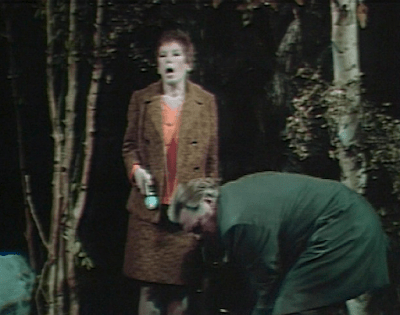
Today, they discover a woman lying on the ground in the woods. She is Hortense, governess at the great house, and she is horribly injured. At first they think Hortense is dead, but Julia feels her wrist and says, using a bit of Collinsport English we haven’t heard since #672, that she can feel a “pulsebeat.” Hortense manages to speak the words “headless creature” before she dies.
Julia and Barnabas tell Quentin Collins, heir to Collinwood and its acting master, what happened. His reaction makes it clear that he knows what Hortense meant by “headless body.” Later, Barnabas gets Quentin to tell him the truth. His cousin Desmond found a severed head in a shop in Macau and brought it back as a gift for him. The severed head turned out to be that of warlock Judah Zachery, who terrorized the town of Bedford until he was executed in 1692. The head has cropped up again from time to time, most recently in 1803, when it was associated with four brutal slayings known as “The Bedford Atrocities.” Under the head’s influence, Desmond found its body. Now the body is roaming about. The head has also gone missing. Until Quentin heard that the body is still headless, he assumed that Judah’s parts had reconnected themselves. He still thinks they must be hanging around together someplace.
Barnabas and Julia decide that the head and body must be associated with the disaster they want to prevent. They make a note of it. But they have more definite knowledge about a woman called Daphne Harridge. They saw Daphne’s ghost in 1995 and 1970, and got to know her as a living being when she was briefly resurrected in 1970. She was governess at Collinwood in 1840, was killed along with her charges, teens Tad Collins and Carrie Stokes, in 1841, and was a part of the disaster in 1970. When they first arrived in 1840, they were puzzled to find that Hortense was the governess and that no one had heard of Daphne. But Daphne is in Collinsport now, and the governess’ position is vacant. Julia and Barnabas make it their top priority to keep her from becoming governess.
Quentin believes Barnabas and Julia to be his cousins from England (or Philadelphia, it doesn’t seem to make a difference.) He has trusted them with the secret of what he and Desmond have done involving the head. So you might think they would address this problem by trying to persuade him not to hire Daphne. But that doesn’t seem to occur to them. Instead Julia goes to Daphne’s room and tells her she is about to be offered the post of governess at Collinwood and that if she accepts it she will be in terrible danger. In response, Daphne asks Julia who she is and why she is threatening her. Julia tries to explain that she is a friend bringing a warning, but that doesn’t cut any ice. Regular viewers know that Julia is not only a prodigiously skilled and creative liar, but that she also has a magical power of hypnosis that enables her to rewrite people’s memories. With those qualifications, you’d think she could do better than that. When Quentin drops by later and says that Desmond has recommended her to be the next governess, Daphne is startled, but quickly accepts.
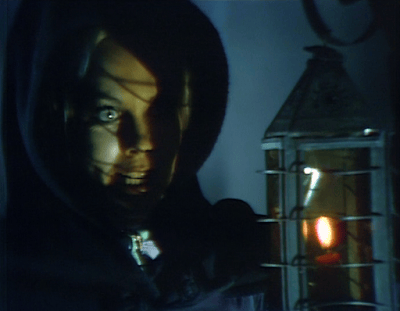
The episode ends with a hooded figure walking through the old cemetery north of town. We see the figure from behind as it enters the mausoleum where Barnabas’ family is entombed. The figure opens the secret panel. The camera stays low and does not allow us to see the face of the figure entering the hidden chamber where Barnabas was sealed in a chained coffin when he first became a vampire in the 1790s. When the figure is in position to see that the coffin is not there, the camera pans up and we see that it is wicked witch Angelique. The composition shows that this is supposed to be a big shock. Indeed it would be, had Lara Parker not delivered the opening voiceover, giving away that she is going to be in the episode.
They have ruined many surprises this way. This one is a particular shame. Regular viewers know that Angelique will probably turn up sooner or later, but this is the first time we have seen the character since #978.* Her return is a big deal, and we do have a right to expect the show to be more careful about getting the biggest bang they can out of it.
*Parker played an alternate universe counterpart of Angelique from April to July 1970. She’s been away for 72 episodes.
The ghost of Daphne Harridge, who died in 1841, gives a bunch of lilacs to Quentin Collins, who immediately falls in love with her. Quentin himself died a couple of times before gaining eternal youth in 1897, so he and Daphne have more in common than you might think.
Carolyn Stoddard Hawkes is half convinced that a local man named Sebastian is actually her dead husband returned to life, mainly because he is played by the same actor. They did this same story in 1968, when well-meaning governess Victoria Winters was convinced that a local man named Jeff was actually her dead boyfriend come back to life. That time around the story was a total non-starter, because it was obvious that Vicki was right. This time it is unclear whether Carolyn is right. It is also unclear what difference it would make if she were, since Carolyn’s husband was entirely exhausted as a source of story development when he died and Sebastian is a clown.
Daphne’s ghost has been appearing to grouchy New England teen David Collins longer than she has been appearing to Quentin, and the two of them are keeping their connections with her secret from each other. They themselves don’t know why. They don’t actually have motivations- it’s the influence of the ghosts holding them back. The ghosts, you see, have a deal with the writers to keep the story from moving faster than they planned when they made up the flimsies for these thirteen weeks.
David borrows Quentin’s camera and takes some pictures at a picnic. He develops the pictures in his darkroom. (Yes, David has a darkroom but no camera.) It is a picture Carolyn had in #1064, set in 1995, 25 years after the present. Carolyn was a crazy woman then, living in the aftermath of a catastrophe that is due to strike the estate of Collinwood later in 1970. Housekeeper Mrs Johnson said that the picture was taken “the first time we saw him,” and Carolyn tore it up. David tells Carolyn today that the picture gives him a sense of dread, and she doesn’t know what he is talking about. But we see the malign ghost that ruled the house in 1995 standing in the background behind them.
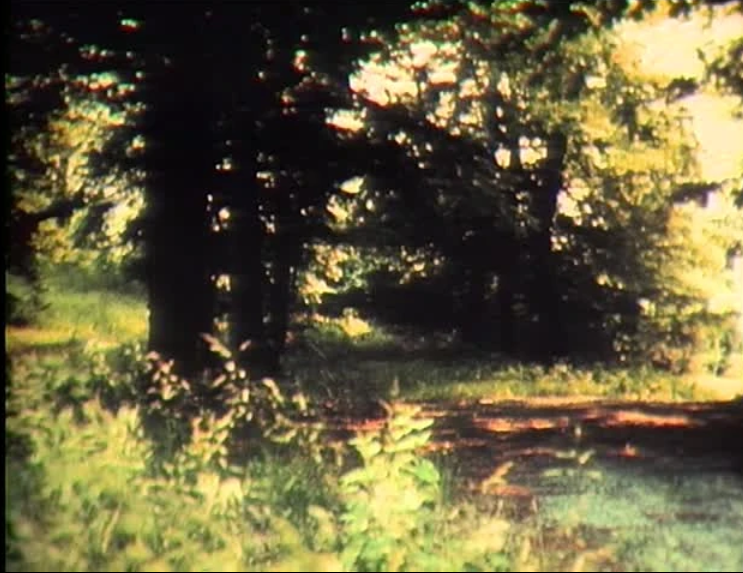
The picnic scene is the first attempt they have made in a while to represent an outdoor setting in the daytime, and it is executed quite well. It is preceded by a still of a wooded scene that I don’t believe we’ve seen before. We had some fresh stills of the Moon the other day; it’s nice that they are giving us new images of the outdoors, even if they are not motion pictures.
Sunny day.
Also, Carolyn eats a little food today. She ate some grapes one day in the 1995 segment. People ate on camera quite often in the first six months of Dark Shadows, but I believe these are the first two instances of characters taking solid nourishment in front of us since then.
In a bit of Collinsport English we’ve heard before, Quentin refers to another Collins named Quentin, one who was alive when Daphne was, as his “great-grand-uncle.” “Grand-uncle” is not unknown in American English, but it is far less common than “great-uncle.”
A disruption in the very nature of time and space has thrust vampire Barnabas Collins and mad scientist Julia Hoffman into the year 1995, where the great house of Collinwood is in ruins and everyone is annoyed with them.
Yesterday, Julia and Barnabas were poking around inside the great house against the express instructions of its owner, Carolyn Fredericks, as conveyed earlier in the evening by the sheriff when he arrested them for trespassing. A heavy bust fell from the railing on the top of the foyer stairs, narrowly missing Julia. She and Barnabas fled the house. They looked back, and saw a young man in nineteenth century garb glaring at them from a window.
Today, Barnabas and Julia are in the parlor of the Old House on the estate. She tells him that when she saw the man in the window she was overcome by a powerful sensation. “It was the very essence of evil! I felt evil all around me. I was trapped by it!” Regular viewers may have thought Julia would be used to that by now, but apparently not. “It made me aware of something deep inside me that I don’t even understand — as though, with that one look, he could concentrate every grain of evil I have in my nature! Make it grow, and grow…” She asks Barnabas if he felt the same thing, and he says he didn’t, not at all. He concedes that he is an inhuman abomination from beyond the grave, so maybe he’s immune to that kind of thing.
Meanwhile, Carolyn is at home in the old shack by Finley’s Cove, accompanied by Mrs Johnson, who was the housekeeper at Collinwood in the late 1960s. Carolyn is brushing her hair and smiling. She reminisces about when she was a little girl and Mrs Johnson used to brush her hair. Mrs Johnson is not shy then or later about contradicting anything Carolyn says that is not so, but does not deny that she did that. So the audience is supposed to believe it. Some say this is a retcon, since Mrs Johnson did not join the staff at Collinwood until 1966, when Carolyn was fully grown. But in a comment on Danny Horn’s post about the episode on his great Dark Shadows Every Day, I expounded a theory as to how it might be true:
In the early episodes, Carolyn talks about having gone to school in town. How did she get there?
She can’t have walked; it was miles away, much of it along a winding road with several blind curves. Her mother never left the grounds during those years, she couldn’t have driven her. Roger was living in Augusta with Laura.
(I should expand on this point. Roger says that when Carolyn was born, he was away at boarding school. So he would still have been in college when his niece first became a pupil at Collinsport Elementary. He then busied himself squandering his inheritance, a process which included the ten years between his marriage to Laura and his return to Collinwood. So that doesn’t leave any time for him to have looked after his “Kitten” when she was little.)
The only servant was Matthew. Matthew and Carolyn don’t seem at all close; it doesn’t seem likely that he drove her to school every morning. If a school bus came up the hill to Collinwood day after day, the kids who rode it couldn’t have maintained the attitude Carolyn describes, whispering behind her back about her living with the witch in the haunted house. Sooner or later they’d have started talking to her face to face about it.
Carolyn also talks about Bill Malloy being more like a father to her than any other man, and the two of them do have a cozy relationship. Carolyn is also very quick to fall in with Mrs Johnson when Burke pitches the idea of her joining the household staff at Collinwood. So I think we have to conclude that Bill Malloy and his housekeeper were in charge of getting Carolyn to school in the mornings. Malloy was on the fishing boats, so that would require an early start to the day. There were probably many days when little Carolyn was still in her pajamas when she got to the Malloy house. On those days, Mrs Johnson brushed her hair while the water came to a boil for breakfast.
Comment left by “Acilius,” 27 January 2021, on Danny Horn, “Episode 1064: Here Comes the Hotstepper,” Dark Shadows Every Day, 20 August 2017.
Carolyn seems to be a crazy lady these days. Yesterday, we saw that much of this is an act, but in her scene with Mrs Johnson we see that it is an act she puts on even when she is alone with someone she trusts. It allows her to smile and laugh and be happy even when she is surrounded by the residue of an unimaginable catastrophe.
Carolyn tells Mrs Johnson that she will be going to the great house of Collinwood to get ready to host a picnic at the gazebo, which she pronounces “ga-ZAY-bo” in a bit of Collinsport English that we’ve been hearing intermittently since Lara Parker invented it in the summer of 1968. Mrs Johnson reacts with horror, saying that no one can go to the devil-haunted wreckage of Collinwood, but Carolyn laughs off her objections. Carolyn shows a picture of a picnic they had at the ga-ZAY-bo in 1970, the last year Collinwood was habitable. Mrs Johnson spots a figure in the background and declares that was “the first time we saw him.” Carolyn gets upset and tears up the picture.
Barnabas had insisted to Julia that the man they saw at the window may not be the only supernatural entity operating within the great house, and Carolyn seems to confirm that he is right. She does not want to hear Mrs Johnson referring to him, nor does she want to have a picture of him. But she happily says that she is going to the great house tonight with a present, because it is his birthday. Apparently him and his refer to different beings, each of which inheres in the haunting. One wonders how much of supernaturalism would dissolve if people would just use proper names instead of pronouns.
Julia and Barnabas barge into Carolyn’s house. Carolyn tells them to get out, which they refuse to do. They badger her with the story of what happened when they were illegally roaming around in her other house, and Mrs Johnson runs out. Eventually Carolyn resumes her crazy lady demeanor. Barnabas and Julia give up and leave, and for a moment we wonder if they are on their way to let themselves into some other property of Carolyn’s.
Julia and Barnabas go back to the Old House. They find that Mrs Johnson is waiting for them there. They tell her that they are time travelers, and that if she will tell them what happened they might be able to go back and prevent it. She is dubious about this claim, but starts telling the story anyway. She casts her mind back to the summer of 1970. “It all began when the days were so beautiful, you couldn’t help but be happy. There was a spirit of joy at Collinwood; there was a feeling that hadn’t been there in a long time. There was so much love among all of us at that time…” This would be the period that began immediately after Barnabas and Julia left.
Mrs Johnson says that all of the beauty and joy and love and other things you might experience when you don’t have a vampire and a mad scientist around your estate came to an end one quiet night. She seems to be on the point of saying something important when she looks at the window of the parlor and sees the glaring young man. She breaks off, screams that she won’t tell, and runs out into the night. Julia tells Barnabas she felt the evil presence, and that the ghost was there. They go out to look for Mrs Johnson.
The ghost catches up to Mrs Johnson first. He touches her shoulder, and she dies. When Barnabas and Julia find Mrs Johnson, she is sitting on the ground, her back against a tree, her eyes open. This was the same posture in which Clarice Blackburn’s character Abigail Collins was found when we saw her corpse in #432. That image was a brief shocker in the last couple of seconds of the episode; this time the camera zooms in on Blackburn’s face and pans across it, allowing her to show that an outstanding actress can give a powerful performance even when she is altogether motionless.
Carolyn happens by. Julia and Barnabas hide. Carolyn thinks Mrs Johnson is alive and chatters to her. As the truth begins to dawn, Carolyn’s alarm mounts. Finally Barnabas and Julia emerge from the shadows. Carolyn accuses them of killing Mrs Johnson. They deny their guilt. Carolyn is unconvinced, and indeed we cannot help but think that since Mrs Johnson lived through the 25 years of their absence and turned up dead so shortly after they returned, Julia and Barnabas cannot be exactly innocent.
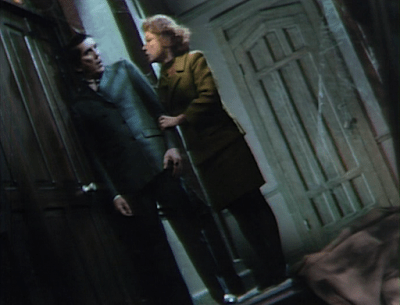
Barnabas and Julia follow Carolyn into the great house. Julia wonders what Mrs Johnson could have meant by “the children’s old room.” This is a blooper on Grayson Hall’s part- Mrs Johnson mentioned “the room the children called The Playroom.” Julia and Barnabas hear music playing, and follow it to a room upstairs. Barnabas looks at the doorway and remarks that the room was never there when he knew the house. The shot is framed at such a severe Dutch angle that we can tell something isn’t on the level.
They hear Carolyn inside, talking and laughing with at least one other person. Since their whole philosophy of life now seems to be making themselves as obnoxious as possible to Carolyn, they let themselves in.
Elizabeth Collins Stoddard is fretting about her brother Quentin’s childish behavior. Quentin’s wife, the former Maggie Evans, has left the house abruptly, without her purse, and has been away for some time. Liz is sure something bad has happened to Maggie, but Quentin refuses to look for her.
Liz tries to interest Alexis Stokes, identical twin sister of Quentin’s late first wife Angelique, in Quentin and Maggie’s troubles. She does not know that the person she is talking to is not Alexis at all, but Angelique herself. Angelique rose from the dead, murdered Alexis, and took Alexis’ place as a permanent houseguest in the great house of Collinwood as part of her plan to win Quentin back. To that end, Angelique is conspiring with a man she knows as John Yaeger. He has abducted Maggie and is holding her in a dungeon out in the country, hoping that after enough time alone with him she will forget all about Quentin and fall in love with him.
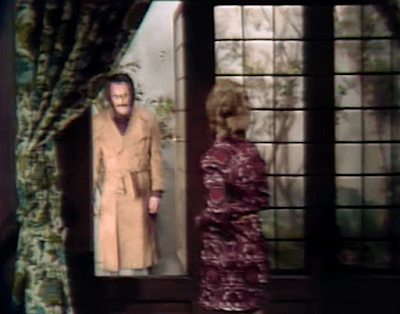
“Alexis” is pacing around the drawing room while Liz talks about Maggie and Quentin. She is half listening when she approaches a window and sees Yaeger waiting outside. She suddenly tells Liz that she is going to go out herself and look for Maggie. Liz tells her this is too dangerous, but she rushes out. She confers with Yaeger in the gazebo.* Yaeger is despairing of his plan, much to Angelique’s annoyance.
There is no such person as Yaeger, any more than there is a living Alexis Stokes. The man is really Cyrus Longworth in disguise. Maggie and Quentin think of Cyrus as a friend, a mild-mannered scientist who means well, though he is sometimes strangely naive. Cyrus has developed a potion which changes his appearance so drastically that not even those who know him best can recognize him when he is under its influence. After Cyrus tried to rape Maggie last week while disguised as Yaeger, he threw the potion away. But he then transformed spontaneously, without drinking it. Since he cannot re-Jekyllize himself without it, we are left wondering if he will remain in his Yaeger form permanently. We may also wonder what he will do if he reverts to his usual appearance in front of Maggie. He has admitted to himself that he and Yaeger are not separate people, but still seems to want to hold onto some sense that they are. He can’t very well do that if Maggie knows he is the one keeping her locked up.
Liz stays in the drawing room after “Alexis” leaves. Roger Collins enters and helps himself to some brandy. Liz picks up with her brother where she had left off with “Alexis.” Roger doesn’t even pretend to care about Maggie. He was fixated on Angelique when she was alive, and cannot forgive Maggie for not being her. He is glad Maggie is gone, and nothing Liz says about her can stir his interest. Joan Bennett and Louis Edmonds played different versions of these characters starting in #1, and it is always great to see them together.
Angelique has a problem of her own. She can stay out of the tomb only so long as she finds living bodies to drain of their warmth. She’s already killed three people that way. The first two were Alexis, whom she is successfully impersonating, and a handyman named Fred, who was expected to leave town anyway. Neither of them has been missed. The third, lawyer Larry Chase, caused puzzlement when his ice cold corpse was found in front of her, but as an isolated occurrence no one seems to have found a way to start solving that puzzle. So “Alexis” is not currently suspected of being a vampiric creature.
The need for warmth suddenly comes over Angelique. She goes to the drawing room and huddles in front of the fire. Roger sees her and remarks on how much she, “Alexis,” reminds him of Angelique. She says she doesn’t want to talk about her sister, then approaches Roger and embraces him. He says he feels terribly cold. She asks him to kiss her. That’s all it took to kill Fred and Larry, and a lot more contact than it took to kill Alexis. Roger is about to do it when Liz enters. They break their clinch and Angelique makes haste to go out. Roger is still feeling extreme cold, but he has no idea his sister just saved his life.
We see Angelique in the apartment of her (step?)father, Tim Stokes. She tells him she killed some stranger on her way over. By this time, his body will have been discovered, so cold that it will be assumed he had been dead for days. She tells Stokes that it was his occult prowess that enabled her to return from the dead, and asks if he can free her of her heat vampirism. He says that he cannot, and that he is so much the greatest expert in this sort of thing that there is no point in looking for anyone else who might be able to do so. She presses, and he mentions that someone else was involved in the process. She demands to see this person; he tells her the person is in the back room of the apartment. She eagerly goes to the door, unbothered by his pained refusal to accompany her.
Stokes’ apartment is laid out like the apartment of Professor Timothy Eliot Stokes, his counterpart in the parallel universe where Dark Shadows was set for its first 196 weeks. Two people had important connections with that other Stokes’ back room. One was Frankenstein’s monster Adam, who was last seen going in there. Adam’s creation was a means of freeing another vampire of his curse; longtime viewers may therefore wonder if we are about to meet his counterpart. The other was Paul Stoddard, ex-husband of Liz’ counterpart, who was attacked and killed in that room by a murderous shape-shifter who, like Cyrus Longworth/ John Yaeger, was played by Christopher Pennock. Perhaps whoever is waiting for Angelique in the room is somehow connected with Cyrus/ Yaeger.
There are other possibilities. Angelique’s counterpart in the other continuity was for a time subordinated to suave warlock Nicholas Blair. We have not seen a counterpart of Nicholas here; my wife, Mrs Acilius, thinks that we will meet another Nicholas tomorrow.
*Which she pronounces “ga-ZAY-bo,” a bit of Collinsport English Lara Parker introduced way back in #489. It’s fun to hear it again.
When Dark Shadows premiered in June 1966, strange and troubled boy David Collins (David Henesy) was obsessed with his absent mother and determined to get rid of his new governess, the well-meaning Victoria Winters. In #15, David had tampered with his father Roger’s car. As he stood at the window and watched Roger drive down the narrow, twisting mountain road away from the great house of Collinwood, he said “He’s going to die, mother, he’s going to die!” When Roger survived and it was discovered that someone had removed the bleeder valve from his braking system, David planted the valve in Vicki’s room in an attempt to frame her for the murder attempt. Later, Roger would come to fear that Vicki was about to expose a dark secret of his own, and would encourage David to try to kill her.
David eventually gave up on homicide, and dropped his hostility to Vicki. One of the more benevolent influences on him was his best friend, the ghost of the gracious Josette. In #102, we saw David in the Old House on the grounds of Collinwood, carrying on a conversation with the portrait of Josette that hung above the mantel. We could not hear Josette’s side of the conversation, but it certainly sounded like David could. We already knew at that point that Josette was real- we saw her emanate from the portrait, walk out of the house, and dance among the columns outside it in #70, when David first took Vicki to the Old House. In #126, we would see and hear Josette when she led the ghosts of Collinwood in rescuing Vicki from crazed handyman Matthew Morgan. That rescue was not only a good deed for Vicki, but also a favor to David, who had stumbled upon Vicki in the secret room where Matthew had her tied up and, in a panic, left her to her fate.
In #153, we learned that David’s mother, the former Laura Murdoch, was the one who chose his name, one which no previous Collins had borne. Roger had wanted to call David “Charles Andrew,” in honor of some Collins ancestors. In #181, Vicki and her allies learned that two previous women given the name Laura Murdoch at birth had died by fire, one in 1867 and the other in 1767, each accompanied by her young son, and that each of those boys was named David. It would eventually become clear that Laura was an undead fire witch, a humanoid Phoenix who went into a pyre with her sons at intervals of exactly 100 years, gaining immortality for herself, though not for the Davids. In #288, they had forgotten the lore about David’s name, and mentioned a previous David Collins, but in #685 and #767, it was back to being a first in the family. Between those two episodes, from #729 to #760, another iteration of Laura was on the show, suggesting that the writers brushed up on their knowledge of her original storyline.
By the time Vicki saved David from Laura, he had moved out of the villain category altogether. When his third cousin Amy Jennings (Denise Nickerson) moved into Collinwood at the end of 1968, David was as pleasant to her as one could expect. But his behavior towards her and others changed when the two of them stirred up the ghost of Quentin Collins, Amy’s great-grandfather and David’s great-great-uncle. As Quentin gathered strength, he intermittently possessed first one child and then the other. While David was under Quentin’s control in #679, he twisted Amy’s arm to force her to go to a secret room and join in their vengeful ancestor’s evil plans for their governess, Vicki’s successor Maggie Evans (Kathryn Leigh Scott.) The camera lingered on that act of bullying, meant to shock us with evidence that Quentin’s dire influence had overwhelmed David’s kindly nature.
The arm-twisting incident made an impression on the viewers. In #813, set in the year 1897 when Quentin was alive, Henesy and Nickerson played brother and sister Jamison and Nora Collins, nephew and niece of Quentin, grandfather and great-aunt to David. Jamison, possessed by sorcerer Count Petofi, twisted Nora’s arm to force her to give him information, a reference which shows that the writers were confident that many viewers would see David Henesy’s character abusing Denise Nickerson’s in that way and read it as a sign that he is under the power of an outside force.
Now, it is 1970, but we are not in the main continuity at all. We have traveled to an alternate universe, which on Dark Shadows is known as “Parallel Time.” In this “time-band,” to use another bit of Collinsport English, Quentin is alive and the master of Collinwood. His first wife, the counterpart of wicked witch Angelique, has died, and he has remarried. The new Mrs Collins is the former Maggie Evans (Kathryn Leigh Scott.) Quentin and Angelique’s son, strange and troubled boy Daniel (David Henesy,) is obsessed with his absent mother and determined to get rid of his new stepmother.
Apparently the writers still remember the connection between David’s name and the first Phoenix story, because Daniel is the only character we have yet seen in Parallel Time answering to a different first name than his counterpart in the main continuity. Angelique and Quentin gave him the name of the Collins ancestor whom Mr Henesy played in early 1968, when the show was set in the year 1796. We know that the timelines diverged in that period, so it follows that it was the counterpart of the eighteenth and nineteenth century Daniel who was this Daniel’s namesake.
When we first saw Daniel, he was carrying on a one-sided conversation with his mother’s portrait, which hangs in her old bedroom. Today, he devises a plan to use the portrait to frighten Maggie. The plan requires the cooperation of his cousin, Amy Collins (Denise Nickerson.) When Amy refuses, he twists her arm until she agrees to go to a secret room and sing, making Maggie think the portrait is coming to life. This attack is shown only for a few seconds, and Amy’s arm is out of frame. They have already established that Daniel is cruel, and do not need to dwell on the act of abuse.
Daniel claims that his father often goes to Angelique’s room to meditate and talk to the portrait. That lures Maggie to the room, where Daniel is waiting. They have a confrontation. When she says she wishes she could “make him understand-,” he interrupts her and asks if what she wants him to understand is that his mother is dead and is never coming back. She looks at him and answers with a flat “Yes.” He tells her she is wrong, and pleads with the portrait to sing to him. Maggie says she can’t stand to see him like this, and turns to go. Before she gets out of the room, we hear a woman’s voice singing a lullaby. Maggie and Daniel hear it too. She turns around, shocked, and runs from the room. Daniel laughs that his plan worked so well.
Amy comes rushing into the room. Daniel congratulates her on her performance, and asks how she got in from the secret room so quickly. She explains that she never went to the secret room- her brother Chris intercepted her before she could do so. It wasn’t her voice Daniel and Maggie heard. He absorbs her message, and looks at the portrait in wonderment.
The audience could tell it wasn’t Denise Nickerson singing- she had such a high-pitched voice when she was twelve that she had to work hard to keep it in a range that would sound good on television, while the pre-recorded voice we heard singing was definitely that of a grown woman. Angelique was played by Lara Parker; Parker did some very distinctive things with her voice on Dark Shadows, none of which shows up in the lullaby, so I’m sure it wasn’t her. Several fansites attribute the singing to Joan Bennett, who is in this episode, but I’ve heard Bennett sing and she didn’t get from one note to another the way this voice does. I think the singer must be Kathryn Leigh Scott.
Early in the episode, Daniel and Amy had a scene in his bedroom. David’s bedroom was a frequent set in the first 38 weeks of the show, and was occasionally seen thereafter. Daniel’s room is the same set, with the same furnishings and decorations, but they are arranged in the opposite direction from the pattern we see in David’s. His bed is at stage right rather than stage left, and everything else is also transposed. Seeing this mirror image, regular viewers will appreciate this reminder that we are in a Mirror Universe.
Yesterday, Barnabas Collins went to the long-disused east wing of the great house of Collinwood to search for the coffin that vampire Megan Todd occupies during the day. Barnabas is himself the vampire who ended Megan’s human life, passing his curse along to her. When his friend, mad scientist Julia Hoffman, makes a characteristic remark and tells him “you must not feel personally about Megan Todd,” Barnabas asks “How can I feel any other way?” Most of Barnabas’ feelings, in this or any other matter, consist of pity for himself, but there is a trace of sympathy for Megan in there someplace, probably.
Now, Barnabas has taken Julia to a spot that he happened upon while looking for Megan. While Julia was in the carriage house on the estate with matriarch Elizabeth Collins Stoddard, Barnabas saw two women who looked and sounded exactly like them in a brightly lit, fully furnished, heavily decorated room behind a pair of doors in the otherwise dark and empty east wing. Julia’s double was wearing a French maid outfit and giving orders to Liz’, which is probably someone’s fetish but which is totally out of character for the women Barnabas knows.
In #351, Barnabas was without a blood-thrall. Julia offered to guard his coffin during the day. They were not really friends at that point, and he reacted to her offer warily. Among his objections was that it was not suitable for her, as a medical doctor, to fill such a position. She assured him that she was not volunteering “to be your maid.” Longtime viewers might remember that line when they see Parallel Julia in her livery.
There was an invisible barrier in the doorway that Barnabas could not cross, and he was unable to attract the attention of the women who were so near to him, even when he shouted what he supposed to be their names. The doors closed, and when they opened again the barrier was gone, but so were the doubles of Julia and Liz, along with all the furnishings and lights that had surrounded them.
Thinking of what Barnabas has told her about the room, Julia hesitates to enter it with him. She dismisses her concern as “silly.” Regular viewers will perk up at this- labeling a fear as “silly” is the surest way of marking it as the basis of an upcoming major story point. Once inside the bare room, Julia starts thinking out loud:
JULIA: I was at Eliot Stokes’ house one night, oh, last spring. We were having a brandy after dinner and he started talking about time… He was complaining that we all simply accept it. We don’t have much choice, I thought.
But Eliot had been reading a theory. It sounded insane to me. A theory of parallel time… we live on this universe in 1970, right? We accept the fact that our time is the only time that we can truly know. Suppose time is like a road and parallel to it there’s another road. On one we live the lives we know, but on the other road our lives are different because we’re in a different time-band* and we’ve made different choices. For example, in that other band of time I could’ve made a different choice when I was at college. Instead of being a doctor I could’ve married and had children.
Barnabas, you don’t actually think through some warp in the time band that you have actually seen us living other lives?
BARNABAS: I don’t know, there’s got to be a more rational explanation.
JULIA: Must there?
So, now we know that we are about to launch a new kind of time travel story. The show has taken us back in time for long costume drama inserts, most notably from November 1967 to March 1968 when it was set in the 1790s and from March to November 1969 when it was set in 1897. Now they are going to travel sideways in time, and take us to a parallel universe where Julia is a maid and Liz is not the lady of the house.
At the end of the episode, Barnabas sees the room change again. Parallel Time Liz and Parallel Time Julia uncover a portrait that hangs there, the portrait of a woman whom PT Liz insists is dead and PT Julia insists is still the rightful mistress of the room. Barnabas recognizes the subject as the Parallel Time counterpart of his ex-wife, wicked witch Angelique.
With this, the behavior of PT Liz and PT Julia falls into place. We’re about to see a story derived from Daphne Du Maurier’s Rebecca. PT Julia is Mrs Danvers, the housekeeper maniacally devoted to Rebecca, the late wife of Maxim de Winter. PT Angelique is the one whose death and continued ownership of the room have been a point of contention between PT Julia and PT Liz. We’ve seen a photograph of Parallel Time counterparts of Barnabas’ distant cousin Quentin Collins and strange and troubled boy David Collins, signed “Your loving husband, Quentin.” PT Quentin is the one whom we have heard Liz say is returning with a new wife. In the main “time-band,” Quentin is a penniless rogue with a long supernatural backstory, but his counterpart is the master of Collinwood, and Liz ranks somewhere below the uniformed domestics in the household hierarchy. The David we know is the son of Liz’ brother Roger and a blonde fire witch named Laura Murdoch, but evidently his Parallel Time counterpart is the son of the counterparts of Quentin and Angelique. We have had no indication of who Quentin’s new wife is to be.
This is not the first reference to Rebecca on the show. When Clarice Blackburn joined the cast as housekeeper Mrs Johnson in September 1966, she was supposed to model the character on Mrs Danvers. Mrs Johnson came to Collinwood as a spy for Collins family nemesis Burke Devlin, driven by her certainty that Roger was responsible for the death of her beloved former employer Bill Malloy. Bill, like Rebecca, had drowned under suspicious circumstances, though he didn’t have much else in common with her. By the time the “Death of Bill Malloy” story played out, Mrs Johnson had taken on a new function as an inveterate gossip who made narrative progression possible by blabbing everything she knew to everyone she met. Blackburn’s outstanding talents made her a significant part of the show for quite some time; it’s a shame she isn’t going to be part of the upcoming segment.
Rebecca was not the only Du Maurier novel to inspire a story on Dark Shadows. Dangerously unstable ruffian Willie Loomis first freed Barnabas to prey upon the living after David and Mrs Johnson told him the plot of Du Maurier’s Frenchman’s Creek and claimed that it happened to one of the Collins ancestors. Searching for the treasure the pirate gave to the lady, Willie stumbled upon Barnabas’ coffin. He opened it, earning a bite that made him the vampire’s slave.
Willie’s mistake was that he did not know what kind of show he was on. When Dark Shadows began, executive producer Dan Curtis and ABC vice president for daytime programming Leonard Goldberg** meant for it to be the television equivalent of the “Gothic romance” novels that were so popular in those days. Du Maurier’s novels were among the cornerstones of the Gothic romance genre, and if it were still that kind of show in April 1967 Willie would have been on solid ground in his expectation that there might be a lot of jewels hidden in an unmarked coffin in the old mausoleum. But when Laura was on the show from December 1966 to March 1967, her story subsumed all the major plot threads into a tale of the supernatural. Willie and his sometime friend, seagoing con man Jason McGuire, were on the show as in-betweeners to sweep up the last non-paranormal odds and ends and help introduce the next uncanny menace.
Now, the show is heading in the opposite direction, and Willie is back to help take us there. In Parallel Time, Dark Shadows will finally do the Daphne Du Maurier adaptation that didn’t work out in the Bill Malloy story and that was never meant to work out for Willie. But Megan has to be destroyed before Barnabas can decamp for Parallel Time, and he and Julia order Willie to destroy her.
It was not a foregone conclusion that Julia and Barnabas would want to stake Megan. At the moment, Julia is giving Barnabas injections meant to relieve him of the effects of the vampire curse. Similar injections had worked in 1968 and again during the 1897 segment. Julia shows Barnabas the cross she wears to ward Megan off, and he does not recoil from it. That suggests the injections are having some effect on him, even though he keeps complaining that they aren’t doing anything to curb his bloodlust. When Julia and Barnabas find Megan in the east wing, she refuses the injections. When they find that she is feeding on Roger, they conclude that she cannot be allowed to see another night.
Willie is horrified by the command to drive a stake through Megan’s heart. He protests that he doesn’t even know her. As Barnabas and Julia tell him of the nightmare that awaits everyone if he doesn’t do as they say, he starts to talk about his fiancée Roxanne and the secrets he has been keeping from her. He worries about the image she will have of him if she finds out that he is the former blood-thrall of one vampire and the destroyer of another. “I mean, she’s gonna be thinkin’ I’m weird or somethin’!” I suppose that would be an occupational hazard for blood-thralls.
Willie is worried Roxanne might get the wrong idea about him. Screenshot by Dark Shadows Before I Die.
There is an odd moment when Julia is asking Liz about the east wing. Liz tells her that Roger knows more about the legends of the house than she does. When Julia was first on the show, she was posing as an historian looking into the old families of New England. In those days, Liz mentioned that Roger knew far less about the Collins past than she did, which fit with the original keynote of Roger’s character, an extreme lack of family feeling. But by this point, Roger has merged with the roles Louis Edmonds played in the 1790s and 1897 segments, both of whom were dedicated to the honor of the Collins name.
*The first appearance of this bit of Collinsport English.
**Not to be confused with his then-boss, network president Leonard Goldenson.
Today, everyone has the memory of a goldfish. Heiress Carolyn receives a telepathic message from her mother, the apparently-dead Liz, urging her to go home to the great house of Collinwood and stay inside in order to escape a terrible danger. A few minutes later, she has apparently forgotten the content of this message, as she goes back outside to check on Liz in her coffin.
During her brief stay in Collinwood, Carolyn talked with permanent houseguest Julia. Julia keeps telling her that Liz is dead and that the dead cannot communicate with the living, suggesting that she too has become a goldfish. Julia is a doctor, and Liz is entombed because she mistakenly declared her dead. She had made the same mistake about her several weeks before, and learned nothing from that experience. But she has also attended several séances, built two Frankenstein’s monsters, seen a number of ghosts, and spent a year and a half carrying on a one-sided romance with recovering vampire Barnabas. She also knows that in #592 and #593, Carolyn herself died and came back to life. So it is bizarre that she goes on about the finality of death and the impossibility of communication between the living and the dead.
Carolyn goes back to her mother’s crypt and is attacked by a werewolf. Liz knew she would be buried alive, and so insisted her coffin be equipped with a button that would ring bells everyone at Collinwood could hear. While Carolyn is confronting the werewolf, Liz overcomes her paralysis sufficiently to push this button. That brings Barnabas and Julia.
The werewolf paused in his attack on Carolyn when he saw her silver bracelet; that gave Julia and Barnabas time to arrive while Carolyn was still alive. Barnabas strikes him with the silver head of his cane, causing him to run off. When Carolyn tells of the werewolf’s fascination with the bracelet, Barnabas mentions that the head of the cane is also silver; he grows very thoughtful, apparently realizing that silver has a power over the werewolf. Yet later, when he goes to hunt for the werewolf, he takes a gun but nearly leaves the cane behind. He finally takes it, but his long hesitation shows that he, too, is suffering from goldfishism.
While still in the crypt, Julia had looked at Liz’ body and insisted she was dead. She wrote off the ringing of the bells as a coincidence, perhaps caused by some jostling during Carolyn’s encounter with the werewolf. Later, Liz gets out of the coffin and goes home to Collinwood. There, Julia, Barnabas, and Carolyn are astonished to see her. Julia examines her. After she finds that Liz has what is in Collinsport English called a “pulsebeat,” she seems willing to concede that she might be alive. She then starts giving orders which everyone willingly follows, because she is such a good doctor.
Liz is the one character whose brain seems to be in working order today. She can remember that her trouble started when her brother Roger’s wife Cassandra cast a spell on her. Barnabas and Julia know that Cassandra was in fact a wicked witch named Angelique, and that Barnabas has just returned from a trip back in time during which he destroyed Angelique. They assure her that Cassandra will never return. They can’t tell her why they are sure of this, because they, like the producers of Dark Shadows, have decided that Liz must never know what is really happening around her, lest she become an active participant in the plot. So all they can say is that they just know, and she is of course unconvinced.
It is a relief to wrap up the “Liz will be buried alive” storyline; that was dull from the beginning, and just got duller as it went. It didn’t help that we have seen Liz immobilized by depression twice before. This isn’t even the first time she has been rendered catatonic as the result of a curse placed by an undead blonde fire witch.
It’s also encouraging that Julia and Barnabas have met the werewolf and are engaged with him. They are the show’s chief protagonists, and nothing can really move without their involvement. Now that they are involved with the werewolf, we can stop spinning our wheels.
Frankenstein’s monster Adam has threatened to go on a murder spree unless old world gentleman Barnabas and mad scientist Julia build him a mate. He has further demanded that heiress Carolyn donate the “life force” that will animate his bride. We open today with a reprise of yesterday’s ending in which the experiment begins and immediately goes wrong. Julia announces that unless the mate comes to life in the next sixty seconds, Carolyn will die. They show us a clock. Sixty seconds pass, and the mate doesn’t come to life. So I guess Carolyn is dead now.
When we return from the opening titles, Adam insists on taking Carolyn from the laboratory. Julia says that Carolyn is in a bad way. Using a bit of Collinsport English, she says that Carolyn’s “pulsebeat” is decreasing. Alarmed, Barnabas asks if she might die. Julia reluctantly admits that it is possible. Evidently the opening titles wiped their memories clean of her earlier statement about the sixty seconds that would determine Carolyn’s fate.
Adam and Carolyn share a scene in the upstairs bedroom. Robert Rodan and Nancy Barrett do a wonderful job of acting, enough to save the episode from the “Stinkers” label. As Carolyn describes what she saw while she was unconscious during the experiment, images of sculpted pieces depicting body parts are superimposed on the screen over her face. She says she “saw something in the fog… hazy forms, floating in the air. They began to take shape. A collection of dead things, disconnected, coming toward me, wanting something from me-wanting life. My life!” The superimposed images don’t lead to anything, anymore than anything else in the episode does. But they are typical of the bold visual artistry of director Lela Swift, and evocative of the sort of thing you would see in the more ambitious low-budget films of the period.
Carolyn loses consciousness just before Julia comes in with her medical bag. Julia pronounces Carolyn dead. Adam goes to the basement, where he tells Barnabas he is ready to start his murder spree. Barnabas tries to stop him, and Adam easily beats him down. Adam storms out of the house, passing Julia in the foyer on his way to the great house of Collinwood. Barnabas staggers upstairs and tells Julia what happened. She goes upstairs to retrieve her bag so she can treat his wounds, and finds that Carolyn’s body has vanished from the bed.
Professor Timothy Eliot Stokes, expert on the occult, finds himself laboring under the direction of Julia Hoffman, MD. Stokes does not understand why Julia insisted on leaving the long abandoned shack where a very tall, very mysterious man named Adam seemed to be suffocating, he does not understand why Julia has buried her friend Barnabas Collins in an unmarked grave in the woods, and does not understand why Julia has concluded that Barnabas is alive and they must dig him up. Julia tells Stokes she will answer his questions when the exhumation is complete. Stokes keeps digging. They reach a coffin. They open it to find Barnabas. Julia detects a faint “pulsebeat” in his wrist. Before Stokes can raise his questions, Julia says she wants to be alone with Barnabas and reminds Stokes that Adam needs attention.
Back in the shack, Stokes finds heiress Carolyn Collins Stoddard with Adam. Earlier, Carolyn was distraught, unable to find a “pulsebeat” in Adam’s wrist, but now he is up and moving, apparently quite well. Stokes says that Julia is on her way, and Adam becomes agitated. He hates Julia and Barnabas, but has never explained to Stokes or Carolyn why. Carolyn decides to hide him in the long-deserted west wing of her family’s home, the great house of Collinwood. Stokes sees many drawbacks to this plan, but can suggest no alternative.
Only Stokes is still in the shack when Julia comes. He will not tell her where Adam has gone, and she will not answer any of his questions. With a smile, he tells her that he looks forward to understanding Barnabas’ secret. At this, she looks uneasy, clearly not welcoming that prospect.
Barnabas was, for 172 years, a vampire. His curse went into remission earlier in 1968, and he has been virtually human since #490, when he took part in an experiment that brought Adam to life as a Frankenstein’s monster. Julia ordered Barnabas’ servant Willie to bury him the other day, because she was afraid he was about to become a vampire again, but yesterday she figured out that Adam’s existence was keeping that from happening.
When Barnabas is unearthed, he is afraid that he has reverted to vampirism. Julia shows him his reflection in her compact mirror, proving to him that he is still human. The first time they did the vampire/ mirror bit was in #288, when Julia saw that Barnabas did not cast a reflection in a compact mirror and thereby confirmed her suspicion that Barnabas was a vampire. That led him to try to kill her. Now they are fast friends, and the same gimmick, with the opposite result, brings them a moment of shared joy.
Barnabas goes to the great house, and sees wicked witch Angelique/ Cassandra standing on the terrace. She was the one who cast the spell that prompted Julia and Willie to think they ought to bury him, and Julia had told her that he was dead. She is rather surprised when he shows up. He taunts her with the failure of her attack on him, she pretends not to know what he is talking about, and he goes along his merry way. Alone, she vows that she will soon regain her power over Barnabas.
A magical bat has bitten recovering vampire Barnabas Collins on the neck and Barnabas appears to have died. Barnabas’ friend Julia and his servant Willie have a conference to discuss their next steps. Barnabas had expected such an attack, knowing that the witch who made him a vampire in the first place has been working to renew her curse. Willie laments the situation, crying out, “Aw, now we’re gonna hear the dogs howlin’ again!” Evidently that’s the bad part.
Barnabas had directed Julia and Willie to drive a stake through his heart once it had stopped beating. They can’t do it. They decide to bury him in the woods instead. Willie mentions a cross; a silver cross inside the lid of his coffin had kept Barnabas immobilized for the 171 years before Willie inadvertently released him to prey upon the living in April 1967, so perhaps that’s how they plan to show mercy to their friend.
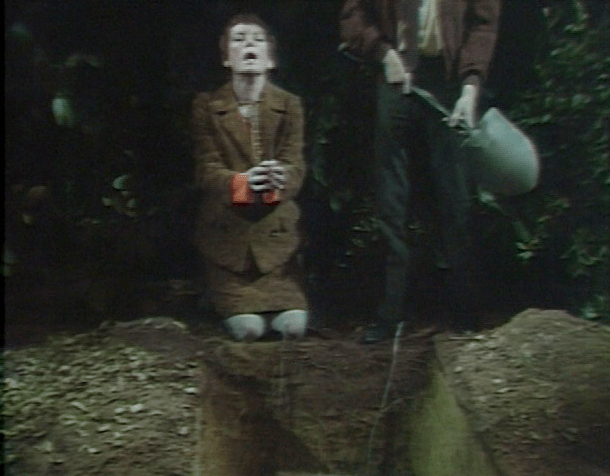
Once Willie has dug the grave and put Barnabas’ coffin in it, he and Julia decide to pray. She takes the lead, kneeling and throwing dirt, presumably including stones, onto the coffin. Dark Shadows avoided the topic of religion almost completely until repressed spinster Abigail Collins made her first appearance in #367; she and the Rev’d Mr Trask, introduced in #385, presented a wildly unfair, highly entertaining lampoon of eighteenth century New England Congregationalism. Recently the show has been lurching towards a vaguely friendly attitude towards Christianity. If Julia keeps strewing stones onto the grave once it is filled in, we might think that this friendliness extends to Judaism as well.
Meanwhile, a very tall man named Adam is having a bad time. Adam is a Frankenstein’s monster, and when he was created he drew the effect of the vampire curse from Barnabas. He does not feel the effects of that curse, but he does suffer pain when Barnabas is injured. When heiress Carolyn calls on Adam at the old shack in the woods where he is hiding, she finds that his neck hurts where Barnabas was bitten. When Julia declares Barnabas dead, we cut back to the shack, where Adam has stopped moving. Occult expert Timothy Eliot Stokes has joined Carolyn; he feels Adam’s wrist, and in a bit of Collinsport English that is becoming increasingly prominent on the show says that he can find no “pulsebeat.”
Barnabas was bricked up in a wall from #512 to #516, and Adam felt his pain during that period. So it is no surprise to returning viewers that Adam suffers along with Barnabas now. We also have heard countless repetitions of something neither Julia nor Willie has ever heard, an audiotape in which Eric Lang, the mad scientist who created Adam, explains that as long as Adam lives Barnabas will be free of vampirism. So we doubt that Barnabas’ curse will return, and hope that Adam’s suffering will be the clue that leads Julia and Willie to rescue Barnabas from being buried alive. Since Julia and Willie have no idea where Adam is and Adam hates them both, it’s as difficult to see how they could find out what he’s going through as it is to see how Barnabas could get out of the grave any other way. In that difficulty is the suspense with which the episode ends.