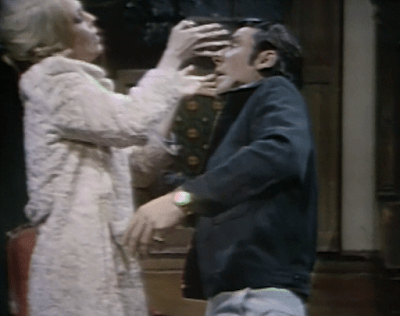
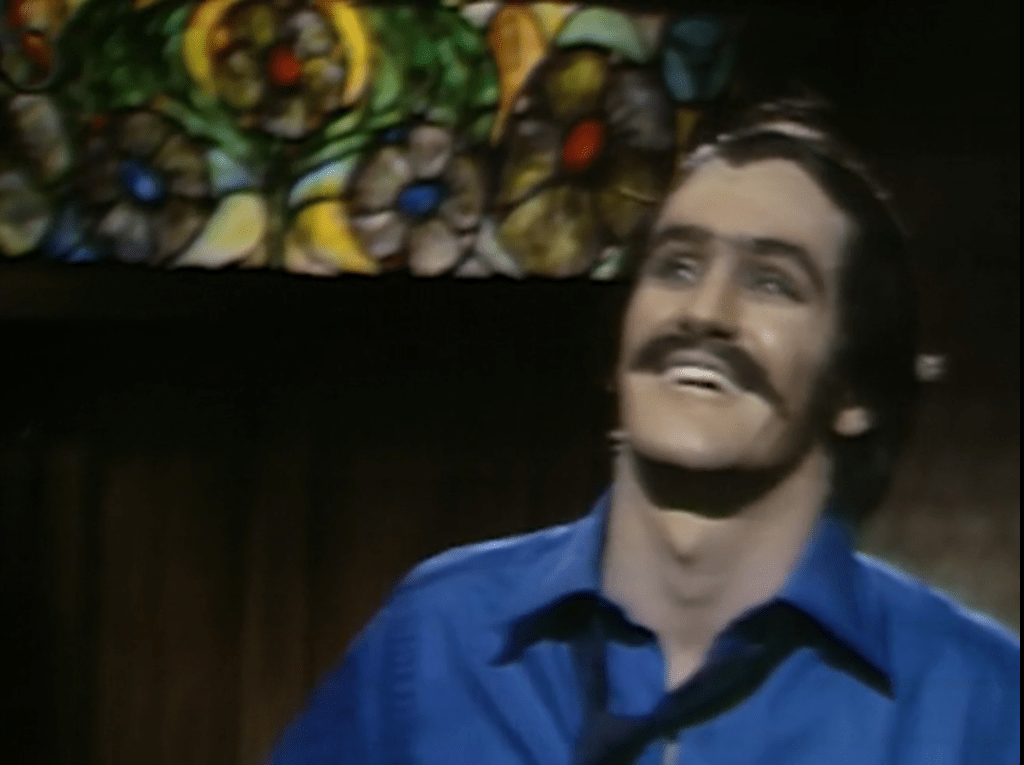
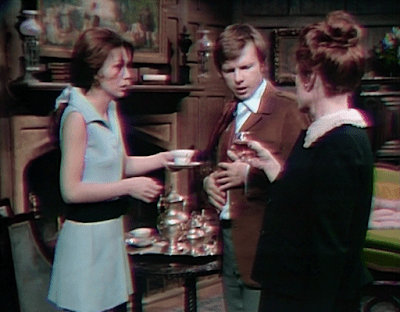
Mad scientist Cyrus Longworth developed a potion that changed his appearance so drastically that even people who knew him well cannot recognize him when he is under its influence. He used this disguise to carry out beatings, rapes, and murders. Now, he has spontaneously transformed in front of his fiancée, Sabrina Stuart. Cyrus had fooled Sabrina into thinking that his disguise was a separate person named “John Yaeger.” Sabrina had reason to hate Yaeger and fear him. She was shocked to learn that Yaeger and Cyrus were one and the same, and Cyrus ridiculed her for her continued attachment to him. Nonetheless, Sabrina pledged to support Cyrus come what may, and she does keep his secret today. Even after he threatens her with the sword in his cane, a threat which seems all too real since Christopher Pennock holds the prop too close to Lisa Blake Richards’ face when he pops the sharp blade out, she still stands by her man.
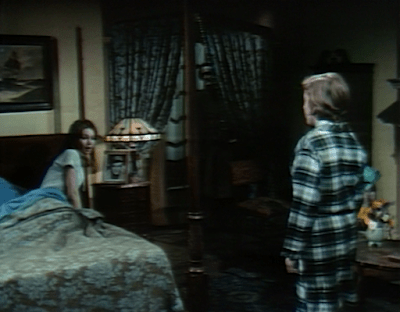
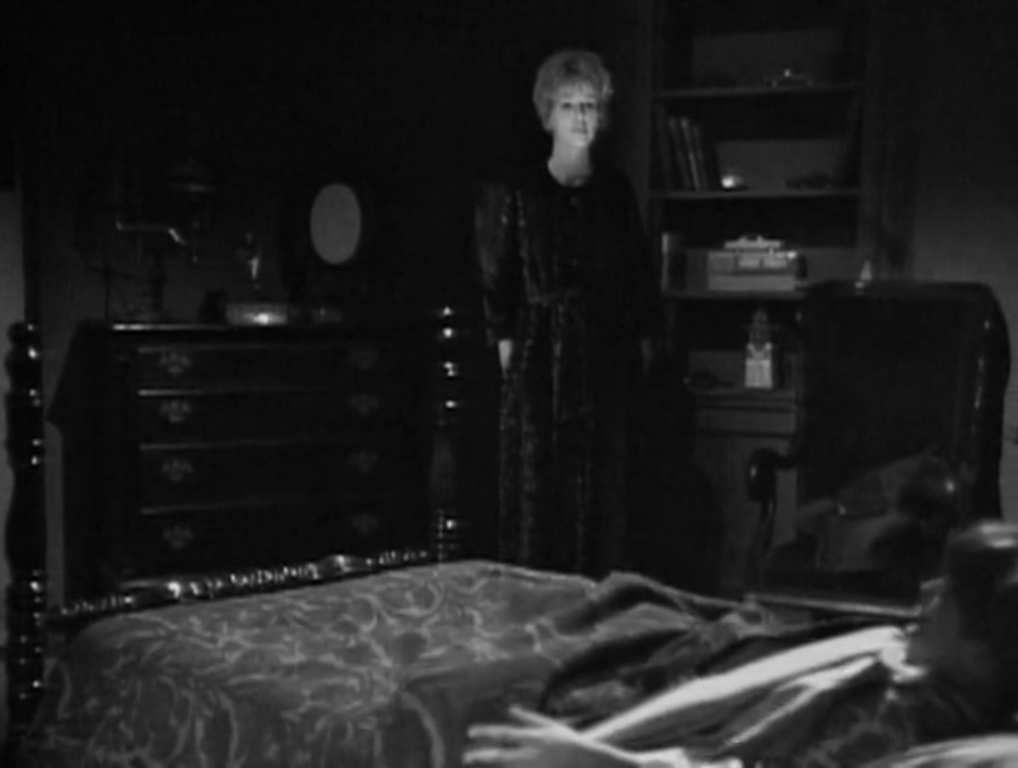
Cyrus has slipped into the great house of Collinwood and entered the master bedroom. He is watching the lady of the house, Maggie Evans Collins, while she sleeps. Cyrus tried to rape Maggie in a dark alley last week, and apparently he has decided to finish the job while she is in her own bed. At the last moment, Maggie’s stepson, strange and troubled teen Daniel Collins, enters. Cyrus hides behind the curtains while Daniel asks for his father.
Cyrus has ot chosen a particularly good hiding place. The light is on him, and he is directly in Daniel’s line of sight. It is preposterous enough that an armed intruder as physically prepossessing and as unscrupulous as Cyrus would hide from Maggie and Daniel, and this slip emphasizes that Cyrus, however much he may revel in the harm he has done as when in his disguise, is basically a coward.
Hey Daniel, notice that very tall man peeking out from behind the curtains directly in front of you? Screenshot by Dark Shadows Before I Die.
Daniel has been bitterly hostile to Maggie up to this point. Today they are suddenly great friends. He says sadly that he sometimes gets a premonition when something evil is about to happen in the house, and that he has such a premonition now. She talks to him affectionately, so softly that we can’t tell whether she is calling him “Daniel” or “Dan,” and touches his hair. Regular viewers have seen these two actors play friends in the first 196 weeks of Dark Shadows, when the action took place in a different universe and they were various other characters. It’s good to see them pick up where they left off, and exciting to think of what they might be able to do to breathe more life into Maggie’s stories. Alas, this is the last time we will see Daniel.
Later, Cyrus meets with someone we’ve never seen before. The closing credits will identify this man as Aldon Wicks. Cyrus says he wants to buy an old farmhouse from Wicks. He is particularly interested in a room in the basement, which he wants to outfit with an extra-heavy door. Wicks puts the door Cyrus wants on the room. When the time comes to pay up, Cyrus asks Wicks a bunch of questions, the answers to which all imply that no one knows where he is or will miss him if he disappears. So Cyrus stabs him to death with his cane. That’s certainly one way to cut costs on a real estate transaction.
The opening voiceover is delivered by associate director Ken McEwen. In the first 54 weeks of Dark Shadows, every voiceover was delivered by Alexandra Moltke Isles in character as well-meaning governess Victoria Winters, whether Vicki was in the episode or not. Between them and today, the narrator has always been an actor who appears in the episode. McEwen was drafted to appear in a few episodes as lawyer Larry Chase when Don Briscoe’s health problems caught up to him and forced him to leave the cast. Maybe they gave McEwen a contract to appear in three episodes more than turned out to include parts for Larry, and that explains his voice responsibilities in this one, #1079, and #1082.
A third pair of videotape editors are credited today, Carl Pollack and Fred Labib, joining the teams of Indra Sadoo and Chuck Gardner and Dan Rosenson and Robert Steinback.
From the time he joined the cast of characters in April 1967, vampire Barnabas Collins has been the most famous thing about Dark Shadows. We haven’t seen him in over a month. He passed through a cosmic rift in #980, leaving his native universe behind and arriving in another “time-band” populated largely by counterparts of people he knew. In the original continuity, Barnabas was freed from his coffin when dangerously unstable ruffian Willie Loomis unchained it, believing he would extract from it a treasure in jewels that would make him rich. Here, Barnabas is trapped in his coffin when Willie’s counterpart, author William H. Loomis, chains it, believing he will extract a story from Barnabas that will make him rich.
We haven’t seen any of Will Loomis’ oral history sessions with Barnabas, since John Karlen and Jonathan Frid have both been in Tarrytown, New York. Along with many other key members of the cast, they have been filming their parts in the feature House of Dark Shadows. That production is nearing a wrap, and several other cast members have already come back. Today’s story is all about Barnabas’ impending return.
When Barnabas found himself in “Parallel Time,” the first person he met was Will’s wife, the counterpart of Barnabas’ distant cousin Carolyn Collins Stoddard. He told Carolyn that he was a descendant of the eighteenth century Barnabas Collins, of whom a portrait hangs in the foyer of the great house of Collinwood. In his own universe, that portrait does hang there, and it has been Barnabas’ letter of introduction to the Collinses more than once. But Carolyn told him there was no such portrait there or, so far as she knows, anywhere else. So he bit her and made her his blood thrall.
Indeed, the other day we saw the spot on the wall where Barnabas’ portrait hangs in the main continuity, and it was not there. Instead, there was a metallic decoration reminiscent of a coat of arms. That decoration hung there before Barnabas’ portrait first appeared in #204. So few of the people watching at this point in 1970 had been in the audience in early 1967, and so few of those would have made note of what was hanging on the walls, that I can’t imagine one viewer in ten thousand would have caught the reference during the first broadcast. None of the writers currently with the show was on staff then, nor was line producer Peter Miner. It’s one of those moments when I suspect director Lela Swift and art director Sy Tomashoff were decorating the set for their own amusement.
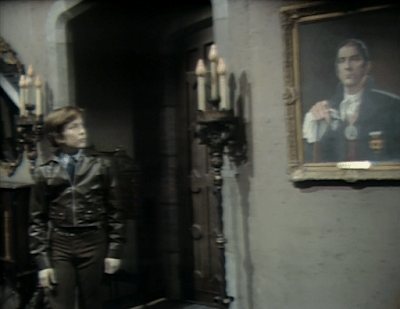
Today, a portrait of Barnabas has taken the place of the coat of arms. Children Daniel and Amy Collins found it in the attic of Will and Carolyn’s house, and for some reason housekeeper Julia Hoffman and butler Mr Trask decided to hang it up by the front door. It is a copy of the one we have seen over the last three years. It depicts Barnabas’ counterpart in this universe, a man who lived a quiet life and died a natural death in 1830.
The master of Collinwood, drunken sourpuss Quentin Collins, is shocked to see the portrait, and orders it to be removed immediately. Daniel’s counterpart, strange and troubled boy David Collins, had been the first to speak Barnabas’ name when he called Willie’s attention to the portrait in #205. Shortly after, Willie heard a heartbeat coming from the portrait, which led him to make his fateful trip to open the coffin. In this continuity, it is Daniel who hears the heartbeat, and he will today try to find and open the coffin.
Quentin has caught two glimpses of the other universe in the room in the east wing that was his late wife Angelique’s bedroom. Unknown to Quentin, Angelique has returned from the dead and murdered her identical twin sister Alexis. Quentin thinks that it is Alexis who is his guest in the great house, staying in her sister’s old room. When he tells her today what he saw, “Alexis” thinks he is losing his mind. But she then sees the phenomenon herself. She sees Hoffman’s counterpart calling for Barnabas, as Quentin had seen her talking about Barnabas’ “terrible curse.” “Alexis” and Quentin decide that they and Hoffman should have a séance to contact the spirit of the Barnabas Collins who died in their universe in 1830, the only Barnabas Collins they know of.
In the main continuity, séances are a frequent occurrence; we have seen fourteen of them there, and heard a detailed account of a fifteenth. In the early days, there was always one participant who tried to break the circle, only to be sternly reproved by the leader. The characters stopped doing that as they got to be familiar with the procedure, but séances are rarer in this universe. As things start to get interesting, Hoffman can’t take it anymore. She breaks the circle and runs out. “Alexis” says that the presence she felt is gone. But then a ghost materializes in the corner of the room.
There are a number of buildings on the estate of Collinwood. There is the Old House, a big mansion where the Collinses lived until the 1790s, and the great house, an even bigger mansion where they have lived since. These days, the Old House is home to hard-drinking writer William H. Loomis and his wife, the former Carolyn Collins Stoddard. Sometimes the place is called “Loomis House” in recognition of its inhabitants. We learn today that the Loomises have a servant. His name is Wilfred Block, but everyone knows him as Fred.
Fred hears some noise coming from the attic. He goes up there and finds two kids who belong at the great house. They are Amy Collins and her cousin, Daniel Collins. Amy is out cold, and Fred asks Daniel what he did to her. Daniel claims to be innocent. He says that Amy just looked at a portrait and fainted. That’s the sort of thing the Collinses do all the time, so Fred accepts it. He carries Amy back to the great house. Daniel follows.
There, Daniel tells his father, Quentin Collins, the same story he told Fred. Fred tells Quentin that he couldn’t get any answers out of Amy. She just kept repeating the words “chained” and “trapped.” Quentin thanks Fred.
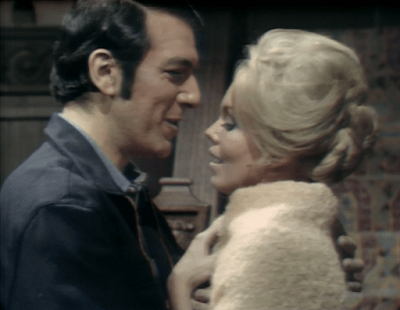
On his way out, Fred sees a woman whom he greets as “Miss Alexis.” He tells Alexis that he misses her visits to the Loomis House. She walks up very close to him and says she is feeling cold. He says he knows what to do about that, and hugs her. She holds the embrace for quite a while. He says he’s wanted to do that ever since he first saw her. She tells him to kiss her. Before he can comply, they hear Quentin coming. They separate and look nonchalant. Quentin is surprised Fred is still there. Fred hastens out.
Later, Alexis’ aunt, Hannah Stokes, would go to Fred at the Loomis House and ask him to come to her place, telling him Alexis wanted to see him there. That scene took place out of our view. The next time we do see Fred, Hannah is leading him into her parlor. Fred tells Alexis that he’d been planning to see her at Collinwood, but she says it is better at Hannah’s. Hannah leaves them alone together. They embrace, and Fred kisses Alexis. He feels cold. She tells him he will go on feeling cold, but bids him embrace her again. He does. He collapses.
Hannah was close to one of her nieces, Quentin’s late wife Angelique Stokes Collins. But she never got along with Angelique’s identical twin sister Alexis. Angelique had shared Hannah’s interest in the occult, and had been her pupil in that area, while Alexis scorned such matters. Alexis came to stay at Collinwood four and a half weeks ago, and spoke to Hannah only once during that time, when Hannah invited herself to the great house. That was a tense meeting which ended with Alexis all but ordering Hannah to go.
Hannah is taken aback today when she answers her door. She sees Alexis. She makes sarcastic remarks about Alexis, which do not deter her visitor from entering. The visitor asks Hannah to tell her fortune. Hannah resists, but the visitor keeps telling her it is something she wants very much. Hannah starts laying out the Tarot, but the first two cards disturb her so deeply she stops and cannot be persuaded to resume. She tells her visitor that they mean that she has no future. The visitor responds with a placid look and an insistence that Hannah read her palm. Hannah does not want to see the same message there, but the visitor will not be denied. When she looks at her palm, Hannah has a realization. “You are not Alexis! You are Angelique!”
Hannah is horrified that Angelique has returned from the dead. She does not want to know how it was done. Angelique seems eager to tell her everything; if Hannah were willing to listen, she might even volunteer that she murdered Alexis by draining the warmth from her body to heat her own undead frame. Angelique asks Hannah to bring her up to date on some things that happened while Alexis was at Collinwood and she was in the tomb. She then explains that her own death was also a murder, and that she wants to avenge it, though she does not yet know who the murderer was. She also has plans for Quentin, though she does not make it clear at this time what those are. She tells Hannah to bring Fred to her so that she can drain the warmth from him. Hannah protests, but Angelique tells her she has no choice. If she does not deliver Fred to her, she will haunt Hannah as long as Hannah lives.
After Fred collapses, Angelique calls her aunt back to the parlor. She tells her that she is all right now. Hannah finds that Fred is dead. Angelique agrees that he is, and repeats that she is warm again. She goes on: “That’s the way it must be now. This is the way I will live now. And when Quentin comes to join me, he will live this way, too. For eternity.” Evidently she is now a vampire, only instead of blood she drains heat from her victims. Also, she will be killing someone every 24 hours. Collinsport has been established as a very small town, so if she and Quentin are both going to be keeping up that pace it’s hard to see how it can last even for a year, let alone for eternity.
Quentin Collins
Quentin does not suspect that Angelique has risen from the dead, killed her sister, and taken her place. He has problems of his own. At the beginning of today’s episode, he is standing at the door to Angelique’s old bedroom in the east wing of Collinwood, where Alexis stayed during her visit and which Angelique now occupies again under Alexis’ name. He is looking into the room, but does not see it. Instead, he sees an entirely different space. Unlike Angelique’s richly decorated room, it is bare and dark.
Quentin sees two children in the room. They look and sound exactly like Daniel and Amy, though they are wearing clothing he does not recognize. He calls the names Daniel and Amy, but even though they are just a few feet away from him they do not seem to hear him or to be aware of his presence. An invisible barrier of some kind keeps him from entering the room.
Though the children cannot hear Quentin, he can hear what they are saying. The boy says that according to his father, “Dr Hoffman” said that “Barnabas got caught” in the room. The girl is alarmed and says that she does not want to get caught. She does not want to be in the room at all, but would rather be asleep in bed.
Quentin keeps calling the names Daniel and Amy. After a moment, he hears Daniel’s voice coming from somewhere other than the room. He turns, and sees Daniel and Amy standing behind him in the hallway. They don’t know what he is talking about when he asks them if they have been in the room, and he doesn’t know how to explain what he saw.
The Hoffman likeliest to come to Quentin’s mind is Julia Hoffman, Angelique’s fanatically devoted servant, who is the housekeeper at the great house of Collinwood and is certainly not a doctor. The only Barnabas he can think of is Barnabas Collins, an ancestor who died in 1830 and who was the subject of a biography Will Loomis wrote five years ago. Amy has told him that Will has started another book about that Barnabas. Quentin read Will’s original book, and was puzzled as to what could possibly be left to be said about its subject. So the conversation he has overheard makes no more sense to him than does the setting in which it took place.
Quentin shoos the children away and goes into the room. It is furnished as it always is. Angelique, whom he believes to be Alexis, is lounging in the middle of it. He tries to explain the phenomenon to her, and she does not take him at all seriously. He tells her enough that she should know that if it was an hallucination, it was a remarkably involved one, the sort that occurs only to people with grave mental illnesses. Even so, she could not be less interested in it. She wants to know what Quentin is doing to investigate her murder. He says that he doesn’t believe Angelique was murdered, to which she replies that he is a fool. This conversation does not have an obvious track forward, and Quentin quickly excuses himself.
Barnabas Collins
Barnabas Collins went to the island of Martinique in the 1790s on a business trip for his father’s shipping concern. While there, he met two lovely young women. One was Josette DuPrés, daughter of the richest sugar planter on the island. He was captivated by Josette, but did not believe she could love him. Josette’s aunt, the exiled Countess DuPrés, had brought a lady’s maid with her when she escaped from the French Revolution. This maid, named Angelique, was quite as beautiful as Josette, and made it clear that she was available to Barnabas. He consoled the sadness that he felt when he supposed Josette to be unreachable in a light-hearted love affair with Angelique. When it turned out that Josette was not unreachable at all, he forgot about Angelique and turned to her. Soon, he and Josette were engaged to be married.
When Josette and her father came to Collinwood for the wedding in 1795, the countess and Angelique came along. Angelique was sure that Barnabas was marrying Josette only to conceal his true intention, which was to keep her as his real partner. When she discovered that this was not the case, Angelique vowed to do something about it. She had learned black magic, and was ready to wreak a terrible vengeance.
Angelique managed to end Barnabas’ engagement to Josette, and had caused many disasters by the time Barnabas agreed to marry her. Before long, he discovered that she was a witch. He made several farcically inept attempts to kill her. When he shot her with a gun, she thought he had succeeded. As she lay bleeding, Angelique cursed Barnabas to become a vampire. It turned out her wounds were only superficial, but the curse was not. Barnabas was eventually trapped and chained in his coffin until 1967, when he was accidentally freed once more to prey upon the living.
That Barnabas Collins was not the one Will wrote his 1965 book about, and that Angelique is not the one who has returned from her coffin to stay in Quentin’s house. They were residents of a parallel universe. It was in their universe that the first 196 weeks of Dark Shadows took place. There, the east wing of Collinwood has long been vacant and disused. Barnabas happened to be there when the bare dark room Quentin sees today was replaced by Angelique’s room from this universe. He and several other residents of the original continuity saw the phenomenon a number of times over the next few days.
Barnabas became preoccupied with the forlorn hope that if he could enter the other “time-band,” he might be freed of the vampire curse and become human again. His closest friend, mad scientist Julia Hoffman, MD, tried to dissuade him from this plan, but he was nothing daunted. Barnabas finally did manage to find a way through the barrier.
Once in “Parallel Time,” Barnabas’ hopes were instantly disappointed. He was still a vampire. The first person he met was Carolyn Stoddard Loomis. He bit her and made her his thrall. Will found out about this very shortly after, and trapped Barnabas in a chained coffin. He is using him as a source of material for a new book.
The children Quentin saw talking about Barnabas were not Daniel and Amy Collins, but David Collins and Amy Jennings from the main continuity. They don’t know that Barnabas is a vampire; so far as they are concerned, he is their kindly cousin from England, an old world gentleman with some eccentric habits.
Amy Collins
Amy had stayed with the Loomises for a few days recently when there was some trouble in the great house. She took Daniel to their attic because she wanted him to join her in her favorite pastime while she was there, going through the trunks. Daniel declares that only girls would be interested in an activity like that. Amy doesn’t refute his claim when she says that the trunks have all sorts of interesting old stuff in them, such as dolls.
Daniel asks Amy about the basement of the Loomis House. She tells him that Will has the only key, and that he refuses to let even Carolyn go down there. We know that the basement is where Will keeps Barnabas’ coffin. Daniel says that there is a tunnel that leads from the beach right into the basement, and that he likes to play there. He says that it has been sealed up lately, but suggests Amy come with him to unseal it and explore. She says “Not at night,” and turns away. He calls her a scared-y-cat. Longtime viewers know that the same tunnel exists in the main continuity and that it has been a hugely important part of the story more than once, and will wonder if they can again match the excitement associated with it in those past episodes.
Amy tells Daniel that there is a sword somewhere in the attic, a real one. This does not exactly thrill Daniel, but at least he asks if it is a saber or a fencing foil, which is more than he had to offer in response to the prospect of digging up some antique dolls. He goes to look for the sword behind some paintings. When he turns up the portrait of Barnabas Collins, he hears a heartbeat. Longtime viewers will remember that characters have several times heard a heartbeat when looking at the portrait of Barnabas in the main continuity, and that this means that Barnabas is going to be on the show before much longer. Amy can’t hear the heartbeat, but she does have a strong reaction. It is at this point that she faints and the ill-fated Fred enters.
Regular viewers know that Amy’s muttering of the words “chained” and “trapped” mean that she has a mystical perception of Barnabas’ situation. But Quentin doesn’t have the slightest idea what to make of it. Amy comes to in the drawing room and tells Quentin that when she saw the eyes in the portrait of Barnabas, she realized he needed help. Quentin says that Barnabas has been dead for a very long time.* Amy says she knows, and leaves it at that.
Ben Stokes
In the 1790s, the Barnabas of the main continuity befriended much-put-upon indentured servant Ben Stokes. Barnabas’ father, haughty overlord Joshua Collins, made Ben’s life miserable. Barnabas took pity on Ben, teaching him to read and write and standing up for him when he was wrongly accused of misconduct. In return, Ben gave Barnabas his absolute loyalty.
When Angelique came to Collinwood in 1795 and hatched her evil schemes, she decided she needed a henchman. She chose Ben. She pretended to find Ben attractive. He matter-of-factly walked up to her and took hold of her, as if women who look like movie stars come on to indentured servants every day. She soon used his excitement to cast her spell on him. He found himself helping Angelique to do great harm to Barnabas and everyone he cared about, grieving him very deeply.
Eventually, Ben broke free of Angelique. He went on to be freed from his indenture and to have children. One of his descendants is Professor Timothy Eliot Stokes, an expert on the occult and a frequent ally of Barnabas and Dr Hoffman.
Fred’s response to Angelique today reminds us of Ben so long ago. Once Ben gathered that Angelique was propositioning him, he didn’t see any need to talk at all. They both had work to get back to, so he was ready to get down to business straightaway. But Fred keeps telling Angelique how beautiful she is and how he always hoped something would develop between them. His dialogue and Edmund Hashim’s delivery of it are as realistic and unadorned as Angelique’s lines and Lara Parker’s style are florid and over the top. The contrast is deliberate, as the contrast between the monosyllabic working-class “Fred” and the ornate and ethereal “Angelique” is deliberate. Just as Ben did not know what kind of world he had stumbled into when he reached for the original Angelique, Fred has no idea that he lives in a place where beings such as this Angelique can exist.
When Barnabas first came to this universe, Carolyn Loomis told him that Angelique and Alexis were the daughters of “Tim Stokes,” the counterpart of his old acquaintance Timothy Eliot Stokes. We have yet to see Tim Stokes, but we can be sure he will played by Thayer David. We know what Thayer David looks like. Alexandra Moltke Isles, who was in 333 episodes as well-meaning governess Victoria Winters, dated critic John Simon in the 1970s. Simon was a college classmate of Thayer David, and told her that in their day David was “the handsomest man at Harvard.” When I mention that to my wife, Mrs Acilius, she says that those must have been rough days for Harvard. David may have been better looking before he put on weight, but he never bore anything that could be mistaken for a family resemblance to the dazzling Lara Parker.
Longtime viewers, thinking back to what we saw when the show was set in 1795, might have an idea. Will’s book proves that the timelines diverged in the 1790s, when the Barnabas of the current timeline left Angelique alone and had a happy marriage with Josette. Perhaps in that continuity Ben really did pair off with Angelique. If so, Angelique and Alexis might be their descendants. They were lucky to inherit all of the genes governing their appearance from her.
The thought of the counterparts of Ben and Angelique as the forebears of the Stokes family in the current continuity might shed some light on its members. We’ve heard not only that Hannah and Alexis had no use for each other, but that Alexis and her father have not spoken for a long time. Like Hannah, Tim shared Angelique’s interest in the occult and doted on Angelique, while scorning Alexis. The new Angelique certainly qualifies as the Evil Twin, and is very much a continuation of the Angelique we already know from the main continuity. From what we know about them, Hannah and Tim seem to be the sort of people Angelique would naturally turn to for help in her deadly doings.
As for Alexis, she seems to have set her cap for Quentin, and succeeded in driving Quentin’s current wife Maggie out of Collinwood when she caught Alexis and Quentin in rather a compromising position. Alexis kept saying it would be easier for the new Mrs Collins to come home if she were to leave, but she never did leave. On a conventional soap, Alexis would have the makings of a Vixen, but it takes more than husband-stealing to join the ranks of the villains on Dark Shadows. Alexis would seem to take more after Ben, who had been indentured because he was a thief and was bewitched by Angelique because he disregarded sexual morality. She may have those sorts of flaws, but compared to the evils around her they seem like minor foibles indeed.
Edmund Hashim
Fred is played by character actor Edmund Hashim, making his only appearance on Dark Shadows. Hashim does a fine job. Fred had to be played with strict naturalism, so that the only resource Hashim could draw on to hold anyone’s attention against the flamboyant Parker was skilled and truthful acting. He pulls it off. It’s a shame we won’t see him again. He died in 1974 at the age of 41, one of the first cast members to pass away. The only ones who predeceased him were Fred Stewart (1970, aged 64,) House Jameson (1971, aged 68) George Mitchell (1972, aged 66) and Patrick McVey (1973, aged 63.)
*In fact, he says that Barnabas has been dead for “over 200 years.” It’s 1970, as the wardrobe makes unmistakably clear, and they have explicitly said that the Barnabas Quentin has heard of died in 1830. So he’s bad at math.
Medical researcher Cyrus Longworth has invented a potion which, when he drinks it, darkens his hair, causes him to grow more of it, and adds to his muscle mass. When he is in this state, Cyrus calls himself “John Yaeger.” Yaeger serves Cyrus as a very effective disguise. The other day, he ran into his old friend Quentin Collins while he was presenting himself as Yaeger. Quentin did not suspect that the man he was talking to was Cyrus.
Cyrus uses Yaeger to escape responsibility for violent crimes. He has started a couple of bar fights in the Eagle tavern. Barmaid Buffie Harrington has drawn Cyrus’ special attention; he hit her, twisted her arm, choked her, and threatened worse when he was alone in the tavern with her, and he has since taken an apartment in her boarding house. Cyrus has also beaten Buffie’s sometime boyfriend Steve so severely that he put him in the hospital. Cyrus was choking Steve when he heard a police whistle and ran away. It looked like he would probably have murdered him if the police had been a minute later. When Buffie saw Cyrus in his undisguised form and told him of the cruelty she and Steve had suffered at Yaeger’s hands, Cyrus barely bothered to conceal his pleasure. When Buffie asked Cyrus if Yaeger worked for him, Cyrus was delighted to say that he did.
We open in the drawing room of the great house of Collinwood, where Cyrus is waiting for Quentin. All of a sudden Cyrus starts to transform into Yaeger. This is the first time the transformation has taken place spontaneously, without a fresh dose of the potion. Cyrus leaves a note, then jumps out the window and runs away.
In his laboratory, Cyrus is about to drink the antidote to restore his usual appearance. He decides he would rather have some more fun as Yaeger first and puts the antidote back. His fiancée and lab assistant Sabrina Stuart comes downstairs. She has not seen Cyrus as Yaeger before, and is completely fooled by the disguise. She has heard the name John Yaeger in connection with recent strange behavior on Cyrus’ part, and is stern with him. Regular viewers know how brutal Cyrus is with Buffie, and we fear that he will mete the same treatment out to Sabrina. But he does not do so, not this time. He insists that Cyrus wants him to wait in the laboratory, and Sabrina leaves him alone there. After Sabrina exits, he takes a painting from the wall and goes.
Cyrus takes the painting to the apartment he has rented in the name of Yaeger. Buffie comes to him there. He harries her about her visit to him when he looked like his usual self and she knew him as Cyrus. He says she told Cyrus she likes a quiet man. He walks up to her, talking all the while about how quiet he can be. He gets quieter and quieter until he brings his hand across her face with full force. The next we see, she is bruised and cut, her clothing badly torn. Christopher Pennock and Elizabeth Eis play these moments very well. They are really hard to watch.
Cyrus gives Buffie the painting from his laboratory. He asks her if she wants him to take her someplace nice, with good food and a sophisticated atmosphere. She perks up and is enthusiastic. He then points out that she is covered in bruises and abrasions and wearing damaged clothing. He ridicules the idea that she could be seen anywhere looking like that, and taunts her with imprecations to take better care of herself. She leaves, hanging her head and carrying the painting. Cyrus laughs, relishing the misery he has inflicted on Buffie.
Cyrus rejoices to have battered and humiliated Buffie.
As Cyrus, whether he has red hair, a white coat, and a diffident manner, or black hair, a mustache, and a sadistic swagger, Pennock has a relatively straightforward job to do. He is to embody a total rat bastard, one who pretends to be nice when he might be held accountable for his actions and who exults in hurting people when he thinks he can get away with it.
Eis has a trickier assignment. When we first saw Buffie, she was cheerfully fending off Steve’s clumsy advances. Even after she had seen Cyrus, as Yaeger, outfight many strong men, she still stood up to him and spoke her mind. But now he has harmed her again and again, and she just keeps coming back for more. It would be depressing to see anyone fall into that pattern, but it strips us of all hope when we know the person to be so lively and dynamic. That’s the point, I think, and Eis doesn’t let us off the hook. Buffie still holds her head up, she still looks Cyrus in the face, she still speaks in a mature tone of voice when she protests against his abuse. But even so, whatever masochistic fascination is at work has such a grip on Buffie that she will not walk away from a situation that is already intolerably bad and can only get worse.
A Window Into This World From That
We are currently several weeks into a segment set in a different continuity than the one where Dark Shadows spent its first 196 weeks. Vampire Barnabas Collins brought us here. Barnabas discovered that a room in the long-disused east wing of the great house of Collinwood was the site of an inexplicable phenomenon. When he opened the doors to the room, he usually saw it as it was in his universe, a dark space with bare floors and undecorated walls. But once in a while, it appears to be brilliantly lit, fully furnished, and the setting of frequent meetings among people who look and sound just like his acquaintances, but who are living different lives. Through an invisible barrier, Barnabas could see and hear those people, but he could neither pass through the barrier nor attract the people’s notice.
Barnabas became obsessed with the forlorn hope that if he could pass into the other universe, he might be free of his curse and become a living man once more. Other characters from the main continuity joined him in watching their counterparts in the other world; few of these knew that Barnabas was a vampire, but all of them could see that the phenomenon had some obscure significance special to him, and were concerned that he was going to do something dangerous. In #980, Barnabas managed to make his way through the barrier, only to find that he was still a vampire. He bit the first person he met, and shortly after was chained in a coffin by her husband. He has been trapped there ever since.
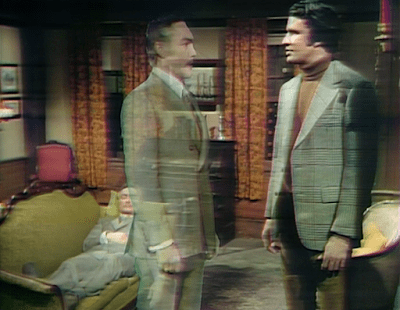
The room on which Barnabas and others in the main continuity had been spying in the days before he crossed over has been a major set in the “Parallel Time” segment, and every time we see it we wonder if those others are still watching. Today, we intercut with the original “time-band.” Quentin goes to the room, and finds the bare dark space it represents in the main continuity. He sees two children there, whom he takes to be his son Daniel Collins and Daniel’s cousin Amy Collins. The boy is telling the girl that “Dr Hoffman” told his father that Barnabas got caught in that room. The girl responds that she certainly does not want to get caught, and she wants to leave at once. Quentin calls Daniel and Amy’s names, and is puzzled that the children do not react. He hears Daniel’s voice coming from behind him. He turns and sees Daniel and Amy standing in the hallway, asking why he is calling their names.
This is the first indication we have had that the main continuity is ever visible from this one. We are left wondering if the traffic between the universes can go both ways, and if so whether this continuity and the original one will in some way merge together. Cyrus’ attack on Buffie and her response to it were so difficult to watch that, done as well as the scenes were done today, they left us reluctant to tune back in tomorrow. The story of Buffie’s degradation at Cyrus’ hands can only become more depressing as it goes. But this new information about how “Parallel Time” works suggests such a wide variety of possible next steps that it sets our imaginations into overdrive, and we can’t wait to see which way we will turn next.
In December 1966 and January 1967, strange and troubled boy David Collins was unwilling to believe that a woman who had come to the estate of Collinwood was his long-absent mother, Laura Murdoch Collins. He had troubling dreams about her. In #150, we saw him asleep in his bed when Laura appeared in the corner of his room. He opened his eyes and looked at her while she made a speech. This is not generally considered a dream sequence, since David appears to wake up at the beginning of it. But Laura turns out to be a humanoid Phoenix. The Phoenix is a creature first described in the Histories of Herodotus. As is typical in ancient Greek literature, all dreams in Herodotus take the form of a person materializing at the foot of the dreamer’s bed and delivering a speech while the dreamer appears to be awake. So I think we have to consider that the first dream sequence dramatized on Dark Shadows.
Laura appears in David’s room, #150.
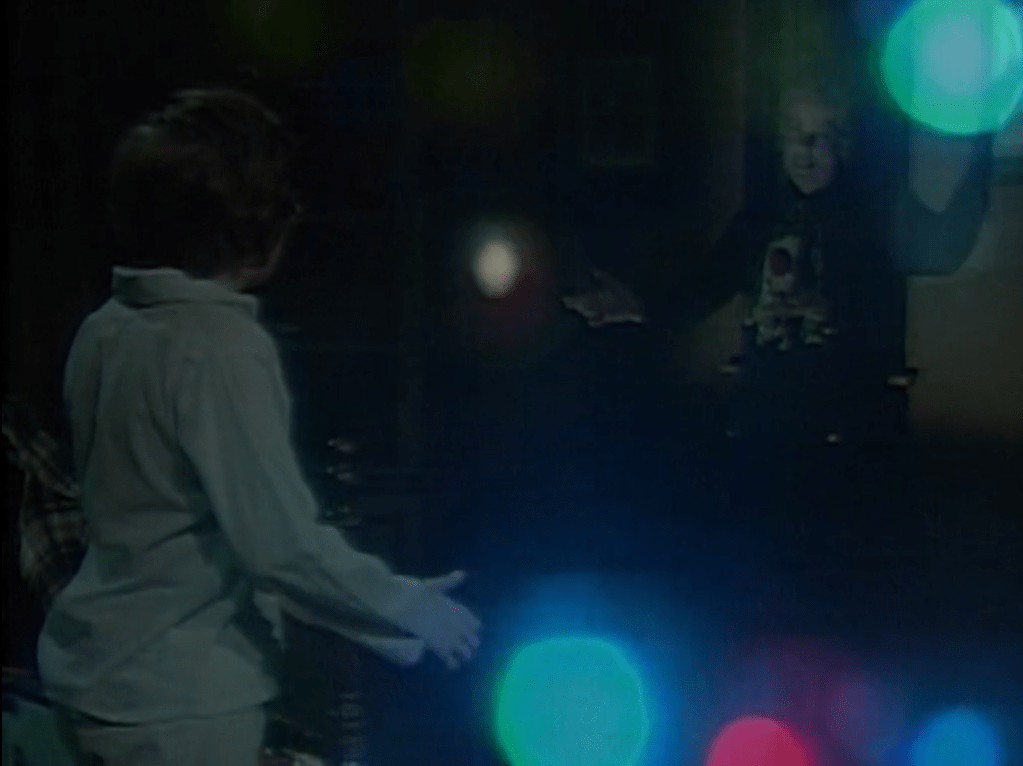
Now, we have crossed over into an alternate universe, which the show insists on calling “Parallel Time.” David’s counterpart is strange and troubled teenager Daniel Collins. Daniel is unwilling to believe that a woman who has come to the estate of Collinwood is not his late mother, Angelique Stokes Collins. We see him asleep in his bedroom. As Daniel’s problem is the mirror image of David’s, so his room is the mirror image of David’s. Daniel’s bed is at stage right while David’s is at stage left on the same set. Daniel has a troubling dream in which Angelique appears to him. Dark Shadows is a lot more definite now than it was in its first year, so they have a special effect to show that even though Daniel is opening his eyes and getting out of bed, it is still a dream sequence. It is 1970, so that special effect is a disco glitter ball throwing colored lights.
Daniel thrashes about in bed, and the visitor, who has been patiently trying to explain to everyone that she is Angelique’s identical twin sister Alexis, comes rushing in. Daniel awakes, and asks her to promise to tell him the truth. He in turn promises to keep her secret. He asks her if she is his mother. She is silent, apparently stunned by the question. At that moment, Daniel’s father Quentin appears in the doorway.
Laura turned out to be an undead blonde fire witch come to burn David alive that she might renew her own unnatural existence. Angelique’s counterpart in the main continuity is also an undead blonde fire witch, and for a time she was David’s stepmother and represented a considerable danger to him. So regular viewers will understand Daniel’s confusion.
There is a scene today in the tavern in the village of Collinsport. In the main continuity, this tavern was called the Eagle in the eighteenth and nineteenth centuries, but the Blue Whale in the twentieth. In this universe, it is still called the Eagle. The bartender in the Blue Whale is usually played by Bob O’Connell. The bartender in the Eagle today is played by Kenneth McMillan. McMillan was a very distinguished actor and does a fine job telling a long story, but Bob O’Connell is a favorite of longtime viewers and I think we are all disappointed we didn’t get another chance to see him.
When Dark Shadows premiered in June 1966, strange and troubled boy David Collins (David Henesy) was obsessed with his absent mother and determined to get rid of his new governess, the well-meaning Victoria Winters. In #15, David had tampered with his father Roger’s car. As he stood at the window and watched Roger drive down the narrow, twisting mountain road away from the great house of Collinwood, he said “He’s going to die, mother, he’s going to die!” When Roger survived and it was discovered that someone had removed the bleeder valve from his braking system, David planted the valve in Vicki’s room in an attempt to frame her for the murder attempt. Later, Roger would come to fear that Vicki was about to expose a dark secret of his own, and would encourage David to try to kill her.
David eventually gave up on homicide, and dropped his hostility to Vicki. One of the more benevolent influences on him was his best friend, the ghost of the gracious Josette. In #102, we saw David in the Old House on the grounds of Collinwood, carrying on a conversation with the portrait of Josette that hung above the mantel. We could not hear Josette’s side of the conversation, but it certainly sounded like David could. We already knew at that point that Josette was real- we saw her emanate from the portrait, walk out of the house, and dance among the columns outside it in #70, when David first took Vicki to the Old House. In #126, we would see and hear Josette when she led the ghosts of Collinwood in rescuing Vicki from crazed handyman Matthew Morgan. That rescue was not only a good deed for Vicki, but also a favor to David, who had stumbled upon Vicki in the secret room where Matthew had her tied up and, in a panic, left her to her fate.
In #153, we learned that David’s mother, the former Laura Murdoch, was the one who chose his name, one which no previous Collins had borne. Roger had wanted to call David “Charles Andrew,” in honor of some Collins ancestors. In #181, Vicki and her allies learned that two previous women given the name Laura Murdoch at birth had died by fire, one in 1867 and the other in 1767, each accompanied by her young son, and that each of those boys was named David. It would eventually become clear that Laura was an undead fire witch, a humanoid Phoenix who went into a pyre with her sons at intervals of exactly 100 years, gaining immortality for herself, though not for the Davids. In #288, they had forgotten the lore about David’s name, and mentioned a previous David Collins, but in #685 and #767, it was back to being a first in the family. Between those two episodes, from #729 to #760, another iteration of Laura was on the show, suggesting that the writers brushed up on their knowledge of her original storyline.
By the time Vicki saved David from Laura, he had moved out of the villain category altogether. When his third cousin Amy Jennings (Denise Nickerson) moved into Collinwood at the end of 1968, David was as pleasant to her as one could expect. But his behavior towards her and others changed when the two of them stirred up the ghost of Quentin Collins, Amy’s great-grandfather and David’s great-great-uncle. As Quentin gathered strength, he intermittently possessed first one child and then the other. While David was under Quentin’s control in #679, he twisted Amy’s arm to force her to go to a secret room and join in their vengeful ancestor’s evil plans for their governess, Vicki’s successor Maggie Evans (Kathryn Leigh Scott.) The camera lingered on that act of bullying, meant to shock us with evidence that Quentin’s dire influence had overwhelmed David’s kindly nature.
The arm-twisting incident made an impression on the viewers. In #813, set in the year 1897 when Quentin was alive, Henesy and Nickerson played brother and sister Jamison and Nora Collins, nephew and niece of Quentin, grandfather and great-aunt to David. Jamison, possessed by sorcerer Count Petofi, twisted Nora’s arm to force her to give him information, a reference which shows that the writers were confident that many viewers would see David Henesy’s character abusing Denise Nickerson’s in that way and read it as a sign that he is under the power of an outside force.
Now, it is 1970, but we are not in the main continuity at all. We have traveled to an alternate universe, which on Dark Shadows is known as “Parallel Time.” In this “time-band,” to use another bit of Collinsport English, Quentin is alive and the master of Collinwood. His first wife, the counterpart of wicked witch Angelique, has died, and he has remarried. The new Mrs Collins is the former Maggie Evans (Kathryn Leigh Scott.) Quentin and Angelique’s son, strange and troubled boy Daniel (David Henesy,) is obsessed with his absent mother and determined to get rid of his new stepmother.
Apparently the writers still remember the connection between David’s name and the first Phoenix story, because Daniel is the only character we have yet seen in Parallel Time answering to a different first name than his counterpart in the main continuity. Angelique and Quentin gave him the name of the Collins ancestor whom Mr Henesy played in early 1968, when the show was set in the year 1796. We know that the timelines diverged in that period, so it follows that it was the counterpart of the eighteenth and nineteenth century Daniel who was this Daniel’s namesake.
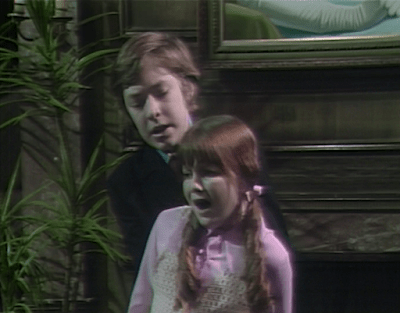
When we first saw Daniel, he was carrying on a one-sided conversation with his mother’s portrait, which hangs in her old bedroom. Today, he devises a plan to use the portrait to frighten Maggie. The plan requires the cooperation of his cousin, Amy Collins (Denise Nickerson.) When Amy refuses, he twists her arm until she agrees to go to a secret room and sing, making Maggie think the portrait is coming to life. This attack is shown only for a few seconds, and Amy’s arm is out of frame. They have already established that Daniel is cruel, and do not need to dwell on the act of abuse.
Daniel claims that his father often goes to Angelique’s room to meditate and talk to the portrait. That lures Maggie to the room, where Daniel is waiting. They have a confrontation. When she says she wishes she could “make him understand-,” he interrupts her and asks if what she wants him to understand is that his mother is dead and is never coming back. She looks at him and answers with a flat “Yes.” He tells her she is wrong, and pleads with the portrait to sing to him. Maggie says she can’t stand to see him like this, and turns to go. Before she gets out of the room, we hear a woman’s voice singing a lullaby. Maggie and Daniel hear it too. She turns around, shocked, and runs from the room. Daniel laughs that his plan worked so well.
Amy comes rushing into the room. Daniel congratulates her on her performance, and asks how she got in from the secret room so quickly. She explains that she never went to the secret room- her brother Chris intercepted her before she could do so. It wasn’t her voice Daniel and Maggie heard. He absorbs her message, and looks at the portrait in wonderment.
The audience could tell it wasn’t Denise Nickerson singing- she had such a high-pitched voice when she was twelve that she had to work hard to keep it in a range that would sound good on television, while the pre-recorded voice we heard singing was definitely that of a grown woman. Angelique was played by Lara Parker; Parker did some very distinctive things with her voice on Dark Shadows, none of which shows up in the lullaby, so I’m sure it wasn’t her. Several fansites attribute the singing to Joan Bennett, who is in this episode, but I’ve heard Bennett sing and she didn’t get from one note to another the way this voice does. I think the singer must be Kathryn Leigh Scott.
Early in the episode, Daniel and Amy had a scene in his bedroom. David’s bedroom was a frequent set in the first 38 weeks of the show, and was occasionally seen thereafter. Daniel’s room is the same set, with the same furnishings and decorations, but they are arranged in the opposite direction from the pattern we see in David’s. His bed is at stage right rather than stage left, and everything else is also transposed. Seeing this mirror image, regular viewers will appreciate this reminder that we are in a Mirror Universe.
In #210, dangerously unstable ruffian Willie Loomis found a coffin wrapped in chains in an old mausoleum and jumped to the conclusion that it was full of jewels. He broke the chains and opened the coffin, only to find that it actually contained vampire Barnabas Collins. Barnabas bit Willie and enslaved him.
Now, Barnabas has traveled to an alternate universe. In this “Parallel Time,” Willie’s counterpart is a writer, the author of several novels and of a biography of Barnabas’ own counterpart, who died a natural death in 1830. This Will Loomis lives in the Old House on the estate of Collinwood, which corresponds to Barnabas’ home in his own universe. Will’s wife, the former Carolyn Collins Stoddard, was the first person Barnabas met upon arriving in Parallel Time. Barnabas took Carolyn as his blood thrall, and he has shown her a room in the basement of the Old House that she never knew existed. He stashed a coffin there.
Three of Will’s novels were bestsellers made into feature films, but he and Carolyn are now acutely short of funds. We see why today. Carolyn explains to Barnabas that Will won’t be home until the Eagle closes. Barnabas asks what the Eagle is. He should know- that was the name of the tavern in his Collinsport in the 1790s and again in 1897, and he knew it in both eras. The same place was called the Blue Whale in the 1960s in the main continuity, but evidently it kept its old name here.
Will comes staggering home. He recognizes Barnabas’ profile from a sketch of the subject of the biography he wrote. Carolyn explains that Barnabas is that man’s descendant. When Barnabas says that he read Will’s book and admires it, Will brightens, as authors do, and says that the occasion calls for a drink. At first he insists on putting Barnabas up as a houseguest, free of charge, but Carolyn persuades him to let Barnabas pay rent. It’s anyone’s guess how Barnabas will be paying for anything- he stumbled into “Parallel Time” quite inadvertently, without stuffing his pockets or putting on a money belt or making any other preparations. But Will and Carolyn have an extensive discussion about charging Barnabas rent in this scene, and they bring it up again later. Evidently the writers want us to think about it.
The next day, Will suggests that he and Carolyn go to the great house on the estate to meet the new mistress, the bride of Carolyn’s uncle Quentin. Carolyn pleads a migraine, and Will goes by himself. Housekeeper Julia Hoffman is about to introduce him when he cuts her off. He tells the new Mrs Collins that he knew her father. She is the former Maggie Evans. The past tense about her father Sam is news to returning viewers- yesterday Sam was mentioned in terms that left it unclear whether he was still alive, and we might have hoped to see him. In the main continuity, Sam was killed by a Frankenstein’s monster in June 1968, but that monster would not have existed in this universe.
Will says that he and Sam spent many a night drinking together at the Eagle. The new Mrs Collins is not visibly pleased to be reminded of her father’s drinking habit. She offers Will a cup of tea, and he refuses. He avers that tannic acid is bad for the health. Hoffman is at hand with a glass of brandy, and she chuckles when she agrees with him that she can tell Maggie his views about beverages. Hoffman leaves, and Will urgently whispers to Maggie that he must not trust Hoffman.
Later, Maggie will go to Angelique’s old room in the east wing of the house and overhear Hoffman telling the portrait of Angelique that hangs there that she has her on the run. Hoffman cackles with glee at Maggie’s discomfort. Maggie opens the door and asks her what’s going on; Hoffman quickly composes herself and says that the staff hasn’t had a chance to tidy up the east wing sufficiently to welcome the new mistress.
Back in the Old House, Will wonders why Carolyn seems so weak. She passes out, and he sees the puncture wounds on her neck. At daybreak, Will waiting for Barnabas by the coffin. He holds him at bay with a large cross and forces him to explain who he is and where he came from. Barnabas tells Will to let him die. Will says he has other plans. He orders Barnabas to open the coffin. There is an even larger cross mounted inside the lid. He says that he will get a book out of Barnabas, and that that book will be his salvation. He makes Barnabas get in the coffin, and chains it shut. To the extent that this universe is a mirror image of the one we have known, we might have expected that Will would believe he could obtain a fortune by putting chains on the coffin, as Willie thought he could obtain one by smashing them off.
The scene between Will and Maggie brings out several of the problems with the current A story, a reworking of Daphne Du Maurier’s Rebecca in which Maggie is the second Mrs de Winter and Hoffman is Mrs Danvers. Maggie Prime has an iconography that goes back to #1, which makes it hard for us to believe that would be overwhelmed by the subtle intimidations that overwhelm Du Maurier’s anxiety-ridden heroine. When we met the Sam of the original continuity in June 1966, he was an alcoholic. Even after the story that was supposed to make Sam’s alcoholism interesting fizzled out and he was retconned as a social drinker, Maggie retained many Adult Child of an Alcoholic traits, such as beginning each utterance with an irrelevant laugh. So Maggie’s reaction to Will’s reminiscence about boozing it up with Parallel Sam goes a long way to confirming that this is the same ol’ Maggie we’ve known all along and leads us to expect her to be as capable as Maggie would be of meeting the challenges before her.
Also, while Kathryn Leigh Scott is a wonderful actress and a great asset to the show, she makes a bad choice in playing Maggie Collins. In the costume drama segment set in 1897, Miss Scott started out as neurotic intellectual Rachel Drummond. Rachel was terribly fragile, the survivor of an abusive childhood that left her with paralyzingly low self-esteem. Miss Scott went small as Rachel, taking a subtle approach that required us to watch her closely as we tried to figure out what she was feeling and thinking. But as Maggie Collins, Miss Scott cycles through five or six facial expressions per minute and crafts a distinctive emphasis on multiple syllables per sentence. The directors famously didn’t give the actors much guidance on Dark Shadows– John Karlen said that when he first took on the role of Willie, all Lela Swift told him was “Go!” But either Swift or today’s helmsman, Henry Kaplan, should have taken Miss Scott aside and told her she was overacting and giving Maggie Collins too vivid a personality.
Further, Will is only one of many allies who present themselves to Maggie in her showdown with the memory of Quentin’s first wife, the glamorous Angelique. The second Mrs de Winter feels herself all alone at the estate of Manderley, but Maggie can’t very well feel that way at Collinwood. Not only do people who live there keep making it clear they are on her side, she has a sister to whom she starts writing a letter today, who represents support from and connection with the outside world.
Worst of all, Hoffman is absolutely transparent. In the novel, it is not clear until the very end whether Mrs Danvers is even hostile to the second Mrs de Winter. Du Maurier keeps us guessing for 400 pages whether the whole thing is in the protagonist’s fevered imagination. But the cackling Maggie overhears when Hoffman is having her conversation with the portrait is not even the most flagrant sign she has so far given of her plans.
Suave warlock Nicholas Blair first joined the cast of characters in June 1968, posing as the brother of Cassandra, wife of Roger Collins. Since Cassandra was an alias that 200 year old wicked witch Angelique was using, we knew right away this could not be so. Nicholas asserted himself as Angelique’s boss, faced down the ghost of the fanatical Reverend Trask, and kept saying that he had a plan that was far more important than Angelique’s petty little scheme to establish herself in the great house of Collinwood and turn Roger’s distant cousin Barnabas Collins back into a vampire. As played by Humbert Allen Astredo, Nicholas kept us believing for weeks that we would be in awe once we heard his plan.
Eventually, Nicholas stumbled upon the fact that Barnabas’ best friend, mad scientist Julia Hoffman, had constructed a Frankenstein’s monster in the course of a project to keep his vampirism in remission. From that point on, Nicholas declared that his plan was to force Julia to make a female Frankenstein’s monster, to mate the already existing monster to her, and thereby to breed a new race of people loyal only to his master, Satan. He’d been on the show so long at that point that his sudden parachuting into the Frankenstein story only revealed that up to that point, all his talk about his grand design had been empty boasting.
Moreover, Nicholas’ plan for the patchwork people did not make sense in the context of the show. In a novel or movie like Rosemary’s Baby, the audience sees the heroine raped with the acquiescence of her husband, and our horror at that crime gives force to the premise that she will bear Satan’s only begotten son, who, in an inversion of the Christian story, will transform the whole world by the very fact of his birth. Stealing fresh corpses, chopping them up, and stitching them together isn’t the same horror as rape, but it is a pretty disgusting way to spend an evening, so I suppose that will get you off to some kind of start. But if your show is on the air for half an hour a day across the board Monday through Friday, your audience has time to sit with Nicholas’ scheme and think through all of the practicalities it implies. The new race is going to take many years to grow and multiply and overtake H. Sap., even if its members all have Soap Opera Rapid Aging Syndrome. What are we all supposed to do in the interim, watch the Frankenbabies through nanny cams? It isn’t an idea for series television.
Nicholas not only saddled himself with a plan that obviously wasn’t going to work, he didn’t deliver on his claim to be a surpassingly talented sorcerer. In #528, Angelique asked him to slip a potion to one of her adversaries. He complained that “I am much too talented to spend my time drugging drinks,” but he complied with the request. Not only did that turn out to be a waste of time, later he would on his own initiative drug a couple of other people’s drinks, again without the results he wanted.
Eventually, Nicholas fell in love with Maggie Evans, The Nicest Girl in Town. That amused Angelique, who taunted him with all the times when he had sneered at her for the humanity she showed in her emotional attachment to Barnabas. As Nicholas grew fonder of Maggie, his powers became less reliable, and his involvement with the main plot became more tenuous. No longer able to make Angelique obey him, Nicholas was reduced to using unsightly ex-convict Harry Johnson as his henchman. By the time the Frankenstein project collapsed and Satan called Nicholas back to Hell, not even Astredo’s considerable acting talent could make us take him seriously.
Nicholas returned in February 1970, just over five weeks ago. At that point the show was mainly concerned with an attempt the writers were making to take some material from the tales of H. P. Lovecraft and make a story out of them. The Leviathan People are Elder Gods who want to reconquer the Earth and destroy humankind. Their harbinger was a shape-shifting monster who had taken the form of a tall young man and invited people to call him Jabe. Jabe was supposed to join with Roger’s niece Carolyn to produce a new race of people.
The Lovecraft material never came together, and by the middle of February the makers of the show were scrambling to find a new direction. Nicholas appears to have been a last-minute replacement for a different sort of villain who was supposed to take over as the chief menace in the second half of the segment. Now they have thrown out that second half and are trying to get to something else before the ratings drop any further. So they brought back an already established character and plugged him into the scenes originally meant to be played by the one they never got around to introducing.
Bringing Nicholas in to the Leviathan arc makes it hard for longtime viewers to ignore the similarities between the Leviathans’ plan to breed a new race and his 1968 plan for the patchwork people, including the shared weakness that if either plan were successful, it wouldn’t leave you anything to put on a daytime soap. Also, Nicholas explicitly acknowledges that he has already failed in one such project, lampshading the problem but not alleviating it. He also keeps bringing up his “Master,” who is clearly still Satan. No other character in the Leviathan arc makes reference to any themes derived from Christianity- everyone else is living in the determinedly non-Christian world of Lovecraft’s imagination. So he seems out of place from the beginning.
The Leviathans’ plan was already nearing collapse when Nicholas showed up. Every time Jabe has used his powers, the results have backfired on him. His personality has alienated all of his allies. And now he doesn’t even want to be a shape-shifting monster anymore- he fell in love with Carolyn, and just wanted to take her on dates and then marry her. Nicholas is supposed to be the trouble-shooter who will turn this troubled operation around, but nothing about him inspires confidence that he is the right person for that job.
Since Nicholas arrived, things have gone downhill for the Leviathan cause even faster than they had been before. In #966, Nicholas watched in horror as Jabe smashed the box from which he originally emanated, causing all of the Leviathans’ other visible belongings to vanish. Nicholas then declared that everything was over, and that the time of the Leviathans was no more. But they still didn’t have another story ready to go, so he and Jabe have continued to hang around. Nicholas still has one follower, Angelique’s estranged husband Sky Rumson, but since there is no reason for Sky to be on the show either, that isn’t much of a basis for Nicholas’ continued presence. On his great blog Dark Shadows Every Day, Danny Horn called Nicholas a “failure demon”; all in all, that would seem an apt classification.
Today, Jabe turns up at Nicholas’ place. Nicholas knows that Angelique cursed Jabe to be plagued by a mysterious shadow not his own that follows him and drives him mad. This much is borrowed from George MacDonald’s 1858 novel Phantastes, but unlike the Reverend MacDonald’s allegory of sin and anxiety this shadow is a physical weapon that will kill Jabe when it grows strong enough. Jabe asked Nicholas to use his powers to lift Angelique’s spell the other day, but Nicholas refused, even though he claimed that he could and he acknowledged that it would have been to his advantage to do so. The opening voiceover today reminds us that Nicholas knows all about the shadow.
Now, Jabe is telling Nicholas that he was wrong to turn against him, wrong to smash the box, wrong to give up his destiny of leading the Leviathans to global dominion. Nicholas dwells on his exhaustive knowledge of the shadow and tells Jabe he can take the shadow from him and set it on Angelique. He begins to hypnotize Jabe. When he seems to have Jabe in a trance, he tells him he does not give second chances, and that he is going to kill him and Carolyn. Jabe suddenly produces the paper cutout Angelique used to place the shadow curse on him and places it on Nicholas’ jacket. He then runs out of the room. The shadow appears and envelopes Nicholas, who collapses. Even though he knew in advance exactly what was going on, Nicholas still could not avoid death as the result of getting slapped on the chest with a piece of construction paper. He dies as he lived, a failure demon to the end.
Sky enters. Jabe returns, and Sky tells him Nicholas is dead. Sky whines that because Nicholas was not human, his death will not be the end of him and Jabe will not get away with killing him. Geoffrey Scott’s appallingly bad acting reinforces the image of Nicholas as a colossal loser- if this was the only ally he had left at the end, he must have been an even more hopeless stumblebum than we had thought. Jabe exits. A moment later, Nicholas’ ghost appears to Sky and tells him to kill Jabe.
Jabe goes back to the great house of Collinwood to tell Carolyn that he is rid of the shadow. They are married now, but have spent very little time together because the shadow has kept chasing Jabe off. She is puzzled by the whole thing, in part because Jabe refuses to tell her anything about his situation, and is unenthusiastic about Jabe’s renewed insistence that they go away immediately. She agrees to leave with him in the morning.
Carolyn goes upstairs. In the drawing room, Jabe hears Nicholas’ voice telling him that he will never escape. Roger’s son, strange and troubled boy David Collins, enters; Jabe tells him that he and Carolyn are going on a trip tonight.
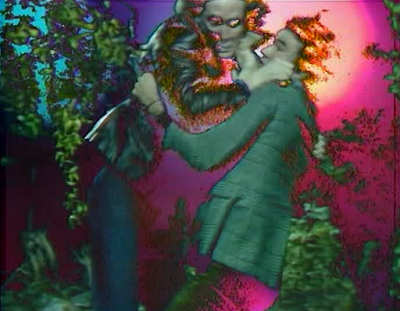
Jabe sent Carolyn upstairs with orders to pack and tell her mother they were leaving, but it would seem she has not complied. She is snoozing in a chair in her room. She has a dream. It begins with Nicholas’ voice rasping at her that it will all end at Widows’ Hill. She then sees Jabe and Sky, lit in groovy psychedelic colors, arguing about Nicholas and fighting near the precipice. Sky throws Jabe over the edge.
Carolyn awakens, calls for Jabe, and rushes out. On her way she tells David that she is going to Widows’ Hill. A moment later Jabe comes along, and David relays this information to him.
Carolyn gets to the top of Widows’ Hill, where Sky is waiting for her. He tells her that the dream Nicholas sent her stopped short of its end, because he did not want her to see her own death. He grabs her by the throat.
Meanwhile, in another universe…
While Jabe, Nicholas, and Carolyn are cleaning up the messes the Leviathan segment left behind, Roger is busy getting the new storyline off the ground. There is a room in the long disused east wing of the great house in which an alternate universe is occasionally visible. Roger goes there, and sees the counterparts of Carolyn and David. They are talking about the boy’s parents, whom Roger ascertains to be, not himself and undead blonde fire witch Laura Murdoch, but the counterparts of his distant cousin Quentin Collins and of Angelique. Everyone else we have seen in “Parallel Time” has the same first name as their counterpart in the main continuity, but David’s is named “Daniel.”
Roger never found out who Cassandra really was, so it is a puzzle for longtime viewers how he knows Angelique’s name. Carolyn and her mother met her under that name at the house she and Sky shared, but somehow did not recognize her as Cassandra. She visited them at Collinwood after her marriage to Sky broke up, but did not see Roger there.
Arrivals and Departures
This is the first time we see this Daniel Collins, but not the first time we are exposed to his name. The closing credits for #958 billed David Henesy not as David Collins, the role he played that day, but as Daniel Collins. I don’t know whether they had already decided that would be his name in Parallel Time and the person making up the credit roll got confused about it, or if the writers thought the goof was funny and gave the character the name as an inside joke.
Also, Mr Henesy played a character named Daniel Collins in February and March 1968, when the show was set in the year 1796. Since they have established that the two universes diverged during that Daniel’s lifetime, he may be this Daniel’s namesake. There is another connection, an accidental one I’m sure but an accident with a bit of an eldritch quality to it. In #350, three weeks before the 1790s segment began and more than sixteen weeks before Daniel made his first appearance, a slip of Nancy Barrett’s tongue left Carolyn referring to David as “Daniel.” It’s odd that the two Daniels were both heralded by these small inadvertences.
This episode marks, not only the final appearance of Nicholas, but also that of Roger. Louis Edmonds will play Roger’s counterpart in the Parallel Time segment, and as these episodes are being taped he is playing still another iteration of Roger on the feature film House of Dark Shadows. He will also be back in another role later on. But all the character development Roger has gone through since we first saw him in episode 1 is at an end.
Monday’s episode gave Roger his real sendoff, and my post about it summed up his history. I will just mention here that when I first saw Dark Shadows, Roger was something of a puzzle to me. That was the 1990s, when I saw it on what was then The SciFi Channel. The first episode I saw was #193, featuring art dealer Portia Fitzsimmons, but I didn’t have a chance to watch it at all regularly until a month or so after that, when Barnabas had already joined the cast. By that point Roger was already very much confined to the margins.
Curious as to when the dazzling Mrs Fitzsimmons would return, I looked online and found what is now the Dark Shadows wiki. I was disappointed to find that she was a one-off character. I also found that her function was to bring to a head a major story centering on Roger. I then looked through the episode summaries of the first weeks of the show. Those were quite terse and indigestible, meant to remind people who had seen the episodes of points they had forgotten. But one thing I did gather from them was that Roger had been a major character when the show started, indeed its chief villain. I couldn’t imagine the sardonic but lovable Roger of 1967 and 1968 in that capacity, and when I finally saw those episodes many years later I was thrilled by Edmonds’ performance.
One of the strongest themes of Roger’s character in his early days as a villain was his open hatred of David. It is nice for longtime viewers that he makes his final exit with an affectionate fatherly hand on David’s shoulder.