Mad scientist Cyrus Longworth has developed a potion that changes his appearance so drastically that even those closest to him cannot recognize him when he is under its influence. In this disguise, he calls himself “John Yaeger” and indulges his sadistic impulses. He has just committed his first murder, killing a man who had learned his secret. The potion he needs to restore his usual looks is in his lab, but he can’t get there without passing the police. So he has ordered Buffie Harrington, a young woman he has been terrorizing, to fetch it for him. He was waiting for Buffie in a cave on the beach near the estate of Collinwood when he saw the signs of a secret passage, and decided to see where it would lead him.
It has led him to the basement of the Old House on the estate, home of writer Will Loomis and his wife, the former Carolyn Collins Stoddard. We have known that this passage was here since #1003, when strange and troubled teen Daniel Collins suggested that his young cousin, Amy Collins, join him in opening it and exploring the basement. Amy refused to go there at night, prompting Daniel to taunt her as a scared-y-cat. We also know, if only because the opening voiceover has been telling us every day for the last five and a half weeks, that vampire Barnabas Collins is chained in a coffin in the basement. Will is holding him captive and forcing him to dictate his autobiography to him.
Barnabas is a visitor from a parallel universe. Longtime viewers are familiar with that universe; Dark Shadows was set there for its first 196 weeks. There is a tunnel between the beach and the basement there as well, and each time it has figured there has been a major development in the story. So when Cyrus, disguised as Yaeger, follows the tunnel and discovers Barnabas’ coffin, we can believe something big is about to happen. He starts to unchain the coffin; if he frees the vampire, that would certainly qualify.
Will and Carolyn are upstairs. She hears the sounds Cyrus is making in the basement and tells Will to go down and check. He takes this as an invitation to another of their drunken quarrels, in which he taunts her for being Barnabas’ victim. Eventually he does go downstairs, where he pistol-whips Cyrus into unconsciousness. He and Carolyn rather improbably manage to carry Cyrus up to the parlor.
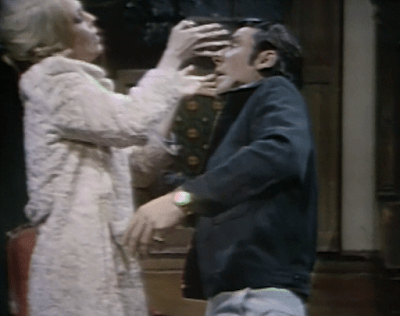
When Cyrus comes to, he finds Carolyn aiming the pistol at him. He calls her by name. She does not recognize him, and asks how he knows her. He tells her that he makes it his business to know who all the attractive women are. He asks why Will isn’t there. She doesn’t answer the question. He sees that she is trembling so violently that she can barely keep hold of the pistol; he knocks it out of her hands and runs away. Later, he will meet Buffie in the cave, get the potion from her, and shed his disguise in time to get away with his crimes.
Will rejoins Carolyn in the parlor. He scolds her for letting the intruder escape; she says he was wrong to leave her alone with him. He says he was busy sealing up the panel so that no one else could come into the basement through the tunnel. He says that Barnabas’ coffin must be moved. His idea is to carry it up the stairs and hide it in a secret chamber behind the bookcase in the parlor.
This chamber, too, has its counterpart in the original continuity. We first saw it in December 1966, when crazed handyman Matthew Morgan abducted well-meaning governess Victoria Winters and planned to kill her there. After Barnabas joined the cast of characters in April 1967 and became the master of the Old House, he several times used the chamber as a hiding place. Matthew’s plans for Vicki backfired on him when the ghosts of Collinwood and scared him to death before he could carry out his fell design. None of the occasions when Barnabas used the chamber worked out very well for him. So longtime viewers may suspect that, even if Will and Carolyn can somehow transport Barnabas and his coffin up the stairs and into the hidden chamber, things will not go as they project.
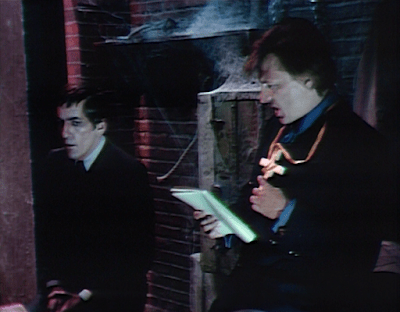
Will and Carolyn let Barnabas out of his coffin. They wear large crosses around their necks, and hold them towards him when he looks at them. They get him up the stairs and into the secret chamber this way.
Once there, Will resumes interrogating Barnabas. Barnabas protests that Will has “enough story” and ought to set him free; Will disagrees. One wonders if Barnabas’ line represents Sam Hall’s feelings as one half of the two-man staff currently charged with writing five scripts a week for Dark Shadows.
Will’s counterpart in the original continuity is Willie Loomis, who was Barnabas’ sorely bedraggled blood thrall. In #326, Barnabas had framed Willie for some of his own crimes, and the police had obligingly shot him several times. Barnabas was worried that Willie was not dying quickly enough. He railed to his associate, mad scientist Julia Hoffman, that Willie continued to “cling to life with leech-like persistence!” When Julia assured him that Willie would probably die without regaining consciousness, Barnabas said that he might just as easily make a full recovery and set about “writing his memoirs!”
The show picked up on that line after it went back in time to the 1790s. We learned in #510 that Ben Stokes, the much-put-upon indentured servant who was Barnabas’ friend before and after he first became a vampire, did indeed write a memoir, and in #756 we learned that Ben’s memoir included the story of Barnabas’ curse. I wonder if Barnabas’ line to Julia about Willie writing his memoirs was the seed, not only of Ben’s memoirs, but of the whole story of Will Loomis.
Barnabas’ cartoonish villainy in #326 was hilarious, but his objections to Will’s behavior today are quite reasonable. Will would have been doing his civic duty had he staked Barnabas, and indeed Barnabas asked Will to let him die when he first found him in his coffin. Keeping him trapped in the coffin endangers the community irresponsibly, and when Will opens it night after night with Barnabas immobilized by the cross and forces him to produce an oral history he can use use as a source of material he is choosing to be as much of a parasite on Barnabas as Barnabas’ curse has forced him to be on his victims.
Moreover, when Will tells Carolyn today that the book he extracts from Barnabas will be “all true” and that “every critic” will hail it as “a classic,” he seems to be delusional. If it is “all true,” the book will be a novelization of the last 160 weeks of Dark Shadows. The show is fun to watch, but that’s largely because the writers know what kind of material the actors and directors can use to create exciting moments. I can’t imagine anyone looking at it as so much text sitting on the page and calling it “a classic.”
Will turns his back on Barnabas and takes a note. Seeing an opportunity, Barnabas grabs the cord by which the cross hangs from Will’s neck, choking him. Will falls to the floor, and Barnabas bares his fangs.
I haven’t read Anne Rice’s 1976 novel Interview with the Vampire. Ms Rice says she wrote a short story about a reporter taking an oral history from a vampire no later than 1969, the year before this storyline premiered. That story has never been published, but biographers of hers report having seen it and they accept the dating. She also says that she decided to turn it into a novel in 1973, not because she had seen Dark Shadows, but because her daughter had died and she thought it would be a way of exploring her grief. So, any similarities are mere coincidence. I bring it up here, because it represents the definitive refutation of Will’s expectation that “every critic” would hail his retelling of Dark Shadows from the time Barnabas debuted as “a classic.” Ms Rice was free to craft a story that would be right for a novel, unconstrained to copy material produced to keep a soap opera spinning, and most of the reviews she received were quite hostile.
Mad scientist Cyrus Longworth has devised a potion that alters his appearance so that even the people who know him best, including his fiancée Sabrina Stuart and his attorney Larry Chase, cannot recognize him. When he is thus disguised he calls himself “John Yaeger” and indulges his sadistic impulses. One of his favorite hobbies is beating and intimidating a woman named Buffie Harrington, who submits to his abuse for psychological reasons the show never explains, but for clues to which Elizabeth’s Eis’ performance keeps us watching closely. Buffie does not know that Yaeger is really Cyrus. As Sabrina and Larry have not recognized Cyrus when they saw him as Yaeger, so Buffie has not recognized Cyrus when she has met him undisguised.
The only person who has so far figured out Cyrus’ secret is chemist Horace Gladstone. Cyrus bought a vital ingredient for his potion from Gladstone, who knows that it can be used to change a person’s appearance. He has had dealings with Cyrus when he was presenting himself as Yaeger, has seen his handwriting in both states, and has questioned both Sabrina and Buffie. Combined with several other pieces of evidence, Gladstone was able to build an overwhelming case that Yaeger is merely Cyrus in disguise. Yesterday he demanded Cyrus pay him $10,000 in return for a continued supply of the ingredient and his silence. Cyrus responded by drinking the potion to assume his disguise, going to a dark alley where he had gleaned from an indiscretion on Larry’s part Gladstone would be waiting, and murdering him. Larry arrived at the scene a moment later and pursued “Yaeger” on foot from the alley to the courtyard behind Cyrus’ place. He saw “Yaeger” jump the fence into the courtyard.
As Yaeger, Cyrus enters his laboratory through the door in the courtyard. He is about to take the antidote to change his appearance back to normal when he hears Sabrina and Larry coming downstairs. He hastens out the way he came. Eavesdropping through the courtyard door, he is relieved to hear Larry say that he did not get a good enough look at him to be able to make a positive identification. He hears Larry place a call to the police, and exits.
Cyrus goes back to the alley where he killed Gladstone. Buffie enters, getting off her shift as a barmaid at the Eagle tavern. The tavern abuts the alley, but evidently the police didn’t think it was necessary to bother her with news of the murder. He demands she do him a favor. She says she is too tired to do anything tonight; he says it’s better to be tired than dead. Whatever it is that compels Buffie to keep coming back to Cyrus in his Yaeger form is strong enough that this death threat does not drive her away. She protests that she does not have a criminal record and wants to keep it that way; he tells her she won’t get caught. He gives her the keys to his lab and the combination to his safe and orders her to take the bottle containing the antidote. He tells her to bring the bottle to him in a cave on the beach below the estate of Collinwood.
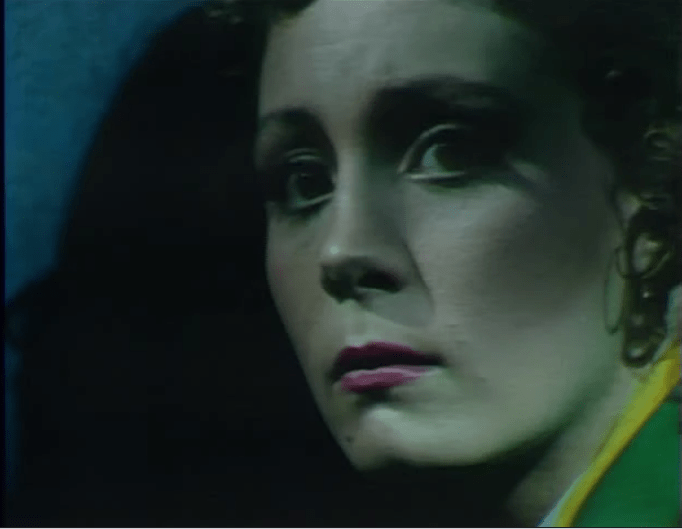
Buffie goes to the courtyard door. She is about to open it when she hears Sabrina and Larry inside the lab, talking about Gladstone’s murder. When the name “John Yaeger” comes up as a suspect, she looks down. We can see a forlornness in her face. She is as much addicted to his hard domination of her as Cyrus is addicted to violence, but she still does not want to think of herself as a criminal, certainly not as an accessory to murder.
Buffie hears about Yaeger as a murder suspect. Screenshot by Dark Shadows Wiki.
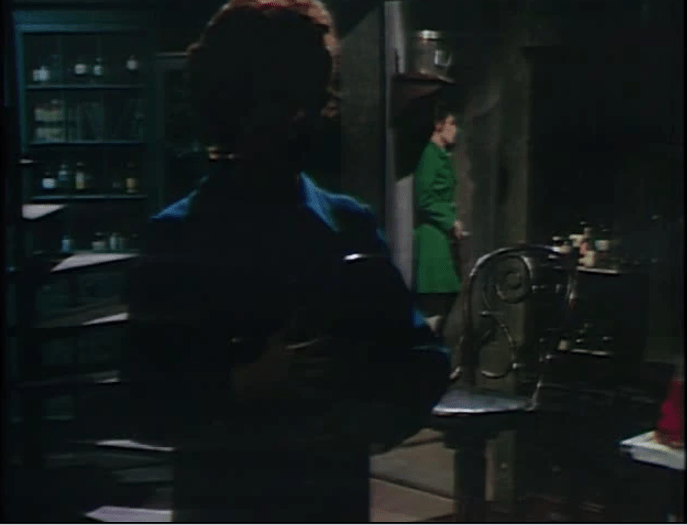
When Sabrina and Larry go upstairs, Buffie lets herself in to the lab. She has removed the painting that covers the safe and is starting to turn the dial for the combination when she hears Sabrina tell Larry she has to go back downstairs to retrieve something she left in the lab. Buffie hides by the door while Sabrina collects her purse. The purse is right next to the painting, but the room is dark. We are in suspense whether Sabrina will see it. She doesn’t, she leaves, and Buffie gets the bottle.
In the cave, Cyrus notices footprints going up to a pile of stones that appear to be a natural part of the cave wall. He realizes that the stones must be hiding a secret passage. He is curious where it leads, and figures it will be at least half an hour before Buffie comes. So he starts pulling the stones down.
Cyrus follows the path into the basement of the Old House on the grounds of Collinwood. This house is currently occupied by writer Will Loomis and his wife, the former Carolyn Collins Stoddard. Cyrus realizes where he is, and finds a chained coffin. He wonders what secret Will might be hiding from the world. He decides that if the secret is shameful enough, it might come in handy. He breaks the first chain, intending to open the coffin.
The opening voiceover, delivered arrestingly by Eis, told us what is in the coffin. It is a visitor from a parallel universe. He is named Barnabas Collins, and he is a vampire. Will is holding Barnabas prisoner in the coffin and taking an oral history from him, which he plans to use as the basis of his next book. Longtime viewers of Dark Shadows are familiar with Barnabas’ native universe; the first 196 weeks of the show were set there. As Will put chains on Barnabas’ coffin in the hope of finding a fortune in his stories, Will’s counterpart, dangerously unstable ruffian Willie Loomis, took the chains off Barnabas’ coffin in hopes of finding a fortune in jewels. In his universe, Barnabas is the master of the Old House and he keeps his coffin in the space where Will has it here. It has occasionally been opened by intruders; the first time we saw that happen was in #275, when Willie’s sometime friend, seagoing con man Jason McGuire, lifted the lid at sunset, only to be greeted by Barnabas’ hand darting out and crushing his throat. If Cyrus gets the coffin open, Gladstone’s death might be avenged sooner than anyone could expect.
Gladstone’s death marks the final appearance of John Harkins. Harkins’ first appearance was in #174, in which he played Lieutenant Costa of the Arizona State Police. The most famous of his dozens of screen roles was in The Mary Tyler Moore Show, when he played the clergyman who officiates at the funeral of Chuckles the Clown. He also had a recurring role on Cagney & Lacey as Mansfield the drug kingpin. Harkins didn’t have any scenes with John Karlen, who was a regular both on that show and on Dark Shadows.
The Dark Shadows Wiki tells us that this is one of only six episodes with no cast member who appeared in 200 or more episodes. It lists the others as 168, 172, 180, 1141, and 1182. It also says that there is no one in it who joined the cast before David Selby’s debut as Quentin, but since Harkins was on almost two years before Mr Selby that is not so.
There are a number of buildings on the estate of Collinwood. There is the Old House, a big mansion where the Collinses lived until the 1790s, and the great house, an even bigger mansion where they have lived since. These days, the Old House is home to hard-drinking writer William H. Loomis and his wife, the former Carolyn Collins Stoddard. Sometimes the place is called “Loomis House” in recognition of its inhabitants. We learn today that the Loomises have a servant. His name is Wilfred Block, but everyone knows him as Fred.
Fred hears some noise coming from the attic. He goes up there and finds two kids who belong at the great house. They are Amy Collins and her cousin, Daniel Collins. Amy is out cold, and Fred asks Daniel what he did to her. Daniel claims to be innocent. He says that Amy just looked at a portrait and fainted. That’s the sort of thing the Collinses do all the time, so Fred accepts it. He carries Amy back to the great house. Daniel follows.
There, Daniel tells his father, Quentin Collins, the same story he told Fred. Fred tells Quentin that he couldn’t get any answers out of Amy. She just kept repeating the words “chained” and “trapped.” Quentin thanks Fred.
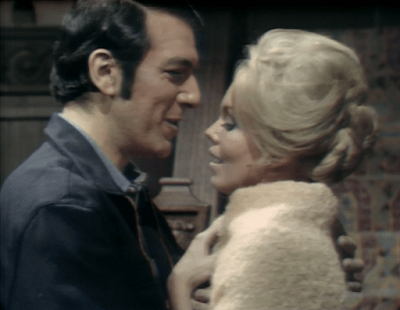
On his way out, Fred sees a woman whom he greets as “Miss Alexis.” He tells Alexis that he misses her visits to the Loomis House. She walks up very close to him and says she is feeling cold. He says he knows what to do about that, and hugs her. She holds the embrace for quite a while. He says he’s wanted to do that ever since he first saw her. She tells him to kiss her. Before he can comply, they hear Quentin coming. They separate and look nonchalant. Quentin is surprised Fred is still there. Fred hastens out.
Later, Alexis’ aunt, Hannah Stokes, would go to Fred at the Loomis House and ask him to come to her place, telling him Alexis wanted to see him there. That scene took place out of our view. The next time we do see Fred, Hannah is leading him into her parlor. Fred tells Alexis that he’d been planning to see her at Collinwood, but she says it is better at Hannah’s. Hannah leaves them alone together. They embrace, and Fred kisses Alexis. He feels cold. She tells him he will go on feeling cold, but bids him embrace her again. He does. He collapses.
Hannah was close to one of her nieces, Quentin’s late wife Angelique Stokes Collins. But she never got along with Angelique’s identical twin sister Alexis. Angelique had shared Hannah’s interest in the occult, and had been her pupil in that area, while Alexis scorned such matters. Alexis came to stay at Collinwood four and a half weeks ago, and spoke to Hannah only once during that time, when Hannah invited herself to the great house. That was a tense meeting which ended with Alexis all but ordering Hannah to go.
Hannah is taken aback today when she answers her door. She sees Alexis. She makes sarcastic remarks about Alexis, which do not deter her visitor from entering. The visitor asks Hannah to tell her fortune. Hannah resists, but the visitor keeps telling her it is something she wants very much. Hannah starts laying out the Tarot, but the first two cards disturb her so deeply she stops and cannot be persuaded to resume. She tells her visitor that they mean that she has no future. The visitor responds with a placid look and an insistence that Hannah read her palm. Hannah does not want to see the same message there, but the visitor will not be denied. When she looks at her palm, Hannah has a realization. “You are not Alexis! You are Angelique!”
Hannah is horrified that Angelique has returned from the dead. She does not want to know how it was done. Angelique seems eager to tell her everything; if Hannah were willing to listen, she might even volunteer that she murdered Alexis by draining the warmth from her body to heat her own undead frame. Angelique asks Hannah to bring her up to date on some things that happened while Alexis was at Collinwood and she was in the tomb. She then explains that her own death was also a murder, and that she wants to avenge it, though she does not yet know who the murderer was. She also has plans for Quentin, though she does not make it clear at this time what those are. She tells Hannah to bring Fred to her so that she can drain the warmth from him. Hannah protests, but Angelique tells her she has no choice. If she does not deliver Fred to her, she will haunt Hannah as long as Hannah lives.
After Fred collapses, Angelique calls her aunt back to the parlor. She tells her that she is all right now. Hannah finds that Fred is dead. Angelique agrees that he is, and repeats that she is warm again. She goes on: “That’s the way it must be now. This is the way I will live now. And when Quentin comes to join me, he will live this way, too. For eternity.” Evidently she is now a vampire, only instead of blood she drains heat from her victims. Also, she will be killing someone every 24 hours. Collinsport has been established as a very small town, so if she and Quentin are both going to be keeping up that pace it’s hard to see how it can last even for a year, let alone for eternity.
Quentin Collins
Quentin does not suspect that Angelique has risen from the dead, killed her sister, and taken her place. He has problems of his own. At the beginning of today’s episode, he is standing at the door to Angelique’s old bedroom in the east wing of Collinwood, where Alexis stayed during her visit and which Angelique now occupies again under Alexis’ name. He is looking into the room, but does not see it. Instead, he sees an entirely different space. Unlike Angelique’s richly decorated room, it is bare and dark.
Quentin sees two children in the room. They look and sound exactly like Daniel and Amy, though they are wearing clothing he does not recognize. He calls the names Daniel and Amy, but even though they are just a few feet away from him they do not seem to hear him or to be aware of his presence. An invisible barrier of some kind keeps him from entering the room.
Though the children cannot hear Quentin, he can hear what they are saying. The boy says that according to his father, “Dr Hoffman” said that “Barnabas got caught” in the room. The girl is alarmed and says that she does not want to get caught. She does not want to be in the room at all, but would rather be asleep in bed.
Quentin keeps calling the names Daniel and Amy. After a moment, he hears Daniel’s voice coming from somewhere other than the room. He turns, and sees Daniel and Amy standing behind him in the hallway. They don’t know what he is talking about when he asks them if they have been in the room, and he doesn’t know how to explain what he saw.
The Hoffman likeliest to come to Quentin’s mind is Julia Hoffman, Angelique’s fanatically devoted servant, who is the housekeeper at the great house of Collinwood and is certainly not a doctor. The only Barnabas he can think of is Barnabas Collins, an ancestor who died in 1830 and who was the subject of a biography Will Loomis wrote five years ago. Amy has told him that Will has started another book about that Barnabas. Quentin read Will’s original book, and was puzzled as to what could possibly be left to be said about its subject. So the conversation he has overheard makes no more sense to him than does the setting in which it took place.
Quentin shoos the children away and goes into the room. It is furnished as it always is. Angelique, whom he believes to be Alexis, is lounging in the middle of it. He tries to explain the phenomenon to her, and she does not take him at all seriously. He tells her enough that she should know that if it was an hallucination, it was a remarkably involved one, the sort that occurs only to people with grave mental illnesses. Even so, she could not be less interested in it. She wants to know what Quentin is doing to investigate her murder. He says that he doesn’t believe Angelique was murdered, to which she replies that he is a fool. This conversation does not have an obvious track forward, and Quentin quickly excuses himself.
Barnabas Collins
Barnabas Collins went to the island of Martinique in the 1790s on a business trip for his father’s shipping concern. While there, he met two lovely young women. One was Josette DuPrés, daughter of the richest sugar planter on the island. He was captivated by Josette, but did not believe she could love him. Josette’s aunt, the exiled Countess DuPrés, had brought a lady’s maid with her when she escaped from the French Revolution. This maid, named Angelique, was quite as beautiful as Josette, and made it clear that she was available to Barnabas. He consoled the sadness that he felt when he supposed Josette to be unreachable in a light-hearted love affair with Angelique. When it turned out that Josette was not unreachable at all, he forgot about Angelique and turned to her. Soon, he and Josette were engaged to be married.
When Josette and her father came to Collinwood for the wedding in 1795, the countess and Angelique came along. Angelique was sure that Barnabas was marrying Josette only to conceal his true intention, which was to keep her as his real partner. When she discovered that this was not the case, Angelique vowed to do something about it. She had learned black magic, and was ready to wreak a terrible vengeance.
Angelique managed to end Barnabas’ engagement to Josette, and had caused many disasters by the time Barnabas agreed to marry her. Before long, he discovered that she was a witch. He made several farcically inept attempts to kill her. When he shot her with a gun, she thought he had succeeded. As she lay bleeding, Angelique cursed Barnabas to become a vampire. It turned out her wounds were only superficial, but the curse was not. Barnabas was eventually trapped and chained in his coffin until 1967, when he was accidentally freed once more to prey upon the living.
That Barnabas Collins was not the one Will wrote his 1965 book about, and that Angelique is not the one who has returned from her coffin to stay in Quentin’s house. They were residents of a parallel universe. It was in their universe that the first 196 weeks of Dark Shadows took place. There, the east wing of Collinwood has long been vacant and disused. Barnabas happened to be there when the bare dark room Quentin sees today was replaced by Angelique’s room from this universe. He and several other residents of the original continuity saw the phenomenon a number of times over the next few days.
Barnabas became preoccupied with the forlorn hope that if he could enter the other “time-band,” he might be freed of the vampire curse and become human again. His closest friend, mad scientist Julia Hoffman, MD, tried to dissuade him from this plan, but he was nothing daunted. Barnabas finally did manage to find a way through the barrier.
Once in “Parallel Time,” Barnabas’ hopes were instantly disappointed. He was still a vampire. The first person he met was Carolyn Stoddard Loomis. He bit her and made her his thrall. Will found out about this very shortly after, and trapped Barnabas in a chained coffin. He is using him as a source of material for a new book.
The children Quentin saw talking about Barnabas were not Daniel and Amy Collins, but David Collins and Amy Jennings from the main continuity. They don’t know that Barnabas is a vampire; so far as they are concerned, he is their kindly cousin from England, an old world gentleman with some eccentric habits.
Amy Collins
Amy had stayed with the Loomises for a few days recently when there was some trouble in the great house. She took Daniel to their attic because she wanted him to join her in her favorite pastime while she was there, going through the trunks. Daniel declares that only girls would be interested in an activity like that. Amy doesn’t refute his claim when she says that the trunks have all sorts of interesting old stuff in them, such as dolls.
Daniel asks Amy about the basement of the Loomis House. She tells him that Will has the only key, and that he refuses to let even Carolyn go down there. We know that the basement is where Will keeps Barnabas’ coffin. Daniel says that there is a tunnel that leads from the beach right into the basement, and that he likes to play there. He says that it has been sealed up lately, but suggests Amy come with him to unseal it and explore. She says “Not at night,” and turns away. He calls her a scared-y-cat. Longtime viewers know that the same tunnel exists in the main continuity and that it has been a hugely important part of the story more than once, and will wonder if they can again match the excitement associated with it in those past episodes.
Amy tells Daniel that there is a sword somewhere in the attic, a real one. This does not exactly thrill Daniel, but at least he asks if it is a saber or a fencing foil, which is more than he had to offer in response to the prospect of digging up some antique dolls. He goes to look for the sword behind some paintings. When he turns up the portrait of Barnabas Collins, he hears a heartbeat. Longtime viewers will remember that characters have several times heard a heartbeat when looking at the portrait of Barnabas in the main continuity, and that this means that Barnabas is going to be on the show before much longer. Amy can’t hear the heartbeat, but she does have a strong reaction. It is at this point that she faints and the ill-fated Fred enters.
Regular viewers know that Amy’s muttering of the words “chained” and “trapped” mean that she has a mystical perception of Barnabas’ situation. But Quentin doesn’t have the slightest idea what to make of it. Amy comes to in the drawing room and tells Quentin that when she saw the eyes in the portrait of Barnabas, she realized he needed help. Quentin says that Barnabas has been dead for a very long time.* Amy says she knows, and leaves it at that.
Ben Stokes
In the 1790s, the Barnabas of the main continuity befriended much-put-upon indentured servant Ben Stokes. Barnabas’ father, haughty overlord Joshua Collins, made Ben’s life miserable. Barnabas took pity on Ben, teaching him to read and write and standing up for him when he was wrongly accused of misconduct. In return, Ben gave Barnabas his absolute loyalty.
When Angelique came to Collinwood in 1795 and hatched her evil schemes, she decided she needed a henchman. She chose Ben. She pretended to find Ben attractive. He matter-of-factly walked up to her and took hold of her, as if women who look like movie stars come on to indentured servants every day. She soon used his excitement to cast her spell on him. He found himself helping Angelique to do great harm to Barnabas and everyone he cared about, grieving him very deeply.
Eventually, Ben broke free of Angelique. He went on to be freed from his indenture and to have children. One of his descendants is Professor Timothy Eliot Stokes, an expert on the occult and a frequent ally of Barnabas and Dr Hoffman.
Fred’s response to Angelique today reminds us of Ben so long ago. Once Ben gathered that Angelique was propositioning him, he didn’t see any need to talk at all. They both had work to get back to, so he was ready to get down to business straightaway. But Fred keeps telling Angelique how beautiful she is and how he always hoped something would develop between them. His dialogue and Edmund Hashim’s delivery of it are as realistic and unadorned as Angelique’s lines and Lara Parker’s style are florid and over the top. The contrast is deliberate, as the contrast between the monosyllabic working-class “Fred” and the ornate and ethereal “Angelique” is deliberate. Just as Ben did not know what kind of world he had stumbled into when he reached for the original Angelique, Fred has no idea that he lives in a place where beings such as this Angelique can exist.
When Barnabas first came to this universe, Carolyn Loomis told him that Angelique and Alexis were the daughters of “Tim Stokes,” the counterpart of his old acquaintance Timothy Eliot Stokes. We have yet to see Tim Stokes, but we can be sure he will played by Thayer David. We know what Thayer David looks like. Alexandra Moltke Isles, who was in 333 episodes as well-meaning governess Victoria Winters, dated critic John Simon in the 1970s. Simon was a college classmate of Thayer David, and told her that in their day David was “the handsomest man at Harvard.” When I mention that to my wife, Mrs Acilius, she says that those must have been rough days for Harvard. David may have been better looking before he put on weight, but he never bore anything that could be mistaken for a family resemblance to the dazzling Lara Parker.
Longtime viewers, thinking back to what we saw when the show was set in 1795, might have an idea. Will’s book proves that the timelines diverged in the 1790s, when the Barnabas of the current timeline left Angelique alone and had a happy marriage with Josette. Perhaps in that continuity Ben really did pair off with Angelique. If so, Angelique and Alexis might be their descendants. They were lucky to inherit all of the genes governing their appearance from her.
The thought of the counterparts of Ben and Angelique as the forebears of the Stokes family in the current continuity might shed some light on its members. We’ve heard not only that Hannah and Alexis had no use for each other, but that Alexis and her father have not spoken for a long time. Like Hannah, Tim shared Angelique’s interest in the occult and doted on Angelique, while scorning Alexis. The new Angelique certainly qualifies as the Evil Twin, and is very much a continuation of the Angelique we already know from the main continuity. From what we know about them, Hannah and Tim seem to be the sort of people Angelique would naturally turn to for help in her deadly doings.
As for Alexis, she seems to have set her cap for Quentin, and succeeded in driving Quentin’s current wife Maggie out of Collinwood when she caught Alexis and Quentin in rather a compromising position. Alexis kept saying it would be easier for the new Mrs Collins to come home if she were to leave, but she never did leave. On a conventional soap, Alexis would have the makings of a Vixen, but it takes more than husband-stealing to join the ranks of the villains on Dark Shadows. Alexis would seem to take more after Ben, who had been indentured because he was a thief and was bewitched by Angelique because he disregarded sexual morality. She may have those sorts of flaws, but compared to the evils around her they seem like minor foibles indeed.
Edmund Hashim
Fred is played by character actor Edmund Hashim, making his only appearance on Dark Shadows. Hashim does a fine job. Fred had to be played with strict naturalism, so that the only resource Hashim could draw on to hold anyone’s attention against the flamboyant Parker was skilled and truthful acting. He pulls it off. It’s a shame we won’t see him again. He died in 1974 at the age of 41, one of the first cast members to pass away. The only ones who predeceased him were Fred Stewart (1970, aged 64,) House Jameson (1971, aged 68) George Mitchell (1972, aged 66) and Patrick McVey (1973, aged 63.)
*In fact, he says that Barnabas has been dead for “over 200 years.” It’s 1970, as the wardrobe makes unmistakably clear, and they have explicitly said that the Barnabas Quentin has heard of died in 1830. So he’s bad at math.
Stuffy Edward Collins was under a spell for several weeks that prevented him from keeping up with what has been happening on the estate of Collinwood in 1897. He knows that his distant cousin Barnabas is a vampire who originally died in the 1790s and has come back to prey on the living. From this, he has drawn the eminently logical conclusion that he is a character in a horror story, and that it is his responsibility to be the hero who destroys the undead ghoul.
In fact, Dark Shadows stopped being that kind of show long ago. Others know that it is chiefly about time travel now. That point is made when we flash forward to the year 1969, from which Barnabas has traveled to prevent a disaster that had its roots in 1897. Barnabas’ friends Julia Hoffman and Timothy Eliot Stokes talk about the intersection of past and present, so that the events of 5 September 1897 are somehow also taking place on 5 September 1969. The show has been using anniversaries as substitutes for natural laws in this way since #157, broadcast and set in January 1967, and they spin this out much further today. In his post about the episode at his great Dark Shadows Every Day, Danny Horn writes a big prose poem about the weirdness of the show’s conception of time at this point, it’s well worth reading.
When Barnabas first came on in the spring of 1967, it was set in contemporary times and the writers had a lot of fun with characters who mistook the genre of show they were on. Dangerously unstable ruffian Willie Loomis heard the plot of Daphne du Maurier’s Frenchman’s Creek, concluded he was part of a Gothic romance, and wound up freeing Barnabas and becoming his blood thrall. That mistake continued to shape Willie’s character. Willie was forced to be Barnabas’ accomplice in the abduction and attempted brainwashing of Maggie Evans, The Nicest Girl in Town. Willie listened to Barnabas’ own rantings about his motive being an attempt to recreate his lost love Josette, and kept imagining that he would somehow overcome Barnabas to rescue Maggie and become her lover. Willie also harbored a deep hostility towards Burke Devlin, who was left over from a period when the show really was inspired by Gothic romance.
Willie’s sometime friend Jason McGuire made a similar mistake, believing that the show was still the noir crime drama it was when it spent weeks on the question of where Burke’s fountain pen had got to. So he sleuthed out signs of where Willie went when no one was looking and where Barnabas got his money. All that Barnabas could contribute to that kind of story was murder, and so he unceremoniously strangled Jason in #275.
Local physician Dr Dave Woodard thought he was on the usual daytime dramas of the period. Actor Robert Gerringer had a lot of fun playing Woodard as if he were on The Guiding Light. There were whole episodes built around that conceit- for example, we spend #235 in the Collinsport Hospital, where everyone acts just as you would expect them to on any other soap, except for Maggie, who is there being treated for vampire bites. Woodard notices that his friend Julia is growing close to Barnabas, and in #324 comes to the logical daytime conclusion- they are having an affair. Eventually Woodard finds out that he has misidentified the genre of the show, but it is too late- Barnabas and Julia murder him in #341.
Today, that is to say 5 September 1897, Edward catches Barnabas and locks him in the prison cell in the basement of the Old House at Collinwood. Barnabas kept Maggie in that cell when she was his prisoner, and the ghost of his little sister Sarah helped Maggie find a secret panel that led to a tunnel to the beach. In #260, Maggie escaped through that tunnel at the last minute before Barnabas could kill her, and Barnabas himself later used the same tunnel to escape from the cell in #616. In #781, Edward made it clear that he knew all about the tunnel and expected everyone else at Collinwood to know about it as well. So it is no surprise when he tells Barnabas that he has blocked it off. In fact, he says that he has blocked “all” of the secret passages- we may wonder just how many escape routes there are.
Edward leaves Barnabas alone in the cell, saying he will be back before dawn. There is a writing desk in the cell; Barnabas remembers that Willie moved that desk to the front parlor for him in 1967, and so he describes his predicament in a letter to Julia and closes it in a secret compartment of the desk.
In 1969, nine year old Amy Jennings is in the parlor, playing with her dolls. One of the dolls is named “Amanda”; this will catch the attention of returning viewers. The 1897 story features a character named Amanda, who is an oil painting come to life. If artist Charles Delaware Tate could make his paintings come to life, as in Greek myth the sculptor Pygmalion made a statue come to life as a woman named Galatea, then perhaps we should find out who made Amy’s doll before we let it out of our sight.
Amy first came on the show in November 1968, at the beginning of the story that led from contemporary dress to the 1897 segment. Her very first night at Collinwood, Amy went straight to the room where the magic objects were hidden that would trigger that story. She often delivers her lines directly into the camera, as if she knows perfectly well where the audience is. Amy is at the opposite pole from Edward and such earlier characters as Willie, Jason, and Woodard- she not only knows what genre the show is, she’s read the flimsies for next month’s episodes and is getting a head start on them.
Amy looks in the desk for a book to read to her dolls, and inadvertently opens the secret compartment. She eventually gives the letter to Julia; this is what prompts Julia and Stokes to have their talk about the ontological status of past events and what philosophers call “the reality of tense.” They know all about the time travel aspect of the show; Julia, in fact, has for some time been the closest thing the audience has in the parts of Dark Shadows set in the 1960s to a point of view character, one who knows everything we do. She was certainly the first one to know that the show was transitioning from vampire horror to quasi-science fiction. She surprised Barnabas in #291 with a proposal to develop a medical treatment that might put his vampirism into abeyance.
In the letter, Barnabas refers to his “secret.” Stokes does not know what this is, and is not satisfied with Julia’s lame attempts to answer his questions about it. This makes sense to regular viewers; shortly after Stokes arrived in Collinsport, another mad scientist got hold of Barnabas and succeeded where Julia had failed in putting the symptoms of the vampire curse into remission. For all the time he has known Barnabas, Stokes has seen him moving about in the day, casting reflections in mirrors, eating food not derived from human blood, etc. In 1968 and 1969, his ignorance of his Barnabas’ past vampirism is not much more serious than his ignorance of the details of the automobile accident that killed Mr Hanson in 1956. But the vampirism came back in full force when Barnabas went to the past, so Stokes is at a loss as to what the letter means.
Julia decides that she will try to travel into the past using the same mumbo-jumbo that transported Barnabas there. While Stokes reads up on that, Julia and Amy make a stop at the great house on the estate, which is impenetrably haunted by the ghost of Quentin Collins. That errand seems to be going sideways when the episode ends.
Vampire Barnabas Collins has been exposed and is in hiding. Most of those who would destroy him are as evil as he is, and none is as much fun to watch, so we’re on his side.
Stuffy Edward Collins catches Barnabas’ blood thrall Charity Trask in the basement of the Old House on the estate of Collinwood. Barnabas sent her there to fetch some soil from his original grave which he will use to make a new coffin habitable. Edward asks Charity what she is doing in the basement; she lies and claims that she can’t remember. This is an interesting moment for fans of Dark Shadows. Nancy Barrett’s acting style is uninhibited and often larger-than-life; one suspects that she was often accused of overacting. But Charity really does overact. In the contrast between her one-dimensional, exaggerated manner when she feigns amnesia and Miss Barrett’s own very noisy but highly textured performances, we see the definitive refutation of any such charge.
Charity got into the basement through a tunnel that connects the beach below Widows’ Hill to a prison cell in the basement of the Old House. In #260, set in 1967, we saw that the tunnel was in place when Barnabas and his little sister Sarah were living beings in the eighteenth century, that Sarah was aware of the tunnel, and that their father Joshua forbade her to tell Barnabas about it. Sarah’s ghost told Barnabas’ victim Maggie Evans how to escape through the tunnel. When Barnabas pursued her through it, we could see from his reaction that he was seeing the tunnel for the first time. The other Collinses of the 1960s were unaware of the existence even of the cell, let alone of the tunnel.
Now it is 1897, and when Charity mentions the tunnel to Edward he impatiently responds that he knows all about the tunnel. His tone suggests that he would expect Charity to know that he knows about it; evidently it is no secret among the residents of Collinwood. Since Edward’s twelve year old son Jamison is one of those residents, and Jamison’s daughter Liz and son Roger will be the adults at Collinwood in the 1960s, one wonders how that knowledge was lost in the seventy years separating this time-travel story from the principal time frame.
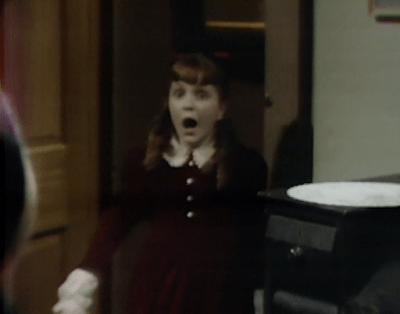
In the last scene, Barnabas is in Charity’s bedroom, about to chow down on her bloodstream. We pan from a two-shot to a closeup of Charity. She gives a thirty five second speech about how it isn’t safe for him to stay long, since her father knows that she is under Barnabas’ power and is lying in wait for him. Thirty five seconds is evidently how long it took for Jonathan Frid to put in Barnabas’ fangs, because when we pan back to him they are showing and he is ready to bite. At that moment, Jamison’s nine year old sister Nora walks in and reacts with horror to the sight of Barnabas with his mouth on Charity’s neck.
When vampire Barnabas Collins first appeared on Dark Shadows in April 1967, regular viewers may have thought they knew what to expect. They had just spent four months focused on undead blonde fire witch Laura Murdoch Collins, mother of strange and troubled boy David. David’s well-meaning governess Victoria Winters gradually realized that Laura was a deadly threat to him. After some initial confusion, Vicki rallied the other characters in opposition to Laura. Ultimately Laura went up in smoke and David escaped her clutches, choosing Vicki and life over his mother and death.
In many ways, the Laura story was modeled on Bram Stoker’s Dracula. So when Laura’s successor as supernatural menace was an out and out vampire, we may have expected further mining of that source. Barnabas bit and abducted Vicki’s friend Maggie Evans. As the daughter of drunken artist Sam, Maggie had played a key role in the “Revenge of Burke Devlin” storyline. But that storyline fizzled in the show’s early months, and by #201 even Burke Devlin lost interest in it. Maggie was at that point surplus to requirements, and when Barnabas added her to his diet we might have suspected that she would die and rise as a vampire. As Mina and the group she led in Dracula had to destroy her friend Lucy when Lucy rose as “the Bloofer Lady,” so Vicki and her friends would have to destroy Maggie. Vicki herself would then stake Barnabas. The average viewer would have expected this to be the sign to move on to the next menace; those who were aware of TV ratings and programming decisions might think it would be Dark Shadows‘ way of going out with a flourish before its impending cancellation.
Barnabas turned out to be a hit. The idea of a vampire on a daytime soap was such an oddity that a sizable new audience tuned in out of curiosity, and Jonathan Frid’s portrayal of Barnabas’ scramble to impersonate a living man native to the twentieth century resonated with so many of them that he became a breakout star. So they had to figure out a way to make him a permanent part of the cast. That meant Maggie couldn’t die. In the first place, they couldn’t risk making Barnabas responsible for the death of so likable a character. Second, as the survivor of the horrendous abuse Barnabas inflicts on her Maggie would have a new function, as the witness who might emerge to expose him and wreck the show. Third, while Maggie was in Barnabas’ clutches Kathryn Leigh Scott proved herself such a versatile actress that it would obviously damage the show to lose her. So Barnabas not only failed to kill Maggie, he completed only two homicides in the whole of 1967. Each of his two victims was a male character who had run out of story. As a result, the killings and the victims were quickly forgotten.
Barnabas’ nonlethal vampirism made it easier to keep the cast intact, but it also drained him of the lurid novelty that had made him such a draw. To reassure the audience that Barnabas really was a bloodthirsty fiend from the depths of Hell, the show had Vicki come unstuck in time in #365. She found herself in the 1790s, when Barnabas first became a vampire. That gave us a whole cast of characters whom we did not expect to see again once the show returned to contemporary dress. So Barnabas was free to slaughter people to his heart’s content.
The 1790s flashback was a hit in the ratings. When Vicki brought us back to 1968 in #461, the makers of the show had to figure out a way to keep the momentum going. They cured Barnabas of the effects of the vampire curse and surrounded him with a hectic parade of other refugees from 1930s horror movies- mad scientists, Frankensteins, witches, werewolves, and a couple of fresh vampires. After that Monster Mash period exhausted itself, they took us through a long, deliberately paced segment focusing on just two stories, one about a tormented werewolf and the other about a ghost who takes possession first of two young children, then of the whole estate of Collinwood. Barnabas, who has come to see himself as a good guy and the protector of the family, tries to cure the werewolf and reason with the ghost. His efforts instead transport him back in time to 1897.
In that year, Barnabas is a vampire again. He keeps saying that his only goal is to prevent the evils that will befall the family in 1969, but he is as uninhibitedly murderous as he ever was in the periods when he was unambiguously a villain. In Friday’s episode, he murdered one of the principal members of the Collins family, prankster Carl Collins, uncle of the Jamison Collins whose daughter and son are the adults at Collinwood in the 1960s. Barnabas had become so careless after so many killings that he left Carl’s body propped up behind the curtains in the windows of the drawing room, where it fell into plain view moments after Barnabas’ foe the Rev’d Gregory Trask entered. In this episode, Trask enlists Edward Collins, brother of Carl and father of Jamison, to help him hunt Barnabas.
My wife, Mrs Acilius, points out that when we see a character closing the doors to the drawing room, that person is in charge of the house. So in the early months of the show matriarch Liz was the one to close the doors; when Liz was taken to a hospital and her daughter Carolyn was in charge, Carolyn closed the doors. When Vicki was fully in command of the campaign against Laura, she closed the doors to consult privately with her lieutenants. When Trask and Edward go into the drawing room to discuss the situation, it is Trask who closes the doors. Vicki was good, so consistently so that she had to be written out of the show months ago. But Trask is overwhelmingly evil. That he has ascended to the rank of door-closer means that virtue has no stronghold anywhere.
Edward and Trask go to the Old House on the estate, where Barnabas has been staying. They find Barnabas’ reluctant sidekick, broad ethnic stereotype Magda Rákóczi. Magda denies that Barnabas is in the house and pretends not to know what Trask and Edward are talking about when they say that Barnabas is a vampire. Trask slaps Magda in the face; we have seen many face-slaps on Dark Shadows, but so far as I can recall this is the first delivered while the slap-ee has her back to the camera. Since he does not have to swing his hand very close to Grayson Hall’s face, Jerry Lacy can therefore put full force into the gesture, making it look like Trask is delivering a truly brutal blow to Magda. Afterward, Magda rubs her face and vows revenge on Trask. She quotes a rather confusing “old gypsy saying”: “Walk fast and the Devil will overtake you; walk slow and misfortune will catch you. You’d better not walk slow, because I will never be far behind.”
Edward and Trask search the Old House and find nothing. At dusk, Barnabas emerges from the secret room behind the bookcase in the front parlor. Magda hadn’t thought to look there, and Trask and Edward didn’t know the room existed. Barnabas says he will have to find a new hiding place for his coffin. Magda says she will do whatever she can to help him. Barnabas is surprised at her support for him; after all, he has bitten and enslaved her husband Sandor, and his destruction would mean Sandor’s restoration. Magda has an atypical moment of speechlessness, after which she says that Trask is an “animal” and must be punished at all costs.
Trask and Edward went back to the main house early in the morning to look for the plans to the Old House. It apparently took them all day to find them. By the time they have gone through them and identified all of its secret rooms, Barnabas is already up. They come back to the Old House and find the empty coffin in the secret room. Trask says that he will make the coffin “unusable” for Barnabas before daybreak. He leaves Edward, who is carrying a gun loaded with silver bullets, to guard the house.
Barnabas goes to one of his blood-thralls, Trask’s daughter Charity. He tells Charity that he is “in serious trouble” and commands her to go to the basement of the Old House. There, she will find some soil from his original grave, which he needs to prepare his new resting place. He tells her about a tunnel from the beach to the basement which she can use to elude detection by Edward. Since Barnabas has just materialized in Charity’s room and will shortly materialize in the secret room in the Old House while Edward is standing on the other side of the bookcase, we wonder why he can’t use that same power to get into the basement himself.
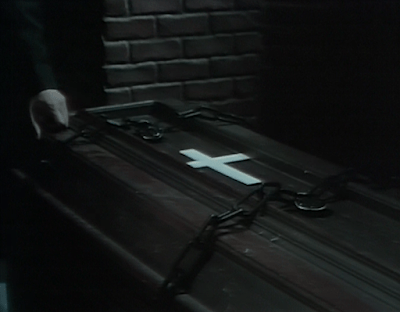
Barnabas finds that the coffin is topped with a cross. He can’t get close enough to take hold of the coffin and move it, so presumably even after he gets the soil he needs he will have to plunder a mortuary showroom to get a fresh resting place before dawn.
Charity does go to the basement. She puts some soil in her purse, then knocks over a crate, attracting Edward’s attention. She does not run away, but merely hides in an alcove until Edward comes down, sees her in shadow, and orders her to show herself.
In June 1967, vampire Barnabas Collins locked his victim Maggie Evans, The Nicest Girl in Town, in the prison cell in the basement of the Old House on the estate of Collinwood. The ghost of Barnabas’ little sister Sarah appeared to Maggie several times while she was in the cell. Sarah told Maggie that no one could know she had been to the cell, and particularly warned her not to tell her “big brother” she had seen her. With some reluctance, Sarah eventually gave Maggie a clue that led her to a hidden passage. Sarah’s father had sworn her to secrecy about the passage, and that not even her big brother knew about it. Maggie finally puzzled out the clue, enabling her to escape just moments before Barnabas came to the cell with the intention of killing her. When Barnabas chased Maggie through the hidden passage in #260, the wondering expression on his face confirmed that he had never had any idea the passage was there.
From November 1967 to March 1968, Dark Shadows was a costume drama set in the years 1795 and 1796, the period when Barnabas and Sarah were living beings and the Old House was their home. We saw how cruelly their father, haughty overlord Joshua, treated his indentured servant Ben, and we saw that Joshua had the great house of Collinwood built with a prison cell in its basement. Joshua confined Ben to that cell in #401. With that, we could be sure that Maggie’s cell was already in the basement of the Old House when Barnabas and Sarah lived there, and could surmise that Joshua really did forbid the living Sarah to share with Barnabas or anyone else what she had found about the hidden passage.
The show never explained how Sarah found out about the passage. We might imagine her hiding and watching Joshua or someone else do maintenance on the cell. But the fact that Joshua kept the existence of the escape hatch from Barnabas suggests he wanted the option of locking his son in the cell. Why not his daughter as well? Perhaps Sarah found the passage while confined in the cell herself. Or perhaps some other, older ghost appeared to her while she was there and told her about it. That the clue she gives Maggie is in the form of a rhyme (“One, two, away they flew…”) would suggest this latter possibility. Sarah may have memorized the rhyme as she memorized the lyrics to “London Bridge” and may have solved the riddle as Maggie solves it.
Shortly after Dark Shadows came back to a contemporary setting in March 1968, Barnabas was cured of vampirism. That cure was stabilized in May, when he donated some of his “life force” to the creation of Frankenstein’s monster Adam in an experiment completed by his friend, mad scientist Julia Hoffman. Barnabas and Julia locked Adam up in the basement prison cell for the first weeks of his life. Vampires and mad scientists are metaphors for selfishness, so it is hardly surprising that they are horribly bad parents. But if Joshua was in the habit of locking his children in that same cell, the moments when Barnabas takes fatherly pride in the imprisoned Adam take on a special pathos. It really does seem like a normal situation to him.
Adam escaped from the cell in #500, demolishing the doorway in the process. Today we see that it has been rebuilt. Perhaps to Barnabas, a house just isn’t a home unless it has a prison cell in the basement.
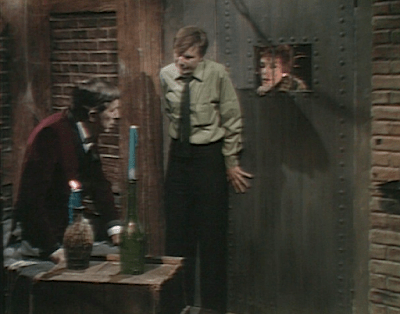
Now, Barnabas has himself become the blood thrall of a vampire, his ex-wife Angelique. Discovering the bite marks, Julia decides to address the situation by locking Barnabas and his servant Willie in the cell. Barnabas won’t be able to get out to heed Angelique’s summons, and Willie hangs a cross over the door to keep her from materializing inside it.
Left to right: Barnabas Collins (Jonathan Frid); Willie Loomis (John Karlen); Julia Hoffman (Lady Elaine Fairchilde.) Screenshot by Dark Shadows Before I Die.
We cut to Maggie’s house. Maggie’s memory of her ordeal as Barnabas’ victim has been wiped from her mind a couple of times. She receives a visitor, the suave Nicholas Blair. Unknown to Maggie, Nicholas is a warlock and Angelique’s master. He has a crush on Maggie which has distracted him from his managerial responsibilities, which to be frank he had not been handling very diligently in the first place. Maggie gives Nicholas several pieces of news that he really ought to have been aware of for some time. She tells him that her ex-fiancé, Joe Haskell, is still alive; that she visited Joe twice while he was at the Old House recovering from some injuries; that Joe is now in the hospital under police guard; and that Joe tried to kill Barnabas and keeps vowing that he will try again, since he believes Barnabas is trying to kill him. Nicholas is flummoxed by all of this, and meekly goes along when Maggie insists on visiting the Old House to pay a call on dear, sweet Barnabas.
The scene in Maggie’s house has an odd feature. We’ve just had a closeup of Willie hanging a cross above the door in the cell to keep Angelique away. In the early days of the vampire storyline, it was not at all clear that the cross would deter vampires in the world of Dark Shadows, since Barnabas was often seen strolling comfortably through a cemetery where half the grave markers were cross-shaped. It was not until #450, during the 1790s flashback, that we saw Barnabas recoil from a cross. In #523, we learned that the cross also immobilizes Nicholas. Yet Maggie is today wearing a dress the front of which is dominated by a red cross, and it doesn’t bother Nicholas a bit. The show is drifting into a spot where it may have to stop and spend time explaining its theurgy. Does the cross only work against a demonic creature if it is specifically aimed at that creature? Or if the person setting it up knows about the creature? Or is there some other qualification? It’s getting confusing.
At the Old House, Julia tells Maggie and Nicholas that they cannot see Barnabas, because he is resting. Maggie keeps insisting, and Julia shifts her ground, claiming that Barnabas went out, she knows not where. When Julia says this, Maggie is incredulous, but Nicholas brightens. Evidently he wants to believe that Barnabas has gone off to respond to Angelique’s call, and accepts Julia’s statement happily. Maggie apologizes for demanding to see Barnabas, and she and Nicholas leave.
Meanwhile, Barnabas is scheming to get out of the cell. While Willie is complying with his request to pour a glass of water, Barnabas bashes him on the head with an empty bottle. He then goes to the hatch for the secret panel, remembers that “Maggie found it a long time ago!” and figures out how to open it. Since we saw Willie open the hatch and show Adam Barnabas’ jewel box in #494, you would think Barnabas already knew how it worked. At that time, it also seemed that the passage behind the hatch had been sealed up, so that it no longer led to the beach. Apparently we aren’t supposed to remember that. Barnabas crawls out and closes the hatch behind him before Julia comes back.
As Barnabas, Jonathan Frid usually moves in the stateliest possible manner. When he escapes from the cell today, the camera lingers on him crawling, driving home the contrast with his typical gait. That is quite different from what we saw in #260, when he followed Maggie into the hatch- then, we saw him move toward the opening, but cut away before he had to take an ungainly position. Today, the makers of the show want us to hold the image of a crawling Barnabas in our minds.
Crawling suggests Barnabas’ weakness under Angelique’s power, certainly, but in this setting it suggests more. This is the house where he was born, and what he is crawling into is a lightless passage that it looks like he will have to squeeze through to emerge outside. He has regressed not only to infancy, but all the way back to birth. If Joshua did indeed confine him to this cell in his childhood, Barnabas would likely have experienced that same regression in those days as well.
The sign of the cross reminds us of one who said that we must be born again to receive a life in which our hopes will be fulfilled more abundantly than we can ask or imagine; Barnabas labored for 172 years under a curse that compelled him to die at every dawn and revive at every sunset, but perhaps even before that he was the prisoner of a cycle of abuse that forced him to experience the trauma of birth over and again, each time finding himself in the same narrow space, a stranger to all hope. Indeed, when Barnabas first became a vampire in the 1790s, he put his coffin in this basement, near the cell, and he persisted in putting it there even after it became obvious that it was very likely to be discovered. That persistence made no logical sense in terms of Barnabas’ need for operational security, but if he saw his vampirism as a continuation of his childhood experience of confinement in the basement cell, it would make all the sense in the world. That is his place, that is where he belongs, that is his reality.
From #227 to #260, Maggie Evans, The Nicest Girl in Town, was under the influence of vampire Barnabas Collins. As Barnabas tried to brainwash Maggie so that her personality would disappear and that of his lost love Josette would take its place, she began to rebel against him. From #251 until she escaped in #260, Barnabas kept Maggie locked up in a prison cell in his basement.
Throughout this whole period, Barnabas’ sorely bedraggled blood thrall Willie Loomis tried to spare Maggie the worst. Willie anonymously telephoned Maggie’s friend Vicki in #230 so she and her friends could interrupt Barnabas’ first attempt to take Maggie into custody; while Maggie was Barnabas’ prisoner he several times pleaded with Barnabas to show her mercy; and when in #260 Barnabas had decided to kill Maggie with extreme cruelty, Willie brought a glass of poison to her cell so she could die painlessly.
Now, Barnabas’ vampirism is in remission. He has brought Willie back to work for him, arranging his release from the mental hospital where he was confined after Barnabas framed him for all of his crimes against Maggie. It is by no means clear what effect Barnabas’ loss of his vampire powers has had on Willie. At times he seems to be confused and childlike; at times, to be the dangerously unstable ruffian he was before he fell into Barnabas’ clutches. But he is still fascinated by Maggie, and still longs for her friendship. The very night Barnabas brought him home from the hospital, Willie sneaked off to visit Maggie and tell her he was innocent.
For her part, Maggie’s memories of her experience with Barnabas were excluded from her conscious mind when mad scientist Julia Hoffman hypnotized her. The other day, Maggie had a nightmare as part of the “Dream Curse,” and in the course of the nightmare she heard the sound of Josette’s music box, which Barnabas forced her to listen to while in captivity. She also saw a skull with eyes, suggesting that her deepest fear has to do with the dead watching her. Since Barnabas, as a vampire, was dead and yet kept Maggie under surveillance, this image combines with the music to suggest that Maggie’s memory might soon return.
Today, Willie is minding Adam, a Frankenstein’s monster whom Julia brought to life in a procedure meant to cure Barnabas of his vampirism once and for all. Barnabas and Julia have no idea what to do with Adam, and so they have chained him up in Maggie’s old cell. Barnabas’ jewel box is stashed behind the secret panel Maggie used to escape from the cell, and Willie shows Adam some of its shinier contents to calm him.
Among the shiniest are a pair of emerald earrings. Barnabas has been talking to Willie as if Willie remembers everything that happened when he was his blood thrall, yet Willie has not confirmed that this is so. When he sees the earrings, Willie gets very intense. He says that he saw Josette wearing them, then realizes that it was Maggie. Perhaps Barnabas, by modeling the conversations they used to have, is inadvertently providing the therapy Willie needs to recover his memory.
Willie decides to give the earrings to Maggie. He goes to Maggie’s house and peeks through the window. He sees her with her boyfriend Joe. When he came to the house the other day to tell Maggie he never meant to hurt her, she was terrified and Joe stated as a matter of fact that he would kill Willie if he ever came near Maggie again. Willie does not knock on the door to greet the two of them.
Instead, he slips into the house while they are out of the room. He plants the earrings in Maggie’s purse, and is gone by the time she and Joe come back. Maggie finds the earrings. The tinkling sound of Josette’s music box plays on the soundtrack while she looks at them. She is fascinated:
Maggie says that the earrings “remind me of something- something I’ve forgotten. I know they don’t belong to me yet. But somehow when I look at them, I seem to think they were meant for me- I mean from the start. They are lovely, a very beautiful and thoughtful gift. Only a man who has gazed into my eyes with deepest love would know they were meant for me.” As she delivers these lines, Kathryn Leigh Scott fades out of Maggie’s voice, into the tones she used while playing Josette from #370 to #430.
Barnabas’ attempt to turn Maggie into Josette would have reminded many viewers at the time of the 1932 film The Mummy, in which the undead Imhotep (played by Boris Karloff, whose voice Jonathan Frid often seems to be imitating as Barnabas) abducts the beautiful young Helen Grosvenor, whom he believes to be the reincarnation of his lost love, the Princes Ankh-esen-amun. In that movie, Helen and the Princess were both played by Zita Johanns, suggesting that Imhotep was onto something. From November 1967 to March 1968, Dark Shadows was a costume drama set in the 1790s and we saw that Maggie and Josette are both played by Kathryn Leigh Scott, suggesting the same about Barnabas. The bleakness and horror of Barnabas’ treatment of Maggie in the summer of 1967 makes this suggestion a daring one, and that Maggie makes a speech blissfully describing the one who looked at her and saw Josette as a “man who gazed into my eyes with deepest love” in the middle of an episode that begins and ends in the cell where he confined her and planned to torture her to death is more daring still.
I don’t think the risk pays off. Miss Scott was usually one of the most reliable performers on Dark Shadows. She found Maggie in her relationship to her father Sam, whose drinking problem was a major story point for the first 40 weeks of the show, and articulates the character as a series of very intelligent answers to the question “How would an Adult Child of an Alcoholic respond to this situation?” This scene presents her with a very complex challenge, as she is supposed to show that the earrings have jarred loose some fragment of a memory but to keep us guessing just what that fragment is. Joel Crothers plays Joe’s disquiet at the appearance of the earrings with a simplicity that sets Miss Scott up for a star turn. But she doesn’t seem to have any idea what to make of her lines. For the first time on the show, she is physically stiff and vocally overbearing. As a result of her atypical overacting, the scene does not deliver the sense of mystery and foreboding it requires. It just leaves the audience confused.
Maggie Evans, The Nicest Girl in Town, has been a prisoner of vampire Barnabas Collins for a long time now. Barnabas is planning to kill her tonight. We spend the opening scene with Barnabas’ sorely bedraggled blood thrall, Willie Loomis. We hear Willie’s thoughts as he does the housekeeping. Willie wishes he could save Maggie, but Barnabas has too much power over him. The most he can do is bring her a poisoned glass of milk and invite her to drink it if she wants to die an easy death.
Willie is not Maggie’s only friend. The ghost of Barnabas’ nine year old sister, Sarah, materializes in Maggie’s cell. Sarah asks Maggie why she is crying. Maggie tells her that if she doesn’t get out of the cell very soon, she will die. Sarah is distressed to hear this- “You mustn’t die- I don’t want you to die.”
Maggie hasn’t figured out that Sarah is a ghost, and keeps asking her how she manages to get in and out of the cell. Sarah usually evades this question, but now she says that there is a way. She came upon it accidentally, long ago, and her father ordered her not to tell anyone, not even her brother. She will be punished if she tells. If her father put her in the prison cell in their basement intentionally, Sarah’s fear of punishment is quite understandable.
Sarah overcomes her fear sufficiently to share a riddle with Maggie which she says will give her the answer:
One, two, away they flew.
Three, four, by the door.
Five, six, count the bricks.
Seven, eight, the clue is “grate.”
Nine, ten, home again.
Maggie asks Sarah to repeat the riddle, and she says she can only say it once. Maggie tells her where to find her own father, Sam Evans, and asks her to tell Sam that she has seen her. Sarah disappears.
Sarah’s fear of punishment will ring a bell for regular viewers. Strange and troubled boy David Collins is so intensely afraid that his father, high-born ne’er-do-well Roger, will punish him by sending him away to a boarding school or a jail that he tried to murder Roger. Later, David left his favorite person, well-meaning governess Vicki, to be decapitated by crazed handyman Matthew Morgan because he was afraid that if he helped Vicki his father would find out he had earlier defied him and would punish him. Now, Maggie is in mortal danger because another Collins child, one who lived in a previous century, has a similar fear of punishment. The cell in the basement of the Old House was there before slavery was abolished in the area in 1783; perhaps Sarah’s fear and David’s are a bequest from the slaves and indentured servants whom their forebears locked up in it.
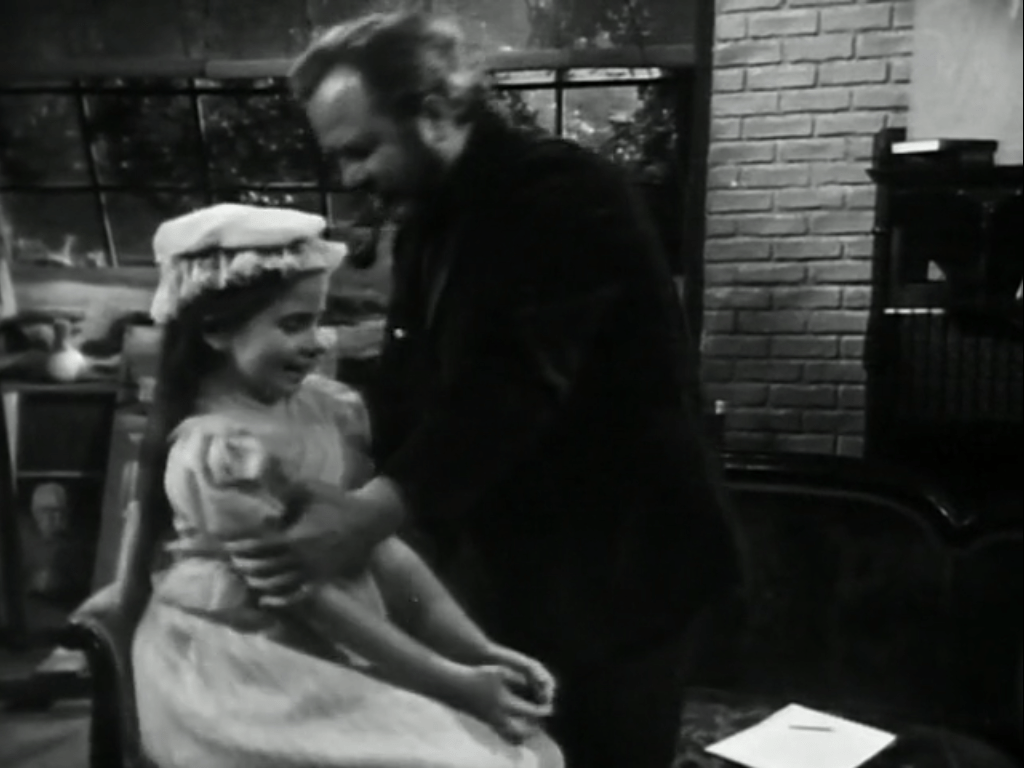
We cut to the Evans cottage. Sam is an artist, and is working. Sarah materializes in the living room. Sam had locked the door and Sarah won’t explain how she got in, but he seems to be delighted with her anyway. She is impressed with his paintings and asks him to paint a picture of her. He offers a drawing instead. When she agrees, he picks her up and sets her on a stool. She flashes a grin at being picked up. She asks if she can keep the drawing when he is done with it.
The most fun Sarah has had the whole time she’s been dead
Sam tells Sarah that her dress is very pretty. He then mentions that you don’t see many dresses in its style. She asks if that means he doesn’t like it. When Sam says that all he means is that it isn’t the sort of thing other little girls wear, she says she doesn’t play with other little girls so she doesn’t care what they wear. She seems to be getting worked up about this, so Sam calms her down with, “All right, all right, I see.” This little exchange gave my wife, Mrs Acilius, a laugh. Sarah may have been born in the same year as Jacob Grimm, but she is very much a nine year old girl.
While Sam draws Sarah, she steers the conversation to Maggie. She asks Sam if he looked for Maggie on the beach under Widow’s Hill. He says he’s looked everywhere he could. She repeats her suggestion that he look for her on the beach. He says he is sure he won’t find her there. She responds “You might, if you go there tonight.” Disturbed by this, Sam looks up, and finds that Sarah has vanished.
This surprises us almost as much as it surprises Sam. Sarah had made it clear that she very much wanted to keep the drawing, yet she disappears before Sam is finished. Evidently, it wasn’t within her power to stay.
Back in the cell, we see Maggie and hear her thoughts as she tries to remember Sarah’s riddle. Like Willie’s voiceover internal monologue in the opening scenes, Maggie’s goes on too long. We can see that Maggie is in an upsetting situation and understand why Sarah’s presence confuses and distracts her. That makes it clear she would have difficulty remembering the exact wording of the riddle, but we really don’t need to hear her go over every part of it.
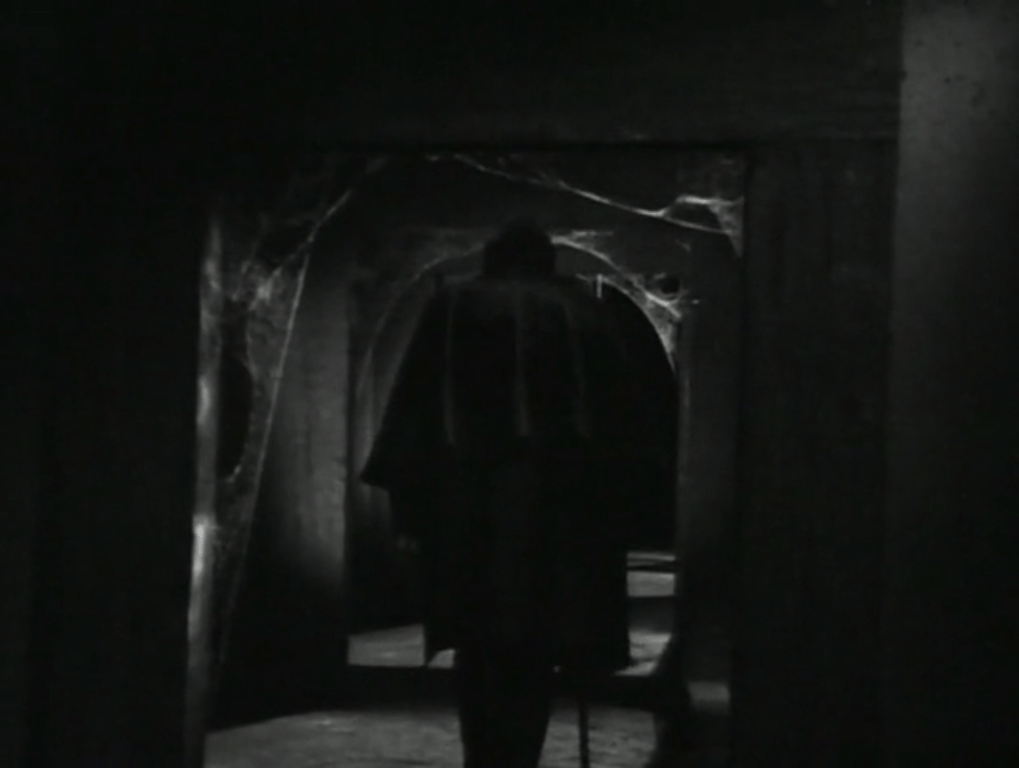
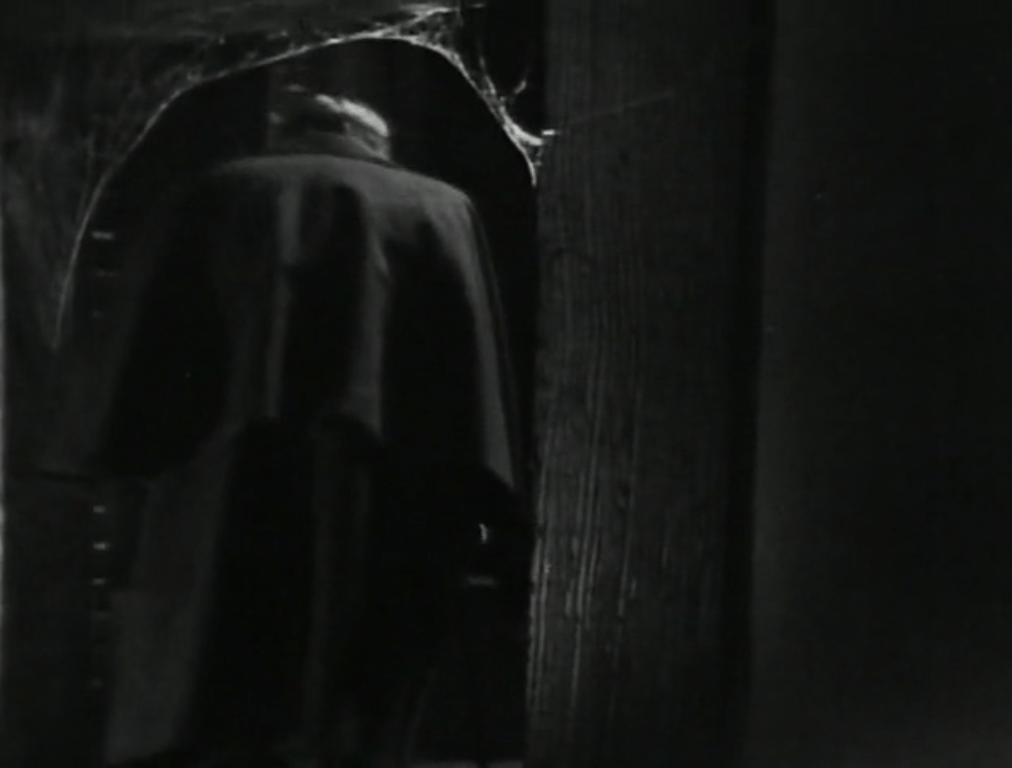
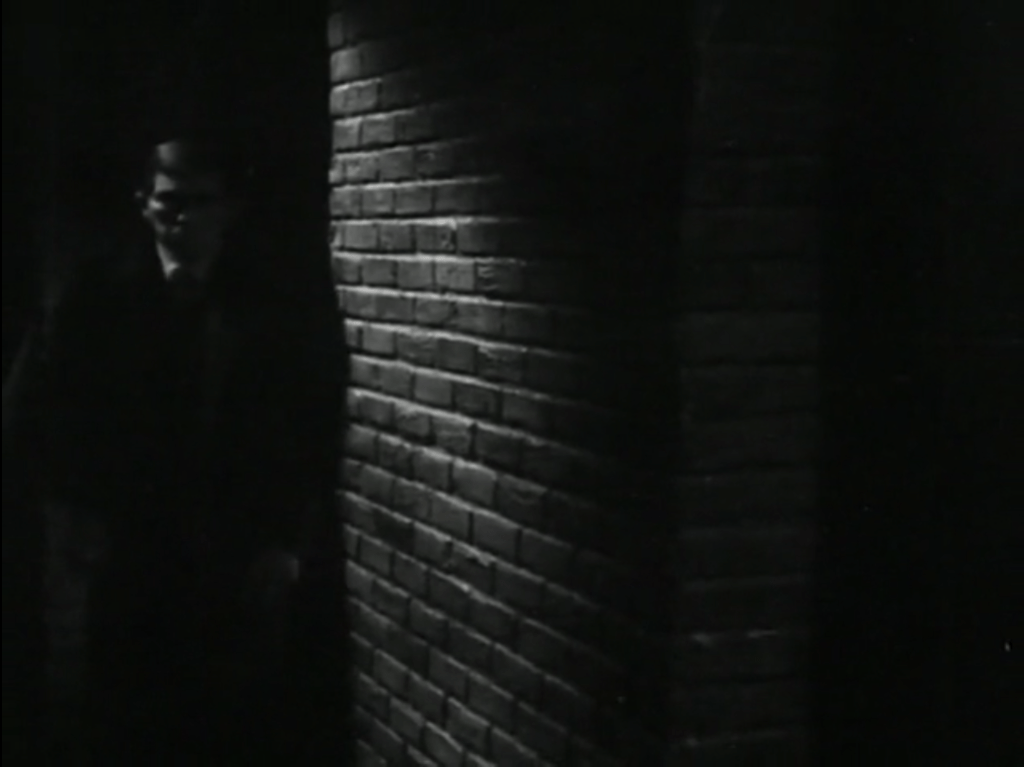
By the time Maggie finds the loose brick that triggers the opening of the secret panel, Barnabas is already rising from his coffin. We cut between Barnabas walking through the basement and Maggie struggling to open the panel. It may sound like we’re describing filler when we say that we see Barnabas traversing three distinct corridors between his coffin and Maggie’s cell, but it doesn’t feel that way. Not only do these shots build suspense as we wonder if Maggie will get out before he reaches her, but in Barnabas shown as a hunched, solitary figure in narrow spaces sketched in shades of gray we see the representative of a world bleak beyond endurance. We can see why the first serious feature film about a vampire, F. W. Murnau’s Nosferatu (1922), devoted so much screen time to showing Count Orlok skulking about the corridors of his castle.
First corridorSecond corridorThird corridor
Maggie crawls into the secret passage. She doesn’t close the panel behind her. Not only doesn’t Maggie know that Sarah is a ghost, she doesn’t know that Barnabas is Sarah’s brother. When Sarah says that not even her brother knows about the secret panel, she is telling us, but not Maggie, that Barnabas is unfamiliar with this way. We know that if Maggie had closed the panel, Barnabas wouldn’t have known where to look for her, and so we might yell at the screen urging her to do that. But since it is his house, she has to assume that he does know about the panel, and she knows that he might be at the door any second. So it is rational for her to forget the panel and use all of her time moving forward.
The gap between Maggie’s knowledge and ours again adds to the suspense as we watch her flee from Barnabas through the twisting passages beyond the panel. We only see one path, but the looks on the actors’ faces as they look from side to side tell us that there are several. Maggie is moving cautiously, choosing her way with care, the sensible thing to do if Barnabas is familiar with the passages. Since we know that it is new to him as it is to her, we want her simply to pick a path and run.
Maggie beholding the paths before her
Maggie finds two heavy doors, both of them apparently stuck. Barnabas looks around, seems bewildered, and takes a breath. He shouts a speech at Maggie, claiming that she has no chance of escape because he can hear her. He can’t hear much while he’s shouting, so we want her to take advantage of that and bash away at one of the doors during his speech.
Barnabas wondering at part of his house he never knew existedMaggie with two closed doors in front of her and an angry vampire behind her
This episode ends the 52nd week of Dark Shadows. When ABC* picked the series up in 1966, it gave executive producer Dan Curtis a 26 week commitment, carrying production to #130. After that, the network renewed it for the then-standard 13 week period. The first renewal carried them to #195, the second to this episode. Until just a couple of months ago, the ratings were so low that no one thought it was likely that it would get a third renewal. When the vampire was introduced in April, viewership started to pick up, preventing cancellation and requiring them to come up with a story that they could keep telling.
I do think we can see traces here and there of the original plan. The first part of the plan seems to have been to copy Bram Stoker’s Dracula far more thoroughly than they wound up doing.
The two female characters on the show who had or were about to have boyfriends when Barnabas was introduced were Maggie and Vicki, who are both seeing men who are cut out to be stout-hearted action heroes. The two female characters in Bram Stoker’s Dracula who had boyfriends were Lucy Westenra and Mina Murray, who were both seeing men who emerge as stout-hearted action heroes. Dracula feeds on Lucy, prompting several other people to band together to try to save her. Dr John Seward, MD, contacts his old Professor, the brilliant Abraham Van Helsing, to advise the group. Despite their best efforts, Lucy dies and rises as a vampire, the “Bloofer Lady” who feeds on the children of east London. Lucy’s boyfriend has to destroy her body to free her soul of the vampire curse.
If the show was about to be canceled, it would have been a favor to Kathryn Leigh Scott to have Maggie suffer Lucy’s fate. Going out with a splash like that would certainly have given her something to lead with as she looked for her next job. But once it was decided that the show would continue beyond #260, it was out of the question to lose a character as popular and versatile as Maggie. When the network ordered 65 more episodes, Maggie had to be saved.
The Van Helsing analogue was actually named on screen. In #242, the show’s equivalent of Dr John Seward, addled quack Dr Woodard, said that he was going to call in a specialist to consult on Maggie’s case, a Dr Hoffman, who is “one of the best men in the field.” We haven’t heard about this man since Dan Curtis found out the show was going to be renewed, suggesting that they’ve abandoned the idea to hew quite so closely to Dracula.
In Stoker’s novel, once Van Helsing has corrected the group’s knowledge deficits concerning vampires, Mina emerges as its leader. Attempting to be gallant, the men cut Mina out of their operations, with the result that Dracula escapes them and bites her. Mina is able to resist his influence so far that she can play a pivotal role in the Count’s final destruction.
The first time Dark Shadows modeled a storyline on Dracula, the menace was not a vampire, but undead fire witch Laura Murdoch Collins. In that arc, the men formed a group of stout-hearted heroes advised by Dr Peter Guthrie and led by well-meaning governess Vicki. Guthrie and Vicki were plainly Van Helsing and Mina. Laura killed Guthrie, so he can’t come back to help in the fight against Barnabas, but Vicki is still around, still the chief protagonist, and still the one likeliest to lead the opposition to a villain.
Indeed, Barnabas has expressed interest in Vicki as a replacement for Maggie, and in #233 he blurted out an obvious threat when he realized she was getting uncomfortably close to figuring out the truth about him. So, had Dark Shadows ended with this episode, it is likely that it would have ended with Vicki overcoming Barnabas’ power and driving a stake through his heart.
Of course, the vampire is the source of the ratings, and Vicki and Maggie are needed for future story development. So the makers of the show can’t use any of those plot elements. What in the world they can do is a question that does not, as yet, have a clear answer. So they have been stalling and stalling. Sooner or later, the stalling will have to end.
*The American Broadcasting Company, that is, not the Australian Broadcasting Corporation.