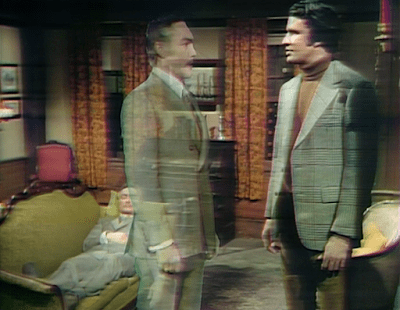
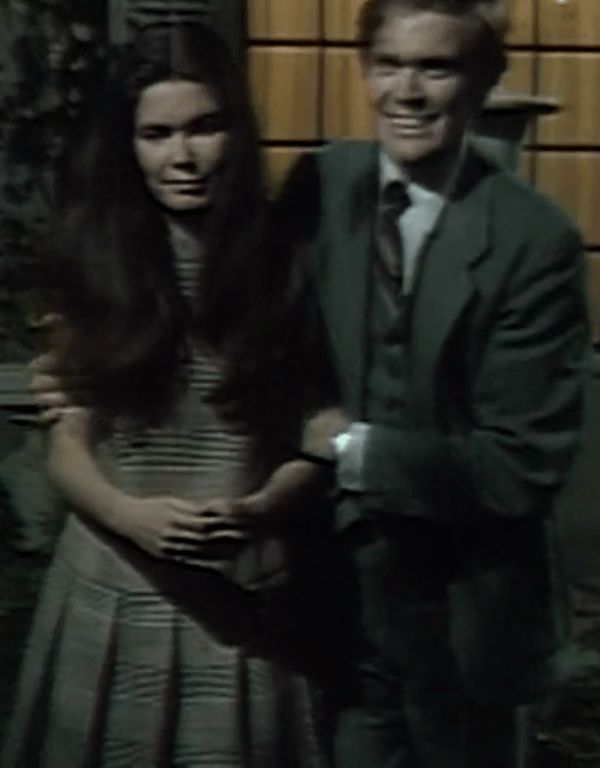
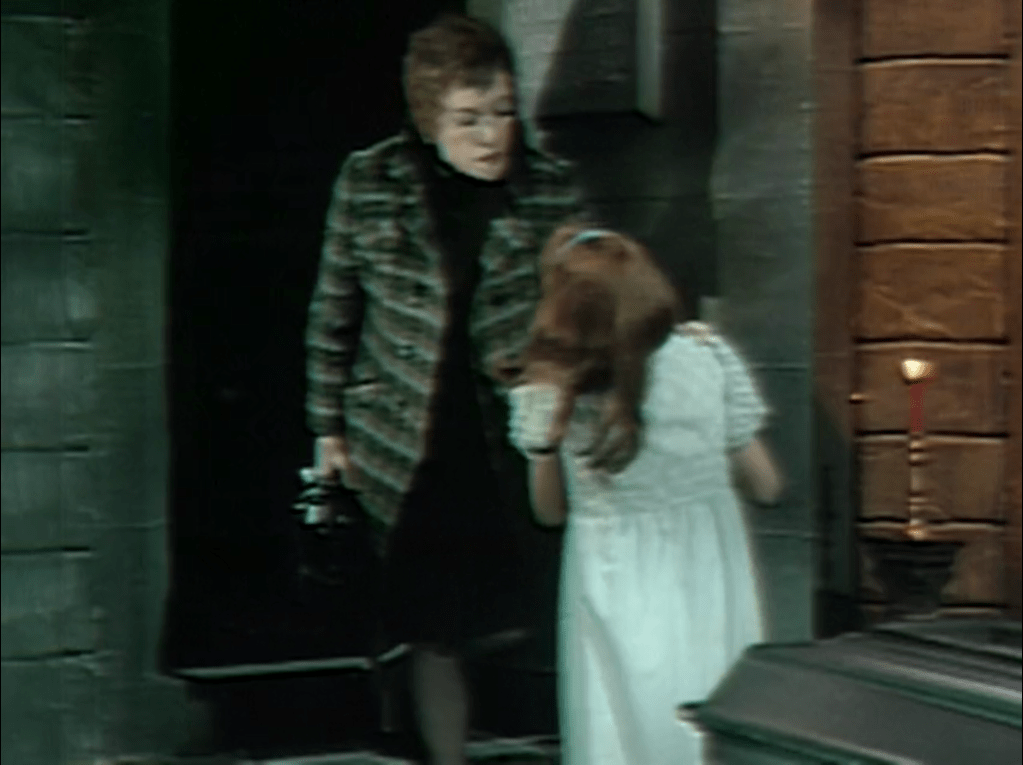
Angelique Stokes Collins has returned from the grave to take vengeance on her murderer. Unfortunately, she doesn’t know who that is. For the last several weeks, she has been operating on the assumption that she was killed by her widower, foul-tempered sourpuss Quentin Collins. She has managed to get Quentin charged with one murder and suspected of several others; under her influence, he assaulted a police officer and broke out of jail. She has persuaded him that his current wife, the former Maggie Evans, is a witch and is responsible for all his troubles. He is lurking about the great house on the estate of Collinwood, where yesterday he encountered Maggie and told her he would kill her.
Angelique herself is residing in the great house. Eleven weeks ago she killed her identical twin sister Alexis, assumed Alexis’ identity, and took her place as Quentin’s houseguest. Maggie now thinks of “Alexis” as her friend.
Others in and around the house know better. High-born ne’er-do-well Roger Collins, Quentin’s brother, has seen through her imposture. Two visitors from the alternate universe where Dark Shadows was set for its first 196 weeks, mad scientist Julia Hoffman and vampire Barnabas Collins, knew her counterpart in their world and are onto her tricks.
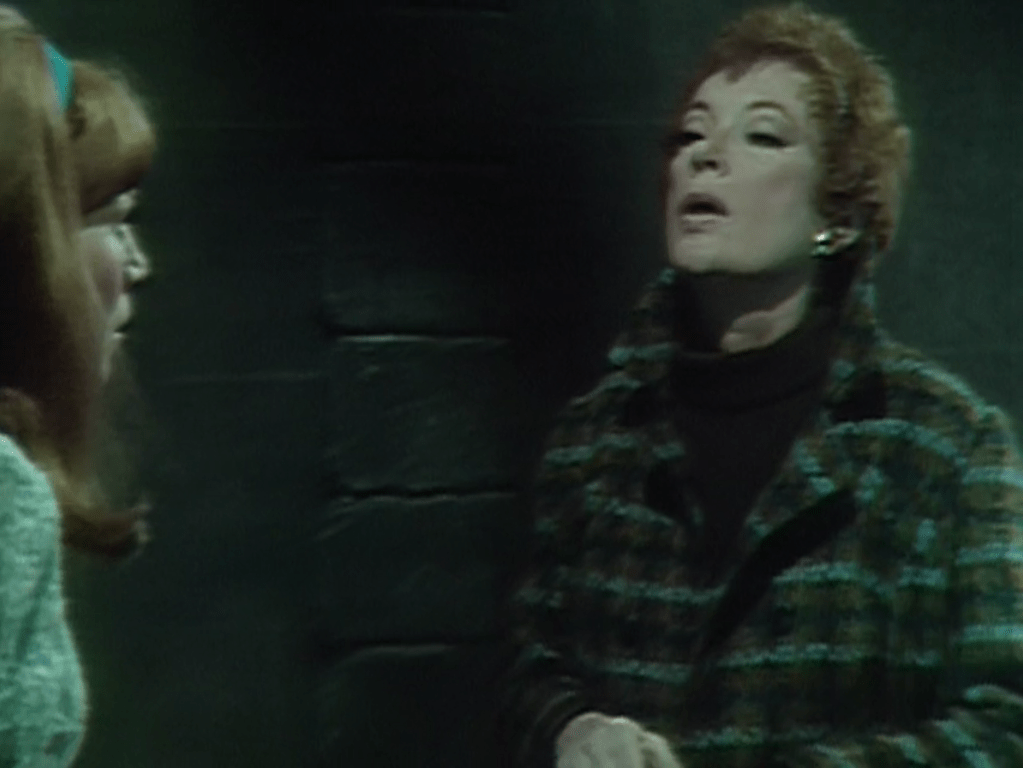
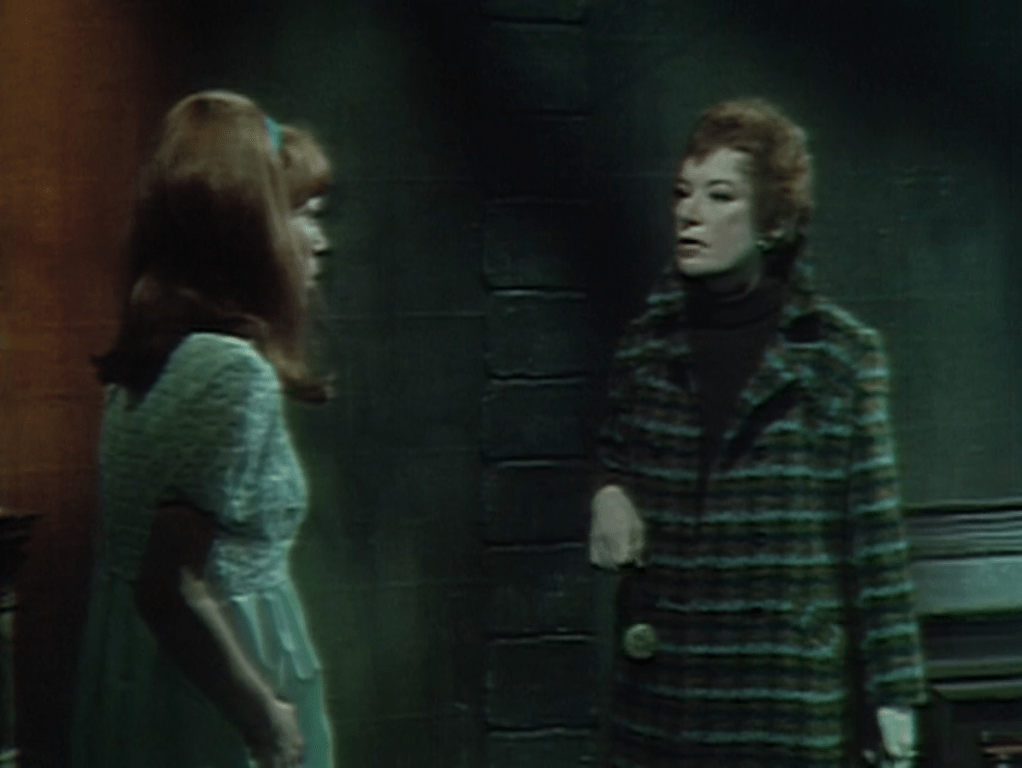
Angelique hears some noise in her old bedroom in the east wing of the great house. She finds the door locked and hears Roger’s voice. She demands to be let in. He opens the door and she forces her way past him. She finds Maggie in a heap on the floor. Roger rushes out. Maggie tells “Alexis” that Roger tried to strangle her after confessing to three murders, including Angelique’s. Angelique and Maggie decide to call the police.
Julia and Barnabas learned that Angelique’s father, evil barfly Tim Stokes, made it possible for her to rise from the dead by using a mixture of medical science and black magic to establish a remote connection between Angelique and a woman named Roxanne. Through this connection, Stokes drains most of the “life force” from Roxanne into Angelique. Julia and Barnabas have taken Roxanne from the back room of Stokes’ apartment and hooked her up to some mad science equipment in the basement of the Old House at Collinwood. They hope to manipulate Roxanne’s condition as a means of controlling Angelique.
Angelique has locked Julia in a dungeon off the basement of the great house and left her there to die of thirst. Barnabas is sure Angelique has captured her, but cannot begin to guess where she might be. He takes a shot at using the mad science equipment to revive Roxanne sufficiently to knock Angelique out. He cannot see any effect, and goes out to try to look for Julia.
As Barnabas goes out, a man peers at him from behind a tree. Since Barnabas never under any circumstances locks his front door, the man strolls into the house as soon as Barnabas is out of sight.
The man is Claude North, a mysterious person somehow connected with Roxanne. Barnabas comes back to the basement and finds Claude trying to get Roxanne to talk. He tells him that she must not do so just yet, because at her first word Angelique will die and there are some things he has to take care of before that happens. Claude cares nothing for this. Barnabas is afraid that if he attacks Claude, Roxanne will be startled into speaking, so he withdraws.
The other day, we saw a grave marker in Claude’s name, and we have seen that he has the same power Barnabas does to mesmerize people when they follow his command to “Look into my eyes!” He had also been staying in a hidden chamber identical to the one where Barnabas’ coffin was kept for his first 171 years as a vampire. And he had some kind of mystical power over Roxanne, as Barnabas has over his victims. So we thought Claude might be a vampire, too. But today he explains that the grave was his grandfather’s, he clearly doesn’t recognize Barnabas as a fellow bloodsucker, and when cornered he doesn’t flash fangs. So we’re left thinking he’s probably just Roxanne’s overconfident ex.
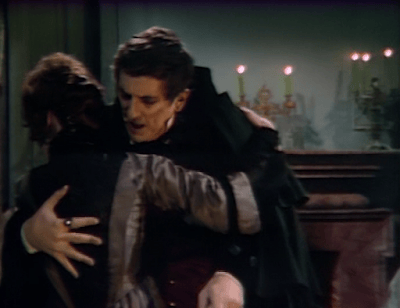
Meanwhile, Angelique is feeling cold and weak because Roxanne has reclaimed so much of her “life force.” She has cast a spell to cause Roger to slip past the police swarming the estate and make his way to her in her old room. Once they are together, she warms herself up for a while by hugging and kissing him. First time viewers may think this is an odd thing for her to do, but returning viewers know that she is a heat vampire who can by those actions drain the warmth from a living body and leave it an icy corpse. Louis Edmonds has been doing some great work these last few weeks, and he plays Roger’s death scene especially well.
Downstairs in the drawing room, Angelique is still shivering. Maggie enters and sees that “Alexis” is ill. Maggie insists on helping, and Angelique suggests she walk her to the fireplace. They sit together beside it. We learned Wednesday that Angelique has magical hypnotic powers, and Maggie’s counterpart in the main continuity was subjected to frequent mind-wipes. So there is a nice sense of inevitability when Angelique puts her into a trance and orders her to get a gun and prepare to shoot Quentin.
Angelique is still sitting by the fire, still feeling miserable, when Barnabas comes back. He tells her that Claude is with Roxanne and that Roxanne will be speaking at any moment. He writes up a confession and orders her to sign it, saying it will clear Quentin of the murder with which he was charged. He says that this will allow her to find peace. She says she doesn’t want peace. We may wonder how the confession could possibly clear Quentin. All she could do would be to admit that the man Quentin is charged with killing actually died because she cast a magic spell on him. We have already seen that the policeman in charge of the case has zero patience for talk about magic, and there is no end of evidence pointing to Quentin’s guilt.
We end where we began, in Angelique’s room with a homicide in the offing. Then it was Roger with his hands around Maggie’s neck; now it is Maggie pointing her revolver at the door as the knob turns. That isn’t all that suspenseful a situation. I’m sure Maggie would feel bad if she had killed Quentin, but he’s so hyper-violent that no one would doubt she acted in self-defense and has been such a bad husband to her that it’s hard to imagine she wouldn’t get over it in short order. If Quentin dies, there will be so few characters left that the show couldn’t go on, but we will probably be leaving this universe in a few days in any case. So this isn’t much of a Friday cliffhanger.
For some time, wicked witch Angelique Stokes Collins has been dissatisfied with her minion Julia Hoffman. What she most wants from Hoffman is information about her new enemy, old world gentleman Barnabas Collins. Yet Hoffman has told her nothing useful about Barnabas. The only time she brings him up is to claim that she was busy following him when Angelique needed her to do something else. Even then, her reports are no more substantive than “He went into town,” without so much as a single name of a person he met or building he entered while there. Hoffman keeps showing friendliness to people to whom Angelique wants her to be hostile, asking questions to which she ought already know the answer, and resisting orders she would usually be eager to follow. Whatever is wrong with Hoffman, Angelique does not propose to put up with it indefinitely.
Yesterday, Angelique found the solution to the puzzle. She learned that she has not been dealing with Hoffman at all, but with her Doppelgänger from an alternate universe. Barnabas came from that universe as well. This Julia is as devoted to Barnabas as Hoffman was to Angelique, and followed him to this reality to take her place at his side. Today, Angelique traps Julia in a secret chamber off the basement of the great house of Collinwood and demands to know what she has done with Hoffman. At length Julia confirms her true identity and admits that she killed Hoffman, but she will not answer any of Angelique’s questions about Barnabas.
Angelique takes out a medallion and tells Julia to look at it. Julia gasps and turns away. She says that she knows about hypnosis and knows how to resist it. Angelique says that if she knows how to resist, there is no reason for her not to look at the medallion, but Julia keeps looking away. Julia was first introduced as a psychiatrist, whose talent for hypnosis was of magical proportions. By showing her medallion to a person, she could erase and rewrite that person’s memory as easily and as completely as one could erase and rewrite a chalkboard. Julia is the heroine of the show now, but longtime viewers will still find it fitting that Angelique turns the tables on her.
Upstairs in the same house, high-born ne’er-do-well Roger Collins is having a conversation with Angelique’s portrait. This is one of several habits Roger has that recall Waldo Lydecker, the sarcastic dandy in the 1943 novel and 1944 film Laura. Lydecker turned out to have murdered a woman with whom he had a strange obsession.
Roger is overwrought, telling the Angelique in the portrait that he should have known she would come back from the dead. If he had, he would have realized it was a waste of time to kill her. He only made things worse by doing that; for one thing, it made it necessary for him to kill his niece Carolyn. As he says this, his sister Elizabeth Collins Stoddard, Carolyn’s mother, overhears. She storms in. He tries to deny that meant anything he said, but Liz won’t be stopped. As Roger presses his hands on Liz’ shoulders, Joan Bennett plays the part of someone being strangled. Louis Edmonds’ fingers are nowhere near her throat. You can’t believe that Roger is hurting Liz, but you can easily believe that Edmonds and Bennett are a brother and sister playing pretend. They look like they’re about six.
Oh, oh, I’m being strangggled!
Just as Roger closes Liz’ body into the storage space under the window seat, Barnabas enters. Roger is on the point of tears, a circumstance Barnabas notices. Roger keeps urging Barnabas to leave the room with him, but he replies that what he has to say will take only a moment. Barnabas says that he is worried about Liz. Roger gets even more upset, and Barnabas finally agrees to go downstairs with him.
For longtime viewers, this scene makes a poignant contrast with #446. In that episode, set in the year 1796, Edmonds played haughty overlord Joshua Collins, father of Barnabas. Joshua discovered that Barnabas had become a vampire. Joshua confronted his son in his hiding place. Joshua was at once horrified and shattered, but in no way intimidated by Barnabas, who was for his part alternately ashamed and petulant. Edmonds and Jonathan Frid made that scene into one of the high points of the series. Now, it is Edmonds’ turn to be the murderer dejected by the knowledge of his own inexpungable guilt, and Frid’s turn to be the upright family man. Barnabas does not know Roger’s secret as Joshua knew his, but in Roger’s inability to face him we see the fear of the same righteous condemnation Joshua had felt it his duty to proclaim.
At one point in this conversation Frid has so much trouble with his lines that the words dissolve into a buzzing sound. I told my wife, Mrs Acilius, that it sounded like Barnabas had briefly turned into Bob Dylan. She roared with laughter and said that was exactly what she was going to say.
This is the first “Parallel Time” episode in which Lara Parker is credited as playing Angelique. Previously she had been billed as Alexis Stokes, the identical twin sister whom Angelique killed when she rose from the dead ten and a half weeks ago and whom she has been impersonating ever since. Several times in the series, cast members have wandered onto the set while the credits were rolling.* Referring to this, Mrs Acilius had explained that they kept using Alexis’ name in case any characters who didn’t know who she really was wandered in while the credits were rolling. She imagined them looking up, widening their eyes, and pointing. She meant that hypothesis as a joke. But since the only character in today’s episode who didn’t know Angelique’s true identity was Liz, who was dead by the time the credits rolled, I think we have to take it as proven.
*Most conspicuously in #703, #635, #510, and #328. There are also moments when crew members can be seen during the closing credits, most spectacularly in #999, when a man is just sitting there eating a sandwich.
Suave warlock Nicholas Blair first joined the cast of characters in June 1968, posing as the brother of Cassandra, wife of Roger Collins. Since Cassandra was an alias that 200 year old wicked witch Angelique was using, we knew right away this could not be so. Nicholas asserted himself as Angelique’s boss, faced down the ghost of the fanatical Reverend Trask, and kept saying that he had a plan that was far more important than Angelique’s petty little scheme to establish herself in the great house of Collinwood and turn Roger’s distant cousin Barnabas Collins back into a vampire. As played by Humbert Allen Astredo, Nicholas kept us believing for weeks that we would be in awe once we heard his plan.
Eventually, Nicholas stumbled upon the fact that Barnabas’ best friend, mad scientist Julia Hoffman, had constructed a Frankenstein’s monster in the course of a project to keep his vampirism in remission. From that point on, Nicholas declared that his plan was to force Julia to make a female Frankenstein’s monster, to mate the already existing monster to her, and thereby to breed a new race of people loyal only to his master, Satan. He’d been on the show so long at that point that his sudden parachuting into the Frankenstein story only revealed that up to that point, all his talk about his grand design had been empty boasting.
Moreover, Nicholas’ plan for the patchwork people did not make sense in the context of the show. In a novel or movie like Rosemary’s Baby, the audience sees the heroine raped with the acquiescence of her husband, and our horror at that crime gives force to the premise that she will bear Satan’s only begotten son, who, in an inversion of the Christian story, will transform the whole world by the very fact of his birth. Stealing fresh corpses, chopping them up, and stitching them together isn’t the same horror as rape, but it is a pretty disgusting way to spend an evening, so I suppose that will get you off to some kind of start. But if your show is on the air for half an hour a day across the board Monday through Friday, your audience has time to sit with Nicholas’ scheme and think through all of the practicalities it implies. The new race is going to take many years to grow and multiply and overtake H. Sap., even if its members all have Soap Opera Rapid Aging Syndrome. What are we all supposed to do in the interim, watch the Frankenbabies through nanny cams? It isn’t an idea for series television.
Nicholas not only saddled himself with a plan that obviously wasn’t going to work, he didn’t deliver on his claim to be a surpassingly talented sorcerer. In #528, Angelique asked him to slip a potion to one of her adversaries. He complained that “I am much too talented to spend my time drugging drinks,” but he complied with the request. Not only did that turn out to be a waste of time, later he would on his own initiative drug a couple of other people’s drinks, again without the results he wanted.
Eventually, Nicholas fell in love with Maggie Evans, The Nicest Girl in Town. That amused Angelique, who taunted him with all the times when he had sneered at her for the humanity she showed in her emotional attachment to Barnabas. As Nicholas grew fonder of Maggie, his powers became less reliable, and his involvement with the main plot became more tenuous. No longer able to make Angelique obey him, Nicholas was reduced to using unsightly ex-convict Harry Johnson as his henchman. By the time the Frankenstein project collapsed and Satan called Nicholas back to Hell, not even Astredo’s considerable acting talent could make us take him seriously.
Nicholas returned in February 1970, just over five weeks ago. At that point the show was mainly concerned with an attempt the writers were making to take some material from the tales of H. P. Lovecraft and make a story out of them. The Leviathan People are Elder Gods who want to reconquer the Earth and destroy humankind. Their harbinger was a shape-shifting monster who had taken the form of a tall young man and invited people to call him Jabe. Jabe was supposed to join with Roger’s niece Carolyn to produce a new race of people.
The Lovecraft material never came together, and by the middle of February the makers of the show were scrambling to find a new direction. Nicholas appears to have been a last-minute replacement for a different sort of villain who was supposed to take over as the chief menace in the second half of the segment. Now they have thrown out that second half and are trying to get to something else before the ratings drop any further. So they brought back an already established character and plugged him into the scenes originally meant to be played by the one they never got around to introducing.
Bringing Nicholas in to the Leviathan arc makes it hard for longtime viewers to ignore the similarities between the Leviathans’ plan to breed a new race and his 1968 plan for the patchwork people, including the shared weakness that if either plan were successful, it wouldn’t leave you anything to put on a daytime soap. Also, Nicholas explicitly acknowledges that he has already failed in one such project, lampshading the problem but not alleviating it. He also keeps bringing up his “Master,” who is clearly still Satan. No other character in the Leviathan arc makes reference to any themes derived from Christianity- everyone else is living in the determinedly non-Christian world of Lovecraft’s imagination. So he seems out of place from the beginning.
The Leviathans’ plan was already nearing collapse when Nicholas showed up. Every time Jabe has used his powers, the results have backfired on him. His personality has alienated all of his allies. And now he doesn’t even want to be a shape-shifting monster anymore- he fell in love with Carolyn, and just wanted to take her on dates and then marry her. Nicholas is supposed to be the trouble-shooter who will turn this troubled operation around, but nothing about him inspires confidence that he is the right person for that job.
Since Nicholas arrived, things have gone downhill for the Leviathan cause even faster than they had been before. In #966, Nicholas watched in horror as Jabe smashed the box from which he originally emanated, causing all of the Leviathans’ other visible belongings to vanish. Nicholas then declared that everything was over, and that the time of the Leviathans was no more. But they still didn’t have another story ready to go, so he and Jabe have continued to hang around. Nicholas still has one follower, Angelique’s estranged husband Sky Rumson, but since there is no reason for Sky to be on the show either, that isn’t much of a basis for Nicholas’ continued presence. On his great blog Dark Shadows Every Day, Danny Horn called Nicholas a “failure demon”; all in all, that would seem an apt classification.
Today, Jabe turns up at Nicholas’ place. Nicholas knows that Angelique cursed Jabe to be plagued by a mysterious shadow not his own that follows him and drives him mad. This much is borrowed from George MacDonald’s 1858 novel Phantastes, but unlike the Reverend MacDonald’s allegory of sin and anxiety this shadow is a physical weapon that will kill Jabe when it grows strong enough. Jabe asked Nicholas to use his powers to lift Angelique’s spell the other day, but Nicholas refused, even though he claimed that he could and he acknowledged that it would have been to his advantage to do so. The opening voiceover today reminds us that Nicholas knows all about the shadow.
Now, Jabe is telling Nicholas that he was wrong to turn against him, wrong to smash the box, wrong to give up his destiny of leading the Leviathans to global dominion. Nicholas dwells on his exhaustive knowledge of the shadow and tells Jabe he can take the shadow from him and set it on Angelique. He begins to hypnotize Jabe. When he seems to have Jabe in a trance, he tells him he does not give second chances, and that he is going to kill him and Carolyn. Jabe suddenly produces the paper cutout Angelique used to place the shadow curse on him and places it on Nicholas’ jacket. He then runs out of the room. The shadow appears and envelopes Nicholas, who collapses. Even though he knew in advance exactly what was going on, Nicholas still could not avoid death as the result of getting slapped on the chest with a piece of construction paper. He dies as he lived, a failure demon to the end.
Sky enters. Jabe returns, and Sky tells him Nicholas is dead. Sky whines that because Nicholas was not human, his death will not be the end of him and Jabe will not get away with killing him. Geoffrey Scott’s appallingly bad acting reinforces the image of Nicholas as a colossal loser- if this was the only ally he had left at the end, he must have been an even more hopeless stumblebum than we had thought. Jabe exits. A moment later, Nicholas’ ghost appears to Sky and tells him to kill Jabe.
Jabe goes back to the great house of Collinwood to tell Carolyn that he is rid of the shadow. They are married now, but have spent very little time together because the shadow has kept chasing Jabe off. She is puzzled by the whole thing, in part because Jabe refuses to tell her anything about his situation, and is unenthusiastic about Jabe’s renewed insistence that they go away immediately. She agrees to leave with him in the morning.
Carolyn goes upstairs. In the drawing room, Jabe hears Nicholas’ voice telling him that he will never escape. Roger’s son, strange and troubled boy David Collins, enters; Jabe tells him that he and Carolyn are going on a trip tonight.
Jabe sent Carolyn upstairs with orders to pack and tell her mother they were leaving, but it would seem she has not complied. She is snoozing in a chair in her room. She has a dream. It begins with Nicholas’ voice rasping at her that it will all end at Widows’ Hill. She then sees Jabe and Sky, lit in groovy psychedelic colors, arguing about Nicholas and fighting near the precipice. Sky throws Jabe over the edge.
Carolyn awakens, calls for Jabe, and rushes out. On her way she tells David that she is going to Widows’ Hill. A moment later Jabe comes along, and David relays this information to him.
Carolyn gets to the top of Widows’ Hill, where Sky is waiting for her. He tells her that the dream Nicholas sent her stopped short of its end, because he did not want her to see her own death. He grabs her by the throat.
Meanwhile, in another universe…
While Jabe, Nicholas, and Carolyn are cleaning up the messes the Leviathan segment left behind, Roger is busy getting the new storyline off the ground. There is a room in the long disused east wing of the great house in which an alternate universe is occasionally visible. Roger goes there, and sees the counterparts of Carolyn and David. They are talking about the boy’s parents, whom Roger ascertains to be, not himself and undead blonde fire witch Laura Murdoch, but the counterparts of his distant cousin Quentin Collins and of Angelique. Everyone else we have seen in “Parallel Time” has the same first name as their counterpart in the main continuity, but David’s is named “Daniel.”
Roger never found out who Cassandra really was, so it is a puzzle for longtime viewers how he knows Angelique’s name. Carolyn and her mother met her under that name at the house she and Sky shared, but somehow did not recognize her as Cassandra. She visited them at Collinwood after her marriage to Sky broke up, but did not see Roger there.
Arrivals and Departures
This is the first time we see this Daniel Collins, but not the first time we are exposed to his name. The closing credits for #958 billed David Henesy not as David Collins, the role he played that day, but as Daniel Collins. I don’t know whether they had already decided that would be his name in Parallel Time and the person making up the credit roll got confused about it, or if the writers thought the goof was funny and gave the character the name as an inside joke.
Also, Mr Henesy played a character named Daniel Collins in February and March 1968, when the show was set in the year 1796. Since they have established that the two universes diverged during that Daniel’s lifetime, he may be this Daniel’s namesake. There is another connection, an accidental one I’m sure but an accident with a bit of an eldritch quality to it. In #350, three weeks before the 1790s segment began and more than sixteen weeks before Daniel made his first appearance, a slip of Nancy Barrett’s tongue left Carolyn referring to David as “Daniel.” It’s odd that the two Daniels were both heralded by these small inadvertences.
This episode marks, not only the final appearance of Nicholas, but also that of Roger. Louis Edmonds will play Roger’s counterpart in the Parallel Time segment, and as these episodes are being taped he is playing still another iteration of Roger on the feature film House of Dark Shadows. He will also be back in another role later on. But all the character development Roger has gone through since we first saw him in episode 1 is at an end.
Monday’s episode gave Roger his real sendoff, and my post about it summed up his history. I will just mention here that when I first saw Dark Shadows, Roger was something of a puzzle to me. That was the 1990s, when I saw it on what was then The SciFi Channel. The first episode I saw was #193, featuring art dealer Portia Fitzsimmons, but I didn’t have a chance to watch it at all regularly until a month or so after that, when Barnabas had already joined the cast. By that point Roger was already very much confined to the margins.
Curious as to when the dazzling Mrs Fitzsimmons would return, I looked online and found what is now the Dark Shadows wiki. I was disappointed to find that she was a one-off character. I also found that her function was to bring to a head a major story centering on Roger. I then looked through the episode summaries of the first weeks of the show. Those were quite terse and indigestible, meant to remind people who had seen the episodes of points they had forgotten. But one thing I did gather from them was that Roger had been a major character when the show started, indeed its chief villain. I couldn’t imagine the sardonic but lovable Roger of 1967 and 1968 in that capacity, and when I finally saw those episodes many years later I was thrilled by Edmonds’ performance.
One of the strongest themes of Roger’s character in his early days as a villain was his open hatred of David. It is nice for longtime viewers that he makes his final exit with an affectionate fatherly hand on David’s shoulder.
Nine year old Nora Collins walks in on her teacher, Charity Trask, being bitten by vampire Barnabas Collins. Barnabas tells Nora to “Look into my eyes!” He hypnotizes Nora and mind-wipes away her memory of him. Barnabas has been on Dark Shadows for more than two years now, and this is only the second time he has pulled the “Look into my eyes!” move with someone whose blood he has not been drinking. The previous occasion was also with Nora, in #756. In the parts of Dark Shadows set in the 1960s, Barnabas is usually paired with mad scientist Julia Hoffman, who is the master of a magical form of hypnosis that allows her to rewrite people’s memories at will. So if Barnabas exercised this traditional vampire power in those segments of the show, he’d be stepping on Julia’s territory. But this episode is part of a time-travel story set in 1897, and Julia is not here.
Barnabas has been exposed and is being hunted by a number of people. His current hiding place is inside a cave. He confers there with his reluctant sidekick, broad ethnic stereotype Magda Rákóczi. Today the show is being taped on new cameras, and the image is crisper and more nuanced than we have seen since it went to color in August of 1967. The cave would barely have shown up through yesterday’s cameras, but it looks nifty today.
Magda is Barnabas’ sidekick, she is quick with lies, and she is played by Grayson Hall, but she does not do hypnosis. Screenshot by Dark Shadows Before I Die.
Magda has stolen a severed hand that a crime boss was keeping in a box, and believes that she can use it to undo a curse she placed on the rakish Quentin Collins. Barnabas is worried that they will not use the hand correctly when the time comes to release Quentin. Since there is no way to test the procedure they plan to use on Quentin, he asks if it will be able to help someone else. Magda says that it should. He has the bright idea to summon Charity. He evidently overate, and she is in danger of dying from loss of blood.
Vampires are metaphors for extreme selfishness, and with this suggestion Barnabas is a case in point. If the hand can lift curses from the people it touches, why does Barnabas not have Magda place it on him? If it freed him of vampirism, that would heal Charity and his other victims, and would allow him to stroll up to the vampire hunters on some sunny day and watch their suspicions of him collapse. But that is out of the question, because he does not know how to control the hand. He is simply using Charity as a laboratory animal.
Barnabas telepathically summons Charity. As it happens, lawyer/ Satanist Evan Hanley is at her bedside. Evan is among the vampire hunters, and knows Charity is under Barnabas’ power. He physically restrains her from leaving her room. Barnabas and Magda despair of bringing Charity and the hand together. The hand then disappears from its box. Magda thinks the hand is simply lost and is terrified that she will not be able to return it to its owner, but Barnabas is serenely convinced that it has gone to Charity under its own power.
This turns out to be true. The hand materializes in Charity’s room. Evan sees it, and, expert that he is in occult lore, exclaims “The hand of Ojden!” It settles on Charity’s face, and when it vanishes the bite marks are gone from her neck and she is once again her brisk, authoritative, and intensely priggish self, no longer a thrall of Barnabas. The hand reappears in the cave next to the box, and Barnabas smugly announces to Magda that it completed its mission.
For some reason, Barnabas’ self-satisfied certitude crumbles and he feels compelled to check on Charity to see that she has indeed been healed. He materializes in her room, but she is not there and the cock is already crowing. When he returns to the cave, Evan meets him, holding up a cross and keeping him from getting back into his coffin.
A woman named Eve sees a man standing on the terrace of the great house of Collinwood. She addresses the man as “Peter Bradford.” Regular viewers know that this is indeed his name, but we also know that he prefers to be called “Jeff Clark.” Peter/ Jeff has died and came back to life since he was first known as “Peter Bradford,” so I suppose you could say that’s a case of deadnaming. But while most transfolk tend to be patient when people inadvertently deadname them, Peter/ Jeff is a huge jerk about correcting people who use his former name. Yesterday twelve year old David Collins called him “Peter Bradford,” and he grabbed the boy and shook him until it looked like he had given him a concussion.
Eve is also a returnee from the world of the dead. Doubly so; her body is a Frankenstein creation made of parts salvaged from corpses, while her memories and personality are those of eighteenth century homicidal maniac Danielle Roget. Peter lived in that same era, and when Eve/ Danielle recognizes him we learn that they knew each other then. Peter/ Jeff doesn’t assault her as he did David; she’s his own size. He doesn’t recognize her, which she attributes to the fact that she looks different than she did when they knew each other. He keeps whining that his name is “Jeff Clark,” but she isn’t having it.
Meanwhile, Peter/ Jeff’s fiancée, well-meaning governess Vicki, is in the drawing room, having a conversation with matriarch Liz. There is a blooper in the middle of this conversation. Liz is supposed to say something like “Then you’ve resolved all your difficulties,” but Joan Bennett stumbles over the words. Alexandra Moltke Isles improvises a response that makes sense of it. That response is smooth enough, but she delivers the rest of her lines very quickly and with unusually little eye contact with her scene partner. Perhaps that is because she was afraid the improvised line was going to put the scene over time, or maybe she realized she had called attention to Bennett’s flub and was nervous because she had embarrassed a big star.
Or maybe Mrs Isles was nervous because her next scene was going to be with Peter/ Jeff, and she knew it would involve Roger Davis putting his hands on her. As they exit, Peter/ Jeff clutches Vicki by wrapping his arms around her in a remarkably awkward fashion, and she visibly squirms. This is most likely Mrs Isles’ discomfort arising from Mr Davis’ habit of physically assaulting his scene partners. A charitable viewer just might be able to believe that it is Vicki’s discomfort because Peter/ Jeff just spent the whole scene telling her transparent lies. He doesn’t want to tell her about his encounter with Eve/ Danielle, and makes up totally unconvincing excuses for his distracted state. Perhaps Mrs Isles channeled her unhappiness at being yoked with Mr Davis into her expression of Vicki’s dissatisfaction with the loathsome little man she is engaged to marry.
Peter/ Jeff steers Vicki offscreen.
Once Vicki and Peter/ Jeff are gone, Eve/ Danielle emerges from the bushes whence she had been spying on them. Liz comes out to the terrace and sees Eve/ Danielle. She asks who she is. When she does not answer, Liz tells her that she knows- she is the angel of death. Eve/ Danielle is startled by this, and hurries away.
The next scene takes place in the house of suave warlock Nicholas Blair. Nicholas has been keeping Eve/ Danielle there since she came to life. She has returned from Collinwood. Nicholas is upset with her for going out without his permission. She taunts him, and he slaps her. He threatens to kill her, and she says that while she does not know what his plans are, it is clear to her that she figures too prominently in them for him to do that.
Coming so shortly after we saw an actress give strong signs of unease at contact with Roger Davis, Nicholas’ slap to Eve/ Danielle’s face is a lesson in how professional actors handle scenes involving physical violence. Eve/ Danielle is relaxed before the slap and in shock after it. Her reaction gives the scene its energy. If Marie Wallace had reason to believe Humbert Allen Astredo would actually hit her, she may well have been as tense before the slap as Mrs Isles was before Roger Davis slithered his arms around her, and the scene would have dribbled out as lifelessly as does Peter/ Jeff’s scene with Vicki.
Once Nicholas concedes that Eve/ Danielle is important to his plans, she relaxes again and decides she may as well tell him about her encounter with Peter/ Jeff. Nicholas is intrigued, and disturbed. He tells Eve/ Danielle that “If it is true that they are one and the same, then there are forces at work here that I don’t know about.” Eve/ Danielle’s memory of her previous existence is very incomplete, and she wants Nicholas to help her to learn more about herself. Once he has heard about Peter/ Jeff, he is eager to oblige. He hypnotizes her.
At this point, my wife, Mrs Acilius, expressed frustration. “He’s going to hypnotize her and afterward she won’t remember anything! It’s only interesting if she remembers.” Eve/ Danielle does have a flashback to 1795, but at the end she seems to come out of the trance on her own. She turns to Nicholas, calls him by name, and says that she remembers Peter Bradford and she loves him. Since Nicholas doesn’t give her a post-hypnotic suggestion and snap his fingers, it seems likely she will remember her past with Peter.
When Danielle was introduced, I assumed that the name “Roget” was a case of deadline-induced selection. She is based on Madame DuFarge from A Tale of Two Cities, so she had to be French. But the writer didn’t have a list of French surnames at his fingertips, so he looked at his desk, saw a copy of Roget’s Thesaurus, and went with that. Perhaps that was what happened, but today Eve/ Danielle lives up to her namesake and goes into the synonym business. She calls Peter/ Jeff by his original name. She is on the receiving end of synonymy from Liz, since “the angel of death” is as good a name for her as any. And one of the memory gaps Eve/ Danielle wants Nicholas to help her fill is her previous name.
Marie Wallace plays Danielle in the flashback, even though she had mentioned in the first act that she looked different in those days. This occasions much discussion on the fansites. Here is the debate on the Dark Shadows Wiki:
During the fiashback scene, Danielle Roget should have been played by Erica Fitz instead of Marie Wallace. Fitz had previously portrayed Danielle Roget in episode 594, so it would have made sense and for character continuity to continue using the same actress. [Addendum: There are strong reasons to argue otherwise as well. One could argue that this is a memory that Nicholas is conjuring in Eve, so it’s from Eve’s perspective, and she would naturally see herself in her current guise, not even knowing what Danielle Roget looked like. This is also a reasonable place for dramatic license to prevail. The scene is very short, and it wouldn’t have been especially practical to have an additional actress. It’s also possible that viewers may have been confused if another actress was in the scene–Erica Fitz was on the show for only two episodes, so viewers at the time might not even have seen or not fully remembered what she looked like. Aside from that, it’s also possible Erica Fitz was not available.]
Discussion under “Bloopers and Continuity Errors” in “610” on The Dark Shadows Wiki.
In a comment on his own post about the episode on Dark Shadows Every Day, Danny Horn puts it more succinctly:
Yeah, I think the in-universe explanation is that the flashback pictured at the top of this post is Eve’s hypnosis-assisted memory of the event, so she’s picturing herself as she is now.
The real-world explanation is that Marie Wallace is playing Eve/Danielle now, and exactly nobody wants Erica Fitz to come back and appear in the flashback.
Comment left 23 March 2015 by Danny Horn on “Episode 610: Inexplicable You,” Dark Shadows Before I Die, 21 March 2015.
For my part, I’m sure Erica Fitz Mears is a very nice lady, and we should all give her money to help with her health problems. But no, she was not a good actress and I do not regret that she did not get more work on screen. Since Mrs Mears was only in two episodes, today’s flashback might have been an opportunity to give some other actress a chance to show what she could do as Danielle. But Miss Wallace does a very good job, and rounding the episode with two confrontations between the same pair of performers does a great deal to strengthen its structure. It would probably have been a mistake to cast anyone else in the flashback.
The flashback scene does come as bad news to longtime viewers, for reasons that have nothing to do with the casting of Danielle. When in November 1967 the show needed to develop a backstory for vampire Barnabas Collins, it took us back to 1795 and introduced Angelique, a maniacal ex-girlfriend who was determined to disrupt Barnabas’ new romance. That was a triumph that turned Barnabas from a stunt that boosted their ratings sufficiently to ward off cancellation into one of the major pop-culture phenomena of the 1960s, and Angelique herself became one of the show’s most important characters. That they are trying the same tactic with Peter/ Jeff, right down to a dramatic date of 1795, leads us to fear that they see him as a permanent part of the cast, and that they want to tie Eve/ Danielle as closely to him as Angelique is tied to Barnabas.
Frankenstein’s monster Adam has threatened to kill everyone in the great house of Collinwood unless old world gentleman Barnabas and mad scientist Julia create a mate for him. They are to do this by building a woman out of parts scavenged from corpses and draining someone’s “life force” into her. Adam has a crush on heiress Carolyn, so he insisted she be the “life force” donor. Under the influence of suave warlock Nicholas, Carolyn volunteered to serve in that capacity. On Monday, Adam figured out that Carolyn is in love with him, so he told her there was no need to complete the procedure. They could just marry each other. She reacted to that with evident confusion, her own feelings competing with Nicholas’ spell. Nicholas’ influence won out, and Carolyn insisted on going through with the experiment.
The experiment failed to bring the mate to life, and left Carolyn badly injured. After a soulful conversation with Adam in the upstairs bedroom, she lost consciousness. Julia pronounced her dead. Adam then went to Barnabas and declared that he would make good on his threat. He knocked Barnabas down and stalked out of the house. When Julia saw how badly Barnabas was hurt, she went back up to the bedroom to get her medical bag. She found that Carolyn’s body was gone.
Barnabas and Julia wonder where Carolyn’s remains could be and how they can prevent Adam killing everyone. Barnabas’ servant Willie returns to the house to tell them about another crisis. In May and June of 1967, when Barnabas was a vampire, Maggie, The Nicest Girl in Town, was his victim. He imprisoned and tortured her. In August of that year, Julia abused her position as Maggie’s psychiatrist to hypnotize her so that she would forget all about her ordeal. Now Maggie’s memory has come back, and Willie is keeping her locked up in the hidden chamber of the old Collins family mausoleum. Willie tells Barnabas and Julia that Maggie has figured out how to get out of the chamber, and that she is staying there now only because he knocked her out with chloroform. It’s just a matter of time before she gets away.
Willie also says that he saw Adam a few minutes before. Adam was sitting quietly under a tree. He did not have Carolyn’s body with him. Julia wonders if that means that Adam has decided not to go through with his threats, but Barnabas is not so optimistic.
In the Mausoleum
We see Maggie awaken in the mausoleum. She goes to open the door, only to find Julia standing behind it. Julia blocks the exit and enters. Maggie is afraid Barnabas has sent Julia to kill her. Julia can deny that, but denies nothing else Maggie says. Maggie confronts her as Barnabas’ accomplice and walks toward her; Julia backs away, and Maggie chases her around the coffin in the center of the little space. Julia tells Maggie that she will never get out of the chamber unless she cooperates. Julia tries to hypnotize Maggie, but that only succeeds in reminding her of how Julia erased her memory before. Julia admits that she did that, and tells Maggie her only hope for survival is to let her do it again. Maggie says she would rather die than submit to such a thing. When we first met Julia, she was a doctor whose ambition to treat a vampire led her to betray a patient’s trust, but who could still tell herself that she was serving a greater good. Now, we see that she has lost her moral compass completely. This scene is a showcase for both Grayson Hall and Kathryn Leigh Scott.
A Fanfic Interlude
Julia has been inseparable from Barnabas long enough that it is possible for daily viewers to forget that she was introduced in scenes with Maggie, and that it was by betraying Maggie’s trust that she earned her place as a main character. This scene reminds us of that history, but it doesn’t really make sense. Julia must know that if she calls on Maggie in the hidden chamber where she is being held prisoner, it will be obvious to her that she is in league with her captors. If she wants Maggie trust her so that she can hypnotize her, she will have to deceive her in some way. Julia is the show’s most fluent and plausible liar, so you might assume she would have come up with an effective stratagem.
Mrs Acilius and I came up with a method that might have worked. Imagine an episode that opens with Maggie alone in the hidden chamber. The door opens, and Willie enters. Maggie confronts him with enough information to bring the audience up to date with her situation. Maggie hits him with something, stunning him momentarily. She is opening the door when he grabs her and puts a cloth over her nose. She passes out.
After the opening titles, Maggie comes to in her old prison cell in Barnabas’ basement. She finds that Julia is also there, chained to the wall. Julia tells her that she has only recently discovered the full truth about Barnabas, and that he locked her up to keep her quiet. Maggie knows how close Julia and Barnabas have been for the last year, and is skeptical. At the end of Act One, Maggie is still unsure whether she can trust her.
In Act Two, Barnabas comes in and threatens both women. He lets slip that Maggie found a way to escape from the cell in June 1967. By the time he leaves, Maggie believes that Julia is on her side. In Act Three, Julia asks Maggie how she escaped the year before. That part of Maggie’s memory hasn’t come back, so Julia offers to hypnotize her so that she will remember. Maggie agrees. Julia produces her medallion, and Maggie goes under. We dissolve to the aftermath of the hypnosis. Maggie is asleep on the cot in the cell; she is smiling. Julia is taking the fetter off; it was never locked. Barnabas and Willie open the door; Julia says that Maggie’s memory has been wiped clean again. She will be asleep for an hour, so they should take her home now.
That would not only remind us how Julia began, show us how she has turned out, and explain how Maggie lost her memory, but it would also give us a glimpse of the old, evil Barnabas who first made the show a hit. Barnabas spent his first year as a bloodthirsty ghoul pretending to be a kindly cousin from England; it would be interesting to see the humanized Barnabas pretending to be his old self.
Meanwhile, In the Episode They Actually Made…
Julia leaves the mausoleum and goes back to Barnabas’ house. She tells him the hypnosis failed. At that, Barnabas decides the time has come for him to go to the surviving members of the family in the great house and tell them the truth. Julia tries to talk him out of it, and he says he will do what he can to “exonerate” her from responsibility for the crimes they have committed together. But with Adam and Maggie both at large, he feels he can no longer keep secrets. Just as Julia has lost her conscience it seems that Barnabas, who earlier this week told Julia he would murder Maggie if she couldn’t keep her quiet, may at last have found his.
At the door of the great house, Barnabas wrestles with doubts:
I can’t go through with it. I can’t tell them Carolyn is dead. I’d be forced to tell them about the experiments, Adam, everything Julia and I have done. And if the truth starts to come out, where will it end? Where?… No. I can’t think about that. The family has to know that Carolyn is dead–how she died! I have to tell them no matter what happens to me. No matter what happens. I must tell them!
He finally knocks on the door, and is thunderstruck when Carolyn opens it, looking the picture of health. This might have been an effective surprise if Barnabas’ voiceover soliloquy hadn’t given us ninety seconds to think about who might open the door, and realize there is only one possible candidate.
In August 1967, Maggie Evans, The Nicest Girl in Town, was about to expose old world gentleman Barnabas Collins as a vampire. In the nick of time, Maggie’s doctor, mad scientist Julia Hoffman, hypnotized her and blocked all memory of her time as Barnabas’ victim.
Today, suave warlock Nicholas puts a magical zap on the mind of heiress Carolyn Collins Stoddard to induce her to take part in an experiment meant to produce a mate for Frankenstein’s monster Adam. All this mind control makes for a low level of suspense. If traumatic memories can be erased and personal motives overriden by whatever mumbo-jumbo is convenient, there is no reason to suppose that the story’s events will have consequences or that there is any point in getting to know the characters.
This episode includes a tacit acknowledgement of the problem. The other day, Willie Loomis, Barnabas’ bedraggled servant, overheard Barnabas and Julia discussing another evil plan for Maggie. Willie has a crush on Maggie, so he resolved to foil that plan. He has abducted Maggie and is holding her in the hidden chamber inside the old Collins family mausoleum. This turns out to be the worst possible choice of location. Barnabas tortured Maggie there when she was his victim, and in a series of dream sequences those events come back to her. At the end of this episode, Maggie exclaims “I know what Barnabas Collins is!”
Now, Barnabas is not in fact a vampire at the moment. An experiment involving the creation of a Frankenstein’s monster freed him from the effects of that curse. But it would cause a lot of trouble for Barnabas, Julia, Willie, and the plot if Maggie were to go to the police and identify Barnabas as the man who held her prisoner. So Maggie’s closing exclamation might encourage us to hope that the show will swear off its habit of turning its characters into each other’s puppets.
Professor Timothy Eliot Stokes has been harboring a fugitive in his apartment for some time. The fugitive, known only as Adam, is a very tall, extremely strong man whose vocabulary was limited to a handful of words when he met Stokes. He has been learning at a prodigious rate, and can now carry on conversations. Stokes gives Adam a break from reading the dictionary and asks him to recount his earliest memory.
Adam speaks once more in isolated monosyllables as he tells the story of waking up on a table and seeing old world gentleman Barnabas Collins. Barnabas’ friend, psychiatrist/ blood specialist Julia Hoffman, then jabbed him with a needle. After a car ride, he found himself chained to a wall in a small room where Barnabas’ servant Willie Loomis was bad to him. Adam broke the chain and attacked Willie, then Barnabas beat him. Stokes is trying to decide what to make of this story when a knock comes at the door. He sends Adam to read the dictionary quietly in the back bedroom while he deals with his visitors.
They are well-meaning governess Vicki Winters and her boyfriend, an unpleasant man named Peter. Vicki wants Stokes to hypnotize Peter in hopes of breaking through the total amnesia that covers all of his life up to the last few months. Stokes sends Vicki away, and puts Peter under.
Peter tells him that a mad scientist named Lang compelled him to assist in the construction of a Frankenstein’s monster, and that Barnabas and Julia were in on the project. Stokes puts two and two together. He brings Adam into the room, and Peter identifies him as Lang’s creation. Still under hypnosis, Peter refuses to regress any further into his past, fearing that he, too, might be one of Lang’s products.
Stokes calls on Vicki at the great house of Collinwood. Vicki says that it makes no difference to her what Peter’s background is; Stokes tells her that she is lying, because if that were the case she would not have taken Peter to him to be hypnotized. When Dark Shadows began, Vicki represented the audience’s point of view; since then, she has tended to be simply a Good Person. It is extremely rare to hear any suggestion that she might have a selfish motive, and even rarer for her to be credibly accused of deception. For Vicki fans, it is intriguing to think that the show might allow her to be a complex character who has secrets and behaves unpredictably.
Stokes meets the suave Nicholas Blair, whom Vicki introduces as the brother of Cassandra Collins. Stokes knows that Cassandra is a wicked witch, and he recognizes Nicholas as a man he saw months ago in an antique shop handling a curio associated with Cassandra. Nicholas denies that he was that man, saying that he is new to the area and there are many people who look like him. Nicholas is such a distinctive looking man that he must know that Stokes will know that he is lying, but it does put a stop to the conversation.
Stokes tells Vicki that she must leave Collinwood at once. He explains that if she does not, she “will have the dream,” that “Barnabas Collins will be your beckoner,” and that this means Barnabas will die. She protests that she cannot have “the dream,” because Sam Evans died before he could tell it to her. He insists that Nicholas and Cassandra will find a way to make her have it. This will be total gibberish to anyone watching for the first time. Regular viewers will know what it means, but most of them will wish they didn’t, since it refers to a slow-moving, heavily repetitious plot that they had hoped the show had decided to abandon.
Adam the Frankenstein’s monster has abducted heiress Carolyn and taken her to an abandoned structure. Carolyn says the structure looks like a root cellar. She doesn’t have a television, or she would have recognized it at once. It’s the old Flintstone place.
Adam was created in an experimental procedure mad scientist Julia Hoffman completed, an experiment that Julia’s late colleague Eric Lang designed to free old world gentleman Barnabas Collins from vampirism. The experiment was a success, but Barnabas and Julia are the world’s worst parents. They have kept Adam chained to the wall of the prison cell in the basement of Barnabas’ house for the first three and a half weeks of his life. As far as Adam is concerned, it is normal for people to confine one another in underground spaces.
The cell was in the basement of the house when Barnabas and his little sister Sarah were growing up there in the eighteenth century; in #260, we found that Sarah had found a secret passage leading out of the cell, suggesting she must have spent a lot of time there in her nine years of life. Perhaps the cycle of abuse that Adam is perpetuating goes back a very long way.
Barnabas is out searching for Adam and Carolyn. Julia is in his house, along with his servant Willie. Julia finds that Willie has had a nightmare and is compelled to tell Carolyn about it. The nightmare is part of The Dream Curse. One person after another has the same dream, which the audience sees dramatized every time. Then that person wrestles with a compulsion to tell the nightmare to someone else. We usually see that, too. Finally, the person does tell the dream, giving a speech to repeat the material to us yet again. This time-waster will go on indefinitely, and is supposed to end with Barnabas reverting to vampirism.
Julia knows all about this. She had the dream herself, and has interacted with others who have had it since. Today, she tries to hypnotize Willie into forgetting the dream.
It is very strange Julia hasn’t tried this before. She has a phenomenal ability to use hypnosis to erase memories, so regular viewers would expect her to turn to that right away. When she starts giving Willie the instructions, kaleidoscopic colors pulse on the screen, suggesting that she will have yet another great triumph. Willie does have a vision of Carolyn in the Flintstone house, so Julia must have unlocked his capacity for extrasensory perception. But he still remembers the dream, and is still driven to tell it to Carolyn.
The sheriff comes by. He tells Julia and Willie about evidence that Adam has a connection with the house. They deny everything. Willie is a panicky mess. He is still upset because of the dream, and the barking of the police tracking hounds outside triggers his memories of the nights when Barnabas’ bloodlust prompted dogs to howl. Julia is able to parry all of the sheriff’s questions and observations, but she is too shaken to produce her usual stream of perfectly plausible lies.
Adam comes to the house. He is hungry, and it is the only place he has ever seen food. The sheriff sees him, threatens to shoot him unless he stops, and opens fire immediately. Adam isn’t killed; in fact, he is so healthy that it takes twenty (20) men to subdue him and take him to gaol.
The sheriff sticks around and tells Julia and Willie that Adam gave them a look of recognition. Julia dismisses that, and the sheriff protests “I’m not a stupid man!” Regular viewers know that he is in fact an utterly stupid man, and that Julia is extraordinarily intelligent. Typically, she wouldn’t need more than five seconds to distract him from whatever was on his mind and get him chasing after an imaginary squirrel. But she is so run down from the ongoing crises that she is reduced to challenging him to “Prove it!”
Mrs Johnson, housekeeper in the principal mansion on the great estate of Collinwood, isn’t herself. She had a nightmare a week ago, and ever since has been plagued with a compulsion to tell its details to strange and troubled boy David Collins. She knows that if she does, David will have the same nightmare, the same compulsion to tell it to some third person, and that if he does that person will suffer the same complex. She doesn’t know that the nightmare is part of a curse sent by wicked witch Angelique, or that at the climax of the curse old world gentleman Barnabas Collins is supposed to revert to the vampirism that afflicted him from the 1790s until last month. But she does know that it is part of something horrible, and she has tried desperately to keep it from continuing.
Mrs Johnson spent a couple of days with her sister in Boston to stay far from David, but she kept having the nightmare there. She has given up, and has come back to Collinwood. She does not go straight home to the great house, but stops first at the Old House in the estate. Barnabas lives there, but it is Barnabas’ friend Julia Hoffman she sees. Julia had passed the dream to her. Julia urges Mrs Johnson not to tell David about it. She replies that she knows she should not tell him, but that she has no more choice in the matter than Julia had in telling her.
This scene will raise a question in the minds of regular viewers. Julia is a medical doctor doubly qualified in hematology and psychiatry; she also has developed a method of hypnosis so powerful that she can virtually rewrite a subject’s memory, confining even very intense recollections to the depths of the unconscious mind, sometimes after an acquaintance of only a few minutes. Why doesn’t she try to hypnotize Mrs Johnson into forgetting the dream? All she actually does is slap her and repeat her command to avoid David.
David turns up. His father has sent him to ask Julia to come to the great house at her convenience. Julia tries to manage the situation by sending Mrs Johnson home first and keeping David in the house for a while. After Mrs Johnson leaves, Barnabas’ servant Willie enters and tells Julia there is an emergency in the basement. David agrees to wait for her to come back, but once she is gone he shouts that he will be playing outside.
We follow David out the front door, and find that Mrs Johnson is there waiting for him. She comes up on him from behind and says she has something to tell him. This scene will startle regular viewers. For nineteen weeks, from #365 to #461, Dark Shadows was a costume drama set in the 1790s. In that period, Clarice Blackburn played repressed spinster Abigail Collins and David Henesy played Daniel Collins, heir to the Collins fortune. We first saw Daniel in #431, when his Aunt Abigail intercepted him on this very spot and scolded him for playing at the Old House. Abigail was enforcing rules and believed she was acting in Daniel’s best interests; now the same actors invert the scene, showing us Mrs Johnson doing something she knows to be wrong and harmful to David.
Maggie Evans, The Nicest Girl in Town, isn’t herself. Some emerald earrings mysteriously appeared in her purse the other day, and when she tried them on she got a faraway look on her face, began speaking in a voice different from her own, and a tinkling music played on the soundtrack. Today her boyfriend Joe tells her that he took the earrings and showed them to a jeweler and to the police. The jeweler valued them at $15,000* and the police said that they didn’t match the description of any jewelry that had been reported missing. Maggie was not only irked that Joe had taken the earrings without her permission, as anyone might be, but when he tries to get her to agree that such expensive things don’t just materialize out of thin air her usual level-headedness and cheerful disposition vanish and she becomes childishly defensive. Maggie does not know that Barnabas’ servant Willie placed the earrings in her purse as an attempt to reestablish the connection the two of them had when she was Barnabas’ prisoner in the Old House. As a result of Julia’s hypnosis, she does not even remember what Barnabas did to her. But after she runs Joe off, she is compelled to go to the Old House.
Again, regular viewers will recognize an echo of an earlier episode, in this case one that aired a year ago. When Maggie was Barnabas’ victim in May 1967, she snapped at Joe and drove him out of her house as she does today. Then too, she headed for Barnabas once Joe was gone.
Maggie doesn’t find Barnabas at the Old House. Instead, she sees Willie. Barnabas had framed Willie for his crimes against Maggie, and Willie was confined to the mental hospital Julia runs. Barnabas and Julia have brought him back to the Old House to help with their latest nefarious scheme. Willie had been Barnabas’ blood thrall; it is not clear to the audience just what effect it had on Willie when Barnabas’ vampirism went into remission. When we first see him today, he is playing with an unloaded rifle and grinning maniacally, reminding us of the dangerously unstable ruffian he was before Barnabas first bit him.
Maggie knocks on the door and asks Willie if she can come in. He falls over himself inviting her. He becomes the friend he tried to be to her during her imprisonment. She says she knows that he wasn’t the one who hurt her, and he is overjoyed. She seems blissful. He asks her out on a date; she says that Joe wouldn’t like it. Before Barnabas, Willie propositioned all the young women and threatened all their boyfriends, and at first this approach, like his gleeful handling of the rifle, suggests that dangerously unstable ruffian is back. He assures Maggie that he only wants friendship, but after she leaves he picks the rifle up again and says that Joe will be out of the way soon.
For her part, Maggie’s behavior does not represent a reversion to her time as Barnabas’ prisoner. Rather, the earrings seem to have done what Barnabas tried to do when he bit her, imprisoned her, and subjected her to a series of role-playing exercises. Her personality is showing signs of giving way to that of Barnabas’ lost love, gracious lady Josette. In #260, Barnabas told Maggie “You are Josette!”; in #370, we saw that he was right, inasmuch as Kathryn Leigh Scott played both characters, as Zita Johanns had played both Helen Grosvenor and Princess Ankh-Esen-Amun in the 1932 film The Mummy, from which Barnabas’ Josettification project was borrowed. The tinkling melody that plays on the soundtrack when Maggie wears the earrings is that of Josette’s music box; this could be a sign that her memory of what Barnabas did to her is coming back, since he forced her to listen to the music box for hours on end. But the voice she speaks in at those times is the voice Miss Scott used as Josette, and her blissfulness reminds us of Josette’s first scenes with her beloved Barnabas, not of Maggie’s captivity in the ghoul’s dungeon.
Back at Collinwood, Mrs Johnson watches David sleep. She tells him she is sorry for what she has done and for what he will suffer. Clarice Blackburn was always good, but she outdoes herself with this speech. It is a beautiful performance.
David has the nightmare. The first several dream sequences in the Dream Curse storyline ended with the dreamer opening a door, seeing something scary, and screaming. David’s goes a step further. There is a gigantic spider web behind the last door he opens. He not only sees it, but is tangled in it when he starts screaming. He awakes, still screaming, and Mrs Johnson holds him.