
Episode 1052: Marked for murder

In #969, vampire Barnabas Collins was in the east wing of the great house of Collinwood. He opened a door to a room which, like all other rooms in that long-disused area, was bare and vacant. But he did not see it as it was. Rather, he saw the same space brightly lit, fully furnished, and richly decorated. Women who appeared to be matriarch Elizabeth Collins Stoddard and mad scientist Julia Hoffman were in the room, bickering in a way Liz and Julia never would about matters neither Liz nor Julia knew anything about. After a moment, this apparition dissolved and Barnabas could see the empty room.

Over the next two weeks, Barnabas and others at Collinwood witnessed the same phenomenon a few more times. In #970, Julia told Barnabas that Professor Timothy Eliot Stokes, expert on all topics relevant to whatever needs explaining, had told her about the many worlds hypothesis. She wondered if the room represented a portal between alternate universes, in which similar people lead different lives. Barnabas conceived the hope that he might escape the vampire curse and become human again if he could cross over into the universe that occasionally becomes visible in the east wing. He managed to make the crossing in #980, but found that his curse had followed him to the new continuity.

In #1002 and #1003, we saw that the phenomenon also operates in reverse. In the new continuity, Quentin Collins went to the east wing and opened the door, expecting to find the fully furnished room, but instead saw the bare room as it exists in the main continuity. There, he could see and hear children David Collins and Amy Jennings talking about how “Dr Hoffman” had told them that they should avoid the room because Barnabas got trapped there. Quentin saw the main continuity again in #1007, wicked witch Angelique caught a glimpse of it in #1008, and Barnabas and Quentin saw it together in #1012.

In #1031 and #1032, Barnabas returned to the main continuity for a brief visit. He met Julia in the room where the phenomenon occurs. He neglected to tell her that the people in the other universe can sometimes see and hear what is said in that room, and that he has already had to deal with suspicions from Quentin and Angelique because they have heard her saying that someone named Barnabas has crossed into their universe and that he is under a curse.

In #1035, Julia’s counterpart, the housekeeper in the great house, was looking into the room and heard that Barnabas is a vampire. Since Angelique already regarded Barnabas as an enemy and this Julia Hoffman was Angelique’s most fanatical devotee, she made her way to Barnabas’ coffin with a hammer and stake. She was in the act of bringing the hammer down in #1036 when Julia herself showed up behind her and beat her to death. Julia had crossed over from the main continuity to take her place at Barnabas’ side. She stole Hoffman’s French maid outfit, assumed her identity, and became a double agent, pretending to spy on Barnabas for Angelique when she is really spying on Angelique for Barnabas.

Lately, Angelique has been getting suspicious of Julia. Julia tells Barnabas about this. He urges her to go back to the main continuity. She tells him “I’ll be all right for now.” Later, she tells Barnabas she is going on a covert mission to meet Quentin, who is hiding from the law in a cave. He says this is too risky; she again says “I’ll be all right.” He stares at her silently for a long moment. Even Barnabas knows that a character who says “I’ll be all right” twice in one episode is doomed.

Angelique is in the east wing when she hears voices coming from the room where the phenomenon occurs. She opens the doors and sees the counterparts of Quentin and his wife Maggie. They are talking about Julia’s decision to follow Barnabas out of their native universe. They refer to Julia as “Dr Julia Hoffman” and talk about her extreme devotion to Barnabas.
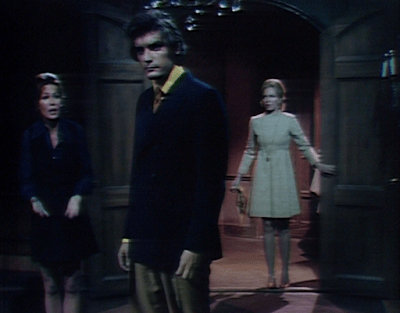
Maggie and Quentin have an eavesdropper. Screenshot by Dark Shadows Before I Die.

Julia reaches the cave where Quentin is hiding. She has talked him into going with her when Angelique shows up. Angelique claims that the police are swarming the area and that Quentin will be caught if he tries to leave. He obeys her instructions to take shelter in a tunnel deep in the cave. Julia asks what is going on, and Angelique replies with a question of her own. “First of all, I want you to tell me just exactly where you were going to take Quentin, Dr Hoffman.”

With this line, the “Parallel Time” segment has nowhere to go but its climax. Julia is the heroine of the show and the main audience identification character. This function is usually served by a character who is played by an actress twenty years younger than Grayson Hall was in 1970 and who does not spend as much time as Julia does covering up murders and making a mockery of all that is holy. But that’s who we’ve got, and once the self-pitying vampire for whom she has an all-consuming unrequited love rescues her from the arch-villainess the story will be over.

There are a couple of things today that make me wish “Parallel Time” had started differently and gone on a lot longer. The scene between the Maggie and Quentin of the main continuity includes a moment when Maggie says something Quentin regards as foolish, and he replies by saying “Maggie…” in a slow, irritated voice. This is the hallmark of the Parallel Time version of Quentin with whom we’ve spent the last twelve and a half weeks. The parts the actors take in the costume drama segments tend to influence the characters they play when they come back to a contemporary setting, and the purpose of Parallel Quentin seems to have been to find a new path of development for the original Quentin. But Parallel Quentin’s contempt for his wife has been a dead end, and hearing the charming rascal who took the show by storm in 1969 echo it strikes a sour note. If they had started with several weeks of a relationship between Quentin and his new bride that we could root for and then shown it slowly falling apart under the witch’s malevolent power, there might have been space to find something new in Quentin. But the breakneck pace of story progression to which Dark Shadows has been committed since the end of 1967 precludes anything like that.

Angelique mentions to Quentin that Maggie’s father Sam Evans died under circumstances that have never been fully explained, and that there are reasons to believe that his own father had a guilty secret in connection with it. That might have been an interesting thing to let the audience know before we came within sight of the end of the segment. Not only could it have given Quentin and his new wife something to feel interestingly uncomfortable about, but it would mirror the first 40 weeks of the show, in which the Sam Evans of the main continuity carried the heavy burden of a secret pertaining to an incompletely explained death. Longtime viewers might be excited to see that story turned inside out.
Episode 982: Keep the bottle full

In #210, dangerously unstable ruffian Willie Loomis found a coffin wrapped in chains in an old mausoleum and jumped to the conclusion that it was full of jewels. He broke the chains and opened the coffin, only to find that it actually contained vampire Barnabas Collins. Barnabas bit Willie and enslaved him.

Now, Barnabas has traveled to an alternate universe. In this “Parallel Time,” Willie’s counterpart is a writer, the author of several novels and of a biography of Barnabas’ own counterpart, who died a natural death in 1830. This Will Loomis lives in the Old House on the estate of Collinwood, which corresponds to Barnabas’ home in his own universe. Will’s wife, the former Carolyn Collins Stoddard, was the first person Barnabas met upon arriving in Parallel Time. Barnabas took Carolyn as his blood thrall, and he has shown her a room in the basement of the Old House that she never knew existed. He stashed a coffin there.

Three of Will’s novels were bestsellers made into feature films, but he and Carolyn are now acutely short of funds. We see why today. Carolyn explains to Barnabas that Will won’t be home until the Eagle closes. Barnabas asks what the Eagle is. He should know- that was the name of the tavern in his Collinsport in the 1790s and again in 1897, and he knew it in both eras. The same place was called the Blue Whale in the 1960s in the main continuity, but evidently it kept its old name here.

Will comes staggering home. He recognizes Barnabas’ profile from a sketch of the subject of the biography he wrote. Carolyn explains that Barnabas is that man’s descendant. When Barnabas says that he read Will’s book and admires it, Will brightens, as authors do, and says that the occasion calls for a drink. At first he insists on putting Barnabas up as a houseguest, free of charge, but Carolyn persuades him to let Barnabas pay rent. It’s anyone’s guess how Barnabas will be paying for anything- he stumbled into “Parallel Time” quite inadvertently, without stuffing his pockets or putting on a money belt or making any other preparations. But Will and Carolyn have an extensive discussion about charging Barnabas rent in this scene, and they bring it up again later. Evidently the writers want us to think about it.

The next day, Will suggests that he and Carolyn go to the great house on the estate to meet the new mistress, the bride of Carolyn’s uncle Quentin. Carolyn pleads a migraine, and Will goes by himself. Housekeeper Julia Hoffman is about to introduce him when he cuts her off. He tells the new Mrs Collins that he knew her father. She is the former Maggie Evans. The past tense about her father Sam is news to returning viewers- yesterday Sam was mentioned in terms that left it unclear whether he was still alive, and we might have hoped to see him. In the main continuity, Sam was killed by a Frankenstein’s monster in June 1968, but that monster would not have existed in this universe.

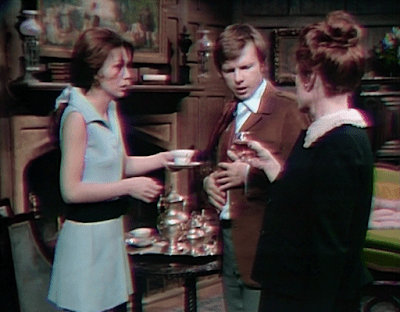
Will says that he and Sam spent many a night drinking together at the Eagle. The new Mrs Collins is not visibly pleased to be reminded of her father’s drinking habit. She offers Will a cup of tea, and he refuses. He avers that tannic acid is bad for the health. Hoffman is at hand with a glass of brandy, and she chuckles when she agrees with him that she can tell Maggie his views about beverages. Hoffman leaves, and Will urgently whispers to Maggie that he must not trust Hoffman.

Will does not approve of tannic acid. Screenshot by Dark Shadows Before I Die.

Later, Maggie will go to Angelique’s old room in the east wing of the house and overhear Hoffman telling the portrait of Angelique that hangs there that she has her on the run. Hoffman cackles with glee at Maggie’s discomfort. Maggie opens the door and asks her what’s going on; Hoffman quickly composes herself and says that the staff hasn’t had a chance to tidy up the east wing sufficiently to welcome the new mistress.

Back in the Old House, Will wonders why Carolyn seems so weak. She passes out, and he sees the puncture wounds on her neck. At daybreak, Will waiting for Barnabas by the coffin. He holds him at bay with a large cross and forces him to explain who he is and where he came from. Barnabas tells Will to let him die. Will says he has other plans. He orders Barnabas to open the coffin. There is an even larger cross mounted inside the lid. He says that he will get a book out of Barnabas, and that that book will be his salvation. He makes Barnabas get in the coffin, and chains it shut. To the extent that this universe is a mirror image of the one we have known, we might have expected that Will would believe he could obtain a fortune by putting chains on the coffin, as Willie thought he could obtain one by smashing them off.

The scene between Will and Maggie brings out several of the problems with the current A story, a reworking of Daphne Du Maurier’s Rebecca in which Maggie is the second Mrs de Winter and Hoffman is Mrs Danvers. Maggie Prime has an iconography that goes back to #1, which makes it hard for us to believe that would be overwhelmed by the subtle intimidations that overwhelm Du Maurier’s anxiety-ridden heroine. When we met the Sam of the original continuity in June 1966, he was an alcoholic. Even after the story that was supposed to make Sam’s alcoholism interesting fizzled out and he was retconned as a social drinker, Maggie retained many Adult Child of an Alcoholic traits, such as beginning each utterance with an irrelevant laugh. So Maggie’s reaction to Will’s reminiscence about boozing it up with Parallel Sam goes a long way to confirming that this is the same ol’ Maggie we’ve known all along and leads us to expect her to be as capable as Maggie would be of meeting the challenges before her.

Also, while Kathryn Leigh Scott is a wonderful actress and a great asset to the show, she makes a bad choice in playing Maggie Collins. In the costume drama segment set in 1897, Miss Scott started out as neurotic intellectual Rachel Drummond. Rachel was terribly fragile, the survivor of an abusive childhood that left her with paralyzingly low self-esteem. Miss Scott went small as Rachel, taking a subtle approach that required us to watch her closely as we tried to figure out what she was feeling and thinking. But as Maggie Collins, Miss Scott cycles through five or six facial expressions per minute and crafts a distinctive emphasis on multiple syllables per sentence. The directors famously didn’t give the actors much guidance on Dark Shadows– John Karlen said that when he first took on the role of Willie, all Lela Swift told him was “Go!” But either Swift or today’s helmsman, Henry Kaplan, should have taken Miss Scott aside and told her she was overacting and giving Maggie Collins too vivid a personality.

Further, Will is only one of many allies who present themselves to Maggie in her showdown with the memory of Quentin’s first wife, the glamorous Angelique. The second Mrs de Winter feels herself all alone at the estate of Manderley, but Maggie can’t very well feel that way at Collinwood. Not only do people who live there keep making it clear they are on her side, she has a sister to whom she starts writing a letter today, who represents support from and connection with the outside world.

Worst of all, Hoffman is absolutely transparent. In the novel, it is not clear until the very end whether Mrs Danvers is even hostile to the second Mrs de Winter. Du Maurier keeps us guessing for 400 pages whether the whole thing is in the protagonist’s fevered imagination. But the cackling Maggie overhears when Hoffman is having her conversation with the portrait is not even the most flagrant sign she has so far given of her plans.

I outlined these and other objections in a long comment on Danny Horn’s post about this episode on his great Dark Shadows Every Day in January 2021. I still agree with most of what I wrote there, and will be coming back to the topic many times over the next few months.