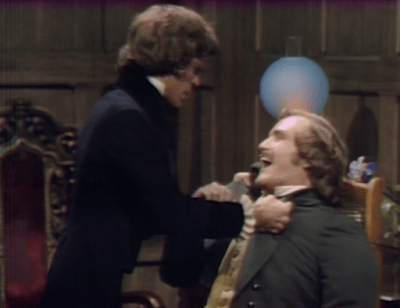
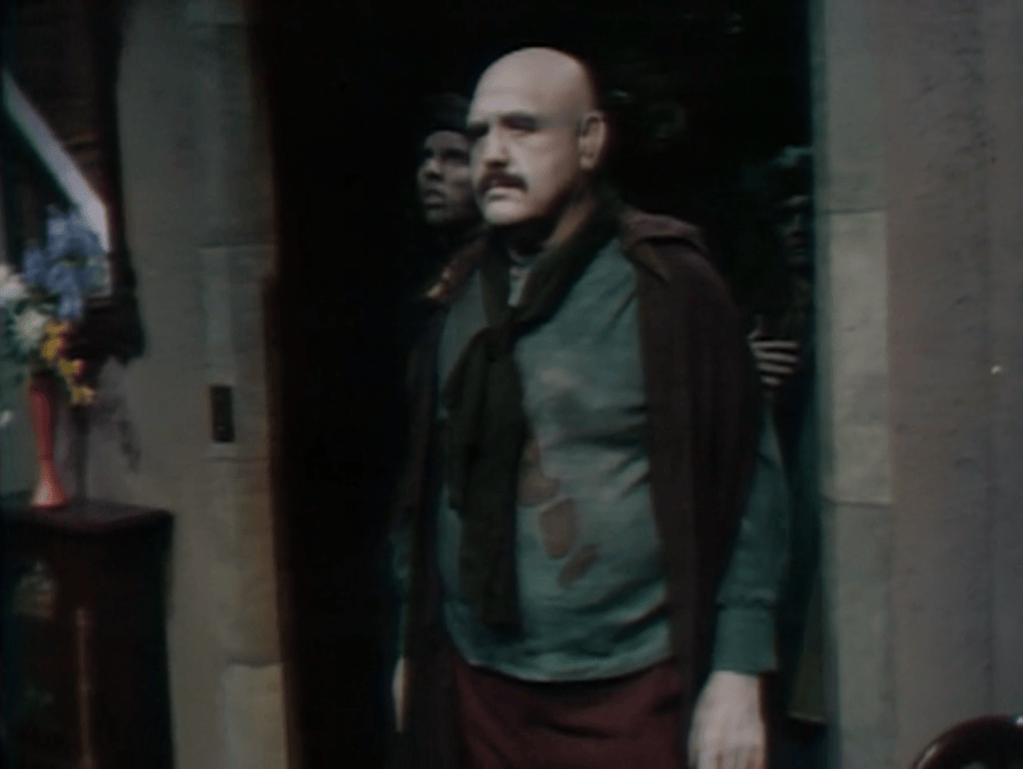
The narrative voiceover that opened #202 told us that a new addition to the cast of characters, dangerously unstable ruffian Willie Loomis, was destined to “awaken and unleash a force that will affect the lives of everyone.” In #209, the voiceover identified this “force” as “the darkest and strangest secret of them all.”
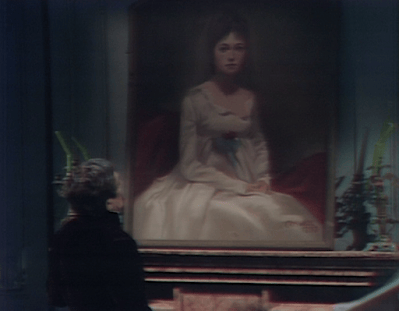
In his first five appearances, Willie was played by Mississippian James Hall. In #205, Hall’s Willie was escorted to a portrait we had seen for the first time under the previous day’s closing credits. Strange and troubled boy David Collins identified its subject to Willie as Barnabas Collins, a name we had not heard before. Soon Willie started to hear a heartbeat coming from the portrait, and it led him to a mausoleum in a rarely visited part of the old cemetery north of town. In #210, Willie, now played by John Karlen, inadvertently opened a secret panel in that mausoleum and found a chained coffin in the secret chamber behind it. He opened that coffin, hoping to find the jewels that once belonged to Barnabas. In fact, he found Barnabas himself, a vampire who would enslave him.
In the fall of 1970, the feature film House of Dark Shadows was playing in theaters around the USA. In that movie, Karlen again plays Willie. That version of the character is led to the mausoleum not by a heartbeat he hears through a the portrait of Barnabas, but by a riddle he finds in an old book:
The Madonnas rest high above
The Lion’s head watches the dove
And in the womb beneath the hill
A blazing light glows bright and still.
As in the show, so in the movie Willie opens the coffin expecting to find a fortune in jewels, only to find Barnabas’ hand darting for his throat. As in the show, the movie version of Willie becomes a slave whom Barnabas beats unmercifully.
Now, the show is set in the year 1840. Karlen plays Desmond Collins. An evil spirit emanating from a severed head Desmond brought home with him from Macau has taken control of him. As Willie heard the heartbeat from the portrait of Barnabas, so Desmond hears a voice from the head. The head wants to be reunited with its body, which is buried somewhere in the Collinsport area. Yesterday Desmond brought a man named Otis Greene to his room. Greene was under the head’s control in 1803, when he brutally murdered four people. Desmond showed the head to Otis, who was horrified. Desmond demanded to know where the body was, and kept shouting in Otis’ ear even after Otis clutched his chest and started gasping. He managed to get a few cryptic remarks out of Otis before he fell dead to the floor: “The noose, a ring of gold, the stairs, top of the hill, direct line, an unmarked stone.”
A woman named Leticia Faye enters. Leticia sees Otis’ body on the floor and asks Desmond why he killed him. Leticia has psychic powers, so she quickly realizes that it was not really Desmond, but the head that is responsible. Desmond menaces her and demands she keep quiet.
Later, Leticia returns to the room and notices the body is gone. When she asked “Where’s the body?,” my wife, Mrs Acilius, laughed out loud. It’s as if she is noticing that Desmond has removed a piece of furniture. Desmond says that Otis’ son came and took it away. One might wonder how that went. There were no telephones in 1840, and we haven’t seen any servants at Desmond’s house. So Desmond must have gone to Greene’s son in person, told him he had his father’s body in his room, and asked him to come fetch it.
Leticia herself is a reference to Willie’s early days on the show. As seagoing con man Jason McGuire brought Willie to Collinwood to play a never-specified part in his plan to cheat the Collinses out of their money, so seagoing con man Gerard Stiles brought Leticia to play a never-specified part in his pursuit of the same objective. Before we saw Willie, we saw Jason talking on the telephone to someone named Chris who wanted to join him at Collinwood and with whom he had an ambivalent relationship. We might have assumed that “Chris” was short for some such name as Christine or Christabel and that she was a girlfriend or wife who was going to complicate Jason’s plans to impose himself on matriarch Elizabeth Collins Stoddard. When the name Chris was dropped and Willie put in its place, we saw it wasn’t quite that way, but as Dennis Patrick played Jason and both James Hall and John Karlen played Willie, we wondered if it might have been somewhat that way. There was something a lot more complicated in the emotions they showed in their scenes together than what could be explained by what we saw.
Leticia is upset with Gerard these days. He married Samantha Collins, widow of Quentin Collins, lady of the great house of Collinwood, and sole heiress to the Collins fortune. That seemed to seal his triumph, and left Leticia out in the cold. The marriage was only a few hours old when it turned out Samantha wasn’t a widow after all. Quentin turned up alive and well six months after he went missing during a mishap at sea. Now Samantha has to decide whether to go back to Quentin, leaving Gerard where he started, or to go with Gerard, going him a wife to support somehow. Leticia mocks Gerard bitterly for the dismal alternatives he now faces.
House of Dark Shadows left the audience to do a lot of guesswork as to how the characters got from one place to another, and indeed as to where exactly any given scene was supposed to be taking place. Among other things, it never explained how the riddle led Willie to the mausoleum. Today, Desmond goes to his cousin Gabriel Collins to ask for help deciphering Otis’ cryptic remarks. Gabriel mentions a place called Gallows Hill; that reminds Desmond that Otis said his grandfather was the executioner, and between them they figure out where to go.
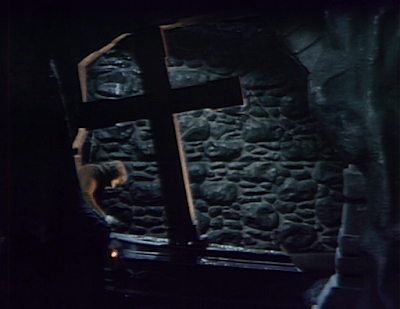
In both #210 and House of Dark Shadows, Willie opened the secret panel in the mausoleum in the old cemetery by pulling a ring that was connected to a cable. Today, Desmond pulls a ring on a small headstone in an old cemetery and opens a secret panel on the ground next to it. As Willie walked down stone steps and found a chained coffin behind the panel, Desmond walks down stone steps and finds a coffin. This coffin is held shut, not by chains, but by a large cross wedged between it and the ceiling of the chamber.
Desmond finds that the lid of the coffin is divided into two parts. He can open the small part at one end. inside it, he finds what Willie had hoped to find, many precious jewels. They are embedded in a golden face mask.
Six months ago, in the spring of the year 1840, a man named Gerard Stiles came to the great house of Collinwood bearing a sad tale. Quentin Collins, heir to the house and all the family’s fortune, had been washed off the deck of a ship at sea with his son, Tad Collins. Gerard had done what he could to rescue them, but Quentin and Tad could be presumed dead. Gerard was invited to stay at the great house as a guest, and that is where he has been ever since. Quentin’s widow Samantha has married Gerard, and Quentin’s father Daniel has said he thinks he should adopt Gerard. The couple stands to inherit everything once meant for Quentin, much to the dismay of Quentin’s younger brother Gabriel.
Now, Quentin turns up at the house, alive and well. The audience might have seen this coming, but the audience is familiar with the story of Alfred Lord Tennyson’s poem “Enoch Arden,” either from reading it in school or from seeing one of the many plays and movies based on it. Since that poem won’t be published until 1864, the characters are at a disadvantage.
Enoch Arden saw how happy his wife was with her new husband and decided to slink off into the darkness, never telling them he was alive. Quentin is even more gallant, telling Samantha that he will respect whatever decision she makes. If she chooses to resume her life with him, he will do his best to make a go of it; if she chooses to stay with Gerard, she can go with his blessing.
Quentin goes to the drawing room, and sees a man whom he recognizes as a distant cousin recently come to the house from England. He has been told that Barnabas Collins is visiting, and that he is a dead ringer for the portrait of his late father that hangs in an upstairs bedroom. What he does not understand is why Barnabas reacts to the sight of him with a shocked exclamation of “Quentin!” He asks how he knows him, and Barnabas claims to have seen a drawing of him.
The truth is that Barnabas is a time-traveler from the year 1970. In that year, Gerard’s ghost will precipitate a disaster that will destroy Collinwood and everyone in it. He recognizes Quentin because Quentin looks just like his great nephew, another Quentin Collins who is a friend of Barnabas’ in that future time.
Another ghost who was prominent in 1970 but who has not yet been seen in this period is that of governess Daphne Harridge. In fact, none of the 1840 characters has heard of Daphne, and the governess at Collinwood is someone named Hortense. Returning viewers have been in suspense as to when we would see Daphne. That suspense is ruined today when Kate Jackson does the opening narration. Barnabas spots a figure skulking about in the woods at the end of the episode; he’s the only one who is surprised to see that it’s Daphne.
Gabriel Collins is frustrated by his lot in life. His father, the demented Daniel Collins, had planned to leave the family’s entire fortune to Gabriel’s brother Quentin. When Quentin’s friend, Gerard Stiles, reported that Quentin and his son Tad had been washed overboard during a storm at sea and were to be presumed dead, Daniel saw no need to change his will. Quentin’s widow Samantha is now Daniel’s sole heir. Gabriel, his wife Edith, and their two children are to receive nothing. As a wheelchair user, Gabriel’s prospects for employment in the year 1840 are quite dim, to say the least.
Over the last few days, Gabriel has been trying to improve his odds of inheriting by blackmailing Gerard into murdering Samantha. Now, Gerard and Samantha have come back from a trip to the village of Collinsport. Gabriel is disappointed to find that Samantha is still alive, and shocked that she and Gerard have married. He recovers his composure and tells the happy couple that Daniel will surely disinherit Samantha now.
Gabriel goes to Daniel’s room, the locked cell at the top of the tower on the great house at Collinwood. Daniel is kept there because of his unfortunate habit of mistaking women for his late wife and trying to murder them as he did her. How Gabrel got his wheelchair up the stairs to the tower room is not explained. Indeed, he is continually turning up by himself in rooms on every floor of the house, which no one asks any questions about.
Daniel tells Gabriel that Gerard asked him for Samantha’s hand in marriage and that he gave his blessing. Gabriel says that has has a complete dossier proving that Gerard is guilty of many crimes, probably including murder. This does not impress Daniel in the least. Daniel says that he ought to adopt Gerard, who is the sort of man who should be his son.
Gabriel has somehow got himself back downstairs to the drawing room. He tells Samantha that he knows facts about Gerard that she does not know. She refuses to listen to him, and leaves the room with an airy laugh.
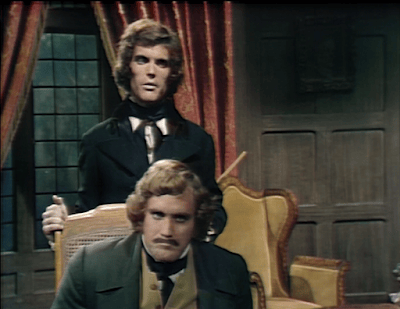
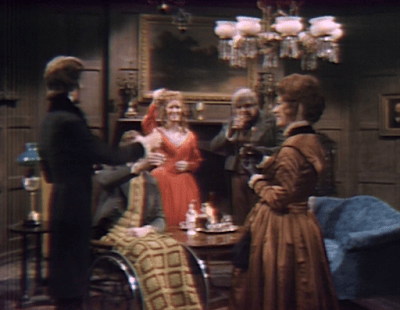
Gerard enters and gloats about Samantha’s loyalty to him. Gabriel tries to leave the room. Gerard grabs the back of his wheelchair and holds him in place. Yesterday, Samantha slapped Gabriel in the face, and it was proof of Christopher Pennock’s success at making Gabriel a man we love to hate that we could sympathize with her. But that sympathy also grew from our fondness for Samantha. We’ve seen Gerard do nothing but run con games, and we know that he is fated to be the face of a terrible disaster at Collinwood in 1970. Appealing as James Storm is, Gerard has shown us nothing we can like. His assault on Gabriel is therefore much more outrageous than was Samantha’s. That’s as it should be- we’re supposed to be outraged. Gerard tells Gabriel that he has to be “a good boy” if he knows what’s good for him. There’s no way saying that can make us root for Gerard, no matter how much we may loath Gabriel.
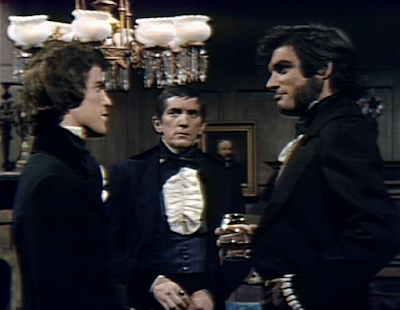
Gabriel’s cousin Desmond enters. He congratulates Gerard, but soon makes it clear he does not approve of the marriage. Gerard storms out, and Gabriel asks Desmond to run an errand for him. He gives Desmond a letter and says that if he presents it at the bank, they will give him his safe deposit box. Desmond agrees to bring Gabriel the box.
Gerard calls on Daniel in the tower room. Daniel tells Gerard that he reminds him of Quentin. This is rather a bold move on the part of the writers. The first version of Quentin we met was an evil ghost who haunted the great house starting late in 1968; we first met Gerard as an evil ghost haunting Collinwood earlier this year. The stories of the two hauntings were both adaptations of Henry James’ novella The Turn of the Screw, and had a great deal more in common with each other than with the source material. James Storm’s costume and hairstyle as Gerard even evokes David Selby’s as that original Quentin.
In March 1969, the show traveled back in time to 1897 and we met that Quentin as a living being. He was the great-nephew of the Quentin who preceded Gerard as Samantha’s husband. He was a violent, drunken wastrel. We saw him with his siblings and other denizens of the great house who already knew all about those lamentable qualities, so he wasn’t trying to fool anyone. Since the 1897 Quentin had David Selby’s charm and easy manner and spoke in the witty dialogue of Violet Welles, we couldn’t help but like him. We saw that for all his faults, he truly loved his young nephew Jamison Collins, and we could root for that relationship. It was hardly a surprise that Quentin soon caught on with a large audience, making Mr Selby Dark Shadows’ second major breakout star.
The first such star was of course Jonathan Frid as vampire Barnabas Collins. Though Gerard may look like a miniaturized version of Quentin, so far in the 1840 segment he has been more like Barnabas. As Barnabas presented himself to the Collinses in the great house in 1967 as a living man, their long-lost cousin from England, so Gerard is continually pretending to be something he is not. We first heard of Barnabas as, in the words of the opening voiceover, “the strangest, darkest secret of all,” first learned of his supernatural presence as a disembodied heartbeat emanating from his portrait, and first saw him as a hand clutching the throat of the luckless Willie Loomis, so we knew that he was a monster; likewise, we first saw Gerard as an immensely destructive ghost.
The major difference between Gerard and Barnabas is that we still haven’t got to know Gerard. Barnabas set aside his “cousin from England” act when we saw him alone with Willie, whom he terrorized and beat unmercifully. The contrast between Barnabas’ savage cruelty to Willie and his suave pretense with everyone else kept us interested until the collapse of his first crazy scheme, his attempt to erase the personality of Maggie Evans and replace it with that of his lost love Josette. Then, we saw some glimmers of recognizable human emotions coming through his horrible personality, and we started wondering what sort of person could become what Barnabas was.
Gerard’s mask has slipped a couple of times, but only to reveal other masks underneath. We’ve seen that he was cheating Gabriel when he led him to think he was going to murder Samantha for him, and even his assault on Gabriel today is cloaked in passive-aggression, holding his wheelchair instead of hitting his body. In #1113, we saw him alone with Cockney showgirl Leticia Faye, whom he had brought with him to Collinwood as part of a scheme to get money out of the Collinses. The more he talked to her about that money, the more sure she seemed to be that she wasn’t going to see any of it, whatever Gerard managed to do for himself. So far, Gerard has been a type, Con Man, and a function, Villain. We have yet to see any reason to expect that he will become a character. Though Gerard is the face of The Destruction of Collinwood as we saw it a couple of weeks ago, before the trip back in time to 1840, Gabriel seems to be a much more promising addition to the cast at this point.
Gabriel and Samantha are in the drawing room. He tells her that his wedding present for her should be arriving at any moment. He also tells her that he hired Gerard to kill her, which she immediately dismisses as a lie. She tells Gabriel that he is as insane as his father. A few seconds later, Gerard brings Daniel downstairs. It is not clear whether Daniel heard her; if so, we wonder whether he would be more offended at being used as an exemplar of insanity or at being compared to Gabriel, the son whom he hates with such an unreasoning passion.
Gabriel objects that it is unsafe to let Daniel out of the locked room. Daniel replies that Gabriel is just like his mother. Since Daniel is obsessed with his murder of Gabriel’s mother, that response goes a long way towards explaining why he hates Gabriel so much.
Desmond shows up with Gabriel’s safe deposit box. Gabriel opens it in front of everyone, with much ado about how its contents will expose Gerard for what he really is. The box turns out to be empty. We remember that Gerard and Samantha went to the bank before their wedding, and wonder how he got into the vault and emptied the box. Though if we are wondering whether we will ever see Gerard do anything other than run games on people, the emptiness of the box may strike us as a suitable comment on what Gerard really is.
It seems that nothing can stop Gerard. Samantha embraces him and tells him he has made her forget all about Quentin. At that, the doors swing open and there’s Quentin, saying “I’m home!” As my wife, Mrs Acilius, pointed out, we’ve seen so many people eavesdrop through those doors over the last four years that it is hard to believe Quentin did not hear Samantha telling Gerard she was no longer thinking of him.
Alfred Lord Tennyson’s 1864 narrative poem “Enoch Arden,” about a man lost at sea who returns to find that his wife has remarried in his absence, was hugely popular for a century after its publication, inspiring plays and movies, and prompting legislative bodies around the world to adopt laws defining the period after which a missing person could be declared legally dead. Dark Shadows adapted so many other hits of nineteenth century English literature that it is frankly a bit surprising it’s taken them this long to get around to it.
From November 1967 to March 1968, Dark Shadows was a costume drama set in the 1790s. In that period, we learned how scion Barnabas Collins first became the vampire we had met in April 1967, and more importantly learned that he could be interesting even if he were not a vampire.
We also met much-put-upon indentured servant Ben Stokes. Ben was played by Thayer David, who first joined the cast of Dark Shadows in 1966 as crazed handyman Matthew Morgan. Matthew was so maniacally devoted to matriarch Elizabeth Collins Stoddard that he inadvertently killed a friend of hers whom he imagined to be her enemy and was about to deliberately murder another of her favorite people, well-meaning governess Victoria Winters, when the ghosts who haunt the estate of Collinwood emerged from the background and did him in. When we met Ben, he was as open-hearted and kindly as Matthew was dark and twisted.
Barnabas was the one member of the Collins family who took a liking to Ben. He taught Ben to read. Later, Barnabas would press his father, haughty overlord Joshua Collins, to free Ben from his indenture. When Barnabas became a vampire, Ben repaid his kindness by protecting him and abetting his crimes. Eventually, Ben’s devotion to “Mistah Bah-nah-bahs” led him to recreate the very crimes that triggered Matthew’s destruction, killing a man in the course of a struggle and murdering a woman in cold blood. We saw that he and Matthew were two versions of the same character. Ben became what Matthew was after a few months in the shadow of the Collins family curse. Matthew had spent his entire life in the shadow of that curse, and so he was doomed from the beginning.
Barnabas brought the vampire curse on himself when he met the gracious Josette, jumped to the conclusion that she could never love him, and consoled himself in a brief affair with her aunt’s maid Angelique. Unknown to Barnabas, Angelique had a talent for witchcraft. When it turned out that Josette did love Barnabas and agreed to marry him, Barnabas cast Angelique aside. Humiliated and enraged, Angelique used her powers of witchcraft to make him into a ghoul and sentence him to exist forever without love. The vampire curse was dramatically satisfying, because Barnabas had been so selfish that it was fitting he should be reduced to a metaphor for extreme selfishness. And Angelique’s declaration that anyone who loved him would die gave an extra pathos to his underestimate of his own lovableness.
As his involvement with Angelique led to Barnabas’ destruction, so Ben’s involvement with her blighted his life. He met Angelique in #372, and thought she was making a sexual overture to him. Without further ado, he walked up to her and took her in his arms. She gave him something to drink first, which made him the victim of a spell that subjected him to her will. As Angelique’s slave, he did harm to Barnabas and others whom he loved, filling him with anguish and self-loathing. Ben did not share Barnabas’ selfishness, so there would have been little point in making him a vampire. But his desperate response to Barnabas’ kindnesses suggests that he, too, believes himself to be unlovable.
Now, the show has traveled back in time again. Mad scientist Julia Hoffman, Barnabas’ devoted friend in 1970, escaped a disaster in that year by passing through a time warp that took her to 1840, when the seeds of the disaster were planted. Barnabas used some mumbo-jumbo to project his 1970 personality into his body as it was in 1840 and joined her there. The two of them needed help establishing themselves in the Collinwood of that period. They found that Ben was living there and that he was still devoted to Barnabas. Ben was very old, but also amazingly resourceful. He was able to provide Julia with contemporary clothing and a set of luggage that she seemed to have left at the Collinsport Inn, and to substantiate the story that Barnabas and Julia were the son and daughter of the original Barnabas Collins. Now they are securely ensconced in the bosom of the Collins family. At the rate Ben has enabled them to go, Julia and Barnabas should be able to solve all the problems they face in another week or two.
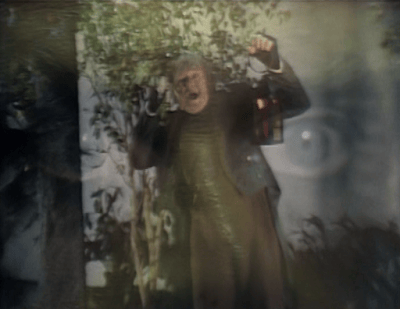
Of course, it cannot be so. Ben sees that Desmond Collins, a cousin of the Collinses who live in the great house, has brought a severed head back from a trip to the southeastern coast of China. Ben recognizes this loathsome thing as an object that was mentioned in connection with a series of murders many years before. He has gone to Desmond’s home, a mansion known as Rose Cottage, and left a book with a chapter about the murders and a note urging him to destroy the head. He also spent some time looking at the head and telling it he was going to see to it that it was destroyed. That turns out to have been unwise; when Ben is walking home through the woods, the head appears to him and he cries out in distress. The next morning, Ben’s corpse is found. It looks as if he tried to cut his own head off.
The Happy Couple
In March 1969, Barnabas began the longest of all Dark Shadows’ excursions backward in time when he went to the year 1897. When he arrived at Collinwood, the matriarch of the house was dying. She was Edith Collins, nonagenarian widow of Gabriel Collins. On her deathbed, Edith reminisced about the difficult relationship she and her darling Gabriel had with Gabriel’s father, Daniel Collins, master of Collinwood. At the time, that startled longtime viewers. We had seen Daniel as a twelve year old boy in the 1790s segment, and he seemed pleasant enough. But if we were to believe that he was the man his daughter-in-law remembered decades after his death, he grew up to be bitter and estranged from his own nearest kin.
We have met the adult Daniel, and he is indeed a difficult sort. He is confined to the tower room in the great house because of his unfortunate tendency to mistake women for his late wife and to try to kill them as he killed her. He also has dementia, so that people have to keep telling him which members of the family are dead and what year it is. In fairness to Daniel, these points are extremely difficult for anyone to keep track of on Dark Shadows. We’ve also heard that Daniel has a heart condition that medical science as of 1840 is powerless to do anything about.
We have met Gabriel, too. He uses a manual wheelchair to get around; apparently he is quite skilled with it, since he keeps appearing in rooms on every floor of the house without any apparent assistance getting up and down stairs. He is a vicious bully, a characteristic Edith did not bring up in her deathbed reminiscences.
Today, we meet the young Edith. She is played by Terrayne Crawford, who in the 1897 segment played lady’s maid Beth Chavez. We haven’t seen her on the show since Beth’s final appearance in #880, though she did have a small part in the feature film House of Dark Shadows which was in theaters at this time.
Unlike the dying Edith of 1897, this version of the character despises Gabriel. There is an amusing idea in there. Perhaps in the 57 years between what we see today and what we saw then, Edith talked herself into believing that she and Gabriel had a lovely marriage and that only Daniel’s hostility gave them trouble.
If that was an idea they were planning to develop, they probably should not have given the part of Edith to Miss Crawford. She seems to be a very nice person, but she had severe limitations as an actress. All of the roles in the 1897 segment included dialogue which called for the depiction of multiple layers of feeling at once, and Miss Crawford was alone among the cast in failing to meet this challenge even a single time. So when Beth tells a devastatingly handsome married man that she doesn’t want him to make passes at her, that’s all there is to it- she simply does not want that, and he simply is a jerk for continuing to do it. We can see no conflict within her to set up a story in the course of which she will stop resisting his charms and begin an affair with him.
Eventually they started writing Beth as a one-dimensional character. That allowed Beth to be part of the story, but they did have to sacrifice some themes they had apparently meant to develop. So in her first appearance, Beth reacted with alarm when a Romani character dropped a hint that she was going to reveal to the Collinses that Beth was Romani, too. That fit with Beth’s origin as a servant who had come to Collinwood in the train of Jenny Collins, who was herself secretly Romani. But delivering on it would have required Beth to have more complicated feelings than Miss Crawford could be relied on to portray, so that was laid quietly to one side.
Showing the audience that Edith is the sort of person who will, in her own mind, eventually retcon her crappy marriage into a great but haunted romance would place even greater demands on a performer than would showing that Beth is hiding the facts about her ethnic background. But as we see her today, Miss Crawford seems to have become an even worse actress than she was playing Beth a year ago. She keeps changing her tone of voice in the middle of her lines for no apparent reason, making us wonder if she is trying to suppress the hiccups. That isn’t because she is tense- on the contrary, she is relaxed and comfortable, with a big grin on her face, an inexplicable affect when every conversation Edith has consists of everyone reviling and threatening everyone else.
Gabriel is in a good mood despite Edith’s loathing for him. He is blackmailing the evil Gerard Stiles into murdering Samantha Drew Collins, widow of his brother Quentin Collins. This will leave Daniel with no choice but to leave the Collins fortune to Gabriel. Samantha has no suspicion that anything like this is going on, but she does know that Gabriel hates her and cordially returns his hatred.
Gerard has told Gabriel that he will give Samantha a poison that will cause her to have a fatal stroke while he and she are in the village and Gabriel is at home, so that she will die in front of witnesses and no one will suspect him even if it is discovered that the stroke was artificially induced.
Gerard comes back to Collinwood. Gabriel menacingly says that “If you tell me anything went wrong…” Gerard replies that nothing went wrong. It is done. Delighted, Gabriel asks for all the details. Gerard says that he and Samantha made a stop at the police station to arrange for Ben’s body to be released for burial. Gabriel asks if it happened at the police station. Gerard says no, then goes on to say that they went from there to the bank. Gabriel asks if it happened at the bank. Gerard says no. He then says that they went to the courthouse. Gabriel is thrilled at the idea that it happened at the courthouse, and Gerard confirms that it did happen at the courthouse.
Gabriel asks where the body is now. Before Gerard can answer, the front door opens and the body comes walking in. What happened at the courthouse was not Samantha’s death. It was Gerard and Samantha’s wedding. Gabriel is dumbfounded.
When he first joined the show in January 1970, Christopher Pennock had some troubles with line delivery that limited him almost as badly as Miss Crawford’s weaknesses limited her. But he has grown by leaps and bounds over the last ten months, and he really breaks through as Gabriel. The three “It happened in the–” questions and his responses to the answers they elicit are pattern from a bit that was old when Gallagher and Shean did it in vaudeville in 1910, but he and James Storm execute it so well that it feels fresh today. The expression on his face when he learns that Samantha has married Gerard is just exquisite.
The measure of Pennock’s success came earlier in the episode, when Samantha slapped Gabriel in the face. Virginia Vestoff is likable enough that her characters can get away with almost anything, but not even she could sell an audience on an able-bodied person who physically assaults a wheelchair user. But Pennock has established Gabriel as such an utter louse that we can see Samantha’s point.
Also in this episode, Samantha clears the toys out of a space known as “The Playroom.” It is explicitly acknowledged that her son Tad had outgrown the toys in it long before, a point the fans like to make whenever The Playroom is mentioned. Samantha has set aside her earlier resolution to leave the room unchanged to honor Tad, who was washed away in a storm at sea and is presumed dead, along with his father Quentin. She has decided the time has come to move on from the past.
The time warp that brought Julia to 1840 was localized in The Playroom, so we wonder what clearing it out will do to the prospects for a return trip. Also, The Playroom occasionally popped into being, complete with Tad’s old toys, in 1970 and in 1995, due to the influence of a bunch of ghosts of people from this period. So while first-time viewers will not likely find any significance in Samantha’s redecoration project, returning viewers may have many questions about it.
From March to June 1969, during a segment of Dark Shadows set in the year 1897, John Karlen played inveterate prankster Carl Collins. Carl could barely contain the manic glee his own practical jokes inspired in him, even though they rarely moved anyone else to more than irritation. A childlike man, Carl quickly dissolved into helplessness before even the slightest challenge.
Now, the dramatic date is 1840. Karlen is Desmond Collins. We met Desmond yesterday, and he seemed to be cut from the same cloth as Carl. He has returned from a trip to East Asia, and has brought a severed human head in a glass display case. His mother Flora reacted to this object with horror, as one would expect. In response, Desmond kept insisting that there was nothing frightening about the head and averring that he could not understand Flora’s reaction. His demeanor is calm and mature, setting him apart from Carl. But as regards the head, his judgment seems to be just as ludicrously poor.
Desmond does show good sense in one matter. Yesterday, Desmond expressed distrust of two people who have recently presented themselves at the great house of Collinwood under the names Barnabas and Julia Collins. Julia and Barnabas have identified themselves as brother and sister, and have said that their father was the Barnabas Collins who lived on the estate in the late eighteenth century and left for England in the 1790s. Desmond talks with Barnabas in the drawing room of the great house today, and is still openly suspicious.
The two people at Collinwood now who were there in the 1790s are Ben Stokes, an old man who was an indentured servant at Collinwood back then, and Daniel Collins, who was a child then and is now the master of the house. Daniel reacts with amazement to the sight of Barnabas. He is convinced he is the same man, unchanged after four and a half decades. Barnabas tells him he is the son of that Barnabas. There is still a note of suspicion in Desmond’s voice when he remarks that it is Barnabas’ night for being mistaken for his father, but he can hardly keep doubting that he is a member of the family.
As it happens, Daniel’s first impression was right. Barnabas is the person he knew long ago. Julia is not related to the Collinses at all. Barnabas has not aged, because he was turned into a vampire in the 1790s and was sealed in a coffin from that time until Julia released him a few nights ago. She is a time traveler from the year 1970, where she and Barnabas are friends. Barnabas is also a time traveler of a sort; he used some mumbo-jumbo to project his 1970 personality into his 1840 body, so that he and Julia are on the same page now. They have traveled into the past in hopes of preventing a disaster that will befall the Collins family in 1970, so their motives are good. But after all, one of them is a vampire and the other is a mad scientist. They are not likely to be an unmixed blessing to any house they enter.
Ben is visiting Flora at the house she and Desmond share, a mansion near Collinwood known as Rose Cottage. He sees the head, and recognizes it as something that figured in a series of murders many years before. Those murders took place in and around a town called Bedford, and are therefore known as The Bedford Atrocity. Ben asks Daniel if he remembers the matter. He certainly does, and mentions that his late sister Millicent had a book that included a chapter about it. He suggests Ben look for the book in the attic.
Ben finds the book there, and he is sure that if he shows it to Desmond he will convince Desmond to destroy the head. He takes the book to Rose Cottage. No one is home. He leaves the book in the room where the head is kept and writes a note for Desmond. He explains to the head that he is going to destroy it. This turns out to have been an unwise move. When Ben is walking home through the woods, an image of the head is superimposed over him and he reacts with distress.
In a day concerned with nautical mishaps, it is somehow fitting that Ben gets stuck in the head. Screenshot by Dark Shadows Before I Die.
There are a couple of other points worthy of mention. Daniel is conscious of his position as master of Collinwood, but he is not the haughty overlord Louis Edmonds played when he was Joshua Collins in the part of the show set in the 1790s or the stuffy but lovable figure he created as Edward Collins in the 1897 segment. He is dignified, courteous, and kindly. But he is also gravely mentally ill. When first we saw him, he tried to kill Julia, not for any of the good reasons anyone might have to do such a thing, but because he thought she was his late wife, whom he killed years ago and keeps trying to kill again every time she shows up disguised as someone else. He cannot remember who is alive and who is dead, or what year it is. (In fairness, these are very difficult things to keep track of on Dark Shadows.) It’s a cliche that Jonathan Frid played Barnabas “as if he were playing King Lear.” In his scenes today, Edmonds quite literally is playing King Lear. Mrs Acilius and I marveled at the depth and complexity of the characterization.
Barnabas meets the evil Gerard Stiles. Barnabas knows that Gerard’s ghost will cause the destruction of the great house and its residents in 1970 and that he will still preside over its ruins in 1995. Gerard tells Daniel a story about the deaths of his son and grandson, Quentin and Tad Collins. Barnabas is in the room when Gerard tells this story, and has reason to disbelieve it. Later, he is alone with Gerard and challenges his story. Barnabas learns nothing from this encounter, but Gerard learns that Barnabas is his enemy. Barnabas very often introduces himself to his foes by showing his cards in this way. That habit does keep the plot moving, but it is frustrating that the protagonist does not even try to ingratiate himself to his adversaries and get information from them he can use to advance his goals.
The year is 1840. Vampire Barnabas Collins summons his latest victim, Roxanne Drew. They meet at the gazebo on the grounds of the estate of Collinwood. He says he has a way they can be together forever. She says she would die for him. That’s what he had in mind. He bites her, drains her body of blood, and lets her fall to the floor of the gazebo. He tells her corpse that it will be found tomorrow, and that Roxanne will be mourned. The following night, she will rise as a vampire. He walks off, leaving her.
Roxanne, left like a cat leaves a mouse for its people to find.
Roxanne’s sister Samantha also has a new relationship, and may also be murdered as a result. Her husband, whose name is Quentin Collins, is missing and presumed dead after a shipwreck. Quentin and Samantha’s son Tad was with his father and is also missing. Quentin’s friend Gerard Stiles has been a guest at the great house of Collinwood for some time. We saw the other day that Samantha turns to Gerard when she needs comforting, and they kiss today.
After Gerard and Samantha’s love scene, Gerard is alone in the drawing room with Quentin’s brother Gabriel. He is in the act of walking out on Gabriel when Gabriel addresses him as “Mr Miller.” Gabriel leafs through a stack of papers about the life of crime Gerard led under his original name, Ivan Miller. Gerard grabs the papers from Gabriel. Gabriel clutches at Gerard’s arm and squeezes it so hard Gerard falls to his knees. Gerard is stunned by Gabriel’s strength. Gabriel gets around by pushing himself in a manual wheelchair, which does indeed build the muscles in the arms and upper back, so it is a believable moment.
Gabriel then hands Gerard the papers and says that they are his copy. He has another copy stashed where it will go to the authorities should any harm befall him. He says that he will hold them back provided Gerard makes himself useful to him. First he dispatches Gerard to acquire a large packet of arsenic. Then he tells Gerard that his next duty will be to poison Samantha with the arsenic a little bit at a time, so that she dies a painful, lingering death. Gerard says that he would rather just leave Collinwood and make a fresh start somewhere else rather than do that. Gabriel says that since Samantha’s death will make him the heir to his terminally ill father’s vast estate, he will be able to pay Gerard very handsomely for the task. He offers him 10% of the Collins fortune. Since Gerard apparently murdered a woman in Portugal a few years back, Gabriel is quite sure he will not be squeamish about murdering another woman, especially when he stands to profit so richly. Gerard says they have a deal.
In #1077, set in 1970, another Quentin Collins was reading the family history when he learned for the first time that he had a “grand uncle” who lived in 1840 who was also named Quentin Collins. Not even the family history mentioned Tad’s name. Since that Quentin was born in 1870 (though he looked much younger than his hundred years,) we could take it that neither Grand Uncle Quentin nor his widow was the one through whom ownership of the Collins family wealth passed to the other generations we have seen. Indeed, longtime viewers may recall that in #701 and #702, set in 1897, Quentin’s very elderly grandmother Edith Collins reminisced on her deathbed about her husband Gabriel. So we know that Gabriel and Edith are the parents of a son who will sire that other Quentin and his siblings, among them Edward Collins, whose son Jamison will go on to be the father of Elizabeth Collins Stoddard and Roger Collins, the adults at the great house in the 1960s.
As of this day in 1840, however, Gabriel’s father Daniel Collins has named his son Quentin his sole heir, with Tad in second place and Samantha in third. Told that Quentin and his son are dead, Daniel has refused to rewrite the will in Gabriel’s favor. Early in the episode, Samantha tells Gabriel that when Daniel dies, it will be up to her to take care of him and his wife, and that she will do so provided they behave themselves. Knowing that it does not work out that way, we can believe Gerard will actually carry out the assignment Gabriel gives him today.
The disappearance of Quentin and Samantha from the Collins family’s memory by the late nineteenth century is only the first of four reasons we might believe Gabriel’s plan will come to fruition. The second is the casting of Samantha. Virginia Vestoff was a splendid actress whose performance lets a great deal of fresh air into every scene she appears in. However, Samantha is Vestoff’s first role on Dark Shadows. If she were a member of the show’s established repertory company, we might be confident that Gerard will disappoint Gabriel and let her live. But first timers, even spectacularly talented ones with solid backgrounds on Broadway and in daytime television, often turn out to be short-timers. So her presence adds to the suspense about her character’s future.
The third reason is an echo of the circumstances of one of Dark Shadows‘ most prominent on-screen murders. In 1967, Barnabas coerced his associate, mad scientist Julia Hoffman, into preparing a lethal injection for her old friend Dave Woodard, who was threatening to expose their crimes. As Gerard brings the arsenic to Gabriel today, only to be shocked to hear that he will have to commit the murder himself, so Julia offered the hypodermic to Barnabas, only to be told that she would administer the deadly shot. The murder of Woodard actually came off, so longtime viewers have another reason to expect that Samantha, too, might die. And of course that Gabriel pulls the same maneuver on Gerard that Barnabas pulled on Julia shows that they really are members of the same family and that they are bearers of that family’s curse.
The fourth reason grows from what we have seen of the future of Collinwood. In segments set in 1970 and 1995, we have seen that Gerard’s ghost will destroy Collinwood and rule over its uninhabitable ruins for decades after. Today that starts to make sense. If Gabriel’s descendants own the house and hold their position in the community as the result of a hideous crime their ancestor committed through Gerard, then it is fitting that Gerard should be the face of the long-delayed reckoning for that crime.
I should mention that Vestoff is not alone in giving an excellent performance today. Christopher Pennock was pretty hard to take when he first joined the show as monstrous man-child Jabez Hawkes in #935; he moved well, but he delivered his dialogue with so much bombast that he stood out even among the cast of Dark Shadows. He was noticeably better as Jekyll/ Hyde characters Dr Cyrus Longworth and John Yaeger from #985, but still enunciated his lines too self-consciously to really draw the audience in. As astrologer Sebastian Shaw from #1073, he was a little more natural, but Sebastian was such a poorly conceived character that he couldn’t really show his stuff.
As Gabriel, Pennock finally comes into his own. He is smooth as silk in Gabriel’s scenes with Gerard today; it’s a pleasure to listen to him sidle his way from one syllable to the next. He’s just as pitch-perfect projecting Gabriel’s humiliation and uncontrolled rage in his scene with Samantha as he is at the opposite end of the emotional spectrum with Gerard. Certainly Vestoff and James Storm are first-rate scene partners; they may deserve a share of the credit for Pennock’s fine work. Or maybe he just needed to sit down, I don’t know.
It’s no news to fans of Dark Shadows that Jonathan Frid was capable of great work. He’s been on top form this week. The other day, Barnabas’ aged friend Ben Stokes told him a bizarre story, to which Barnabas replied “You’re mad, old man.” No actor could deliver Henry V’s dismissal of Falstaff, “I know thee not, old man” more heart-breakingly than Frid delivers that line. And watching his face as Roxanne falls dead in Barnabas’ arms, you can feel the terror and the awe of the moment. The murders sometimes come so thick and fast on Dark Shadows that watching them we can feel like we are seeing the coyote raise yet another the mushroom cloud at the end of his fall after failing to catch the roadrunner, and Barnabas himself often takes killing very lightly. But there is nothing cartoonish about what he does to Roxanne.
From March to November 1969, Dark Shadows was mostly set in the year 1897, to which time-traveling vampire Barnabas Collins had made his way. Barnabas’ friend, mad scientist Julia Hoffman, would join him for several weeks towards the end of the 1897 segment.
While Barnabas and Julia were busy in the past, the show cut to a contemporary setting a few times to show us that time was passing there and that the actions taking place in 1897 were changing the circumstances at the great house of Collinwood in the twentieth century. When Barnabas returned to the contemporary setting, the other characters knew where he had been and remembered both the events he went back in time hoping to prevent and those that had replaced them.
The 1897 segment was so good I wished it had gone on longer. One way I imagined they might have been able to stretch it out would have been to do more with the intercutting timelines. So perhaps spend a week in 1897, then a week in 1969. Obviously that would have required a lot more advance planning than they ever managed to do, since they would have had to keep redressing the sets to represent the different periods, but I thought it might have been worthwhile.
Today, we have evidence that some idea like this also occurred to the makers of the show. Julia has gone back in time to 1840 to keep a series of events from starting that will lead to the ruination of Collinwood and its inhabitants in 1970. Barnabas was unable to join her. We spend time today with Julia in 1840, and then with Barnabas in 1970.
Arriving in 1840, Julia’s first act was to make contact with Barnabas’ old friend Ben Stokes. Ben believed her story and made himself incredibly helpful to her effort to establish herself at Collinwood. But she convinced herself that Barnabas had magically projected himself from 1970 into his body as it is in 1840. So she went to the secret room of the old Collins family mausoleum, unchained his coffin, and released him. He was about to kill her when Ben showed up and stopped him. Ben persuaded Barnabas to let Julia leave the room alive, and repeated her story to him. Barnabas reacted with incredulity, telling Ben that he had gone mad to accept such a tale, but Ben insisted Julia was their friend. Now Barnabas has resumed killing people, and Julia is terribly afraid that unless he stops he might be caught.
Barnabas is in the bedroom at the Old House at Collinwood once meant for Josette DuPrés to call her own after she married him. He takes Josette’s portrait off the wall and tells her that he must go on without her. We’ve heard that before. In #281, he stood in the same room and spoke to the same portrait, telling Josette that her ghost must go away and never come back so that he could face the world with someone else. We soon found that his plan was to turn that someone else into a simulacrum of Josette, and later he kept deciding that other women were reincarnations of Josette, so that speech did not represent the emotional growth we might have hoped to see. Finally, Josette’s ghost appeared to Barnabas in #948 and told him to lose her number, and his next love interest was a woman who did not remind him of her. That new woman was comatose, and Barnabas rhapsodized about how much beauty he found in her silence and immobility. Also, there was a bit of a problematic age gap, since she was 22 and he was well over 200. Baby steps, baby steps.
Ben enters and tries to talk Barnabas into returning to his coffin and allowing himself to be chained back in. As my wife, Mrs Acilius, points out, he doesn’t even mention that murder is bad. He knows Barnabas well enough to know he’d roll his eyes at that kind of talk. He just focuses on the danger Barnabas is putting himself in. Barnabas says that Ben does not know how horrible it is to spend years trapped in the darkness. Returning viewers may smile at this, since Barnabas doesn’t know that either. When Julia opened his coffin, he had no idea more than a single day had passed since he was chained there in the 1790s. He flounces off to take more victims.
In the drawing room of the great house, Julia meets Cockney psychic Leticia Faye. She asks Leticia if she can tell what will happen in that room in 1970. Leticia laughs and says her visions don’t extend that far. She adds that there wouldn’t be much point in them if they did, since no one alive today will be around to see if they came true. Julia claims to have had a dream about 1970, and Leticia humors her. She goes into a trance, and smells smoke. That’s about it, and when Leticia comes out of it she is still laughing, perhaps thinking that it didn’t amount to much. But it reminds Julia of the disaster she escaped, and leaves her wondering what Barnabas is doing in 1970.
We cut to Barnabas’ house in that year. He is doing what he does best, sitting around feeling sorry for himself. Ben’s descendant, occult expert Timothy Eliot Stokes, is there. They are talking about the funeral held that afternoon for the residents of the great house killed in the disaster. Stokes does not know that Barnabas is a vampire, and so Barnabas has to make an excuse for his absence from this daytime event. He simply says he was too upset to attend.
Heiress Carolyn Stoddard Hawkes and charming rogue Quentin Collins survived the disaster and are in the Old House, both quite insane. Barnabas and Stokes cart them off to a psychiatric facility. This is the final appearance on Dark Shadows of either of these characters, each of whom has been enormously important to the show.
Carolyn is played by Nancy Barrett, who also plays Leticia. Quentin is played by David Selby. We had expected to see Mr Selby in 1840 as another character named Quentin Collins, but when Julia arrived she learned that Quentin was missing and presumed dead after a nautical mishap. This glimpse of Quentin doesn’t add much to the story, but it does serve to reassure us that Mr Selby has not left the cast and that we will be seeing the 1840 version of Quentin sooner or later.
Barnabas decides to cast some I Ching wands. That’s what got him back to 1897, and the wands fall in the same pattern this time as they did then. He meditates on them. He sees a door, and seems to pass through it. On the other side, he sees a tombstone engraved “Julia Hoffman Collins 6 October 1840.”
Julia is masquerading as the daughter Barnabas had after he left for England in the 1790s, and has been telling the Collinses to expect her brother, Barnabas Junior. We haven’t heard her give “Hoffman” as a middle name. Of course it had to be there for Barnabas to be shocked by the stone. Otherwise, he would just have wondered who “Julia Collins” was.
It strikes me that they missed an opportunity. Julia has said that she moved from England to Philadelphia. Even though she lived there for so many years that she picked up an eastern Pennsylvania accent, she did not contact the family at Collinwood. Eventually they are likely to find out that she has a great deal of medical expertise, most unusual for a lady in 1840. Had she introduced herself as Julia Collins Hoffman, she might have explained that she met her late husband Dr Samuel Hoffman while he was studying in London, married him there, and lived with him in his hometown, Philadelphia. At the name “Dr Samuel Hoffman,” a theremin might have played on the soundtrack. Electronic music enthusiasts would laugh at the nod to the real Dr Samuel J. Hoffman (1903-1967,) the great player of and composer for the theremin. And fans of Dark Shadows would be happy that Julia’s imaginary husband has the same first name as Grayson Hall’s real husband, series writer Sam Hall.
This episode marks not only the final appearances of Carolyn and the original Quentin, but also the last time Peter Miner’s name will appear in the credits as line producer. Starting tomorrow, Lela Swift will be in command at 433 West 53rd Street. Swift was the principal director since the beginning of the show, chiefly responsible for the show’s often striking visual composition. It will be exciting to see what she can do now that she has a wider scope of action.
Mad scientist Julia Hoffman has traveled back in time from 1970 to 1840. Julia’s best friend, vampire Barnabas Collins, was unable to follow her into the past. Julia and Barnabas met in 1967 and became friends in 1968. In this period, Barnabas has been trapped in a chained coffin in the secret room of the old Collins family mausoleum for decades. She misses him so deeply that she convinces herself he must have used some mumbo-jumbo to project himself from 1970 into his body as it is in this time. She unchains the coffin and lets him out. He does not recognize her, and within seconds has his hands on her throat.
In the nick of time, Barnabas’ old retainer Ben Stokes shows up and tells him to let Julia go. Barnabas is shocked to see that Ben is far older than he was when last he saw him. Ben explains that 45 years have passed since he chained the coffin. Barnabas’ reaction settles a question that the vampire lore we have so far seen on Dark Shadows had left open. We have not known whether Barnabas experiences the passage of time while he is sealed in his coffin. Now, we see that he does not. That doesn’t stop him from throwing a big fit when Ben tells him that for the sake of all that is holy he must let himself be sealed back in; he pouts that he has already spent 45 years there, as if he had suffered consciously through all of them. That point will be exploited to broadly comic effect in Tim Burton’s 2012 feature film titled Dark Shadows, in which Johnny Depp’s version of Barnabas is closed in his coffin for a minute and a half and when the lid is reopened wails “How many centuries!?” This scene is played more subtly, but regular viewers will be just as inclined to laugh at Barnabas’ extravagant self-pity.
Ben tells Barnabas Julia’s preposterous story of a journey back in time from a future in which she is his fast friend. Barnabas tells Ben that he has gone mad, but Ben insists that he believes the story, bizarre as it is. Indeed, as a vampire Barnabas is hardly in a position to dismiss tales of the supernatural.
We got to know Ben from November 1967 to March 1968, when Dark Shadows was set in the 1790s. Young Daniel Collins was also a character on the show then. Daniel is in the cast of characters again now. He is the master of the great house of Collinwood, but is a man old before his time because of a severe mental illness and a heart condition that nineteenth century medicine is powerless to treat. When we saw that Ben and Daniel were in the story, longtime viewers realized that the 1840 segment would be a sequel to the 1790s segment. And indeed, Barnabas’ manner and tone of voice when he rises from his coffin are an exact match for what they were at the end of that part of the show. Jonathan Frid picks up right where he left off in #460. I know classically trained actors are taught to do things like that, but he pulls it off so brilliantly that I can’t help but wonder just how it was done.
Ben had laid out a plan for Julia in yesterday’s episode. He told her to present herself at the great house of Collinwood as Julia Collins. She was to tell the Collinses that she was the daughter of the Barnabas Collins who left for England in the 1790s, that she has been living in America, near Philadelphia, for many years, while her brother, Barnabas Junior, had stayed in England. She was to say that Barnabas Junior has written to her saying that he wanted to meet her at Collinwood and to feign surprise that her brother is not already there. She would say that her bags were at the Collinsport Inn. They might then invite her to stay at Collinwood.
Julia leaves the mausoleum. When Barnabas rushes out to claim more victims, she peeks out from behind a tree and watches him go. She now has nowhere to turn but Collinwood and no plan to follow but Ben’s.
Samantha Collins, daughter-in-law of Daniel and the lady of the house at Collinwood, is in the woods when she senses a malign presence. She starts running, and we see Barnabas. By the time Samantha bursts into the front door of the great house, she is on the point of tears. She tells her brother-in-law Gabriel Collins and houseguest Gerard Stiles that she felt that something evil was in the woods. She didn’t see whatever it was, but has somehow come to the conclusion that it was “tall.” Yesterday Gerard, who is a clairvoyant, had a vision of Julia; he described her as tall. Neither Jonathan Frid nor Grayson Hall was much above average height, while the cast included several actors who were. For example, Christopher Pennock, who plays Gabriel, was well over six feet. Gabriel uses a wheelchair, so this role does not emphasize his tallness, but we can’t help noticing it when they keep banging on about the great height of two medium-sized people.
Gerard says that he will go into the woods to investigate. Samantha tells him not to, that she wants him to stay with her and make her feel safe. She tilts her head towards his chest. Samantha’s husband, whose name is Quentin Collins, is missing at sea and presumed dead. In this moment, we see that she is considering Gerard as Quentin’s successor.
Gabriel speaks up. He tells Samantha and Gerard that there is no reason to investigate, since the police are all over the grounds. A woman was found dead earlier in the evening, her corpse drained of all blood. The presence Samantha sensed must have been, not a man, but the animal that killed that woman.
By opening the coffin, not only did Julia needlessly expose herself to the gravest possible danger and release a monster who has already taken one human life and will doubtless take more. She also put an additional obstacle in the way of her own effort to establish herself at Collinwood. That she will present herself and announce Barnabas to the Collinses on the very night the vampire attacks start makes it all but impossible for them not to connect the two of them with those attacks.
Samantha answers a knock at the front door and finds Julia. Julia feigns surprise that Samantha does not recognize her name. She is startled to see Gerard, whose ghost she met in terrible moments in the years 1970 and 1995, but composes herself quickly. Samantha invites Julia in. She tells the story Ben had crafted for her and expresses surprise the Collinses had not received the letters she sent.
Ben shows up and Julia makes a show of recognizing his name. She says that her late father often spoke warmly of him, and that he will be impressed by how much Barnabas Junior looks like his old man. They embrace. By that point, Samantha and Gabriel are sold. Samantha insists Julia stay at Collinwood, and sends Gerard to the inn to fetch her bags. Gerard pounces when Julia says Barnabas Junior will be glad to see Collinwood “again”; she explains that their father told them so much about the place that it feels like they’ve been there before.
Gerard does fetch a set of bags from the inn. Apparently Ben had supplied those, as he had earlier supplied the period-appropriate clothing Julia is wearing. He’s a very handy fellow to have on your side, that Ben.
In the morning, Ben joins Julia as she is returning to the mausoleum. He tells her sternly that they must chain the coffin back up and that she must never return to the secret room, no matter how sure she is that her version of Barnabas is summoning her.
They find they are too late. The coffin is gone. Both Julia and Ben know that Barnabas has a compulsion to stash his coffin at the foot of the cellar stairs in the Old House at Collinwood, and Julia also knows that Barnabas’ second choice for a hiding place is behind the bookcase in the parlor of that same house. Julia also knows of a cave near the beach where Barnabas has hidden his coffin a couple of times. So it would seem that they should be able to take the chains with them to those places, find the coffin, and take care of the matter before lunch. But for some reason they just give up.
Back in the great house, Gerard confronts Julia with an earring he found on the dresser in her room when he was putting her bags away. He tells her its mate was found in the long-disused playroom upstairs two nights ago, and asks her how long she has been lurking around. She denies everything, failing to quell his suspicions. Freeing Barnabas to prey upon the living may have been the most foolish thing Julia could possibly have done, but it was not much wiser of her to leave one extremely distinctive earring in such a conspicuous place when she has lost its mate she knows not where.
It was Gabriel who found the earring. He showed it to Gerard shortly after, prompting Gerard to have his vision of the “tall” Julia. Gerard and Gabriel have a scene early in today’s episode, before they meet Julia, in which they go back over the matter of the earring. We can see not only that Gerard is onto Julia, but also that Gabriel has a plan of some kind in which he is planning to involve Gerard. Combined with Samantha’s obvious interest in Gerard, that in turn suggests that we will see how multiple members of the household entangle themselves with him and put him in a position from which he can become a threat to the future of Collinwood.
In the closing credits, Grayson Hall is billed as “Julia Collins.” It has been their custom to list characters by the names they use, even when the audience knows those names to be false. So after Angelique Collins rose from the dead, killed her sister Alexis Stokes, and assumed Alexis’ identity in #1000, when the show was set in an alternate universe, Lara Parker kept being billed as Alexis until all the characters who were fooled by her imposture were off the show. Actors sometimes wander onto the set during the closing credits. My wife, Mrs Acilius, imagines someone doing so while still in character, looking at a credit that gives away someone’s true identity, and pointing at it with wide eyes and an “Aha!” Maybe they were trying to protect Julia from that.
Dark Shadows has been drifting downward in the ratings and the writing staff has been repeating material. If it is to survive, the show needs a new villain who will generate fresh story points and another breakout star to grab the attention of the public as Jonathan Frid did when he joined the cast as vampire Barnabas Collins in 1967 and as David Selby did when he came along as the dangerous Quentin Collins late in 1968 and early in 1969. They are gambling that they will be able to fulfill both of these requirements with James Storm as the evil Gerard Stiles.
Gerard has been on the show as an unspeaking ghost for twelve weeks. He makes his first appearance as a living being today, and delivers his first lines. He makes less of an impression than does any other member of the cast, which I believe is intentional.
Yesterday, mad scientist Julia Hoffman traveled back in time to 1840. Previous time-travel segments have begun with episodes mounted on the biggest scale of production the show could manage, but yesterday they tried a new approach. Most of the episode took place in one little section of the great house of Collinwood, with Julia hiding behind partitions in darkened rooms while she eavesdropped on random conversations. That structure suggested that 1840 is going to open out gradually, introducing new characters and situations a little bit at a time. So far from whisking us into the new world with a torrent of additional information, they subtracted from what we came in thinking we knew. When they revealed that governess Daphne Harridge is unknown in the great house, and Quentin Collins* and his son Tad are missing at sea and presumed dead, we found that this is a very different place from what we were led to expect. That was as good a way as any of ensuring we would come back on Monday.
Gerard makes his entrance in the middle of a scene between fluttery novelist Flora Collins and evil-tempered bully Gabriel Collins. Gabriel is not as cruel to Flora as we have seen him be with others, and he even pretends to take her latest novel seriously. But when she describes Gerard as “The Healer” and claims that he has supernatural powers, Gabriel has had enough. He insists that Flora ought not to waste her time with a man who, if he were not a transparent fraud, could only be a practitioner of the black arts. Flora is appalled by Gabriel’s description of Gerard as a possible Satanist.
Gerard enters and Flora tells him she is coming down with a migraine. She coquettishly asks him to do his thing for her. He rubs her forehead for a bit, and she proclaims that she is cured. After she exits, wheelchair user Gabriel tells Gerard that if he really has a miraculous gift of healing he would welcome him using it to restore his own ability to walk. Gerard angrily refuses.
Gabriel then tells Gerard that Flora claims more for him even than a gift for healing. She says that he is clairvoyant. Gerard says that he does have such a gift. Gabriel shows him an earring he found in the upstairs playroom and asks if he can identify it. Gerard goes into a trance and says that he sees “a tall woman… not dressed as a woman should be.” The earring belongs to Julia, whom we heard a clairvoyant describe as “a tall woman” in #1059, and she is indeed wearing the clothes she had on when she came from 1970. So we know that Gerard is a real clairvoyant, and expect that he will recognize Julia when he meets her. But Gabriel hasn’t been watching the show, so he laughs out loud and tells Gerard that he is indeed a fraud.
Gerard gets even angrier than he was a moment before, and tells Gabriel that he will not abide being laughed at. That suggests a complicated existence for a character on Dark Shadows, a show that has a lot of great stuff in it but that rarely goes more than ten minutes at a time without making at least one member of the cast look ridiculous.
Of course, no one is easier to laugh at than people who take themselves absolutely seriously, which is one of the reasons Barnabas and Julia were such big hits. But most of the characters who demand to be regarded with solemnity have had an expiration date, no matter how much value they added while they were on the show. So the fanatical witchfinder the Rev’d Mr Trask was one of the highlights of the show when it was set in the 1790s from November 1967 to March 1968, but no one could have expected Trask to stay in the cast when it returned to contemporary dress. Those who have lasted and have helped to grow the audience have had a sense of humor about themselves. By the middle of 1968, even wicked witch Angelique could crack the occasional joke at her own expense. Unless Gerard gains the same ability, he would seem unlikely to rise above Trask’s level in the hierarchy of characters.
Meanwhile, the aged Ben Stokes has befriended Julia. In the 1790s segment, Ben was a much-put-upon indentured servant whose extreme regard for Barnabas led him to become complicit in Barnabas’ crimes in his first nights as a vampire. When we revisited the 1790s in January 1969, Ben followed the footsteps of the first character Thayer David played on the show, crazed handyman Matthew Morgan. Matthew’s fanatical devotion to matriarch Elizabeth Collins Stoddard led him to inadvertently kill a man who was the head of the Collins fishing fleet and to attempt the deliberate murder of a woman who was played by the daughter of a countess. In #666, Ben inadvertently killed roguish naval officer Nathan Forbes, who was in Collinsport to do some executive work associated with the Collins family’s ships, and then deliberately murdered Natalie DuPrés, a character who bore the title countess. We saw that the kindly, sensible, open-hearted Ben whom we met before the great curse was placed on the Collins family had been deformed into the same shape that a century and a half in the shadow of that curse had inflicted on Collinsport dweller Matthew. Now, we see that Ben has lived on into his eighties and has recovered much of the goodness that was his hallmark when first we met him.
Julia tells Ben the insane story of her travels through time and her friendship with Barnabas, and he decides to help her find a place in 1840. He digs up a period-appropriate gown for her. It’s too big for his granddaughter Carrie and too small for him, so it does not seem likely to have been in his possession. He doesn’t have time to make a gown. He doesn’t leave the house, so even if there had been shops in central Maine in 1840 that sold ladies’ formal wear off the rack, he wouldn’t have been able to buy it at one of those. And any of the ladies in the house would surely notice if one of their dresses went missing and a stranger showed up wearing one exactly like it. So I suppose it must have belonged to a lady no longer resident in the house who left it behind in a disused room.
Ben drills Julia in a plan he has devised. She is to present herself at the front door of the great house of Collinwood at 8:30 PM, wearing the gown he has provided. She is to say that her name is Julia Collins, daughter of Barnabas, and that she has been living in America for ten years. Her brother, Barnabas Junior, is still based in England, where their father died some time ago. He wrote her a letter saying he was coming to the States and she was to meet him at Collinwood. Her bags are at the Collinsport Inn, where she is staying.
Julia is reluctant to follow Ben’s plan. She is preoccupied with Barnabas. She expects him to use some mumbo-jumbo to project himself from 1970 into his body as it is in 1840. Since that body is in a chained coffin in the secret room of the old Collins family mausoleum, she wants to go there and release him.
Ben points out that Julia’s desire is preposterous. Barnabas won’t meet Julia for another 127 years. The vampire in that coffin has no idea who she is, and if she lets him out she will be only the first of many victims in a renewed rampage of murder and enslavement.
Of course Julia goes to the mausoleum; of course she opens the panel to the secret room. If she were capable of taking good advice when it was offered, there wouldn’t be a show. We end with Julia trying to communicate with Barnabas through the coffin. She has already said that she has a sense that he might be calling her, a sense that she admits might be her imagination. So we know that it is unlikely that she will fail to discern the summons she so desperately wants to hear.
*Not the one we eat in 1968 and 1969, though apparently he is also David Selby.
The ghost of Gerard Stiles kills Daphne Harridge, Tad Collins, and Carrie Stokes. It was his idea to bring these three back to life in recent weeks after he murdered them the first time, in 1841. Daphne regained a body of her own, while Carrie and Tad took possession of the bodies of Hallie Stokes and David Collins. Now all of them are dead again, David and Hallie into the bargain. What the point was of any of that, none can say.
Gerard waves a green polyester flag from the window of the room on top of the tower at the great house of Collinwood, prompting zombies to rise from the dead and wreck the house. The shots of the earth heaving as the zombies rise from their graves were anticipated when David waved the flag in #1089, when a monster masquerading as a man named Jabez Hawkes raised some zombies in #963, and when wicked witch Angelique raised Jeremiah Collins from the dead as a zombie in #392/393. For that matter, the whole graveyard scene was anticipated in the 1959 feature film Plan 9 from Outer Space, and actor Chuck Morgan, who also played one of Jabe’s zombies, even looks like Tor Johnson.
Laugh if you must, but he’s leading a group of six who will demolish an incomprehensibly large haunted house in a single night. That’s more than you’ve done.
The Destruction of Collinwood will leave most of the Collins family dead, missing, or hopelessly insane. That was prophesied when vampire Barnabas Collins and mad scientist Julia Hoffman traveled to the far-off future year 1995 in #1061-1070. It also echoes a line with which heiress Carolyn Collins Stoddard greeted well-meaning governess Victoria Winters in #2, “Welcome to the House of Usher.”
Julia escapes from the zombies and finds herself in 1840. She has to leave Barnabas behind in 1970, where he is busy wrestling with some of the zombies. Each of Dark Shadows‘ major costume drama segments has begun with a character from the contemporary setting alone in an unfamiliar past. Victoria served this function in the first costume drama segment, when the show went to the 1790s from November 1967 to March 1968; Barnabas did it in March 1969, when the show started an eight months tour in the year 1897. Now it is Julia’s turn. She eventually joined Barnabas in 1897; we may wonder whether Barnabas, or perhaps someone else, will manage to find their way to her from 1970.