
Dark Shadows has been drifting downward in the ratings and the writing staff has been repeating material. If it is to survive, the show needs a new villain who will generate fresh story points and another breakout star to grab the attention of the public as Jonathan Frid did when he joined the cast as vampire Barnabas Collins in 1967 and as David Selby did when he came along as the dangerous Quentin Collins late in 1968 and early in 1969. They are gambling that they will be able to fulfill both of these requirements with James Storm as the evil Gerard Stiles.
Gerard has been on the show as an unspeaking ghost for twelve weeks. He makes his first appearance as a living being today, and delivers his first lines. He makes less of an impression than does any other member of the cast, which I believe is intentional.
Yesterday, mad scientist Julia Hoffman traveled back in time to 1840. Previous time-travel segments have begun with episodes mounted on the biggest scale of production the show could manage, but yesterday they tried a new approach. Most of the episode took place in one little section of the great house of Collinwood, with Julia hiding behind partitions in darkened rooms while she eavesdropped on random conversations. That structure suggested that 1840 is going to open out gradually, introducing new characters and situations a little bit at a time. So far from whisking us into the new world with a torrent of additional information, they subtracted from what we came in thinking we knew. When they revealed that governess Daphne Harridge is unknown in the great house, and Quentin Collins* and his son Tad are missing at sea and presumed dead, we found that this is a very different place from what we were led to expect. That was as good a way as any of ensuring we would come back on Monday.
Gerard makes his entrance in the middle of a scene between fluttery novelist Flora Collins and evil-tempered bully Gabriel Collins. Gabriel is not as cruel to Flora as we have seen him be with others, and he even pretends to take her latest novel seriously. But when she describes Gerard as “The Healer” and claims that he has supernatural powers, Gabriel has had enough. He insists that Flora ought not to waste her time with a man who, if he were not a transparent fraud, could only be a practitioner of the black arts. Flora is appalled by Gabriel’s description of Gerard as a possible Satanist.
Gerard enters and Flora tells him she is coming down with a migraine. She coquettishly asks him to do his thing for her. He rubs her forehead for a bit, and she proclaims that she is cured. After she exits, wheelchair user Gabriel tells Gerard that if he really has a miraculous gift of healing he would welcome him using it to restore his own ability to walk. Gerard angrily refuses.
Gabriel then tells Gerard that Flora claims more for him even than a gift for healing. She says that he is clairvoyant. Gerard says that he does have such a gift. Gabriel shows him an earring he found in the upstairs playroom and asks if he can identify it. Gerard goes into a trance and says that he sees “a tall woman… not dressed as a woman should be.” The earring belongs to Julia, whom we heard a clairvoyant describe as “a tall woman” in #1059, and she is indeed wearing the clothes she had on when she came from 1970. So we know that Gerard is a real clairvoyant, and expect that he will recognize Julia when he meets her. But Gabriel hasn’t been watching the show, so he laughs out loud and tells Gerard that he is indeed a fraud.
Gerard gets even angrier than he was a moment before, and tells Gabriel that he will not abide being laughed at. That suggests a complicated existence for a character on Dark Shadows, a show that has a lot of great stuff in it but that rarely goes more than ten minutes at a time without making at least one member of the cast look ridiculous.
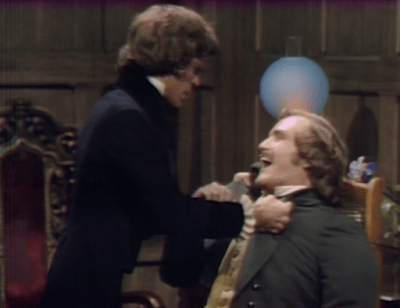
Of course, no one is easier to laugh at than people who take themselves absolutely seriously, which is one of the reasons Barnabas and Julia were such big hits. But most of the characters who demand to be regarded with solemnity have had an expiration date, no matter how much value they added while they were on the show. So the fanatical witchfinder the Rev’d Mr Trask was one of the highlights of the show when it was set in the 1790s from November 1967 to March 1968, but no one could have expected Trask to stay in the cast when it returned to contemporary dress. Those who have lasted and have helped to grow the audience have had a sense of humor about themselves. By the middle of 1968, even wicked witch Angelique could crack the occasional joke at her own expense. Unless Gerard gains the same ability, he would seem unlikely to rise above Trask’s level in the hierarchy of characters.
Meanwhile, the aged Ben Stokes has befriended Julia. In the 1790s segment, Ben was a much-put-upon indentured servant whose extreme regard for Barnabas led him to become complicit in Barnabas’ crimes in his first nights as a vampire. When we revisited the 1790s in January 1969, Ben followed the footsteps of the first character Thayer David played on the show, crazed handyman Matthew Morgan. Matthew’s fanatical devotion to matriarch Elizabeth Collins Stoddard led him to inadvertently kill a man who was the head of the Collins fishing fleet and to attempt the deliberate murder of a woman who was played by the daughter of a countess. In #666, Ben inadvertently killed roguish naval officer Nathan Forbes, who was in Collinsport to do some executive work associated with the Collins family’s ships, and then deliberately murdered Natalie DuPrés, a character who bore the title countess. We saw that the kindly, sensible, open-hearted Ben whom we met before the great curse was placed on the Collins family had been deformed into the same shape that a century and a half in the shadow of that curse had inflicted on Collinsport dweller Matthew. Now, we see that Ben has lived on into his eighties and has recovered much of the goodness that was his hallmark when first we met him.
Julia tells Ben the insane story of her travels through time and her friendship with Barnabas, and he decides to help her find a place in 1840. He digs up a period-appropriate gown for her. It’s too big for his granddaughter Carrie and too small for him, so it does not seem likely to have been in his possession. He doesn’t have time to make a gown. He doesn’t leave the house, so even if there had been shops in central Maine in 1840 that sold ladies’ formal wear off the rack, he wouldn’t have been able to buy it at one of those. And any of the ladies in the house would surely notice if one of their dresses went missing and a stranger showed up wearing one exactly like it. So I suppose it must have belonged to a lady no longer resident in the house who left it behind in a disused room.
Ben drills Julia in a plan he has devised. She is to present herself at the front door of the great house of Collinwood at 8:30 PM, wearing the gown he has provided. She is to say that her name is Julia Collins, daughter of Barnabas, and that she has been living in America for ten years. Her brother, Barnabas Junior, is still based in England, where their father died some time ago. He wrote her a letter saying he was coming to the States and she was to meet him at Collinwood. Her bags are at the Collinsport Inn, where she is staying.
Julia is reluctant to follow Ben’s plan. She is preoccupied with Barnabas. She expects him to use some mumbo-jumbo to project himself from 1970 into his body as it is in 1840. Since that body is in a chained coffin in the secret room of the old Collins family mausoleum, she wants to go there and release him.
Ben points out that Julia’s desire is preposterous. Barnabas won’t meet Julia for another 127 years. The vampire in that coffin has no idea who she is, and if she lets him out she will be only the first of many victims in a renewed rampage of murder and enslavement.
Of course Julia goes to the mausoleum; of course she opens the panel to the secret room. If she were capable of taking good advice when it was offered, there wouldn’t be a show. We end with Julia trying to communicate with Barnabas through the coffin. She has already said that she has a sense that he might be calling her, a sense that she admits might be her imagination. So we know that it is unlikely that she will fail to discern the summons she so desperately wants to hear.
*Not the one we eat in 1968 and 1969, though apparently he is also David Selby.

