
Episode 1117: That Hideous Strength

The Signal of Another Start*

In June 1970, Dark Shadows was set in a universe other than the one where it usually takes place. The show insisted on calling that other continuity “Parallel Time.”

In the main continuity, mad scientist Julia Hoffman is the friend and enabler of vampire Barnabas Collins. When Barnabas crossed over to Parallel Time, he found that Julia’s counterpart there was as devoted to wicked witch Angelique as the Julia he knew was to him. He made himself Angelique’s enemy, and in #1036 Hoffman was poised over him with a stake and a hammer, ready to destroy him. In the nick of time, Julia arrived from the main continuity and saved Barnabas. She bashed Hoffman’s head in, stole her clothes, and set about impersonating her. When Barnabas first saw Julia in Parallel Time, he thought she was her Doppelgänger, and since she was in his hiding place he was going to kill her. Fortunately for Julia, Barnabas had got into the habit of making speeches to people before he murdered them, so she was able to tell him who she was. With that, the murder was off and their friendship was back on track.

Now, it is Julia who has crossed over into another world. She has traveled back to the year 1840, and has told the family in the great house of Collinwood at that time that she is the daughter of the Barnabas Collins who supposedly left for England in the 1790s. She has also told them to expect her brother, Barnabas Junior, who, she says, looks just like their old man.

In a moment of extreme folly, Julia went to the room where Barnabas was sealed in his coffin in the 1790s and released him. This mirrored the folly of her waiting around in his hiding place after she killed Hoffman in Parallel Time. The Barnabas of 1840 had no idea that any time had passed since he was imprisoned four and a half decades before, and certainly did not know what Julia was talking about when she claimed that they had met in 1967 and become friends in 1968. He was about to kill her when his old friend Ben Stokes turned up in the nick of time and stopped him.

Now, Barnabas has discovered that Julia is interfering in his plans. He has bitten the lovely Roxanne Drew, intending for her to die and rise as his vampire bride. Julia and Ben found Roxanne and brought her to the Old House on the grounds of Collinwood. Julia is giving Roxanne a blood transfusion which has prevented her death. When Barnabas sees what is going on, he grabs Julia and is about to bite her.

Barnabas is already flashing his fangs when he has a seizure and collapses. He stands back up and finds Julia holding a cross at him. He tells her that he is the Barnabas of 1970, projected into his 1840 body by some mumbo-jumbo involving the I Ching. He could be making that up based on things she has already told him, so she keeps holding the cross. He goes on to give specific facts about several people they know in 1970. She realizes he is telling the truth. She puts the cross down, and gives him a hug. As Julia came from the main continuity and destroyed her own Doppelgänger to save Barnabas, so Barnabas has come from the future and destroyed his previous self to save Julia.**
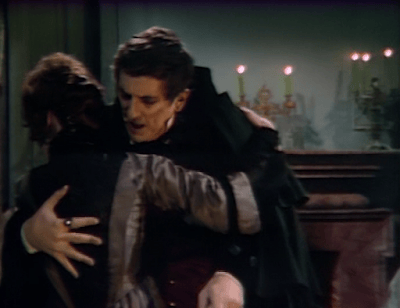
Embraceable vampire. Screenshot by Dark Shadows Before I Die.

The 1970 model Barnabas does not want Roxanne to be a vampire, and he is ashamed of his earlier self for having tried to make her one. Roxanne comes to, sees him, and is delighted to think he has come to bite her again. When he says that things have changed, she is disappointed and he is embarrassed. He goes away.

Julia has a superhuman power of hypnosis that she has often used to erase people’s memories and overwrite them with information that will not incriminate Barnabas. She tries this on Roxanne. She is halfway through the process when some noises outside prompt her to leave the room and investigate. The room is at the top of the stairs, and has been a major set for years. We’ve caught glimpses of the door that opens to it a couple of times, but this is the first time there is set built all the way to the railing.

Julia goes to the railing and calls downstairs, asking if anyone is there. No one answers, so she goes back into the room. Roxanne has somehow got away.

Barnabas goes to the great house and introduces himself as Julia’s brother. Julia comes. They get a private moment, during which Julia tells him that Roxanne escaped and that she does not know whether the hypnosis was successful. Roxanne enters, looks at Barnabas, and announces to the assembled Collinses that she knows who he is. She is escorted upstairs. Barnabas and Julia are on the verge of panic until Roxanne’s sister, Samantha Drew Collins, comes down and says that Roxanne doesn’t remember anything of the last couple nights.

The Gods are Weak at First*

The 1970 version of Barnabas is not the only character to make his grand entrance today. We also meet Desmond Collins and an acquaintance of his.

Desmond is the son of Flora Collins, a lady novelist and all-around silly person who lives in the nearby mansion called Rose Cottage. He has just returned from a long journey with a present for his friend, Quentin Collins, husband of Samantha and heir to the Collins estate. Flora breaks the sad news that Quentin and his son Tad Collins were lost at sea some time ago, that they have been missing ever since, and that they are now presumed dead.

The present is in a large cube that is covered with a cloth. Desmond removes the cloth and exposes a glass box holding a severed head. Flora reacts with horror; Desmond laughs and says that it is surely a carved figure of some sort, entirely harmless. We know better; the episode ends with the head opening its eyes.
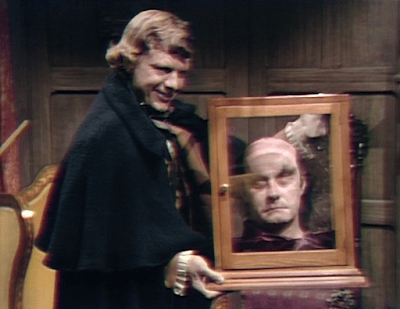
The perfect gift for the man who has everything, except a sense of decency. Screenshot by Dark Shadows Before I Die.

In 1945, C. S. Lewis published the third volume of his “Space Trilogy,” a novel called That Hideous Strength. It was a commercial success at the time, and has been in print ever since. I have mixed feelings about Lewis’ writings; I essentially agree with his religious views, but he often expressed them in a cutesy-poo style that is still endemic among Anglican writers and that makes me wish I were a Zoroastrian or a Buddhist or something whenever I encounter it.

But the first fifty pages of That Hideous Strength are terrific. I teach in a university, and the account of life inside the fictional University of Edgestow is the most insightful depiction of campus politics I’ve ever read. The place is dominated by a clique of administrators who keep talking to each other about what “Our Head” wants them to do. In British institutions of higher education, “Head” is a title for a permanent director of a department or institute, so that’s what you think they are talking about. But no, it’s an actual severed head through which the voice of Satan speaks to them. They worship the head and follow the commands they receive from its mouth.

That Hideous Strength was certainly popular enough that it is likely the writers of Dark Shadows had looked to it as a source of material. In particular, Sam Hall was a serious enough Protestant that he persuaded Shirley Grossman to convert from Judaism and join him in the Lutheran church before they married and she became Grayson Hall. Lewis was so celebrated for his apologetics that it would be rather odd if his name did not attract Hall’s notice. So we can expect that Desmond and others will form a cult of some sort and that the Head will give them diabolical orders to follow.

The Head is that of Michael McGuire, making the first of scores of television appearances. One of my favorite parts of his was Sumner Sloan, the prominent academic who dumped Diane Chambers in the first episode of Cheers and came back for her in her last episode as a regular part of the cast of characters. McGuire also appeared in my favorite episode of Columbo, “A Friend in Deed,” in which his character tries to confess to killing his wife in a fit of rage only to find himself involved in a plot to kill another man’s wife in cold blood. I suppose one of McGuire’s specialties was “Do Not Date This Man.” I’ve never heard that he was anything other than a nice guy in real life, though.

*These section titles are taken from William Dickey’s 1961 poem, “Continued in Our Next”:

Over the quiet paper, in light that is

Interested only in a casual way,

All quite polite, the neat pen idly marries

Third sons to princesses.

They go away,

To the widest margin, to a land of white,

Wholly uninhabited until they came,

And from the sacks with which they are provided

Stock it with leaping trout and huntable game.

Hounds to be cursed at when the blood trail falters,

Eventually, reasons why the hounds went wrong.

Then to the reasons they establish altars.

The gods are weak at first.

When they grow strong

They bring into the world their choicest thunders.

Plagues, curses color the narrow countryside.

The peasantry speaks of horned, unnatural wonders,

And in the violence takes a natural pride.

But all the while the map-makers are busy.

Faint explorations die in the savage hills,

Others go on to the farthest fabled city,

Where for six months the sun is lost, and the cold kills.

Geometers prove the world, and it is conquered.

Truth overtakes the aborigine.

The gods depart. Mankind is anchored

To clear historical necessity.

Until one day at midday

When the sun ought to be loudest in the shouting sky

Shadow occludes it. Suddenly life is done.

The fire goes out. The constellations die.

Only, above the following page, the pen,

Whose quality is not to have taken part,

Hovers in uncommittedness again,

Poised for the signal of another start

Towards some fresh country, princesses more golden,

And younger sons who wage a bolder fight,

Stags nobler, hounds more diligent than the olden,

The page lies empty in the easy light.

This poem reminds me of Dark Shadows. The creative process is so close to the surface of the show that an image of a writer with pen and paper is a suitable way to start a description of it. When the third sons and the princesses are moved to the “widest margin, to the land of white” it’s ambiguous if that just means the writer is making notes on the otherwise blank edge of the paper or whether the characters are going off to the Arctic. We see the same ambiguity in “the pen whose quality is not to have taken part.” That brings to mind both the characters visiting from other times or other universes and the writers who use those cosmic journeys to start the story fresh.

The “natural pride” that the “peasantry” takes in the crimes of the “unnatural wonders” explains both why there are characters who are willing to go on living in Collinsport and why the audience keeps coming back to the show. The wish for “princesses more golden” and for “younger sons who wage a bolder fight” casts our minds to stories like the conflict between Barnabas and Jeremiah Collins over the love of the gracious Josette and the ongoing scheme Gabriel Collins has devised to do away with his sister-in-law Samantha, grubby little imbroglios that never could lead to anything but sorrow, and leaves us wondering why we choose to follow this show rather than seeking out happier and more glorious tales.

**My wife, Mrs Acilius, had a lot to say about this inverted parallel.
Episode 1111: The healer himself

Dark Shadows has been drifting downward in the ratings and the writing staff has been repeating material. If it is to survive, the show needs a new villain who will generate fresh story points and another breakout star to grab the attention of the public as Jonathan Frid did when he joined the cast as vampire Barnabas Collins in 1967 and as David Selby did when he came along as the dangerous Quentin Collins late in 1968 and early in 1969. They are gambling that they will be able to fulfill both of these requirements with James Storm as the evil Gerard Stiles.

Gerard has been on the show as an unspeaking ghost for twelve weeks. He makes his first appearance as a living being today, and delivers his first lines. He makes less of an impression than does any other member of the cast, which I believe is intentional.

Yesterday, mad scientist Julia Hoffman traveled back in time to 1840. Previous time-travel segments have begun with episodes mounted on the biggest scale of production the show could manage, but yesterday they tried a new approach. Most of the episode took place in one little section of the great house of Collinwood, with Julia hiding behind partitions in darkened rooms while she eavesdropped on random conversations. That structure suggested that 1840 is going to open out gradually, introducing new characters and situations a little bit at a time. So far from whisking us into the new world with a torrent of additional information, they subtracted from what we came in thinking we knew. When they revealed that governess Daphne Harridge is unknown in the great house, and Quentin Collins* and his son Tad are missing at sea and presumed dead, we found that this is a very different place from what we were led to expect. That was as good a way as any of ensuring we would come back on Monday.

Gerard makes his entrance in the middle of a scene between fluttery novelist Flora Collins and evil-tempered bully Gabriel Collins. Gabriel is not as cruel to Flora as we have seen him be with others, and he even pretends to take her latest novel seriously. But when she describes Gerard as “The Healer” and claims that he has supernatural powers, Gabriel has had enough. He insists that Flora ought not to waste her time with a man who, if he were not a transparent fraud, could only be a practitioner of the black arts. Flora is appalled by Gabriel’s description of Gerard as a possible Satanist.

Gerard enters and Flora tells him she is coming down with a migraine. She coquettishly asks him to do his thing for her. He rubs her forehead for a bit, and she proclaims that she is cured. After she exits, wheelchair user Gabriel tells Gerard that if he really has a miraculous gift of healing he would welcome him using it to restore his own ability to walk. Gerard angrily refuses.

Gabriel then tells Gerard that Flora claims more for him even than a gift for healing. She says that he is clairvoyant. Gerard says that he does have such a gift. Gabriel shows him an earring he found in the upstairs playroom and asks if he can identify it. Gerard goes into a trance and says that he sees “a tall woman… not dressed as a woman should be.” The earring belongs to Julia, whom we heard a clairvoyant describe as “a tall woman” in #1059, and she is indeed wearing the clothes she had on when she came from 1970. So we know that Gerard is a real clairvoyant, and expect that he will recognize Julia when he meets her. But Gabriel hasn’t been watching the show, so he laughs out loud and tells Gerard that he is indeed a fraud.

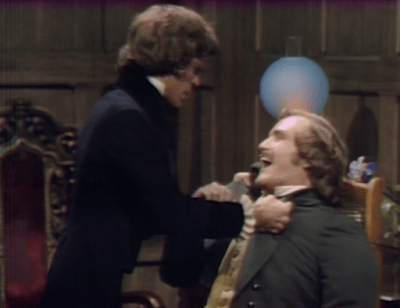
Gerard gets even angrier than he was a moment before, and tells Gabriel that he will not abide being laughed at. That suggests a complicated existence for a character on Dark Shadows, a show that has a lot of great stuff in it but that rarely goes more than ten minutes at a time without making at least one member of the cast look ridiculous.

Gabriel is unimpressed with Gerard. Screenshot by Dark Shadows Before I Die.

Of course, no one is easier to laugh at than people who take themselves absolutely seriously, which is one of the reasons Barnabas and Julia were such big hits. But most of the characters who demand to be regarded with solemnity have had an expiration date, no matter how much value they added while they were on the show. So the fanatical witchfinder the Rev’d Mr Trask was one of the highlights of the show when it was set in the 1790s from November 1967 to March 1968, but no one could have expected Trask to stay in the cast when it returned to contemporary dress. Those who have lasted and have helped to grow the audience have had a sense of humor about themselves. By the middle of 1968, even wicked witch Angelique could crack the occasional joke at her own expense. Unless Gerard gains the same ability, he would seem unlikely to rise above Trask’s level in the hierarchy of characters.

Meanwhile, the aged Ben Stokes has befriended Julia. In the 1790s segment, Ben was a much-put-upon indentured servant whose extreme regard for Barnabas led him to become complicit in Barnabas’ crimes in his first nights as a vampire. When we revisited the 1790s in January 1969, Ben followed the footsteps of the first character Thayer David played on the show, crazed handyman Matthew Morgan. Matthew’s fanatical devotion to matriarch Elizabeth Collins Stoddard led him to inadvertently kill a man who was the head of the Collins fishing fleet and to attempt the deliberate murder of a woman who was played by the daughter of a countess. In #666, Ben inadvertently killed roguish naval officer Nathan Forbes, who was in Collinsport to do some executive work associated with the Collins family’s ships, and then deliberately murdered Natalie DuPrés, a character who bore the title countess. We saw that the kindly, sensible, open-hearted Ben whom we met before the great curse was placed on the Collins family had been deformed into the same shape that a century and a half in the shadow of that curse had inflicted on Collinsport dweller Matthew. Now, we see that Ben has lived on into his eighties and has recovered much of the goodness that was his hallmark when first we met him.

Julia tells Ben the insane story of her travels through time and her friendship with Barnabas, and he decides to help her find a place in 1840. He digs up a period-appropriate gown for her. It’s too big for his granddaughter Carrie and too small for him, so it does not seem likely to have been in his possession. He doesn’t have time to make a gown. He doesn’t leave the house, so even if there had been shops in central Maine in 1840 that sold ladies’ formal wear off the rack, he wouldn’t have been able to buy it at one of those. And any of the ladies in the house would surely notice if one of their dresses went missing and a stranger showed up wearing one exactly like it. So I suppose it must have belonged to a lady no longer resident in the house who left it behind in a disused room.

Ben drills Julia in a plan he has devised. She is to present herself at the front door of the great house of Collinwood at 8:30 PM, wearing the gown he has provided. She is to say that her name is Julia Collins, daughter of Barnabas, and that she has been living in America for ten years. Her brother, Barnabas Junior, is still based in England, where their father died some time ago. He wrote her a letter saying he was coming to the States and she was to meet him at Collinwood. Her bags are at the Collinsport Inn, where she is staying.

Julia is reluctant to follow Ben’s plan. She is preoccupied with Barnabas. She expects him to use some mumbo-jumbo to project himself from 1970 into his body as it is in 1840. Since that body is in a chained coffin in the secret room of the old Collins family mausoleum, she wants to go there and release him.

Ben points out that Julia’s desire is preposterous. Barnabas won’t meet Julia for another 127 years. The vampire in that coffin has no idea who she is, and if she lets him out she will be only the first of many victims in a renewed rampage of murder and enslavement.

Of course Julia goes to the mausoleum; of course she opens the panel to the secret room. If she were capable of taking good advice when it was offered, there wouldn’t be a show. We end with Julia trying to communicate with Barnabas through the coffin. She has already said that she has a sense that he might be calling her, a sense that she admits might be her imagination. So we know that it is unlikely that she will fail to discern the summons she so desperately wants to hear.

*Not the one we eat in 1968 and 1969, though apparently he is also David Selby.

My usual themes: Bossy Big Sister/ Bratty Little Brother

In 281 of the posts that follow, I link to comments I made on Danny Horn’s blog, “Dark Shadows Every Day.”

Not all of these comments were absolutely unique. Several times it occurred to me that a Dark Shadows features a number of older sisters who clean up messes that their misbehaving younger brothers make, and that a variety of male-female relationships on the show take on the dynamic of a bossy big sister and her bratty little brother. Danny doesn’t cover the first 209 episodes of the show, when we learn that Roger Collins has managed to squander his entire inheritance, half of the family fortune, and that his older sister Elizabeth Collins Stoddard has gone deeply into debt to contain the damage that his irresponsibility has done to the family business. Elizabeth takes Roger into her house, and alternates between demanding that he reform his ways and enabling his ongoing bad conduct. She takes charge of the raising of Roger’s son David and puts Roger to work in the family business, setting bounds to Roger’s crapulence but also insulating him from its consequences.

My first remarks about this theme were in a comment on episode 565:

Watching this episode, I just realized the main relationship in DARK SHADOWS- Bossy Big Sister/ Bratty Little Brother. Liz and Roger are literally that, and each one’s struggle to safeguard their relationship by keeping the other in the dark about their shameful secrets is the background of every storyline in the first 209 episodes. Carolyn and David become the functional equivalent of a Bossy Big Sister and a Bratty Little Brother, and that’s the development that makes Carolyn a relatable character.

In Julia and Barnabas, we have the supreme example of such a relationship. They fall into it naturally; Julia is used to giving orders, and Barnabas is used to disobeying them. From the moment Julia lit her cigarette on the candles in the old house, she’s been Barnabas’ Bossy Big Sister, pursuing one plan after another meant for his own good. He’s been alternately pouting at her, raging against her, and clinging to her, at once resenting her demands on him and craving her validation for his narcissism. The climax of the episode, when they both know that a he-vampire is roaming about in search of a victim but it occurs to neither Julia nor Barnabas that Julia might be in danger, shows how deeply they have embedded themselves in these roles. Barnabas won’t even let Vicki walk to her car alone, and Julia, hearing the dognoise, understands why. But when Julia tells Barnabas that she will close up the lab and leave shortly after he goes out to join Willie, implying that she’s going to walk all the way back to the Great House by herself, he just leaves. Of course nothing will happen to Big Sis, she’ll always be OK.

That’s also why I don’t see how slashfic positing a sexual relationship between Barnabas and Julia can work. They are so much Bossy Big Sister and Bratty Little Brother that no matter how much time they spent telling themselves that they aren’t actually related, it would still be impossibly weird to try to be something else to each other.

I returned to the theme in a remark about episode 572, where Jonathan Frid gives a line-reading so pouty that I wonder if he was consciously trying to depict Barnabas as a bratty little brother to Julia:

I love the way Jonathan Frid pouts the line “I was afraid your visit would be pointless.” He’s every inch the bratty little brother upset that his big sister went out when he didn’t want her to go.

By episode 648, the idea has moved me to fanfic:

Cavada Humphrey looks quite a bit like Jonathan Frid. I wonder what 1795 would have been like if Barnabas had had an older sister who bossed him around, stood around during his ridiculously childish fits of petulance, occasionally acted as his conscience, and time and again serve as his enabler and protector. It would have been funny to see Grayson Hall’s Countess express disapproval of such a relationship.

Heck, that older sister could have been Sarah. Just because she’s a child in her ghost form doesn’t mean she has to have died at that age. Maybe she comes back in the form in which her relationship to her brother took its permanent shape, when she was about nine and he was about seven. Of course, that possibility is foreclosed at Sarah’s first appearance, when she tells Maggie not to let her “big brother” know she saw her, but I suppose they could have retconned that away with a phony flashback where she says “little brother.”

I revisited these points a few times- Danny’s blog consists of over a thousand posts, one each for episodes 210-1245, plus a few dozen about properties related to Dark Shadows, and each post has its own discussion thread. So it isn’t bad netiquette to repeat yourself a bit from one thread to another- there is always a chance someone who didn’t see a comment previously posted elsewhere will take an interest when you post a similar one. But I did try to keep from making a bore of myself to those who read everything.

I could have mentioned some other bossy big sister/ bratty little brother combos. In a comment on the 1897 storyline, I alluded to the relationship between Judith Collins Trask and her feckless younger brothers. Judith’s arc doesn’t really allow her to be a bossy big sister to any of her three bratty little brothers. But each of them does find himself attached to at least one woman who is stronger than he is, and who might well treat him as Elizabeth does Roger and as Julia does Barnabas.

It’s a shame Terry Crawford wasn’t a more accomplished actress in the 1960s- in the scripts Beth fluctuates between indulging Quentin in his every vice and insisting that he clean up his act. That’s the bossy big sister/ bratty little brother dynamic we’ve seen so many times, but unlike any previous pair who have enacted it Beth and Quentin are lovers and are not social equals. It would be interesting to explore the dynamic in that context, but Ms Crawford’s performance is so wooden that you sometimes have to think about her scenes after it is over and call to memory the dialogue and the visual composition before it strikes you what the point was.

Pansy Faye isn’t on the show very long, unfortunately but she’s clearly in the driver’s seat in her relationship with her thoroughly clownish husband Carl Collins. And Edward Collins is much the weaker personality in his connections with both his estranged wife Laura and with Kitty Soames. So each of those men was looking for a woman who was forceful enough to take charge of him, but indulgent enough to allow him to continue in all his established habits.

I also made only one brief reference to the bossy big sister/ bratty little brother dynamic in the discussions of the 1840 storyline. That’s rather odd- after all, in that one Julia actually presents herself to the family as Barnabas’ sister, and he is forced to go along with the pretense.

I did not refer to the theme in my comments on posts about “The Haunting of Collinwood” by the ghost of Quentin, and I made only a single reference to it in my comments on posts about the “Re-Haunting of Collinwood” by the ghost of mini-Quentin Gerard. Indeed, that single reference is to Julia’s failure to focus her bossiness on Barnabas. I dropped the ball there, I think- the relationship between David and Amy in the original “Haunting of Collinwood” is at its most interesting when it mixes elements of the bossy big sister/ bratty little brother dynamic with other types of interaction, while the bland, lifeless relationships between David and Hallie on the one hand and between Tad and Carrie on the other in the “Re-Haunting of Collinwood” could benefit from some kind of structure.

I also left the theme unmentioned in my comments regarding the show’s dying days, the 1841 Parallel Time storyline of episodes 1199-1245. That’s understandable- the show did not develop any bossy big sister/ bratty little brother relationships in that period. But there was an implicit one- Miss Julia Collins was the sister of Justin Collins, and she had functioned as head of the household during his years of madness. Justin dies a few episodes into the story, without sharing a scene with Julia, and she is left as a bossy big sister with no bratty brother to whom she can attach herself. Meanwhile, Bramwell is a thoroughly bratty man with no big sister. It’s rather sad for the loyal audience, having enjoyed so many scenes in which Grayson Hall and Jonathan Frid had enormous fun with the bossy big sister/ bratty little brother pattern, seeing them drift separately through these dreary episodes.

The closest we get to a bossy big sister/ bratty little brother scene in the dying days of the show is also the one genuinely irresistible moment of that segment. In episode 1215, Flora Collins (Joan Bennett) and her son Morgan (Keith Prentice) are walking through the woods on their way to Biddleford’s Creek. He whines about the pointlessness of the trip, she scolds him, and we get a brilliant little glimpse of what their relationship must have been like since he first learned to talk. That authoritative mother/ whiny son moment left me, not only wanting more such scenes between them, but also wishing it had been presented in contrast with a bossy big sister/ bratty little brother relationship elsewhere in the show.