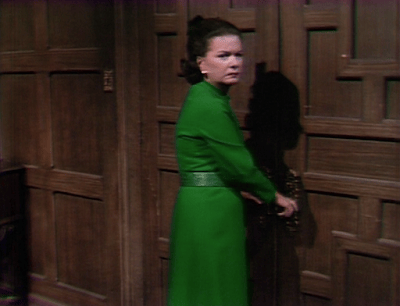
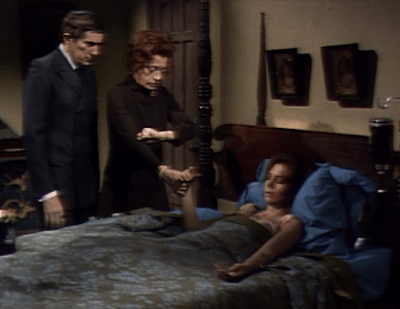
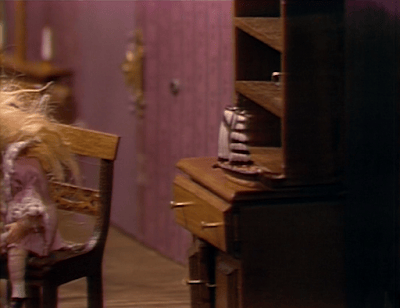
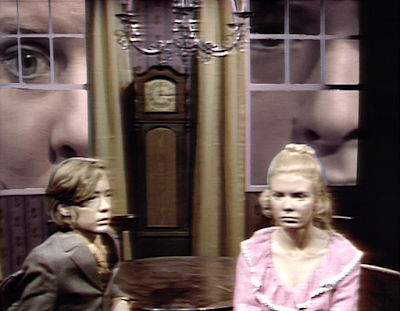
Desmond Collins has fallen under the power of a mysterious severed head he brought back from southeastern China. When his mother Flora sees him in the room where he keeps the head in a glass case, he bursts out with inexplicable remarks, such as “An outcast has no friends!” and “I kept telling them! Death was an extension of life! I kept telling them that!” Flora remarks that Desmond hasn’t acted like that since he was in love with a girl named Carson. He then tells her that she’s discovered his secret. He met a pretty girl recently and can’t find her again, and that’s what he’s upset about. This doesn’t explain who it was Desmond told that “Death was an extension of life!” or why it is important to remember either that idea or the notion that “An outcast has no friends,” but it’s the best Flora is going to get, so she settles for it.
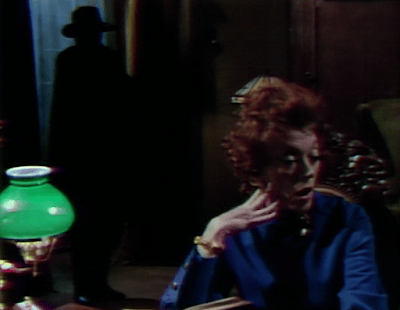
Desmond really is trying to reconnect with a pretty girl. Her name is Daphne Harridge, and he finds her today when he goes to the offices of the Collinsport Star to ask for some issues from October 1803, 37 years ago. His cousin, the 57 year old Daniel Collins, told him that the papers were full of stories about a series of murders that took place in and around the town of Bedford in that month, and that a severed head was mentioned in connection with them. Since Daniel also said that the man who was last known to have the head ran off to Macau and died there, Desmond suspects that it is the same head he brought back from that city. Moreover, a man named Ben Stokes recently died in circumstances that strongly remind Daniel of the Bedford Atrocity, and Desmond now knows that the Head has power over him. So he fears the worst.
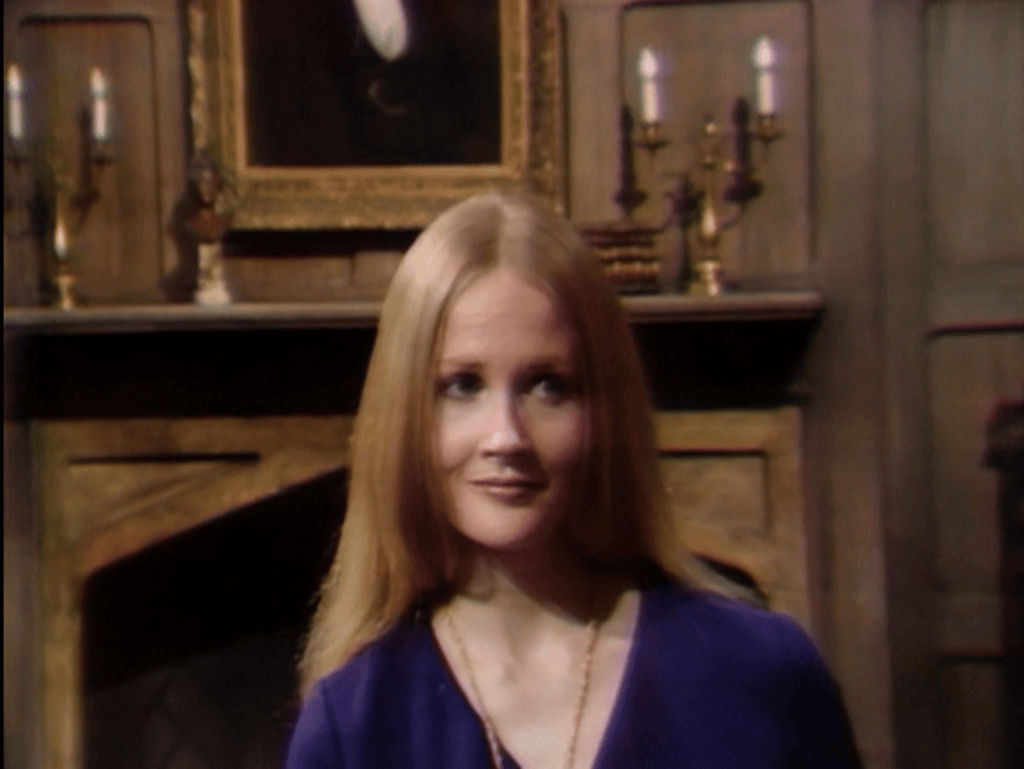
Desmond is surprised when Daphne answers the door at the offices of the Star. She explains that she needed a job, and she found a respectable one there. She shows him the file with back issues from October 1803. He finds some with stories about the killings in Bedford, and asks permission to sign them out. When he does, she asks if he is making a joke. He has signed his name “Judah Zachery.” He is disconcerted, then claims that he uses that as a pen name for some writing he does.
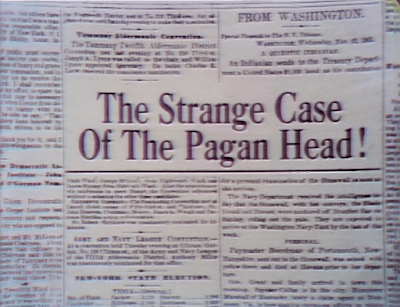
A headline from an October 1803 edition of the Collinsport Star. Screenshot by Dark Shadows Before I Die.
Earlier, we had seen Daphne at what we now know was her desk at the newspaper office. Daphne was thinking to herself that she really ought to have found a way to pretend to like Desmond when they met yesterday, since he can be useful to her in the objective she has come to Collinsport to pursue. She wondered how she would meet him again. So when he invites her to the house he and Flora share, a mansion known as Rose Cottage, she gladly accepts.
Daphne has dinner with Desmond, Flora, and Quentin Collins. Quentin is Daniel’s son and the heir to his vast fortune. He turned up at the great house of Collinwood the other day, six months after he and his son Tad were washed off the deck of a ship at sea and presumed dead. He and Tad hiked their way back to the States over a circuitous route that took them all through South America, and Quentin got home just in time to congratulate his wife on her remarriage.
Flora has recently taken an avid interest in the occult. She deals a layout of tarot cards to tell Quentin’s fortune. She is horrified by each card in its turn. She asks Quentin if someone close to him died recently. They just had Ben’s funeral and he has been close to the family for decades, but Quentin gets agitated and insists that no one he loves has died, no one at all.
Back in the newspaper office, Daphne writes in a notebook that she has met the man she came to town to kill. Presumably this is a private notebook; it might be embarrassing if that winds up printed in the paper.
In June 1970, Dark Shadows was set in a universe other than the one where it usually takes place. The show insisted on calling that other continuity “Parallel Time.”
In the main continuity, mad scientist Julia Hoffman is the friend and enabler of vampire Barnabas Collins. When Barnabas crossed over to Parallel Time, he found that Julia’s counterpart there was as devoted to wicked witch Angelique as the Julia he knew was to him. He made himself Angelique’s enemy, and in #1036 Hoffman was poised over him with a stake and a hammer, ready to destroy him. In the nick of time, Julia arrived from the main continuity and saved Barnabas. She bashed Hoffman’s head in, stole her clothes, and set about impersonating her. When Barnabas first saw Julia in Parallel Time, he thought she was her Doppelgänger, and since she was in his hiding place he was going to kill her. Fortunately for Julia, Barnabas had got into the habit of making speeches to people before he murdered them, so she was able to tell him who she was. With that, the murder was off and their friendship was back on track.
Now, it is Julia who has crossed over into another world. She has traveled back to the year 1840, and has told the family in the great house of Collinwood at that time that she is the daughter of the Barnabas Collins who supposedly left for England in the 1790s. She has also told them to expect her brother, Barnabas Junior, who, she says, looks just like their old man.
In a moment of extreme folly, Julia went to the room where Barnabas was sealed in his coffin in the 1790s and released him. This mirrored the folly of her waiting around in his hiding place after she killed Hoffman in Parallel Time. The Barnabas of 1840 had no idea that any time had passed since he was imprisoned four and a half decades before, and certainly did not know what Julia was talking about when she claimed that they had met in 1967 and become friends in 1968. He was about to kill her when his old friend Ben Stokes turned up in the nick of time and stopped him.
Now, Barnabas has discovered that Julia is interfering in his plans. He has bitten the lovely Roxanne Drew, intending for her to die and rise as his vampire bride. Julia and Ben found Roxanne and brought her to the Old House on the grounds of Collinwood. Julia is giving Roxanne a blood transfusion which has prevented her death. When Barnabas sees what is going on, he grabs Julia and is about to bite her.
Barnabas is already flashing his fangs when he has a seizure and collapses. He stands back up and finds Julia holding a cross at him. He tells her that he is the Barnabas of 1970, projected into his 1840 body by some mumbo-jumbo involving the I Ching. He could be making that up based on things she has already told him, so she keeps holding the cross. He goes on to give specific facts about several people they know in 1970. She realizes he is telling the truth. She puts the cross down, and gives him a hug. As Julia came from the main continuity and destroyed her own Doppelgänger to save Barnabas, so Barnabas has come from the future and destroyed his previous self to save Julia.**
The 1970 model Barnabas does not want Roxanne to be a vampire, and he is ashamed of his earlier self for having tried to make her one. Roxanne comes to, sees him, and is delighted to think he has come to bite her again. When he says that things have changed, she is disappointed and he is embarrassed. He goes away.
Julia has a superhuman power of hypnosis that she has often used to erase people’s memories and overwrite them with information that will not incriminate Barnabas. She tries this on Roxanne. She is halfway through the process when some noises outside prompt her to leave the room and investigate. The room is at the top of the stairs, and has been a major set for years. We’ve caught glimpses of the door that opens to it a couple of times, but this is the first time there is set built all the way to the railing.
Julia goes to the railing and calls downstairs, asking if anyone is there. No one answers, so she goes back into the room. Roxanne has somehow got away.
Barnabas goes to the great house and introduces himself as Julia’s brother. Julia comes. They get a private moment, during which Julia tells him that Roxanne escaped and that she does not know whether the hypnosis was successful. Roxanne enters, looks at Barnabas, and announces to the assembled Collinses that she knows who he is. She is escorted upstairs. Barnabas and Julia are on the verge of panic until Roxanne’s sister, Samantha Drew Collins, comes down and says that Roxanne doesn’t remember anything of the last couple nights.
The Gods are Weak at First*
The 1970 version of Barnabas is not the only character to make his grand entrance today. We also meet Desmond Collins and an acquaintance of his.
Desmond is the son of Flora Collins, a lady novelist and all-around silly person who lives in the nearby mansion called Rose Cottage. He has just returned from a long journey with a present for his friend, Quentin Collins, husband of Samantha and heir to the Collins estate. Flora breaks the sad news that Quentin and his son Tad Collins were lost at sea some time ago, that they have been missing ever since, and that they are now presumed dead.
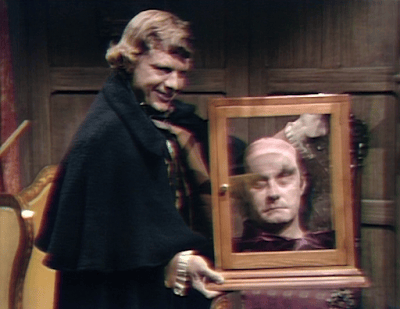
The present is in a large cube that is covered with a cloth. Desmond removes the cloth and exposes a glass box holding a severed head. Flora reacts with horror; Desmond laughs and says that it is surely a carved figure of some sort, entirely harmless. We know better; the episode ends with the head opening its eyes.
The perfect gift for the man who has everything, except a sense of decency. Screenshot by Dark Shadows Before I Die.
In 1945, C. S. Lewis published the third volume of his “Space Trilogy,” a novel called That Hideous Strength. It was a commercial success at the time, and has been in print ever since. I have mixed feelings about Lewis’ writings; I essentially agree with his religious views, but he often expressed them in a cutesy-poo style that is still endemic among Anglican writers and that makes me wish I were a Zoroastrian or a Buddhist or something whenever I encounter it.
But the first fifty pages of That Hideous Strength are terrific. I teach in a university, and the account of life inside the fictional University of Edgestow is the most insightful depiction of campus politics I’ve ever read. The place is dominated by a clique of administrators who keep talking to each other about what “Our Head” wants them to do. In British institutions of higher education, “Head” is a title for a permanent director of a department or institute, so that’s what you think they are talking about. But no, it’s an actual severed head through which the voice of Satan speaks to them. They worship the head and follow the commands they receive from its mouth.
That Hideous Strength was certainly popular enough that it is likely the writers of Dark Shadows had looked to it as a source of material. In particular, Sam Hall was a serious enough Protestant that he persuaded Shirley Grossman to convert from Judaism and join him in the Lutheran church before they married and she became Grayson Hall. Lewis was so celebrated for his apologetics that it would be rather odd if his name did not attract Hall’s notice. So we can expect that Desmond and others will form a cult of some sort and that the Head will give them diabolical orders to follow.
The Head is that of Michael McGuire, making the first of scores of television appearances. One of my favorite parts of his was Sumner Sloan, the prominent academic who dumped Diane Chambers in the first episode of Cheers and came back for her in her last episode as a regular part of the cast of characters. McGuire also appeared in my favorite episode of Columbo, “A Friend in Deed,” in which his character tries to confess to killing his wife in a fit of rage only to find himself involved in a plot to kill another man’s wife in cold blood. I suppose one of McGuire’s specialties was “Do Not Date This Man.” I’ve never heard that he was anything other than a nice guy in real life, though.
Hounds to be cursed at when the blood trail falters,
Eventually, reasons why the hounds went wrong.
Then to the reasons they establish altars.
The gods are weak at first.
When they grow strong
They bring into the world their choicest thunders.
Plagues, curses color the narrow countryside.
The peasantry speaks of horned, unnatural wonders,
And in the violence takes a natural pride.
But all the while the map-makers are busy.
Faint explorations die in the savage hills,
Others go on to the farthest fabled city,
Where for six months the sun is lost, and the cold kills.
Geometers prove the world, and it is conquered.
Truth overtakes the aborigine.
The gods depart. Mankind is anchored
To clear historical necessity.
Until one day at midday
When the sun ought to be loudest in the shouting sky
Shadow occludes it. Suddenly life is done.
The fire goes out. The constellations die.
Only, above the following page, the pen,
Whose quality is not to have taken part,
Hovers in uncommittedness again,
Poised for the signal of another start
Towards some fresh country, princesses more golden,
And younger sons who wage a bolder fight,
Stags nobler, hounds more diligent than the olden,
The page lies empty in the easy light.
This poem reminds me of Dark Shadows. The creative process is so close to the surface of the show that an image of a writer with pen and paper is a suitable way to start a description of it. When the third sons and the princesses are moved to the “widest margin, to the land of white” it’s ambiguous if that just means the writer is making notes on the otherwise blank edge of the paper or whether the characters are going off to the Arctic. We see the same ambiguity in “the pen whose quality is not to have taken part.” That brings to mind both the characters visiting from other times or other universes and the writers who use those cosmic journeys to start the story fresh.
The “natural pride” that the “peasantry” takes in the crimes of the “unnatural wonders” explains both why there are characters who are willing to go on living in Collinsport and why the audience keeps coming back to the show. The wish for “princesses more golden” and for “younger sons who wage a bolder fight” casts our minds to stories like the conflict between Barnabas and Jeremiah Collins over the love of the gracious Josette and the ongoing scheme Gabriel Collins has devised to do away with his sister-in-law Samantha, grubby little imbroglios that never could lead to anything but sorrow, and leaves us wondering why we choose to follow this show rather than seeking out happier and more glorious tales.
**My wife, Mrs Acilius, had a lot to say about this inverted parallel.
Three ghosts who have been hanging around the great house of Collinwood for the last several weeks have assumed corporeal form. Teenagers Tad Collins and Carrie Stokes have taken possession of the bodies of David Collins and Hallie Stokes. Once embodied, Carrie and Tad cast a spell that brought their governess, Daphne Harridge, back to life in a body of her own.
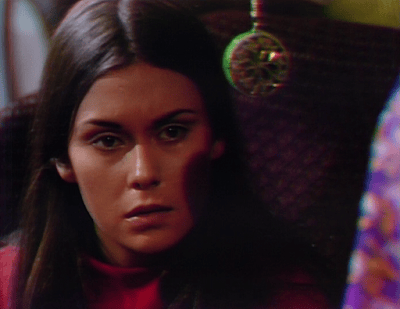
Mad scientist Julia Hoffman confronts Daphne and demands she help David and Hallie resume their place among the living. Daphne angrily refuses. “I’m not going to let you destroy Tad and Carrie to bring David and Hallie back!” Carrie and Tad were already destroyed, when they died in 1841; it was Daphne who robbed Hallie and David of their rightful place among the living when she helped Carrie and Tad possess them. That possession is a murder, and one of the victims of that murder, David, has been a central character since the show’s first week in 1966, and the show has often been driven by our concern for his well-being. Daphne’s protest, voiced in a righteous tone that makes it clear David and Hallie mean nothing at all to her, marks Daphne as a villain whose motivations are entirely hostile to everything we could care about. But Daphne is, among other things, Kate Jackson. As such, it is impossible for an audience not to fall in love with her. Though Daphne’s presence in the story can lead to nothing but disaster for the human characters, we cannot want her to go away.
Among Julia’s many powers is mastery of a preternatural form of hypnosis that enables her to mold people’s memories as easily as a potter can shape clay. Until today, we have seen her use this power only on humans. But Daphne is human now, at least technically, so Julia gives it a shot. She takes out her magical medallion and shows it to Daphne. Once Daphne is in a trance, Julia asks her questions. They are not questions about Daphne’s memories of the past, but about events that will take place in the future. Somehow Daphne knows the answers to those. They suggest that the final catastrophe is very near at hand.
Julia introduces our new friend Daphne to our old friend, the magical medallion. Screenshot by Dark Shadows Before I Die.
Carrie and Tad have been inmates at Windcliff, a psychiatric facility Julia controls. Daphne had reached them there, driven in a car by charming rogue Quentin Collins. When Windcliff was first introduced in the summer of 1967, it was made explicit that it was located a hundred miles north of Collinwood. It lay far enough away that Julia could be sure no one on the estate or in the village of Collinsport would recognize her face or name when she showed up in town in #284. It was an unmistakable sign of supernatural agency when Maggie Evans was able to make it from Windcliff to Collinsport on foot in a single night in #295. And after hardworking young fisherman Joe Haskell was sent to Windcliff in #658, everyone seemed to forget all about him, as they had forgotten about sorely bedraggled blood thrall Willie Loomis after he was set there in #329. The place was the functional equivalent of the far side of the moon.
Today, Tad and Carrie escape from Windcliff and Tad remarks that Collinwood is “only a few miles” away. This is quite a severe retcon. It does strip away the sense that Windcliff is a safe place where the characters can take refuge from the impending catastrophe, raising the stakes and heightening the tension. But it also leaves us wondering why they don’t just go someplace else further away. The Collinses are supposed to be terribly rich, so there’s nothing stopping them from buying a place in California or Hawai’i or Bugtussle, Oklahoma and moving there while the ghosts have their way at Collinwood.
Vampire Barnabas Collins and mad scientist Julia Hoffman are trying to prevent a disaster that is fated to destroy the great house of Collinwood and everyone in it before the year 1970 is out. They have a handful of cryptic phrases that clue them in to events that will precede this disaster. One of the phrases is “The night Rose Cottage was destroyed.” They have no idea what Rose Cottage is, and have been unable to find anyone who does.
Julia finds heiress Carolyn Stoddard Hawkes leaving the great house. Carolyn says nonchalantly that there is something she has to do at Rose Cottage. Julia gets Carolyn to say that going to Rose Cottage involves leaving the grounds of Collinwood through the front gate. She asks her to mail a letter for her on her way. She agrees, and waits outside while Julia goes back into the house to get the letter.
Julia rushes to a bedroom where Barnabas is sitting with governess Maggie Evans, who is the victim of a vampire other than himself. Julia fabricates a letter while repeating to Barnabas what Carolyn said. Julia takes over the vigil, and Barnabas gives Carolyn the phony letter. He then follows her to a deserted mansion in the area.
Barnabas barges in on Carolyn in a room in Rose Cottage. He ignores her indignation at his following her and presses her with questions:
CAROLYN: Barnabas!
BARNABAS: So this is Rose Cottage.
CAROLYN: You followed me here!
BARNABAS: Carolyn, who is your friend? Who were you talking to just before I came in?
CAROLYN: That, that really is no concern of yours, now is it?
BARNABAS: Carolyn, you must tell us everything you know about this place, who lived here and who it was you were trying to find.
CAROLYN: Why are you and Dr. Hoffman so interested in this place?
BARNABAS: We’ve told you before one of the events that’s to happen before the disaster at Collinwood is the destruction of Rose Cottage.
CAROLYN: Rose Cottage… [laughs] Now, that’s a strange name for a place like this, isn’t it?
BARNABAS: I know now why it was so difficult to find. How did it get such a name?
CAROLYN: Oh, it happened a very long time ago, when Carrie was very small.
BARNABAS: Carrie lived here?
CAROLYN: Are you going to be quiet and let me tell you?
BARNABAS: I’m sorry, go on.
CAROLYN: Carrie, Carrie always dreamed of having a doll’s house which she would call Rose Cottage. So for her birthday I asked Quentin to build her one. Quentin was so good with his hands you know, and so terribly inventive. He actually built a replica of this house, and I gave it to Carrie for her birthday. [laughs] I told her she would have to find another name for it, but she said no, it would always be Rose Cottage to her. So she kept calling it that, and before very long people called the mansion itself Rose Cottage.
BARNABAS: When was all this, Carolyn?
CAROLYN: I’m not going to answer any more of your questions! You were very rude to follow me here, very rude indeed!
Carrie died in 1841. Her ghost has taken possession of teenager Hallie Stokes. The ghost of Carrie’s friend Tad has taken possession of David Collins. Tad and Carrie, in personis David and Hallie, are currently at Windcliff, a psychiatric facility Julia controls. Before they were taken there, Carrie and Tad did some mumbo-jumbo and restored their late governess Daphne Harridge to life. Daphne then led Tad and Carrie in an unsuccessful attempt to do the same for another ghost, erstwhile pirate captain Gerard Stiles. Carolyn is possessed by the spirit of a certain Leticia Faye, though unlike Hallie and David her own personality still exists within her body and from time to time asserts itself.
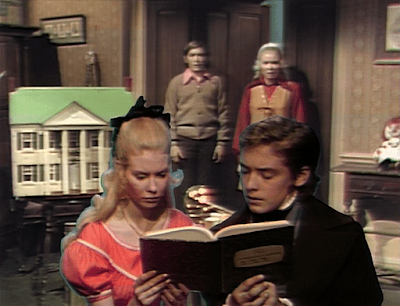
We have seen the dollhouse of which Carolyn/ Leticia speaks many times, and we know that it is in some supernatural sense identical with the full-scale mansion. The episode opened with a reprise of Friday’s cliffhanger, in which Gerard used the dollhouse to trap Daphne in the mansion and to set fire to it. Carolyn/ Leticia interrupted Gerard and saved Daphne.
Barnabas returns to the great house and tells Julia that he now knows where Rose Cottage is. He says that he saw Carolyn there. She asks if he got any information out of Carolyn. He says that he did not. He does not mention the business about Carrie and the dollhouse, which is just bizarre. He and Julia know about a mysterious playroom full of toys appropriate to small children that intermittently appears in a space in a little used part of the great house otherwise occupied by a linen closet. They know that all four ghosts are associated with this playroom. You would think he would therefore realize that a story about a toy of Carrie’s would be relevant to their concerns, but apparently the connection escaped him.
In the last scene, Julia is in Maggie’s room when she is suddenly seized by a fit of sleepiness. A dark figure in a cloak and a slouch hat appears inside the window. Maggie gets up and goes to the figure, who is no taller than she is.
The figure’s slight build and short stature may suggest it is a woman, but no woman on Dark Shadows has ever worn shoes like that. Screenshot by Dark Shadows Before I Die.
I don’t know if the above makes it clear, but this episode is a sharp step up from last week’s offerings. It is tightly paced, clearly developed, and forcefully acted, a bright spot in a storyline that has been desperately dreary so far.
The ghosts of four people who died in 1841 have been haunting the great house of Collinwood. They represent teenagers Carrie Stokes and Tad Collins; Carrie and Tad’s governess, Daphne Harridge; and a sometime pirate captain known as Gerard Stiles. Three of these four have now assumed corporeal form. Tad and Hallie have taken possession of their lookalikes, David Collins and Hallie Stokes. They then performed a ceremony that caused Daphne to come back to life in a body of her own. We open with these three repeating the ceremony in order to conjure Gerard back into existence as a living being.
When Carrie and Tad performed the ceremony the first time, they did not know whether they would raise Daphne or Gerard. That episode ended with a knock at the door, leaving us to wonder along with them who would come. My wife, Mrs Acilius, said it would be funny if it were someone else. She suggested the writers might take a page from Let’s Make a Deal and have Tad and Carrie find a donkey behind Door Number Three.
Today, the ceremony again ends with a rapping on the door. But it is not Gerard. It isn’t a donkey, either. It is Willie Loomis, servant to old world gentleman Barnabas Collins. John Karlen always finds a way to bring out humor in his characters’ predicaments, and the rough-hewn Willie does deflate the grandiosity of Carrie, Tad, and Daphne’s meddling in God’s realm.
Scrambling to cover up the signs of the ceremony before he has to open the door to Willie, Tad calls out “We were sleeping! (pause) I was sleeping!” David Henesy plays this absolutely straight, so that we can see it dawning on Tad that he and Carrie aren’t supposed to be sleeping together. Karlen wasn’t the only actor who knew how to find the laughs hidden in his lines.
Daphne hides. Tad opens the door. Willie sees the pentagram on the floor with the candles at its points and says he recognizes it as a device of black magic. He forestalls the teens’ attempt to pretend to be Hallie and David by calling Tad by name. Tad then turns to Carrie and makes fun of Willie’s twentieth century vocabulary in an attempt to intimidate him by a display of social superiority. This collapses immediately, and Willie says that Tad and Carrie have to come with him because he is bigger than they are.
Willie detains Carrie and Tad in the drawing room, waiting for Barnabas to come back. He has to leave them when he hears Maggie Evans, governess to the late David and Hallie, coming downstairs. Maggie is the victim of a vampire, and Willie is part of the crew that is keeping her from going off to get her blood sucked.
Willie rushes to the foyer and asks Maggie why housekeeper Mrs Johnson isn’t keeping her in her room. Maggie does not respond. The true answer would be that Clarice Blackburn has a writing job on another soap now and isn’t available to play the part, so they leave Mrs Johnson’s absence unexplained.
While Willie gets Maggie back to her room, Tad and Carrie listen to the dogs howling outside. Carrie says she has never heard howling like that before, and Tad contradicts her. He says that if she searches her memory, she will find that they heard just that sound in their own time. He gives a somber look, as if he knows what the howling means. The show has been making it clear that we will be going back in time to 1840 sooner or later. These lines of Tad’s tell us that we will find a vampire in operation when we get there.
In Maggie’s bedroom, Willie explains that Hallie and David have been possessed by Carrie and Tad. Maggie has seen enough in her time at Collinwood that she finds this instantly credible. She blames herself, saying that if she were not ill she would have been able to prevent the possession. Willie asks what she could have done, and she cannot think of anything. He presses her to tell him who the vampire is. She claims he cannot understand what she is going through. He cannot tell her that he himself was once the victim of a vampire, since that vampire was Barnabas and the show will implode if Maggie is ever told about that. So they are left at a stalemate.
Meanwhile, Daphne takes shelter in a deserted mansion once known as Rose Cottage. Gerard confronts her there. He is cranky about still being dead. She tells him it’s no one’s fault that the ceremony didn’t work. They will reenact it tonight, when the stars are back in the right alignment. She also tells him that they don’t need Tad and Carrie to accomplish their goal. This line is unfortunate- to the extent that the story has generated suspense, it has involved us wondering how Carrie and Tad are involved in whatever it is Gerard wants to do. When we hear they aren’t involved at all, it lets the air out of an already badly under-inflated set of tires.
Gerard vanishes from Daphne’s presence and materializes in a mysterious chamber known as The Playroom. The Playroom intermittently appears in a little-used part of the great house, behind a door that usually opens on a linen closet. There is a dollhouse in The Playroom that is a scale model of Rose Cottage and that is, in some supernatural sense, identical to it. Gerard sets fire to the room in the dollhouse that corresponds to the room in Rose Cottage where Daphne is. He uses his finger to hold closed the door corresponding to the one from which she could escape a fire in the room.
Daphne finds that the room she is in is engulfed in flames and she cannot open the door. Apparently Gerard has decided that if Daphne is going to tell him they don’t need Tad and Carrie, he doesn’t need Daphne, either. Daphne, being as she is played by Kate Jackson, is impossible not to care about, so this cliffhanger does make us want to come back Monday and see her escape. But since it implies that none of the relationships among the ghosts means anything, and since we’ve already seen that none of the living characters can mount an effective resistance to the ghosts, it also brings us to the conclusion that the whole Re-Haunting of Collinwood story is at a dead end.
Dark Shadows began in June 1966, when well-meaning governess Victoria Winters was on her way to the great house of Collinwood to take charge of the education of strange and troubled boy David Collins. David’s aunt, matriarch Elizabeth Collins Stoddard, had written to Vicki to offer her the job; his father, Liz’ brother Roger Collins, was opposed to Vicki’s hiring. Roger’s opposition rose from mild disapproval to paranoid fervor when he learned that his arch-nemesis, Burke Devlin, rode into the village of Collinsport on the same train as Vicki.
In the months that followed, the only story that consistently worked was Vicki’s attempt to build a friendship with David in spite of his vicious and at times murderous hostility towards her. Later, David met Burke, and the two of them quickly bonded over their shared hatred of Roger. For his part, Roger was haunted by the thought that Burke was David’s biological father, a thought which Liz forbade him to express.
For a long time, David continued to be the pivot on which the story turned. Crazed handyman Matthew Morgan abducted Vicki and tried to kill her; that crisis reached its emotional peak when David found Vicki bound and gagged in Matthew’s hiding place and refused to rescue her. David’s mother, undead blonde fire witch Laura Murdoch Collins, came back to claim him, which would have meant his death. That arc ended when David ran from the fishing shack Laura had set ablaze and flung himself into Vicki’s arms. With that, he chose Vicki and life over Laura and death, appointing Vicki as his new mother. That marked the conclusion, not only of the David and Vicki story, but of Dark Shadows 1.0.
As the show reinvented itself, David remained the key to the action. The two long costume drama inserts that established Dark Shadows as, first and foremost, a show about time travel, the trip to the 1790s that lasted from November 1967 to March 1968 and the trip to 1897 that ran from March to November 1969, were both prompted by attempts to protect David from a looming supernatural menace. Though he was not an active participant in either of those stories, it was his peril that triggered them, and attempts to protect him and his analogues in previous generations of the Collins family that set the boundaries of the possible action.
As of this episode, all of the characters mentioned above are off the show. Vicki made her final appearance in #665*; Matthew made his in #123; Laura in #191**; Burke in #344; Roger, in #979***. Liz made her last substantive appearance on Friday; she will have one brief scene in #1198, simply to mark the end of a storyline. David leaves the show today.
In the early parts of today’s episode, David and his fellow teenager, houseguest Hallie Stokes, are being led through the woods by the unspeaking ghosts of two people who died in 1841. David’s psychopomp is the late Gerard Stiles, who was apparently a pirate when he was alive but has become a landlubber in death. Hallie’s is the late Daphne Harridge, who was once the governess at the great house. Daphne’s charges were Tad Collins and Carrie Stokes. Hallie and David have spent vast amounts of time moaning about how the ghosts of Carrie and Tad are going to take possession of their bodies and erase them from existence. Much of this moaning has taken place in a mysterious room which they call “The Playroom.” The Playroom intermittently exists in a obscure corner of the great house. When it materializes, it can be found behind a door that at other times opens onto a linen closet. Gerard, Daphne, Tad, and Carrie have free rein in The Playroom.
There is a dollhouse in The Playroom that the ghosts like to play with when David and Hallie aren’t looking. This dollhouse is a scale model of Rose Cottage, a mansion which stood somewhere near Collinwood in 1840. It is in some supernatural sense identical with that mansion. In #1082 and again in #1093, it was made clear to Hallie and David that they are fated to become dolls confined to this dollhouse, and that any living that is left for their bodies to do will be done by Carrie and Tad.
Daphne and Gerard take Hallie and David to a full-sized version of Rose Cottage that stands in the woods. It is unclear whether this mansion is visible all the time, or if it comes and goes as does The Playroom. The latter would seem more likely, since it is such a big place it is hard to imagine it would have escaped the notice of the people who have heard the expression “Rose Cottage” and have recently been trying to figure out which of the big houses in the area was around in 1840 and could have been known by that name in that year.
Gerard gets David to Rose Cottage while Daphne and Hallie are still making their way through the woods. David takes a nap in the corridor outside the upstairs parlor where the dolls are kept. He has another dream like the one he and Hallie both had in #1082, in which they are in the upstairs parlor. Daphne is in his dream. She smiles. Her smile is more unsettling than Gerard’s sneer. David wakes up and finds that Daphne is there, with Hallie.
David says they must resist; Hallie says it is too late. Then there is a commercial break. When we come back, they are in the upstairs parlor. Hallie notices the dolls are gone. David says they are no longer needed. Hallie says they must resist; David says it is too late. David Henesy manages to make David Collins’ part in these two scenes work. In the corridor, David is conflicted, trying to sound brave as he says the words about resisting but looking helpless as his eyes turn to the ghosts. In the parlor, he is simply defeated. His performance sketches a clear line between these two emotional states.
Kathleen Cody is less successful as Hallie. She seems to have come to terms with the reality while in the corridor. In the parlor, she flips back into Hallie’s usual mode, maximum possible tension. It doesn’t help that her dialogue is a bunch of questions about why they can’t resist. In context, those questions are just nonsense, and Hallie’s abrupt switch from quiet resignation to extreme plangency is inexplicable. My wife, Mrs Acilius, asked if they were trying to make us root for the ghosts who promise to shut Hallie up.
This story is the second time Dark Shadows has adapted Henry James’ The Turn of the Screw. The first time through, in late 1968 and early 1969, David and his friend Amy Jennings took turns in the role of Child Who Enforces the Will of the Ghosts and Child Who Resists the Will of the Ghosts. That got to be frustrating, but at least they waited until the episode was over to switch roles. Switching them during a commercial break is just a slap in the face of the audience. Miss Cody’s decision to play Hallie at such a high level of agitation so much of the time was a costly mistake, but no performer could really have saved the part.
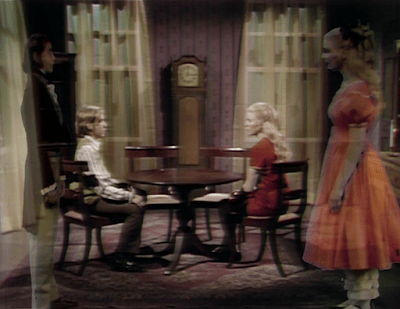
The ghosts indicate that David and Hallie are to take their seats at the table where the dolls usually sit. When they do so, we jump to a somewhat lower camera angle. This cut does indeed make it look like Hallie and David are small figures inside a small space. Henry Kaplan directed this episode. I usually have a lot of complaints about Kaplan. His preferred visual strategy was to cut from a closeup of one face to a closeup of another face to an extreme closeup that shows at most part of a face. But this shot achieves a subtle effect, and that effect tells the whole story. I can’t suppress a suspicion that Lela Swift stepped in and set the shot up for Kaplan, but even if she did he deserves credit for not fouling it up.
Carrie and Tad come into view. Carrie superimposes herself on Hallie’s body, Tad superimposes himself on David’s, and both ghosts fade out. As they do, we hear Tad say “Goodbye, David,” and Carrie say “Goodbye, Hallie.” We will see Carrie and Tad in the persons of Hallie and David for some time, but will never see either David or Hallie again.
I remembered this closing image vividly from our previous watch-through of the series. I misremembered the lines, though. I recalled David and Hallie saying goodbye to each other, not the ghosts saying goodbye to the teenagers as they took possession of them. I think it is better the way it is. We are supposed to be horrified at Carrie and Tad’s thoughtless cruelty as they annihilate Hallie and David, and denying them even the opportunity to bid each other farewell serves that purpose. Unsatisfactory as are the rest of the episode and indeed the rest of the David and Hallie story, this closing shot is highly effective.
*Alexandra Moltke Isles last played the character in #627. Two other actresses succeeded Mrs Isles in the role.
**Another iteration of the character appeared in 20 episodes between #729 and #760.
***Another version of the character appeared in 17 episodes between #975 and #1055.
I first started watching Dark Shadows in the 1990s, when what was then The Sci Fi Channel was showing it Monday through Friday at 10:00 and 10:30 AM. I got into the habit of daily viewing when they were showing episodes from the summer of 1967, when the ghost of nine year old Sarah Collins was occasionally dropping in on strange and troubled boy David Collins. Sarah’s brother, vampire Barnabas, was thinking he might want to kill David, and David’s aunt, matriarch Elizabeth Collins Stoddard, was a blocking figure who refused to engage with any evidence that anything unusual was going on.
In those days, it appeared that if Barnabas got his way the estate of Collinwood would be peopled only by the unquiet spirits of the dead. I imagined how that might have played out, if the show were not an open-ended serial but were allowed to come to an end. I pictured the great house in ruins. Well-meaning governess Victoria Winters and her boyfriend, hopeless schlub Burke Devlin, would venture into the wreckage. Vicki and Burke would dodge phantoms and demons and make their way into the drawing room. There, they would find Liz sitting serenely while leathery-winged fiends flutter about her head. Vicki would plead with Liz to escape with them. Liz would only smile at her and say that nothing is wrong, nothing at all. Seeing that Liz had taken her commitment to denial as a way of life to its ultimate extreme, Vicki and Burke would have no alternative but to leave without her.
The makers of the show have acknowledged that Barnabas’ plan would have left Collinwood entirely uninhabitable. They did that in the feature film House of Dark Shadows, which replays the story that led to the summer of 1967 and takes it to that conclusion. And they are doing it again now.
Vicki has long since left the show, replaced as the audience point of view character by mad scientist Julia Hoffman. Julia tried to cure Barnabas of his vampirism in 1967; in 1968, she completed a procedure devised by a fellow mad scientist that did put the symptoms of his curse into abeyance. Barnabas has since bungled his way into another vampire curse, but his connection to Julia still makes it possible for him to be a permanent part of the cast of characters and, on balance, a defender of the status quo, which in a genre where the most important thing is that there is still a story left to tell in the next episode is the closest thing there is to a hero. As such, he is the successor to Burke, who was supposed to be a dashing action hero when Dark Shadows started.
In July 1970, Barnabas and Julia came unstuck in time and found themselves in the far-off future year 1995. There, the great house of Collinwood was in ruins, its residents either dead, missing, or insane as the result of a mysterious disaster that took place before 1970 was out. The estate was dominated by malevolent ghosts, and the people of the village of Collinsport dared not even speak of the place, let alone visit it. Since Julia and Barnabas returned to 1970 in #1071, they have been trying to figure out what the disaster will be and to prevent it.
At first, Liz was somewhat sympathetic to Barnabas and Julia’s efforts, as befits the several times in 1969 and early 1970 we saw her admit that uncanny events were taking place around her. But her old commitment to denial came back to the surface when she forbade Julia and Barnabas to talk with David or teenage houseguest Hallie Stokes about what they had seen in 1995, even though Hallie and David are clearly central to the upcoming disaster. Because they cannot talk with the teens, Barnabas and Julia have not been able to do anything to prevent the ghosts from encroaching on them and taking an ever stronger position in the house.
In #1088, Liz finally realized what was going on and ran to find Julia, crying that they would have to get David and Hallie out of the house before the ghosts got hold of them. But it was too late. She found herself looking into the face of the haunting, an evil spirit known as Gerard. By the time Julia caught up to her in #1089, Liz was entirely under the power of Gerard, and placidly refused to accept that anything out of the ordinary was going on.
Hints have been mounting that the disaster will occur soon. Today, Julia and Barnabas tell Liz that it is urgent Hallie and David be taken from the house at once. Liz refuses, telling them that when the night ends with no further disturbances they will have to admit that all of their fears are simply a “ridiculous fantasy.”
For their part, David and Hallie have been spending a lot of time the last few weeks sitting around moaning about how helpless they are. That does not make for gripping television, even when they look at a dollhouse and say they think the ghosts have been playing with the dolls when they weren’t looking. David gets an idea. The dolls in the ghosts’ dollhouse have connections with particular people around the estate, so if he and Hallie make a doll of Barnabas, perhaps that will cause Barnabas to be aware of what the ghosts are doing.
Hallie asks David why he wants to alert Barnabas in particular. He says that if anyone can fight Gerard and the other ghosts, it will be Barnabas, because “He’s… different.” In the summer and fall of 1967, David was the one person at Collinwood who was on track to figure out Barnabas’ secret, leading the show into a blind alley from which it escaped by going back in time to the year 1795. When they returned from that first costume drama insert in March 1968, David was for some reason no longer a threat to Barnabas. But he was still conscious about his distant cousin in ways his Aunt Liz would never countenance. So in #660, David told his friend Amy Jennings that “Barnabas knows a lot of things that he doesn’t tell anybody.”
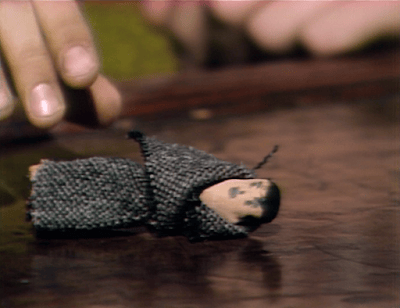
The doll is not particularly realistic; the spirit world doesn’t require very high production values, and Hallie and David are under severe time constraints. So their Barnabas doll is adorably crude. I’m thinking of making it my PFP, replacing the tailor’s dummy known as “Mr Juggins” that I’ve been using since David and Amy showed him to Liz in #681.
Looks more like Jonathan Frid than does the Barnabas from the Gold Key comics. Screenshot by Dark Shadows Before I Die.
Regular viewers know that David’s instincts are sound. Barnabas and Julia confronted Gerard in the room where the dollhouse is in #1070. Gerard was powerless against Barnabas. Something might have come of that, but Gerard then turned his attention to Julia, causing her to become very ill and forcing them to retreat. After they have put the doll in the dollhouse, David and Hallie leave the room for a little while. When they return, the Barnabas doll has been thrown from the dollhouse and destroyed, suggesting that Gerard did indeed see a danger in its presence.
Finally, Julia and Barnabas manage to corner Liz and force her to let them take Hallie and David away. After they leave her, Liz shuts herself up in the drawing room and apologizes to the unseen Gerard. She says she could not think of any way to resist them further.
This admission of defeat is the next to last time we will see Liz. She will appear again in one scene twenty and a half weeks from now, in #1198, in which she will simply serve to confirm that things are back to normal. Moreover, that version of Liz appears in a Collinwood where none of the events we have seen over the last several months has taken place; we have no idea what her character development has been. This is the final appearance of the person we have been watching since episode #1.
When Dark Shadows began, Joan Bennett was its biggest ratings draw and Liz was the most powerful character. Her function as Keeper of the Secrets set her on the path that would lead her towards extreme denialism and away from any active role on the story, but along the way Bennett used her great talents to give the show’s foundations their basic outline. For example, in the relationship between Liz and her brother, high-born ne’er-do-well Roger Collins, Bennett and Louis Edmonds pioneered the dynamic of Bossy Big Sister and Bratty Little Brother, the same dynamic that makes Barnabas and Julia so much fun to watch and that turned Quentin Collins into a breakout hit in 1969 when we saw him with his Bossy Big Sister, Judith (also played by Joan Bennett.) In her other roles, Bennett will continue to be indispensable to the show, but those of us who started with #1 will never stop wishing the writers had found more to do with the character of Liz.
In July, vampire Barnabas Collins and mad scientist Julia Hoffman came unstuck in time and found themselves in the far-off future year 1995. Julia and Barnabas found that the great house of Collinwood had been in ruins ever since some mysterious disaster took place on an unspecified night in 1970. Some residents of the great house went missing that night, others died, and two of them, Carolyn Stoddard Hawkes and Quentin Collins, went insane. The mad Carolyn of 1995 apparently knew that Barnabas was a vampire; she had known that for a while in 1967, when she was his victim, but appeared to have forgotten it when he was relieved of the effects of his curse for a while starting in March 1968. Towards the end of Barnabas and Julia’s time in 1995, Carolyn left a note for them, consisting of six cryptic phrases, shortly before the ghosts who rule Collinwood killed her. They decided the phrases were clues to the disaster, and ever since returning to 1970 have been trying without success to use them to figure out what is going on.
One thing that is clear is that the disaster will involve the deaths of teenagers Hallie Stokes and David Collins and the merger of their ghosts with the ghosts of their lookalikes from the year 1840, Carrie Stokes and Tad Collins. David and Hallie are aware of this and spend all their time moaning about how helpless they are to do anything about it. Their headquarters for this operation is a room that intermittently materializes behind a door that usually leads to a linen closet. The room is much too large to fit into the space the linen closet occupies, is stocked with high-end antique toys, and is frequented by the ghosts. Hallie and David call it “The Playroom.” In 1995, Julia and Barnabas found that The Playroom was in existence all the time and that anyone could enter it, but until today only David, Hallie, and the ghosts have been able to go there. Everyone else just sees the linen closet when they open the door.
Hallie and David are in The Playroom, bummed out because Carrie has revealed to them that they are fated to become dolls in the dollhouse that is there. This was previously revealed to them in #1082, but Dark Shadows has been losing teenage viewers lately, so perhaps David and Hallie weren’t watching that day. A miniature carousel starts turning and playing music; David is influenced by the music, and says that perhaps their future in the dollhouse won’t be so bad.
Meanwhile, Carolyn is in the corridor outside The Playroom. We see her after the camera pans out from a closeup of the stained glass work above the door that sometimes opens on The Playroom. We notice that it depicts roses. The dollhouse is a scale model of a house that was known as Rose Cottage in 1840, and is in some sense identical to that house. One of the clues Carolyn left in 1995 was “The night Rose Cottage was destroyed,” which has led Barnabas and Julia to ask everyone if they’ve ever heard of Rose Cottage and to work feverishly to try to locate it. You might think they would remember the roses above the door to The Playroom and to think of the toys they saw there in 1995, but no such luck.
Carolyn hears the carousel’s music and wonders where it is coming from. She opens the door to The Playroom. She still hears the music, but sees only the linen closet. It is a haunting moment. We know that she is glimpsing an aperture between her world and another, but nothing she can see could lead her to conclude that anything at all extraordinary is happening. It might leave us wondering what it would be like if we were in the presence of some utterly bizarre phenomenon- would we notice?
Carolyn returns to the corridor. Her back is turned when David opens the door. We see The Playroom behind him. We wonder if Carolyn would be able to see it if she were facing the right way. David closes the door silently. Carolyn turns and is startled to see him. He says he is looking for Hallie. Carolyn asks him about the music; he claims he cannot hear it. He suggests someone may have left a radio playing in another part of the house.
The sequence reminded me of the 2017 season of Twin Peaks, as does the whole idea of The Playroom. As Agent Cooper disappeared into the mysterious, intermittently existent Red Room and the Black Lodge beyond, so the ghosts threaten to absorb the living characters into the mysterious, intermittently visible Playroom and the ruinous world of 1995 beyond. As Deputy Hawk once caught a glimpse of the curtains of the Red Room in the clouds above the spot deep in the woods where the worlds sometimes open onto each other, a glimpse so brief and vague that someone unfamiliar with the legends of the Black Lodge would likely either ignore it completely or assume it was a reflection of the clouds from some water on the ground, so the music from the miniature carousel gives Carolyn a glimpse so subtle and vague that anyone who had not been briefed by Julia and Barnabas would immediately accept David’s idea that it is just a radio. I doubt that this part of the show had a direct influence on Twin Peaks– more likely, the shared imagery is just the logical endpoint of a sense that there is more to the world than we can readily perceive with commonplace fears of being trapped in unfamiliar places. But I do think the two shows can shed light on each other.
Under the influence of the ghosts, Hallie and David make a doll with bright yellow hair and put it in the dollhouse. It represents someone named “Leticia” who will join them when they are living in the dollhouse. Since the only blonde character on the show other than Hallie is Carolyn, we have to assume that a ghost named Leticia has the same designs on Carolyn that Carrie has on Hallie and Tad has on David.
In 1995, Carolyn had not disappeared into the dollhouse, but was living in a shack by Finley’s Cove. She even went in and out of The Playroom from time to time, interacting with Tad and Carrie. This is the first indication we’ve had that the ghosts’ will is not entirely ineluctable. There may be nothing the characters can do to keep a disaster from occurring, but perhaps there is some hope that we might see them do something to shape the particulars of the disaster that will befall them.
Carolyn is busy looking after David and Hallie’s governess, Maggie Evans. Maggie is ill, having been bitten by a vampire. When he found out about this, Barnabas was surprised to learn he isn’t the only vampire in town, and he and Julia have been trying to figure out who has been feeding on Maggie. Carolyn and Maggie talk about the previous vampire attacks. There is an electric moment when each of them looks like she is trying very hard to remember something that is hidden way down in the recesses of her mind. Several times in 1968, Nancy Barrett played Carolyn as if she remembered a lot more about Barnabas than he knew. The script didn’t give her any support in that, and she eventually had to give it up. Maggie was Barnabas’ victim in May and June of 1967; that experience has been wiped from her memory several times, and we may wonder if it will emerge one more time. In light of what we saw about Carolyn’s knowledge in 1995 and the similarity of what Maggie is going through now to what she went through in 1967, this moment is highly effective.
Miss Barrett also manages to get a laugh from regular viewers today. She has a scene with Christopher Pennock as astrologer Sebastian Shaw. Pennock also played Carolyn’s late husband Jabe (alias “Jeb”) Hawkes. The two characters are supposed to resemble each other strongly, and for a while Carolyn hoped Sebastian would turn out to be Jabe. But she’s given up on that, and Sebastian wants to date Maggie.
Sebastian comes to Collinwood. Carolyn tells him Maggie is very sick and cannot receive visitors. Sebastian wants to see her anyway. Carolyn tells him that is impossible. He becomes angry and declares that she will see him sooner or later, no matter what! Sebastian storms out of the house, and Carolyn watches him go with a sad little smile. Sebastian is violent, irrational, controlling, and childish, just like Jabe. Her look shows us how much she misses those things about him.
Aww, what a wonderful dangerously unstable man-child he is!
Carolyn can’t get the tune the little carousel plays out of her head. She goes back to the door and opens it. Now, it opens on The Playroom. The circle the ghosts have drawn around Hallie and David now encloses her as well. We can start to see how she might have known enough to leave the clues she left in 1995 for Barnabas and Julia.
The vampire story is new and has some promise, but the haunting has been going in a tight little circle for five weeks, with no progress in sight. The miniature carousel is all-too-apt a symbol of that. Even the opening voiceover seems to acknowledge that the show is in a rut. It breaks off in mid-sentence. We hear Kathryn Leigh Scott telling us that David and Hallie have discovered “a secret world- a world populated by the dead. And this night, they learn…” That’s it, the audio stops abruptly at that point. What do David and Hallie learn? What does it matter, whatever it is can’t possibly affect the story in any way.
Governess Maggie Evans has been bitten by a vampire other than Barnabas Collins. Barnabas and mad scientist Julia Hoffman are stymied in their efforts to find out who this other vampire is. They decide not to take Maggie to the hospital, since they don’t want to answer any questions. Instead, Julia goes to some unspecified location in the village of Collinsport to get several units of blood to transfuse into Maggie. I’m sure a no-questions-asked blood bank would be a highly profitable enterprise in Collinsport.
I wonder if Julia had to go in the blood store to get that bag, or if they have a drive-through. Screenshot by Dark Shadows Before I Die.
Meanwhile, Maggie’s charges, gloomy teenagers David Collins and Hallie Stokes, are sitting around in a space that intermittently materializes in a location usually occupied by a linen closet. It is stocked with fancy antique toys, frequented by ghosts, and called “The Playroom.” The ghosts don’t take visible form today, but Hallie and David notice that they keep playing with a dollhouse in The Playroom.
The dollhouse is a scale model of a mansion known as Rose Cottage that stood somewhere in the Collinsport area in 1840, when the ghosts were living beings, and is in some supernatural sense identical with that mansion. The ghosts are big fans of scale models. Some time ago they gave David a scale model of a ship that one of them sailed when he was alive. Today, David and Hallie see that the ghosts have added a tiny model of the same ship, reduced in size so that it is in the same proportion to the dolls in the dollhouse as the original model was to the residents of the great house of Colllinwood. Hallie says that if they go to David’s room, they will find that the model is gone from there, because it has been transformed into this minuscule thing.
At the end of the episode, Hallie and David hear one of the ghosts telling them to look into the dollhouse and learn their fate. They comply, and see themselves in place of the dolls. David and Hallie have spent all day sitting around doing nothing, and when they look into the future they see that they are still sitting around doing nothing. Evidently the greatest horror the writers can imagine is that the show will go on as it has been lately. I have to admit they have a point!
Julia Hoffman and her friend Barnabas Collins recently returned to 1970 after a cosmic journey that ended with two weeks in 1995. In that far-off future year, they found the great house of Collinwood in ruins and everyone who had lived there either dead, missing, or hopelessly insane. This was the result of a mysterious disaster that occurred before 1970 was out. Since they returned, they have been trying to find out what this disaster will be and to prevent it.
Julia’s friend Timothy Eliot Stokes tells her she and Barnabas have accomplished nothing since they came back to 1970. He says that the time has come to enlist the aid of a strangely dressed man named Sebastian Shaw. Sebastian has psychic powers, and may be able to use them to figure out what’s going on.
Sebastian comes to the great house. Julia tells him of her experience in the future. He has a vision which he says he cannot interpret. It is presented to us in an unfocused shot, so that we can believe Sebastian does not know what he is seeing. But we recognize it. It is The Playroom, a room that intermittently exists behind a door in a little-used part of the great house. Most of the time that door opens on a linen closet, but teenagers Hallie Stokes and David Collins have found that occasionally the same door admits them to a much larger space stocked with antique toys and ruled by the ghosts of several people who died in 1841. Julia knows The Playroom well; she and Barnabas visited it several times in 1995, and met the same ghosts there who are now taking control of David and Hallie. Julia and Barnabas also went to The Playroom in 1995 with two living people, Carolyn Fredericks (née Carolyn Collins Stoddard) and the Sheriff of Collinsport. But in 1970, only the linen closet has so far been visible to anyone other than Hallie, David, or the ghosts.
After Sebastian has his vision, Stokes and Julia decide to bring David and Hallie to him. Stokes goes upstairs to fetch them, and Julia goes to get some tea. When she returns to the drawing room, Julia finds Sebastian at the piano. He is playing the melody that often sounds in The Playroom, and that Julia heard echoing through the house in 1995. She asks him where he heard it. When he says he was just making it up as he went along, she flatly declares that he is lying. He must have heard it in his vision, because it is the very tune that is associated with the phenomenon they are investigating. He will not admit to this, and she will not soften her tone. On the contrary, she says that she had suspected that he was a fraud, but that she now believes he is something far worse- a man with genuine psychic gifts who uses them dishonestly. We learned yesterday that this is precisely what Sebastian is, but Julia can hardly expect him to agree with her. He says that he is being insulted, and leaves the house before Hallie and David can get downstairs.
Julia has been given to counterproductively harsh behavior of this sort since returning to 1970. Perhaps this is the consequence of a trauma she suffered in 1995, when a blatantly evil ghost known as Gerard Stiles took possession of her. Or perhaps it is the influence of someone she encountered on the first leg of her journey, when she was in an alternate universe. There, she met her own Doppelgänger. She greeted this other Julia Hoffman by beating her to death, stealing her clothes, and assuming her identity. A deed like that might leave a mark on its doer. Besides, that other Hoffman was herself inclined to be tactless, so perhaps Julia picked that habit up in the course of her imposture.
Unknown to Julia and Stokes, David and Hallie are busy in The Playroom today. Yesterday they learned that the ghosts plan to reduce them to the status of the dolls that are in a dollhouse there. In particular, the ghost of a teenage boy named Tad wants to take possession of David, and that of a teenage girl named Carrie wants to take possession of Hallie. Tad and Carrie will then live their lives while David and Hallie are in storage as inanimate things in a miniature case. Hallie and David took the dolls to the fireplace in the drawing room and burned them there, hoping this would break the power of the ghosts. Once they had seen the flames consume the dolls, they returned to The Playroom, hoping to find that it had vanished and the linen closet had resumed its place. To their dismay, they found that The Playroom was still there and the dolls had reappeared in their places in the dollhouse.
While David and Hallie are processing this fact, they see lights come on inside the dollhouse. The dollhouse has no electricity, so this puzzles them. David looks inside the dollhouse and sees a man in it. He is the size of the dolls, but is moving around as if he is alive. By the time Hallie comes around to look, the tiny man has vanished. She believes that David saw him, though.
David then tells Hallie that they ought to write up everything that has happened to them since they first encountered The Playroom. When Hallie asks what good that would do, David says it is the only way people will know what happened to them after they are gone.
They go to David’s room and write the whole story in a notebook. When Stokes comes to get them, they hide the notebook. They return to the room after Sebastian’s abrupt departure, and find that the notebook is gone.
Hallie and David decide that one of the ghosts must have taken the notebook. They go to The Playroom to look for it. They open the door, and see Carrie and Tad reading the notebook.
David’s vision of a little man moving around inside the dollhouse now reminds me of the moment in part 6 of the 2017 revival of Twin Peakswhen a tiny version of the supernatural figure known as “Mike” appears to the near-catatonic Special Agent Dale Cooper and urges him to “Wake up! Wake up! Don’t die! Don’t die!” “Mike” is a resident of The Red Room, a space that is as mysterious in its nature and as intermittent in its presence as is The Playroom. We can assume that the tiny man David sees is Gerard, whose plans for him are just the opposite of “Mike’s” wish that Cooper should regain his true identity and once more function as an action hero.
At the time, the idea of living figures small enough to make their homes in a dollhouse and of people from the outside world shrunken and enclosed with them might have reminded viewers of the 1963 Twilight Zone episode “Miniature,” featuring the young Robert Duvall as a lonely man who encounters such a situation. “Mike” himself is a reference to 1960s cult television; he is a mysterious one-armed man who sometimes goes by the name Philip Gerard, evoking the two antagonists Dr Richard Kimble faced on The Fugitive. So it is not unlikely that “Miniature” was a common source for that installment of Twin Peaks and this installment of Dark Shadows. It isn’t even impossible that David Lynch or Mark Frost saw this episode of Dark Shadows and were on some level influenced by it as they wrote the script for Twin Peaks, though of course that would be a far less probable source than The Twilight Zone, which has long been one of the most heavily rerun of all TV shows.
At any rate, I think the similarity is intriguing even beyond the question of influences and sources. A soundstage looks a lot like a dollhouse, and when a drama isn’t connecting with the audience the actors may as well be dolls the director is playing a private game with. So the premise of characters ending up in a dollhouse plays to a fear that must prey on the minds of the writers.
Moreover, all three of these shows share a theme of stunted sexual development. Robert Duvall’s character in “Miniature” is a solitary man who cannot achieve any form of intimacy with another person. The stupefied Agent Cooper lives with a woman who has mistaken him for her husband and enjoys sex with her, but that is strictly a matter of mechanics. He has no idea what is going on during their encounters.
For their part, David and Hallie seem to be developing on the usual timetable. Certainly the dialogue between them when they were first introduced acknowledged that they were old enough to be interested in each other sexually, though David made it very clear to Hallie that she was not the partner he would choose. But Tad and Carrie seem to be quite alarmingly immature. Tad first possessed David in #1081, on Monday. That day, Hallie found David in The Playroom. Speaking as Tad, David took her to be Carrie. Tad was shocked by Hallie’s 1970 clothing and advised her to take it off immediately. It doesn’t seem to occur to Tad that there is anything untoward about demanding Carrie disrobe in front of him. Tad also said that he would be sad when he was too old to play with the toys in The Playroom. But he is very obviously much too old to be enthusiastic about a rocking horse, a dollhouse, a miniature carousel, and a bunch of stuffed animals. So his and Carrie’s attachment to those things shows that even when they were alive they were relics of a dead past. They never grew up, and their ghosts are determined to freeze Hallie and David in place, immobilized and on display in a small, unchanging world.
Danny Horn’s post under the title Episode 1084 on his great Dark Shadows Every Day doesn’t have all that much to do with the episode, but it is a magnificent production in its own right. Its subtitle is “100 Things That I Would Like David and Hallie to See When They Open the Playroom Door, in No Particular Order.” The 100 things he lists range from chuckleworthy to hilarious. Best of all, it ends with a video the post inspired Cody Schell to put together with alternate endings for the episode.