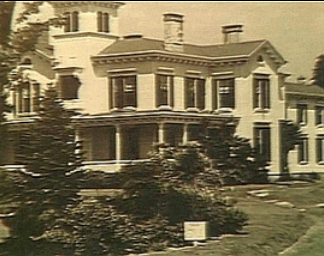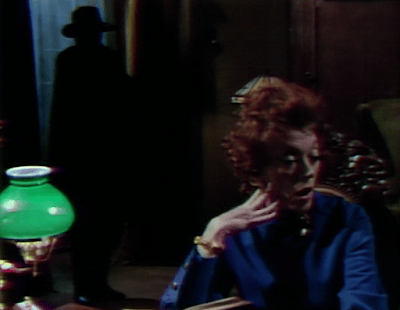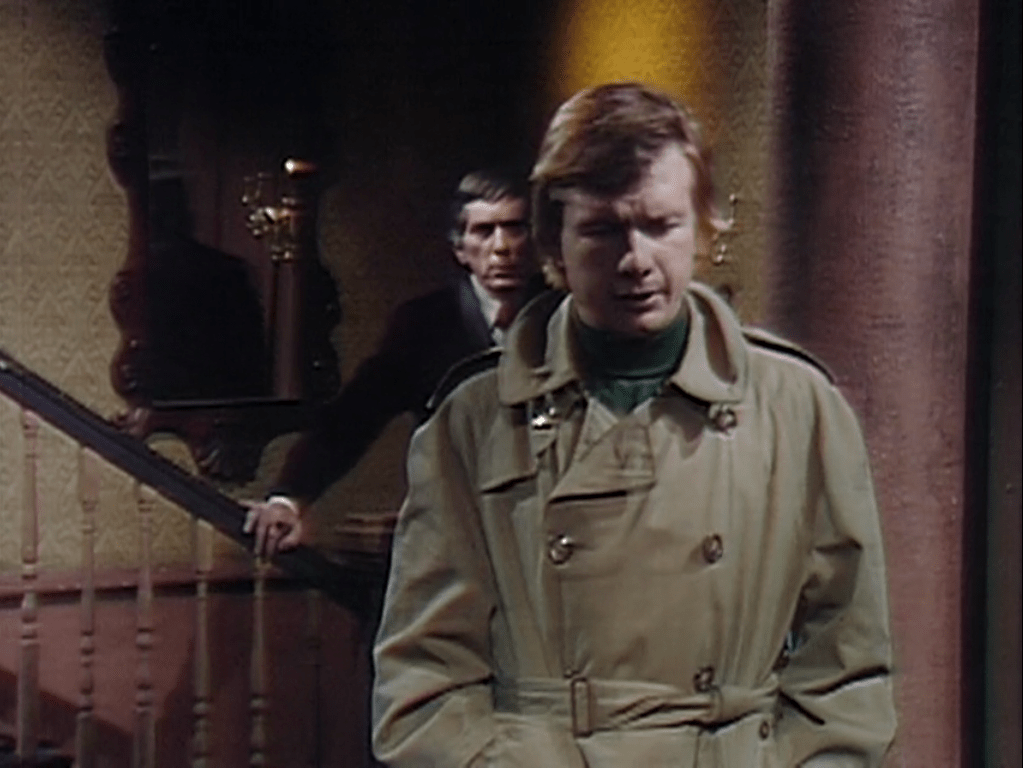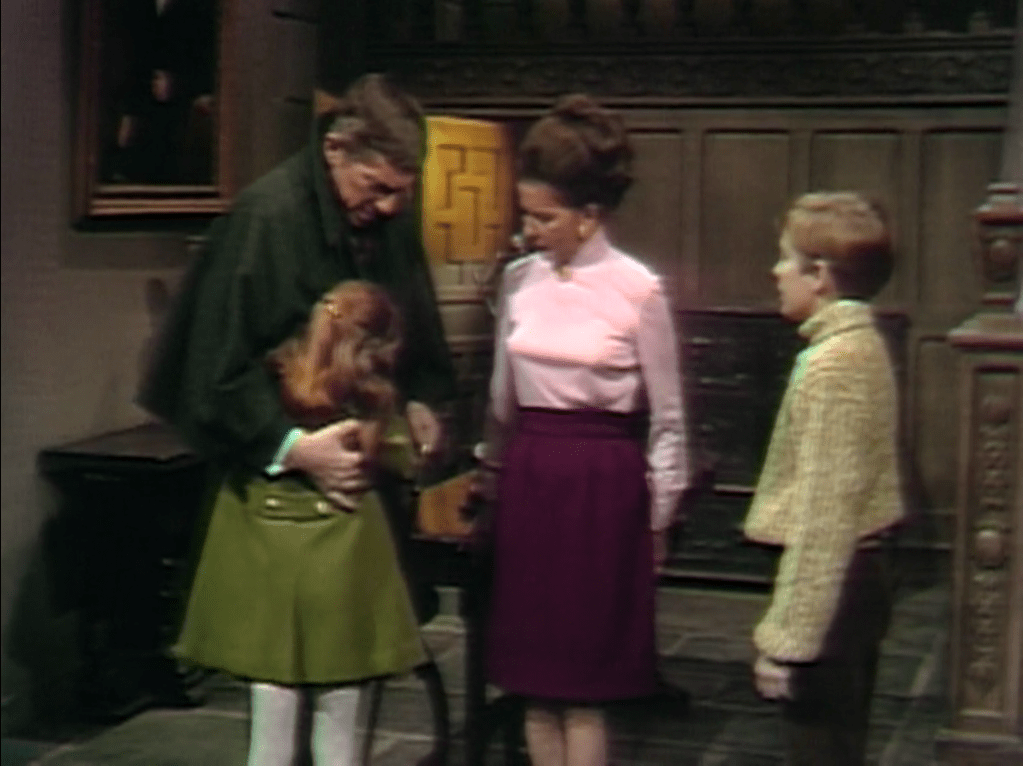
Episode 1108: The Nicest Girl in Town

In episode #1 of Dark Shadows, first broadcast 27 June 1966, Victoria Winters came to the great house of Collinwood to serve as governess to strange and troubled boy David Collins. On her way, Vicki stopped at the Collinsport Inn and had a meal at the diner there. Her waitress was Maggie Evans, a young woman with short blonde hair whom the original story bible identified as “everybody’s pal and nobody’s friend.” Maggie opened their conversation by telling Vicki that she was a “jerk- J-E-R-K” for going to live at Collinwood. Maggie told Vicki that the great house would turn her long black hair gray in two months. When Vicki said she would go there anyway, Maggie offered her a “piece of apple pie on the house- and I won’t take no for an answer.”
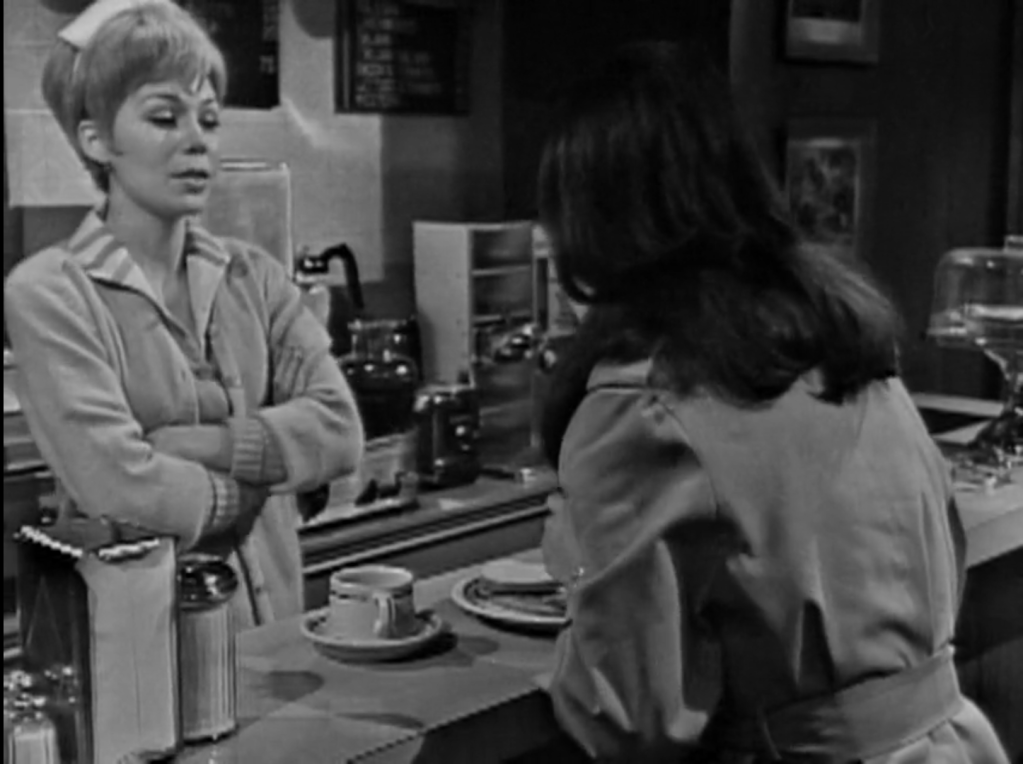
Maggie lays it on the line for the new jerk.

Maggie was the chief representative of Collinsport’s working class in the show’s first months. The diner was a meeting place for a variety of characters, so we saw her wait on all sorts of people. She shared her home, “The Evans Cottage,” with her father, drunken sad-sack Sam Evans. Sam’s career as an artist was ruined when he took a bribe from high-born ne-er-do-well Roger Collins and allowed his one-time friend, Burke Devlin, to go to prison alone for a crime of which Roger was also guilty. Sam’s misery and Maggie’s Adult Child of an Alcoholic (ACoA, they call it) mannerisms, such as laughing awkwardly whenever she begins to speak, attest to the dire consequences for the whole town of what goes on in the big house on the hill. As Maggie and Sam’s territory, the cottage was a space where Burke, who left prison and came back to Collinsport as a corporate raider, could talk about his plans to wrench control of the cannery and fishing fleet from the feudal-minded Collinses and bring the area into the age of capitalism.
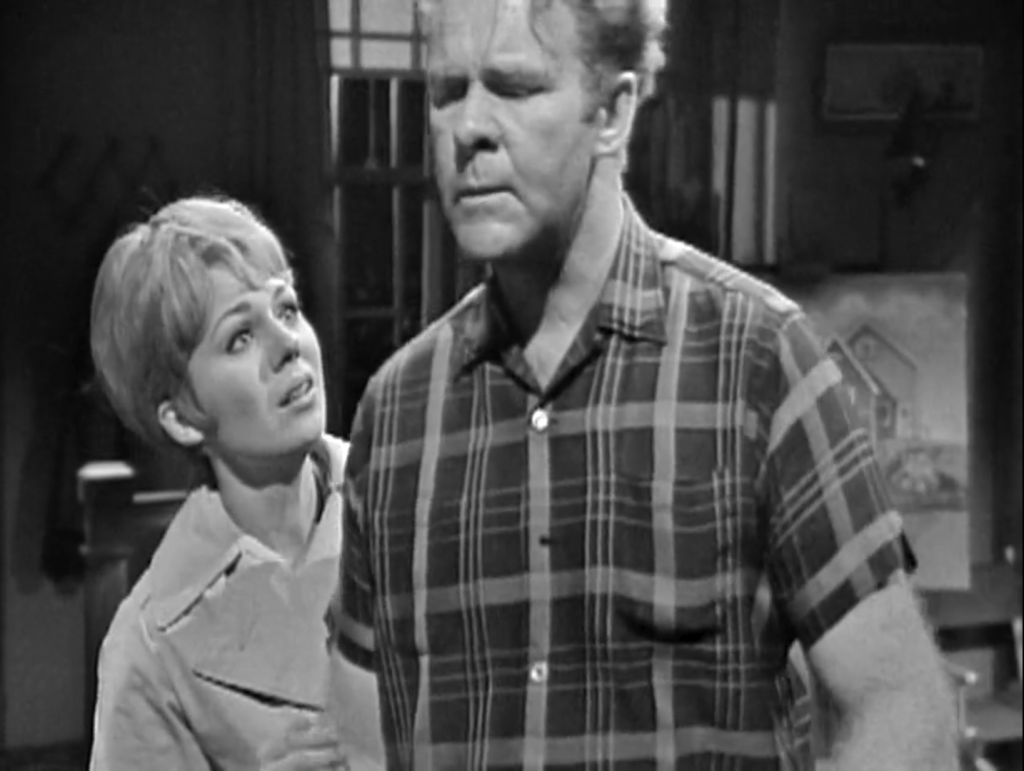
From #12, Maggie at home with Sam. At that point, Sam was played (very badly) by Mark Allen.

They eased up on the “everybody’s pal and nobody’s friend” business pretty quickly. Maggie’s short blonde hair was a wig seen for the last time in #12; from #20 on, she has Miss Scott’s long brown hair. When Miss Scott’s real hair came out, her real personality started to peek through as well. While Maggie could still make a caustic remark or a tactless one as occasion demanded, the signs were already there of her final form, The Nicest Girl in Town.
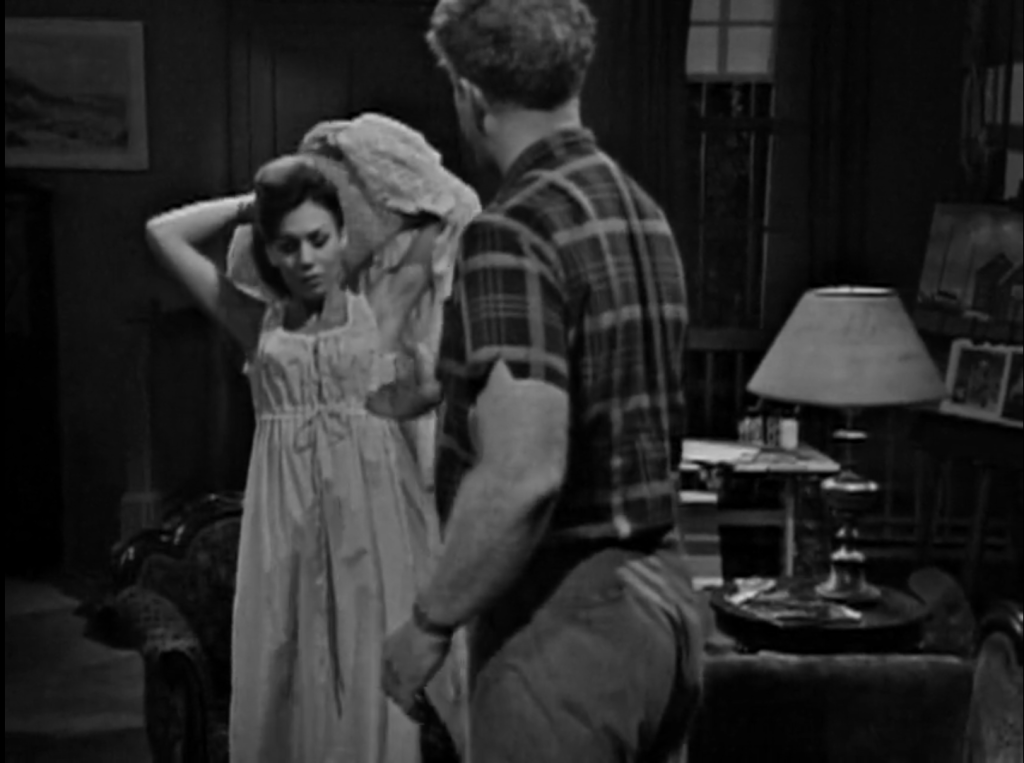
Our first look at Maggie as a brunette.

In #63, Maggie made her first visit to Collinwood. She had made a vow never to set foot in the great house, and was ill at ease when she broke it. With a great show of courage she stood up to matriarch Elizabeth Collins Stoddard. She told Liz that she believed that her family had information about what had gone wrong in her father’s life, and she wanted answers.
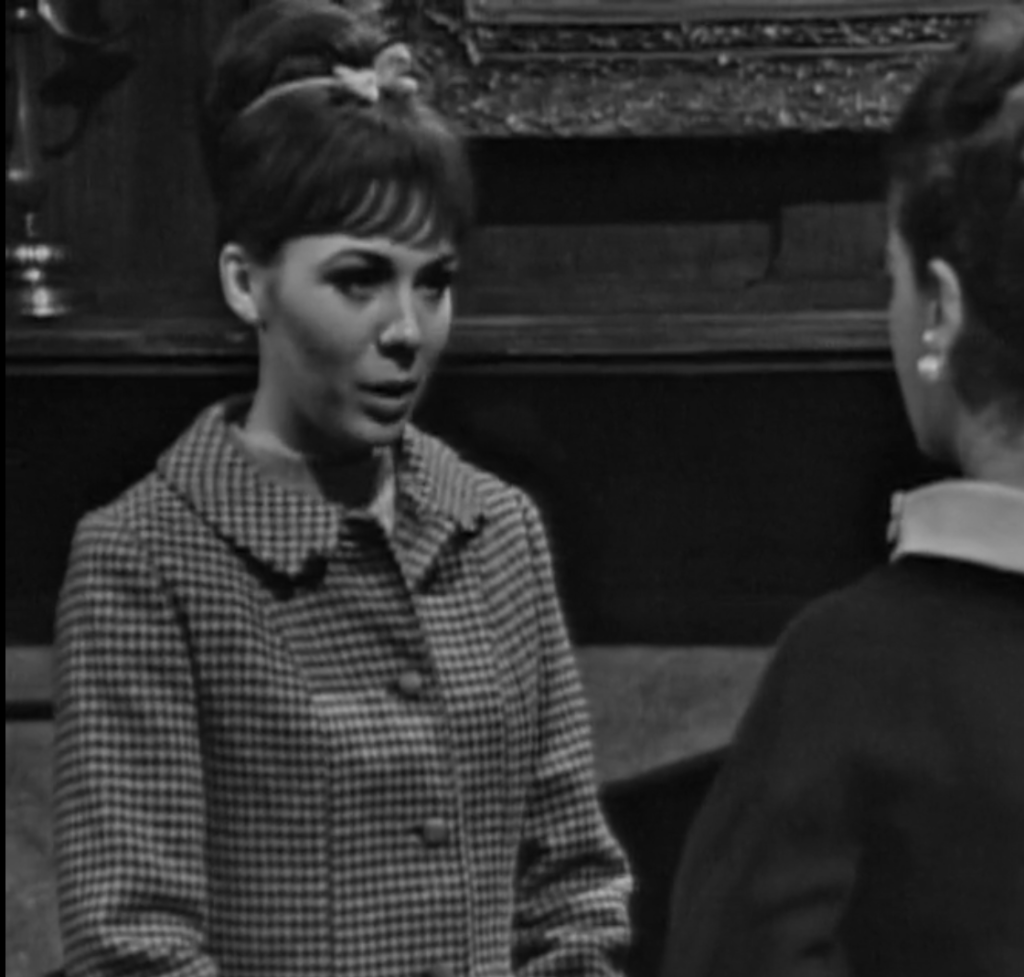
Maggie admits to Liz that she had to screw up her courage to come to Collinwood.

The supernatural was represented in the first months of Dark Shadows primarily by people using the word “ghost” as a metaphor when talking to Vicki, prompting her to reply “Surely you don’t believe in ghosts!?” They would then respond that they damn well did believe in them, and that if she went on living at Collinwood it wouldn’t be long before she believed in them, too. The first unequivocal sign the audience had of supernatural activity came in #70, when the ghost of the gracious Josette Collins emanated from her portrait above the mantel of the Old House at Collinwood, walked outside, and danced among the columns. The figure of Josette was none other than Kathryn Leigh Scott, who volunteered for the task when the original plan to achieve the effect without a performer fell apart.
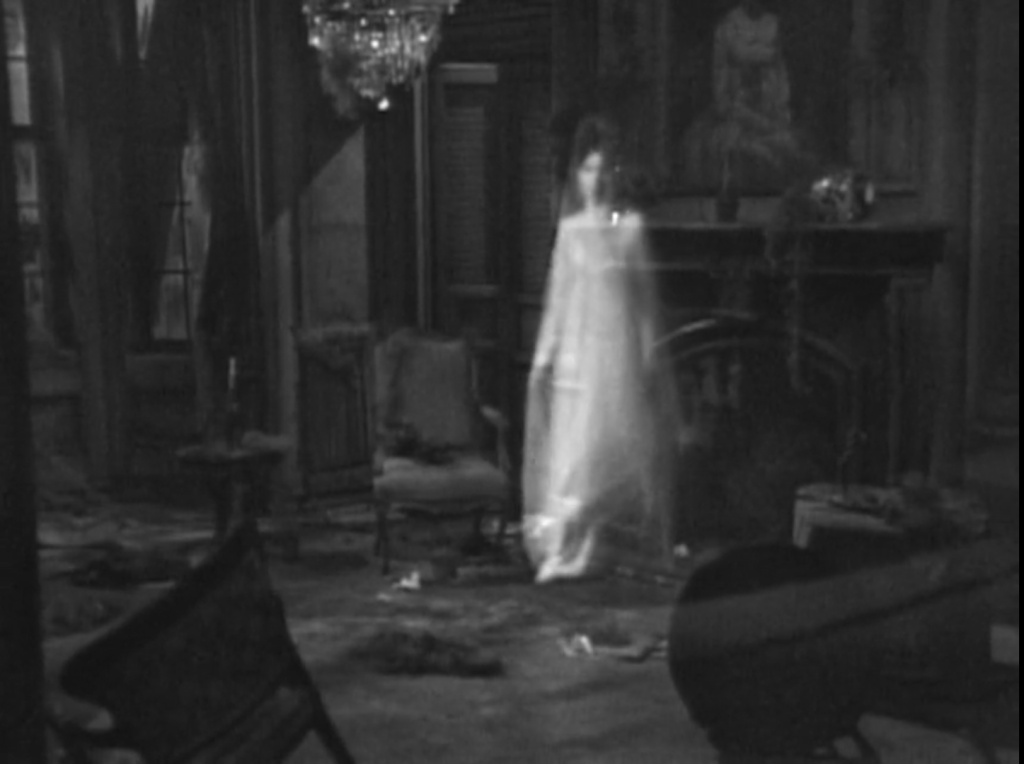
Miss Scott reprised the role of Josette’s ghost in #126, wearing a heavy veil over her face. We hear her voice, with a French accent of sorts, telling Vicki not to be afraid even though a madman has tied her up and is on his way with an ax to cut her head off. Josette then leads the other ghosts of Collinwood in killing the madman before he can harm Vicki.
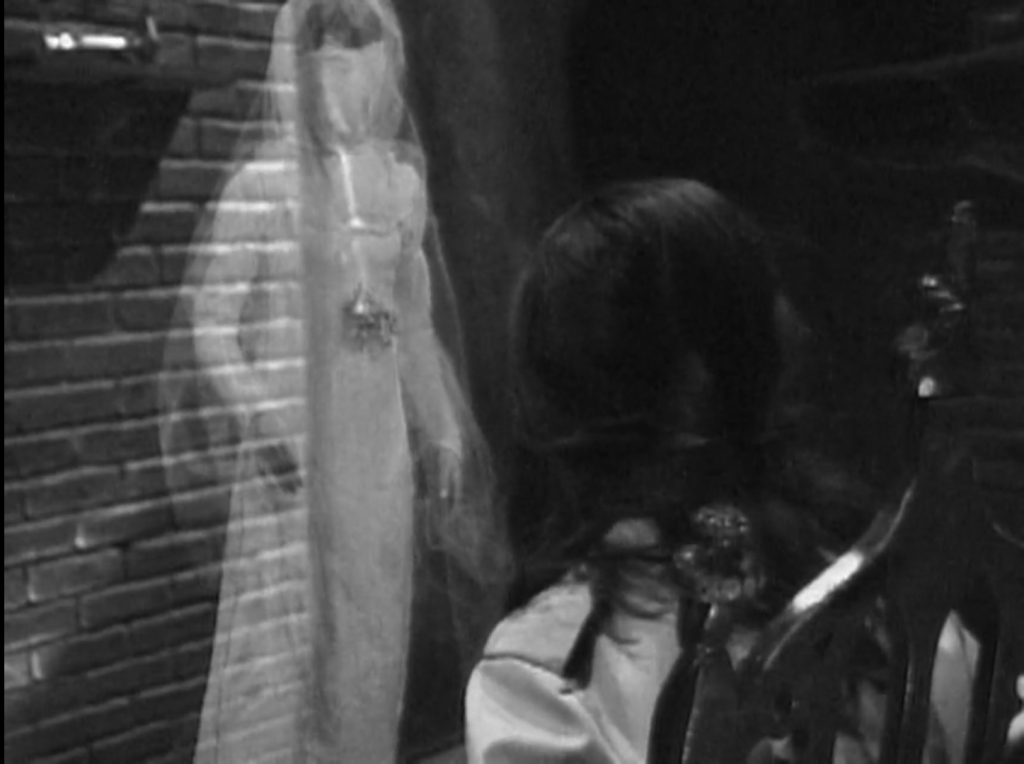
“I am Josette Collins.”

With that, Miss Scott became the first member of the cast to play multiple roles on Dark Shadows. For anyone who happened to recognize her voice in #126 and notice that she was in the credits, even though Maggie was not in the episode, the wised-up waitress and the ghost of Josette would have made an interesting pair. All we knew about Josette at that point was that her maiden name was LaFreniere, that she came to Collinwood in 1830 and married Jeremiah Collins, that she died by jumping off the cliff at Widows’ Hill, and that her ghost could be seen and heard around the estate. For all we knew, the LaFrenieres may have been a humble Franco-American family whom Jeremiah’s haughty relatives snubbed. She may have grown up in a house like The Evans Cottage, and her death might have been the outcome of a class conflict. Later, Josette’s family name would be retconned to DuPrés, her time of arrival to 1795, and she would be presented as a French aristocrat who was the daughter of one of the richest sugar planters on the island of Martinique, a description met in our universe by Joséphine de Beauharnais, wife and empress to Napoleon I.

In the first months of the show, Liz’ daughter Carolyn was dating hardworking young fisherman Joe Haskell. Carolyn and Joe were bored to tears with each other, and only kept going out because Liz thought they should. Joe and Carolyn finally broke up in #84, and he started dating Maggie by #129. Maggie and Joe were happy together, and soon planned to get married once Joe had saved up the money to go into business for himself with a boat and crew of his own. Their cheerful repartee was more agreeable to watch than were the many many scenes of Carolyn and Joe staring silently at each other, but it did not generate any story. It would be helpful that Joe and Maggie each had someone to talk to if they got involved in the plot in any way, but there were long stretches when we did not see either of them.
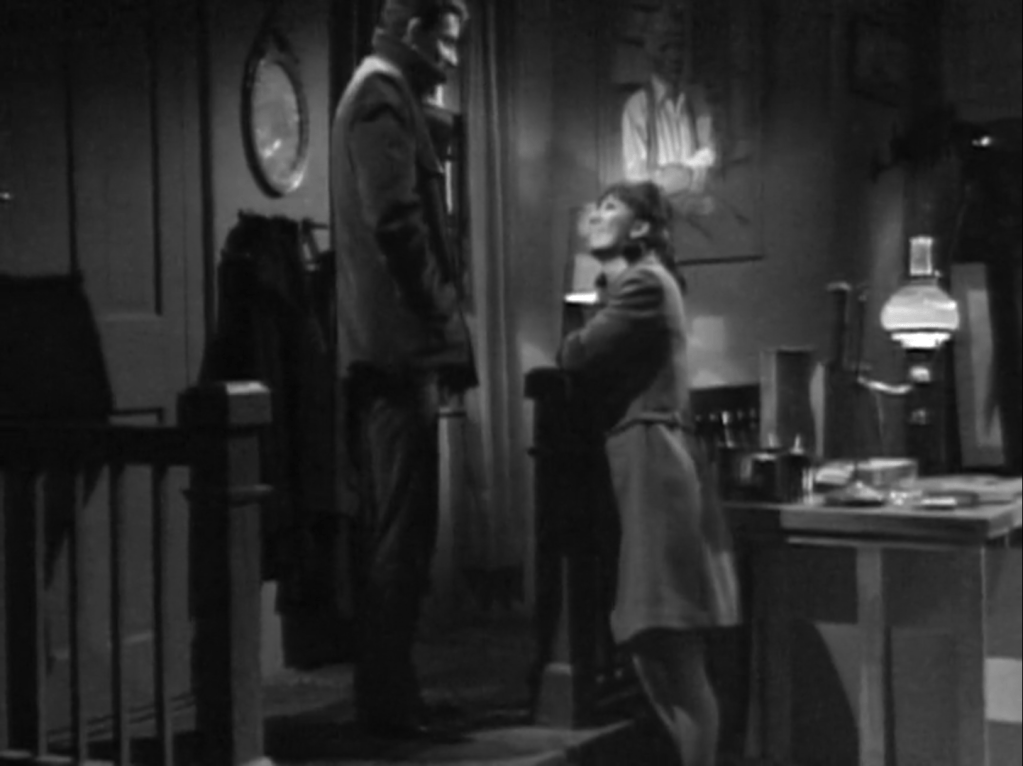
Maggie invites Joe to stay for a nightcap after a date in #129.

From December 1966 to March 1967, Dark Shadows was dominated by the story of undead blonde fire witch Laura Murdoch Collins. Maggie was very far from the center of the action during that period. Laura’s story gathered up the loose ends of all the ongoing stories, including “The Revenge of Burke Devlin” and the significance it gave to Sam’s alcoholism. That would clear the decks for the transformation of the show from a Gothic romance with occasional nods to the uncanny to a full-blown supernatural thriller.

After Laura went up in smoke in #192, Sam wrestled with the idea of admitting Burke that he had taken a bribe from Roger to stay silent in his case. Maggie had a tearful scene in #199 when Sam told her the truth. She urged him to make a clean breast of it. Even if he went to prison, he would be better off in prison than he has been these last ten years. In #200 and #201, Burke heard Sam’s confession and Roger’s, and decided to peace out. The Revenge of Burke Devlin never was a very exciting storyline, and it was apt that Burke himself eventually gave up on it.

In April 1967, Laura was succeeded as the show’s supernatural Big Bad by vampire Barnabas Collins. Barnabas met Maggie in #221, and shortly after added her blood to his diet. She went through a period bedridden in her room at The Evans Cottage, helplessly weak during the day and aggressively determined to deliver herself to Barnabas at night. Eventually he took her to his home, the Old House, where he set about erasing her personality and replacing it with that of Josette.
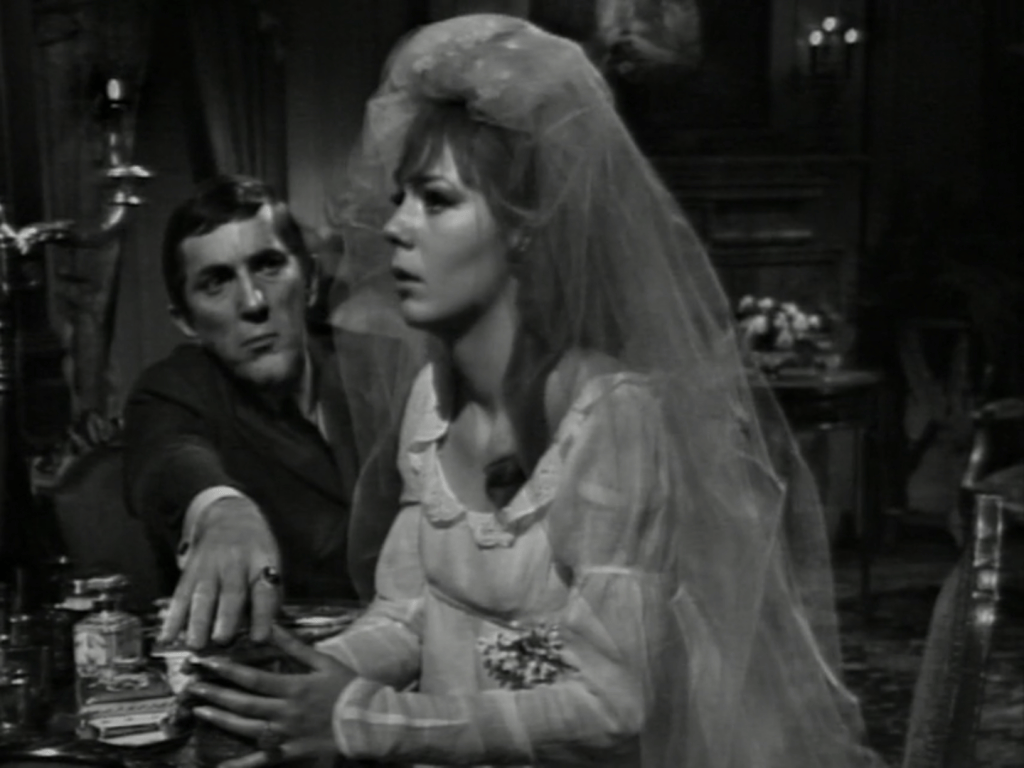
Barnabas with the partially Josettified Maggie in #241.

Despite Miss Scott’s appearances as the ghost of Josette in #70 and #126, the show had always associated Josette primarily with Vicki up to that point. At times it seemed Barnabas believed Maggie really was Josette come back to life; he certainly expressed himself with conviction in #260, when he sat with Maggie in the prison cell in his basement to which he had confined her after she started trying to resist him and said “But you are Josette!” And David, who had been very chummy with the ghost of Josette, saw Maggie in the dress in #240 and #241 and took her for Josette, remarking that her face looked exactly the same as it always had. In those moments, the show was nodding to the 1932 film The Mummy, in which Boris Karloff plays the undead Imhotep, who recognizes in Helen Grosvenor (Zita Johanns) the reincarnation of his lost love Ankh-Esen-Amun (also Zita Johanns.)

At other times, it seems that any pretty girl will do for arnabas’ fiendish plan. So in #274, after Maggie escaped and he decided to repeat the experiment with Vicki as the subject, Barnabas tells his sorely bedraggled blood thrall Willie Loomis that if you “Take the right individual, place her under the proper conditions and circumstances, apply the required pressure… a new personality is created.”

While Barnabas was holding Maggie in his basement cell, the ghost of his little sister Sarah showed up and befriended Maggie. It was she who helped Maggie escape. Sarah’s appearances turned out to be at least as big a turning point in Dark Shadows’ development as anything else that had happened up to that point, since it showed that the beings who lurked in the supernatural back-world behind the show’s action are starting to emerge into the foreground. Eventually, they will come on in force.
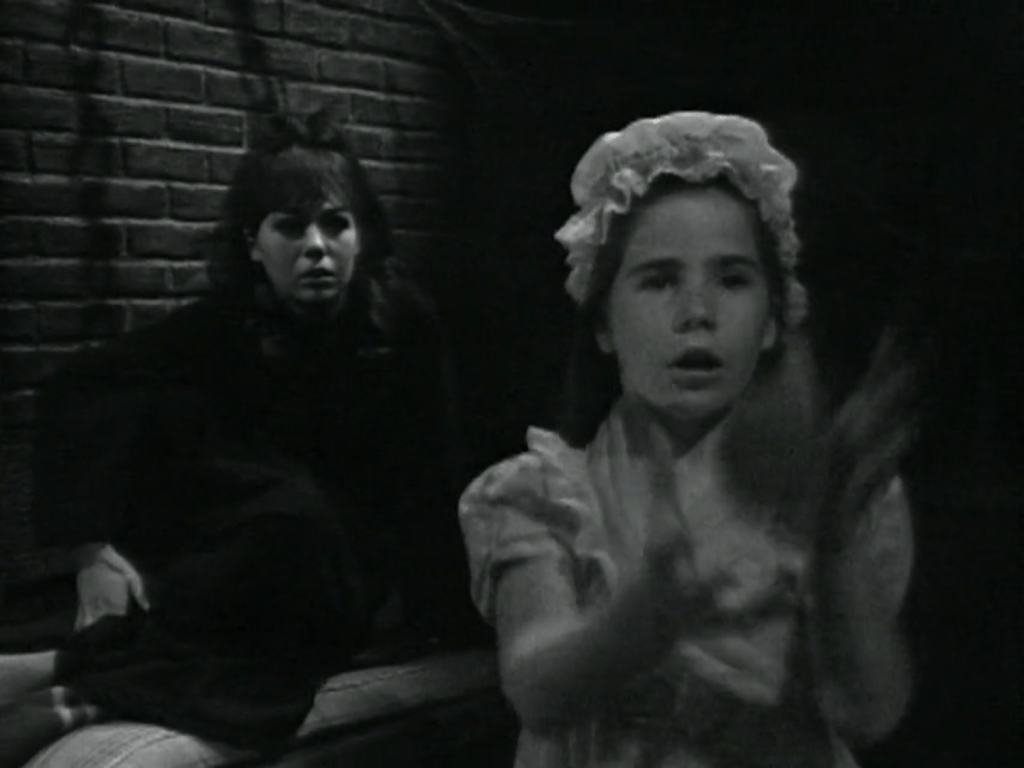
Sarah visits Maggie in her cell.

Maggie was sent off to a psychiatric facility called Windcliff after her ordeal as Barnabas’ prisoner. She had lost much of her memory and regressed to an almost nonverbal state. Her doctor, Julia Hoffman, probed into her mind, and soon learned the truth. Julia then went to Collinwood, where it turned out that her true loyalty was not to Maggie at all. She had been working on a cure for vampirism, and wanted to attach herself to Barnabas. When Sarah magically released Maggie from Windcliff and led her back to Collinsport, Julia betrayed her patient completely by using her powers of hypnosis to erase her memory and protect her abuser.

In November 1967, the supernatural back-world switched places with the naturalistic fore-world when Vicki traveled back in time to 1795. There, she met Josette, played by Miss Scott. That casting confirmed that Maggie really was the reincarnation of Josette, as Helen Grosvenor really was the reincarnation of Ankh-Esen-Amun. Those who remember how bleak the show was in May and June of 1967 when Maggie was in Barnabas’ basement can’t help but squirm at the thought that his attempt to torture her into expressing Josette’s personality was motivated by anything other than his utter loathsomeness, yet here the show is telling us that, however unsound his methods may have been, he had a point.
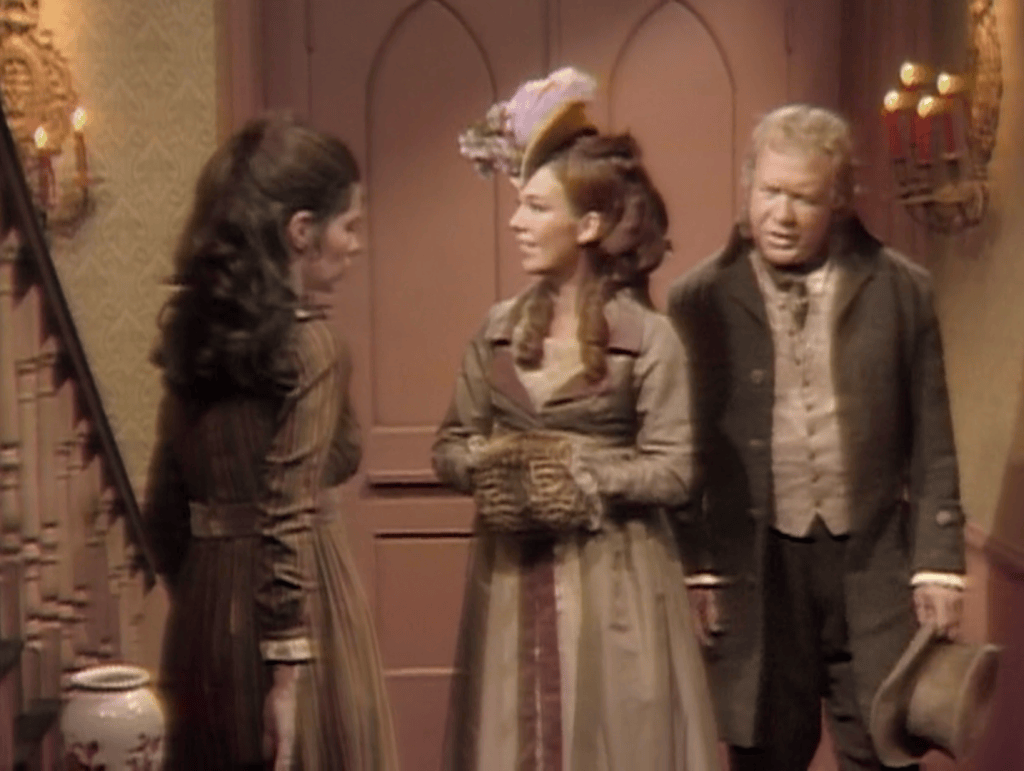
Josette’s first appearance as a living being, in #370.

When the show returned to contemporary dress in March 1968, it was a Monster Mash with a cast drawn from the whole back-catalogue of Universal Studios horror pictures from the 1930s. Wicked witch Angelique struck Sam blind; later, he befriended Frankenstein’s monster Adam. Not knowing his own strength, Adam would accidentally kill Sam. The story moved so fast in those days that Maggie didn’t have much time to mourn her father.

Angelique defied her master, suave warlock Nicholas Blair. To punish her, Nicholas turned Angelique into a vampire. Angelique took Joe as a victim, wrecking his relationship with Maggie. In #599, Maggie had recovered her memory of her own time as Barnabas’ victim, and she saw Angelique biting Joe. She pleaded with Joe to run away with her, urging upon him the hope that there was still time for them to escape. Then, Nicholas got hold of them. He erased Maggie’s memory again, leaving her cheerful and Joe beyond help.

Shortly thereafter, Nicholas and Maggie went on some dates. Nicholas had plans for Adam that required a woman to risk her life. In #633/634, Maggie accompanied Nicholas to the basement of the Old House, where he was forcing Julia and Barnabas to do his bidding. Maggie calmly and cheerfully volunteered to serve the function Nicholas had in mind for her. She looked around the basement and mentioned that she had spent a great deal of time there, indicating a knowledge of everything that had happened to her in that place before. When Nicholas threatens to kill both Adam and Barnabas if he does not get his way, Julia tells Maggie to stop him. Maggie blandly asks why she should. Her willingness to risk her life seems to be the measure, not of her resignation to her fate, but of an indifference to human life so total as to include her own life. Maggie was under a spell then, and when Nicholas’ plans failed she became her usual self again. But in that scene, we catch the only glimpse we will ever get of Evil Maggie. It is thrilling.
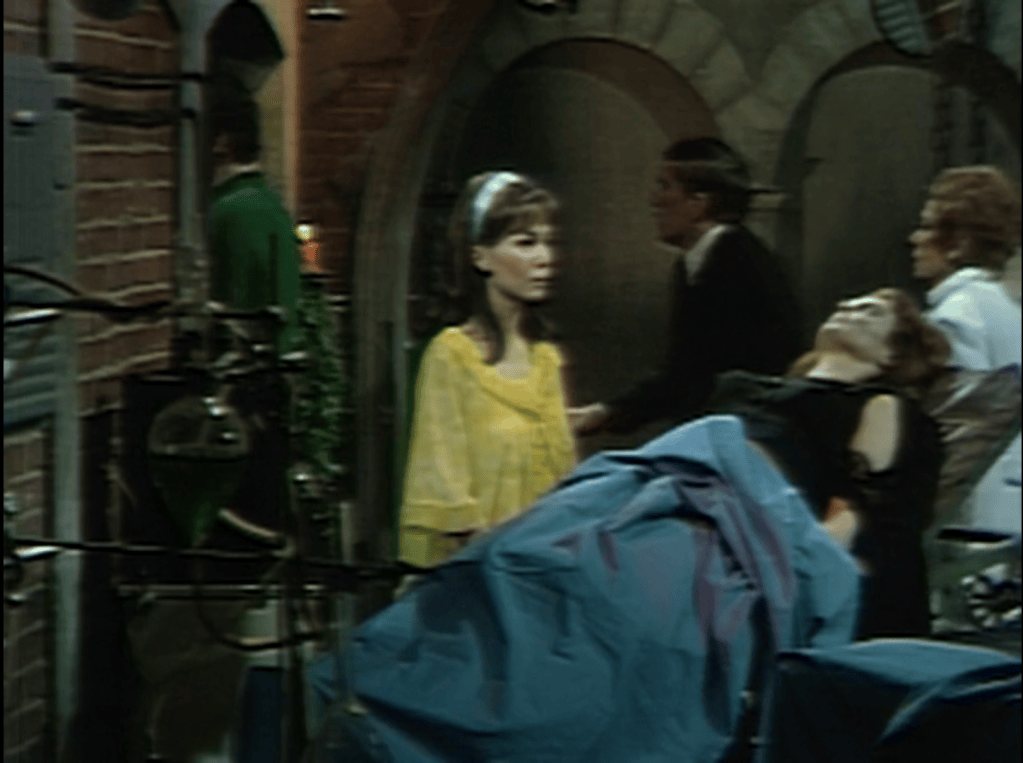
Maggie working with Nicholas in #633/634.

Not long after Nicholas’ defeat, Vicki disappeared. Maggie took her place as the new governess at Collinwood just in time for a story that calls for a new governess, an adaptation of Henry James’ The Turn of the Screw. Unlike the famously unreliable narrator of that novella, Maggie is not an overpowering presence who would obviously a danger to the children in her charge even if she were right about the ghosts. Instead, she is a squish, a completely ineffective teacher whom David and his live-in playmate Amy Jennings easily wrap around their fingers.

That’s a long way from the hard-boiled dame in the short blonde wig. Nor is it what we would have expected of the plucky heroine who fought her way back from dependence on the vampire’s bite to escape Barnabas in June 1968. It works in the story, though, and we’ve all known people who are tough and efficient in one situation but who go to pieces in a different kind of situation. And if we remember #63, we know that even when she was at her most hard-bitten Maggie couldn’t keep from trembling at the thought of Collinwood, so longtime viewers can believe that Maggie would be unable to bring herself to discipline David, who is after all one of Liz’ principal heirs.

The “Haunting of Collinwood” segment ended with another trip back in time, in this case to 1897. In that period, Miss Scott played Rachel Drummond, a neurotic intellectual hired to act as governess to children Jamison and Nora Collins. Rachel had spent the first twenty-odd years of her life under the thumbs of the horrendous Rev’d Mr Gregory Trask and his equally unspeakable family, wife Minerva and daughter Charity. The show gave Miss Scott enough to work with that we could see why Rachel kept going back to the Trasks and submitting to further abuse from them.

Miss Scott’s performance as Rachel was a finely observed and persuasively realized study of the psychology of dependence, which is probably why the fans all hate it so much. Dark Shadows was such a slam-bang adventure show at that point that Rachel seemed to have wandered in from the Strindberg play in the theater down the street. But so far as I’m concerned, she anchors the whole 1897 segment. Every story in it depends on our dread of the Trasks. They are the villains in the part that is concerned with the danger that they will take control of Collinwood. The Collinses are such a mess that the Trasks have to be something special to make us see them as a step down. The other parts of the segment require that we enjoy watching or even root for villains who are so wicked that we might be expected to want them to be stopped immediately. It is because they are a relief from the Trasks that we can find sympathy for werewolf Quentin Collins, can be amused by sorcerer Count Petofi, and can be glad that Angelique makes friends with Julia and Barnabas. Rachel’s torment shows us just how much is at stake in the battle against the Trasks and makes those reactions possible.

Rachel died halfway into 1897. After a bit, Miss Scott returned to the cast as Kitty Soames, a young American woman who is the dowager Countess of Hampshire. Kitty schemes to marry stuffy Edward Collins for his money, while he wants to marry her for her money. As it happens, they don’t have a cent between them. This farcical situation is executed with charm and wit, and as Kitty Miss Scott proved that she could play a character who is not The Nicest Girl in Town.

Kitty’s story came to a bizarre end. It turned out that she really was the reincarnation of Josette, that Josette’s personality was lurking in her subconscious, and that she wanted to trade places with her and live again. Barnabas was all for this, and he and Kitty vanished from 1897 into Josette’s portrait. They came out in 1796, where Kitty was indeed an inchoate memory somewhere in the depths of Josette’s mind. Barnabas tried to prevent Josette dying, but succeeded only in diverting her from her leap off the cliff to a fatal dose of poison. Poison was a suitable way to end that story, since it left a bitter taste in the audience’s mouths.

When the show was back in a contemporary setting in February 1970, Josette’s ghost appeared one last time. In #948, she told Barnabas that it was over between them, and that he should get a new girlfriend. In March, it looked like he and Maggie were becoming an item. She was certainly interested in him. In #973, she asks the newlywed Carolyn how married life is treating her, and mentions that she has a dinner date with Barnabas. When Carolyn responds that “Oh, maybe you and Barnabas…,” with the implied conclusion “will get married soon, Maggie doesn’t contradict her. It is unclear how Barnabas can take Maggie to dinner- she doesn’t know that he’s a vampire, and if she looks up from her salad to see him munching on one of the girls at the docks she will probably catch on. But for a couple of weeks they are getting remarkably cozy.

In #980, Barnabas traveled to an alternate universe, which the show insists on calling “Parallel Time.” In Parallel Time, Maggie’s counterpart is married to Quentin’s. Parallel Quentin is an abusive jerk, and he and Maggie Collins never have a single happy day together. This Maggie stands up for herself in #985. In one of the very best scenes Miss Scott ever played on Dark Shadows, she objects that Quentin insists on talking to her “like a child, and I am not a child, and I refuse to be treated like a child.” She walks out of the house and does not return until #1016.
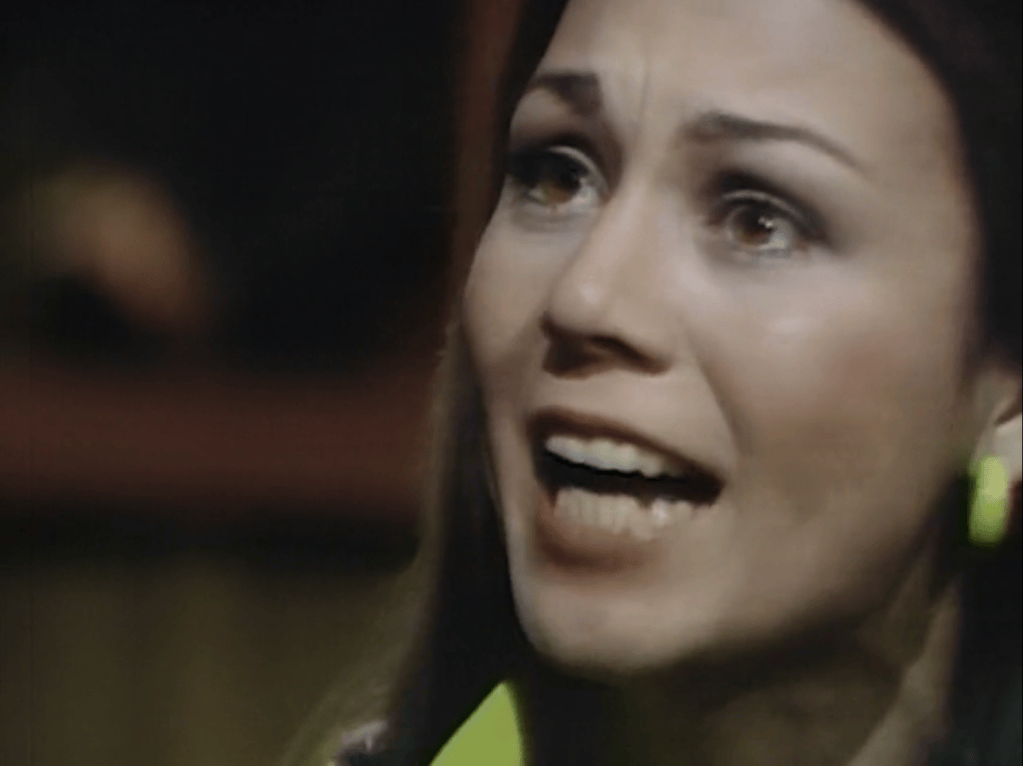
Maggie Collins refuses to be treated like a child.

The six weeks of Maggie’s absence were the six weeks Miss Scott was in Tarrytown, New York for principal photography on the feature film House of Dark Shadows, in which she played the lead. When we see Maggie again, she is in her sister’s apartment in New York writing a letter to Quentin saying that it is time to formally end their marriage. She crumples that letter up before the phone rings and she learns that Quentin is gravely ill. Whether she would have written another draft making the same point, we never find out.

Maggie goes back to Collinwood, where Quentin dishes out more of the same stuff. This time she does allow herself to be treated like a child. It is a demoralizing thing to see. We don’t get enough of Maggie Collins’ backstory to give Miss Scott room to etch a portrait of the psychology of defeat like that which made Rachel such a triumph for her. Worst of all, Quentin is not in the position of the Trasks- we aren’t supposed to hate him. On the contrary, we can get invested in the story only to the extent that we like him. Seeing how he treats Maggie, that extent is zero.

In July 1970, Barnabas returned to the original continuity. After a few days we saw that Maggie was distraught that he wasn’t coming around anymore. Other characters tried to explain that he and Julia had learned of a terrible menace facing Collinwood and were busy trying to fight it, and they did eventually enlist Maggie in their efforts. But she is still disappointed that her romance with him has fizzled. Considering that Barnabas’ attempted Josettification of Maggie was the story that first made Dark Shadows a hit, and that it is retold in House of Dark Shadows, you don’t have to be a longtime fan for this attitude to make you queasy.

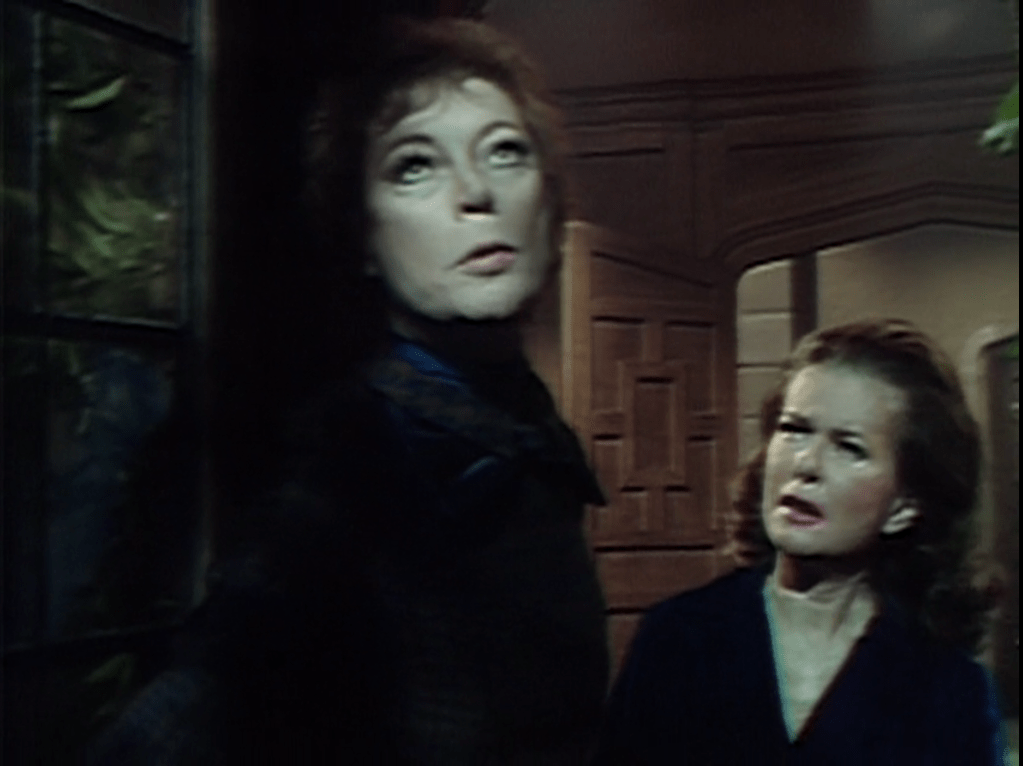
For the last couple of weeks, Maggie has been the victim of a vampire other than Barnabas. This turns out to be Roxanne Drew, counterpart of a woman Barnabas fell in love with in Parallel Time. Barnabas has taken male victims before, but this is the first time a female vampire has taken a female victim. They never showed Barnabas biting Willie or the luckless Dirk Wilkins, while they often lingered over him biting female victims and Angelique, in her vampire phase, biting male ones. The ABC network’s office of Standards and Practices was vigilantly on guard against any exploration of homoerotic imagery. We never see Roxanne bite Maggie, though the final image of #1104 does show Maggie with a startlingly raw look of longing as she approaches a veiled Roxanne.
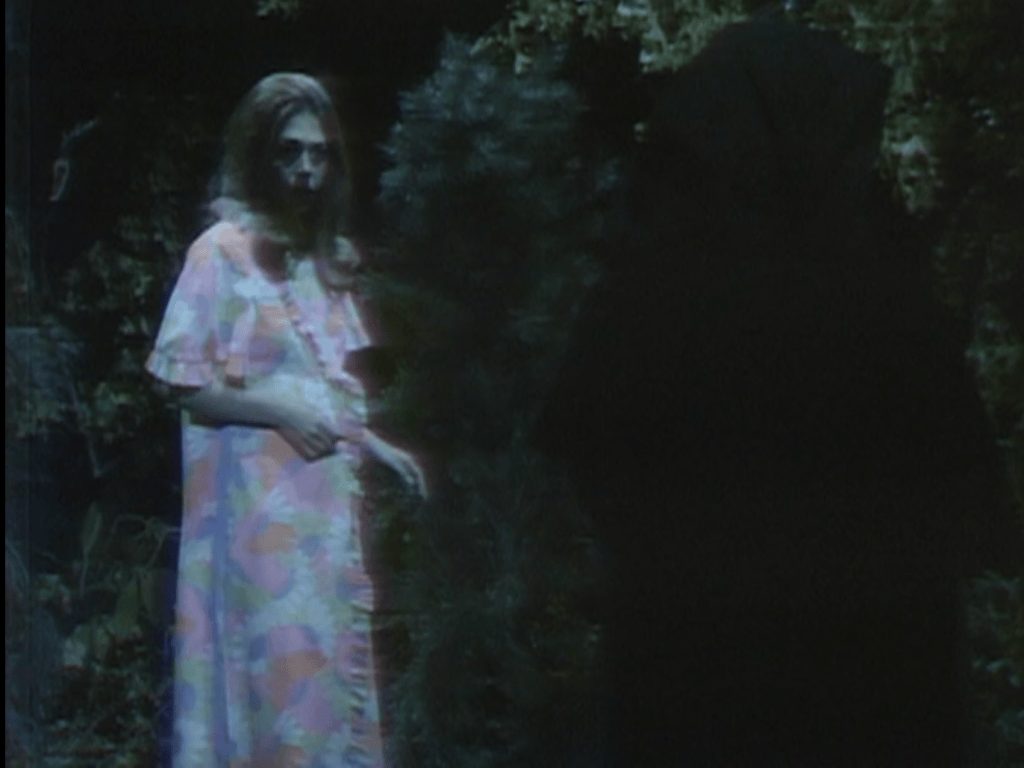
She wants her disease.

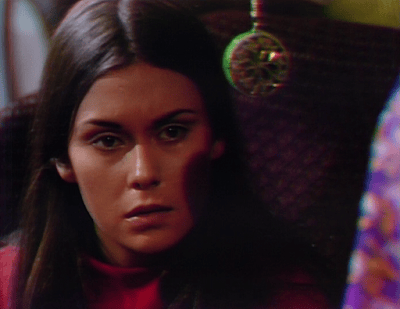
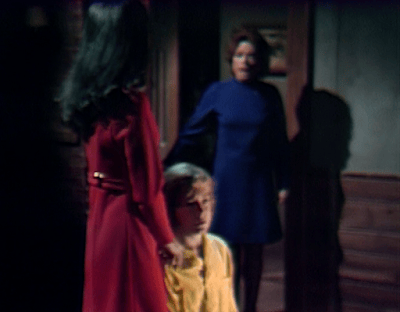
We see Maggie for the last time today. She is in a car, being driven back to Windcliff by strangely dressed man Sebastian Shaw. Some speculate that this ending was a private joke on the part of executive producer Dan Curtis, who thought that Miss Scott was crazy to want to leave the show and move to Paris with her husband, photographer Ben Martin.
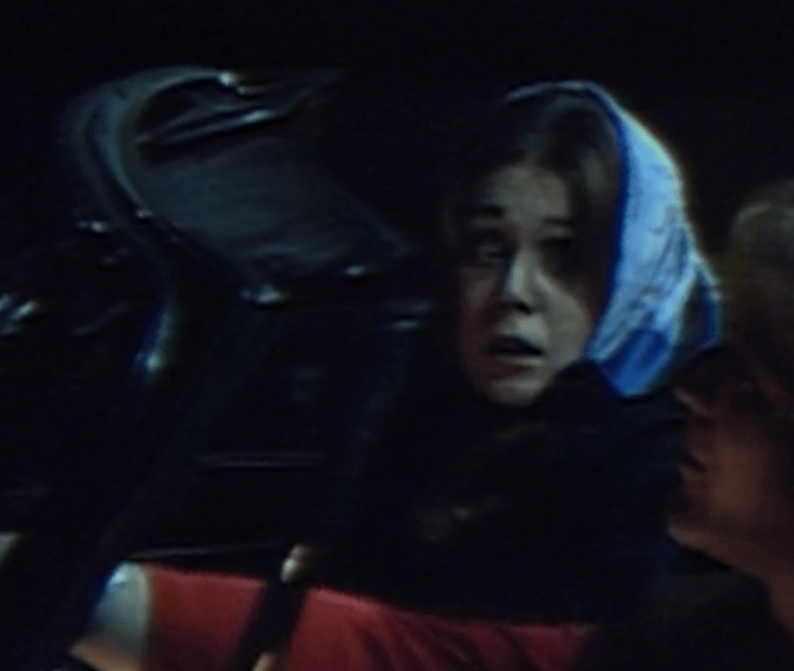
The last of Maggie.

Be that as it may, it is a nice touch that the final reference to Windcliff should be in connection with Maggie, for whom it was invented in the first place. Her stay there brought Julia onto the show, and Julia, for all her villainy, has for some time been the chief protagonist and audience identification character. Sending her there also leaves open the widest range of options for ways to bring her back. Maybe she will still be a patient there, as she was when she played a mad scene in #265 that was the single most frightening moment in all of Dark Shadows. Or maybe she will return to Collinwood, or maybe she will become a monster, or maybe something else will happen. Anything is possible.

Except that nothing is possible. The ratings are going down, Curtis and the writers are exhausted, and the public has moved on from the mood that made Dark Shadows one of the big fads of the late 1960s. The loss of Miss Scott, a performer who gave the show so much of its heart, is a nail in a coffin that was almost fully built already. House of Dark Shadows is in the theaters, and it is a big enough hit that MGM will greenlight another film in the franchise. But the series is on a one-way road to cancellation. In April 1971, Mrs Ben Martin will pick up an American paper from a newsstand in Paris and be astonished to read that Dark Shadows has broadcast its final episode.

In the years since, Miss Scott has been perhaps the most assiduous member of the original cast at keeping the fandom alive. No one has attended more of the conventions; she presided over the last two, held this year. Her publishing firm, Pomegranate Press, has put out many Dark Shadows-themed books, some of which she herself wrote. She, along with Jonathan Frid, David Selby, and Lara Parker, had a cameo in Tim Burton’s 2012 Dark Shadows film. She took roles in many of the audio drama continuations of the show produced by Big Finish, and she is the voice performer for the audiobooks of “Marilyn Ross'” Dark Shadows novels. If Dark Shadows was a projection of the personality of Dan Curtis while he was alive, in the last twenty years Kathryn Leigh Scott has been the first lady of the world of Dark Shadows, and has done more than anyone else to set the cheerful, welcoming tone of its fandom.
Episode 1103: Must things always happen the way they happened the first time?

Three ghosts who have been hanging around the great house of Collinwood for the last several weeks have assumed corporeal form. Teenagers Tad Collins and Carrie Stokes have taken possession of the bodies of David Collins and Hallie Stokes. Once embodied, Carrie and Tad cast a spell that brought their governess, Daphne Harridge, back to life in a body of her own.

Mad scientist Julia Hoffman confronts Daphne and demands she help David and Hallie resume their place among the living. Daphne angrily refuses. “I’m not going to let you destroy Tad and Carrie to bring David and Hallie back!” Carrie and Tad were already destroyed, when they died in 1841; it was Daphne who robbed Hallie and David of their rightful place among the living when she helped Carrie and Tad possess them. That possession is a murder, and one of the victims of that murder, David, has been a central character since the show’s first week in 1966, and the show has often been driven by our concern for his well-being. Daphne’s protest, voiced in a righteous tone that makes it clear David and Hallie mean nothing at all to her, marks Daphne as a villain whose motivations are entirely hostile to everything we could care about. But Daphne is, among other things, Kate Jackson. As such, it is impossible for an audience not to fall in love with her. Though Daphne’s presence in the story can lead to nothing but disaster for the human characters, we cannot want her to go away.

Among Julia’s many powers is mastery of a preternatural form of hypnosis that enables her to mold people’s memories as easily as a potter can shape clay. Until today, we have seen her use this power only on humans. But Daphne is human now, at least technically, so Julia gives it a shot. She takes out her magical medallion and shows it to Daphne. Once Daphne is in a trance, Julia asks her questions. They are not questions about Daphne’s memories of the past, but about events that will take place in the future. Somehow Daphne knows the answers to those. They suggest that the final catastrophe is very near at hand.

Julia introduces our new friend Daphne to our old friend, the magical medallion. Screenshot by Dark Shadows Before I Die.

Carrie and Tad have been inmates at Windcliff, a psychiatric facility Julia controls. Daphne had reached them there, driven in a car by charming rogue Quentin Collins. When Windcliff was first introduced in the summer of 1967, it was made explicit that it was located a hundred miles north of Collinwood. It lay far enough away that Julia could be sure no one on the estate or in the village of Collinsport would recognize her face or name when she showed up in town in #284. It was an unmistakable sign of supernatural agency when Maggie Evans was able to make it from Windcliff to Collinsport on foot in a single night in #295. And after hardworking young fisherman Joe Haskell was sent to Windcliff in #658, everyone seemed to forget all about him, as they had forgotten about sorely bedraggled blood thrall Willie Loomis after he was set there in #329. The place was the functional equivalent of the far side of the moon.

Today, Tad and Carrie escape from Windcliff and Tad remarks that Collinwood is “only a few miles” away. This is quite a severe retcon. It does strip away the sense that Windcliff is a safe place where the characters can take refuge from the impending catastrophe, raising the stakes and heightening the tension. But it also leaves us wondering why they don’t just go someplace else further away. The Collinses are supposed to be terribly rich, so there’s nothing stopping them from buying a place in California or Hawai’i or Bugtussle, Oklahoma and moving there while the ghosts have their way at Collinwood.

Episode 1102: Can one more thing happen?

There are two storylines running on Dark Shadows at the moment. The A story began as an adaptation of Henry James’ novella The Turn of the Screw. Since they already adapted The Turn of the Screw as a Dark Shadows storyline in late 1968 and early 1969, it was rather grim for longtime viewers to see the same thing coming up again, but they’ve taken a fresh angle on it these last couple of weeks. The Miss Jessel equivalent, late governess Daphne Harridge, has taken the form of a living woman. That the living woman is the young Kate Jackson means that the audience instantly falls in love with her, which is very helpful since she is on a lot and the scripts do not give her an intelligible motivation for any two actions.

The characters corresponding to children Miles and Flora are teenagers David Collins and Hallie Stokes. The ghosts of Daphne’s charges Tad Collins and Carrie Stokes have taken over the bodies of David and Hallie. Daphne, Carrie, and Tad keep trying to perform a magic spell that will give corporeal form to the fourth ghost, Peter Quint equivalent Gerard Stiles. Gerard is even more blatantly evil than are the other three, and they keep getting interrupted before they can turn him into a real boy. Today, Carrie and Tad are inmates at Windcliff, a psychiatric facility under the control of mad scientist/ heroine Julia Hoffman, and at the end of the episode Julia catches Daphne in Tad’s room, making another attempt to get through the spell.

Julia catches Daphne with Tad in his room at Windcliff. Screenshot by Dark Shadows Before I Die.

The interiors of Windcliff look very much like an old mansion, prompting many commenters to say that the production staff had mounted so many scenes in the great house of Collinwood that they have forgotten how to depict any other kind of setting. But when we first saw Windcliff in #265, there was an exterior shot that made it look very much like a big old house that had been converted to use as a public facility. There’s no reason why the patients’ rooms shouldn’t still have looked like bedrooms.

Windcliff.

The B story is also heating up. There is a vampire prowling around the estate of Collinwood, and it isn’t Julia’s buddy Barnabas Collins. This new vampire has been feeding on Hallie and David’s governess Maggie Evans, and Maggie is so low on blood she may die if she is bitten again. Julia was guarding Maggie in the opening reprise of yesterday’s close, when the vampire appeared in the room, caused Julia to fall asleep, and drew Maggie out of bed. Today, charming rogue Quentin Collins enters in the nick of time to prevent Maggie being bitten again.

Quentin is distressed he did not get a good look at the vampire and still does not know who it is. They’ve made a big enough deal about the vampire’s identity that it must be someone we have already met, and we could see that the vampire is shorter than Maggie, which rules out all of the men in the cast. The only female character we haven’t seen in the daytime is the mysterious Roxanne Drew, so regular viewers don’t have a long list of suspects to work with.

One puzzle that hasn’t been solved is why Maggie is not at Windcliff. Windcliff was introduced as the place she was kept when she escaped from Barnabas after a time as his victim. Barnabas believed she was dead at that time, but as a vampire he had difficulty traveling any distance from Collinwood and he did show a tendency to lose interest in people who went away for any period of time. So if the new vampire operates along the same lines now that Barnabas did then, it would seem much wiser to send Maggie to Windcliff than to keep her in the great house.

This is the last of 63 episodes credited to writer Joe Caldwell. Caldwell made uncredited contributions to the show for some time before his name first appeared onscreen in #245. He specialized in intimate character studies; the slow pace of the show in 1967 gave him an opportunity to write many episodes of that type, all of them among the highlights of a very uneven period. He left in October 1967, and returned in 1970 when Violet Welles left the writing staff.

Even though very little really happened in the early part of the Re-Haunting of Collinwood segment, the show was so busy spinning in its tight little circles that it left Caldwell no opportunity to write the sorts of finely crafted miniatures in which he excelled. As a result, his second tour of duty on Dark Shadows does not include many memorable scripts. He will not be replaced, leaving Gordon Russell and Sam Hall as the only two credited writers for the remainder of the series. Others continued to make uncredited contributions from time to time, and in Welles’ case some of those contributions are instantly recognizable. But for the most part, it’s just those two guys locked in a room with executive producer Dan Curtis from now on.

Episode 1101: Whithersoever the governess listeth

Vampire Barnabas Collins and mad scientist Julia Hoffman are trying to prevent a disaster that is fated to destroy the great house of Collinwood and everyone in it before the year 1970 is out. They have a handful of cryptic phrases that clue them in to events that will precede this disaster. One of the phrases is “The night Rose Cottage was destroyed.” They have no idea what Rose Cottage is, and have been unable to find anyone who does.

Julia finds heiress Carolyn Stoddard Hawkes leaving the great house. Carolyn says nonchalantly that there is something she has to do at Rose Cottage. Julia gets Carolyn to say that going to Rose Cottage involves leaving the grounds of Collinwood through the front gate. She asks her to mail a letter for her on her way. She agrees, and waits outside while Julia goes back into the house to get the letter.

Julia rushes to a bedroom where Barnabas is sitting with governess Maggie Evans, who is the victim of a vampire other than himself. Julia fabricates a letter while repeating to Barnabas what Carolyn said. Julia takes over the vigil, and Barnabas gives Carolyn the phony letter. He then follows her to a deserted mansion in the area.

Barnabas barges in on Carolyn in a room in Rose Cottage. He ignores her indignation at his following her and presses her with questions:

CAROLYN: Barnabas!

BARNABAS: So this is Rose Cottage.

CAROLYN: You followed me here!

BARNABAS: Carolyn, who is your friend? Who were you talking to just before I came in?

CAROLYN: That, that really is no concern of yours, now is it?

BARNABAS: Carolyn, you must tell us everything you know about this place, who lived here and who it was you were trying to find.

CAROLYN: Why are you and Dr. Hoffman so interested in this place?

BARNABAS: We’ve told you before one of the events that’s to happen before the disaster at Collinwood is the destruction of Rose Cottage.

CAROLYN: Rose Cottage… [laughs] Now, that’s a strange name for a place like this, isn’t it?

BARNABAS: I know now why it was so difficult to find. How did it get such a name?

CAROLYN: Oh, it happened a very long time ago, when Carrie was very small.

BARNABAS: Carrie lived here?

CAROLYN: Are you going to be quiet and let me tell you?

BARNABAS: I’m sorry, go on.

CAROLYN: Carrie, Carrie always dreamed of having a doll’s house which she would call Rose Cottage. So for her birthday I asked Quentin to build her one. Quentin was so good with his hands you know, and so terribly inventive. He actually built a replica of this house, and I gave it to Carrie for her birthday. [laughs] I told her she would have to find another name for it, but she said no, it would always be Rose Cottage to her. So she kept calling it that, and before very long people called the mansion itself Rose Cottage.

BARNABAS: When was all this, Carolyn?

CAROLYN: I’m not going to answer any more of your questions! You were very rude to follow me here, very rude indeed!

Carrie died in 1841. Her ghost has taken possession of teenager Hallie Stokes. The ghost of Carrie’s friend Tad has taken possession of David Collins. Tad and Carrie, in personis David and Hallie, are currently at Windcliff, a psychiatric facility Julia controls. Before they were taken there, Carrie and Tad did some mumbo-jumbo and restored their late governess Daphne Harridge to life. Daphne then led Tad and Carrie in an unsuccessful attempt to do the same for another ghost, erstwhile pirate captain Gerard Stiles. Carolyn is possessed by the spirit of a certain Leticia Faye, though unlike Hallie and David her own personality still exists within her body and from time to time asserts itself.

We have seen the dollhouse of which Carolyn/ Leticia speaks many times, and we know that it is in some supernatural sense identical with the full-scale mansion. The episode opened with a reprise of Friday’s cliffhanger, in which Gerard used the dollhouse to trap Daphne in the mansion and to set fire to it. Carolyn/ Leticia interrupted Gerard and saved Daphne.

Barnabas returns to the great house and tells Julia that he now knows where Rose Cottage is. He says that he saw Carolyn there. She asks if he got any information out of Carolyn. He says that he did not. He does not mention the business about Carrie and the dollhouse, which is just bizarre. He and Julia know about a mysterious playroom full of toys appropriate to small children that intermittently appears in a space in a little used part of the great house otherwise occupied by a linen closet. They know that all four ghosts are associated with this playroom. You would think he would therefore realize that a story about a toy of Carrie’s would be relevant to their concerns, but apparently the connection escaped him.

In the last scene, Julia is in Maggie’s room when she is suddenly seized by a fit of sleepiness. A dark figure in a cloak and a slouch hat appears inside the window. Maggie gets up and goes to the figure, who is no taller than she is.

The figure’s slight build and short stature may suggest it is a woman, but no woman on Dark Shadows has ever worn shoes like that. Screenshot by Dark Shadows Before I Die.

I don’t know if the above makes it clear, but this episode is a sharp step up from last week’s offerings. It is tightly paced, clearly developed, and forcefully acted, a bright spot in a storyline that has been desperately dreary so far.

Episode 957: That’s a bad sign

Willie Loomis has come back to the Old House on the great estate of Collinwood, where he once lived as the sorely bedraggled blood thrall of vampire Barnabas Collins. Willie intends to stay only for a short time, answering an invitation from Barnabas and mad scientist Julia Hoffman. Willie is engaged to marry a woman named Roxanne, and Roxanne expects to leave with him in the morning. But he finds out that Barnabas and Julia, along with the kindly Maggie Evans and some other people, are locked in battle with a vast and incomprehensible evil. So Willie announces that he cannot leave. He will stay and help Barnabas and Julia fight.

At the beginning and end, a shape-shifting monster sees something that terrifies him. Pondering this, Barnabas remembers that the two things which frighten the monster are ghosts and werewolves. Since Collinwood is the world capital of both ghosts and werewolves, that raises the question of why the monster wants to be there. The disturbance can’t be a werewolf- the first time it occurs, it prevents the monster from attacking Willie and Maggie, and if it were a werewolf it would just have gone on to attack them itself. The second time, Julia comes face to face with it. It casts a glowing light on her, and she asks what it is. One might assume she would recognize a werewolf, who in any case don’t glow. The show does a good job making us wonder just what the phenomenon is and making us hope we will find out tomorrow.

When Barnabas first enslaved Willie in 1967, he was extremely cruel and Willie was miserable beyond imagining. When Willie came back in 1968 after a stay in Windcliff, the mental hospital Julia controls, Barnabas’ vampirism was in remission and Willie took rather an insouciant attitude towards him. In those days, Barnabas put up with Willie’s insubordinate attitude with relatively mild displays of annoyance. Barnabas finally brought Willie to heel in #560, when he convinced Willie that his disobedience was putting Maggie in danger and Willie responded with agony. Torturing Willie in that way made Barnabas smile for the first time in ages. He was glad to return at last to his happy place.

Now, Barnabas is a vampire again, but Willie is full of friendship and goodwill towards him. He talks warmly to Julia about how Barnabas helped him in the past. In turn, Barnabas is genuinely concerned for Willie’s well-being, telling him that the current situation is too dangerous for him and that he should go live his own life. This new coziness leads to some intentionally funny moments. At one point, Willie walks in on Barnabas saying out loud that he doesn’t understand what’s going on. He tells the vampire “You’re talking to yourself, Barnabas. That’s a bad sign!” As if that’s the part he needs to worry about!

Willie has a conversation with Maggie that verges on the poetic. When he tells her “I never knew how awful it was to be alone until I wasn’t,” we find ourselves wanting him to go directly to Roxanne and run as far as he can as fast as he can.

There is a big mirror on the wall at the foot of the stairs in Barnabas’ house. At one point he walks in front of it and casts a reflection. Sometimes they have been very emphatic that vampires don’t cast reflections. Most famously, Julia confirmed that Barnabas was a vampire in #288, when she contrived to open her compact and point the mirror at him. The same prop was used in #704, when it exposed Barnabas’ secret to the luckless Sophie Baker, prompting him to murder her. On the other hand, when wicked witch Angelique became a vampire for a while in 1968, there were some shots that were obviously deliberate in their composition that prominently featured her reflection in mirrors, making the point that she was an exception to this rule. The mirror doesn’t have to be on the wall, but if it is we will inevitably see Jonathan Frid reflected in it, suggesting that they put it there on purpose to show that he is now another exception to the rule.

Barnabas reflects.

Willie was off the show for a year, from #696 (broadcast 24 February 1969) to #956 (broadcast 23 February 1970.) His absence during that period was not explained. Today he mentions to Julia that he has been working at another hospital, as he once worked for her at Windcliff. Indeed, she had offered him a job there in #537. Since Julia did not know about this other hospital job, he must have taken it sometime after leaving his position at Windcliff and without a reference from her. Before Barnabas enslaved him, Willie was a dangerously unstable ruffian, wanted by the police, so they are likely the first employers he has had who would have provided a usable reference. So he probably left Collinwood for the job at Windcliff not much later than March 1969 and held a job in some third place before getting back into hospital work more recently.

In the first year of the show, only David Henesy, as strange and troubled boy David Collins, looked directly into the camera; in the last year, that move has been the signature of Denise Nickerson as David’s young friend Amy Jennings. Today, just about every member of the cast does it. I believe it is the first time Jonathan Frid has done so, though there have been times when his examination of the teleprompter has moved him perilously close to an unintentional soliloquy.

Barnabas tells Julia that their enemies will never find his coffin “where it is now.” The first time we heard that was in 1967, and back then it made us wonder why, if he has an impregnable hiding place for his coffin, he usually just leaves it in the middle of his basement where no one coming downstairs could avoid seeing it. Barnabas spent most of 1969 as a time traveler visiting 1897. His vampirism was exposed in that year, and he was hunted. He assured his allies that no one could find his coffin where it was hidden then; they found it immediately. So longtime viewers aren’t so sure that Barnabas will escape detection during the day.

As Julia, Grayson Hall has a new hairdo today. It is a bit longer than it has been, and is swept up in front.

Episode 685: Barnabas, Quentin, and the Thing Glasses

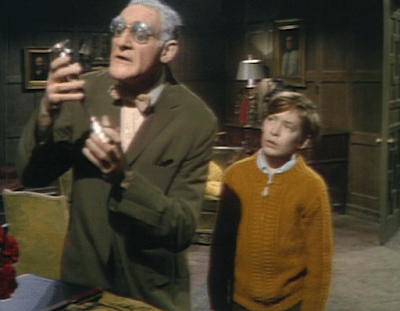
Silversmith Ezra Braithwaite comes to the great house of Collinwood, bearing a ledger with information that old world gentleman Barnabas Collins wants. Barnabas is in the study, so twelve year old boy David Collins lets Mr Braithwaite into the house and escorts him to the drawing room. The two of them play a scene that may not have looked like much on the page, but as delivered by talented comic actors Abe Vigoda and David Henesy the lines are hilarious.

For example, Mr Braithwaite has two pairs of glasses, which he describes to David as his glasses for looking at things and his glasses for looking at people. David asks if the ones he is wearing are his “thing glasses.” We laughed out loud at that whole exchange. Mr Braithwaite asks David to go get “Uncle Barnabas”; David replies “He’s my cousin,” to which Mr Braithwaite answers “Ah, yes.” Again, that wouldn’t be a hit in a joke book, but Vigoda and Mr Henesy sell it. The purest example comes when Mr Braithwaite starts to change his glasses as he turns to the pages of the ledger and says out loud to himself “Oh, Ezra, Ezra, you already got on your reading glasses.” That is a laugh line entirely because of the way Vigoda stresses the words “got” and “on.”

There is a little exchange between Ezra and David that will stand out to longtime viewers:

Ezra: David is it? Well, I don’t remember a Collins being named David before. Now, my name is Ezra, as my father was and his father before him. You find a name like Ezra and you don’t give it up.

David: I guess not.

Ezra: Yes, now, David’s kind of a new-fangled name.

David: No, there’s King David in the Bible.

Ezra: Oh, of course, yes, yes. A good man, too.

In #153, it was established that no Collins ever bore the name “David” until undead blonde fire witch Laura Murdoch Collins insisted that her husband Roger go along with her plan to name their son “David Theodore Collins.” That turned out to be hugely important as evidence of Laura’s evil intentions. In #288, it sounded like they had decided to retcon that away when David looked in a family album, saw a portrait of a “David Collins” from a previous century, and wondered aloud if he had found his namesake. Nothing has come of that potential namesake in the 79 weeks since, and Ezra’s line that he didn’t “remember a Collins being named David before” would suggest that they’ve gone back to the original idea.

Mr Braithwaite, in his thing glasses, examines a piece of silver. David examines him. Screenshot by Dark Shadows Before I Die.

Each time Mr Braithwaite looks at someone through his “thing glasses,” we get a point of view shot showing that his eyesight is blurry. They then cut back to the other actor in regular focus. These shots are brief enough that the repetition isn’t a big problem, but it results in a series of exchanges the actors deliver to the camera rather than to each other. Those don’t work at all. Mr Henesy and Abe Vigoda had such a fine comic rhythm going that it’s a shame to break it up with this clunky stuff.

Reading the ledger, Mr Braithwaite says that the silver pentagram Barnabas wants to know about was bought in April 1897 by Miss Beth Chavez and paid for by Quentin Collins. We have seen Beth’s ghost. She is very tall and so thin you could clasp your fingers around her waist. Her complexion is pale as can be, her hair blonde, her eyes blue. I’ve met a fair number of Chavezes in my time, including a couple of Elizabeth Chavezes, and none has met this description. I have nothing to say against slender blondes, and actress Terrayne Crawford is movie-star beautiful. Still, if a fellow were excited about a blind date with a girl known to him only by the name “Beth Chavez,” he’d probably be a bit disappointed if the person who showed up met her description.

We have also seen Quentin’s ghost. Quentin is manipulating David into helping him with a number of murders he intends to commit. Beth has thwarted one of these murders so far, and is trying to prevent Quentin from achieving other evil plans of his. But Quentin is apparently more powerful than she is.

While Mr Braithwaite is alone in the drawing room, Quentin enters through a secret panel. Earlier in this episode, they made it clear Quentin can choose whether he is visible to the living people in the spaces he occupies; there is no need for him to hide. Why does he use the panel?

Longtime viewers may be able to make a surmise. We saw this panel for the first time in #87, when David’s father Roger used it for a sneaky errand. We didn’t see it or hear of it again until #643, when David told nine-year old Amy Jennings that there was a passage “very few people” knew about, and used it to lead her to the room in which Quentin was at that point confined. Quentin’s use of it will therefore suggest that he knows all the secrets of the house. It also suggests that when he dwelt there as a living being he was a naughty fellow who was in the habit of using its secret passages for the sort of underhanded mischief Roger got up to in #87 and #88.

Quentin strolls up to Mr Braithwaite and smiles at him. Mr Braithwaite is wearing his “thing glasses” and cannot see Quentin clearly. He asks Quentin if he is the friend Barnabas spoke of when he asked him about the pentagram. Quentin nods. Mr Braithwaite says that he himself made the pentagram in April 1897, when he was “fifteen and a half.” It is now February 1969, so we know that Mr Braithwaite is 87. He recognizes Quentin. Shocked to see a man who has been dead for decades apparently alive, well, and in his twenties,* Mr Braithwaite dies of a heart attack.

It’s a shame we won’t be seeing more of Abe Vigoda as Mr Braithwaite. At least they spelled his name correctly in the credits this time; yesterday he was “Abe Vigodo.”

*Two days past his 28th birthday, to be exact. Happy belated 84th to David Selby!

Episode 645: We’ll go downstairs and be ourselves again

The ghost of the mysterious Quentin Collins has trapped children David Collins and Amy Jennings in a storeroom in the long-deserted west wing of the great house of Collinwood. Unable to open the door to the corridor, David and Amy have found another room hidden behind a panel in the storeroom. A room inside another room is often referred to as a “closet,” and this is the perfect soap opera closet- there is literally a skeleton in it.

On Dark Shadows, a fashion-conscious skeleton is never seen without a wig. This one is no exception. It is seated in a chair that swivels towards the children, revealing its face. This swivel reminds us of one of the most famous reveals of a bewigged skeleton in cinema, that of Norman Bates’ mother in Alfred Hitchcock’s Psycho.

Amy and David conclude that the skeleton in the closet must be Quentin’s. The skeleton sits beside an antique gramophone that plays a sickly old waltz over and over; Amy wonders how it started playing. David has been living in the house for two and a half years, so his experience with ghosts is already very extensive, and the gramophone is the least of his concerns.

The adults in the great house have noticed David and Amy’s absence and have gone looking for them. Matriarch Elizabeth Collins Stoddard calls at the other residence on the estate, the home of her distant cousin Barnabas Collins. She tells Barnabas that she wonders if they may have slipped in while he was sleeping. Barnabas tells Liz that he locked all the doors before going to bed, to which she responds “Barnabas, a locked door never kept David Collins out.” In 1967, Barnabas was a vampire and David kept endangering himself by sneaking into his house. In those days, David’s father Roger once made a similar remark. Barnabas isn’t a vampire anymore, but everyone other than Dark Shadows‘ hardcore fans will always think of him as one. David’s inability to get out of the room where Quentin kept him and Amy would suggest that he too has changed, and is now at a loss before locked doors. But for Liz, her nephew will always be a master burglar.

Barnabas searches his house and does not find the children. He and Liz leave for the great house. Hiding nearby, the children see them go and sneak in. As per Quentin’s orders, they go upstairs and take a wooden cradle. Later, we will see them put the cradle in the room with the skeleton and interact with Quentin’s ghost there. Their activities in the room don’t make any sense to the audience; they clearly are not meant to. They come after Amy and David have agreed to “play the game,” using a phrase we hear for the first time today. Those familiar with the mysterious atmosphere of ghost stories can assume it will be some time before we will get enough information even to guess what sort of game it is.

For longtime viewers, the highlight of today’s episode comes when Amy meets Barnabas and gives him a hug. Amy has dominated the show since her first appearance in #632; Barnabas has been its undisputed star since he joined the cast in #211. It turns out that the two of them became friends when they were both patients at Windcliff, a mental hospital a hundred miles north of town.

Amy hugs Barnabas while Liz and David look on.

The director of Windcliff is Julia Hoffman, MD. For almost a year and a half, Julia has been a permanent houseguest at Collinwood; as 1968 has gone on, she has become Barnabas’ inseparable friend. She hugged Barnabas for the first time in #635, to his evident discomfort. But as we saw when he interacted with the ghost of his little sister Sarah in #364 and again when we saw him with the living Sarah in the extended flashback to the 1790s that ran from November 1967 to March 1968, Barnabas gets along well with little girls, so it isn’t such a surprise that he returns Amy’s embrace.

In #629, Liz told Julia that Barnabas was miserable at Windcliff. If Barnabas were still a vampire, it would be easy to imagine his evil overwhelming the scientific rationality at the heart of a psychiatric facility, as it has long since overwhelmed Julia’s professional ethics. But his curse is in abeyance now. They’ve had to work to keep us thinking that he is exotic and uncanny and dangerous; one look at him in a group therapy session would undo all that work so abruptly that we would never stop laughing. Of course we never see him as a patient there. It was daring of them even to include Liz’ line, inviting us to imagine him in such a mundane setting.

In a comment on Danny Horn’s great Dark Shadows Every Day, Stephen E. Robinson wonders about the image Amy conjures up when she says that she and Barnabas spent time together as patients at Windcliff:

There’s an implication that Barnabas and Amy hung out at Windcliff, because apparently exposing small children, in shock over the deaths of family members, to middle-aged mental patients is part of the healing process. The Barnabas/Amy scene makes me laugh at loud because it’s as if the writers think Windcliff is a vacation resort and Barnabas and Amy met by the pool.

Stephen E. Robinson, comment left 11 May 2015 at 6:59 AM Pacific time, on Danny Horn, “Episode 645: Spirited Away,” 10 May 2015, Dark Shadows Every Day.

Stephen is being generous- Barnabas was in the hospital because he had himself been the victim of a vampire, and Amy was there because her brother Tom had died. She did not know, but Julia did, that Tom had also come back as a vampire, and it was Barnabas who destroyed him, first by driving a stake through his heart, later by forcing him into the sunlight. I’m no psychiatrist, but with that history of closely related but non-discussable traumas I wouldn’t think the two of them ought to spend much time together.

But of course none of that matters. Barnabas and Julia are the show’s principal protagonists, and they ran out of story two weeks ago. Ever since Amy took over, we’ve been waiting to see how she will connect with them. Now that we know she is Barnabas’ substitute sister and Julia’s sometime patient, they are ready to rejoin the action.

Episode 632: A new mate

Two arcs overlap today. Suave warlock Nicholas Blair is in one that is coming to its end, while mysterious drifter Chris Jennings is in one that is beginning.

The fansites I consult when I write these posts vary in how much detail they give about what happens in the episodes. At one pole is John and Christine Scoleri’s Dark Shadows Before I Die, which gives detailed summaries of every plot point, usually illustrating each with at least one screenshot. Their post about this one is no exception.

At the other pole is Patrick McCray and Wallace McBride’s Dark Shadows Daybook. They typically present a brief essay about one key point in an episode. Halfway between the two is Danny Horn’s Dark Shadows Every Day, which occasionally drifts towards one or the other of those extremes and occasionally disregards the episode altogether to focus on some other Dark Shadows related topic, but which as a rule focuses on two or three points and weaves them together as it runs through an overview of the day’s narrative outline. It’s a sign of the thickness of today’s story that not only Danny’s post, but even Patrick’s, approaches a Scoleri-esque level of retelling.

Nicholas is under orders from his boss, Satan, to do two things in a very short time. He must sacrifice Maggie Evans, The Nicest Girl in Town, in a Black Mass. For this, he will be rewarded with Maggie’s eternal companionship in Hell. He doesn’t exactly seem happy about this, but he does drug Maggie, dress her up, and put her on an altar, so it seems like he’s going to comply.

Nicholas’ other task is to create a humanoid species entirely subject to the spiritual forces of darkness. This would seem like a big project, but he already has a start on it. A male Frankenstein’s monster known as Adam lives in his house, and at Nichol;as’ bidding Adam has coerced mad scientist Julia Hoffman and her friend, old world gentleman Barnabas Collins, to revive a female of the same breed known as Eve. As their names suggest, Adam and Eve are to be the parents of this new race of people.

Nicholas finds that Adam has grown reluctant. Eve needs reviving because Adam killed her the first time she was brought to life. She hated Adam and rebelled against Nicholas’ command that she mate with him, and at the end the big guy murdered her. Adam says that if Eve comes back to life with the same personality, he will kill her again. Nicholas tells Adam that the reason Eve was so hard to live with was that the woman who donated the “life force” Julia used to animate her was evil, and that the woman who takes that role when Eve is brought back to life will be very sweet and loving. When Adam is skeptical, Nicholas tells him that Maggie will donate the “life force.” Knowing Maggie, Adam finds this acceptable.

Nicholas doesn’t have time to recruit any other woman, since the experiment must take place tonight. It seems he must be telling Adam the truth about Maggie. Perhaps he will take her to Barnabas’ basement and tell Julia to hook her up to the machinery. But even before the end of the episode, when we see her on the altar, her throat apparently about to be cut, it puzzles returning viewers how this can be. Yesterday Barnabas forced Nicholas to promise he would not harm Maggie in any way, and said that he and Julia would not continue working to revive Eve unless he honored that promise. So it is a mystery how he can expect them to cooperate if he shows up with Maggie and tells them to subject her to a procedure that is more likely than not to kill her.

Meanwhile, Chris is visiting his little sister in the hospital. The hospital is Windcliff, a sanitarium about a hundred miles north of Collinsport; Julia is its nominal head. The sister was first mentioned in #627; her name was “Molly” then. It’s “Amy” now. There’s good precedent for such an identity change. When Julia was first mentioned in #242, she was simply “Dr Hoffman,” and she was “one of the best men in the field” of rare blood diseases. A change from “Molly” to “Amy” isn’t so drastic as that.

Amy reacts blankly to Chris. He offers her a box of paints. He tries to get her to say something in response; at length, she replies “Why didn’t you come before?” He doesn’t have a satisfactory answer to that, and she says “You did what you had to do. You brought me the present. You can go now.” He looks for words to express his wish that he could be with her, and all she hears is that he is about to go away again. He breaks down and promises to stay “right here in Collinsport.” Regular viewers will recognize that as a continuity error, but if we imagine it to be a slip on Chris’ part it is intriguing- he has been so far away for so long that any location in Maine seems like Collinsport. He repeats his promise, and finally she throws her arms around him, bursts into tears, and pleads with him to stay.

This is our introduction to Denise Nickerson. In the hands of another actress, Amy’s transition from suspecting Chris to embracing him could have seemed very pat indeed, but she is so utterly cold to him in the first part of the scene, so subtle in showing signs of hope in the middle of it, and so abrupt when time comes to warm up, that the whole thing plays as a real surprise. When we see that she has those skills, we can be confident that the show will be in good hands as long as Nickerson is part of the cast.

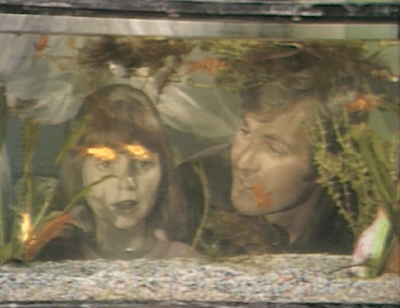
Nickerson and Don Briscoe play part of their scene behind an aquarium. We last saw that aquarium in #276. In that one, we were supposed to be uneasy about Windcliff and about Julia as its director. When we saw her feed the fish, it was a metaphor for her role as the mistress of a strange, self-contained little world whose inhabitants were at her mercy. Julia has been living on the estate of Collinwood for well over a year now, and the only member of Windcliff’s staff whom we see today is a nurse whose bit part was a prize given to beauty contest winner Bobbi Ann Woronko. So our attention is directed not to whoever is in charge of the place, but to Nickerson and Briscoe’s faces distorted in the water as the goldfish pass in front of them. This is rather a heavy-handed way of telling the audience that they are, each in their own way, as much prisoners as are the fish.

In the tank. Screenshot by Dark Shadows Before I Die.

Chris has seen the weather report in the newspaper and realized that the moon will be full tonight. This alarms him. Back at the Collinsport Inn, he asks the innkeeper, whom longtime viewers met in #1 and know as Mr Wells, if he can change his room. He wants the most isolated room in the place. He also wants Mr Wells to lock the door from the outside and to leave the door closed no matter what he hears inside. Mr Wells is reluctant, but agrees to all of these conditions.

Even viewers who stumbled onto Dark Shadows never having heard of it would know from what we have seen between Maggie and Nicholas that it is a horror story. Those who have been to the movies will add Chris’ status as a mysterious drifter to his alarm at the full moon and his request to be locked up and left alone no matter what Mr Wells may hear and will come up with the irresistible conclusion that he is a werewolf. They will also be sure that Mr Wells will eventually decide the sounds coming from behind the door are so terrible he cannot leave Chris alone, and that when he unlocks it Chris will kill him. Of course this is exactly what does happen. Our last shot of Mr Wells shows his face streaked with red and blue markings. The red ones presumably signify blood, and the others signify that most TV sets in the USA in 1968 received only in black and white, so blue lines would look like bruises.

Blue and red. Screenshot by Dark Shadows Before I Die.
The same shot in black and white.

Mr Wells, played by veteran character actor and future TV star Conrad Bain, had last appeared in #61. That was one of the longest gaps between appearances by a cast member, though the record belongs to Albert Hinckley, who like Bain appeared in #1. Hinckley, a train conductor in that one, will return playing a doctor in #868. That’s quite an extended absence from the show, but a remarkably short period to make it all the way through medical school, he must have been very bright.

Also in #1 was Alexandra Moltke Isles as well-meaning governess Victoria Winters; Mrs Isles left the show three days before this episode was taped. Victoria was Dark Shadows’ chief protagonist for its first year, and Mrs Isles’ presence in the cast was a powerful reminder of the show’s history even after the character was relegated to the sidelines of the action. Combining her departure with Mr Wells’ on-screen death, it might seem plausible that Maggie, another survivor from the first episode, might really die on Nicholas’ altar.

Episode 621: The only known cure

Mad scientist Julia Hoffman and bedraggled servant Willie Loomis have been in the woods, looking for old world gentleman Barnabas Collins. Barnabas has become the victim of vampire Angelique, and loss of blood has brought him very low. Julia and Willie fear that if they do not find Barnabas before nightfall, he will die. Barnabas was a vampire himself until March; they fear he will revert to that condition if they cannot save his life.

Despairing of the search, they return to Barnabas’ house. Julia remarks that “I actually found myself feeling that we’d come home and find him here.” Willie lives there, Julia doesn’t, but as Barnabas’ inseparable friend and partner in all his adventures she may as well. Julia and Willie decide that the only way to save Barnabas is to drive a stake through Angelique’s heart. She tells Willie that she believes the suave Nicholas Blair to be keeping Angelique’s coffin in his house. She sends Willie to fetch a stake and mallet, and she ventures forth to visit Nicholas.

Julia and Nicholas had a very dramatic confrontation in his living room in #619. Today, she tells him she has come to provide medical attention to Frankenstein’s monster Adam. Adam and Barnabas have a Corsican brothers connection, so Julia knows that Barnabas’ injuries will have reduced Adam to a dire state. Nicholas is keeping Adam at his house because he has plans for him, and if those plans fail it “will bring down the Master’s wrath.” Facing that prospect, Nicholas has little choice but to allow Julia to attend to Adam. She gives him some shots, which do provide him with considerable relief. But she says this is only temporary. She proclaims that “the only known cure” for Adam and Barnabas’ joint condition is Angelique’s destruction.

Early in the scene, Julia says that she and Nicholas must work together to help Adam and Barnabas. Nicholas tells her that he has no healing powers. At that, we may think he is about to talk forthrightly about himself as a warlock. But when she asks where Angelique’s coffin is, Niccholas starts playing dumb again. This frustrates Julia, as it might frustrate the audience. Danny Horn’s whole post about the episode on Dark Shadows Every Day is about how much it frustrates him. Julia leaves the stake behind when she goes, and Nicholas takes it downstairs to Angelique’s coffin with the intention of destroying her.

Meanwhile, Julia’s ministrations have done enough to revive Adam and Barnabas that the latter is able to cry out in the woods. Willie finds him and takes him home. Julia comes back, sees them, and sends Willie to call for an ambulance to take Barnabas to Windcliff, a sanitarium of which she is the nominal head and which is located about a hundred miles away. Barnabas objects to that, but Julia insists.

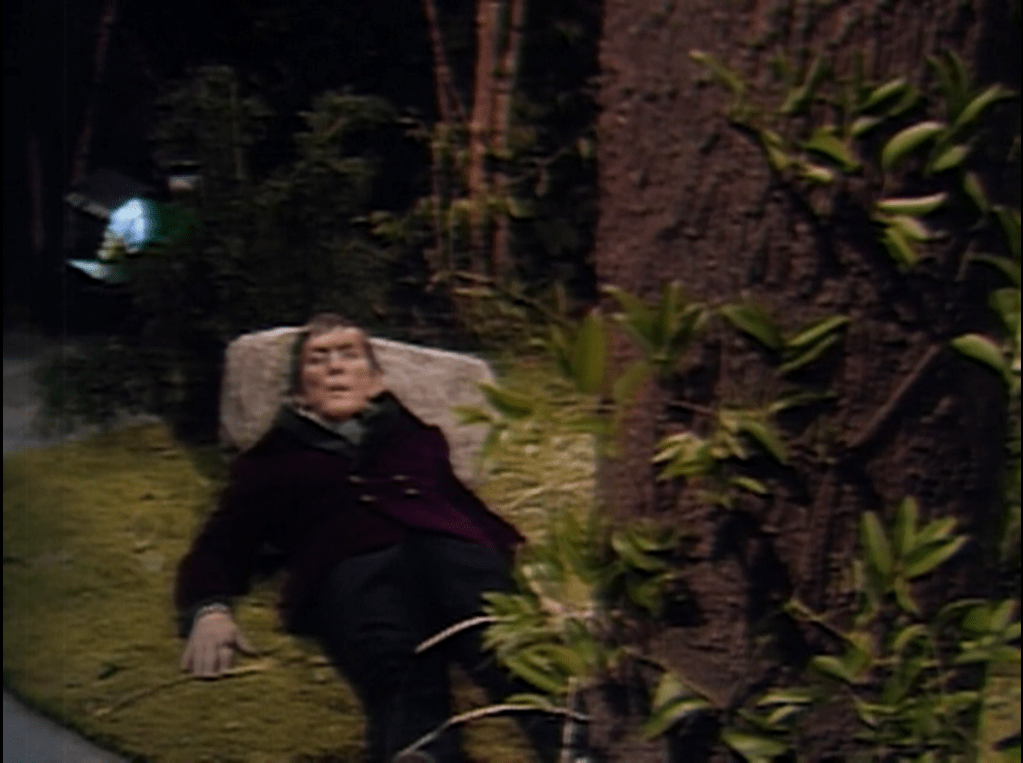
There is a spectacular goof in this one. We see Barnabas lying on the “grass” in the “woods.” For several seconds we can see the edges of the little green rug Jonathan Frid is on, and a studio light on the floor next to it.

“The woods”

Episode 569: Call me a superstitious woman

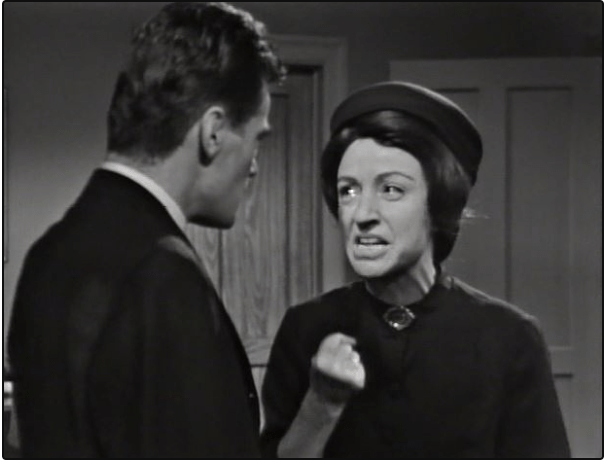
When housekeeper Mrs Johnson was first on Dark Shadows in September 1967, she was hyper-intense, determined to exact vengeance on the ancient and esteemed Collins family for the death of her longtime employer, Bill Malloy. In #69, she told the Collinses’ nemesis, dashing action hero Burke Devlin, that “I believe in signs and omens!” and that the signs and omens she could see showed that reclusive matriarch Elizabeth Collins Stoddard and her family had Bill’s blood on their hands.

“I believe in signs and omens!” Mrs Johnson with Burke Devlin in #69.

As the storyline centered on Bill’s death petered out, Mrs Johnson forgot about her hostility to Liz and her family, and became their devoted retainer. Her new personality was that of a friendly old busybody who kept advancing the plot by blabbing all the information she has to whoever can use it to make the most trouble. Since Mrs Johnson opened the front door to the great house of Collinwood in #211 and admitted Barnabas Collins, she has become an intermittent presence on the show, but Clarice Blackburn plays her with so much style that her occasional appearances are always a highlight.

Today, Mrs Johnson lets suave warlock Nicholas Blair into the house. She informs Nicholas that Liz has escaped from Windcliff, the mental hospital where she has been staying for the last nine and a half weeks. She gets very worked up as she declares that Liz’ aberrations are no ordinary psychiatric problem, but are the product of a hostile supernatural force that plagues the Collinses. Her voice is fearful and she shies away from eye contact with Nicholas, a contrast with the anger and boldness she had shown with Burke Devlin 100 weeks ago, but she again underlines her point with exaggerated hand gestures and facial expressions.

Mrs Johnson tells Nicholas about the curse on the house. Screenshot by Dark Shadows Before I Die.

For regular viewers, it is surprising that Nicholas doesn’t seem to have known about the details of Liz’ trouble. His subordinate, the wicked witch known variously as Angelique and Cassandra, had sent Liz mad by placing a spell on her shortly before he arrived on the scene. He’s still keeping Angelique/ Cassandra around his house- he stripped her of her powers, turned her into a vampire, and has been using her to attack various men he wants to silence. You’d think he would at some point have asked her what happened to the lady who owns the town he has settled in. But, evidently his curiosity did not extend that far.

Liz’ brother Roger comes home and invites Nicholas to join him for a brandy. As they are headed for the drawing room, permanent houseguest Julia Hoffman enters. She is pale, unsteady on her feet, and talking with great distress about her inability to find Tom Jennings. Roger points out that Tom is dead, and Julia faints.

Nicholas carries Julia to the couch in the drawing room. While she lies on it unconscious, he sneaks a peek under her scarf and finds bite marks on her neck. Thus he learns that Tom, whom Angelique turned into a vampire at his direction, has been feeding on Julia.

Liz has not been an active part of any major storyline since #272, when it turned out that her belief that she had killed her husband was mistaken and she did not in fact have any terrible secrets to conceal. So Nicholas’ lack of interest in her might just be a sign that he doesn’t want to waste time on irrelevant details. But Julia is indispensable to Nicholas’ plan to found a new race of artificially constructed human beings. She is a medical doctor, and is the only person Nicholas can coerce into building a mate for the Frankenstein’s monster she recently helped bring to life. She hasn’t been able to work on the project since Tom bit her, and apparently won’t be able to resume work until she is freed of his influence. If Nicholas lets his projects get in each other’s way to this extent, one can draw no conclusion other than that he is a bad manager.

Julia recovers and refuses to see a doctor. She goes to bed, and Roger tells Nicholas he thinks Liz might be on the grounds of the estate. The two of them go out to look for her. Of course Liz is there; of course she sees Tom; of course it is only when Roger and Nicholas approach that Tom vanishes and she is spared his bite.

It has been established that Windcliff is about 100 miles north of Collinsport; in #294, the ghost of Sarah Collins performed one of the most stupendous of her many feats when she transported Maggie Evans, The Nicest Girl in Town, from Windcliff to Collinsport on foot in about an hour. Liz has had 24 hours since she went missing from her room, and people used to hitch-hike in those days, so it wouldn’t necessarily have required a supernatural agency to get her home in that time. It still would have been quite a trip for an escaped mental patient to make by herself, without bus fare, as the subject of a state police all points bulletin, on the roads running through the woods of central Maine.

Back in the house, Liz makes it clear that she is not herself when she only gradually recognizes Mrs Johnson. She is also obsessed with a fear of being buried alive. Roger concludes that she has to return to the hospital, and goes off to get the car. Julia comes downstairs, and Mrs Johnson asks her to keep an eye on Liz while she goes off to telephone the hospital.

Liz asks Julia, who is the nominal director of Windcliff and a qualified psychiatrist, to examine her and see that she is sane. As she is about to respond, Julia hears dogs howling outside and goes into a trance. She opens the window and stares out into the night, saying that the dogs are calling to her and that she must go to “him.” While she does this, Liz asks her what she’s talking about, but clearly still wants her to serve as the standard of sanity. The first time we saw Liz, in #1, she was standing where Julia stands in this shot, looking out the window with Roger behind her. Liz reprised that pose many times in the first year of the show, and it became her signature. It is incongruous to see Julia in Liz’ customary place as Liz looks on. The whole encounter is so funny that I suspect the humor must have been intentional.

Liz begins to doubt that Julia will be able to help her.

Julia rushes from the house; Liz follows her out. Julia goes to the crypt where Tom’s coffin is kept; evidently Tom’s hunger is getting the better of him, and he has decided to DoorDash it tonight. Liz follows her in. Julia sees Liz and demands that she leave. Liz sees the coffin and asks if it the one in which she will be buried alive. Julia tells her it has nothing to do with her, and repeatedly yells at her to “Get out!” She complies. Tom appears, and opens his mouth to bite Julia.

Julia’s expulsion of Liz from the crypt is an effective turn, but it is also a sad one for longtime viewers. When Dark Shadows started, the presence of Joan Bennett in the cast was probably its single biggest ratings draw, and all the way through her name appears at the beginning of the credits under the word “Starring.” But for a year now, the show’s whole attitude towards Liz has been one of active hostility. They simply will not let her be involved in the action. When Julia shouts “Get out, get out, get out!,” she is speaking with the voice of the story conference.

Danny Horn’s post about this episode on Dark Shadows Every Day details how Liz has been pushed to the margins and kept there as the show has evolved. Danny makes a point of not discussing the first 42 weeks, when Liz was enough of a part of the action that Joan Bennett had some chance to show what she could do, but in this post at least he seems to realize that the makers of Dark Shadows were squandering a considerable resource.