Preemption Day: Dark Shadows actors on N.Y.P.D. (1967-1969)

On 23 October 1970, the ABC network preempted its afternoon lineup to cover President Richard Nixon’s address to the General Assembly of the United Nations. As a result no episode of Dark Shadows premiered 56 years ago today.

A few months ago, I was looking for something to watch on TV. My eye fell on a show from the 1960s I’d never heard of, titled NYPD. I flipped over to it, expecting it would hold my attention for a few seconds at most. But I saw that the guest star was John Karlen, Willie Loomis himself, playing a television reporter. Like Willie, Karlen’s character thought he had found a path to fortune and success, only to end up hopelessly entangled with a homicidal maniac. Karlen was great of course, and the show was way above average for cop shows of any period. Also, the opening title sequence, shot from a perspective immediately behind a flashing light on top of a car speeding through the city streets, was obviously the inspiration for the same image in the opening of Police Squad! So I watched it again the next time it was on, and soon found myself watching it as a matter of habit.

NYPD was produced in New York City for ABC from 1967 to 1969, and Karlen was one of a great many Dark Shadows cast members who had parts on it. Their appearances are fun for Dark Shadows fans, and in more than a few cases, they played remarkably similar roles. There were other connections between the shows as well- Ohrbach’s even provided the wardrobe.

Here are some of the casting overlaps. The first season was 26 episodes long, the second 23:

Season 1, Episode 1, “Shakedown”: Opens in a hotel room where a man appears to have committed suicide. The hotel manager is played by Conrad Bain; as when he played Mr Wells, manager of the Collinsport Inn, we don’t get to see nearly enough of him. The hotel detective is played by Dana Elcar, Sheriff Patterson #1. The heroes from the 27th Squad of the New York Police Department are exasperated at having to deal with Elcar’s character, since he is notorious throughout the city as an utterly incompetent investigator. Good to see that he didn’t lose his Collinsport ways when he moved to the big city! And John Harkins, who appeared in four roles on Dark Shadows, always as a mysterious man from another place, plays a nameless character who is the secret leader of all the gays in NYC (I don’t know if the gays all share a secret leader now. Maybe things were different in the sixties.)

Season 1, Episode 2, “Fingerman”: Joel Fabiani was heard but not seen as Paul Stoddard in #271, when we flashed back to the night when Liz learned Paul’s secret and tried to beat him to death. In this episode, Fabiani plays a man who is frantic because his secrets have caught up with him and now someone wants to beat him to death.

Season 1,Episode 8, “To Catch a Hero”: Michael Currie was Dark Shadows first law enforcement officer, the hapless Constable Jonas Carter. In this episode, Currie plays an army officer assigned to assist the detectives with the case of a psychotic war veteran. He fails to provide appropriate security to keep the veteran from getting loose and the police are forced to shoot him. That’s exactly the result we’d expect if Constable Carter were in his position.

Season 1, Episode 9, “Murder for Infinity”: John Karlen’s episode. Other familiar faces in the cast are Ralph Waite, the future Pa Walton, as the homicidal maniac and Sam Waterston as a beatnik who uses “hetero” as a pejorative term to describe Karlen’s character. There’s no word on whether the Sam Waterston character is satisfied with John Harkins’ secret leadership, but I do wish the young Sam Waterston had been on Dark Shadows as a militant sexual liberationist who sneered at straight people.

Season 1, Episode 10, “The Pink Gumdrop”: Nancy Barrett is glimpsed for about three seconds sitting at a table in a cafe where people plan car thefts.

Season 1, Episode 11, “The Witness”: about 20 minutes into it there was Bob O’Connell, a.k.a. Bob the Bartender, as laboratory technician Gerardi. He has several lines, but is uncredited. He isn’t even listed on IMDb, so I took this screenshot to prove that it is him:
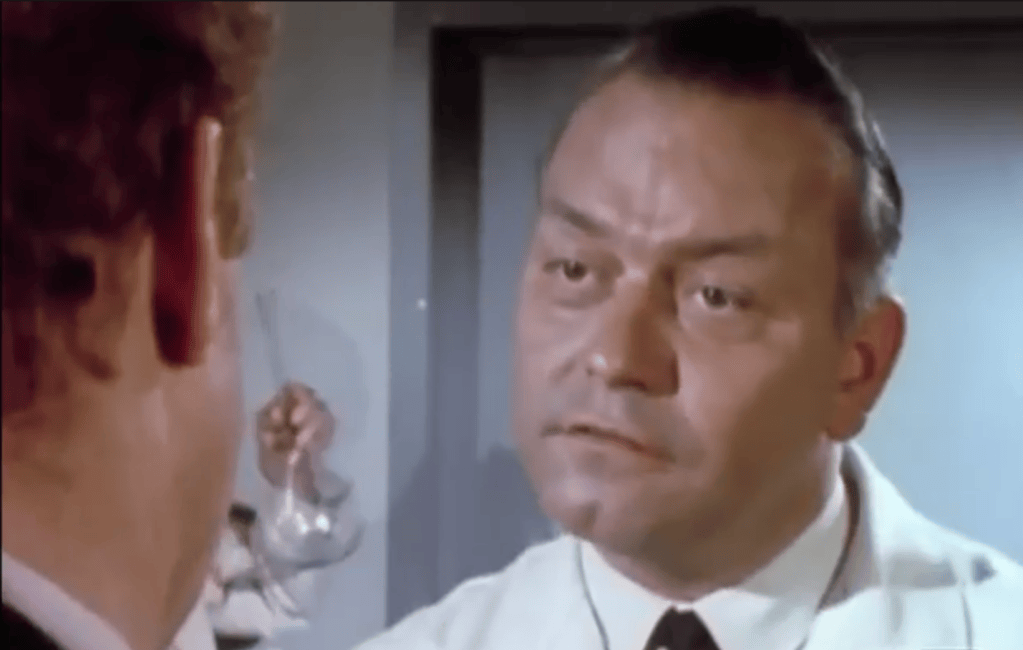
Criminalist Gerardi is supposed to analyze the ink on a document and determine when it was signed.

Season 1, Episode 12, “Boy Witness”: A 13 year old sees a woman shot to death and claims to have seen the gunman. A fingerprint on the cartridge of the fatal bullet leads the detectives to a man who matches the boy’s description and who was dating the woman. The man is played by Mitch Ryan. Ryan’s character breaks into the boy’s bedroom, and when the police catch up to him he assaults them and attempts suicide. It turns out the boy didn’t really get such a good look at the guy, so the detectives say that now they have to start all over. Since they could prove that he loaded the murder weapon, that would seem to be an overreaction! That overreaction reminds me of Burke Devlin’s belief that he was somehow proved innocent of vehicular manslaughter because he wasn’t driving his car when it hit the victim, he was just passed out drunk in the back seat after he had given the keys to an equally drunk guy. Still guilty!

Season 1, Episode 16, “Cruise to Oblivion”: Hugh Franklin played Richard Garner, grey eminence of the Collins’ family’s legal team on Dark Shadows. In this one, he plays the grey eminence of a drug ring. James Hall was Willie Loomis #1, a young mariner who seems to have lost his sea papers and who is a subordinate in some kind of unsavory scheme. Here, Hall is a subordinate in the scheme Franklin’s character oversees, and is connected with a ship carrying heroin.

Season 1, Episode 20, “Cry Brute”: Clarice Blackburn played three characters on Dark Shadows whose function was to introduce false allegations. Housekeeper Mrs Johnson was originally supposed to accuse Roger Collins of killing Bill Malloy; repressed spinster Abigail Collins brought in the Rev’d Mr Trask to accuse well-meaning governess Victoria Winters of witchcraft; and hateful biddy Minerva Trask accused neurotic intellectual Rachel Drummond of all sorts of things. In this episode, Blackburn plays a wife who backs her husband up when he falsely accuses one of Our Heroes of assault.

Season 1, Episode 24, “The Private Eye Puzzle”: Donna McKechnie as a young woman with a secret, over a year before she appeared on Dark Shadows as Amanda Harris.

Season 1, Episodes 25 & 26, “Nothing is Real But the Dead” Parts One and Two: Michael Hadge, who attained immortality as motorcycle enthusiast Buzz on Dark Shadows, plays a man the detectives meet in a pool hall. In Part One, he’s on camera for about a minute, enough to make a strong impression. He complains angrily about the damn dirty hippies who have moved into the neighborhood and are ruining it for all the hardworking, clean-living old-time residents such as himself and his family.

In Part Two, he gets another minute. The detectives remember his vociferousness against the hippies, and suspects he may have killed one of them. He denies it. Hadge has a very fine needle to thread here. The character is pretending not to be afraid of the police, and he is not as good an actor as Hadge is. We notice his insincerity, and are left wondering if he might be guilty. But it takes more time than Hadge has to really deliver on this, so we wind up attributing the character’s shrill awkwardness to his limitations and bumping ourselves out of the story for a little bit.

Season 2, Episode 1, “Naked in the Streets”: Vince O’Brien played a couple of forgettable roles as senior law enforcement officers on Dark Shadows. He has an equally forgettable role in this one as the New York Police Department’s Commander for the borough of Manhattan.

Season 2, Episode 2, “Encounter on a Rooftop”: Alfred Hinckley had a bit part in the first episode of Dark Shadows as a train conductor, and a more substantial part later as a doctor who is initially courageous when confronted by the monsters, but who ends up letting them have their way. He has a small part in this one as a man who reports a prowler and sets off the action.

Season 2, Episode 5, “Deadly Circle of Violence”: Gene Lindsey has a great scene as a man who catches up to a racist mass murderer played by some guy called Al Pacino. He doesn’t share any scenes with the murderer’s girlfriend, played by a actress named Jill Clayburgh. I wonder if those two ever called Lindsey for career help when he made it big as Randall Drew in the 1840 segment of Dark Shadows.

Season 2, Episode 6, “Case of the Shady Lady”: Harvey Keitel danced at the Blue Whale in #33; within two years, he played the manager of a dance club in NYC in this episode.

Season 2, Episode 7, “The Golden Fleece”: John Harkins has a major part as a man who gives the police an incomplete report of a a robbery of which he was the victim. Erica Fitz is credited as a waitress, but we didn’t notice her.

Season 2, Episode 9, “Walk the Long Pier”: Hugh Franklin reprises his role as the drug kingpin, but doesn’t have much to say. Dolph Sweet, a forceful Collins family loyalist in #99, is a forceful police official. Frederic Forrest, who danced at the Blue Whale in #137, appears briefly and is credited as “Customs Official.”

Season 2, Episode 12, “The Love Hustle”: The episode opens with Lara Parker walking into the squad room, raving that her mother is in danger, and dropping dead. Most of the time she is on screen she is photographed in an extreme closeup focused on her eyes. She’s only on for a minute, but the rest of the episode is an investigation of what happened to her, so she makes an impression.

Season 2, Episode 13, “The Body in the Trunk”: Mitch Ryan is the angry father of a girl who died under unsavory circumstances. House Jameson, who appeared in #270 as the useless Judge Crathorne in #270 and #271, here plays the even more useless doctor who is responsible for the girl’s death.

Season 2, Episode 14, “Night Watch”: Daniel Keyes plays a locksmith, which I suppose might be a joke about his name. Come to think of it, as the Caretaker at the old cemetery north of town he played a character whose chief responsibility was locking and unlocking gates and doorways, so perhaps he was cast on Dark Shadows for the same reason.

Season 2, Episode 15, “Three Fifty Two”: Frederic Forrest, wearing a wig that appears to be made of an old truck tire, is the second most prominent member of a gang of robbers who beat up two of the three main characters.

Season 2, Episode 21, “Boys’ Night Out”: David Ford, Sam Evans #2 and Andre DuPrés, is a detective who advises Our Heroes on his specialty, extortion rackets. He just sits across a table from them and gives a brief lecture in a reassuring tone. He appears to be reading off a teleprompter.

Season 2, Episode 22, “Everybody Loved Him”: Alfred Hinckley has another small part as a witness.

Season 2, Episode 23, “No Day-Trippers Need Apply”: Lee Beery and Gaye Edmond play women who are more or less prostitutes, which their characters on Dark Shadows were not. Philip R. Allen plays a policeman, which his was.
Episode 632: A new mate

Two arcs overlap today. Suave warlock Nicholas Blair is in one that is coming to its end, while mysterious drifter Chris Jennings is in one that is beginning.

The fansites I consult when I write these posts vary in how much detail they give about what happens in the episodes. At one pole is John and Christine Scoleri’s Dark Shadows Before I Die, which gives detailed summaries of every plot point, usually illustrating each with at least one screenshot. Their post about this one is no exception.

At the other pole is Patrick McCray and Wallace McBride’s Dark Shadows Daybook. They typically present a brief essay about one key point in an episode. Halfway between the two is Danny Horn’s Dark Shadows Every Day, which occasionally drifts towards one or the other of those extremes and occasionally disregards the episode altogether to focus on some other Dark Shadows related topic, but which as a rule focuses on two or three points and weaves them together as it runs through an overview of the day’s narrative outline. It’s a sign of the thickness of today’s story that not only Danny’s post, but even Patrick’s, approaches a Scoleri-esque level of retelling.

Nicholas is under orders from his boss, Satan, to do two things in a very short time. He must sacrifice Maggie Evans, The Nicest Girl in Town, in a Black Mass. For this, he will be rewarded with Maggie’s eternal companionship in Hell. He doesn’t exactly seem happy about this, but he does drug Maggie, dress her up, and put her on an altar, so it seems like he’s going to comply.

Nicholas’ other task is to create a humanoid species entirely subject to the spiritual forces of darkness. This would seem like a big project, but he already has a start on it. A male Frankenstein’s monster known as Adam lives in his house, and at Nichol;as’ bidding Adam has coerced mad scientist Julia Hoffman and her friend, old world gentleman Barnabas Collins, to revive a female of the same breed known as Eve. As their names suggest, Adam and Eve are to be the parents of this new race of people.

Nicholas finds that Adam has grown reluctant. Eve needs reviving because Adam killed her the first time she was brought to life. She hated Adam and rebelled against Nicholas’ command that she mate with him, and at the end the big guy murdered her. Adam says that if Eve comes back to life with the same personality, he will kill her again. Nicholas tells Adam that the reason Eve was so hard to live with was that the woman who donated the “life force” Julia used to animate her was evil, and that the woman who takes that role when Eve is brought back to life will be very sweet and loving. When Adam is skeptical, Nicholas tells him that Maggie will donate the “life force.” Knowing Maggie, Adam finds this acceptable.

Nicholas doesn’t have time to recruit any other woman, since the experiment must take place tonight. It seems he must be telling Adam the truth about Maggie. Perhaps he will take her to Barnabas’ basement and tell Julia to hook her up to the machinery. But even before the end of the episode, when we see her on the altar, her throat apparently about to be cut, it puzzles returning viewers how this can be. Yesterday Barnabas forced Nicholas to promise he would not harm Maggie in any way, and said that he and Julia would not continue working to revive Eve unless he honored that promise. So it is a mystery how he can expect them to cooperate if he shows up with Maggie and tells them to subject her to a procedure that is more likely than not to kill her.

Meanwhile, Chris is visiting his little sister in the hospital. The hospital is Windcliff, a sanitarium about a hundred miles north of Collinsport; Julia is its nominal head. The sister was first mentioned in #627; her name was “Molly” then. It’s “Amy” now. There’s good precedent for such an identity change. When Julia was first mentioned in #242, she was simply “Dr Hoffman,” and she was “one of the best men in the field” of rare blood diseases. A change from “Molly” to “Amy” isn’t so drastic as that.

Amy reacts blankly to Chris. He offers her a box of paints. He tries to get her to say something in response; at length, she replies “Why didn’t you come before?” He doesn’t have a satisfactory answer to that, and she says “You did what you had to do. You brought me the present. You can go now.” He looks for words to express his wish that he could be with her, and all she hears is that he is about to go away again. He breaks down and promises to stay “right here in Collinsport.” Regular viewers will recognize that as a continuity error, but if we imagine it to be a slip on Chris’ part it is intriguing- he has been so far away for so long that any location in Maine seems like Collinsport. He repeats his promise, and finally she throws her arms around him, bursts into tears, and pleads with him to stay.

This is our introduction to Denise Nickerson. In the hands of another actress, Amy’s transition from suspecting Chris to embracing him could have seemed very pat indeed, but she is so utterly cold to him in the first part of the scene, so subtle in showing signs of hope in the middle of it, and so abrupt when time comes to warm up, that the whole thing plays as a real surprise. When we see that she has those skills, we can be confident that the show will be in good hands as long as Nickerson is part of the cast.

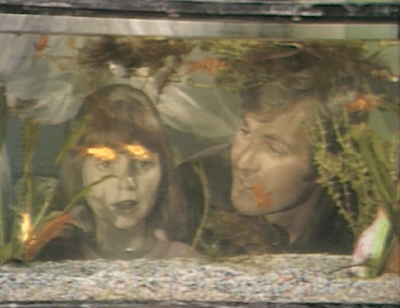
Nickerson and Don Briscoe play part of their scene behind an aquarium. We last saw that aquarium in #276. In that one, we were supposed to be uneasy about Windcliff and about Julia as its director. When we saw her feed the fish, it was a metaphor for her role as the mistress of a strange, self-contained little world whose inhabitants were at her mercy. Julia has been living on the estate of Collinwood for well over a year now, and the only member of Windcliff’s staff whom we see today is a nurse whose bit part was a prize given to beauty contest winner Bobbi Ann Woronko. So our attention is directed not to whoever is in charge of the place, but to Nickerson and Briscoe’s faces distorted in the water as the goldfish pass in front of them. This is rather a heavy-handed way of telling the audience that they are, each in their own way, as much prisoners as are the fish.

In the tank. Screenshot by Dark Shadows Before I Die.

Chris has seen the weather report in the newspaper and realized that the moon will be full tonight. This alarms him. Back at the Collinsport Inn, he asks the innkeeper, whom longtime viewers met in #1 and know as Mr Wells, if he can change his room. He wants the most isolated room in the place. He also wants Mr Wells to lock the door from the outside and to leave the door closed no matter what he hears inside. Mr Wells is reluctant, but agrees to all of these conditions.

Even viewers who stumbled onto Dark Shadows never having heard of it would know from what we have seen between Maggie and Nicholas that it is a horror story. Those who have been to the movies will add Chris’ status as a mysterious drifter to his alarm at the full moon and his request to be locked up and left alone no matter what Mr Wells may hear and will come up with the irresistible conclusion that he is a werewolf. They will also be sure that Mr Wells will eventually decide the sounds coming from behind the door are so terrible he cannot leave Chris alone, and that when he unlocks it Chris will kill him. Of course this is exactly what does happen. Our last shot of Mr Wells shows his face streaked with red and blue markings. The red ones presumably signify blood, and the others signify that most TV sets in the USA in 1968 received only in black and white, so blue lines would look like bruises.

Blue and red. Screenshot by Dark Shadows Before I Die.
The same shot in black and white.

Mr Wells, played by veteran character actor and future TV star Conrad Bain, had last appeared in #61. That was one of the longest gaps between appearances by a cast member, though the record belongs to Albert Hinckley, who like Bain appeared in #1. Hinckley, a train conductor in that one, will return playing a doctor in #868. That’s quite an extended absence from the show, but a remarkably short period to make it all the way through medical school, he must have been very bright.

Also in #1 was Alexandra Moltke Isles as well-meaning governess Victoria Winters; Mrs Isles left the show three days before this episode was taped. Victoria was Dark Shadows’ chief protagonist for its first year, and Mrs Isles’ presence in the cast was a powerful reminder of the show’s history even after the character was relegated to the sidelines of the action. Combining her departure with Mr Wells’ on-screen death, it might seem plausible that Maggie, another survivor from the first episode, might really die on Nicholas’ altar.

Episode 61: A sandwich for a lonely man

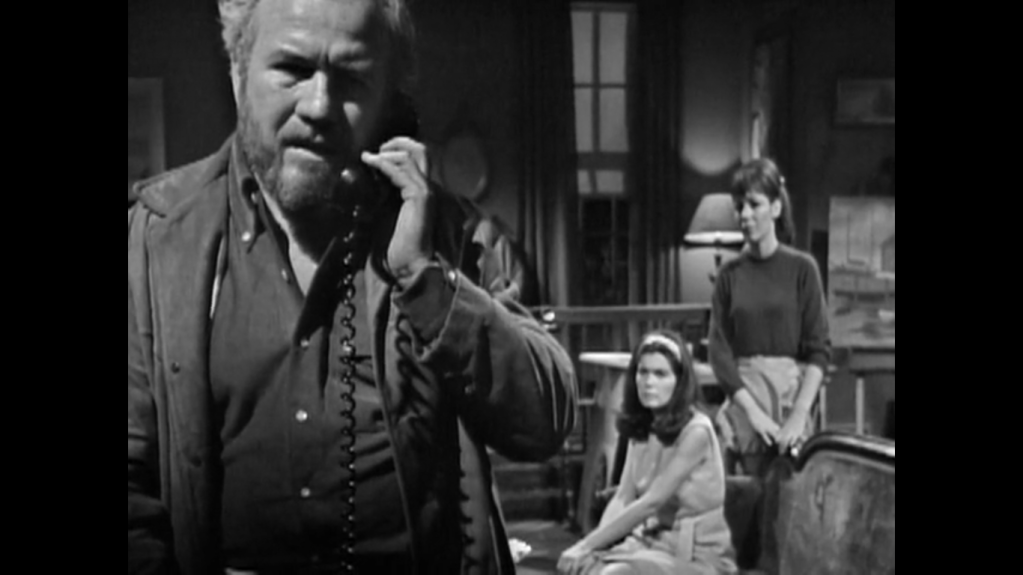
My wife, Mrs Acilius, pointed out that my post about episode 60 was unfair. She objected to the sentence “The Friday cliffhanger is Burke asking if he may join the Evanses and Vicki for dinner.” As she explained, that moment actually is an effective cliffhanger. I hadn’t mentioned that the sheriff had called drunken artist Sam Evans to warn him that dashing action hero Burke Devlin might be coming to his house, that he urged Sam to call back if Burke did come, and that actor David Ford played Sam’s reaction to this call with a convincing display of terror.

Sam on the phone
Sam trying to conceal his fear from the women behind him and the man on the other end of the call

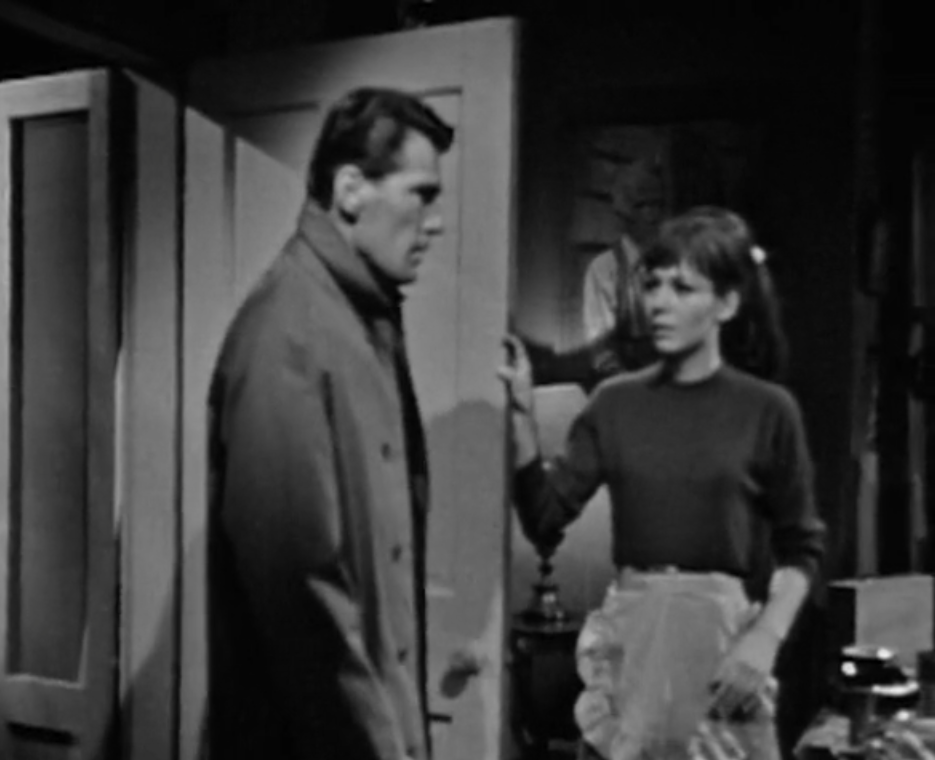
I also failed to mention the shot when Burke enters the room. Before Sam can get the words out to tell his daughter Maggie not to open the door, Burke has burst in. The scenes in the Evans cottage have been dimly lit, with all three figures moving before dark backgrounds. When the light colored door swings open, its relative brightness feels for a second like a flash, and when he stands in front of it Burke cuts a stark figure. We see him in contrast with Maggie, who stands against a dark background, wearing a dark top and a stunned expression:

Burke enters
Burke enters the Evans cottage

Throughout the episode, Sam had failed repeatedly to exercise any measure of control even in a social situation in his own home where the only other people are his daughter Maggie and well-meaning governess Vicki, the two kindliest characters on the show. The irruption of Burke into that setting is indeed a formidable moment for Sam.

So yes, that was a more plausible Friday cliffhanger than I allowed. Perhaps I was prejudiced against it because I remembered this episode. The purpose of a cliffhanger is to bring the audience back for the next installment. Typically, the next installment will begin by resolving the cliffhanger as quickly and unceremoniously as possible. But today, Burke’s intrusion into the Evans cottage drags on and on. In the process, it does serious harm to Burke’s character.

After rushing into the Evans cottage, Burke defies Sam and Maggie to say that he isn’t welcome. Maggie, unaware of the sheriff’s call urging Sam to let him know if Burke shows up, breaks down and says that of course Burke is welcome. Burke then tries to order Vicki and Maggie into the kitchen so that he can be alone with Sam. Neither woman is at all meek, however, and they stand up to Burke’s browbeating admirably.

Not so Sam. He takes the first opportunity to run away. We know that Sam has his guilty secrets, but he is a likable character, and it is hurts to imagine the pain that will await him the rest of his life whenever he remembers the night he left his daughter and her sweet young friend to face an angry man alone in his house. Sam doesn’t even call the sheriff. Instead, in his panic he goes to the hotel to try to retrieve a sealed envelope he had Maggie leave in the safe there. That gives us a scene with Conrad Bain as hotel manager Mr Wells. Bain is always a delight, and his little business about the envelope is certainly the most pleasant part of the episode. At the end of the episode, Sam will meet Burke at the hotel and ask to talk with him alone in his room, leaving us with the image of him trying to redeem himself in his own eyes.

Before that end comes, however, we have much, much more of Burke trying to bully the young women in the cottage. He won’t let them eat dinner. He harangues them about his manslaughter conviction. In the course of that harangue, it becomes clear that he isn’t thinking at all clearly. “I was drunk and don’t remember too much about that night, but I do remember Roger Collins taking over the wheel.” That’s just delicious- he was hopelessly drunk, blacked out in fact, but he’s pretty sure he remembers giving the keys to someone else before the fatal collision. The fact that his substitute driver was just as drunk as he was doesn’t seem to occur to him as a flaw in his “defense,” nor does the fact that this one convenient piece of information is the only thing to surface from his alcoholic stupor. That sort of thinking runs at such an oblique angle to reality that there would be nothing to say to Burke even if he were willing to listen to you. He goes on to suggest to Maggie that her father may have killed their old friend Bill Malloy, and refuses to leave the house when Maggie tells him to do so.

Burke’s abuse of Sam, Maggie, and Vicki makes it hard for us to like Burke as much as the show needs us to like him. We’re supposed to perk up when he’s on screen, not only because we don’t know what he might do next, but also because we don’t know whether we will approve of whatever surprising thing he makes happen. Even when he is trying to destroy the family to which our point of view character, Vicki, owes her loyalty, we’re supposed to want to see more of him. But when we see him treat Vicki and Maggie the way he does here, the image of him as a grinning thug sticks in the mind, and it is hard to want more of that.

All the more so, perhaps, because of his ineffectiveness as a thug. Our first concern with the show is that it should tell an interesting story, and Burke earns our attention by providing exciting story points. We can like even a very evil character who makes exciting things happen, but someone who simply shows up at your house when you’re about to eat, keeps you from your dinner, rambles on with a lot of nonsense, insults your father, and refuses to leave is just testing your patience for bad conduct.

We can compare Burke as the villain of this episode to another, more interesting villain. Throughout 1966, Mitch Ryan was not only playing Burke on Dark Shadows, but was also on Broadway in Wait Until Dark. In that play, he was one of the con men who, under the control of a mysterious figure calling himself Harry Roat, junior (and senior, but that’s another matter,) talk their way into a blind woman’s apartment and try, at first by trickery and then by threats of murder, to get her to hand over something valuable that she hadn’t realized she had in her possession. Like Maggie and Vicki, the heroine of the play stands up to Ryan’s character and the other villains. She ultimately triumphs over them. Unlike Burke, who is simply indulging on rage for its own sake and boring everyone as he does so, Roat has devised a brilliantly clever scheme to trick his victim, a scheme which fails only because she is his equal in brilliance and his superior in other ways. Wait Until Dark was a major hit in that original Broadway run, as was the movie version the next year and as many revivals of it have been in the years since. If Roat’s activities were as pointless in the play as Burke’s are in this episode, I very much doubt it would have been produced at all.

Episode 11: “‘Straight from the bean to you!’ I wonder who writes that junk.”

One of the great challenges of writing a serial is fitting enough recap of previous story points into each installment that new viewers can catch up without putting so much in that you bore the regulars. A time will come when Dark Shadows gives up recapping altogether, but in these early weeks they are scrupulous about soapcraft.

In episode 11, much of the recapping takes place in a scene between innkeeper Mr Wells (Conrad Bain) and drunken artist Sam Evans (Mark Allen.) The story justification for Mr Wells telling Sam everything the audience might need to know about Burke Devlin and the Collinses is that Sam’s daughter Maggie, who runs the restaurant in the inn, is about to return to work, and Mr Wells doesn’t want her to see her father drunk. He knows that as long as Sam thinks he might have something new to tell him about Burke, he will sit there and drink coffee.

The scene between Mr Wells and Sam is an example of something that becomes ever more important to Dark Shadows as it goes on: good acting trumping not-so-good writing. And good acting trumping bad acting- while Mark Allen is the worst actor on the show, Conrad Bain is phenomenally good. He single-handedly takes what must have looked in the script to be a terribly dull scene and makes it completely absorbing. I can imagine a show entirely composed of him looking into the camera and telling stories, and that show would be great. No wonder he went on to have such a big career in television!