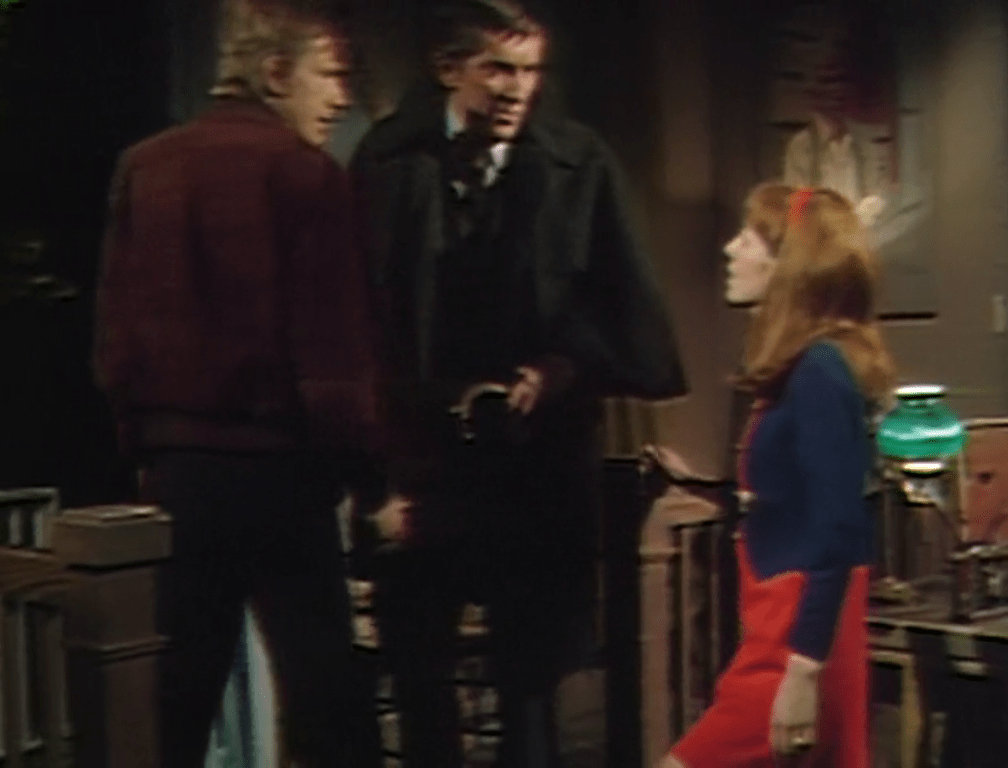
Episode 1084: A living man no bigger than a doll

Julia Hoffman and her friend Barnabas Collins recently returned to 1970 after a cosmic journey that ended with two weeks in 1995. In that far-off future year, they found the great house of Collinwood in ruins and everyone who had lived there either dead, missing, or hopelessly insane. This was the result of a mysterious disaster that occurred before 1970 was out. Since they returned, they have been trying to find out what this disaster will be and to prevent it.

Julia’s friend Timothy Eliot Stokes tells her she and Barnabas have accomplished nothing since they came back to 1970. He says that the time has come to enlist the aid of a strangely dressed man named Sebastian Shaw. Sebastian has psychic powers, and may be able to use them to figure out what’s going on.

Sebastian comes to the great house. Julia tells him of her experience in the future. He has a vision which he says he cannot interpret. It is presented to us in an unfocused shot, so that we can believe Sebastian does not know what he is seeing. But we recognize it. It is The Playroom, a room that intermittently exists behind a door in a little-used part of the great house. Most of the time that door opens on a linen closet, but teenagers Hallie Stokes and David Collins have found that occasionally the same door admits them to a much larger space stocked with antique toys and ruled by the ghosts of several people who died in 1841. Julia knows The Playroom well; she and Barnabas visited it several times in 1995, and met the same ghosts there who are now taking control of David and Hallie. Julia and Barnabas also went to The Playroom in 1995 with two living people, Carolyn Fredericks (née Carolyn Collins Stoddard) and the Sheriff of Collinsport. But in 1970, only the linen closet has so far been visible to anyone other than Hallie, David, or the ghosts.

After Sebastian has his vision, Stokes and Julia decide to bring David and Hallie to him. Stokes goes upstairs to fetch them, and Julia goes to get some tea. When she returns to the drawing room, Julia finds Sebastian at the piano. He is playing the melody that often sounds in The Playroom, and that Julia heard echoing through the house in 1995. She asks him where he heard it. When he says he was just making it up as he went along, she flatly declares that he is lying. He must have heard it in his vision, because it is the very tune that is associated with the phenomenon they are investigating. He will not admit to this, and she will not soften her tone. On the contrary, she says that she had suspected that he was a fraud, but that she now believes he is something far worse- a man with genuine psychic gifts who uses them dishonestly. We learned yesterday that this is precisely what Sebastian is, but Julia can hardly expect him to agree with her. He says that he is being insulted, and leaves the house before Hallie and David can get downstairs.

Julia has been given to counterproductively harsh behavior of this sort since returning to 1970. Perhaps this is the consequence of a trauma she suffered in 1995, when a blatantly evil ghost known as Gerard Stiles took possession of her. Or perhaps it is the influence of someone she encountered on the first leg of her journey, when she was in an alternate universe. There, she met her own Doppelgänger. She greeted this other Julia Hoffman by beating her to death, stealing her clothes, and assuming her identity. A deed like that might leave a mark on its doer. Besides, that other Hoffman was herself inclined to be tactless, so perhaps Julia picked that habit up in the course of her imposture.

Unknown to Julia and Stokes, David and Hallie are busy in The Playroom today. Yesterday they learned that the ghosts plan to reduce them to the status of the dolls that are in a dollhouse there. In particular, the ghost of a teenage boy named Tad wants to take possession of David, and that of a teenage girl named Carrie wants to take possession of Hallie. Tad and Carrie will then live their lives while David and Hallie are in storage as inanimate things in a miniature case. Hallie and David took the dolls to the fireplace in the drawing room and burned them there, hoping this would break the power of the ghosts. Once they had seen the flames consume the dolls, they returned to The Playroom, hoping to find that it had vanished and the linen closet had resumed its place. To their dismay, they found that The Playroom was still there and the dolls had reappeared in their places in the dollhouse.

While David and Hallie are processing this fact, they see lights come on inside the dollhouse. The dollhouse has no electricity, so this puzzles them. David looks inside the dollhouse and sees a man in it. He is the size of the dolls, but is moving around as if he is alive. By the time Hallie comes around to look, the tiny man has vanished. She believes that David saw him, though.

David then tells Hallie that they ought to write up everything that has happened to them since they first encountered The Playroom. When Hallie asks what good that would do, David says it is the only way people will know what happened to them after they are gone.

They go to David’s room and write the whole story in a notebook. When Stokes comes to get them, they hide the notebook. They return to the room after Sebastian’s abrupt departure, and find that the notebook is gone.

Hallie and David decide that one of the ghosts must have taken the notebook. They go to The Playroom to look for it. They open the door, and see Carrie and Tad reading the notebook.
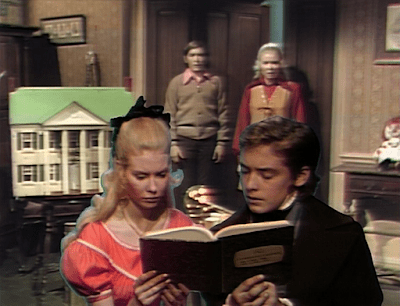
David and Hallie see Carrie and Tad. Screenshot by Dark Shadows Before I Die.

David’s vision of a little man moving around inside the dollhouse now reminds me of the moment in part 6 of the 2017 revival of Twin Peaks when a tiny version of the supernatural figure known as “Mike” appears to the near-catatonic Special Agent Dale Cooper and urges him to “Wake up! Wake up! Don’t die! Don’t die!” “Mike” is a resident of The Red Room, a space that is as mysterious in its nature and as intermittent in its presence as is The Playroom. We can assume that the tiny man David sees is Gerard, whose plans for him are just the opposite of “Mike’s” wish that Cooper should regain his true identity and once more function as an action hero.

At the time, the idea of living figures small enough to make their homes in a dollhouse and of people from the outside world shrunken and enclosed with them might have reminded viewers of the 1963 Twilight Zone episode “Miniature,” featuring the young Robert Duvall as a lonely man who encounters such a situation. “Mike” himself is a reference to 1960s cult television; he is a mysterious one-armed man who sometimes goes by the name Philip Gerard, evoking the two antagonists Dr Richard Kimble faced on The Fugitive. So it is not unlikely that “Miniature” was a common source for that installment of Twin Peaks and this installment of Dark Shadows. It isn’t even impossible that David Lynch or Mark Frost saw this episode of Dark Shadows and were on some level influenced by it as they wrote the script for Twin Peaks, though of course that would be a far less probable source than The Twilight Zone, which has long been one of the most heavily rerun of all TV shows.

At any rate, I think the similarity is intriguing even beyond the question of influences and sources. A soundstage looks a lot like a dollhouse, and when a drama isn’t connecting with the audience the actors may as well be dolls the director is playing a private game with. So the premise of characters ending up in a dollhouse plays to a fear that must prey on the minds of the writers.

Moreover, all three of these shows share a theme of stunted sexual development. Robert Duvall’s character in “Miniature” is a solitary man who cannot achieve any form of intimacy with another person. The stupefied Agent Cooper lives with a woman who has mistaken him for her husband and enjoys sex with her, but that is strictly a matter of mechanics. He has no idea what is going on during their encounters.

For their part, David and Hallie seem to be developing on the usual timetable. Certainly the dialogue between them when they were first introduced acknowledged that they were old enough to be interested in each other sexually, though David made it very clear to Hallie that she was not the partner he would choose. But Tad and Carrie seem to be quite alarmingly immature. Tad first possessed David in #1081, on Monday. That day, Hallie found David in The Playroom. Speaking as Tad, David took her to be Carrie. Tad was shocked by Hallie’s 1970 clothing and advised her to take it off immediately. It doesn’t seem to occur to Tad that there is anything untoward about demanding Carrie disrobe in front of him. Tad also said that he would be sad when he was too old to play with the toys in The Playroom. But he is very obviously much too old to be enthusiastic about a rocking horse, a dollhouse, a miniature carousel, and a bunch of stuffed animals. So his and Carrie’s attachment to those things shows that even when they were alive they were relics of a dead past. They never grew up, and their ghosts are determined to freeze Hallie and David in place, immobilized and on display in a small, unchanging world.

Danny Horn’s post under the title Episode 1084 on his great Dark Shadows Every Day doesn’t have all that much to do with the episode, but it is a magnificent production in its own right. Its subtitle is “100 Things That I Would Like David and Hallie to See When They Open the Playroom Door, in No Particular Order.” The 100 things he lists range from chuckleworthy to hilarious. Best of all, it ends with a video the post inspired Cody Schell to put together with alternate endings for the episode.
Episode 900: Precious possession

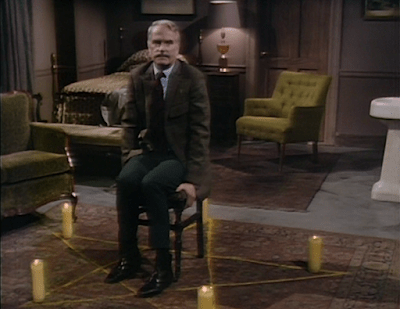
We open with the sight of a man (Dennis Patrick) sitting nervously on a chair placed in the middle of a pentagram marked on a rug. At each point of the pentagram there is a candle. The man is Paul Stoddard.

Paul’s precarious pentagram perch. Screenshot by Dark Shadows Before I Die.

Regular viewers will remember #752, in which Quentin Collins was told to sit on a chair in the middle of a similar pentagram. Quentin’s friend, amateur warlock Evan Hanley, told him that by doing this he could keep from turning into a werewolf. Paul isn’t afraid of turning into a werewolf, and he doesn’t have a friend like Evan. His worry is vague, but urgent- he knows that someone is after him, that if that someone catches up to him they will do something horrible, and that whoever it is keeps sending him messages that it is time for him to pay his debt. But he has no idea who that is, what they will do, or what the debt they are talking about. Sitting in the pentagram was a suggestion that came from a sailor who cruised him in a gay bar met him in a local tavern.

Paul’s pursuers are a cult associated with mysterious beings known as “the Leviathan people.” It has been made clear to us that both Paul and his daughter, heiress Carolyn Collins Stoddard, are, unknown to themselves, part of its orbit. In #888, Paul and Carolyn ran into each other at a cairn that is the cult’s ceremonial center and looked at it. Carolyn had been on its site many times, and could not understand why she had not seen it before. In #894/895, the cult’s acting leader, Carolyn’s distant cousin Barnabas Collins, took antique shop owner Philip Todd to the cairn. Philip told Barnabas he had walked past the site a few days before and that the cairn was not there then; Barnabas explained that only those connected with the Leviathan cult can see it. Barnabas has also been highly solicitous of Carolyn’s well-being since he became part of the cult, and he keeps telling her that he knows she has an extraordinary future ahead of her. So we know that the cult has plans for her, and Paul’s distress suggests that they have less attractive plans for him.

Paul sees the doorknob turning. He is terrified. Instead of the enemy Paul expects, Carolyn enters. He yells at her to leave. She stays. When he is unable to explain what he is afraid of, but that the pentagram on the floor will protect him, she notices that it is the same as the symbol she has been wearing on a chain around her neck. Barnabas gave it to her some days ago and urged her to wear it always. The audience knows, but she does not, that he intends it to protect her from the local werewolf. When she sees the similarity, the show invites us to wonder what the Leviathans have to do with werewolves. Carolyn tells Paul that if the symbol will protect him from his enemies in the form of chalk or gaffer tape on the floor, it will also protect him when it is composed of a silver pendant. He puts the pendant on and declares that he feels much better. He can no longer hear the voices that have been telling him his payment is due immediately. He embraces Carolyn and tells her he trusts only her.

When Carolyn mentioned Barnabas to Paul, he responded “Who is Barnabas?” Carolyn seems surprised he does not know, since she saw him near Barnabas’ house. Indeed, we saw him enter Barnabas’ house and wander through it the night he first returned to Collinwood, after an absence of twenty years. But he doesn’t remember anything about that.

Not that Carolyn’s own long acquaintance with Barnabas is all that enlightening to her just now. Ever since the Leviathans adopted him as one of their own, he has not been himself at all. We see him in his front parlor with mad scientist Julia Hoffman, who has for a year and a half been his inseparable best friend. She is trying to interest him in some information she has gathered about another storyline, and he makes it clear he could not be less interested in it or in her. She demands to know what he is interested in, and he refuses to answer. Carolyn enters, and suddenly Barnabas is all ears. Julia, frustrated, snaps that now she can see what he does care about.

In the autumn of 1967, Barnabas was a vampire and Julia had failed in an attempt to make him human again. He bit Carolyn and made her his blood thrall. He also decided that he would kill Julia to prevent her exposing him. Julia soon learned that Carolyn was both a wily operator and a most devoted servant. Julia had already realized that she was in so deep with Barnabas that she would be unlikely ever to make a life with anyone else, and so she conceived an unrequited love for him. In her dealings with Carolyn in those days, terror mingled with jealousy. Her bitter remark when she sees that Barnabas, who has been so dismissive of her, is now so concerned with Carolyn, reminds longtime viewers of that jealousy. Combined with the story of a daughter reunited with her long-absent and none too respectable father, this faint suggestion of a love triangle is enough to remind us that we are watching a daytime soap.

For her part, Carolyn was freed of her subservience to Barnabas as soon as he was freed of the effects of the vampire curse in March 1968. For some time, Nancy Barrett went out of her way to play Carolyn in a way that left us wondering if Carolyn remembered her time in his power. The scripts didn’t give her a lot of support in that endeavor, but the closeness she feels towards him combines with Julia’s jealousy to bring it back to our minds.

Carolyn has come to ask Julia to help Paul. Julia is back in the great house of Collinwood getting her medical bag to take to Paul’s hotel room when Paul himself bursts in. He demands to see Carolyn. Julia tells him that she left a little while ago to go to his hotel, and is probably there now. The telephone rings. Julia answers it, and tells Paul it is for him. This doesn’t strike her as odd, even though he hasn’t set foot there in twenty years, not since the night he left his wife Liz thinking she had killed him. Julia hands the phone to Paul. He expects to hear Carolyn, but instead hears the same voice that has been taunting him, saying that his bill is due now. He hangs up, and it starts ringing again. He forbids Julia to answer it, and runs out. We cut to his hotel room, and see that this time it is Carolyn trying to reach her father. Later, Carolyn will come home and Julia will tell her that Paul doesn’t seem to want help, however much he may need it.

Paul goes back to his room, and hears the phone there ringing. Terrified, he runs out, returning to the bar where he’d picked up trade met a new friend the night before. He sees another stranger sitting at a table, looking him over and beckoning him by rolling back one finger. The stranger is Barnabas.

Barnabas beckons Paul. Screenshot by Dark Shadows Before I Die.

Paul reluctantly goes to the table, and Barnabas introduces himself. Paul says he doesn’t know Barnabas, but Barnabas makes it clear he knows all about Paul. He asks him to think back to the night he left Collinwood in 1949. We dissolve to a flashback.

Paul is at the bar, and another strange man strikes up a conversation with him. The man encourages him to assume that he has the power to grant any wish Paul might make in return for a price they would agree on. Paul says that in that case, he will ask for twenty years of boundless prosperity. At the end of those twenty years, Paul will give up anything he has, even his “most precious possession.” They shake hands on this deal. Paul laughs, and says he has won the game. He said that he would surrender anything he has, present tense- not anything he might gain in the course of his successful future, but anything he has as of 4 December 1949. On that date, Paul assures the man, he has nothing anyone could possibly want. The man laughs, and wants to drink to congratulate Paul on his cleverness.

Back in the present, Barnabas is laughing as heartily as the other man did twenty years before. He finds it preposterous that Paul could have forgotten such an important encounter. Paul can’t see anything important in it- it was just a silly little game, and its only consequence was that a strange man bought him a drink. Barnabas says that on the contrary, the bargain he struck was quite real. The Leviathans kept their side of it by giving him the success he has had over the last twenty years. Now that the twenty years are up, the time has come for them to claim the most precious possession he had the night he fled Collinwood.

Paul says that he supposes Barnabas is talking about his soul. He laughs heartily at that, and tells Barnabas that he is welcome to it. He is telling Paul that that is not what he meant as Carolyn enters. Paul is still laughing, and is delighted to see his daughter. She says she is relieved that the two of them found each other, and he tells her everything will be all right now. Barnabas says that Carolyn is her father’s most precious possession.

The scenes of Paul rushing around in a steadily mounting panic he is unable to explain are highly reminiscent of The Twilight Zone. The last line is a twist worthy of that classic series, especially as delivered by Jonathan Frid. His icy performance as Barnabas in these early episodes of the Leviathan arc not only recalls the malign representatives of alien powers on that show, but is superb in itself. He stumbles a little over his words in Barnabas’ scene with Julia, but is perfectly composed otherwise, and the effect is quite frightening.

I remarked on the gay subtext of the barroom scenes in the comment thread on Danny Horn’s post about the episode at his great Dark Shadows Every Day:

So far, this has been the gayest storyline the show has taken on yet.

In 899, the sailor offers to buy Paul a drink, and Paul shouts “I buy my own drinks!” This isn’t subtext- any man getting that reaction in a bar will know that the other fellow has interpreted his offer as including more than the drink. Paul apologizes and becomes friendly, indicating that he is willing to abandon that interpretation and set aside the hostility that accompanied it.

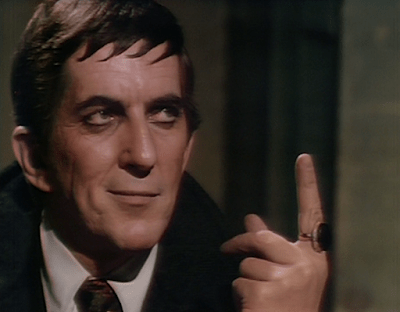
In this episode, we’re back in the same bar. Barnabas beckons Paul to his table with his index finger. I invite any man who doesn’t think we are intended to read this as a reference to a sexual come-on to try that move on a homophobic tough guy in a bar.

Paul’s face shows his inner struggle as he tries to resist Barnabas’ advances, but he can’t. Barnabas coaxes him into reminiscing about yet another night in the same bar, when a casual encounter with yet another guy led to something that seemed at the time like a little harmless tomfoolery, but that has now grown into a threat to his relationship with his family, his standing in the community, his physical well-being, and everything else.

Comment by “Acilius,” left 12 December 2020 on Danny Horn, “Episode 900: The Long Con,” posted on Dark Shadows Every Day, 18 July 2016.

In response to someone who said some kind words about that comment, I made a remark that I no longer think is very good:

Thanks! It’s a bit of a puzzle- so far as I know, none of the writers on the show at this time was gay, so I’m not sure why they decided to go so deep into these themes just then.

Comment by “Acilius,” left 11 April 2021 on Danny Horn, “Episode 900: The Long Con,” posted on Dark Shadows Every Day, 18 July 2016.

What I think now, and probably would have thought then if I had stopped and considered it for a minute before I hit “Post Comment,” is that the writing staff’s sexuality has nothing to do with it. They were worldly, sophisticated people with long experience in the theatrical profession in New York City. They all probably had many gay friends, and when they are called upon to write a story about people being drawn into a secret underworld and learning uncomfortable truths about themselves in the process their minds will naturally turn to themes having to do with closeted homosexuality. Granted, that doesn’t fully account for Christopher Bernau’s decision to play Philip as a much queenier version of Paul Lynde, but it is hardly a “puzzle” that the writers would draw on motifs suggestive of the closet when that’s the story they have to work with.

The man who met Paul in the bar in 1949 is unnamed in today’s dialogue, but will later be referred to as Mr Strak. Strak is played by John Harkins, who appeared in #174 as Lieutenant Costa of the Arizona State Police and in #878, 879, 880, 881, and 883 as Garth Blackwood, formerly the keeper of England’s Dartmoor Prison, and by that time a creature raised from Hell to wreak vengeance on an escaped prisoner and anyone else who caught his attention.

Strak’s name may remind longtime viewers of another minor character whom we saw in episodes #1 and #2, Wilbur Strake, private eye. We saw Strake in this same bar, where he gave reports about Carolyn and other members of the Collins family to his employer, Burke Devlin. Like Strak, Strake was a rather smug, sardonic sort. Add to this the rarity of the names “Strak” and “Strake” and the fact that they sound so much alike, and it seems obvious that there is an intentional reference of some kind. Paul’s presence in this storyline is the result of the writers reaching back to the show’s early days to find a loose end they could attach to this storyline to incorporate it into the Collins family saga, so they probably were looking through the scripts from the first week. Still, I can’t imagine they thought many people would remember Wilbur Strake by this point. Likely the reference is an inside joke, but who was on the inside and what the point of the joke was, I can’t begin to guess.

I wasn’t writing detailed posts with background information when I covered the first weeks of the show, so I will mention here Strake was played by Joseph Julian, who later became a regular on Somerset, a soap that aired on NBC opposite Dark Shadows for the last year of its run. The cast of Somerset included several Dark Shadows alums, including Dennis Patrick, Joel Crothers, and Christopher Pennock in major roles, and, as day players, Dolph Sweet and Humbert Allen Astredo.

Episode 599: If you open it, something terrible will happen

Maggie Evans, The Nicest Girl in Town, is wandering in the woods. She is wearing her nightgown and staggering for lack of food. She has just escaped from the hidden chamber in the old Collins family mausoleum, where Willie Loomis had been holding her prisoner for some days.

Maggie in the woods.

Willie had abducted Maggie because he wanted to protect her from the evil plans of his master, recovering vampire Barnabas Collins, and Barnabas’ friend, mad scientist Julia Hoffman. Because of his choice of hiding place he found that he had a new problem on his hands even after Barnabas and Julia had moved on to another victim. When Barnabas was in the full grip of the vampire curse in May and June of 1967, he had preyed upon Maggie, and the hidden chamber was one of the places he had taken her for torture.

After Maggie escaped from Barnabas, she was taken to a mental hospital. Julia was her psychiatrist, and in August 1967 she abused her position to hypnotize Maggie into forgetting her ordeal. When Willie took her to the hidden chamber, Maggie’s memory quickly came back. Willie is hopelessly dependent on Barnabas and Julia, and could see no alternative to keeping Maggie locked up once she became a threat to them. Yesterday, young David Collins found Maggie and freed her, and now she is trying to find her way to the sheriff’s office to tell her story.

It occurs to Maggie that the sheriff might not believe her once she starts accusing a member of the family that owns the town of being a vampire. He might be particularly skeptical when her psychiatrist comes along and tells them about how she behaved while she was an inmate in the mental hospital. Maggie decides that her ex-fiancé, the lately unemployed Joe Haskell, will believe her story and protect her, so she sets off for his apartment.

Maggie opens Joe’s door to find a blonde woman with her mouth on his neck. She faints. When she comes to, the woman is gone and Joe is apologizing for his inability to explain what is going on. Maggie tells him he doesn’t have to explain. She understands perfectly what has been happening to him, since the same thing happened to her. The woman is a vampire, and Joe has been showing the same symptoms Maggie showed when Barnabas started feeding on her.

Maggie urges Joe to leave town with her, right now. They should get in his car and drive, just drive until they are far, far away. Joe’s eyes are bright and he repeats the key words, clearly excited about the idea. It seems for a moment they might give it a try. A knock comes at the door. Maggie begs Joe not to answer it, but he is compelled to do so. Perhaps this is a symptom of being under the vampire’s power. Or perhaps it may just be a sign that he is a character on Dark Shadows, which usually devotes about 10% of its screen time to people answering doors. At the end of the scene, it is clear that Joe will answer the door, but we do not see what happens next.

Later that evening, Maggie Evans, The Nicest Girl in Town, is at home looking at some sketches her late father made. She is wearing a red dress under a smart blue jacket, her hair well-styled. She seems quite=the comfortable. She answers the door, and finds old world gentleman Barnabas Collins and Barnabas’ servant, the high-strung Willie. They tell her that Joe had stopped by their house and brought them a message that Maggie wants to see them.

Maggie happily invites her old friends in. She shows them the sketches, and tells them her late father made them the year before while he was preparing to paint a portrait of Barnabas. She says it occurred to her Barnabas might want the sketches. He accepts them gratefully, and asks if that was the only reason she wanted to see them. Smiling, she says that it was. She mentions that she hasn’t seen Willie for three or four weeks. Willie agrees that she has not seen him in that time. Barnabas says they will have to be going; Maggie is disappointed they can’t stay for a cup of coffee.

Maggie wishes her friends Barnabas and Willie could stay longer.

Returning viewers will already know what Barnabas and Willie figure out in the final scene, that suave warlock Nicholas wiped Maggie’s memory. Unlike the, we are familiar with the plot mechanics that would have motivated Nicholas to do this.

The contrast between the frantic urgency of the scene between Maggie and Joe and the subsequent placidity of the scene in Maggie’s house makes for an effective single episode. The gold standard of anthology series, The Twilight Zone, often drew just that contrast as people would struggle more and more desperately for freedom, that struggle would mount to a fever pitch in a scene that seemed like it just might lead to something, then an event we don’t quite see thwarts them and all of a sudden everything is calm and peaceful and utterly hopeless. Three of my favorite examples are “Number Twelve Looks Just Like You,” “It’s a Good Life,” and “The Lateness of the Hour.” It’s especially piquant to see that scenario play out so much of the story is presented to us from the viewpoint of the villains. Barnabas and Julia generate so much of the show’s interest that none of its fans really wants to see them get their just deserts, and so it makes us squirm a bit when we see that they can evade punishment only by a triumph of evil over good. Writer Ron Sproat deserves credit for developing this structure expertly.

But Dark Shadows is not an anthology series, and as a segment in an ongoing serial, the whole thing is quite frustrating. When Maggie understands what is happening to Joe and can talk to him about it, there is a chance they will be able to make plans and take action that might have consequences for the story. But the mind-wipe just takes the last several weeks of the show and throws them in the trash. All that time we spent cooped up with Maggie and Willie in the hidden chamber? Never mind, it wasn’t important.

In a comment on Danny Horn’s Dark Shadows Every Day, “Mark Perigard” wonders what might have been:

The scenes between Maggie and Joe are just brilliant. For viewers, it’s like we’re being treated to a seven-course meal we’ve been promised for over a year – and then they snatch the tray away and tell us to suck on crumbs.

How incredible – how daring would it have been to show Maggie fighting for Joe’s sanity and life against the supernatural forces of Collinwood? DS would have a truly proactive heroine. One can imagine Maggie ultimately, reluctantly forming an alliance with Barnabas and Julia against Angelique and Nicholas.

Instead we got another mind-wipe. We was robbed.

Comment left at 11:46 Pacific time, 6 March 2015 by “Mark Perigard,” on “Episode 599: Live, Die, Repeat,” Danny Horn, Dark Shadows Every Day

I can see how that might have played out. Maggie gets to the sheriff’s office and tells him her whole story. He listens intently and instructs his assistant to take notes. When she finishes, he says “Bring her in.” The assistant goes to the door and ushers Julia in. “It’s just as you said, doctor,” the sheriff says. “She has lost her mind completely.”

Maggie would then go back to the mental hospital. While she was there, Nicholas would try to get at her. He would overplay his hand and reveal that he is a warlock. Maggie would realize that Nicholas is responsible for the vampire attack on Joe and that he is at odds with Barnabas and Julia. That’s when she makes her uneasy alliance with her old tormentors and the story really gets going.

Laramie Dean’s Shadows on the Wall posted a scan of the script for this one in August 2016, it’s interesting to see it side by side with a transcript of the dialogue that was actually delivered.

Episode 404: I forgot you were here

When I was a kid in the 80s, a friend of mine liked watching syndicated reruns of the tongue-in-cheek Western series Alias Smith and Jones on Saturday afternoons. I didn’t much care for it, but sat through a few of them with him. Eventually they got to some episodes in which the actor who played the character with the alias “Smith” was replaced by a man who was always smiling as if he had just said something terribly clever, even if he hadn’t said anything at all. After a few minutes of that bozo’s inane mugging, my friend couldn’t stand it either, and we could go back outside and play. So that worked out to my benefit.  

In those same years, I was a great fan of The Twilight Zone. The man whose pointless self-satisfied smile ruined Alias Smith and Jones for its fans showed up in one of those episodes, but he was used intelligently there. The episode was called “Spur of the Moment.” In it, a young woman has to choose between two lovers, one of them a prosperous fellow whom her father likes, the other a penniless dreamer whom the whole family hates. Any audience will have seen that story countless times and will assume that we are supposed to root for the penniless dreamer. But The Twilight Zone mixed that up for us by casting the likable Robert E. Hogan as daddy’s choice and the man with what we nowadays call an “instantly punchable face” as the poor boy. When the twist ending shows us that the woman was horribly wrong to marry the poor boy, it’s our dislike of the actor playing him that makes it a satisfying resolution.

So, when I first saw this episode of Dark Shadows some years ago, it was with some apprehension that I met the sight of that same repellent man on screen. His name is Roger Davis. In later years, Joan Bennett would look back at her time on Dark Shadows and would refer to Mr Davis as “Hollywood’s answer to the question, ‘What would Henry Fonda have been like if he had had no talent?'” Mr Davis’ head is shaped like Fonda’s, and his character turns out to be a defense attorney, a common occupation among the roles Fonda played.

The first line addressed to Mr Davis is “I forgot you were here,” spoken by bewildered time-traveler Vicki. When his character Peter, a jailer who is reading for the bar, tells her that he can hear her in her cell at night, she tells him she didn’t know he was there. Vicki’s repeated failure to notice Peter’s existence may not sound like an auspicious start to what is supposed to be a big romance, but it isn’t as bad as what happens when he is escorting her back to her cell. He puts his hand on her elbow, and she reflexively recoils.

Mr Davis is just awful in his scene today. He spits each of out his lines as if they were so many watermelon seeds, stops between them to strike poses almost in the manner of a bodybuilder, and looks at the teleprompter. The last was a near-universal practice on Dark Shadows, but I mention it for two reasons. First, because this is his debut on the show- even Jonathan Frid, whose relationship with the teleprompter is the true love story of Dark Shadows, didn’t start reading from it until he’d been on the show for a week or two. Second, in his attempts to defend what he did on Dark Shadows, Mr Davis has many times claimed that he “always” knew his lines, that he “never” used the teleprompter.

Mr Davis is going to be a heavy presence on the show for what will seem like a very, very long time to come. He, more than anyone else, prompted me to make a habit of what I call “imaginary recasting.” When Joan Bennett was stuck playing a scene with him, she evidently made the experience endurable by thinking back to the days when she was a movie star playing opposite the original, talented Henry Fonda. When I am watching him butcher a scene, I think of other actors who actually appeared on Dark Shadows or who would likely have accepted a part on it if offered, and try to visualize what they would have done in his stead.

Harvey Keitel was a background player in #33, and surely he would have accepted a speaking role on the show at this point in his career. Mr Davis’ invariably, pointlessly belligerent tone of voice makes Peter seem like a guy with a lot of anger. Mr Keitel is of course a master of playing men who have issues with anger but are still deeply sympathetic. When it’s time to sit through one of Mr Davis’ scenes as Peter, I have enough fun imagining what Mr Keitel could have done with the part that I am not too sorely tempted to give up.

Closing Miscellany

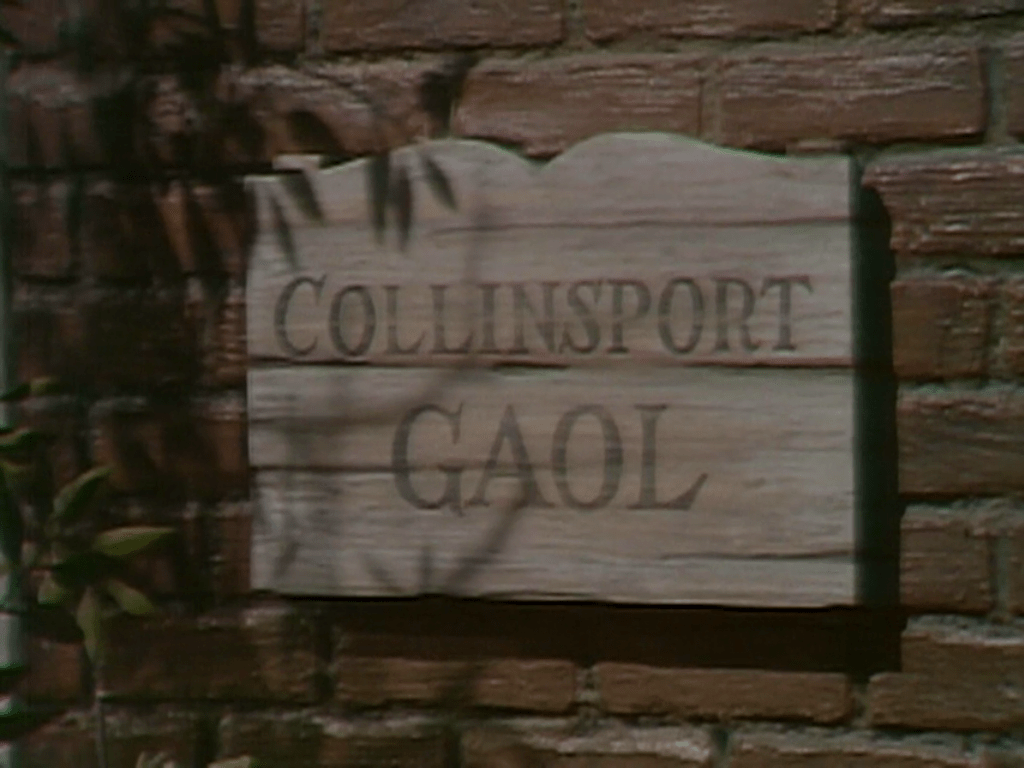
This is the first episode to show that the sign outside the town lockup is labeled, in a period-appropriate spelling, “Collinsport Gaol.”

Ballad of Collinsport Gaol.

The Bil Baird bat puppet appears in this episode, but is so close to the camera it looks like a felt cutout. Bit of a disappointment.

In his post about this episode on Dark Shadows Every Day, Danny Horn discusses the performance Addison Powell gives as a lawyer who meets with Vicki and decides he can’t take her case. He claims that Powell was THE WORST ACTOR EVER TO APPEAR ON DARK SHADOWS. Powell isn’t one of my favorites, but I don’t think he deserves that title. Of those we’ve seen so far, I’d say Mark Allen, who played drunken artist Sam Evans in the first weeks of the series, was the most consistently worthless performer, while Michael Hadge, who was motorcycle enthusiast Buzz for a while in 1967, was the most endearingly inept. Powell is awkward in his scene today, but Roger Davis is even more so, and he, unlike Powell, is so naturally unpleasant that he has to be flawless to earn the audience’s toleration.