Episode 1093: It’s just gonna happen anyway

In July, vampire Barnabas Collins and mad scientist Julia Hoffman came unstuck in time and found themselves in the far-off future year 1995. Julia and Barnabas found that the great house of Collinwood had been in ruins ever since some mysterious disaster took place on an unspecified night in 1970. Some residents of the great house went missing that night, others died, and two of them, Carolyn Stoddard Hawkes and Quentin Collins, went insane. The mad Carolyn of 1995 apparently knew that Barnabas was a vampire; she had known that for a while in 1967, when she was his victim, but appeared to have forgotten it when he was relieved of the effects of his curse for a while starting in March 1968. Towards the end of Barnabas and Julia’s time in 1995, Carolyn left a note for them, consisting of six cryptic phrases, shortly before the ghosts who rule Collinwood killed her. They decided the phrases were clues to the disaster, and ever since returning to 1970 have been trying without success to use them to figure out what is going on.

One thing that is clear is that the disaster will involve the deaths of teenagers Hallie Stokes and David Collins and the merger of their ghosts with the ghosts of their lookalikes from the year 1840, Carrie Stokes and Tad Collins. David and Hallie are aware of this and spend all their time moaning about how helpless they are to do anything about it. Their headquarters for this operation is a room that intermittently materializes behind a door that usually leads to a linen closet. The room is much too large to fit into the space the linen closet occupies, is stocked with high-end antique toys, and is frequented by the ghosts. Hallie and David call it “The Playroom.” In 1995, Julia and Barnabas found that The Playroom was in existence all the time and that anyone could enter it, but until today only David, Hallie, and the ghosts have been able to go there. Everyone else just sees the linen closet when they open the door.

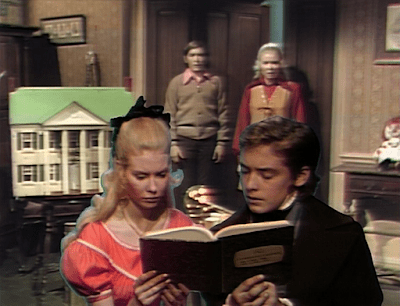
Hallie and David are in The Playroom, bummed out because Carrie has revealed to them that they are fated to become dolls in the dollhouse that is there. This was previously revealed to them in #1082, but Dark Shadows has been losing teenage viewers lately, so perhaps David and Hallie weren’t watching that day. A miniature carousel starts turning and playing music; David is influenced by the music, and says that perhaps their future in the dollhouse won’t be so bad.

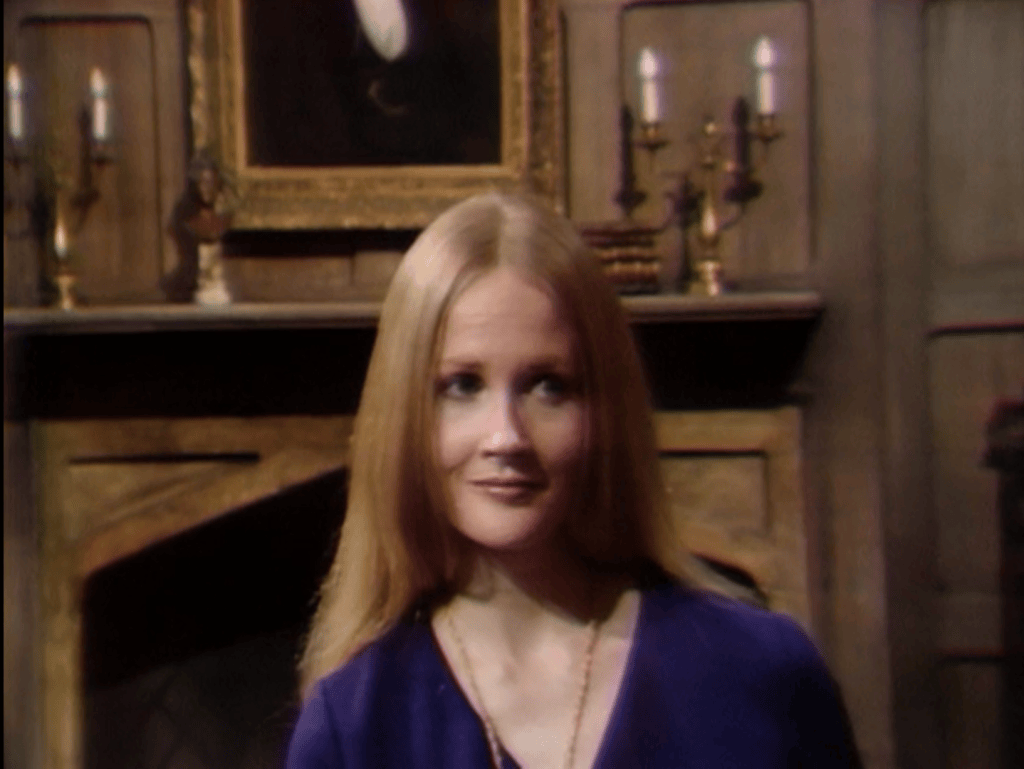
Meanwhile, Carolyn is in the corridor outside The Playroom. We see her after the camera pans out from a closeup of the stained glass work above the door that sometimes opens on The Playroom. We notice that it depicts roses. The dollhouse is a scale model of a house that was known as Rose Cottage in 1840, and is in some sense identical to that house. One of the clues Carolyn left in 1995 was “The night Rose Cottage was destroyed,” which has led Barnabas and Julia to ask everyone if they’ve ever heard of Rose Cottage and to work feverishly to try to locate it. You might think they would remember the roses above the door to The Playroom and to think of the toys they saw there in 1995, but no such luck.

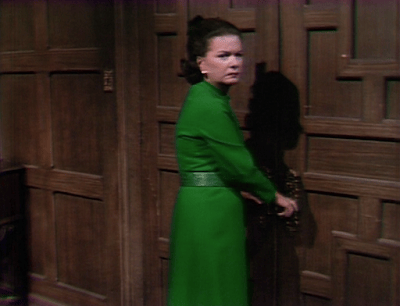
Carolyn hears the carousel’s music and wonders where it is coming from. She opens the door to The Playroom. She still hears the music, but sees only the linen closet. It is a haunting moment. We know that she is glimpsing an aperture between her world and another, but nothing she can see could lead her to conclude that anything at all extraordinary is happening. It might leave us wondering what it would be like if we were in the presence of some utterly bizarre phenomenon- would we notice?

Carolyn returns to the corridor. Her back is turned when David opens the door. We see The Playroom behind him. We wonder if Carolyn would be able to see it if she were facing the right way. David closes the door silently. Carolyn turns and is startled to see him. He says he is looking for Hallie. Carolyn asks him about the music; he claims he cannot hear it. He suggests someone may have left a radio playing in another part of the house.

The sequence reminded me of the 2017 season of Twin Peaks, as does the whole idea of The Playroom. As Agent Cooper disappeared into the mysterious, intermittently existent Red Room and the Black Lodge beyond, so the ghosts threaten to absorb the living characters into the mysterious, intermittently visible Playroom and the ruinous world of 1995 beyond. As Deputy Hawk once caught a glimpse of the curtains of the Red Room in the clouds above the spot deep in the woods where the worlds sometimes open onto each other, a glimpse so brief and vague that someone unfamiliar with the legends of the Black Lodge would likely either ignore it completely or assume it was a reflection of the clouds from some water on the ground, so the music from the miniature carousel gives Carolyn a glimpse so subtle and vague that anyone who had not been briefed by Julia and Barnabas would immediately accept David’s idea that it is just a radio. I doubt that this part of the show had a direct influence on Twin Peaks– more likely, the shared imagery is just the logical endpoint of a sense that there is more to the world than we can readily perceive with commonplace fears of being trapped in unfamiliar places. But I do think the two shows can shed light on each other.

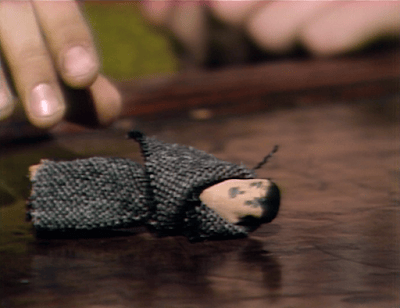
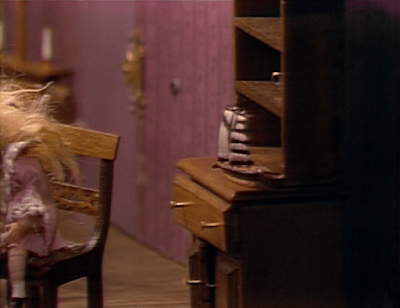
Under the influence of the ghosts, Hallie and David make a doll with bright yellow hair and put it in the dollhouse. It represents someone named “Leticia” who will join them when they are living in the dollhouse. Since the only blonde character on the show other than Hallie is Carolyn, we have to assume that a ghost named Leticia has the same designs on Carolyn that Carrie has on Hallie and Tad has on David.

In 1995, Carolyn had not disappeared into the dollhouse, but was living in a shack by Finley’s Cove. She even went in and out of The Playroom from time to time, interacting with Tad and Carrie. This is the first indication we’ve had that the ghosts’ will is not entirely ineluctable. There may be nothing the characters can do to keep a disaster from occurring, but perhaps there is some hope that we might see them do something to shape the particulars of the disaster that will befall them.

Carolyn is busy looking after David and Hallie’s governess, Maggie Evans. Maggie is ill, having been bitten by a vampire. When he found out about this, Barnabas was surprised to learn he isn’t the only vampire in town, and he and Julia have been trying to figure out who has been feeding on Maggie. Carolyn and Maggie talk about the previous vampire attacks. There is an electric moment when each of them looks like she is trying very hard to remember something that is hidden way down in the recesses of her mind. Several times in 1968, Nancy Barrett played Carolyn as if she remembered a lot more about Barnabas than he knew. The script didn’t give her any support in that, and she eventually had to give it up. Maggie was Barnabas’ victim in May and June of 1967; that experience has been wiped from her memory several times, and we may wonder if it will emerge one more time. In light of what we saw about Carolyn’s knowledge in 1995 and the similarity of what Maggie is going through now to what she went through in 1967, this moment is highly effective.

Miss Barrett also manages to get a laugh from regular viewers today. She has a scene with Christopher Pennock as astrologer Sebastian Shaw. Pennock also played Carolyn’s late husband Jabe (alias “Jeb”) Hawkes. The two characters are supposed to resemble each other strongly, and for a while Carolyn hoped Sebastian would turn out to be Jabe. But she’s given up on that, and Sebastian wants to date Maggie.

Sebastian comes to Collinwood. Carolyn tells him Maggie is very sick and cannot receive visitors. Sebastian wants to see her anyway. Carolyn tells him that is impossible. He becomes angry and declares that she will see him sooner or later, no matter what! Sebastian storms out of the house, and Carolyn watches him go with a sad little smile. Sebastian is violent, irrational, controlling, and childish, just like Jabe. Her look shows us how much she misses those things about him.

Aww, what a wonderful dangerously unstable man-child he is!

Carolyn can’t get the tune the little carousel plays out of her head. She goes back to the door and opens it. Now, it opens on The Playroom. The circle the ghosts have drawn around Hallie and David now encloses her as well. We can start to see how she might have known enough to leave the clues she left in 1995 for Barnabas and Julia.

The vampire story is new and has some promise, but the haunting has been going in a tight little circle for five weeks, with no progress in sight. The miniature carousel is all-too-apt a symbol of that. Even the opening voiceover seems to acknowledge that the show is in a rut. It breaks off in mid-sentence. We hear Kathryn Leigh Scott telling us that David and Hallie have discovered “a secret world- a world populated by the dead. And this night, they learn…” That’s it, the audio stops abruptly at that point. What do David and Hallie learn? What does it matter, whatever it is can’t possibly affect the story in any way.

Episode 1092: Visitors only stay for a week

Governess Maggie Evans has been bitten by a vampire other than Barnabas Collins. Barnabas and mad scientist Julia Hoffman are stymied in their efforts to find out who this other vampire is. They decide not to take Maggie to the hospital, since they don’t want to answer any questions. Instead, Julia goes to some unspecified location in the village of Collinsport to get several units of blood to transfuse into Maggie. I’m sure a no-questions-asked blood bank would be a highly profitable enterprise in Collinsport.

I wonder if Julia had to go in the blood store to get that bag, or if they have a drive-through. Screenshot by Dark Shadows Before I Die.

Meanwhile, Maggie’s charges, gloomy teenagers David Collins and Hallie Stokes, are sitting around in a space that intermittently materializes in a location usually occupied by a linen closet. It is stocked with fancy antique toys, frequented by ghosts, and called “The Playroom.” The ghosts don’t take visible form today, but Hallie and David notice that they keep playing with a dollhouse in The Playroom.

The dollhouse is a scale model of a mansion known as Rose Cottage that stood somewhere in the Collinsport area in 1840, when the ghosts were living beings, and is in some supernatural sense identical with that mansion. The ghosts are big fans of scale models. Some time ago they gave David a scale model of a ship that one of them sailed when he was alive. Today, David and Hallie see that the ghosts have added a tiny model of the same ship, reduced in size so that it is in the same proportion to the dolls in the dollhouse as the original model was to the residents of the great house of Colllinwood. Hallie says that if they go to David’s room, they will find that the model is gone from there, because it has been transformed into this minuscule thing.

The Java Queen II. Screenshot by Dark Shadows Before I Die.

At the end of the episode, Hallie and David hear one of the ghosts telling them to look into the dollhouse and learn their fate. They comply, and see themselves in place of the dolls. David and Hallie have spent all day sitting around doing nothing, and when they look into the future they see that they are still sitting around doing nothing. Evidently the greatest horror the writers can imagine is that the show will go on as it has been lately. I have to admit they have a point!

Ultimate fate. Screenshot by Dark Shadows Before I Die.

Episode 1085: What’s happened to my freedom?

If you’re telling a fictional story and your audience is with you, they will treat whatever you don’t explain as something that does not need to be explained. So if the story takes place in and around a village on the Atlantic coast about 50 miles from Bangor, Maine, you don’t need to explain why Bar Harbor doesn’t exist in the world you are describing. They will take it for granted that your village is on that spot instead.

When you introduce fantastic elements and don’t explain them, you have “fantasy fiction.” That’s the category Dark Shadows has belonged to since undead blonde fire witch Laura Murdoch Collins joined the cast of characters late in 1966 and her arc absorbed all of the unresolved narrative threads that were still generating interest. So in March 1970, it turned out that an alternate universe could sometimes be glimpsed in a room in the long-disused east wing of the great house of Collinwood, and that people who entered the room at the right time could cross over into that universe. The aperture between the universes was not induced by any process, either natural or artificial; it was just there, and it was marked by an ordinary door. The handful of throwaway lines we heard about the many-worlds hypothesis were not explanatory in any way; they were simply a description of one way the show might use the alternate universe to develop characters. Because the practicalities were not explained, we accepted them as something that needed no explanation.

Mad scientist Julia Hoffman and her friend, old world gentleman Barnabas Collins, crossed over into the other universe. They escaped from it in July, while the alternate version of Collinwood was on fire. Evidently the flames disturbed the aperture, because they found themselves, not in the summer of 1970, but in 1995. In that far-off future year, Collinwood was in ruins and everyone who had lived there was either dead, missing, or insane. Julia and Barnabas learned that this sad state of affairs resulted from a mysterious disaster that took place at some point in 1970. They had gathered only a little information as to what this disaster might have been when they had to flee for their lives. A ghost led them to a magic doorway behind which a staircase appeared. They followed this staircase to another doorway. They passed through that, and found themselves back in the Collinwood of their own native universe in 1970, sometime before the disaster is due to strike.

Passing from 1995 to 1970 by means of a stairway is as fantastic as passing from one universe to another by means of a door, but it was not explained, and has barely been mentioned these last three weeks as Julia, Barnabas, and those they have told of their experiences have been trying to figure out what the disaster is going to be and how they might prevent it. So we have accepted it as readily as we accepted the “Parallel Time room.”

That changes today. Julia knows that the ghosts represent people who lived in 1840, and has started looking for information about the staircase in documents from that year. Quentin Collins has been giving her a hand with this project. She finds a plan for a “Proposed Stairway into Time” signed by another Quentin Collins and dated 1840.

Plan. Screenshot by Dark Shadows Before I Die.

The ghost of governess Daphne Harridge seemed friendly to Julia and Barnabas in 1995, but in 1970 she has ensorcelled Quentin and kept him from being as helpful to Julia as he might. Today, Daphne oversees the destruction of a notebook in which teens David Collins and Hallie Stokes have written an account of their experiences with her and the other ghosts. But later it seems Daphne might be coming back around. She gives Quentin another journal, which he hands over to Julia. In it, Julia finds that Quentin’s namesake from 1840 had written about the thoughts that led him to design his “Proposed Stairway into Time”:

There is no such thing as time. There’s only space, physical space, and it is space that measures the distance between those points which we, in our ignorance and folly, insist are points in time. All time is one point, one moment. It is ever existent and it is ever accessible, and it is physical space that can be used to make all time easily accessible.

This describes the show’s method of jumping backward, forward, and sideways in time accurately enough. They cut from a set in one part of the studio to a set in another, and in so doing they have defeated chronology. Since Julia has found the note as part of an investigation that has kept her busy for so long, we are led to expect that we will be hearing more of this kind of talk, perhaps arranged in a pattern that will create the impression that we are being presented with an explanation of something.

Dark Shadows has been desperately short of story since Julia and Barnabas returned to 1970, and spinning out explanations is one way of introducing new story points. When these explanations resemble theories that researchers are actually using to look into natural phenomena, they turn fantastic fiction into science fiction. At no point has Dark Shadows come anywhere near this genre, and it does not seem like the “Proposed Stairway into Time” will lead them there. But who knows. Before Laura came on the show, it was a Gothic romance that included hints that ghosts and other unearthly forces were at work in an uncanny back-world behind the action. If Laura could transform it from that into the supernatural thriller it has been ever since, perhaps Quentin’s namesake from 1840 will be able to transform it into a science-fiction show.

If they are going to take that route, a time-travel gimmick would seem to be the logical way to merge onto it. Ghosts and vampires and zombies and other revenants, like time travel and alternate universes, are ways of making believe that options which events have foreclosed are still at least partly open to us. So if we say that the 1840 Quentin built a time machine, we can subsume more or less everything else we have seen under the idea that he created a rupture in space-time through which all of the other weird phenomena have been cascading.

Episode 1084: A living man no bigger than a doll

Julia Hoffman and her friend Barnabas Collins recently returned to 1970 after a cosmic journey that ended with two weeks in 1995. In that far-off future year, they found the great house of Collinwood in ruins and everyone who had lived there either dead, missing, or hopelessly insane. This was the result of a mysterious disaster that occurred before 1970 was out. Since they returned, they have been trying to find out what this disaster will be and to prevent it.

Julia’s friend Timothy Eliot Stokes tells her she and Barnabas have accomplished nothing since they came back to 1970. He says that the time has come to enlist the aid of a strangely dressed man named Sebastian Shaw. Sebastian has psychic powers, and may be able to use them to figure out what’s going on.

Sebastian comes to the great house. Julia tells him of her experience in the future. He has a vision which he says he cannot interpret. It is presented to us in an unfocused shot, so that we can believe Sebastian does not know what he is seeing. But we recognize it. It is The Playroom, a room that intermittently exists behind a door in a little-used part of the great house. Most of the time that door opens on a linen closet, but teenagers Hallie Stokes and David Collins have found that occasionally the same door admits them to a much larger space stocked with antique toys and ruled by the ghosts of several people who died in 1841. Julia knows The Playroom well; she and Barnabas visited it several times in 1995, and met the same ghosts there who are now taking control of David and Hallie. Julia and Barnabas also went to The Playroom in 1995 with two living people, Carolyn Fredericks (née Carolyn Collins Stoddard) and the Sheriff of Collinsport. But in 1970, only the linen closet has so far been visible to anyone other than Hallie, David, or the ghosts.

After Sebastian has his vision, Stokes and Julia decide to bring David and Hallie to him. Stokes goes upstairs to fetch them, and Julia goes to get some tea. When she returns to the drawing room, Julia finds Sebastian at the piano. He is playing the melody that often sounds in The Playroom, and that Julia heard echoing through the house in 1995. She asks him where he heard it. When he says he was just making it up as he went along, she flatly declares that he is lying. He must have heard it in his vision, because it is the very tune that is associated with the phenomenon they are investigating. He will not admit to this, and she will not soften her tone. On the contrary, she says that she had suspected that he was a fraud, but that she now believes he is something far worse- a man with genuine psychic gifts who uses them dishonestly. We learned yesterday that this is precisely what Sebastian is, but Julia can hardly expect him to agree with her. He says that he is being insulted, and leaves the house before Hallie and David can get downstairs.

Julia has been given to counterproductively harsh behavior of this sort since returning to 1970. Perhaps this is the consequence of a trauma she suffered in 1995, when a blatantly evil ghost known as Gerard Stiles took possession of her. Or perhaps it is the influence of someone she encountered on the first leg of her journey, when she was in an alternate universe. There, she met her own Doppelgänger. She greeted this other Julia Hoffman by beating her to death, stealing her clothes, and assuming her identity. A deed like that might leave a mark on its doer. Besides, that other Hoffman was herself inclined to be tactless, so perhaps Julia picked that habit up in the course of her imposture.

Unknown to Julia and Stokes, David and Hallie are busy in The Playroom today. Yesterday they learned that the ghosts plan to reduce them to the status of the dolls that are in a dollhouse there. In particular, the ghost of a teenage boy named Tad wants to take possession of David, and that of a teenage girl named Carrie wants to take possession of Hallie. Tad and Carrie will then live their lives while David and Hallie are in storage as inanimate things in a miniature case. Hallie and David took the dolls to the fireplace in the drawing room and burned them there, hoping this would break the power of the ghosts. Once they had seen the flames consume the dolls, they returned to The Playroom, hoping to find that it had vanished and the linen closet had resumed its place. To their dismay, they found that The Playroom was still there and the dolls had reappeared in their places in the dollhouse.

While David and Hallie are processing this fact, they see lights come on inside the dollhouse. The dollhouse has no electricity, so this puzzles them. David looks inside the dollhouse and sees a man in it. He is the size of the dolls, but is moving around as if he is alive. By the time Hallie comes around to look, the tiny man has vanished. She believes that David saw him, though.

David then tells Hallie that they ought to write up everything that has happened to them since they first encountered The Playroom. When Hallie asks what good that would do, David says it is the only way people will know what happened to them after they are gone.

They go to David’s room and write the whole story in a notebook. When Stokes comes to get them, they hide the notebook. They return to the room after Sebastian’s abrupt departure, and find that the notebook is gone.

Hallie and David decide that one of the ghosts must have taken the notebook. They go to The Playroom to look for it. They open the door, and see Carrie and Tad reading the notebook.

David and Hallie see Carrie and Tad. Screenshot by Dark Shadows Before I Die.

David’s vision of a little man moving around inside the dollhouse now reminds me of the moment in part 6 of the 2017 revival of Twin Peaks when a tiny version of the supernatural figure known as “Mike” appears to the near-catatonic Special Agent Dale Cooper and urges him to “Wake up! Wake up! Don’t die! Don’t die!” “Mike” is a resident of The Red Room, a space that is as mysterious in its nature and as intermittent in its presence as is The Playroom. We can assume that the tiny man David sees is Gerard, whose plans for him are just the opposite of “Mike’s” wish that Cooper should regain his true identity and once more function as an action hero.

At the time, the idea of living figures small enough to make their homes in a dollhouse and of people from the outside world shrunken and enclosed with them might have reminded viewers of the 1963 Twilight Zone episode “Miniature,” featuring the young Robert Duvall as a lonely man who encounters such a situation. “Mike” himself is a reference to 1960s cult television; he is a mysterious one-armed man who sometimes goes by the name Philip Gerard, evoking the two antagonists Dr Richard Kimble faced on The Fugitive. So it is not unlikely that “Miniature” was a common source for that installment of Twin Peaks and this installment of Dark Shadows. It isn’t even impossible that David Lynch or Mark Frost saw this episode of Dark Shadows and were on some level influenced by it as they wrote the script for Twin Peaks, though of course that would be a far less probable source than The Twilight Zone, which has long been one of the most heavily rerun of all TV shows.

At any rate, I think the similarity is intriguing even beyond the question of influences and sources. A soundstage looks a lot like a dollhouse, and when a drama isn’t connecting with the audience the actors may as well be dolls the director is playing a private game with. So the premise of characters ending up in a dollhouse plays to a fear that must prey on the minds of the writers.

Moreover, all three of these shows share a theme of stunted sexual development. Robert Duvall’s character in “Miniature” is a solitary man who cannot achieve any form of intimacy with another person. The stupefied Agent Cooper lives with a woman who has mistaken him for her husband and enjoys sex with her, but that is strictly a matter of mechanics. He has no idea what is going on during their encounters.

For their part, David and Hallie seem to be developing on the usual timetable. Certainly the dialogue between them when they were first introduced acknowledged that they were old enough to be interested in each other sexually, though David made it very clear to Hallie that she was not the partner he would choose. But Tad and Carrie seem to be quite alarmingly immature. Tad first possessed David in #1081, on Monday. That day, Hallie found David in The Playroom. Speaking as Tad, David took her to be Carrie. Tad was shocked by Hallie’s 1970 clothing and advised her to take it off immediately. It doesn’t seem to occur to Tad that there is anything untoward about demanding Carrie disrobe in front of him. Tad also said that he would be sad when he was too old to play with the toys in The Playroom. But he is very obviously much too old to be enthusiastic about a rocking horse, a dollhouse, a miniature carousel, and a bunch of stuffed animals. So his and Carrie’s attachment to those things shows that even when they were alive they were relics of a dead past. They never grew up, and their ghosts are determined to freeze Hallie and David in place, immobilized and on display in a small, unchanging world.

Danny Horn’s post under the title Episode 1084 on his great Dark Shadows Every Day doesn’t have all that much to do with the episode, but it is a magnificent production in its own right. Its subtitle is “100 Things That I Would Like David and Hallie to See When They Open the Playroom Door, in No Particular Order.” The 100 things he lists range from chuckleworthy to hilarious. Best of all, it ends with a video the post inspired Cody Schell to put together with alternate endings for the episode.

Episode 1082: I haven’t been wrong very often when it comes to judgment of people

Barnabas Collins and Julia Hoffman have returned to 1970 from a cosmic journey that took them first to a parallel universe, then to the future year 1995. In the parallel universe, they met a comatose woman named Roxanne Drew. Barnabas was immediately smitten with Roxanne, and was still attracted to her even after she gained the ability to open her eyes and move around. By the time she was able to speak, he was in love. Roxanne couldn’t come along when they left her universe, and he’s been down in the dumps about that. Barnabas could always go to the hospital and look for another comatose woman, but I suppose that might not be quite the same, somehow.

Now, Barnabas has met Roxanne’s counterpart in his own universe. She is attached to astrologer Sebastian Shaw, whom Barnabas had been pestering for reasons having to do with the efforts he and Julia have been making to prevent a mysterious disaster they learned about during their stay in 1995. Sebastian was so fed up with Barnabas that he walked out of his own living room, leaving Barnabas alone there. Then the door opened, and a Roxanne Drew entered, carrying a brown paper grocery bag. Barnabas greeted her by name, to her puzzlement.

When Barnabas explains that he knew another Roxanne Drew who looked exactly like her “in another time,” Roxanne assumes he means many years ago. He allows her to proceed under this assumption, which does seem less likely to prompt a call to the police than introducing yourself to a stranger with a story about how you’ve been traveling between parallel universes and back and forth in time. Roxanne comes out with a theory that two people with the same name born on the same day in different parts of the USA might become “astral twins” and look just alike. This idea may not be less plausible than what Julia and Barnabas have actually done, but it does seem considerably less likely to be useful in making up interesting stories. So it comes as a great relief when Roxanne stops talking about it.

Barnabas asks Roxanne to meet him for dinner at 10 PM. This is an odd invitation, since Barnabas is a vampire. Where is he going to take her, the blood bank? She hesitates, but at length agrees to meet him “there.” They haven’t named a place.

Later, Roxanne calls the great house of Collinwood. Julia answers. Roxanne identifies herself, and Julia reacts with amazement. Roxanne says she must be thinking of “that other Roxanne Drew.” She says that she won’t be able to meet Barnabas for dinner “there” after all.

Barnabas enters. He is excited to tell Julia about Roxanne. She tells him she already knows about her, and gives him Roxanne’s message. Julia reminds him that some people in the parallel universe were radically different from their counterparts in this universe, giving herself and her counterpart as an example. Barnabas refuses to admit that this Roxanne Drew is not the same person as the one whose immobility and silence so charmed him in the other continuity. Julia keeps warning him, and he declares that “I haven’t been wrong very often when it comes to judgment of people.” This remark will astound regular viewers. Barnabas is a worse judge of character than any figure in all human history. I myself can’t claim to be all that perspicacious, but neither I nor anyone else I know has ever misjudged a person so desperately we were turned into vampires as a result. That has happened to Barnabas twice. Julia is so stunned by Barnabas’ bizarre remark that all she can do is humor him and say that she agrees with his assessment of himself.

Barnabas goes back to Sebastian’s apartment and speaks to Roxanne. She says he must not have received her message. He says he did, but asks to come in anyway. She allows it, and he gets strangely aggressive with his insistence that they will eventually go out together. He’s usually a lot more pleasant with people, unless he’s been feeding on their blood or threatening to kill them. He wants to charm Roxanne, so we may wonder why he gets in her face, adopts a sullen tone, and vows that she will someday date him. The other Roxanne had an obnoxious ex-boyfriend named Claude North. In his sulky and petulant refusal to take no for an answer, or even for an indication that he has to change tactics, Barnabas sounds a lot like Claude.

Meanwhile, Julia has been trying to find out which house in the area was known as “Rose Cottage” in 1840. During their sojourn in 1995, she and Barnabas received some cryptic clues about the disaster that will befall the great house of Collinwood and everyone in it later in 1970, one of which was the phrase “the night Rose Cottage was destroyed.” Also during that trip they saw the ghosts of some people who lived in 1840, and since returning have found a document from that year that mentions a house called Rose Cottage, but does not say which house it was.

Teenagers Hallie Stokes and David Collins had died in the version of 1995 Barnabas and Julia visited. They saw ghosts who looked just like them, but were in fact those of figures from 1840 named Carrie and Tad. Julia suspects that David and Hallie are withholding information from her about paranormal occurrences in the house, as she and Barnabas are withholding information from them. Rather than leveling with Hallie and David about what they learned in 1995 and asking them to reciprocate, Julia has decided to be as inexplicably harsh and aggressive with Hallie as Barnabas is with Roxanne.

Hallie finds Julia going through some old tax records today. When Julia says that she is trying to figure out what house in the area used to be known as “Rose Cottage,” Hallie mentions that Julia had previously asked her if she’d ever heard of such a place. Julia takes that remark as an opportunity to fix Hallie with an unwavering stare and drill her with question after question. During this bizarre interrogation, the ghost of Tad and Carrie’s governess Daphne Harridge appears to Hallie, reminding her not to answer. Julia loses interest in Hallie and turns back to the tax records. Hallie excuses herself and follows Daphne out of the room.

David has a dream in which he finds Hallie in an unfamiliar corridor. He asks her where they are. She says they are in Rose Cottage. She tells him to follow her to a birthday party. He is unhappy that he has not brought a present; she laughs a little at this. They go into a small room and see two dummies sitting opposite each other at a table. Hallie says that they will sit in the other two places at the table. There are placecards identifying them as Carrie and Tad. They sit down, and Daphne’s gigantic face appears at the window. Daphne has been silent in all her appearances so far. She breaks her silence in this dream, laughing maniacally at the sight of David and Hallie sitting with the dummies.

Happy Dappy. Screenshot by Dark Shadows Before I Die.

David wakes up. He goes to a little-used part of the house. He finds Hallie in front of a door behind which there is usually a linen closet. Sometimes, however, the space transforms into a larger room stocked with antique toys. Hallie and David refer to that room as “The Playroom.” They have seen Daphne there several times and have sensed the presence of another, more blatantly hostile spirit, one which Julia and Barnabas came to know in 1995 as Gerard Stiles. Hallie asks David why he has joined her. He tells her about his dream. It turns out she had the same dream. They resign themselves to entering The Playroom. Inside, they see a dollhouse that has previously been set up with its facade towards them is now set on a lower table with its interior on display. There is a room that looks just like the one in their dream, complete with dolls sitting at the table.

Barnabas and Julia visited The Playroom several times in the future, and the dollhouse was there then. It always seemed likely that the dollhouse was a model of Rose Cottage. Now, it is confirmed that it is not merely a model of it, but is in some sense identical with it. Perhaps it is a ghostly survival of a house that no longer exists, or perhaps it is a mystical reflection of a haunted house that stands somewhere else in the area. One way or another, it seems that Hallie and David are fated to lose their independent existence and become inert playthings confined to an inaccessible space.

David, Hallie, Daphne, and Gerard are part of a recycled story. In late 1968 and early 1969, Dark Shadows adapted Henry James’ The Turn of the Screw with David and his friend Amy in the roles of the children Miles and Flora and the ghosts of Quentin Collins and Beth Chavez as the ghosts of Peter Quint and Miss Jessel. The whole point of the novella is that it is an open question whether the ghosts are real and the new governess is heroically trying to save the children from them or the ghosts are figments of the imagination of the governess, a crazy woman who is a mortal threat to her charges. Benjamin Britten’s opera preserves that ambiguity to some extent, but screen adaptations tend to come down firmly in favor of the ghosts being real. The first “Haunting of Collinwood” left no room for doubt on that score, and the current Re-Haunting of Collinwood is just as emphatic.

The ghosts of Quentin and Beth were silent when we first saw them in 1968, as Daphne’s ghost has been silent until she laughs maniacally today. They made their first appearance in #646, but neither of them made a sound until Quentin laughed maniacally in #689. Gerard has yet to make himself heard, though actor James Storm read the opening voiceover narration in #1066.

Episode 1080: It’s going to be uneventful

Matriarch Elizabeth Collins Stoddard is in the drawing room of the great house of Collinwood, studying a horoscope that astrologer Sebastian Shaw prepared for her. Liz’ daughter Carolyn asks what the horoscope says will happen today. Liz responds that it predicts the day will pass without incident. She adds that the horoscope has made the same prediction about each of the last several days, and that it has been right so far. The audience can agree with Liz’ assessment of the last several episodes, though we might wonder at what the makers of the show were thinking when they chose to make this explicit.

Carolyn is struck by the fact that Sebastian looks just like her late husband Jabe, whom she and others insisted on calling Jeb. So much so, in fact, that they are played by the same actor. Jabe died some time ago, and Sebastian has already denied that he rose from the grave. But two years ago Carolyn’s friend Vicki met her own late fiancé, an unpleasant man called Peter, after he had come back to life. Vicki found that Peter had lost his memory, refused to believe anything he told her about their past, and wanted to be known as Jeff. After several tedious months Peter/ Jeff admitted his true identity and he and Vicki went away and stopped bothering us. So Carolyn has grounds for hoping that the astrologer is not merely Sebastian, but will turn out to be Seb/ Jeb. We are forcefully reminded of Peter/ Jeff when Carolyn picks up the telephone to call Sebastian. She is standing next to a sculpture of a horse. The camera zooms in on that part of a horse which Peter/ Jeff brought to mind every time we saw him.

Memories of Peter/ Jeff.

When Carolyn makes the call, she says “I’d like to speak with Sebastian Shaw, please.” When Liz commissioned her horoscope, she went to Sebastian’s apartment, which was clearly his only premises. He is a prickly sort, unlikely to let a visitor answer his telephone for him, so this line suggests that someone else has regular access to Sebastian’s place. Nothing we have seen so far has given us a hint who this might be.

Sebastian is alone when Carolyn calls on him. She asks him where he is from. He says that he is from New York City, then asks why she is so inquisitive. Liz told him that he looks remarkably like Jeb, so Carolyn could easily answer that she wonders if he might be related to him. That would put him on the defensive if he withheld the basic facts about himself. But Carolyn simply says that she was idly curious, giving him an opportunity to shut her down immediately. Longtime viewers know that Jeb was originally a formless monster from beyond space and time and therefore had no relatives in the usual sense. But Carolyn doesn’t know that, and even if she did she would have no reason to suspect that Sebastian knew it.

Meanwhile, teenagers David Collins and Hallie Stokes are falling under the influence of some ghosts who resemble them as strongly as Seb resembles Jeb. Longtime viewers may not believe that this contradicts Sebastian’s prediction that nothing noteworthy would happen, since it is a rehash of a story we saw eighteen months ago, when David and his friend Amy fell under the influence of some other ghosts and, as in that story, they keep going in circles as to how they feel about it and what they should do.

In the course of The Re-Haunting of Collinwood, a mysterious room sometimes materializes in a disused part of the great house. Hallie goes to that room today. She sees David wearing clothes from the 1840s and making vigorous use of a rocking horse. She talks to him, but he does not respond to her at all. She gets steadily more upset. She turns and leaves the room, exclaiming “All right then!” as she does so. In the hallway outside, she then sees David, wearing his usual clothes and smiling at her. She gasps in amazement.

My wife, Mrs Acilius, said that this closing could have been a lot more effective had Kathleen Cody read a single line differently. Hallie’s mounting agitation as the person whom she believes to be David so totally ignores her is fine, but if at the end of it she had just relaxed a little and said “All right then” in a quiet voice, she would have had somewhere to go when Hallie sees David in the hallway. As it is, she is already at maximum tension, so her gasp adds nothing to the scene.

The mysterious room is stocked with toys and known as “The Playroom.” The fans often complain that the toys are meant for kids much younger than Hallie and David. When David Henesy joined the cast of Dark Shadows in 1966, he was nine and could pass for six; by this point he is about to turn fourteen and could pass for sixteen. Miss Cody is at this point about to turn sixteen, and looks about that age. It is not likely that a person their age would take much interest in a rocking horse, or a miniature carousel, or a stuffed animal. But as Mrs Acilius points out, that is as it should be. We are not supposed to like this situation. It is unsettling that teenagers would become fascinated with those things, and that is the point. The ghosts were the ages David and Hallie are now when they died, and evidently they were hung up on the toys in The Playroom; that suggests that they represent some kind of arrested development, that even when they were alive they were stuck in the past. If Hallie and David are going to have a future, they will have to break free of the ghosts and everything they stand for.

Episode 1076: The addition of the letter O

Grouchy New England teen David Collins and his live-in girlfriend Hallie Stokes go to a playroom for small children that intermittently manifests itself in a space otherwise occupied by a linen closet in the west wing of the great house of Collinwood. Hallie is possessed by the spirit of a girl named Carrie, who died in 1841. David hasn’t caught on that Hallie isn’t herself, and in his exasperation he asks her to “stop acting like the world’s number-one weirdo.” Carrie is puzzled by the word “weirdo.” She recognizes it as a derivative of “weird,” but claims that “the addition of the letter O makes it completely incomprehensible.” Evidently Carrie wasn’t all that quick on the uptake. If someone called me a “peculiar-Z,” I might not know why the letter Z was added, but it would be perfectly clear to me what they were saying. Historians of American English often say that the 1830s and 1840s were the single busiest period for the invention of new slang terms the USA has ever seen, so that if Carrie were as stumped by the “O” on “weirdo” as she claims to be, she would likely have been unable to conduct a conversation with many of her contemporaries.

David’s realistic 1970 dialogue and Carrie’s antiquated verbiage bounce off each other to produce some intentional comedy; my wife, Mrs Acilius, thought the scene was really funny. It is certainly more appealing than the rest of the episode, which is yet another series of events that take place only because the characters cannot bring themselves to tell each other what’s going on. Because the ghosts won’t let them, yes yes yes, we’ve been through all that many times before. The fansites seem bored enough by the whole thing that one of biggest points of discussion is whether it is reasonable to say that, because a bit of Grayson Hall’s slip is visible under her skirt at one point, we can say that we see her “underwear.” I guess the slip is “underwear” in the sense that she is wearing it under something else, and it probably wasn’t supposed to be visible, but you’d have to be a very specific kind of person to get excited about it.

Feast your eyes, pervs.

Hall plays Julia Hoffman, MD. Julia is a psychiatrist, among other things. She tells Quentin Collins that the ghost of Daphne Harridge, a governess who like her charge Carrie died in 1841, fills the room with the scent of lilacs when she is near. Quentin is so obviously lying when he tells Julia that he has not smelled that scent that we are probably supposed to assume that Julia is onto him.

Episode 1071: The incredible part of our story

Quentin Collins comes to the drawing room of the great house of Collinwood to deliver some bad news to his distant cousin, Elizabeth Collins Stoddard. He was peering into the room in the east wing of the house through which an alternate universe is occasionally visible. He saw the room as it is in that other timeline, engulfed in smoke and occupied by a young woman calling the name “Barnabas.” Since Liz and Quentin’s distant cousin, Barnabas Collins, and Barnabas’ dear friend Julia Hoffman crossed over into the alternate universe some time ago and the aperture in the east wing is the only place where transits between the universes are known to be possible, Quentin proclaims to Liz that the “only conclusion” one can reach is that “we shall never see them again!” No sooner has he got those words out than the drawing room doors open to reveal Julia and Barnabas standing side by side, smiling happily, and saying “Elizabeth! Quentin! We’ve returned!”

One might think this would cure Quentin of the idea that he knows what the “only conclusion” is at which one might reasonably arrive, but no such luck. He tells Barnabas and Julia that today’s date is 3 August 1970. They say that was the date when they left the other universe, and that they then spent over a week in the year 1995, when they saw a bleak and horrifying future that resulted from a disaster that will occur later in 1970 unless they can somehow prevent it. Quentin says their experience in the future must have been an hallucination, because they can’t have come back to 3 August in one year from any date other than 3 August in another year. Julia and Barnabas share detailed recollections of their experience in the future, and have already met a living person in 1970 whom they saw for the first time as a ghost in 1995, but this argument shakes their confidence.

Quentin’s claim, nonsensical as it is to new viewers, actually does fit in with a notion the show has been developing since it first committed to being a supernatural thriller in late 1966 and early 1967. Since the laws of nature that science studies do not apply, they have to find other predictive models that will make it possible to build suspense. So they had well-meaning governess Victoria Winters figure out that women named Laura Murdoch incinerated their young sons named David at intervals of “exactly one hundred years!!!,” and therefore that Laura Murdoch Collins would soon present a mortal danger to her young son David Collins.

From that point on, the power of anniversaries has been a tremendously potent force in the metaphysics of Dark Shadows. Barnabas traveled back to the 1790s in #661 by going to a grave on the anniversary of its occupant’s death and shouting at the deceased for a while (shouting is also a potent metaphysical force.) Quentin himself first joined the cast of characters as the malevolent ghost of a man who died in 1897 and in 1968 and 1969 returned to haunt Collinwood, kill several people, and drive the survivors from the house. Barnabas traveled back to 1897 and bungled around until someone else changed history to prevent Quentin dying or even aging. On the anniversary of that change, the haunting broke, just in time to allow David to return from the dead. But when Quentin showed up as a living being late in 1969, everyone who had lived through the ten months of the haunting remembered it. So apparently the reality of Dark Shadows is a composite of all the various, mutually inconsistent timelines, and the consequences of the actions not taken are just as real as are those of the ones taken. The power of anniversaries is the thread that binds these unmatched events into a cosmic crazy quilt.

As the aperture between universes was a door to a room in the east wing, so the aperture from 1995 to 1970 was a door inside a room in the west wing. Barnabas and Julia were trapped in a mysterious playroom there when the ghost of a blonde teenager known to them as Carrie appeared, beckoned to them, and walked through the wall. A moment later, a door materialized in the spot through which Carrie had exited. Julia and Barnabas went through the door and found themselves on a staircase. They followed the staircase to another door. It was the door through which they had entered the playroom, but the corridor outside was in good repair, not in ruins as it was in 1995. They saw a girl there who appeared to be Carrie, though she was wearing different clothes, was alive, and demanded to know who they were.

Barnabas and Julia gave the girl their thanks for her help, and she repeated that she had no idea who they were or what they were talking about. She said that she was not named Carrie, but Hallie, Hallie Stokes, niece of Professor Timothy Eliot Stokes. She told them Liz was in the drawing room, Liz’ brother Roger was in Europe, and the year was 1970.

Later, Julia questions Hallie about some names and phrases she heard in 1995. Grayson Hall delivers all of these questions as if she were playing a Gestapo interrogator in a very bad World War Two movie. Even when Hallie says it is her bedtime, Hall enunciates the lines “All right, Hallie. Good night” while standing rigidly still and peering at the girl from under a single ruffled eyelid, as if the next words were going to be “Dream uff ze Fazzerlahnt, und uff ze famlee you shtill haff zere!”

Hallie is terrified of Julia, a perfectly natural reaction which Grayson Hall seems to think she needed to explain by turning into a villain from Hogan’s Heroes. Screenshot by Dark Shadows Before I Die.

The script calls for Hallie to hear something sinister in Julia’s voice, and Hall was an extraordinarily accomplished actress who should easily have been able to make us understand why a friendly series of questions might sound that way to a nervous person. This exaggerated performance cannot be explained as an ordinary failure. She also failed atypically last week when required to show that Julia was secretly under the control of the evil spirit. There was zero subtlety in her performance, leaving it inexplicable that Barnabas didn’t instantly catch on. Those episodes, like this one, were directed by Henry Kaplan, a hack. Kaplan’s idea of working with actors involved poking them with a stick and tying them up with gaffer tape. Hall’s misfires may not have been a protest against Kaplan’s brutishness and incompetence, but he certainly did not do anything to help her correct them.

When Julia and Barnabas left for the alternate universe, Quentin was still living somewhere in the village of Collinsport; it was implied Julia was paying his rent. At some point since, he has relocated to the great house. We see today that he has moved back into his old room. This is as hilarious for longtime viewers as was the instant refutation of Quentin’s claim that the only logical conclusion from the available facts is that they will never see Barnabas and Julia again. During the 1968-1969 “Haunting of Collinwood” segment, Quentin’s room served the same function the mysterious playroom served in the excursion to 1995 and in this incipient Re-Haunting of Collinwood. It was a place known at first only to the children, who visited it, fell under the power of the ghosts of its former occupants, and thereby became the instruments of general destruction. But he’s even brought his old stuff with him, including his haunted phonograph.

When we got to know Quentin as a living being during the eight months the show was set primarily in 1897, we saw that he had the same vices and the same appeal Roger had when he was introduced as a villain at the beginning of the series. Roger was eventually nerfed into a harmless snob who made sarcastic remarks and sipped brandy, and then reinvented again as an upright family man. Throughout those personality shifts, Roger continued to be one of the “Logical Explanation People.” No matter what he saw or experienced, he would reject any supernatural account and insist “There must be a logical explanation!” Quentin has followed Roger’s character progression to the point where he, a former student of black magic who conjured up demons from a fireplace, who turned into a zombie the first time he died and into a werewolf after he was resurrected, who died again and became a ghost, whose second death was then averted when he became half of a magical dyad including an enchanted oil painting, and who is now a hundred years old even though to all outward appearances he is about 30, is insisting that There Must Be a Logical Explanation.

As if that were not enough, when we see Quentin in his room he is wearing a dressing gown, an article of attire Roger favored in his first months on the show. Roger drifted to the margins of the action as he lost his capacity for villainy; he made his final appearance in #979. The show has had so much difficulty figuring out what to do with Quentin since it returned from 1897 that we may well fear he is headed for the same fate, and these resonances do nothing to assuage that fear.

Hallie comes in to see Quentin. She asks if Barnabas and Julia are good people. He hesitates to answer. He knows that Barnabas is a vampire and Julia is a mad scientist. Nonetheless, they are his friends, and he believes that they are motivated by a sincere desire to prevent the disasters they think they have foreseen. So he might answer truthfully by saying that they are locked in a three-way tie with him for the title of Most Dangerous Person You Have Ever Met, but that he likes them, and so long as Barnabas doesn’t start looking at her neck and Julia doesn’t try to strap her to a table and hook her up to an apparatus including Tesla coils she will probably survive her encounter with them. But he’s more interested in reassuring her than he is in adhering to strict literal accuracy, and so he says “Now look, now you listen to me. Barnabas and Julia are very fine people, and you don’t have to be afraid of them or of anything else. Now you believe that.” None of the other actors is having a good day at the office with this episode, but David Selby is on top form, and he delivers this little speech with a note of urgency that makes him sound like he is telling the truth, but with a panicked flicker in his eyes that makes it clear he is desperate for Hallie to accept a lie that might keep Julia and Barnabas from murdering her.

Hallie tells Quentin that she saw Barnabas and Julia emerge from a door in the west wing. He calls Barnabas to his room and tells him that since the aperture to the other universe is in the east wing, that causes Quentin to think there might be something to their story after all. Barnabas leads him to the door, and says that the playroom was behind it in 1995. Quentin says that there is no playroom there and never has been. Barnabas himself knew that full well when first he opened the door and saw the room in 1995, but for some reason is shocked today when sees that it is a linen closet. Quentin says that there cannot possibly ever be a playroom there, since the other wall is to the outside. Evidently it is perfectly in order for an entire alternate universe to intermittently fit into a room in the east wing, but the west wing doesn’t swing that way.

In his post about the episode on his great Dark Shadows Every Day, Danny Horn complains about Kathleen Cody’s performance as Hallie, claiming that she renders the next several weeks of the show unwatchable. I agree that in adopting a constant tone of freaked-out disbelief, Miss Cody made an acting choice that left her nowhere to go. If you’re already at the limit of the amount of bizarreness you can accept in your life, that’s it for you as a character on Dark Shadows.

I can see why Miss Cody thought that was the only way to go, though. This is her first substantive appearance on the show, and Quentin warns Barnabas not to tell anything disturbing to Hallie, because “She’s a very sensitive child… She frightens quite easily.” Everything else in the script reinforces the idea that Hallie is on the brink of a panic attack, so that’s how she plays it today. That’s the angle subsequent scripts are going to stick with, so I can see that Miss Cody felt she had no choice but to stay in the corner she had painted herself into.

When actors find themselves in a jam like that, a director might be expected to offer some kind of helpful guidance. That wasn’t going to happen with Henry Kaplan at the helm, and even principal director Lela Swift, an outstanding visual artist, was not an enthusiastic director of actors. John Karlen said that the only direction Lela Swift ever gave him was the single word “Go!” So once an actor took a wrong turn on Dark Shadows, they could find themselves trapped in a dead end. Many of the cast members who joined the show without much experience have spoken with gratitude about guidance they received from their veteran cast-mates; Karlen, Joan Bennett, Jonathan Frid, Clarice Blackburn, and Humbert Allen Astredo are most often mentioned as gifted teachers of acting. The only director any of the actors mentioned as a source of productive suggestions was John Sedwick, who left the show in June 1968. So unless Miss Cody could get some help from one of her cast-mates, it was very likely that her initial mistakes would doom her whole performance.

Episode 1070: Never without you

The sun has set, and vampire Barnabas Collins is opening the lid of his coffin in the basement of the Old House on the estate of Collinwood. Suddenly a cross is thrust in his face. He recoils from it, crying in pain and becoming immobile. The cross is wielded by the sheriff of Collinsport, who announces “I know all about you, Barnabas Collins!”

Before the sheriff can take matters any further, a teenage girl appears nearby. Shocked to see her, he reels away from the coffin. He jabbers at her, saying that he recognizes her and pleading with her not to come closer. Barnabas grabs him from behind and strangles him to death.

Barnabas didn’t have anything against the sheriff, but can’t deny that it feels good to use the old strangling muscles again. Screenshot by Dark Shadows Before I Die.

Barnabas goes upstairs and finds his best friend, mad scientist Julia Hoffman. He tells Julia that the sheriff’s gun was loaded with silver bullets, and that only the manifestation of the ghost of Carrie prevented his destruction. The police know about him, and more officers will be coming any time. Julia admits that she told the sheriff about Barnabas. Shocked, he says “You betrayed me?” He has said these words many times, always as a prelude to extreme violence. Julia braces herself, expecting the same. But to her amazement, Barnabas is gentle and understanding. He realizes she is under the sway of an evil ghost named Gerard. She says that she will betray Barnabas again and again, and urges him to leave without her. He says he will never do that. She embraces him, weeping, and he comforts her. For most people, a day that begins with the murder of a policeman is a day when nothing goes well, but Barnabas is not like most people. This is far and away the most mature behavior we have ever seen on his part.

The year is 1995; Barnabas and Julia have come unstuck in time and found themselves at Collinwood 25 years after a mysterious disaster wrecked the great house on the estate, ruined its inhabitants, and left Gerard in charge. They believe they can travel back to 1970 and prevent the disaster from ever occurring, if only they can find out what it was. Barnabas’ distant cousin Carolyn left him a note yesterday consisting of six cryptic phrases which he took to be clues, but Gerard killed Carolyn before Barnabas could ask her to explain them.

Barnabas has brought occult expert Timothy Eliot Stokes to the Old House. We find Stokes exclaiming to Barnabas “You killed the sheriff?” Barnabas confirms, “Yes, I killed him.” Stokes replies, “Everyone’s going mad. It’s the effect of this place. I’m not surprised at your terrible story. Horrified, not surprised.” One wonders what the story was that Julia and Barnabas told. Stokes’ role in the parts of the show set in contemporary times was always limited, because he is too decent and law-abiding to be a party to the continued existence of a vampire. He could never be allowed to learn the truth about Barnabas. He stays in the room, chatting amiably with Barnabas and Julia, so clearly they haven’t told him now, either. Perhaps they just told him that the sheriff was going to shoot Barnabas, and let him assume that the reason was that Gerard was making him do it.

Be that as it may, Stokes is still aware of the situation. “Do you realize that I will be implicated in all this if the police come here?” he asks. They say that they do, but that they desperately need him to make a third for a séance. He dismisses as hopelessly naive the idea that Gerard would allow a séance to succeed, but Barnabas says that Gerard may not have the power to prevent Carolyn’s spirit coming through and telling them what her note meant. The idea of one spirit trying to block another from emerging out of the supernatural back-world and speaking at a séance harks back to the very first séance on Dark Shadows, in #170 and #171, when undead fire witch Laura Murdoch Collins used her powers to impede the spirit of the gracious Josette from warning the company about her. Stokes gives in and agrees to participate; Julia, self-conscious because of her compromised position, is reluctant, but Barnabas proclaims that if Carolyn is to speak it will be through her.*

The séance begins. Julia goes into the trance, and starts speaking in what appears to be Carolyn’s voice. If this is Grayson Hall’s Nancy Barrett imitation, it is terrible. Mrs Acilius and I laughed out loud at it. But the voice does not give any useful information, and Julia is under Gerard’s power, so it is also possible she is faking the trance to throw Barnabas off. In that case, it is Julia’s Carolyn imitation, and it reminds us of the ups and downs in the relationship between those two characters.

When the séance is over, Stokes says he feels a presence. He rises from the table, drifts towards the window, and sees Gerard watching him from outside. Gerard touches the pane. Stokes staggers back, descends into a chair, and becomes still. Barnabas finds that he is dead. He looks up and realizes that Julia has fled the house.

Julia has gone to the great house. She is in a mysterious playroom with Gerard. Gerard gives her a dagger. She asks if she “must.” She is reluctant, but finally works herself up to joy as she says that she always knew it would come to this, that now she will be with Gerard as he wants her. She lifts the dagger to stab herself in the heart.

Barnabas enters. He confronts Gerard. As the two beings from beyond the grave stare each other down, Julia drops the dagger. Barnabas tells Gerard he cannot stop them leaving. Gerard looks offended at this. He touches Julia, who collapses. She is not dead, but she and Barnabas fear she is dying. Gerard leaves the room and takes his time locking the door from the outside.

Carrie’s ghost materializes to Julia and Barnabas. She beckons to them, then walks out through the wall. They stare at the wall, and a door appears. They pass through the door, and find themselves on a staircase. They follow the staircase, and come to another door. They exit in the same corridor outside the playroom; they have gone in a circle. In space, anyway- the time appears to be different. The corridor is in severe decay in 1995, but is in good repair now. And they see a girl who looks exactly like Carrie, but is alive. She asks them who they are.

This is the final episode set in 1995. It is also the last we will see of Don Crabtree. Previous sheriffs of Collinsport have been ridiculously ineffective. Crabtree’s sheriff doesn’t chalk up many successes either, but no one else meets with anything but failure in these two weeks. Every death and defeat we see reinforces the sense that the evil which Gerard represents is overwhelming. As the penultimate victim of the 1995 curse, the sheriff is second only to Stokes as someone who would have been able to make a positive difference, if anyone could have, and Crabtree makes us believe that he belongs in that position.

*In the main continuity of Dark Shadows, spirits at séances always speak through a medium of the same sex as themselves. In the séance in #990, when the show was set in a mirror universe, the spirit chose a medium of the opposite sex.

Episode 1069: The sheriff’s place

Vampire Barnabas Collins and mad scientist Julia Hoffman have come unstuck in time and found themselves in the year 1995. The estate of Collinwood is in ruins, dominated by an evil ghost named Gerard. Barnabas’ distant cousins Carolyn Fredericks (née Stoddard) and Quentin Collins are insane. Occult expert Timothy Eliot Stokes is sometimes openly hostile, sometimes apparently helpful, but never his usual trustworthy self. Everyone else they knew in 1970 has either gone missing or died. Julia has fallen under the possession of Gerard and turned against Barnabas. Most unaccountable of all, the sheriff of Collinsport is not completely useless at his job.

Barnabas has received a note from Carolyn asking him to meet her in what remains of the great house. He and Julia enter the house; she insists on waiting in the foyer. While he goes into the drawing room, she stares up at Gerard, standing in his usual perch on the walkway at the top of the stairs. Barnabas looked right at Gerard there yesterday and did not see him, so apparently he can be selective about making himself visible.

Barnabas finds Carolyn sitting at the desk in the drawing room. She falls over dead. He calls for Julia. Gerard shakes his head, and she does not respond. Barnabas goes to the foyer and brings her to the spot where Carolyn had lain a moment before; she has vanished. The note she was writing is still on the desk; it is made up of six cryptic phrases which Barnabas declares to be clues as to what happened in 1970. He reads them aloud- “The night of the sun and the moon,” “The night Rose Cottage was destroyed,” “The unfinished horoscope,” “The night I sang my song,” “The picnic,” “The murder.” Julia keeps interrupting him, declaring that the phrases are meaningless and Carolyn was mad. He keeps wondering why she has become so uncooperative.

Barnabas tells Julia to find a telephone and call the sheriff. Often on Dark Shadows, people dismiss the idea of calling the police when someone turns up dead, saying that it’s too late to do anything but bury them and move on. But after a lot of back and forth, Julia goes off and does place the call.

Barnabas goes to open the secret panel in the drawing room to see if Gerard stashed Carolyn’s remains there. Gerard himself appears to Barnabas. Barnabas yells at him for a while. Julia comes back, and Gerard disappears. Julia wonders why Gerard did not try to harm Barnabas; Barnabas says that he knows he cannot harm him. This seems to be news to Julia. In 1970, Quentin knew that Barnabas was a vampire. We learned the other day that his contact with Gerard erased this knowledge. We may wonder if this fact has also slipped Julia’s mind.

Barnabas goes upstairs, and asks Julia to bring the sheriff to him when he gets to the house. She agrees. Once he is out of earshot, she asks Gerard if he had to kill Carolyn. She seems sad about it.

Barnabas is at the door of the one room at Collinwood that is in good repair, a mysterious playroom on an upper floor. He can’t get the door open. Julia brings the sheriff, and Barnabas says that the door wasn’t locked when he was there earlier. The sheriff says he has some questions and Barnabas angrily responds “Not now!” Cops don’t love it when you answer them that way, in my experience, but the sheriff does seem to be a bit cowed by the surroundings and he lets it pass.

Barnabas asks the sheriff to try the door. He does, and the knob turns easily. He turns to Barnabas and asks sternly “How much of this is in your imagination, Mr Collins?”

Barnabas’ embarrassment doesn’t last long. Carolyn is laid out on a table in the middle of the room, a spray of flowers on her chest. The sheriff remembers how lovely Carolyn was when she was young; Barnabas stalks around the room yelling at the invisible Gerard. When the sheriff says it is time to go, Julia insists on sitting with Carolyn for a while. The sheriff tells her she’s crazy to want to stay in the middle of the house. He’s not exactly sane himself, leaving her alone at what is after all a crime scene. Once the sheriff and Barnabas have gone, Julia receives further instructions from Gerard.

Barnabas, the sheriff, and Julia pay their respects to the late Ms Fredericks. Screenshot by Dark Shadows Before I Die.

The sheriff finds Quentin at the Old House on the estate. He questions him, and gets some very strange answers. Quentin has worked himself into a state when Julia comes back. She announces that she is a doctor and will now give Quentin a sedative. The sheriff takes her word for her professional credentials, and tries to wrestle Quentin into position for her to give him an injection. He can’t manage it, but Julia speaks to Quentin in a tone that is sufficiently authoritative it calms him down right away. Once he is sedated, Quentin asks the sheriff to take him back to the psychiatric facility from which he recently escaped. The sheriff agrees.

The sheriff turns to Julia and asks where Barnabas is. In lieu of an answer, she tells him to come back to the house immediately before sunset. We cut to Barnabas opening the lid of his coffin. The sheriff is there, sticking a cross in his face, and announcing “I know all about you, Barnabas Collins!” Odd as his behavior in the playroom may have been, this sheriff clearly has more on the ball than did any of his predecessors. It’s a good thing the others weren’t up to his standards. If Sheriff Patterson had been as quick to catch on to what was going on around him in April 1967, Barnabas would have been staked by the end of the month and Dark Shadows would never have become a hit.

Sheriff Patterson may be on the minds of longtime viewers. Sometimes fans wonder what Barnabas’ ultimate plan was when he returned to prey upon the living in 1967. Weren’t the Collinses going to catch on that there was something a bit odd about their “cousin from England” sooner or later, as girls kept disappearing or turning up drained of blood? I think the answer is what we see in these two weeks of episodes, and also in the feature film House of Dark Shadows. Had Barnabas gotten his own way, eventually all living people would have fled Collinwood and no one from the village would have dared approach the estate. He’d have ventured forth occasionally to take fresh victims, but otherwise Collinwood would have been entirely cut off from the outside world. The buildings would have decayed and the grounds been overgrown. It was only because Julia showed up and devised a way to limit his consumption of human blood and to give him hope his curse could be put into remission that he himself did not long ago reduce Collinwood to the condition to which Gerard has brought it.