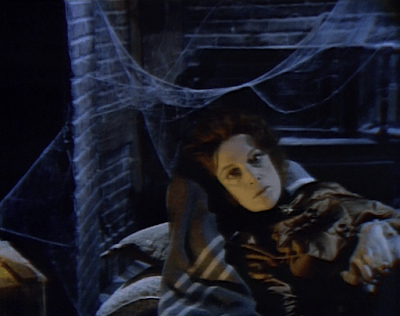
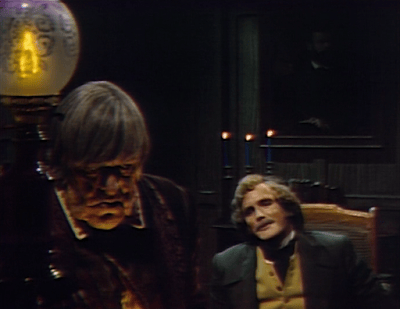
In #1109, broadcast and set in 1970, mad scientist Julia Hoffman and her friend, vampire Barnabas Collins, were trapped in the great house of Collinwood while a group of zombies were destroying it and attacking them. Julia escaped by means of an anomaly in space and time that takes the form of a staircase. She found herself in the year 1840.
Since #1063, the show had been building up the ghost of Gerard Stiles as its next supernatural Big Bad. It was at the ghost’s bidding that the zombies destroyed Collinwood. Gerard is alive in 1840, so when Julia realizes what year she has come to she believes that she is about to confront her greatest enemy. But the living Gerard has fizzled completely as a villain. The other day, he was evicted from his body and replaced by the spirit of a dead warlock. James Storm is now playing Judah Zachery, who is impersonating Gerard. The 1840 segment does show more signs of advance planning than do most parts of Dark Shadows, particularly in the costuming, set design, and casting. So it is possible they always meant to do this. But it still feels like Mr Storm was given a new part because the writers couldn’t make Gerard work.
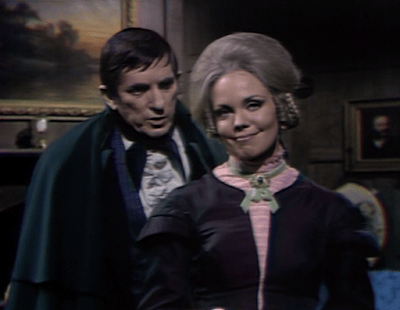
The key witness in the 1692 trial that resulted in the beheading of Judah’s original body is still alive and apparently the same age as she was then. She is wicked witch Angelique Collins, whom Judah knew in 1692 as Miranda DuVal and who is now using the alias Valerie Collins. Judah is not quite certain Angelique is really Miranda, so he causes the ghost of magistrate Amadeus Collins to appear and make the same speech he made to her before she gave her testimony. She recognizes Amadeus, calls him by name, and sends him away. This proves her identity to Judah. He takes satisfaction in the fact that he knows who she is while she does not know who he is.
Angelique is busy with a project of her own. Barnabas managed to follow Julia back to 1840. Angelique was married to Barnabas for a little while in the 1790s, and when their relationship didn’t work out she turned him into a vampire. She wants him back now, and sees Julia as an obstacle to that goal.
Angelique was an enemy to Barnabas and Julia in 1968 and an ally of theirs in 1897 and 1970, but she does not remember any of those times. She is not a time-traveler at this point. It was only yesterday that she learned Julia and Barnabas had come from the future, and she was candid with Julia about how amazing she found it that she and Barnabas had transcended time. Strangely, Julia’s own candor in response to Angelique’s discovery of her origin extended only to the time when they were enemies, not to those when they were friendly.
Angelique sicced vampire Roxanne Drew on Julia. Now, Julia is in an old lighthouse, dying of the wounds Roxanne inflicted on her. Angelique tells Julia today that she is going to let her die and rise as a vampire. Barnabas knows that this is going on, and so he divides his time between searching for Julia and quarreling with Angelique.
As a kid in the 1970s and 1980s, I spent a lot of time reading Mad Magazine. It really is too bad Mad never satirized Dark Shadows;* James Storm and Lara Parker both had the kinds of faces Jack Davis loved to draw, and today each of them uses facial expressions he could have tipped into hilarity by the slightest exaggeration.
*The first issue of Marvel Comics’ Spoof did do a satire of the show in 1970; the whole feature can be found on Danny Horn’s great blog Dark Shadows Every Day. It’s pretty funny, and writer Roy Thomas makes clever use of so much of the show’s deep lore that he must have been a devoted fan. But, talented as artist Marie Severin was, she was no Jack Davis. Not only was Davis a master of subtle caricature, but he also had a gift for drawing crowded scenes that didn’t look busy. It was a stylistic decision to draw Barnacle Crawlins and the rest of the “Darn Shadows” gang in the very broadly cartoonish manner typical of Spoof, Crazy, and Marvel’s other attempts to compete with Mad. Had Davis been on the job, he would have had to draw them that way as well. But the big scenes with lots of characters are cluttered in a way that Davis’ scenes never were.
Dark Shadows featured several long costume drama segments depicting stories of time travel. From November 1967 to March 1968, well-meaning governess Victoria Winters bumbled around in the years 1795 and 1796, convincing the people of Collinsport that they should hang her. Meanwhile, we learned how old world gentleman Barnabas Collins first became a vampire.
From March to November 1969, Barnabas was the one making poor decisions in an era not his own when he found himself in the year 1897. Those eight months were by most measures the show’s most successful period. From March to July 1970, the show traveled sideways in time to an alternate universe where Barnabas and his friend, mad scientist Julia Hoffman, meddled in the problems of the family who lived on that version of the estate of Collinwood. The show insisted on calling that alternate universe “Parallel Time.”
Now, Julia and Barnabas have made their way to the year 1840. They know that something or other happened in that year that would lead to the destruction of the great house of Collinwood and its residents in 1970. They have no very clear idea what that fateful event was, and it is becoming increasingly clear that the writers don’t have any good ideas about it either.
While Barnabas, Julia, and the writers cast about in the darkness, we keep meeting characters who remind us of earlier phases of the show. Early on, we met Ben Stokes and Daniel Collins, two people left over from the 1790s segment. Ben helped Julia and Barnabas establish themselves with the current crop of Collinses by corroborating their story that they were cousins from England (or Philadelphia, whichever.) Daniel, who was a boy in the 1790s and is now the master of Collinwood, greeted them warmly and invited Barnabas to stay in the Old House at Collinwood as long as he liked. The presence of Daniel and Ben not only helped graft Barnabas and Julia onto the new stories, but also told longtime viewers that the 1840 segment will be a sequel to the 1790s segment.
We also see mergers of characters from the 1897 segment with those from Parallel Time. For example, charming rogue Quentin Collins became a huge breakout star in 1897; in Parallel Time, Quentin’s counterpart was the grumpy and irascible master of Collinwood. In 1840, Quentin is Daniel’s older son and sole heir, in charge of the house due to his father’s many problems. He is again grumpy and irascible, again in a loveless marriage. But like the 1897 Quentin, he is fascinated by the occult and creates trouble by his reckless involvement with it. Quentin’s best friend and fellow occultist is his cousin Desmond Collins, played by John Karlen. Desmond shares the irresponsibility of Karlen’s 1897 character, inveterate prankster Carl Collins. But Desmond has none of the extreme childlike quality that it made seem Carl had a cognitive impairment of some sort. He has the manner and bearing of Karlen’s Parallel Time character, drunken novelist Will Loomis.
Will was married to Carolyn Collins Stoddard, played by Nancy Barrett. In 1897, Miss Barrett played a villain named Charity Trask who fell afoul of evil sorcerer Count Petofi. Petofi erased Charity’s personality and replaced it with that of Cockney showgirl/ mentalist Pansy Faye. Carl had brought Pansy to Collinwood as his fiancée. Pansy was killed before she ever met Charity, who never had any use for Carl. Carl himself was killed before Petofi took Charity’s body away from her and gave it to Pansy. Miss Barrett’s acting style is to throw herself completely into each of her roles, so we quickly accepted her as Pansy. But when we heard Miss Barrett’s Pansy pine for her poor lost Carl, we were reminded that Petofi had murdered Charity and reanimated her form with Pansy’s mind.
In 1840, Miss Barrett is Leticia Faye, who is barely distinguishable from Pansy. She was brought to Collinwood by the evil Gerard Stiles to play some part in his never-explained scheme to cheat the Collilnses out of their money. When we first saw her, Leticia confronted Gerard over her suspicions that if he ever did get his hands on any of the Collins money, she wouldn’t see any of it. Then Gerard humiliated her by marrying Quentin’s widow Samantha, which promptly redounded to his own humiliation when Quentin turned up alive and well. Leticia confronted him again, brandishing her own pain and mocking his in what sounded very much like the sorts of things Carolyn used to say to Will. Now, Leticia has set her cap for Desmond, but also become involved in his occult mischief.
Most of the action in the 1790s was driven by wicked witch Angelique. A maniacal villain then, Angelique appeared in 1897 and became a multilayered personality. Angelique rejoined the cast of characters at the end of yesterday’s episode. We saw her enter the hidden chamber where Barnabas’ chained coffin was kept from the 1790s on and discover that it was no longer there.
Angelique’s counterpart in Parallel Time had a sidekick, a housekeeper modeled on Mrs Danvers from Rebecca who was herself Julia’s Doppelgänger. We didn’t get to see a great deal of that relationship, since Grayson Hall was off for principal photography for the feature film House of Dark Shadows during most of the first half of the Parallel Time segment. Today, we see that we will be getting another look at how Angelique handles a sidekick. Angelique Model 1840 has a servant, a man named Laszlo Ferrari.
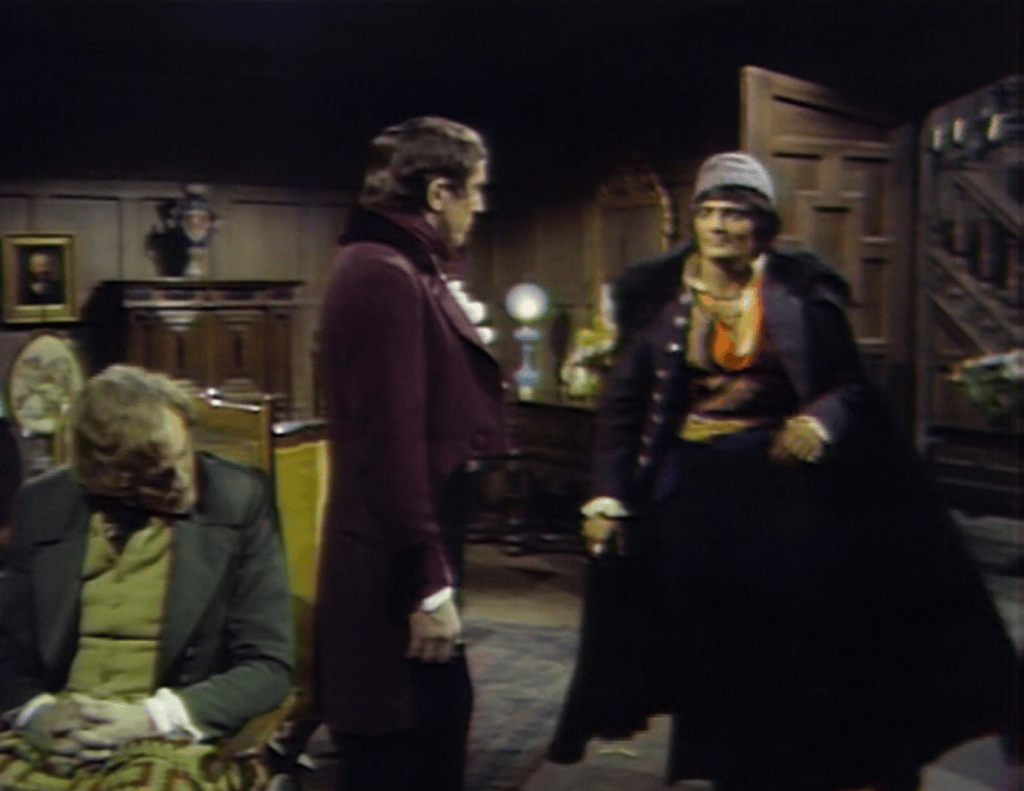
Laszlo’s appearance evokes the 1897 segment. He is played by Michael Stroka, wearing the astrakhan hat that he wore when we first saw him as Aristide, servant of Count Petofi. His attitude towards Angelique is very much like Aristide’s towards Petofi, asking a question in a vaguely belligerent tone, occasionally making a show of defiance, and quickly collapsing into cringing obedience. So he asks Angelique why they keep coming to the tomb every year, and why she isn’t as happy as she usually is when she emerges from the secret room. She snaps at him in response, saying that she would have expected him to stop asking her questions by now, since she has never yet given him any answers. She orders him to go to the great house at Collinwood and find out if a man named Barnabas Collins has been around recently. Reluctant to go, he asks who Barnabas is. She says he is the only man she ever loved. He says “Other than me, of course!” and she agrees in a sarcastic tone. It’s all in very joking, but he scurries away to obey her. All that is missing is him addressing her as “Excellency!” and her remarking on his good looks, and we’d be right back with Aristide and Petofi.
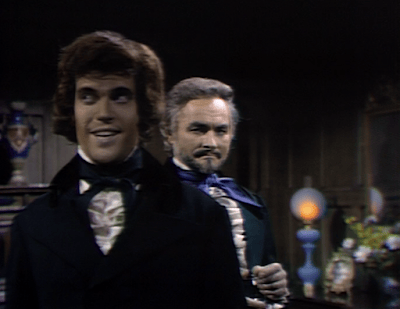
At Collinwood, Laszlo meets Quentin’s younger brother, Gabriel Collins. Gabriel is amused by Laszlo’s attempt to persuade him that he can see into the future, and tells him that the pressing need is for someone who can see into the present. There is a headless body wandering the estate killing people, and if Laszlo can tell them how to put a stop to that he’ll be onto something. Barnabas shows up and scowls at Laszlo, who leaves.
Meanwhile, we learn that Leticia knows a great deal about the headless body. It used to be attached to a severed head that Desmond brought back from Macau as a gift for Quentin. That separates Desmond from Carl, who brought Pansy back from Atlantic City to be his own bride. Leticia is now keeping the head in her own room, and is acting under its influence.
The head and body are those of warlock Judah Zachery, executed in 1692. The head has turned up occasionally in the years since, each time figuring in a series of brutal murders. Apparently the situation will get even worse if the head can be reattached to the body. This also harks back to Petofi, whose hand had been cut from his wrist in the 1790s and had carried on its own career of malignity in the years before Petofi stuck it back onto the end of his arm in 1897. Since Angelique joined forces with Barnabas and Julia to fight Petofi then, showing a new and extremely engaging side of her character, longtime viewers may hope that she and Laszlo will be part of an alliance with our protagonists against Judah Zachery in this period.
Laszlo’s name evokes the movie Casablanca, in which the most morally upright character is French Résistance leader Victor Laszlo while the most morally debased character is crime boss Signor Ferrari. We can imagine Jerry Lacy breaking his character as overbearing undertaker Lamar Trask, putting on his celebrated Humphrey Bogart imitation, and saying of Angelique that “Of all the temporal anomalies in all the multiverse, she had to walk into mine.”
The Petofi/ Aristide relationship was based on one memorialized in another Humphrey Bogart film, Gutman and Wilmer in The Maltese Falcon. As Sydney Greenstreet played Ferrari in Casablanca, so he played Gutman in The Maltese Falcon. It may have been a bit on-the-nose to cast portly gentleman Thayer David as an analogue of Greenstreet, a criticism which cannot be leveled at the choice of the svelte and dazzling Lara Parker. In another departure from the Petofi/ Aristide model, Laszlo is a member of the Romani or Sinti people, the ethnicities often slurred as “Gypsies.” Petofi was vulnerable to certain Romani, and was deathly afraid of all of them.
Aristide was a lot of fun. Stroka came back in 1970 as two characters very like Aristide, first in the original continuity as a hitman known only as Bruno, then in Parallel Time as failed composer Bruno Hess, a member of a little cult that had grown up around that universe’s version of Angelique. The two Brunos were so similar to each other and to Aristide that regular viewers might be disappointed to see Stroka working the old stand one more time.
The essence of Aristide and the Brunos was an insecurity that rode very close to the surface of the character. Each man sneers as he asserts himself against his victims or puffs himself up as he attempts to assert himself against his superiors, then dissolves immediately into frantic backpedaling when he encounters opposition. Stroka made as much as anyone could of those parts, and I had hoped to see him in a role where the insecurity lies deeper in the character’s personality. I wanted to see him as an authority figure whose pompous self-satisfaction can withstand a fair amount of battering and whose eventual defeats prompt a more complex response from him than Aristide/ Bruno’s hectic flailing.
The two characters we have seen who meet that description were Joshua Collins in the 1790s segment and Edward Collins in the 1897 segment, both played brilliantly by Louis Edmonds. In 1840, Edmonds plays Daniel, who is the legal owner of the Collins fortune but whose mental and physical infirmities keep him from exercising much authority. In #1074 and #1076, an ancestor called Abner Collins was associated with the events of 1840; I wish that Barnabas and Julia had found that Abner, rather than Quentin, was Daniel’s eldest son and was in charge of Collinwood and the businesses. Quentin would then be free to be the insouciant wastrel who was such a hit in 1897, rather than a retread of the foul-tempered sourpuss who was a consistent downer in Parallel Time.
As Abner, Stroka could have taken advantage of his striking facial resemblance to William F. Buckley, Junior, making clever-sounding but specious arguments in defense of the family’s most objectionable business practices, littering his speech with seldom-heard polysyllabic words and, when he makes what he believes to be a persuasive argument, leaning way back in his chair and fluttering his eyelids. Buckley was a prominent figure nationally and especially in NYC in 1970. He had been hosting a nationally syndicated television show ever since his unsuccessful bid for mayor of New York in 1965, and in 1970 his brother James would defeat the Democratic and Republican nominees to be elected to the US Senate from New York as the candidate of the Buckley family’s Conservative Party. A spoof of him would therefore be something that grownups in the audience would likely find amusing, and that the New York based makers of the show would surely have enjoyed creating.
In the early days of the show, the most prominent supernatural presences were the ghosts of The Widows, women who flung themselves to their deaths after their husbands were lost at sea due to the inhumane practices of the Collins whaling fleet. The story of The Widows came forward as the first explanation of the origin of the Collins family curse. The whaling industry in New England was approaching its zenith in 1840; it was in the following decades that it finally surpassed cod fishing in the region’s economy. It would close the loop on that early story to present Abner as the man who ensured that the Collinses would be enormously rich for a long time to come by switching the focus of the fleet from a mature market to a rapidly growing one, but who also ensured that they would be the object of undying wrath among many in Collinsport by switching from a decentralized business in which many men had a realistic chance of becoming independent operators to a capital-intensive one in which a handful of magnates control everyone else’s destiny. Abner could become callous to conditions on the whaling ships, because he would see the men as easily replaceable parts of a single machine, not as professionals who had to use their judgment to track down the fish and who might at any time strike out on their own as his colleagues or competitors.
The switch from cod fishing to whaling and its consequences for the life of the village would hark back not only to The Widows, but also to the business stories incorporated in the early storyline of “The Revenge of Burke Devlin.” The theme of those stories was that the Collinses had trapped the people of Collinsport in a situation where the only way for an ambitious young man to improve his lot in life was to leave town. If the 1840 story went on long enough, they might have been able to explore that theme in some depth. Not only would that have appealed to the taste for social and political relevance that was so much in the air in the early 1970s, but by depicting Collinsport as a place full of people who are involved in the story it would also relieve the claustrophobia that stems from the all-Collins episodes that come up so often in the later phases of the show.
Mad scientist Julia Hoffman has escaped from a band of zombies who were wrecking the great house of Collinwood. From her perspective, it is a few moments after she saw her friend, vampire Barnabas Collins, wrestling with the zombies and urging her to save herself by walking down a mysterious staircase. But she soon discovers that she has left the year 1970 and made her way to 1840, when both the zombies and the ghosts who have triggered their destructive actions were living human beings.
Julia enters the staircase from a playroom that is only intermittently present in 1970 and walks down its two flights. She exits into the same playroom, which is a normal presence in 1840. We saw this same distortion of space in #1070 and #1071, when Julia and Barnabas used the staircase to escape from the far-off future year of 1995 and return to 1970. It was an effective way of expressing the magical nature of the staircase and the playroom then, and is still effective the second time.
When they opened the playroom door on their return to 1970, Barnabas and Julia saw a girl in the corridor. That girl appeared to be a ghost named Carrie whom they had met in 1995, but turned out to be a living girl named Hallie Stokes who had moved into Collinwood while they were away on their bizarre cosmic journey. Now, Julia opens the door and sees the living Carrie in the same corridor.
Hallie was the niece of occult expert Timothy Eliot Stokes and therefore a descendant of much-put-upon indentured servant Ben Stokes, whom we got to know from November 1967 to March 1968, when the show was set in the 1790s. We learn today that Carrie is Ben’s granddaughter, and that he and she are staying in the great house as the guests of Daniel Collins.
We saw Daniel in the 1790s segment. He was played then by David Henesy, who was eleven years old at the time. Mr Henesy looked a lot older in September 1970 than he had three years before, and he was an accomplished young actor. But it would likely have been beyond even his abilities to play a character well into middle age, so when we see Daniel from the knees down later in the episode we can be fairly sure he will turn out to be someone else.
Julia sees a confrontation between Carrie and a tall young man in a wheelchair. The man turns out to be Daniel’s son Gabriel. He insists Carrie open the door to her grandfather’s bedroom and push him in. Carrie objects, and Gabriel sneers that she is not to tell a Collins what to do at Collinwood. He berates her, saying that while others may indulge her because they are impressed by her good looks he sees only her impudence. She capitulates to his demands.
In the room, Gabriel turns his abusiveness against Ben. He orders Ben to break some bad news to Daniel. Word has come that Daniel’s son Quentin and Quentin’s son Tad have been lost at sea. Ben protests that Daniel is in no condition to receive such news. Gabriel digresses and says that he cannot make his own living; Ben tells him that many men in worse condition than he is have done, which only makes him angrier than he was to start with. Gabriel regrets his inability to stand up and strangle Ben. We can see that he’s a true Collins; they are a strangley bunch. He then says that he is now likely to become Daniel’s heir, and threatens to evict Ben and Carrie from Collinwood when he does. He menaces Ben with the prospect that he will use his position to make Carrie’s life difficult if he does not obey him now. Ben gives in.
When Ben returns to his room he finds Quentin’s wife, Samantha Drew Collins, waiting for him there. He tells her that the news did not prompt Daniel to change his will. She is still in line to inherit the estate when Daniel dies.
Samantha goes to the drawing room, where she finds Gabriel playing a one-handed game of chess. She is smugly pleased with his dismayed reaction to the news that Daniel has not changed his will. She exits and later returns with word that Daniel has escaped from the tower room. The Collinses have always made a practice of keeping mentally ill family members in that room, and Samantha and Gabriel are so frightened by his escape that we can assume Daniel’s illness disposes him to violence.
Julia emerges from the shadows in Ben’s room. Ben is alarmed to see her, and horrified when she identifies herself a friend of Barnabas’. She claims that she is not a monster, which is a defensible claim, given a very narrow definition of “monster.” When she tells him about traveling back in time from a future period when Barnabas is free to prey upon the living and she is his best friend, he says that she is mad. She denies being mad, which is what a person would do when they are as far from sanity as she is. Ben is leery, but agrees to help her. He escorts her back to the playroom and tells her to stay there until morning. Of course she leaves the room very shortly thereafter, and as soon as she enters the corridor Daniel grabs her by the throat.
The drawing room is downstairs; Ben’s room and the playroom are upstairs. No one seems to be helping Gabriel get from one floor to another, and there is no sign of any ramp or other contrivance that would make it possible for wheelchair users to get themselves from one floor of the house to another without help. Odd as this is, it is not a first on Dark Shadows. In January and February 1970, strange and troubled boy David Collins used a wheelchair in a few episodes because David Henesy had actually suffered a leg injury. David kept going up and down stairs by himself, without explanation of how such a thing was possible. I suppose they got few enough letters complaining about the illogic of that movement that they decide they could get away with it again.
Carrie has three scenes. In addition to her encounter with Gabriel, she talks with Samantha in the playroom and with her grandfather in his room. As Hallie, Kathleen Cody was in a state of maximum nervous tension from the start, so that she had nowhere to go in response to anything that might happen. As Carrie’s ghost, she often swung to the opposite extreme, being so blandly cheerful that she made no impression at all. She did put in a few good performances in the 1970 segment, however, and she is quite good as Carrie today.
Samantha is played by Virginia Vestoff, making her Dark Shadows debut. Vestoff was a distinguished performer who is now remembered chiefly for her role as Abigail Adams in the original Broadway cast of 1776 and of the 1972 film based on that musical. The Broadway cast also included several other Dark Shadows alums- David Ford (Sam Evans #2, Andre DuPres) as John Hancock, Emory Bass (Mr Best) as James Wilson, Daniel F. Keyes (The Cemetery Caretaker) as Josiah Bartlett, and Peter Lombard (Oberon) as a stage manager and understudy for the roles of Stephen Hopkins and Thomas Jefferson. All of those, aside from Lombard, also appeared in the film. Vestoff died of cancer in 1983, aged 42, a major loss to the world of the theater.
A great deal of emphasis is placed today on Samantha’s maiden name, Drew. We have in the last few months met two characters named Roxanne Drew; we can take it that Samantha will turn out to be related to one of those in some way.
Longtime viewers, learning that Daniel and Ben are in the 1840 story, will readjust their expectations. Most of what we saw in the ten weeks leading up to this uncertain and frightening journey into the past was recycled from a story that ran from December 1968 to March 1969 and culminated in a trip to the year 1897. So we may have come in thinking there would be a retelling of 1897. But seeing Ben and Daniel, we have the prospect of a sequel to the 1790s segment. That does sound like a fresher idea.
The episode is certainly structured very differently than were the first episodes of either the 1790s segment or the 1897 segment. Those featured a relatively wide variety of brightly lit sets full of busy people, getting us off to a fast start in a new world. Today most of the action takes place in the playroom, Ben’s room, and the corridor between them, with a couple of brief glimpses of the drawing room. We keep cutting to Julia standing very still behind one partition or another as she eavesdrops on the dialogue. We are operating within a very small space, but hearing about people who are far outside that space and whom we are confident we will meet soon. So rather than leading with the equivalent of a panorama of our new surroundings, they are opening the space up for us a little bit at a time. That makes it easier to keep the action moving rapidly and clearly, and also leaves us wanting more.
In the posts that follow, I link to comments I made on Danny Horn’s blog Dark Shadows Every Day. Unlike most daytime serials, Dark Shadows tended to restart itself from time to time, dividing the show into major periods. I’ve tagged most of these posts with the periods of the show to which they refer.
There are several ways of periodizing the show. The scheme I use is this:
Episodes 1-45 “Meet Vicki”
Episodes 46-126 “Meet Matthew”
Episodes 127-192 “Meet Laura”
Episodes 193-209 “Meet Jason”
Episodes 210-260 “Meet Barnabas”
Episodes 261-365 “Meet Julia”
Episodes 366-466 “Meet Angelique”
Episodes 467-626 “Monster Mash”
Episodes 627-700 “Meet Amy” (subdivided into “Chris the Werewolf,” 627-638, and “The Haunting of Collinwood,” 639-700)
Episodes 701-885 “1897″ (subdivided into “Meet Quentin,” 701-748, and “Meet Petofi,” 749-885)
Episodes 886-969 “Leviathans”
Episodes 970-1060, “Meet Another Angelique”
Episodes 1061-1198, “Meet Gerard” (subdivided into “1995,″ 1061-1070, “The Re-Haunting of Collinwood,” 1071-1109, and “1840,″ 1110-1198)
In which I suggest that the “Head of Judah Zachery” might be a borrowing from C. S. Lewis’ 1945 novel That Hideous Strength, a best-seller in which a group of devil worshipers take their orders from a severed head kept in a box in a curtained room.