
Episode 1077: It’s wrong to love the dead and go on looking for them

The ghost of Daphne Harridge, who died in 1841, gives a bunch of lilacs to Quentin Collins, who immediately falls in love with her. Quentin himself died a couple of times before gaining eternal youth in 1897, so he and Daphne have more in common than you might think.

Carolyn Stoddard Hawkes is half convinced that a local man named Sebastian is actually her dead husband returned to life, mainly because he is played by the same actor. They did this same story in 1968, when well-meaning governess Victoria Winters was convinced that a local man named Jeff was actually her dead boyfriend come back to life. That time around the story was a total non-starter, because it was obvious that Vicki was right. This time it is unclear whether Carolyn is right. It is also unclear what difference it would make if she were, since Carolyn’s husband was entirely exhausted as a source of story development when he died and Sebastian is a clown.

Daphne’s ghost has been appearing to grouchy New England teen David Collins longer than she has been appearing to Quentin, and the two of them are keeping their connections with her secret from each other. They themselves don’t know why. They don’t actually have motivations- it’s the influence of the ghosts holding them back. The ghosts, you see, have a deal with the writers to keep the story from moving faster than they planned when they made up the flimsies for these thirteen weeks.

David borrows Quentin’s camera and takes some pictures at a picnic. He develops the pictures in his darkroom. (Yes, David has a darkroom but no camera.) It is a picture Carolyn had in #1064, set in 1995, 25 years after the present. Carolyn was a crazy woman then, living in the aftermath of a catastrophe that is due to strike the estate of Collinwood later in 1970. Housekeeper Mrs Johnson said that the picture was taken “the first time we saw him,” and Carolyn tore it up. David tells Carolyn today that the picture gives him a sense of dread, and she doesn’t know what he is talking about. But we see the malign ghost that ruled the house in 1995 standing in the background behind them.

The picnic scene is the first attempt they have made in a while to represent an outdoor setting in the daytime, and it is executed quite well. It is preceded by a still of a wooded scene that I don’t believe we’ve seen before. We had some fresh stills of the Moon the other day; it’s nice that they are giving us new images of the outdoors, even if they are not motion pictures.
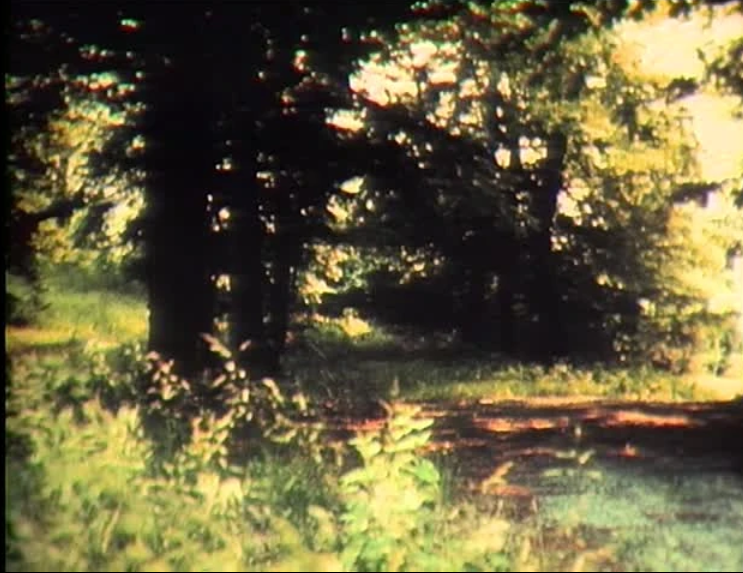
Sunny day.

Also, Carolyn eats a little food today. She ate some grapes one day in the 1995 segment. People ate on camera quite often in the first six months of Dark Shadows, but I believe these are the first two instances of characters taking solid nourishment in front of us since then.

In a bit of Collinsport English we’ve heard before, Quentin refers to another Collins named Quentin, one who was alive when Daphne was, as his “great-grand-uncle.” “Grand-uncle” is not unknown in American English, but it is far less common than “great-uncle.”
Episode 1076: The addition of the letter O

Grouchy New England teen David Collins and his live-in girlfriend Hallie Stokes go to a playroom for small children that intermittently manifests itself in a space otherwise occupied by a linen closet in the west wing of the great house of Collinwood. Hallie is possessed by the spirit of a girl named Carrie, who died in 1841. David hasn’t caught on that Hallie isn’t herself, and in his exasperation he asks her to “stop acting like the world’s number-one weirdo.” Carrie is puzzled by the word “weirdo.” She recognizes it as a derivative of “weird,” but claims that “the addition of the letter O makes it completely incomprehensible.” Evidently Carrie wasn’t all that quick on the uptake. If someone called me a “peculiar-Z,” I might not know why the letter Z was added, but it would be perfectly clear to me what they were saying. Historians of American English often say that the 1830s and 1840s were the single busiest period for the invention of new slang terms the USA has ever seen, so that if Carrie were as stumped by the “O” on “weirdo” as she claims to be, she would likely have been unable to conduct a conversation with many of her contemporaries.

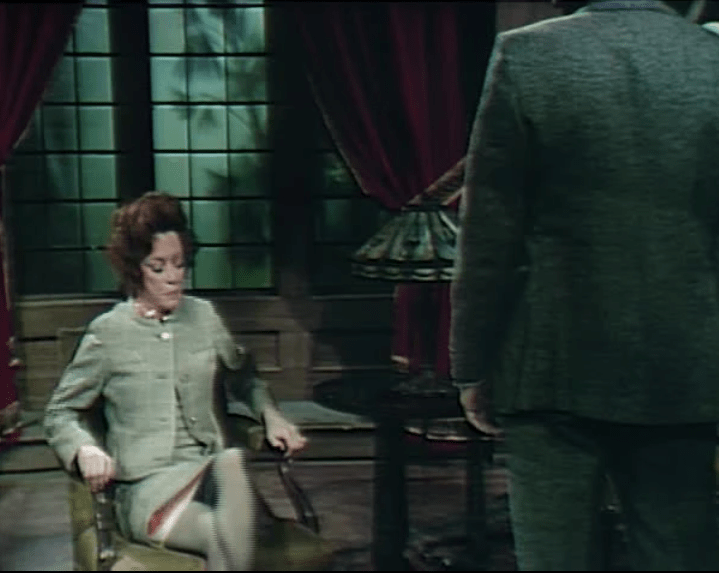
David’s realistic 1970 dialogue and Carrie’s antiquated verbiage bounce off each other to produce some intentional comedy; my wife, Mrs Acilius, thought the scene was really funny. It is certainly more appealing than the rest of the episode, which is yet another series of events that take place only because the characters cannot bring themselves to tell each other what’s going on. Because the ghosts won’t let them, yes yes yes, we’ve been through all that many times before. The fansites seem bored enough by the whole thing that one of biggest points of discussion is whether it is reasonable to say that, because a bit of Grayson Hall’s slip is visible under her skirt at one point, we can say that we see her “underwear.” I guess the slip is “underwear” in the sense that she is wearing it under something else, and it probably wasn’t supposed to be visible, but you’d have to be a very specific kind of person to get excited about it.

Feast your eyes, pervs.

Hall plays Julia Hoffman, MD. Julia is a psychiatrist, among other things. She tells Quentin Collins that the ghost of Daphne Harridge, a governess who like her charge Carrie died in 1841, fills the room with the scent of lilacs when she is near. Quentin is so obviously lying when he tells Julia that he has not smelled that scent that we are probably supposed to assume that Julia is onto him.

Episode 1067: Collinwood works on all our imaginations

Dark Shadows just spent sixteen weeks in an alternate universe where Quentin Collins was neither the family-annihilating ghost he was when first we saw him in December 1968 nor the charming rogue we got to know when the show went back in time in March 1969. Instead, he was a foul-tempered sourpuss who treated his wife like an irritating child and refused to learn anything from anyone. Like those previous iterations of the character, “Parallel Time” Quentin had a compulsion to choke people, but unlike them he was no fun to watch.

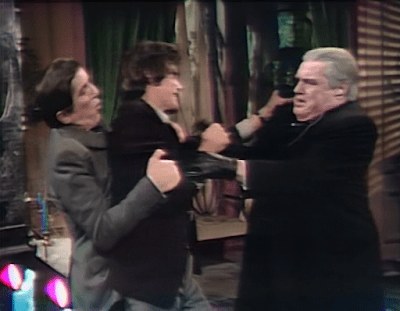
Now we have traveled forward in time to the year 1995. Here, Quentin is an escaped mental patient who is sometimes extremely docile and at other times just as extremely refractory. But one thing hasn’t changed, which is his zeal for strangling anyone who bothers him. He sees the elderly Timothy Eliot Stokes, expert in the supernatural, and at once grabs him by the throat. Quentin’s friend Barnabas Collins pulls him off of Stokes. Barnabas suggests that Dr Julia Hoffman should give Quentin a sedative. He responds “The only sedative I need is to get my hands around Stokes’s neck. I’ll be calm for the rest of my life!” That’s our Quentin.

Barnabas tries to keep Quentin from giving Stokes his signature Collinwood Handshake. Screenshot by Dark Shadows Before I Die.

Quentin blames Stokes for the fact that the estate of Collinwood has been a demon-ridden ruin for the last 25 years. Stokes has been telling Julia and Barnabas that it was that way when he got there. He returned from a trip to Europe in the autumn of 1970, a few months after Barnabas and Julia left on their journey into the alternate universe and out to this future year, and found the place in its current condition and everyone associated with it destroyed in one way or another. But Quentin says that the real disaster came only when Stokes tried to exorcize a ghost. That just made the ghost angry.

Once Quentin is out of the way, Barnabas tells Stokes he believes that Quentin’s madness is a symptom of the ghost’s continued hegemony over Collinwood. He is determined to try another exorcism. Stokes advises him against it, but says he will try to help him if he does go ahead.

Meanwhile, the ghost, who according to the credits is named Gerard, has taken possession of Julia. The ghost has ordered Julia to do something she does not want to do. She keeps this from Barnabas. She tells Barnabas they should give up and go away. He refuses, and she sadly says that whatever will happen will happen. From the look on her face, it seems that the ghost has ordered her to do away with Barnabas and she is resigned to the idea that she will eventually obey this command.

There are other ghosts in the area as well. Yesterday Julia and Barnabas saw the ghosts of two teenagers who were apparently named Tad and Carrie while they danced a minuet and exchanged a chaste kiss, and they heard Quentin talking earnestly to an invisible person he called Daphne. A woman with long black hair briefly comes into Barnabas’ view in his parlor today; the credits confirm that she is Daphne. Anyone who watched US television in the 1970s, 1980s, or 1990s will already know that she is Kate Jackson, and might be interested to know that she is making her first screen appearance.

When Daphne appears, the air smells of lilacs. That comes as something of a relief. The opening voiceover told us that Collinwood is ruled by “a ghost whose mere presence corrupts the surrounding air.” That would suggest rather a less pleasant odor than that of lilac perfume.

The ghost of the gracious Josette was the chief supernatural presence on the show for its first 42 weeks, and an occasional visitor for some time after. Her signature was the scent of jasmine, so longtime viewers are getting a hint that Daphne will turn out to be important.