
From March to November 1969, Dark Shadows was mostly set in the year 1897, to which time-traveling vampire Barnabas Collins had made his way. Barnabas’ friend, mad scientist Julia Hoffman, would join him for several weeks towards the end of the 1897 segment.
While Barnabas and Julia were busy in the past, the show cut to a contemporary setting a few times to show us that time was passing there and that the actions taking place in 1897 were changing the circumstances at the great house of Collinwood in the twentieth century. When Barnabas returned to the contemporary setting, the other characters knew where he had been and remembered both the events he went back in time hoping to prevent and those that had replaced them.
The 1897 segment was so good I wished it had gone on longer. One way I imagined they might have been able to stretch it out would have been to do more with the intercutting timelines. So perhaps spend a week in 1897, then a week in 1969. Obviously that would have required a lot more advance planning than they ever managed to do, since they would have had to keep redressing the sets to represent the different periods, but I thought it might have been worthwhile.
Today, we have evidence that some idea like this also occurred to the makers of the show. Julia has gone back in time to 1840 to keep a series of events from starting that will lead to the ruination of Collinwood and its inhabitants in 1970. Barnabas was unable to join her. We spend time today with Julia in 1840, and then with Barnabas in 1970.
Arriving in 1840, Julia’s first act was to make contact with Barnabas’ old friend Ben Stokes. Ben believed her story and made himself incredibly helpful to her effort to establish herself at Collinwood. But she convinced herself that Barnabas had magically projected himself from 1970 into his body as it is in 1840. So she went to the secret room of the old Collins family mausoleum, unchained his coffin, and released him. He was about to kill her when Ben showed up and stopped him. Ben persuaded Barnabas to let Julia leave the room alive, and repeated her story to him. Barnabas reacted with incredulity, telling Ben that he had gone mad to accept such a tale, but Ben insisted Julia was their friend. Now Barnabas has resumed killing people, and Julia is terribly afraid that unless he stops he might be caught.
Barnabas is in the bedroom at the Old House at Collinwood once meant for Josette DuPrés to call her own after she married him. He takes Josette’s portrait off the wall and tells her that he must go on without her. We’ve heard that before. In #281, he stood in the same room and spoke to the same portrait, telling Josette that her ghost must go away and never come back so that he could face the world with someone else. We soon found that his plan was to turn that someone else into a simulacrum of Josette, and later he kept deciding that other women were reincarnations of Josette, so that speech did not represent the emotional growth we might have hoped to see. Finally, Josette’s ghost appeared to Barnabas in #948 and told him to lose her number, and his next love interest was a woman who did not remind him of her. That new woman was comatose, and Barnabas rhapsodized about how much beauty he found in her silence and immobility. Also, there was a bit of a problematic age gap, since she was 22 and he was well over 200. Baby steps, baby steps.
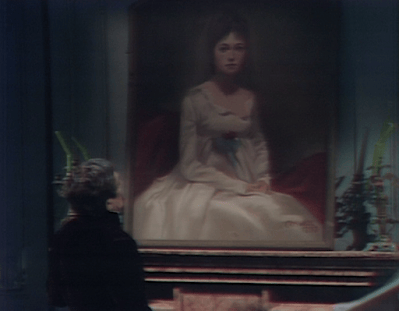
Ben enters and tries to talk Barnabas into returning to his coffin and allowing himself to be chained back in. As my wife, Mrs Acilius, points out, he doesn’t even mention that murder is bad. He knows Barnabas well enough to know he’d roll his eyes at that kind of talk. He just focuses on the danger Barnabas is putting himself in. Barnabas says that Ben does not know how horrible it is to spend years trapped in the darkness. Returning viewers may smile at this, since Barnabas doesn’t know that either. When Julia opened his coffin, he had no idea more than a single day had passed since he was chained there in the 1790s. He flounces off to take more victims.
In the drawing room of the great house, Julia meets Cockney psychic Leticia Faye. She asks Leticia if she can tell what will happen in that room in 1970. Leticia laughs and says her visions don’t extend that far. She adds that there wouldn’t be much point in them if they did, since no one alive today will be around to see if they came true. Julia claims to have had a dream about 1970, and Leticia humors her. She goes into a trance, and smells smoke. That’s about it, and when Leticia comes out of it she is still laughing, perhaps thinking that it didn’t amount to much. But it reminds Julia of the disaster she escaped, and leaves her wondering what Barnabas is doing in 1970.
We cut to Barnabas’ house in that year. He is doing what he does best, sitting around feeling sorry for himself. Ben’s descendant, occult expert Timothy Eliot Stokes, is there. They are talking about the funeral held that afternoon for the residents of the great house killed in the disaster. Stokes does not know that Barnabas is a vampire, and so Barnabas has to make an excuse for his absence from this daytime event. He simply says he was too upset to attend.
Heiress Carolyn Stoddard Hawkes and charming rogue Quentin Collins survived the disaster and are in the Old House, both quite insane. Barnabas and Stokes cart them off to a psychiatric facility. This is the final appearance on Dark Shadows of either of these characters, each of whom has been enormously important to the show.
Carolyn is played by Nancy Barrett, who also plays Leticia. Quentin is played by David Selby. We had expected to see Mr Selby in 1840 as another character named Quentin Collins, but when Julia arrived she learned that Quentin was missing and presumed dead after a nautical mishap. This glimpse of Quentin doesn’t add much to the story, but it does serve to reassure us that Mr Selby has not left the cast and that we will be seeing the 1840 version of Quentin sooner or later.
Barnabas decides to cast some I Ching wands. That’s what got him back to 1897, and the wands fall in the same pattern this time as they did then. He meditates on them. He sees a door, and seems to pass through it. On the other side, he sees a tombstone engraved “Julia Hoffman Collins 6 October 1840.”
Julia is masquerading as the daughter Barnabas had after he left for England in the 1790s, and has been telling the Collinses to expect her brother, Barnabas Junior. We haven’t heard her give “Hoffman” as a middle name. Of course it had to be there for Barnabas to be shocked by the stone. Otherwise, he would just have wondered who “Julia Collins” was.
It strikes me that they missed an opportunity. Julia has said that she moved from England to Philadelphia. Even though she lived there for so many years that she picked up an eastern Pennsylvania accent, she did not contact the family at Collinwood. Eventually they are likely to find out that she has a great deal of medical expertise, most unusual for a lady in 1840. Had she introduced herself as Julia Collins Hoffman, she might have explained that she met her late husband Dr Samuel Hoffman while he was studying in London, married him there, and lived with him in his hometown, Philadelphia. At the name “Dr Samuel Hoffman,” a theremin might have played on the soundtrack. Electronic music enthusiasts would laugh at the nod to the real Dr Samuel J. Hoffman (1903-1967,) the great player of and composer for the theremin. And fans of Dark Shadows would be happy that Julia’s imaginary husband has the same first name as Grayson Hall’s real husband, series writer Sam Hall.
This episode marks not only the final appearances of Carolyn and the original Quentin, but also the last time Peter Miner’s name will appear in the credits as line producer. Starting tomorrow, Lela Swift will be in command at 433 West 53rd Street. Swift was the principal director since the beginning of the show, chiefly responsible for the show’s often striking visual composition. It will be exciting to see what she can do now that she has a wider scope of action.

