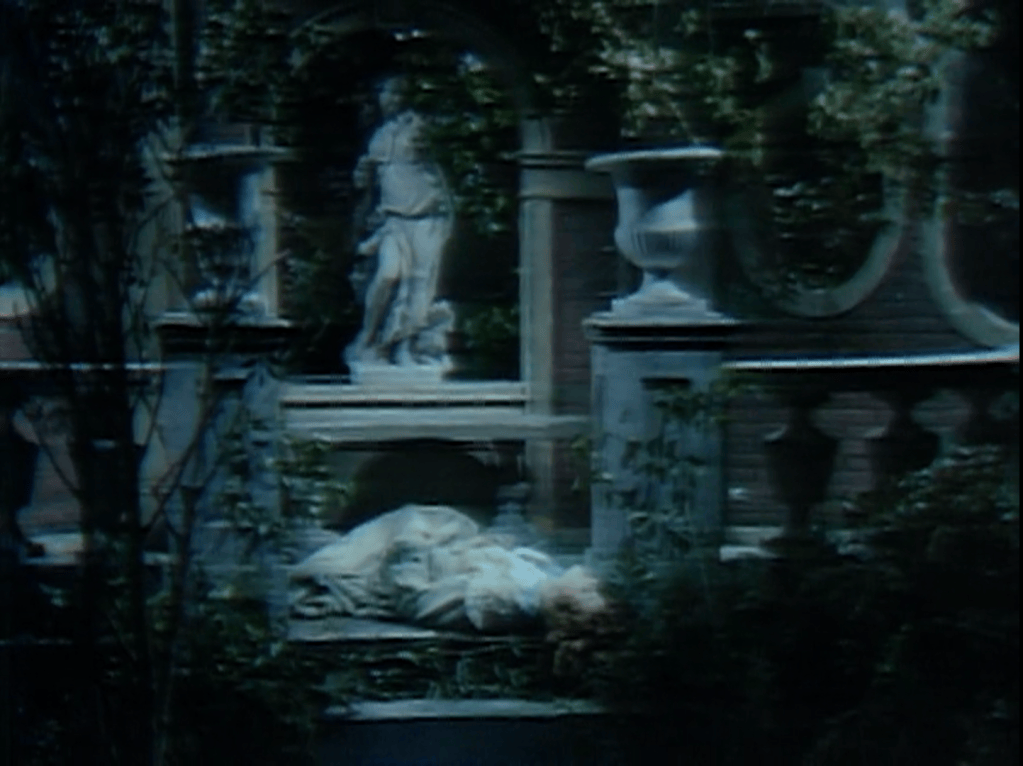
Episode 1070: Never without you

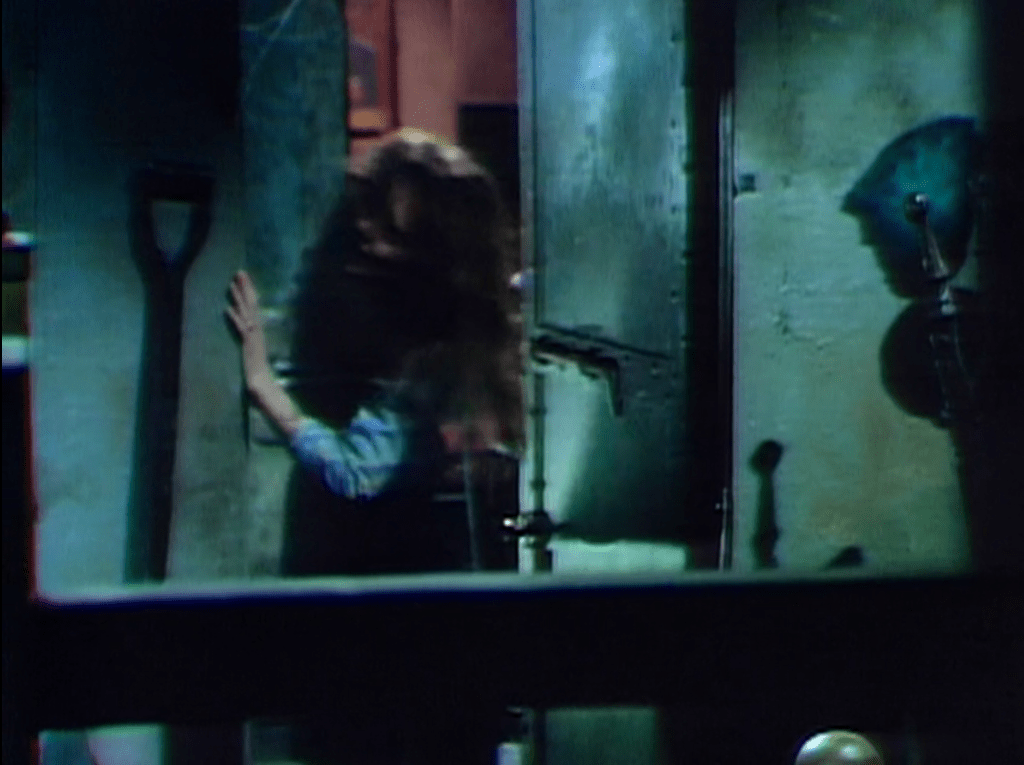
The sun has set, and vampire Barnabas Collins is opening the lid of his coffin in the basement of the Old House on the estate of Collinwood. Suddenly a cross is thrust in his face. He recoils from it, crying in pain and becoming immobile. The cross is wielded by the sheriff of Collinsport, who announces “I know all about you, Barnabas Collins!”

Before the sheriff can take matters any further, a teenage girl appears nearby. Shocked to see her, he reels away from the coffin. He jabbers at her, saying that he recognizes her and pleading with her not to come closer. Barnabas grabs him from behind and strangles him to death.

Barnabas didn’t have anything against the sheriff, but can’t deny that it feels good to use the old strangling muscles again. Screenshot by Dark Shadows Before I Die.

Barnabas goes upstairs and finds his best friend, mad scientist Julia Hoffman. He tells Julia that the sheriff’s gun was loaded with silver bullets, and that only the manifestation of the ghost of Carrie prevented his destruction. The police know about him, and more officers will be coming any time. Julia admits that she told the sheriff about Barnabas. Shocked, he says “You betrayed me?” He has said these words many times, always as a prelude to extreme violence. Julia braces herself, expecting the same. But to her amazement, Barnabas is gentle and understanding. He realizes she is under the sway of an evil ghost named Gerard. She says that she will betray Barnabas again and again, and urges him to leave without her. He says he will never do that. She embraces him, weeping, and he comforts her. For most people, a day that begins with the murder of a policeman is a day when nothing goes well, but Barnabas is not like most people. This is far and away the most mature behavior we have ever seen on his part.

The year is 1995; Barnabas and Julia have come unstuck in time and found themselves at Collinwood 25 years after a mysterious disaster wrecked the great house on the estate, ruined its inhabitants, and left Gerard in charge. They believe they can travel back to 1970 and prevent the disaster from ever occurring, if only they can find out what it was. Barnabas’ distant cousin Carolyn left him a note yesterday consisting of six cryptic phrases which he took to be clues, but Gerard killed Carolyn before Barnabas could ask her to explain them.

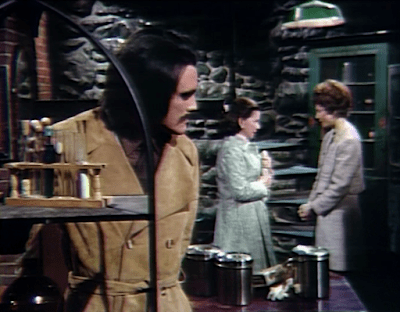
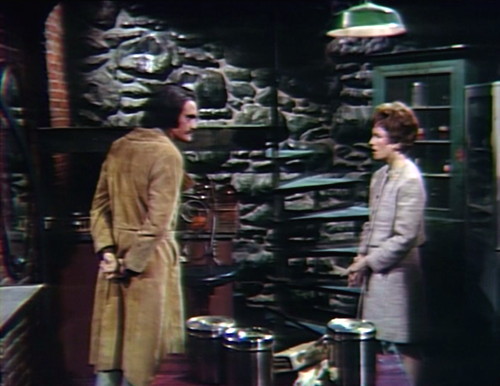
Barnabas has brought occult expert Timothy Eliot Stokes to the Old House. We find Stokes exclaiming to Barnabas “You killed the sheriff?” Barnabas confirms, “Yes, I killed him.” Stokes replies, “Everyone’s going mad. It’s the effect of this place. I’m not surprised at your terrible story. Horrified, not surprised.” One wonders what the story was that Julia and Barnabas told. Stokes’ role in the parts of the show set in contemporary times was always limited, because he is too decent and law-abiding to be a party to the continued existence of a vampire. He could never be allowed to learn the truth about Barnabas. He stays in the room, chatting amiably with Barnabas and Julia, so clearly they haven’t told him now, either. Perhaps they just told him that the sheriff was going to shoot Barnabas, and let him assume that the reason was that Gerard was making him do it.

Be that as it may, Stokes is still aware of the situation. “Do you realize that I will be implicated in all this if the police come here?” he asks. They say that they do, but that they desperately need him to make a third for a séance. He dismisses as hopelessly naive the idea that Gerard would allow a séance to succeed, but Barnabas says that Gerard may not have the power to prevent Carolyn’s spirit coming through and telling them what her note meant. The idea of one spirit trying to block another from emerging out of the supernatural back-world and speaking at a séance harks back to the very first séance on Dark Shadows, in #170 and #171, when undead fire witch Laura Murdoch Collins used her powers to impede the spirit of the gracious Josette from warning the company about her. Stokes gives in and agrees to participate; Julia, self-conscious because of her compromised position, is reluctant, but Barnabas proclaims that if Carolyn is to speak it will be through her.*

The séance begins. Julia goes into the trance, and starts speaking in what appears to be Carolyn’s voice. If this is Grayson Hall’s Nancy Barrett imitation, it is terrible. Mrs Acilius and I laughed out loud at it. But the voice does not give any useful information, and Julia is under Gerard’s power, so it is also possible she is faking the trance to throw Barnabas off. In that case, it is Julia’s Carolyn imitation, and it reminds us of the ups and downs in the relationship between those two characters.

When the séance is over, Stokes says he feels a presence. He rises from the table, drifts towards the window, and sees Gerard watching him from outside. Gerard touches the pane. Stokes staggers back, descends into a chair, and becomes still. Barnabas finds that he is dead. He looks up and realizes that Julia has fled the house.

Julia has gone to the great house. She is in a mysterious playroom with Gerard. Gerard gives her a dagger. She asks if she “must.” She is reluctant, but finally works herself up to joy as she says that she always knew it would come to this, that now she will be with Gerard as he wants her. She lifts the dagger to stab herself in the heart.

Barnabas enters. He confronts Gerard. As the two beings from beyond the grave stare each other down, Julia drops the dagger. Barnabas tells Gerard he cannot stop them leaving. Gerard looks offended at this. He touches Julia, who collapses. She is not dead, but she and Barnabas fear she is dying. Gerard leaves the room and takes his time locking the door from the outside.

Carrie’s ghost materializes to Julia and Barnabas. She beckons to them, then walks out through the wall. They stare at the wall, and a door appears. They pass through the door, and find themselves on a staircase. They follow the staircase, and come to another door. They exit in the same corridor outside the playroom; they have gone in a circle. In space, anyway- the time appears to be different. The corridor is in severe decay in 1995, but is in good repair now. And they see a girl who looks exactly like Carrie, but is alive. She asks them who they are.

This is the final episode set in 1995. It is also the last we will see of Don Crabtree. Previous sheriffs of Collinsport have been ridiculously ineffective. Crabtree’s sheriff doesn’t chalk up many successes either, but no one else meets with anything but failure in these two weeks. Every death and defeat we see reinforces the sense that the evil which Gerard represents is overwhelming. As the penultimate victim of the 1995 curse, the sheriff is second only to Stokes as someone who would have been able to make a positive difference, if anyone could have, and Crabtree makes us believe that he belongs in that position.

*In the main continuity of Dark Shadows, spirits at séances always speak through a medium of the same sex as themselves. In the séance in #990, when the show was set in a mirror universe, the spirit chose a medium of the opposite sex.

Episode 1064: There are only intruders

A disruption in the very nature of time and space has thrust vampire Barnabas Collins and mad scientist Julia Hoffman into the year 1995, where the great house of Collinwood is in ruins and everyone is annoyed with them.

Yesterday, Julia and Barnabas were poking around inside the great house against the express instructions of its owner, Carolyn Fredericks, as conveyed earlier in the evening by the sheriff when he arrested them for trespassing. A heavy bust fell from the railing on the top of the foyer stairs, narrowly missing Julia. She and Barnabas fled the house. They looked back, and saw a young man in nineteenth century garb glaring at them from a window.

Today, Barnabas and Julia are in the parlor of the Old House on the estate. She tells him that when she saw the man in the window she was overcome by a powerful sensation. “It was the very essence of evil! I felt evil all around me. I was trapped by it!” Regular viewers may have thought Julia would be used to that by now, but apparently not. “It made me aware of something deep inside me that I don’t even understand — as though, with that one look, he could concentrate every grain of evil I have in my nature! Make it grow, and grow…” She asks Barnabas if he felt the same thing, and he says he didn’t, not at all. He concedes that he is an inhuman abomination from beyond the grave, so maybe he’s immune to that kind of thing.

Meanwhile, Carolyn is at home in the old shack by Finley’s Cove, accompanied by Mrs Johnson, who was the housekeeper at Collinwood in the late 1960s. Carolyn is brushing her hair and smiling. She reminisces about when she was a little girl and Mrs Johnson used to brush her hair. Mrs Johnson is not shy then or later about contradicting anything Carolyn says that is not so, but does not deny that she did that. So the audience is supposed to believe it. Some say this is a retcon, since Mrs Johnson did not join the staff at Collinwood until 1966, when Carolyn was fully grown. But in a comment on Danny Horn’s post about the episode on his great Dark Shadows Every Day, I expounded a theory as to how it might be true:

In the early episodes, Carolyn talks about having gone to school in town. How did she get there?

She can’t have walked; it was miles away, much of it along a winding road with several blind curves. Her mother never left the grounds during those years, she couldn’t have driven her. Roger was living in Augusta with Laura.

(I should expand on this point. Roger says that when Carolyn was born, he was away at boarding school. So he would still have been in college when his niece first became a pupil at Collinsport Elementary. He then busied himself squandering his inheritance, a process which included the ten years between his marriage to Laura and his return to Collinwood. So that doesn’t leave any time for him to have looked after his “Kitten” when she was little.)

The only servant was Matthew. Matthew and Carolyn don’t seem at all close; it doesn’t seem likely that he drove her to school every morning. If a school bus came up the hill to Collinwood day after day, the kids who rode it couldn’t have maintained the attitude Carolyn describes, whispering behind her back about her living with the witch in the haunted house. Sooner or later they’d have started talking to her face to face about it.

Carolyn also talks about Bill Malloy being more like a father to her than any other man, and the two of them do have a cozy relationship. Carolyn is also very quick to fall in with Mrs Johnson when Burke pitches the idea of her joining the household staff at Collinwood. So I think we have to conclude that Bill Malloy and his housekeeper were in charge of getting Carolyn to school in the mornings. Malloy was on the fishing boats, so that would require an early start to the day. There were probably many days when little Carolyn was still in her pajamas when she got to the Malloy house. On those days, Mrs Johnson brushed her hair while the water came to a boil for breakfast.

Comment left by “Acilius,” 27 January 2021, on Danny Horn, “Episode 1064: Here Comes the Hotstepper,” Dark Shadows Every Day, 20 August 2017.

Carolyn seems to be a crazy lady these days. Yesterday, we saw that much of this is an act, but in her scene with Mrs Johnson we see that it is an act she puts on even when she is alone with someone she trusts. It allows her to smile and laugh and be happy even when she is surrounded by the residue of an unimaginable catastrophe.

Carolyn tells Mrs Johnson that she will be going to the great house of Collinwood to get ready to host a picnic at the gazebo, which she pronounces “ga-ZAY-bo” in a bit of Collinsport English that we’ve been hearing intermittently since Lara Parker invented it in the summer of 1968. Mrs Johnson reacts with horror, saying that no one can go to the devil-haunted wreckage of Collinwood, but Carolyn laughs off her objections. Carolyn shows a picture of a picnic they had at the ga-ZAY-bo in 1970, the last year Collinwood was habitable. Mrs Johnson spots a figure in the background and declares that was “the first time we saw him.” Carolyn gets upset and tears up the picture.

Barnabas had insisted to Julia that the man they saw at the window may not be the only supernatural entity operating within the great house, and Carolyn seems to confirm that he is right. She does not want to hear Mrs Johnson referring to him, nor does she want to have a picture of him. But she happily says that she is going to the great house tonight with a present, because it is his birthday. Apparently him and his refer to different beings, each of which inheres in the haunting. One wonders how much of supernaturalism would dissolve if people would just use proper names instead of pronouns.

Julia and Barnabas barge into Carolyn’s house. Carolyn tells them to get out, which they refuse to do. They badger her with the story of what happened when they were illegally roaming around in her other house, and Mrs Johnson runs out. Eventually Carolyn resumes her crazy lady demeanor. Barnabas and Julia give up and leave, and for a moment we wonder if they are on their way to let themselves into some other property of Carolyn’s.

Julia and Barnabas go back to the Old House. They find that Mrs Johnson is waiting for them there. They tell her that they are time travelers, and that if she will tell them what happened they might be able to go back and prevent it. She is dubious about this claim, but starts telling the story anyway. She casts her mind back to the summer of 1970. “It all began when the days were so beautiful, you couldn’t help but be happy. There was a spirit of joy at Collinwood; there was a feeling that hadn’t been there in a long time. There was so much love among all of us at that time…” This would be the period that began immediately after Barnabas and Julia left.

Mrs Johnson says that all of the beauty and joy and love and other things you might experience when you don’t have a vampire and a mad scientist around your estate came to an end one quiet night. She seems to be on the point of saying something important when she looks at the window of the parlor and sees the glaring young man. She breaks off, screams that she won’t tell, and runs out into the night. Julia tells Barnabas she felt the evil presence, and that the ghost was there. They go out to look for Mrs Johnson.

The ghost catches up to Mrs Johnson first. He touches her shoulder, and she dies. When Barnabas and Julia find Mrs Johnson, she is sitting on the ground, her back against a tree, her eyes open. This was the same posture in which Clarice Blackburn’s character Abigail Collins was found when we saw her corpse in #432. That image was a brief shocker in the last couple of seconds of the episode; this time the camera zooms in on Blackburn’s face and pans across it, allowing her to show that an outstanding actress can give a powerful performance even when she is altogether motionless.

Carolyn happens by. Julia and Barnabas hide. Carolyn thinks Mrs Johnson is alive and chatters to her. As the truth begins to dawn, Carolyn’s alarm mounts. Finally Barnabas and Julia emerge from the shadows. Carolyn accuses them of killing Mrs Johnson. They deny their guilt. Carolyn is unconvinced, and indeed we cannot help but think that since Mrs Johnson lived through the 25 years of their absence and turned up dead so shortly after they returned, Julia and Barnabas cannot be exactly innocent.

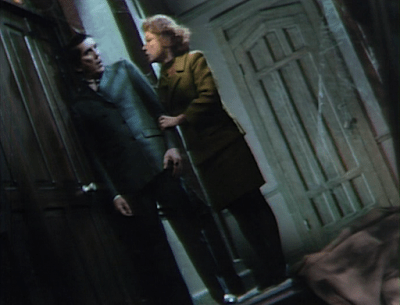
Barnabas and Julia follow Carolyn into the great house. Julia wonders what Mrs Johnson could have meant by “the children’s old room.” This is a blooper on Grayson Hall’s part- Mrs Johnson mentioned “the room the children called The Playroom.” Julia and Barnabas hear music playing, and follow it to a room upstairs. Barnabas looks at the doorway and remarks that the room was never there when he knew the house. The shot is framed at such a severe Dutch angle that we can tell something isn’t on the level.

Tell all the truth but tell it slant. Screenshot by Dark Shadows Before I Die.

They hear Carolyn inside, talking and laughing with at least one other person. Since their whole philosophy of life now seems to be making themselves as obnoxious as possible to Carolyn, they let themselves in.

Episode 1055: The man who murdered Angelique

Angelique Stokes Collins has returned from the grave to take vengeance on her murderer. Unfortunately, she doesn’t know who that is. For the last several weeks, she has been operating on the assumption that she was killed by her widower, foul-tempered sourpuss Quentin Collins. She has managed to get Quentin charged with one murder and suspected of several others; under her influence, he assaulted a police officer and broke out of jail. She has persuaded him that his current wife, the former Maggie Evans, is a witch and is responsible for all his troubles. He is lurking about the great house on the estate of Collinwood, where yesterday he encountered Maggie and told her he would kill her.

Angelique herself is residing in the great house. Eleven weeks ago she killed her identical twin sister Alexis, assumed Alexis’ identity, and took her place as Quentin’s houseguest. Maggie now thinks of “Alexis” as her friend.

Others in and around the house know better. High-born ne’er-do-well Roger Collins, Quentin’s brother, has seen through her imposture. Two visitors from the alternate universe where Dark Shadows was set for its first 196 weeks, mad scientist Julia Hoffman and vampire Barnabas Collins, knew her counterpart in their world and are onto her tricks.

Angelique hears some noise in her old bedroom in the east wing of the great house. She finds the door locked and hears Roger’s voice. She demands to be let in. He opens the door and she forces her way past him. She finds Maggie in a heap on the floor. Roger rushes out. Maggie tells “Alexis” that Roger tried to strangle her after confessing to three murders, including Angelique’s. Angelique and Maggie decide to call the police.

Julia and Barnabas learned that Angelique’s father, evil barfly Tim Stokes, made it possible for her to rise from the dead by using a mixture of medical science and black magic to establish a remote connection between Angelique and a woman named Roxanne. Through this connection, Stokes drains most of the “life force” from Roxanne into Angelique. Julia and Barnabas have taken Roxanne from the back room of Stokes’ apartment and hooked her up to some mad science equipment in the basement of the Old House at Collinwood. They hope to manipulate Roxanne’s condition as a means of controlling Angelique.

Angelique has locked Julia in a dungeon off the basement of the great house and left her there to die of thirst. Barnabas is sure Angelique has captured her, but cannot begin to guess where she might be. He takes a shot at using the mad science equipment to revive Roxanne sufficiently to knock Angelique out. He cannot see any effect, and goes out to try to look for Julia.

As Barnabas goes out, a man peers at him from behind a tree. Since Barnabas never under any circumstances locks his front door, the man strolls into the house as soon as Barnabas is out of sight.

The man is Claude North, a mysterious person somehow connected with Roxanne. Barnabas comes back to the basement and finds Claude trying to get Roxanne to talk. He tells him that she must not do so just yet, because at her first word Angelique will die and there are some things he has to take care of before that happens. Claude cares nothing for this. Barnabas is afraid that if he attacks Claude, Roxanne will be startled into speaking, so he withdraws.

The other day, we saw a grave marker in Claude’s name, and we have seen that he has the same power Barnabas does to mesmerize people when they follow his command to “Look into my eyes!” He had also been staying in a hidden chamber identical to the one where Barnabas’ coffin was kept for his first 171 years as a vampire. And he had some kind of mystical power over Roxanne, as Barnabas has over his victims. So we thought Claude might be a vampire, too. But today he explains that the grave was his grandfather’s, he clearly doesn’t recognize Barnabas as a fellow bloodsucker, and when cornered he doesn’t flash fangs. So we’re left thinking he’s probably just Roxanne’s overconfident ex.

Meanwhile, Angelique is feeling cold and weak because Roxanne has reclaimed so much of her “life force.” She has cast a spell to cause Roger to slip past the police swarming the estate and make his way to her in her old room. Once they are together, she warms herself up for a while by hugging and kissing him. First time viewers may think this is an odd thing for her to do, but returning viewers know that she is a heat vampire who can by those actions drain the warmth from a living body and leave it an icy corpse. Louis Edmonds has been doing some great work these last few weeks, and he plays Roger’s death scene especially well.

So long, Rodgie. Screenshot by Dark Shadows Before I Die.

Downstairs in the drawing room, Angelique is still shivering. Maggie enters and sees that “Alexis” is ill. Maggie insists on helping, and Angelique suggests she walk her to the fireplace. They sit together beside it. We learned Wednesday that Angelique has magical hypnotic powers, and Maggie’s counterpart in the main continuity was subjected to frequent mind-wipes. So there is a nice sense of inevitability when Angelique puts her into a trance and orders her to get a gun and prepare to shoot Quentin.

Angelique is still sitting by the fire, still feeling miserable, when Barnabas comes back. He tells her that Claude is with Roxanne and that Roxanne will be speaking at any moment. He writes up a confession and orders her to sign it, saying it will clear Quentin of the murder with which he was charged. He says that this will allow her to find peace. She says she doesn’t want peace. We may wonder how the confession could possibly clear Quentin. All she could do would be to admit that the man Quentin is charged with killing actually died because she cast a magic spell on him. We have already seen that the policeman in charge of the case has zero patience for talk about magic, and there is no end of evidence pointing to Quentin’s guilt.

We end where we began, in Angelique’s room with a homicide in the offing. Then it was Roger with his hands around Maggie’s neck; now it is Maggie pointing her revolver at the door as the knob turns. That isn’t all that suspenseful a situation. I’m sure Maggie would feel bad if she had killed Quentin, but he’s so hyper-violent that no one would doubt she acted in self-defense and has been such a bad husband to her that it’s hard to imagine she wouldn’t get over it in short order. If Quentin dies, there will be so few characters left that the show couldn’t go on, but we will probably be leaving this universe in a few days in any case. So this isn’t much of a Friday cliffhanger.

Episode 1053: To have the final word

For some time, wicked witch Angelique Stokes Collins has been dissatisfied with her minion Julia Hoffman. What she most wants from Hoffman is information about her new enemy, old world gentleman Barnabas Collins. Yet Hoffman has told her nothing useful about Barnabas. The only time she brings him up is to claim that she was busy following him when Angelique needed her to do something else. Even then, her reports are no more substantive than “He went into town,” without so much as a single name of a person he met or building he entered while there. Hoffman keeps showing friendliness to people to whom Angelique wants her to be hostile, asking questions to which she ought already know the answer, and resisting orders she would usually be eager to follow. Whatever is wrong with Hoffman, Angelique does not propose to put up with it indefinitely.

Yesterday, Angelique found the solution to the puzzle. She learned that she has not been dealing with Hoffman at all, but with her Doppelgänger from an alternate universe. Barnabas came from that universe as well. This Julia is as devoted to Barnabas as Hoffman was to Angelique, and followed him to this reality to take her place at his side. Today, Angelique traps Julia in a secret chamber off the basement of the great house of Collinwood and demands to know what she has done with Hoffman. At length Julia confirms her true identity and admits that she killed Hoffman, but she will not answer any of Angelique’s questions about Barnabas.

Angelique takes out a medallion and tells Julia to look at it. Julia gasps and turns away. She says that she knows about hypnosis and knows how to resist it. Angelique says that if she knows how to resist, there is no reason for her not to look at the medallion, but Julia keeps looking away. Julia was first introduced as a psychiatrist, whose talent for hypnosis was of magical proportions. By showing her medallion to a person, she could erase and rewrite that person’s memory as easily and as completely as one could erase and rewrite a chalkboard. Julia is the heroine of the show now, but longtime viewers will still find it fitting that Angelique turns the tables on her.

Upstairs in the same house, high-born ne’er-do-well Roger Collins is having a conversation with Angelique’s portrait. This is one of several habits Roger has that recall Waldo Lydecker, the sarcastic dandy in the 1943 novel and 1944 film Laura. Lydecker turned out to have murdered a woman with whom he had a strange obsession.

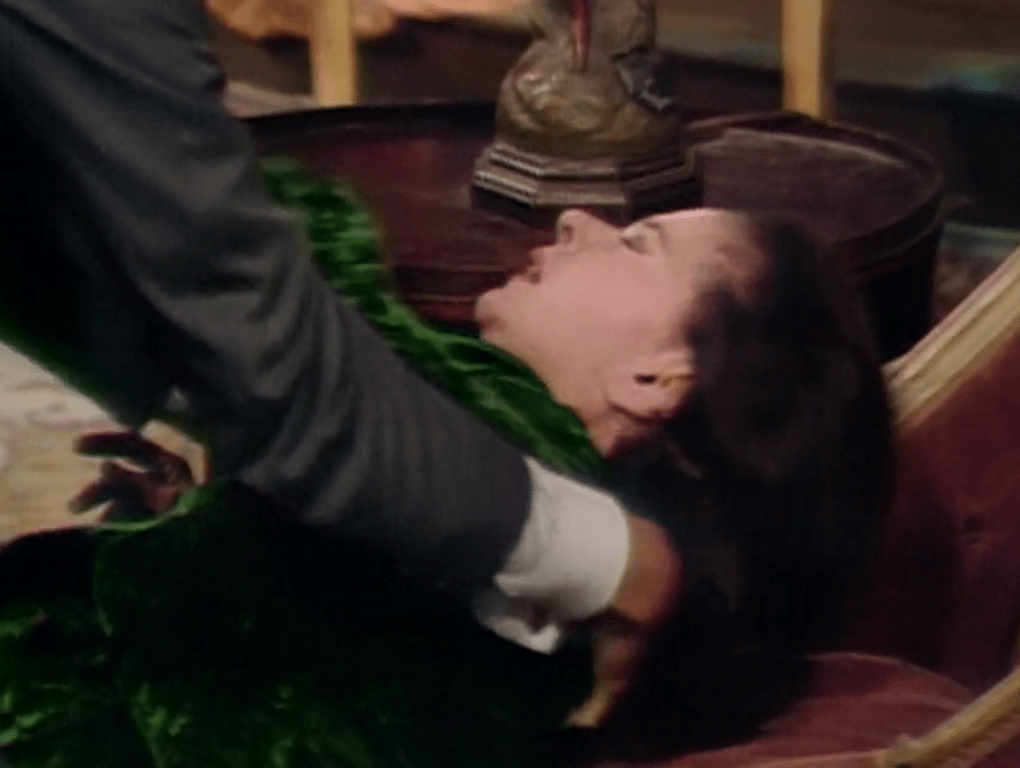
Roger is overwrought, telling the Angelique in the portrait that he should have known she would come back from the dead. If he had, he would have realized it was a waste of time to kill her. He only made things worse by doing that; for one thing, it made it necessary for him to kill his niece Carolyn. As he says this, his sister Elizabeth Collins Stoddard, Carolyn’s mother, overhears. She storms in. He tries to deny that meant anything he said, but Liz won’t be stopped. As Roger presses his hands on Liz’ shoulders, Joan Bennett plays the part of someone being strangled. Louis Edmonds’ fingers are nowhere near her throat. You can’t believe that Roger is hurting Liz, but you can easily believe that Edmonds and Bennett are a brother and sister playing pretend. They look like they’re about six.

Oh, oh, I’m being strangggled!

Just as Roger closes Liz’ body into the storage space under the window seat, Barnabas enters. Roger is on the point of tears, a circumstance Barnabas notices. Roger keeps urging Barnabas to leave the room with him, but he replies that what he has to say will take only a moment. Barnabas says that he is worried about Liz. Roger gets even more upset, and Barnabas finally agrees to go downstairs with him.

For longtime viewers, this scene makes a poignant contrast with #446. In that episode, set in the year 1796, Edmonds played haughty overlord Joshua Collins, father of Barnabas. Joshua discovered that Barnabas had become a vampire. Joshua confronted his son in his hiding place. Joshua was at once horrified and shattered, but in no way intimidated by Barnabas, who was for his part alternately ashamed and petulant. Edmonds and Jonathan Frid made that scene into one of the high points of the series. Now, it is Edmonds’ turn to be the murderer dejected by the knowledge of his own inexpungable guilt, and Frid’s turn to be the upright family man. Barnabas does not know Roger’s secret as Joshua knew his, but in Roger’s inability to face him we see the fear of the same righteous condemnation Joshua had felt it his duty to proclaim.

At one point in this conversation Frid has so much trouble with his lines that the words dissolve into a buzzing sound. I told my wife, Mrs Acilius, that it sounded like Barnabas had briefly turned into Bob Dylan. She roared with laughter and said that was exactly what she was going to say.

This is the first “Parallel Time” episode in which Lara Parker is credited as playing Angelique. Previously she had been billed as Alexis Stokes, the identical twin sister whom Angelique killed when she rose from the dead ten and a half weeks ago and whom she has been impersonating ever since. Several times in the series, cast members have wandered onto the set while the credits were rolling.* Referring to this, Mrs Acilius had explained that they kept using Alexis’ name in case any characters who didn’t know who she really was wandered in while the credits were rolling. She imagined them looking up, widening their eyes, and pointing. She meant that hypothesis as a joke. But since the only character in today’s episode who didn’t know Angelique’s true identity was Liz, who was dead by the time the credits rolled, I think we have to take it as proven.

*Most conspicuously in #703, #635, #510, and #328. There are also moments when crew members can be seen during the closing credits, most spectacularly in #999, when a man is just sitting there eating a sandwich.

Episode 1035: Terrified at his own duality

Since #1021, Barnabas Collins has been trying to figure out what links mild-mannered scientist Cyrus Longworth with a strange and violent man known as John Yaeger. Yesterday, Cyrus telephoned Barnabas and told him that Yaeger was holding Maggie Collins prisoner in an old farmhouse. Today, Barnabas finds Yaeger choking Maggie in the basement of that farmhouse.

Barnabas orders Yaeger to unhand Maggie, saying that he will kill him if he does not. Maggie gives an ecstatic look, then Yaeger flings her to the floor. He and Barnabas start fighting. Yaeger’s weapon of choice is a heavy cane that conceals a bayonet. The other day, Barnabas was looking at his own heavy cane and thinking about what an effective weapon it is, setting us up to expect a cane fight between him and Yaeger. Returning viewers will therefore be puzzled that Barnabas doesn’t even have his cane. Barnabas’ cane is one of his signature gimmicks, so maybe the makers of the show didn’t want to risk damaging it.

Yaeger exposes the bayonet in his cane and stabs Barnabas with it. Barnabas pulls it out of his chest and keeps coming. Yaeger asks “What kind of creature are you?,” to which Barnabas replies that he will never know. Barnabas strangles Yaeger to death. Barnabas’ threatening statements to Yaeger combine with the fact that he keeps choking him well after he becomes unconscious to leave us no label for this act other than willful murder.

Maggie gets up and goes into the room where Barnabas has just finished killing Yaeger. As she does so, there is a bad goof in the production, as a gap in the panel behind her exposes another set, the one representing the foyer of the great house of Collinwood. Watching Dark Shadows is an education in how resilient an audience’s suspension of disbelief can be, but the idea that the farmhouse is very far from the great house is so important to the suspense that this one really does undercut the rest of the episode.

Maggie should just have clicked her heels and said “There’s no place like home.”

Maggie and Barnabas watch in amazement as the dead Yaeger transforms into Cyrus. Once they have absorbed the implication that Yaeger was just Cyrus in disguise, Barnabas takes Maggie home to the great house.

Maggie is walking when Barnabas gets her in the front door, but she is unconscious by the time he puts her on the couch in the drawing room. Housekeeper Julia Hoffman and Carolyn Stoddard Loomis, a cousin of Maggie’s husband Quentin, are astounded to see them, and have many questions. Barnabas confirms that Yaeger was holding Maggie prisoner and that he is now dead, then orders Hoffman to bring a blanket for her mistress.

Quentin comes home. Barnabas tells him they must go to the farmhouse at once. There, they see Cyrus’ body. Thinking of what Barnabas and Maggie saw, Quentin realizes that the experiment Cyrus had been so secretive about must have been the creation of a Jekyll and Hyde formula. He decides that they should tell the police everything, in spite of the damage it will do to Cyrus’ posthumous reputation and the risk that Barnabas might be inconvenienced in some way for having murdered him.

Quentin has only known Barnabas for a few weeks, and has been wary of him. He has been especially impatient over the last several days with Barnabas’ insistence that Maggie was in danger when he was under the impression that she had merely left the house. This scene shows us Quentin’s remorse at having disbelieved Barnabas, and marks the beginning of a friendship between the two.

Back in the great house, Hoffman is in a brightly lit, richly decorated room, making a telephone call. She is telling the person on the other end of the line that she has learned a crucial secret about Barnabas, and that this secret might be just what they have been looking for. She promises to tell the other person what the secret is once they can talk face to face. Returning viewers know that Hoffman is talking to Quentin’s undead first wife, Angelique, who has been staying in the great house in the guise of her identical twin sister Alexis. The two of them have been scheming to split Maggie and Quentin up so that Angelique can remarry Quentin and resume her place as the mistress of Collinwood. They were in league with Cyrus/ Yaeger, and are afraid that their enemy Barnabas may have picked up some information from him that he can use against them.

Later, Hoffman is on her way back to the same room, perhaps to place another call to Angelique. She finds she cannot pass through the doorway. A phenomenon is occurring that others have seen before. Hoffman sees, not the room that is in that space as she knows it, but dark, bare walls. There are two people there, whom she can see and hear though they are not aware of her. They appear to be herself and Quentin, and they are talking about Barnabas. The man says that Barnabas will be doomed if the “people in that other time” find out that he is a vampire.

Regular viewers know that the man and woman are Julia Hoffman and Quentin Collins, but not the Hoffman and Quentin we have come to know over the last eleven weeks. They are part of another universe altogether. For its first 196 weeks, Dark Shadows was set in that universe, and most of the current characters are counterparts of characters we met there. Barnabas crossed over from that continuity to this one in the futile hope that by doing so he would escape the vampire curse and become human again. Hoffman’s counterpart in the original continuity, Julia Hoffman MD, is as devoted to the undead Barnabas as Hoffman herself is to the undead Angelique. Quentin’s is best friend and confidant to Barnabas and Julia, and is neither the master of Collinwood nor married to his world’s version of Maggie, who is the governess at Collinwood.

Earlier this week, Barnabas popped back to his own reality for a few minutes and talked with Julia. It is his fault that she and Quentin are talking about his vampirism where Hoffman can hear them. He knew that the room as it is in the original universe occasionally becomes perceptible to people in the current universe, since he and Quentin themselves saw it when Julia was standing there talking about him. He just did not think to mention that fact to her.

In the foyer, Barnabas tells Carolyn to stay with Maggie. Carolyn points out that her husband Will Loomis is going to be away until mid-morning, so Barnabas will be alone in their house for several hours. He says he will be all right. While she eavesdrops on this conversation from the drawing room, Hoffman uses the mirror in Carolyn’s compact to confirm that Barnabas does not cast a reflection.

This is precisely the same method Julia used in the original continuity, in #288, to make sure Barnabas was a vampire. The feature film House of Dark Shadows wrapped principal photography several weeks ago; Julia does the same thing there. It is somewhat undercut for returning viewers, not so much by the many times Jonathan Frid’s reflection is inadvertently captured in the many mirrors that decorate the sets in this “mirror universe,” but by the deliberate choice the show made in #1033 to show us an inverted reflection of Barnabas in a magnifying glass in Cyrus’ laboratory. Also, longtime viewers will remember a period in 1968 when Angelique’s counterpart in the main continuity was a vampire. They went out of their way to show us her reflection several times. They never explained what point that was supposed to be making, but it was obviously intentional. If we were confused then, we will be confused again this week.

Julia learned earlier this week that Barnabas keeps an empty coffin behind a secret panel in Carolyn and Will’s house. So she knows where to go this morning. She opens the coffin, places a stake on Barnabas’ chest, and raises a hammer to drive it through his heart. Roll credits!

This cliffhanger leaves us wondering who will interrupt Hoffman and save Barnabas in the first scene of act one on Monday. Carolyn and Will are Barnabas’ victims and are in charge of protecting him, so it would be logical for one or both of them to come home earlier than expected. That would be an anticlimax, but the characters are on the show so rarely and the actors are so dynamic that it would have its compensations. Barnabas has a third victim, Buffie Harrington. We haven’t seen Buffie since #1023 or heard her name since #1028, but regular viewers were reminded of her yesterday when Barnabas mentioned an incident he could have learned about only from her. So it would make sense for her to show up, and it would certainly be nice to see her again.

There are also a few long-shot possibilities. The show spent much of 1969 explaining how Barnabas and Quentin became friends; today Quentin’s counterpart accepts Barnabas as a friend. Perhaps this continuity’s Quentin will somehow save Barnabas. Also, Barnabas’ brief visit home suggests that the barrier between the universes is getting leakier, so we can’t discount the possibility that the original Quentin, the original Julia, or perhaps Will’s counterpart or another character from the old days may happen by.

Episode 1033: You’ll miss me whether I go or stay

Sabrina Stuart has been having a rough few weeks. Her fiancé, mild mannered scientist Cyrus Longworth, has been spending less and less time with her and is entangled with a strange, violent man named John Yaeger. The other day, she was with Cyrus in his laboratory and saw him transform into Yaeger. He confirmed that he had devised a potion to alter his appearance, and that Yaeger is merely a disguise he assumes to carry out crimes. The transformation Sabrina saw took place spontaneously, without a dose of the potion. Cyrus poured the potion down the drain a while ago, when he was feeling guilty about a rape he had committed as Yaeger, and we have seen him re-Jekyllize himself only by drinking another dose. So for all we know he will never resume his normal appearance. Sabrina pledged to stand by Cyrus no matter what; in response, he jeered and said he had no further use for her.

Tonight, Sabrina went out with her friend Elizabeth Collins Stoddard. Liz took her to a concert. The two women come to Cyrus’ laboratory, where Sabrina has left her wallet. Sabrina apologizes and calls herself stupid for forgetting it, as she keeps apologizing and calling herself stupid throughout the episode. She is very nervous, as witness not only her forgetfulness but also her physical awkwardness, shown most strikingly in the frequent mismatch between her facial expressions and her circumstances.

In his post about this episode on his great blog Dark Shadows Every Day, Danny Horn makes several complaints about Lisa Blake Richards as an actress, saying that “I don’t understand what Sabrina does with her face most of the time. She acts like she just got it recently, and she hasn’t figured out how to use it yet.” I think Danny is unfair to Miss Richards generally, and that this is a case in point. As Danny documents, the episode is full of flubs and goofs of various kinds, so it is natural to write off any kind of awkwardness as just another mistake. But considering how distracted and anxiety-ridden Sabrina must be given what she knows about Cyrus, her disconcerting facial expressions suit her perfectly, and are an intelligent acting choice on Miss Richards’ part. That we first see her in a scene with Liz helps to underline this intelligence, since Joan Bennett is the only other member of the cast who seems to know her lines today. Her smooth performance gives Miss Richards something to play off of and spotlights Sabrina’s barely controlled panic.

Sabrina and Liz haven’t been in the lab very long when Cyrus enters, as Yaeger. He introduces himself to Liz as a close associate of Cyrus’, and asks Sabrina to stay and help him analyze some data. Sabrina agrees to do so, and Liz excuses herself.

Cyrus, as “Yaeger,” listens while Liz and Sabrina talk in the laboratory. Screenshot by Dark Shadows Before I Die.

Cyrus tells Sabrina to mail some of his clothes and all of his money to New York. She asks if he is moving to New York permanently. In response, he rambles on about how big the world is and how little of it he knew before he assumed his current appearance. Apparently Cyrus retains his ignorance of geography when disguised as Yaeger. He simply tells Sabrina to send his belongings to New York, addressed to John Yaeger at General Delivery. Apparently he thinks there is only one post office location in the state of New York.

We next see Sabrina in the basement of an old farmhouse. Returning viewers know that Cyrus obtained this farmhouse last week by murdering the man who was about to sell it to him. Evidently, Sabrina has followed him there. She sees and hears him in a dungeon, tormenting Maggie Evans Collins, the wife of Liz’ brother Quentin. When Cyrus emerges from the dungeon, Sabrina runs away. He does not see her, but he finds the check he gave her to send to some post office randomly chosen from among the 1720 in New York State in 1970. It fell out of the pocket in her skirt* onto a stair.

We cut to Liz’ home, the great house on the estate of Collinwood. We hear a car screeching to a halt. Sabrina comes running in the foyer, calling the names of the residents of the house. Cyrus follows her. He marches her into the drawing room and asks a series of questions. When she tells him she put the check in a safe place, he produces it. She blurts out that she dropped it. She pleads with him to let Maggie go. He says it would be foolish to let someone go who knows what Maggie knows about him. Sabrina knows even more about Cyrus than Maggie does, and asks what he is going to do to her. He tells her she knows what he is going to do. He strangles her.

Liz enters and screams. Startled, Cyrus lets go of Sabrina’s neck. She falls to the floor, her eyes closed. Tomorrow it will be confirmed that she is dead.

Liz had a dream earlier. She and Sabrina entered Cyrus’ lab and found it a shambles. Sabrina started cleaning the place up, only to find Maggie’s dead body sprawled on a table. Liz told this dream to a person named Barnabas Collins, who introduced himself to her family a few weeks ago as a distant cousin from South America. While the rest of the Collinses believe that Maggie left of her own accord, Barnabas is convinced that she is being held prisoner. The dream convinces Liz that Barnabas is right. When she told him about the dream, she also told him she had met Yaeger. Barnabas knows how cruel and dangerous Yaeger is, and has since #1021 been trying to find out exactly what the connection is between Cyrus and Yaeger. He announced to Liz that there is only one way to find out whether Yaeger has abducted Maggie, and when we last saw him in this episode he was in Cyrus’ lab, looking at the wardrobe he keeps there to wear when he is disguised as Yaeger.

Sabrina’s death marks Lisa Blake Richards’ final appearance on Dark Shadows. Her quiet competence as an actress allowed her scene partners to dial the vehemence essential to the Dark Shadows house style of acting down to bearable levels, and it highlighted Sabrina’s clumsiness under the severe pressures to which the story subjected her. I was glad when, during a 2020 reunion of Dark Shadows cast members on Zoom, Mitch Ryan took a call from Miss Richards, who was at that time his fellow student in a writing class. I’ll miss her, even if Danny Horn doesn’t.

*That pocket gets a couple of closeups today; after watching the episode, my wife and I happened to see another video mentioning that there was a trend towards putting pockets in skirts in the early 1970s.

Episode 1009: Remember the dead

The Graves of All Those Who Once Lived Here

The name “Barnabas Collins” has been coming up in the oddest circumstances around the estate of Collinwood. The only person of that name known to drunken sourpuss Quentin Collins, the master of the great house, was an ancestor of his who lived a long dull life and died a natural death in 1830. Quentin has decided that it is time to ask Barnabas’ spirit what’s going on. He wants housekeeper Julia Hoffman to join him and his late wife Angelique’s identical twin sister, Alexis Stokes, in a séance.

Hoffman is reluctant to participate, and when the invocation prompts theremin music to start playing in the background she breaks the circle of fingers and runs out of the drawing room. But Hoffman is not the most problematic participant. Alexis is not in fact present. Angelique returned from the dead, murdered her, and took her place. Unknown to Hoffman or to Quentin, it is the undead Angelique who is at the table with them.

“Alexis” tells Quentin that she felt a presence before Hoffman broke the circle, but that it is gone now. Suddenly a figure appears in the corner of the room. He identifies himself as the ghost of Joshua Collins, father of Barnabas. Joshua addresses his remarks to Quentin, ignoring “Alexis.” He says that Quentin knows all he needs to know about his son Barnabas, but that there is another entity at Collinwood, an evil that is at once living and dead. “Alexis” looks shocked and says “Living and dead? How can that be possible?” I suppose we should praise Lara Parker for resisting the temptation to pad her part by visibly squirming and playing up the fact that this describes her character precisely. She is giving the audience credit for the brains needed to make that connection. But if I wanted a show that gave me credit for brains, I wouldn’t watch Dark Shadows every evening, so I’m disappointed. I wish she were tugging on her collar and fidgeting like a Hank Azaria character on The Simpsons.

Joshua can’t be any more specific. This might have been OK had he just flickered into view for a few seconds, uttered his vague warning, and flickered out. We would then be left thinking of the awe-inspiring improbability of even the most fleeting communication between the living and the dead. But as Joshua, Louis Edmonds stands there for several minutes, in the same light as the other actors. They’ve had trouble with one of the microphones lately, occasionally making one actor sound like they are far away from the person standing next to them, but that microphone isn’t used in this scene. Both the audio and the video make it clear Joshua is occupying the same space as Quentin and “Alexis.” The result is an embarrassment for which writer Gordon Russell and director Henry Kaplan must share the blame.

This embarrassment is particularly disappointing under the circumstances. The scene is Edmonds’ first appearance since going off to play his part in the feature House of Dark Shadows after #990, and the first appearance of this Joshua Collins. Edmonds played another version of Joshua from November 1967 to March 1968, when Dark Shadows was set in a different universe. That Joshua figured in a costume drama segment set in the 1790s. He emerged as the central figure in a tragedy in the course of which his son Barnabas became a vampire and he had to decide what to do about him.

This Joshua never dealt with such a curse. The audience knows, if only because the opening voiceover told us, that the vampire Barnabas has crossed over into this universe, into this year 1970, and that he is at present trapped in a chained coffin in the basement of the home where the Joshua we meet today raised that other, luckier Barnabas. We last saw the other Joshua in #623, and longtime viewers will be excited at the idea of seeing Edmonds reprise the character who was perhaps his greatest triumph. To see him in such a debacle lets us down hard.

After Joshua leaves, Quentin and “Alexis” talk for a moment. Then Quentin’s brother Roger enters. Roger is also played by Louis Edmonds, but neither Quentin nor “Alexis” notices that he looks like Joshua. This works well enough, since Edmonds takes a very different posture and tone as Roger than he had as Joshua. Joshua was erect and stentorian, Roger curls to his left as he sits on the couch and purrs about how tedious it is to read about the life of the late Barnabas.

Quentin exits, and Roger talks with “Alexis.” He says that despite her resemblance to her sister, he never for a moment thought she was Angelique. In fact, when he first met the real Alexis he was utterly shocked, certain she was Angelique, and she had to work hard to bring him around. But Angelique doesn’t know about that, and Roger doesn’t want to remember it, so she just looks at him placidly while he goes on and on about how unlike anyone else Angelique was and how he knew her more intimately than anyone else could, even though she was married to Quentin.

I suppose Russell may have been trying to make a point by juxtaposing Joshua’s long pointless speech in which he keeps referring to Quentin’s responsibilities as the master of Collinwood with Roger’s long pointless speech in which he keeps referring to his mystical connection with his brother’s late wife. We saw in the 1790s segment that the Joshua of the other continuity was the victim of his own virtues. A forceful, dynamic man devoted to his family and its honor, he became a tyrant in pursuit of his worthy goals, and saw everyone he loved destroyed in part because of his haughtiness. As generation followed generation, Joshua’s misguided strength and brittle courage would yield to ever weaker, ever-softer descendants. Perhaps in the contrast between this Joshua’s attempt to help his successor use the authority he once held when he cannot impart any useful information and Roger’s fatuous pretense to have known Angelique uniquely well when he cannot recognize that he is talking to her we can see the same decline in this iteration of the Collins family.

The Legal Eagle

Meanwhile, mad scientist Cyrus Longworth has a problem of his own. Cyrus has developed a potion which, when he drinks it, transforms his appearance so drastically that even those closest to him cannot recognize him. When thus disguised, he calls himself “John Yaeger,” spends a lot of money, and beats people up. This makes him very happy, but now chemist Horace Gladstone, his connection for one of the potion’s vital ingredients, has learned his secret. Gladstone will not supply him with more of the ingredient or keep his mouth shut about Cyrus’ crimes unless he gets $10,000 in cash.

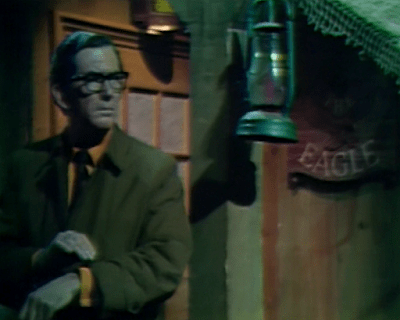
Cyrus’ lawyer, Larry Chase, comes to his laboratory. On Cyrus’ instructions, Larry has drawn up a will naming “Yaeger” as the sole beneficiary of Cyrus’ estate. Larry has met “Yaeger” and been appalled by him. He urges Cyrus to reconsider. Cyrus signs the papers and invites Larry to a late supper. Larry declines, saying that Horace Gladstone called him earlier and wants to meet him outside the Eagle tavern at 10 PM.

Larry was in the drawing room at Collinwood going over some papers with Quentin when he got Gladstone’s call. Cyrus’ newly drafted will fell out of Larry’s briefcase, and Quentin read through it while Larry was looking for another document. Quentin asked some questions about the will. Larry responded to the first by saying that he couldn’t talk about it, but thereafter blabbed away, revealing everything Quentin could want to know. With that level of regard for a client’s confidential communications, we aren’t surprised when Larry tells Cyrus who he is going to meet at what time in what place.

After Larry goes, Cyrus takes the potion, that is, puts on his disguise. He goes to the alley next to the Eagle, in which the sign for the Greenfield Inn hangs. He corners Gladstone there. He beats Gladstone to the pavement with his heavy cane. Gladstone begs for mercy, and Cyrus sneers at him. He releases the bayonet from inside the cane, stabbing Gladstone with it. The first time Cyrus took the potion, he had amnesia after he resumed his normal appearance, and we could believe that he was less than fully responsible for what he did while under its influence. But he has had his full memories on each subsequent occasion, and has shown pleasure when told of the harm “Yaeger” has done and the fear he inspires. By this point, we can classify Cyrus’ killing of Gladstone as nothing other than premeditated murder.

Cyrus doesn’t really surprise us by this act. It is Larry who does something we would not have expected. While Gladstone is in the alley, Larry is already in front of the tavern. We see enough of the set that we cannot believe he is more than 30 or 40 feet away from Gladstone, just around the corner. Gladstone cries out when “Yaeger” attacks him. We cut to Larry, and see him react to that cry and start towards the alley. “Yaeger” stands over Gladstone and pontificates for a minute or two before stabbing him. Even after that, “Yaeger” still has time to get most of the way out of the alley before Larry finally arrives. It took Joshua Collins less time to get from the abode of the dead to the drawing room at Collinwood than it takes Larry to walk the few steps from the sidewalk to the alley. Maybe he had to stop somewhere along the way to make some more announcements about a client’s business.

Larry hears a cry for help. Screenshot by Dark Shadows Before I Die.

Episode 980: I don’t want memories

Heiress Carolyn Collins Stoddard has had a dream in which her new husband, whom she knows as Jeb Hawkes but who when we first saw him asked to be called Jabe, was in a fight on top of Widows’ Hill. His opponent, a stooge named Sky Rumson, threw him off the precipice to his death. When she awoke, Carolyn ran to the hill in search of Jabe. Instead, she found Sky. He told her that her dream was not complete, because it did not show her death. He then grabbed her by the throat.

Jabe rushes up and knocks Carolyn out of Sky’s grip. He and Sky fight, and Sky does throw him off the precipice. Carolyn escapes.

Back home at the great house of Collinwood, Carolyn finds her mother, matriarch Elizabeth Collins Stoddard, and permanent houseguest Julia Hoffman, MD. It takes her a while to compose herself sufficiently to tell Liz and Julia what happened. Julia offers Carolyn a sedative, which prompts her to jump up and shout a verbal refusal. By the time Carolyn starts telling the story, her distant cousin, old world gentleman Barnabas Collins, has joined them in the drawing room. She interrupts herself to yell at Barnabas that he always hated Jabe and is probably glad he’s dead. When Carolyn finishes, Barnabas slips out. Liz calls the police, and Julia is surprised neither of them saw Barnabas leave.

For the last nineteen weeks, the show has been trying to make a story out of some themes drawn from the writings of H. P. Lovecraft. That segment is usually called “the Leviathans,” after a race of Elder Gods who are behind the action. Jabe was central to the Leviathan segment. Sky is the only other character remaining from it. Barnabas appears in the house where Sky has been crashing and finds him packing his bag. Sky does not understand how Barnabas got in. Barnabas dismisses his question, merely saying that Sky knows there are things he can do that ordinary people cannot. Sky draws a revolver and fires two rounds at Barnabas point blank, without effect. Sky exclaims “Oh, no!” Barnabas is amused that none of Sky’s late colleagues told him that he is a vampire. He takes Sky’s hand, curls his arm back so that the gun is pointing at his heart, and squeezes Sky’s finger onto the trigger.

Back at the great house, Liz gets a telephone call from the sheriff. The police haven’t found Jabe’s body, and have surmised that it washed out to sea. They have found Sky, and have tentatively ruled his death a suicide. Later, Carolyn has another dream. In this one, Jabe shows up and confirms his death. That marks the end of the Leviathan segment. Carolyn will go on using the name “Mrs Hawkes” and saying she misses Jabe, but otherwise the last nineteen weeks will be forgotten.

Carolyn sees Jabe for the last time. Screenshot by Dark Shadows Before I Die.

Before killing Sky, Barnabas had mentioned that he almost regrets not leaving him to the other person who is on her way to do him in. That is Sky’s estranged wife, wicked witch Angelique. Had the Leviathan segment been more successful, or had Geoffrey Scott been even marginally competent in his performance as Sky, they might have made something of the parallels between Sky and Jabe. They are both very tall men with blonde wives who are dissatisfied with them. Angelique is dissatisfied that Sky is a tool of the Leviathans and that he tried to set fire to her on the orders of their representative, and Carolyn is dissatisfied with Jabe because he keeps running away from dangers he has brought on himself by his rebellion against the Leviathans and he won’t tell her anything about himself. Sky is a mortal man, while Angelique may once have been human but has long since become a creature of the supernatural. Carolyn is a mortal woman, while Jabe is now human but was originally a shape-shifting monster from beyond space and time.

But the ratings have been sinking throughout the Leviathan period, and the whole narrative structure of the arc keeps collapsing around them every time they try to do anything with it. So they are in too much of a hurry to move on to the next thing to do any exploring of the characters. Also, Scott is hopeless. As my wife, Mrs Acilius, put it, it isn’t that he is an actor with just one strategy. He keeps trying different things, and none of them comes close to working. We won’t see him again.

The new story has to do with an alternate universe that is occasionally visible in a room in the long disused east wing of Collinwood. Barnabas, Julia, and others have been spying on its inhabitants, and Barnabas is fixated on the idea that if he can cross over into it his vampirism will disappear. Since his bloodlust is overwhelming him, he is desperate to pursue this forlorn hope. He goes to the room when the alternate universe cannot be seen there, and a moment later finds that it has changed with him in it. Julia is in the hallway, looking in. At first she and Barnabas can see each other, and she can hear him, though he cannot hear her. After a moment, Carolyn’s alternate universe counterpart enters and demands to know who Barnabas is and what he is doing in the house.

Barnabas took Carolyn as his blood-thrall in October 1967. The show went back in time to 1795 the following month. In the 1790s segment, Nancy Barrett played fluttery heiress Millicent Collins. We saw that Barnabas first became a vampire in 1796; not long after, he took Millicent as his blood thrall. Shortly after the show returned to contemporary dress in March 1968, one of Julia’s colleagues in the mad science profession applied a treatment that put Barnabas’ vampirism into remission. That freed Carolyn of her connection to him, and at some point she forgot it ever happened.

For most of 1969, Dark Shadows was set in 1897. In that segment, Miss Barrett played repressed schoolmarm Charity Trask. Barnabas bit her, too. Carolyn’s counterpart in “Parallel Time,” known by her married name Carolyn Loomis, is the fourth character* Miss Barrett played on Dark Shadows; considering that Barnabas is so frantically hungry, it looks like she will follow in the footsteps of her predecessors and serve as his breakfast.

*Or fifth- in #819, sorcerer Count Petofi found Charity’s personality to be an irritant, so he erased it and replaced it with that of the late Pansy Faye, a Cockney showgirl/ mentalist. From that time on, Miss Barrett played Pansy, not Charity.

Episode 963: A very bizarre practice

The reigning chief villain on Dark Shadows is a shape-shifting monster from beyond space and time. He refuses to shift his shape, since he likes being a tall young man. He isn’t interested in any part of space or time not connected with heiress Carolyn Collins Stoddard, with whom he has fallen in love. He can’t persuade anyone to call him by his preferred name, “Jabe,” so has resigned himself to going by “Jeb.”

As we open, Jabe is raising four men from the dead. That he can do such a thing might suggest that he is a formidable menace, but the introductory voiceover explains that he has no choice about it, since he is “unable to trust one living human being.” Whatever powers he may have, Jabe is surrounded by enemies whom he can battle only by resorting to the most desperate means. We are left wondering how much longer the show can keep the storyline going if it depends on such a feeble menace.

Jabe and one of the zombies are peeking through the window of the Old House on the estate of Collinwood, home to vampire Barnabas Collins, a distant cousin of Carolyn’s. Jabe sees Barnabas’ best friend, mad scientist Julia Hoffman, giving him an injection. He realizes that Julia is trying to treat Barnabas’ vampirism.

Jabe goes to the great house on the estate and orders Carolyn’s mother, matriarch Elizabeth Collins Stoddard, to keep watch over Barnabas’ blood thrall Megan Todd. Liz is one of Jabe’s few remaining followers. He is crude and abusive towards her; she protests that they are in her house, and when he responds to this with a sneer she gives him a look of disbelief. First-time viewers can understand how Jabe came to be so isolated.

When Barnabas was first on the show, from April 1967 to March 1968, Liz never figured out that he was a vampire. The show depended on keeping Liz in the dark about Barnabas’ curse, because she was too civic-minded to let him stay in a house on her estate if she had known that he was an abomination risen from the depths of Hell to prey upon the living, even if he was her cousin. In those days, the show seemed determined to keep Liz on the shelf lest she be stained by contact with the main story, and so they took care to give Barnabas’ adversaries reasons to keep from telling Liz about him.

Now, Liz is under the control of the forces Jabe represents. She is already hostile to Barnabas, and has told Jabe she would try to evict him from Collinwood if that is what he wants her to do. Jabe does not have any reason to withhold from her the fact that his enemy is a vampire.

Moreover, Liz is no longer the symbol of lawful goodness she was two years ago. In #956, she told eleven year old Amy Jennings that she hoped Jabe wouldn’t murder Maggie Evans, The Nicest Girl in Town. Her first reason for not wanting this to happen was that it would remind people of the other murders Jabe has committed. The second, and more important, was that it would tend to exonerate the person they have framed to keep the heat off Jabe. It seems likely that Jabe will soon defeated and Liz will be released from the spell under which she has been laboring, but if she comes out of that remembering what Barnabas is she will also remember that she herself is complicit in some pretty serious felonies, all of them well-known to Barnabas. Since Liz knows that Barnabas is invested in her position in the community and puts a high priority on protecting it, the show wouldn’t have a hard time explaining why she keeps him around, and she would be available to take part in whatever stories they might have going.

Liz is sitting with Megan. She can see that Megan is ill and goes to fetch her a glass of water. When she returns, Megan has gone. We see Megan at Barnabas’ house. Barnabas is intensely hungry. But he does not want to bite her. He knows that if he does so, she will die. She insists, and he gives in.

Julia enters and pronounces Megan dead. Barnabas is in a panic; he had earlier lied when Julia asked him if he had bitten anyone, and he flies directly into hysteria, accusing Julia of implying that he acted deliberately. She keeps her cool and assures him she does not see it that way. Usually Julia’s quickness to make excuses for Barnabas’ murders is an opportunity for Grayson Hall to amaze us with the spectacle of a brilliant woman rationalizing the behavior of a hopelessly evil man, but this scene is a showcase for Jonathan Frid. So they have taken care to establish that Barnabas was overpowered by the need for blood and have shown him taking steps to avoid biting Megan, allowing us to take Julia’s behavior more seriously and focus on Barnabas’ panic.

Barnabas tells Julia that to prevent Megan rising as a vampire they will have to drive a wooden stake through her heart. Previously Barnabas has simply strangled his victims or broken their necks after they died, and that has kept them from coming back. He did this as recently as #951, when he fed on Jabe’s would-be devotee Nelle Gunston. Regular viewers will know that the trip he and Julia make to the basement to fetch a stake is just a setup for them to return and find Megan already gone. Before that happens, there is a strange moment when Barnabas and Julia have the stake and are talking about driving it through Megan’s heart. Barnabas wants to spare Julia that horror, but she smiles warmly as if assuring him that it is her pleasure to join in the act.

Togetherness. Screenshot by Dark Shadows Before I Die.

Jabe dispatches his four zombie henchmen into the great house, saying that he has given them their orders and now it is time to “Carry them out!” Julia lives in the great house, and is working with some test tubes in her bedroom. It’s the first time we’ve seen Julia’s room in years, and the first time we have seen scientific apparatus of any kind there. One of the zombies knocks on her door, another emerges from behind the curtains, and a third comes up and slaps her in the face. Perhaps remembering Jabe’s words as he sent them into the house, they carry her out.

You can’t say the zombies don’t follow instructions. Screenshot by Dark Shadows Before I Die.

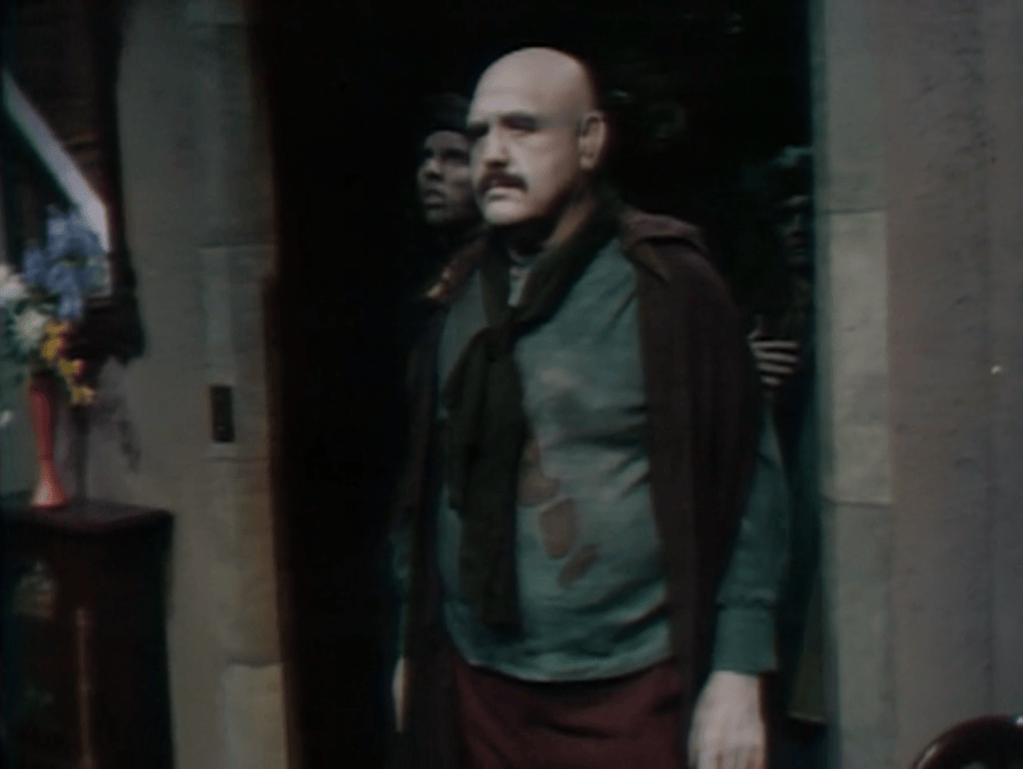
One of the zombies is named Thomas Findley. Longtime viewers will remember Madame Janet Findley, a psychic who made a big impression in three episodes in December 1968, and Margaret Findley, who was one of the ghostly Widows who were prominent in the show’s supernatural back-world in its first 26 weeks. Another zombie is a large bald man who will remind many viewers of Tor Johnson in Plan 9 from Outer Space.

Danny Horn’s post about this one at his great Dark Shadows Every Day is a fascinating comparison of the episode with four issues of Gold Key’s Dark Shadows comic book. Other commentators have mentioned that the graveyard scenes often evoke the sensibility of EC Comics, particularly in the character of The Caretaker, but Danny’s in-depth discussion of what this episode has in common with those four issues is far and away the most substantive analysis I have seen of the overlap between the visual grammar of Dark Shadows and that of comic books.

Episode 935: Call me Jabe

Sheriff Davenport and his new sidekick, mad scientist Julia Hoffman, have come to the top of the stairs above Philip and Megan Todd’s antique shop in the village of Collinsport. The sheriff has a search warrant that specifies the room by the landing as a place of interest in connection with the violent death of one Paul Stoddard. Philip begs the sheriff not to enter the room, saying that a boy who lived there recently died and that any disturbance would “defile” it. He swears the room is entirely empty. The sheriff expresses his sympathy, but opens the door anyway.

Inside is a young man. Philip seems as surprised at the sight of him as are the sheriff and Julia. He gives his name as “Hawkes, Jeb Hawkes. Short for Jabez… Call me Jabe.” No one calls him Jabe, which seems a bit rude. Jabe claims that he came by earlier when Megan was in and Philip was out, and that she offered to let him live in the room.

The room does not contain any furniture, any luggage, or any other movable property whatsoever. Moreover, while it is possible Megan might have rented the room without mentioning it to Philip, it is difficult to see what Jabe has been doing up there since she left, and since Philip has been moving around the rest of the building it is even more difficult to suppose Jabe could have left his belongings elsewhere without attracting Philip’s notice. Jabe claims to be a photographer, but does not appear to have any camera equipment. Moreover, the sheriff will later tell Julia that he noticed a distinctive odor on Jabe that was prominent on Paul’s corpse, and that he found one of Paul’s cufflinks, damaged as by fire, on the floor of the antique shop. In the finest traditions of Collinsport law enforcement, the sheriff does not take Jabe or Philip into custody, question either of them more than cursorily, or close off the antique shop for a further search. He does come back later to tell Jabe that he should think about finding another apartment.

Jabe is the latest embodiment of a mysterious creature that has previously taken the form of a newborn boy, an eight year old boy, an eight year old girl, and a thirteen year old boy. The boys were vicious little tyrants who did not seem to think at all, only to follow impulses to dominate and humiliate whomever they met. The girl was a Doppelgänger of Paul’s daughter Carolyn as she was when she was eight, and she existed specifically to make Paul feel worthless because he was a deadbeat dad. None of these children engaged with another character in a way that meant there was anything at stake for them in any scene. They as much as tell us that the same will be true of Jabe. When Philip complains today that he has put him and Megan in a difficult position by failing to tell them of his plans, Jabe answers “Maybe I just didn’t want to let you know. Maybe I just wanted to see you sweat it out.”

The only time one of the children did anything surprising in an effort to take on an adversary was when the eight year old boy shape-shifted and became the young Carolyn. Had the sheriff not shown the clownish ineptitude typical of his office, but instead done what a real cop would do and arrested Jabe and Philip, they might have created a situation in which Jabe would have to surprise us again. It might be interesting to see him turn into the grown-up Carolyn, for example. As it is, Jabe just insults Philip, goes to the police station, and murders the sheriff.

Jabe berates Philip. Screenshot by Dark Shadows Before I Die.

This puts a new spin on Roger Ebert’s category of “Idiot Plot.” Ebert said that a movie had an Idiot Plot when its story would end immediately if any of the characters had the brains of an average member of the audience. In this case, the story stays stuck in an angry and utterly predictable rut because of the sheriff’s inexplicable nonfeasance.

The first time Mrs Acilius and I watched Dark Shadows through, we hated Jabe and didn’t want to see Christopher Pennock again. Later, Pennock will return in several quite different roles, each of them more appealing than the one before. By the end of the series he had become one of our favorites, and it occurred to us that even as Jabe he managed to do a lot of things right. But there is only so much an actor can do to work around a script problem, and as written Jabe is barely a character at all. His actions cause problems for several other people, but nothing we see him do or hear him say makes us care about why he takes those actions as opposed to any others. It certainly doesn’t help that half of his episodes, including this one, are directed by Henry Kaplan, whose idea of visual composition was to shove a camera so close to an actor’s face that you can see about one half of one cheekbone.

It didn’t have to be that way. Not only was Pennock a fine actor when he had something to work with, but in this episode we have a scene between Julia and rakish libertine Quentin Collins that shows how a character with a bizarre backstory and a record of evil deeds can become an audience favorite. Quentin is down in the dumps because he just failed to rescue his one true love, Amanda Harris, from the realm of the dead. Julia urges him to reconnect with the Collinses of Collinwood. He asks how he can possibly explain that he is 72 years older than he looks and is now alive, even though his ghost carried out a protracted and deadly haunting of the estate. This dialogue shows that Quentin’s origins require us to believe any number of impossible things, and longtime viewers remember that he is a murderer who killed his wife in cold blood, among other unspeakable acts. But all we see in this scene are his charm and the affection that he and Julia have for each other, and we want to see more of that, as much as they can give us. With similar material, Pennock could have achieved similar results. But it is already clear that he won’t get it as Jabe.

Postscript

In his scene with Julia, Quentin says that no one at the hotel where he and Amanda have been staying remembers her, and that all traces of the alias she had been using seem to have disappeared. Julia speculates that when he lost her in the underworld, the last 72 years of Amanda’s life were negated, that the past was reset so that she did in fact die on a night in the 1890s when she might have died had one of the gods of the dead not intervened.

This raises two questions. First, Amanda has been keeping Quentin. If they are now in a timeline where she never came to town, who’s paying his hotel bill and buying his liquor? It’s a standard feature of soap operas that unless they are telling a story about conflicts over ownership of a business or a house or some other valuable property, everyone just has an inexhaustible supply of money, but they put enough time into Amanda and Julia’s squabble as to which one of them would be Quentin’s sugar mama that you might have expected a line or two about this question.

Second, if everyone else has forgotten Amanda, how does Julia remember her? Quentin journeyed through the infernal regions with her, and so I suppose it makes a kind of sense that from that supernatural location he would have a perspective that would transcend our perception of time and space. But Julia was in and around Collinsport the whole time Quentin and Amanda were harrowing the abode of the permanently unavailable. I suppose the real answer is that she is the audience’s point of view character, and as such knows everything we know. But it does leave us wondering if, in the course of her adventures, some kind of uncanny power may have rubbed off on her.