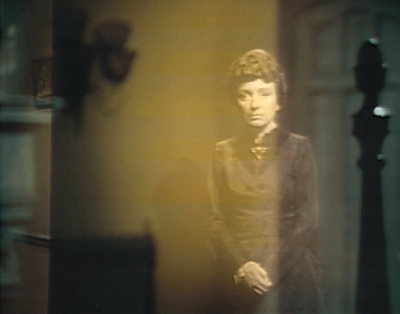
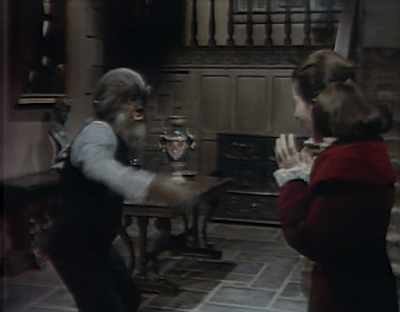
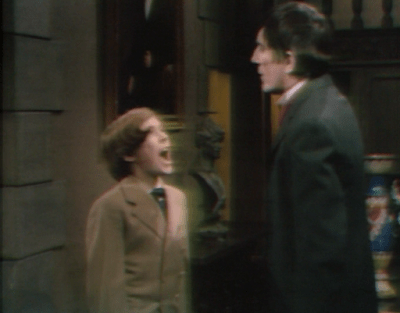
Vampire Barnabas Collins and mad scientist Julia Hoffman have come unstuck in time and found themselves in the year 1995. The estate of Collinwood is in ruins, dominated by an evil ghost named Gerard. Barnabas’ distant cousins Carolyn Fredericks (née Stoddard) and Quentin Collins are insane. Occult expert Timothy Eliot Stokes is sometimes openly hostile, sometimes apparently helpful, but never his usual trustworthy self. Everyone else they knew in 1970 has either gone missing or died. Julia has fallen under the possession of Gerard and turned against Barnabas. Most unaccountable of all, the sheriff of Collinsport is not completely useless at his job.
Barnabas has received a note from Carolyn asking him to meet her in what remains of the great house. He and Julia enter the house; she insists on waiting in the foyer. While he goes into the drawing room, she stares up at Gerard, standing in his usual perch on the walkway at the top of the stairs. Barnabas looked right at Gerard there yesterday and did not see him, so apparently he can be selective about making himself visible.
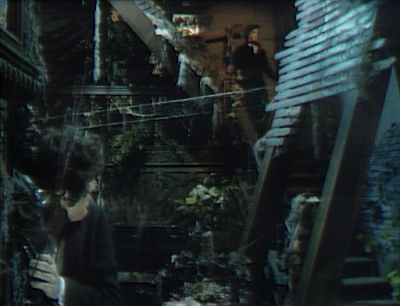
Barnabas finds Carolyn sitting at the desk in the drawing room. She falls over dead. He calls for Julia. Gerard shakes his head, and she does not respond. Barnabas goes to the foyer and brings her to the spot where Carolyn had lain a moment before; she has vanished. The note she was writing is still on the desk; it is made up of six cryptic phrases which Barnabas declares to be clues as to what happened in 1970. He reads them aloud- “The night of the sun and the moon,” “The night Rose Cottage was destroyed,” “The unfinished horoscope,” “The night I sang my song,” “The picnic,” “The murder.” Julia keeps interrupting him, declaring that the phrases are meaningless and Carolyn was mad. He keeps wondering why she has become so uncooperative.
Barnabas tells Julia to find a telephone and call the sheriff. Often on Dark Shadows, people dismiss the idea of calling the police when someone turns up dead, saying that it’s too late to do anything but bury them and move on. But after a lot of back and forth, Julia goes off and does place the call.
Barnabas goes to open the secret panel in the drawing room to see if Gerard stashed Carolyn’s remains there. Gerard himself appears to Barnabas. Barnabas yells at him for a while. Julia comes back, and Gerard disappears. Julia wonders why Gerard did not try to harm Barnabas; Barnabas says that he knows he cannot harm him. This seems to be news to Julia. In 1970, Quentin knew that Barnabas was a vampire. We learned the other day that his contact with Gerard erased this knowledge. We may wonder if this fact has also slipped Julia’s mind.
Barnabas goes upstairs, and asks Julia to bring the sheriff to him when he gets to the house. She agrees. Once he is out of earshot, she asks Gerard if he had to kill Carolyn. She seems sad about it.
Barnabas is at the door of the one room at Collinwood that is in good repair, a mysterious playroom on an upper floor. He can’t get the door open. Julia brings the sheriff, and Barnabas says that the door wasn’t locked when he was there earlier. The sheriff says he has some questions and Barnabas angrily responds “Not now!” Cops don’t love it when you answer them that way, in my experience, but the sheriff does seem to be a bit cowed by the surroundings and he lets it pass.
Barnabas asks the sheriff to try the door. He does, and the knob turns easily. He turns to Barnabas and asks sternly “How much of this is in your imagination, Mr Collins?”
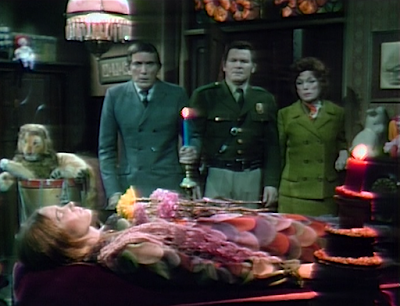
Barnabas’ embarrassment doesn’t last long. Carolyn is laid out on a table in the middle of the room, a spray of flowers on her chest. The sheriff remembers how lovely Carolyn was when she was young; Barnabas stalks around the room yelling at the invisible Gerard. When the sheriff says it is time to go, Julia insists on sitting with Carolyn for a while. The sheriff tells her she’s crazy to want to stay in the middle of the house. He’s not exactly sane himself, leaving her alone at what is after all a crime scene. Once the sheriff and Barnabas have gone, Julia receives further instructions from Gerard.
Barnabas, the sheriff, and Julia pay their respects to the late Ms Fredericks. Screenshot by Dark Shadows Before I Die.
The sheriff finds Quentin at the Old House on the estate. He questions him, and gets some very strange answers. Quentin has worked himself into a state when Julia comes back. She announces that she is a doctor and will now give Quentin a sedative. The sheriff takes her word for her professional credentials, and tries to wrestle Quentin into position for her to give him an injection. He can’t manage it, but Julia speaks to Quentin in a tone that is sufficiently authoritative it calms him down right away. Once he is sedated, Quentin asks the sheriff to take him back to the psychiatric facility from which he recently escaped. The sheriff agrees.
The sheriff turns to Julia and asks where Barnabas is. In lieu of an answer, she tells him to come back to the house immediately before sunset. We cut to Barnabas opening the lid of his coffin. The sheriff is there, sticking a cross in his face, and announcing “I know all about you, Barnabas Collins!” Odd as his behavior in the playroom may have been, this sheriff clearly has more on the ball than did any of his predecessors. It’s a good thing the others weren’t up to his standards. If Sheriff Patterson had been as quick to catch on to what was going on around him in April 1967, Barnabas would have been staked by the end of the month and Dark Shadows would never have become a hit.
Sheriff Patterson may be on the minds of longtime viewers. Sometimes fans wonder what Barnabas’ ultimate plan was when he returned to prey upon the living in 1967. Weren’t the Collinses going to catch on that there was something a bit odd about their “cousin from England” sooner or later, as girls kept disappearing or turning up drained of blood? I think the answer is what we see in these two weeks of episodes, and also in the feature film House of Dark Shadows. Had Barnabas gotten his own way, eventually all living people would have fled Collinwood and no one from the village would have dared approach the estate. He’d have ventured forth occasionally to take fresh victims, but otherwise Collinwood would have been entirely cut off from the outside world. The buildings would have decayed and the grounds been overgrown. It was only because Julia showed up and devised a way to limit his consumption of human blood and to give him hope his curse could be put into remission that he himself did not long ago reduce Collinwood to the condition to which Gerard has brought it.
For many months starting in late 1968, the estate of Collinwood was haunted by the ghost of Quentin Collins. Quentin’s presence became steadily more intolerable until the living members of the Collins family had to abandon the great house in #694. At the end of that episode, we saw Quentin standing on the walkway at the top of the foyer stairs, laughing in triumph.
Vampire Barnabas Collins traveled back in time in #701 and blundered around until history was changed. In #838, set in September 1897, Quentin’s death was prevented. On the anniversary of that event in September 1969, the haunting broke, though the people who lived through it remembered Quentin’s ghost and the events of the haunting. A magic spell was cast on Quentin keeping him forever young, and late in 1969 he took his place among the Collinses whom he had once driven from the family home.
Now, Barnabas and his friend, mad scientist Julia Hoffman, have come unstuck in time again. They find themselves in Collinwood in the year 1995. The house is in ruins, the members of the family either dead, missing, or insane, and the village of Collinsport full of people who won’t answer any of their questions. Quentin is around, having escaped from a psychiatric facility and come back to the estate. Today, Barnabas and Julia have taken him to the great house to try to get him to tell them something useful.
Julia and Barnabas want Quentin to see an upstairs room that is in much better shape than the rest of the house. They open the door, and see a ghost which appears to be strange and troubled teen David Collins. Quentin flees in terror and makes his way to the foyer while Barnabas and Julia watch the ghost vanish.
Quentin finds that he cannot open the front doors. He sees the ghost of a young man staring at him from the walkway at the top of the stairs. Like Quentin during “The Haunting of Collinwood,” this ghost has lots of curly black hair, does not speak, and wears a dark suit from the nineteenth century. Since David Selby is very tall and James Storm is rather the other thing, I can’t help but think of him as Mini-Quentin. The credits tell us that his name is Gerard.
Quentin rolls around on the floor, terrified of Gerard. Barnabas and Julia come and try to calm him down. Quentin says the doors won’t open; Barnabas opens them. Quentin runs out. Julia says she senses an evil presence, which, considering that every character we’ve seen so far is a murderer, is not too surprising. She and Barnabas leave.
Two ghosts dance a minuet by the gazebo. Julia and Barnabas think that one of the ghosts is David; the other is a blonde girl whom they do not recognize. The ghosts kiss each other. They walk towards the woods and vanish.
Barnabas and Julia go to the Old House on the estate. They find Quentin, and overhear him talking in an anguished voice to someone named “Daphne.” He tells them that the ghost they saw was not David Collins, but was named Tad. Julia remembers that they found a birthday card addressed to “Tad” and signed “Carrie.” If the ghost who looks like David is actually Tad, one might assume that the blonde girl is Carrie, though she could be Daphne or some other personage.
The next afternoon, Quentin finds Julia sleeping in an armchair in the parlor of the Old House. He asks to see Barnabas. Julia reacts with puzzlement. She says Quentin knows perfectly well that Barnabas cannot rise until the sun sets. He says he doesn’t know what she’s talking about. Julia is shocked. Once you’ve learned that a fellow is a vampire, that information doesn’t usually slip your mind. But he seems quite sincere. He wanders off.
The blonde girl appears at the window and beckons to Julia. Julia follows her, silently. It seems at first that Julia is in a trance, since she does not call to the girl by the names “Carrie” or “Daphne.” But when the girl leads her into the great house, Julia keeps moving her head around as she watches her step, making it clear she is wide awake. The girl leads her into the strangely intact room, where Gerard is waiting for her.
Danny Horn’s post about the episode on his great Dark Shadows Every Day is full of remarks about how cleverly they blur the line between soundtrack music that the characters can’t hear and atmospheric sounds that they can, disorienting us in a way that adds greatly to the effect of the scares and confusion. It is indeed powerful, and there is a lot of other good stuff in this one.
But this is the first episode of the 1995 segment I wouldn’t show to someone new to Dark Shadows to entice them into watching the show. The pacing is just too slow for the material. We have time to start asking questions that take us out of the story. For example, Julia and Barnabas lament that they have no idea what is going on and are desperate for Quentin to tell them what he knows. But as soon as he volunteers a piece of information, telling him that they saw Tad’s ghost rather than David’s they flatly contradict him. Also, Julia gives Quentin a sedative. We wonder where she got it, since her prescription pad is 25 years out of date and any samples she had in her bag have been sitting out, unrefrigerated and exposed to dry rot, for that same period. Those and other incongruities are the sorts of things we could easily overlook if we were moving as fast as we moved in all five episodes last week, but when events move as leisurely as they do today they mean trouble.
A disruption in the very nature of time and space has thrust vampire Barnabas Collins and mad scientist Julia Hoffman into the year 1995, where the great house of Collinwood is in ruins and everyone is annoyed with them.
Yesterday, Julia and Barnabas were poking around inside the great house against the express instructions of its owner, Carolyn Fredericks, as conveyed earlier in the evening by the sheriff when he arrested them for trespassing. A heavy bust fell from the railing on the top of the foyer stairs, narrowly missing Julia. She and Barnabas fled the house. They looked back, and saw a young man in nineteenth century garb glaring at them from a window.
Today, Barnabas and Julia are in the parlor of the Old House on the estate. She tells him that when she saw the man in the window she was overcome by a powerful sensation. “It was the very essence of evil! I felt evil all around me. I was trapped by it!” Regular viewers may have thought Julia would be used to that by now, but apparently not. “It made me aware of something deep inside me that I don’t even understand — as though, with that one look, he could concentrate every grain of evil I have in my nature! Make it grow, and grow…” She asks Barnabas if he felt the same thing, and he says he didn’t, not at all. He concedes that he is an inhuman abomination from beyond the grave, so maybe he’s immune to that kind of thing.
Meanwhile, Carolyn is at home in the old shack by Finley’s Cove, accompanied by Mrs Johnson, who was the housekeeper at Collinwood in the late 1960s. Carolyn is brushing her hair and smiling. She reminisces about when she was a little girl and Mrs Johnson used to brush her hair. Mrs Johnson is not shy then or later about contradicting anything Carolyn says that is not so, but does not deny that she did that. So the audience is supposed to believe it. Some say this is a retcon, since Mrs Johnson did not join the staff at Collinwood until 1966, when Carolyn was fully grown. But in a comment on Danny Horn’s post about the episode on his great Dark Shadows Every Day, I expounded a theory as to how it might be true:
In the early episodes, Carolyn talks about having gone to school in town. How did she get there?
She can’t have walked; it was miles away, much of it along a winding road with several blind curves. Her mother never left the grounds during those years, she couldn’t have driven her. Roger was living in Augusta with Laura.
(I should expand on this point. Roger says that when Carolyn was born, he was away at boarding school. So he would still have been in college when his niece first became a pupil at Collinsport Elementary. He then busied himself squandering his inheritance, a process which included the ten years between his marriage to Laura and his return to Collinwood. So that doesn’t leave any time for him to have looked after his “Kitten” when she was little.)
The only servant was Matthew. Matthew and Carolyn don’t seem at all close; it doesn’t seem likely that he drove her to school every morning. If a school bus came up the hill to Collinwood day after day, the kids who rode it couldn’t have maintained the attitude Carolyn describes, whispering behind her back about her living with the witch in the haunted house. Sooner or later they’d have started talking to her face to face about it.
Carolyn also talks about Bill Malloy being more like a father to her than any other man, and the two of them do have a cozy relationship. Carolyn is also very quick to fall in with Mrs Johnson when Burke pitches the idea of her joining the household staff at Collinwood. So I think we have to conclude that Bill Malloy and his housekeeper were in charge of getting Carolyn to school in the mornings. Malloy was on the fishing boats, so that would require an early start to the day. There were probably many days when little Carolyn was still in her pajamas when she got to the Malloy house. On those days, Mrs Johnson brushed her hair while the water came to a boil for breakfast.
Comment left by “Acilius,” 27 January 2021, on Danny Horn, “Episode 1064: Here Comes the Hotstepper,” Dark Shadows Every Day, 20 August 2017.
Carolyn seems to be a crazy lady these days. Yesterday, we saw that much of this is an act, but in her scene with Mrs Johnson we see that it is an act she puts on even when she is alone with someone she trusts. It allows her to smile and laugh and be happy even when she is surrounded by the residue of an unimaginable catastrophe.
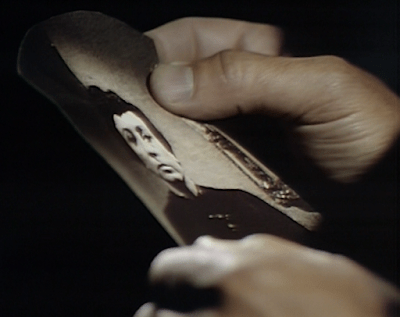
Carolyn tells Mrs Johnson that she will be going to the great house of Collinwood to get ready to host a picnic at the gazebo, which she pronounces “ga-ZAY-bo” in a bit of Collinsport English that we’ve been hearing intermittently since Lara Parker invented it in the summer of 1968. Mrs Johnson reacts with horror, saying that no one can go to the devil-haunted wreckage of Collinwood, but Carolyn laughs off her objections. Carolyn shows a picture of a picnic they had at the ga-ZAY-bo in 1970, the last year Collinwood was habitable. Mrs Johnson spots a figure in the background and declares that was “the first time we saw him.” Carolyn gets upset and tears up the picture.
Barnabas had insisted to Julia that the man they saw at the window may not be the only supernatural entity operating within the great house, and Carolyn seems to confirm that he is right. She does not want to hear Mrs Johnson referring to him, nor does she want to have a picture of him. But she happily says that she is going to the great house tonight with a present, because it is his birthday. Apparently him and his refer to different beings, each of which inheres in the haunting. One wonders how much of supernaturalism would dissolve if people would just use proper names instead of pronouns.
Julia and Barnabas barge into Carolyn’s house. Carolyn tells them to get out, which they refuse to do. They badger her with the story of what happened when they were illegally roaming around in her other house, and Mrs Johnson runs out. Eventually Carolyn resumes her crazy lady demeanor. Barnabas and Julia give up and leave, and for a moment we wonder if they are on their way to let themselves into some other property of Carolyn’s.
Julia and Barnabas go back to the Old House. They find that Mrs Johnson is waiting for them there. They tell her that they are time travelers, and that if she will tell them what happened they might be able to go back and prevent it. She is dubious about this claim, but starts telling the story anyway. She casts her mind back to the summer of 1970. “It all began when the days were so beautiful, you couldn’t help but be happy. There was a spirit of joy at Collinwood; there was a feeling that hadn’t been there in a long time. There was so much love among all of us at that time…” This would be the period that began immediately after Barnabas and Julia left.
Mrs Johnson says that all of the beauty and joy and love and other things you might experience when you don’t have a vampire and a mad scientist around your estate came to an end one quiet night. She seems to be on the point of saying something important when she looks at the window of the parlor and sees the glaring young man. She breaks off, screams that she won’t tell, and runs out into the night. Julia tells Barnabas she felt the evil presence, and that the ghost was there. They go out to look for Mrs Johnson.
The ghost catches up to Mrs Johnson first. He touches her shoulder, and she dies. When Barnabas and Julia find Mrs Johnson, she is sitting on the ground, her back against a tree, her eyes open. This was the same posture in which Clarice Blackburn’s character Abigail Collins was found when we saw her corpse in #432. That image was a brief shocker in the last couple of seconds of the episode; this time the camera zooms in on Blackburn’s face and pans across it, allowing her to show that an outstanding actress can give a powerful performance even when she is altogether motionless.
Carolyn happens by. Julia and Barnabas hide. Carolyn thinks Mrs Johnson is alive and chatters to her. As the truth begins to dawn, Carolyn’s alarm mounts. Finally Barnabas and Julia emerge from the shadows. Carolyn accuses them of killing Mrs Johnson. They deny their guilt. Carolyn is unconvinced, and indeed we cannot help but think that since Mrs Johnson lived through the 25 years of their absence and turned up dead so shortly after they returned, Julia and Barnabas cannot be exactly innocent.
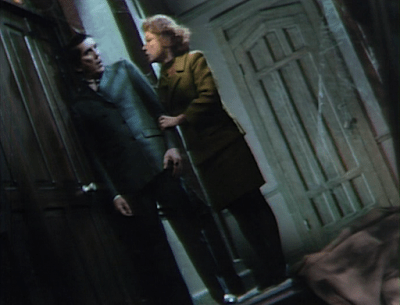
Barnabas and Julia follow Carolyn into the great house. Julia wonders what Mrs Johnson could have meant by “the children’s old room.” This is a blooper on Grayson Hall’s part- Mrs Johnson mentioned “the room the children called The Playroom.” Julia and Barnabas hear music playing, and follow it to a room upstairs. Barnabas looks at the doorway and remarks that the room was never there when he knew the house. The shot is framed at such a severe Dutch angle that we can tell something isn’t on the level.
They hear Carolyn inside, talking and laughing with at least one other person. Since their whole philosophy of life now seems to be making themselves as obnoxious as possible to Carolyn, they let themselves in.
Maggie Collins is unnerved because people keep getting murdered in and around the great house of Collinwood. Her husband Quentin was arrested for one of those murders and is the prime suspect in another. He escaped from jail, just in time to be unable to account for his whereabouts during yet another. Maggie goes downstairs and finds old world gentleman Barnabas Collins in the foyer.
Maggie mentions that Alexis Stokes, identical twin sister of Quentin’s late wife Angelique, has suddenly taken ill and is asking her to call her father, evil barfly Tim Stokes. Maggie does not understand what Stokes can do that a doctor can’t, but this has happened before and Stokes was able to fix the problem. Barnabas excuses himself, saying he has urgent business to attend to at the Old House on the other side of the estate. He promises to be back soon.
Maggie hears footsteps outside her bedroom, which she thinks might be Quentin’s. The only friend she has in the great house at the moment is Elizabeth Collins Stoddard, who is under sedation following the murder of her daughter. So she rushes to the Old House to look for Barnabas. He is not in; she finds a strange man in the parlor. She asks him who he is and what he is doing there. He insists that he will ask the questions. He asks what Barnabas has done with “her.” Maggie has no idea what he is talking about. He demands that she look into his eyes; as soon as she does, he realizes she is telling the truth. He orders her to tell Barnabas that he will be back, but refuses to give his name.
Maggie runs back to the great house. She finds Barnabas in the foyer, and gives him a full report. Barnabas urges Maggie to believe in Quentin’s innocence. That is something she can no longer do. She says that she is afraid that Quentin has lost his mind and that he will kill everyone in the house, one by one. We pan out and see Quentin lurking at the top of the stairs, listening.
Maggie has a dream. Quentin comes home smiling, with a spring in his step, after chairing a meeting of the board of directors of Collinsport Enterprises. He takes her in his arms and tells her he’s neglected her long enough. She says she doesn’t feel neglected. He says he is taking six months off work, and that the two of them will be leaving tomorrow for a trip around the world.
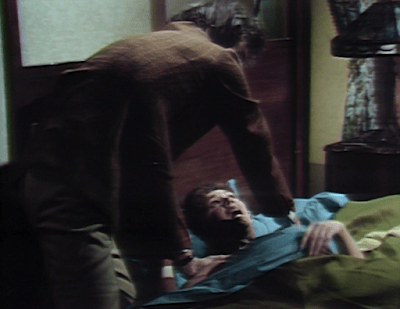
Quentin finds a bouquet of flowers. He instantly becomes extremely hostile. He accuses Maggie of receiving the flowers as a gift from her lover. She is baffled and denies his allegations. He strangles her. She wakes up, and finds Quentin standing over her, his hands on either side of her neck.
We’ve never seen Quentin and Maggie as happy as they are in the opening part of her dream, but we have several times seen his mood abruptly flip from cheerful to violent. He is not entirely guilty of any of the murders, but he does sometimes choke people, and was in fact choking the person he is charged with strangling immediately before a witch cast a spell to complete the killing.
Moreover, we have seen a dream very much like this one before. For its first 196 weeks, Dark Shadows was set in another universe. In that continuity, Maggie’s counterpart dreamed of Quentin’s ghost in #682. That dream began with Quentin taking a delighted Maggie in his arms and dancing with her; all of a sudden, for no discernible reason, he interrupted the dance to strangle her.
That Quentin did not confine his strangulations to dreams. He murdered his wife Jenny by strangulation in #748. Wife-strangling is a pastime the two Quentins have in common. This Quentin is suspected of killing Angelique. His defense against that charge is that he could not have driven the pin into the back of her head that killed her, because he was using both hands to choke her at the time. So it would seem that Maggie’s fears are well-founded.
In #808, set in the year 1897, the chief villain was sorcerer Count Petofi. Petofi’s henchman Aristide threatened an enemy with “the mysterious shadow he can cast, the shadow that isn’t your own that follows you.” That suggested a borrowing from George MacDonald’s once-famous 1858 novel Phantastes, one of the forerunners of the “fantasy” genre. MacDonald’s protagonist, Anodos (whose name comes from the Greek for “No Way,”) travels through Fairyland. Anodos falls afoul of an ash tree, which uses its magical powers to plague him with an autonomous shadow. The shadow comes and goes as Anodos makes his journey; at times he finds himself morbidly attached to it, at other times full of despair at the sight of it. In a climactic section, he is trapped in a tower, alone with the shadow and afraid he will remain solitary forevermore. He is freed of the shadow in the end.
Though MacDonald’s popularity faded as the years went on, he was still quite popular in some circles in the 1960s, a beneficiary of the enthusiastic endorsements of writers like C. S. Lewis, J. R. R. Tolkien, and W. H. Auden, who admired not only his manner of evoking a dream but also his intense Christian fervor. He still has a following today. Writer Meredith Finch and artists Christine Norrie and Andrew Pepoy adapted Phantastes into a graphic novel in 2022.
Shortly after the shadow is attached to him, Anodos happens upon a cottage in the woods. He enters, and meets a wise woman. She tells him what has happened:
The woman never raised her face, the upper part of which alone I could see distinctly; but, as soon as I stepped within the threshold, she began to read aloud, in a low and not altogether unpleasing voice, from an ancient little volume which she held open with one hand on the table upon which stood the lamp. What she read was something like this:
“So, then, as darkness had no beginning, neither will it ever have an end. So, then, is it eternal. The negation of aught else, is its affirmation. Where the light cannot come, there abideth the darkness. The light doth but hollow a mine out of the infinite extension of the darkness. And ever upon the steps of the light treadeth the darkness; yea, springeth in fountains and wells amidst it, from the secret channels of its mighty sea. Truly, man is but a passing flame, moving unquietly amid the surrounding rest of night; without which he yet could not be, and whereof he is in part compounded.”
As I drew nearer, and she read on, she moved a little to turn a leaf of the dark old volume, and I saw that her face was sallow and slightly forbidding. Her forehead was high, and her black eyes repressedly quiet. But she took no notice of me. This end of the cottage, if cottage it could be called, was destitute of furniture, except the table with the lamp, and the chair on which the woman sat. In one corner was a door, apparently of a cupboard in the wall, but which might lead to a room beyond. Still the irresistible desire which had made me enter the building urged me: I must open that door, and see what was beyond it. I approached, and laid my hand on the rude latch. Then the woman spoke, but without lifting her head or looking at me: “You had better not open that door.” This was uttered quite quietly; and she went on with her reading, partly in silence, partly aloud; but both modes seemed equally intended for herself alone. The prohibition, however, only increased my desire to see; and as she took no further notice, I gently opened the door to its full width, and looked in. At first, I saw nothing worthy of attention. It seemed a common closet, with shelves on each hand, on which stood various little necessaries for the humble uses of a cottage. In one corner stood one or two brooms, in another a hatchet and other common tools; showing that it was in use every hour of the day for household purposes. But, as I looked, I saw that there were no shelves at the back, and that an empty space went in further; its termination appearing to be a faintly glimmering wall or curtain, somewhat less, however, than the width and height of the doorway where I stood. But, as I continued looking, for a few seconds, towards this faintly luminous limit, my eyes came into true relation with their object. All at once, with such a shiver as when one is suddenly conscious of the presence of another in a room where he has, for hours, considered himself alone, I saw that the seemingly luminous extremity was a sky, as of night, beheld through the long perspective of a narrow, dark passage, through what, or built of what, I could not tell. As I gazed, I clearly discerned two or three stars glimmering faintly in the distant blue. But, suddenly, and as if it had been running fast from a far distance for this very point, and had turned the corner without abating its swiftness, a dark figure sped into and along the passage from the blue opening at the remote end. I started back and shuddered, but kept looking, for I could not help it. On and on it came, with a speedy approach but delayed arrival; till, at last, through the many gradations of approach, it seemed to come within the sphere of myself, rushed up to me, and passed me into the cottage. All I could tell of its appearance was, that it seemed to be a dark human figure. Its motion was entirely noiseless, and might be called a gliding, were it not that it appeared that of a runner, but with ghostly feet. I had moved back yet a little to let him pass me, and looked round after him instantly. I could not see him.
“Where is he?” I said, in some alarm, to the woman, who still sat reading.
“There, on the floor, behind you,” she said, pointing with her arm half-outstretched, but not lifting her eyes. I turned and looked, but saw nothing. Then with a feeling that there was yet something behind me, I looked round over my shoulder; and there, on the ground, lay a black shadow, the size of a man. It was so dark, that I could see it in the dim light of the lamp, which shone full upon it, apparently without thinning at all the intensity of its hue.
“I told you,” said the woman, “you had better not look into that closet.”
“What is it?” I said, with a growing sense of horror.
“It is only your shadow that has found you,” she replied. “Everybody’s shadow is ranging up and down looking for him. I believe you call it by a different name in your world: yours has found you, as every person’s is almost certain to do who looks into that closet, especially after meeting one in the forest, whom I dare say you have met.”
Here, for the first time, she lifted her head, and looked full at me: her mouth was full of long, white, shining teeth; and I knew that I was in the house of the ogre. I could not speak, but turned and left the house, with the shadow at my heels. “A nice sort of valet to have,” I said to myself bitterly, as I stepped into the sunshine, and, looking over my shoulder, saw that it lay yet blacker in the full blaze of the sunlight. Indeed, only when I stood between it and the sun, was the blackness at all diminished. I was so bewildered—stunned—both by the event itself and its suddenness, that I could not at all realise to myself what it would be to have such a constant and strange attendance; but with a dim conviction that my present dislike would soon grow to loathing, I took my dreary way through the wood.
The Visionary Novels of George MacDonald: Lilith and Phantastes, edited by Anne Fremantle (Noonday Press, 1954) pages 311-314*
Petofi never got round to casting the mysterious shadow on any of his enemies or doing anything else to remind people of MacDonald’s works. But today wicked witch Angelique picks up on Aristide’s suggestion. One-man wrecking crew Jeb Hawkes, alias Jabe, comes home to the carriage house on the estate of Colllinwood and finds Angelique waiting for him. She tells Jabe she blames him for something that happened to her husband. He denies responsibility. Ignoring his protests, she trims a piece of black construction paper into a crude figure. She places the figure on his chest and tells him it will spell his doom.
Jabe has no idea how this could be. Angelique thinks aloud for a moment about keeping him guessing, then decides she may as well tell him. She instructs him to look into the fire. When he does, he has a vision of himself asleep in bed (fully clothed, of course, it’s Collinsport) when a shadow in the form of Angelique’s cutout appears, engulfs him, and makes him scream. We cut back to the carriage house, where Jabe keeps telling Angelique that she while she may be able to make him have visions, she can’t cause such a thing to happen in reality. She assures him she can.
The carriage house is a cottage in the woods, so in this scene Angelique combines the roles of the wise woman who explains the shadow curse to Anodos and the ash tree that places it. The cutout is a much sillier visual than was the image Anodos saw in chapter four of Phantastes, when his curse began:
When [the Moon] shone out again, with a brilliancy increased by the contrast, I saw plainly on the path before me—from around which at this spot the trees receded, leaving a small space of green sward—the shadow of a large hand, with knotty joints and protuberances here and there. Especially I remarked, even in the midst of my fear, the bulbous points of the fingers. I looked hurriedly all around, but could see nothing from which such a shadow should fall. Now, however, that I had a direction, however undetermined, in which to project my apprehension, the very sense of danger and need of action overcame that stifling which is the worst property of fear. I reflected in a moment, that if this were indeed a shadow, it was useless to look for the object that cast it in any other direction than between the shadow and the moon. I looked, and peered, and intensified my vision, all to no purpose. I could see nothing of that kind, not even an ash-tree in the neighbourhood. Still the shadow remained; not steady, but moving to and fro, and once I saw the fingers close, and grind themselves close, like the claws of a wild animal, as if in uncontrollable longing for some anticipated prey. There seemed but one mode left of discovering the substance of this shadow. I went forward boldly, though with an inward shudder which I would not heed, to the spot where the shadow lay, threw myself on the ground, laid my head within the form of the hand, and turned my eyes towards the moon. Good heavens! what did I see? I wonder that ever I arose, and that the very shadow of the hand did not hold me where I lay until fear had frozen my brain. I saw the strangest figure; vague, shadowy, almost transparent, in the central parts, and gradually deepening in substance towards the outside, until it ended in extremities capable of casting such a shadow as fell from the hand, through the awful fingers of which I now saw the moon. The hand was uplifted in the attitude of a paw about to strike its prey. But the face, which throbbed with fluctuating and pulsatory visibility—not from changes in the light it reflected, but from changes in its own conditions of reflecting power, the alterations being from within, not from without—it was horrible. I do not know how to describe it. It caused a new sensation. Just as one cannot translate a horrible odour, or a ghastly pain, or a fearful sound, into words, so I cannot describe this new form of awful hideousness. I can only try to describe something that is not it, but seems somewhat parallel to it; or at least is suggested by it. It reminded me of what I had heard of vampires; for the face resembled that of a corpse more than anything else I can think of; especially when I can conceive such a face in motion, but not suggesting any life as the source of the motion. The features were rather handsome than otherwise, except the mouth, which had scarcely a curve in it. The lips were of equal thickness; but the thickness was not at all remarkable, even although they looked slightly swollen. They seemed fixedly open, but were not wide apart. Of course I did not remark these lineaments at the time: I was too horrified for that. I noted them afterwards, when the form returned on my inward sight with a vividness too intense to admit of my doubting the accuracy of the reflex. But the most awful of the features were the eyes. These were alive, yet not with life.
They seemed lighted up with an infinite greed. A gnawing voracity, which devoured the devourer, seemed to be the indwelling and propelling power of the whole ghostly apparition. I lay for a few moments simply imbruted with terror; when another cloud, obscuring the moon, delivered me from the immediately paralysing effects of the presence to the vision of the object of horror, while it added the force of imagination to the power of fear within me; inasmuch as, knowing far worse cause for apprehension than before, I remained equally ignorant from what I had to defend myself, or how to take any precautions: he might be upon me in the darkness any moment. I sprang to my feet, and sped I knew not whither, only away from the spectre. I thought no longer of the path, and often narrowly escaped dashing myself against a tree, in my headlong flight of fear.
The Visionary Novels of George MacDonald: Lilith and Phantastes, edited by Anne Fremantle (Noonday Press, 1954) pages 284-286
The only images of the sky we ever see on Dark Shadows are stock footage and stills; a massive translucent figure looming in front of the moon, an immense shadow itself casting a shadow on the ground below, is far beyond anything they have attempted. So we can understand why they decided to go to the opposite extreme, and try to build an initially unprepossessing prop into something powerful. Moreover, the show at this point has an audience consisting very largely of elementary school students, so the sight of a major character using scissors to trim a figure out of construction paper will be relatable.
The shadow that follows Anodos does not develop the ability to cause physical harm to him. It wears him down psychologically, and is the Reverend MacDonald’s allegory for anxiety resulting from sin. Jabe’s vision tells us that this story will deviate from the source material, and that his shadow will grow in size and intensity until it kills Jabe.
Of course, a story about a dark shadow involves the show making reference to its own title. Around the time Dark Shadows was on the air, it was a fad for teenagers in movie theaters to cheer whenever a character said the title of the film. I wonder if the appearances of Jabe’s unwanted companion prompted many members of the original audience to cheer.
Closing Miscellany
There is a moment that may not mean much to first-time viewers, but that will astonish confirmed fans. Jabe goes into the drawing room of the great house of Collinwood. Matriarch Elizabeth Collins Stoddard introduces him to Angelique, whom she knows only as a fellow rich lady. When Liz starts telling Jabe about Angelique’s stately home, Angelique volunteers that Jabe has been there and that he is close to her husband. Throughout the preceding 193 weeks, characters have been able to count on their enemies to keep their secrets for them. Disclosing information relevant to the plot to Liz is particularly inconceivable, even in the most desperate circumstances. When Angelique disregards these rules, she is going so far against the grain that my wife, Mrs Acilius, wondered for a second if Lara Parker had decided to throw the script away and blow up the show.
Today marks the final appearance of two actors on Dark Shadows. Roger Davis first appeared in #404 as an unpleasant man named Peter Bradford; today he is Peter’s ghost. Mr Davis played several other parts in the interval, all of them selfish, handsy men with an irritating habit of shouting their lines in a voice rising, not from the diaphragm, but from tightened rectal sphincters. Making matters even worse, Mr Davis is a highly trained, accomplished actor who is capable of doing excellent work. Once in a rare while, he deigns to put his skills to use on Dark Shadows, and he was part of one or two of the best scenes on the show. But most of the time, he chooses to put all of that aside and instead assaults his female scene partners on camera and subjects us to his unvarying anal screech. When Angelique dismisses him, we forgive her all her past misdeeds. Mr Davis will be back as the juvenile lead in the feature House of Dark Shadows, but at least we no longer have to dread 4:00 PM on weekdays.
Christopher Bernau also makes his departure as Philip Todd, Jabe’s onetime foster father. The part of Philip didn’t give Bernau much to work with, and he compounded the difficulties by playing him as if he were Jack Benny. But Bernau, too, was a very capable actor, and he was a true professional. A few times he has shown us what he can do, and he will be missed. Later in the 1970s Bernau achieved fame in two parts that harked back to Dark Shadows. He played Dracula on Broadway in 1977. That same year, he joined the cast of The Guiding Light as womanizing rogue Alan Spaulding, a part he played for several years until his death, of AIDS, in 1989. I reminisced about Bernau’s Alan Spaulding on Danny Horn’s great Dark Shadows Every Day:
I was a kid when Bernau joined GUIDING LIGHT. My mother watched that show, and I had several times attempted to watch it with her, but it always defeated me after 5 or 10 minutes. It just seemed like a window into the deepest level of Hell, the frozen cavern where absolutely nothing happens. But Bernau caught my imagination. I could watch entire episodes if he was in them.
Years later, when I watched DARK SHADOWS on the Sci-Fi Channel, I realized what made Bernau so compelling on GUIDING LIGHT. He was doing a Jonathan Frid imitation. Within moments of first seeing Barnabas, I exclaimed “Alan Spaulding!” It was only years later that I learned Bernau had been on DARK SHADOWS.
Comment left 10 December 2020 by Acilius, on Danny Horn, “Episode 888: Little Shop,” 26 June 2016, Dark Shadows Every Day.
Alan Spaulding was such a hit for Bernau that there can be no doubt a Jonathan Frid imitation was a better starting place for him than was a Jack Benny imitation, at least in daytime.
The closing credits run over a view of the landing at the top of the foyer stairs. We see this space straight-on, an unusual angle. Typically they tilt the camera way back and look up at it. Perhaps they are showing off some new equipment.
*I first heard of Phantastes from a January 2022 episode of God and Comics, a podcast that three Episcopal priests did until shortly after one of them flaked off and became a Roman Catholic. When they talked about Anodos’ shadow, I wished I had a Dark Shadows blog, so I could tell people about the connection to this story.
My copy of The Visionary Novels of George MacDonald is one I came across at a charity book sale in May of 2025. I’ve had it on the table next to the spot where I sit when I write these posts ever since. It isn’t my kind of writing. I usually enjoy dry, matter-of-fact prose, while MacDonald was rarely less florid than in the passages above. Besides which, MacDonald was a sometime clergyman whose evangelistic zeal led even the Reverend Misters hosting God and Comics to admit that his books reminded them too much of their day jobs for their taste. For my part, I say there’s a place for everything, and the proper place for MacDonald’s heavy-handed style of preaching is a pulpit in a church I don’t attend.
**As the saying goes, people who call Twitter “X” would have turned you in to the Stasi.
In May and June of 1967, vampire Barnabas Collins held Maggie Evans, The Nicest Girl in Town, prisoner. He drank her blood, tortured her, and drove her insane. When Maggie escaped, he turned his attentions to well-meaning governess Vicki Winters. Maggie’s imprisonment was the storyline that first made Dark Shadows a hit, but it was bleak and often difficult to watch, and if its horrors had shortly after been reenacted with Vicki as the victim many viewers would likely have given up on the show. So Barnabas decided that he wanted Vicki to come to him of her own will. That avoided the problem, but left the show stuck in a rut. For the next several months, Barnabas did not have a coherent goal. Since he was the main figure in the A story, that left Dark Shadows spinning in circles.
They escaped from that rut in November 1967, when Vicki went back in time to the 1790s. The audience followed her there, and we found out how Barnabas first became a vampire. He had fallen afoul of wicked witch Angelique. Angelique wanted Barnabas to love her. Since her enormous powers were explicitly shown to include the ability to make people fall in love with each other, we wondered why she didn’t simply use that ability on Barnabas. They answered that question by having Angelique declare that she wanted him to come to her of his own will. She tried to attract his love by casting a series of spells on everyone around him, spells that resulted in death and ruin for the people he most cared about. When Barnabas found out what was going on and tried to kill Angelique, she turned him into a vampire.
Now it is January 1970, and Barnabas’ vampire curse is in abeyance. A race of Elder Gods called the Leviathan People are trying to retake the Earth from humankind, and have threatened to reactivate the curse if he does not help them. The Leviathans control a group of people whom they have formed into a cult devoted to their service. The Leviathans have brought a shape-shifting monster to life, and it is written that the monster will marry Barnabas’ distant cousin Carolyn Collins Stoddard and turn her into a creature like himself.
Angelique has renounced her powers and is trying to live as a mortal woman. The other day, Barnabas asked her to help him protect Carolyn from the Leviathans. Angelique no longer wants anything to do with Barnabas or anyone else from the estate of Collinwood, but she understands the threat the Leviathans pose and is willing to help Barnabas against them, provided she can do so without losing what she has in her current life. Barnabas arranged for Carolyn and her mother, matriarch Elizabeth Collins Stoddard, to hide out at Angelique’s house while he tried to figure out a way of fighting the monster. Liz is a dedicated member of the cult, and believes Barnabas to be its faithful leader, so when Barnabas told her to take Carolyn to Angelique’s she complied at once.
Unknown to Angelique, her husband, hard-charging businessman Sky Rumson, is himself a member of the Leviathan cult. Thursday, he telephoned the monster and told him Carolyn was at the house; Friday he opened the door to the monster, and the monster went to Carolyn. Today, the monster decides that he will not impose the transformation on Carolyn after all. Instead, he will wait for her to come to him of her own will. This keeps the story from ending here, but it makes it unclear where it can go.
The monster’s decision poses a deeper problem for him as a presence on the show than the similar decisions did for Barnabas and Angelique. They pursued identifiable goals, and were influenced by thoughts and feelings they had while they interacted with others. The only goal the monster has is to take possession of Carolyn, and now it is unclear what that means. Nor is anything at stake for him in any encounter with another person. He keeps saying that he doesn’t need anyone, and that seems to be true- there is no reason to pay attention to him in any scene. He has, in short, been established not as a character at all, but simply as a function. All he has ever been is Threat. Now that he has decided to be nice to Carolyn, he will no longer even fulfill that function. His future would appear to be quite limited.
Sky also appears to be a short-timer. When Dark Shadows started, one of its most dynamic characters was hard-charging businessman Burke Devlin, played ably by the charismatic Mitchell Ryan. Despite all of Ryan’s magnetism, they could never come up with anything very interesting for Burke to do. Hard-charging businessman just isn’t a type they have much use for. They signal that Sky won’t be around long by casting Geoffrey Scott in the role. Scott was very handsome and would go on to a long career on screen, but in early 1970 he did not appear to have any skills of any kind as an actor. Not only does he deliver his dialogue as if he were reading a series of nonsense syllables aloud, but he is noticeably bad at hitting his mark. For example, on Friday Sky at one point backed away from Carolyn during a conversation. He took a step too far, with the result that his rear end was a few inches from a hearth with a vigorously burning fire. It was hard not to watch the seat of his pants and wait for it to ignite. There were times when they cast actors who still needed a lot of training and kept them around for quite a while, but Scott was at this point in his career so amazingly inept that it is hard to imagine they meant to use him for anything more than the decorative value his good looks offered.
Liz is at home in the great house of Collinwood when a man she has not seen before appears on the walkway above the foyer and starts giving her orders. He comes down and introduces himself to her by the name Bruno. He shows her that he is wearing a ring that identifies him as a member of the Leviathan cult. Liz says that he must have come to give her instructions. He confirms that this is so.
A howling resounds outside, and Bruno asks Liz about it. She tells him that she long ago met a wolf-like creature in the woods, and she suspects the howling comes from that creature. Returning viewers know that the Leviathans are vulnerable to werewolves and that the monster is terrified of them. Bruno knows this too, so he goes out to hunt for it.
The monster, in the form of a tall young man, comes to the great house to introduce himself to Liz. She is concerned when he tells her to stop taking orders from Barnabas, but delighted when he says that Carolyn has a future with “us.” Carolyn telephones from Angelique’s house, and Liz puts the monster on the phone.
Carolyn is all smiles when she is talking to the monster. They’ve met a few times, and he has been nothing but a jerk to her. She had objected to his behavior, and his responses had ranged from frightening to slimy. That she is all of a sudden attracted to him undercuts her character almost as badly as nerfing his threat to her undercuts his position on the show.
After the phone call, Bruno returns. He tells the monster he couldn’t find the werewolf. The monster declares that he will go to the Old House on the estate to confront Barnabas, whom he labels a traitor. Bruno points out that it is almost daybreak, and if he waits just a little while he will not be in danger from the werewolf. The monster says that it is too important to wait.
The werewolf chases the monster through the woods. By the time the monster gets to the Old House, he is shouting for Barnabas, the “traitor” he was planning to deal with, to come and help him. Barnabas is nowhere to be seen, and we end with the werewolf bursting through the window. The werewolf got a few closeups earlier in the episode, when he was nosing around in the woods. These always make him look like a cute widdle doggie. If they hadn’t given us those ridiculous images, his entrance through the window might have been a genuinely scary moment.
Carolyn’s scene at the beginning involves a couple of notable wardrobe-related points. She went to bed Friday fully dressed, even wearing shoes, and is still that way when she is back in bed today. Several times we have seen men go to bed shoes and all, but usually the women wear nighties. I think this is the first time we have seen a shod woman asleep in bed.
Carolyn falls on her back in the opening reprise. She is wearing a very short skirt, and this fall exposes her underwear. She is lying on the bed in several subsequent shots, and it must have taken some doing to keep the undies from making another unscheduled guest appearance.
In #762, the Rev’d Mr Gregory Trask walked in on lawyer Evan Hanley and handsome rake Quentin Collins as they were performing a Satanic rite. Trask’s response was to blackmail Evan. Trask wanted his wife Minerva out of the way so that he could marry rich spinster Judith Collins, Quentin’s sister. Threatened with exposure, Evan cast a spell on an unfortunate young man named Tim Shaw. He brainwashed Tim into reenacting the plot of The Manchurian Candidate, with Trask in the Angela Lansbury role and Evan as the People’s Republic of China. As Evan and Trask planned, Tim killed Minerva. Shortly after, Trask married Judith.
On their wedding day, Judith saw Minerva’s ghost in the corner of the drawing room in the great house of Collinwood. In yesterday’s episode, Minerva’s ghost took possession of Judith, and the closing cliffhanger showed the possessed Judith about to stab Evan with a letter opener to avenge Minerva’s death. As we open today, Judith’s brother Edward enters and prevents the stabbing, and Judith is released from possession. She can remember nothing that happened while she was under Minerva’s power, and Edward is convinced that she has gone mad.
Edward takes Judith to her room, and Trask enters. Evan tells him that Minerva’s ghost has been in touch with Judith. The ghost knows what they did, and if the contact continues Judith will know as well. Trask demands that Evan do something to prevent that, and Evan says that he can cast a spell that may turn the haunting to their advantage and neutralize Judith permanently.
The plan turns out to be the creation of a “black ghost.” The only Black actor to have had a speaking part on Dark Shadows was Beverley Hope Atkinson, who played an unnamed nurse in one scene in #563, almost a year ago. Humbert Allen Astredo, who plays Evan, was also in that scene, playing suave warlock Nicholas Blair. Atkinson was terrific, and it would be great to see her again, but it turns out that the “black ghost” is not actually black. Nor is it a ghost. This misnamed entity is a simulacrum of Minerva, a kind of supernatural hologram that Evan will fabricate and that will appear when Judith is around. This will lead Judith to believe that she is insane, thereby causing her actually to become insane and to cease to be an obstacle to Trask’s enjoyment of her wealth.
The simulacrum first shows up in a transparent form in Judith’s bedroom. Judith screams. In the drawing room, Trask and Edward hear her scream and break off a conversation in which Edward has been urging Trask to agree to annul his marriage to the obviously disturbed Judith. Judith comes downstairs. She is reluctant to explain why she screamed, and tells Edward and Trask that nothing is wrong. She and Trask go to the drawing room and talk privately. He has to prod her a bit before she will admit she saw Minerva. He tells her it was just her imagination. She considers this; after all, she was in bed when she saw the image, so it may have been a dream. But then the simulacrum appears in the drawing room, near the spot where she saw Minerva’s ghost on her wedding day. Judith sees Minerva sitting quietly and sewing. Trask pretends he does not see anything; after a bit, Judith pretends she can’t see the image either. Trask leaves Judith alone with the simulacrum. Judith goes upstairs, and the simulacrum follows her. When they reach the top of the staircase, Judith cries out in fear and tells the simulacrum to stay away from her.
Though it is disappointing to be reminded that Beverley Hope Atkinson isn’t coming back, it is always good to see Clarice Blackburn. In her interviews with the authors of the book Barnabas and Company, Nancy Barrett said that Blackburn was the best performer in the entire cast of Dark Shadows. She doesn’t have a lot to do today- she delivers the opening voiceover, we see a snapshot of her, and as the simulacrum she stands motionless in a corner, sews placidly, then is seen from behind as she follows Judith up the stairs. But if there ever was a case to prove the old cliche that no part is small when a big enough actor plays it, Blackburn makes each of these little turns into a moment viewers will remember.
Screenshots by Dark Shadows Before I Die.
As Judith, Joan Bennett also deserves a great deal of credit for getting the gaslighting plot off to a good start. For example, there is an embarrassingly ill-written scene when Judith is in her room, pacing back and forth while some vibes play on the soundtrack. A knock comes at the door, and the music stops. Judith opens the door, and no one is there. The music resumes, and she starts pacing again. There is another knock. Again the music stops, again Judith opens the door, and again no one is there. The music resumes, and she’s back to pacing. The knock comes a third time. A third time the music stops, and a third time Judith turns to the door. This time she asks who’s there. It’s Trask. She lets him in, and he denies having knocked before. Knocking on doors and running away is a pretty crude tactic even on a show with an audience consisting largely of kids aged twelve and under, and the apparent complicity of the music in Trask’s plot is the kind of thing they ridiculed in Looney Tunes cartoons. But Bennett’s soulful performance holds our attention throughout.
This is the second time Dark Shadows has shown us an adventurer trying to gaslight his new wife so that she will go away and give him unfettered access to her fortune. The first time was in March 1968, when the show was set in 1796. Naval officer/ sleazy operator Nathan Forbes had married fluttery heiress Millicent Collins. Nathan discovered that Millicent had transferred all her assets to her little brother Daniel. Nathan then set about driving Millicent out of her mind so that he could take her place as Daniel’s legal guardian. That plot also featured some weak writing, but Joel Crothers and Nancy Barrett were so irresistible as Nathan and Millicent that it hardly mattered. Perhaps the writers wanted to revisit the gaslighting theme to show that this time they could consistently write scripts worthy of their outstanding cast.
Neurotic intellectual Rachel Drummond is the third character Kathryn Leigh Scott has played on Dark Shadows, and today she joins the other two in becoming the victim of a vampire. In the parts of Dark Shadows set in the 1960s, Miss Scott plays Maggie Evans, The Nicest Girl in Town. Vampire Barnabas Collins took Maggie as his victim in May and June of 1967, and tried to brainwash her into believing she was his lost love Josette. At first Maggie responded to the vampire’s bite with the same addictive behavior it prompted in others, but eventually she shook loose of Barnabas’ power and rebelled against him. She tried to stake Barnabas, and when that failed she escaped from him. It was only because her psychiatrist betrayed her to become Barnabas’ co-conspirator and to hypnotize Maggie into forgetting her experience that she did not expose Barnabas.
When Dark Shadows flashed back to the 1790s to show how Barnabas became a vampire and to suggest that he might still be interesting if he weren’t one, Miss Scott played Josette. After he had brought the vampire curse on himself, Barnabas bit Josette, who like Maggie at first responded blissfully. When Josette realized Barnabas wanted to make her into a vampire as well, she, like Maggie, resolved to escape. Maggie’s escape took her from the prison cell in Barnabas’ basement through a tunnel to the beach below the cliff of Widow’s Hill; Josette’s escape led to very nearly the same spot, but it began, not in the cell, but at the top of the cliff, and it involved her flinging herself to her death on the rocks below.
Early in 1968, Barnabas was freed of the effects of his vampirism, and he set about battling other supernatural menaces. In the course of one such battle, he has come unstuck in time, and taken us with him to the year 1897. In that year, he is once again a vampire. One of his victims was dim-witted servant Dirk Wilkins. Since Barnabas was beginning to attract suspicion, he allowed Dirk to die and rise as a vampire, planning to tip people off to Dirk’s hiding place so that he would be found and destroyed and everyone would attribute all the vampire attacks of the previous few months to him. This plan fell apart immediately, when Barnabas lost track of Dirk as soon as he first rose.
Rachel has stumbled into Dirk’s hiding place. She asks him if he knows what happened to her friend Tim, and he bites her. She shows some signs of a blissful initial reaction to the bite, but still has some questions about Tim. Dirk tells her to forget about Tim and to stay where she is. He returns before dawn to find her waiting. She brings Tim up again, and he ignores her. She helps him close the lid of his coffin, caressing it. Though Rachel is obedient, this does not mean that she is any more under Dirk’s power than Maggie was under Barnabas’ power when she rebelled against him or Josette was when she jumped off Widow’s Hill. Rachel’s personality is something that takes place deep inside her head and prevents her from asserting herself against other people. Even if Dirk were not a vampire, she would probably have been just as compliant.
While Rachel is sitting dutifully in his hiding place, Dirk calls upon Barnabas. He tells Barnabas that he will kill Rachel unless he brings blonde fire witch Laura Murdoch Collins back to life before dawn. Returning viewers know that Barnabas has no idea how to revive Laura. We also know that no one else is going to bring Laura back, because she was running out of story when she vanished in #760 and they already have more characters than they can fully use. Even a fan favorite like Miss Scott is absent from the show for dozens of episodes at a time. So it seems that Rachel is doomed.
Meanwhile, Barnabas has another problem to deal with. His distant cousin, stuffy Edward Collins, has summoned him to the great house of Collinwood. Edward suspects Barnabas of vampirism, and has told him so. Edward’s sister, spinster Judith, has turned up with bite marks on her neck and an oddly subdued affect. Edward brings Barnabas face to face with Judith. When she does not react to him as Edward expects a victim to react to the vampire who bit her, Edward is embarrassed and stumbles through a series of half-expressed apologies. Barnabas declares that he will resume the search for Dirk, and instructs Edward to stay with Judith at all times. He hopes that Judith will lead Edward to Dirk’s lair.
Edward does sit with Judith for a time, but when he hears some noises in the foyer he leaves the room to investigate. He wanders all through the house for a number of minutes, long enough that the recorded background music plays beyond the cues we are used to hearing and gets to some tunes we haven’t heard in months.
While Edward is conducting this journey, Dirk sneaks up behind him on the walkway at the top of the foyer stairs and grabs him by the neck, knocking him out. Dirk then appears in Judith’s room, gives her a gun, and tells her he will have a job for her to do soon. He dematerializes before Edward comes back and finds Judith still in bed.
Later, Edward leaves again to make tea, and when he brings the tray back Judith is gone. In its first months, one of the themes of Dark Shadows was that the Collinses of 1966 were running out of money, so it made sense that they were chronically short of servants. In this period, however, the Collinses are supposed to be at the zenith of their wealth and power. It is simply a flaw in the story that Edward himself has to leave Judith to find out what the noises were in the foyer or to fetch her tea.
The task Dirk set for Judith was to murder Rachel. After dawn, she goes to the hiding place, pulls the gun, and tells Rachel she is sorry for what she must do. In the parts of Dark Shadows set in the 1960s, Joan Bennett plays matriarch Elizabeth Collins Stoddard. In #569 and #570, it looked like Liz might be bitten by vampire Tom Jennings. But the show is firmly committed to a prohibition against involving Liz directly in the plot, so that came to nothing. When Judith presents herself as Rachel’s designated assassin, longtime viewers will be glad to see that Judith is not subject to the same restrictions.
In the spring of 1969, the twin crises created by the malign ghost of Quentin Collins and the werewolf curse upon drifter Chris Jennings had combined to kill a number of people, bring others to the point of death, and make life on the estate of Collinwood utterly intolerable. Recovering vampire Barnabas Collins and his friends found some I Ching wands in Quentin’s old room and tried to use them to communicate with the ghost. Instead, they caused Barnabas to come unstuck in time. In #701, Barnabas found himself in the year 1897, his own curse of vampirism once again in full force.
Today, Barnabas bites Quentin’s girlfriend, maidservant Beth Chavez, and makes her tell him everything she knows about the werewolf curse. He was in a position to know all of this before he bit her; much of it he could have figured out if he had been paying attention to the information available to him in the late 1960s. But the show has been gaining lots of new viewers lately, and they probably appreciate the recap.
Quentin was married to a woman named Jenny, who unknown to him was the sister of ethnic stereotype Magda Rákóczi. Quentin left Jenny in 1895. Neither Quentin nor Magda knew at that time that Jenny was pregnant. Quentin’s siblings Edward and Judith put the story out that Jenny had gone away, and locked her up in a room hidden in the house. They enlisted Beth, her former maid, to be Jenny’s keeper. By the time she gave birth to boy-girl twins, Jenny had gone entirely insane.
In #720, Jenny escaped and stabbed Quentin. She escaped again in #748, and Quentin strangled her. When Magda found out that Quentin had killed Jenny, she cursed him and his male descendants to be werewolves. In #763, Beth told Magda about the twins; Magda’s reaction made it clear to Beth that she was powerless to lift the curse. Regular viewers already know that. The audience first heard Magda’s name months before she appeared on the show, when she spoke at a séance in #642 and expressed deep regret about “my currrrrse,” which we knew to be connected to both Quentin and the werewolf. In #684 and #685, Barnabas found a silver pentagram that Quentin and Beth bought in 1897 on a chain around the neck of a dead baby, and identified it as an amulet to ward off werewolves. Barnabas learned yesterday that Beth had bought the pentagram, and she confirms today that it is for Quentin’s son to wear. She also bought a similar pendant for herself, and is wearing it.
There is a full moon tonight, and most of the episode is taken up with the mechanics of people getting ready to go into the woods to hunt the werewolf, coming back from the woods where they have been hunting the werewolf, and telephoning to ask others to join in hunting the werewolf.
Magda has a pistol and loads it with silver bullets. Some wonder where Magda came up with silver bullets, but in a comment on Danny Horn’s post about the episode at Dark Shadows Every Day someone posting as “cslh324” reminds us that in #757 Magda persuaded undead blonde fire witch Laura to give her the money to buy silver bullets with which to shoot Barnabas. One of Magda’s purposes in putting this plan forward was to get Laura to leave her alone in the room so that she could steal a magical doodad from her, but it turns out Magda really did buy the silver bullets.
The werewolf gets into the great house of Collinwood and attacks Judith. Beth shows up in the nick of time and shows the werewolf her pentagram. He flees. Judith asks why the werewolf would run away from her, and Beth refuses to explain. At first she denies that it happened, then she asserts that the werewolf is probably as afraid of them as they are of him.
The confrontation between Judith and the werewolf includes a spectacular stunt. The werewolf jumps over the railing on the walkway above the foyer and holds a stationary two-point landing on the floor twelve feet below. Alex Stevens deserves high praise for that.
When we hear the sound effects associated with the werewolf or see the consequences of his attacks or catch a glimpse of him as a blur in the middle of a cloud of shattering glass, we can be afraid of him. Unfortunately, the show often gives us a long look at him, and he is not scary at all. They didn’t have the schedule or the makeup budget to cover his whole body in fur, so he wears Quentin’s suit. Seeing him standing there in that little outfit you don’t want Magda to shoot him with her silver bullets. At most, you might swat him with a rolled-up newspaper and tell him he is a bad doggie.
You have to stop killing people, or you won’t get any more bickies! Screenshot by Dark Shadows Before I Die.
Beth does not want Judith to suspect that Quentin is the werewolf, but it really doesn’t make any sense that she won’t tell her about the apotropaic power of the silver pentagram. You’d think she would want everyone on the estate and in the neighboring village of Collinsport to wear such pendants for the duration of Quentin’s curse. Surely she could come up with some explanation as to how she knew about the silver pentagram that wouldn’t invite questions she couldn’t answer.
Matriarch Edith Collins has died. Her grandson Edward stands with recently arrived distant cousin Barnabas in the study of the great house of Collinwood, viewing Edith’s body. Edward asks Barnabas if Edith told him the family’s celebrated secret. Barnabas assures him she did not. Edward claims that the oldest son of the family has known the secret in every generation for a century. This does not appear to be true- Edward is the oldest son in his generation, and he has never known it. We have learned that the family has many false ideas about the secret. That it has been passed from father to son may well be one of these.
We cut to the foyer. Edward’s brother, libertine Quentin, enters with a character we have not seen before. He is lawyer Evan Hanley. Evan and Quentin conspire to replace Edith’s will with a forgery that will leave her money to Quentin. Quentin inveigles Evan into this plot by talking about their “meetings” and intimating that they may become known if he doesn’t get his way. Since Evan is played by Humbert Allen Astredo, whom longtime viewers know as warlock Nicholas Blair, and since Quentin was first introduced as the malevolent ghost of a man who may have been involved with black magic, we might assume that these “meetings” have something to do with the occult.
Quentin exits, and Barnabas and Edward enter. Edward introduces Barnabas to Evan, then he and Evan leave to attend to business. Barnabas gives them a hard look as they go. Barnabas’ conversation with Edward about the secret had grown quite heated, and returning viewers know that he has reason to be uncomfortable about the topic. He knows that the secret in fact concerns him, and that if the family learns it he will be in big trouble. So his expression may be entirely due to the apprehension he still feels as the result of that discussion. On the other hand, Barnabas did know Nicholas and do battle with him, and it is possible that he recognizes a trace of Nicholas in Evan. Astredo plays Evan as a subdued version of Nicholas, with no noticeable difference of posture or manner or cadence. Even if Barnabas can’t see that the two are played by the same actor, he may well have observed the similarity.
Barnabas hears laughter from the walkway at the top of the foyer stairs. He looks up to see twelve year old Jamison. Jamison says that Evan is lying when he says that he had a deep regard for Edith- they hated each other, since Evan knew that Edith believed he was a “shyster.” I’m sure it was possible in central Maine in 1897 for a rich Protestant kid with red hair and an Irish name to drop a shmekndik of Yiddish here and there, but it does get your attention.
Jamison tells Barnabas he is reluctant to view Edith’s body, as he has never seen a dead person. That’s what he thinks- Barnabas is a vampire, so he’s talking with a dead person right now. Barnabas asks Jamison if he likes Quentin. Something about his tone reveals to Jamison that Barnabas is hostile to Quentin, and so Jamison yells at him that he is “just like the others” who disapprove of his favorite uncle. He storms out.
Edith’s grandchildren are scrambling to find her will. Quentin suggests they make a game of the search; stuffy Edward objects that they most certainly will not make a game of it. Of course they will, since the search for a secret will is obviously a comedy plot.
Blackmailing Evan into joining his plot to forge a will in Edith’s name is not Quentin’s only crime today. He also assaults Edith’s friend Magda Rákóczi. Magda and her husband Sandor have been living in the Old House on the estate as Edith’s guests; now Barnabas is staying there. He has bitten Sandor and made him his slave, and bribed Magda into going along with his plans. Quentin calls at the Old House, where he chokes Magda and threatens her with a knife until she tells him where the will is. He then goes back to the great house and exploits Jamison’s trust to manipulate him into stealing the will and giving it to him. Quentin is such a horrible stinker that if he were played by any actor less charming than David Selby he would be intolerable to watch. As it is, we just keep wishing that Quentin would straighten up and fly right.
At the end of the episode, Barnabas accuses Quentin of having the will and threatens to do something “drastic” if he does not give it up. As a matter of fact, Jamison has not yet handed the will over to Quentin at this point, so what Barnabas says is not true. Worse, there is no tactical advantage for Barnabas in openly declaring himself to Quentin as an enemy at this point. Quite the contrary; he has traveled back in time to 1897 to prevent Quentin’s ghost haunting the great house in 1969 and making it uninhabitable, and has no idea what will be involved in doing that. He needs to be on friendly terms with as many people as possible to get the information he needs, and he particularly needs to get as close to Quentin as he can if he is to have any hope of thwarting whatever disaster is in store for him.
This isn’t the first time Barnabas has rashly shown his enemies what he thinks of them. When wicked witch Angelique returned to torment him in the spring of 1968, Barnabas repeatedly confronted her about her evil schemes, keeping her up to date on exactly what he did and did not know, while concealing everything from the people who wanted to help him fight her. Longtime viewers can see that there is no danger that Barnabas will learn anything from his experiences.