Episode 1081: Tell me what I said

This script badly needed another trip through the typewriter before it fell into the hands of the cast and production staff.

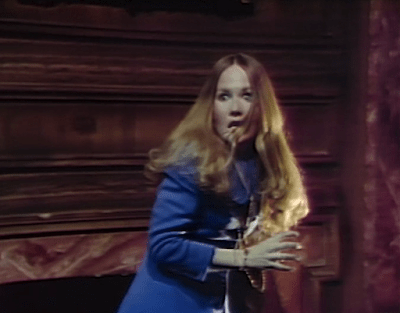
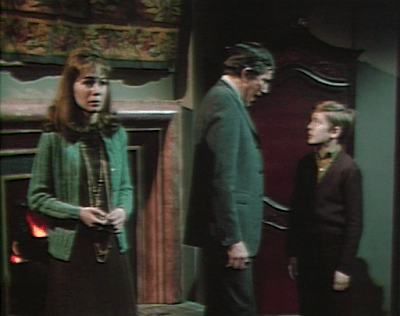
We start in a mysterious room that intermittently materializes in a disused corner of the great house of Collinwood. It is stocked with toys appropriate for small children, and is known to teenagers David Collins and Hallie Stokes as “The Playroom.” Hallie sees a boy in clothing from the nineteenth century who appears to be David making vigorous use of the rocking horse in the room. He will not respond to her in any way, so she leaves the room and goes to the hallway. There, she is shocked to find David wearing his usual clothes and smiling at her.

This bit is video copied and inserted from the end of #1080. After the opening title, Hallie explains to David that she saw him in the room studying a model ship that is there. This is not remotely true. We saw the room throughout Hallie’s whole time there, and at no point did the boy whom she took to be David look at the model ship. Nor did we see the ship, for that matter. This episode was taped four days before #1080, so they may have forgotten about Hallie’s lines until they spliced in the opening, at which point it was too late. In view of the pressures of time and budget to which the makers of the show were subject that may be understandable, but it can hardly be considered a good start.

There is a lot more business involving Hallie and David. They keep taking turns being possessed by ghosts and then returning to themselves, not knowing what they said or did. David Henesy is a good enough comic actor to get laughs each time this happens to David Collins, but it does not advance the story or deepen our understanding of the characters. Since it is a repeat of a story we saw a year and a half ago when other ghosts took possession of David and his friend Amy, it doesn’t even come as a surprise.

Old world gentleman Barnabas Collins learns that his distant cousin, Carolyn Stoddard Hawkes, has had a disappointment. Carolyn asked an astrologer named Sebastian Shaw to draw up her horoscope. Sebastian has abandoned the task partway through and refuses to finish it. Barnabas recently took a trip to the year 1995, Collinwood was still in ruins as the result of an unexplained disaster that will take place later in this current year, 1970. In 1995, a crazed Carolyn wrote a note with six cryptic phrases which Barnabas took to be clues as to the events that would precede the disaster. One of those phrases was “The unfinished horoscope.” When Barnabas hears what Sebastian has done, he decides that by persuading him to finish the horoscope he might be able to prevent the disaster.

We cut to Sebastian’s place, where we see that Sam Hall was not the only person having difficulty writing today. We zoom in on a folder labeled “CAROLYN STODRARD HAWKES.” The camera lingers over the big block letters for so long that you could have read them even on a 1970 television picking up the low-quality signal typical of ABC affiliates:

Stodrard. Screenshot by Dark Shadows Before I Die.

Barnabas is unable to persuade Sebastian to finish the horoscope. Sebastian declares that “The only Schumann that tells me what I must do is me!” and walks out of his own parlor, leaving Barnabas alone there. Barnabas looks bewildered, perhaps wondering why Sebastian thinks his name is Schumann.

The door opens, and a woman enters. When Carolyn telephoned Sebastian yesterday, someone other than him answered, so we might suspect someone else lives there. But there was no hint as to who that might be. In fact, it is someone whose name Barnabas knows very well. She is Roxanne Drew. They have never met, and she doesn’t know him from Schumann. But before his trip to 1995, Barnabas was staying in an alternate universe and he got to know Roxanne’s counterpart there. He somehow fell in love with her and has been pining for her ever since. He greets this Doppelgänger by name, with a triumphant smile.

I should mention that a copy of the book Astrology by Louis MacNeice figures prominently in these episodes. I’ve never read that book myself, but I have an acquaintance in common with MacNeice. I was a graduate student in Classics at the University of Texas at Austin in the 1990s, and one of my professors was Peter Green. As a young poet in England in the years after the Second World War, Peter had been something of a protege of MacNeice’s. Since astrology is a way of inscribing the passage of time with meaning, and since Dark Shadows is so much about time travel that it insisted on calling the alternate universe where Barnabas met the first Roxanne “Parallel Time,” I think it would be apt to quote MacNeice’s “Meeting Point“:

Time was away and somewhere else,

There were two glasses and two chairs

And two people with the one pulse

(Somebody stopped the moving stairs):

Time was away and somewhere else.

And they were neither up nor down;

The stream’s music did not stop

Flowing through heather, limpid brown,

Although they sat in a coffee shop

And they were neither up nor down.

The bell was silent in the air

Holding its inverted poise—

Between the clang and clang a flower,

A brazen calyx of no noise:

The bell was silent in the air.

The camels crossed the miles of sand

That stretched around the cups and plates;

The desert was their own, they planned

To portion out the stars and dates:

The camels crossed the miles of sand.

Time was away and somewhere else.

The waiter did not come, the clock

Forgot them and the radio waltz

Came out like water from a rock:

Time was away and somewhere else.

Her fingers flicked away the ash

That bloomed again in tropic trees:

Not caring if the markets crash

When they had forests such as these,

Her fingers flicked away the ash.

God or whatever means the Good

Be praised that time can stop like this,

That what the heart has understood

Can verify in the body’s peace

God or whatever means the Good.

Time was away and she was here

And life no longer what it was,

The bell was silent in the air

And all the room one glow because

Time was away and she was here.

(Louis MacNeice, “Meeting Point,” 1939, as reprinted in The Collected Poems of Louis MacNeice [Oxford University Press, 1967])
Episode 1079: Just join hands with us and you’ll know everything

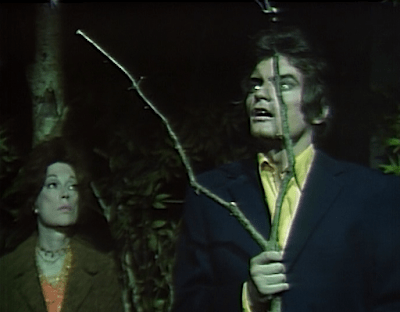
The ghost of Daphne Harridge wants to kill Quentin Collins, for no reason the show divulges to us; then she doesn’t, again for no reason we can see. Daphne insists teenager David Collins and Hallie Stokes not look at her, then insists they do look at her. David refuses to join hands with Hallie and Daphne to gain mystical knowledge, then demands Hallie join hands with him in a séance. Quentin is under Daphne’s power and unable to assist Julia Hoffman in her quest to free the great house of Collinwood from the hauntings; then he orders Julia to attend him while he performs an exorcism of the house.

Quentin the exorcist. Screenshot by Dark Shadows Before I Die.

In his post about the episode on his great Dark Shadows Every Day, Danny Horn said everything I wanted to say about how unsatisfying all of this is. The show has had its ups and downs. I call this segment The Re-Haunting of Colllinwood, because the A story from December 1968 to March 1969 is often called The Haunting of Collinwood and this is a recycling of that. The original Haunting of Collinwood was itself pretty slow-paced and frequently got bogged down with ominous games of dress-up. This time around the pace is again slow and the rounds of dress-up are even more tedious.

It is somewhat interesting to listen to Quentin reciting traditional Christian formulas as he conducts the exorcism. When we first got to know him, Quentin was a devout and enthusiastic Satanist. I suppose all religions lose adherents from time to time.

Episode 1078: The only answer

Quentin Collins and David Collins are under the influence of the unspeaking ghost of Daphne Harridge. Quentin and David each fret about their inability to resist Daphne, to understand their own actions, or to tell each other or anyone else what is going on. Since Daphne is herself a total enigma at this point, the audience learns nothing when these characters are on screen.

Barnabas Collins and Julia Hoffman know that Daphne is associated with an impending catastrophe. They are trying to learn about her as part of their efforts to prevent this catastrophe. Since Daphne will not allow either David or Quentin to give them any information, they are helpless.

The episode ends with Daphne about to stab Quentin in the back. This is not much of a cliffhanger. Quentin is 100 years old, but has the body of a 30 year old because of a magic spell that also makes him impervious to physical injury. Daphne can stab him all day and all night, and all that will happen is that his enchanted portrait will get a little grislier.

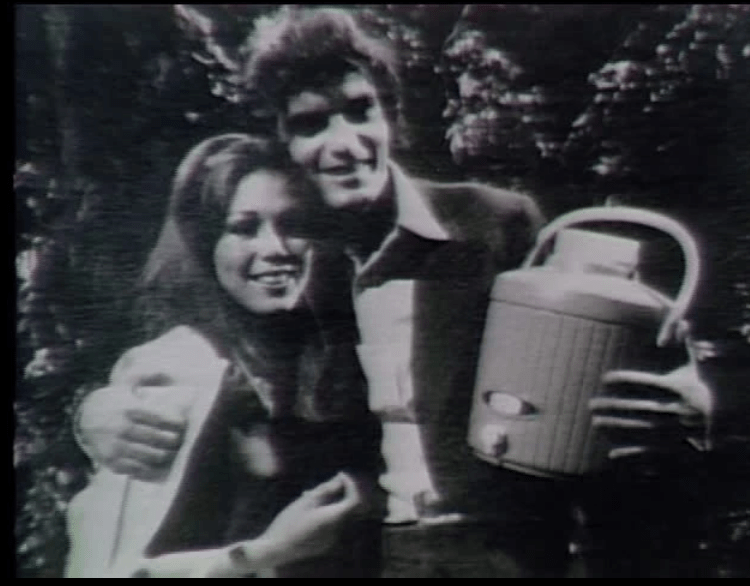
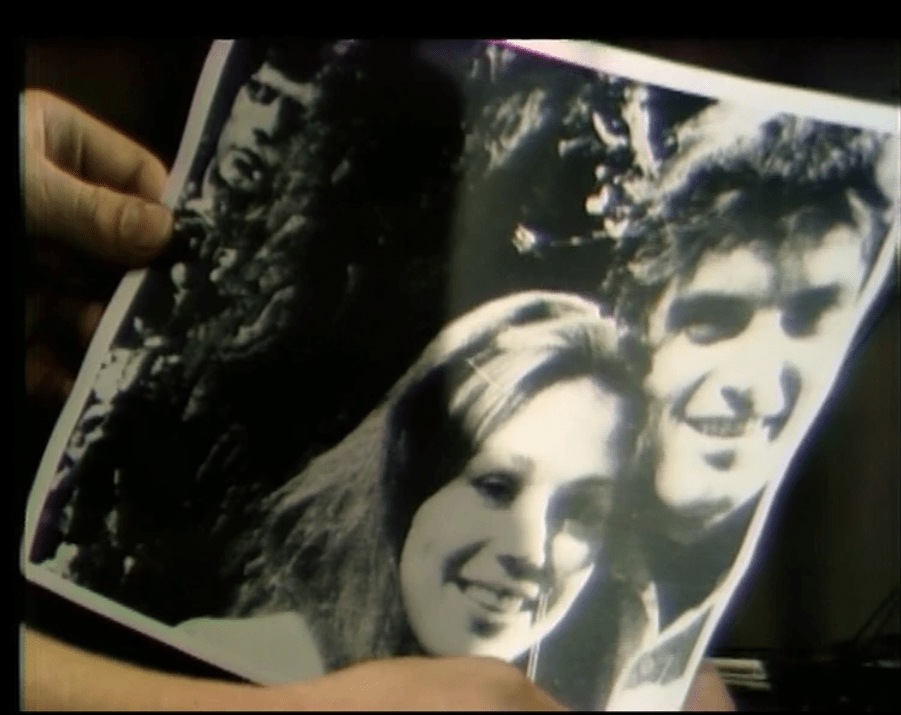
There is some business about a photograph David took. We saw this photograph in #1064, when there was some dispute about whether one of the ghosts was visible in it. Today David shows it to Quentin and asks him if he sees a face in it. Quentin says that it does look like a face, but he thinks it’s just an optical illusion created by the sunlight on some leaves. We imagine that the face will be a subtle thing, as it would have to be if it were somewhere in the photograph we saw in #1064, but when they show it to us later the face is as prominent as any other feature of the image. The result is an insult to the audience’s intelligence.

The original photograph, as seen in #1064.
The photograph as presented today.

Episode 1074: Talking doesn’t help

For the first six months of Dark Shadows, reclusive matriarch Elizabeth Collins Stoddard kept the story from moving by refusing to tell anyone what she knew about the major storylines. With the introduction of undead blonde fire witch Laura Murdoch Collins in #123, the show became a supernatural thriller. The characters driving the new storylines took care to exclude Liz from the action by never letting her find out what was going on.

Now, old world gentleman Barnabas Collins and mad scientist Julia Hoffman have returned to 1970 after a visit to 1995. They have told Liz and others what they saw in that future year, warning that a terrible disaster is impending that will destroy the great house of Collinwood and everyone in it. Julia and Barnabas are not sure just what will happen or when, but they know it will occur before the year is out and that it will center on teenagers David Collins and Hallie Stokes.

The adults have decided to keep the relevant information from Hallie and David themselves. That’s the whole problem today- a series of uncanny events occur that David and Hallie would recognize as signs of the disaster and about which they would be able at least to sound the alarm had they been given the relevant information. Since they have been kept in the dark, they are helpless and the events are pointless.

Not only are the characters not learning from each other, Liz and David have forgotten a great deal that they used to know. From the first week of the show, David was on intimate terms with the ghosts of Collinwood. But today he mentions to Hallie that when he saw a ghost he was not afraid, and he cannot understand why he wasn’t afraid. Liz’ daughter Carolyn mentions that she found Hallie wearing an antique dress. Liz responds that putting on an antique dress can hardly precipitate the kind of disaster Barnabas is talking about. Yet precisely the kind of disaster Barnabas is talking about already befell Collinwood in March 1969, and the first step towards it came when David and his friend Amy Jennings played dress-up, wearing antique clothes under the influence of the malign ghost who would eventually drive everyone out of the great house.

At moments, the script seems to acknowledge that the whole episode is a waste of time. Liz asks Carolyn if she believes in astrology. Carolyn says she doesn’t believe in anything, so she might as well pay attention to her horoscope. It’s no more meaningless than anything else.

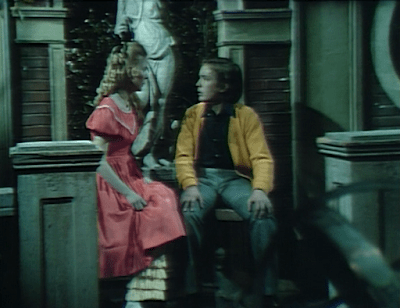
The opening scene, in which David and Hallie spend what seems like an hour hanging around the gazebo and talking about the fact that she doesn’t remember putting on her dress, is particularly bad. I’m reluctant to complain about any of the actors, since the conditions under which they had to work were extremely difficult. I’m especially reluctant to single out performers like Kathleen Cody, who gets a lot of negative comment from fandom. But she is very bad in this scene, just terrible, loud and fake and hard to put up with. Not that I can see what anyone could have done to make the scene interesting, but the situation is so slight it cannot for one moment bear the emotional load Miss Cody piles on it.

There are a few moments of unintentional comedy today revolving around wardrobe. David wears a sweater over a sports shirt and a pair of trousers with the belt fastened somewhere above his navel. David Henesy is in his late 60s now; he still isn’t old enough to wear that outfit. But combined with David’s grouchy attitude, the costume makes him seem like some old guy from New England.

Why don’t nobody know how to make clam chowdah no more? Screenshot by Dark Shadows Before I Die.

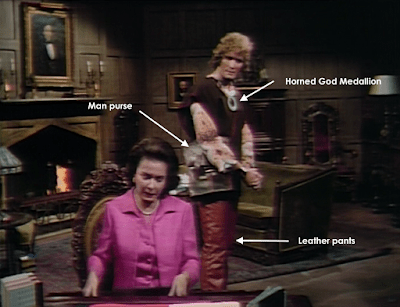
Chris Pennock shows up as astrologer Sebastian Shaw. Sebastian’s costume was bizarre even by the very generous standards of 1970. John and Christine Scoleri labeled some of its more unusual features in their post about it at Dark Shadows Before I Die:

I mean really. Screenshot by Dark Shadows Before I Die.

The utter preposterousness of Sebastian’s getup goes some way towards relieving another bad taste in the mouths of longtime viewers. Pennock also played Carolyn’s late husband Jabe, whom everyone insisted on calling Jeb. When Carolyn first sees Sebastian, she is shocked at the resemblance. The show first went all-in on its repertory approach to casting in November 1967, when well-meaning governess Vicki traveled back in time to the 1790s. She found that the characters she met in that epoch were played by actors she knew from the first 73 weeks of the show, and tried everyone’s patience by telling them about their previous parts. That unbelievably stupid habit marred the 1790s segment and utterly destroyed the audience’s interest in Vicki. Carolyn’s recognition that Pennock was Jeb before he was Seb brings that unpleasant memory back, and any distraction from it is welcome.

At one point Liz finds David standing over Hallie while she is in bed in the small hours of the morning. Liz demands to know what he’s doing there, and is particularly indignant that he is “still dressed.” Mrs Acilius and I laughed out loud at that. It’s better he should be naked?

Episode 945: Carolyn’s rough night in

Episode 361 was virtually a one-woman show, featuring Grayson Hall as Julia Hoffman, MD. Julia was being tormented by haunted house-style effects resulting from her involvement with a supernatural entity. The script, by Ron Sproat, was largely a recycling of an episode Sproat had written for Never Too Young, the soap opera that ran on ABC at 4 PM before Dark Shadows premiered.

Episode 658 consisted largely of a one-man show, featuring Joel Crothers as fisherman Joe Haskell. Joe was being tormented by haunted house-style effects resulting from his involvement with a supernatural entity. The script, by Gordon Russell, owed a good deal to Sproat’s work on #361.

Episode 897 ended with a long scene that amounted to a one-woman show, featuring Marie Wallace as antique shop owner Megan Todd. Megan was being tormented by haunted house-style effects resulting from her involvement with a supernatural entity. The script, by Violet Welles, drew from both #361 and #658.

Many fans consider #361 to be The Worst Episode of Dark Shadows, and many consider Megan’s turn at the end of #897 to be The Worst Scene on Dark Shadows. To the extent that #658 is remembered at all, it is because it is one of Crothers’ last appearances on the show. The memory of this fine and well-loved actor makes the fans so weepy that no one can be very harsh about his final star turn.

Today, the second half of the episode is virtually a one-woman show featuring Nancy Barrett as heiress Carolyn Collins Stoddard. Carolyn is being tormented by haunted house-style effects resulting from her involvement with a supernatural entity. The script, by Gordon Russell, recycles elements of #361, #658, and #897.

Carolyn scared. Screenshot by Dark Shadows Before I Die.

Russell was usually one of the most careful writers on Dark Shadows, but this one is remarkably shoddy. Carolyn and her mother, matriarch Liz, are staying at the home of a woman named Angelique. Angelique tells them that she has to drive to the airport to pick up her husband, and that she will be away for “several hours.” A couple of minutes later, Liz is also called away, and she tells Carolyn that she is sure “Angelique will only be gone an hour or so.”

Worse, all the action of the episode is completely, flagrantly unnecessary. The calls that leave Carolyn alone in the house are part of a monster’s scheme to get at Carolyn. But Liz is the monster’s loyal servant- if he had told her to bring Carolyn to him, she would gladly have done so.

Carolyn’s torments aren’t quite a monodrama, since they are interrupted by a couple of brief scenes with other actors. But one of those is a dream sequence in which she talks to the monster while we see him silhouetted in darkness. The interaction between them is so limited he may as well be a recorded voice. She also has a few interactions with Angelique’s husband. Since he is played by Geoffrey Scott, he may as well be a cardboard standee.

One advantage this episode has over #361 is that Nancy Barrett was excellent at screaming, second only to Clarice Blackburn in her ability to produce a true blood-curdler. Grayson Hall, accomplished as she was, had asthma and was physically incapable of controlling the timbre of her voice when she raised its volume above a certain level. Sproat’s script for #361 required Julia to scream several times, and every time she tried it Hall emitted a croaking sound that raised a bad laugh. Miss Barrett’s closing scream today, by contrast, really puts the “opera” in “soap opera,” it sounds great.

This is one of the few episodes with no scenes on the estate of Collinwood, and one of very few to take place primarily in a location many miles from the village of Collinsport.

There’s also an interesting moment when Angelique claims to have met Liz and Carolyn’s distant cousin Barnabas while they were both living in England. Barnabas never lived in England, that’s a lie he has been telling his relatives to conceal the fact that he is a recovering vampire who hasn’t left Maine since George Washington was president. Liz is part of the current supernatural storyline and Carolyn has at various times known all about Barnabas, so we don’t expect to be reminded that he’s still peddling the “cousin from England” bit.

Episode 698: The kind of scene you should be avoiding

Barnabas Collins, old world gentleman extraordinaire, and Julia Hoffman, MD, are helping mysterious drifter Chris Jennings cover up the fact that he is a werewolf, responsible for a great many violent deaths. Lately Chris has started transforming into his lupine shape even on nights when the moon is not full, and this morning they find that he has not changed back even after dawn.

As if that did not present enough difficulty to Julia and Barnabas, one of Chris’ surviving victims is in town. She is his onetime fiancée, Sabrina Stuart. Two years ago, Sabrina saw Chris as the werewolf. She hasn’t told anyone about him, because she hasn’t been able to speak since. Her hair turned white, her skin turned pale, and she has been nearly catatonic.

Others have encountered the werewolf, and none has had this reaction. It’s true that Chris’ cousin Joe had to be taken to a mental hospital after he saw the transformation, but Joe had just been through a very long train of supernaturally induced traumas that had shattered his sensibilities and taken away everything he cared about. Seeing Chris change was just the last step in that process. Sabrina, as we see in a flashback segment today, was fine until she encountered Chris as the werewolf, and she didn’t even see the transformation itself. Yet here she is two years later, unspeaking, immobilized, and wearing the same makeup that Eli Wallach wore as Mr Freeze in the 1960s Batman TV show.

In a comment on Danny Horn’s post about this episode at Dark Shadows Every Day, “Cole” speculates that the show might have meant to tell us that the real reason Sabrina’s condition is less to do with what happened that on night in Chris’ apartment than with her brother and sole caretaker, Ned, played by Roger Davis:

I am once more getting through the Ned/Sabrina scenes thanks to this blog and the comments here; and although I still have to frequently avert my eyes from the screen to hold back the nausea, I keep concentrating on the dialogue while speculating further on JRM’s theory.

It does seem that we– and Julia– might be meant to feel especially concerned by Ned’s refusal to even consider allowing Sabrina to stay at Windcliff. He even says (or, rather, since it is Roger Davis, he SCREAMS), ​”I won’t be separated from her!”

I don’t think his character is meant to be overly suspicious of Julia and Barnabas so the vehemence behind his already rather alarming declaration becomes more baffling unless the viewer concludes he has … extremely unnatural feelings of possessiveness towards sad, PTSD-afflicted Sabrina.

It is almost half as frustrating as it is disturbing because, with any other actors, we would surely know for certain how to interpret these scenes.

We would perhaps recognize that when Sabrina stares pleadingly at Julia once Ned leaves the room, that her muteness is caused as much by her horror at being an ongoing victim of her brother’s unspeakable abuse as by having once witnessed Chris’s transformation into a werewolf. We wouldn’t wonder, instead if the actress, Lisa Richards, is actually pleading with Hall to help her endure Davis’s deliberate act of molesting and assaulting her through out these scenes.

If it wasn’t Roger Davis in this role, we would know who Ned is really meant to be since there is no way any of the other regular male cast members would willingly subject their costars to type of abuse Davis is inflicting on Richards.

If it were … say, Jerry Lacy who was currently playing “Ned Stuart” in a manner even remotely similar to Roger Davis’s ‘interpretation’ of the role, we would recognize at once that the character of Ned is obviously scripted to be an incestuous rapist (and I am sure Lacy would still keep his hands professionally and respectfully away from Lisa Richards’s/”Sabrina’s” breasts, instead using actual acting techniques to portray his character’s warped nature). But with Davis ..

It really could be, as Mary commented below, that he is trying to get the poor actress to break character. And how could we expect other than that he would use his usual disgusting and violent Drumph-like/”‘you can grab them by the pussy” sense of Curtis-granted entitlement to assault her as “Ned,” regardless of the intent of the writer and director.

Either way, what a horrifically mistaken choice in casting.

Lisa Richards: fifty years later, I am thinking of you and hoping you weren’t forced to endure PTSD after filming these scenes with Davis.

Comment left 29 August 2021 by “Cole” on “Episode 698: Sister Act,” Dark Shadows Every Day, Danny Horn, 8 August 2015

When I mentally recast the many parts Roger Davis played on Dark Shadows, I divide them between two men who were background players in the show’s first months. I imagine Fredric Forrest playing the two characters with aliases, Peter Bradford (a.k.a. Jeff Clark) and Charles Delaware Tate (a.k.a. Harrison Monroe.) Forrest excelled both as a quietly intense man under pressure and as a sweet, goofy, overgrown kid. In the hands of an actor who, unlike Mr Davis, could project those qualities, those two unloved characters might both have become fan favorites. His other two parts, Ned Stuart and Dirk Wilkins, would have been perfect for Harvey Keitel, who is unsurpassed as a man who is agitated by a deep anger that he himself barely understands and that he certainly cannot explain to anyone else. Not that it’s any secret why Ned is angry at Chris, but when he takes a break from pawing at Sabrina’s face and breasts he handles her so roughly that he is obviously angry with her, and that is something he isn’t going to be giving any thought.

Mr Davis’ behavior wasn’t much better in episodes directed by Lela Swift and others, but it is little surprise director Henry Kaplan didn’t rein him in. Kaplan directed with a conductor’s baton, and actresses complain that he would jab them with it. When the person in charge has that light a regard for women’s personal space, it’s no wonder a creep like Mr Davis felt free to rub himself all over Ms Richards.

Episode 671: We promised Maggie we’d be good children

An extraordinarily uneventful outing. In yesterday’s episode it looked like heiress Carolyn would go to visit Chris the werewolf as he is in the middle of a transformation and would be attacked. But she didn’t go. Governess Maggie did go to Chris’ cottage, and at the end of the episode it looked like she might be attacked. As we open today, she is there and he is about to change, but she leaves and gets home safely while he is still in human form.

It again looks like Carolyn might be attacked when she walks through the woods to visit the mausoleum where her mother, matriarch Liz, is entombed. Liz was alive when she was mistakenly buried and is still alive now. Liz is unable to move or speak, but she somehow shares the audience’s thought that Carolyn might possibly be attacked. We see her in her coffin and hear her interior monologue as she thinks about the “terrible danger” her daughter is in.

As it happens, Carolyn makes it home fine. Later she goes out again; we see the werewolf prowling nearby, again raising the theoretical possibility that she will be attacked. But Carolyn hears Liz’ voice in her head, a telepathic warning that she should hasten off. The werewolf also reacts as if he can hear Liz’ voice, and he goes off in another direction. The screen goes dark and the credits start rolling. The werewolf hasn’t attacked anyone and no one has learned anything about him.

It appears that the werewolf is trying to figure out where Liz’ voice is coming from.

It’s kind of interesting that Liz can transmit telepathic messages now. She could use a supernatural power or two if she’s going to get into the swing of things on the show. It’s also interesting that the werewolf seems to be able to overhear the messages Liz sends to Carolyn. Chris’ little sister Amy lives in the great house of Collinwood now, and along with strange and troubled boy David she is falling under the power of the evil ghost of Quentin Collins. Quentin communicated with Amy before he could get through to David. David was miffed by this, since “Quentin is my ancestor.” That suggested that Quentin will turn out to be Amy’s ancestor as well, making her and Chris members of the Collins family. If so, that might explain why Chris, even in his lupine form, was able to pick up a telepathic transmission Liz directed to her blood relatives.

There is a wardrobe malfunction in this one of a type that showed up several times in the first year of the show. When Carolyn makes her first entrance, she walks down the stairs in the foyer. At each step, Nancy Barrett’s chest thrusts into her sweater with results that would probably not have made it on the air had anyone from the ABC network’s office of Standards and Practices been watching the show. In the early days, they put the actresses into very form-fitting tops often enough that I thought they were challenging the audience to take an adult attitude towards female anatomy, and so I did my best to rise to that challenge by leaving it unremarked when we could see the exact shape of their breasts. But it’s a rare occurrence now, so I think we have to list it among production faults.

Episode 657: We will never leave this house

Old world gentleman Barnabas Collins, temporarily in charge of the great estate of Collinwood, has decided to place children David Collins and Amy Jennings in boarding school in Boston. Under the influence of the evil ghost of Quentin Collins, Amy and David want to remain in the house. While they pretend to be enthusiastic about Barnabas’ plan, they try to thwart it by talking about when exactly certain clothes had been in or out of certain closets. As it plays out on screen, this plan is somehow even more tedious than you might expect. Eventually Barnabas sets aside the idea of Boston, not because of anything the children have done or know about, but because the ghost of their former governess, the well-meaning Victoria Winters, made its presence known. Barnabas is attached to Vicki and he doesn’t want to miss a visit from her.

David and Amy’s new governess is Maggie Evans, The Nicest Girl in Town. For the first year of the show, Maggie was a waitress, her father Sam was a drunken artist, and their house was a counterpoint to Collinwood. As a working-class residence in the village of Collinsport, it represented all the homes affected by the crises the Collinses put themselves through, and scenes there suggested that there is a whole community of people whose futures hinge on what happens on top of the hill. In 1966, there were even stories about the Collins family business and its employees, and events at the Evans cottage were key to those.

When Barnabas joined the cast in April 1967, he was a vampire, and he soon took Maggie as his victim. In time, she escaped, her memory was erased, and he was cured of vampirism. Sam died in #518 and left the show in #530. Maggie’s engagement to hardworking young fisherman Joe Haskell ended a while ago; there isn’t much left to happen in the Evans cottage. When Maggie was hired to replace Vicki in #652/653, she moved into the mansion. The show formally bade farewell to the Evans cottage as a place in its own right at the end of that episode and beginning of the next, when Joe went there to get Maggie’s things and was attacked by a werewolf. From now on our excursions out of Collinwood will be brief; we don’t have any place left to stay.

Maggie looks like she’s rethinking her decision to move into the mansion. Screenshot by Dark Shadows Before I Die.

For some time one of the cameras has been on its last legs. In this one, it is almost completely unusable. It is something of a peculiar effect to cut back and forth between two cameras, one of them up to the broadcast standards of the period, the other of which produces only ghostly green images. The episode was directed by Henry Kaplan, who was a poor visual artist under any circumstances. The only remotely ambitious composition he tries today is a shot from a point of view inside a fireplace. They did this several times between December 1966 and March 1967, when David’s mother, undead blonde fire witch Laura Murdoch Collins, was on the show, often to good effect. But this time it is done with the defective camera, and it is simply difficult to see what is going on.

Episode 644: Well that was a waste of time

There is some reason to believe that writer Ron Sproat was disaffected from the rest of the production staff at this time. Today’s script is so unbelievably bad that it is tempting to think he wrote it as an act of protest.

Children Amy and David have gone looking for the ghost of Quentin Collins and are now trapped in a room in the long deserted west wing of the great house of Collinwood. David’s father Roger, his aunt Liz, and his cousin Carolyn are moving about the house in a conga line trying to find them.

Quentin’s ghost is keeping the children locked up; the ghost of someone named Magda is trying to lead the adults to rescue them. At one point the adults watch a mirror while letters appear on it spelling out “Jamison,” the name of Liz and Roger’s father. This is plainly a supernatural manifestation, but it advances neither Magda’s goal nor Quentin’s. Perhaps Jamison’s ghost can’t rest with all the racket Quentin and Magda are making, and he just wants to say hello.

Hi, kids, it’s grandpa! Screenshot by Dark Shadows Before I Die.

In the locked room, David bangs on a wall, finds it is hollow, and speculates about what is on the other side. Amy protests “We can’t go through a wall!” In response, he again bangs on the wall, again finds it hollow, again speculates about what’s on the other side, and Amy again protests “We can’t go through a wall!” Later in the episode, they start this scene a third time, but they stop before Amy has another chance to say “We can’t go through a wall!” It’s just as well she does stop short of saying this a third time. By the end of the episode, they’ve found a crowbar, which enables them to pry the paneling open and go through the wall quite easily.

Meanwhile, the adults have progressed to the drawing room, where they argue about whether to search the west wing. They troop upstairs and find the door to that part of the house locked. This leads them to conclude that David and Amy can’t have gone in there, and the parade goes back to the drawing room. There, they again argue about whether to search the west wing. They again troop upstairs, this time unlocking the door and conducting the search. After they fail to find the children, they return to the drawing room again, where Roger speaks for all of us when he says “Well, that was a waste of time.”

When the adults were shuffling around huddled in their little clump, I found it hard not to look at Liz’ face and see Joan Bennett thinking that she used to be a big movie star and now she’s reduced to this stage business that would have embarrassed the Three Stooges. This week’s episodes were directed by a mysterious figure billed as “Penberry Jones”; whoever Jones was, I don’t think s/he was to blame for the weird little parade the adult characters keep making through the house. The script calls for the actors to talk with each other constantly while walking together through narrow, awkward spaces such as stairways, darkened corridors, and a cluttered store-room, and so it would have taken more time than they had to choreograph a more fluid set of movements.

David and Amy hear a waltz. It has a creaky sound to it, as though it were being played on an old gramophone. This is introduced as a special effect. Unfortunately, Dark Shadows introduces special effects by ramping up the background music, so when the children first talk about the waltz we can barely hear it. After a commercial break, the background music calms down and the waltz is more audible. We will hear it a great many times over the next several months, so often that it will be ironic to think that there was a time when we wanted to hear it but could not. I suppose Penberry Jones probably did have the discretion to tone down the accompaniment, so that would be one strike against him or her.

Longtime viewers will notice a small deviation from continuity when David tells Amy that ghosts come out only at night. In the first year of the show, David often saw the ghost of the gracious Josette in the Old House of Collinwood during the day, and from June to November 1967 he and the ghost of nine year old Sarah played together in the sunlight several times.

Episode 541: Creating a living human being

When Dark Shadows began in the summer of 1966, its most intelligent character was also its most dangerous, strange and troubled boy David Collins. David twice came within an inch of committing the perfect murder, first when he sabotaged his father Roger’s car, then when he trapped his governess Vicki in a room in the long-deserted west wing of the great house of Collinwood.

The only story that consistently worked in those days was the relationship between David and Vicki, and that was solely due to actors David Henesy and Alexandra Moltke Isles. While the writers gave them terrible dialogue- at one point having Vicki read aloud to David from a reference book on the geography of Maine- they used their faces, voices, and movements to show us what was going on inside the characters. Mr Henesy always looked like an angry boy who was grimly determined to keep hating his governess even though he couldn’t help but like her, while Mrs Isles always looked like a fearless young woman who was determined to befriend a boy who might make an attempt on her life at any moment. As David relented from his hatred, we could see a friendship budding between them, even if the words were still no good.

The story of Vicki and David had its climactic phase from December 1966 to March 1967, when his mother Laura Murdoch Collins was on the show. Laura was Dark Shadows’ first supernatural menace, an undead fire witch who planned to incinerate herself and David so that she could attain a new life. When David ran from the burning Laura into Vicki’s arms in #191, he chose her and life over Laura and death. She thus became his new mother, and their story was complete.

Since then, the show has found very little for David to do. Yesterday, he was wandering around the house with a tape recorder. He told his stepmother Cassandra that he couldn’t figure out how to play a tape. The preoccupied Cassandra sent him away, and he asked his cousin Carolyn to help him. Carolyn made it clear that all you do is press the button labeled “Play.” Two years ago, David could sabotage a brake cylinder to fail at precisely the spot on the road where it would be likeliest to lead to a fatal crash, but now he can’t grasp the concept of “Press play to listen to the tape”?

Longtime viewers will see a missed opportunity here. Cassandra is a wicked witch, also known as Angelique. In #492, Angelique/ Cassandra cast a spell that caused David to forget some incriminating information about her, so we know that he is subject to her power. Vicki knows a great deal about Angelique/ Cassandra; they could easily give us a series of scenes in which Vicki tries to warn David about his stepmother, but his mind is clouded. Instead, we never see Vicki and David alone together during this phase of the show, and Angelique/ Cassandra rarely does anything more with David than display irritation and order him to go away.

David eventually played the tape for Angelique/ Cassandra. She reacted with great excitement, since it included a message that explained why she failed in her attempt to restore the vampire curse she once placed on David’s distant cousin Barnabas Collins. She sends David away and keeps the tape recorder.

Angelique/ Cassandra won’t let David take the tape recorder back to his room. Screenshot by Dark Shadows Before I Die.

Angelique/ Cassandra informs her supervisor, suave warlock Nicholas, that she can re-vamp Barnabas if she kills Frankenstein’s monster Adam. Fascinated by the idea of an artificially constructed human being, Nicholas loses interest in Barnabas and instructs Angelique/ Cassandra to find out more about Adam.

In #532/533, Nicholas met Maggie, The Nicest Girl in Town. Nicholas was obviously smitten with Maggie, putting the lie to his taunting of Angelique/ Cassandra for her ability to feel an emotional attachment to Barnabas and his own claim to be motivated solely by a devotion to evil for its own sake. After he gives Angelique/ Cassandra her orders, Nicholas goes to Maggie’s house. Ostensibly this is to find out if she knows where Adam might be, but she so obviously does not that it is clear he just wants to see her. He asks her about her hospitalized fiancé Joe, admires her late father’s paintings, and offers to buy one of them at a high price and lend it back to her. Maggie seems to be quite charmed by him. Nicholas’ “Evil, be thou my good” schtick can be fun to watch for short periods, but if he is going to be a major character for any length of time he will need a more complex inner life. His attraction to Maggie is a step towards giving him one.

David goes to Barnabas’ house. He tells Barnabas’ friend Julia that at least twice this evening he has listened to a message on a tape recorder that had something to do with Barnabas and Adam, but he can’t remember any of the details. He does remember that Angelique/ Cassandra got excited when he played it for her, but that’s it. If Angelique/ Cassandra had cast a spell on David, his forgetfulness would be understandable. If Vicki and Angelique/ Cassandra were locked in battle for David’s allegiance, it could be dramatic. But as it is, the show has chosen simply to present David as an abject moron, and that is infuriating.

Julia and David go back to the great house, where they find Nicholas and Angelique/ Cassandra with the tape recorder. Nicholas and Angelique/ Cassandra leave, and Julia and David play the tape. It no longer has the original message, but instead has the witches’ sabbath portion of Berlioz’ Symphonie Fantastique. David furrows his brow, then comes up with the bright suggestion that Angelique/ Cassandra, who has been in possession of the tape the entire time, may just possibly be the one who made the change. Again, since we have not seen Angelique/ Cassandra cast a spell to confuse David’s thinking, this incredible stupidity can do nothing but exasperate the audience.

They don’t even have the excuse that the current writing staff doesn’t know that David used to be interesting. The gimmick of replacing important information on a reel-to-reel tape with an audio signature suggestive of the culprit is a callback to #172, when Laura thwarted parapsychologist Dr Peter Guthrie by replacing an audio recording of a séance with the sound of fire crackling. If they can recall that bit, surely they can remember that David used to have a functioning brain.

In the early days of the show, Vicki was on a quest to find out who her parents were and why they left her at a foundling home when she was an infant. In #60, Vicki stumbled upon a portrait Maggie’s father Sam painted twenty years before of a woman who looked just like her. Vicki wondered if this woman, whose name was Betty Hanscombe, might have been her mother or aunt. Sam gave Vicki the painting then, but it is back in Maggie’s house today, and Nicholas picks it up at one point. We don’t get a very good look at it, but you can buy a reproduction of it on canvas for $25.99 plus shipping from someone on Etsy, it looks nice.

Nicholas examines the Betty Hanscombe portrait. Screenshot by Dark Shadows Before I Die.