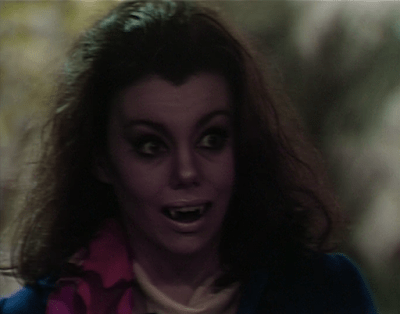
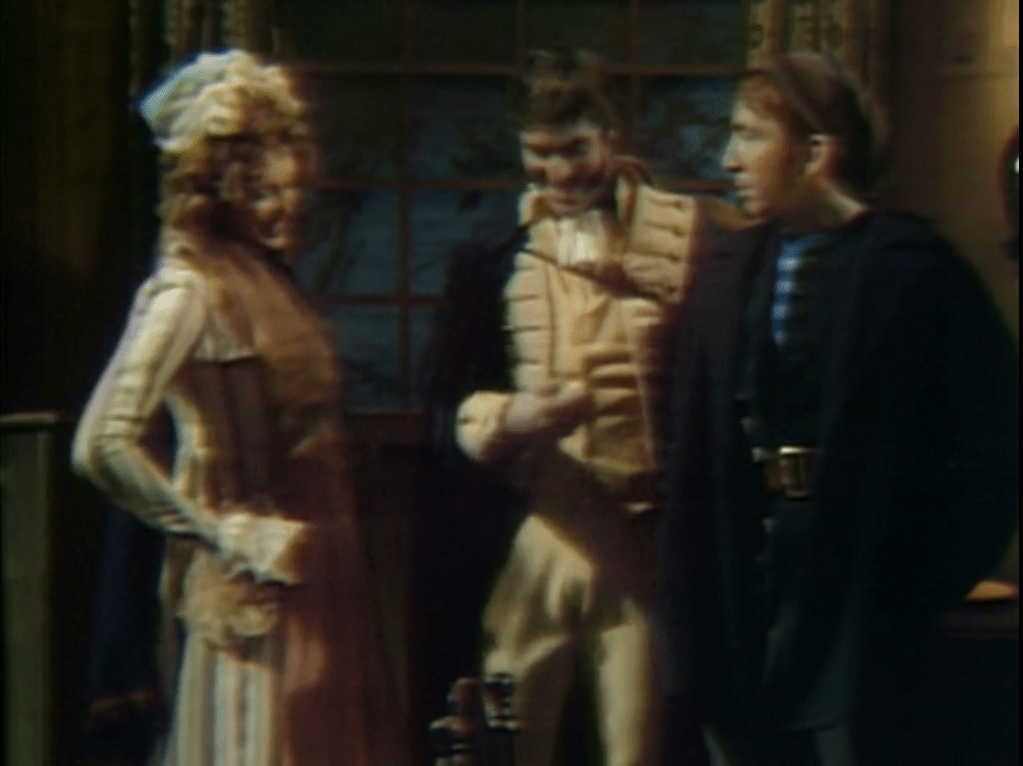
Episode 1009: Remember the dead

The Graves of All Those Who Once Lived Here

The name “Barnabas Collins” has been coming up in the oddest circumstances around the estate of Collinwood. The only person of that name known to drunken sourpuss Quentin Collins, the master of the great house, was an ancestor of his who lived a long dull life and died a natural death in 1830. Quentin has decided that it is time to ask Barnabas’ spirit what’s going on. He wants housekeeper Julia Hoffman to join him and his late wife Angelique’s identical twin sister, Alexis Stokes, in a séance.

Hoffman is reluctant to participate, and when the invocation prompts theremin music to start playing in the background she breaks the circle of fingers and runs out of the drawing room. But Hoffman is not the most problematic participant. Alexis is not in fact present. Angelique returned from the dead, murdered her, and took her place. Unknown to Hoffman or to Quentin, it is the undead Angelique who is at the table with them.

“Alexis” tells Quentin that she felt a presence before Hoffman broke the circle, but that it is gone now. Suddenly a figure appears in the corner of the room. He identifies himself as the ghost of Joshua Collins, father of Barnabas. Joshua addresses his remarks to Quentin, ignoring “Alexis.” He says that Quentin knows all he needs to know about his son Barnabas, but that there is another entity at Collinwood, an evil that is at once living and dead. “Alexis” looks shocked and says “Living and dead? How can that be possible?” I suppose we should praise Lara Parker for resisting the temptation to pad her part by visibly squirming and playing up the fact that this describes her character precisely. She is giving the audience credit for the brains needed to make that connection. But if I wanted a show that gave me credit for brains, I wouldn’t watch Dark Shadows every evening, so I’m disappointed. I wish she were tugging on her collar and fidgeting like a Hank Azaria character on The Simpsons.

Joshua can’t be any more specific. This might have been OK had he just flickered into view for a few seconds, uttered his vague warning, and flickered out. We would then be left thinking of the awe-inspiring improbability of even the most fleeting communication between the living and the dead. But as Joshua, Louis Edmonds stands there for several minutes, in the same light as the other actors. They’ve had trouble with one of the microphones lately, occasionally making one actor sound like they are far away from the person standing next to them, but that microphone isn’t used in this scene. Both the audio and the video make it clear Joshua is occupying the same space as Quentin and “Alexis.” The result is an embarrassment for which writer Gordon Russell and director Henry Kaplan must share the blame.

This embarrassment is particularly disappointing under the circumstances. The scene is Edmonds’ first appearance since going off to play his part in the feature House of Dark Shadows after #990, and the first appearance of this Joshua Collins. Edmonds played another version of Joshua from November 1967 to March 1968, when Dark Shadows was set in a different universe. That Joshua figured in a costume drama segment set in the 1790s. He emerged as the central figure in a tragedy in the course of which his son Barnabas became a vampire and he had to decide what to do about him.

This Joshua never dealt with such a curse. The audience knows, if only because the opening voiceover told us, that the vampire Barnabas has crossed over into this universe, into this year 1970, and that he is at present trapped in a chained coffin in the basement of the home where the Joshua we meet today raised that other, luckier Barnabas. We last saw the other Joshua in #623, and longtime viewers will be excited at the idea of seeing Edmonds reprise the character who was perhaps his greatest triumph. To see him in such a debacle lets us down hard.

After Joshua leaves, Quentin and “Alexis” talk for a moment. Then Quentin’s brother Roger enters. Roger is also played by Louis Edmonds, but neither Quentin nor “Alexis” notices that he looks like Joshua. This works well enough, since Edmonds takes a very different posture and tone as Roger than he had as Joshua. Joshua was erect and stentorian, Roger curls to his left as he sits on the couch and purrs about how tedious it is to read about the life of the late Barnabas.

Quentin exits, and Roger talks with “Alexis.” He says that despite her resemblance to her sister, he never for a moment thought she was Angelique. In fact, when he first met the real Alexis he was utterly shocked, certain she was Angelique, and she had to work hard to bring him around. But Angelique doesn’t know about that, and Roger doesn’t want to remember it, so she just looks at him placidly while he goes on and on about how unlike anyone else Angelique was and how he knew her more intimately than anyone else could, even though she was married to Quentin.

I suppose Russell may have been trying to make a point by juxtaposing Joshua’s long pointless speech in which he keeps referring to Quentin’s responsibilities as the master of Collinwood with Roger’s long pointless speech in which he keeps referring to his mystical connection with his brother’s late wife. We saw in the 1790s segment that the Joshua of the other continuity was the victim of his own virtues. A forceful, dynamic man devoted to his family and its honor, he became a tyrant in pursuit of his worthy goals, and saw everyone he loved destroyed in part because of his haughtiness. As generation followed generation, Joshua’s misguided strength and brittle courage would yield to ever weaker, ever-softer descendants. Perhaps in the contrast between this Joshua’s attempt to help his successor use the authority he once held when he cannot impart any useful information and Roger’s fatuous pretense to have known Angelique uniquely well when he cannot recognize that he is talking to her we can see the same decline in this iteration of the Collins family.

The Legal Eagle

Meanwhile, mad scientist Cyrus Longworth has a problem of his own. Cyrus has developed a potion which, when he drinks it, transforms his appearance so drastically that even those closest to him cannot recognize him. When thus disguised, he calls himself “John Yaeger,” spends a lot of money, and beats people up. This makes him very happy, but now chemist Horace Gladstone, his connection for one of the potion’s vital ingredients, has learned his secret. Gladstone will not supply him with more of the ingredient or keep his mouth shut about Cyrus’ crimes unless he gets $10,000 in cash.

Cyrus’ lawyer, Larry Chase, comes to his laboratory. On Cyrus’ instructions, Larry has drawn up a will naming “Yaeger” as the sole beneficiary of Cyrus’ estate. Larry has met “Yaeger” and been appalled by him. He urges Cyrus to reconsider. Cyrus signs the papers and invites Larry to a late supper. Larry declines, saying that Horace Gladstone called him earlier and wants to meet him outside the Eagle tavern at 10 PM.

Larry was in the drawing room at Collinwood going over some papers with Quentin when he got Gladstone’s call. Cyrus’ newly drafted will fell out of Larry’s briefcase, and Quentin read through it while Larry was looking for another document. Quentin asked some questions about the will. Larry responded to the first by saying that he couldn’t talk about it, but thereafter blabbed away, revealing everything Quentin could want to know. With that level of regard for a client’s confidential communications, we aren’t surprised when Larry tells Cyrus who he is going to meet at what time in what place.

After Larry goes, Cyrus takes the potion, that is, puts on his disguise. He goes to the alley next to the Eagle, in which the sign for the Greenfield Inn hangs. He corners Gladstone there. He beats Gladstone to the pavement with his heavy cane. Gladstone begs for mercy, and Cyrus sneers at him. He releases the bayonet from inside the cane, stabbing Gladstone with it. The first time Cyrus took the potion, he had amnesia after he resumed his normal appearance, and we could believe that he was less than fully responsible for what he did while under its influence. But he has had his full memories on each subsequent occasion, and has shown pleasure when told of the harm “Yaeger” has done and the fear he inspires. By this point, we can classify Cyrus’ killing of Gladstone as nothing other than premeditated murder.

Cyrus doesn’t really surprise us by this act. It is Larry who does something we would not have expected. While Gladstone is in the alley, Larry is already in front of the tavern. We see enough of the set that we cannot believe he is more than 30 or 40 feet away from Gladstone, just around the corner. Gladstone cries out when “Yaeger” attacks him. We cut to Larry, and see him react to that cry and start towards the alley. “Yaeger” stands over Gladstone and pontificates for a minute or two before stabbing him. Even after that, “Yaeger” still has time to get most of the way out of the alley before Larry finally arrives. It took Joshua Collins less time to get from the abode of the dead to the drawing room at Collinwood than it takes Larry to walk the few steps from the sidewalk to the alley. Maybe he had to stop somewhere along the way to make some more announcements about a client’s business.
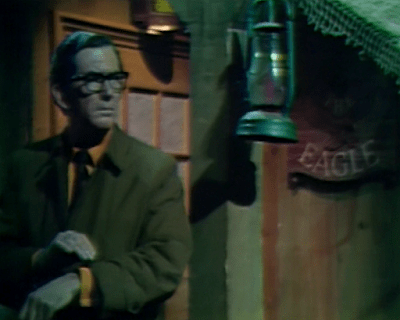
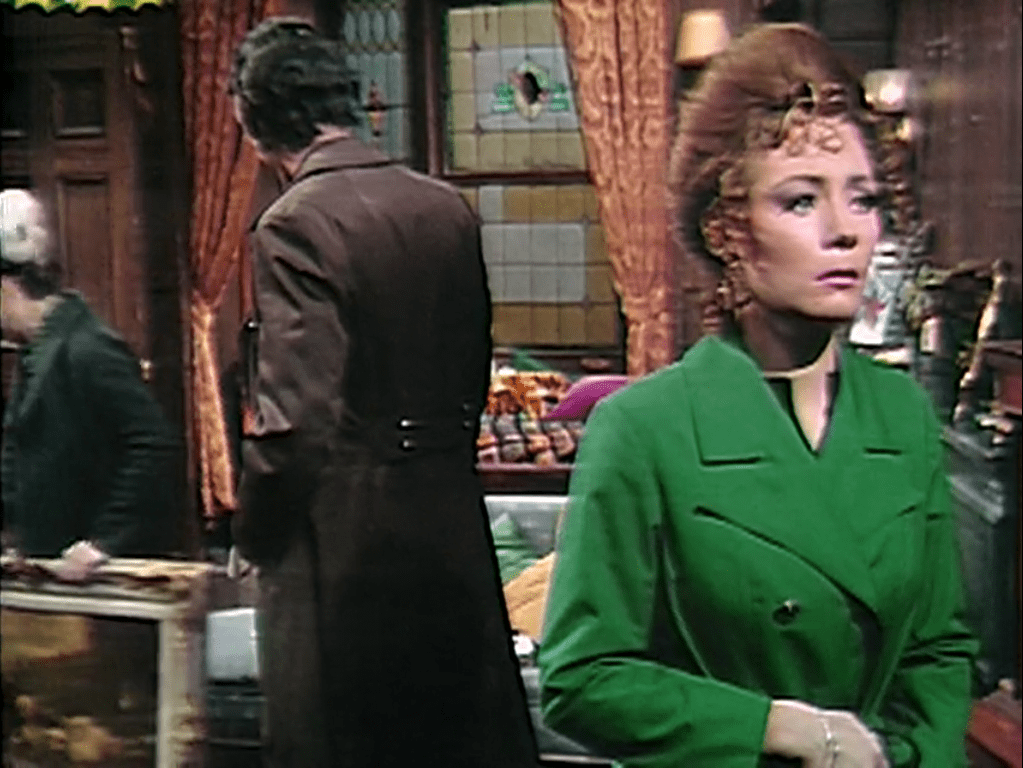
Larry hears a cry for help. Screenshot by Dark Shadows Before I Die.

Episode 997: How pretty your tears

We are in the fourth week of an arc set in a different universe than the one we saw in the first 196 weeks of Dark Shadows. This universe, which the show insists on calling “Parallel Time,” was originally introduced as a realm populated by Doppelgänger of the characters we have known. They are the same people, but have made different choices and are therefore living different lives.

Some of the Parallel Time characters fit this description. So, we have known matriarch Elizabeth Collins Stoddard and her brother Roger Collins from episode #1. In the early days of the show, much was made of the Collinses’ straitened financial circumstances, the result of Roger squandering the half of the family’s assets he had inherited and Liz scrambling to keep control of the business. Roger lived in Liz’ house as her guest and worked in the business as her employee, and she kept a wary eye on any move he made to get his hands on her money. In #981, Parallel Liz mentions that she used to be quite wealthy, but that she entrusted her share of the Collins fortune to Roger, and as a result they are both penniless. Original Liz saw that fate as a distinct possibility, every time Roger was in the same wing of the house as her bank account information.

Parallel Liz and Parallel Roger live in the great house of Collinwood as the guests of their brother Quentin. Parallel Quentin is not at all the same person as Original Quentin. He is an entirely different person. Original Quentin was born in 1870, died in 1897, became a ghost haunting Collinwood in 1968 and 1969, and as the result of a time travel storyline in 1969 was both spared death and immunized against aging. Original Quentin was a riff on the early conception of Roger as a villain, and he was a huge hit with the viewing public during the part of the show set in 1897. Ever since Dark Shadows returned to contemporary dress in late 1969, they’ve been at a loss what to do with him. Parallel Quentin is an attempt to reinvent the character to let him keep enough of his vices that he retains the roguish charm that the fans liked, but at the same time use those vices as motivation for him to act the part of the hero from time to time.

There is need for an action hero today. Quentin’s friend, dippy mad scientist Cyrus Longworth, has invented a Jekyll-and-Hyde potion and taken a swig of it. As the darkly mustachio’d John Yaeger, he has been persecuting barmaid Buffie Harrington and Buffie’s unlucky boyfriend, big galoot Steve. We open with Yaeger choking Buffie and telling her she needs to be beaten into submission. Later, Yaeger gets the jump on Steve in a dark alley behind the Greenfield Inn, an establishment that also fronts a sinister alley in the main continuity. He threatens him with his sword cane. Steve manages to get that weapon away from him, but Yaeger beats him down. Yaeger is choking Steve, apparently with the intention of murdering him, when he hears a police whistle and runs away.

Cyrus Longworth and John Yaeger are played by Christopher Pennock.* In the main continuity, Pennock played a character who asked to be called Jabe but wound up answering to “Jeb.” Jabe appeared to be a man in his twenties, but was in fact a shape-shifting monster who was only a few months old when he was destroyed. We’ve heard a good deal about what Cyrus was doing six months ago and more, and there are diplomas on the walls of his laboratory that show his history is nothing like Jabe’s.

Among the very few choices in Jabe’s short life was an attempt to renounce his shape-shifting abilities so that he could remain in human form at all times. In that way, he is the opposite of Cyrus, who chooses to take his potion knowing it will change him into Yaeger.

Also, Jabe was so obnoxious that even people brainwashed to regard him as a divine being come to fulfill a plan that more than justified the extermination of the human race found his personality too much to take and turned against him after a few encounters. But by the end of Jabe’s time on the show, it had become undeniable that there was a kernel of sweetness in his personality. In this regard, too, Cyrus is the opposite of Jabe. We hear his soft voice and see his diffident manner, and we assume that the single-minded scientist in his lab coat, toiling all hours on a project that he keeps saying will benefit humankind, is a well-meaning sort, though perhaps dangerously naïve. Cyrus’ dutiful assistant and devoted fiancée, the lovely Sabrina Stuart, encourages us in that assumption, insisting that Cyrus is thoroughly good, if hopelessly unworldly. But as the initially insufferable Jabe turned out to be endearing at the end, so the apparently innocent Cyrus is deliberately choosing to turn himself into Yaeger even after he knows what Yaeger is capable of. What’s more, he refuses to let anyone at all help him with his experiment, meaning there is no one to restrain Yaeger’s sprees.

Sabrina’s counterpart in the main continuity was the fiancée, not of Jabe, but of another dangerous shape-shifter. She was engaged to werewolf Chris Jennings. As this Sabrina is convinced Cyrus is good, so that one kept insisting Chris was good, even after she had learned that he repeatedly refused to be restrained on nights of the full Moon, so that the killings he committed in his lupine form were premeditated murders on his part. This Sabrina does not know the nature of Cyrus’ work, and she believes that Yaeger is an enemy of his who is holding him prisoner. Sabrina would appear to stand with Roger and Liz as a character who is in a meaningful sense the same person in both timelines, so we are in suspense as to how she might react if she finds out the truth about her man.

Sabrina’s part makes us wonder if the original plan were to cast Don Briscoe, who plays Chris in the main continuity, as Cyrus and Yaeger. At this time Briscoe was struggling with bipolar disorder. He was trying to self-medicate with street drugs, which not only made matters worse in itself, but also led him to get a severe beating one night while trying to score a fix in Central Park. Briscoe appears in Parallel Time as lawyer Chris Collins and has a small part in the concurrently filmed feature House of Dark Shadows, but his health problems ruled out a part as crucial as the lead in the Jekyll and Hyde story.

Buffie is played by Elizabeth Eis, who appeared in one episode set in the main continuity as Nelle Gunston. Nelle was a young woman from Virginia, bored by life with her parents, who had joined the cult that was meant to serve Jabe and the world-wrecking plan to which he was central. When she was asked if she would commit murder if that was what the cult required, she smiled pleasantly and said “Even that.” Nelle was killed before she could meet Jabe.

Buffie is not at all the same person as Nelle. She is not from Virginia, for one thing. When she thinks about leaving Collinsport to get away from Yaeger, she realizes she has only $13.40 to her name, and laughs at herself for a plan that wouldn’t get her any further than Worcester, Massachusetts. Naming Worcester as a synonym for “nowhere” would suggest that she is a New England girl, which would fit with her employment in a bar in a fishing village in central Maine. Buffie is the opposite of what they originally told us the characters in Parallel Time would be- she is not Nelle after she has made a different choice, she is a person who began differently than Nelle and is making a similar choice.

Buffie is in her room when her landlady, Mrs Duvall, comes for the rent. Buffie has a check ready. Mrs Duvall thanks Buffie for recommending her boarding house to a gentleman who has rented her four best rooms at a very handsome price. She tells Buffie that the man is a big step up from Steve. Buffie has no idea what she is talking about. Yaeger shows up, and Buffie realizes he is Mrs Duvall’s new prize boarder. Buffie is horrified, and demands her rent check back. Mrs Duvall refuses to return it. Yaeger points to a print hanging on the wall and instructs Mrs Duvall to take it away and burn it. She is doing so when Buffie protests that it is hers. At that, Mrs Duvall stops short of the door, but she does not put the print back on the wall. Eventually, Mrs Duvall does take Buffie’s print, and leaves her with Yaeger.

Mrs Duvall leaves with Buffie’s print.

The telephone rings. It is Quentin, asking Buffie about Yaeger. Yaeger stands next to her and forces her to answer Quentin’s questions with lies. Later, Steve will come to Buffie’s room. She will tell him to give up on her and not to take any more beatings from Yaeger on her behalf. Steve asks if Yaeger is a superman; Buffie widens her eyes and says that he might be. This brings us back to Nelle, who renounced her life in Virginia and her connection to the human race because she was looking for a superman and thought she would find one in Jabe. Steve may not have had much to offer, but it’s a cinch he wasn’t as bad as Yaeger, and he’s gone from Buffie’s life after this scene.

The emptiness of Buffie’s life is represented today by a prop we have seen only once before on Dark Shadows, a television set. There was a set in a motel room in Bangor in #27; we never do see one in the Collinsport or the Collinwood of the main continuity. Perhaps the makers of the show are suggesting that people who have nothing better to do than to watch the idiot box are likely to fall prey to any fella who offers physical abuse and verbal intimidation.

Mrs Duvall is played by Camila Ashland. Ashland was a very distinguished stage actress who appeared in #928 as someone called Mrs Hutchins. A man from the cult around Jabe hired Mrs Hutchins to tell some lies to throw mad scientist Julia Hoffman off their trail. That didn’t work, but Julia admired Mrs Hutchins’ performance, as we suspect Grayson Hall admired Ashland’s. When the man from the cult paid Mrs Hutchins for her work, he was unpleasantly surprised at her questions and the uneasy conscience it reflected, responding roughly that she is being paid for a job and should leave it at that. He didn’t realize he was dealing with an artist. Mrs Duvall’s eagerness to please the obviously horrible Yaeger shows that she really is the crude mercenary the man from the cult assumed Mrs Hutchins was.

We cut to Cyrus’ laboratory. Yaeger has fled there from the police. He is about to take the re-Jekylling formula when Quentin shows up and demands to know where Cyrus is. We end with them in that standoff.

*Billed twice in the closing credits- as Christopher Pennock for Cyrus, and as Chris Pennock for Yaeger. Adorable!

Episode 915: Emergency Leviathan Broadcast

In #701, old world gentleman Barnabas Collins traveled in time from 1969 to 1897. For the next eight months, ending in #884, Dark Shadows was a costume drama set in that year. On his way back to a contemporary setting, Barnabas took a detour to the 1790s, when he was a vampire. Before he left the 1790s, he was abducted by and absorbed into a cult that serves supernatural beings known as the Leviathans. At their behest, he took a small wooden box with him to November, 1969, and functioned as one of the leaders of the Leviathan cult in that period.

The first six weeks of the Leviathan story has had its strengths. Ever since Barnabas was first cured of vampirism in March 1969, he has been under the impression that he was a good guy and has been doing battle with various supernatural menaces. He was hopelessly inept at this, and created as much work for the other characters by his attempts at virtue as he formerly did in his unyielding evil. That has made him a tremendously productive member of the cast, but it does leave him with a tendency to seem harmless, even when he is trying to murder his way out of a problem. But Barnabas the Leviathan chief has been ice-cold and formidably efficient. Even though not much has yet been done to hurt anyone, seeing him in this mode adds a note of terror to the proceedings.

Moreover, the Leviathans have voided Barnabas’ friendship with mad scientist Julia Hoffman. Since the relationship between the two of them has been the heart of the show for over two years now, from the hostility of their early days to the close bond they formed in the summer of 1968, this reinvigorates the action. It is as interesting to see them fight with each other as it is to see them collaborate against a common foe, and their hate scenes gain an extra depth because we keep wondering about their eventual reconciliation. If they play their cards right, they should be able to keep this up for months.

Today, it all falls apart. Barnabas has drawn a huge following of very young fans who run home from elementary school to watch the show. The 1897 segment was a triumph in large part because it had a core of stories that could hold the attention of adults while also appealing to the preteen demographic. But the Leviathan arc has so far had little to offer anyone but grownups. Apparently the kids were writing angry letters, because this episode, rushed into production at the last minute and bearing signs of haste in every shot, turns Barnabas back into the would-be hero who was such a klutz that he couldn’t even stay in the right century.

The creature who emerged from the box Barnabas brought from the past now appears to be a 13 year old boy and answers to the name Michael. In the opening scene, Michael orders Barnabas to kill Julia. Barnabas declares that he will not, and goes home. There, he tells his troubles to the box, then falls asleep in his chair.

A hooded figure appears to him. This hooded figure says that he is a Leviathan, and tells Barnabas he must comply with Michael’s commands. The Leviathan is not named in the dialogue and there are no actors’ credits at the end, but reference works based on the original paperwork call him Adlar.

Adlar sets out to explain Barnabas’ position, much as Marley’s ghost did to Scrooge in Dickens’ A Christmas Carol. The shortened production schedule shows in inconsistencies that litter Adlar’s speeches. At one point he says that the Leviathans needed Barnabas to transport the box from the eighteenth century to the twentieth; at another, he claims that they are holding his lost love Josette prisoner in the eighteenth century and will inflict a new, far more horrible death on her than the one she died the last time Barnabas was in the 1790s, a threat they will be able to carry out only if they have their own means of traveling back and forth through the years. Barnabas doesn’t pick up on this or any of Adlar’s other inconsistencies; perhaps he is too distracted by the many jump cuts that make this episode look like the videotape was edited with a rusty butter knife.

Adlar threatens to make Barnabas a vampire again, then disappears. He does not tell him that he will be visited by three spirits, one representing his past, another his present, and the third the future he is risking by his present course of action, but this is in fact what happens. Barnabas goes outside, and sees a bat. It was a bat whom he first saw on this very spot who initially made him a vampire. Barnabas rushes inside, looks in the mirror, and does not see a reflection. He thinks of his mouth, and feels fangs growing there.

Next comes Megan Todd, a Leviathan cultist who with her husband Philip is fostering Michael in their home. Barnabas cannot take his eyes off Megan’s long white neck. Megan keeps telling Barnabas that he is the only one she can confide in about her concerns with the progress of the Leviathan plan; he keeps demanding ever more stridently that she leave at once. His bloodlust may explain why he doesn’t notice the continuity problem in the scene. They’ve made the point time and again that it is only while Barnabas is giving orders to her and Philip that Megan remembers that he is their leader. At other times, she thinks he is an outsider. But Megan is the only one who can tell Barnabas a story of family life in any way paralleling that which the Ghost of Christmas Present brings to Scrooge’s attention at the Cratchit house. Continuity has to go if the episode is going to fit into the form of A Christmas Carol.

Suddenly, Barnabas finds himself in an alley by the waterfront. A sign behind him says that he is next to the Greenfield Inn; we saw this sign in #439, set in the year 1796. Evidently the Greenfield Inn is a long-established, though not very reputable, place of lodging.

A woman approaches him. She is very aggressive about insisting he take her with him wherever he is going. He is reluctant at first, urging her to seek friends at the Blue Whale tavern, but she won’t take no for an answer. All of a sudden, he brightens and looks at her with desire. She says she is afraid of him. He asks if she wants to go, and she screws up her courage to declare that she will stay with him. He bares his fangs and attacks. The rough videotape editing adds to the violence of the scene. There is no sensuous bite, only a flash as he lunges at her and then is standing up again, protesting that he didn’t want to do it. When the camera zooms in on the bleeding marks on her neck, it is surprising to see that he didn’t rip her throat out altogether.

We cut back to Barnabas’ house. He is dozing in his chair, and the woman, displaying vampire fangs of her own, walks in through the front door. She approaches Barnabas. He awakens, and is horrified. Adlar tells Barnabas that “she is not up to your usual standards.” She’s standing right there, that’s pretty tactless. Also, she is future four-time Academy Award nominee Marsha Mason. The only other Oscar nominee Barnabas bit was Grayson Hall as Josette’s aunt, the Countess DuPrés, in #886. Hall was only nominated once, so if anything this woman is a step up for him.

Four time Academy Award Nominee Marsha Mason. Screenshot by Dark Shadows Before I Die.

Adlar makes the woman disappear, and shows Barnabas that he is not really a vampire again. With that, we see that she is a shade of a future that may come to be, not one that is already ordained. Adlar also tells Barnabas that it is not now necessary to kill Julia. But he does say that Barnabas will have to do something to ensure Julia’s silence, or else Josette will suffer. Barnabas hangs his head and says to the mirror that he has no choice to obey.

Episode 439: Whose cane this is

The opening voiceover is delivered by Vala Clifton, who makes her debut today as Maude Browning, a young lady whose profession it is to make herself agreeable to the gentlemen she meets. This marks the first time since episode #1 that the first voice we have heard was that of someone we had not seen previously. The rule lately has been that the introduction is always delivered by a woman who appears in the episode. Today, that leaves Ms Clifton as the only candidate.

At the top of the episode, vampire Barnabas Collins tells his friend, much put-upon servant Ben Stokes, of his plans for revenge on the Rev’d Mr Trask, a visiting witchfinder responsible for much misery and injustice. When he makes it clear that he plans to murder Trask and to do it in an especially atrocious manner, Ben puts his foot down and says that he will no longer help Barnabas in any way. Barnabas threatens to kill Ben if he doesn’t come back with the implements he has ordered. Ben says that he may as well kill him right away. He stands still and squeezes his eyes shut, evidently expecting Barnabas to accept the invitation. Barnabas does put on his strangling face and move towards Ben, but at the last second he relents.

We then see Ben at The Eagle tavern, demanding “More rum!” Maude is at his table, trying to engage him in conversation. He warns her against going out at night, bringing up Ruby Tate, a woman who died on the docks some nights before. Maude has already said that she arrived in town the day of Ruby’s death, but when she is explaining why she isn’t afraid to go out alone at night she suddenly becomes the expert on Ruby’s ways. “She talked to anyone. I don’t.” This is a delicious little moment, reminding us of all the people we’ve known who make up little stories to persuade themselves that they are immune from the misfortunes that have befallen others.

Untrustworthy naval officer Nathan Forbes enters the tavern accompanied by a man in sailor’s togs. Maude gives up on Ben and leaves his table; she chats with Nathan for a moment, her eyes on the bulge in his pants most of the time. That’s understandable, it’s rather a conspicuous bulge.

Maude leaves the tavern, and Nathan directs his companion to sit with Ben and to get information from him about Barnabas Collins. The man introduces himself to Ben, giving his name as Noah Gifford. Noah claims to be looking for work on the great estate of Collinwood. Ben tells Noah to stay away from there and to go back to the sea. He is drunk enough to mention Barnabas’ name, but doesn’t say much about him. He says that he wishes he could go to sea himself. He says that he likes tea, and wants to go to China to get a nice strong cup of it.

In #363, the ghost of Barnabas’ little sister Sarah mentioned that her father and his friends were always going to China on their ships. When Ben brings up China, regular viewers might remember that, and take it as confirmation that the Collinses were involved in trade with China in the 1790s.

Right before we watched this episode, I was reading an article by Amitav Ghosh in the 23 January 2024 issue of The Nation magazine about trade between the USA and China. Mr Ghosh says that between 1784 and 1804, the USA shipped a wide variety of products to China, but that from 1805 on Americans sold nothing to China but opium. He likens the label “China trade” for that commerce to calling Pablo Escobar’s business “the Andean trade.” Right up to the beginning of the flashback in #365 the show was equivocating on whether Barnabas, Sarah, and the rest of them lived in the eighteenth century or in the 1830s. Choosing 1795-1796 as the setting for this segment turns out to be a way of lightening one of the darker shadows the history we know from our time-band might otherwise have cast over the world of the show.

Nathan’s connection with Noah will sound another echo in the minds of longtime viewers. The first unsavory mariner on the show was seagoing con man Jason McGuire, who spent several months in 1967 blackmailing reclusive matriarch Liz. Jason was accompanied by a henchman, dangerously unstable ruffian Willie Loomis. Nathan at first seemed to be a good-natured and likable fellow, if a bit free with the servant girls and regrettably mercenary in his engagement to marry heiress Millicent Collins. But ever since it turned out that he already had a wife and that she was blackmailing him into splitting Millicent’s inheritance with her, Nathan has been reminding us more and more of the sinister Jason. When he turns up with Noah in tow, the resemblance is complete. We can only wonder if Noah will follow Willie’s lead and get into some kind of terrible trouble at the Collins family mausoleum in the cemetery north of town.

On the docks, Barnabas meets Maude. He goes through the same struggle to keep himself from biting her that he had gone through with Ruby in #414. He is so slow to move in for the kill that she has time to scream and attract Nathan’s attention. Barnabas hears someone running towards them, drops his cane, and runs off.

Nathan sends Maude back to the tavern. He finds the cane and recognizes his old friend Barnabas’ signature wolf’s head handle. In the tavern, he asks Maude to describe her assailant. She mentions that the man wore a gold ring with a large black stone. Knowing that Barnabas always wore such a ring, Nathan is convinced that he did not go to England as his family has been telling everyone, but that he is in Collinsport and is the strangler who has been terrorizing the community.

Nathan seemed most virtuous when Barnabas was alive and he was his more or less loyal friend. So it is a jolt that his reaction to the idea that Barnabas might be a serial killer is to tell Ruby that, lucky as she was to escape the Collinsport Strangler, she “may not be the only lucky one tonight.” Since he has not made any move to contact the authorities, there can be little doubt that his luck is not an opportunity to stop the killings, but the discovery of information he can use to blackmail the Collins family out of every penny they have. He has completed his transformation from a good guy with a rakish side into a deep-dyed villain.

Closing Miscellany

As Nathan enters the waterfront scene, we see a sign behind him labeled “Greenfield Inn.” We saw weeks ago that the Collinsport Inn, familiar from the first year of the show, already exists in the 1790s, so evidently this is a different hostelry. In #214, when Barnabas had returned to Collinsport in 1967, high-born ne’er-do-well Roger Collins did mention that any place in town other than the Collinsport Inn where there were rooms for rent would hardly “qualify as a flophouse”; perhaps the Greenfield Inn is the ancestor of one of these frightful places.

Greenfield Inn. Presumably not the front entrance.

Originally broadcast on 29 February 1968, this was the only episode of Dark Shadows to air on a Leap Day. One of the reasons I started the episode summaries this blog when I did is that the calendars for the years 2022-2027 match those for 1966-1971, so that I can post on the 56th anniversary of each original broadcast, matching not only the date but also the day of the week.