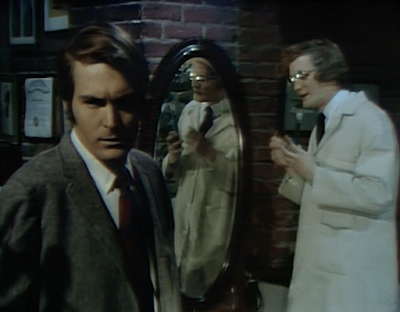
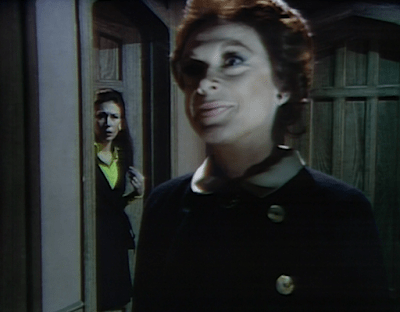
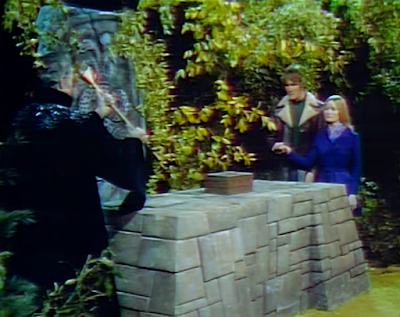
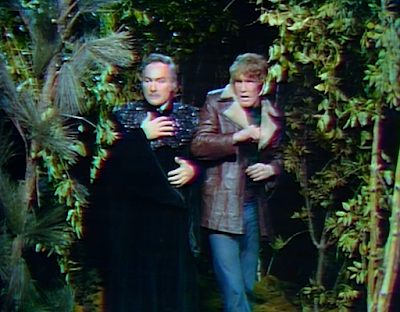
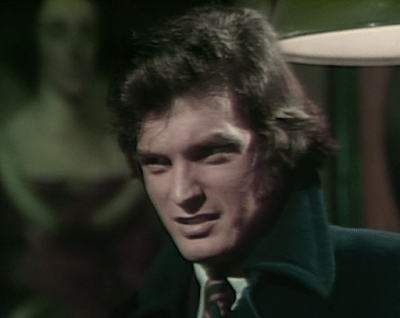
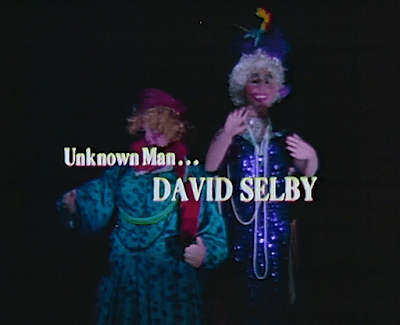
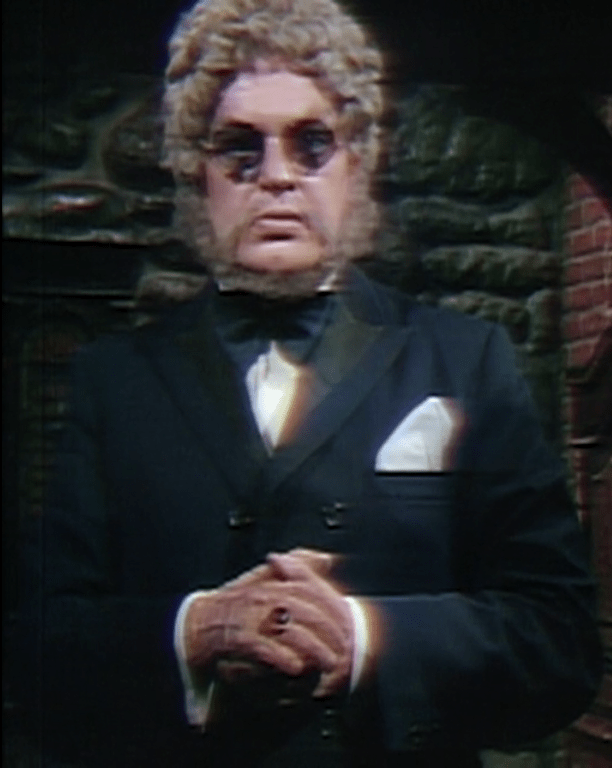
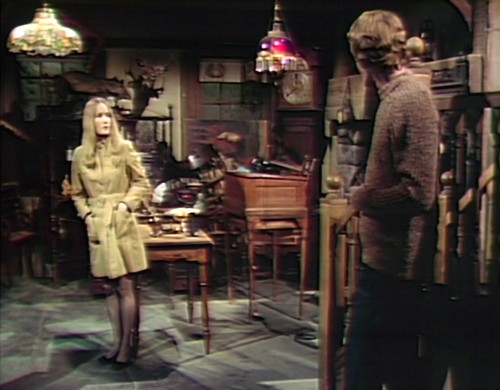
In October 1897, sorcerer Count Petofi has hijacked the body of Quentin Collins and banished Quentin to his own aging form. I call the villainous Petofi played by David Selby Q-Petofi, and the forlorn Quentin played by Thayer David P-Quentin.
P-QuentinQ-Petofi
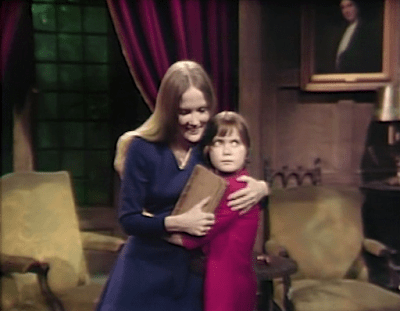
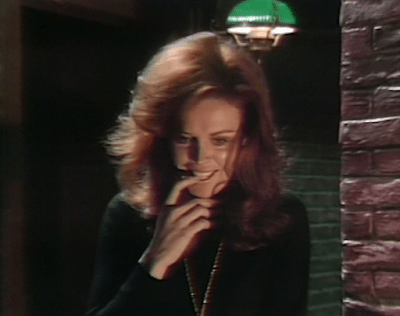
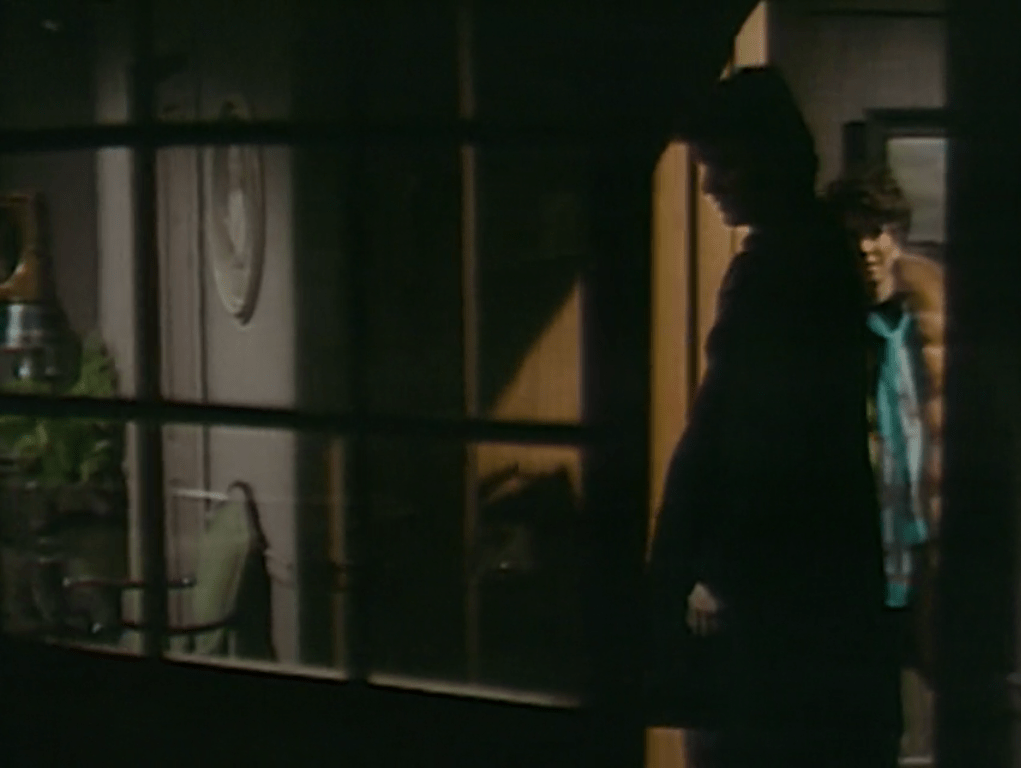
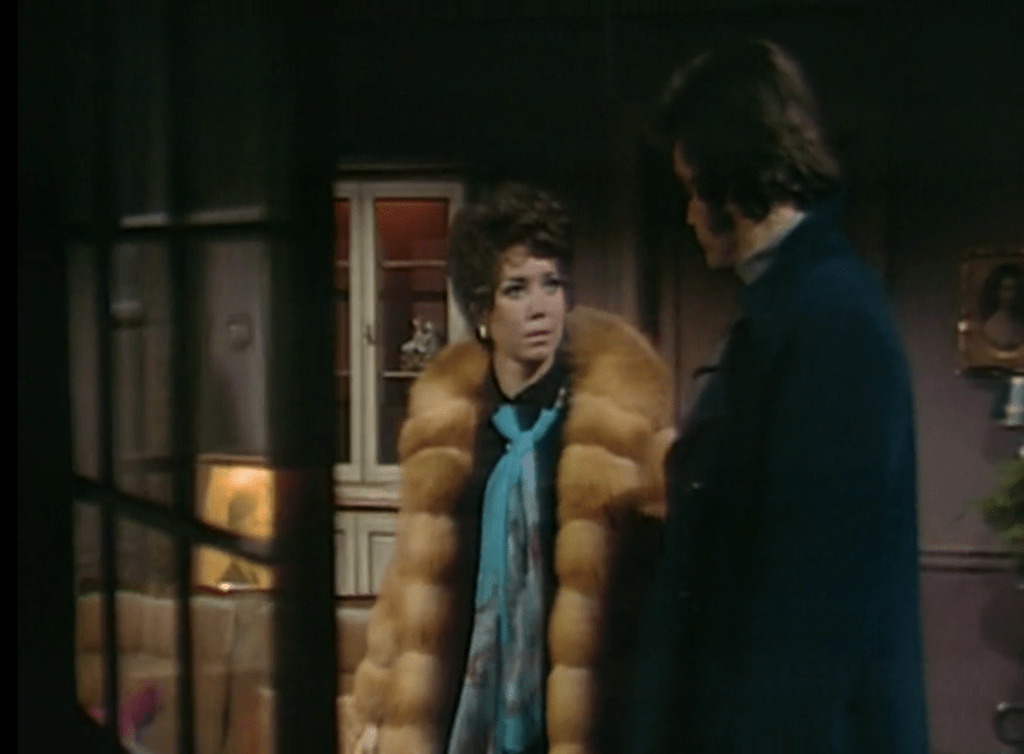
Today, wicked witch Angelique explains to P-Quentin how she and mad scientist Julia Hoffman cured time-traveler Barnabas Collins of vampirism, created a Doppelgänger of Barnabas, and used that Doppelgänger to persuade Quentin’s family in the great house of Collinwood that Barnabas never really was a vampire. Later, artist Charles Delaware Tate mistakes P-Quentin for Petofi, and tries to kill him. Q-Petofi then enters and takes control of Tate, using him for a project of his own.
Petofi stripped Angelique of her powers in #865, and deprived Tate of his ability to paint in #851. Angelique has been such an important part of the show for so long that regular viewers are confident she will be back eventually, but the 1897 segment seems to be lurching towards its close, and after her last exit there was no urgent reason in the story for her to come back. It’s good to see that she is still part of this arc.
Tate’s continued presence is rather less good news. Like all characters played by Roger Davis, he has an obnoxious personality and a grating voice, with a disturbing habit of invading his scene partners’ personal space. Today, he keeps grabbing at Q-Petofi’s coat while Q-Petofi bats him away; this is so irritating that it is unclear whether the line “You’ve got trouble with your hands” was scripted for Q-Petofi or ad libbed by David Selby.
For the last couple of weeks, we have had grounds for hope that Tate would just go away. When he sold the portrait of the lovely and mysterious Amanda Harris in #864, he lost his last connection to an ongoing plot point. We saw in that same scene that he had a lot of paintings he could sell for high prices if he took them back to New York or another major city. We also know that he has no friends or potential sources of income in the small town of Collinsport. So evidently he is just sticking around to punish the audience for watching the show.
In episodes #853-#856, Sorcerer Count Petofi (Thayer David) used his powers to force the devastatingly handsome Quentin Collins (David Selby) to trade bodies with him. Ever since, Quentin (Thayer David) has been trying to persuade someone to believe his story about Petofi (David Selby.) For the duration of the switch, I shall refer to Thayer David’s version of Quentin as P-Quentin, and David Selby’s version of Petofi as Q-Petofi.
P-QuentinQ-Petofi
Yesterday, P-Quentin persuaded his old friend and fellow Satanist, Evan Hanley, of what had happened. Evan agreed to conduct a ceremony to call upon their dark lord and ask for the transfer to be broken. They trick Q-Petofi into coming to Evan’s house and knock him out with chloroform. Then Evan begins an odd incantation:
Oh, Lucifer…
Great God of man and beast, look upon us with favor. Help us correct this evil which has been done in defiance of you.
Renew our bondage as your servants. Grant us the power we need this night, and we will be yours for eternity.
For Baal, who guides your mind.
For Beelzebub, who rules your spirit.
The robber of a soul must not be spared. The robbed must be avenged.
I exorcise thee.
Oh, impure spirit, who is the mind of the enemy, by the holy rite of Hecate, I conjure thee that thou do immediately hear and obey my command. Leave this man’s body, that he may return… Oh, yes, spirits of invisibility, I conjure and constrain thee herewith to consecrate this ceremony. So that surely and without trickery, thou may return each, to the body of [its] origin.
So be it.
Oh, Lucifer, so be it.
So be it…
I charge thee. I conjure thee. I command thee. Answer my demand.
Depart from these alien bodies and return to those from whence you came.
Depart.
So be it.
So be it.
So be it.
Oh, Lucifer, we give thee thanks.
Evan and P-Quentin seem to have the wrong guy. Whatever Satan’s powers may be, undoing evil, restoring property to its rightful owners, and enforcing justice are not exactly among the old fellow’s core competencies. Of course the ceremony fails. Q-Petofi wakes up from the chloroform, tells Evan he has made the greatest and last mistake of his life, and puts the zap on his brain. The next we see him, Evan is digging a grave, refusing P-Quentin’s offer to help him, and listening to Q-Petofi announce that he is about to be buried alive.
Q-Petofi’s announcement is the closing cliffhanger, suggesting that Evan has a somewhat longer life expectancy than we might have imagined when the ceremony fell apart. But once in a while cliffhangers really are resolved with the death of the character who is in peril, and that would seem to be a possibility in this case. Yesterday was Evan’s first appearance after an absence of more than eleven weeks, and he is not associated with any major loose ends in the plot. His alliance with the odious Gregory Trask, husband of Judith Collins Trask, may have given him a foothold now that Judith is back from her own long absence and is looking on Trask with suspicion, but yesterday he seemed to back off from siding with Trask in whatever fight might be coming up. So if the makers of the show are thinking it’s time for Q-Petofi to confirm his credentials as a major villain by killing a familiar character, Evan would be the obvious choice.
Judith confronts Trask today. He lies to her to cover up his misdeeds during the more than thirteen weeks she was confined to a mental hospital. She does not contradict all of his lies, and invites him to embrace her. He seems to think he has regained his control over her, but she tells him two things that make him uncomfortable. First, she says that she has persuaded his daughter to leave her apartment in the village and move back into the great house of Collinwood. When he protests that “She is not my daughter!,” Judith calmly replies that she is, closing the subject and leaving him looking like a petulant child. She also says that she hopes he has not bought or sold any stocks in her name lately, since she has revoked his power of attorney over her holdings. Again, he can say nothing in response.
Judith’s brother, the stuffy but lovable Edward, does not hear the details of this conversation. After Judith leaves the drawing room, Edward enters and tells Trask that he has won again. Trask perks up at this, and becomes his usual overbearing self. But he is just as quickly deflated when Edward tells him that he is looking into what he has been doing for the last thirteen weeks, and that when he finds out he will make a full report to Judith.
When Dark Shadows first became a costume drama set in 1897, Edward assumed he was to inherit the estate of Collinwood and all the family’s businesses. He was haughty and commanding, and Judith was a fragile spinster. But then their grandmother died, and the will left everything to Judith. She fell victim to Trask’s machinations and married him; he gaslighted her into the madhouse. Now that she has come home, Judith has found a new strength, sufficient to hold her own in the household if not to uphold justice and right on the scale which her position in the community would seem to demand. Edward’s dependent financial position, coupled with the many supernatural horrors he has witnessed, have gradually reduced him to a childlike state. In their scenes today, we see that the two of them have come to embody that signature dynamic of Dark Shadows, the relationship between Bossy Big Sister and Bratty Little Brother.
Sorcerer Count Petofi is wearing the body of rakish libertine Quentin Collins as a disguise, while Quentin is trapped in Petofi’s own aging and pudgy form. I will call the villainous Petofi played by David Selby Q-Petofi, and the forlorn Quentin as played by Thayer David P-Quentin.
Q-PetofiP-Quentin
We open with Q-Petofi at the front door of the great house of Collinwood. Yesterday we saw P-Quentin on the same spot, and heard David Selby’s voice articulating the miserable thoughts that showed on Thayer David’s face. Today the roles are reversed, and we see Mr Selby looking exultant while the voice of Thayer David talks about the glories of his situation.
We see that Q-Petofi is accompanied by his henchman, Aristide. He dismisses Aristide’s fear that he will somehow reveal his true identity to the occupants of the great house. He twits Aristide for a little while, pretending that he will use him as a guinea pig in a dangerous experiment he has planned for later in the evening, then sends him off to find someone else to serve that purpose.
Q-Petofi walks in on an argument in the drawing room between stuffy Edward Collins and the overbearing Gregory Trask. Trask is in charge of the house while his wife, Edward’s sister Judith, is in a mental hospital. Trask is going over the household accounts and complaining that Edward is spending too much on his houseguest, Kitty Soames, the dowager countess of Hampshire. Edward asks Q-Petofi to explain Collinwood’s tradition of hospitality to Trask, setting Trask off with a rant about Quentin’s relationship with Trask’s own former houseguest, the lovely and mysterious Amanda Harris. Q-Petofi’s indifference to the whole discussion strikes both Trask and Edward as odd, but it really is quite typical of the old Quentin.
After Trask exits, Edward tells Q-Petofi that he thinks he can subdue Trask by marrying Kitty. He says that it takes money to run Collinwood, and the late Earl’s estate gives Kitty ownership of half the county of Hampshire. Returning viewers know that the Earl died bankrupt, and so far from owning great swathes of southern England Kitty doesn’t even have train fare to get from Collinwood in central Maine to her mother’s house in Pennsylvania. So we have confirmation that Kitty has been less than fully honest with Edward. On the other hand, Kitty is under the impression that Edward is rich, while in fact their grandmother left every penny to Judith. So neither is leveling with the other about their financial status. Q-Petofi knows all of this, but it has nothing to do with his plans, and so he struggles to feign interest.
For his part, P-Quentin is sitting in the caretaker’s cottage on the estate. It seems right to longtime viewers that a character played by Thayer David should seek refuge here. When we first saw the cottage, it belonged to handyman Matthew Morgan, who was at that time played by George Mitchell. In #38, Mitchell was replaced in the part of Matthew by Thayer David, in the first of the many roles he would play on Dark Shadows. When Matthew had to leave the cottage for the last time in #112, his whole world fell apart. So when Aristide comes in and brutally evicts him, we can feel the full weight of the disaster that has befallen P-Quentin.
With nowhere else to go, P-Quentin returns to the great house. Once again it is Thayer David’s turn to look soulfully at the camera while David Selby’s voice speaks desperate words in voiceover. He tells himself that his brother Edward will have to believe him when he tells him the truth.
As it happens, Edward likes Petofi and is glad when he believes he is receiving a visit from him. Based on Edward’s earlier remarks about Collinwood’s tradition of hospitality, we could be quite sure that if P-Quentin presented himself as Petofi, Edward would be glad to offer him a place to stay. But P-Quentin plunges right in and tries to tell Edward the whole story. Of course Edward is not convinced. He treats it as a joke in questionable taste, and offers P-Quentin a brandy. When P-Quentin tells him to forget the brandy, he says that if he really were Quentin, he would never forget the brandy.
P-Quentin insists on going ahead with the lunatic tale, and keeps clutching at Edward’s arm. Edward finds the whole experience revolting, and firmly escorts him to the door. If it has occurred to P-Quentin to tell Edward any of the little stories of childhood that only he and Edward would know, it is too late now to do so. Edward orders P-Quentin to stop talking and go home. Little does he know that P-Quentin has no home to go to.
At the waterfront, the fog machine is working overtime, and so is one of the locals. In a comment on Danny Horn’s post about the episode at his great Dark Shadows Every Day, user “Goddess of Transitory” remarks:
I was remarking to my husband about the really remarkable size and relative wealth of the hooker population of Collinsport. They may hang at the docks (makes sense in a port town–you troll for lonely sailors) but they all have really nice clothes and jewelry and no matter how many of them Barnabas et al. tear through, there’s always more.
Makes you wonder what modern day Collinsport’s main economic generator really is…
Comment by “Goddess of Transitory,” left 7 April 2021 on Danny Horn, “Episode 857: All of Him,” 5 May 2016, Dark Shadows Every Day.
We find today’s well-bathed, well-coiffed, well-made-up young woman of professionally agreeable disposition drinking from a flask. Aristide emerges from the fog and takes the flask from her. When she protests, he says that if she follows him, she will be drinking champagne, and her protests subside. Her name is Wanda Paisley.
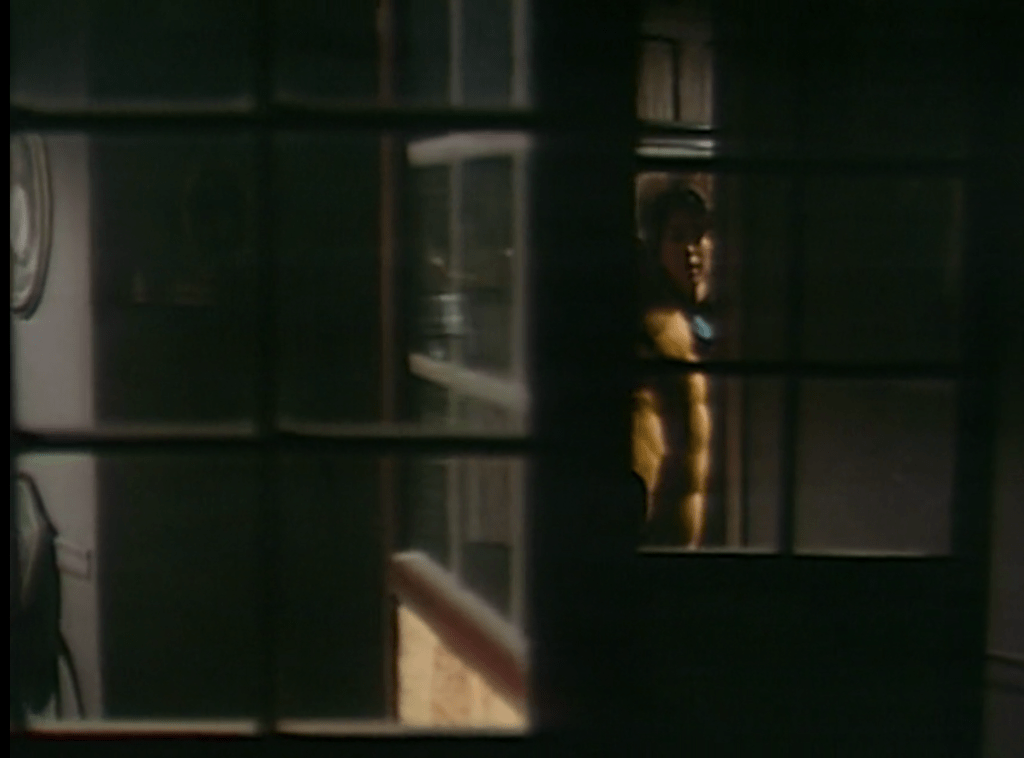
Aristide takes Wanda to the cottage, where Q-Petofi is waiting. Wanda is quite pleased at the prospect of sharing her favors with two handsome young men at once, but less pleased when Q-Petofi says that before the festivities get underway she will have to throw some I Ching wands and meditate on them. He assures her that she will be well paid for whatever services she may render, and asks her to agree that this is what really matters. Wanda’s agreement is not forthcoming. When Q-Petofi keeps yammering on about the wands and the hexagrams and the trance and the doors, it dawns on Wanda that this evening is not going to be what she signed up for, and she gets up to leave. Aristide grabs her, and Q-Petofi uses his magical powers to coerce her into cooperating.
Wanda casts the wands and meditates on them. She has a vision of a skeleton with big plastic eyeballs reaching its arm bones out to her. She screams. Where she had been sitting is another skeleton with big plastic eyeballs, this one also wearing a dress and a wig. Q-Petofi tells Aristide that “beyond the door anything is possible.”
Her turn as Wanda today marks Karen Lynn’s only appearance on Dark Shadows. She’s very good, it’s a shame they couldn’t find more for her. Her only other screen credit is a 1963 feature called The Orgy at Lil’s, which an IMDb reviewer says made history as “the first roughie.” I don’t know what a “roughie” is, and based on the description of The Orgy at Lil’s I rather doubt that my education in cinematic history would be significantly deepened by finding out. At any rate, it sounds like Miss Lynn was well-prepared to portray Wanda’s enthusiastic response when Q-Petofi first joined her and Aristide.
I made a contribution of my own to the comment thread on Danny’s post:
This has to be the archetypal Dark Shadows episode. It has Jerry Lacy modeling the style of acting he and Lara Parker invented for the show, Louis Edmonds being sarcastic, a squabble about control of Collinwood, people drinking brandy, a prostitute picked up on the docks while the [fog] machine runs, several kinds of supernatural mumbo-jumbo presented as if we will of course understand them, a dream sequence, and a skeleton in a wig. The next episode opens with a grave-digging scene, which is pretty nearly the only thing missing from this one.
Comment left by “Acilius,” 3 December 2020, on Danny Horn, “Episode 857: All of Him,” 5 May 2016, Dark Shadows Every Day.
It’s true no actors blow their lines, none of the boom mic shadows obstruct our view of anything crucial, and there is only one audible cough from a crew member, so it is an unusual episode in some ways. But I could have mentioned another very typical thing- a practical effect they try for the first time. I believe the split screen shot of Q-Petofi in the drawing room and P-Quentin at the cottage is the first time the show has used this device. It doesn’t work very well, but they were always pushing to do something new:
Evil sorcerer Count Petofi has cast a spell causing his mind to take over the body of rakish Quentin Collins, while Quentin is confined to Petofi’s own body. So David Selby begins playing a youthful and handsome Petofi, while Thayer David plays an aging and pudgy Quentin.
In their post about the episode on Dark Shadows Before I Die, John and Christine Scoleri use a wide variety of expressions to refer to the characters Thayer David and David Selby play today. I will just call Thayer David’s character P-Quentin and David Selby’s Q-Petofi.
P-QuentinQ-Petofi
Both of those actors give superb performances today; David Selby makes Q-Petofi’s preening arrogance suitably repellent, while the 42 year old Thayer David shows us P-Quentin reduced to the total helplessness of a despised man in extreme old age. There is a scene that Mrs Acilius and I found particularly hard to watch when Q-Petofi’s henchman Aristide takes the thick glasses without which P-Quentin is effectively blind and holds them away from him.
Q-Petofi and Aristide’s gleeful cruelty to P-Quentin make us wonder how the count and his henchman feel about the body they are looking at. The show’s earlier body swap story, in which vampire Barnabas Collins had hoped to die and come back to life in the form of Frankenstein’s monster Adam, led Adam to ask Barnabas in #587 “How could you hate yourself so much that you wanted to change your body?” We hadn’t known that that the count hated himself at all until we saw this scene, but he must have done to take such delight in tormenting P-Quentin, and Aristide’s revelry shows that he, too, harbors more hostility to his master than he ever dared expose.
P-Quentin staggers away from the lair of Q-Petofi and Aristide and meets broad ethnic stereotype Magda Rákóczi in the woods. He tries to explain his true identity to Magda, who has experience with magic and has for some time now been his ally. But Magda’s fear of the count keeps her from listening to the far-fetched tale, and she rushes off.
P-Quentin makes his way to the door of his home, the great house of Collinwood. He stands there, and we hear his thoughts, in David Selby’s voice. He tells himself he cannot go in, because no one there would believe him if he told them who he was. He slinks off to the caretaker’s cottage, where he meets maidservant Beth, who is his sometime fiancée. He tries to tell her the story, but she too is terrified of the count. When Q-Petofi shows up, she leaves with him.
Magda is a wonderful character, and what we have seen has given us every reason to hope she will be a substantial part of the show for a while yet. Unfortunately, this is her final on-screen appearance. We will hear her voice once more, six weeks from now. The show has always been visually ambitious, and lately they’ve managed to pull some neat tricks with videotape that led me to hope we would see at least one scene in which Grayson Hall appears opposite herself as both Magda and time-traveling physician Julia Hoffman. When Hall appeared in the 1970 film End of the Road, she said that it was a relief from playing Julia, to whom she apparently referred as “that tight-ass doctor.” Magda is earthy enough that it would have been fun to see how Hall would have used her to demonstrate the same attitude towards Julia, even if she had to stick to words approved by the ABC network’s Standards and Practices office, and Julia’s reaction to Magda would doubtless have been just as much fun.
Barnabas Collins went into a trance at the end of February 1969 and came to in March 1897, a time when he was a vampire. Barnabas took the audience with him, so that Dark Shadows has been a costume drama set in 1897 ever since. We’ve had a few glimpses of 1969- we can see that time is passing there, that twelve year old David Collins has been saved from death, that the ghosts of rakish libertine Quentin Collins and maidservant Beth Chavez have stopped haunting the great house of Collinwood, and that Barnabas’ physical body has vanished, leaving him no avenue of return to the 1960s. We’ve also had indications at several points that the show was about to put the 1897 segment into its climactic crisis, each of which was followed by a restart of that segment. Some of those false signs probably reflected long-range plans that were abandoned when they saw how popular 1897 was.
Now, they are in a position when they can go back to 1969 whenever they wish. There are only a few unresolved story points in 1897. Most of those can be wrapped up quickly, and the rest can be forgotten. If they wanted to, they could write a single slam-bang episode in which the evil Gregory Trask is forced to accept the annulment of his marriage to Judith Collins and to relinquish control of Collinwood, the family is persuaded that Barnabas never really was a vampire after all, and Kitty Soames, the dowager countess of Hampshire, turns into Barnabas’ lost love Josette and finds a way to leave him that will make him even more miserable than he already is. Sorcerer Count Petofi might be left watching helplessly as Barnabas, his friend Julia Hoffman, and the living Quentin all escape into the future. We could then assume that the rest of the characters just toddled off and led quiet lives.
They could equally well take another tack on their way back to contemporary dress. Barnabas and Julia came to 1897 separately; there is no reason why they, or any other characters, should have to go to 1969 together. Today, Petofi is performing some kind of mumbo-jumbo that is supposed to lead to a body swap that will cause him to trade forms with Quentin. After that, he is confident he will travel to 1969 and be safe from his foes, the Rroma people. He seems to be succeeding. So perhaps a Petofi who looks and sounds like Quentin will appear in 1969, in a Collinwood based on the events that have taken place so far in 1897.
In that pocket universe, Collinwood would be known as Traskwood. Its owner in 1969 would be Trask’s son by a subsequent marriage. Call him Gregory, Junior. It would be unclear at first what happened to Judith and to her presumptive heir, her twelve year old nephew Jamison. The revelation of their fates could set us up for some big twists and the introduction of new characters with familiar faces.
Since Gregory, Junior would be in his sixties, he could have a couple of adult children who would carry on some story points. Gregory III could be played by Jerry Lacy without old age makeup, and could be a morally ambiguous character who might emerge as a protagonist and would certainly become prominent in the pages of the fan magazines. None of the Trasks would have any legal obligation to let Quentin stay in any of their houses or to work for any of their businesses, nor would any surviving Collinses. Moreover, everyone in the area would know full well that there used to be a vampire on the estate named Barnabas Collins, and no one would ever have heard of Julia.
If the show goes that direction, we could spend half of each week with Petofi-as-Quentin while he makes a place for himself in that pocket universe version of 1969, while we would spend the other half with Barnabas and perhaps Julia back in 1897, where they are in an uneasy alliance with wicked witch Angelique as they try to set history right. Kitty’s Josettification would threaten to destroy this alliance, since Barnabas is obsessed with his love for Josette and Angelique is equally obsessed with her hatred for her.
The body-swap theme of today’s episode, along with the emphasis on the procedure Petofi is following, will remind longtime viewers of The Experiment, a theme that ran from April to May 1968. Barnabas and Julia built a Frankenstein’s monster with the intention of killing Barnabas and bringing him to life again in the new body. Some viewers may have wondered if Jonathan Frid was actually going to leave the show, and if the actor playing the monster was going to take over the role of Barnabas.
This time a larger fraction of the viewers are likely to think the transfer might work, since it would not require a popular star to leave the show. On the contrary, casting David Selby as Petofi in an altered twentieth century would give him the chance to wear up-to-date clothing, have magical powers, inflict cruel punishments on people who get in his way, run con games, hint at an ambiguous sexual orientation, and generally have a wonderful time. Since Mr Selby had by this point become the pin-up of a huge percentage of America’s teenaged and preteen girls, that sounds like a recipe for sky-high ratings. Meanwhile, casting Thayer David as a Quentin estranged from his body and his social environment would present an expert character actor with a challenge worthy of his skills.
It might sound like it would be too confusing to intercut between a parallel version of 1969 and a continuation of 1897, but the show will try almost exactly the same tactic a couple of years from now, as they set up for the storyline that carries the series through its final nine weeks. That closing bit is not widely regarded as one of the better phases of Dark Shadows, but the intercutting timelines that lead to it are an intriguing gambit. Maybe the idea for it came when they were trying to figure out how to get from 1897 back to 1969, in which case it is possible that the scenario I have outlined above may be very much like what the writers had in mind at some point in the development of the story.
Corridors of Trial and Error
We do get a few hints today about what we might see in the 1897 half of the show if it does split. Broad ethnic stereotype Magda Rákóczi shows up for the first time since #834, before Julia came to 1897. We had begun to fear we wouldn’t see her again. It’s good to have her back, but since Magda is also played by Grayson Hall, it raises the possibility that Julia might go away for a long time. Maybe the action will be split between 1897 and 1969 for some months, and during those months Julia will be in 1969, running her hospital, entirely unaware that there ever was a Barnabas Collins.
Beth is a servant of Petofi’s now, and she spends the episode bickering with her colleague Aristide. It turns out that she still has feelings for Quentin. At the end, she runs out of Petofi’s lair to try to help Quentin. This suggests that Beth’s conflicted loyalties will be a source of drama. Aristide shouts after her not to go, then says that “You’ll ruin everything.” He delivers this line in such a mild tone that the resulting laugh must have been intentional. This raises the possibility of Aristide emerging as a source of laughs. In the hands of actor Michael Stroka, that is a distinct possibility.
Quentin rambles into the Blue Whale, the tavern in the village of Collinsport. It’s after hours, and the only person in the barroom to tell him to stop knocking on the door is cabaret performer Pansy Faye, whose body Quentin first met when it was occupied by Trask’s daughter Charity. He still calls her Charity, which she overlooks because she has the hots for him. Pansy lets Quentin in, and invites him to her place.
Charity lived at Collinwood with her father, and after Pansy took over she stayed on there for some time. The other day she talked about wanting to leave Collinwood and go “home,” but it was not at all clear what that meant. Her invitation to Quentin is the first time she explicitly says that she has her own apartment now. Perhaps, if we stay in 1897, we will see that apartment. Maybe when Thayer David takes over the part of Quentin, Pansy’s psychic gifts will enable her to recognize who he really is, and she will take him in. In those days, of course, a man and a woman would have to get married to rent a lodging, so presumably that would have involved a wedding. Since Quentin would appear to be Petofi, Pansy would thereby become a countess, Kitty’s equal in rank. It already makes Kitty exceedingly uncomfortable to be around Pansy, so that would be an occasion for a great deal of comedy. Moreover, any viewer who saw that both women had the same title and both were involved in supernatural changes of personality would be convinced that the writers had planned that phase of their story all along.
Pansy goes into her act. She sings her song; Quentin is seized with a fit of brio. He gives a little speech addressed to the absent bartender, picks Pansy up, spins her around, kisses her passionately, then sits down at the piano and bangs out the tune of her song. She admires his piano playing and he says that he used to be able to play quite well, before “they” came. Then he suddenly sinks back into his previous depression. He denies that he ever played the piano in his life. We know that it was Petofi who had that moment of brightness, and that Petofi’s mood darkened when he remembered the Rroma who cut his hand off 100 years before. Quentin has no recollection of anything his body does or says when Petofi is using it.
A piano is prominently featured in the drawing room at Collinwood in the 1960s- perhaps there will also be one there when the estate is renamed Traskwood, and when Petofi, as played by David Selby, wangles an invitation to the great house, he will play it. That might set us up for a moment when Quentin returns to his proper body, tries to explain what has happened, and finds that his inability to play the piano marks him as an impostor. You could build a lot of story on that- you might make it look for a while like Quentin could find a home in the Traskwood universe, then show that no, the people back in 1897 have to reset the past before anything can work again.
Rakish libertine Quentin Collins races to the train station to meet his fiancée, the lovely and mysterious Amanda Harris. He thinks he sees her, but it is actually another young woman wearing a remarkably similar outfit. She tells him the train to New York City left a few minutes ago; Quentin knows Amanda was on it, and that she thinks his absence means that their relationship is over. The young woman was quite miffed when Quentin first approached her, but by the time he offers his second apology her look has gone from indignant to concerned to yearning. The guy’s got game, you have to grant him that.
It’s been less than a minute since he made a bad first impression on her, and she’s ready to run off with him. Screenshot by Dark Shadows Before I Die.
Quentin was detained by a fistfight with a repulsive little man called Charles Delaware Tate. Tate is an artist whose works sometimes have magical powers. His portrait of Quentin, for example, keeps Quentin from turning into a werewolf and ensures him against physical harm. Since Tate is obsessed with Amanda, he stole the portrait from Quentin when he learned Amanda was planning to leave with him. Quentin dared not leave without it, and went to Tate’s studio to demand its return. He very satisfyingly beat Tate senseless, but he did not find the portrait, and now he fears he has lost Amanda forever.
We cut to Tate’s studio. Tate is lying on the floor where he fell when Quentin finished hitting him. Unfortunately, he gets up. Sorcerer Count Petofi, who granted Tate the power to make magical artworks some years ago, enters. He tells Tate that it was stupid to steal Quentin’s portrait. Tate pretends not to know what Petofi is talking about, irritating him and us. Petofi says that he will have to be punished. After he forces Tate to draw a sketch of a pretty woman, he squeezes his wrists, helps himself to Quentin’s portrait, and says what sounds very much like a final goodbye. He exits, and Tate sits down with his pad and pencil. He discovers that he is no longer able to draw, not even a straight line.
These days, Dark Shadows is a costume drama set in 1897. Most of the time between 1966 and 1968, it took place in a contemporary setting. In those days, the set now used as Tate’s studio was the Evans cottage, home to artist Sam Evans, a drunken sad sack, and his daughter Maggie, The Nicest Girl in Town. In December of 1966 and January of 1967, the ghost of the gracious Josette compelled Sam to paint alarming images of Laura Murdoch Collins.
It turned out Josette was doing this because she knew the characters were not all that bright and she had to literally paint them a picture to explain that Laura was an undead fire witch bent on incinerating her young son David. Laura tried to thwart Josette’s plan by harming Sam. In #146, Laura caused a fire at the Evans cottage that burned Sam’s hands, temporarily depriving him of the ability to paint. Petofi’s disabling of Tate on the same set will bring this incident back to longtime viewers. Especially so, since Josette is in the air at this point in the show. In #844, a character named Kitty joined the cast. She keeps having mental flashbacks to things only Josette would remember, and Josette’s music box appeared on Kitty’s table at a time when Josette’s ghost seemed to be the likeliest agency to have put it there. Perhaps she will insert herself into Tate’s story for some reason.
When we were watching the scene between Tate and Petofi, my wife, Mrs Acilius, said that she very much wished someone else were playing Tate. Violet Welles’ script gives whoever is playing Tate a lot of opportunity to show what he can do in that scene. Roger Davis is a highly trained actor who has a long list of stage and screen credits, but he is almost always very unpleasant to watch on Dark Shadows, and he wastes the potentially fascinating dialogue Welles gave him. When Mr Davis is particularly trying, I usually try to make the scenes bearable by imagining what Frederic Forrest, who was a featured background player in #137, would have done in his place. But the echo of the story about Sam makes me wonder what David Ford would have done as Tate. Ford was in his forties, smallish and pudgy, so a David Ford Tate could not believably have had a fistfight with a character played by the very tall and fit 28 year old David Selby. But he might have been a subtle enough villain that such an exchange would not have been called for. Moreover, the incestuous undertone of Tate’s desire for Amanda, who is the product of one of his magical paintings and therefore a kind of daughter to him, would have been all the more disturbing had Tate been played by the man we knew as Maggie’s father in the 1960s and, when the show was set in the 1790s, as Josette’s.
Back home at the great house of Collinwood, Quentin receives a visit from Tim Shaw, Amanda’s ex and a would-be sleazy operator. He demands Tim tell him what he knows about Amanda’s life in New York before they came to Collinwood. Tim declares he will tell him nothing, to which Quentin responds by choking him and flinging him to the floor. Tim then burbles out everything he knows, which turns out to be nothing of the slightest use. Quentin picks Tim up and throws him out the front door in the most humiliating possible way. We cheer this on almost as joyously as we cheered Quentin’s beating of Tate Friday, but for the opposite reason. Mr Davis is a genuinely disagreeable person who ruins episode after episode, and it was him we were angry with. We chanted at the screen, not “Quen-tin! Quen-tin! Quen-tin!,” but “Da-vid! Da-vid! Da-vid!” hoping Mr Selby would pay him back for all his on-screen assaults on the women and children in the cast. But Don Briscoe was as nice a guy as Tim has become despicable, and he and Mr Selby enjoyed working together. You can see Briscoe’s joy in performance in the way he holds on to a little yellow piece of paper representing a note from Amanda all through the beating Quentin administers. Even the shot of Quentin shoving Tim out with his buttocks prominent is the product of Briscoe’s enthusiastic use of his body to demonstrate Tim’s total defeat.
Quentin’s other fiancée, wicked witch Angelique, comes downstairs to ask what the ruckus was about. Quentin makes up a transparent lie about having a financial interest in some firm in Boston, and says that he and Tim were quarreling about the details of it. Angelique lets him go on with this for a while and to say that he is leaving for Boston, then insists that they set a date for their wedding. He begs off, claiming not to know how long he will be away.
Petofi enters, and tells Angelique about Quentin’s plan to go to New York and look for Amanda. He also tells her that they now have a common cause, and proposes an alliance. Each of them is so powerful, and so evil, that this is a sobering prospect.
When Quentin returns to the foyer, it is his turn to be alone with Petofi. Quentin knows that Petofi gave Tate both the power to create the portrait that freed him of his curse and the commission to do so, and that he is therefore beholden to Petofi for his continued humanity. Part of his motivation for fleeing to New York with Amanda was his hope that he could escape the slavery Petofi has imposed on him as the price of that benefice. When Petofi tells Quentin he has come to see him before he goes, Quentin is momentarily stunned, and then makes a brave little noise to the effect that Petofi can’t stop him. Petofi assures him that he does not want to stop him. It doesn’t matter in the least to him where Quentin is- he can control him from anywhere.
Petofi calls on Tim at his room in the inn. He deepens Tim’s misery by pretending he doesn’t believe what Tim told him about Tate’s magical powers. As he leaves, he takes a brooch that belonged to Amanda.
Quentin is at the train station. Angelique appears there, and tells him not to go. He says that he doesn’t care if she kills him. It will be consolation enough to have died walking away from her. She says that she will not harm him in any way. This causes him to open his eyes wide in terror as it dawns on him what she means. She produces Amanda’s brooch and a doll. She positions the pin of the brooch over the doll’s chest and says that no matter where Amanda is, she will die a horrible death when the pin impales the doll.
Closing Miscellany
The actress who plays the young woman Quentin meets at the train station is billed in the credits as “Amy Yaekerson,” the only person known to Google ever to be called “Yaekerson” and known only for this appearance. But in a comment on Danny Horn’s post about the episode at his great Dark Shadows Every Day, a commenter known as “miles” pointed out that there are lots of people named “Yakerson.” He went on to identify an Amy Yakerson born in New York City on 1 April 1946, and to find a 1966 notice of a play featuring an actress of that name and probably of that age in the New York Daily News. I followed that up with some Googling of my own; the only Amy Yakerson I can find who is online today was born in Connecticut in 1954, so I don’t know where Amy Yakerson, star of stage and screen, is now.
We saw some of Sam’s paintings in Tate’s studio Friday and today, twenty-some years before Sam was born. Tate hides the portrait of Quentin behind one of Sam’s seascapes, and Sam’s portrait of Maggie’s mother is on the floor next to him when we see him lying there in the aftermath of the fight. John and Christine Scoleri have the details in their post about Friday’s episode at Dark Shadows Before I Die.
Julia Hoffman is miserable. She has followed her friend, vampire Barnabas Collins, and traveled back in time to the year 1897 on a mission to prevent terrible things that were happening in 1969. She has managed to come up with a treatment that is similar to one that briefly cured Barnabas of vampirism in March and April 1968, and is giving him regular injections in the course of that treatment. She is in hiding with him in an abandoned building, and has survived kidnapping and attempted murder. And what is her reward for all that? He is back on the same bullshit he was involved in when she first learned of his existence in 1967. He has met a girl and made up his mind to throw away all of their plans in an effort to convince her that she is the reincarnation of his lost love Josette. It’s no wonder Julia is so furious with him that she looks like she is the one with fangs.
Barnabas in danger.
Making matters worse, this time it seems Barnabas might be on to something. He pays a visit to his distant cousin, Quentin Collins, and asks who the girl is. Quentin says that she is Kitty Soames, widow of the late Earl of Hampshire, returned to her native USA after her husband’s death. When Barnabas starts in with his lunacy about Josette, Quentin becomes excited. He tells him that Kitty looked at the spot where his portrait hung until he was exposed as a vampire and asked what had become of it. When Quentin asked how she knew about that, since she had never been to the house before, she laughed and said that of course she knew the portrait, of course she was familiar with Barnabas. After a few seconds, she said she knew nothing of any portrait or of anyone named Barnabas.
Barnabas takes this as proof positive that Kitty is Josette returned to life, and that her memories of the 1790s are coming back to her. He asks Quentin to meet him at his hiding place so that they can arrange for him to meet her. He tells him where the hiding place is. Quentin agrees. Barnabas gives Quentin an enigmatic look before he exits.
Quentin is miserable. He is under the power of sorcerer Count Petofi, who has ordered him to kill Barnabas. Now that he knows where Barnabas keeps his coffin, there is nothing to stop him obeying. He will have to go there at dawn and stake his friend.
Barnabas has confronted Quentin about his subjection to Petofi, whom he knows to be his deadly foe. He has several times shown his distrust of Quentin. So people who started watching the show in the last year or so will be puzzled when he tells Quentin where to find him when he is helpless. Those who have been in the audience longer know that Barnabas not only has a habit of telling his enemies exactly what they need to know, but that he also loses all semblance of rationality where Josette is concerned. It is all too believable that he may have done this. Still, there is that look back at Quentin, suggesting that Barnabas knows that he is giving information to his enemies.
Quentin is in the drawing room of the great house, waiting for the dawn to bring with it his obligation to kill his friend. A woman who used to be Miss Charity Trask enters. Petofi erased Charity’s personality some time ago. Her body is now home to Pansy Faye, Cockney showgirl, mentalist, and onetime fiancée of Quentin’s late brother, inveterate prankster Carl Collins.
Pansy is miserable. Pansy is cross that Quentin did not go to see her perform at the Blue Whale, a local tavern where she is doing her old act. But what really has her down is that it is exactly three months since Barnabas murdered Carl, and she is the only one who seems to remember him. When Kitty and Quentin spoke of Carl yesterday, they were the first characters other than Pansy to mention his name since the immediate aftermath of his death. She is irritated with Quentin for getting drunk, angry that Barnabas is still at large, and sorrowful that while the dawn means a new day for most, for people like her and Quentin it just means reliving the same day time and again. Quentin perks up when Pansy lists the many good reasons why someone ought to kill Barnabas, and for a moment it seems like he is going to tell her where he is and invite her to do it. She recognizes this, and keeps asking questions after he stops himself. The whole scene is beautiful from beginning to end, one of the highlights of the series. If they had had Daytime Emmys in 1969, it is the tape they should have sent to the voters to get the acting awards for Nancy Barrett and David Selby.
Dawn comes, and Quentin does go to the cave where Barnabas’ coffin is. He has a stake and mallet with him. He opens the coffin, sees Barnabas, places the stake over his heart, and raises the mallet. That’s as far as he can go. He throws the weapons aside and leaves the cave, vowing that if Barnabas can face whatever he has faced, he too can face his own destiny.
Shortly after, we hear footsteps. Pansy enters. She sees the coffin and opens it. She finds the mallet and stake. She drives the stake into Barnabas’ chest. Blood spurts out around the wound and out of his mouth. It would seem that Barnabas Collins is no more.
Quentin is a villain, but he is charming, and at this point David Selby is a breakout star to rival Jonathan Frid as Barnabas. Earlier, it had seemed Pansy might kill Quentin, and many fans hated her for that. No one seriously expected her to kill Barnabas, since he was a pop culture phenomenon familiar even to people who never saw the show. To this day, Dark Shadows is known (to those who know it at all) as “the vampire soap opera from the 1960s.” So having her kill Barnabas is certainly a twist worthy of ending a week.
There once was a woman named Miss Charity Trask. Charity was desperate to please her father, the hypocritical and overwhelmingly evil Rev’d Mr Gregory Trask. She faced the world as Trask’s enforcer, and was herself so fiercely repressed that she drained the joy out of every group she joined.
There is no longer such a person as Miss Charity Trask. Sorcerer Count Petofi caused the spirit of the late Pansy Faye, Cockney showgirl and fake psychic, to take up residence in Charity’s body. Charity/ Pansy still lives in the great house of Collinwood, of which Trask has established himself as master, but since her only functioning mind is that of the deceased Pansy, she doesn’t understand why people insist on livenaming her.
Charity/ Pansy enters the drawing room and finds Amanda Harris. Amanda greets her as “Miss Trask,” alienating her at once. Charity/ Pansy demands to know what Amanda is doing at Collinwood. Amanda says that she lives there as Trask’s guest. Charity/ Pansy calls for Trask. She leans out the door of the drawing room and in the loudest, harshest voice Nancy Barrett could manage shouts “Hey, Trask! Trask!” It takes Trask a moment to answer, perhaps because Jerry Lacy had the same trouble we had while watching and couldn’t stop laughing. It is one of the top ten intentional comedy moments in the series, maybe top five.
“Hey TRA-A-ASK! TRASK!”
Charity/ Pansy can see that Trask has designs on Amanda, as can everyone else. But she doesn’t care about that. She is convinced Amanda has come to the house to seduce rakish libertine Quentin Collins, whom she herself is determined to marry.
Amanda had no such plans when she first came to the house, but she meets Quentin today, and a few minutes later they are locked in a passionate kiss. Trask surprises them, and declares that he will protect Amanda from her weaknesses.
For his part, Quentin is busy trying to figure out what is happening to him. He is a werewolf, and there is a full Moon tonight, yet he did not transform. He finds a portrait in his room. It bears a plate with his name and the current year- “Quentin Collins, 1897.” But it depicts him as he is when he is in his lupine form. He knows that it is the work of artist Charles Delaware Tate, and goes to confront Tate in his studio in the nearby village of Collinsport.
Quentin handles Tate roughly and demands to know why he painted a wolf on the canvas with his nameplate. Tate says that Charity saw the painting and thought it looked like a wolf, but that when he looked at it himself he saw only Quentin’s face. Quentin takes Tate to his room and shows him the painting; Tate is shocked to see that it is, indeed, the wolf.
Tate gets another shock before he leaves the house. He meets Amanda, and Trask asks him to paint her portrait. Tate has never seen Amanda before, but he has painted her many times. Returning viewers know that Tate’s painting abilities are a gift from Petofi, and that with them comes the power to conjure into existence that which he paints. Amanda is Tate’s creation.
Tate doesn’t want to accept this fact, and so he flees the house. He rushes back to his studio, and tries to take his mind off what is happening by sketching a still life. He adds an imaginary vase to the arrangement of fruit on the table before him. To his dismay, the vase materializes.
Tate painted Amanda into existence two years prior, and has been working steadily as a visual artist since. So you might wonder why he is only now noticing that things pop into being when he draws or paints them.
One possible explanation that comes to mind is about Petofi, the source of Tate’s abilities. Petofi’s right hand was cut off a hundred years ago, in 1797, and most of his power went with it. He was just recently reunited with the Hand. It once more grows from his wrist, and he is restored to his former might. Perhaps when Petofi first gave Tate his abilities, he could give him just enough to create Amanda and a great deal of commercial success. But now he is stronger, and perhaps Tate is stronger too. Petofi had better hope Tate doesn’t think of painting a picture of an avenger putting him to death for the many crimes he has committed against the Rroma people.
As the full Moon is about to rise, hypocritical Rev’d Gregory Trask is standing outside the prison cell in the basement of the great house of Collinwood. He is taunting its inmate, rakish libertine Quentin Collins. Trask knows that Quentin is a werewolf, and is reveling in the prospect of watching him transform, then going to the police.
To Trask’s great disappointment, Quentin stays human. Once the Moon has been up for a while, Quentin grows jubilant. He threatens to contact the police himself, and points out that Trask is committing a number of felonies by holding him in the cell. With singularly poor grace, Trask lets him out. The scene between them is hilarious.
In the foyer, Quentin meets 150 year old sorcerer Count Petofi. He grabs Petofi by the neck, trying the old fellow’s patience. Petofi says that it is quite silly of Quentin to behave as if he can do him physical harm, and that he ought to learn to curb his temper. “But you’re also rather charming, which means there’ll always be somebody who’ll help you.” Of course Quentin is enormously charming- he is played by David Selby. When we first met him, Quentin was a ghost who never spoke but spent months abusing children, murdering day players, threatening to kill our favorite characters, and bringing every storyline screeching to a halt. Still, enough of Mr Selby’s inherently adorable personality came peeking through that Quentin was already a fan favorite long before he delivered a word of dialogue.
Something similar is going on with Amanda Harris, who is an oil painting come to life. Amanda is much nicer than the ghost of Quentin was, but she is a bit shaky in execution. Future Broadway star Donna McKechnie admits nowadays that, while she was a highly trained dancer and singer by 1969, she was still something of a beginner at acting, and that does show when Amanda has a lot to say. But her limited skills really don’t matter at all. Even when Miss McKechnie looks at a scene partner, takes a deep breath, and shouts a whole speech, she is so appealing that your only question is why Amanda acts that way. Maybe that’s how all oil paintings behave two years after they’ve come to life.
In her two-dimensional form, Amanda was the product of Charles Delaware Tate, an artist who received great talents as the result of a Faustian bargain with Petofi. Tate is in the village of Collinsport now. Petofi summoned him to paint a portrait of Quentin. We’ve had many heavy-handed clues that the portrait would function like the picture of Dorian Gray, and that on nights of the full Moon it would transform and leave Quentin as a human. Today Quentin finds the portrait in his room, and it indeed looks like the werewolf. Unfortunately for the show, the werewolf is a cute doggie who wears a tidy little suit, and unless you see him in the act of killing someone it is impossible for us to be afraid of him. As a painting, he wouldn’t pass muster as a set decoration for the walls of an ostensibly haunted house on Scooby Doo Where Are You.
From December 1968 to through February 1969, strange and troubled boy David Collins (David Henesy) and his friend Amy Jennings (Denise Nickerson) were falling under the power of the malign ghost of Quentin Collins. Occasionally the children were possessed by the spirits of David’s grandfather Jamison and great-aunt Nora; at other times they were possessed by Quentin’s own spirit and that of Quentin’s sometime lover, maidservant Beth. In those same days, Amy’s brother Chris (Don Briscoe) was suffering from a curse that made him a werewolf.
As Quentin’s power over David and Amy grew, so did the frequency and duration of Chris’ spells in lupine form. By #700, Quentin so dominated the great house on the estate of Collinwood that its residents fled to the Old House on the estate, home of their distant cousin Barnabas Collins. David, entirely possessed by Jamison, was close to death. For his part, Chris was stuck in wolf form, apparently permanently, and Barnabas had locked him in a secret room in the old Collins family mausoleum.
Desperate to remedy the situation, Barnabas and his associate, occult expert Timothy Eliot Stokes (Thayer David,) searched Quentin’s old room in the long-deserted west wing of the great house. They found some I Ching wands there. Under Stokes’ direction, Barnabas threw the wands, meditated on them, and found himself transported back in time to 1897. In that year, Quentin, Beth, Jamison, and Nora are alive, and Barnabas is a vampire.
Barnabas had no idea what led Quentin to become a malevolent ghost or what first brought the werewolf curse on Chris, but he had reason to believe that 1897 was an important year in the events leading up to both of those unhappy circumstances. So once he arrived in that period, he spent his nights meddling in all the affairs of the Collins family he found there. Vampires are not problem-solvers; their function in a story is to create problems that other characters will have to solve. So all of Barnabas’ well-intentioned interventions backfired badly. Even disregarding the many murders he committed for his own selfish ends, including the murder of Quentin’s brother Carl Collins, his trip would by any standard have to be considered a disaster.
Now, evil sorcerer Count Petofi (Thayer David) has found that Barnabas is a visitor from the future and is determined to go with him when he returns to 1969. When he demanded Barnabas tell him his secret, Barnabas quite truthfully told him he had no idea what was going on when he found himself transported from one period to another. Petofi did not believe him, and is trying to extort the information he wants by summoning the spirit of David to come from 1969 and possess Jamison (David Henesy) in 1897.
Not only is this an intriguing reversal of the 1968-1969 story in which the ghost of Quentin caused Jamison’s spirit to possess David, it also picks up on some recent hints that they might retcon the whole “Haunting of Collinwood” story to put Quentin’s ghost under the control of Petofi. Even if he can’t hitch a ride with Barnabas, perhaps Petofi will find a way to use Quentin to go back to 1969 with us.
Nora (Denise Nickerson) is with her brother Jamison when the possession takes hold. She is puzzled that he insists on calling her “Amy” and himself “David” and that he tells her to call Quentin on the telephone, even though he is in the house. When Quentin shows up, he recognizes the name David Collins from something Barnabas has told him about the future. But Barnabas has not told Quentin that he is fated to become a family-annihilating ghost, and so Quentin cannot understand how David knows who he is.
Meanwhile, a man named Tim Shaw (Don Briscoe) comes to the house and visits Nora in her room. Tim is Amy’s former teacher, and she considers him a friend. She does not know that since she first knew him, he has lost his moral compass, found the severed Hand of Count Petofi, stolen it, and used its magical powers to make a small fortune in New York City. Evidently all working-class Collinsport boys get rich quick when they go to NYC. In 1961, ex-fisherman Burke Devlin got out of prison and went to that city. By the time he returned to Collinsport in 1966, Burke was a big-time corporate raider who had to think for a moment when David Collins asked him if he’d already made his first $100,000,000. He answered “Not yet.” If he’d had the Hand, no doubt he would have passed that milestone long before.
A couple of days ago, Tim asked Nora to hide a box for him. Unknown to her, the box contained the Hand. Tim asks Nora to return the box to him. She tells him Jamison has it, and he flies into a rage. He gets very rough with her. Briscoe and Nickerson were both good actors, and we’ve seen them share tender moments both as Nora and Tim and as Amy and Chris, so the resulting scene is as uncomfortable as it needs to be to show us that Tim is no longer the long-suffering nice guy we once knew. Moreover, longtime viewers who recognize Tim’s echo of Burke and remember that Burke, though sometimes villainous, was always good with David, will be shocked that Tim does not mirror the earlier character’s consistent soft spot for children.
Tim goes downstairs and sees Quentin coming out of the drawing room. He demands to see Jamison. Quentin tells him that Jamison is ill, and it will be impossible for anyone to talk to him. Tim starts to get ugly about it, and Quentin cuts him off, saying that Jamison doesn’t have the Hand. Tim is shocked that Quentin knows about the Hand, but recovers sufficiently to ask who does. Quentin cheerfully tells Tim that if he goes to the abandoned mill at the end of the North Road, he will find his onetime acquaintance Aristide, and that Aristide will direct him to the man who has the Hand.
Tim knows Aristide only slightly, but he has a grudge against him. Aristide attacked Tim’s girlfriend Amanda and demanded she tell him where the Hand was. Even after he realized Amanda did not know what he was talking about, he beat her and threatened to kill her, forcing her to tell him whatever she did know that would help him retrace Tim’s steps. When Tim found Amanda, Aristide had left her unconscious, and Tim feared at first she might be dead.
We cut to the hideout in the mill, where Tim is waiting with a pistol and thinking that he would be justified in killing Aristide for what he did to Amanda. When Aristide comes, Tim holds him at gunpoint and demands the Hand be returned to him. Aristide tells him that is not possible. They quarrel until another man enters. It is Petofi, who shows Tim that the Hand has resumed its place at the end of his right arm.
That suffices to show Tim that the Hand is no longer available to him. Petofi tells him he should consider himself lucky that the Hand, which followed no one’s commands, chose to make him rich and happy. Tim says he is not happy, and will not be until he can take revenge on the hypocritical Rev’d Gregory Trask and lawyer/ Satanist Evan Hanley. This again reminds longtime viewers of Burke, whose original goal in returning to Collinsport was to wreak vengeance on Roger Collins. As Trask and Evan involved Tim in a homicide when he was not in his right mind and tried to make him alone pay the legal penalty for it, so Roger killed someone with Burke’s car while Burke was passed out drunk in the back seat and saw to it that the court concluded that Burke was driving.
Petofi laughs and congratulates Tim on his choice of enemies. Tim brightens and asks if Petofi will join with him in bringing Trask and Evan down. Petofi explains that he does nothing without a price. Tim says he has a lot of money, and Petofi says he doesn’t have any use for money. Petofi brings up Amanda, only to say that he doesn’t have a use for her either, at least not at the moment. He sends Tim along his way.
Aristide is talking when Petofi dismisses him. He tells him that two visitors are coming, and that he wants to be alone when they arrive. He will not explain further, and so Aristide is in rather a huff when he leaves.
The visitors are Quentin and Jamison/ David. Quentin is carrying his nephew/ great-great-nephew. He demands that Petofi cure Jamison of the possession, which seems to be killing him. Petofi refuses. When Jamison/ David calls Quentin by name, Petofi asks him how a boy who lives in 1969 knows who he is. Quentin’s bewildered reaction leaves us wondering how he will respond if Barnabas ever tells him just why he went to the past.
In the opening teaser, Petofi stood over the coffin in which he has trapped Barnabas. He told Aristide that he and Barnabas have been at war for what even he, at his immense age, considers to be a very long time. He says that they are now engaged in the final battle of that war.
Petofi’s remarks make absolutely no sense whatever in the context of what we have seen. It has been clear so far that Petofi’s presence at Collinwood is an accident, that Barnabas never heard of him before, and that Petofi only just learned that Barnabas has traveled through time. Many of the oddest dead ends on the show were left over from advance plans that hadn’t worked out; so when they were drawing up broad outlines six months before taping, or when they were writing episode summaries (called “flimsies”) thirteen weeks before, they would often include ideas that depended on story points that they never got around to making happen or characters who never worked out. Once in a while, the writers tasked with filling in the flimsies wouldn’t be able to make up a complete 22 minute script without incorporating some of this irrelevant material. So perhaps at some point in the planning process they meant to have stories about Barnabas going back to the eighteenth century and fighting Petofi there. They may still have been kicking that idea around when they shot this installment.
If Dark Shadows has offended, Think but this, and all is mended — That you have but slumbered here While these visions did appear. And now, a word from All Temperature Cheer.
Danny Horn, “Episode 816: Midsummer,” posted 1 February 2016 at Dark Shadows Every Day.