Episode 1001: Dead Ringer

Wealthy socialite Alexis Stokes is looking at her identical twin sister, the late Angelique Stokes Collins. Angelique has been dead and in her coffin these six months, but hasn’t decayed visibly. This has led Angelique’s widower, drunken sourpuss Quentin Collins, to the conclusion that Angelique is an uncanny being whose remains must be burned. Quentin’s friend, foolish scientist Cyrus Longworth, heartily concurs with this opinion. Alexis sits by the coffin and tells her late sister that she has, with great regret, come to share Quentin and Cyrus’ conclusion. She touches Angelique’s shoulder. At this, Angelique’s eyes pop open. She speaks, and tells Alexis that she is half right. Someone must be destroyed, but it will be Alexis, not Angelique.

Angelique and Alexis stand facing each other in the tomb. Angelique explains that all she needed to come back to life was a touch. Now that Alexis has given her that, the warmth has begun to drain from her body into Angelique’s. Soon all of Alexis’ body heat will be transferred to Angelique. She will then die, and Angelique will trade places with her. The “heat vampire” idea was one the show explored briefly in April 1969, when undead blonde fire witch Laura Murdoch Collins drained the warmth from the bodies of the living to keep herself alive. Now Angelique will return from the grave as another heat vampire. Alexis will lie in the coffin, and Angelique will move back in to the great house of Collinwood, where Alexis has for the last three weeks been staying as Quentin’s guest.
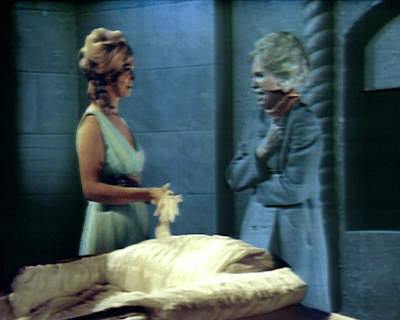
Hi, sis. Screenshot by Dark Shadows Before I Die.

Footage of the dress rehearsal for this scene survives. The only other surviving videotape from any episode of Dark Shadows not originally released for broadcast are the opening slates of the episodes.* The confrontation between Alexis and Angelique not only involves the most complicated videotape editing they’ve done so far, it also requires Lara Parker to do some intricate acting work as she plays off a version of herself she can neither see nor hear. In the rehearsal footage, she several times breaks character and turns to director Lela Swift to report on things that aren’t going right. We can hear Swift’s responses over the control room microphone. Some crew members are in and out of the shot, and at the end two people come to help Parker out of the coffin. It’s fascinating for hard-core fans, a must-watch:

By the time Mr Trask, the butler in the great house at Collinwood, comes to the mausoleum to see what’s taking so long, Angelique has changed into Alexis’ short bluish gray suit and chignon hairstyle with a tight spiral twist at the back, the look that the mysterious Madeleine wore in Alfred Hitchcock’s Vertigo. She has changed Alexis into her own gown and loose hairdo, and has put Alexis into her coffin. She is closing the lid of the coffin when Trask enters. Trask asks if she is ready to return to Collinwood, and she says she is looking forward to it.

We cut to the drawing room at Collinwood, where Quentin is yelling at the wind. He is convinced that it is really a ghost expressing discontent, and he demands to know what the trouble is. He doesn’t get any answers.

Angelique and Trask enter the house. Posing as Alexis, Angelique dismisses Trask, and tells Quentin she now agrees with him and Cyrus. The body in the tomb must be destroyed.

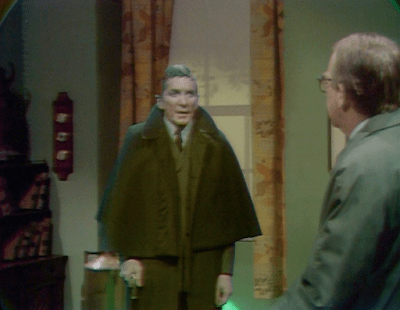
Cyrus is in his laboratory. He is talking with his lawyer, Quentin’s cousin Chris Collins. Chris has questions about Cyrus’ instructions to open a bank account in the name of John Yaeger and deposit $5000 in it. He asks if Yaeger is a pseudonym Cyrus is planning to use. Cyrus denies this, and says that Yaeger is a man he met recently who is helping him with his current experiments. In #985, Cyrus responded to Chris’ questions about these experiments with a lot of mad scientist ravings that alarmed him. Since Cyrus offers no information about Yaeger aside from his connection to this dubious project, Chris is reluctant to comply with Cyrus’ directives. Cyrus agrees that Chris should meet Yaeger first. Chris says “I’m looking forward to meeting him. See you, Cyrus,” and exits. This is the last time we will ever see Chris. Actor Don Briscoe’s health problems were catching up to him, and he was not able to return to the show.

While Quentin and Cyrus burn the coffin, Angelique is in her old bedroom. Alexis had been staying there, so Angelique is right at home. Trask tells her it is as if Angelique never left. Later, Quentin comes to invite her to join him and Cyrus for a drink downstairs. She declines, saying she would like to be alone.

Lara Parker’s performance as the newly returned Angelique is marvelous, her best work so far. We can see that she is a different person than the one who left the house earlier in the evening, and we can believe that the other characters don’t see it. In a closeup, she wrinkles her face like the Grinch, suggesting that Angelique has come to steal Christmas. The supernatural element of her confrontation with Alexis suggests Edgar Allan Poe’s “Ligeia,” which the show has been drawing on for the last few weeks, and reminds longtime viewers of Laura’s April 1969 storyline. But the idea of a woman killing her identical twin and taking her place would have been familiar to much of the audience from the 1964 film Dead Ringer, in which Bette Davis played the sisters in that sad situation. Bette Davis is one of the people frequently mentioned when film buffs name The Greatest Screen Actor of All Time, but not even she could have done better than Parker does today.

In the drawing room, Cyrus is alone. He was reluctant to accept Quentin’s invitation to stay for a drink, and is pacing and fidgeting. What Quentin does not know is that Cyrus is in the middle of a Jekyll and Hyde project, and he wants to get back to his lab to take the potion and change himself into the brutal John Yaeger. He revels in Yaeger’s cruelty and is addicted to the transformation.

Music begins playing on the soundtrack we have not heard before, a jagged piano theme. Cyrus suddenly feels the pains that he has felt after taking the potion. He sees Yaeger’s dark hair springing into place on his arms. He looks in the mirror and sees that he has become Yaeger, without taking the potion. He goes to flee the house, but realizes Quentin is already approaching. He retreats to the drawing room and locks the door. Quentin knocks, asking what on earth is wrong with Cyrus.

This is not only the first time Cyrus has changed without drinking the potion, it is also the first time he has appeared without a putty appliance precariously attached to the bridge of his nose. He looks far more convincing without it, though of course he is even more instantly recognizable as Cyrus.

In his post about the episode at his great Dark Shadows Every Day, Danny Horn points out both that the videotape editing is extremely ambitious today, with the confrontation between Alexis and Angelique at the beginning and the pretaped sequence of the Cyrus-to-Yaeger transformation at the end, and that that the editing in between these heroic shots looks ragged. The jump cut to Cyrus and Quentin’s approach to the mausoleum makes it look like Cyrus’ laboratory opens onto the cemetery, the first sequence of Angelique in her old room begins and ends with unusually long sequences of her pruning some extremely unhealthy looking flowers, and Cyrus spends a surprisingly large amount of time in the drawing room pacing about. Danny guesses that they did not know how long the process shots would run, so they inserted filler that could be removed if they went long.

That could be, but I like the episode the way it is. The jump cuts give the whole thing a dreamlike quality that works well with the subject matter. That’s certainly the case with the cut to the cemetery- we don’t know where Cyrus’ lab is, but we do know that only death is likely to come from the work being done there, so that jump makes a grim symbolic sense. Moreover, the actors use the sequences Danny identifies as filler to shed light on the characters and situate the scenes in the story. Angelique is so absorbed in her plant that you can believe she came back from the dead specifically to work on it, and nothing Trask or Quentin has to say is going to distract her for long. Cyrus’ pacing makes it clear he feels trapped at Collinwood, which adds considerably to the force of the moment when, as Yaeger, he has to hide from Quentin.

*I should mention that we have the dress rehearsal for #584. What we don’t have is a finished episode- they never made one. They just sent the tape of the dress rehearsal to the ABC network, and that was broadcast.
Episode 882: The show must go on. That’s the one and only rule there is.

Many fantastic tales dwell on a sense that dreams have a great power in the world, and so their characters are often afraid of falling asleep. Dark Shadows has several times referenced Edgar Allan Poe, who explored that fear in stories like “The Premature Burial,” “The Tell-Tale Heart,” and “The Man of the Crowd.” The show brought up another writer of fantastic tales preoccupied with the fear of sleep in #808. Aristide, henchman of sorcerer Count Petofi, threatened an enemy of Petofi’s with “the mysterious shadow he can cast, the shadow that isn’t your own that follows you.” That was a reference to George MacDonald’s 1858 novel Phantastes, in which a man named Anodos is plagued by a shadow that moves about on its own, following him and blighting his existence. Not only does Anodos fear sleep from time to time in Phantastes, but the main theme of MacDonald’s other very popular novel, 1895’s Lilith, is Mr Vane’s long refusal to sleep and the great battle he must wage in the dream-world when he finally does allow himself to nod off.

Aristide’s threat suggested that the show was about to give us a story based on Anodos and the autonomous shadow. Aristide is dead now, and Petofi is running out of story, so that isn’t going to happen, at least not in the segment of Dark Shadows set in the year 1897. But today we do get a little bit of George MacDonald in the form of a battle against sleep. Petofi is casting a spell over himself and handsome young rake Quentin Collins. If Quentin loses conscious control of his mind for even a moment, he and Petofi will evacuate their respective bodies and be re-embodied as each other. Petofi will then transport himself, in Quentin’s body, to the year 1969. Quentin will be left behind in 1897, occupying Petofi’s aging form and waiting helplessly for Petofi’s mortal enemies to come and kill him, thinking they are taking their long-delayed revenge.

By the time Quentin finds out what’s going on, it is the wee hours of the morning, after he hasn’t slept for a couple of nights. His friends, Cockney showgirl/ mentalist Pansy Faye and time-traveler/ recovering vampire Barnabas Collins, keep marching him around the drawing room of the great house of Collinwood in an effort to keep him awake. They don’t brew up any coffee, strangely enough. But Barnabas does call on wicked witch Angelique and appeals to her to use her powers to put some kind of barrier between Quentin and Petofi.

Angelique tells Barnabas that she is reluctant to help Quentin because she is upset that he wants to go to New York and look for a woman named Amanda Harris. She had wanted Quentin to fall in love with her, and is jealous that he chose Amanda instead. Barnabas points out that if she doesn’t help Quentin, he won’t exist in the form that either she or Amanda knew. Angelique explains that she has a reason for her attitude:

Before I came here this time, I was in the everlasting pits of Hell, where other creatures of my kind live. Only, my stay here on Earth made me dissatisfied with my life there. I longed to come back here… To Earth, to become a human being. I begged my master for the chance.

Finally, he gave it to me on one condition and one condition only… That I make one man fall in love with me, without any use of supernatural spells or powers. One man, one chance. That’s what I was granted.

Since Quentin is the one man who represented Angelique’s one chance, letting him go to Amanda might mean that Angelique has to go back down. My favorite part of her speech is “Only, my stay here on Earth made me dissatisfied with my life there.” Sure, she could have been happy in the everlasting pits of Hell, as one is, but how ya gonna keep ’em down on the farm after they’ve seen Pa-ree. Or, since Angelique’s sojourns in the upper world have all brought her to Collinsport, after they’ve had the lobster roll at the Blue Whale.

While Barnabas is talking with Angelique, Pansy is on Quentin duty. She decides to keep him awake by compelling him to join in a performance of her song. A record of this song, performed by Nancy Barrett and David Selby, hit the stores the very day this episode was first broadcast, so this is product placement. But Pansy is doing exactly what she would do in this situation, Quentin is reacting just as he would react, and it is a charming moment.

The musical number is preceded by Pansy making what literary critics call a programmatic statement. “Feel like it or not, you gotta do it, the show must go on. That’s the one and only rule there is, love. So let’s have a bright chorus from that new team, Pansy Faye and Quentin Collins.” Pansy is not only a good pal and a gifted psychic, she is an accomplished scientist. She has indeed stated the complete physics, metaphysics, and every other operating principle of the universe of Dark Shadows when she says that “The show must go on.”

Angelique and Barnabas enter. Angelique insists on some time alone with Quentin. He says that once he gets to New York he most definitely will be looking for Amanda and that he has no interest in a relationship with Angelique. She looks away from him and talks herself into believing it will be OK if he falls in love with her after Amanda “has ceased to exist.” Longtime viewers can be fairly sure this means that Angelique is planning to murder Amanda, but at the moment the important thing is to get Angelique involved in helping Quentin against Petofi.

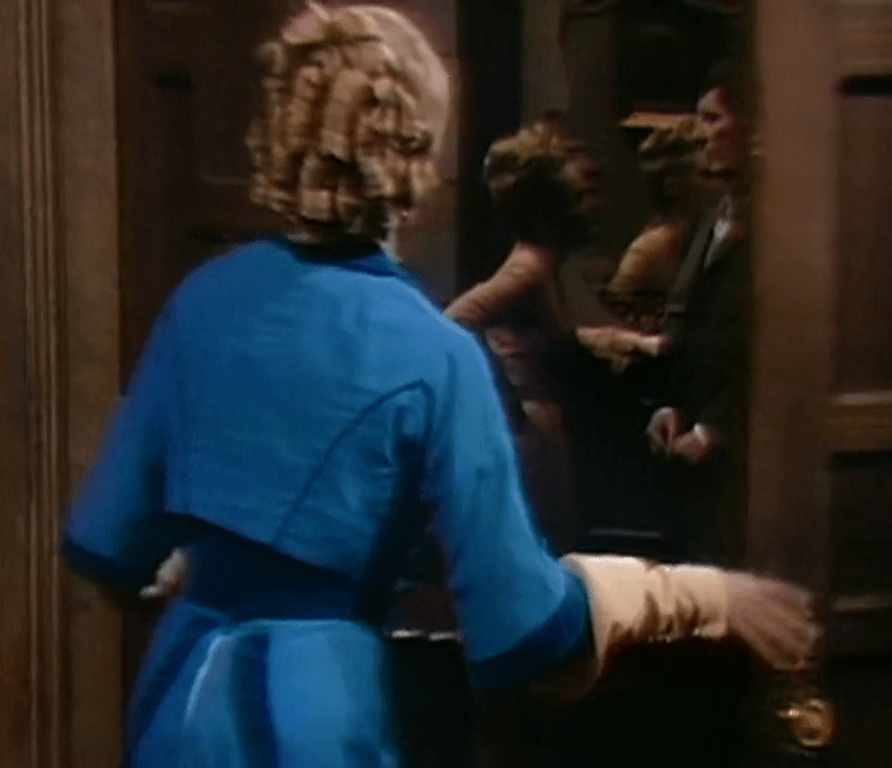
Angelique opens the door to the foyer, where we catch a glimpse of Nancy Barrett and Jonathan Frid doing a really marvelous mime depicting “intense conversation.” It’s one of those deliberately stagey bits of business that these twentieth century New York actors do so well.

Angelique opens the door on a silent “conversation.”

Angelique stares into the fire and tries to project psychic power Petofi-ward. We get a process shot simultaneously depicting Angelique in the drawing room and Petofi in his lair. The shot is not very successful, and Angelique explains that her efforts aren’t working either. She says that Petofi is in so deep a trance that she cannot reach him as she has done before.

Petofi’s surroundings are so heavily decorated that this shot just looks cluttered to me. I suppose having Petofi low in the shot and behind the flames is meant to remind us of Angelique’s old neighborhood, but the visual metaphor is spoiled by the cruddy 1960s TV color palette.
In black and white, as most viewers would have seen it in 1969, the shot has different problems- while the more abstract visual style does make the Petofi-as-Satan metaphor legible, it is less clear which shapes are in Angelique’s space and which are in Petofi’s.

Pansy, eavesdropping from the foyer, hears Angelique say that she will need to have something Petofi is wearing right now, something still warm from contact with him, in order to reach him with her powers. Pansy resolves to provide this, and she sneaks out. She makes her way to his lair, and is about to undo Petofi’s necktie when he comes out of his trance and tells Pansy she has interfered with his plans once too often. We have flashed to the motionless Petofi several times today, leading us to think that Thayer David was going to collect his fee without having to deliver a line. So it is quite effective when he springs into action.

Episode 340: Medical silence

Dave Woodard, MD, has learned that Barnabas Collins is a vampire and mad scientist Julia Hoffman is his co-conspirator. We see Barnabas at home, pressuring Julia into helping him murder Woodard before he can go to the authorities. After a great show of reluctance, Julia prepares a hypodermic of some potion or other that will induce cardiac arrest. When Barnabas insists she administer the lethal injection herself, Julia resumes her attempt to find a way out. Barnabas finally allows her to go to Woodard and tell him that his only options are to cooperate with them and make a great contribution to medical science, or to go out into the night and suffer an unimaginably horrible death when Barnabas catches him.

Julia does go to Woodard’s office, and does deliver this message. Woodard replies that he doesn’t have to go anywhere to tell the sheriff about Barnabas and Julia. He picks up his telephone and starts dialing. High-pitched sounds play, and Woodard sees the shadow of a bat at his window. Yesterday we heard that Julia considered Woodard the most brilliant student in their medical school class, and we can see why- even though this was decades before Covid-19 or Nipah or other bat-borne viruses were in the news, he is transfixed by the outline of the squeaky little guy.

Perhaps Woodard is less prescient about bats as vectors for disease than he is mindful of the experiences of his young friend, strange and troubled boy David Collins. In #330, Barnabas sent a large bat to frighten David in his bedroom. Today, Barnabas materializes inside Woodard’s office after the bat has done its thing outside. This is the first indication we have had that Barnabas has the power to transport himself through walls.

Unfortunately, the National Association of Broadcast Engineers and Technicians were on strike during principal photography for this episode. No doubt the process shot of Barnabas’ materialization was added after they came back to work, but they could do only so much with the footage that the network executives and other amateurs had left them. The Barnabas who appears in Woodard’s office today is about three feet tall and is missing a chunk of his head.

That mini-Bar doesn’t stock anything you want to drink. Screenshot by Dark Shadows Before I Die.

Mini-Bar may be the funniest consequence of this attempt at strikebreaking, but there is another that isn’t amusing at all. Woodard is played by some stooge who took over the part when Robert Gerringer, who has been struggling valiantly since May to find something interesting to highlight in a character who usually doesn’t know anything and isn’t allowed to advance the plot, honored the NABET picket line. The scab annoys the audience every time he opens his mouth today, breathing directly onto his microphone, getting tangled up in trivial lines, and veering between a barking tone and a whine as high-pitched as the sounds the bat makes.

The result of his incompetence is that a conflict the audience is supposed to be experiencing as suspense does not come off. We’re supposed to be torn as Julia is torn, wanting Woodard’s threat to the continuation of the story to be removed, but feeling horror at the thought that he will be killed. Gerringer could have made us feel those incompatible desires, but this alleged actor makes us want nothing but that he be removed from our television screens as soon as possible and by any means necessary. So we find ourselves cheerfully rooting for the vampire and the mad scientist to get on with murder.