Episode 1007: Accumulating guilts

Chemist Horace Gladstone has been selling a strange and powerful synthesis of his own invention to Cyrus Longworth, an independent medical researcher. Cyrus refuses to tell Gladstone what he is using the synthesis for. Gladstone has now figured it out for himself. Cyrus has concocted a potion which he drinks to change his appearance, disguising him so effectively that even the people who know him best do not recognize him. In that disguise, Cyrus calls himself “John Yaeger,” spends a lot of money, and indulges his sadistic impulses.

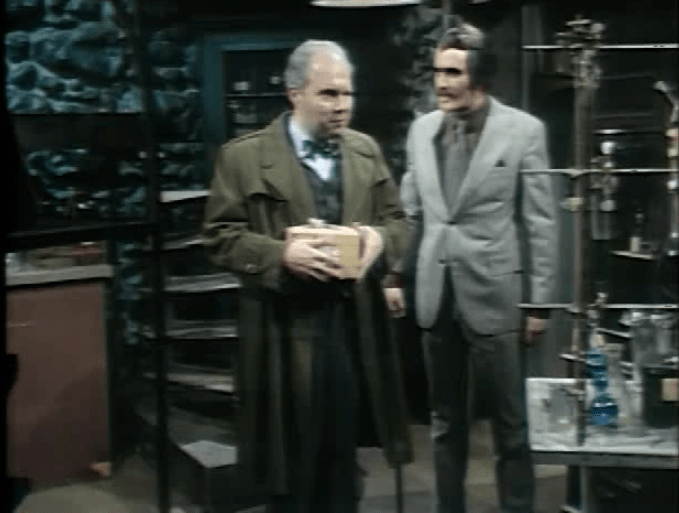
Gladstone comes to Cyrus’ lab and tells him what he knows. Cyrus tries to deny that he is Yaeger, and Gladstone lists the evidence he has collected proving that he is. Gladstone tells Cyrus that he doesn’t believe he can do without the thrills he gets from his activities as Yaeger. The story has been crafted as an account of addiction, so returning viewers are sure Gladstone is right. He says he will go on serving as Cyrus’ connection for the drug he craves, but the price has gone up. He demands $10,000.

Cyrus first learned Gladstone’s name from his late friend Angelique Stokes Collins. Angelique was a woman of vast learning in a variety of fields, much like the title character in Edgar Allan Poe’s story “Ligeia.” Also like Ligeia, Angelique has returned from the dead. She is now back in the great house of Collinwood, impersonating the identical twin sister whom she murdered on the night of her resurrection, and occupying her old room as the guest of her widower, drunken sourpuss Quentin Collins.

Cyrus calls Gladstone a blackmailer. In reply, Gladstone makes a cryptic remark: “Why do you think my number was in Angelique Collins’ phone book? She’s led many lives. Each person only gets one. Good night.” We have indeed been wondering how Angelique came to know Gladstone, and now we wonder if he is aware of just how literally true it is that “She’s led many lives.” It doesn’t make any sense to follow “She’s led many lives” with “Each person only gets one,” but actor John Harkins was so precise in his delivery that I’m sure that was the scripted line. If there was a slip, it came from Sam Hall’s typewriter, not from Harkins’ tongue.

If it isn’t a slip, I think we would have to go out on a limb to explain what Gladstone could mean. Angelique built up a cult around herself, including several people who were firmly convinced that she was going to rise from the dead. When her sister Alexis came to Collinwood, housekeeper Julia Hoffman, sleazy musician Bruno Hess, and Angelique and Quentin’s son Daniel were certain that the prophecy had been fulfilled and they were seeing Angelique redivivus. This was also the first thought that came to Cyrus, to Quentin’s brother Roger, and to Angelique’s Aunt Hannah, though they were more easily persuaded that Alexis was a separate person. The cultists are impressive enough in their certainty that even people outside their ranks were sure Alexis was Angelique returned from the grave. Daniel’s cousin and playmate Amy Collins was horrified to see her for that reason, and Quentin’s second wife, the former Maggie Evans, fled the house in part because she could not shake her belief that Alexis was Angelique.

If Gladstone is familiar with Angelique’s cult and has been involved with it, he might be saying that each person gets to participate in only one of Angelique’s lives. We’ve already seen that is not the case, but that doesn’t mean he doesn’t think it is. Angelique may at some point have taught her followers a doctrine like that. While Hoffman, Bruno, and Daniel expected Angelique to come back and rejoin them, Cyrus, Roger, and Hannah were unsure they would see her again, even though they were certain that she was not simply dead. Indeed, Angelique is still telling her most of her devotees that she is Alexis. The only one to whom she has fully revealed herself is Hannah. Perhaps she had a plan to transcend death, but did not know just how it would work. Or perhaps she has decided the rest are not yet ready to be initiated into the esoteric truth of her return.

Sam Hall was a serious Lutheran, so much so that he insisted Shirley Grossman convert from Judaism before she married him and became Grayson Hall. Christian studies in twentieth century academic institutions were largely taken up with speculation about differences of opinion in the church before the codification of the New Testament and the formulation of the creeds. This sort of thing is still prominent in divinity schools today, and is often heard from pulpits in mainline Protestant denominations. Hall must have been familiar with it, so he probably gave it some thought when he spent Easter season 1970 writing scripts about a figure whose followers sort of expected her to rise from the dead and who surprised them by the way in which she actually did so. I doubt he was making any particular point about the various schools of thought that seminary professors postulate in the primitive church, but when he presents Angelique’s cult as divided into several strains of opinion from the start he is developing an idea that he did not have to invent himself.

We cut from the scene between Cyrus and Gladstone to the basement of Collinwood. Angelique leads Quentin to a little chamber hidden behind an alcove. A human skeleton stands in the chamber. You may wonder how a skeleton can stand, but Quentin doesn’t. He is too busy being surprised that he didn’t realize this chamber was in his basement.

The skeleton is that of Dameon Edwards, a friend of Angelique’s who went missing about a year before. Dameon’s ghost has been haunting the place for a couple of weeks. Angelique tells Quentin that Hannah found the skeleton and exorcised the ghost. Yesterday, we saw Angelique exorcise the ghost. Returning viewers know that she is giving credit to Hannah because she is masquerading as Alexis, who did not share her sister’s interest in the occult or her aunt’s. Quentin thinks that Bruno probably killed Dameon. Indeed, the ghost confirmed this yesterday. Quentin very much wants to get rid of Bruno, so you might think he would be interested in bringing a murder charge against him. But he decides that would be too much trouble, and it hurts his feelings when “Alexis” snaps at him that he shouldn’t be wasting his time reporting Dameon’s murder when he isn’t doing anything to investigate Angelique’s. So he calls Cyrus, and the two of them bury the bones on the grounds of the estate.

Meanwhile, two long-absent characters have returned from trips out of town. Quentin sent Hoffman to visit friends of hers in Boston because she kept antagonizing Maggie. Quentin’s sister Elizabeth Collins Stoddard also went away for a long stay in New York, where she visited Maggie. In off-screen reality, Grayson Hall and Joan Bennett were both in Tarrytown, New York with several other cast members, working on the feature film House of Dark Shadows. Liz complains that Hoffman didn’t meet her at the train station with a car, and Hoffman explains that she just got back herself.

Hoffman says she missed Collinwood terribly while she was in Boston; Liz says she can’t understand that. If she were in Quentin’s place, she would sell the house and move to the city. That will interest longtime viewers. For its first 196 weeks, Dark Shadows was set in a parallel universe, where Liz’ counterpart owned Collinwood. When the show started, she was a recluse who hadn’t left the house for eighteen years. Her brother Roger often urged her to sell the place so that they could live someplace less gloomy, but even after she stopped being a recluse Liz wouldn’t hear of that. She was a symbol of the family’s commitment to the house. We have already seen that this Liz is the opposite of her counterpart in other ways, and now we wonder how far they will take that mirror image motif.

Angelique is in the foyer, talking on the telephone to Hannah. Villains on Dark Shadows have remarkably little sense of OpSec, and this is a case in point. Quentin, Liz, and Hoffman are a few feet away from her in the drawing room, and each of them knows that Alexis and Hannah couldn’t stand each other. All Angelique has to do is call Hannah by name and she will raise their suspicions. Yet not only does she use Hannah’s name several times, she uses one incriminating expression after another about how no one will suspect what they are up to. If any of them listens in, or of anyone else in the house happens by on their way to the front door, Angelique will have tipped her hand.

It is Hoffman who eavesdrops on the call. After Angelique catches her, they have an awkward exchange and Hoffman goes upstairs. Angelique then stands at the door to the drawing room and eavesdrops on a conversation between Liz and Quentin. Liz wants Quentin to go to New York and ask Maggie to come home, he throws a tantrum and says that Maggie is too childish for him to do such a thing.

Hoffman is in Angelique’s old room, talking to the portrait of her that hangs there. The members of Angelique’s cult make a practice of coming to the room and carrying on conversations with the portrait; when Alexis was staying in the room, she sometimes walked in on them while they were confiding their thoughts to it. Angelique eavesdrops on the last part of Hoffman’s account that when she was in Boston, she felt a mystic assurance that when she returned to Collinwood she would find Angelique come back to life. When Hoffman says that everything seems to be the same as it was when she left, she is close to tears.
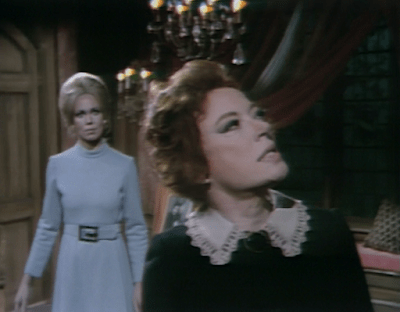
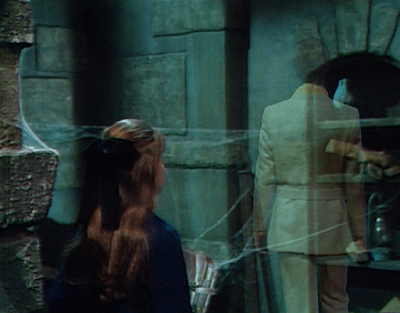
The resurrected Angelique eavesdrops on Hoffman’s conversation with the dead Angelique. Screenshot by Dark Shadows Before I Die.

Angelique takes a step forward, and Hoffman realizes she is not alone with the portrait. She apologizes to “Alexis,” and Angelique says she needs a friend she can trust. Hoffman claims to be such a friend. “Alexis” then launches into her reasons for believing that Angelique was murdered. After the first couple of sentences, returning viewers know what she is going to say, so we dissolve to Quentin and Cyrus in the drawing room.

Quentin and Cyrus have just buried the skeleton, prompting Quentin to feel sorry for himself. He then tries to explain to Cyrus something extremely weird he saw the other evening. He went to Angelique’s old room to see Alexis. He opened the door, and saw a space that lacked the room’s furniture, lights, and decor. He saw two children whom he took to be Daniel and Amy, and they said something about Barnabas Collins. The only person of that name of whom Quentin or Cyrus is aware died in 1830, but the children were talking about someone they knew. An invisible barrier kept Quentin from entering the room, and he could not attract the children’s attention. Regular viewers know that Quentin was catching a glimpse of the other continuity, and that the children were not Daniel and Amy Collins, but their counterparts David Collins and Amy Jennings. Cyrus hasn’t been watching the show, so all he can do is suggest Quentin take a vacation.

They’ve been experimenting with videotape editing, and they make a jump cut from the drawing room scene with Quentin and Cyrus to Quentin walking up to the doors of Angelique’s room. The effect is startling, I suspect intentionally so. Quentin opens the doors, and again sees the other universe.

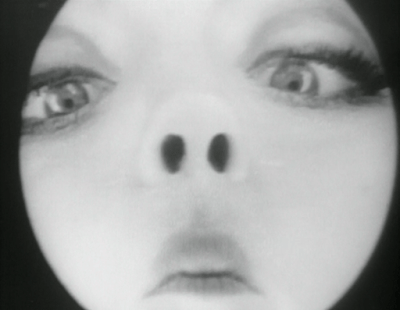
This time Quentin sees the counterparts of Liz and Hoffman. As David and Amy had been, they are talking about Barnabas, who was last seen in this room. Hoffman, whom Liz addresses as Julia, says that they must keep the room open so that Barnabas will have a chance to return to them. She says she wants to stay there, because it makes her feel close to Barnabas. Liz excuses herself, and Julia calls out to Barnabas. As Hoffman had grown emotional talking to the Angelique whom she believed to be absent, Julia grows emotional when she talks to the missing Barnabas. She looks at the hallway, seeing not Quentin but the dark, empty space that is there in her universe. She asks if Barnabas is there, watching her. Grayson Hall plays these two scenes so similarly that we can have no doubt that whatever the one Julia Hoffman feels for Barnabas, the other feels for Angelique.

Quentin calls out to Hoffman’s counterpart, as he had called to Daniel and Amy’s counterparts. As the children had been unaware of his presence, so this other Julia Hoffman is unaware of him. And as Daniel and Amy had come to the hallway and asked why he was shouting for them, Hoffman comes to the hallway and asks why he is shouting for her.
Episode 1006: The meaning of adventure

The show has been spending a lot of time lately trying to interest us in the ghost of Dameon Edwards, a man who doesn’t seem to have had much going for him even when he was alive. They went through the motions of a murder mystery concerning Dameon’s death. The episode that introduced him also hinted that he was killed by sleazy musician Bruno Hess with the complicity of butler Mr Trask, and those hints are confirmed today. So the mystery was never much of a puzzle. Besides, Bruno and Trask are the counterparts of homicidal villains whom we saw in the universe where Dark Shadows was set for its first 196 weeks, so we’ve expected all along that they would turn out to have someone’s blood on their hands. And neither of them is the central figure in an ongoing story, so even if they had been brought to justice for their crimes it would only be an easy way for the writers to dispose of characters who were going to be written out anyway.

Today, wicked witch Angelique finds Dameon’s skeleton sealed up in an alcove in the basement of the great house of Collinwood. She summons his ghost and dismisses him. That’s it for Dameon. What will happen to the skeleton, or to Bruno, or to Trask, or to the alcove, we don’t yet know.

The sight of the skeleton standing in the alcove does remind us of one of Trask’s alternate universe counterparts, a fanatical witchfinder who was sealed up in a basement alcove elsewhere on the estate in 1796. Since Trask is involved in this little arc, it’s a nice touch to connect it to that other Trask.

Most of the episode is devoted to a far more interesting story, an adaptation of Jekyll and Hyde. They’ve been focusing on the addiction angle. Mad scientist Cyrus Longworth is hooked on the potion that changes his appearance and allows him to fool even people who know him well into believing that he is a separate person by the name of John Yaeger. He enjoys the violence that he commits as Yaeger.

Today, three people try to save Cyrus from himself. Lawyer Larry Chase resists Cyrus’ instructions to transfer $5000 to Yaeger and to rewrite his willin Yaeher’s favor; chemist Horace Gladstone is reluctant to keep selling Cyrus a volatile synthesis he needs for the potion, and figures out that he and Yaeger are one and the same; and Buffie Harrington, who is exploring her masochistic side by submitting to beatings from Cyrus as Yaeger but still thinks the two are different people, goes to Cyrus to urge him to be more careful in his dealings with Yaeger. Dark Shadows has dealt intelligently and sensitively with the theme of addiction from its earliest days, and today’s focus on people who care about the addict trying to help him achieves a real poignancy.

We may wonder if drug abuse was a particularly timely topic behind the scenes of Dark Shadows at this point. Larry is a substitute for the character of Chris Collins, who was played by Don Briscoe. Briscoe would eventually be diagnosed with bipolar personality disorder, and in 1970 was trying to self-medicate with street drugs.

The makers of the show didn’t give up on Briscoe until the absolute last minute. This episode was taped very close to airtime, after episodes that would be broadcast weeks later were already in the can, giving Briscoe as much time as possible to get himself together. The part of Larry was played by Ken McEwen. McEwen joined the show in August 1968 as an associate director. He had a guild card due to small parts he had taken in a couple of TV shows in the 50s, but had never been an actor full-time. And he clearly hasn’t had much time to learn his dialogue. He is perfectly competent in the first of his two scenes, when Larry is in The Eagle tavern with Yaeger, Gladstone, and Buffie. There are no major bobbles and you can tell exactly what is on his mind. But when Larry returns and meets with Cyrus in his laboratory, McEwen stumbles over every line and never develops a coherent attitude.

The music is interesting today. The Eagle in the current universe corresponds to the Blue Whale, Collinsport’s tavern in the main continuity, and while we are there we hear the jukebox music that was prominent in the show’s first year. There is a scene between Gladstone and Buffie in her apartment; when that opens, we hear some music I don’t believe we’ve heard before. If they’ve written a theme for Buffie, it gives us hope we will see a lot more of Elizabeth Eis’ excellent performance in this role.

Buffie plays with the magnifier in Cyrus’ lab. Screenshot by Dark Shadows Before I Die.

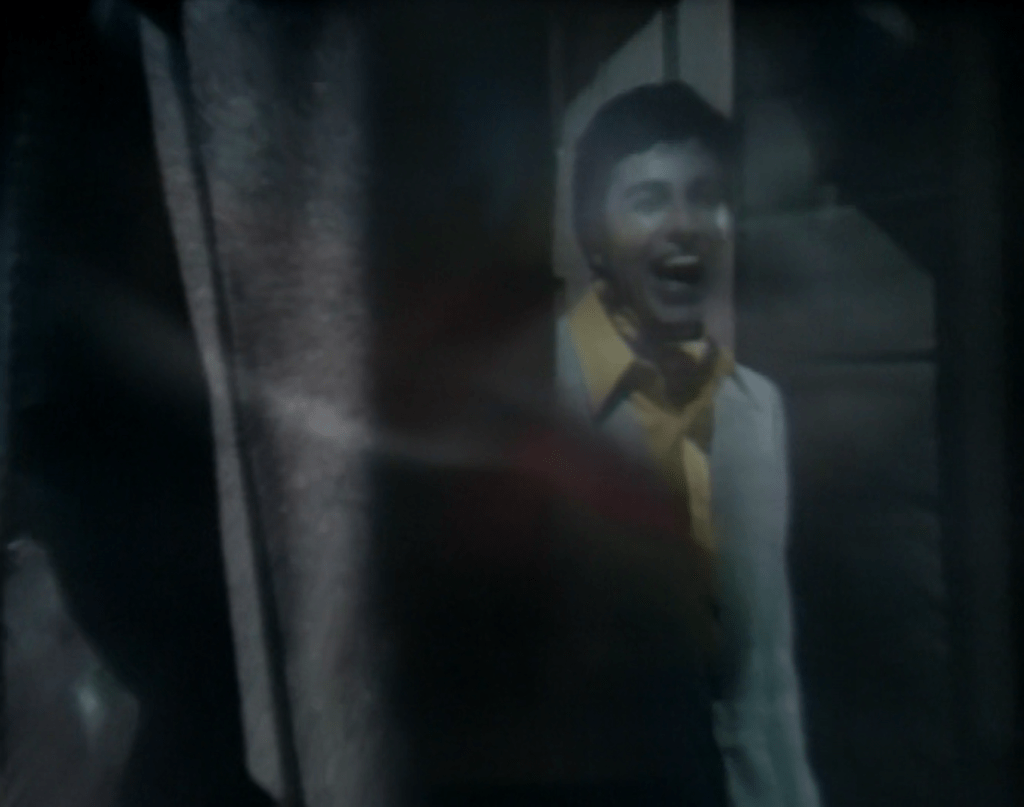
The original videotape master of this episode was lost. We have it on a kinescope. I love the kinescopes; I wish all the episodes were available in that format, as well as the videotapes. We haven’t seen one since #813, and will see only one more, #1017. You can always set the options on your device to display in black and white, but the kinescope comes with some visual blurring and sound distortions. Those are usually flaws, of course, but when the show has already given you the feeling that you are catching a glimpse of another reality they can add to the eeriness and yearning for what might have been.

Episode 1005: No danger, just a lot of confusion

For five weeks, Dark Shadows has been set in a universe parallel to the one where the first 196 weeks took place. So far, “Parallel Time” has recapitulated the early development of the show. As the series began with an attempt to televise the atmosphere that made “Gothic romances” a best-selling genre of the mid-1960s, so the segment began with an adaptation of Daphne Du Maurier’s Rebecca, one of the basic texts of that genre. As it proceeded to the story of the return of undead blonde fire witch Laura Murdoch Collins, mother of strange and troubled boy David Collins (David Henesy,) the segment has proceeded to the return of undead blonde fire witch Angelique Stokes Collins, mother of strange and troubled teen Daniel Collins (David Henesy.)

Between the early Gothic romance period and the Laura story, the show was a whodunit about the death of local man Bill Malloy. Bill would eventually become the first ghost to appear to another character on-screen on Dark Shadows. And throughout the first year, there was a lot of noise about a locked room in the basement of the great house of Collinwood where reclusive matriarch Elizabeth Collins Stoddard believed her husband Paul’s body was buried. Parallel Time got around to an analogue for these two stories with the abrupt introduction of the ghost of Dameon Edwards in #994. Since then, various characters have been wondering who killed Dameon. Today, it is confirmed that Dameon’s body, unlike Paul’s, really was buried in an alcove in Collinwood’s basement.

As Daniel’s room is laid out as a mirror image of David’s, the basement in this Collinwood is laid out as a mirror image of the one in the original continuity. The alcove is on the opposite side of the set than was the locked room. Since we haven’t seen the basement since #273, this resonance is likely to be wasted on everyone except weirdos watching the show on a streaming service and writing several hundred words about each episode.

Even people like that aren’t likely to be much invested in Dameon. If the ghost of Paul’s counterpart appeared as Dennis Patrick, the actor who played Paul from #887 to #953, we would have had something to work with. If they had told us something about Dameon before he turned up as someone who was already dead, again, his story might have mattered. And if his haunting came as succession of frightening events in the lives of people we already cared about, as the haunting of Collinwood by the ghost of Quentin Collins came in late 1968 and early 1969, we would again have had a chance of getting into his story. But none of those things happened. We’ve never seen actor Jered Holmes before, Dameon came out of the blue, and he does nothing that is of the first importance to a major character. Whatever solution there might be to the mystery of his death is unlikely to do anything more than give them an easy way to write someone out of the show who was obviously leaving anyway.

The only thing we really know about Dameon is that he had some kind of connection with Angelique when they were both alive. Today, she specifies what that connection was. She says that he always annoyed her in those days. She goes on to say that with his ghostly apparitions, he has resumed annoying her. Lines like this make me suspect that the writers are in open rebellion against the story of Dameon Edwards.

In fact, Parallel Time is off to a very good start overall. The Dameon story is the only one that isn’t working, and even it benefits from the uniformly good acting. Indeed, all the performances are so good that we want to like it. This episode is mostly given over to plot mechanics advancing the Dameon story.

The remainder is about a story derived from Jekyll and Hyde. Chemist Horace Gladstone is doing business with mad scientist Cyrus Longworth. He meets with the undisguised Cyrus early in the episode, and later encounters him after he has taken the potion and changed his appearance. Cyrus has not told Gladstone what his project is, but Gladstone knows that the work cannot go on without a special synthesis only he can provide. He is wary of “John Yaeger,” and tells him that if he threatens him in any way he will not deliver any more of the synthesis.

Gladstone keeps his cool amid Yaeger’s threats. Screenshot by Dark Shadows Wiki.

There is a lot of action today, but nothing really new. No degree of busyness can keep the Dameon story from feeling slow, since the path it is speeding along has no destination. As for the Jekyll and Hyde material, we’ve already seen that Gladstone is suspicious of Cyrus, that Cyrus is addicted to the potion, and that, when he is in the form of Yaeger, Cyrus can be restrained from violence only by threats. So this is yet another specimen of Dark Shadows’ distinctive contribution to the soap opera, a Friday that is the dullest day of the week.

Episode 1004: The dead are not to be trifled with

We are in the fifth week of a segment set in a different universe than the one where Dark Shadows spent its first 196 weeks. There are enough stories to keep everyone busy all day every day, and almost all of those stories are working quite well right now.

The only exception is the one that dominates the action today. In #994, we learned that a man named Dameon Edwards used to be a frequent visitor to the great estate of Collinwood. Dameon hasn’t been seen or heard from in about a year. He’s dead, as it happens, and his ghost has been popping up and making various people uncomfortable.

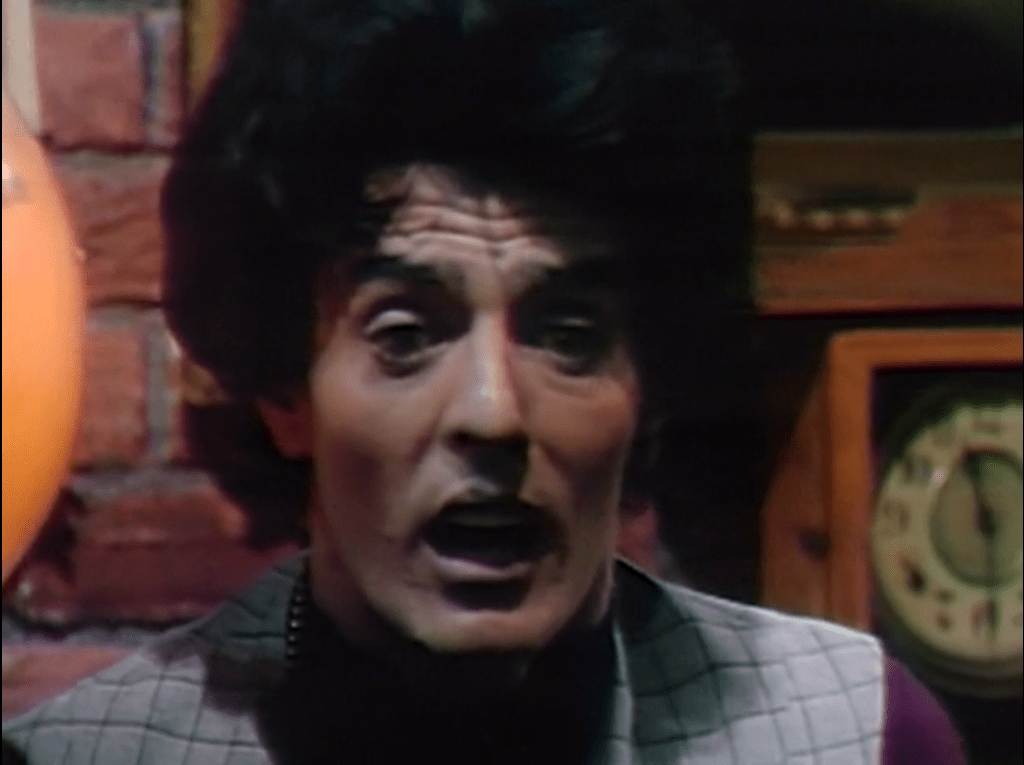
Dameon has a laugh at Quentin’s expense. Screenshot by Dark Shadows Before I Die.

Since the first thing we had ever heard about Dameon was that he was dead, we were off to a rocky start with him. The main continuity had a great success with Quentin Collins, who was introduced the same way. But Quentin was not only a member of the Collins family that is central to the show, he figured first as a series of weird and frightening events in the lives of children David Collins and Amy Jennings, characters we know and care about. Dameon’s only background is that he was one of many ex-boyfriends of Angelique Collins, the late and recently reanimated wife of Quentin’s counterpart. His actions are just a bunch of not-particularly scary special effects that are witnessed by people who have either been brought on so that they can worry about them, such as sleazy musician Bruno Hess and uptight butler Mr Trask, or who have bigger problems, such as Quentin and Angelique.

I’ve speculated in previous posts that this was not the original plan for Dameon. Maybe they planned to develop more of a connection between him and the action, and just couldn’t fit the necessary material into the first 13 scripts of the “Parallel Time” segment. Or maybe they did not intend to introduce a new character, but the counterpart of someone we know from the other continuity. Whatever they may have hoped to do, what they actually did falls absolutely flat.

To the extent that Dameon is the counterpart to anyone in the other continuity, it would be Quentin’s ghost. Indeed, today he leads Parallel Quentin to a room that reminds us of the one from which Quentin’s ghost began his reign of terror in late 1968 and early 1969. As 1969 went on, the living Quentin became an important character. Due to a trip back in time and some magic, he was prevented from dying and immunized against aging. The people he had haunted remembered the ghost, but the living Quentin was also around. Eventually they started to treat the ghost as a separate being from the Quentin who was a regular fixture of the cast of characters. So I suppose they might have intended to have Quentin’s ghost cross over into the current continuity, confusing David Selby when he saw himself wearing mutton chop sideburns, a Victorian-era suit, and a sardonic grin while he refused to speak. But that kind of thing was still a stretch for viewers when they did it on Twin Peaks twenty years later, and would have been a big ask for a daytime audience to follow in 1970.

Episode 995: Another slow Friday

Dark Shadows never followed the usual soap opera pattern of a week building to a slam-bang conclusion on a Friday. This one is a case in point. It aired on a Friday, and nothing new happens.

The actors are all very good, and each makes the most of their time on screen today. As child Amy Collins and drunken sourpuss Quentin Collins, Denise Nickerson and David Selby do a good job reacting to the ghost of someone named Dameon Edwards, which they saw yesterday. As sleazy musician Bruno Hess and sneaky butler Mr Trask, Michael Stroka and Jerry Lacy do a good job being alarmed by the prospect that Dameon has returned to expose their guilty secrets. As mad scientist Cyrus Longworth, Christopher Pennock does a good job failing to perceive the consequences of his lunatic scheme. And as Cyrus’ blindly devoted assistant/ fiancée Sabrina Stuart, Lisa Blake Richards does a good job being trusting and optimistic.

I’ll just single out one moment, when Bruno sees his piano playing with the touch of visible fingers and realizes it is Dameon’s doing. Michael Stroka gives a memorable take.

If the piano starts playing itself, Bruno’s going to be out of a job.

Cyrus drinks the potion he has formulated to turn himself from a mild-mannered Jekyll into a brutish Hyde. As her did the first time we saw him do this, he cries out in pain and collapses. This time they add a lot of flaring green lights to illustrate his distress. The process is not effective at all- at first, I thought something had gone wrong with one of the cameras. At the end of the sequence, we fade from Pennock in his Cyrus look to him in his Hyde makeup, which we didn’t see the first time. The shot doesn’t line up, so it does not create the illusion of a transformation, and the prosthetic nose isn’t very firmly attached, so it takes a second to realize that it is supposed to be part of his face and not just something that landed on him while he was falling.

Episode 994: I might as well be glad

Amy Collins twice sees the ghost of Dameon Edwards, whom she and others at the great house of Collinwood apparently knew when he was alive a year or so previously. At that time, Dark Shadows was set in a different universe than the one it has been showing us for the last few weeks, so the first thing the audience has ever heard about Dameon is that he is dead. Nor do we learn much more about him today. He looks at people with a vaguely sad expression, wanders off, and vanishes into thin air, never speaking a word. His part reminds me of G. K. Chesterton’s line that “Journalism consists largely in saying ‘Lord Jones is dead’ to people who never knew Lord Jones was alive.”

When Amy sees Dameon the second time, he leads her to the basement of Collinwood. This is a bit of a treat for longtime viewers. We may only have been in this universe for a few weeks, but the house is supposed to be laid out similarly to the one where we spent the previous 196 weeks, and the basement of that house was a significant set in the first year of the show. We haven’t been to that basement since #273, when it was revealed that reclusive matriarch Elizabeth Collins Stoddard was mistaken in her belief that she had killed her husband Paul and that he was buried in a locked storeroom there. It turned out Paul wasn’t dead at all. Liz was so embarrassed when her mistake was revealed that no one ever mentioned it again.

Dameon reminds us of that storeroom when he leads Amy, not to the spot where it was, but to an alcove in the wall opposite it. Amy’s cousin Daniel’s bedroom is a mirror image of his counterpart David’s bedroom in the other continuity. If the basement is a mirror image as well, the alcove to which Dameon leads Amy corresponds to the locked storeroom. Dameon turns towards the door, and vanishes as he walks into it. Amy screams.

He wasn’t there again today. Screenshot by Dark Shadows Before I Die.

Dameon is completely new to the audience, and the story of Liz’ belief that Paul was buried in the basement is so old that the reference will be lost on anyone who hasn’t been writing up notices about every episode of the show for the last few years. So the whole thing is pretty ineffective. Indeed, while Amy is screaming Denise Nickerson is visibly struggling not to laugh out loud.

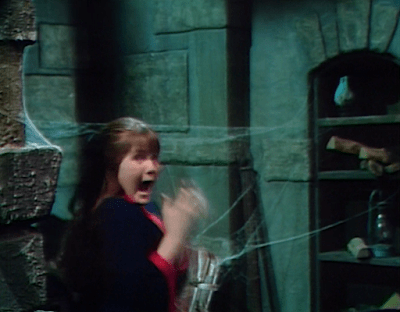
Oh I am sooo scared! Screenshot by Dark Shadows Before I Die.

I’m sure this episode is the result of a failed plan. Dameon must represent a character who would have meant something to us. Since most of the people we have seen in the last few weeks have the same names and are played by the same actors as counterparts from the original continuity, that character would likely have been a familiar face. The one face that would have brought the locked room in Liz’ basement to the minds of longtime viewers would have been that of Dennis Patrick. Patrick was in #273 as Jason McGuire, the seagoing con man who first convinced Liz that Paul was buried in her basement and then returned to exploit that belief by blackmailing her, and returned late in 1969 as Paul himself. Liz’ counterpart in the current universe is named Mrs Stoddard, so Paul must have existed there as well.

Patrick and his wife Barbara Cason were at this time in Tarrytown, New York, playing supporting roles in the feature film House of Dark Shadows. Patrick’s role as the sheriff puts him in only a few scenes, and Dan Curtis may well have hoped that once he’d got Patrick back to the East Coast he would be able to persuade him to return to the show for a short stint as Parallel Paul’s ghost. But Patrick was based in Los Angeles at this time, busy there as a producer and in demand as an actor, and he had no interest in coming back to a daytime drama taped in NYC for any length of time. So Dameon may have been a last-minute patch to cover Parallel Paul’s absence.

If Plan A had been that today’s ghost would represent Parallel Paul, Plan B appears to have been that he would remind longtime viewers of Quentin’s counterpart in the main continuity. Quentin was introduced late in 1968 as a ghost who did not speak. He first appeared to the children at Collinwood. Those were Amy’s counterpart, Amy Jennings, and her friend, strange and troubled boy David Collins, whose counterpart here is Daniel. Quentin’s ghost beckoned Amy and David into hidden rooms where they would, as they called it, “play the game.” When Dameon beckons Amy to the basement today, she asks if this is another of the games he used to play with her and Daniel.

The echo of the “Haunting of Collinwood” story is clear. But a revisiting of it that would have been effective would have taken some time to set up, especially since there is a living, speaking Quentin at the center of the show now. By the time they got to this topic, David Henesy had left to start his own stay in Tarrytown for House of Dark Shadows, so we won’t be seeing Daniel for a while. The most they can do is what we see here.

The upshot of these two aborted plans is a situation that does not seem to belong on the show at all, and it is no wonder Nickerson can’t keep a straight face. Even more than it reminds me of “Lord Jones is dead,” this installment reminds me of Edna St. Vincent Millay’s 1920 poem “The Penitent“:

I had a little Sorrow,

Born of a little Sin,

I found a room all damp with gloom

And shut us all within;

And, “Little Sorrow, weep,” said I,

“And, Little Sin, pray God to die,

And I upon the floor will lie

And think how bad I’ve been!”

Alas for pious planning —

It mattered not a whit!

As far as gloom went in that room,

The lamp might have been lit!

My Little Sorrow would not weep,

My Little Sin would go to sleep —

To save my soul I could not keep

My graceless mind on it!

So up I got in anger,

And took a book I had,

And put a ribbon on my hair

To please a passing lad.

And, “One thing there’s no getting by —

I’ve been a wicked girl,” said I;

“But if I can’t be sorry, why,

I might as well be glad!”

I don’t know if Amy had been a wicked girl, but the other characters today all seem to have secrets that it would behoove them to feel sorry for when Dameon shows up. There is drunken sourpuss Quentin Collins, who like Amy sees Dameon twice; sleazy musician Bruno Hess, whom Quentin suspects of having killed Dameon; and butler Mr Trask, who, when Quentin mentions Dameon, frantically denies knowing anything about him, and who, when Amy says she saw Dameon, squeezes a drinking glass so tightly it shatters in his hand.

This is the first time we see Mr Trask. He is the fourth character played by Jerry Lacy. Mr Lacy first joined the cast in the fall of 1967 to do his celebrated Humphrey Bogart imitation as lawyer Tony Peterson before finding immortality as overheated witch-hunter Reverend Trask in the 1790s flashback that ran from November 1967 to March 1968. That first Trask came to his end sealed in a basement alcove not so different from the one into which Dameon disappears today. That incident made a big impression, and was referenced several times on the show and time and again in spin-offs of Dark Shadows in other media. Mr Trask’s debut today may, in the original, never-developed plan, have been intended to remind viewers of it. Perhaps Mr Trask would be the one to open the alcove and find Parallel Paul’s remains. That would be a fitting way to join the story that introduced the idea of a basement burial to Dark Shadows with the famous story that showed one taking place.

Mr Lacy matched his triumph as the first Trask when he returned as his hypocritical descendant Gregory in the 1897 segment that spanned most of 1969. Today’s Mr Trask is in part a placeholder for sinister housekeeper Miss Hoffman. Quentin explains today that he sent Miss Hoffman to visit her friends. Mr Lacy was in one scene of House of Dark Shadows, a funeral sequence shot on the first day of principal photography, and unlike Dennis Patrick he was still living in NYC. So he was available for a couple of weeks of fill-in work. The role is thin on paper, but Mr Lacy gives the part a lot of life.