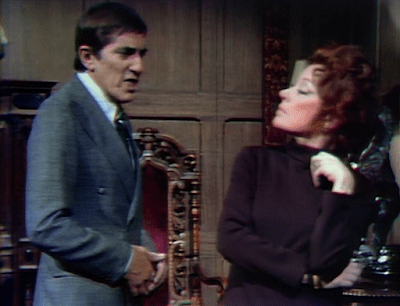
Julia Hoffman enters the drawing room of the great house of Collinwood and sees her best friend, vampire Barnabas Collins, embracing governess Maggie Evans and staring hungrily at Maggie’s neck. She interrupts with news that she just had an ugly scene with one of Maggie’s charges, teenager David Collins. Julia suggests Maggie go to talk with David, and she immediately does so.
Julia scolds Barnabas for almost biting Maggie. He denies he was about to do that. She reminds him of the lengths he went to a few months ago to resist the temptation to bite Maggie. She does not mention that Maggie was his victim three years ago, in May and June of 1967, an event that has repeatedly been wiped from Maggie’s memory, though not from anyone else’s. Barnabas insists that he is in complete control of himself, and that Maggie is in no danger from him. Julia looks at him skeptically, as well she might. He sounds like every addict who is ten minutes away from a relapse.
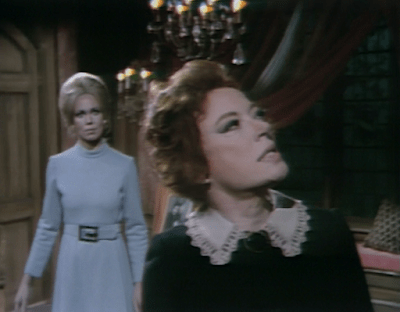
Later, Barnabas and Julia are back in the drawing room. Barnabas is all huffy because Maggie went on a date with astrologer Sebastian Shaw. Julia asks why that bothers him. He says that Sebastian is either a charlatan or something worse. Coming from a vampire, this note of prim disapproval is pretty rich, and Julia does nothing to hide her sardonic amusement at his discomfiture.
Julia is darkly amused at Barnabas’ sputtering over Maggie’s date with Sebastian. Screenshot by Dark Shadows Before I Die.
Julia is so deeply involved with Barnabas that she has no hope of making a life that does not include him, and she long ago decided to make the best of this situation by falling in love with him. Barnabas initially responded to this attitude by cruelly taunting her, but now tends to respond to her unrequited feelings with tact and, at times, a measure of compassion. That tact and compassion do not go so far as to keep him from telling her about the other women he is chasing and expecting her to help him catch up to them, but sometimes, he speaks softly and gives her a hug. For Barnabas, that’s an enormous act of kindness.
For a long time, Barnabas was hung up on Maggie, and early in 1970 it looked like she was about to reciprocate his interest. Julia meekly stayed out of their way at that time. Then Barnabas went on a cosmic journey through an alternate universe and into the far-off future year of 1995. Julia accompanied him on that journey. While in the alternate universe, he fell in love with a girl named Roxanne, who looked like she could be Julia’s daughter. When he and Julia returned to 1970, Barnabas spent some of his time trying to prevent the disaster he and Julia learned was coming when they were in 1995 and the rest mooning about his lost Roxanne. That left him no time to reconnect with Maggie. Then, he met Roxanne’s Doppelgänger who is native to the main universe, and he was back in love.
This Roxanne apparently lives with Sebastian, much to Barnabas’ dismay. So whatever his past attachment to Maggie, the fact that Sebastian is available for Maggie to date suggests Barnabas might have a shot with Roxanne. Part of Julia’s grim amusement may come from watching Barnabas’ total inability to be rational enough to see this as a bright side.
Maggie comes back to the great house having had a fine time with Sebastian. She talks with Julia and Barnabas about David and her other charge, Hallie Stokes. She agrees that they seem already to be under the influence of the evil spirits whom Barnabas and Julia saw in the wreckage of the great house when they were in 1995, and laments her inability to get through to them. Barnabas says he will go home; Maggie offers to walk with him partway, since she wants some fresh air.
We cut to Sebastian and Roxanne’s place. Roxanne knows all about Sebastian’s date with Maggie. She mentions that she saw them at the restaurant in the Collinsport Inn. That will interest longtime viewers- the diner, as it is often called, was a major set in the first 41 weeks of the show, when Maggie worked there. It has been seen so rarely since then that we can never be sure it still exists. Sebastian wonders how Roxanne knows so much, and she placidly tells him she has her ways. He leaves the room, and she gives a mischievous smile, as if she has thought of another opportunity to use her ways to secure her interests.
Julia sees Maggie when she returns to the great house. Julia tells Maggie that she has been gone for an hour and asks what kept her so long. Maggie collapses, and Julia sees bite marks gaping on her neck.
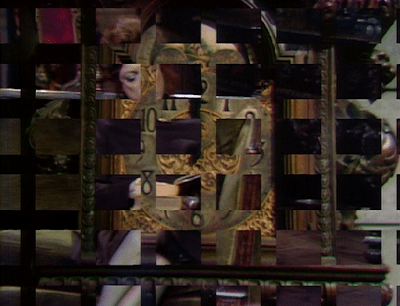
At one point they cut from the clock in the foyer at the great house to Julia. They do a matrix wipe, in which the picture dissolves into squares and then the next picture assembles from those squares. It’s the first time they have used this effect, and it is not at all clear what point it is supposed to make. Also, both shots are loaded with lots of little visual details, so that laying one on top of the other produces an ugly, confusing image.
Chemist Horace Gladstone has been selling a strange and powerful synthesis of his own invention to Cyrus Longworth, an independent medical researcher. Cyrus refuses to tell Gladstone what he is using the synthesis for. Gladstone has now figured it out for himself. Cyrus has concocted a potion which he drinks to change his appearance, disguising him so effectively that even the people who know him best do not recognize him. In that disguise, Cyrus calls himself “John Yaeger,” spends a lot of money, and indulges his sadistic impulses.
Gladstone comes to Cyrus’ lab and tells him what he knows. Cyrus tries to deny that he is Yaeger, and Gladstone lists the evidence he has collected proving that he is. Gladstone tells Cyrus that he doesn’t believe he can do without the thrills he gets from his activities as Yaeger. The story has been crafted as an account of addiction, so returning viewers are sure Gladstone is right. He says he will go on serving as Cyrus’ connection for the drug he craves, but the price has gone up. He demands $10,000.
Cyrus first learned Gladstone’s name from his late friend Angelique Stokes Collins. Angelique was a woman of vast learning in a variety of fields, much like the title character in Edgar Allan Poe’s story “Ligeia.” Also like Ligeia, Angelique has returned from the dead. She is now back in the great house of Collinwood, impersonating the identical twin sister whom she murdered on the night of her resurrection, and occupying her old room as the guest of her widower, drunken sourpuss Quentin Collins.
Cyrus calls Gladstone a blackmailer. In reply, Gladstone makes a cryptic remark: “Why do you think my number was in Angelique Collins’ phone book? She’s led many lives. Each person only gets one. Good night.” We have indeed been wondering how Angelique came to know Gladstone, and now we wonder if he is aware of just how literally true it is that “She’s led many lives.” It doesn’t make any sense to follow “She’s led many lives” with “Each person only gets one,” but actor John Harkins was so precise in his delivery that I’m sure that was the scripted line. If there was a slip, it came from Sam Hall’s typewriter, not from Harkins’ tongue.
If it isn’t a slip, I think we would have to go out on a limb to explain what Gladstone could mean. Angelique built up a cult around herself, including several people who were firmly convinced that she was going to rise from the dead. When her sister Alexis came to Collinwood, housekeeper Julia Hoffman, sleazy musician Bruno Hess, and Angelique and Quentin’s son Daniel were certain that the prophecy had been fulfilled and they were seeing Angelique redivivus. This was also the first thought that came to Cyrus, to Quentin’s brother Roger, and to Angelique’s Aunt Hannah, though they were more easily persuaded that Alexis was a separate person. The cultists are impressive enough in their certainty that even people outside their ranks were sure Alexis was Angelique returned from the grave. Daniel’s cousin and playmate Amy Collins was horrified to see her for that reason, and Quentin’s second wife, the former Maggie Evans, fled the house in part because she could not shake her belief that Alexis was Angelique.
If Gladstone is familiar with Angelique’s cult and has been involved with it, he might be saying that each person gets to participate in only one of Angelique’s lives. We’ve already seen that is not the case, but that doesn’t mean he doesn’t think it is. Angelique may at some point have taught her followers a doctrine like that. While Hoffman, Bruno, and Daniel expected Angelique to come back and rejoin them, Cyrus, Roger, and Hannah were unsure they would see her again, even though they were certain that she was not simply dead. Indeed, Angelique is still telling her most of her devotees that she is Alexis. The only one to whom she has fully revealed herself is Hannah. Perhaps she had a plan to transcend death, but did not know just how it would work. Or perhaps she has decided the rest are not yet ready to be initiated into the esoteric truth of her return.
Sam Hall was a serious Lutheran, so much so that he insisted Shirley Grossman convert from Judaism before she married him and became Grayson Hall. Christian studies in twentieth century academic institutions were largely taken up with speculation about differences of opinion in the church before the codification of the New Testament and the formulation of the creeds. This sort of thing is still prominent in divinity schools today, and is often heard from pulpits in mainline Protestant denominations. Hall must have been familiar with it, so he probably gave it some thought when he spent Easter season 1970 writing scripts about a figure whose followers sort of expected her to rise from the dead and who surprised them by the way in which she actually did so. I doubt he was making any particular point about the various schools of thought that seminary professors postulate in the primitive church, but when he presents Angelique’s cult as divided into several strains of opinion from the start he is developing an idea that he did not have to invent himself.
We cut from the scene between Cyrus and Gladstone to the basement of Collinwood. Angelique leads Quentin to a little chamber hidden behind an alcove. A human skeleton stands in the chamber. You may wonder how a skeleton can stand, but Quentin doesn’t. He is too busy being surprised that he didn’t realize this chamber was in his basement.
The skeleton is that of Dameon Edwards, a friend of Angelique’s who went missing about a year before. Dameon’s ghost has been haunting the place for a couple of weeks. Angelique tells Quentin that Hannah found the skeleton and exorcised the ghost. Yesterday, we saw Angelique exorcise the ghost. Returning viewers know that she is giving credit to Hannah because she is masquerading as Alexis, who did not share her sister’s interest in the occult or her aunt’s. Quentin thinks that Bruno probably killed Dameon. Indeed, the ghost confirmed this yesterday. Quentin very much wants to get rid of Bruno, so you might think he would be interested in bringing a murder charge against him. But he decides that would be too much trouble, and it hurts his feelings when “Alexis” snaps at him that he shouldn’t be wasting his time reporting Dameon’s murder when he isn’t doing anything to investigate Angelique’s. So he calls Cyrus, and the two of them bury the bones on the grounds of the estate.
Meanwhile, two long-absent characters have returned from trips out of town. Quentin sent Hoffman to visit friends of hers in Boston because she kept antagonizing Maggie. Quentin’s sister Elizabeth Collins Stoddard also went away for a long stay in New York, where she visited Maggie. In off-screen reality, Grayson Hall and Joan Bennett were both in Tarrytown, New York with several other cast members, working on the feature film House of Dark Shadows. Liz complains that Hoffman didn’t meet her at the train station with a car, and Hoffman explains that she just got back herself.
Hoffman says she missed Collinwood terribly while she was in Boston; Liz says she can’t understand that. If she were in Quentin’s place, she would sell the house and move to the city. That will interest longtime viewers. For its first 196 weeks, Dark Shadows was set in a parallel universe, where Liz’ counterpart owned Collinwood. When the show started, she was a recluse who hadn’t left the house for eighteen years. Her brother Roger often urged her to sell the place so that they could live someplace less gloomy, but even after she stopped being a recluse Liz wouldn’t hear of that. She was a symbol of the family’s commitment to the house. We have already seen that this Liz is the opposite of her counterpart in other ways, and now we wonder how far they will take that mirror image motif.
Angelique is in the foyer, talking on the telephone to Hannah. Villains on Dark Shadows have remarkably little sense of OpSec, and this is a case in point. Quentin, Liz, and Hoffman are a few feet away from her in the drawing room, and each of them knows that Alexis and Hannah couldn’t stand each other. All Angelique has to do is call Hannah by name and she will raise their suspicions. Yet not only does she use Hannah’s name several times, she uses one incriminating expression after another about how no one will suspect what they are up to. If any of them listens in, or of anyone else in the house happens by on their way to the front door, Angelique will have tipped her hand.
It is Hoffman who eavesdrops on the call. After Angelique catches her, they have an awkward exchange and Hoffman goes upstairs. Angelique then stands at the door to the drawing room and eavesdrops on a conversation between Liz and Quentin. Liz wants Quentin to go to New York and ask Maggie to come home, he throws a tantrum and says that Maggie is too childish for him to do such a thing.
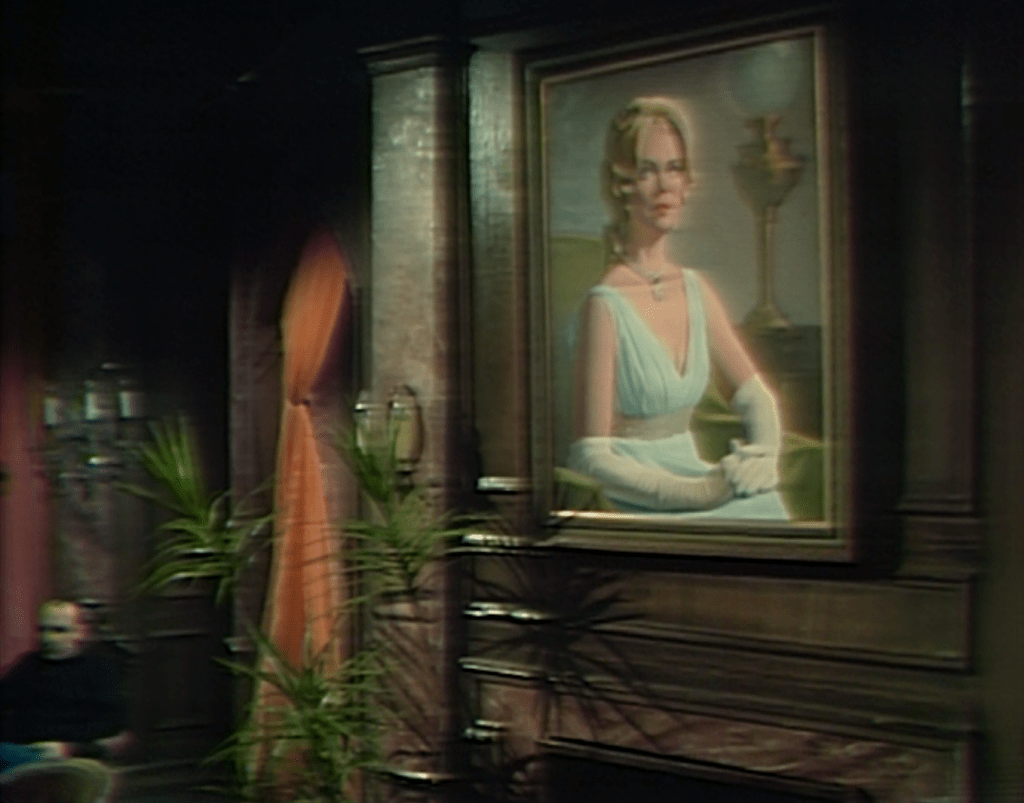
Hoffman is in Angelique’s old room, talking to the portrait of her that hangs there. The members of Angelique’s cult make a practice of coming to the room and carrying on conversations with the portrait; when Alexis was staying in the room, she sometimes walked in on them while they were confiding their thoughts to it. Angelique eavesdrops on the last part of Hoffman’s account that when she was in Boston, she felt a mystic assurance that when she returned to Collinwood she would find Angelique come back to life. When Hoffman says that everything seems to be the same as it was when she left, she is close to tears.
The resurrected Angelique eavesdrops on Hoffman’s conversation with the dead Angelique. Screenshot by Dark Shadows Before I Die.
Angelique takes a step forward, and Hoffman realizes she is not alone with the portrait. She apologizes to “Alexis,” and Angelique says she needs a friend she can trust. Hoffman claims to be such a friend. “Alexis” then launches into her reasons for believing that Angelique was murdered. After the first couple of sentences, returning viewers know what she is going to say, so we dissolve to Quentin and Cyrus in the drawing room.
Quentin and Cyrus have just buried the skeleton, prompting Quentin to feel sorry for himself. He then tries to explain to Cyrus something extremely weird he saw the other evening. He went to Angelique’s old room to see Alexis. He opened the door, and saw a space that lacked the room’s furniture, lights, and decor. He saw two children whom he took to be Daniel and Amy, and they said something about Barnabas Collins. The only person of that name of whom Quentin or Cyrus is aware died in 1830, but the children were talking about someone they knew. An invisible barrier kept Quentin from entering the room, and he could not attract the children’s attention. Regular viewers know that Quentin was catching a glimpse of the other continuity, and that the children were not Daniel and Amy Collins, but their counterparts David Collins and Amy Jennings. Cyrus hasn’t been watching the show, so all he can do is suggest Quentin take a vacation.
They’ve been experimenting with videotape editing, and they make a jump cut from the drawing room scene with Quentin and Cyrus to Quentin walking up to the doors of Angelique’s room. The effect is startling, I suspect intentionally so. Quentin opens the doors, and again sees the other universe.
This time Quentin sees the counterparts of Liz and Hoffman. As David and Amy had been, they are talking about Barnabas, who was last seen in this room. Hoffman, whom Liz addresses as Julia, says that they must keep the room open so that Barnabas will have a chance to return to them. She says she wants to stay there, because it makes her feel close to Barnabas. Liz excuses herself, and Julia calls out to Barnabas. As Hoffman had grown emotional talking to the Angelique whom she believed to be absent, Julia grows emotional when she talks to the missing Barnabas. She looks at the hallway, seeing not Quentin but the dark, empty space that is there in her universe. She asks if Barnabas is there, watching her. Grayson Hall plays these two scenes so similarly that we can have no doubt that whatever the one Julia Hoffman feels for Barnabas, the other feels for Angelique.
Quentin calls out to Hoffman’s counterpart, as he had called to Daniel and Amy’s counterparts. As the children had been unaware of his presence, so this other Julia Hoffman is unaware of him. And as Daniel and Amy had come to the hallway and asked why he was shouting for them, Hoffman comes to the hallway and asks why he is shouting for her.
The show has been spending a lot of time lately trying to interest us in the ghost of Dameon Edwards, a man who doesn’t seem to have had much going for him even when he was alive. They went through the motions of a murder mystery concerning Dameon’s death. The episode that introduced him also hinted that he was killed by sleazy musician Bruno Hess with the complicity of butler Mr Trask, and those hints are confirmed today. So the mystery was never much of a puzzle. Besides, Bruno and Trask are the counterparts of homicidal villains whom we saw in the universe where Dark Shadows was set for its first 196 weeks, so we’ve expected all along that they would turn out to have someone’s blood on their hands. And neither of them is the central figure in an ongoing story, so even if they had been brought to justice for their crimes it would only be an easy way for the writers to dispose of characters who were going to be written out anyway.
Today, wicked witch Angelique finds Dameon’s skeleton sealed up in an alcove in the basement of the great house of Collinwood. She summons his ghost and dismisses him. That’s it for Dameon. What will happen to the skeleton, or to Bruno, or to Trask, or to the alcove, we don’t yet know.
The sight of the skeleton standing in the alcove does remind us of one of Trask’s alternate universe counterparts, a fanatical witchfinder who was sealed up in a basement alcove elsewhere on the estate in 1796. Since Trask is involved in this little arc, it’s a nice touch to connect it to that other Trask.
Most of the episode is devoted to a far more interesting story, an adaptation of Jekyll and Hyde. They’ve been focusing on the addiction angle. Mad scientist Cyrus Longworth is hooked on the potion that changes his appearance and allows him to fool even people who know him well into believing that he is a separate person by the name of John Yaeger. He enjoys the violence that he commits as Yaeger.
Today, three people try to save Cyrus from himself. Lawyer Larry Chase resists Cyrus’ instructions to transfer $5000 to Yaeger and to rewrite his willin Yaeher’s favor; chemist Horace Gladstone is reluctant to keep selling Cyrus a volatile synthesis he needs for the potion, and figures out that he and Yaeger are one and the same; and Buffie Harrington, who is exploring her masochistic side by submitting to beatings from Cyrus as Yaeger but still thinks the two are different people, goes to Cyrus to urge him to be more careful in his dealings with Yaeger. Dark Shadows has dealt intelligently and sensitively with the theme of addiction from its earliest days, and today’s focus on people who care about the addict trying to help him achieves a real poignancy.
We may wonder if drug abuse was a particularly timely topic behind the scenes of Dark Shadows at this point. Larry is a substitute for the character of Chris Collins, who was played by Don Briscoe. Briscoe would eventually be diagnosed with bipolar personality disorder, and in 1970 was trying to self-medicate with street drugs.
The makers of the show didn’t give up on Briscoe until the absolute last minute. This episode was taped very close to airtime, after episodes that would be broadcast weeks later were already in the can, giving Briscoe as much time as possible to get himself together. The part of Larry was played by Ken McEwen. McEwen joined the show in August 1968 as an associate director. He had a guild card due to small parts he had taken in a couple of TV shows in the 50s, but had never been an actor full-time. And he clearly hasn’t had much time to learn his dialogue. He is perfectly competent in the first of his two scenes, when Larry is in The Eagle tavern with Yaeger, Gladstone, and Buffie. There are no major bobbles and you can tell exactly what is on his mind. But when Larry returns and meets with Cyrus in his laboratory, McEwen stumbles over every line and never develops a coherent attitude.
The music is interesting today. The Eagle in the current universe corresponds to the Blue Whale, Collinsport’s tavern in the main continuity, and while we are there we hear the jukebox music that was prominent in the show’s first year. There is a scene between Gladstone and Buffie in her apartment; when that opens, we hear some music I don’t believe we’ve heard before. If they’ve written a theme for Buffie, it gives us hope we will see a lot more of Elizabeth Eis’ excellent performance in this role.
The original videotape master of this episode was lost. We have it on a kinescope. I love the kinescopes; I wish all the episodes were available in that format, as well as the videotapes. We haven’t seen one since #813, and will see only one more, #1017. You can always set the options on your device to display in black and white, but the kinescope comes with some visual blurring and sound distortions. Those are usually flaws, of course, but when the show has already given you the feeling that you are catching a glimpse of another reality they can add to the eeriness and yearning for what might have been.
Quentin Collins walks into the bedroom once occupied by his late wife Angelique, where Angelique’s identical twin sister Alexis is staying. Quentin arrives just in time to see sleazy musician Bruno Hess strangling Alexis. He interrupts this process. Bruno is convinced that Alexis is Angelique returned from the grave, and that she is responsible for many strange and unhappy occurrences that have taken place on the estate of Collinwood since her arrival.
Bruno holds the deed to a cottage on the grounds of the estate and lives there, to Quentin’s intense annoyance. He hates Bruno, who had an affair with Angelique, a fact he likes to throw in Quentin’s face. You might think Quentin would call the police and report Bruno’s assault on Alexis. Not only would that result in a felony charge, but if Bruno bursts out with his suspicions it should be easy to get a civil commitment order that will earn him a a long stay in a home for the very nervous. But Quentin leaves Alexis and Angelique’s room without calling the sheriff. What’s more, when he goes to the drawing room and finds Bruno still in his house he has a lengthy conversation with him and waits for him to go. He never does telephone the police.
By the end of the episode, Quentin has convinced himself to take Bruno’s theory seriously. Alexis overhears him talking about it with his friend Cyrus Longworth. Quentin tells Cyrus that they must open Angelique’s tomb and look in her coffin.
Alexis finds them there, the coffin already out of its niche. She objects to the desecration of her sister’s resting place. She promises to leave Collinwood immediately if they will let Angelique rest in peace. Quentin refuses. He opens the box. Whatever he finds inside prompts a reaction of shock on his face and on Alexis’ as they look inside.
Between these scenes, we spend time in Cyrus’ laboratory. He is a mad scientist who has devised a Jekyll and Hyde potion. His alter ego goes by the name John Yaeger. Cyrus’ fiancée Sabrina Stuart is a sweet, trusting young woman who is determined to believe the best of Cyrus, but she has heard so much about Cyrus’ involvement with the brutal Yaeger that she is certain something is terribly wrong. We know that Cyrus was close to Angelique, and that she put him up to the Jekyll and Hyde experiment. Sabrina doesn’t know what Cyrus’ project is, but his withdrawn and irritable manner reminds her of the influence Angelique had on him. She says “It’s the same as it was when Angelique was alive- you were different then, and you’re different now.” I’m sure that was the scripted line, too.
Sabrina demands Cyrus stop lying to her and tell the truth about who Yaeger is and what hold he has over him. We saw yesterday that Cyrus’ attitude towards the potion and towards his time as Yaeger is already that of an addict towards his drug, and he sullenly refuses to answer any of Sabrina’s questions, even with more lies. She grows more and more exasperated.
Sabrina’s time with Cyrus is cut short when barmaid Buffie Harrington enters and insists on talking with Cyrus alone. Yaeger gave Buffie a check signed by Cyrus to cover the damages he did to her place of employment in a bar fight the other night; she wants to know if the check is authentic. Cyrus confirms that it is, much to Buffie’s delight. She mentions that her sometime boyfriend Steve is in the hospital because of a beating Yaeger gave him; Cyrus hands her a pile of cash to cover Steve’s hospital expenses. Buffie tells Cyrus that Yaeger has taken rooms in the boarding house where she stays, and that he frightens her. She does not tell him that Yaeger has hit her, choked her, and threatened her every time they have met. We know that he knows that- he has met her only when he was in the form of Yaeger, and he recognizes her on sight, showing that he remembers their encounters. Buffie asks if Yaeger works for Cyrus. He smiles with great satisfaction and says that he does.
That smile is a key moment. Yesterday’s episode gave the Jekyll and Hyde story a new lease on life by confirming that it will indeed be about addiction. That’s the usual thing with that material, but Dark Shadows has taken familiar tales in such weird directions that we could by no means take it for granted that its version would follow the typical pattern. Cyrus’ response to the thought that he controls Yaeger, who has put Steve in the hospital and is terrorizing Buffie, confirms something else. Cyrus’ diffident manner and scientific preoccupations help Sabrina hold onto the idea that he is a sweet man whose only flaw is naïveté, but Christopher Pennock’s rendering of that smile leaves no doubt that Yaeger is Cyrus’ means of indulging his own sadistic impulses.
As Buffie is leaving, Cyrus asks her if she likes Yaeger. Holding her head high, she says that sometimes she does. She sounds like she means it. Buffie was a commanding presence when first we saw her, and she is forceful throughout this scene. But she has given up on fighting back against Yaeger or even trying to run away from him. Her line suggests that she is not simply giving in to fear, but is drawn to a masochistic fantasy. Yaeger has been so vicious and Cyrus is so sinister that there is no prospect this fantasy is going to be channeled into any kind of consensual game- Buffie is drifting into a situation that can lead only to her destruction.
This episode includes one of the all-time great bloopers. The closing credits run over a shot of Angelique and Alexis’s room. For the first minute or so, we see a man sitting in a chair, chewing on something. Whoever he was, apparently he decided he’d found a good spot for lunch. Eventually the camera zooms in on the portrait of Angelique that dominates the room. This is so obviously an attempt to get the lunch-eater out of the frame that it only adds to the hilarity.
Writer Gordon Russell has to give two characters plausible motivations today, and he succeeds admirably.
One is Dr Cyrus Longworth, the apparently nice half of a Jekyll and Hyde duality. Jekyll and Hyde is a story about drug addiction, but Dark Shadows has so often featured villains whose crazy ideas have turned out to be true that we can’t be sure the show’s version will be that way. For all we know, it might turn out that Cyrus really has developed a method of separating the good from the evil in human nature and that he will use it to breed a new race.
Today, Cyrus is confronted in his laboratory by his fiancée Sabrina Stuart and his friend Quentin Collins about his association with his alter ego, whom they believe to be a separate person named John Yaeger. Cyrus pulls himself up to his full height and declares “I can end my relationship with Yaeger any time it suits me.” At this, the universal motto of the addict, we know just what is driving Cyrus. We can set aside all the talk in the opening voiceovers and elsewhere about how good and innocent Cyrus is, and see him as a man in the grip of a force he won’t face and can’t beat.
The other character in need of an intelligible motivation is Cyrus’ friend, sleazy musician Bruno Hess. Bruno is staying in a room above Cyrus’ laboratory in hopes that the ghost of a man he murdered won’t be able to find him there. The ghost appears to him there today, and sets the room on fire. Cyrus helps Bruno put the fire out, and talks about trying to exorcise the ghost. Bruno tells Cyrus he doesn’t believe he can help him. When he says this, Bruno seems, for the first time, reasonable. He has asked many things of Cyrus, so many that we might think of him as nothing more than a source of ever-escalating demands. But when he says that what is happening now is outside Cyrus’ province, we can see that there is some kind of mental process going on in his head.
Bruno thinks the ghost and the fire were both sent by Quentin’s late wife, Angelique. In the universe where Dark Shadows spent its first 196 weeks, Angelique’s counterpart is a witch who has a complicated relationship to fire. She is vulnerable to it, but can also use it in various ways. And, she has returned from the dead many times. If the Angelique in this continuity is like that one, it would make sense to suspect her. Angelique’s identical twin sister Alexis is Quentin’s guest at the great house of Collinwood. Bruno believes Alexis is really Angelique. He bursts in on her and says that he has a way to test whether she is Angelique returned from the dead. If she is, she can’t die again. So he sets about strangling her. If he kills her, Bruno will know he was mistaken.
In the main continuity, every drawer in every table at the great house contains a loaded gun. Longtime viewers have no reason to doubt that the same circumstance obtains here. So if we had not seen Bruno being rational in his scene with Cyrus, we would have no question in our minds but why Alexis does not draw a weapon and shoot the crazy man who is going to do nothing but try to kill her. That moment of lucidity makes the scene interesting. It even makes it somewhat surprising that Bruno goes all the way to homicide- we know he is a strange and violent man, but if he could think as clearly as that, maybe he could come up with a less drastic expedient.
The “Dan Curtis Productions” logo at the end of the closing credits is printed in a simpler style than it has been so far. We will see this new style several more times in the remaining months of the show.