
Chemist Horace Gladstone has been selling a strange and powerful synthesis of his own invention to Cyrus Longworth, an independent medical researcher. Cyrus refuses to tell Gladstone what he is using the synthesis for. Gladstone has now figured it out for himself. Cyrus has concocted a potion which he drinks to change his appearance, disguising him so effectively that even the people who know him best do not recognize him. In that disguise, Cyrus calls himself “John Yaeger,” spends a lot of money, and indulges his sadistic impulses.
Gladstone comes to Cyrus’ lab and tells him what he knows. Cyrus tries to deny that he is Yaeger, and Gladstone lists the evidence he has collected proving that he is. Gladstone tells Cyrus that he doesn’t believe he can do without the thrills he gets from his activities as Yaeger. The story has been crafted as an account of addiction, so returning viewers are sure Gladstone is right. He says he will go on serving as Cyrus’ connection for the drug he craves, but the price has gone up. He demands $10,000.
Cyrus first learned Gladstone’s name from his late friend Angelique Stokes Collins. Angelique was a woman of vast learning in a variety of fields, much like the title character in Edgar Allan Poe’s story “Ligeia.” Also like Ligeia, Angelique has returned from the dead. She is now back in the great house of Collinwood, impersonating the identical twin sister whom she murdered on the night of her resurrection, and occupying her old room as the guest of her widower, drunken sourpuss Quentin Collins.
Cyrus calls Gladstone a blackmailer. In reply, Gladstone makes a cryptic remark: “Why do you think my number was in Angelique Collins’ phone book? She’s led many lives. Each person only gets one. Good night.” We have indeed been wondering how Angelique came to know Gladstone, and now we wonder if he is aware of just how literally true it is that “She’s led many lives.” It doesn’t make any sense to follow “She’s led many lives” with “Each person only gets one,” but actor John Harkins was so precise in his delivery that I’m sure that was the scripted line. If there was a slip, it came from Sam Hall’s typewriter, not from Harkins’ tongue.
If it isn’t a slip, I think we would have to go out on a limb to explain what Gladstone could mean. Angelique built up a cult around herself, including several people who were firmly convinced that she was going to rise from the dead. When her sister Alexis came to Collinwood, housekeeper Julia Hoffman, sleazy musician Bruno Hess, and Angelique and Quentin’s son Daniel were certain that the prophecy had been fulfilled and they were seeing Angelique redivivus. This was also the first thought that came to Cyrus, to Quentin’s brother Roger, and to Angelique’s Aunt Hannah, though they were more easily persuaded that Alexis was a separate person. The cultists are impressive enough in their certainty that even people outside their ranks were sure Alexis was Angelique returned from the grave. Daniel’s cousin and playmate Amy Collins was horrified to see her for that reason, and Quentin’s second wife, the former Maggie Evans, fled the house in part because she could not shake her belief that Alexis was Angelique.
If Gladstone is familiar with Angelique’s cult and has been involved with it, he might be saying that each person gets to participate in only one of Angelique’s lives. We’ve already seen that is not the case, but that doesn’t mean he doesn’t think it is. Angelique may at some point have taught her followers a doctrine like that. While Hoffman, Bruno, and Daniel expected Angelique to come back and rejoin them, Cyrus, Roger, and Hannah were unsure they would see her again, even though they were certain that she was not simply dead. Indeed, Angelique is still telling her most of her devotees that she is Alexis. The only one to whom she has fully revealed herself is Hannah. Perhaps she had a plan to transcend death, but did not know just how it would work. Or perhaps she has decided the rest are not yet ready to be initiated into the esoteric truth of her return.
Sam Hall was a serious Lutheran, so much so that he insisted Shirley Grossman convert from Judaism before she married him and became Grayson Hall. Christian studies in twentieth century academic institutions were largely taken up with speculation about differences of opinion in the church before the codification of the New Testament and the formulation of the creeds. This sort of thing is still prominent in divinity schools today, and is often heard from pulpits in mainline Protestant denominations. Hall must have been familiar with it, so he probably gave it some thought when he spent Easter season 1970 writing scripts about a figure whose followers sort of expected her to rise from the dead and who surprised them by the way in which she actually did so. I doubt he was making any particular point about the various schools of thought that seminary professors postulate in the primitive church, but when he presents Angelique’s cult as divided into several strains of opinion from the start he is developing an idea that he did not have to invent himself.
We cut from the scene between Cyrus and Gladstone to the basement of Collinwood. Angelique leads Quentin to a little chamber hidden behind an alcove. A human skeleton stands in the chamber. You may wonder how a skeleton can stand, but Quentin doesn’t. He is too busy being surprised that he didn’t realize this chamber was in his basement.
The skeleton is that of Dameon Edwards, a friend of Angelique’s who went missing about a year before. Dameon’s ghost has been haunting the place for a couple of weeks. Angelique tells Quentin that Hannah found the skeleton and exorcised the ghost. Yesterday, we saw Angelique exorcise the ghost. Returning viewers know that she is giving credit to Hannah because she is masquerading as Alexis, who did not share her sister’s interest in the occult or her aunt’s. Quentin thinks that Bruno probably killed Dameon. Indeed, the ghost confirmed this yesterday. Quentin very much wants to get rid of Bruno, so you might think he would be interested in bringing a murder charge against him. But he decides that would be too much trouble, and it hurts his feelings when “Alexis” snaps at him that he shouldn’t be wasting his time reporting Dameon’s murder when he isn’t doing anything to investigate Angelique’s. So he calls Cyrus, and the two of them bury the bones on the grounds of the estate.
Meanwhile, two long-absent characters have returned from trips out of town. Quentin sent Hoffman to visit friends of hers in Boston because she kept antagonizing Maggie. Quentin’s sister Elizabeth Collins Stoddard also went away for a long stay in New York, where she visited Maggie. In off-screen reality, Grayson Hall and Joan Bennett were both in Tarrytown, New York with several other cast members, working on the feature film House of Dark Shadows. Liz complains that Hoffman didn’t meet her at the train station with a car, and Hoffman explains that she just got back herself.
Hoffman says she missed Collinwood terribly while she was in Boston; Liz says she can’t understand that. If she were in Quentin’s place, she would sell the house and move to the city. That will interest longtime viewers. For its first 196 weeks, Dark Shadows was set in a parallel universe, where Liz’ counterpart owned Collinwood. When the show started, she was a recluse who hadn’t left the house for eighteen years. Her brother Roger often urged her to sell the place so that they could live someplace less gloomy, but even after she stopped being a recluse Liz wouldn’t hear of that. She was a symbol of the family’s commitment to the house. We have already seen that this Liz is the opposite of her counterpart in other ways, and now we wonder how far they will take that mirror image motif.
Angelique is in the foyer, talking on the telephone to Hannah. Villains on Dark Shadows have remarkably little sense of OpSec, and this is a case in point. Quentin, Liz, and Hoffman are a few feet away from her in the drawing room, and each of them knows that Alexis and Hannah couldn’t stand each other. All Angelique has to do is call Hannah by name and she will raise their suspicions. Yet not only does she use Hannah’s name several times, she uses one incriminating expression after another about how no one will suspect what they are up to. If any of them listens in, or of anyone else in the house happens by on their way to the front door, Angelique will have tipped her hand.
It is Hoffman who eavesdrops on the call. After Angelique catches her, they have an awkward exchange and Hoffman goes upstairs. Angelique then stands at the door to the drawing room and eavesdrops on a conversation between Liz and Quentin. Liz wants Quentin to go to New York and ask Maggie to come home, he throws a tantrum and says that Maggie is too childish for him to do such a thing.
Hoffman is in Angelique’s old room, talking to the portrait of her that hangs there. The members of Angelique’s cult make a practice of coming to the room and carrying on conversations with the portrait; when Alexis was staying in the room, she sometimes walked in on them while they were confiding their thoughts to it. Angelique eavesdrops on the last part of Hoffman’s account that when she was in Boston, she felt a mystic assurance that when she returned to Collinwood she would find Angelique come back to life. When Hoffman says that everything seems to be the same as it was when she left, she is close to tears.
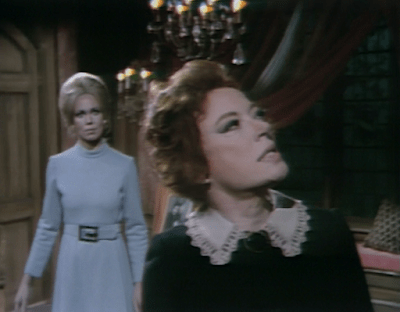
Angelique takes a step forward, and Hoffman realizes she is not alone with the portrait. She apologizes to “Alexis,” and Angelique says she needs a friend she can trust. Hoffman claims to be such a friend. “Alexis” then launches into her reasons for believing that Angelique was murdered. After the first couple of sentences, returning viewers know what she is going to say, so we dissolve to Quentin and Cyrus in the drawing room.
Quentin and Cyrus have just buried the skeleton, prompting Quentin to feel sorry for himself. He then tries to explain to Cyrus something extremely weird he saw the other evening. He went to Angelique’s old room to see Alexis. He opened the door, and saw a space that lacked the room’s furniture, lights, and decor. He saw two children whom he took to be Daniel and Amy, and they said something about Barnabas Collins. The only person of that name of whom Quentin or Cyrus is aware died in 1830, but the children were talking about someone they knew. An invisible barrier kept Quentin from entering the room, and he could not attract the children’s attention. Regular viewers know that Quentin was catching a glimpse of the other continuity, and that the children were not Daniel and Amy Collins, but their counterparts David Collins and Amy Jennings. Cyrus hasn’t been watching the show, so all he can do is suggest Quentin take a vacation.
They’ve been experimenting with videotape editing, and they make a jump cut from the drawing room scene with Quentin and Cyrus to Quentin walking up to the doors of Angelique’s room. The effect is startling, I suspect intentionally so. Quentin opens the doors, and again sees the other universe.
This time Quentin sees the counterparts of Liz and Hoffman. As David and Amy had been, they are talking about Barnabas, who was last seen in this room. Hoffman, whom Liz addresses as Julia, says that they must keep the room open so that Barnabas will have a chance to return to them. She says she wants to stay there, because it makes her feel close to Barnabas. Liz excuses herself, and Julia calls out to Barnabas. As Hoffman had grown emotional talking to the Angelique whom she believed to be absent, Julia grows emotional when she talks to the missing Barnabas. She looks at the hallway, seeing not Quentin but the dark, empty space that is there in her universe. She asks if Barnabas is there, watching her. Grayson Hall plays these two scenes so similarly that we can have no doubt that whatever the one Julia Hoffman feels for Barnabas, the other feels for Angelique.
Quentin calls out to Hoffman’s counterpart, as he had called to Daniel and Amy’s counterparts. As the children had been unaware of his presence, so this other Julia Hoffman is unaware of him. And as Daniel and Amy had come to the hallway and asked why he was shouting for them, Hoffman comes to the hallway and asks why he is shouting for her.

