Episode 1045: Have you a medical degree?

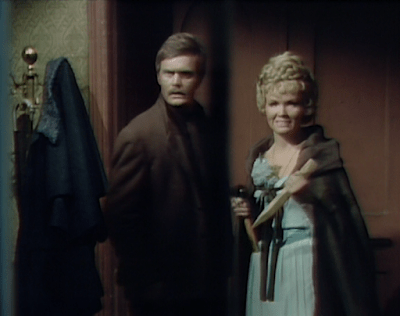
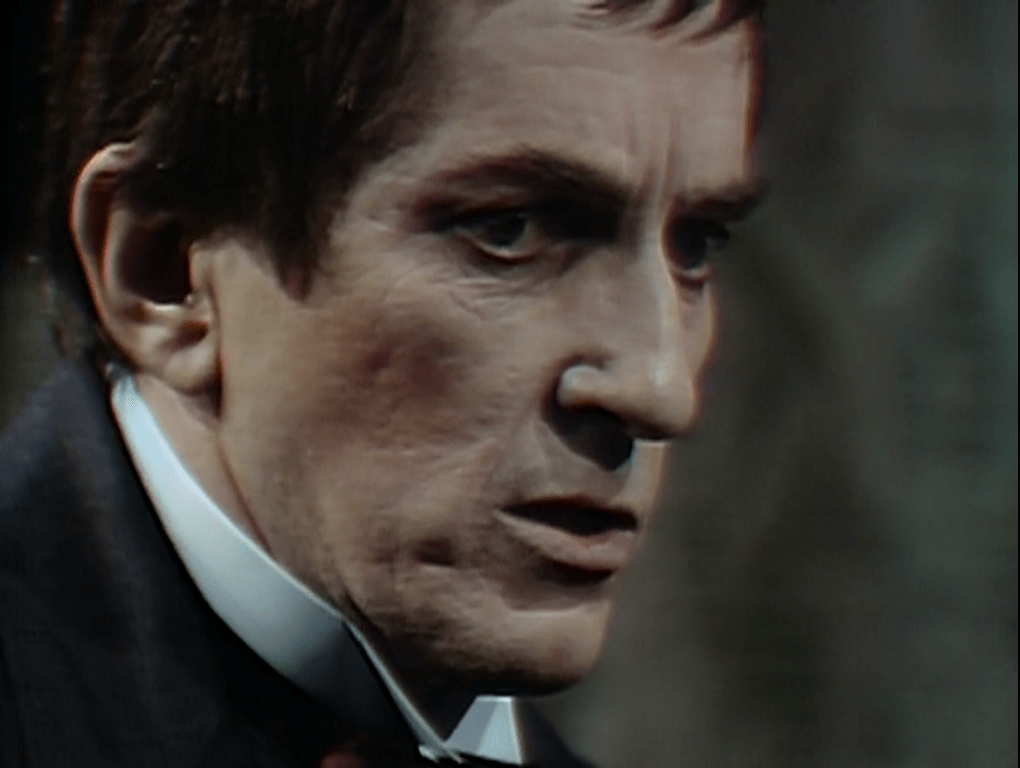
We open in the room atop the tower of the great house on the estate of Collinwood. Wicked witch Angelique, enemy of the mysterious Barnabas Collins, confronts Will Loomis, Barnabas’ henchman. She demands Will tell her Barnabas’ secret. Returning viewers know that Barnabas is a vampire, and Will is his blood thrall. When Will tells Angelique that he is incapable of betraying Barnabas, we know that he is making a literal statement of fact. But Angelique has power over Will, too. Caught between these opposing forces, Will does the only thing he can. He opens the window and flings himself to his death.

John Karlen plays Will, Lara Parker Angelique. In his post about this episode at his great Dark Shadows Every Day, Danny Horn observes that Karlen approached all of his parts as if he were in a play by Tennessee Williams. In a comment I left under that post, I said that while most of Karlen’s scene partners stuck with their own distinctive styles of acting while playing opposite him, resulting in surprisingly effective mashups of techniques that you wouldn’t think could coexist on any stage, Parker followed his volcanic lead in today’s first act. Will’s anguish and Angelique’s vehemence both go way over the top, but the result is far from hammy. Orson Welles famously said that hamminess is not overacting, it is false acting. There is nothing false between Will and Angelique today.

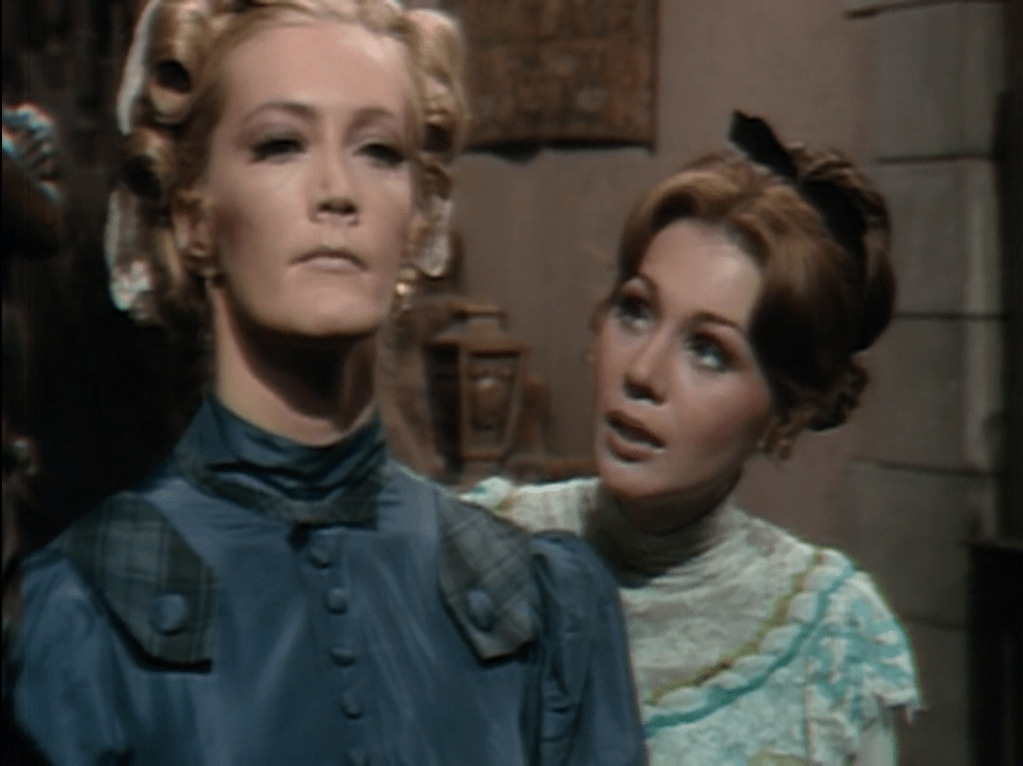
Just before Will jumped out the window, Julia Hoffman entered the room. Furious that Will has died without telling her what sort of creature Barnabas is, Angelique accuses Hoffman of startling him and ruining everything. Wondering if Will may have survived his fall, she orders Hoffman to accompany her to the foot of the tower. Hoffman kneels down and says that Will’s spinal cord snapped on impact resulting in instant death. Angelique says that she is intrigued by Hoffman’s diagnosis. “Have you a medical degree?”

Unknown to Angelique, the true answer would be yes. Angelique believes herself to be with Hoffman the housekeeper, her most fanatical devotee. In fact, the woman is Hoffman’s counterpart from an alternate universe, Dr Julia Hoffman, MD. Julia has followed her best friend Barnabas into this continuity and is assisting Barnabas in his battle against Angelique. Julia killed Hoffman and assumed her identity. Julia responds to Angelique’s puzzlement with a story about an incident when she saw a man fall from a roof and land in the same twisted position Will now holds. She remembered the words the doctor said when examining that man and merely repeated them when she saw Will’s distorted neck. Angelique compliments Julia on her extraordinary memory, and proceeds as if she were telling the truth. There seems little else she could do.

I remembered the line “Have you a medical degree?” from the first time Mrs Acilius and I watched Dark Shadows. Angelique has noticed that Julia is different from the Hoffman she knows, and has been showing signs of impatience with her. But she has not suspected she is a different person, only that she is going soft on her enemies. “Have you a medical degree?” makes it seem that might be changing. Julia may be in grave danger before long.

Barnabas rises from his coffin in the basement of Will’s house. He goes upstairs and finds Angelique waiting for him. She says she came, not to see him, but to console the widow Loomis. Thus Barnabas learns that Will has died.

Barnabas tells Angelique that he will avenge Will’s death upon her, but she tells him that he is the one to blame. It was because his power over Will matched hers that Will could respond to her commands only by killing himself.

Angelique’s counterpart in Barnabas’ own universe placed the curse that first made him a vampire. She was also wholly or partially responsible for the deaths of his mother, sister, aunt, uncle, fiancée, and many other people he cared about. So he reacts to the sight of this Angelique with barely controlled rage. For her part, she has no idea who he is, and does not know why he is hostile to her. She, therefore, is much cooler. The contrast is fascinating to watch, far more interesting than are the scenes between Barnabas and the other Angelique and one of the joys of the “Parallel Time” segment.

Julia and Barnabas are busy with a science project. They have learned that Angelique returned from the grave because her father, evil barfly Tim Stokes, somehow established a remote connection between her and a woman named Roxanne whom he keeps in the back room of his apartment. This connection, whatever it is, drains most of the “life force” from Roxanne into Angelique. This creates a delicate situation. If Roxanne dies, all of her “life force,” including that which animates Angelique, will vanish. But if she regains any of the force that has been taken from her, even enough to flutter her eyelids, Angelique will collapse and, unless Roxanne is brought back down to the prescribed level of debility, re-die.

When Julia and Barnabas first came upon Roxanne, they planned to kill her to finish Angelique off. Barnabas put the kibosh on that when he saw how pretty Roxanne was. Then they thought of destroying Angelique by reviving Roxanne, but, for reasons too silly to explain, they’ve decided they want to keep Angelique around. So now Barnabas has decreed that they will manipulate Roxanne’s condition to slow Angelique down. They have taken her from Stokes’ place and put her on a table in Will’s basement, somewhere away from the coffin. They have connected her to a lot of mad science equipment that is supposed to act on the “life force.” Longtime viewers know all about this equipment, because Julia had it in 1968 when she was building a Frankenstein’s monster as part of a project to cure Barnabas of vampirism.
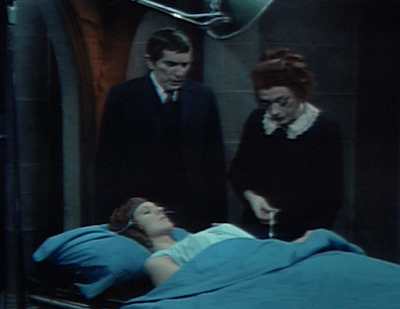
The doctor is in. Screenshot by Dark Shadows Before I Die.

Julia runs the equipment. Roxanne’s condition does not change. Julia tells Barnabas that Angelique is expecting her back at the great house. In her absence, Barnabas takes Roxanne’s hand and stares at her. She opens her eyes and sits up. In the great house, Angelique weakens and collapses.

Many fans wonder where Julia could have got the “life force” equipment. In her own universe, she is a medical doctor and the head of a private hospital, so she could order anything she needed from a medical supply house. Here, her only identity is her imposture as Hoffman the housekeeper, who did not have a prescription pad.

I don’t see why people are so concerned with this. In 1968, the equipment originally belonged, not to Julia, but to another mad scientist, Dr Eric Lang. Barnabas and Julia simply stole it from Dr Lang’s house after he died. In this continuity, we haven’t heard about Dr Lang, but we hadn’t heard about him in the main continuity either until Barnabas fell into his clutches, at which point he already had all of his equipment. So we can presume Barnabas and Julia just found out when his counterpart would be out of the house and raided the place.

Will’s death marks his final appearance, but John Karlen will be back in a couple of months as Willie Loomis, the version of him we met in the main continuity. He will play other characters later, when the show will be set in other periods.
Episode 929: The convergence

For the first 55 weeks of Dark Shadows, matriarch Elizabeth Collins Stoddard was under the impression that she had killed her husband Paul and that Paul’s associate Jason McGuire had buried his corpse in the basement of the great house on the estate of Collinwood. She spent nineteen years at home, terrified that if she left the estate someone might find Paul’s grave and hold her to account for his killing. Finally it turned out that she had only stunned Paul. He and Jason had faked his death to trick Liz into giving them a lot of money. Soon, Liz was no longer a recluse and that whole story was forgotten.

Now, Paul has returned. He denies knowing anything about his fake death, claiming that Jason acted alone. Longtime viewers will be skeptical of this claim, and Liz certainly is. But she doesn’t care about it as much as you might expect. She is now part of a secret cult that serves mysterious supernatural forces known as the Leviathan People, who plan to take over the earth, supplanting the human race. Paul has learned that he inadvertently sold Carolyn Collins Stoddard, his daughter with Liz, to the Leviathans, and he has been trying to sound the alarm about them. As a serenely happy devotee of the Leviathan cult, Liz has agreed to keep Paul at Collinwood where she can drug him into immobility.

The power of the Leviathans has taken bodily form in a succession of children who live in an antique shop in the village of Collinsport. The shop’s owners, Megan and Philip Todd, were the first people inducted into the cult by Liz’ distant cousin, old world gentleman Barnabas Collins. The latest manifestation of this being, an apparently thirteen year old boy known as Michael, had been attracting attention that threatened to blow the cult’s cover, so Philip and Megan faked his death. They held a funeral this morning.

Michael is supposed to retire into his room above the antique shop and stay there until he has graduated to his next form. He comes out and tells Megan and Philip that he has decided not to go through with this plan. Philip picks him up and carries him there, putting a new lock on the outside of the door to keep him in until he has gone through another transformation.

Carolyn calls the Todds and extends her mother’s invitation to an evening at Collinwood. They accept.

Unknown to Liz or the Todds, Barnabas has become disaffected from the cult. He visits Paul in his room. He gives Paul clothes and a lot of money and urges him to go far away. Paul doesn’t trust Barnabas, and holds him at gunpoint throughout their entire conversation.

When the Leviathan cult first emerged, its members were siloed off from each other. Barnabas gave Philip and Megan their instructions in dream visitations. When they were awake, they would not recognize him as their leader. They and Liz were not aware of each other’s connection to the cult, though Liz did know that Barnabas was her leader and her nephew David Collins was a fellow cultist. It reminded us of secret operations in the real world, where only people who work with each other directly are allowed to know of their shared allegiance.

Now, all that security is out the window. Liz and the Todds stand around the drawing room at Collinwood having drinks and talking about what Barnabas has and has not told them about the Leviathans and their goals. They do still keep some secrets, however. Liz says that she can’t help but wonder what Carolyn’s role will be in the time to come. Barnabas and the Todds know that she is fated to be the bride of the force currently incarnated as Michael, but they are not allowed to tell Liz this. They look at each other with alarm, and Barnabas gives her some vague and hasty assurances.

There is an unintentionally hilarious moment during the cocktail party scene. Megan is seized by enthusiasm for the Leviathan project, and starts babbling all sorts of portentous phrases about the new world that is taking shape through their efforts. Marie Wallace was one of the most committed exponents of the Dark Shadows house style of acting, which consists largely of delivering your lines so vehemently that you are in constant danger of spraining your back. For her part, while Joan Bennett sometimes played to the balcony as Liz and her other characters, she never really let go of the urbane and relatively understated approach that made her one of the biggest movie stars of the late 1930s. When Liz responds to Megan with the amiable smile and subtly musical voice of a sophisticated society hostess, it all of a sudden strikes regular viewers who have got used to the show’s peculiarities just how incredibly bombastic Miss Wallace was.

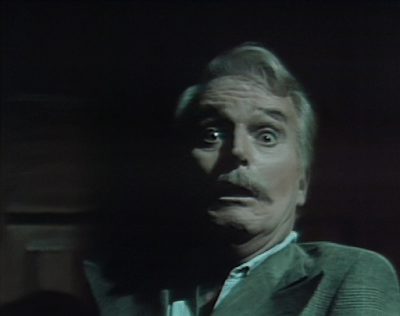
Meanwhile, Paul goes through a lot of business with Barnabas and Carolyn in which he is told to wait an hour, no half an hour, no ten minutes, before leaving the house. He steals the keys from Megan’s purse and sneaks off to the antique shop. He has decided he must figure out what exactly is going on there. He lets himself into the room where the Leviathan force is kept when it is not embodied as a child. He hears a heavy breathing. The camera zooms in on his shocked face. With that, the episode closes. Paul’s future would appear to be extremely brief. On the day of Michael’s phony funeral, he seems likely to bring the show’s first fake death firmly into the realm of the actual.

Paul gets more than he bargained for. Screenshot by Dark Shadows Before I Die.

Today marks Michael Maitland’s last appearance as Michael. He did a lot of acting as a child, including major roles on Broadway both before and after his run on Dark Shadows. Playing Michael didn’t give him much chance to show what he could do. His resume suggests that is a shame- he must have had a lot to offer to get all those big parts. And by all accounts, he was a very nice guy.

Michael Maitland died of cancer in 2014, at the age of 57. That means that three of the five child actors who appeared on Dark Shadows during the Leviathan segment have died. Denise Nickerson, who played Amy Jennings, was 62 when she died in 2019; Alyssa Mary Ross Eppich, who under the name Lisa Ross played the Leviathan child in the guise of an eight year old version of Carolyn in #909, was 60 when she died in 2020. David Henesy, who played David Collins, and David Jay, who played the Leviathan child as an eight year boy called Alexander, are still going strong. So too is Sharon Smyth Lentz, who played the ghost of nine year old Sarah Collins in 31 episodes in 1967 and the living Sarah in six episodes in 1967 and early 1968.

Episode 813: All things, good or evil, come to the same end

This is the first episode to feature a scene in the restaurant at the Collinsport Inn since #227 in May 1967. The show was in black and white then; apparently the restaurant set cannot be seen in color, since this one, set in the year 1897, survives only in kinescope.

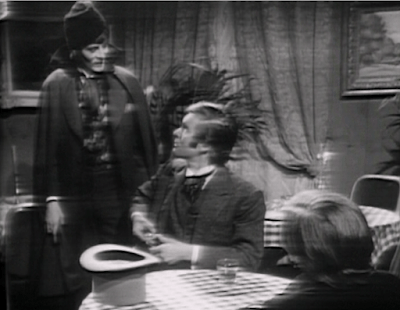
Aristide, Tim, and Jamison/ Petofi in the restaurant at the Collinsport Inn. Screenshot by Dark Shadows Before I Die.

Schoolteacher turned adventurer Tim Shaw is at a table in the restaurant when he is joined by twelve year old Jamison Collins, a former student of his. Unknown to Tim, Jamison’s body is currently a vessel for the spirit of 150 year old sorcerer Count Petofi. Tim is startled to see Jamison, and tells him he had heard he was ill. Jamison asks where he heard this. Tim pauses, then claims that he telephoned Jamison’s home, the great house of Collinwood. He says that Jamison’s nine year old sister Nora answered the phone and told him of his illness. Tim tells Jamison that he is waiting for a young lady, and that after she arrives he would like to be alone with her.

A man enters and talks with Tim. After he goes, Jamison asks who he is. Tim says he has only met him once, and that he knows almost nothing about him beyond the fact that his name is Aristide. We have seen Aristide in the woods with Jamison/ Petofi, and know that he is Petofi’s servant. Jamison/ Petofi told him in that scene that he felt weak and had only a few hours left if he did not recover “The Hand.”

We also saw Aristide in Tim’s room with Amanda, the young lady Tim is waiting to meet. He confronted Amanda, roughed her up, and threatened her with a prop representing a dagger with a curved blade. He wanted Amanda to tell him where “The Hand of Count Petofi” is. Amanda asked if “The Hand of Count Petofi” was a piece of jewelry or something. She had no idea it is literally a severed hand, cut from the wrist of Count Petofi 100 years ago. Aristide questioned her and learned that Tim took a box from the Inn earlier that night and returned without it.

Tim excuses himself, saying that he will go to the front desk to ask if Amanda left a message there explaining why she is so late. Jamison/ Petofi meets Aristide back in the woods. When Aristide tells him that Tim took a box from the Inn and returned without it, he remembers that Tim said he had talked on the telephone with Nora. He deduces that Tim actually talked to Nora in person when he took the box to Collinwood and enlisted Nora’s help hiding it there.

Jamison/ Petofi goes to Nora’s room and wakes her. He tricks her into telling him that Tim was there, but she refuses to tell him where the box is. He twists her arm until she does so. In the parts of Dark Shadows set in the 1960s, David Henesy played strange and troubled boy David Collins, and Denise Nickerson played nine year old Amy Jennings. David and Amy were intermittently possessed by Jamison and Nora in late 1968 and early 1969, and when Amy/ Nora resisted David/ Jamison in #667 and #679, he twisted her arm. When we see the same violent act here, we see a dramatization of a cycle of abuse. We may also wonder if they are going to retcon that “Haunting of Collinwood” segment to include Petofi as a driving force.

Jamison/ Petofi takes the box from Nora’s armoire, opens it, and holds up the Hand. Regular viewers can expect Petofi to return to his own physical form, reattach the Hand to his wrist, and increase his magical powers greatly.

All of the male cast members have trouble with their dialogue today, even the usually line-perfect David Henesy. I wonder if writer Gordon Russell was late finishing the script. Mr Henesy and Michael Stroka manage to give good enough performances that their bobbles don’t really matter, but Don Briscoe is just bad today. When Tim is talking with Nora in the teaser, his intonations are bizarre, and in his later scenes he is flat and lifeless, including a long stretch when he is openly reading off the teleprompter. Perhaps that’s because of his acting style- he worked from the inside out, finding his character’s motivations and developing those first, adding the dialogue last. Give an actor like that less time than he needs, and he might not have anything at all to offer.

One unfair criticism that Briscoe gets from many of the fans who post comments online is that Tim does not have romantic chemistry with any of the women he is paired with. He isn’t supposed to have romantic chemistry with them! At first we see him linked with neurotic intellectual Rachel Drummond. Tim and Rachel were students together at the boarding school run by the sadistic Gregory Trask. When Jamison and Nora are sent to the same school, Tim and Rachel illustrate the horror that lies in store for them. If Tim and Rachel were a hot and exciting couple, they would send the message that kids subjected to Trask’s abuse can grow up to be happy adults, muffing the whole point of the story.

The second woman attached to Tim was Trask’s daughter Charity. Nora points out to Jamison today that Tim and Charity never got along with each other, and regular viewers remember that this is true. Trask forced them to get engaged, a situation that made them both miserable, and then led them both to believe that Tim had murdered Charity’s mother. Again, the whole point of the relationship is to demonstrate how cruel Trask is.

Now Tim is traveling with Amanda. We met Amanda yesterday, and saw that she is impatient with Tim and tolerates him only because he has a lot of money and keeps spending it on her. As possessor of the Hand of Count Petofi, Tim has managed to get rich quick and turn into a tragic version of the character W. C. Fields played in vaudeville routines and stage plays and films set in the Gay Nineties. Amanda is the sort of woman Fields’ characters invariably failed to impress. Again, the last thing you would want would be for Amanda to seem actually to be attracted to Tim.

Though Michael Stroka, in spite of his line bobbles, does a good job as Aristide, there is one moment today when he does make a bad mistake. Aristide makes a big deal out of his dagger, which he initially called “The Dancing Girl.” The prop is obviously just a flat piece of wood, which we might be able to accept if we don’t have to look at it for an extended period. But when he is threatening Amanda today, he holds “The Dancing Girl’s” blade in the palm of his hand, squeezes it, rolls it around, and caresses it. If there were a sharp edge anywhere on it, his hand would be bleeding profusely. They really are not making it easy for us to believe Aristide is going to cut anyone.

Episode 800: Nothing further to lose

When broad ethnic stereotype Magda Rákóczi learned that her sister Jenny had been murdered, she placed a curse on the murderer, Jenny’s husband Quentin Collins. The curse makes Quentin and his male descendants werewolves. In #763, Magda learned that Jenny had given birth to Quentin’s twin children, and ever since she has been trying desperately to lift the curse. It was only this week Quentin found out about the children, after another witch’s curse had already claimed the life of the boy twin. Now he and Magda are debating what risks they should take in their further efforts to save Quentin and any descendants his infant daughter may have.

In #778, Magda returned to her home in the Old House on the estate of Collinwood. She had gone to Boston because she had heard that a Rroma group was in the area and that an old woman who knew how to cure werewolves might be among them. The woman wasn’t there, so Magda did the next best thing. She infiltrated the private quarters of a tribal leader/ organized crime boss known as King Johnny Romana and stole his prized possession. This is a severed hand in a wooden box. It is known as “The Hand of Count Petofi,” after a Hungarian nobleman from whom it was detached over hundred years before, and it has magic powers.

Neither Magda nor anyone she knows has the slightest idea how to control the hand. It has not cured Quentin, briefly disfigured him and his sometime friend Evan Hanley, led to the death of a young woman named Julianka, has been stolen by one person after another, and must soon bring an emissary of King Johnny tasked with Magda’s murder. Moreover, two mysterious and unsavory men known as Aristide and Victor Fenn Gibbon have come to town intent on stealing the hand; at Fenn Gibbon’s bidding, Aristide tortured Quentin and tried to kill him last week, and now he is trying to lure him into a deal.

Magda tells Quentin he is a fool to do business with Aristide and Fenn Gibbon, but Quentin says they have nothing to lose. Aristide implied that Fenn Gibbon can lift the curse; no one else can. They find Fenn Gibbon and Aristide ransacking the Old House. Magda recognizes a design on one of Fenn Gibbon’s buttons. Fenn Gibbon and Quentin struggle, and Fenn Gibbon loses a prosthetic right hand. We have known all along that he was not using his right name, and Magda tells us who he really is. He is Count Petofi himself, still alive more than a century after his mutilation, come to reclaim the hand and all its powers.

Quentin seizes, not the Hand of Count Petofi, but the Hand of Mr Fenn Gibbon. Screenshot by Dark Shadows Before I Die.

Magda and Quentin don’t actually have the hand or know where it is. It has been stolen yet again. This time it is in the possession of Tim Shaw, schoolteacher turned junior executive for the Collins family enterprises. Tim took the hand from the Old House when Magda was out. He takes it to Evan today. Evan is terrified of the hand. Tim threatens him with it. Evan tells Tim what he knows about the hand, and also confesses that he and the evil Gregory Trask brainwashed Tim some time ago and used him to murder Trask’s wife Minerva.

When Evan and Trask decided to use Tim for their evil scheme, he was an innocent. The audience may have known that Tim had the same last name as Raymond Shaw, the main character in The Manchurian Candidate, but nothing else about him suggested he was likely to be of use to sinister figures like Evan and Trask. With his theft of the hand and his interrogation of Evan, we see that Tim has lost his innocence. The stuffy and repressed pedagogue whom we first met was a better fit for Don Briscoe’s heavily interiorized acting style than were the parts he played when the show was set in 1968 and 1969, accursed brothers Tom and Chris Jennings. Briscoe often seemed to be at sea as a vampire or a werewolf, but when he has to show a tortured soul peeking out from inside a three-piece suit he does an expert job. Now that Tim is capable of driving the story, we have a chance to see what Briscoe can do with a starring role crafted for his particular strengths as an actor.

Episode 797: I do not like death at all

Vampire Barnabas Collins, werewolf Quentin Collins, and broad ethnic stereotype Magda Rákóczi hold a séance to contact the spirit of Rroma maiden Julianka. This is the thirteenth séance we have seen on Dark Shadows. It deviates from the previous ones in three important ways. First, no one objects in the middle of it and has to be sternly hushed by the séance-leader. Second, it doesn’t matter that the physical contact among the participants is broken- previously it had been a fatal error if anyone stopped touching the fingers of the people on either side of them, but this time Quentin jumps up and runs out and it’s no problem. Third, Julianka does not choose one of the participants as a medium and speak through them, but manifests as a ghost.

Julianka appears. Screenshot by Dark Shadows Before I Die.

Perhaps because they are rewriting the rules of the Dark Shadows séance, they make a reference to an earlier milestone in the show’s development. The séance is held in the parlor of the Old House on the estate of Collinwood. That isn’t unusual; séances have been held there on three previous occasions, including the second and in some ways most dramatic one, held in #186. What makes the location noteworthy is Julianka’s movement when she first appears. She comes in as a green screen effect hovering somewhat above floor level, then takes several steps down an unseen staircase.

We have seen that same movement on this same set. It was in #70, when the ghost of the gracious Josette was the first supernatural being to become visible to viewers of Dark Shadows. Aside from the reuse of that footage, we have not seen a ghost move that way since. Compared with the changes that began when Josette walked down from her portrait in #70 and brought the supernatural back-world that had been implicit in the show from its first week into the foreground, these changes to the rules for séances are small potatoes.

Barnabas and Magda hoped to persuade Julianka to give them some information they needed to lift the curse from Quentin and cure his lycanthropy, but she isn’t interested. She blames them for her death, and will not even let them ask questions, let alone answer them. They try to protest that they weren’t the ones who killed her, but she ignores them. So far from helping them end Quentin’s curse, she places a new curse, this one on Magda. She decrees that everyone who loves Magda will die. That was the same curse wicked witch Angelique pronounced on Barnabas in #405 when she made him a vampire. Longtime viewers will be unsure how Julianka’s curse will operate- Magda doesn’t seem likely to become a vampire, but perhaps they are suggesting she will turn into a monster of some other kind.

Unfortunately, Julianka’s appearance today is the last time we will see Diana Davila. In her approach to the role, Miss Davila concentrated very much on her eyes. She kept them open wider than I would have imagined a person could open her eyes, did not blink, and when she looked from side to side she did not turn her eyes in their sockets, but instead turned her head. This dictated a rigidity of movement for the rest of her body and a narrow range of inflection for her voice. Taken as a unit, these mannerisms made for a perfectly logical way of expressing Julianka as a strange, unreachable person, an emissary not only of the tribe of King Johnny Romana, but of another world altogether. In practice, this style had a drawback given the conditions under which actors had to work on Dark Shadows. In the three episodes where Julianka was a living being, Miss Davila did not have quite enough time to learn her lines. She did better than did most cast members, but the particular illusion she was trying to create could be shattered by the slightest bobble. This time, though, she is letter-perfect, and as a result the scene with Julianka’s ghost is one of the most effective in the series.

Episode 756: A bizarre activity for a beautiful woman

Undead blonde fire witch Laura Murdoch Collins realizes that Barnabas Collins is a vampire, and that when he was alive he was the “strange, dreamy boy with sad eyes” she was fond of in the 1760s, when she was married to his uncle. Laura and Barnabas confront each other in a graveyard at the beginning of the episode; she tells him he is not human. He passes up the opportunity to reply “So few people are, these days.” At the end of the episode, Laura and her witless henchman Dirk let themselves into Barnabas’ house after dawn. She has a mallet and stake, he has a pistol to ensure no one interferes.

It means something to longtime viewers that we end today with Laura poised to destroy Barnabas. It was Laura who cleared the way for Barnabas’ first introduction. She was the show’s first supernatural menace when she was on from December 1966 to March 1967, and her story was structured very much like Bram Stoker’s Dracula. That was successful enough that the following month they introduced Barnabas as Dracula Mark II. That Laura knew Barnabas in the 1760s when she was already what she is and he was still a boy also nods to this history.

Laura went up in smoke in March 1967, when the show took place in a contemporary setting, and reappeared in April 1969, when it was a costume drama set in 1897. In the interval, Dark Shadows changed from a slow-paced, moody Gothic drama meant for an audience largely consisting of people who were fans of Joan Bennett’s in the 1930’s to a slam-bang supernatural thriller with a huge following among preteens. In her first tour as Laura, Diana Millay could focus on her strengths in dry comedy and subtle psychological drama. This time around, she recognizes the new demographic and plays Laura like a villain on Batman. At times it seems odd that Dirk isn’t wearing a jumpsuit with his name stenciled on it.

Perhaps when she hits the stake with the mallet, the word “Whack!” will be printed in a bubble on the screen. Screenshot by Dark Shadows Before I Die.

Meanwhile, Barnabas materializes inside a classroom at a school where Laura’s nine-year old daughter Nora is alone. Nora tells Barnabas that she is not happy at the school and that she and her twelve year old brother Jamison want to leave with their mother. Barnabas tells her to “Look into my eyes!” and he puts the zap on her. When he is done, he tells her that their conversation will be their secret. She smiles, looks directly into the camera, and tells the audience “I like secrets!” Denise Nickerson had a talent for delivering lines to the camera, and ever since she joined the show in November 1968 they’ve had her do that quite often. Rather too often, I’m sorry to say- it can chill the audience to see a character who is so disconnected from everyone else that they just start talking to us if the effect is used sparingly, but they have her do it so frequently that it has lost its force by now.

Nora and Jamison’s school is a miserable place, less a center of learning than a dungeon where the sadistic Rev’d Gregory Trask gleefully inflicts unwarranted and cruel punishments on both children and teachers. Trask’s daughter Charity is a member of the faculty, and since #727 she has also been Barnabas’ blood thrall. In #753, we saw Charity acting as her father’s second in command at the school, enforcing a particularly vicious sanction against Jamison. It did not then seem that her subjection to Barnabas had modified her role in her father’s operation at all.

When Charity enters and finds Barnabas with Nora, her two enslavements come into conflict. Barnabas tells her that Laura will be coming to the school to see Nora soon, and orders her to let her in. Charity is very confused and starts talking about her father and his rules. Barnabas bites her, leaving her more tranquil but quite weak.

Laura knocks on the door. Charity finds that Barnabas has vanished, and lets her in. She demands to see Nora, saying that she will take her away. Charity says that no relatives are allowed to visit the children at night, and that she will need permission from others to allow Laura to take Nora. Laura insists, and eventually Charity complies. She sends Nora down, and brings her packed suitcase. But Nora has told her mother that she does not want to go. We saw in 1967 that Laura’s children must go with her willingly if she is to perform her evil mission, and so she has to yield. She looks at the collar Charity has drawn up to cover her neck, and says that she will not tell her father that two of Nora’s relatives have visited her tonight.

Some of the actors have trouble with the names “Laura” and “Nora” today. It really was a mistake to give Nickerson’s character a name that rhymes with “Laura.” In #354, set in 1967, matriarch Elizabeth Collins Stoddard told her daughter Carolyn that “Aunt Catherine” would be overjoyed to host her in her home in Boston, and that this never-before mentioned aunt gives wonderful parties attended by men Carolyn’s own age. Catherine cannot have been Elizabeth’s sister or a member of Carolyn’s father’s family; she must be Elizabeth’s own aunt. Nora is the only one of Elizabeth’s aunts we ever hear about, and she would have been 79 in 1967. As a grande dame of Boston society, she might still have been giving big parties featuring people of all ages, and so naming the character “Catherine” would have closed that loop.

It would also have opened the door for another story to add some action to the rather slow period leading up to the 1897 flashback. Aunt Catherine could have come to Collinwood from Boston in 1969 and met the evil ghost of the roguish Quentin Collins. Recognizing her favorite uncle but knowing that he came to a dark and mysterious end, that would have set up a confrontation that might have led to an enigmatic conclusion. Quentin killed other adults who knew about him, but his relationship with Catherine would have made it maladroit to bring their encounter to so straightforward a climax. Better to have her disappear inexplicably. That disappearance would be followed by signs that the disturbances in the house had suddenly grown far more dangerous. We would wonder if Catherine had joined with Quentin as another evil spirit, or if the two of them were doing battle in some unseen realm and inflicting collateral damage in the world of the living.

I have an idea who they should have cast as Aunt Catherine. Isabella Hoopes played dying matriarch Edith Collins at the beginning of the 1897 segment, and she was great fun. Had we been introduced to Hoopes as the spry and sophisticated Aunt Catherine, her turn as Edith would have been even richer. When Quentin chokes and threatens to kill Edith, we would try to read their interaction as a clue to what happened between him and Catherine before her disappearance. When Edith haunts Quentin after her death, we would look for clues as to what happened to Catherine after her disappearance. And of course Nickerson’s role as Catherine’s younger self would have gained another dimension, not only as we watch her interactions with Quentin, but also as we compare her personality at the age of nine to that of the octogenarian we had met previously.

I even have some dialogue Catherine could have exchanged with the Collinses of 1969:

Catherine: Roger, I hear you have married again. Will you present me to your wife this time? I must admit I took it rather personally that I could never meet Laura.

Roger: I’m sorry, Aunt Catherine. Cassandra and I have already gone our separate ways.

Catherine: Oh, I’m the one who should be sorry- it was tactless of me not to know… We Collinses have never have had much luck in marriage, have we?

Elizabeth: You and Uncle Ambrose were happy.

Catherine: Yes. Happy… But there wasn’t much luck to that. After all, he was my fourth husband and I was his third wife. We simply applied the lessons of experience.

Carolyn: So there is hope. After your disappointments, you found your grand passion.

Catherine (a look of frank disbelief on her face): Not exactly. (Pause.) Carolyn, your mother told me some time ago you were the one involved in a grand passion. His name is- what- Bud?

Carolyn: Buzz?

Catherine: Yes, Buzz. I should have remembered that, I once knew a Navy flyer who went by that name. If your Uncle Roger won’t be introducing me to anyone, will you at least present me to Buzz?

Carolyn: Oh, it ended between me and Buzz some time back. He’s left town.

Catherine: Ah, too bad. I’d have liked to meet another Buzz, the one I knew was so elegant.

Elizabeth: This one was hardly elegant. He rode a motorcycle, and that was his whole life. He always wore leather clothing and dark glasses, with a long beard and a ragged mop of hair. You never saw the like, Aunt Catherine.

Catherine: On the contrary, I have seen the like every often. Just such men make up your cousin William’s preferred milieu.

Carolyn (laughing): I once told mother I was going to marry Buzz, but that was an empty threat. Buzz isn’t the sort of man who really wants a wife.

Catherine: Neither is William.

(Elizabeth, Roger, and Carolyn fall silent. After a moment, they all start talking at once.)

Elizabeth: Have you seen-

Roger: How is old Mr-

Carolyn: Was your trip-

(They fall silent again. Another awkward pause ensues.)

Elizabeth: Do you know that there is another Collins at Collinwood?

Catherine: Oh?

Elizabeth: Yes, a distant cousin of ours, from England. His name is Barnabas Collins.

Catherine (furrows her brow): Barnabas Collins? Named for the man in the foyer?

Elizabeth: Yes, the portrait is of his ancestor.

Catherine: How odd. When I was a girl, I asked the old people around here about all of the portraits. They were happy to go on at length about all the others, but they were always tongue-tied when we got to that one. Left me with the impression there was something exceptionally sinister about it, or about the man. Of course that only piqued my curiosity.

Carolyn (suddenly defensive): There is certainly nothing sinister about our Barnabas!

Catherine: Nothing sinister? Are you sure he is a Collins?

(Roger and Elizabeth chuckle, Carolyn flushes.)

Elizabeth: Oh, he is a Collins, all right. He’s quite an expert on the family’s past. I’m sure the two of you would have a great deal to talk about.

Catherine: I’m sure. But I would rather choose another topic. At my age I can’t forget that I will soon be part of the past. I would like to keep my eyes on the future while I still have one.

This scene would have left longtime viewers with some suspense-generating questions. Why did Roger’s wife Laura go out of her way to avoid Catherine? Who were the “old people” at Collinwood in Catherine’s childhood? What did they know about Barnabas? Further, Laura and Buzz were so emblematic of two of the early phases of Dark Shadows that involving Catherine in a conversation referring to both of them would promise that she will be woven in with the whole narrative structure of the show.

Moreover, seeing a Collins who had spent decades far from Collinwood might give us a fresh perspective on the main characters. We see only those whose minds and hearts have been deformed by the many curses that loom over the estate. Meeting one who has been outside their influence for so long would suggest what it has cost the others to stay on the estate. We might then feel anew the tragedy that we have been taking for granted.

Episode 737: The suffering of some people

Laura Collins is the estranged wife of stuffy Edward and the mortal enemy of Edward’s brother, libertine Quentin. Only Quentin knows that Laura is an undead fire witch. He has found the Egyptian urn housing the magic flame that gives life to Laura, and has extinguished the flame.

In the great house of Collinwood, Quentin and Edward’s spinster sister Judith notices that Laura has taken ill. Judith goes off to order a servant to prepare a hot cup of tea for Laura, and is alarmed when she returns to the drawing room and finds that Laura has gone. Quentin enters, and Judith asks him if he saw Laura. Judith explains that Laura is ill, and is appalled at Quentin’s indifference.

Laura has gone to the gazebo on the grounds, where she hid her urn under an armillary sphere. She finds that the urn is gone. Surly groundskeeper Dirk Wilkins chances upon her; she clutches at him. He is shocked at how cold she is, and is afraid of how the scene would be interpreted if anyone saw them in each others’ arms.

Dirk takes Laura back to the great house. Quentin insists on walking her upstairs to her bedroom. While she lies in bed, he taunts her with her doom, reminding her that she had treated him the same way a few nights ago when she thought he was dying. Quentin’s behavior is really abominable in this scene, but as David Selby plays him he keeps the audience’s affection. He visibly thinks about each line before he says it, so that we can really believe he is finding his way through what is after all a bizarre situation and is deciding what to say to Laura. He is relaxed and easy in his physical movement, and modulates his delivery subtly in response to every cue.

After Quentin leaves, Laura prays to the gods of ancient Egypt to take possession of Dirk and send him to her room. They oblige; Dirk finds himself standing by the fire in the drawing room and speaking a few words of old Egyptian, then heads upstairs.

Dirk and Laura take hold of each other while she is in bed. There are a few moments of dissonance when Diana Millay has to reposition herself to get Roger Davis’ hands onto more broadcast standards-friendly parts of her body while Laura insists Dirk hold her ever closer and he protests he must not, but it isn’t as bad as we might expect considering Mr Davis’ usual practice of assaulting his female scene partners. They speak each line more rapidly and more breathily than the one before. Mr Davis has both feet on the floor, but the result is still the most sex-like encounter we have seen so far on Dark Shadows.

Dirk takes hold of Laura while she is in bed. Screenshot by Dark Shadows Before I Die.

Mr Davis’ performance is the opposite of Mr Selby’s. He is as stiff as Mr Selby is relaxed, holding himself rigidly still even when he is grappling with Diana Millay in bed. He tends to take a deep breath and deliver each speech as a single exhalation, making it impossible for him to show thought or adjust his approach while speaking. So even though today’s action shows us Quentin at his most despicable and Dirk at his most innocent, our loyalties are firmly with Quentin.

Joan Bennett famously said that Mr Davis was show business’ answer to the question “What would Henry Fonda have been like if he had had no talent?” Not only does his face resemble Fonda’s, but by his own admission he often mimicked Fonda while acting. There is nothing wrong with mimicry- John Gielgud was as good an actor as any, and he used to say that from the time he first saw Claude Rains in a play, his acting style consisted of imitating Claude Rains. He also said that imitating Rains was a great improvement over his previous style, which was imitating Noel Coward. Mr Davis’ readings of his one-line speeches today are distinctly Fonda-like, and the longer speeches may also have been if he had been breathing normally while delivering them. Today Mr Selby also sounds very much like the actor he tends to mimic, Joseph Cotten. I suspect Cotten would have been more flattered than Fonda had the two of them watched this episode!

Episode 717: I know what color a lie is

A showcase for the actors today. We begin in the room on top of the tower at the great house on the estate of Collinwood. Madwoman Jenny Collins, who has been locked up in that room for some time, is threatening to stab her sister-in-law Judith with a large pair of scissors. Judith and her brother Edward have been hiding Jenny and trying to keep the rest of the family in the dark about her presence in the house. For services to this secret, they have been paying maidservant Beth Chavez and, we heard in #707, someone named Mrs Fillmore. Beth comes in just in time to distract Jenny with talk about her “babies,” and thereby to prevent her from killing Judith. Jenny turns to some baby dolls, and cuddles them happily.

Judith goes downstairs and encounters newly hired governess Rachel Drummond. Rachel has caught on the someone is living in the tower room, and the other day sneaked up there and let Jenny out. Judith reprimands Rachel for seeing and hearing things that don’t exist. Rachel is a neurotic intellectual. Her insecurities compelled her to investigate the question of the tower room, and also make it plausible that she might eventually cave in to Judith’s attempt to gaslight her into believing that she didn’t really see what she saw.

Rachel goes out, and Beth enters. Judith shows how frustrated she is with the whole situation. This scene is a bit of a letdown. As Judith, Joan Bennett was brilliant opposite Marie Wallace’s Jenny, and brilliant again opposite Kathryn Leigh Scott’s Rachel. But she falls to pieces alone with Terrayne Crawford as Beth. So many of the fansites feature so much grousing about Miss Crawford’s literalist style of acting that I hate to pile on, but it is true that she did not give Bennett anything to play off of. When Miss Crawford delivers a line, its meaning is the dictionary meaning of the words that compose it, no more and no less. She never leaves you wondering what else is going on in Beth’s mind. Sharing a scene with her would be like sharing a scene with a sign labeled “No Right on Red.” Later, Miss Wallace will have a two-scene with Miss Crawford, but as a character in a psychotic state she doesn’t need support. Her lines in that scene are flowery gibberish that don’t work at all, but neither actress is to blame for that.

The master class in acting resumes as we cut to the Old House on the estate. The mysterious Barnabas Collins has recently arrived at Collinwood and is staying in the Old House as the guest of his distant cousins in the great house. Rachel and Barnabas are attracted to each other, and she tells him what has happened. He says that he believes her, and goes on to say that no one at Collinwood is what they seem. She pleasantly replies “Except for you!” He hesitates before agreeing.

More than meets the eye.

In fact, Barnabas has more than five hundred episodes of secrets he is keeping from Rachel and everyone else. Jonathan Frid’s work prior to Dark Shadows was almost entirely on stage, but he used his face like a movie actor, keeping every part of it but his eyes virtually immobile. With that, he can isolate emotions, playing just one feeling at a time. All anyone can see by looking at him in his scenes with Rachel today is that he is anguished. Rachel interprets that anguish as a sign that he cares about her, and she is delighted to think that she has such a straightforward and reliable friend.

Returning viewers know that Barnabas is in fact the most dangerous person Rachel has ever met. That knowledge on our part frees Miss Scott to play Rachel’s relief at Barnabas’ friendliness as broadly as she likes. Her unrestrained display of good cheer brightens the episode’s otherwise somber emotional palette, but the irony the audience finds in a woman having this reaction to Barnabas keeps the dramatic tension high.

Barnabas walks Rachel back to the great house. They have made a plan that she will bring him the key to the tower room and he will go up there to investigate. She impulsively kisses him on the cheek. Rachel goes in the house and finds to her surprise that Judith is still awake. Judith detains Rachel in the drawing room with a glass of sherry and a lot of disconnected talk. Judith doesn’t make eye contact with Rachel during this scene; she doesn’t want a conversation. She is simply enjoying her new position as head of the household. Rachel cannot get away until Beth enters and Judith abruptly dismisses her.

Barnabas has been watching the windows of the tower room and has seen lights go on and off. Nervous, he considers letting himself into the room without a key; he has the means to do that, but he would like to keep Rachel from knowing about his abilities, and so he resolves to wait for her.

After Rachel brings Barnabas the key, he goes to the tower room and uses it to let himself in. No one is there. He picks up the damaged, severed head of a doll, one of Jenny’s “babies.” Suddenly, he hears someone enter. He turns, and reacts with shock.

Episode 713: The heart of the room

Vampire Barnabas Collins returns to his coffin at dawn to find it already occupied. Governess Rachel Drummond is resting there, and is under the impression that she is Barnabas’ lost love Josette. He exclaims that only his old enemy, wicked witch Angelique, could be “monstrous enough” to put Rachel in this position.

Longtime viewers remember that in #248 Barnabas forced Maggie Evans, who like Rachel is played by Kathryn Leigh Scott, into this coffin because she refused to submit to his attempt to brainwash her into thinking she was Josette. So we know that Angelique is not all alone in the ranks of the sufficiently monstrous. On the other hand, we also know that it was Angelique who made Barnabas a vampire in the first place, and that like others who labor under Angelique’s curses he is in many ways a reflection of her. So perhaps his remark is not so preposterous an example of lack of self-awareness as it initially seems.

Shortly after, Rachel comes to in the front parlor of Barnabas’ home, the Old House on the estate of Collinwood, and is puzzled to find herself there with him. She has no idea how she got to the Old House, and certainly has no memory of the coffin in its basement. Barnabas tells Rachel he found her wandering in the woods. She goes to pieces, overwhelmed that she is not in control of her actions. He talks soothingly to her. Rachel collects herself, but is still struggling not to let Barnabas see her cry. He offers to walk her home to the great house on the estate. This offer is sheer bravado on his part- the sun has been up for some time, and he cannot possibly expect to survive outdoors all the way to the great house. Luckily for Barnabas, Rachel declines his offer. Unable to keep her emotions in check any longer, she hurries out the front door, walking herself home.

At the great house, Rachel sees maidservant Beth enter the foyer carrying a baby doll. Rachel says that her charge Nora will like the doll very much. Beth sputters at this remark, and spinster Judith Collins summons Beth to the drawing room. Rachel eavesdrops while Judith scolds Beth for her carelessness. Returning viewers know that Beth is helping Judith and Judith’s brother Edward keep someone prisoner in the room atop the tower of the great house, and that it is hugely important to Judith and Edward that no one knows about this. Beth’s sputtering response to Rachel told us also that the doll is not for Nora, but for this mysterious prisoner. Rachel does not have all the information about the matter that we do, but she has enough to suspect something very much like the truth, so we wonder what she gets out of the conversation she overhears.

Later, Rachel meets Beth in the foyer and urgently pleads with her for information about Edward’s wife, the mother of Nora and of her other charge, Jamison. Beth tells her what Edward has already made abundantly clear, that the topic is utterly forbidden. Rachel sidles up to Beth, bends her head at an angle, and speaks in an urgent whisper, something we have not seen from either Maggie or Miss Scott’s other role, Josette. Indeed, Rachel is quite a fresh character, impressively so from an actress whom longtime viewers already seen for so many hours.

Rachel pleads with Beth for more information.

Judith overhears Rachel’s questioning of Beth and Beth’s response that Rachel should leave the matter alone. Judith dismisses Beth and talks to Rachel, telling her that Beth has given her very good advice. Judith has figured so far as a stern and menacing figure; it is something of a surprise that she does not fire Rachel on the spot, and even more of a surprise that she indicates she will not report the conversation to Edward.

The opening voiceover will tell us in a couple of days that Rachel’s reckless curiosity is “spurred on by her own fears.” Miss Scott has been playing this motivation all along. When we first saw Rachel, she and Edward were in a train station. He was being courteous to her, but she was stiff and awkward, clearly very much afraid of something. She is often seen reading, and her dialogue is both filled with signs of intellectual ambition and delivered with a frantic edge, suggesting that her studiousness has its roots in her attempt to defend herself against some danger. We have no idea as yet what that danger was or how it formed Rachel before we met her, but we know that her reaction to the evidence that she has found that someone is being held prisoner in the tower room at Collinwood is a deepening of her long-established fears, not the sudden appearance of new fear.

For her part, Judith’s main concern is finding her late grandmother’s missing will. The late Mrs Collins kept the provisions of her will secret, and it was stolen shortly after her death by some people who wanted to forge a new will and get the estate for themselves.

A woman named Magda Rákóczi shows up at the house, claiming to be able to help Judith find the will. Judith is violently prejudiced against Magda for her Romani ethnicity, and dismisses her offer of help out of hand. But Magda persists. Knowing that her grandmother had a fondness for Magda, Judith lets her into the drawing room and sits behind her while she reads the tarot. Judith keeps protesting that the previous cases Magda cites as evidence that the tarot can tell the future prove nothing, and that in her interpretations of them she is “making no sense whatsoever.”

Magda then says that the arrangement of the cards means that the will is hidden in the room where Judith’s grandmother died, in “the heart of the room.” In an entirely different voice than she has been using so far, Judith asks “What is meant by the heart of the room?” With that, Magda knows that she has Judith in the palm of her hand, and she starts to ham it up. “The hearrrt of the roooom… is a booook! A book that was very important to your grandmother! A very, very oooolld booook!” Judith decides this must be the family history, and she tells Magda that she will look through it at once.

Magda goes over the top. Screenshot by Dark Shadows Before I Die.

In fact, Barnabas found the will and hid it in the family history. He has sent Magda to tell Judith where to find it. It comes as no surprise to us when Judith comes downstairs with the will and is jubilant to find that she is the sole heir of her grandmother’s vast holdings. After all, Barnabas wants the original provisions of the will to be enacted, and the only way to ensure that result is to see that it comes to the hand of the person who is its chief beneficiary.

We end with Beth standing at the door to the tower room, holding the doll and addressing the person inside as “Jenny.” We learned in #701 that Beth was originally maid to a lady named Jenny, that everyone thinks Jenny has gone away, and that it is surprising Beth has stayed on at the house in Jenny’s absence. Now it is confirmed that Jenny is the prisoner in the tower room. The obvious inference is that Jenny is Edward’s estranged wife, and that she has become the sort of crazy lady who appreciates baby dolls.

Episode 647: Her own sensitivities

This is first of three consecutive episodes featuring Cavada Humphrey as Madame Janet Findley, a medium recruited to investigate the strange goings-on at the great house of Collinwood. Humphrey’s performance dominates these segments completely. Her style is more akin to pantomime than to anything native to spoken drama; she uses every muscle of her body to strike a series of exaggerated poses. Since that includes the muscles of the vocal tract, words occasionally come out in the course of her performance. The result is as bizarre as it sounds like it would be, and on Dark Shadows it is magnificent.

Granted, it is a shock when Humphrey reads the opening voiceover. Without seeing her, it is difficult to know what to make of her speech. When we watched it this time, I tried to make Mrs Acilius laugh by mimicking the poses a person might strike while speaking that way. So far from making the monologue sound silly, that just made it clear to us what Humphrey was doing, and left us both taking her performance seriously.

I’ll make a couple of random remarks about the non-Cavada Humphrey parts of the episode. Under the influence of the ghost of Quentin Collins, children David Collins and Amy Jennings have tried to murder David’s father Roger. Yesterday David took the lead in setting the trap that caused Roger to fall down the stairs while Amy showed reluctance in helping him. Today, the children see that Roger is not seriously hurt. David is relieved and wants to stop doing Quentin’s bidding, while Amy insists that they continue. Denise Nickerson delivers one of Amy’s monologues with her eyes fixed on the camera; the effect is unsettling in the extreme, suggesting as it does that Amy and David have taken leave of the other characters and are now in a dramatic space of their own where they may as well communicate directly with the audience.

Amy tells David and us that Quentin must be obeyed.

On his great blog Dark Shadows Every Day, Danny Horn derides David and Amy’s exchange of roles in their conspiracy. He says that the reason they take turns being “Executive Child” is merely sloppiness on the part of the writing staff:

You can handwave and say that seeing his injured father shocked young David out of his temporary hypno trance, but really the explanation is that Gordon Russell wrote yesterday’s episode and Sam Hall wrote today’s, and they didn’t really bother to synch up on David’s emotional throughline. It happens. This is the “good enough for rock ‘n roll” approach to soap opera dramaturgy.

Danny Horn, “Episode 647: The Wire,” posted 12 May 2015 on Dark Shadows Every Day.

I disagree. There’s nothing hand-wavey about an appeal to David’s motivation. However little attention Hall paid to yesterday’s episode, David’s visit to his father, during which he all but begs for a way to help him in his recovery, leaves no doubt that he meant for us to think that David was relieved that he failed to kill his father and that, having seen where Quentin’s spell would lead, he wanted to break free of it.

And the actual effect of seeing the children waver back and forth in the intensity of their subjection to Quentin, alternating between attempts to break free and turns as “Executive Child” enforcing Quentin’s will on the other, is to show us that we are early in the process of obsession and to create suspense as to whether it will progress all the way to possession. So far, Quentin can dominate only one of the children at a time, while he just tugs at the other. In Madame Findley’s intervention, and for that matter in David’s scene with Roger, we can see paths still open that would lead to breaking his power altogether before he grows strong enough to fully control Amy and David simultaneously.

There is a similarity between David and Amy’s relationship to Quentin at this point and Amy’s brother’s relationship to his curse. Chris has been a drifter for a few years, suggesting that he has been a werewolf for that long, but he is still looking for ways to keep himself from hurting anyone when the Moon is full. The supernatural menaces the show has presented up to this point were introduced as already fully committed to the destruction it was ordained they would cause. David’s mother, undead fire witch Laura Murdoch Collins, was an collection of several entities, some of them more purposeful than others, when she joined the show in December 1966, but it was always her fate to lure David to a fiery death. Vampire Barnabas Collins would eventually become a nuanced character and has now been freed of his curse and become human again, but when he first showed up in April 1967 he was all-in on being a creature of the night. Wicked witch Angelique started her murderous rampage shortly after her arrival in November 1967, and all of the various villains of the Monster Mash period that ran from mid-April to early December 1968 showed up loaded and ready to do their thing. But Chris’ curse has only drawn him halfway into monsterdom, as Quentin’s obsession has only drawn Amy and David halfway into his world of evil.

One inconsistency that may be most profitably explained by carelessness comes when Amy tells David that Quentin calls him by the name “Jamison.” Jamison was the name of David’s grandfather, who was Quentin’s nephew. Earlier, David had, under Quentin’s influence, told Amy to call him “Quentin.” It might have been better if they had decided in advance just who it was whose personality was supposed to overwrite David’s, though I don’t think it is a major flaw.