
Six months ago, in the spring of 1840, Samantha Drew Collins learned that her husband Quentin Collins and their young son Tad had been swept off the deck of a ship during a storm at sea. The bearer of this distressing news, Quentin’s friend Gerard Stiles, reported that he tried to rescue Quentin and Tad, but could not. He could only surmise that they had died. A week and a half ago, Samantha married Gerard, only for Quentin to show up that very night, alive and well and reporting that Tad would be along soon. Quentin said that Samantha would have to choose which husband to keep, and that he would abide by her decision.
Today, Samantha chooses Gerard. This is devastating to him, since he was marrying Samantha for her money and now that Quentin is back she won’t have any. But he has to keep pretending he loves her, since admitting the truth would destroy his reputation and burn whatever bridges he still has with people on and around the estate of Collinwood. Quentin has made it clear he does not love Samantha and is sincere when he says he is willing to let her go. He also still regards Gerard as a friend, and is so rich and powerful that even a much better man than Gerard would think long and hard before forfeiting his friendship.
Samantha meets Quentin in their bedroom and tells him of her choice. She brings up his past infidelity and says that she was grateful to him for his candor about it, even though she refused to agree to a divorce when he asked for one a few years ago. He says he will talk to the lawyers about making everything official. He says there doesn’t seem to be anything more to say. She agrees with that. She says she will just take Tad and go.
At this, Quentin’s mood switches abruptly from vague glumness to white-hot rage. Most viewers will have expected that. The oh-so-mature, oh-so-civilized conversation between a divorcing couple has long been a standard scene in domestic melodramas, and it usually is a setup for a sudden explosion of crude and childish anger. Quentin tells Samantha that Tad must stay at Collinwood because he is his son. Samantha replies that Tad is not Quentin’s son. Quentin becomes even angrier, seizing Samantha by the arm, swinging her around to face him, and demanding to know who the other man is. Samantha refuses to give a name, but insists that Tad “is not a Collins!” Quentin vows that Samantha will never see Tad again, and says that he will kill her if she ever tells Tad that he is not his father.
My wife, Mrs Acilius, marveled at the weirdness of Samantha’s thinking in this scene, and I’ve noticed much of the commentary about the episode online focuses on it as a moment when the audience permanently loses interest in Samantha. For example, in a 2021 comment on Danny Horn’s post about this episode on his great Dark Shadows Every Day, “Goddess of Transitory” wrote:
And every time they try to give [Samantha] a new layer or motivation it’s both enraging and silly. Like when she honestly thinks Quentin, in 1840, is going to allow her to take Tad, his only son whom he nursed through shipwreck, Brazilian wretchedness and Boston off with her and Gerard, not a penny between them and head full of delusions? She has absolutely not been played as that kind of “totally unaware of social mores” character up until this point. She would be a divorced woman who ran off with her lover. No court or husband in the land is going to go sure, take Tad!
But let’s say, for whatever reason, she did think so. Quentin’s allowing her to choose for herself has made her think he’s on the same page about their stale, passionless marriage [and honestly, if you can go passionless around Quentin? you have a lot of problems, straight up] and will be glad to see the back of her, so this actually comes as a shock. What does she do?
She yells “TAD’S NOT YOUR SON!” in his face! In what universe, no matter how cracked across and mad, would she think that would get Quentin to go well, in that case, happy trails? Who on this planet is so unaware of all human behavior and motivation that they think telling someone the boy he has raised from infancy isn’t his is going to make him more receptive to her suit?
It really doesn’t matter if it’s true or not. The mere choice to do that renders Samantha totally unbelievable, and therefore unsympathetic.
Comment left 8 September 2021 by “Goddess of Transitory” on “Episode 1128: As Rome Burns,” Danny Horn, Dark Shadows Every Day, 25 February 2018.
The scene is interesting in the context of the show’s overall development. When Dark Shadows debuted in June 1966, its slow pace, vague stories, and reliance on the star power of Joan Bennett made it most appealing to an older audience. When it became a supernatural thriller with action moving at a breakneck speed, it picked up an audience of very young people.
Aside from occasional experiments with more adult themes, most notably at the beginning of the “Leviathan” segment late in 1969, Dark Shadows has been very much a kids’ show for years now. It is stripped across the week during the daytime, but often has only formal similarities to soap operas aimed at housewives and retirees. The triangle between Quentin, Samantha, and Gerard is a step back in the direction of that genre and an older audience. Not only is the triangle itself the typical soap opera situation, but in this one neither man actually wants the woman and it is only through a visible effort of self-deception that she has managed to convince herself that one of them does. Not many elementary school students are likely to be curious as to how people could get themselves into that position or what would come of it.
As “Goddess of Transitory” points out , it makes no difference to Samantha’s goals whether her claim that Tad is not Quentin’s son is true. Simply by saying it she has set back her cause enormously. It would be in her interest to persuade Quentin to listen to her sympathetically, and making this claim ensures that he will never do that again. It would be in her interest to gain the sympathy of the legal authorities and of the general public, and if she says that she had sex with some other man early in her marriage she will forfeit any share she might have of that. In our universe, the penalty for adultery in Maine in 1840 was a fine of up to $1000 and a term of imprisonment up to five years. While the laws in the world where Dark Shadows takes place may not have been the same, the mores and customs there seem to be similar enough that a woman would not do herself any favors by telling the story Samantha has presented to Quentin.
For the purposes of the drama, though, the plausibility of the story does matter. If we believe that Samantha is telling the truth, we expect this other man to show up and become part of the story. If we believe she is not, then she is acting just from an impulse to hurt Quentin, heedless of the fact that she will hurt herself much more substantially. As Quentin’s threats sound like things a small child might say while throwing a tantrum, so Samantha’s denial of Quentin’s paternity suggests the desperation of an equally young child in the same situation.
The last time the show dealt with a paternity question was in 1966 and 1967, when it took place in a contemporary setting. High-born ne’er-do-well Roger Collins suspected that his enemy, Burke Devlin, was the biological father of David, the young son his estranged wife Laura bore early in their marriage. Roger hated both Burke and David enough that he almost hoped this was true, and Burke and David both openly hoped it was true. Laura came back to Collinsport late in 1966, and Burke kept trying to get her to say that David was his son. Laura wasn’t interested in David’s paternity, or in the conflict between Roger and Burke. She was an undead fire witch whose plans had nothing to do with romantic entanglements or family quarrels or business rivalries. By the time she went up in smoke, Laura’s storyline had gathered up all of the open narrative threads and carried Dark Shadows out of the category of conventional soap forever.
Since the show started traveling back in time, we have seen that some of the doubling of roles is supposed to indicate that the characters look like each other. During parts of the show set in 1995 and 1970, Tad’s ghost was mistaken for David, so regular viewers know that they look very much alike. And David is descended, not from Tad, but from a Collins cousin of his. Moreover, David Henesy played not only Tad and David, but also the twelve year old Daniel Collins during the segment set in the 1790s. Daniel is 57 years old now, the father of Quentin, and he is played by Louis Edmonds, who played Roger. So longtime viewers know that Samantha is lying when she says that Tad “is not a Collins.” If Quentin is not Tad’s biological father, a close relative of his must be.
When Samantha realizes Quentin will not consent to her leaving with Tad, she calls on a servant named Hortense. When we see Hortense, she is wearing a plain black dress with a lace decoration below the neck and carrying a tray with food, so we assume that she is a maid.
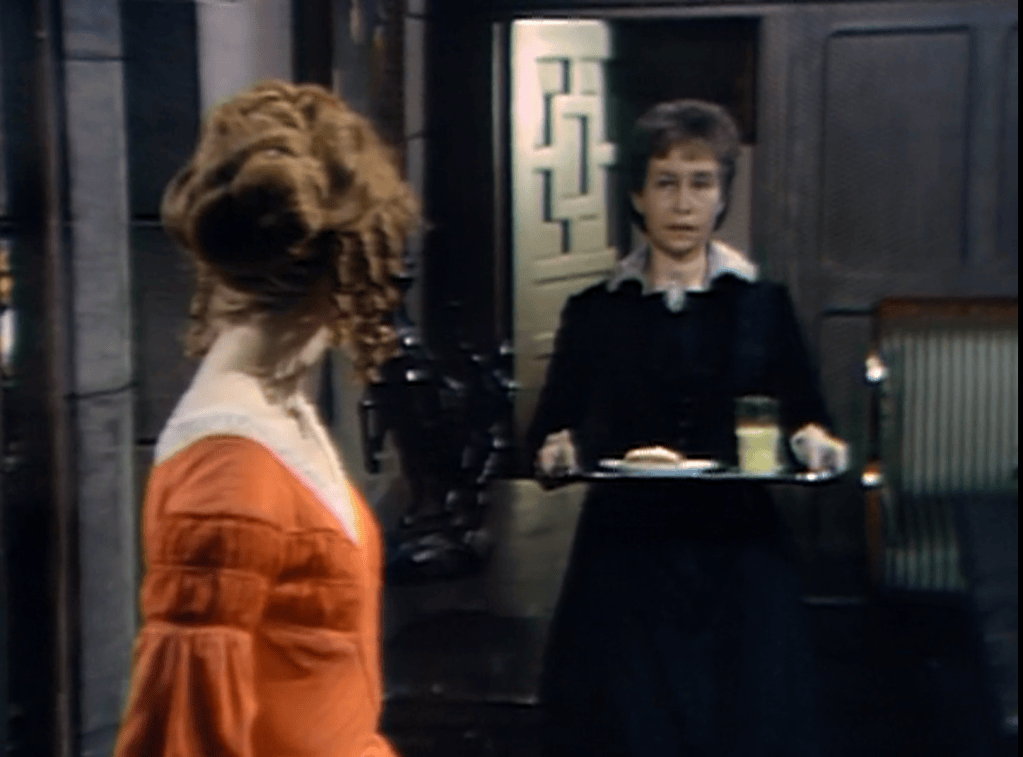
When Samantha addresses her by name, returning viewers will be confused. We heard a few weeks ago that there is a governess at Collinwood named Hortense. That was puzzling in itself, since Tad had been missing and presumed dead for six months at that point and the only especially young person in the house was Carrie Stokes, teenage granddaughter of a houseguest. Rich as the Collinses are, it is a bit much to keep a governess on staff just in case people want to bring their kids for a stay. However few their charges may be, governesses generally don’t wear maid outfits or bring meals on trays, so we might think this is a different Hortense.
Samantha takes Hortense aside and tells her to pack Tad’s bags. She will be taking him away tonight. While they are talking, Quentin’s brother Gabriel is eavesdropping at the door. Characters eavesdrop at the drawing room door all the time, but it is after all a childish thing to do. As a wheelchair user, Gabriel has to lean far forward to get his ear into position, making him look small and emphasizing his childishness. There are no adults at Collinwood at all, only children of various sizes.
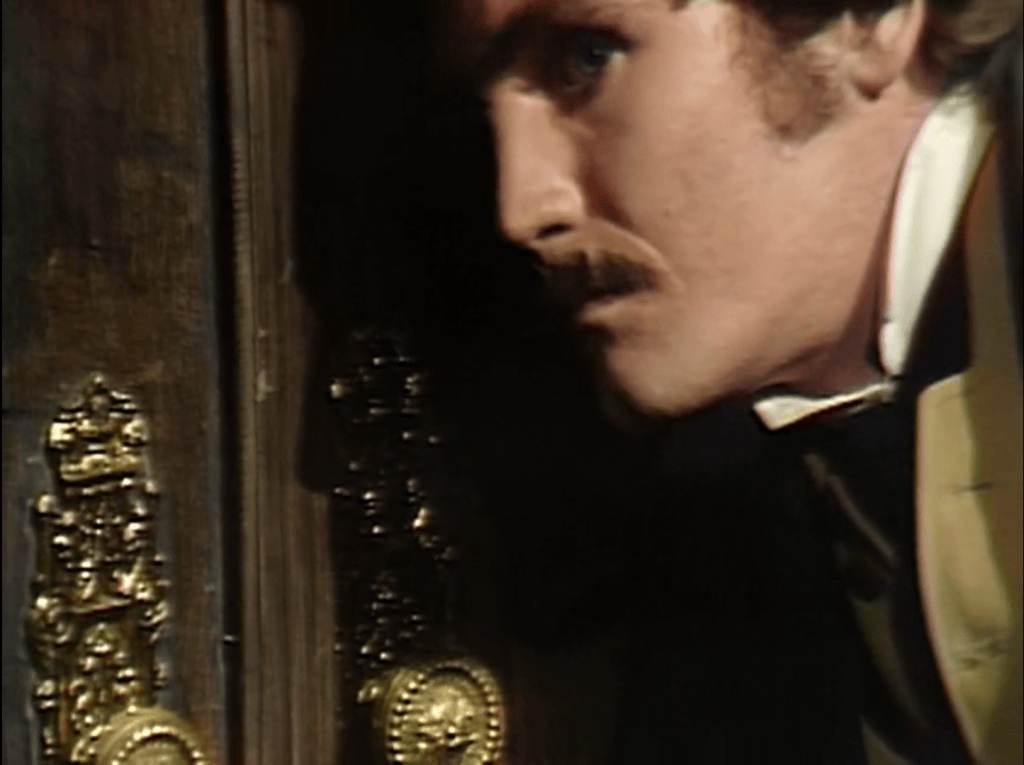
Gabriel goes upstairs to Quentin’s room. How he gets himself from one floor of the house to another is never explained. He tells Quentin what’s going on. Quentin comes to the head of the stairs just in time to catch Hortense putting Tad’s bags inside the front door. He demands to know what she is doing. She stammers out a story about going up to check on Tad’s schoolwork, showing that she is after all the governess. Quentin tells her he knows what she is really up to, and fires her on the spot.
Hortense goes out and walks through the woods, apparently on the way to report to Samantha. She encounters a headless body. It kills her.
Virginia Vestoff’s performance as Samantha elevates this episode. She consistently finds a posture which it would be natural for Samantha to adopt and holds it very still, so that any movement she does make attracts our attention. Even while speaking, she moves only her eyes, and those not so as to break eye contact with her scene partners. When she looks from one side of the other person’s eye to another, the reflections of the studio lights flash in her eyes so that it looks like lightning is coming from her. Her deliberate use of her voice, intoning each line with care, contrasts with the rashness of Samantha’s behavior and leaves us wondering if she might somehow succeed in her ridiculous plans. I agree with “Goddess of Transitory” that as written, Samantha’s part in this episode should be fatal to our interest in the character. But Vestoff manages to keep it alive to fight another day.

