
Maggie Evans is depressed about her marriage to drunken sourpuss Quentin Collins. In #1016, Maggie was getting ready to call a lawyer so she could put an end to their joyless union, but she changed her mind and decided to give it one more try. That has not worked out, and she has gone from contemplating divorce to attempting suicide. She is about to fling herself to her death from a window high in the great house of Collinwood when Quentin’s sister Elizabeth Collins Stoddard enters the room and talks her out of it. For its first 196 weeks, Dark Shadows was set in an alternate universe, which is in some ways a mirror image of this one. This incident is a case in point. In the original continuity, it was Liz’ counterpart whom people kept interrupting while she was trying to do away with herself,* so she takes the reversed position in this universe.
Most of the episode is devoted to the activities of a visitor from the main continuity, Barnabas Collins. The only thing Barnabas has a motivation to do is to try to get back home, but he seems to have decided he’d rather meddle in the problems the people in this alien universe are having. He suspects that the houseguest at Collinwood who is generally accepted as Alexis Stokes, identical twin sister of Quentin’s late first wife Angelique, is in fact Angelique herself risen from the dead. He also suspects that Maggie’s suicide attempt was the consequence of spells Angelique cast on her.
Barnabas is right about these things, but his grounds for believing them are thin. Angelique’s counterpart in his universe is a wicked witch who has long been the bane of his existence, and so he simply assumes that a woman with her face and voice will be the same. But for three weeks, Alexis really was staying at Collinwood, and Angelique really was in her tomb. Alexis looked and sounded exactly like Angelique. We saw that, while Alexis may not have been a one-dimensional innocent, she was not a witch and was not a direct threat to anyone’s life or liberty. Had Barnabas met Alexis before Angelique came back to life and murdered her, he would have had exactly the same suspicions about her that he has now about Angelique. It is purely a matter of luck that his suspicions coincide with the truth.
In the main continuity, Barnabas’ best friend and most frequent accomplice in his many crimes is mad scientist Julia Hoffman, MD. Julia’s counterpart here is the housekeeper at Collinwood. Miss Julia Hoffman is as devoted to Angelique as the original Julia is devoted to Barnabas. As the first Julia shows great reluctance when Barnabas is about to murder someone and shows even greater efficiency in getting rid of the bodies afterward, so this Julia protested yesterday that she would have nothing to do with Angelique’s plan to drive Maggie to her death, but was waiting outside the room when she was about to jump.
After confronting Julia and Angelique, needlessly revealing to them his suspicions, Barnabas decides to get some hard evidence. So he goes to Angelique’s old bedroom and stares really hard at the portrait of her that hangs there. She is in another part of the house, but grows agitated. She runs to the room and screams at him to stop staring into her eyes. He breaks into a triumphant… not grin, exactly, it’s more of a simper. It may be the only triumphant simper ever seen. That suits the occasion. He knows he was right, but Angelique knows that he knows, and it is not clear what he either can do to fight her or what reason he has to want to fight her.
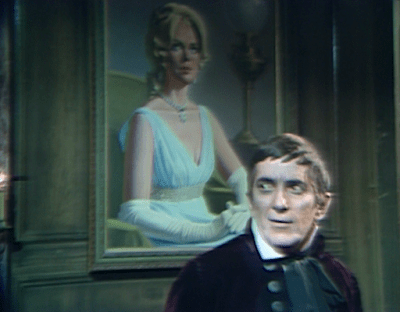
Jonathan Frid’s invention of a facial expression previously thought to be impossible is one of several bits of conspicuously good acting in this episode. He also gets to deliver brief enigmatic responses to a number of questions, such as “Perhaps” and “Did I?,” and he makes each of those words materialize in space in such an arresting way that even his scene partners can’t help but show how impressed they are. As Liz fussing over Maggie, Joan Bennett shows a maternal quality that brings her hitherto undefined character into a very sharp focus. Grayson Hall also adds greatly to Hoffman’s depth. Standing by while Maggie is trying to kill herself, she is bland and detached. When she tells Angelique that it really is better for them that Maggie did not succeed, she is the opposite, torn between a number of emotions, including relief that she has avoided responsibility for a death.
Angelique has several comic lines, for example a wistful lament that she doesn’t get to see Maggie’s corpse mangled on the rocks below her window. And she puts real fervor into her spellcasting directed at Maggie. My wife, Mrs Acilius, remembered that when Lara Parker first joined the cast she wished she were playing an ingenue, so much so that Frid had to keep reminding her that she was the villain. But now she has settled in and become part of the group. So when Angelique abuses Maggie, Parker and her friend Kathryn Leigh Scott turn into two little girls playing make-believe, and they have so much fun at it that they are irresistible to watch, no matter how miserable Maggie is.
*For example, in #266, #267, and #268, and #569.

