
C. S. Lewis’ novel That Hideous Strength was a popular success when it was first published in 1946, and has been in print ever since. It begins as a satire of university life and academic politics. When it turns out that the inner circle of the fictional Edgestowe university are a Satanic cult who take their orders from a severed head that once belonged to a warlock named François Alcasan and that their project involves extensive efforts to add to the head’s power with biotechnological interventions, it turns into a supernatural thriller. As one would expect of a writer as outspokenly Christian as Lewis, this all culminates in the Second Coming of Jesus.
It is psychiatrist Grace Ironwood who does the investigative heavy lifting that leads the protagonists to understand what is really going on. Jane Tudor Studdock, wife of ambitious professor Mark Studdock, has a series of bizarre dreams which she reports to Dr Ironwood. Dr Ironwood interprets these dreams as visions of the simple facts of what is happening at Edgestowe. Mark is arrested for a brutal murder the head committed, one that involved a near-decapitation of the victim, and Jane throws her lot in with Dr Ironwood and the other good guys. Dr Ironwood is then crucial in identifying Alcasan.
The A story on Dark Shadows is about another severed head that takes charge of a malign cult. The warlock from whom this head was cut was called Judah Zachery. The biotechnological intervention is not about connecting it with the “macrobes” Lewis invented, but with its original body. The cult takes shape not as a stable group as at Edgestowe, but serially, as the head takes control first of one person, then of another on or around the estate of Collinwood. The female psychiatrist who is a key member of the team opposing the head’s project is named, not Grace Ironwood, but Julia Hoffman. Today, the head takes Julia under its power, at a stroke both tearing the heart out of its opposition and recruiting the one person most likely to be able to reattach it to its body.
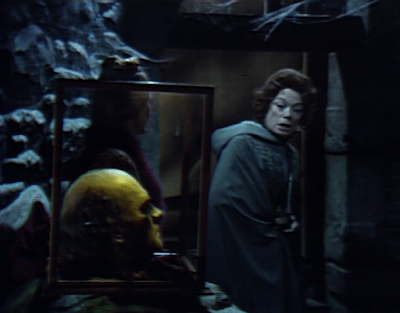
Before that happens, Julia and her best friend, vampire Barnabas Collins, are going over some documents she has found about Judah Zachery. The front door opens and Barnabas’ one-time wife, wicked witch Angelique, enters.
Since November 1967, when the show left its contemporary setting to spend four months in the 1790s, Dark Shadows has largely been about time travel. We met Angelique during that first jaunt into the past, when she was monomaniacally obsessed with taking control of Barnabas and first turned him into a vampire. She hadn’t changed much when we next saw her, when the show was back in contemporary dress for most of 1968. But in 1969, Julia and Barnabas met Angelique during a trip to 1897. In that segment, Angelique remembered the events of 1968 and had moved on from Barnabas, focusing her attentions on his distant cousin Quentin Collins. In the latter part of it, Angelique teamed up with Barnabas and Julia to fight sorcerer Count Petofi. Julia and Angelique even became friends in that time.
Back in a contemporary setting early in 1970, Angelique wound up aligned with Julia and Barnabas again, waging war against a race of Elder Gods known as the Leviathan People. During that segment, she told Barnabas that she regretted turning him into an undead abomination and murdering his family and friends, and he responded in a light tone that he didn’t suppose any of that really mattered all that much.
Now, Barnabas and Julia are in 1840. The Angelique they meet in this year does not remember anything that happened in 1897, 1968, or 1970. She has no idea who Julia is. But they remember it all. So, when Angelique walks in, we might look forward to her reaction when Julia greets her by exclaiming “Angelique! You’re the one person who can help us!”
But that doesn’t happen. Instead, it is Barnabas who calls Angelique by name. When she says she is eager to meet the new sister-in-law whom she heard about when she introduced herself at the great house on the grounds of the estate as “Mrs Barnabas Collins,” Barnabas simply shoos Julia away. Alone with Angelique, Barnabas vents his hostility as if 1897 and 1970 never happened. When Angelique points out that he cannot challenge her directly, Barnabas says that they have arrived at their “usual stalemate.” Stale is the word for this mating, that’s for sure.
Early in the 1840 segment, there were several days when Barnabas had only the knowledge he would have had at that time and did not recognize Julia. Had Angelique come back then, this scene would have made perfect sense. Perhaps it was originally meant to be so, and for some reason they had to displace it to this point, where it is a disappointment. I complained about this years ago in a long comment on Danny Horn’s post about this episode at his great blog Dark Shadows Every Day:
It’s too bad they didn’t have it take a good deal longer for Barnabas to project himself back from 1970. If Julia had managed to partially domesticate the 1840 Barnabas and get him on board with her investigation, his confrontation with Angelique would have been much improved. He wouldn’t have known anything that Julia and we know, and he couldn’t be counted on to listen to Julia. That would have made him a total loose cannon, as absolutely unpredictable in his reaction to Angelique as he would be unpredictable in his reactions to everyone else.
As it is, there’s only one intelligent way for him to respond to Angelique’s appearance. “Since you’re here, you may as well help us.”
“What makes me think I will help you?”
Barnabas and Julia tell her that they have traveled back in time from 1970, and that in the interval between 1840 and 1970 Angelique had twice joined forces with them against common foes.
“Do you expect me to believe this ABSURD TALE?”
They tell her that the foes they fought in 1897 and [1970] were Count Petofi and the Leviathans.
Smiling dismissively, she replies, “You can make up all the names you like, they won’t make me believe [your] story. But very well, tell me what name you have invented for the common adversary we are supposed to fight now.”
They say “Judah Zachery,” and she’s in. Murder Club is in session.
Having Barnabas and Angelique instead revisit their old scenes, right down to an improved version of the “My name is Cassandra!” bit, just tries our patience and makes Barnabas look even dumber than usual.
Comment left 13 February 2021 by “Acilius” on “Episode 11331: The Perils of Memory,” Danny Horn, Dark Shadows Every Day.
Norman Parker plays the body of Judah Zachery, while Michael McGuire plays the head. Michael McGuire gets to open his eyes a couple of times today, and Norman Parker reads the opening voiceover.

