Episode 960: My last run-in with him

When Dark Shadows began in June 1966, its most dangerous villain was high-born ne’er-do-well Roger Collins. Roger had squandered his half of the Collins family’s wealth and put his sister, the reclusive Elizabeth Collins Stoddard, in a difficult position by selling his half of the family business to support his extravagant lifestyle. He now worked in the business as Liz’ employee and, with his son, strange and troubled boy David, lived in Liz’ house as her guest. Roger schemed to cover up his past crimes, and was quite willing to add murder to them if that was the only way to preserve his cushy circumstances.

As played by Louis Edmonds, Roger was too much fun to be killed off as the original story bible foresaw. The show had not in those early days committed itself to the all-villain cast that has come to define it, so they decided that they could keep Roger around only by nerfing him. He became a sardonic gay uncle, amusing, lovable, and harmless. He has been on the margins for years now, often absent for long periods. When Dark Shadows turned to time travel and began to feature extended costume drama inserts, they could make use of Edmonds’ talents by casting him as other characters. His turn as haughty patriarch Joshua Collins made him the star of the 1790s segment that ran from November 1967 to March 1968, and as the stuffy Edward Collins he was among the highlights of the 1897 segment that took up most of 1969. Now that the show has returned to contemporary dress, Edmonds is Roger again, and he is the same afterthought he has been for so long.

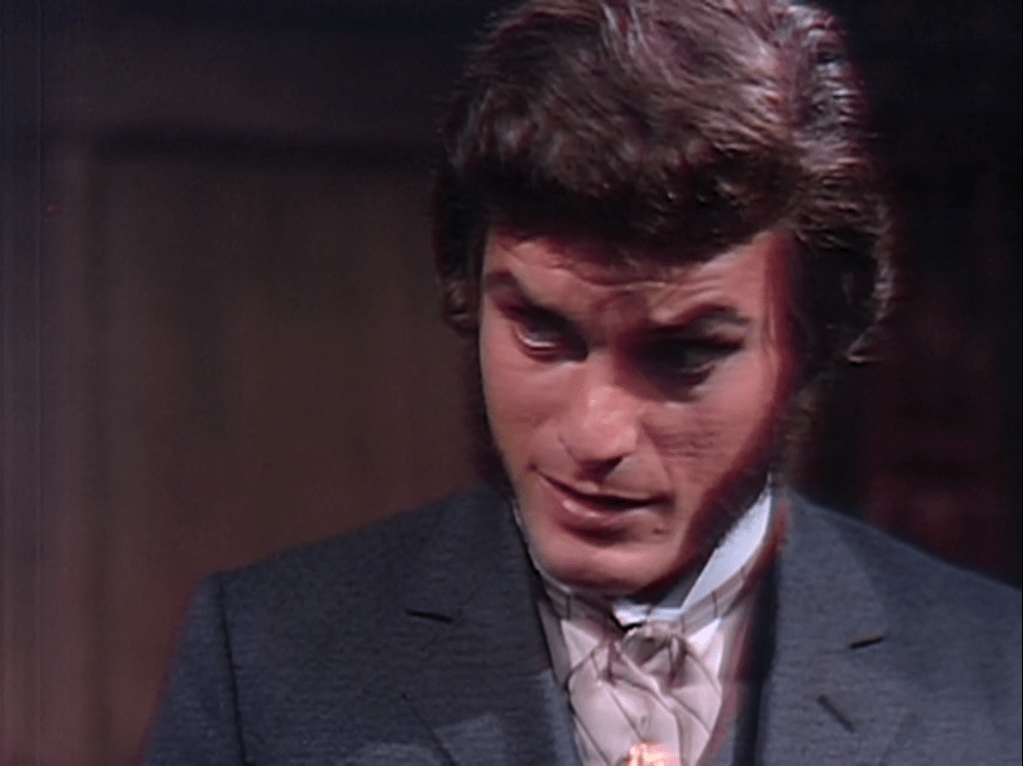
Today, a villain who introduced himself as Jabe but whom everyone calls Jeb walks into the house. Roger hears him, and protests that it is customary to knock. Jabe says that Liz gave him the run of the place, and tells Roger he has come to visit David. Roger forbids him to see David; Jabe says there is nothing he can do to stop him, and he goes upstairs to David’s room.

Roger picks up the phone and calls his distant cousin Quentin Collins. He tells Quentin he isn’t going to put up with any more of Jabe’s insolence, and that he doesn’t care how dangerous he is. He hangs up, and finds Jabe standing in front of him. Jabe asks if he is wondering how much he heard. Roger says that he doesn’t care if he heard all of it, that he wants him to leave the house at once. Jabe says that if it was Quentin he was talking to, he knows more about him than he had assumed. He also tells Roger that nothing Quentin may have told him about him and his associates was an exaggeration. If Roger defies them, he and everyone he loves will pay a terrible price.
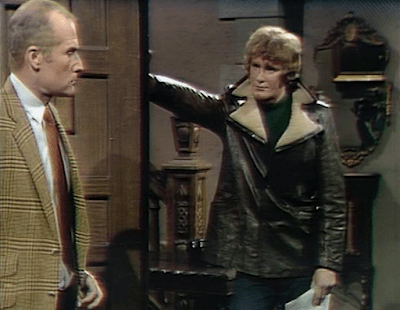
Roger and the “cheap, insufferable pig.” Screenshot by Dark Shadows Before I Die.

When Roger was a villain, they sometimes made him sympathetic by having dashing action hero Burke Devlin threaten to take over the house and start ordering him around. Later, Liz was being blackmailed by seagoing con man Jason McGuire, who when he reached the zenith of his power acted like he owned the house and tried to order Roger around. Burke eventually peaced out, and Jason’s scheme led to his own death not long after he got openly aggressive towards Roger in the drawing room. So longtime viewers will look at this scene and find a reason to believe that Jabe’s menace is approaching its peak.

Jabe’s henchman Bruno has captured Chris Jennings, who is a werewolf. He has locked Chris up in the tomb of the Stockbridges, an old Collinsport family who are in a way related to Roger’s ex-wife. The full Moon will be rising tonight, and Bruno has chained Chris to a wall in the tomb. He has set the world’s most talkative zombie to guard Chris. The zombie was in life a law enforcement officer known as “Sheriff Davenport.” When Jabe raised him from the dead, we saw that his gravestone read “Sheriff Davenport,” so apparently “Sheriff” was his given name. Bruno gave Sheriff a revolver loaded with silver bullets and ordered him to shoot Chris if he started transforming.

Bruno went to Jabe to report that he had captured the werewolf. Before he could get a word out about that, Jabe was berating him about other matters. Jabe wound up hitting Bruno, then twisted his arm until he said that Jabe was born to lead and he was born to follow. After that, Bruno decided that he wouldn’t have Sheriff kill the werewolf after all. Rather, he would sic the werewolf on Jabe.

Jabe’s intolerable personality keeps alienating followers, and he has assembled an array of adversaries including not only people like Bruno who know all of his secrets, but also a vampire, a wicked witch, a mad scientist, and a man with a Dorian Gray-like magical portrait that gives him an immunity to physical harm. On top of all that, we saw yesterday and today that a ghost is after Jabe, and that Jabe is especially vulnerable to ghosts. Add the werewolf to that force, and it seems Roger will be sipping his brandy in peace any day now.

Episode 877: Put down that sword

Throughout October 1897, which at 4 PM on participating stations of the ABC television network coincided with October 1969, 150 year old sorcerer Count Petofi occupied the body of handsome young Quentin Collins and banished Quentin to his own aging form. Last week Quentin broke that spell, and now the two of them are themselves again.

News of the restoration has not reached everyone, however. On Friday and Monday, Quentin’s lover, maidservant Beth, saw him at the top of Widows’ Hill. Thinking he was Petofi, she flung herself to her death on the rocks below rather than submit to whatever evil magic he had in store for her. Yesterday, Petofi’s unreliable servant Aristide went to Quentin, thinking he was his master, and begged for a task by which he could earn his way back into his good graces. Quentin sent him to murder Petofi, which he is trying to do when we open today.

The attempt takes place in the studio of artist Charles Delaware Tate, an unpleasant man who is tied to Petofi. Tate finds Aristide plunging a knife into Petofi’s chest. He stops the attack and gets through to Aristide that the swap is over and he is stabbing Petofi himself. Desperate to undo his latest offense, Aristide hastens back to the great house of Collinwood, intending to kill Quentin.

Petofi comes to and tells Tate that he intends to repossess Quentin’s body and use it to escape his enemies. When Tate tells him what Aristide has gone to do, he sends him to stop him. He does so, showing up in the drawing room at Collinwood in the nick of time and, at gunpoint, forcing Aristide to lay down the sword with which he was about to run Quentin through.

Back in the studio, Petofi instructs Tate to draw a magical sketch. The sketch depicts a man called Garth Blackwood, a cruel jailer whom Aristide killed when he escaped from prison in England. Petofi remembers meeting Aristide for the first time the night he escaped Blackwood’s prison. In #854 Petofi had said he met Aristide in an alley near the Thames in London, but this time we flash back to a meeting on the moors in the county of Devon. Petofi recalls that Aristide pledged his fealty to him in return for freedom from Blackwood’s ghost.

Once Tate has drawn his sketch, Blackwood will come back to life, determined to take his vengeance on Aristide. Aristide returns to the studio to resume begging for mercy, and Petofi takes great pleasure in showing him the sketch and telling him what is in store for him.

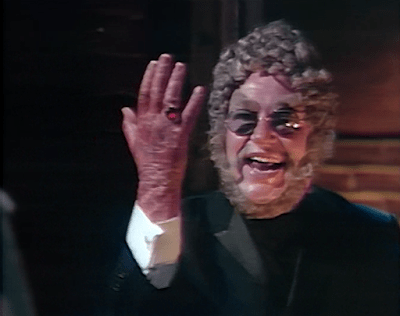
Garth Blackwood.

Episode 868: The man we thought he was

In October 1897, sorcerer Count Petofi has used his powers to steal the body of handsome young Quentin Collins and to trap Quentin in his own aging form. I refer to the villainous Petofi who looks like Quentin as Q-Petofi, and to the forlorn Quentin who looks like Petofi as P-Quentin.

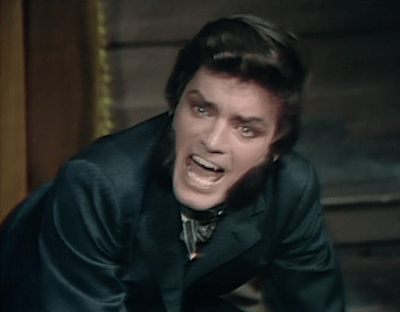
Q-Petofi

We open outside a cave near the estate of Collinwood, where Q-Petofi’s henchman Aristide is on the ground, gradually coming back to consciousness. Q-Petofi had ordered Aristide to hold wicked witch Angelique prisoner in the cave. Shortly after Q-Petofi left, Angelique slipped out of the cave and ran past him. Aristide followed her, and she bashed him on the head with a rock.

Aristide’s eyes focus, and he sees time-traveling vampire Barnabas Collins standing over him. The last time he saw Barnabas was in #842. Barnabas threatened to kill Aristide then, and he was so terrified that he ran away and didn’t come back until he heard that Barnabas had been staked in his coffin. The coffin is in the cave, and Aristide just saw Barnabas in it, the stake still in his heart, so he is shocked to see him up and about.

We cut to the great house of Collinwood, where Q-Petofi and Quentin’s stuffy but lovable brother Edward are recapping another storyline. Edward exits, and a telephone call comes from Ian Reade, MD. Dr Reade says that a strange man is in his office, asking for Edward. When he describes the man, Q-Petofi recognizes him as Barnabas. He takes a gun and goes to Dr Reade’s.

Q-Petofi finds Barnabas lying on Dr Reade’s exam table. He orders Dr Reade to leave. Dr Reade reminds Q-Petofi that they are in his office and refuses to comply with his commands. He does leave for a moment to call Edward again; when he comes back, he finds Q-Petofi holding Barnabas at gunpoint. He bravely tells Q-Petofi that if he wants to kill Barnabas, he will have to shoot him first.

Edward comes. Dr Reade trusts Edward and agrees to leave the room while he is there. After dawn breaks, Edward is astonished to see that Barnabas is still alive. Barnabas tells his old story that he is their cousin from England come to pay his respects. He says that when he first arrived, a man approached him in the dark woods, a man who, when he emerged from the shadows, proved to be his exact double. Until, that is, he opened his mouth and showed two long fangs. Barnabas says that he does not know what happened next or how much time has passed. All he knows is that this strange man kept him captive and dominated his will, from time to time appearing to him and repeating his original assault.

Edward is inclined to believe this story, Q-Petofi to shoot Barnabas on the spot. They compromise, and agree to take him to the cave. If Barnabas’ coffin is empty, they will shoot him. Dr Reade sees Edward and Q-Petofi carrying Barnabas out of his office, and objects that in his condition Barnabas may die if he is subjected to any exertion. When the question is asked if he is willing to go, Barnabas weakly croaks out a “yes.” At that, Dr Reade is willing to wash his hands of the whole thing. For someone who was willing to be shot a few minutes before, it’s quite a startling capitulation.

Q-Petofi does not know that Angelique and Aristide are no longer in the cave, so he insists on leading the way in. He finds that they are gone and the chains around Barnabas’ coffin have been broken. He invites Edward and Barnabas in. He takes it as obvious that the broken chains prove that the coffin is empty, but Edward, with his sense of fair play, insists on opening the coffin before they shoot Barnabas. The body is still there, the stake still in the chest. Barnabas reacts with horror, the others with amazement.

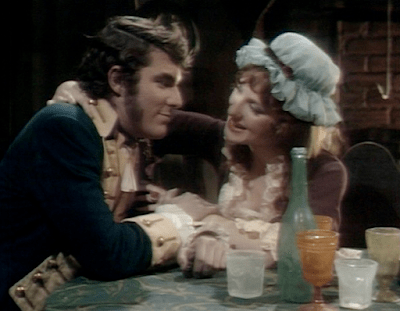
Doppelgänger time.

In #758, Angelique created a Doppelgänger of herself to trick an enemy into thinking that she had killed her, and in #842 she agreed to help Barnabas’ friend Julia Hoffman, MD in a plan to allow him to reestablish himself as a member of the Collins family. Julia was working on a medical intervention to free him of the effects of vampirism, and now we can see that Angelique contributed the grounds for the Collinses to believe that their cousin never labored under that curse.

When Dark Shadows was in production in the 1960s, the legends of King Arthur, the Knights of the Round Table, and the Holy Grail had been fashionable topics in English departments for decades. That vogue was reflected not only in the coursework the writing staff likely did when they were in college, but also in the popularity of novels like The Once and Future King and the Broadway show based on it, Camelot. When I was hanging out in used book stores in the 1980s and 1990s, mass market paperbacks printed in that era collecting the Grail sagas were still a staple.

The coffin in the cave recalls a prominent figure in one of those sagas, a king named Amfortas. In Heinrich of Turlin’s The Crown, Amfortas did not requite the love the mighty sorceress Orgeluse had for him. The humiliated Orgeluse inflicted a wound that both paralyzed Amfortas and made him immortal. In that state, Amfortas was confined to a coffin that was hidden in a cave. Sir Gawain found the coffin and freed Amfortas both of his paralysis and of his immortality.*

Longtime viewers of Dark Shadows will see many parallels to the story of Barnabas and Angelique in Heinrich’s story of Amfortas and Orgeluse. During the part of the show made and set in 1968, two mad scientists played the role of Sir Gawain in returning Barnabas to humanity. The first was a man named Eric Lang, the second was Julia. Now, Angelique herself, who was the original source of the curse that made Barnabas a vampire, combines the functions of Orgeluse and of Gawain. She not only frees Barnabas, but also redeems herself. The Grail legends also abound in other elements that figure prominently in this part of the show. For example, Count Petofi was originally on the show as a severed hand with magical powers, later to be reunited with the rest of its body. Gawain’s most famous story is of his battle with the Green Knight, who starts off as a severed head. Doppelgänger abound in the Grail legends, especially the so-called Vulgate Lancelot where a double of Queen Guinevere sets off a whole arc.

Dr Reade is played by Alfred Hinckley. Hinckley was in plays on and off Broadway, and when the networks ran a lot of programming produced in New York, his was a frequent face on American television. He was in Dark Shadows episode #1 as the conductor of the train that brought well-meaning governess Vicki Winters and dashing action hero Burke Devlin to Collinsport. Longtime viewers were reminded of that train in #850; maybe the production staff was reminded of it too, and that was why they called Hinckley to make his second appearance on the series today. It’s also his final appearance.

*Richard Wagner’s opera Parsifal features another version of the Amfortas legend, calling the sorceress by a different name, omitting Amfortas’ paralysis, leaving out the coffin in the cave, and giving the honor of healing Amfortas and succeeding him as king of the Grail to Percival rather than Gawain.

Episode 814: The hand knows what it must do

One night in 1797, nine Rroma men trapped the sorcerer Count Petofi in the forest of Ojden and cut off his right hand. With it, the count lost most of his magical powers. Sometime after, Petofi learned that he could live for exactly one hundred years without his hand. If he was reunited with it in that time, he would become immortal; if he was not, he would die.

Now, it is 1897, and the hundred years are almost up. Petofi has vacated his body and has for some weeks been operating in the person of twelve year old Jamison Collins. He has regained the hand, but as Petofi is dying, so is Jamison. Jamison/ Petofi collapses in the woods carrying the hand back to the place where his servant Aristide is waiting with Petofi’s own body. Jamison/ Petofi passes out shortly after Jamison’s uncle, the rakish Quentin Collins, catches up to him. Quentin carries Jamison/ Petofi and the hand to the caretaker’s cottage on the grounds of the estate of Collinwood, where he confers with his distant cousin, Barnabas Collins the vampire.

Quentin and Barnabas decide that if Petofi dies, Jamison will die as well. Therefore they have no choice but to take the hand to Aristide. Barnabas does get Aristide to promise that once Petofi has the hand, he will use his powers to cure Quentin’s werewolf curse, but no one seems to regard Aristide’s word as valuable. Barnabas makes a menacing move towards Aristide; Aristide wards him off with a cross. Aristide puts the hand on Petofi’s chest, says some magic words, and waits a little over an hour. During this time, he needles Barnabas by offering him tea, which he must know is not part of a vampire’s diet. Then Petofi comes out of his room, laughing his evil laugh and showing off his reattached hand.

“At last my arm is complete again!” Screenshot by Dark Shadows Before I Die. (Caption by Stephen Sondheim.)

In #767, Jamison had a dream in which Quentin told him that his doom was sealed when the one person he truly loved turned against him. It was already clear at that point that this person was Jamison, but today Quentin tells Jamison in so many words that he is the only person he ever really loved. So we can take this as an announcement that the climactic crisis of the part of Dark Shadows set in 1897 is approaching.

Episode 780: Carl was not mad

In yesterday’s episode, inveterate prankster Carl Collins told his brother, the rakishly handsome Quentin, that their distant cousin Barnabas was a vampire. Quentin has problems of his own, and he is counting on Barnabas to help him. So he locked Carl up in Barnabas’ hiding place, expecting that when night came Barnabas would prune one more branch off the Collins family tree.

Today, Quentin finds that Carl has escaped. He goes to Barnabas and tells him what has happened. Carl’s practical jokes annoy Barnabas intensely, and Barnabas has never bothered to conceal his disdain for him. He reacts to Quentin’s news with fury and a lot of orders. When Quentin later finds Barnabas standing by Carl’s corpse in the drawing room of the great house of Collinwood, he is really torn up about his brother’s death for almost a whole minute.

Quentin mourns for Carl- blink and you’ll miss it. Screenshot by Dark Shadows Before I Die.

A knock comes at the door; it is the oppressively evil Rev’d Gregory Trask. Quentin keeps Trask in the foyer for a bit while Barnabas hides Carl’s body. When Trask forces his way into the drawing room, Barnabas is gone. Carl’s body is cunningly hidden… behind the curtains, propped upright. Of course it falls out almost immediately. Earlier in the episode, Carl took Trask to Barnabas’ hiding place, and we saw that Barnabas had single-handedly lugged his coffin and the structure on which it rests some distance away. If he is strong enough to do that, surely he could have tossed Carl’s body out the window. And regular viewers know that there is a secret panel in this room, of which Barnabas has repeatedly shown that he is well aware. They would probably have expected him to hide the body there. That he just stashes it behind the curtains where it is certain to come into Trask’s view suggests that he isn’t even trying to get away with this particular murder.

Closing Miscellany

John Karlen is breathing pretty deeply during Carl’s big closeup as a corpse. It’s really confusing, I thought they were telling us he wasn’t dead yet.

I don’t know what the writers planned for Carl in the flimsies they sketched out six months before this episode was made, though there is so little room for him in subsequent plot-lines that I suspect he was supposed to die at about this point in the story. Still, his death was accelerated because Karlen had other things to do. He won’t be back on the show until #956, in February of next year.

The creaky little waltz that Quentin listens to obsessively was released as a single in June of 1969 and would hit #13 on the Billboard Hot 100 in August. Regular viewers may be sick of it already, and the characters certainly wish Quentin would get another record. It’s Trask’s turn to complain about it today, giving him something in common with Barnabas.

Trask wears a cross which he uses as a weapon against Barnabas. The show is oddly inconsistent about the effect of the cross on vampires. We’ve seen other characters use crosses against them, and at one point it was said that a cross inside the lid of Barnabas’ coffin immobilized him. But his hiding place is in the middle of a cemetery full of grave markers in the shape of huge crosses, and we see several of them today. Barnabas just walks right past those with no problem. You might think that since the show was made in the USA, where sincerity is so highly regarded, that the cross might be effective against him only if it is wielded by the pure of heart. But Trask is every bit as evil as are Barnabas and Quentin, and it works for him. It’s a puzzlement.

In a long comment on Danny Horn’s post about this episode at Dark Shadows Every Day, I responded to a discussion about whether there is a point in thinking of Barnabas as someone possessed by demons:

I think of the climax of the Iliad. As Achilles moves in to kill Hector, Athena takes hold of his spear and drives it in, delivering the fatal wound herself.

For modern readers, this may ruin the story. The whole poem has been leading up to this moment; we’ve spent a lot of time with Achilles, listening to him try to figure out what it would mean for him to kill Hector. So why have the goddess take over at the last minute? Isn’t it an evasion of Achilles’ responsibility for his actions, and a cheat for us as we’ve been observing his psychological development?

For the original audience, it was not. They actually believed in their gods. Athena really existed, as far as they were concerned. When an event was important enough, they took a interest. If it was really huge, they would get involved. Moreover, the gods worked closely with each other. So much so that you didn’t pray to one at a time, but always to groups of them. When Athena joins Achilles in his fight, it isn’t her pushing him aside- it’s him doing something so important it blurs the boundary between human and divine.

Something like that is at work in the traditional, pre-modern, conception of demonic possession. To say that a person is possessed is a way of looking at behavior that is reducible neither to moralistic judgment nor to psychological analysis. It isn’t individualistic in the way that those modes of discourse are. Rather, it suggests that the boundaries between the person and the spiritual forces of darkness have broken down. Perhaps the person is partly to blame for that breakdown, but the whole point is that s/he is no longer a distinct being, but is merging into those supernatural forces.

So, imagine a version of Dark Shadows where Elizabeth Collins Stoddard really was the main character. Her whole approach to life is denial. So, you could have had a story with a beginning, middle, and end. In the beginning, we see the lengths she has gone to in her quest to keep from ever having to have an embarrassing conversation. In the middle, we see various horrors take place around her, each worse than the one before, each more obvious than the one before, and each time she finds a way to convince herself it doesn’t exist. At the end, a couple of innocent characters go to her in the drawing room of Collinwood to rescue her from the monsters who are running rampant there. She looks at them placidly and tells them she sees nothing wrong. Why ever do they think she would want to leave her home? All the while leathery-winged demons are fluttering about her head. She doesn’t see them, and they have no choice but to flee.

Comment left 10 November 2020 by “Acilius” on “Episode 780: The Establishment Vampire,” posted 2 December 2015 by Danny Horn at Dark Shadows Every Day

Episode 459: The means to destroy ’em

Like every episode of Dark Shadows, this one begins with a voiceover by a member of the cast. Unlike all the preceding voiceovers, this one is delivered by a man. Thayer David does the honors.

We open in the drawing room of the great house of Collinwood. For the first time in months, Barnabas Collins is there. Barnabas died and rose as a vampire in January, and has been concealing his existence since. But now his secret is known to several people in the house. One of those, his mother Naomi, reacted to the knowledge by taking poison. In his agony, Barnabas is pacing the floor, complaining to his friend, much put-upon servant Ben, that the doctor hasn’t come. Barnabas’ father Joshua comes downstairs and announces that there is no longer any need for a doctor- Naomi has died.

Joshua brings the ill-tidings. Screenshot by Dark Shadows Before I Die.

Joshua dismisses Ben and talks with Barnabas. He confesses his doubts that he is able to love anyone. Barnabas tells him that such a disability might save his life- the curse wicked witch Angelique placed on him means that everyone who loves him will die. Joshua says that he must end the curse, and will do so by destroying Barnabas. Barnabas asks if he will drive a stake through his heart. Joshua replies that he found a book in Boston that tells of another way. Come morning, he will fire a silver bullet through Barnabas’ heart.

This is the first we have heard that silver bullets will kill vampires. There is some lore that suggests vampires avoid silver, but we know that doesn’t apply to Barnabas- one of his chief trademarks is a cane with a mostly silver handle. The 1941 film The Wolf Man established silver bullets as a means of killing werewolves, and the Lone Ranger fires silver bullets to knock the guns out of the bad guys’ hands, so I guess they might have come to mind in the 1960s if you were thinking of exotic weaponry.

Barnabas has plans for his final night. It was naval officer/ sleazy operator Nathan Forbes who led Naomi to discover Barnabas’ secret, and who is to that extent responsible for her death. Ben enters to inform Joshua and Barnabas of another item to add to the list of Nathan’s misdeeds. Nathan has evidently apprehended bewildered time traveler Victoria Winters and taken her into town, where she faces death on the gallows after being unjustly convicted of witchcraft. The Collinses knew Vicki to be innocent and had been harboring her since shortly after she escaped from gaol. Joshua and Barnabas are certain that Nathan turned her in solely to collect the reward that has been posted for her capture. Barnabas vows to kill Nathan, and Joshua can’t talk him out of it.

We cut to Nathan in the Eagle tavern, where he is spending the money he sold Victoria for. The Eagle has changed pretty dramatically in the last several weeks. In #419, bartender Mr Mooney greeted a female patron with the announcement that the Eagle did not admit unaccompanied women. Since the Eagle is a public house on the waterfront, the management evidently thought this policy was necessary to keep the place from becoming a headquarters for the sex workers of Collinsport.

Now Mr Mooney is nowhere to be seen, and the only person in the barroom with Nathan is identified in the closing credits as “Barmaid.” She is played by Rebecca Shaw, whom we saw the other day as a streetwalker whom Barnabas was about to bite when good witch Bathia Mapes summoned him away with a magical incantation. She is sitting with Nathan, drinking with him, and flirting with him pretty heavily. A bat squeaking at the window frightens her, and when she catches her breath she announces that she will be leaving him alone in the bar for a bit while she lies down. Nathan replies to that by saying he will see her soon, and she turns to take a look at him, apparently expecting him to follow her to bed. It seems possible she is the same character who was working the docks, now employed in a similar capacity in the Eagle. If this is the person who has taken over from Mr Mooney, the management must have given up the hopes it formerly had for its reputation.

Nathan and the friendly Barmaid. Screenshot by Dark Shadows Before I Die.

Once the woman leaves Nathan alone, Barnabas appears. He confronts Nathan about his many crimes. Nathan pulls a gun and tells Barnabas he will take him to the constable and turn him in as the Collinsport Strangler. Barnabas jeers. Nathan shoots, and Barnabas keeps standing there. He declares that Nathan cannot kill him, because he is already dead. He then informs Nathan that he will wait until 9 pm to kill him. Since it is now 8:30, this does not give Nathan a great deal of time.

At 8:45, Nathan appears at Collinwood. He finds Joshua and Ben in the drawing room, and tells them what has happened. They are neither surprised nor sympathetic. Joshua leaves the room, explaining that he would prefer not to see a gruesome murder. Ben is willing to stay for a while. When Nathan asks how Barnabas can be destroyed, Ben decides to have a little fun. He tells him that if he finds Barnabas resting in his coffin after sunrise and drives a wooden stake through his heart, that will take care of it. Ben is quite jolly when he points out that Nathan will be dead long before sunrise, so that this information would seem to be of little practical use to him. Ben then decides that he doesn’t want to watch the murder either, so he also takes his leave of Nathan.

With five minutes to go, Nathan tells himself that Barnabas will not kill him if Joshua is in the room. He finds Joshua in the study. He begs Joshua to stay. As Joshua is refusing, Nathan looks at the wall and sees a crossbow mounted there, with three wooden bolts next to it. Suddenly his cowardice gives way to wild hope. He tells Joshua he will wait in the study for Barnabas. Joshua goes.

Nathan takes a practice shot at the door, then stands waiting. Barnabas does open the door, Nathan does release another bolt, and does strike him in the chest, a bit to the left of the sternum. Barnabas cries out in pain, and as the episode ends it looks very much as if Nathan may have managed to stake him.

Barnabas takes a bolt to the chest. Screenshot by Dark Shadows Before I Die.

Barnabas is the reason the show is a hit, so we can be quite sure he won’t actually die. Still, the episode is good enough that it feels for a moment that he might. The contrast between the prospect of Joshua killing Barnabas in the stately manner he described earlier in the episode and the idea of Nathan killing him is instructive. Had Joshua carried out his plan or even attempted it, the result would have been what Aristotle was talking about in his Poetics when he described the majestic terror of tragedy. It would have been at once horrifying and awe-inspiring to see a father duty-bound to kill his son. But Nathan is a cheap bum, trying only to save himself so that he can live to abuse and exploit more people. When we root against Nathan destroying Barnabas, we do not want only to continue the pleasure of watching the show. We are rejecting a resolution that would be unworthy of what we have seen so far.

Nathan, indeed, is unworthiness incarnate. When he was first on the show, Nathan was a likable rogue, but in recent weeks he has become both cruel and dreary. So cruel that he has tried to arrange the murder of an eleven year old; so dreary that he works through a conspicuously dim-witted, relentlessly unappealing henchman. Many fans complain about Nathan’s turn, and some speculate that the show just ran out of villains sinister enough to be worthy of Barnabas’ vengeance. On that theory, Nathan’s grave crimes are a last-minute, slapdash invention.

I don’t agree. We met Nathan before Angelique came to Collinwood. In those days, there was room for light comedy, for grand gestures, for dashing heroism, for fairy tale whimsy, and for tender romance. But as her curses have done their work, everyone and everything has been ground down. The ceiling has been lowered, and there is no longer space for the bouncy good cheer of the Old Nathan, much less for the Satanic majesty of villains like Angelique or that Rev’d Mr Trask. The whole world is pervaded by cheapness and sordidness now, and growing more so by the minute.

The only grandeur left is in The Tragedy of Joshua Collins. Were Nathan to destroy Barnabas, that grandeur would vanish, not in sublime pity, but with a taunt. That would be a harsh ending indeed.

Episode 219: One look at the man

This teleplay badly needed another trip through the typewriter.

In the opening scenes, seagoing con man Jason McGuire demands his friend and former henchman, the sorely bedraggled Willie Loomis, leave the estate of Collinwood and the town of Collinsport. He mentions that he saw Willie’s car the night before at the cemetery. He then orders Willie to get on a bus and leave town. Then he starts talking about Willie’s car again. Does Willie have a car or not? They’ve gone back and forth on this from one episode to another, but today they can’t keep it straight from one line of dialogue to the next.

A doctor shows up to examine Willie. He tells Jason that Willie is not sick at all. The reason he is so weak is that he has lost “an enormous amount of blood.” What does the doctor think the word “sick” means if it doesn’t apply to a person who is doing badly because of an “enormous” loss of blood?

Whatever meaning the doctor attaches to “sick” apparently also applies to “ailment.” High-born ne’er-do-well Roger Collins asks what Willie’s ailment is, and the doctor says he has no ailment. He is simply immobilized due to an enormous loss of blood.

The doctor tells first Jason, then Roger, that Willie will be fine if he gets some rest and fluids and food. The idea of a blood transfusion doesn’t cross his mind, nor do Jason or Roger bring it up. It would be one thing if the doctor, Jason, and Roger were played by the Three Stooges, but there is no sign that we are supposed to think that they are a load of idiots.

An actor who has repeatedly triumphed over bad writing reappears after an absence of sixteen weeks. This is Dana Elcar as Sheriff George Patterson. The sheriff’s activities don’t always make a great deal of sense, but Elcar’s acting choices and his zest for performance make him a pleasure to watch no matter how dire the script he has to work with.

Today, the sheriff is telling Roger that a number of cows on the farms owned by the Collins family have been destroyed. A person or persons unknown somehow sucked every drop of blood out of these cows through small punctures in their hides. Roger is deeply unsettled by this strange news, and the sheriff sympathizes with him.

Roger repeatedly asks the sheriff why he is the one telling him about the cows. He says that he would have expected the veterinarian to call him. The sheriff says that the veterinarian called his office, because he determined that the cows were killed by someone’s deliberate act. That doesn’t explain why the veterinarian, whose bill the Collinses will presumably be paying, didn’t call him. We were so glad to see these fine actors working together that the senselessness of the scene didn’t bother us while we were watching it, but as soon as it was over we were left with a feeling of confusion.

Roger and the sheriff. Screenshot by Dark Shadows Before I Die

Regular viewers do wonder what farms the sheriff and Roger are talking about. The only previous reference to the word “farm” in connection with the Collinses was in #64, when Sheriff Patterson told their servant Matthew Morgan to “work their farm for them” and stay out of trouble. Today’s conversation repeatedly refers to “farms,” plural, more than one of which are big enough to have cows. That’s an operation much too complicated for Matthew, who had many other duties, to have handled by himself. Besides, Matthew left his job in #112 and was scared to death by ghosts in #126, and hasn’t been replaced. Whatever farm Matthew was working must have been so small that the Collinses can take care of it themselves in whatever time they can spare from their main occupation, keeping secrets and being sarcastic.

Writer Ron Sproat specialized in inventorying disused storylines and getting them out of the way. Back when Matthew was on the show, the Collinses were heavily in debt and running out of money. Dashing action hero Burke Devlin spent the first 40 weeks of the show trying to avenge himself on the Collinses by driving them into bankruptcy. All of that has gone by the boards, and we aren’t hearing any more about troubles concerning the business. So it’s time for Dark Shadows to reconceive the family as financially secure, indeed as imposingly rich. Talking about their many farms and the herds of livestock on them helps Sproat open up space in his narrative warehouse, but it doesn’t offer much to interest the audience.

My wife, Mrs Acilius, thought up a little fanfic that might have introduced the same points more intriguingly. The trouble with the cows first came up in #215. Hardworking young fisherman Joe Haskell told the story of a calf belonging to his uncle that was found drained of blood. That suggested that an evil has been loosed that is spreading throughout the town and beyond. Why not stick with Joe as the point of view character in connection with the mystery of the desiccated cows? Not only would that give a badly under-utilized character something to do, but would also give us the sense that the fate of a whole community is at stake in the action.

If they needed to connect the Collinses to the cow story, they could have come up with a way to oblige them to join with Joe to figure out what’s going on. That in turn would raise the prospect of a story structured like Bram Stoker’s Dracula, in which one character after another joins the team opposing the malign Count. The formation of the group that resisted blonde fire witch Laura Murdoch Collins in the months leading up to #191 very much followed the pattern set in Stoker’s novel. Of course, the ending could be modified. The Laura story ended, not with the triumphant team-work that defeats Dracula, but with well-meaning governess Vicki cut off from her allies and left to confront Laura alone. But the team-work leading up to that point was full of interest, as characters shared information with each other, reconfigured their relationships, and found themselves doing things neither they nor we would have expected. Simply reintroducing the topic of the cows and leaving Joe and the Collinses siloed off from each other is easy for the writers, but it doesn’t take the story anywhere.