Episode 457: I will meet you

This is the first episode of Dark Shadows credited to a director other than Lela Swift or John Sedwick. It is also the first production of any kind directed by Dan Curtis, the series’ creator and executive producer. Curtis’ inexperience shows at several moments when the camera is in an awkward spot or the actors are unsure what to do, and in his post about the episode on Dark Shadows Every Day Danny Horn documents several of the more egregious examples with screenshots and detailed analysis. The impossible deadlines and tiny budget on which Dark Shadows was produced meant that even Swift and Sedwick, who were seasoned professionals and ambitious visual artists, sometimes had to turn in work that wasn’t much better than what first-timer Curtis manages today, and longtime viewers of the show will take even his worst stumbles in stride.

At the top of the episode, it is daytime, and much put-upon servant Ben Stokes (Thayer David) finds the lady of the house, Naomi Collins (Joan Bennett,) standing at an open coffin that holds the corpse of her son, Barnabas. Ben knows that Barnabas is a vampire who will rise at night to prey upon the living. Naomi has never heard of vampires. All she knows is that Barnabas is dead, and that his coffin has been moved from the family mausoleum to a room atop a tower in the mansion. Ben pleads with her to leave the room and to go with him back to the main part of the house.

Naomi questions Ben. Ben tells her that Barnabas has a “sleeping sickness,” and has been in a coma ever since the night he apparently died. Ben does not like to lie to Naomi, but her husband, haughty overlord Joshua, has judged that the truth would kill her, and Ben is governed by that assessment. He does tell her that the “sleeping sickness” is a symptom of a curse, that the wicked witch who placed the curse was Barnabas’ sometime wife Angelique, and that Joshua is in Boston trying to find someone who knows how to lift it.

Ben asks Naomi how she came to be in the tower room. She tells him that naval officer/ sleazy operator Nathan Forbes told her that Barnabas was being kept there, and also that Barnabas was responsible for the series of murders that had recently taken place in the town of Collinsport. At that, Ben vows to kill Nathan. To his chagrin, Naomi forbids him to do this.

Naomi forbids Ben to kill Nathan. Screenshot by Dark Shadows Before I Die.

In the part of Dark Shadows set between August and December of 1966, Bennett played reclusive matriarch Elizabeth Collins Stoddard and David played her fanatically devoted handyman Matthew Morgan. When well-meaning governess Vicki came unstuck in time and arrived in the late 1790s, she at first mistook Naomi for Liz and Ben for Matthew. This scene takes longtime viewers back to the days when Matthew was always on the lookout for someone who represented a threat to Liz’ interests and she was always sternly prohibiting him from murdering anyone for her sake.

Ben is a far saner man than Matthew ever was; the contrast between them shows the effect that growing up in Collinsport, a town suffering from the consequences of a curse that has been working its way for many generations, has had on Matthew’s personality. While Ben is a brave, kind-hearted fellow whose fierce loyalties sometimes overpower his good sense, Matthew is a paranoid ogre who kills Liz’ friend Bill Malloy and tries to kill Vicki. It isn’t just one family that will be warped by Angelique’s curse. It will breed monsters everywhere the Collinses’ influence prevails.

Naomi then turns her attention to the B-plot. Nathan has married fluttery heiress Millicent Collins, only to find that Millicent has signed her share of the Collins fortune over to her little brother Daniel. Nathan responded to that news by crafting a plot to murder Daniel. His first attempt failed when Noah Gifford, the henchman he hired to abduct Daniel and drown him, fell afoul of Vicki. Vicki found Noah strangling Daniel near the place where she was hiding, having escaped from gaol, and shot him to death. After that, Daniel and Vicki went back to the mansion and told Naomi what they knew. Naomi recognized Daniel’s description of his attacker as a man she had seen with Nathan earlier, and realizes that Nathan is trying to murder the boy. So she orders Ben to take Daniel into town to stay with the Rev’d Mr Bland, a clergyman who looks like a duck.

Naomi confronts Nathan, who keeps telling her that whatever Barnabas might look like during the day, he gets up at night and goes out to murder people. She tries to shut him up, but later she is still wondering whether she should go back to the tower room after dark to check his story out.

She sees Millicent standing in the foyer, staring at the portrait of Barnabas that hangs there. The portrait of Barnabas first appeared under the closing credits in #204, and from #205 on it figured as a means through which Barnabas could communicate with the living. Barnabas bit Millicent the other day, and she hears him summoning her.

Among the 1960s characters who receive their commands from the vampire while staring at the portrait is Liz’ daughter Carolyn, who like Millicent is played by Nancy Barrett. Millicent at times evoked an early version of Carolyn. Until the spring of 1967, Carolyn was tempestuous and irresponsible, sometimes friendly to point-of-view character Vicki, sometimes hostile to her. Millicent is as timid and overly dependent as that version of Carolyn was headstrong and self-centered. One way or another, each is a Spoiled Heiress, and evidently that’s a favorite meal of Barnabas’.

Naomi follows Millicent to the gazebo on the grounds of the estate. There, she sees Barnabas. She is stunned that the son whose corpse she was looking at just a few hours before is up and moving. He bites Millicent, and Naomi lets out a scream. Barnabas looks up, and realizes that his mother has caught him in the act.

The vampire’s bite affects each victim differently. The first victim we saw was Willie Loomis, whom Barnabas’ bite transformed from a dangerously unstable ruffian to a sorely bedraggled blood thrall. Willie was at first gravely ill, then ran to Barnabas like an addict desperate for a fix, and eventually settled into life as a sorrowful servant who could not run away from Barnabas but could resist him to the point where Barnabas occasionally found it necessary to keep him in line with beatings.

The second victim we saw was Maggie Evans, The Nicest Girl in Town. She reacted very much like the first victim in the 1790s segment, gracious lady Josette, who, like Maggie, was played by Kathryn Leigh Scott. At first, those two were alternately blissful and snappish, happy to be under Barnabas’ power and defensive with anyone who might interfere with it. But each recoiled from him by the time it became clear he planned to kill her and make her into a vampire herself. Each escaped from him to the shore below Widow’s Hill- Maggie by running through an underground tunnel that rose to the shoreline, Josette by flinging herself to her death from the top of the cliff.

Later, Barnabas bit Carolyn. She initially contemplated his most gruesome crimes with pure glee and showed great energy as his protector and enforcer. Soon her conscience reappeared, but she was still doing his dirty work faithfully when Vicki disappeared into the past.

Millicent differs from all those others in that she simply continues to go about her business in between Barnabas’ meal-times. Granted, she was already deeply disturbed by that point, so that her business was conducted mostly in show-stopping mad scenes. But it’s still odd that she can talk to Nathan as if their marriage were the main thing in her life.

When we finished watching this one, my wife, Mrs Acilius, wondered if these differences were simply the result of the victims’ personalities coming through or if the vampire can pick and choose how to apply the pressure. He wanted Willie as a slave, and the reaction he produced gave him that. He wanted to turn Maggie into a reincarnation of Josette, and wound up getting the same reaction from Maggie that he had got from Josette. He bit Carolyn in a moment of desperation, with no plan in mind, and her reaction is complicated and volatile. He bit Millicent to keep her quiet, and her reaction is remarkably inconspicuous. Maybe we’re just supposed to think that Barnabas is fabulously lucky, but there is an opening there to tell a story about how him deciding what he wants to do to a person when he sucks their blood.

Episode 456: The little boy I brought with me

In 1966, the well-meaning Victoria Winters (Alexandra Moltke Isles) came to the great house of Collinwood to be governess to strange and troubled boy David Collins (David Henesy.) Throughout the first 25 weeks of Dark Shadows, Vicki gradually learned that David’s stories of ghosts and other paranormal phenomena were not signs of a disordered imagination, but were simple statements of fact. Once she came to terms with that reality, Vicki and David became the closest of friends.

Now it is 1796. Vicki has come unstuck in time. For a brief period she served at Collinwood as governess to the children there, including Daniel Collins (David Henesy,) with whom she became the closest of friends. Vicki’s signal failure to adapt to her new surroundings soon led her to be convicted of witchcraft and sentenced to death. She escaped from gaol and found a hiding place in the secret room of the Collins family mausoleum. Daniel joined her there.

Daniel, too, had been fleeing for his life. An unsightly man had abducted him. Daniel got away from him and made his way to the cemetery, where he had earlier seen Vicki duck into the mausoleum. When Daniel went out again, the man appeared and tried to strangle him. Vicki found out what was going on and shot the man to death.

Daniel and Vicki then left the cemetery and went to the great house. The lady of the house, Naomi Collins, believes that Vicki is innocent. Daniel is sure Naomi will help her.

In the study. Screenshot by Dark Shadows Before I Die.

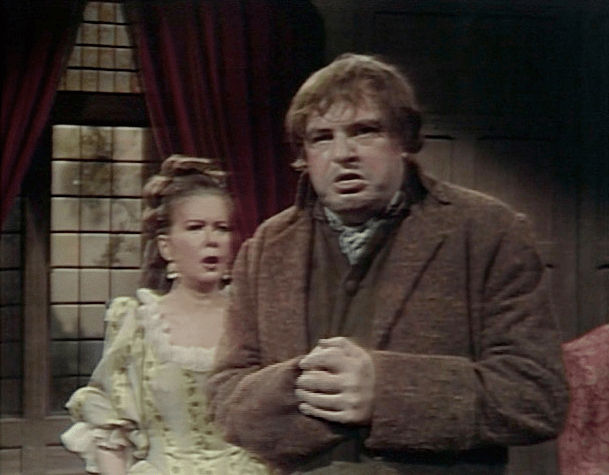
Today, Daniel and Vicki arrive at the house, and Naomi does indeed hide them. The three of them are in the study when Daniel’s brother-in-law, naval officer/ sleazy operator Nathan Forbes, knocks on the door. Naomi hustles Vicki into a closet and lets Nathan in. Nathan dismisses Daniel’s claim that he was attacked, but when Daniel gives a description of his assailant Naomi realizes that it matches a man she saw Nathan with earlier. She is convinced that Nathan tried to do away with the boy.

She is correct. Nathan wooed Daniel’s sister Millicent for her money, only to discover after they were married that she had signed all of it over to Daniel. If Daniel dies, it reverts to her, which is to say to her husband. So Nathan set about scheming to have Daniel killed. As it was always dangerous to disbelieve David, so it would be dangerous to disbelieve Daniel.

When Naomi tells Nathan that the authorities will investigate Daniel’s story, he warns her against attracting the attention of the constable. He can see that she doesn’t know what he’s talking about. So he tells her that it is to do with her son Barnabas. Naomi declares that Barnabas is in England, repeating a lie that her husband Joshua commanded her to propagate. Nathan says that isn’t true. “So you know Barnabas is dead,” replies Naomi. Nathan denies that as well, and says that Barnabas has recently been murdering people in the town of Collinsport.

Naomi was in the house when Barnabas died and saw him in his coffin afterward, so she is not inclined to accept Nathan’s assertion. But Millicent keeps saying that she has seen Barnabas, Naomi thought she heard Barnabas’ voice the other day, and Joshua is obviously keeping some secret from her. So when Nathan tells her that Barnabas is in the room on top of the tower attached to the house, she can’t resist going up there to see for herself. At the end of the episode, Naomi is in the tower room, opening Barnabas’ coffin.

Episode 441: The subject of vicious gossip

When well-meaning governess Vicki came unstuck in time and found herself in the year 1795, regular viewers of Dark Shadows could expect certain plot points to be resolved before she returned to the 1960s. We would learn how Barnabas Collins became a vampire, and how he wound up trapped in a chained coffin in the secret chamber of the Collins family mausoleum. We would learn how Barnabas’ little sister Sarah died. We would see Barnabas’ lost love, gracious lady Josette, marry his uncle Jeremiah Collins. We would see Josette jump to her death from the precipice atop Widows’ Hill. And we would see Vicki escape from some dangerous situation and find herself back in her own time.

Now, the only items on that list left unresolved are Barnabas’ chaining and Vicki’s return. The show has made it clear to people paying close attention how each of those events will happen, and they could fit them both into one episode. Into any given episode, in fact- they’ve given us all the foundation we need for both stories.

But they aren’t going home to a contemporary setting quite yet. The eighteenth century segment has been a ratings hit, Dan Curtis Productions owns the period costumes, and several fun characters are still alive. So they have decided to restart some storylines they had shut down earlier and to build up some new ones.

The main thing that happens today is the first step towards restarting an apparently concluded story. Fluttery heiress Millicent Collins had shared a series of wonderful comedy scenes with untrustworthy naval officer Nathan Forbes, become engaged to him, and discovered that he was already married to someone else. Since that discovery, Millicent has been grimly determined to exact revenge on Nathan, and the rest of the Collins family has regarded him with icy disdain.

Nathan has made a discovery of his own. He has learned that Barnabas did not go to England, as his family has been telling everyone, but that he is still in Collinsport, and is the serial killer preying on the young women of the town. Last week, he made it clear to the audience he had a plan to turn this information into money, apparently by blackmailing the Collinses. Today, we learn that his plans are more complicated, and involve a renewal of his relationship with Millicent. Late at night, he shows up at the lodgings of a visiting witchfinder, the Rev’d Mr Trask. He asks Trask to take a letter to Millicent.

Trask does not want to let Nathan into his room, since the corpse of a prostitute is sprawled across his bed. She is Maude Browning. Barnabas murdered her in Friday’s episode. As part of his campaign to make life difficult for Trask, he deposited her remains at his place.

Nathan won’t take no for an answer, so Trask throws a blanket over Maude and lets him in. Nathan notices Maude’s arm sticking out from under the blanket and is delighted to think that Trask is not the fanatical ascetic he seems to be. Trask breaks down and starts telling Nathan what happened. He tells him that he was astounded to find Maude’s body on his bed, and he asks him to help get rid of it. Nathan agrees to do so on condition he deliver the letter to Millicent.

The scene is just marvelous. Danny Horn devotes most of his post about this episode on Dark Shadows Every Day to a rave review of it, to which I happily refer you.

We then cut to the great house at Collinwood, where Millicent is studying a layout of Tarot. All the Dark Shadows fansites point out that Millicent misidentifies the Queen of Cups as the High Priestess. This is not the fault it is often made out to be. On Dark Shadows Before I Die, Christine Scoleri reminds us that the Countess DuPrés made the same mistake in #368. Since the countess introduced the Tarot to Collinwood and presumably taught Millicent how to read the cards, it would have been a break in continuity had she called it anything else.

Millicent looks at the cards and addresses the absent Nathan, telling him that she is filled with hatred for him and that he faces certain destruction as punishment for his mistreatment of her. Naomi Collins, mistress of the house, enters and asks Cousin Millicent to whom she is speaking. When she answers that she is talking to Nathan, Naomi tells her Nathan is not there. Millicent replies that he does not need to be present to hear her voice. Since Barnabas was able to magically project his own taunting voice across space into Trask’s hearing in Thursday and Friday’s episodes, this claim of Millicent’s has a curious resonance for returning viewers.

Trask shows up with Nathan’s letter. He wants to meet with Millicent alone in the drawing room to give it to her, but Naomi insists on being present. They stay in the foyer. When Naomi forces Trask to tell them that the letter is from Nathan, Naomi takes it and tears it to pieces. Millicent says that she approves of Naomi’s action, but we can see a flicker in her eye and hear a quiver in her voice that suggest the hatred of Nathan she spoke of a few minutes before may not be quite so undiluted as she would like to believe. Trask leaves the house, Naomi leaves the foyer, and Millicent gathers up the shredded pieces of the letter.

Back in his room, Trask goes to sleep. He has a dream. The dream sequence begins with an image reminiscent of pieces moving in a kaleidoscope.

Trask goes into a dream world. Screenshot by Dark Shadows Before I Die.

That kaleidoscopic pattern was part of a visual effect we saw when Dark Shadows was still set in 1967. That effect introduced scenes that took place in #347, #352, and #354, when mad scientist Julia Hoffman hypnotized Vicki and took her to the Old House at Collinwood. At Collinwood, Barnabas’ helper Carolyn spotted Julia and Vicki, putting Julia in great danger.

The echo of those episodes is startling coming on the heels of the scene we just saw, in which Millicent figures as a student of the countess. Julia and the countess are both played by Grayson Hall, and Millicent and Carolyn are both played by Nancy Barrett. The relationships between their characters are different now, shifted as the colored pieces shift in a turning kaleidoscope. But remembering those earlier episodes, we might remember that what is seen in a semiconscious state might be a message sent to manipulate and deceive, and we certainly remember that people who go to the Old House are in danger from Barnabas.

Trask’s dream brings him face to face with the ghost of Maude, accusing him of having her remains dumped in the sea, so that she cannot rest. She predicts that everyone will learn that her dead body was in his bed. He denies both her accusation and her prediction, but does not convince either her or himself.

The ghost of Maude tells Trask the score. Screenshot by Dark Shadows Before I Die.

Another ghost then appears. It is that of Trask’s great supporter, repressed spinster Abigail Collins. Trask tries to tell Abigail that he is innocent of Maude’s charges, but she tells him she has no idea what he is talking about. She wants to tell him that there is a great evil he must destroy. Trask has a vision telling him the evil is lurking in the Old House. He resolves to go there.

All of the acting is excellent in this one. That’s no more than we would expect from most of the cast members we see today, but Vala Clifton’s two turns as the living Maude were pretty bad, so that it is a pleasant surprise that she is so good as Maude’s ghost. The physical space gives her a hard job. She is standing a very few feet in front of Jerry Lacy with only a couple of wispy stage decorations indicating that she is separated from him, but she strikes a pose and maintains a degree of stillness that really does create the sense that she is speaking to him from another realm. She also manages to keep up an ethereal quality while making it clear that Maude is determined to be avenged. I wonder what her first appearances would have been like if she had had more time to rehearse. If they had been as good as this one, Ms Clifton and Maude would be among the more fondly remembered parts of the eighteenth century segment.

Episode 438: A night he will never forget

Dark Shadows often signaled a commercial break by playing an ominous three note motif on the soundtrack. Even in 1968, DUN DUN DUNNNN! was a pretty corny way to punch up your dramatic values. It was even cornier when, as was often the case, it followed a three syllable clausula. So today’s first act ends with vampire Barnabas Collins vowing that he will kill the Rev’d Mr Trask, a visiting witchfinder whose fanatical pursuit of bewildered time-traveler Vicki has helped precipitate many disasters. After Barnabas says Trask is “Going To Die!,” Mrs Acilius and I sang along with the motif- “Going- To- Die!” The missus pointed out that many among the 8-13 year olds who made up so much of the show’s original audience probably sang exactly the same refrain when the episode was first broadcast.

There are a couple of missing transitions in quick succession today. The opening scene between Barnabas and Ben takes place in the Old House on the estate of Collinwood; they take care to show a clock to establish the time of this scene as 4:00 AM. We then cut to the great house on the same estate, where it appears to be dark out. A knock comes at the door; the mistress of the house, Naomi Collins (Joan Bennett,) answers and finds Trask. It isn’t 4:00 AM anymore- Ben enters after a moment, and mentions that the sun is about to set. Inserting a still photo of a daytime scene would have been enough to tell us that many hours have passed, and the lack of that insert really is confusing.

Trask has come demanding the keys to the Old House so that he can gather Vicki’s things and burn them. A different kind of transition is omitted in the scene this demand initiates. Lately, Naomi has become assertive and independent, primarily in her refusal to go along with the persecution of Vicki. She does that for a while in her response to Trask, ordering him to leave, telling him he disgusts her, slapping him in the face, and daring him to hit her. But when Trask threatens to go to her husband, haughty tyrant Joshua, and enlist him against her, she gives in immediately, without any visible change in affect. That is puzzling, and not at all in keeping with Joan Bennett’s usual style. Typically, she makes the most of every chance she gets to show us why she was one of the biggest movie stars of the late 1930s.

Rough patches like these, along with the many many line bobbles from all the actors throughout the episode, make me wonder if writer Gordon Russell was late delivering the script. The show never had more than three credited writers at a time, and there must have been occasions when they couldn’t get the documents to the directors and actors early enough that they could get everything nailed down. It would take considerable thought for any performer to choose the best way to play a brief moment within which Naomi moves from fearless defiance to capitulation. Perhaps the reason she wound up doing nothing was that she didn’t have time to think about the question.

Ben accompanies Trask to the Old House. While Trask goes to Vicki’s old room, Ben meets Barnabas emerging from the basement and apprises him of the situation. We see Trask upstairs and hear Ben and Barnabas’ voices in the distance. Trask reacts, but goes ahead with his mission. He waits until he is downstairs with all of Vicki’s stuff in a bundle before confronting Ben and demanding to know who else is in the house. Ben claims that he was talking to himself. Trask is unconvinced.

Later, we see Trask in his own room at a nearby inn. He hears the rattling of chains and the disembodied voice of Barnabas taunting him. After a while, Barnabas’ hand comes floating towards him. When this happened, Mrs Acilius called out “Got your nose!” We both burst out laughing and were still laughing hard when the closing credits started to roll.

Trask talks to the hand. Screenshot by Dark Shadows Before I Die.

Despite the rough spots and the bad laugh at the end, this installment was a lot of fun. I can’t give it the “Genuinely Good Episode” tag, but we won’t be tempted to skip it if we do another watch-through of the series someday.

Episode 434: No business to run

Some people have conversations relating to the ongoing witchcraft trial of bewildered time traveler Vicki Winters. The trial itself is a waste of time, so a half hour listening to people talk about what might happen during the trial is a grim prospect. Indeed, none of today’s scenes is necessary to the overall development of the plot or of any major themes. Still, they give the actors an opportunity to show us what they can do, and four of the five members of the cast turn that opportunity to good advantage.

The exception is of course Roger Davis as Vicki’s defense attorney Peter Bradford. Mr Davis was usually tolerable when he delivered his lines in a normal conversational tone, but when he had to raise his voice, as characters on Dark Shadows have to do very frequently, the results were painfully bad. Voice teachers sometimes tell their students to sing from way down in their bodies; the more indelicate among them have been known to tell boys’ choirs that “The music escapes from the testicles.” Such a teacher would be displeased with Mr Davis. When he raises his voice, the muscles he is tensing are not those around the pelvic floor, but the sphincters in his buttocks, with the result that he seems to be having difficulty evacuating his bowels. I realize this is rather a distasteful discussion, but the topic is impossible to avoid when you listen to Davis going through one sentence after another, in each case building up to one word and grunting it out loudly. Yesterday, young Daniel Collins mentioned that repressed spinster Abigail’s personality was that of someone suffering from indigestion, and when today we hear Peter ask untrustworthy naval officer Nathan Forbes (Joel Crothers) “Why did you LIE!” or tell him “You already DID!” he sounds so much like someone struggling with constipation that we can think of nothing else.

The episode opens with a long scene between Peter and Nathan. One of Crothers’ great strengths as an actor was his ability to relax. He stays loose and moves fluidly, never stiffening in response to Mr Davis’ muscular tension, much less reacting to his straining sounds with either a giggle or a misplaced expression of disgust.

Nathan and Peter’s scene involves a fistfight, the first we have seen on Dark Shadows since dashing action hero Burke Devlin fought dangerously unstable ruffian Willie Loomis in #207. The fight is well-choreographed and Crothers does a good job falling down and looking like he has been beaten, but that result stretches credibility. Not only was Crothers the taller man, but his easy physicality would have given him a great advantage in hand-to-hand combat against someone as rigid and awkward as Mr Davis.

Peter and Nathan do battle. Screenshot by Dark Shadows Before I Die.

We cut to the drawing room of the great house at Collinwood, where Naomi Collins (Joan Bennett) wants to talk to her husband, haughty tyrant Joshua Collins (Louis Edmonds.) Joshua is moping after the death of his sister Abigail, and doesn’t want to talk to Naomi or anyone else. At first they exchange a few words about Abigail. Naomi doesn’t try to hide her dislike of her late sister-in-law, saying that she led a senseless life. This of course offends Joshua, but Naomi stands her ground.

This part of the conversation includes two lines that are interesting to fans who are curious about the details of the characters’ relationship to their society. When Naomi says that it was because Abigail had too few responsibilities that she became a religious fanatic and a dangerous bigot, Joshua says that she did have some things to do. “She had her church,” he says. Not “the church,” not “our church,” but “her church.” This is not the first indication we have had that Abigail differed from the rest of the family in religion, but it is the most definite confirmation. As aristocratic New Englanders of the eighteenth century, presumably the family would be Congregationalists. Abigail might just have gone to the another, stricter meeting within the Congregationalist fold, or she might have joined a different group.

The other line marks Naomi as a remarkably advanced feminist for her time and place. She says that Abigail was “Like a businesswoman with no business to run.” The concept of “businesswoman” was hardly familiar in the days when this episode is set. Even the word “businessman” was not widely known then- the earliest citation of it in The Oxford English Dictionary dates to 1798, two years after this episode is supposed to be taking place, and its first appearance in the modern sense came several years after that. The same dictionary can find no use of “business-woman” until 1827, and then in only a strongly pejorative sense. But the audience, seeing Joan Bennett on this set, will think of her character matriarch Elizabeth Collins Stoddard, who in the parts of Dark Shadows set in the 1960s runs the family’s business enterprises from this room. Naomi is looking towards the future, and she sees Liz.

Edmonds and Bennett are both wonderful in this scene. She is steady and authoritative throughout; he is alternately gloomy, irritated, and sullen. It is as compelling to watch her hold her single mood as it is to watch him navigate from one to the other. Joshua at no point concedes anything to Naomi, and he ends by turning his back on her and going away. But he is not at all in command today, as he has always been in command before. He is hurting too deeply to give orders and compel obedience by the force of his presence.

In the village of Collinsport, Nathan meets with the Rev’d Mr Trask (Jerry Lacy,) visiting witchfinder. The other day, Nathan capitulated to Trask’s blackmail and testified against Vicki. Now he wants Trask to intercede with Joshua and to talk him out of informing the Navy of his many crimes. He tries to sell Trask a bill of goods, claiming that all the things he did wrong were simply the result of his pure and innocent love for fluttery heiress Millicent Collins. The audience knows that this is entirely false, but Trask doesn’t even let him start on it- he responds that “Physical love is beyond my comprehension.” Mr Lacy is an accomplished comic, and he doesn’t fail to get a laugh with this line. Trask realizes that Nathan’s testimony would lose much of its persuasiveness if he were exposed as the scoundrel he is, Trask agrees.

Joshua comes to meet with Trask. Mr Lacy is a great shouter, and Trask is always on full volume. When he insists that Joshua meet with Nathan and forswear his plan to send a letter to the Navy, he builds Trask into a tower of hypocrisy and repression, and we remember all of the scenes where Joshua has demolished people he disdains, Trask among them. But Joshua is not going to demolish anyone now, not while he is mourning everyone he ever loved. He mutters, frowns, and finally caves in to Trask’s demand. The contrast between the overweening Trask and the fusty Joshua is electrifying to returning viewers.

Joshua then consents to meet privately with Nathan. He tells Nathan that he will keep quiet on condition he secure a transfer to another port as soon as possible. Nathan tells some lies and makes some excuses that impress neither Joshua nor anyone who has been watching the show for any length of time, but again, the actors are fascinating to watch together. The chaos and evil Trask represents has turned the world upside down, weakening the strong Joshua and emboldening the degenerate Nathan.

More bad news awaits Joshua when he goes home. Unhappy as Joshua was with Naomi’s insistence on discussing the faults of his recently deceased sister, he is much more upset when she tells him she has decided to go to court and testify in Vicki’s defense. Joshua is appalled she would do this. He is sure Vicki is to blame for the deaths of both of their children, of both of his siblings, and of various other people, some of whom he cared about when they were alive. He threatens to lock Naomi up in her room to prevent her going to court, but she replies that if he does that she will escape, and he will never see her again. The children are dead and she has no work of her own; she has no reason to stay.

Episode 432: Cousin Abigail’s religion

In the deserted Old House on the great estate of Collinwood, repressed spinster Abigail Collins has stumbled upon the coffin in which her nephew Barnabas spends his days. She arrives just as he is rising for the evening. Abigail knows that Barnabas is dead, but she has never heard of vampires, so she has no idea what to make of what she sees.

Barnabas taunts Abigail. When she cries that the Devil is trying to touch her, he cynically asks why she thinks that the Devil always wants to touch her. The broadcast date is 1968, when Freudianism was riding high in the circles frequented by the sort of people who wrote and produced Dark Shadows. The dramatic date is 1796, when that school of thought was undreamed of. Still, there were various strands of folk wisdom about the adverse psychological effects of celibacy, so Barnabas’ smirking comment undoubtedly means exactly what the original audience would have taken it to mean.

From the moment Barnabas saw Abigail at the end of yesterday’s episode, we’ve wondered how he would go about killing her. She is his aunt, after all; the vampire’s bite is so widely recognized a metaphor for the sexual act that we could hardly expect the ABC censors to have allowed him to make a meal of her. In the end, he simply bares his fangs and she dies of fright.

Barnabas scares Abigail to death. Screenshot by Dark Shadows Before I Die.

Abigail has been a villain; even the opening voiceover refers to her as “a woman who has been responsible for much grief.” During their confrontation, Barnabas tells Abigail many truths that, had she known them earlier, would have kept her from causing that grief. If she accepts them now, she will be remorseful. To the extent that we want Abigail to know what she has done, we identify with Barnabas during this scene. That might lead us to think that her death by fright is a way of letting us see Barnabas as the good guy, since he does not kill her by physical contact. But throughout the confrontation he has been telling her that she is about to die. Before he bares his teeth, he makes a dramatic announcement that clearly tells us that he is bringing matters to their climax, and when he sees her die he does not look the least bit unhappy. He seems to have known that the sight of his teeth had the power to kill his aunt, and to have deliberately used that power.

Abigail is the sister of Barnabas’ father, haughty overlord Joshua Collins. Before he even became a vampire, Barnabas killed Joshua’s brother Jeremiah in a duel. By his clumsiness, Barnabas inadvertently caused the death of his own sister, little Sarah Collins. Things are getting rather lonesome for Joshua.

In the great house on the same estate, young Daniel Collins is trying to slip out into the night. Yesterday, he arranged to meet secretly with much put-upon servant Ben so Ben could give him pointers on how to run away from this depressing house. The lady of the house, Joshua’s wife Naomi, intercepts Daniel. She asks if he plays whist, and he complains that he isn’t allowed to play cards because that is “against cousin Abigail’s religion.” Naomi says that so long as it isn’t against his religion, it’s no problem for her.

This isn’t the first indication that Abigail’s religion is different from that of the rest of the family. As rich New England landowners in the eighteenth century, we can assume they are all Congregationalists, but the loose polity of Congregationalism left room for a lot of variation from one congregation to another. She may well have attended a stricter meeting than did the other members of the family, though she seems to have taken her greatest satisfaction in imposing her austere ways on the other members of the household.

Naomi suggests that Daniel and his older sister Millicent might stay at Collinwood with her and Joshua indefinitely. Daniel is clearly not a fan of this idea, and struggles to find a polite way to say that he is desperate to go back home to New York City. He is still struggling when a knock comes at the door. It is the Rev’d Mr Trask, whom Abigail called in from out of town to find witches. Trask is currently prosecuting Victoria Winters, former governess to Daniel and the late Sarah. Abigail asked Trask to meet her because she thought she would find evidence against Vicki in the Old House. Since she found Barnabas instead, she will not be keeping the appointment.

While Naomi goes to look for Abigail, Trask takes the opportunity to work on Daniel. At first Trask seems to be far more agreeable than we have ever seen him before. So when Daniel apologizes for telling him that he looks like the Devil and that he sees no reason they should exchange any words, Trask smiles and calmly says that he appreciates his honesty. Trask holds Abigail up as an exemplar of Christian virtue; Daniel says that he cannot bring himself to want to emulate Abigail, since she “is always so, so unhappy, as if whatever she has eaten doesn’t agree with her.” Trask takes this remark in good turn.

Daniel keeps insisting that Vicki is not a witch, but is very nice. Trask takes everything he says as evidence against Vicki. For example, when he tells Trask that Vicki extolled the virtues of curiosity, Trask exclaims that “Curiosity is the Devil’s money! What you buy with it is disbelief in everything it is right to believe in!” Even in this portion of their encounter, Trask seems far smoother than the screaming fanatic we’ve seen up to now. Daniel complains that Trask keeps talking about the Devil when “I want nothing to do with him.” At that, Trask leans in and says that if Daniel feels that way, he can still be saved. When Daniel asks how he can be saved, we can see how Trask might have managed to win a new follower, if he hadn’t gone straight to a demand that Daniel testify against his friend Vicki.

Trask and Daniel have a man-to-man talk. Screenshot by Dark Shadows Before I Die.

Trask finally loses his temper. Naomi returns and is appalled when she hears Trask telling Daniel that he bears the mark of the Devil. Daniel runs out into the night, and Naomi tells Trask he is to blame for that.

Daniel wanders about in the woods, looking for Ben. He quickly concludes that he must have missed Ben, and he thinks of going back to the house. Remembering that Trask is there, he chooses to stay outside.

Naomi is in the woods looking for Daniel; Trask joins her, much to her displeasure. Daniel sees Abigail’s corpse propped against a tree. He shouts for Naomi. She and Trask come, and he points the corpse out to them.

Daniel shares his gruesome discovery. Screenshot by Dark Shadows Before I Die.

Abigail is the second character Clarice Blackburn has played on Dark Shadows. She joined the cast in #67 as housekeeper Mrs Johnson. In her first months on the show, Mrs Johnson was out to get revenge on the Collins family for their treatment of her former employer and the object of her unrequited love, the late Bill Malloy. Blackburn was told to think of the character as if she were Mrs Danvers, the terrifying housekeeper in Daphne DuMaurier’s Rebecca. After the Death of Bill Malloy storyline ended, Mrs Johnson transformed into a warm-hearted old biddy whose wildly indiscreet chatter gave the other characters just the information they could use to advance the plot.

Mrs Johnson was always fun to watch, and one of the reasons to look forward to the show’s return to a contemporary setting is that she is waiting for us in 1968. But after her first few weeks, her appearances were rare and usually brief. Abigail gave Blackburn her first chance to show viewers of Dark Shadows what she could do when she had the chance to work on a big canvas. In later storylines, she will have more such opportunities, but we will always miss Abigail.

Episode 426: Men change, and seldom for the better

For months now, fluttery heiress Millicent Collins has been staying at the great house of Collinwood as the guest of her cousin Joshua and Joshua’s wife Naomi. Tonight, she returns to the drawing room after a moonlight stroll and makes a series of statements that bewilder Joshua and Naomi.  

Joshua and Naomi wonder what Millicent could possibly be talking about. Screenshot by Dark Shadows Before I Die.

Millicent tells her hosts that she has seen their son Barnabas. Joshua and Naomi are shocked to hear this, because they know that Barnabas has died. Believing that Barnabas died of the plague and that this news would scare the workers away from the family’s shipyard, Joshua put the word out that Barnabas went to England. Millicent saw Barnabas standing in the graveyard, near the secret chamber where his coffin is hidden. This further shocks Joshua and Naomi.

Millicent says that she needs Barnabas. He is the only member of the family who has fought a duel, and there is a family matter that can be settled only by dueling. Joshua and Naomi have no idea what she is talking about. She tells them she has learned that naval officer Nathan Forbes, to whom she recently became engaged, was already married. That hits them so hard they almost embrace her, something characters on this show do not do. They are supposed to be New Englanders, after all. She shies away from them.

What neither his parents nor Naomi know is that Barnabas rises from the dead by night and walks the earth as a vampire. The only living person privy to this secret is Barnabas’ friend, much put-upon servant Ben Stokes.

Ben saw Millicent at the graveyard, moments after Barnabas vanished into thin air. He tried desperately to convince her that she did not see Barnabas, repeating Joshua’s story that he has gone to England. He tried to bargain with her, promising to look for Barnabas and tell her if he finds him. His insistent denials that she saw what she knows she saw frustrated her. She told him that she wants to be buried in the mausoleum, and that she thinks of herself as already dead, dead as of today, no matter how long her body may survive. She told him her grave marker should reflect this date of death. He begged her to let him walk her back to Collinwood. Irritated with him, she allowed him only to follow her at a distance.

Millicent complains to Joshua and Naomi that Ben kept telling her that Barnabas had gone to England. She says that he must be punished. Joshua has been telling Millicent she is ill, and he wants Ben to stick to the official story. But he is such a tyrant that he cannot help but warm to the idea of punishing Ben. He ends the episode by expressing his vigorous agreement with Millicent.

Ben and Millicent are both wonderful today. Millicent has dozens of lines, all of them quotable, and most of them quoted in Danny Horn’s post about this episode. Nancy Barrett developed a deliberately stagy style for Millicent that always works, and today it reaches its summit.

As Ben, Thayer David has a subtler part to play, and he does it perfectly in this one. In an opening scene with Barnabas, he begins with a gruff expression of distaste for the horrible things Barnabas does, and before we know it is pleading with him not to allow himself to be destroyed. In a tiny bit of time, with only a few lines to speak and only a few opportunities to show his face, he takes us from loathing for the vampire to devotion to his friend, and at no point does the transition feel forced.

Naomi and Joshua have recently lost both of their children, among other loved ones, and there doesn’t seem to be any end to the death that surrounds them. Joan Bennett and Louis Edmonds fully connect us to their grief today. Dark Shadows too rarely gives these two extraordinary actors a chance to show what they can do, and both of them make great use of this opportunity.

Barnabas’ part is somewhat ridiculous. Today, he outdoes himself in narcissism, describing the death of his true love Josette solely as a thing that happened to him. But we know going in that that’s his deal- as a vampire, he is a metaphor for selfishness, and he was pretty self-centered even when he was alive. By this time, Jonathan Frid’s performance has made this preposterous creature into a major phenomenon of the era’s pop culture, and when he is this deep in his wheelhouse he does not disappoint. The result is a surprisingly strong entry in the series.

Episode 416: Poor lost children

We open in the drawing room of the great house of Collinwood, where Naomi Collins (Joan Bennett) is drinking alone. Her husband Joshua (Louis Edmonds) enters, returning home after an absence of some days, and greets Naomi with a loud expression of scorn for her alcoholism. She looks up and recites these lines: “A little bird flew to the window. It hovered there for a moment, and then flew away. The first bird of the morning.” Many times, Joan Bennett found ways to show the viewers of Dark Shadows why she had been one of the biggest movie stars of her generation, but this is not one of those times. She delivers this little speech stiffly, as if embarrassed by it.

Joshua is about to leave the room when Naomi tells him that their daughter Sarah died the night before, on her eleventh birthday. He is thunderstruck and says that he cannot believe it. Naomi replies, “Yes, that is what we must do- not believe it!” With this line, Joan Bennett recovers her footing. As matriarch Elizabeth Collins Stoddard in the first 73 weeks of Dark Shadows, when the show was set in 1966 and 1967, Bennett created a character who had devoted her entire life to this motto. Now that the show is set in the late 18th century, we see that the Collinses had been living by it for hundreds of years. Once she starts playing a character who is wrestling with denial, Bennett is in familiar territory, and she is terrific to watch.

Joshua believes that the bewildered Victoria Winters (Alexandra Moltke Isles) is a witch, and that a spell she cast on Sarah caused her death. He goes to the gaol in the village of Collinsport where Vicki is being held, awaiting trial on witchcraft charges. We see her in her cell, the first time we have seen this set. Joshua confronts her there. She denies his accusation. She tells him she is a time-traveler displaced from 1967 and that she has been trying to use her knowledge of history to rescue people from the fates that she has read about. This is true, as it happens, but of course Joshua is not favorably impressed. He tells her to enjoy the few sunsets and sunrises that she will see between now and the day she is put to death.

A week before, Naomi and Joshua’s other child, their forty-ish son Barnabas (Jonathan Frid,) had died of a mysterious illness. Joshua decreed that no one must know that Barnabas had died. He had Barnabas’ body interred in a secret chamber hidden inside the Collins family mausoleum, and put out the word that Barnabas had gone to England.

Unknown to Joshua or Naomi, Barnabas has become a vampire. Joshua’s remark to Vicki about sunrises and sunsets thus carried an ironic charge for regular viewers. When Barnabas emerges from his coffin after this sunset, his friend, much put-upon servant Ben Stokes (Thayer David,) tells him Sarah has died. Barnabas blames himself for this. Sarah had seen him with blood on his face, and in her fear had run away. Alone in the night, she suffered from exposure. Barnabas tells Ben that he will go into the village of Collinsport, confess everything to the authorities, and let the sunlight destroy him. At least that will save Vicki. Ben pleads with him to find another way, but Barnabas insists.

Sarah’s remains have been deposited in a vault in the outer part of the mausoleum. Naomi comes in to look at the vault again; Joshua follows her. Naomi has many bitter words for Joshua; he is ready to lament the deaths of their children. Barnabas and Ben, hiding inside the secret chamber, listen to this painful conversation.

Joshua losing his grip on Naomi
Barnabas and Ben eavesdrop.

For viewers who have been watching Dark Shadows from the beginning, the scene of Barnabas and Ben eavesdropping on Joshua and Naomi evokes two earlier scenes with particular force. In #318, Barnabas and his associate, mad scientist Julia Hoffman, stood on the same spots where Barnabas and Ben stand now, listening as two local men talking in the outer chamber revealed knowledge that might expose their many crimes. In #118, crazed groundskeeper Matthew Morgan, also played by Thayer David, held Vicki prisoner in a different secret chamber, and the two of them listened as another pair of local men searched for Vicki just outside. In those episodes, Frid and David played men who were bent on murder, but whom we knew to be unlikely to kill their intended targets. Today, they are playing characters who are both desperate to stop killing, but we know that they are doomed to take more lives.

After Naomi and Joshua leave, Barnabas tells Ben he cannot turn himself in. The family must not be disgraced. He tells Ben to come back in the morning with a stake made of holly and to drive it through his heart. He gives him this command in just the same words the witch Angelique had used in #410. Ben had not at that time known what had become of Barnabas, and had complied only because he was under Angelique’s power. He resists Barnabas’ command now, saying that he cannot destroy one who has been a true friend to him. Barnabas tells him he is already destroyed, and that staking him will be a mercy. Ben reluctantly agrees.

Episode 404: I forgot you were here

When I was a kid in the 80s, a friend of mine liked watching syndicated reruns of the tongue-in-cheek Western series Alias Smith and Jones on Saturday afternoons. I didn’t much care for it, but sat through a few of them with him. Eventually they got to some episodes in which the actor who played the character with the alias “Smith” was replaced by a man who was always smiling as if he had just said something terribly clever, even if he hadn’t said anything at all. After a few minutes of that bozo’s inane mugging, my friend couldn’t stand it either, and we could go back outside and play. So that worked out to my benefit.  

In those same years, I was a great fan of The Twilight Zone. The man whose pointless self-satisfied smile ruined Alias Smith and Jones for its fans showed up in one of those episodes, but he was used intelligently there. The episode was called “Spur of the Moment.” In it, a young woman has to choose between two lovers, one of them a prosperous fellow whom her father likes, the other a penniless dreamer whom the whole family hates. Any audience will have seen that story countless times and will assume that we are supposed to root for the penniless dreamer. But The Twilight Zone mixed that up for us by casting the likable Robert E. Hogan as daddy’s choice and the man with what we nowadays call an “instantly punchable face” as the poor boy. When the twist ending shows us that the woman was horribly wrong to marry the poor boy, it’s our dislike of the actor playing him that makes it a satisfying resolution.

So, when I first saw this episode of Dark Shadows some years ago, it was with some apprehension that I met the sight of that same repellent man on screen. His name is Roger Davis. In later years, Joan Bennett would look back at her time on Dark Shadows and would refer to Mr Davis as “Hollywood’s answer to the question, ‘What would Henry Fonda have been like if he had had no talent?'” Mr Davis’ head is shaped like Fonda’s, and his character turns out to be a defense attorney, a common occupation among the roles Fonda played.

The first line addressed to Mr Davis is “I forgot you were here,” spoken by bewildered time-traveler Vicki. When his character Peter, a jailer who is reading for the bar, tells her that he can hear her in her cell at night, she tells him she didn’t know he was there. Vicki’s repeated failure to notice Peter’s existence may not sound like an auspicious start to what is supposed to be a big romance, but it isn’t as bad as what happens when he is escorting her back to her cell. He puts his hand on her elbow, and she reflexively recoils.

Mr Davis is just awful in his scene today. He spits each of out his lines as if they were so many watermelon seeds, stops between them to strike poses almost in the manner of a bodybuilder, and looks at the teleprompter. The last was a near-universal practice on Dark Shadows, but I mention it for two reasons. First, because this is his debut on the show- even Jonathan Frid, whose relationship with the teleprompter is the true love story of Dark Shadows, didn’t start reading from it until he’d been on the show for a week or two. Second, in his attempts to defend what he did on Dark Shadows, Mr Davis has many times claimed that he “always” knew his lines, that he “never” used the teleprompter.

Mr Davis is going to be a heavy presence on the show for what will seem like a very, very long time to come. He, more than anyone else, prompted me to make a habit of what I call “imaginary recasting.” When Joan Bennett was stuck playing a scene with him, she evidently made the experience endurable by thinking back to the days when she was a movie star playing opposite the original, talented Henry Fonda. When I am watching him butcher a scene, I think of other actors who actually appeared on Dark Shadows or who would likely have accepted a part on it if offered, and try to visualize what they would have done in his stead.

Harvey Keitel was a background player in #33, and surely he would have accepted a speaking role on the show at this point in his career. Mr Davis’ invariably, pointlessly belligerent tone of voice makes Peter seem like a guy with a lot of anger. Mr Keitel is of course a master of playing men who have issues with anger but are still deeply sympathetic. When it’s time to sit through one of Mr Davis’ scenes as Peter, I have enough fun imagining what Mr Keitel could have done with the part that I am not too sorely tempted to give up.

Closing Miscellany

This is the first episode to show that the sign outside the town lockup is labeled, in a period-appropriate spelling, “Collinsport Gaol.”

Ballad of Collinsport Gaol.

The Bil Baird bat puppet appears in this episode, but is so close to the camera it looks like a felt cutout. Bit of a disappointment.

In his post about this episode on Dark Shadows Every Day, Danny Horn discusses the performance Addison Powell gives as a lawyer who meets with Vicki and decides he can’t take her case. He claims that Powell was THE WORST ACTOR EVER TO APPEAR ON DARK SHADOWS. Powell isn’t one of my favorites, but I don’t think he deserves that title. Of those we’ve seen so far, I’d say Mark Allen, who played drunken artist Sam Evans in the first weeks of the series, was the most consistently worthless performer, while Michael Hadge, who was motorcycle enthusiast Buzz for a while in 1967, was the most endearingly inept. Powell is awkward in his scene today, but Roger Davis is even more so, and he, unlike Powell, is so naturally unpleasant that he has to be flawless to earn the audience’s toleration.

Episode 395: Stay on as master of the Old House

It is 1795. In the foyer of the great house of Collinwood, young gentleman Barnabas Collins stands on the staircase, his father Joshua stands on the floor. Joshua forbids Barnabas to marry lady’s maid Angelique on pain of disinheritance; when Barnabas declares he will marry her anyway, Joshua announces that they are no longer father and son.

Barnabas on the stairs, Joshua standing on the floor. Screenshot by Dark Shadows Before I Die.

In 1967, Barnabas will return to Collinwood as a vampire. In that year, in episode #214, he will take well-meaning governess Vicki on a guided tour of the foyer of the old manor house, indicate the staircase there, and say that “On these stairs, a father and son hurled words at each other, words that would lead to the death of the son.” He will then begin laughing maniacally and repeat the words “The death!,” seeing the desperate irony of referring to his own death in the past tense.

By today’s episode, the Collinses have moved out of the old manor house without any shocking scenes between Barnabas and Joshua playing out on the stairs there. That isn’t so surprising- that one remark eight months ago was the only reference to the stairs as the site of a fateful quarrel between Barnabas and Joshua, and the writer responsible for that day’s script, Malcolm Marmorstein, has been gone and forgotten since August. Neither today’s screenwriter, Gordon Russell, nor his colleague, Sam Hall, was with the show when Barnabas gave that speech to Vicki, and the third member of the writing staff, Ron Sproat, has been in the background for most of the 1795 segment so far.

But they do go out of their way to put Barnabas on the stairs of the new house for his showdown with Joshua today. It seems likely that they are hoping that at least some viewers will remember Barnabas’ remark in #214 and look for a significance in the connection. They did that sort of thing all the time in the early months of the show. For example, when they were developing a murder mystery about the death of beloved local man Bill Malloy in the last four months of 1966, they would show us a clock face in one episode, then weeks later have a character lie about the time established by that clock. Sproat more or less put a stop to those kinds of wild over-estimations of the audience’s attention span when he joined the writing staff near the end of 1966, but ever since the vampire story began in April of 1967 they had acquired obsessive fans who sent letters and gathered outside the studio. So they do have a reason to try to close the loop on a very long and very slender thread. What might the significance be of this particular nod to Barnabas’ first days on the show?

The 1795 segment began when the ghost of Barnabas’ little sister Sarah took possession of Vicki at a séance in #365, announced she wanted to “tell the story from the beginning,” and hurled Vicki back to her own time as a living being. But it is not simply a flashback explaining what made Barnabas a vampire. Vicki has completely failed to adapt to her new environment, and as a result has made significant changes to the timeline. She is now in hiding, suspected of witchcraft because of her endless stream of bizarre words and actions.

In fact, there is a witch at Collinwood. It is Angelique. Presumably, the first time these events took place Angelique pinned responsibility for her crimes on Sarah’s proper governess, Phyllis Wick. We caught a glimpse of Phyllis in #365; we could tell, not only that she was indigenous to the eighteenth century, but that she was quite cautious about anything that might suggest the paranormal. It would have taken Angelique some time and effort to set Phyllis up as a patsy, while Vicki volunteered for the role without any action at all on Angelique’s part. So maybe Vicki has speeded everything up. Maybe the family was still in the Old House when Joshua disowned Barnabas in the original sequence of events, but Vicki’s blunderings have accelerated matters so that they moved out before the conflict between them came to a head.

There is another puzzle about the writers’ intentions in this episode. It is established that without his inheritance or his position in the family business, Barnabas will be in a most parlous state. In separate scenes, both Barnabas and Joshua talk about the impossibility of Barnabas finding a job in Collinsport. Barnabas tells Angelique they will have to go at least as far as Boston before they can find anyone who will risk Joshua’s displeasure by hiring him. Later, Joshua tells Naomi that Barnabas won’t even be able to reach Boston- he doesn’t have enough money and won’t be able to get enough credit to stay in an inn, and he has no friends who will so much as put him up for a night if they know he doesn’t have an inheritance coming.

Barnabas’ mother, Naomi, has a solution to his financial problems. She gives him the Old House. The Old House is supposed to be a huge mansion, which it takes a very substantial income to maintain. How a man who can’t even afford a room for the night is going to meet those expenses is not made clear.

The frustrating thing about this is that they dwell at such length about the hard realities of dollars and cents immediately before, and then again after, Naomi makes her gift. By the laws of Soap Opera Land, a character who possesses a symbol of wealth such as a mansion does not need an income. We can accept that convention, and do in the 1967 segment, when a moneyless Barnabas occupies the Old House and can pay for all sorts of expensive things. But today they keep rubbing our faces in the implausibility of it.

My wife, Mrs Acilius, suggested they could have presented both themes if they’d dealt with the realistic financial problems in one episode and in a subsequent episode had gone back to the fantasy world. Maybe Joshua disinherits Barnabas on a Friday, he worries about getting a job on Monday, Tuesday we watch someone try to introduce Vicki to the concept of “lying,” Wednesday we see caddish naval officer Nathan woo feather-headed heiress Millicent, Thursday much-put-upon servant Ben Stokes tries to escape from the spell with which Angelique controls him, and then comes another Friday, when Naomi waves her magic wand and gives Barnabas the house. But as it stands, Barnabas talks to Angelique about how they have to go hundreds of miles to eke out a bare subsistence, Joshua talks to Naomi about Barnabas’ impending poverty, and then all of a sudden they remember that none of that matters, sorry sorry we shouldn’t have bothered you with it.

There were times in 1966 and 1967 when Dark Shadows only had one viable storyline, and no readily apparent means of starting others. But now they have several stories in progress, and an abundance of lively characters with whom they can make as many more as they like. There is no need for events in any one plot-line to move so quickly that incompatible themes crash into each other with such an unfortunate result.

Naomi’s gift to Barnabas was legally impossible in 1795. Until 1821, Maine was part of Massachusetts, and married women could not own property in Massachusetts until 1822. Maine did not pass its own Married Women’s Property Act until 1844. The show never brings this up, so it isn’t the same kind of problem as Barnabas’ lack of income.

Still, it does represent a missed opportunity. If Naomi’s family of origin had owned the house, they might have placed it in a trust over which she would have enough influence to deliver it to her son against her husband’s wishes. In fact, the show never makes the slightest allusion to where Naomi came from. If they’d given her relatives of her own, she would have had potential allies in a clash with Joshua and potential goals to pursue independently of him. As it stands, they have put her firmly in his shadow, so that the category of possible stories about Naomi is a subset of stories about Joshua. That’s a sad situation for a character who is capable of the dynamism she shows today, and a criminal waste of the talents of an actress as accomplished as Joan Bennett.